HOMOGENEOUS MIXTURE
A homogeneous mixture is a
mixture in which the components
that make up the mixture are
uniformly distributed throughout
the mixture. The composition of
the mixture is the same
throughout.
HETEROGENEOUS
MIXTURE
Heterogeneous mixture is a mixture in
which the components that make up
the mixture are not uniformly
distributed throughout the mixture.
The composition of the mixture is
different in different parts.
https://www.youtube.com/watch?v=hGkc2BqhPEo
 Handpicking is the method of separating an
unwanted solid impurity from a useful solid
by hand. It is used to remove stone from
grains at home.
 Sieving is method of separating
components of different sizes in a mixture
using a sieve.
 Threshing is the method of separating the
grain from stalk using violent movement. It
can be done with the help of hand or the
combined harvester.
 Winnowing is a method of separating light
particles such as husk from heavier particles
such as rice or wheat grains with the help of
wind.
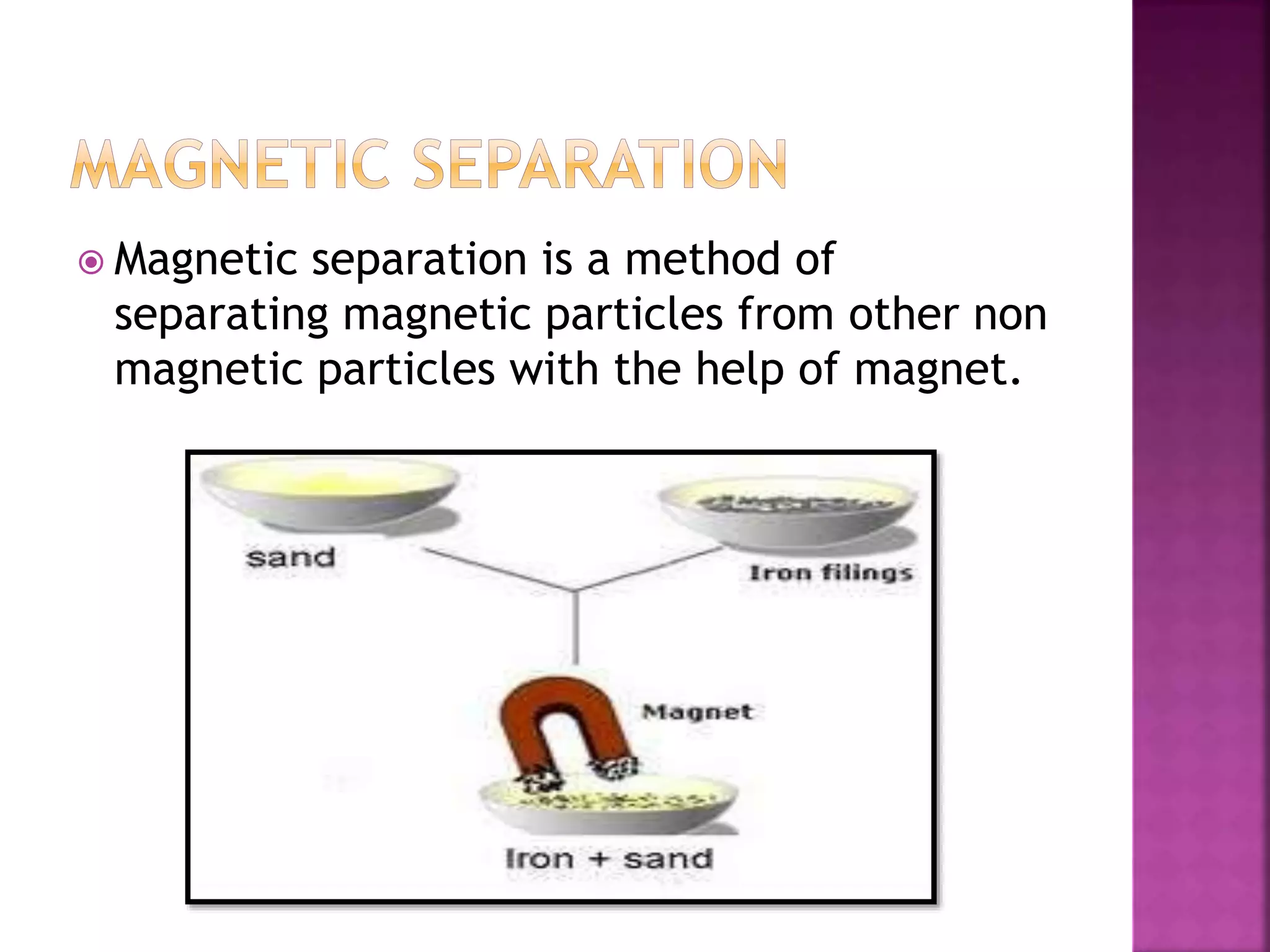
 Magnetic separation is a method of
separating magnetic particles from other non
magnetic particles with the help of magnet.
1) Handpicking
2) Sieving
3) Threshing
4) Winnowing
5) Magnetic Separation
The substance that dissolves in a liquid is called
the Solute.
The liquid in which the solute dissolves is called
the solvent.
When a solute is mixed in a solvent is called the
solution.
SEDIMENTATION AND DECANTATION
 Sedimentation is the process of settling
down of heavy solids in a mixture of a
liquid and an insoluble solid.
 Decantation is the removal of the clear
layer of the liquid without disturbing the
settled solids.
 Loading is the process of making the insoluble solids
in a liquid settle down faster by addition of specific
chemicals.
 https://www.youtube.com/watch?v=NSJJ9bb
kaZA
 Solutions that contain very fine insoluble
particles that are evenly distributed in them
are called Suspensions. These particles can
be removed by filtration.
 Filtration is the process by which very fine
insoluble solids can be separated from a
Solid-liquid mixture by passing it through a
suitable porous material.
 https://www.youtube.com/watch?v=GoTw82
JuNeA
The liquid that passes through the
filter paper during the process of
filtration is called the Filtrate.
The insoluble Solid component
retained on the filter paper during the
process of filtration is called Residue.
1.Evaporation
2.Distillation
 https://www.youtube.com/watch?v=zNnytH2
NsDo
 Evaporation is the process of converting
liquid into its vapour form.
 The process by which a pure liquid is
obtained from a solution by evaporating the
liquid and then condensing the vapours is
called distillation.
 https://www.youtube.com/watch?v=EcvXA-
j8ikA
 Liquids that do not mix with each other are
called immiscible liquids.
 Oil and water
 https://www.youtube.com/watch?v=7oqLUIH
pqOc
 The solubility of a substance is the
maximum amount of the substance that
will dissolve in a given amount of solvent at
a certain temperature.
A saturated solution is one in which no more
solute can be added.
 https://www.youtube.com/watch?v=0_ZcCqq
pS2o
 SEDIMENTATION-DECANTATION-LOADING-FILTRATION-
CHLORINATION

Separation of substances

  • 10.
    HOMOGENEOUS MIXTURE A homogeneousmixture is a mixture in which the components that make up the mixture are uniformly distributed throughout the mixture. The composition of the mixture is the same throughout.
  • 11.
    HETEROGENEOUS MIXTURE Heterogeneous mixture isa mixture in which the components that make up the mixture are not uniformly distributed throughout the mixture. The composition of the mixture is different in different parts.
  • 13.
  • 14.
     Handpicking isthe method of separating an unwanted solid impurity from a useful solid by hand. It is used to remove stone from grains at home.
  • 15.
     Sieving ismethod of separating components of different sizes in a mixture using a sieve.
  • 16.
     Threshing isthe method of separating the grain from stalk using violent movement. It can be done with the help of hand or the combined harvester.
  • 17.
     Winnowing isa method of separating light particles such as husk from heavier particles such as rice or wheat grains with the help of wind.
  • 18.
     Magnetic separationis a method of separating magnetic particles from other non magnetic particles with the help of magnet.
  • 19.
    1) Handpicking 2) Sieving 3)Threshing 4) Winnowing 5) Magnetic Separation
  • 21.
    The substance thatdissolves in a liquid is called the Solute. The liquid in which the solute dissolves is called the solvent. When a solute is mixed in a solvent is called the solution.
  • 25.
    SEDIMENTATION AND DECANTATION Sedimentation is the process of settling down of heavy solids in a mixture of a liquid and an insoluble solid.  Decantation is the removal of the clear layer of the liquid without disturbing the settled solids.
  • 26.
     Loading isthe process of making the insoluble solids in a liquid settle down faster by addition of specific chemicals.  https://www.youtube.com/watch?v=NSJJ9bb kaZA
  • 27.
     Solutions thatcontain very fine insoluble particles that are evenly distributed in them are called Suspensions. These particles can be removed by filtration.  Filtration is the process by which very fine insoluble solids can be separated from a Solid-liquid mixture by passing it through a suitable porous material.
  • 28.
     https://www.youtube.com/watch?v=GoTw82 JuNeA The liquidthat passes through the filter paper during the process of filtration is called the Filtrate. The insoluble Solid component retained on the filter paper during the process of filtration is called Residue.
  • 29.
  • 30.
     https://www.youtube.com/watch?v=zNnytH2 NsDo  Evaporationis the process of converting liquid into its vapour form.
  • 31.
     The processby which a pure liquid is obtained from a solution by evaporating the liquid and then condensing the vapours is called distillation.  https://www.youtube.com/watch?v=EcvXA- j8ikA
  • 32.
     Liquids thatdo not mix with each other are called immiscible liquids.  Oil and water  https://www.youtube.com/watch?v=7oqLUIH pqOc
  • 33.
     The solubilityof a substance is the maximum amount of the substance that will dissolve in a given amount of solvent at a certain temperature.
  • 34.
    A saturated solutionis one in which no more solute can be added.
  • 35.