Separating Mixtures:
DECANTATION
Day 1
I. OBJECTIVES:
Content Standards:
The learners demonstrate understanding of
different techniques to separate mixtures.
Performance Standard:
The learners should be able to separate desired materials
from common and local products.
Learning Competencies/Objectives:
Enumerate techniques in separating mixturessuch as
picking, winnowing, decantation, use of magnet, sieving,
filtering, and evaporation.
Separate the components of common solid mixtures by
winnowing.
Write the LC code for each
(S6MT-Id-f-2)
II. CONTENT: Separating Mixtures: Decantation
III. LEARNING RESOURCES:
A. Reference
1. Teacher’s Guide Science 6 Teachers Guide 91-95
2. Learner’s Materials pages
3. Textbook Pages
4. Additional Materials from Learning Resources (LR) portal
a. GRADE 6 SCIENCE ACTIVITIES page 30-33
b. BEAM 4. 5 Explain what happens after Mixing
Materials. Learning Guides. Mix it Up. July 2009. pp. 5-7.
c. EASE Science II. Chemistry Module 4. Lesson 2.
Chemistry III Textbook. Mapa, Amelia P., Ph.D., et al. 2001.
pp. 42-45.
d. Science and Technology I: Integrated Science Textbook.
NISMED. 2012. pp. 57-58.
B. Other Learning Resources
Multimedia Presentation, Pictures, and Materials for the Activity
I will asks
review questions
and you will
search the
answer around
the room.
What is
winnowing?
How can
mixtures be
separated in
winnowing?
Describe how the
technique
winnowing is
done in
separating
mixture.
What is sieving?
How can
mixtures be
separated in
sieving?
Describe how
the technique
sieving is done
in separating
mixture.
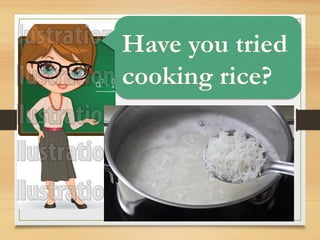
Have you tried
cooking rice?
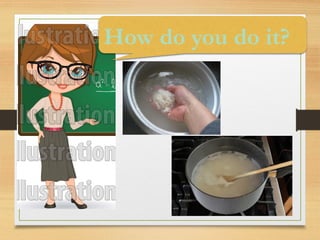
How do you do it?
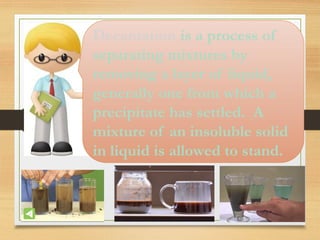
Decantation is a process of
separating mixtures by
removing a layer of liquid,
generally one from which a
precipitate has settled. A
mixture of an insoluble solid
in liquid is allowed to stand.
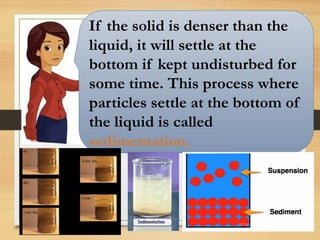
If the solid is denser than the
liquid, it will settle at the
bottom if kept undisturbed for
some time. This process where
particles settle at the bottom of
the liquid is called
sedimentation.
Lets do Activity
4.3 Let it Sink and
Separate.
I will give initial
instructions about
the activity.
Let us have the
following
materials to be
used in our
activity.
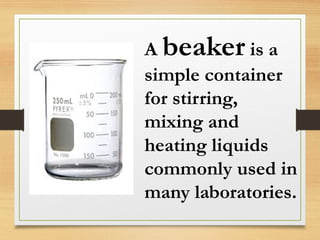
A beaker is a
simple container
for stirring,
mixing and
heating liquids
commonly used in
many laboratories.
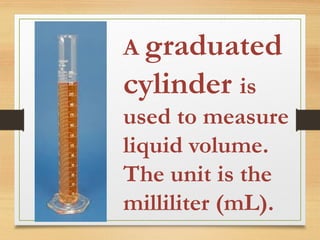
A graduated
cylinder is
used to measure
liquid volume.
The unit is the
milliliter (mL).
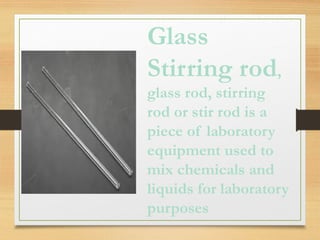
Glass
Stirring rod,
glass rod, stirring
rod or stir rod is a
piece of laboratory
equipment used to
mix chemicals and
liquids for laboratory
purposes
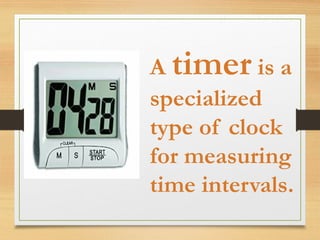
A timer is a
specialized
type of clock
for measuring
time intervals.
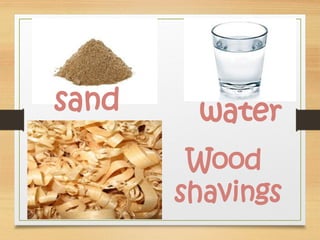
sand
Wood
shavings
water
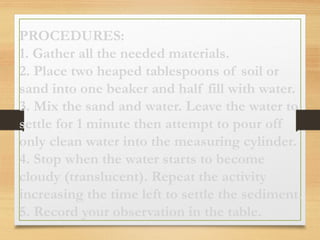
PROCEDURES:
1. Gather all the needed materials.
2. Place two heaped tablespoons of soil or
sand into one beaker and half fill with water.
3. Mix the sand and water. Leave the water to
settle for 1 minute then attempt to pour off
only clean water into the measuring cylinder.
4. Stop when the water starts to become
cloudy (translucent). Repeat the activity
increasing the time left to settle the sediment.
5. Record your observation in the table.
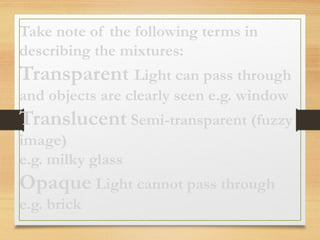
Take note of the following terms in
describing the mixtures:
Transparent Light can pass through
and objects are clearly seen e.g. window
Translucent Semi-transparent (fuzzy
image)
e.g. milky glass
Opaque Light cannot pass through
e.g. brick
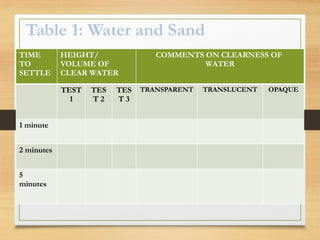
Table 1: Water and Sand
TIME
TO
SETTLE
HEIGHT/
VOLUME OF
CLEAR WATER
COMMENTS ON CLEARNESS OF
WATER
TEST
1
TES
T 2
TES
T 3
TRANSPARENT TRANSLUCENT OPAQUE
1 minute
2 minutes
5
minutes
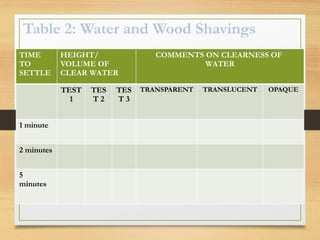
Table 2: Water and Wood Shavings
TIME
TO
SETTLE
HEIGHT/
VOLUME OF
CLEAR WATER
COMMENTS ON CLEARNESS OF
WATER
TEST
1
TES
T 2
TES
T 3
TRANSPARENT TRANSLUCENT OPAQUE
1 minute
2 minutes
5
minutes
You are going
to present your
group output
on the activity.
I will give
feedback about
the result.
1. Can the solid particles
be separated from water
right after mixing without
letting it settle at the
bottom of the container?
2. Did waiting a longer
time improve the clarity of
water? Why?
Let’s answer the
guide questions
3. Do you think water
becomes potable
after decanting?
Why?
4. What could water
be used for after
decanting?
Let’s answer the
guide questions
1. Can the solid particles be separated
from water right after mixing without
letting it settle at the bottom of the
container?
2. Did waiting a longer time improve the
clarity of water? Why?
3. Do you think water becomes
potable after decanting? Why?
4. What could water be used for
after decanting?
You present your
output on the
activity. The
teacher will give
feedback about the
result.
We will continue
our activity on
decantation
tomorrow so
please do not
forget to bring the
materials

Separating Mixtures Decantation.ppt Grade 6

  • 1.
  • 2.
    I. OBJECTIVES: Content Standards: Thelearners demonstrate understanding of different techniques to separate mixtures. Performance Standard: The learners should be able to separate desired materials from common and local products. Learning Competencies/Objectives: Enumerate techniques in separating mixturessuch as picking, winnowing, decantation, use of magnet, sieving, filtering, and evaporation. Separate the components of common solid mixtures by winnowing. Write the LC code for each (S6MT-Id-f-2)
  • 3.
    II. CONTENT: SeparatingMixtures: Decantation III. LEARNING RESOURCES: A. Reference 1. Teacher’s Guide Science 6 Teachers Guide 91-95 2. Learner’s Materials pages 3. Textbook Pages 4. Additional Materials from Learning Resources (LR) portal a. GRADE 6 SCIENCE ACTIVITIES page 30-33 b. BEAM 4. 5 Explain what happens after Mixing Materials. Learning Guides. Mix it Up. July 2009. pp. 5-7. c. EASE Science II. Chemistry Module 4. Lesson 2. Chemistry III Textbook. Mapa, Amelia P., Ph.D., et al. 2001. pp. 42-45. d. Science and Technology I: Integrated Science Textbook. NISMED. 2012. pp. 57-58. B. Other Learning Resources Multimedia Presentation, Pictures, and Materials for the Activity
  • 4.
    I will asks reviewquestions and you will search the answer around the room.
  • 5.
  • 6.
  • 7.
    Describe how the technique winnowingis done in separating mixture.
  • 8.
  • 9.
  • 10.
    Describe how the technique sievingis done in separating mixture.
  • 11.
  • 12.
    How do youdo it?
  • 13.
    Decantation is aprocess of separating mixtures by removing a layer of liquid, generally one from which a precipitate has settled. A mixture of an insoluble solid in liquid is allowed to stand.
  • 14.
    If the solidis denser than the liquid, it will settle at the bottom if kept undisturbed for some time. This process where particles settle at the bottom of the liquid is called sedimentation.
  • 15.
    Lets do Activity 4.3Let it Sink and Separate. I will give initial instructions about the activity.
  • 16.
    Let us havethe following materials to be used in our activity.
  • 17.
    A beaker isa simple container for stirring, mixing and heating liquids commonly used in many laboratories.
  • 18.
    A graduated cylinder is usedto measure liquid volume. The unit is the milliliter (mL).
  • 19.
    Glass Stirring rod, glass rod,stirring rod or stir rod is a piece of laboratory equipment used to mix chemicals and liquids for laboratory purposes
  • 20.
    A timer isa specialized type of clock for measuring time intervals.
  • 21.
  • 23.
    PROCEDURES: 1. Gather allthe needed materials. 2. Place two heaped tablespoons of soil or sand into one beaker and half fill with water. 3. Mix the sand and water. Leave the water to settle for 1 minute then attempt to pour off only clean water into the measuring cylinder. 4. Stop when the water starts to become cloudy (translucent). Repeat the activity increasing the time left to settle the sediment. 5. Record your observation in the table.
  • 24.
    Take note ofthe following terms in describing the mixtures: Transparent Light can pass through and objects are clearly seen e.g. window Translucent Semi-transparent (fuzzy image) e.g. milky glass Opaque Light cannot pass through e.g. brick
  • 25.
    Table 1: Waterand Sand TIME TO SETTLE HEIGHT/ VOLUME OF CLEAR WATER COMMENTS ON CLEARNESS OF WATER TEST 1 TES T 2 TES T 3 TRANSPARENT TRANSLUCENT OPAQUE 1 minute 2 minutes 5 minutes
  • 26.
    Table 2: Waterand Wood Shavings TIME TO SETTLE HEIGHT/ VOLUME OF CLEAR WATER COMMENTS ON CLEARNESS OF WATER TEST 1 TES T 2 TES T 3 TRANSPARENT TRANSLUCENT OPAQUE 1 minute 2 minutes 5 minutes
  • 27.
    You are going topresent your group output on the activity. I will give feedback about the result.
  • 28.
    1. Can thesolid particles be separated from water right after mixing without letting it settle at the bottom of the container? 2. Did waiting a longer time improve the clarity of water? Why? Let’s answer the guide questions
  • 29.
    3. Do youthink water becomes potable after decanting? Why? 4. What could water be used for after decanting? Let’s answer the guide questions
  • 30.
    1. Can thesolid particles be separated from water right after mixing without letting it settle at the bottom of the container? 2. Did waiting a longer time improve the clarity of water? Why?
  • 31.
    3. Do youthink water becomes potable after decanting? Why? 4. What could water be used for after decanting?
  • 32.
    You present your outputon the activity. The teacher will give feedback about the result.
  • 33.
    We will continue ouractivity on decantation tomorrow so please do not forget to bring the materials