QUARTER 1 WEEK 1
SCIENCE 4
• Use information from secondary
sources to identify a famous Filipino
and/or foreign scientist and their
invention/s.
• Use information from home or local
community to identify a science
invention and explain its impact on
their everyday life.
DAY 1
Learning Objectives:
At the end of the lesson, the
learners should be able to identify
famous Filipino and or foreign
scientist and their inventions.
Nowadays, people use sophisticated
materials to make work easier and
faster. Materials we use at home, in
school and in the local community are
invented and created by scientists.
Cite materials you use at home, at school and in the local community
and classify them as to food, health, cleaning agents or gadget. Write
your answer on your paper.
Most of the materials we
see and use at home, in
school and in the local
community are products
of scientists’
inventions.
Read the poem titled “I am a Scientist” by Brian Crawford.
I Am a Scientist
by Brian Crawford
I am a scientist. What do I do? I study the nature of things,
old and new. I take a close look at the things that I see And
make guesses about all the ways they might be.
When I find something neat, sometimes I will ponder, “Why
does that thing behave like that, I wonder?” I’ll come up
with ideas – I’ll take a good guess, And I’ll call my guess a
“hypothesis”.
The next thing I’ll do is conduct a short test To see what
answers my question best.
When I find a result that explains the confusion I’ll
call that answer my “conclusion”.
Next I’ll write down all the things I’ve uncovered
Then share with the world those neat things I’ve
discovered. And I’ll say to myself when my hard
work is done, “Science is interesting, useful, and
fun!”
Questions:
Based on the poem, describe the work of a
scientist.
What are the scientific processes that a scientist
does before discovering something?
What should be the attitude of a scientist?
Local and Foreign Scientists:
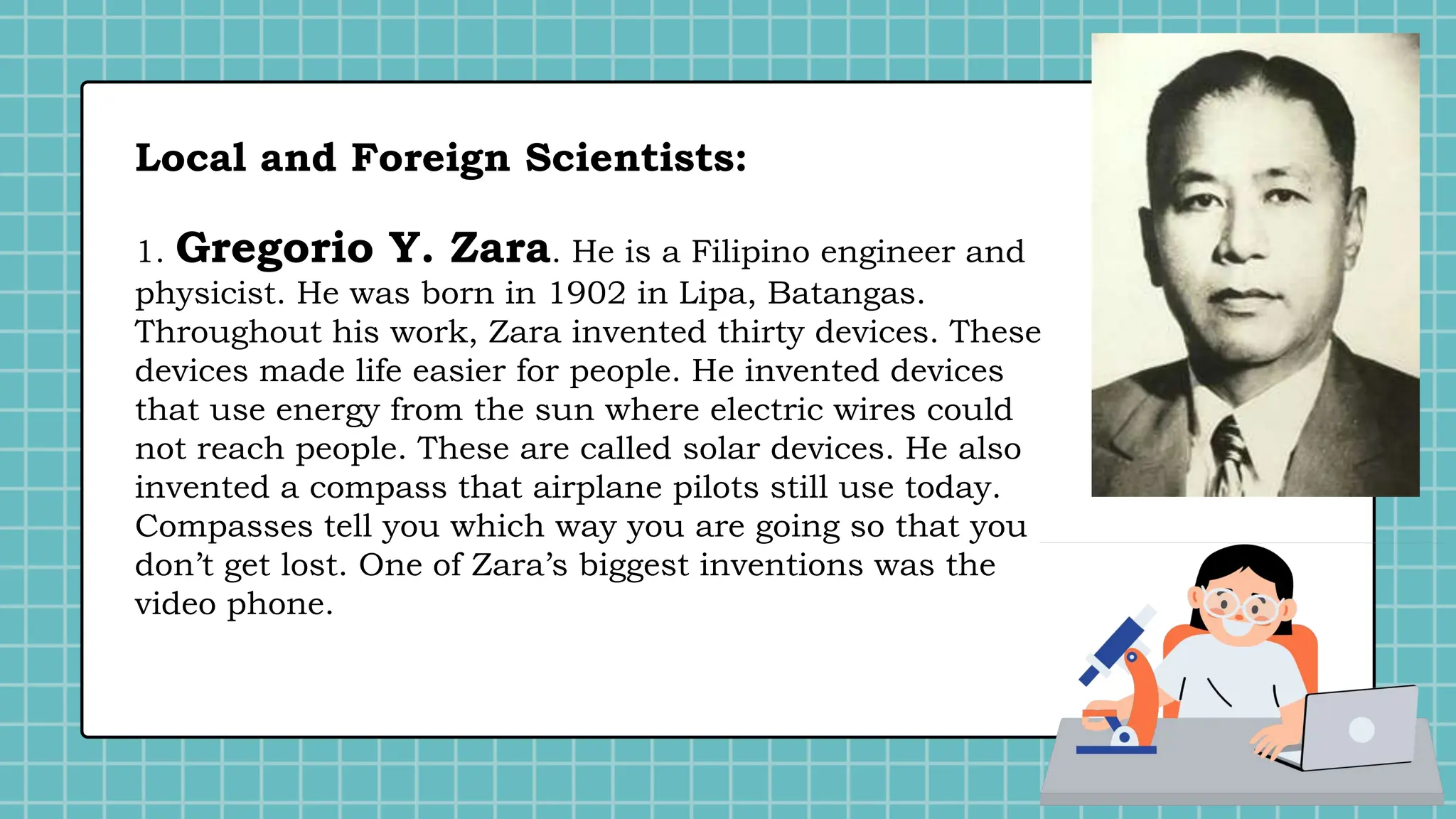
1. Gregorio Y. Zara. He is a Filipino engineer and
physicist. He was born in 1902 in Lipa, Batangas.
Throughout his work, Zara invented thirty devices. These
devices made life easier for people. He invented devices
that use energy from the sun where electric wires could
not reach people. These are called solar devices. He also
invented a compass that airplane pilots still use today.
Compasses tell you which way you are going so that you
don’t get lost. One of Zara’s biggest inventions was the
video phone.
2. Agapito Flores.
He is the inventor of
fluorescent lamp which is
used at home, schools and
offices.
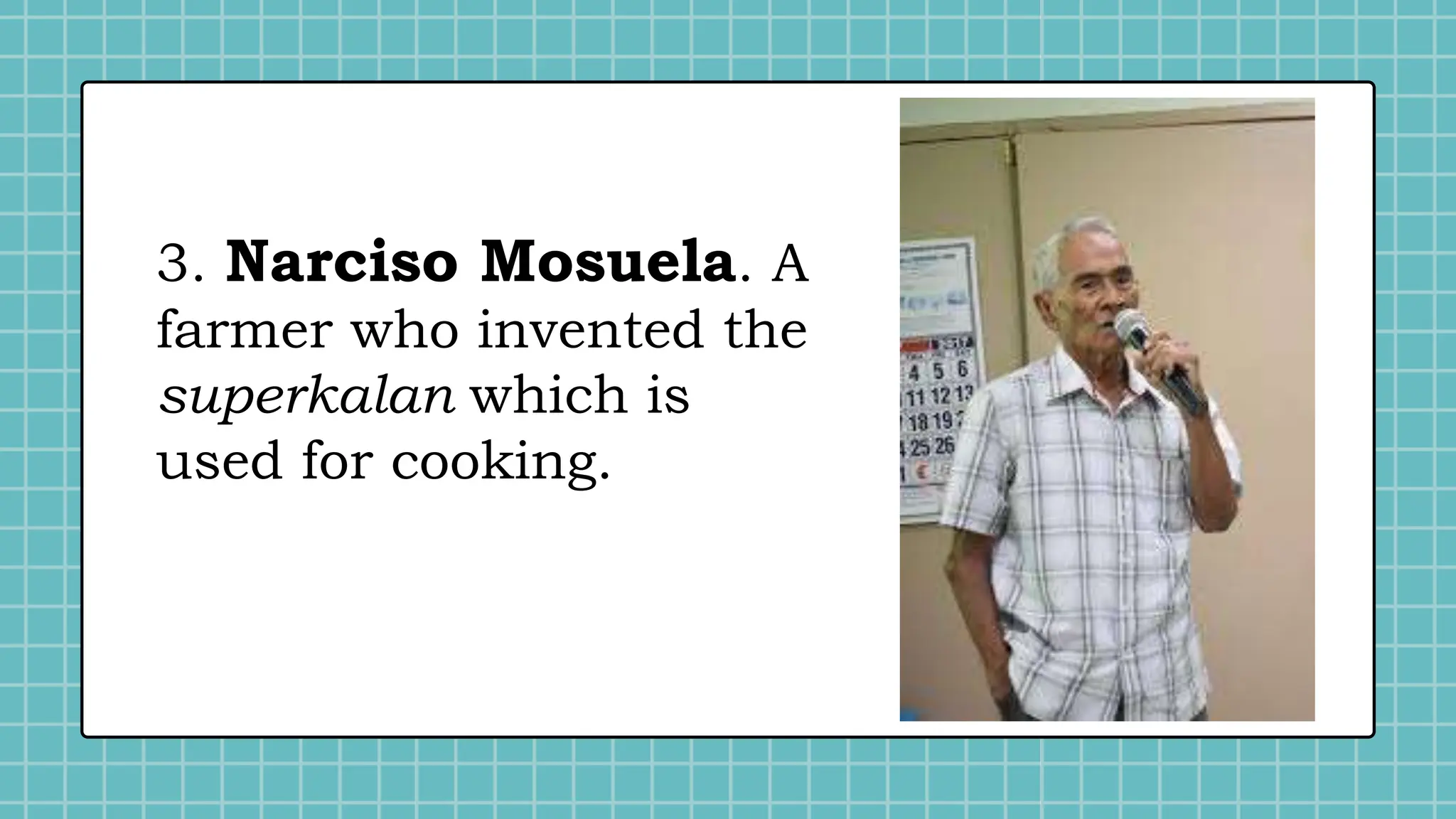
3. Narciso Mosuela. A
farmer who invented the
superkalan which is
used for cooking.
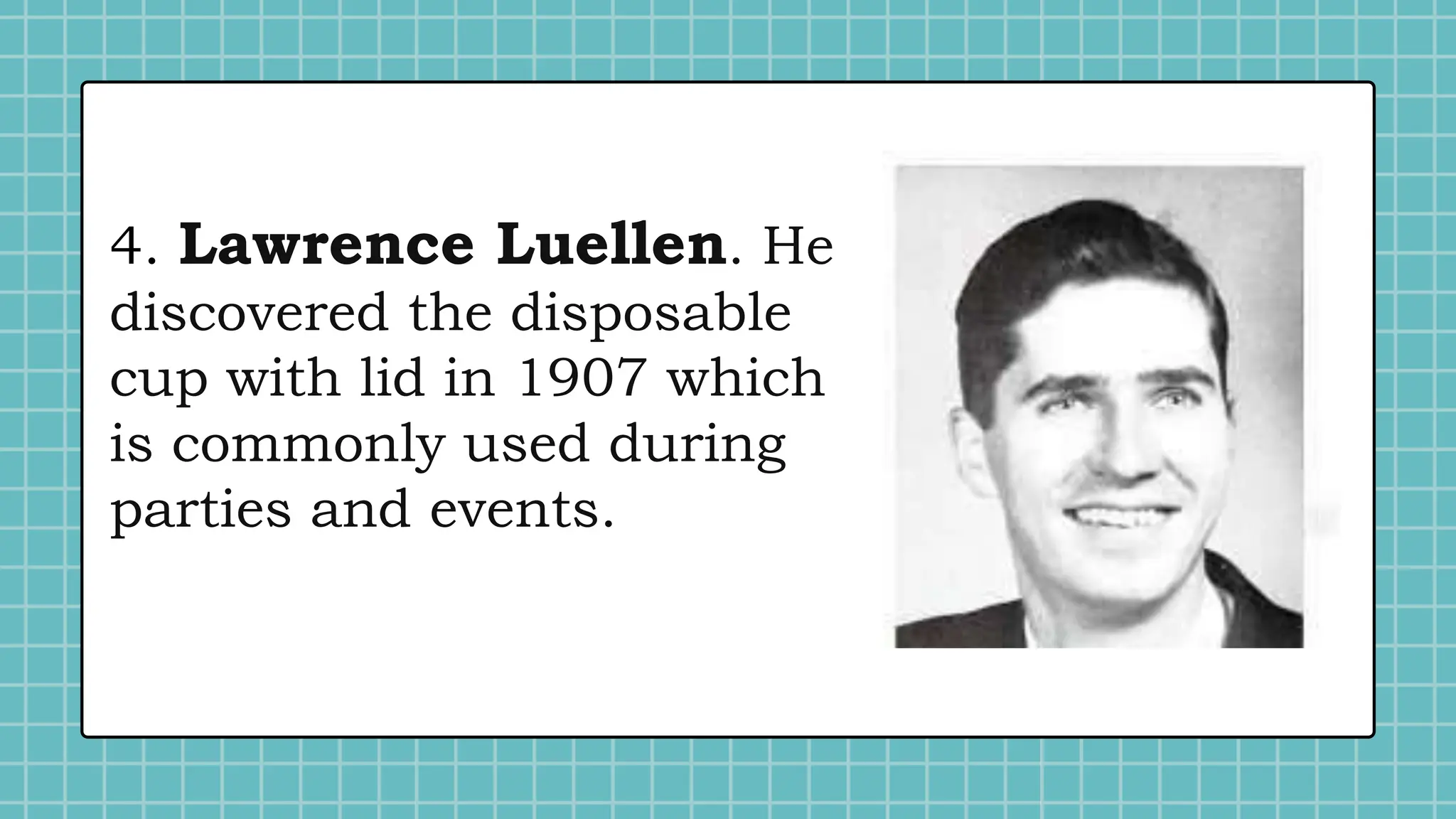
4. Lawrence Luellen. He
discovered the disposable
cup with lid in 1907 which
is commonly used during
parties and events.
The learners will be grouped into
five (5). Each group will be given a
tablet and let them search 5
Filipino and foreign scientists and
enumerate their inventions.
Has this lesson helped you to
identify Foreign and Filipino
scientists and their inventions?
Why? Why not?
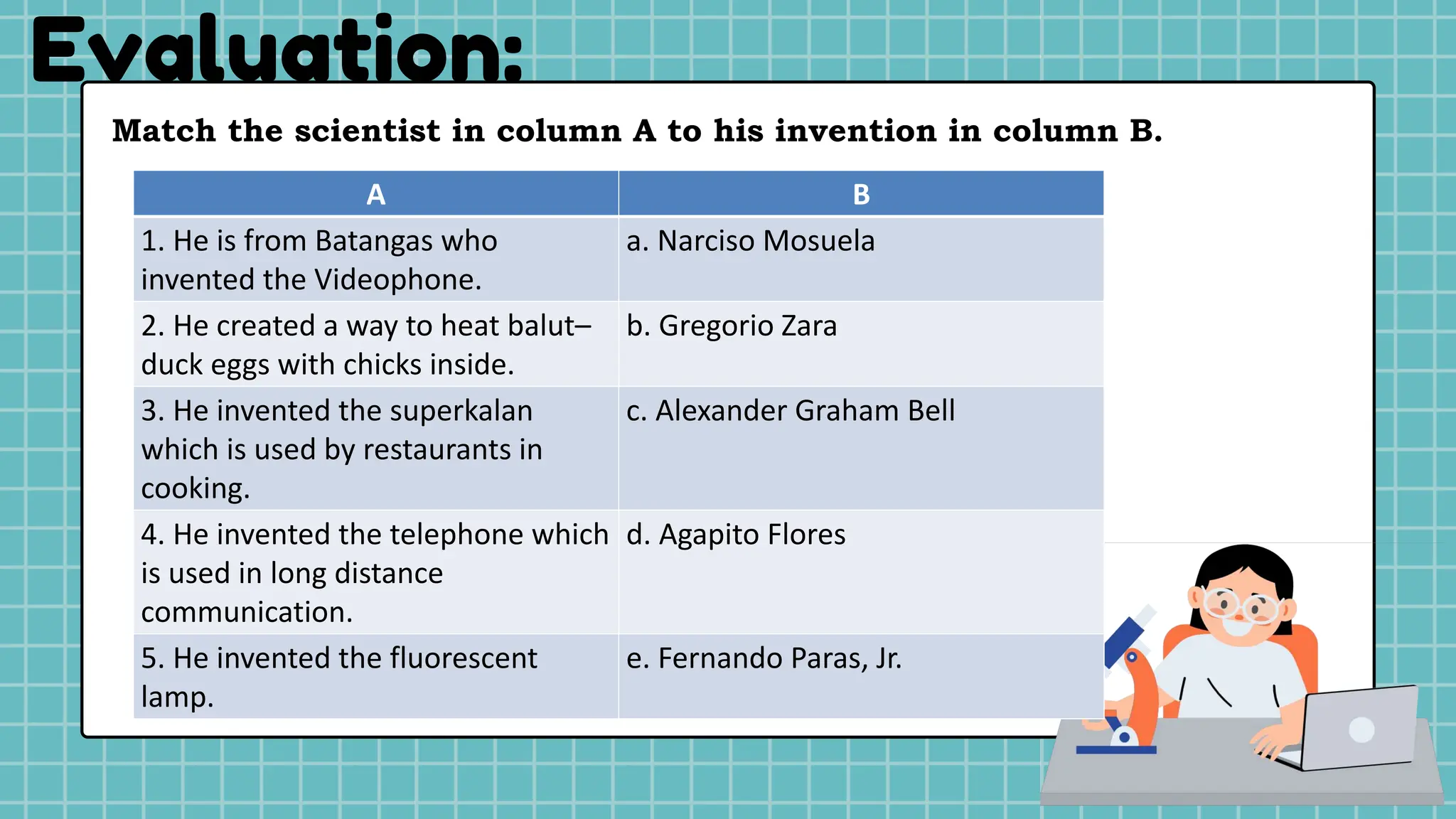
Match the scientist in column A to his invention in column B.
Evaluation:
A B
1. He is from Batangas who
invented the Videophone.
a. Narciso Mosuela
2. He created a way to heat balut–
duck eggs with chicks inside.
b. Gregorio Zara
3. He invented the superkalan
which is used by restaurants in
cooking.
c. Alexander Graham Bell
4. He invented the telephone which
is used in long distance
communication.
d. Agapito Flores
5. He invented the fluorescent
lamp.
e. Fernando Paras, Jr.
DAY 2
Learning Objectives:
At the end of the lesson, the
learners should be able to use
information from home or the local
community to identify a science
invention.
Complete the graphic organizer to recall the scientists
and their inventions.
The lesson for today is all about the use of
information from home or the local
community to identify a science invention.
Divide the class into 6. Let them accomplish the activity
provided in the Worksheet Day 2 Task 1.
Name the materials needed in order to perform/accomplish
the daily tasks identified below. Write your answer on your
science notebook.
Q1. What common materials did you
use to accomplish the identified tasks?
Q2. What would your life be if these
materials you use everyday were not
invented?
Read the given story and answer the questions that follow.
Write your answers in your Science notebook.
Answer the following questions. Write your answers
in your Science notebook.
1. Who is the scientist the story is referring to?
2. What is the biggest invention of the scientist in the
story?
3. Why did Zara invent a videophone?
4. How are video phones different from normal phones?
5. How do video phones work?
6. Why are video phones useful?
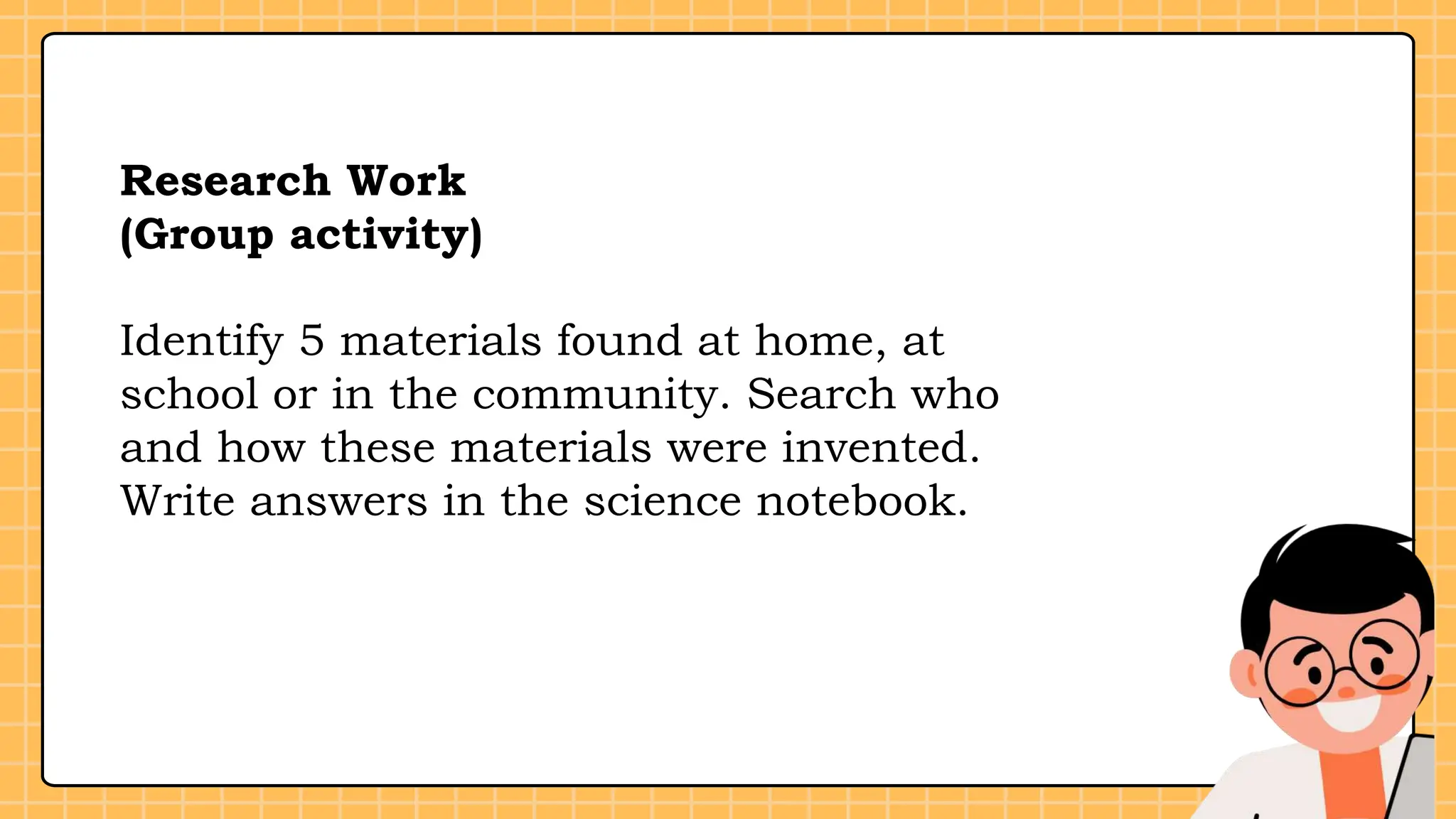
Research Work
(Group activity)
Identify 5 materials found at home, at
school or in the community. Search who
and how these materials were invented.
Write answers in the science notebook.
What is your favorite scientist’s
invention? Why?
Classify the materials in the box that were invented by scientists as to
food/medicine, cleaning materials and tool/gadget. Write your answer
on your paper.
Evaluation:
DAY 3
Learning Objectives:
At the end of the lesson, the
learners should be able to use
information from the home or the
local community to identify a
science invention and its
importance.
Complete the graphic organizer. Write the importance of the following
invented materials found at home and in the community.
The lesson is all about the use
information from the home or the
local community to identify a
science invention and its
importance.
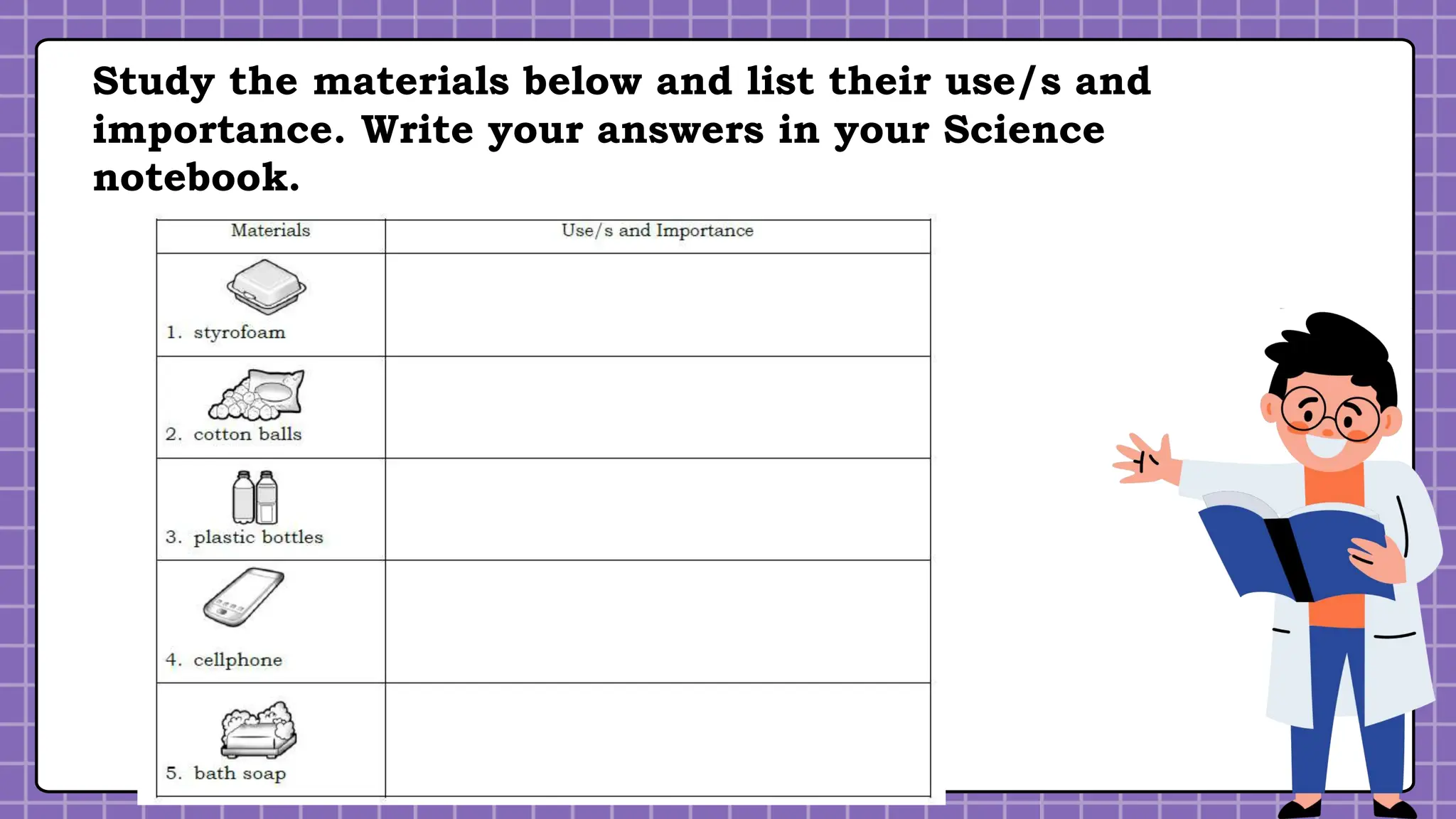
Study the materials below and list their use/s and
importance. Write your answers in your Science
notebook.
Read the given story and answer the questions that follow.
Write your answers in your Science notebook.
Q1. What science invention is the passage all
about?
Q2. Why is the science invention invented ?
Q3. What are the importance of the
videophone as cited in the reading passage?
Name one invention used in each of the
given places and give its importance/use.
a. at home
b. at school
c. at the garden
Q1. What have you realized after doing
the tasks?
Q2. How did the given materials help in
your daily life?
Q3. If you were a scientist, what invention
would you want to invent? Why?
If you were a scientist, what do you
think would be the best invention you
can create in this time? Why?
Evaluation:
DAY 4
Learning Objectives:
At the end of the lesson, the
learners should be able to explain
the impact of the Filipino and or
foreign scientist and their
inventions on everyday life.
Bring out any materials from your
bag and tell how important are the
materials to you.
Show to the learners a video lifted from Youtube
about how windmill works and its importance.
Suggested Youtube link:
https://youtu.be/_8DtGAp1fyI
Let the learners watch a video lifted from
the Youtube about windmill.
Youtube link:
https://youtu.be/_8DtGAp1fyI?si=TjGzOr
FGdG-Y3eof
Q1. How does a windmill work to
produce electricity?
Q2. What is the impact of windmill on
the everyday life of the people in the
local community?
Choose from the following materials
and give its importance.
laptop
cellphone
television
How do the scientists’ inventions like
cellphones, fluorescent lamp, laptop
and the like impact your life?
Assessment/Reflection:
Answer the listed question either by class
discussion or writing the answers in their
worksheet.
Write a composition on the impact of the
Filipino scientists and their inventions to
the lives of the Filipino people.

Science4 Q1 Week1 PPT MATATAG.pptppppppx

  • 1.
    QUARTER 1 WEEK1 SCIENCE 4 • Use information from secondary sources to identify a famous Filipino and/or foreign scientist and their invention/s. • Use information from home or local community to identify a science invention and explain its impact on their everyday life.
  • 2.
    DAY 1 Learning Objectives: Atthe end of the lesson, the learners should be able to identify famous Filipino and or foreign scientist and their inventions.
  • 3.
    Nowadays, people usesophisticated materials to make work easier and faster. Materials we use at home, in school and in the local community are invented and created by scientists.
  • 4.
    Cite materials youuse at home, at school and in the local community and classify them as to food, health, cleaning agents or gadget. Write your answer on your paper.
  • 5.
    Most of thematerials we see and use at home, in school and in the local community are products of scientists’ inventions.
  • 6.
    Read the poemtitled “I am a Scientist” by Brian Crawford. I Am a Scientist by Brian Crawford I am a scientist. What do I do? I study the nature of things, old and new. I take a close look at the things that I see And make guesses about all the ways they might be. When I find something neat, sometimes I will ponder, “Why does that thing behave like that, I wonder?” I’ll come up with ideas – I’ll take a good guess, And I’ll call my guess a “hypothesis”. The next thing I’ll do is conduct a short test To see what answers my question best.
  • 7.
    When I finda result that explains the confusion I’ll call that answer my “conclusion”. Next I’ll write down all the things I’ve uncovered Then share with the world those neat things I’ve discovered. And I’ll say to myself when my hard work is done, “Science is interesting, useful, and fun!”
  • 8.
    Questions: Based on thepoem, describe the work of a scientist. What are the scientific processes that a scientist does before discovering something? What should be the attitude of a scientist?
  • 9.
    Local and ForeignScientists: 1. Gregorio Y. Zara. He is a Filipino engineer and physicist. He was born in 1902 in Lipa, Batangas. Throughout his work, Zara invented thirty devices. These devices made life easier for people. He invented devices that use energy from the sun where electric wires could not reach people. These are called solar devices. He also invented a compass that airplane pilots still use today. Compasses tell you which way you are going so that you don’t get lost. One of Zara’s biggest inventions was the video phone.
  • 10.
    2. Agapito Flores. Heis the inventor of fluorescent lamp which is used at home, schools and offices.
  • 11.
    3. Narciso Mosuela.A farmer who invented the superkalan which is used for cooking.
  • 12.
    4. Lawrence Luellen.He discovered the disposable cup with lid in 1907 which is commonly used during parties and events.
  • 13.
    The learners willbe grouped into five (5). Each group will be given a tablet and let them search 5 Filipino and foreign scientists and enumerate their inventions.
  • 14.
    Has this lessonhelped you to identify Foreign and Filipino scientists and their inventions? Why? Why not?
  • 15.
    Match the scientistin column A to his invention in column B. Evaluation: A B 1. He is from Batangas who invented the Videophone. a. Narciso Mosuela 2. He created a way to heat balut– duck eggs with chicks inside. b. Gregorio Zara 3. He invented the superkalan which is used by restaurants in cooking. c. Alexander Graham Bell 4. He invented the telephone which is used in long distance communication. d. Agapito Flores 5. He invented the fluorescent lamp. e. Fernando Paras, Jr.
  • 16.
    DAY 2 Learning Objectives: Atthe end of the lesson, the learners should be able to use information from home or the local community to identify a science invention.
  • 17.
    Complete the graphicorganizer to recall the scientists and their inventions.
  • 18.
    The lesson fortoday is all about the use of information from home or the local community to identify a science invention.
  • 19.
    Divide the classinto 6. Let them accomplish the activity provided in the Worksheet Day 2 Task 1. Name the materials needed in order to perform/accomplish the daily tasks identified below. Write your answer on your science notebook.
  • 20.
    Q1. What commonmaterials did you use to accomplish the identified tasks? Q2. What would your life be if these materials you use everyday were not invented?
  • 21.
    Read the givenstory and answer the questions that follow. Write your answers in your Science notebook.
  • 24.
    Answer the followingquestions. Write your answers in your Science notebook. 1. Who is the scientist the story is referring to? 2. What is the biggest invention of the scientist in the story? 3. Why did Zara invent a videophone? 4. How are video phones different from normal phones? 5. How do video phones work? 6. Why are video phones useful?
  • 25.
    Research Work (Group activity) Identify5 materials found at home, at school or in the community. Search who and how these materials were invented. Write answers in the science notebook.
  • 26.
    What is yourfavorite scientist’s invention? Why?
  • 27.
    Classify the materialsin the box that were invented by scientists as to food/medicine, cleaning materials and tool/gadget. Write your answer on your paper. Evaluation:
  • 28.
    DAY 3 Learning Objectives: Atthe end of the lesson, the learners should be able to use information from the home or the local community to identify a science invention and its importance.
  • 29.
    Complete the graphicorganizer. Write the importance of the following invented materials found at home and in the community.
  • 31.
    The lesson isall about the use information from the home or the local community to identify a science invention and its importance.
  • 32.
    Study the materialsbelow and list their use/s and importance. Write your answers in your Science notebook.
  • 33.
    Read the givenstory and answer the questions that follow. Write your answers in your Science notebook.
  • 36.
    Q1. What scienceinvention is the passage all about? Q2. Why is the science invention invented ? Q3. What are the importance of the videophone as cited in the reading passage?
  • 37.
    Name one inventionused in each of the given places and give its importance/use. a. at home b. at school c. at the garden
  • 38.
    Q1. What haveyou realized after doing the tasks? Q2. How did the given materials help in your daily life? Q3. If you were a scientist, what invention would you want to invent? Why?
  • 39.
    If you werea scientist, what do you think would be the best invention you can create in this time? Why? Evaluation:
  • 40.
    DAY 4 Learning Objectives: Atthe end of the lesson, the learners should be able to explain the impact of the Filipino and or foreign scientist and their inventions on everyday life.
  • 41.
    Bring out anymaterials from your bag and tell how important are the materials to you.
  • 42.
    Show to thelearners a video lifted from Youtube about how windmill works and its importance. Suggested Youtube link: https://youtu.be/_8DtGAp1fyI
  • 43.
    Let the learnerswatch a video lifted from the Youtube about windmill. Youtube link: https://youtu.be/_8DtGAp1fyI?si=TjGzOr FGdG-Y3eof
  • 44.
    Q1. How doesa windmill work to produce electricity? Q2. What is the impact of windmill on the everyday life of the people in the local community?
  • 45.
    Choose from thefollowing materials and give its importance. laptop cellphone television
  • 47.
    How do thescientists’ inventions like cellphones, fluorescent lamp, laptop and the like impact your life?
  • 48.
    Assessment/Reflection: Answer the listedquestion either by class discussion or writing the answers in their worksheet. Write a composition on the impact of the Filipino scientists and their inventions to the lives of the Filipino people.