The document describes a lesson about gravity that discusses how gravity works and its effects on objects. It provides examples of gravitational forces and explains the importance of gravity. Students are expected to learn about gravity, give examples of its effects, and identify factors that affect the speed and movement of falling objects under gravitational pull.
Why do objectsthat are thrown
upward fall back to the ground? Have
you observed which falls faster
between a ball and a feather? What
causes these objects to fall? What
factors affect the speed of a falling
object?
Describing Gravity
Lesson 6
5.
What I needto Know
In this new lesson, you are expected to:
a. describe gravity and how it works (S6FE-IIIa-c-1)
b. list examples of gravitational forces
c. identify the importance of gravity
6.
What I Know
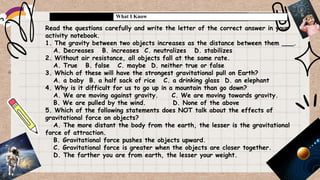
Readthe questions carefully and write the letter of the correct answer in your
activity notebook.
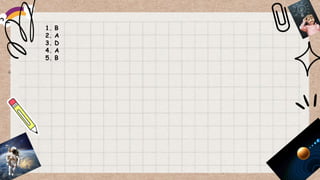
1. The gravity between two objects increases as the distance between them ___.
A. Decreases B. increases C. neutralizes D. stabilizes
2. Without air resistance, all objects fall at the same rate.
A. True B. false C. maybe D. neither true or false
3. Which of these will have the strongest gravitational pull on Earth?
A. a baby B. a half sack of rice C. a drinking glass D. an elephant
4. Why is it difficult for us to go up in a mountain than go down?
A. We are moving against gravity. C. We are moving towards gravity.
B. We are pulled by the wind. D. None of the above
5. Which of the following statements does NOT talk about the effects of
gravitational force on objects?
A. The more distant the body from the earth, the lesser is the gravitational
force of attraction.
B. Gravitational force pushes the objects upward.
C. Gravitational force is greater when the objects are closer together.
D. The farther you are from earth, the lesser your weight.
What’s In
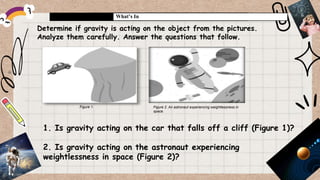
Determine ifgravity is acting on the object from the pictures.
Analyze them carefully. Answer the questions that follow.
1. Is gravity acting on the car that falls off a cliff (Figure 1)?
2. Is gravity acting on the astronaut experiencing
weightlessness in space (Figure 2)?
Figure 2. An astronaut experiencing weightlessness in
space.
Figure 1.
9.
What’s New
Activity 1:THE FALL
After this simple activity, you will be able to describe gravity.
You will need any handy object (ball/notebook/small stone or crumpled
paper).
Instructions:
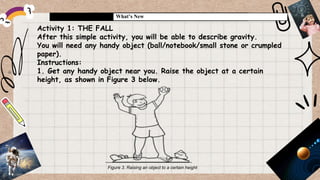
1. Get any handy object near you. Raise the object at a certain
height, as shown in Figure 3 below.
Figure 3. Raising an object to a certain height
10.
2. Quickly releasethe object. Observe what happens to the object.
Repeat the step two more times and observe.
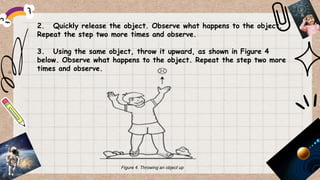
3. Using the same object, throw it upward, as shown in Figure 4
below. Observe what happens to the object. Repeat the step two more
times and observe.
Figure 4. Throwing an object up
11.
Answer the questionsbelow by writing the letter of the correct answer.
Write the letter of your answers on a separate sheet of paper.
1. In Figure 3, what happened to the object when it was released?
A. It fell to the ground. B. It floated in the air.
2. In Figure 4, what happened to the object after it was thrown
upward?
A. It flew up and eventually falls after some time.
B. It flew all the way into the air and never fell back.
3. Based on the two activities, what was common in what happened to
the objects?
A. The objects fell to the ground. B. The objects stayed in the air.
4. Why did the objects behave the way they did in the two activities?
A. Gravity pulls the object downward.
B. Air pulls the object downward.
5. How do you describe gravity?
A. Gravity is a force that pulls objects towards each other.
B. Gravity is a force that keeps objects float in the air.
12.
What Is It
InActivity 1, whether the object is dropped or thrown
upward, the object tends to go back to the ground.
There is a force that pulls all objects towards the
ground. This force is called gravity or also known as the
gravitational force.
Gravity is a force of attraction that exists between any
two objects. This gravitational force between the two
objects acts towards each other. The two objects are
attracting or pulling one another towards each other.
Also, there is a gravitational force between Earth and
us, between two people, between two marbles, and even
between two atoms or particles.
13.
What’s More
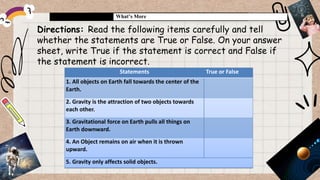
Directions: Readthe following items carefully and tell
whether the statements are True or False. On your answer
sheet, write True if the statement is correct and False if
the statement is incorrect.
Statements True or False
1. All objects on Earth fall towards the center of the
Earth.
2. Gravity is the attraction of two objects towards
each other.
3. Gravitational force on Earth pulls all things on
Earth downward.
4. An Object remains on air when it is thrown
upward.
5. Gravity only affects solid objects.
14.
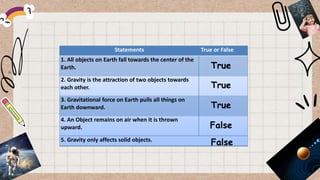
Statements True orFalse
1. All objects on Earth fall towards the center of the
Earth.
2. Gravity is the attraction of two objects towards
each other.
3. Gravitational force on Earth pulls all things on
Earth downward.
4. An Object remains on air when it is thrown
upward.
5. Gravity only affects solid objects.
True
True
True
False
False
15.
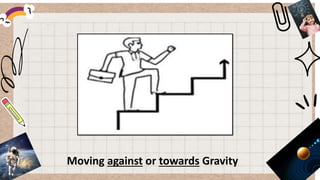
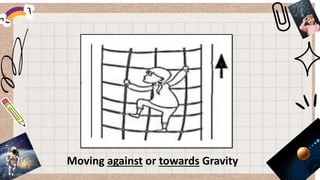
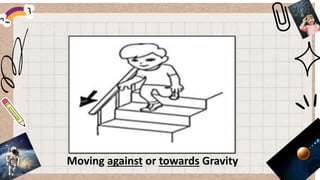
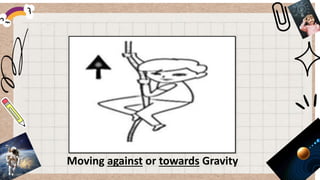
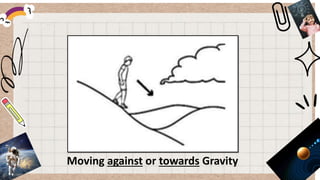
Directions: Directions: Examinethe
following pictures. Write Against if the
picture illustrates moving against
gravity and towards, otherwise. Write
your answers on your answer sheet.
What’s More
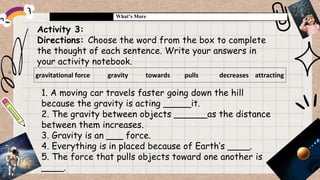
Activity 3:
Directions:Choose the word from the box to complete
the thought of each sentence. Write your answers in
your activity notebook.
gravitational force gravity towards pulls decreases attracting
1. A moving car travels faster going down the hill
because the gravity is acting _____it.
2. The gravity between objects ______as the distance
between them increases.
3. Gravity is an ___ force.
4. Everything is in placed because of Earth’s ____.
5. The force that pulls objects toward one another is
____.
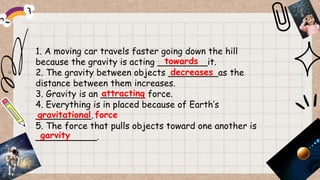
22.
towards
1. A movingcar travels faster going down the hill
because the gravity is acting _________it.
2. The gravity between objects _________as the
distance between them increases.
3. Gravity is an ________ force.
4. Everything is in placed because of Earth’s
__________.
5. The force that pulls objects toward one another is
___________.
decreases
attracting
gravitational force
garvity
23.
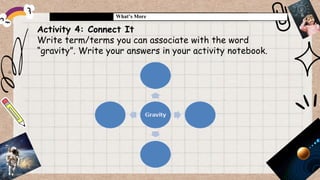
What’s More
Activity 4:Connect It
Write term/terms you can associate with the word
“gravity”. Write your answers in your activity notebook.
24.
What I HaveLearned
I learned that:
1. Gravity is a force that pulls all objects downward or
towards the center of the Earth.
2. Gravity is a force of attraction that exists between
two objects which act towards each other.
3. Earth’s gravity keeps us and all objects on the
ground.
4. Gravity is a force that affects all objects in the
universe.
5. Gravity was first observed by Isaac Newton as an
apple fell down on him. He wondered of this phenomenon
and was able to present the concept of gravity.
25.
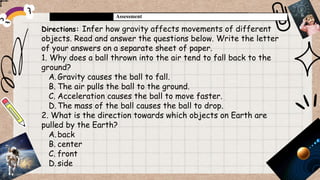
Assessment
Directions: Infer howgravity affects movements of different
objects. Read and answer the questions below. Write the letter
of your answers on a separate sheet of paper.
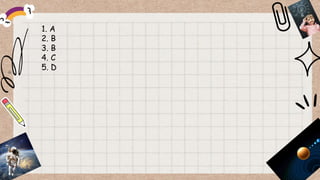
1. Why does a ball thrown into the air tend to fall back to the
ground?
A.Gravity causes the ball to fall.
B. The air pulls the ball to the ground.
C. Acceleration causes the ball to move faster.
D.The mass of the ball causes the ball to drop.
2. What is the direction towards which objects on Earth are
pulled by the Earth?
A.back
B. center
C. front
D.side
26.
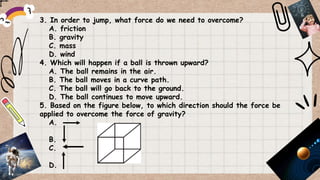
3. In orderto jump, what force do we need to overcome?
A. friction
B. gravity
C. mass
D. wind
4. Which will happen if a ball is thrown upward?
A. The ball remains in the air.
B. The ball moves in a curve path.
C. The ball will go back to the ground.
D. The ball continues to move upward.
5. Based on the figure below, to which direction should the force be
applied to overcome the force of gravity?
A.
B.
C.
D.
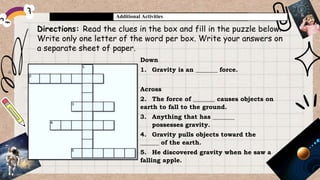
Additional Activities
Directions: Readthe clues in the box and fill in the puzzle below.
Write only one letter of the word per box. Write your answers on
a separate sheet of paper.
Down
1. Gravity is an _______ force.
Across
2. The force of _______ causes objects on
earth to fall to the ground.
3. Anything that has _______
possesses gravity.
4. Gravity pulls objects toward the
______ of the earth.
5. He discovered gravity when he saw a
falling apple.