Grade 8, 4th quarter science lesson plan
MC Science 101 (San Jose Community College)
Scan to open on Studocu
Studocu is not sponsored or endorsed by any college or university
Grade 8, 4th quarter science lesson plan
MC Science 101 (San Jose Community College)
Scan to open on Studocu
Studocu is not sponsored or endorsed by any college or university
Downloaded by Clarissa Hugasan (clarissa.hugasan@deped.gov.ph)
lOMoARcPSD|19726572
School Bantayan National High School Grade Level 8
Student-Teacher JOSE JOVIE BONTO JR. Learning Area Science
Teaching Date Friday, 12-May, 2023 Quarter 4th
Section 8- Bobier, 8-Buere, 8-Porsona Duration 1 Hour
I. Objectives
A. Content Standard The learners demonstrate understanding of:
1. How cells divide to produce new cells
2. meiosis as one of the processes producing genetic variation of mendelian pattern
of inheritance
B. Performance Standard The learners should be able to …
C. Most Essential Learning
Competencies (MELCs)
Write the LC code for each
The learners should be able to compare mitosis and meiosis, and their role in the
cell division cycle.(S8LT-IVd-16)
D. Specific Objective At the end of the lesson, the students will be able to:
1.define heredity and variation
2. describe chromosomes
3. identify parts of the chromosomes
4. determine the number of chromosome of the organism
II. Content
The cell cycle
III. Learning Resources
A. References
Curriculum Guide
Teacher’s Guide
=Learner’s Material
Additional materials
from Learning Resources (LR)
portal
B. Other Learning Resources
IV. Lesson Proper
Teacher’s Activity Students’Activity
Preliminary Activity
Good morning, class.
Arrange your chairs properly, pick up the pieces of paper and
you may take your sit.
Good morning, sir.
Thank you!
Downloaded by Clarissa Hugasan (clarissa.hugasan@deped.gov.ph)
lOMoARcPSD|19726572
Who are present/ absent today?
Are you now ready for our new discussions?
The class monitor checks the attendance.
Yes, sir,
Elicit
Before we start with our discussion
when you look at your parents you can see features that you
share with them, right?
Why do you so?
Very good, heredity it is where traits are passed from parents to
offspring.
But look at your brother and sister, you can observe that even if
you have same parents, you are unique to each other, what do
you think we call it in biology?
Very good, so when we talk about heredity and variation, we are
studying genetics, in your own idea, why?
Very good.
It is because of heredity.
Variation sir.
Genetics is the study of heredity and variation
Engage
Where do you think we inherit those traits and how it transfers
to us generation by generation?
What is the meaning of DNA?
So, in simple terms, what is DNA?
By means of reproduction, our parent shares the
DNA to us.
Deoxyribonucleic acid
DNA are genetic materials that serve as the set of
instruction that direct the activity and function of the
cells.
Explore
The teacher will present a video clip about the chromosomes
in front.
guide question
1. what is chromosomes?
2. what are the parts of the chromosomes?
3. what are the importance of chromosomes?
The student will answer the given guide question.
Explain
Downloaded by Clarissa Hugasan (clarissa.hugasan@deped.gov.ph)
lOMoARcPSD|19726572
The teacher will call every representative of the group to answer
the guide question and will listen to the answer and correct some
misconception if there is any.
Student’s possible answer
1. chromosomes are the entire chain of DNA
2.telomere, centromere, p arm and q arm
3.Chromosomes allow DNA to be accurately copied
during these cell divisions
Elaborate
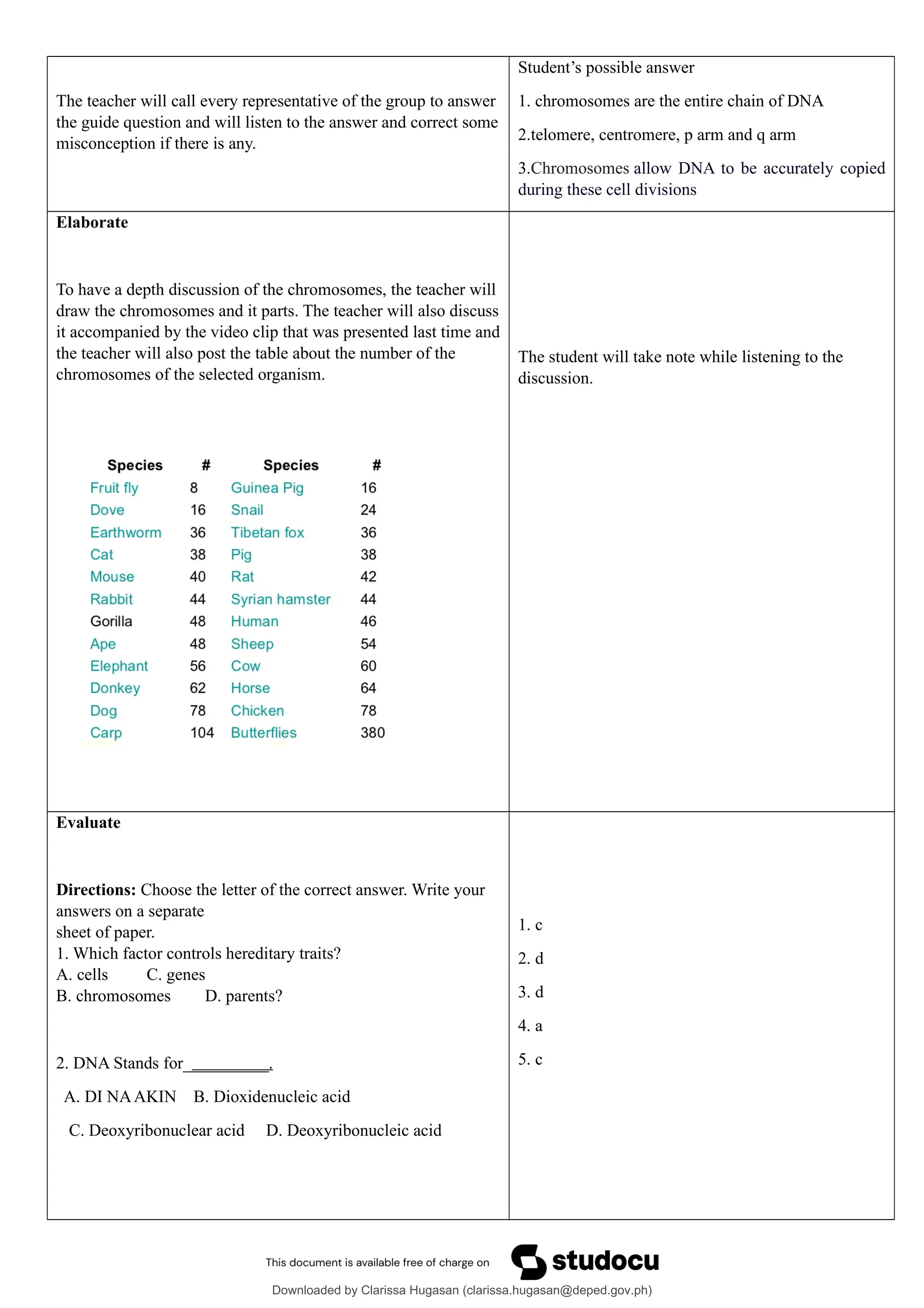
To have a depth discussion of the chromosomes, the teacher will
draw the chromosomes and it parts. The teacher will also discuss
it accompanied by the video clip that was presented last time and
the teacher will also post the table about the number of the
chromosomes of the selected organism.
The student will take note while listening to the
discussion.
Evaluate
Directions: Choose the letter of the correct answer. Write your
answers on a separate
sheet of paper.
1. Which factor controls hereditary traits?
A. cells C. genes
B. chromosomes D. parents?
2. DNA Stands for__________.
A. DI NAAKIN B. Dioxidenucleic acid
C. Deoxyribonuclear acid D. Deoxyribonucleic acid
1. c
2. d
3. d
4. a
5. c
Downloaded by Clarissa Hugasan (clarissa.hugasan@deped.gov.ph)
lOMoARcPSD|19726572
3. it is the entire chain of the DNA?
A. cell cycle B. heredity
C. variation D. chromosomes
4. it is the short arm of the chromosomes?
a. p arm b. q arm
c. centromere d. telomere
5. how many chromosomes that can be found in normal human?
a. 48 b. 47 c. 46 d. 45
Extend
V. Remarks
VI. Reflection
Prepared by: Checked by:
JOSE JOVIE BONTO JR ROSELYN B. BORGANIO
Science Student Teacher Science Critic Teacher
Noted:
ALVIN C. BORROMEO
Principal II
Downloaded by Clarissa Hugasan (clarissa.hugasan@deped.gov.ph)
lOMoARcPSD|19726572
Downloaded by Clarissa Hugasan (clarissa.hugasan@deped.gov.ph)
lOMoARcPSD|19726572

grade-8-4th-quarter-science-lesson-plan.pdf

  • 1.
    Grade 8, 4thquarter science lesson plan MC Science 101 (San Jose Community College) Scan to open on Studocu Studocu is not sponsored or endorsed by any college or university Grade 8, 4th quarter science lesson plan MC Science 101 (San Jose Community College) Scan to open on Studocu Studocu is not sponsored or endorsed by any college or university Downloaded by Clarissa Hugasan (clarissa.hugasan@deped.gov.ph) lOMoARcPSD|19726572
  • 2.
    School Bantayan NationalHigh School Grade Level 8 Student-Teacher JOSE JOVIE BONTO JR. Learning Area Science Teaching Date Friday, 12-May, 2023 Quarter 4th Section 8- Bobier, 8-Buere, 8-Porsona Duration 1 Hour I. Objectives A. Content Standard The learners demonstrate understanding of: 1. How cells divide to produce new cells 2. meiosis as one of the processes producing genetic variation of mendelian pattern of inheritance B. Performance Standard The learners should be able to … C. Most Essential Learning Competencies (MELCs) Write the LC code for each The learners should be able to compare mitosis and meiosis, and their role in the cell division cycle.(S8LT-IVd-16) D. Specific Objective At the end of the lesson, the students will be able to: 1.define heredity and variation 2. describe chromosomes 3. identify parts of the chromosomes 4. determine the number of chromosome of the organism II. Content The cell cycle III. Learning Resources A. References Curriculum Guide Teacher’s Guide =Learner’s Material Additional materials from Learning Resources (LR) portal B. Other Learning Resources IV. Lesson Proper Teacher’s Activity Students’Activity Preliminary Activity Good morning, class. Arrange your chairs properly, pick up the pieces of paper and you may take your sit. Good morning, sir. Thank you! Downloaded by Clarissa Hugasan (clarissa.hugasan@deped.gov.ph) lOMoARcPSD|19726572
  • 3.
    Who are present/absent today? Are you now ready for our new discussions? The class monitor checks the attendance. Yes, sir, Elicit Before we start with our discussion when you look at your parents you can see features that you share with them, right? Why do you so? Very good, heredity it is where traits are passed from parents to offspring. But look at your brother and sister, you can observe that even if you have same parents, you are unique to each other, what do you think we call it in biology? Very good, so when we talk about heredity and variation, we are studying genetics, in your own idea, why? Very good. It is because of heredity. Variation sir. Genetics is the study of heredity and variation Engage Where do you think we inherit those traits and how it transfers to us generation by generation? What is the meaning of DNA? So, in simple terms, what is DNA? By means of reproduction, our parent shares the DNA to us. Deoxyribonucleic acid DNA are genetic materials that serve as the set of instruction that direct the activity and function of the cells. Explore The teacher will present a video clip about the chromosomes in front. guide question 1. what is chromosomes? 2. what are the parts of the chromosomes? 3. what are the importance of chromosomes? The student will answer the given guide question. Explain Downloaded by Clarissa Hugasan (clarissa.hugasan@deped.gov.ph) lOMoARcPSD|19726572
  • 4.
    The teacher willcall every representative of the group to answer the guide question and will listen to the answer and correct some misconception if there is any. Student’s possible answer 1. chromosomes are the entire chain of DNA 2.telomere, centromere, p arm and q arm 3.Chromosomes allow DNA to be accurately copied during these cell divisions Elaborate To have a depth discussion of the chromosomes, the teacher will draw the chromosomes and it parts. The teacher will also discuss it accompanied by the video clip that was presented last time and the teacher will also post the table about the number of the chromosomes of the selected organism. The student will take note while listening to the discussion. Evaluate Directions: Choose the letter of the correct answer. Write your answers on a separate sheet of paper. 1. Which factor controls hereditary traits? A. cells C. genes B. chromosomes D. parents? 2. DNA Stands for__________. A. DI NAAKIN B. Dioxidenucleic acid C. Deoxyribonuclear acid D. Deoxyribonucleic acid 1. c 2. d 3. d 4. a 5. c Downloaded by Clarissa Hugasan (clarissa.hugasan@deped.gov.ph) lOMoARcPSD|19726572
  • 5.
    3. it isthe entire chain of the DNA? A. cell cycle B. heredity C. variation D. chromosomes 4. it is the short arm of the chromosomes? a. p arm b. q arm c. centromere d. telomere 5. how many chromosomes that can be found in normal human? a. 48 b. 47 c. 46 d. 45 Extend V. Remarks VI. Reflection Prepared by: Checked by: JOSE JOVIE BONTO JR ROSELYN B. BORGANIO Science Student Teacher Science Critic Teacher Noted: ALVIN C. BORROMEO Principal II Downloaded by Clarissa Hugasan (clarissa.hugasan@deped.gov.ph) lOMoARcPSD|19726572
  • 6.
    Downloaded by ClarissaHugasan (clarissa.hugasan@deped.gov.ph) lOMoARcPSD|19726572