welcome
PRESENTED BY
OM SUBHASHREE LENKA
M.sc Nursing 1st Year
( Mental Health Nursing )
KINS,KIIT DEEMED TO BE
UNIVERSITY
SENSORY DEPRIVATION AND IT’S
MANAGEMENT
INTRODUCTION
Sensory deprivation is a condition where someone is deprived
of sensory input. A floating tank is a voluntary activity that
involves partial sensory deprivation.
SENSORY DEPRIVATION
DEFINATION
A process by which someone is deprived of normal
external stimuli such as sight and sound for an extended
period of time, especially as an experimental technique in
psychology.
A natural or experimentally arranged situation in which stimulation of a
subject's senses is greatly reduced. Experiments have included floating
subjects in soundproof water chambers. Though short periods of sensory
deprivation can be relaxing, extended deprivation can result in extreme
anxiety, hallucinations,depression, and antisocial behavior.
Effects of Sensory Deprivation
It includes perceptual, cognitive and emotional disturbances
 Perceptual Responses
- Inaccurate perception of co-ordination and equilibrium.
- Mild to gross distortions ranging from daydreams to hallucinations .
 Cognitive Responses
- Inability to control the direction of thought content.
- Inability to concentation.
Emotional disturbances
- In appropriate response
- Anxiety
- Anger
- Depression
- Fear
- Panic
- Rapid mood changes
Characteristics of sensory deprivation
1. Physical behaviour : Drowsiness
2. Escape behaviour : Running away to escape the deprived environment
3. Changes in perception behaviour : Unusual body sensations, preoccupation
with somatic complaints .
4. Changes in affecting behaviour : Annoyance over small matter ,increased
irritability.
Motor Neuron: Nerve that produces muscular activity.
Motor end plate: Muscular organ that bocomes active in rosponse to stimuli.
Receptor (free nerve ending): Recever of nervous stimuli.
Auditory
stimulation
Visual
stimulation
Gustatory and
Olfactory
stimulation
Responsibilities of nursing in Sensory deprivation
studies in all six major modalities the importance of
sensory experience for normal brain development.
Tactile
stimulation
Cognitive
input
Emotional
Support
Cont.....
CHAMBER REST
Restricted Environmental Stimulation Therapy (REST)
There are many different numbers of basic methods of restricted
environmental stimulation, including therapy (REST).
There two types of rest
FLOTATION REST
CHAMBER REST
 In chamber REST, the subject lies on a bed in a completely dark and sound-
reducing room for up to 24 hours.
 Their movement is restricted by the experimental instructions, but not by any
mechanical restraints.
 Food, drink, and toilet facilities are provided in the room and are at the discretion
of the tester, who can communicate with the participants using an open intercom.
 Chamber REST affects psychological functioning (thinking, perception, memory,
motivation, and mood) and psychophysiological processes.
CHAMBER REST
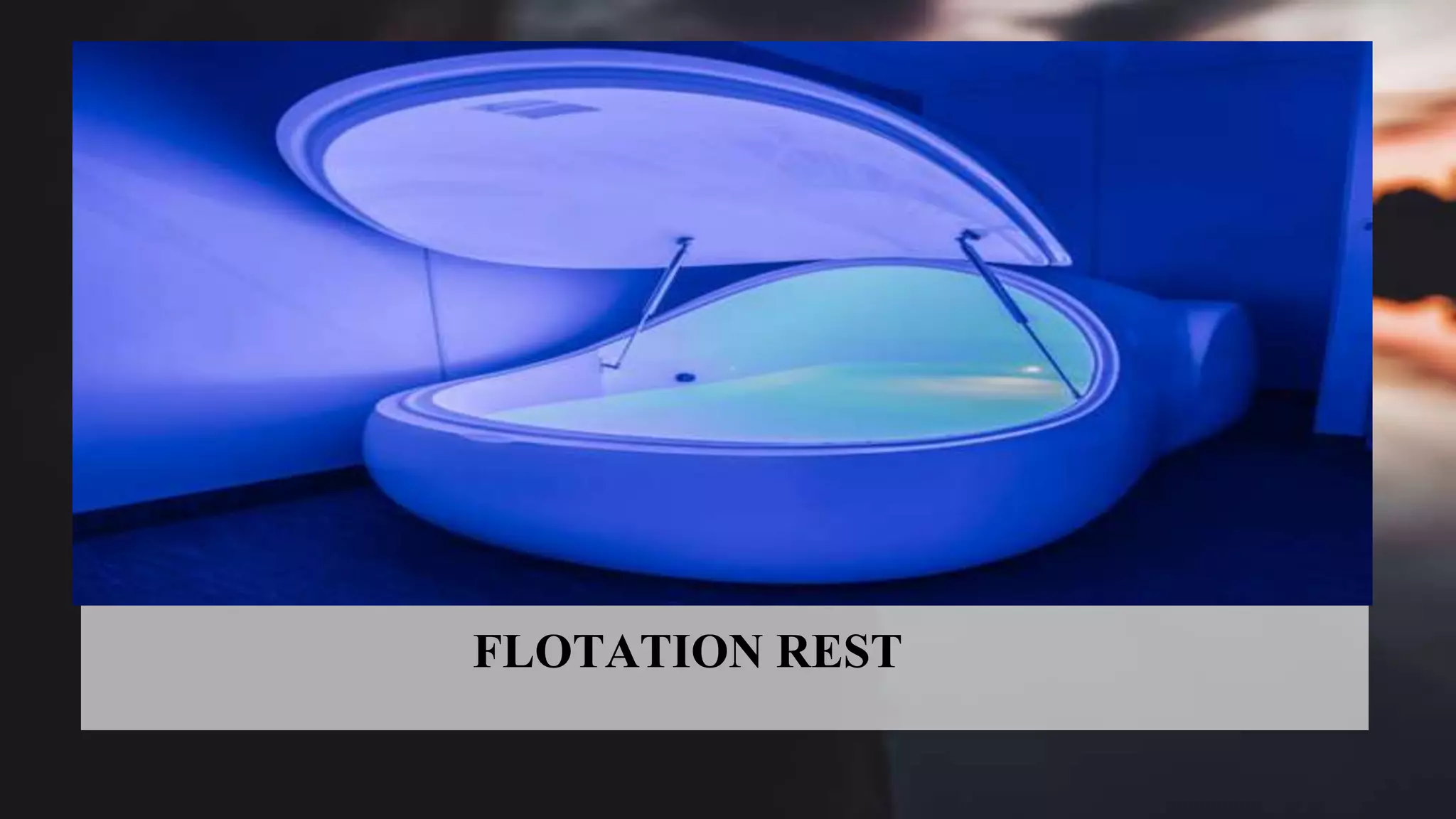
FLOTATION REST (Main article: Isolation tank)
 Flotation tank with flip top lid opened In flotation REST, the room contains a tank
or pool.
 The flotation medium consists of a skin-temperature solution of water and Epsom
salts at a specific gravity that allows for the patient to float supine without the
worry of safety. In fact, to turn over while in the solution requires "major
deliberate effort.
 The relaxed state also involves lowered blood pressure, lowered levels of cortisol,
and maximal blood flow. Besides physiological effects, REST seems to have
positive effects on well-being and performance.
FLOTATION REST
SENSORY DEPRIVATION TANK PROCESS
Though the process may vary slightly depending on the flotation center, a session in a
sensory deprivation tank usually goes as follows:
• You arrive at the flotation center , showing up early if it’s your first visit.
• Remove all of your clothing and jewelry.
• Shower before entering the tank.
• Enter the tank and close the door.
• Music plays for 10 minutes at the start of your session to help you relax.
Cont...
• Float for an hour.
• Music plays for the last five minutes of your session.
• Get out of the tank once your session has ended.
• Shower again and get dressed.
BENEFITS OF A SENSORY DEPRIVATION
 There are several psychological and medical benefits of a sensory deprivation
tanks on conditions such as anxiety disorders, stress, and chronic pain.
These therapies have many physical and mental benefits.
♦ It provides an unparalleled level of relaxation
♦ Old wounds and injuries are allowed to heal faster
♦ Vasodilatory effect (the body's circulation is increased while the blood pressure
and heart rate are reduced)
26
Cont....
Our evolution
STRESS MANAGEMENT
VISUALIZATION TECHNIQUES
PAIN RELIEF
PROBLEM SOLVING
27
Mercury is the closest
planet to the Sun and
the smallest one in the
Solar System
Audiovisual
Jupiter is a gas giant
and the biggest planet
in our Solar System
Static
Saturn is the ringed
one. It’s a gas giant,
composed mostly of
hydrogen and helium
Interactive
Venus has a beautiful
name and is the second
planet from the Sun.
It’s terribly hot
Dynamic
enter your title
NURSING MANAGEMENT
1.Assessment
Nursing history ,MSE, physical examination,identification
of clients at risk,the clients environment and social support network .
2.Diagnosis
• Disturbed sensory perception
• Risk for injury related to sensory perceptual disturbance
• Risk for impaired skin integrity
3.Planning
• Care of clients independent
• Care of clients in the home environment
4.Implementation
• Promotion healthy sensory function
• Adjusting environmental stimuli
• Preventing sensory overload
• preventing sensory deprivation
5.Evaluation
The corporate culturally assistive ,supportive ,facilitative act into nursing care
.
SUMMARY
CONCLUSION
Sensory deprivation studies in all six major modalities demonstrate the
importance of sensory experience for normal brain development.
BIBLIOGRAPHY
• P. Solomon et al. (eds.) (1961). Sensory deprivation. Harvard University Press.
• Marvin Zuckerman, Nathan Cohen (1964). "Sources of Reports of Visual Auditory
Sensations in perceptual-isolation experiments." Psychological Bulletin, July 1964, 62, pp.
1–20.
• L. Goldberger (1966). "Experimental isolation: An overview." American Journal of
Psychiatry 122, 774–782.
• J. Zubek (ed.) (1969). Sensory deprivation: Fifteen years of research. Appleton Century
Crofts.
• European Court of Human Rights (1978). "Ireland v. the United Kingdom" – January 18,
1978.
• Dirk van Dierendonck & Jan te Nijenhuis (2005). "Flotation restricted environmental
stimulation therapy (REST) as a stress-management tool: A meta-analysis." Psychology
and Health, June 2005, 20(3), pp. 405–412.
ASSINGMENT
What is the Sensory deprivation ?
THANK YOU....
For patiently Listening and Watching....

sensory deprivation.pptx

  • 1.
  • 2.
    PRESENTED BY OM SUBHASHREELENKA M.sc Nursing 1st Year ( Mental Health Nursing ) KINS,KIIT DEEMED TO BE UNIVERSITY
  • 4.
    SENSORY DEPRIVATION ANDIT’S MANAGEMENT
  • 5.
    INTRODUCTION Sensory deprivation isa condition where someone is deprived of sensory input. A floating tank is a voluntary activity that involves partial sensory deprivation.
  • 6.
  • 7.
    DEFINATION A process bywhich someone is deprived of normal external stimuli such as sight and sound for an extended period of time, especially as an experimental technique in psychology.
  • 8.
    A natural orexperimentally arranged situation in which stimulation of a subject's senses is greatly reduced. Experiments have included floating subjects in soundproof water chambers. Though short periods of sensory deprivation can be relaxing, extended deprivation can result in extreme anxiety, hallucinations,depression, and antisocial behavior.
  • 9.
    Effects of SensoryDeprivation It includes perceptual, cognitive and emotional disturbances  Perceptual Responses - Inaccurate perception of co-ordination and equilibrium. - Mild to gross distortions ranging from daydreams to hallucinations .  Cognitive Responses - Inability to control the direction of thought content. - Inability to concentation.
  • 10.
    Emotional disturbances - Inappropriate response - Anxiety - Anger - Depression - Fear - Panic - Rapid mood changes
  • 11.
    Characteristics of sensorydeprivation 1. Physical behaviour : Drowsiness 2. Escape behaviour : Running away to escape the deprived environment 3. Changes in perception behaviour : Unusual body sensations, preoccupation with somatic complaints . 4. Changes in affecting behaviour : Annoyance over small matter ,increased irritability.
  • 13.
    Motor Neuron: Nervethat produces muscular activity. Motor end plate: Muscular organ that bocomes active in rosponse to stimuli. Receptor (free nerve ending): Recever of nervous stimuli.
  • 14.
    Auditory stimulation Visual stimulation Gustatory and Olfactory stimulation Responsibilities ofnursing in Sensory deprivation studies in all six major modalities the importance of sensory experience for normal brain development.
  • 15.
  • 16.
    CHAMBER REST Restricted EnvironmentalStimulation Therapy (REST) There are many different numbers of basic methods of restricted environmental stimulation, including therapy (REST). There two types of rest FLOTATION REST
  • 17.
    CHAMBER REST  Inchamber REST, the subject lies on a bed in a completely dark and sound- reducing room for up to 24 hours.  Their movement is restricted by the experimental instructions, but not by any mechanical restraints.  Food, drink, and toilet facilities are provided in the room and are at the discretion of the tester, who can communicate with the participants using an open intercom.  Chamber REST affects psychological functioning (thinking, perception, memory, motivation, and mood) and psychophysiological processes.
  • 18.
  • 19.
    FLOTATION REST (Mainarticle: Isolation tank)  Flotation tank with flip top lid opened In flotation REST, the room contains a tank or pool.  The flotation medium consists of a skin-temperature solution of water and Epsom salts at a specific gravity that allows for the patient to float supine without the worry of safety. In fact, to turn over while in the solution requires "major deliberate effort.  The relaxed state also involves lowered blood pressure, lowered levels of cortisol, and maximal blood flow. Besides physiological effects, REST seems to have positive effects on well-being and performance.
  • 20.
  • 21.
    SENSORY DEPRIVATION TANKPROCESS Though the process may vary slightly depending on the flotation center, a session in a sensory deprivation tank usually goes as follows: • You arrive at the flotation center , showing up early if it’s your first visit. • Remove all of your clothing and jewelry. • Shower before entering the tank. • Enter the tank and close the door. • Music plays for 10 minutes at the start of your session to help you relax.
  • 22.
    Cont... • Float foran hour. • Music plays for the last five minutes of your session. • Get out of the tank once your session has ended. • Shower again and get dressed.
  • 24.
    BENEFITS OF ASENSORY DEPRIVATION  There are several psychological and medical benefits of a sensory deprivation tanks on conditions such as anxiety disorders, stress, and chronic pain. These therapies have many physical and mental benefits. ♦ It provides an unparalleled level of relaxation ♦ Old wounds and injuries are allowed to heal faster ♦ Vasodilatory effect (the body's circulation is increased while the blood pressure and heart rate are reduced)
  • 26.
    26 Cont.... Our evolution STRESS MANAGEMENT VISUALIZATIONTECHNIQUES PAIN RELIEF PROBLEM SOLVING
  • 27.
    27 Mercury is theclosest planet to the Sun and the smallest one in the Solar System Audiovisual Jupiter is a gas giant and the biggest planet in our Solar System Static Saturn is the ringed one. It’s a gas giant, composed mostly of hydrogen and helium Interactive Venus has a beautiful name and is the second planet from the Sun. It’s terribly hot Dynamic enter your title
  • 28.
    NURSING MANAGEMENT 1.Assessment Nursing history,MSE, physical examination,identification of clients at risk,the clients environment and social support network . 2.Diagnosis • Disturbed sensory perception • Risk for injury related to sensory perceptual disturbance • Risk for impaired skin integrity
  • 29.
    3.Planning • Care ofclients independent • Care of clients in the home environment 4.Implementation • Promotion healthy sensory function • Adjusting environmental stimuli • Preventing sensory overload • preventing sensory deprivation
  • 30.
    5.Evaluation The corporate culturallyassistive ,supportive ,facilitative act into nursing care .
  • 33.
  • 34.
    CONCLUSION Sensory deprivation studiesin all six major modalities demonstrate the importance of sensory experience for normal brain development.
  • 35.
    BIBLIOGRAPHY • P. Solomonet al. (eds.) (1961). Sensory deprivation. Harvard University Press. • Marvin Zuckerman, Nathan Cohen (1964). "Sources of Reports of Visual Auditory Sensations in perceptual-isolation experiments." Psychological Bulletin, July 1964, 62, pp. 1–20. • L. Goldberger (1966). "Experimental isolation: An overview." American Journal of Psychiatry 122, 774–782. • J. Zubek (ed.) (1969). Sensory deprivation: Fifteen years of research. Appleton Century Crofts. • European Court of Human Rights (1978). "Ireland v. the United Kingdom" – January 18, 1978. • Dirk van Dierendonck & Jan te Nijenhuis (2005). "Flotation restricted environmental stimulation therapy (REST) as a stress-management tool: A meta-analysis." Psychology and Health, June 2005, 20(3), pp. 405–412.
  • 36.
    ASSINGMENT What is theSensory deprivation ?
  • 37.
    THANK YOU.... For patientlyListening and Watching....