
FORENSIC NURSING
BY ANIL MANDALIA
MSN
BHAVNAGAR
1
INTRODUCTION
• Television has brought forensic science to
the forefront, and we are now seeing an
explosion in young people who want to
work in this arena.
• Forensic Nursing is new emerging aspect in
India.
2
Definition of Forensic Nursing
• “Forensic nursing is the application of
nursing sciences to public and legal
proceedings. It provides treatment for
trauma or death to victims and the
perpetrators of abuse, violence, criminal
offenses, traumatic accidents, and events of
nature”
3
Scope and Significance of
forensic Nursing
1. Forensic nurses are practicing in hospitals
and out in the community, making a
difference in people’s lives.
2. They identify issues that will have a legal
impact on society.
3. They document injuries and pull
communities together to address issues
such as domestic violence, sexual assault,
and child abuse.
4
Scope and Significance of
forensic Nursing
4. They work with grieving family members
when death comes unexpectedly.
5. They care for inmates and those in the
psychiatric facilities who are unable to
understand the consequences of their
actions.
6. Forensic nurses contribute to disaster
planning and response.
5
Scope and Significance of
forensic Nursing
7. They are also entrepreneurs and consult
on legal cases, assisting attorneys to
understand the intricate medical
terminology and how care is provided to
the community.
8. Anywhere there is an injury or potential
for injury, there is a role for the forensic
nurse.
6
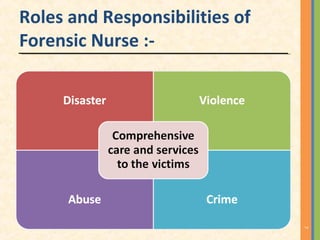
Roles and Responsibilities of
Forensic Nurse :-
7
Roles and Responsibilities of
Forensic Nurse :-
• The safety of the living victim and the
deceased victim’s body remains the first
priority.
• Collecting and preserving evidence from the
victim should never compromise the safety
or integrity of the body.
8
Roles and Responsibilities of
Forensic Nurse :-
• The forensic nurse performs a forensic
examination.
– The purpose is to identify and collect evidence
that has transferred from the perpetrator to
the victim.
– Law enforcement personnel may collect
evidence from the crime scene; however,
forensic nurses and other health care providers
collect evidence from the victim.
9
Roles and Responsibilities of
Forensic Nurse :-
• Evidence must be collected in an organized
and comprehensive manner.
– Without bias and without inducing any physical or
psychological harm to the victim.
– Without bias and without producing any physical injury or
damage to the deceased victim.
– Examination and evidence identification and collection
require a careful search of the entire body.
– Meticulous documentation requires identification of all
evidence, preservation method, and retention (chain of
custody).
10
Roles and Responsibilities of
Forensic Nurse :-
• The forensic nurse must develop
interviewing techniques.
– To interview the victim
– To interview the suspected perpetrator
– To interview the convicted perpetrator
– To interview family, friends, and all those who
may add to the investigation
11
Roles and Responsibilities of
Forensic Nurse :-
• Evidence includes the following:
– All clothing
– All jewelry
– Any items in pockets
– Any items removed from the body
• Dirt (physical evidence).
• Saliva (biological evidence).
• Paint chips (physical evidence).
• Semen (biological evidence).
• Insects (biological evidence).
• Plant material (biological evidence.)
• Dried or fresh blood (biological evidence.)
• Fabric (physical material).
• Additional physical and biological material.
12
Roles and Responsibilities of
Forensic Nurse :-
• Preservation of evidence is dependent on
the type of material, whether physical or
biological.
13
Additional Roles of the Forensic
Nurse:
1. May assist in the development of evidence-based
policies and procedures related to evidence
identification, collection, and preservation and
photographic documentation.
2. Is able to develop and implement orientation and
continuing education programs for the staff
related to forensic nursing and forensic science
techniques.
3. May also act as a consultant with risk
management administration.
14
Additional Roles of the Forensic
Nurse:
4. May review medical records as a consultant for
the facility legal counsel.
5. In a school setting is able to identify children at
risk for abuse or neglect.
6. In law enforcement setting is able to provide
direct evaluation and care for the victims of
violence and at the same time is able to collect
evidence and provide referrals.
15
Additional Roles of the Forensic
Nurse:
7. In the home care setting is able to assess the
living conditions for safety; assess the patient for
evidence of exploitation, abuse, or neglect;
provides referral for community service agency
assistance.
8. Professional Nurse Education + Forensic Science
Education + Forensic Nursing Education = A
professional nurse trained to provide care and
treatment to the victims, both the living and the
dead, of violent crime or traumatic events.
16
THANK YOU
17

Forensic nursing

  • 1.
    FORENSIC NURSING BY ANILMANDALIA MSN BHAVNAGAR 1
  • 2.
    INTRODUCTION • Television hasbrought forensic science to the forefront, and we are now seeing an explosion in young people who want to work in this arena. • Forensic Nursing is new emerging aspect in India. 2
  • 3.
    Definition of ForensicNursing • “Forensic nursing is the application of nursing sciences to public and legal proceedings. It provides treatment for trauma or death to victims and the perpetrators of abuse, violence, criminal offenses, traumatic accidents, and events of nature” 3
  • 4.
    Scope and Significanceof forensic Nursing 1. Forensic nurses are practicing in hospitals and out in the community, making a difference in people’s lives. 2. They identify issues that will have a legal impact on society. 3. They document injuries and pull communities together to address issues such as domestic violence, sexual assault, and child abuse. 4
  • 5.
    Scope and Significanceof forensic Nursing 4. They work with grieving family members when death comes unexpectedly. 5. They care for inmates and those in the psychiatric facilities who are unable to understand the consequences of their actions. 6. Forensic nurses contribute to disaster planning and response. 5
  • 6.
    Scope and Significanceof forensic Nursing 7. They are also entrepreneurs and consult on legal cases, assisting attorneys to understand the intricate medical terminology and how care is provided to the community. 8. Anywhere there is an injury or potential for injury, there is a role for the forensic nurse. 6
  • 7.
    Roles and Responsibilitiesof Forensic Nurse :- 7
  • 8.
    Roles and Responsibilitiesof Forensic Nurse :- • The safety of the living victim and the deceased victim’s body remains the first priority. • Collecting and preserving evidence from the victim should never compromise the safety or integrity of the body. 8
  • 9.
    Roles and Responsibilitiesof Forensic Nurse :- • The forensic nurse performs a forensic examination. – The purpose is to identify and collect evidence that has transferred from the perpetrator to the victim. – Law enforcement personnel may collect evidence from the crime scene; however, forensic nurses and other health care providers collect evidence from the victim. 9
  • 10.
    Roles and Responsibilitiesof Forensic Nurse :- • Evidence must be collected in an organized and comprehensive manner. – Without bias and without inducing any physical or psychological harm to the victim. – Without bias and without producing any physical injury or damage to the deceased victim. – Examination and evidence identification and collection require a careful search of the entire body. – Meticulous documentation requires identification of all evidence, preservation method, and retention (chain of custody). 10
  • 11.
    Roles and Responsibilitiesof Forensic Nurse :- • The forensic nurse must develop interviewing techniques. – To interview the victim – To interview the suspected perpetrator – To interview the convicted perpetrator – To interview family, friends, and all those who may add to the investigation 11
  • 12.
    Roles and Responsibilitiesof Forensic Nurse :- • Evidence includes the following: – All clothing – All jewelry – Any items in pockets – Any items removed from the body • Dirt (physical evidence). • Saliva (biological evidence). • Paint chips (physical evidence). • Semen (biological evidence). • Insects (biological evidence). • Plant material (biological evidence.) • Dried or fresh blood (biological evidence.) • Fabric (physical material). • Additional physical and biological material. 12
  • 13.
    Roles and Responsibilitiesof Forensic Nurse :- • Preservation of evidence is dependent on the type of material, whether physical or biological. 13
  • 14.
    Additional Roles ofthe Forensic Nurse: 1. May assist in the development of evidence-based policies and procedures related to evidence identification, collection, and preservation and photographic documentation. 2. Is able to develop and implement orientation and continuing education programs for the staff related to forensic nursing and forensic science techniques. 3. May also act as a consultant with risk management administration. 14
  • 15.
    Additional Roles ofthe Forensic Nurse: 4. May review medical records as a consultant for the facility legal counsel. 5. In a school setting is able to identify children at risk for abuse or neglect. 6. In law enforcement setting is able to provide direct evaluation and care for the victims of violence and at the same time is able to collect evidence and provide referrals. 15
  • 16.
    Additional Roles ofthe Forensic Nurse: 7. In the home care setting is able to assess the living conditions for safety; assess the patient for evidence of exploitation, abuse, or neglect; provides referral for community service agency assistance. 8. Professional Nurse Education + Forensic Science Education + Forensic Nursing Education = A professional nurse trained to provide care and treatment to the victims, both the living and the dead, of violent crime or traumatic events. 16
  • 17.