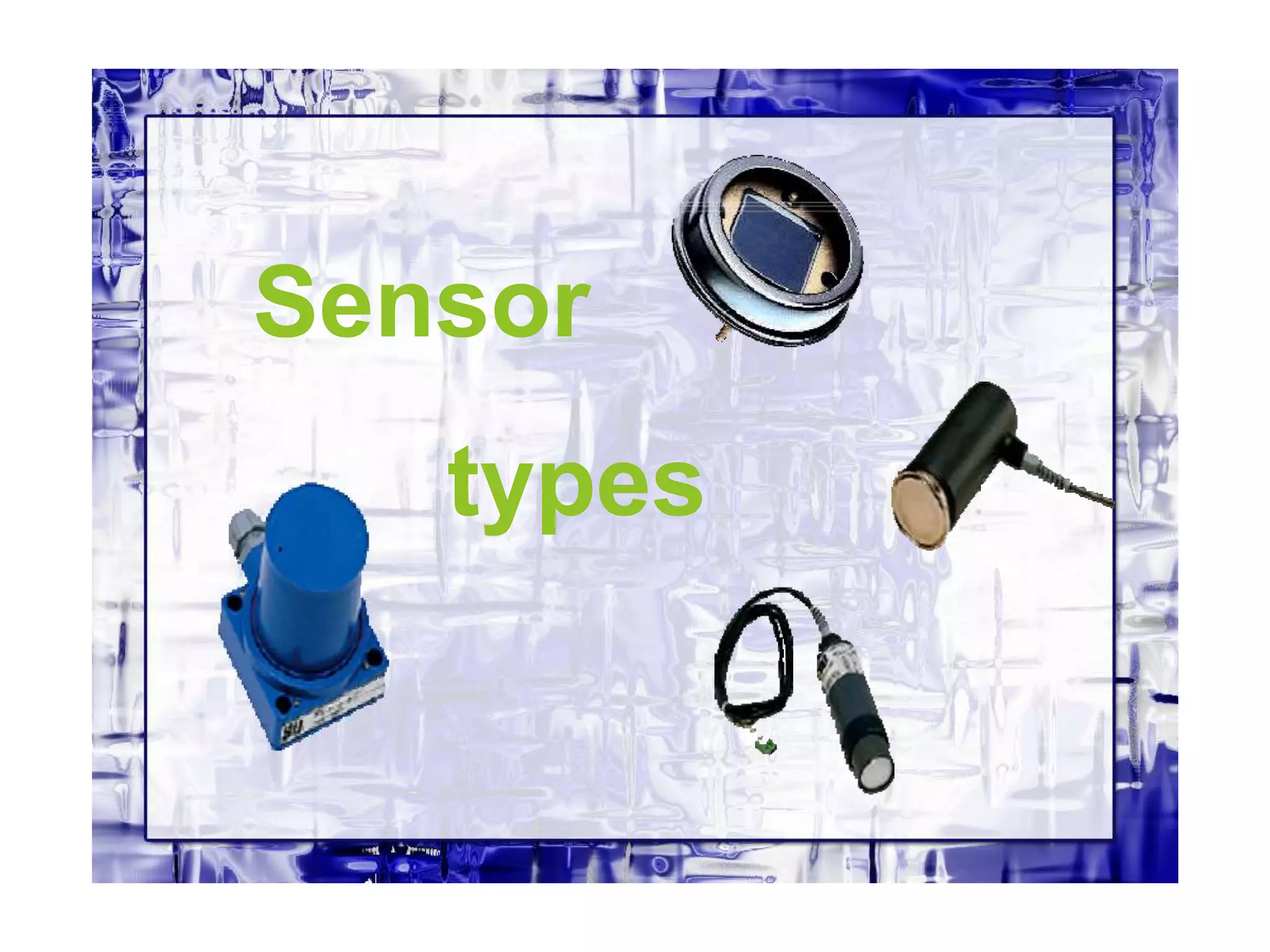
Sensor
types
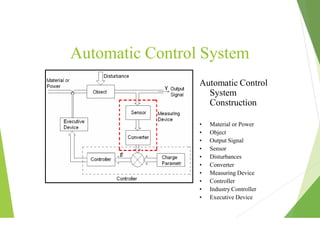
Automatic Control System
Automatic Control
System
Construction
• Material or Power
• Object
• Output Signal
• Sensor
• Disturbances
• Converter
• Measuring Device
• Controller
• Industry Controller
• Executive Device
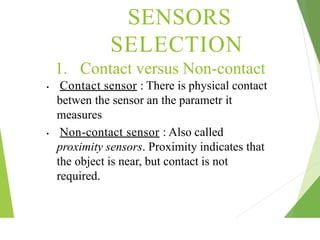
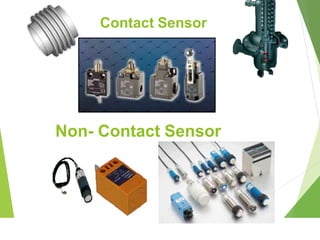
1. Contact versus Non-contact
• Contact sensor : There is physical contact
betwen the sensor an the parametr it
measures
• Non-contact sensor : Also called
proximity sensors. Proximity indicates that
the object is near, but contact is not
required.
SENSORS
SELECTION
Contact Sensor
Non- Contact Sensor
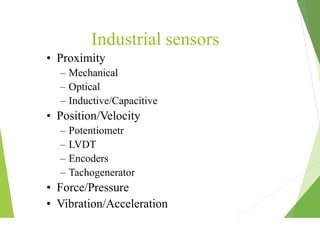
Industrial sensors
• Proximity
– Mechanical
– Optical
– Inductive/Capacitive
• Position/Velocity
– Potentiometr
– LVDT
– Encoders
– Tachogenerator
• Force/Pressure
• Vibration/Acceleration
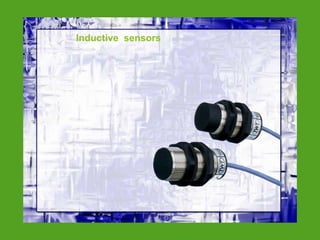
Inductive sensors
Types of inductive sensors
❖ proximity
❖ movement
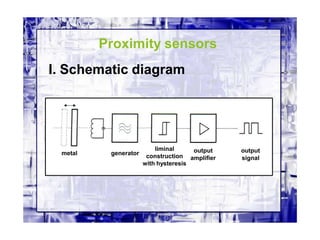
I. Schematic diagram
metal generator
liminal
construction
with hysteresis
output
amplifier
output
signal
Proximity sensors
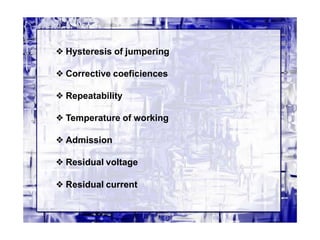
❖ Hysteresis of jumpering
❖ Corrective coeficiences
❖ Repeatability
❖ Temperature of working
❖ Admission
❖ Residual voltage
❖ Residual current
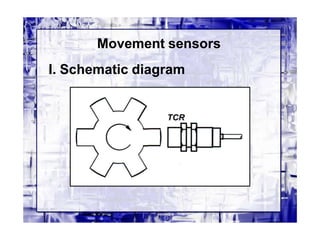
Movement sensors
I. Schematic diagram
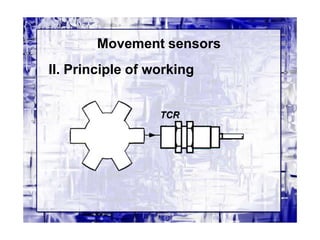
Movement sensors
II. Principle of working
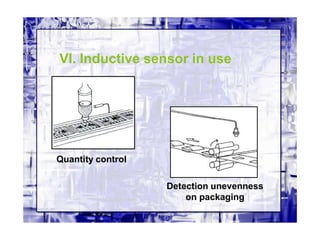
VI. Inductive sensor in use
Quantity control
Detection unevenness
on packaging
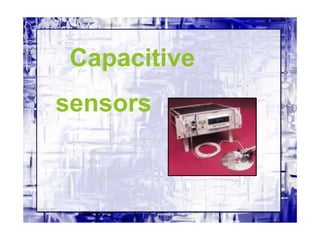
Capacitive
sensors
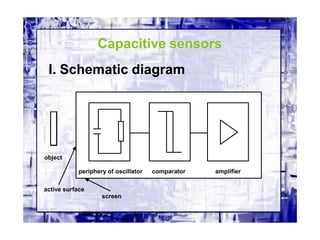
Capacitive sensors
I. Schematic diagram
object
active surface
screen
periphery of oscillator comparator amplifier
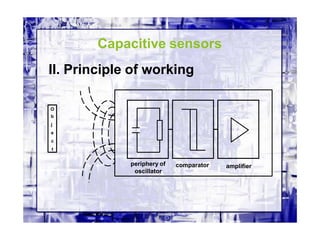
Capacitive sensors
II. Principle of working
periphery of
oscillator
amplifier
comparator
O
b
j
e
c
t
IV. Capacitive sensor in use
❖ Silicon Wafer deposition & etching
❖ Silicon Wafer proximity
❖ Wafer cutting/processing
❖ Robot arm control
❖ Computer hard disc drive
❖ Printing Press/Photocopiers
❖ Tooling parallelism/alignment
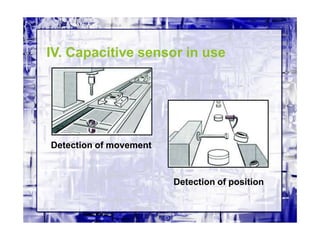
IV. Capacitive sensor in use
Detection of movement
Detection of position
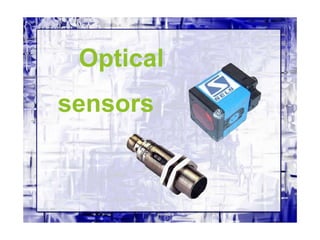
Optical
sensors
Optical (Photoelectric)
Sensors use light to sense
• All optical sensors
objects.
• Operation method:
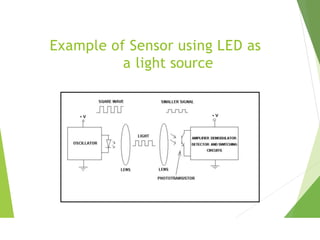
- Lasers, Incandescend bulbs, or Light emitting diodes
(LEDs) are used as light source
- The light source is turned off and on (modulation) at a
high frequency (could be as hight as several kHz)
- A photodetector senses the pulsed light
- The light emitter and receiver are turned to the
modulation frequency.
Example of Sensor using LED as
a light source
Types of Optical
Sensors
• Reflective (Diffuse) Sensors
• Retroreflective Sensors
• Thru-beam Sensors
• Polarizing Photo Sensors
• Convergent Photo Sensors
• Fiber Optic Sensors
• Laser Sensors
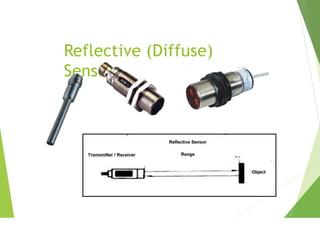
Reflective (Diffuse)
Sensors
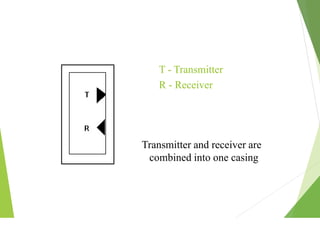
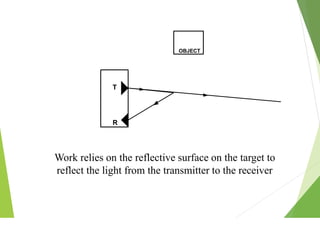
T - Transmitter
R - Receiver
Transmitter and receiver are
combined into one casing
Work relies on the reflective surface on the target to
reflect the light from the transmitter to the receiver
T
R
OBJECT
Advantages
• Singular casing (Transmitter +
Receiver)
• Objects detection with high reflect
parameter (0,6 - 0,9)
Disadvantages
• Low detecting distance
• Sensitive to colour and quality
• Sensitive to background
• Dead zone
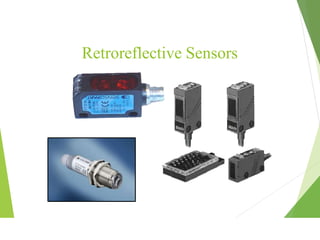
Retroreflective Sensors
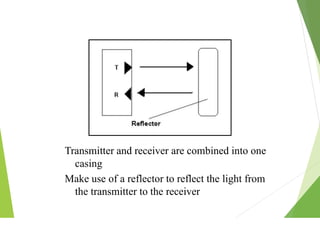
Transmitter and receiver are combined into one
casing
Make use of a reflector to reflect the light from
the transmitter to the receiver
Advantages
• Easy instalation
• Singular casing ( Transmitter +
Receiver)
• Good working zone
Disadvantages
• Sensitive to lights objects
• Use reflector
• Dead zone
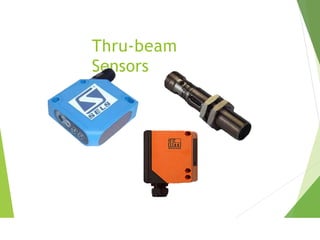
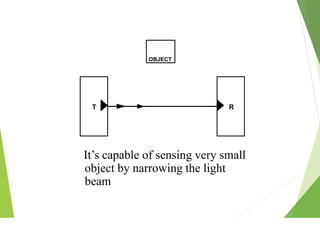
Thru-beam
Sensors
It’s capable of sensing very small
object by narrowing the light
beam
T R
OBJECT
Advantages
• Detection for long distance
• Lack of dead zone
• Detection light objects
• Detection in several environment
Disadvantages
• Large separate casings
• Problems with instalation ( set- up
Transmitter and Receiver)
Typical
Application
• Detecting the presence or absence of an object
• Positioning and counting
• Detection the end of travel of an object
• Packaging machinery
• Sorting and labelling machinery
• Textile machinery
• Pharmaceutical
• Small part detection
• High speed detection
• Door controls
Encoders
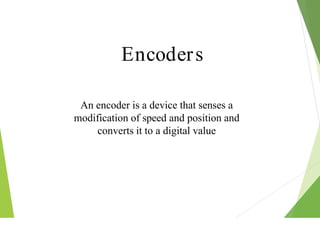
An encoder is a device that senses a
modification of speed and position and
converts it to a digital value
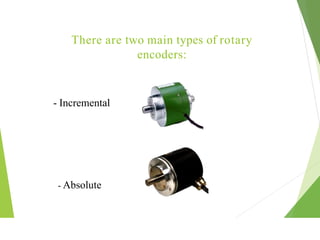
There are two main types of rotary
encoders:
- Incremental
- Absolute
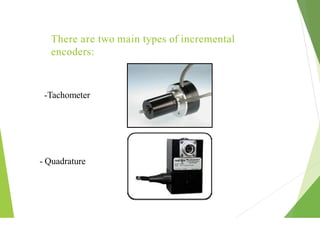
There are two main types of incremental
encoders:
-Tachometer
- Quadrature
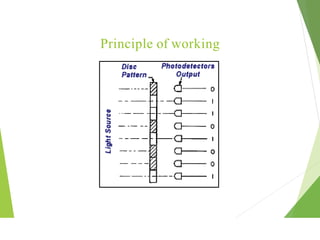
Principle of working

sensors.pptx