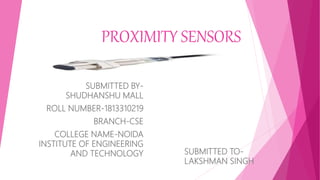
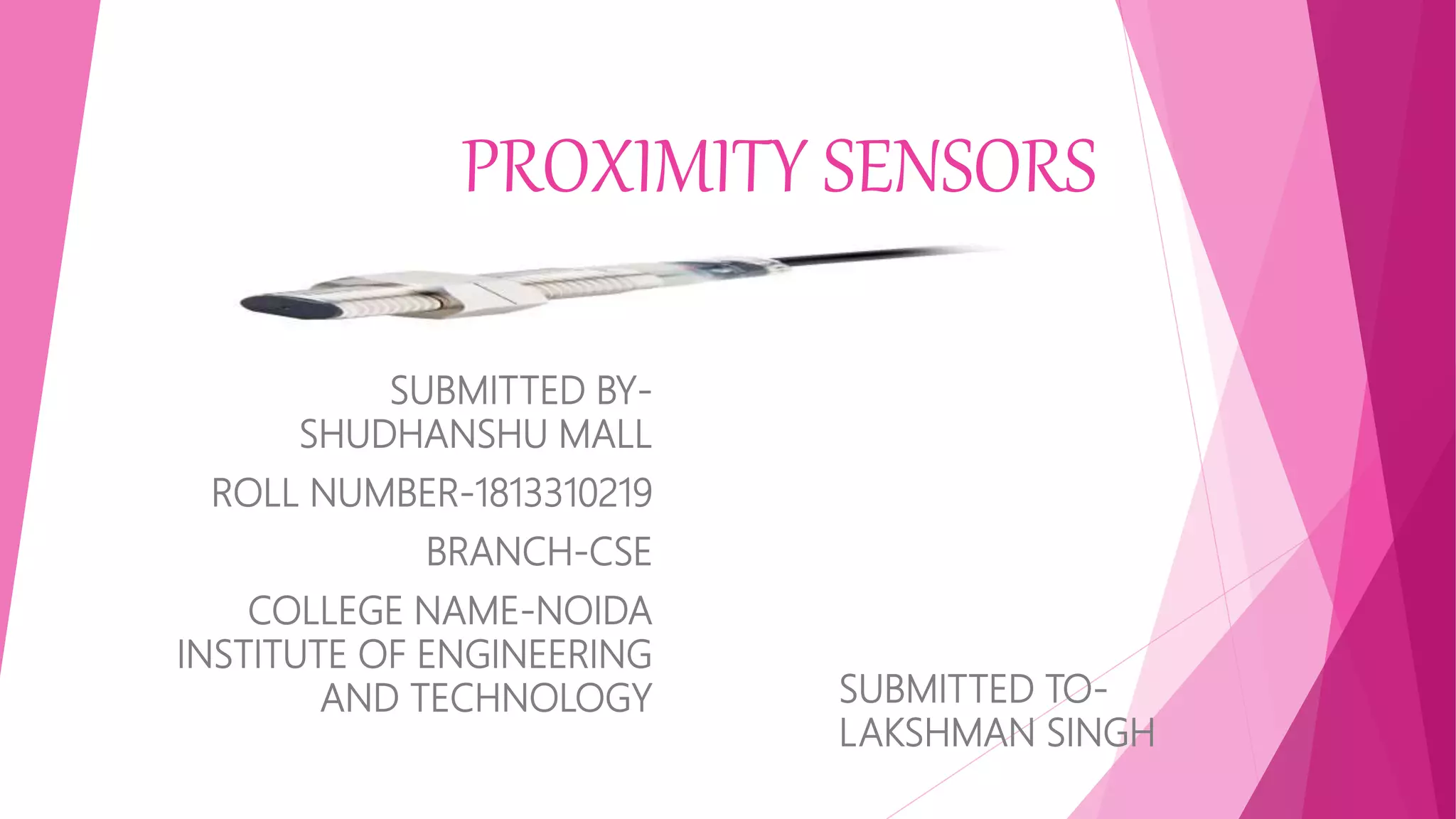
PROXIMITY SENSORS
SUBMITTED BY-
SHUDHANSHU MALL
ROLL NUMBER-1813310219
BRANCH-CSE
COLLEGE NAME-NOIDA
INSTITUTE OF ENGINEERING
AND TECHNOLOGY SUBMITTED TO-
LAKSHMAN SINGH
TABLE OF CONTENT
 INTRODUCTION
 TYPES OF PROXIMITY SENSOR
 CONSTRUCTION
 WORKING
 APPLICATIONS
 ADVANTAGE
 DISADVANTAGE
 CONCLUSION
 REFRENCES
WHAT IS A PROXIMITY SENSOR ?
 A Proximity Sensor Detects An Object When
The Object Approaches Within The
Detection Range And Boundary Of The
Sensor.
 Proximity Sensor Includes All The Sensor
That Perform Non Contact Detection In
Comparison To Sensors Such As Limit Switch
, That Detect The Object By Physically
Contacting Them.
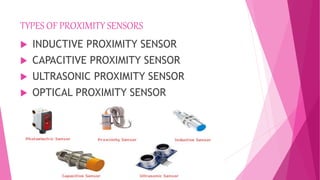
TYPES OF PROXIMITY SENSORS
 INDUCTIVE PROXIMITY SENSOR
 CAPACITIVE PROXIMITY SENSOR
 ULTRASONIC PROXIMITY SENSOR
 OPTICAL PROXIMITY SENSOR
INDUCTIVE PROXIMITY SENSOR
 An Inductive proximity sensor is an
electronic proximity sensor , which detect
metallic object without touching them.
 Their operating principle is based on a coil
and high frequency oscillator that creates a
field in the close surrounding of the sensing
surface .
 The operating distance of the sensor
depends on the coil’s size as well as the
target’s shape, size and material
CONSTRUCTION AND WORKING
 The Main Components Of The Inductive Proximity
Sensor Are. Coil, Oscillator, Detector And The
Output Circuit
 The Operating Distance Of The Sensor Depends On
The Actuator's Shape And Size And Is Strictly
Linked To The Nature Of The Material
 The Coil Generates The High Frequency Magnetic
Field In Front Of The Face. When The Metallic
Target Comes In This Magnetic Field It Absorbs
Some Of The Energy
CONT…
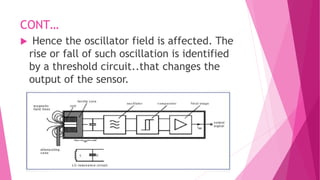
 Hence the oscillator field is affected. The
rise or fall of such oscillation is identified
by a threshold circuit..that changes the
output of the sensor.
ADVANTAGES
 They are very accurate compared to other
technologies.
 Have high switching rate.
 Can work in harsh environmental
conditions.
DISADVANTAGES
 It can detect only metallic target.
 Operating range may be limited.
APPLICATIONS
 Common applications of inductive sensors
include metal detectors, car washes, and a
host of automated industrial process .
Because the sensor does not require
physical contact it is particularly useful for
applications where access presents
challenges or where dirt is prevalent . The
sensing range is rarely greater than 6 cm,
however, and it has no directionality.
Capacitive proximity sensors
 Capacitive Sensor Are Used For Non Contact
Detection Of Metallic Object And Non
Metallic Object(liquid, Plastic, Wooden
Material Etc.)
 Capacitive Proximity Sensors Use The
Variation Of Capacitance Between The
Sensor And Object Being Detected.
 Capacitance Methods Are Very Sensitive ,
Distance Down To One Micro Inch Can Be
Measured.
Construction and working
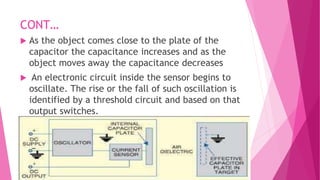
 The Main Components Of The Capacitive
Proximity Sensor Are Plate, Oscillator,
Threshold Detector And The Output Circuit.
 The Plate Inside The Sensor Acts As One
Plate Of The Capacitor And The Target Acts
As Another Plate And The Air Acts As The
Dielectric Between The Plates.
 The Capacitive Sensor Can Detect Any
Targets Whose Dielectric Constant Is More
Than Air
CONT…
 As the object comes close to the plate of the
capacitor the capacitance increases and as the
object moves away the capacitance decreases
 An electronic circuit inside the sensor begins to
oscillate. The rise or the fall of such oscillation is
identified by a threshold circuit and based on that
output switches.
OPTICAL SENSORS
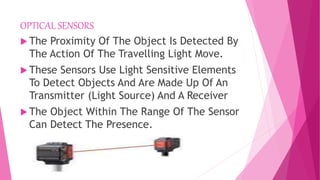
 The Proximity Of The Object Is Detected By
The Action Of The Travelling Light Move.
 These Sensors Use Light Sensitive Elements
To Detect Objects And Are Made Up Of An
Transmitter (Light Source) And A Receiver
 The Object Within The Range Of The Sensor
Can Detect The Presence.
CONT…
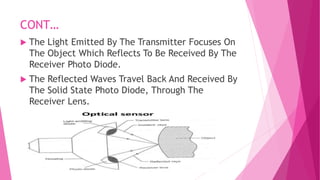
 The Light Emitted By The Transmitter Focuses On
The Object Which Reflects To Be Received By The
Receiver Photo Diode.
 The Reflected Waves Travel Back And Received By
The Solid State Photo Diode, Through The
Receiver Lens.
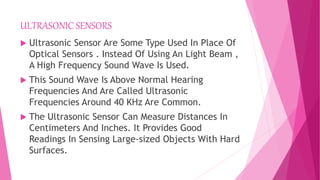
ULTRASONIC SENSORS
 Ultrasonic Sensor Are Some Type Used In Place Of
Optical Sensors . Instead Of Using An Light Beam ,
A High Frequency Sound Wave Is Used.
 This Sound Wave Is Above Normal Hearing
Frequencies And Are Called Ultrasonic
Frequencies Around 40 KHz Are Common.
 The Ultrasonic Sensor Can Measure Distances In
Centimeters And Inches. It Provides Good
Readings In Sensing Large-sized Objects With Hard
Surfaces.
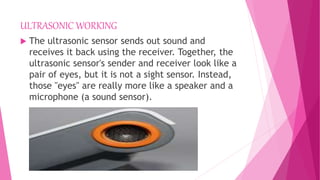
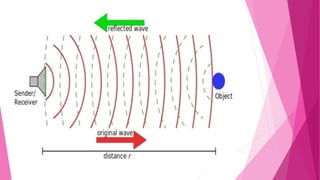
ULTRASONIC WORKING
 The ultrasonic sensor sends out sound and
receives it back using the receiver. Together, the
ultrasonic sensor's sender and receiver look like a
pair of eyes, but it is not a sight sensor. Instead,
those "eyes" are really more like a speaker and a
microphone (a sound sensor).
CONT…
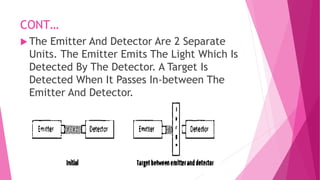
 The Emitter And Detector Are 2 Separate
Units. The Emitter Emits The Light Which Is
Detected By The Detector. A Target Is
Detected When It Passes In-between The
Emitter And Detector.
CONCLUSION
 The global market for these proximity sensors is
expected to grow at a steady rate. Major
industries using proximity sensors are machine
tools, woodworking machines, packaging
machines and other types of machinery.
 Further applications of are automatic door units
such as garage doors or doors inside buildings,
elevator doors or doors inside railway coaches.
 The building and automotive sector are further
industries using high volumes of proximity
sensors.
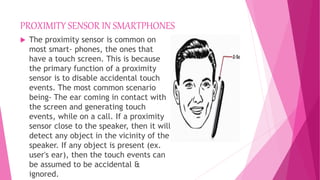
PROXIMITY SENSOR IN SMARTPHONES
 The proximity sensor is common on
most smart- phones, the ones that
have a touch screen. This is because
the primary function of a proximity
sensor is to disable accidental touch
events. The most common scenario
being- The ear coming in contact with
the screen and generating touch
events, while on a call. If a proximity
sensor close to the speaker, then it will
detect any object in the vicinity of the
speaker. If any object is present (ex.
user's ear), then the touch events can
be assumed to be accidental &
ignored.
Proximity sensors

Proximity sensors

  • 1.
    PROXIMITY SENSORS SUBMITTED BY- SHUDHANSHUMALL ROLL NUMBER-1813310219 BRANCH-CSE COLLEGE NAME-NOIDA INSTITUTE OF ENGINEERING AND TECHNOLOGY SUBMITTED TO- LAKSHMAN SINGH
  • 2.
    TABLE OF CONTENT INTRODUCTION  TYPES OF PROXIMITY SENSOR  CONSTRUCTION  WORKING  APPLICATIONS  ADVANTAGE  DISADVANTAGE  CONCLUSION  REFRENCES
  • 3.
    WHAT IS APROXIMITY SENSOR ?  A Proximity Sensor Detects An Object When The Object Approaches Within The Detection Range And Boundary Of The Sensor.  Proximity Sensor Includes All The Sensor That Perform Non Contact Detection In Comparison To Sensors Such As Limit Switch , That Detect The Object By Physically Contacting Them.
  • 4.
    TYPES OF PROXIMITYSENSORS  INDUCTIVE PROXIMITY SENSOR  CAPACITIVE PROXIMITY SENSOR  ULTRASONIC PROXIMITY SENSOR  OPTICAL PROXIMITY SENSOR
  • 5.
    INDUCTIVE PROXIMITY SENSOR An Inductive proximity sensor is an electronic proximity sensor , which detect metallic object without touching them.  Their operating principle is based on a coil and high frequency oscillator that creates a field in the close surrounding of the sensing surface .  The operating distance of the sensor depends on the coil’s size as well as the target’s shape, size and material
  • 6.
    CONSTRUCTION AND WORKING The Main Components Of The Inductive Proximity Sensor Are. Coil, Oscillator, Detector And The Output Circuit  The Operating Distance Of The Sensor Depends On The Actuator's Shape And Size And Is Strictly Linked To The Nature Of The Material  The Coil Generates The High Frequency Magnetic Field In Front Of The Face. When The Metallic Target Comes In This Magnetic Field It Absorbs Some Of The Energy
  • 7.
    CONT…  Hence theoscillator field is affected. The rise or fall of such oscillation is identified by a threshold circuit..that changes the output of the sensor.
  • 8.
    ADVANTAGES  They arevery accurate compared to other technologies.  Have high switching rate.  Can work in harsh environmental conditions.
  • 9.
    DISADVANTAGES  It candetect only metallic target.  Operating range may be limited.
  • 10.
    APPLICATIONS  Common applicationsof inductive sensors include metal detectors, car washes, and a host of automated industrial process . Because the sensor does not require physical contact it is particularly useful for applications where access presents challenges or where dirt is prevalent . The sensing range is rarely greater than 6 cm, however, and it has no directionality.
  • 11.
    Capacitive proximity sensors Capacitive Sensor Are Used For Non Contact Detection Of Metallic Object And Non Metallic Object(liquid, Plastic, Wooden Material Etc.)  Capacitive Proximity Sensors Use The Variation Of Capacitance Between The Sensor And Object Being Detected.  Capacitance Methods Are Very Sensitive , Distance Down To One Micro Inch Can Be Measured.
  • 12.
    Construction and working The Main Components Of The Capacitive Proximity Sensor Are Plate, Oscillator, Threshold Detector And The Output Circuit.  The Plate Inside The Sensor Acts As One Plate Of The Capacitor And The Target Acts As Another Plate And The Air Acts As The Dielectric Between The Plates.  The Capacitive Sensor Can Detect Any Targets Whose Dielectric Constant Is More Than Air
  • 13.
    CONT…  As theobject comes close to the plate of the capacitor the capacitance increases and as the object moves away the capacitance decreases  An electronic circuit inside the sensor begins to oscillate. The rise or the fall of such oscillation is identified by a threshold circuit and based on that output switches.
  • 14.
    OPTICAL SENSORS  TheProximity Of The Object Is Detected By The Action Of The Travelling Light Move.  These Sensors Use Light Sensitive Elements To Detect Objects And Are Made Up Of An Transmitter (Light Source) And A Receiver  The Object Within The Range Of The Sensor Can Detect The Presence.
  • 15.
    CONT…  The LightEmitted By The Transmitter Focuses On The Object Which Reflects To Be Received By The Receiver Photo Diode.  The Reflected Waves Travel Back And Received By The Solid State Photo Diode, Through The Receiver Lens.
  • 16.
    ULTRASONIC SENSORS  UltrasonicSensor Are Some Type Used In Place Of Optical Sensors . Instead Of Using An Light Beam , A High Frequency Sound Wave Is Used.  This Sound Wave Is Above Normal Hearing Frequencies And Are Called Ultrasonic Frequencies Around 40 KHz Are Common.  The Ultrasonic Sensor Can Measure Distances In Centimeters And Inches. It Provides Good Readings In Sensing Large-sized Objects With Hard Surfaces.
  • 17.
    ULTRASONIC WORKING  Theultrasonic sensor sends out sound and receives it back using the receiver. Together, the ultrasonic sensor's sender and receiver look like a pair of eyes, but it is not a sight sensor. Instead, those "eyes" are really more like a speaker and a microphone (a sound sensor).
  • 19.
    CONT…  The EmitterAnd Detector Are 2 Separate Units. The Emitter Emits The Light Which Is Detected By The Detector. A Target Is Detected When It Passes In-between The Emitter And Detector.
  • 20.
    CONCLUSION  The globalmarket for these proximity sensors is expected to grow at a steady rate. Major industries using proximity sensors are machine tools, woodworking machines, packaging machines and other types of machinery.  Further applications of are automatic door units such as garage doors or doors inside buildings, elevator doors or doors inside railway coaches.  The building and automotive sector are further industries using high volumes of proximity sensors.
  • 21.
    PROXIMITY SENSOR INSMARTPHONES  The proximity sensor is common on most smart- phones, the ones that have a touch screen. This is because the primary function of a proximity sensor is to disable accidental touch events. The most common scenario being- The ear coming in contact with the screen and generating touch events, while on a call. If a proximity sensor close to the speaker, then it will detect any object in the vicinity of the speaker. If any object is present (ex. user's ear), then the touch events can be assumed to be accidental & ignored.