Causes and Preventive Measures for Motor
Failures
1. Why do Motors Fail?
2. Conditioning monitoring of rotating equipment
3. Preventive maintenance
4. Testing analysis
1 Why do Motors Fail?
Motors don't fail just because of age or operating
hours. Typical failures are caused by:
 1.1 Heat
 1.2 Power Supply Anomalies
 1.3 Dust contamination & water ingress
 1.4 Improper Lubrication
 1.5 Unusual Mechanical Loads
Motors have survived for several hundred
thousand operating hours when these
stresses have been minimized.
1.1 Heat
Primary causes of overheating are:
 Overloading: By the proses, unexpected loads or
mechanical stresses.
 Too frequent starts: NEMA recommends two cold starts or
one hot start per hour.
 Low or unbalanced voltages: 10% +/- can be allowed.
 Inadequate ventilation: Damaged cooling fan, dust contaminated
in cooling fins of the motors.
1.2 Power Supply Anomalies
Ideal power is a perfect sine wave on each phase at the motor's rated voltage &
frequency-rarely achieved. The following problems appear.
 Harmonics: Cause overheating and decreased efficiency.
 Overvoltage: At moderate levels is usually not damaging, but can reduce efficiency
and power factor. (NEMA limit 110%)
 Under-voltage: Increases current and causes overheating and reduced efficiency in
fully loaded motors. It is relatively harmless in under-loaded motors. (NEMA limit 90% of
rated).
 Voltage unbalance: Causes overheating and reduced efficiency. Unbalance greater
than 1% requires motor de-rating and motors should never be powered by a system
with more than
5% unbalance.
 Voltage spikes: Commonly caused by capacitor switching, lightning, or cable stranding
waves from a variable frequency drive (VFD). These tend to cause turn-to-turn failures.
 Frequencies under 50 HZ from VFDs: The application should be reviewed to insure
motor is suitable for the application without installation of supplemental cooling.
• Abrasion
• Corrosion
• Overheating
1.3 Dust contamination & water ingress:
Contamination cannot be completely excluded by total enclosure or even an
explosion proof enclosure. Contamination destroys motors in three ways:
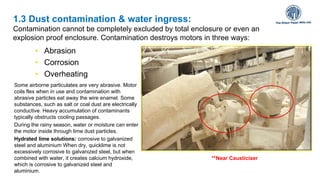
Some airborne particulates are very abrasive. Motor
coils flex when in use and contamination with
abrasive particles eat away the wire enamel. Some
substances, such as salt or coal dust are electrically
conductive. Heavy accumulation of contaminants
typically obstructs cooling passages.
During the rainy season, water or moisture can enter
the motor inside through lime dust particles.
Hydrated lime solutions: corrosive to galvanized
steel and aluminium When dry, quicklime is not
excessively corrosive to galvanized steel, but when
combined with water, it creates calcium hydroxide,
which is corrosive to galvanized steel and
aluminium.
**Near Causticiser
1.4 Improper Lubrication
Unfortunately, there are more ways to get it wrong than right. One can over-lubricate as
well as under-lubricate.
Grease itself introduces contaminants into bearings if careful control is not practiced.
Mixing greases with different bases may cause grease constituents to separate and run
out.
Different motors pose different requirements for the introduction of lubricant and removal
of old lubricant.
Each individual application dictates the amount, type, and frequency of lubrication
required.
However in most of industry's greasing scheduled in quarterly.
1.5 Unusual Mechanical Loads
A variety of mechanical conditions can either overstress bearings, leading to early failure,
or distort the motor frame causing asymmetric air gap, which in turn can cause vibration
and bearing failure or winding overheating. Conditions to avoid are:
Misaligned couplings
Over-tightened belt; or mis-alignment sheaves
Overly-compliant base or poor shimming of motor mounting feet
"Soft Foot," (i.e. motor feet) not in the same plane
Dynamic imbalance of load or internal imbalance of motor rotor
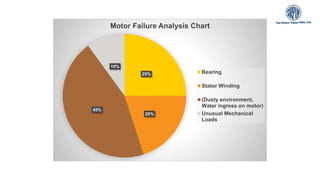
25%
20%
45%
10%
Motor Failure Analysis Chart
Bearing
Stator Winding
(Dusty environment,
Water ingress on motor)
Unusual Mechanical
Loads
2 Conditioning monitoring of rotating equipment
By condition monitoring we mean continuous evaluation of the health of plant
and equipment throughout its serviceable life.
Condition monitoring and protection are closely related functions. The approach
to the implementation of each is, however, quite different.
Condition monitoring can, in many cases, be extended to provide primary
protection, but its real function must always be to attempt to recognize the
development of faults at an early stage.
In Weekly basis we have to do CM (Conditioning monitoring) for all critical
motors so that we can take precautionary action on early stage of failure.
11-
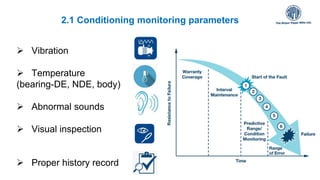
2.1 Conditioning monitoring parameters
 Vibration
 Temperature
(bearing-DE, NDE, body)
 Abnormal sounds
 Visual inspection
 Proper history record
3 Preventive maintenance
Protective maintenance will generally involve lubricating, cleaning and check for sparking
brushes, vibration, loose belts, high temperature and unusual noises.
So a planned inspection and maintenance is needed for vast of electrical equipment to keep in
proper working condition.
But the question arises do we need a proper maintenance schedule?
And the answer will be yes because without a proper maintenance schedule when something
goes wrong with a motor it can lead to expensive repairs, can take some leads to replace it with
a new one. This is why a proper schedule maintenance schedule is necessary; however, it will
not guarantee that motor will not get any trouble, but it will limit the problems.
So the main idea behind motor maintenance is to prevent breakdown rather than repairs them.
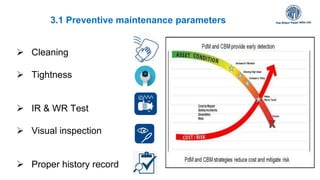
3.1 Preventive maintenance parameters
 Cleaning
 Tightness
 IR & WR Test
 Visual inspection
 Proper history record
4 Testing analysis
TYPES OF MOTOR TESTING
There are several ways to classify motor testing. Offline or static testing is done while the motor is turned off,
and can be performed on-site, in a repair facility or during inventory. This test is scheduled once or twice a
year and determines the insulation system’s integrity. Online or dynamic testing, on the other hand, is
executed while the motor is on its average load and operational condition. This test collects current
information to flag concerning results.
Motor testing can also be grouped either by electrical or mechanical methods. Most of these tests are done
in conjunction with another to ensure optimal operability and are just some of the most common examples
out of the many diagnostic methods, depending on the need and requirement.
Mostly testing of motor is to understand the healthiness of the motor with this test reports we can take
preventive measures to eliminate the breakdowns.
Every year we have to do tests for all critical motors with a 3rd party so that we can understand the health of
the motors.
insulation resistance: An insulation resistance (IR) test measures the total resistance between any two points separated by electrical
insulation. The test, therefore, determines how effective the dielectric (insulation) is in resisting the flow of electrical current. Such tests are useful
for checking the quality of insulation, not only when a product is first manufactured but also over time as the product is used.
polarization index: The polarization index (PI) is used as an indicator of motor insulation health, and is useful in identifying accumulation
of contaminants as well as physical change in the insulation.
stator winding resistance: Winding resistance measurements detect various faults in motors and transformers: shorted turns, loose
connections, broken strands and malfunctioning tap changer mechanisms. Winding resistance measurements detect problems in motors which
other tests may not find.
Inductance: The position of the rotor in relation to the center bore of the stator will change the magnetic field generated by test measurement,
which will impact the measured inductance. Inductance quite simply is opposition to changes in circuit current.
tan delta and capacitance analysis: Tan delta (Tan δ, TD) testing, also called dissipation factor or loss angle, is used for measuring
the degree of deterioration of shielded MV/HV motor insulation. The results reveal how contaminated, damaged, or water tree strewn the
insulation has become.
polarizing discharge current analysis: The polarization/depolarization current (PDC) test, where the charging current is measured for
several minutes and then the test object is grounded and the discharging current is measured for several minutes, may provide more diagnostic
information.
PD Test: Partial discharge testing is a leading indicator of machine failure. If left undetected, it can eventually lead to complete deterioration
of the electrical insulation which is one of the principal causes for forced outages of generators and motors.
4.1 Testes need to be conducted in motors
-U Prasanna Kumar

causes and preventive measures for motor failures (1).pptx

  • 1.
    Causes and PreventiveMeasures for Motor Failures 1. Why do Motors Fail? 2. Conditioning monitoring of rotating equipment 3. Preventive maintenance 4. Testing analysis
  • 2.
    1 Why doMotors Fail? Motors don't fail just because of age or operating hours. Typical failures are caused by:  1.1 Heat  1.2 Power Supply Anomalies  1.3 Dust contamination & water ingress  1.4 Improper Lubrication  1.5 Unusual Mechanical Loads Motors have survived for several hundred thousand operating hours when these stresses have been minimized.
  • 3.
    1.1 Heat Primary causesof overheating are:  Overloading: By the proses, unexpected loads or mechanical stresses.  Too frequent starts: NEMA recommends two cold starts or one hot start per hour.  Low or unbalanced voltages: 10% +/- can be allowed.  Inadequate ventilation: Damaged cooling fan, dust contaminated in cooling fins of the motors.
  • 4.
    1.2 Power SupplyAnomalies Ideal power is a perfect sine wave on each phase at the motor's rated voltage & frequency-rarely achieved. The following problems appear.  Harmonics: Cause overheating and decreased efficiency.  Overvoltage: At moderate levels is usually not damaging, but can reduce efficiency and power factor. (NEMA limit 110%)  Under-voltage: Increases current and causes overheating and reduced efficiency in fully loaded motors. It is relatively harmless in under-loaded motors. (NEMA limit 90% of rated).  Voltage unbalance: Causes overheating and reduced efficiency. Unbalance greater than 1% requires motor de-rating and motors should never be powered by a system with more than 5% unbalance.  Voltage spikes: Commonly caused by capacitor switching, lightning, or cable stranding waves from a variable frequency drive (VFD). These tend to cause turn-to-turn failures.  Frequencies under 50 HZ from VFDs: The application should be reviewed to insure motor is suitable for the application without installation of supplemental cooling.
  • 5.
    • Abrasion • Corrosion •Overheating 1.3 Dust contamination & water ingress: Contamination cannot be completely excluded by total enclosure or even an explosion proof enclosure. Contamination destroys motors in three ways: Some airborne particulates are very abrasive. Motor coils flex when in use and contamination with abrasive particles eat away the wire enamel. Some substances, such as salt or coal dust are electrically conductive. Heavy accumulation of contaminants typically obstructs cooling passages. During the rainy season, water or moisture can enter the motor inside through lime dust particles. Hydrated lime solutions: corrosive to galvanized steel and aluminium When dry, quicklime is not excessively corrosive to galvanized steel, but when combined with water, it creates calcium hydroxide, which is corrosive to galvanized steel and aluminium. **Near Causticiser
  • 6.
    1.4 Improper Lubrication Unfortunately,there are more ways to get it wrong than right. One can over-lubricate as well as under-lubricate. Grease itself introduces contaminants into bearings if careful control is not practiced. Mixing greases with different bases may cause grease constituents to separate and run out. Different motors pose different requirements for the introduction of lubricant and removal of old lubricant. Each individual application dictates the amount, type, and frequency of lubrication required. However in most of industry's greasing scheduled in quarterly.
  • 7.
    1.5 Unusual MechanicalLoads A variety of mechanical conditions can either overstress bearings, leading to early failure, or distort the motor frame causing asymmetric air gap, which in turn can cause vibration and bearing failure or winding overheating. Conditions to avoid are: Misaligned couplings Over-tightened belt; or mis-alignment sheaves Overly-compliant base or poor shimming of motor mounting feet "Soft Foot," (i.e. motor feet) not in the same plane Dynamic imbalance of load or internal imbalance of motor rotor
  • 8.
    25% 20% 45% 10% Motor Failure AnalysisChart Bearing Stator Winding (Dusty environment, Water ingress on motor) Unusual Mechanical Loads
  • 9.
    2 Conditioning monitoringof rotating equipment By condition monitoring we mean continuous evaluation of the health of plant and equipment throughout its serviceable life. Condition monitoring and protection are closely related functions. The approach to the implementation of each is, however, quite different. Condition monitoring can, in many cases, be extended to provide primary protection, but its real function must always be to attempt to recognize the development of faults at an early stage. In Weekly basis we have to do CM (Conditioning monitoring) for all critical motors so that we can take precautionary action on early stage of failure. 11-
  • 10.
    2.1 Conditioning monitoringparameters  Vibration  Temperature (bearing-DE, NDE, body)  Abnormal sounds  Visual inspection  Proper history record
  • 11.
    3 Preventive maintenance Protectivemaintenance will generally involve lubricating, cleaning and check for sparking brushes, vibration, loose belts, high temperature and unusual noises. So a planned inspection and maintenance is needed for vast of electrical equipment to keep in proper working condition. But the question arises do we need a proper maintenance schedule? And the answer will be yes because without a proper maintenance schedule when something goes wrong with a motor it can lead to expensive repairs, can take some leads to replace it with a new one. This is why a proper schedule maintenance schedule is necessary; however, it will not guarantee that motor will not get any trouble, but it will limit the problems. So the main idea behind motor maintenance is to prevent breakdown rather than repairs them.
  • 12.
    3.1 Preventive maintenanceparameters  Cleaning  Tightness  IR & WR Test  Visual inspection  Proper history record
  • 13.
    4 Testing analysis TYPESOF MOTOR TESTING There are several ways to classify motor testing. Offline or static testing is done while the motor is turned off, and can be performed on-site, in a repair facility or during inventory. This test is scheduled once or twice a year and determines the insulation system’s integrity. Online or dynamic testing, on the other hand, is executed while the motor is on its average load and operational condition. This test collects current information to flag concerning results. Motor testing can also be grouped either by electrical or mechanical methods. Most of these tests are done in conjunction with another to ensure optimal operability and are just some of the most common examples out of the many diagnostic methods, depending on the need and requirement. Mostly testing of motor is to understand the healthiness of the motor with this test reports we can take preventive measures to eliminate the breakdowns. Every year we have to do tests for all critical motors with a 3rd party so that we can understand the health of the motors.
  • 14.
    insulation resistance: Aninsulation resistance (IR) test measures the total resistance between any two points separated by electrical insulation. The test, therefore, determines how effective the dielectric (insulation) is in resisting the flow of electrical current. Such tests are useful for checking the quality of insulation, not only when a product is first manufactured but also over time as the product is used. polarization index: The polarization index (PI) is used as an indicator of motor insulation health, and is useful in identifying accumulation of contaminants as well as physical change in the insulation. stator winding resistance: Winding resistance measurements detect various faults in motors and transformers: shorted turns, loose connections, broken strands and malfunctioning tap changer mechanisms. Winding resistance measurements detect problems in motors which other tests may not find. Inductance: The position of the rotor in relation to the center bore of the stator will change the magnetic field generated by test measurement, which will impact the measured inductance. Inductance quite simply is opposition to changes in circuit current. tan delta and capacitance analysis: Tan delta (Tan δ, TD) testing, also called dissipation factor or loss angle, is used for measuring the degree of deterioration of shielded MV/HV motor insulation. The results reveal how contaminated, damaged, or water tree strewn the insulation has become. polarizing discharge current analysis: The polarization/depolarization current (PDC) test, where the charging current is measured for several minutes and then the test object is grounded and the discharging current is measured for several minutes, may provide more diagnostic information. PD Test: Partial discharge testing is a leading indicator of machine failure. If left undetected, it can eventually lead to complete deterioration of the electrical insulation which is one of the principal causes for forced outages of generators and motors. 4.1 Testes need to be conducted in motors
  • 15.