Learning is changing behavior;
teaching is changing yourself…
Dr. Ibrahim Koncak
International Atatürk Alatoo University
SEMINAR PLAN
• Warm-up activity
• Reality and Questions
• Syllabus Preparing
• Lecture Plan
• Elements of lecture
• Nurbek doesn’t want to go to university
• Conclusion remarks and Questions
WARM UP ACTIVITY
• Write 3 questions you would like to ask to the presenter on this topic?
• Write the title of the methodology book you read recently on the other side
of the paper.
• Write the title of the last book you finished reading in last three months on
back of the paper.
• Write the title of the book you are reading at the moment.
REALITY AND QUESTIONS
• Students forget most of the details they have learned just after the lecture is over;
they forget the remaining following the exams; they start to forget the titles of the
lectures in five years; in ten years’ time students forget most of the titles of the
lectures if they are not in the academia.
• Exceptions? Well, exceptions do not change the rule…
Fundamental Questions:
• Why do we teach what we teach then? What is our goal in teaching as a
lecturer/teacher? Are we wasting time or is there a way to do something about it?
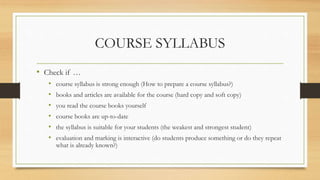
COURSE SYLLABUS
• Check if …
• course syllabus is strong enough (How to prepare a course syllabus?)
• books and articles are available for the course (hard copy and soft copy)
• you read the course books yourself
• course books are up-to-date
• the syllabus is suitable for your students (the weakest and strongest student)
• evaluation and marking is interactive (do students produce something or do they repeat
what is already known?)
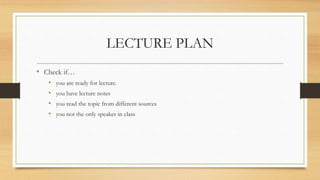
LECTURE PLAN
• Check if…
• you are ready for lecture.
• you have lecture notes
• you read the topic from different sources
• you not the only speaker in class
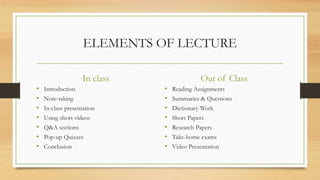
ELEMENTS OF LECTURE
In class
• Introduction
• Note-taking
• In-class presentation
• Using short videos
• Q&A sections
• Pop-up Quizzes
• Conclusion
Out of Class
• Reading Assignments
• Summaries & Questions
• Dictionary Work
• Short Papers
• Research Papers
• Take-home exams
• Video Presentation
SOURCES
Bill Wilder,How Learning Can Change Behavior, Produce Results.
http://www.reliableplant.com/Read/28781/learning-change-behavior. Access
date: December 24, 2015
Conclusion and Remarks
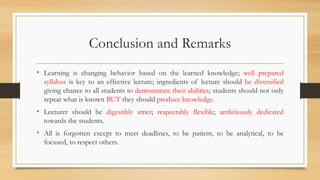
• Learning is changing behavior based on the learned knowledge; well prepared
syllabus is key to an effective lecture; ingredients of lecture should be diversified
giving chance to all students to demonstrate their abilities; students should not only
repeat what is known BUT they should produce knowledge.
• Lecturer should be digestibly strict; respectably flexible; ambitiously dedicated
towards the students.
• All is forgotten except to meet deadlines, to be patient, to be analytical, to be
focused, to respect others.
THANKS FOR YOUR ATTENTION!

Seminar on lecturing

  • 1.
    Learning is changingbehavior; teaching is changing yourself… Dr. Ibrahim Koncak International Atatürk Alatoo University
  • 2.
    SEMINAR PLAN • Warm-upactivity • Reality and Questions • Syllabus Preparing • Lecture Plan • Elements of lecture • Nurbek doesn’t want to go to university • Conclusion remarks and Questions
  • 3.
    WARM UP ACTIVITY •Write 3 questions you would like to ask to the presenter on this topic? • Write the title of the methodology book you read recently on the other side of the paper. • Write the title of the last book you finished reading in last three months on back of the paper. • Write the title of the book you are reading at the moment.
  • 4.
    REALITY AND QUESTIONS •Students forget most of the details they have learned just after the lecture is over; they forget the remaining following the exams; they start to forget the titles of the lectures in five years; in ten years’ time students forget most of the titles of the lectures if they are not in the academia. • Exceptions? Well, exceptions do not change the rule… Fundamental Questions: • Why do we teach what we teach then? What is our goal in teaching as a lecturer/teacher? Are we wasting time or is there a way to do something about it?
  • 5.
    COURSE SYLLABUS • Checkif … • course syllabus is strong enough (How to prepare a course syllabus?) • books and articles are available for the course (hard copy and soft copy) • you read the course books yourself • course books are up-to-date • the syllabus is suitable for your students (the weakest and strongest student) • evaluation and marking is interactive (do students produce something or do they repeat what is already known?)
  • 6.
    LECTURE PLAN • Checkif… • you are ready for lecture. • you have lecture notes • you read the topic from different sources • you not the only speaker in class
  • 7.
    ELEMENTS OF LECTURE Inclass • Introduction • Note-taking • In-class presentation • Using short videos • Q&A sections • Pop-up Quizzes • Conclusion Out of Class • Reading Assignments • Summaries & Questions • Dictionary Work • Short Papers • Research Papers • Take-home exams • Video Presentation
  • 8.
    SOURCES Bill Wilder,How LearningCan Change Behavior, Produce Results. http://www.reliableplant.com/Read/28781/learning-change-behavior. Access date: December 24, 2015
  • 9.
    Conclusion and Remarks •Learning is changing behavior based on the learned knowledge; well prepared syllabus is key to an effective lecture; ingredients of lecture should be diversified giving chance to all students to demonstrate their abilities; students should not only repeat what is known BUT they should produce knowledge. • Lecturer should be digestibly strict; respectably flexible; ambitiously dedicated towards the students. • All is forgotten except to meet deadlines, to be patient, to be analytical, to be focused, to respect others.
  • 10.
    THANKS FOR YOURATTENTION!