www.politicsassociation.com


                      A Level Ideologies

                          Neo-Conservatism
www.politicsassociation.com


     Why the ‘neo’?

     • Liberals first applied the "neo" prefix to their
          comrades who broke ranks to become more
          conservative in the 1960s and 70s.
     •    The defectors remained more liberal on some
          domestic policy issues.
     •    Foreign policy stands have always defined
          neoconservatism.
     •    Where other conservatives favoured détente and
          containment of the Soviet Union, neocons
          pushed direct confrontation.
www.politicsassociation.com


     Neo-Conservative world-view

     • A critique of modern society:
     1.      Moral decline
     2.      Crime
     3.      Drugs
     4.      Prostitution / pornography
     5.      Decline in family values – teenage pregnancies
www.politicsassociation.com


     Neo-Cons – in their own words
     • we need to increase defence spending significantly if we
          are to carry out our global responsibilities today and
          modernize our armed forces for the future;
     •    we need to strengthen our ties to democratic allies and
          to challenge regimes hostile to our interests and values;
     •    we need to promote the cause of political and economic
          freedom abroad;
     •    we need to accept responsibility for America's unique
          role in preserving and extending an international order
          friendly to our security, our prosperity, and our principles.
           Statement of Principles of the Project of New American Century (1997)
www.politicsassociation.com


     Neo-Conservative foreign policy

     • Interventionist, sometimes described as ‘hawkish’.
     • Intervention – to replace to replace autocratic regimes
          with democratic ones.
Neo-Conservative domestic
www.politicsassociation.com


     policy
     • Neoconservatives          are less sceptical of
          government than other conservatives.
     •    They are less worried about reducing the size of
          government, less enthusiastic about tax cuts,
          more concerned about forging national crusades
          that can tap either the American public's
          patriotism or its desire for reform.
www.politicsassociation.com


     Neo-Cons – who are they?
     • Individuals
     • James Burnham , founding editor at the conservative National
       Review and a vocal anticommunist figure of the Cold War era,
       started his political life as a Trotskyite. James Burnham and the
       Struggle for the World: Daniel Kelly. ISI Books, 2002.
     • Max Shactman , a philosophical founder of the Democrat
       Socialists, USA, that was guided for many years by Michael
       Harrington, gravitated from Trotskyism to Socialism and finally to
       neoconservatism. Shactman urged the Socialists to support U.S.
       funding of the Nicaraguan contras and support nuclear weapons in
       Europe and the Pacific.
     • Irving Kristol , Distinguished Fellow at the conservative American
       Enterprise Institute and a former editor of the once liberal
       Commentary magazine, is also considered a leading founder of
       Neoconservatism.
     • Leo Strauss , a guiding philosopher of Neoconservative thought,
       has been credited with giving the Neocons the proposition that "not
       all lies are self-evident."
www.politicsassociation.com


     Neo-Cons – who are they?

     • Organisations
          Heritage      Foundation ,     American
          Enterprise Institute , Empower America
          and Project for a New American century
          are only a few of many organizations that
          present the new conservative mindset.
www.politicsassociation.com


     Neo-Cons – who are they?

     • In government
          Government    officials   of   prominent
          importance in administrations of the last
          twenty years and well-identified with the
          Neocon ideology include State and
          Defence department appointees Elliott
          Abrams, Richard Perle, Paul Wolfowitz,
          Douglas Feith, Lewis "Scooter" Libby,
          and John R. Bolton, former CIA Director
          James Woolsey and previous Democrat
          and UN representative Jeane Kirkpatrick.
www.politicsassociation.com


     Neo-Cons – who are they?

     • In the print media
          The media well represents the voice of
          Neoconservatism in the writings of pro-
          war Campus Watch leader Daniel Pipes,
          syndicated       columnists     Charles
          Krauthammer and Robert Kagan, media
          pundit David Brooks, Weekly Standard’s
          Bill Kristol and Commentary Magazine's
          Norman Podhoretz.
www.politicsassociation.com


     Neo-Cons – who are they?

     • In television
          News         empires      and    television
          broadcasters , principally Reverend Moon's
          Washington Times a nd Rupert Murdoch's
          Fox News , favor Neocon policies and
          personalities.
www.politicsassociation.com


     Neo-Cons – who are they?

     • Big business
          Financial support of the organizations
          that favour the Neocons (as well as other
          conservative causes) come from the
          Lynde and Harry Bradley Foundation
          ($489 million in 2002), chemical and
          munitions profits of the John M. Olin
          Foundation and the banking and oil
          money of The Scaife Foundations of
          Pittsburgh.
www.politicsassociation.com


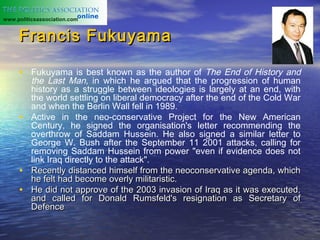
     Francis Fukuyama

     • Fukuyama is best known as the author of The End of History and
       the Last Man, in which he argued that the progression of human
       history as a struggle between ideologies is largely at an end, with
       the world settling on liberal democracy after the end of the Cold War
       and when the Berlin Wall fell in 1989.
     • Active in the neo-conservative Project for the New American
       Century, he signed the organisation's letter recommending the
       overthrow of Saddam Hussein. He also signed a similar letter to
       George W. Bush after the September 11 2001 attacks, calling for
       removing Saddam Hussein from power "even if evidence does not
       link Iraq directly to the attack".
     • Recently distanced himself from the neoconservative agenda, which
       he felt had become overly militaristic.
     • He did not approve of the 2003 invasion of Iraq as it was executed,
       and called for Donald Rumsfeld's resignation as Secretary of
       Defence
www.politicsassociation.com


     Is Tony Blair a neo-con?

     • Prepared to use military force for moral purposes?
     • A shift of political beliefs from left to right?
     • A strong belief in religion?
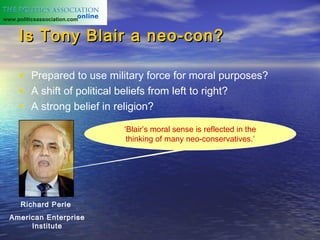
                              ‘Blair’s moral sense is reflected in the
                               thinking of many neo-conservatives.’


      Richard Perle
  American Enterprise
       Institute
www.politicsassociation.com


     It gets even more confusing -
     • Centrist – Just what it sounds like. Someone who doesn’t have any
          particularly strong ideological leanings in any direction.
     •    Left-libertarian –An anti-statist who is somewhat fearful of corporate and
          religious influence on public life.
     •    Liberal – Supports economic regulation to promote social justice and takes
          a progressive stance toward moral or cultural issues.
     •    Libertarian – A libertarian opposes most or all government activities. Does
          not favour much or any government support for either moral or economic
          systems.
     •    Paleoconservative – "Paleocons" want less US involvement in foreign
          affairs than other conservatives and oppose mass immigration. They are
          also more favourably disposed toward the South and the idea of secession,
          or at least decentralization, than neoconservatives.
     •    Paleo-libertarian – Similar to other libertarians except for opposition to
          mass immigration, and shares the paleocon appreciation of the South.
     •    Radical – Critical of bourgeois morality and strongly opposed to capitalism
          and willing to use state power to achieve desired ends.
     •    Third-way – More supportive of foreign intervention than liberals and less
          supportive of economic regulation, coupled with more-or-less progressive
          social views. "Third-way" is to liberal what neoconservative is to
          conservative.

Neo conservatism

  • 1.
    www.politicsassociation.com A Level Ideologies Neo-Conservatism
  • 2.
    www.politicsassociation.com Why the ‘neo’? • Liberals first applied the "neo" prefix to their comrades who broke ranks to become more conservative in the 1960s and 70s. • The defectors remained more liberal on some domestic policy issues. • Foreign policy stands have always defined neoconservatism. • Where other conservatives favoured détente and containment of the Soviet Union, neocons pushed direct confrontation.
  • 3.
    www.politicsassociation.com Neo-Conservative world-view • A critique of modern society: 1. Moral decline 2. Crime 3. Drugs 4. Prostitution / pornography 5. Decline in family values – teenage pregnancies
  • 4.
    www.politicsassociation.com Neo-Cons – in their own words • we need to increase defence spending significantly if we are to carry out our global responsibilities today and modernize our armed forces for the future; • we need to strengthen our ties to democratic allies and to challenge regimes hostile to our interests and values; • we need to promote the cause of political and economic freedom abroad; • we need to accept responsibility for America's unique role in preserving and extending an international order friendly to our security, our prosperity, and our principles. Statement of Principles of the Project of New American Century (1997)
  • 5.
    www.politicsassociation.com Neo-Conservative foreign policy • Interventionist, sometimes described as ‘hawkish’. • Intervention – to replace to replace autocratic regimes with democratic ones.
  • 6.
    Neo-Conservative domestic www.politicsassociation.com policy • Neoconservatives are less sceptical of government than other conservatives. • They are less worried about reducing the size of government, less enthusiastic about tax cuts, more concerned about forging national crusades that can tap either the American public's patriotism or its desire for reform.
  • 7.
    www.politicsassociation.com Neo-Cons – who are they? • Individuals • James Burnham , founding editor at the conservative National Review and a vocal anticommunist figure of the Cold War era, started his political life as a Trotskyite. James Burnham and the Struggle for the World: Daniel Kelly. ISI Books, 2002. • Max Shactman , a philosophical founder of the Democrat Socialists, USA, that was guided for many years by Michael Harrington, gravitated from Trotskyism to Socialism and finally to neoconservatism. Shactman urged the Socialists to support U.S. funding of the Nicaraguan contras and support nuclear weapons in Europe and the Pacific. • Irving Kristol , Distinguished Fellow at the conservative American Enterprise Institute and a former editor of the once liberal Commentary magazine, is also considered a leading founder of Neoconservatism. • Leo Strauss , a guiding philosopher of Neoconservative thought, has been credited with giving the Neocons the proposition that "not all lies are self-evident."
  • 8.
    www.politicsassociation.com Neo-Cons – who are they? • Organisations Heritage Foundation , American Enterprise Institute , Empower America and Project for a New American century are only a few of many organizations that present the new conservative mindset.
  • 9.
    www.politicsassociation.com Neo-Cons – who are they? • In government Government officials of prominent importance in administrations of the last twenty years and well-identified with the Neocon ideology include State and Defence department appointees Elliott Abrams, Richard Perle, Paul Wolfowitz, Douglas Feith, Lewis "Scooter" Libby, and John R. Bolton, former CIA Director James Woolsey and previous Democrat and UN representative Jeane Kirkpatrick.
  • 10.
    www.politicsassociation.com Neo-Cons – who are they? • In the print media The media well represents the voice of Neoconservatism in the writings of pro- war Campus Watch leader Daniel Pipes, syndicated columnists Charles Krauthammer and Robert Kagan, media pundit David Brooks, Weekly Standard’s Bill Kristol and Commentary Magazine's Norman Podhoretz.
  • 11.
    www.politicsassociation.com Neo-Cons – who are they? • In television News empires and television broadcasters , principally Reverend Moon's Washington Times a nd Rupert Murdoch's Fox News , favor Neocon policies and personalities.
  • 12.
    www.politicsassociation.com Neo-Cons – who are they? • Big business Financial support of the organizations that favour the Neocons (as well as other conservative causes) come from the Lynde and Harry Bradley Foundation ($489 million in 2002), chemical and munitions profits of the John M. Olin Foundation and the banking and oil money of The Scaife Foundations of Pittsburgh.
  • 13.
    www.politicsassociation.com Francis Fukuyama • Fukuyama is best known as the author of The End of History and the Last Man, in which he argued that the progression of human history as a struggle between ideologies is largely at an end, with the world settling on liberal democracy after the end of the Cold War and when the Berlin Wall fell in 1989. • Active in the neo-conservative Project for the New American Century, he signed the organisation's letter recommending the overthrow of Saddam Hussein. He also signed a similar letter to George W. Bush after the September 11 2001 attacks, calling for removing Saddam Hussein from power "even if evidence does not link Iraq directly to the attack". • Recently distanced himself from the neoconservative agenda, which he felt had become overly militaristic. • He did not approve of the 2003 invasion of Iraq as it was executed, and called for Donald Rumsfeld's resignation as Secretary of Defence
  • 14.
    www.politicsassociation.com Is Tony Blair a neo-con? • Prepared to use military force for moral purposes? • A shift of political beliefs from left to right? • A strong belief in religion? ‘Blair’s moral sense is reflected in the thinking of many neo-conservatives.’ Richard Perle American Enterprise Institute
  • 15.
    www.politicsassociation.com It gets even more confusing - • Centrist – Just what it sounds like. Someone who doesn’t have any particularly strong ideological leanings in any direction. • Left-libertarian –An anti-statist who is somewhat fearful of corporate and religious influence on public life. • Liberal – Supports economic regulation to promote social justice and takes a progressive stance toward moral or cultural issues. • Libertarian – A libertarian opposes most or all government activities. Does not favour much or any government support for either moral or economic systems. • Paleoconservative – "Paleocons" want less US involvement in foreign affairs than other conservatives and oppose mass immigration. They are also more favourably disposed toward the South and the idea of secession, or at least decentralization, than neoconservatives. • Paleo-libertarian – Similar to other libertarians except for opposition to mass immigration, and shares the paleocon appreciation of the South. • Radical – Critical of bourgeois morality and strongly opposed to capitalism and willing to use state power to achieve desired ends. • Third-way – More supportive of foreign intervention than liberals and less supportive of economic regulation, coupled with more-or-less progressive social views. "Third-way" is to liberal what neoconservative is to conservative.