CIRCUIT BREAKER
SAROJ KUMAR SAHOO
ELECTRICAL –2(A)
REGD NO-1401227304
Contents
Introduction
 Operating mechanism
 Types of circuit breakers
 Air Blast circuit breaker
 Vacuum circuit breaker
 Oil circuit breaker
 SF6 circuit breaker
 Conclusion
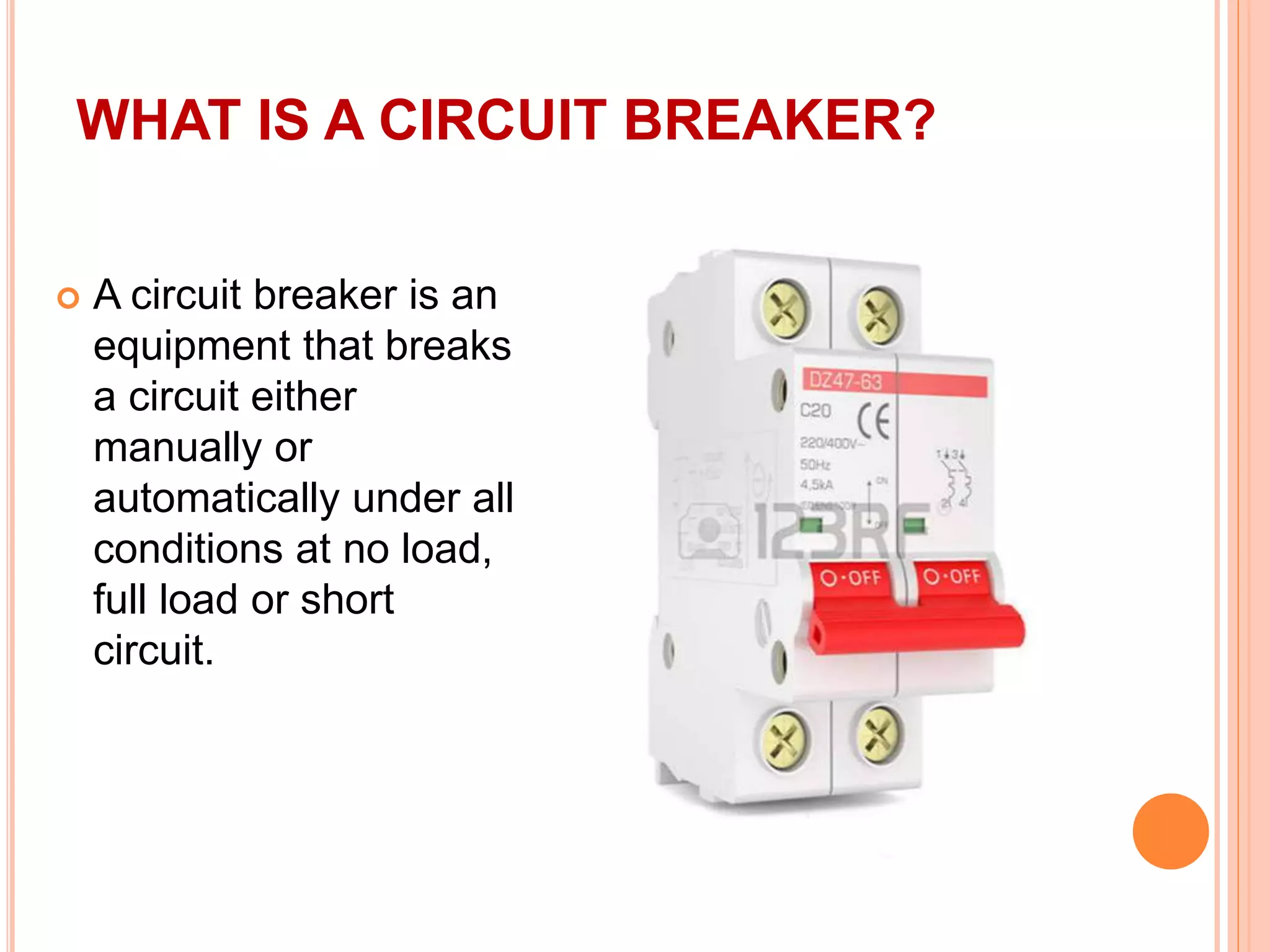
WHAT IS A CIRCUIT BREAKER?
 A circuit breaker is an
equipment that breaks
a circuit either
manually or
automatically under all
conditions at no load,
full load or short
circuit.
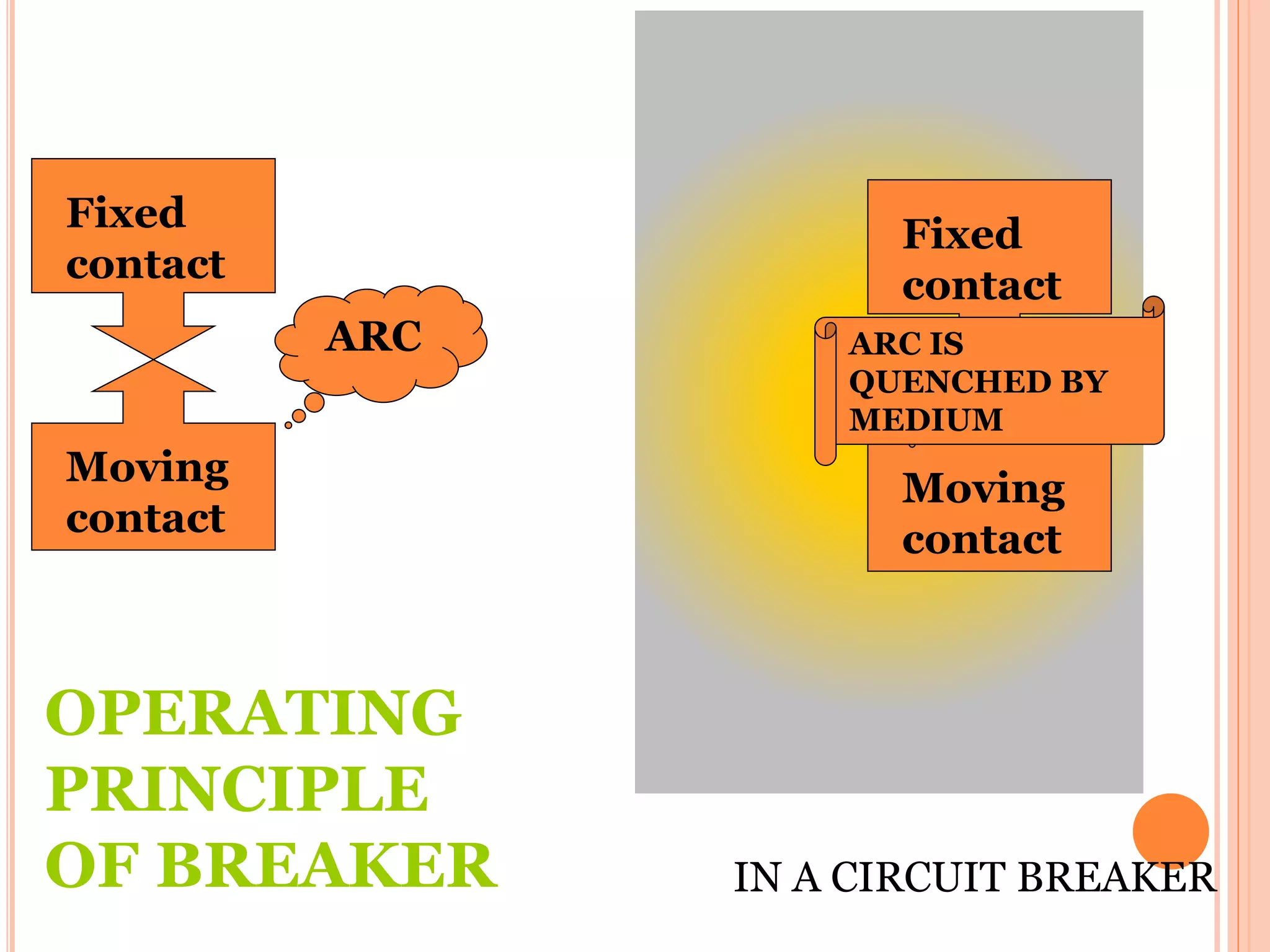
OPERATING PRINCIPLE
 Two contacts
called electrode
remains closed
under normal
operating
conditions. When
fault occurs on any
part of the system,
the trip coil of the
circuit breaker get
energized and
contacts are
separated.
Fixed
contact
Moving
contact
ARC
Fixed
contact
Moving
contact
ARCARC IS
QUENCHED BY
MEDIUM
IN A CIRCUIT BREAKER
OPERATING
PRINCIPLE
OF BREAKER
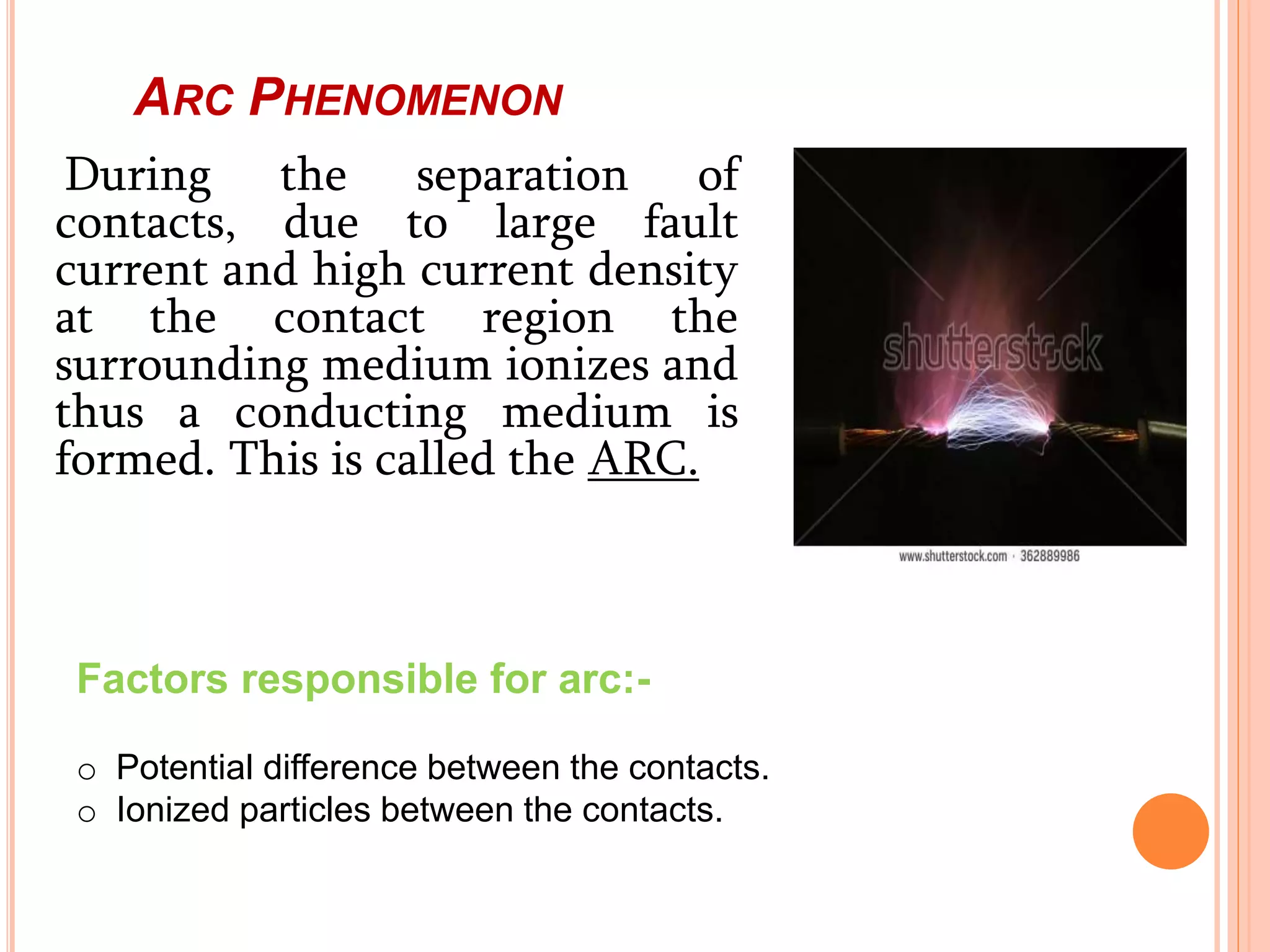
ARC PHENOMENON
During the separation of
contacts, due to large fault
current and high current density
at the contact region the
surrounding medium ionizes and
thus a conducting medium is
formed. This is called the ARC.
Factors responsible for arc:-
o Potential difference between the contacts.
o Ionized particles between the contacts.
PRINCIPLES OF ARC EXTINCTION
Arc quenching is achieved by:
 Greater dielectric strength than restriking voltage.
 Faster rate of heat removal than rate of heat
generation.
Arc extinction methods are:
 By lengthening the gap.
 Cooling the arc.
 Inserting medium of high dielectric strength.
TYPES OF
CIRCUIT
BREAKER
OIL
CIRCUIT
BREAKER
AIR BLAST
CIRCUIT
BREAKER
SF6
CIRCUIT
BREAKER
VACCUM
CIRCUIT
BREAKER
OIL CIRCUIT BREAKER
 It is designed for 11kv-
765kv.
 These are of two types
• BOCB (Bulk oil Circuit Breaker)
• MOCB (Minimum oil Circuit Breaker)
 The contacts are immersed
in oil bath.
 Oil provides cooling by
hydrogen created by arc.
 It acts as a good dielectric
medium and quenches the
arc.
Advantages:
Oil has good dielectric strength.
 Low cost.
Oil is easily available.
It has wide range of breaking capability.
Disadvantages:
Slower operation , takes about 20 cycles for arc
quenching.
It is highly inflammable , so high risk of fire.
High maintenance cost.
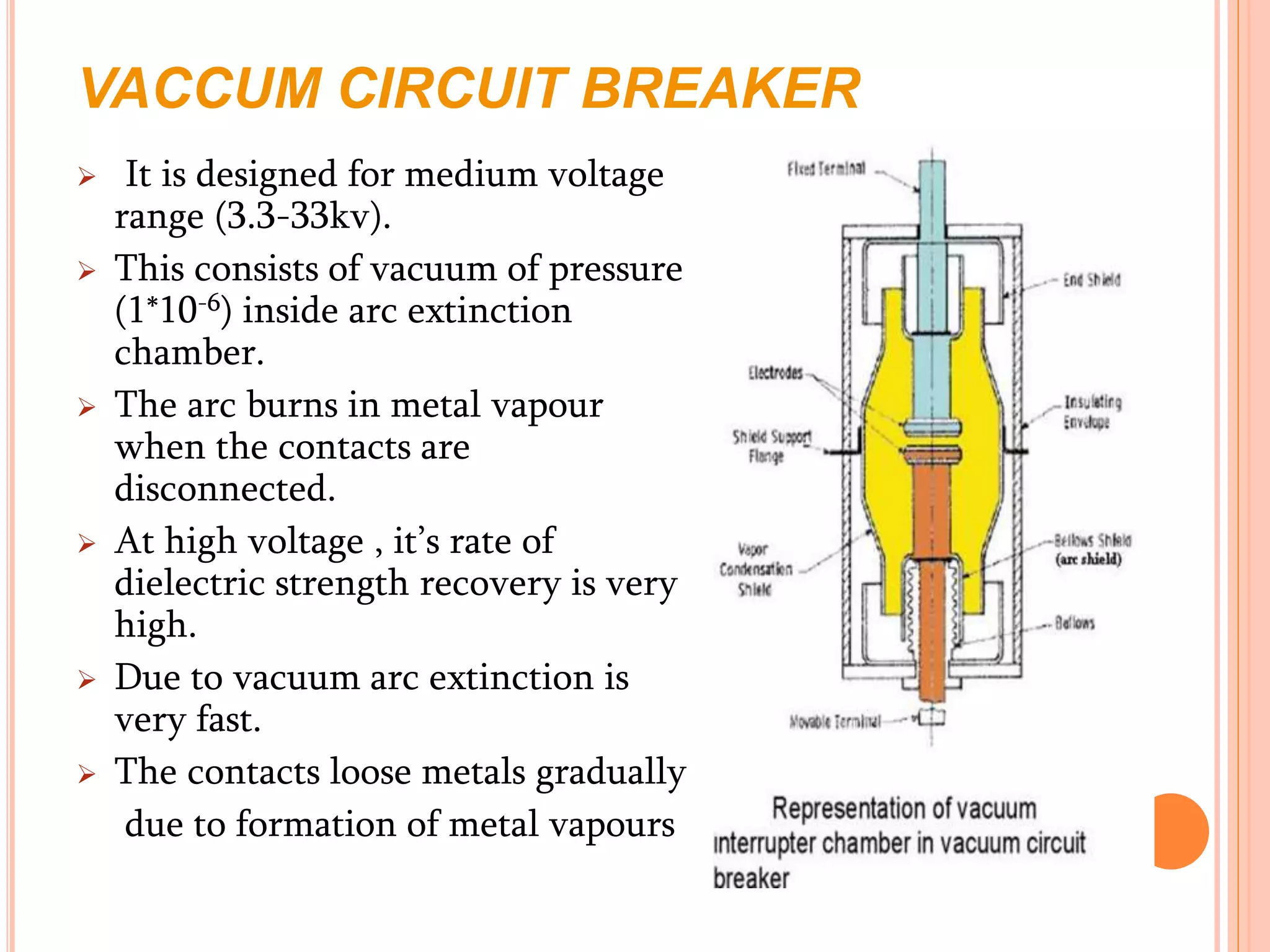
VACCUM CIRCUIT BREAKER
 It is designed for medium voltage
range (3.3-33kv).
 This consists of vacuum of pressure
(1*10-6) inside arc extinction
chamber.
 The arc burns in metal vapour
when the contacts are
disconnected.
 At high voltage , it’s rate of
dielectric strength recovery is very
high.
 Due to vacuum arc extinction is
very fast.
 The contacts loose metals gradually
due to formation of metal vapours
Advantages:
Free from arc and fire hazards.
Low cost for maintenance & simpler mechanism.
Low arcing time & high contact life.
Silent and less vibrational operation.
Due to vacuum contacts remain free from
corrosion.
No byproducts formed.
Disadvantages:
High initial cost due to creation of vacuum.
Surface of contacts are depleted due to metal
vapours.
High cost & size required for high voltage
breakers.
AIR BLAST CIRCUIT BREAKERS
This operates using high velocity blast of air
which quenches the arc.
It consists of blast valve , blast tube &
contacts.
Blast valve contains air at high pressure.
Blast tube carries the air at high pressure &
opens the moving contact attached to spring.
There is no carbonization of surface as in
VCB.
Air should be kept clean & dry to operate it
properly.
Advantages:
High speed operation as compared to OCB.
Ability to withstand frequent switching.
Facility for high speed reclosure.
Less maintenance as compared to OCB.
Disadvantages:
Little moisture content prolongs arcing time.
Pressure should be checked frequently for
frequent operation.
Risk of fire hazards due to over voltages.
It can’t be used for high voltage operation
due to prolonged arc quenching.
SF6 CIRCUIT BREAKERS
 It contains an arc interruption chamber containing SF6 gas.
 In closed position the contacts remain surrounded
by SF6 gas at a pressure of 2.8 kg/cm2 .
 During opening high pressure SF6 gas at 14 kg/cm2 from its
reservoir flows towards the chamber by valve mechanism.
 SF6 rapidly absorbs the free electrons in the arc path to form
immobile negative ions to build up high dielectric strength.
 It also cools the arc and extinguishes it.
 After operation the valve is closed by the action of a set of
springs.
 Absorbent materials are used to absorb the byproducts and
moisture.
Advantages:
 Very short arcing period due to superior arc quenching
property of SF6 .
 Can interrupt much larger currents as compared to other
breakers.
 No risk of fire.
 Low maintenance, light foundation.
 No over voltage problem.
 There are no carbon deposits.
Disadvantages:
 SF6 breakers are costly due to high cost of SF6.
 SF6 gas has to be reconditioned after every operation of the
breaker, additional equipment is required for this purpose.
CONCLUSION:
Therefore, we conclude that circuit breaker is
the most essential part of the electrical
networks as it protects every device from
damage. It helps us to detect the fault and area
affected by it. Nowadays vacuum and SF6
circuit breakers are widely used due to their
reliable and fast operations.
Seminar on circuit breaker

Seminar on circuit breaker

  • 1.
    CIRCUIT BREAKER SAROJ KUMARSAHOO ELECTRICAL –2(A) REGD NO-1401227304
  • 2.
    Contents Introduction  Operating mechanism Types of circuit breakers  Air Blast circuit breaker  Vacuum circuit breaker  Oil circuit breaker  SF6 circuit breaker  Conclusion
  • 3.
    WHAT IS ACIRCUIT BREAKER?  A circuit breaker is an equipment that breaks a circuit either manually or automatically under all conditions at no load, full load or short circuit.
  • 4.
    OPERATING PRINCIPLE  Twocontacts called electrode remains closed under normal operating conditions. When fault occurs on any part of the system, the trip coil of the circuit breaker get energized and contacts are separated.
  • 5.
  • 6.
    ARC PHENOMENON During theseparation of contacts, due to large fault current and high current density at the contact region the surrounding medium ionizes and thus a conducting medium is formed. This is called the ARC. Factors responsible for arc:- o Potential difference between the contacts. o Ionized particles between the contacts.
  • 7.
    PRINCIPLES OF ARCEXTINCTION Arc quenching is achieved by:  Greater dielectric strength than restriking voltage.  Faster rate of heat removal than rate of heat generation. Arc extinction methods are:  By lengthening the gap.  Cooling the arc.  Inserting medium of high dielectric strength.
  • 8.
  • 9.
    OIL CIRCUIT BREAKER It is designed for 11kv- 765kv.  These are of two types • BOCB (Bulk oil Circuit Breaker) • MOCB (Minimum oil Circuit Breaker)  The contacts are immersed in oil bath.  Oil provides cooling by hydrogen created by arc.  It acts as a good dielectric medium and quenches the arc.
  • 10.
    Advantages: Oil has gooddielectric strength.  Low cost. Oil is easily available. It has wide range of breaking capability. Disadvantages: Slower operation , takes about 20 cycles for arc quenching. It is highly inflammable , so high risk of fire. High maintenance cost.
  • 11.
    VACCUM CIRCUIT BREAKER It is designed for medium voltage range (3.3-33kv).  This consists of vacuum of pressure (1*10-6) inside arc extinction chamber.  The arc burns in metal vapour when the contacts are disconnected.  At high voltage , it’s rate of dielectric strength recovery is very high.  Due to vacuum arc extinction is very fast.  The contacts loose metals gradually due to formation of metal vapours
  • 12.
    Advantages: Free from arcand fire hazards. Low cost for maintenance & simpler mechanism. Low arcing time & high contact life. Silent and less vibrational operation. Due to vacuum contacts remain free from corrosion. No byproducts formed. Disadvantages: High initial cost due to creation of vacuum. Surface of contacts are depleted due to metal vapours. High cost & size required for high voltage breakers.
  • 13.
    AIR BLAST CIRCUITBREAKERS This operates using high velocity blast of air which quenches the arc. It consists of blast valve , blast tube & contacts. Blast valve contains air at high pressure. Blast tube carries the air at high pressure & opens the moving contact attached to spring. There is no carbonization of surface as in VCB. Air should be kept clean & dry to operate it properly.
  • 15.
    Advantages: High speed operationas compared to OCB. Ability to withstand frequent switching. Facility for high speed reclosure. Less maintenance as compared to OCB. Disadvantages: Little moisture content prolongs arcing time. Pressure should be checked frequently for frequent operation. Risk of fire hazards due to over voltages. It can’t be used for high voltage operation due to prolonged arc quenching.
  • 16.
    SF6 CIRCUIT BREAKERS It contains an arc interruption chamber containing SF6 gas.  In closed position the contacts remain surrounded by SF6 gas at a pressure of 2.8 kg/cm2 .  During opening high pressure SF6 gas at 14 kg/cm2 from its reservoir flows towards the chamber by valve mechanism.  SF6 rapidly absorbs the free electrons in the arc path to form immobile negative ions to build up high dielectric strength.  It also cools the arc and extinguishes it.  After operation the valve is closed by the action of a set of springs.  Absorbent materials are used to absorb the byproducts and moisture.
  • 18.
    Advantages:  Very shortarcing period due to superior arc quenching property of SF6 .  Can interrupt much larger currents as compared to other breakers.  No risk of fire.  Low maintenance, light foundation.  No over voltage problem.  There are no carbon deposits. Disadvantages:  SF6 breakers are costly due to high cost of SF6.  SF6 gas has to be reconditioned after every operation of the breaker, additional equipment is required for this purpose.
  • 19.
    CONCLUSION: Therefore, we concludethat circuit breaker is the most essential part of the electrical networks as it protects every device from damage. It helps us to detect the fault and area affected by it. Nowadays vacuum and SF6 circuit breakers are widely used due to their reliable and fast operations.