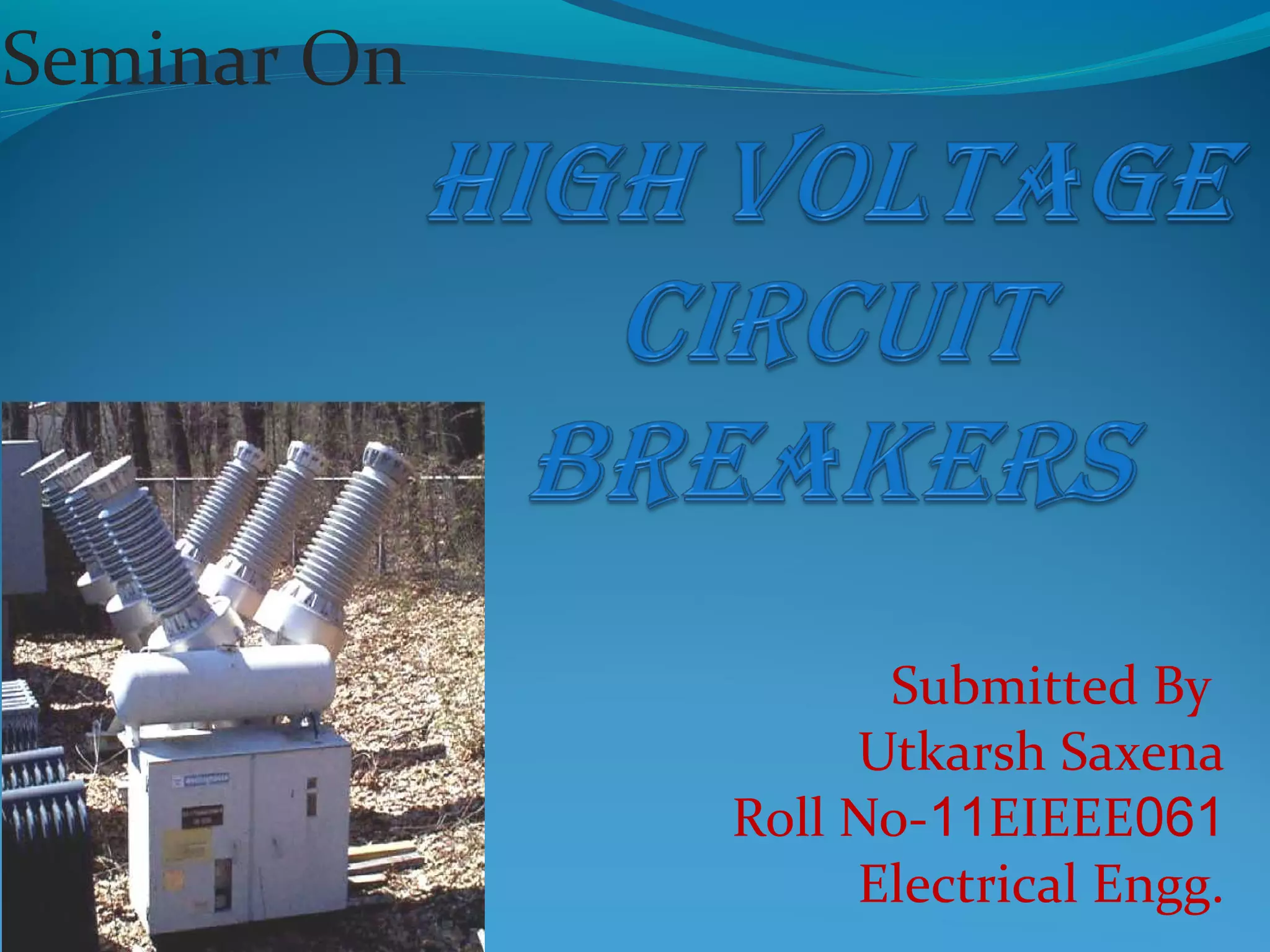
Submitted By
Utkarsh Saxena
Roll No-11EIEEE061
Electrical Engg.
Seminar On
Contents
 Introduction
 Operating mechanism
 Types of circuit breakers
 Air Blast circuit breaker
 Vacuum circuit breaker
 Oil circuit breaker
 SF6 circuit breaker
 Conclusion
Introduction
 A circuit breaker is a mechanical switching
device, capable of making, carrying
and breaking currents under normal
circuit conditions. It is also capable of
making and carrying currents for a
specified time and breaking currents
under specified abnormal circuit
conditions, such as those of a short
circuit.
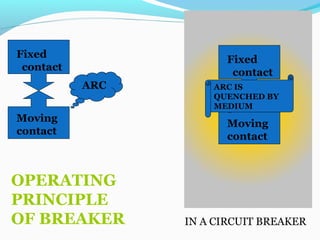
Fixed
contact
Moving
contact
ARC
Fixed
contact
Moving
contact
ARC
ARC IS
QUENCHED BY
MEDIUM
IN A CIRCUIT BREAKER
OPERATING
PRINCIPLE
OF BREAKER
Operating Mechanism
Circuit Breaker consistsof two contacts:
Fixed contact.
Moving contact.
Moving contact isused to makeand break thecircuit
using stored energiesin theform of spring or compressed
air.
Spring, pneumatic or oil damping isused to arrest the
speed of mc whileclosing.
FC containsaspring which holdsthemc after closing.
 Circuit breaker consistsof two coils:
Closing coil –Used to closethecircuit.
Tripping coil-Used to trip thecircuit.
 Thesecoilsactivatethestored energy and directs
themc to open or close.
 DC batteriesareused to energizethesecoils.
 Solenoidsareused to closeor trip it.
 CBsareusually arranged with pilot devicesto
senseafault current and to operatethetrip
opening mechanism.
The Electric Arc
During the separation of contacts, due to large fault
current and high current density at the contact region
the surrounding medium ionizes and thus a
conducting medium is formed. This is called the
ARC.
Factorsresponsiblefor arc:-
Potential differencebetween thecontacts.
Ionized particlesbetween thecontacts.
Arc quenching isachieved by:
Greater dielectric strength than restriking voltage.
Faster rateof heat removal than rateof heat
generation.
Arc extinction methodsare:
By lengthening thegap.
Cooling thearc.
Inserting medium of high dielectric strength.
PRINCIPLES OF ARC
EXTINCTION
Types Of Circuit Breakers
Oil Circuit Breakers
Vacuum Circuit Breakers
AirBlast Circuit Breakers
SF6 Circuit Breakers
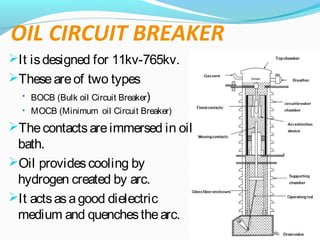
OIL CIRCUIT BREAKER
It isdesigned for 11kv-765kv.
Theseareof two types
• BOCB (Bulk oil Circuit Breaker)
• MOCB (Minimum oil Circuit Breaker)
Thecontactsareimmersed in oil
bath.
Oil providescooling by
hydrogen created by arc.
It actsasagood dielectric
medium and quenchesthearc.
Advantages:
Oil hasgood dielectric strength.
 Low cost.
Oil iseasily available.
It haswiderangeof breaking capability.
Disadvantages:
Slower operation , takesabout 20 cyclesfor arc
quenching.
It ishighly inflammable, so high risk of fire.
High maintenancecost.
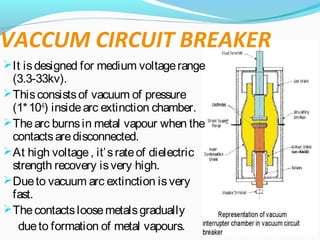
VACCUM CIRCUIT BREAKER
It isdesigned for medium voltagerange
(3.3-33kv).
Thisconsistsof vacuum of pressure
(1*10-6
) insidearc extinction chamber.
Thearc burnsin metal vapour when the
contactsaredisconnected.
At high voltage, it’srateof dielectric
strength recovery isvery high.
Dueto vacuum arc extinction isvery
fast.
Thecontactsloosemetalsgradually
dueto formation of metal vapours.
Advantages:
Freefrom arc and firehazards.
Low cost for maintenance& simpler mechanism.
Low arcing time& high contact life.
Silent and lessvibrational operation.
Dueto vacuum contactsremain freefrom corrosion.
No byproductsformed.
Disadvantages:
High initial cost dueto creation of vacuum.
Surfaceof contactsaredepleted dueto metal vapours.
High cost & sizerequired for high voltagebreakers.
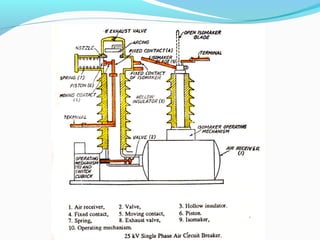
AIR BLAST CIRCUIT BREAKERS
Thisoperatesusing high velocity blast of air which
quenchesthearc.
It consistsof blast valve, blast tube& contacts.
Blast valvecontainsair at high pressure.
Blast tubecarriestheair at high pressure& opensthe
moving contact attached to spring.
Thereisno carbonization of surfaceasin VCB.
Air should bekept clean & dry to operateit properly.
Advantages:
High speed operation ascompared to OCB.
Ability to withstand frequent switching.
Facility for high speed reclosure.
Lessmaintenanceascompared to OCB.
Disadvantages:
Littlemoisturecontent prolongsarcing time.
Pressureshould bechecked frequently for frequent
operation.
Risk of firehazardsdueto over voltages.
It can’t beused for high voltageoperation dueto prolonged
arc quenching.
SF6 CIRCUIT BREAKERS
 It containsan arc interruption chamber containing SF6 gas.
 In closed position thecontactsremain surrounded by SF6 gas
at apressureof 2.8 kg/cm2
.
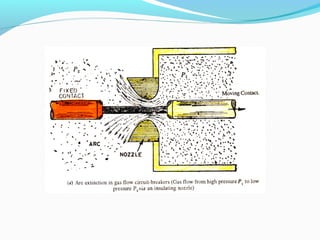
 During opening high pressureSF6 gasat 14 kg/cm2
from its
reservoir flowstowardsthechamber by valvemechanism.
 SF6 rapidly absorbsthefreeelectronsin thearc path to form
immobilenegativeionsto build up high dielectric strength.
 It also coolsthearc and extinguishesit.
 After operation thevalveisclosed by theaction of aset of
springs.
 Absorbent materialsareused to absorb thebyproductsand
moisture.
Advantages:
 Very short arcing period dueto superior arc quenching
property of SF6 .
 Can interrupt much larger currentsascompared to other
breakers.
 No risk of fire.
 Low maintenance, light foundation.
 No over voltageproblem.
 Thereareno carbon deposits.
 SF6 breakersarecostly due to high cost of SF6.
 SF6 gashasto bereconditioned after every operation of the
breaker, additional equipment isrequired for thispurpose.
Disadvantages:
CONCLUSION:
Therefore, weconcludethat circuit breaker is
themost essential part of theelectrical networks
asit protectsevery devicefrom damage. It
helpsusto detect thefault and areaaffected by
it. Nowadays vacuum and SF6 circuit breakers
arewidely used dueto their reliableand fast
operations.
Circuitbreaker

Circuitbreaker

  • 1.
    Submitted By Utkarsh Saxena RollNo-11EIEEE061 Electrical Engg. Seminar On
  • 2.
    Contents  Introduction  Operatingmechanism  Types of circuit breakers  Air Blast circuit breaker  Vacuum circuit breaker  Oil circuit breaker  SF6 circuit breaker  Conclusion
  • 3.
    Introduction  A circuitbreaker is a mechanical switching device, capable of making, carrying and breaking currents under normal circuit conditions. It is also capable of making and carrying currents for a specified time and breaking currents under specified abnormal circuit conditions, such as those of a short circuit.
  • 4.
  • 5.
    Operating Mechanism Circuit Breakerconsistsof two contacts: Fixed contact. Moving contact. Moving contact isused to makeand break thecircuit using stored energiesin theform of spring or compressed air. Spring, pneumatic or oil damping isused to arrest the speed of mc whileclosing. FC containsaspring which holdsthemc after closing.
  • 6.
     Circuit breakerconsistsof two coils: Closing coil –Used to closethecircuit. Tripping coil-Used to trip thecircuit.  Thesecoilsactivatethestored energy and directs themc to open or close.  DC batteriesareused to energizethesecoils.  Solenoidsareused to closeor trip it.  CBsareusually arranged with pilot devicesto senseafault current and to operatethetrip opening mechanism.
  • 7.
    The Electric Arc Duringthe separation of contacts, due to large fault current and high current density at the contact region the surrounding medium ionizes and thus a conducting medium is formed. This is called the ARC. Factorsresponsiblefor arc:- Potential differencebetween thecontacts. Ionized particlesbetween thecontacts.
  • 8.
    Arc quenching isachievedby: Greater dielectric strength than restriking voltage. Faster rateof heat removal than rateof heat generation. Arc extinction methodsare: By lengthening thegap. Cooling thearc. Inserting medium of high dielectric strength. PRINCIPLES OF ARC EXTINCTION
  • 9.
    Types Of CircuitBreakers Oil Circuit Breakers Vacuum Circuit Breakers AirBlast Circuit Breakers SF6 Circuit Breakers
  • 10.
    OIL CIRCUIT BREAKER Itisdesigned for 11kv-765kv. Theseareof two types • BOCB (Bulk oil Circuit Breaker) • MOCB (Minimum oil Circuit Breaker) Thecontactsareimmersed in oil bath. Oil providescooling by hydrogen created by arc. It actsasagood dielectric medium and quenchesthearc.
  • 11.
    Advantages: Oil hasgood dielectricstrength.  Low cost. Oil iseasily available. It haswiderangeof breaking capability. Disadvantages: Slower operation , takesabout 20 cyclesfor arc quenching. It ishighly inflammable, so high risk of fire. High maintenancecost.
  • 12.
    VACCUM CIRCUIT BREAKER Itisdesigned for medium voltagerange (3.3-33kv). Thisconsistsof vacuum of pressure (1*10-6 ) insidearc extinction chamber. Thearc burnsin metal vapour when the contactsaredisconnected. At high voltage, it’srateof dielectric strength recovery isvery high. Dueto vacuum arc extinction isvery fast. Thecontactsloosemetalsgradually dueto formation of metal vapours.
  • 13.
    Advantages: Freefrom arc andfirehazards. Low cost for maintenance& simpler mechanism. Low arcing time& high contact life. Silent and lessvibrational operation. Dueto vacuum contactsremain freefrom corrosion. No byproductsformed. Disadvantages: High initial cost dueto creation of vacuum. Surfaceof contactsaredepleted dueto metal vapours. High cost & sizerequired for high voltagebreakers.
  • 14.
    AIR BLAST CIRCUITBREAKERS Thisoperatesusing high velocity blast of air which quenchesthearc. It consistsof blast valve, blast tube& contacts. Blast valvecontainsair at high pressure. Blast tubecarriestheair at high pressure& opensthe moving contact attached to spring. Thereisno carbonization of surfaceasin VCB. Air should bekept clean & dry to operateit properly.
  • 16.
    Advantages: High speed operationascompared to OCB. Ability to withstand frequent switching. Facility for high speed reclosure. Lessmaintenanceascompared to OCB. Disadvantages: Littlemoisturecontent prolongsarcing time. Pressureshould bechecked frequently for frequent operation. Risk of firehazardsdueto over voltages. It can’t beused for high voltageoperation dueto prolonged arc quenching.
  • 17.
    SF6 CIRCUIT BREAKERS It containsan arc interruption chamber containing SF6 gas.  In closed position thecontactsremain surrounded by SF6 gas at apressureof 2.8 kg/cm2 .  During opening high pressureSF6 gasat 14 kg/cm2 from its reservoir flowstowardsthechamber by valvemechanism.  SF6 rapidly absorbsthefreeelectronsin thearc path to form immobilenegativeionsto build up high dielectric strength.  It also coolsthearc and extinguishesit.  After operation thevalveisclosed by theaction of aset of springs.  Absorbent materialsareused to absorb thebyproductsand moisture.
  • 19.
    Advantages:  Very shortarcing period dueto superior arc quenching property of SF6 .  Can interrupt much larger currentsascompared to other breakers.  No risk of fire.  Low maintenance, light foundation.  No over voltageproblem.  Thereareno carbon deposits.  SF6 breakersarecostly due to high cost of SF6.  SF6 gashasto bereconditioned after every operation of the breaker, additional equipment isrequired for thispurpose. Disadvantages:
  • 20.
    CONCLUSION: Therefore, weconcludethat circuitbreaker is themost essential part of theelectrical networks asit protectsevery devicefrom damage. It helpsusto detect thefault and areaaffected by it. Nowadays vacuum and SF6 circuit breakers arewidely used dueto their reliableand fast operations.