ADIGRAT UNIVERSITY
COLLEGE OF ENGINEERING AND TECHNOLOGY
DEPARTMENT OF INFORMATION TECHNOLOGY
Course Title: IT social, professional and ethical issues
Course Code: ITec4142
Group Leader: Bereket Tesfaw
Group-3 Assignment I
Members Name ID No
1. Bereket Tesfaw 00547/08
2. Samson Tizazu 00625/08
3. Abrhaley Tsegay 00529/08
4. Sisaynew Gobeze 00640/08
5. Nabyom Adisu 00619/08
Submitted to Inst. Tesfaye T.
Submission Date 20/04/2011 E.C 04/06/191
ABSTRACT
This slide gives a review of fiber optic communication system, including
architectural methodologies, key features, applications and furthermore
talks about their future activities towards the next generation. Advantages
and disadvantages of fiber optic communication systems are explained.
Fiber optic systems are vital media transmission foundation for overall
broadband systems. Wide data transfer capacity (bandwidth) signal
transmission with low delay is a key prerequisite in present day
applications.
04/06/192
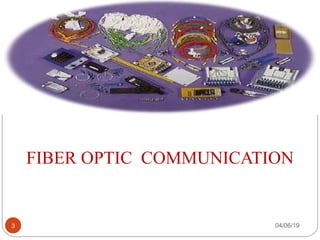
FIBER OPTIC COMMUNICATION
04/06/193
Introduction
Optical communication system consists of transmitter, channel and receiver.
Transmitter consists of amplifier, modulator and a light emitting semi-
conductor device, whereas receiver contains photo detecting devices. Optic
Fiber communication offers extremely high bandwidth, immunity to
electromagnetic interference, non-existent delays and immunity from
interception by external means. Optical fibers are widely used in Fiber-optic
communications, which permits transmission over longer.
04/06/194
History
The world's first wireless telephone transmission between two buildings,
some 213 meters apart. Due to its use of an atmospheric transmission
medium, the Photo phone would not prove practical until advances in
laser and optical fiber technologies permitted the secure transport of light.
The Photo phone's first practical use came in military communication
systems many decades later.
04/06/195
CONT…
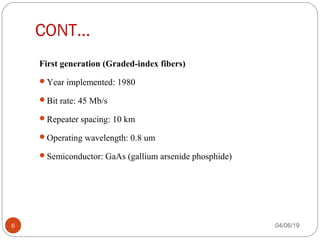
First generation (Graded-index fibers)
Year implemented: 1980
Bit rate: 45 Mb/s
Repeater spacing: 10 km
Operating wavelength: 0.8 um
Semiconductor: GaAs (gallium arsenide phosphide)
04/06/196
CONT…
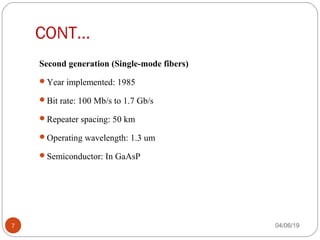
Second generation (Single-mode fibers)
Year implemented: 1985
Bit rate: 100 Mb/s to 1.7 Gb/s
Repeater spacing: 50 km
Operating wavelength: 1.3 um
Semiconductor: In GaAsP
04/06/197
CONT…
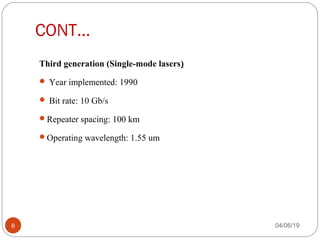
Third generation (Single-mode lasers)
 Year implemented: 1990
 Bit rate: 10 Gb/s
Repeater spacing: 100 km
Operating wavelength: 1.55 um
04/06/198
CONT…
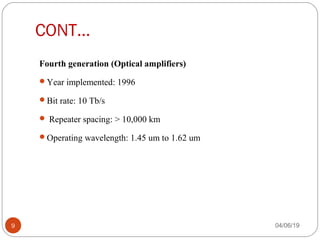
Fourth generation (Optical amplifiers) 
Year implemented: 1996
Bit rate: 10 Tb/s
 Repeater spacing: > 10,000 km
Operating wavelength: 1.45 um to 1.62 um
04/06/199
CONT…
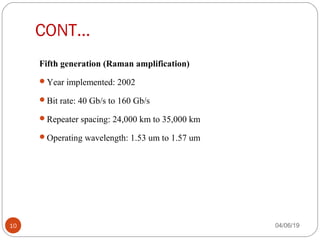
Fifth generation (Raman amplification) 
Year implemented: 2002
Bit rate: 40 Gb/s to 160 Gb/s
Repeater spacing: 24,000 km to 35,000 km
Operating wavelength: 1.53 um to 1.57 um
04/06/1910
Motivation/Push Factors
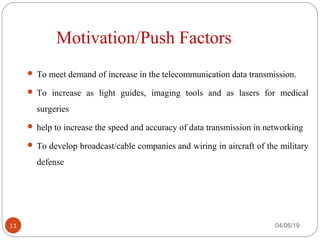
 To meet demand of increase in the telecommunication data transmission.
 To  increase  as  light  guides,  imaging  tools  and  as  lasers  for  medical 
surgeries
 help to increase the speed and accuracy of data transmission in networking
 To develop broadcast/cable companies and wiring in aircraft of the military 
defense
04/06/1911
Meaning of Fiber Optic Communication
What does fiber optic communication mean?
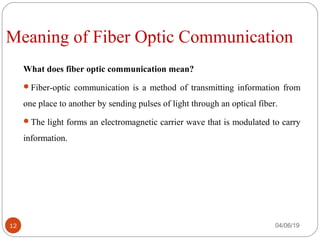
Fiber-optic  communication  is  a  method  of  transmitting  information  from 
one place to another by sending pulses of light through an optical fiber. 
The light forms an electromagnetic carrier wave that is modulated to carry 
information.
04/06/1912
How It Works?
 The transmission entirely depends on electrical signals passing through 
the cable, the fiber optics transmission involves transmission of signals 
in the form of light from one point to the other. Furthermore, a fiber 
optic  communication  network  consists  of  transmitting  and  receiving 
circuitry, a light source and detector devices.
 When the input data, in the form of electrical signals, is given to the 
transmitter circuitry, it converts them into light signal with the help of a 
light source.
04/06/1913
  Architectures and Development Methodology
 Fiber-optic communication systems can be classified into three broad 
categories - point-to-point links, distribution networks, and local-area 
networks.
Point-to-Point Links
 Point-to-point links is the simplest form in fiber-optic communication 
systems.  The  main  role  is  to  transport  information, in  the  form  of 
digital bit stream, from one place to another with high accuracy.
04/06/1914
 Distribution Networks
 In  the  case  of  distribution  networks,  information  is  not  only 
transmitted, but is also distributed to a group of subscribers. 
 Examples include local-loop distribution of telephone services and
 Broadcast of multiple video channels over cable television.
  Such networks have the ability to distribute a wide range of services, 
including telephone, computer data, and video broadcasts.
04/06/1915
CONT…
 Such networks are called metropolitan-area networks (MANs) as hubs 
are typically located in major cities.
 For bus topology, a single fiber cable carries the multichannel optical 
signal throughout the area of service. 
 An example is the common-antenna television (CATV) application of 
bus topology consists of distributing multiple video channels within a 
city. 
04/06/1916
 Local Area Networks
 Local-area networks, also known as LANs, refers to networks in which
a large number of users within a local area are interconnected in such a
way that any user can access the network randomly to transmit data to
any other user.
 Optical-access networks used in a local subscriber loop also fall in this
category For such networks, transmission distance are relative short
(<10 km).
04/06/1917
CONT…
04/06/1918
CONT…
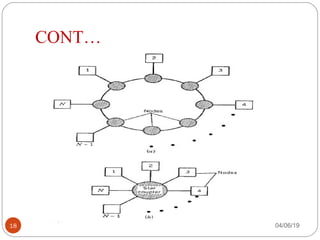
 The figure about shows the structure of (a) ring topology and (b) star
topology for local-area networks.
 In the case of the ring topology, consecutive nodes are connected by
point-to-point links to form a closed ring.
 Each node can transmit and receive the data by using a transmitter–
receiver pair, which also acts as a repeater.
 In the case of the star topology, all nodes are connected through point-
to-point links to a central node called a hub, or simply a star.
04/06/1919
Key Features
 Low attenuation
 Large bandwidth
 Small diameter
 Transmission security
 Thinner and Immunity
 Light weight
 Long distance signal transmission
04/06/1920
Areas of Application
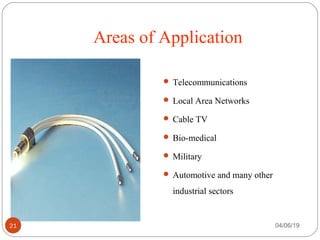
 Telecommunications
 Local Area Networks
 Cable TV
 Bio-medical
 Military
 Automotive and many other
industrial sectors
04/06/1921
Advantages
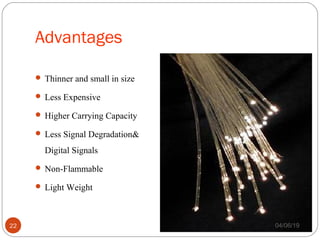
 Thinner and small in size
 Less Expensive
 Higher Carrying Capacity
 Less Signal Degradation&
Digital Signals
 Non-Flammable
 Light Weight
04/06/1922
CONT...
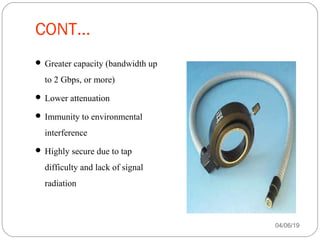
 Greater capacity (bandwidth up
to 2 Gbps, or more)
 Lower attenuation
 Immunity to environmental
interference
 Highly secure due to tap
difficulty and lack of signal
radiation
04/06/19
Disadvantages
 Difficult to Splice.
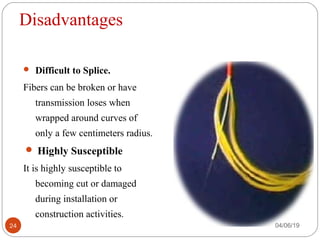
Fibers can be broken or have
transmission loses when
wrapped around curves of
only a few centimeters radius.
 Highly Susceptible
It is highly susceptible to
becoming cut or damaged
during installation or
construction activities.
04/06/1924
CONT…
Expensive to install
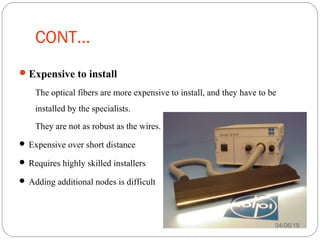
The optical fibers are more expensive to install, and they have to be
installed by the specialists.
They are not as robust as the wires.
 Expensive over short distance
 Requires highly skilled installers
 Adding additional nodes is difficult
04/06/19
Future Activities
The evolution of fiber optic communication has been driven by
advancement in technology and increased demand for fiber optic
communication. It is expected to continue into the future, with the
development of new and more advanced communication technology.
 All Optical Communication Network
 Intelligent Optical Transmission Network
 Improvements in Laser Technology
 Laser Neural Network Nodes
04/06/1926
Conclusion
Fiber optics provides many advantages over copper conductors including
higher bandwidth, transmission of signals over longer distances, lower
weight and cost and immunity from electromagnetic interference. The
fiber optics communications industry is an ever evolving one, the growth
experienced by the industry has been enormous this past decade. There is
still much work to be done to support the need for faster data rates,
advanced switching techniques and more intelligent network
architectures.
04/06/1927
References
 Govind P. Agrawal. (2002). Fiber-optic communications systems (Third
Edition). Rochester, NY: John Wiley & Sons, Inc.
 V.S.Bagad. (2009). Optical fiber communication (First Edition). Pune, India:
Technical Publications Pune.
 Raman Amplification in Fiber Optical Communication Systems (Editors
- Clifford Headley, Govind P. Agrawal)
 http://en.wikipedia.org/wiki/Optical_fiber
04/06/1928
THANK YOU!
ANY QUESTION ?
04/06/1929

It professional assignment

  • 1.
    ADIGRAT UNIVERSITY COLLEGE OFENGINEERING AND TECHNOLOGY DEPARTMENT OF INFORMATION TECHNOLOGY Course Title: IT social, professional and ethical issues Course Code: ITec4142 Group Leader: Bereket Tesfaw Group-3 Assignment I Members Name ID No 1. Bereket Tesfaw 00547/08 2. Samson Tizazu 00625/08 3. Abrhaley Tsegay 00529/08 4. Sisaynew Gobeze 00640/08 5. Nabyom Adisu 00619/08 Submitted to Inst. Tesfaye T. Submission Date 20/04/2011 E.C 04/06/191
  • 2.
    ABSTRACT This slide givesa review of fiber optic communication system, including architectural methodologies, key features, applications and furthermore talks about their future activities towards the next generation. Advantages and disadvantages of fiber optic communication systems are explained. Fiber optic systems are vital media transmission foundation for overall broadband systems. Wide data transfer capacity (bandwidth) signal transmission with low delay is a key prerequisite in present day applications. 04/06/192
  • 3.
  • 4.
    Introduction Optical communication systemconsists of transmitter, channel and receiver. Transmitter consists of amplifier, modulator and a light emitting semi- conductor device, whereas receiver contains photo detecting devices. Optic Fiber communication offers extremely high bandwidth, immunity to electromagnetic interference, non-existent delays and immunity from interception by external means. Optical fibers are widely used in Fiber-optic communications, which permits transmission over longer. 04/06/194
  • 5.
    History The world's firstwireless telephone transmission between two buildings, some 213 meters apart. Due to its use of an atmospheric transmission medium, the Photo phone would not prove practical until advances in laser and optical fiber technologies permitted the secure transport of light. The Photo phone's first practical use came in military communication systems many decades later. 04/06/195
  • 6.
    CONT… First generation (Graded-indexfibers) Year implemented: 1980 Bit rate: 45 Mb/s Repeater spacing: 10 km Operating wavelength: 0.8 um Semiconductor: GaAs (gallium arsenide phosphide) 04/06/196
  • 7.
    CONT… Second generation (Single-modefibers) Year implemented: 1985 Bit rate: 100 Mb/s to 1.7 Gb/s Repeater spacing: 50 km Operating wavelength: 1.3 um Semiconductor: In GaAsP 04/06/197
  • 8.
    CONT… Third generation (Single-modelasers)  Year implemented: 1990  Bit rate: 10 Gb/s Repeater spacing: 100 km Operating wavelength: 1.55 um 04/06/198
  • 9.
    CONT… Fourth generation (Opticalamplifiers)  Year implemented: 1996 Bit rate: 10 Tb/s  Repeater spacing: > 10,000 km Operating wavelength: 1.45 um to 1.62 um 04/06/199
  • 10.
    CONT… Fifth generation (Ramanamplification)  Year implemented: 2002 Bit rate: 40 Gb/s to 160 Gb/s Repeater spacing: 24,000 km to 35,000 km Operating wavelength: 1.53 um to 1.57 um 04/06/1910
  • 11.
    Motivation/Push Factors  To meet demand of increase in the telecommunication data transmission.  To increase  as  light  guides,  imaging  tools  and  as  lasers  for  medical  surgeries  help to increase the speed and accuracy of data transmission in networking  To develop broadcast/cable companies and wiring in aircraft of the military  defense 04/06/1911
  • 12.
    Meaning of Fiber Optic Communication What does fiberoptic communication mean? Fiber-optic  communication  is  a  method  of  transmitting  information  from  one place to another by sending pulses of light through an optical fiber.  The light forms an electromagnetic carrier wave that is modulated to carry  information. 04/06/1912
  • 13.
    How It Works?  The transmission entirely depends on electrical signals passing through  the cable, the fiber optics transmission involves transmission of signals  in the form of light from one point to the other. Furthermore, a fiber  optic  communication network  consists  of  transmitting  and  receiving  circuitry, a light source and detector devices.  When the input data, in the form of electrical signals, is given to the  transmitter circuitry, it converts them into light signal with the help of a  light source. 04/06/1913
  • 14.
      Architectures and Development Methodology  Fiber-optic communication systems can be classified into three broad  categories - point-to-point links, distribution networks, and local-area  networks. Point-to-Point Links Point-to-point links is the simplest form in fiber-optic communication  systems.  The  main  role  is  to  transport  information, in  the  form  of  digital bit stream, from one place to another with high accuracy. 04/06/1914
  • 15.
     Distribution Networks  In the  case  of  distribution  networks,  information  is  not  only  transmitted, but is also distributed to a group of subscribers.   Examples include local-loop distribution of telephone services and  Broadcast of multiple video channels over cable television.   Such networks have the ability to distribute a wide range of services,  including telephone, computer data, and video broadcasts. 04/06/1915
  • 16.
  • 17.
     Local AreaNetworks  Local-area networks, also known as LANs, refers to networks in which a large number of users within a local area are interconnected in such a way that any user can access the network randomly to transmit data to any other user.  Optical-access networks used in a local subscriber loop also fall in this category For such networks, transmission distance are relative short (<10 km). 04/06/1917
  • 18.
  • 19.
    CONT…  The figureabout shows the structure of (a) ring topology and (b) star topology for local-area networks.  In the case of the ring topology, consecutive nodes are connected by point-to-point links to form a closed ring.  Each node can transmit and receive the data by using a transmitter– receiver pair, which also acts as a repeater.  In the case of the star topology, all nodes are connected through point- to-point links to a central node called a hub, or simply a star. 04/06/1919
  • 20.
    Key Features  Lowattenuation  Large bandwidth  Small diameter  Transmission security  Thinner and Immunity  Light weight  Long distance signal transmission 04/06/1920
  • 21.
    Areas of Application Telecommunications  Local Area Networks  Cable TV  Bio-medical  Military  Automotive and many other industrial sectors 04/06/1921
  • 22.
    Advantages  Thinner andsmall in size  Less Expensive  Higher Carrying Capacity  Less Signal Degradation& Digital Signals  Non-Flammable  Light Weight 04/06/1922
  • 23.
    CONT...  Greater capacity(bandwidth up to 2 Gbps, or more)  Lower attenuation  Immunity to environmental interference  Highly secure due to tap difficulty and lack of signal radiation 04/06/19
  • 24.
    Disadvantages  Difficult toSplice. Fibers can be broken or have transmission loses when wrapped around curves of only a few centimeters radius.  Highly Susceptible It is highly susceptible to becoming cut or damaged during installation or construction activities. 04/06/1924
  • 25.
    CONT… Expensive to install Theoptical fibers are more expensive to install, and they have to be installed by the specialists. They are not as robust as the wires.  Expensive over short distance  Requires highly skilled installers  Adding additional nodes is difficult 04/06/19
  • 26.
    Future Activities The evolutionof fiber optic communication has been driven by advancement in technology and increased demand for fiber optic communication. It is expected to continue into the future, with the development of new and more advanced communication technology.  All Optical Communication Network  Intelligent Optical Transmission Network  Improvements in Laser Technology  Laser Neural Network Nodes 04/06/1926
  • 27.
    Conclusion Fiber optics providesmany advantages over copper conductors including higher bandwidth, transmission of signals over longer distances, lower weight and cost and immunity from electromagnetic interference. The fiber optics communications industry is an ever evolving one, the growth experienced by the industry has been enormous this past decade. There is still much work to be done to support the need for faster data rates, advanced switching techniques and more intelligent network architectures. 04/06/1927
  • 28.
    References  Govind P.Agrawal. (2002). Fiber-optic communications systems (Third Edition). Rochester, NY: John Wiley & Sons, Inc.  V.S.Bagad. (2009). Optical fiber communication (First Edition). Pune, India: Technical Publications Pune.  Raman Amplification in Fiber Optical Communication Systems (Editors - Clifford Headley, Govind P. Agrawal)  http://en.wikipedia.org/wiki/Optical_fiber 04/06/1928
  • 29.