
By:
Shantiram Dahal and Kamalraj Dahal
Faculty of Education
Janta Multiple Campus, Itahari
Welcome to The
Orientation Programme
Semester System in M.Ed.
Education
2074/12/01
AnnualVs Semester System
 In semester system, examination held
at the end of each semester, as course
outlines divided into semesters,
 therefore students prepare and perform
better and obtain better marks. ...
 Therefore, annual exam should be
replaced with semester system in
government schools across country.
 Semester system is quite different from
annual system.
 One academic year is divided into equal parts
of six months of each semester.
 A semester is a period of six months during
which teaching work is conducted.
 Credit hour concept and grading system.
 Student centered practical based learning
(students are active rather than teacher)
Features of Semester System
 Ongoing Evaluation process, i.e. in semester
evaluation-Tests/Exam, Assignments, group
discussion, interaction, personal presentation etc.
 After the end of teaching work of the six months, end
semester examinations are held.
 Students develop the habit of regular study.
 Global recognition,
 Maintain Minimum percentage of class attendance
Contd…
Value of Post Graduate Degree
 It will provide an opportunity to the
students for continuous learning, assessment
and feedback.
 It facilitates the better understanding of the
subject.
 More emphasis is laid on class interaction
because of constant engagement between
teachers and students.
 It facilitates in evaluating the performance of
students twice a year.
Contd..
 A semester system allows greater freedom and
scope for designing and delivering a variety of
courses that the students can pick to enhance the
quality of learning.
 Through this system, students attend the college
regularly without failing as there is a regulation of
compulsory 80% attendance.
 Students can develop skills and subject
related knowledge in a better way though
this system
 The students will not have more burden of
syllabus as it is divided into two halves.
Contd..
Contd..
 Developing high level mastery of
knowledge, skill and competency in
related area.
 Seeking higher career opportunity.
 Career development as researcher,
teacher, civil service officer or consultant
service provider etc.
 Upgrading social status.
 Living quality life.
Academic Terms
 Annual system
 A semester system
 A trimester system
 A quarter system
A Quarter System
Divides the academic year into four terms,
one per season, with attendance required
in three quarters per year to total 32 to
36 weeks of instruction.
Trimester System
 A trimester system divides the
academic year into three terms of 14 to
16 weeks .
s] xf] ;]d]:6/ k|0ffnL <
(What is Semester System?)
 cGt/fli6«o ?kdf Volt k|Kt / dfGotf k|fKt
z}lIfs k|0ffnL.
 ;]d]:6/ k|0fnL 5 dlxgfdf k/LIff ;+rfng x'g]
k/LIff k|0fnLdfq x}g, of] t ljBfyL{sf] 1fg, ;Lk /
Ifdtf lgvfg]{ / ltvfg]{ z}lIfs k|lqmof xf] .
 -Semester system is not only an
examination system .The main ’
knowledge, skill and capacity depth)
 gofF lzIff k4lt ;+u} o;sf] k|of]u g]kfndf
;?jft ePsf] kfOG5 .
 lqljn] r/0fj4?kdf la;+ @)&@ ;fnb]lv of]
k|0ffnL nfu' u/]sf] xf] .
lsg ;]d]:6/ k|0ffnL <
(Why Semester System?)
 ljBfyL{sf] z}lIfs pknJwL a[l4 ug{ -To upgrade
academic performance of learner)
 cGt/fli6«o :t/ cg';f/sf] ljZjljBfno lzIff
k|bfg ug{ .-To meet international standard of
university education.)
 k/Dk/fut lzIf0f k|lqmofnfO{ cfw'lgs gjk|jt{g
åf/f lj:yfkg ug{ .-To replace traditional
(telling /selling ) teaching learning process by
latest innovation of education.)
 k|l1s?kdf bIf hgzlQmsf] ljsfz ug{ . -to
produce academically qualified human
resources.)
Ef}lts k'jf{wf/ -Infrastractures)
 cfw'lgs / ;'ljwf ;DkGg sIffsf]7fsf]
Joj:yf,
 sfof{no ;xof]lu ;lxt ;'ljwf ;DkGg
sfof{no,
 lzIfs sIfsf] Joj:yf /
 ;'ljwf ;DkGg k':tsfno / ;"rgf sIf .
k|fl1s cj:yf -Academic Status)
 Uf'0f:tl/o ljBfyL{ dfq} egf{ ul/g] 5 .
 ljifo ljlzli6s/0fdf hf]8 lbOPsf] 5.
 lzIf0f l;sfO / cg';Gwfgdf hf]8 lbOPsf] 5.
 k':ts tyf ;Gbe{ ;fdu|Lsf] pknJwtf
;'lglZrt ul/Pssf] 5 .
 :tl/o kf7oqmd / OG6/g]6sf] kx'“r ;'lglZrt
ul/Psf] 5.
Features of M.Ed. Education
 k|yd, bf];|f] / t];|f] ;]d]:6/ !* qm]l86 cfj/sf
(Credit Hours) x'g]5g .
 / rf}yf] ;]d]:6/ !% qm]l86 cfj/sf] (Credit
Hours) x'g]5.
 !qm]l86 cfj/ a/fa/ !^ lzIf0f 306fsf] cjlw
u0fgf x'G5 .
 Ps lzIf0f 306f a/fa/ b'O l;sfO 306f u0fgf x'G5
.
 cfGtl/s k/LIff sf] ;dofjlw ;d]t qm]l86
cfj/df u0fgf ul/G5 .
Contd…
 ljBfyL{ egf{sf] nflu k|j]z k/LIff clgjfo{ ?kdf pTtL0f{
x'g' kg]{ 5 .
 ljBfyL{sf] of]Uotfqmd cg';f/ egf{ lnOG5 .
 Ps z}lIfs zqdf Psk6s dfq laBfyL{ egf{ lnOg] 5 .
 sIff ;'?x'g' eGbf cufl8g} ljBfyL{ sIffdf k|j]z
ul/;Sg' kg]{ 5 .
 ljBfyL{n] sfIffdf lgoldt pkl:ylt x'g' kg]{ 5 .
 ljBfyL{sf] sIff pkl:ylt *) k|ltzt x'g' kg]{ 5 .
 sIffdf gf]6 n]vfpg] sfo{ k"0f{?kdf alh{t ul/Psf] 5 .
 x/]s 3l06df lgoldt xf“lhl/ ul/g] 5 .
 *) k|ltzt pk:yLlt gx'g] ljBfyL{x?nfO{ clGtd
k/LIffdf ;xeflu u/fOg] 5}g .
 t/ l;ls:t lj/fld k/]sf] 8fS6/L ;l6{lkms]6
NofPdf &) k|ltzt pkl:ylt ePsf ljBfyL{nfO{
k/LIffdf ;fd]n u/fOg] 5 .
 ;f7L dlxgfsf] cjlw leq :gftsf]Q/ tx
pTtL0f{ x'g g;s]df k'gM k|j]z k/LIff lbO egf{
lng' kg]{ 5 .
Contd…
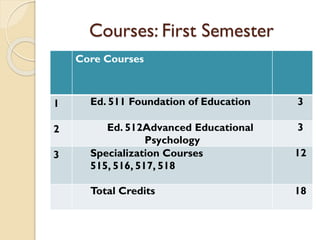
Courses: First Semester
Core Courses
1 Ed. 511 Foundation of Education 3
2 Ed. 512Advanced Educational
Psychology
3
3 Specialization Courses
515, 516, 517, 518
12
Total Credits 18
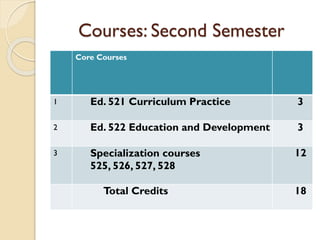
Courses: Second Semester
Core Courses
1 Ed. 521 Curriculum Practice 3
2 Ed. 522 Education and Development 3
3 Specialization courses
525, 526, 527, 528
12
Total Credits 18
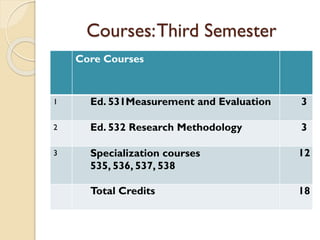
Courses:Third Semester
Core Courses
1 Ed. 531Measurement and Evaluation 3
2 Ed. 532 Research Methodology 3
3 Specialization courses
535, 536, 537, 538
12
Total Credits 18
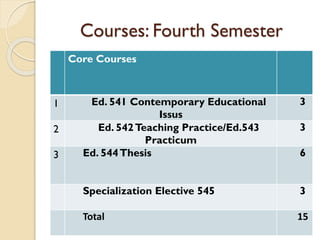
Courses: Fourth Semester
Core Courses
1 Ed. 541 Contemporary Educational
Issus
3
2 Ed. 542Teaching Practice/Ed.543
Practicum
3
3 Ed. 544Thesis 6
Specialization Elective 545 3
Total 15
What is credit and teaching hour?
 One credit hours means 16 teaching
hours.
 One teaching hour = two learning hours.
I.e (1:2)
 Every student has to spend six hours time
per day in college .(three hours at
library/self study/internet and three hours
at home)
Educational Innovations in Teaching
Instructional Techniques
 This program is based on the student-centered
learning approach. The general teaching
methodology of the program includes:
 interactive lectures,
 students’ presentations,
 Case studies, and projects.
 Group work
 lecture with discussion
 Demonstration
 Home/ class assignment and self study
 Paper writing
Student assessment
 Internal assessment 40%
 1. attendance and participation 10%
 2. First assignment (book review/ written
assignment/ quizes) 10%
 3. second assignment (paper writing and
presentation) 10%
 4.Third assignment (written test 1 or2)
10%
Student Assessment
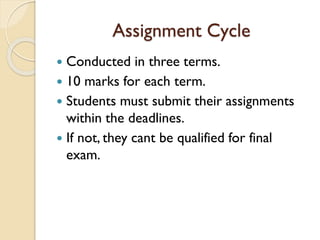
Assignment Cycle
 Conducted in three terms.
 10 marks for each term.
 Students must submit their assignments
within the deadlines.
 If not, they cant be qualified for final
exam.
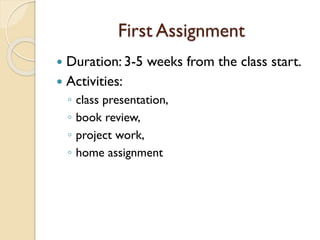
First Assignment
 Duration: 3-5 weeks from the class start.
 Activities:
◦ class presentation,
◦ book review,
◦ project work,
◦ home assignment
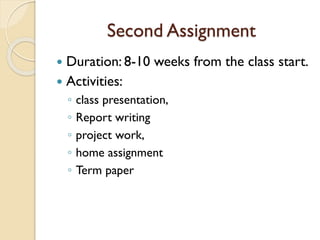
Second Assignment
 Duration: 8-10 weeks from the class start.
 Activities:
◦ class presentation,
◦ Report writing
◦ project work,
◦ home assignment
◦ Term paper
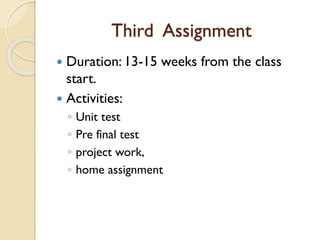
Third Assignment
 Duration: 13-15 weeks from the class
start.
 Activities:
◦ Unit test
◦ Pre final test
◦ project work,
◦ home assignment
Student Assessment
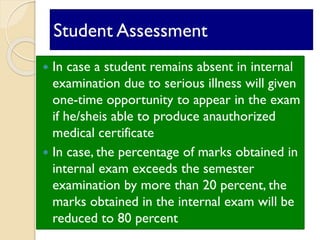
 In case a student remains absent in internal
examination due to serious illness will given
one-time opportunity to appear in the exam
if he/sheis able to produce anauthorized
medical certificate
 In case, the percentage of marks obtained in
internal exam exceeds the semester
examination by more than 20 percent, the
marks obtained in the internal exam will be
reduced to 80 percent
Final Examination
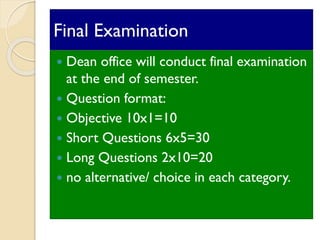
 Dean office will conduct final examination
at the end of semester.
 Question format:
 Objective 10x1=10
 Short Questions 6x5=30
 Long Questions 2x10=20
 no alternative/ choice in each category.
Final Examination
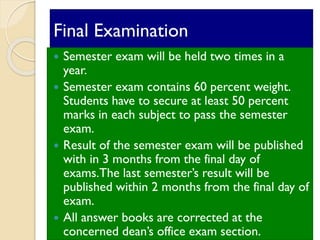
 Semester exam will be held two times in a
year.
 Semester exam contains 60 percent weight.
Students have to secure at least 50 percent
marks in each subject to pass the semester
exam.
 Result of the semester exam will be published
with in 3 months from the final day of
exams.The last semester’s result will be
published within 2 months from the final day of
exam.
 All answer books are corrected at the
concerned dean’s office exam section.
Make Up and Re - take Examination
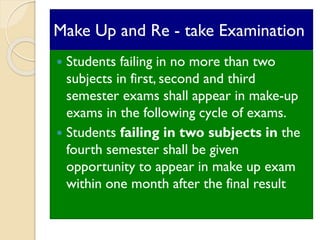
 Students failing in no more than two
subjects in first, second and third
semester exams shall appear in make-up
exams in the following cycle of exams.
 Students failing in two subjects in the
fourth semester shall be given
opportunity to appear in make up exam
within one month after the final result
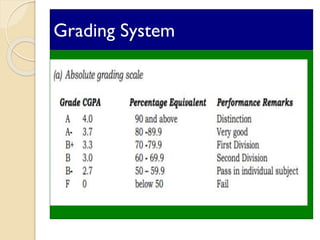
Grading System
Analysis of Grades
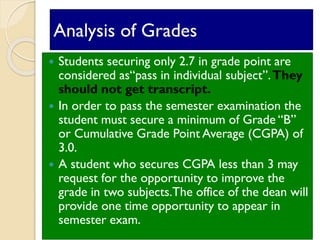
 Students securing only 2.7 in grade point are
considered as“pass in individual subject”.They
should not get transcript.
 In order to pass the semester examination the
student must secure a minimum of Grade “B”
or Cumulative Grade Point Average (CGPA) of
3.0.
 A student who secures CGPA less than 3 may
request for the opportunity to improve the
grade in two subjects.The office of the dean will
provide one time opportunity to appear in
semester exam.
 pRr lzIffnfO{ uxg, a[xQ/ / cGt/tli6«o klxrfg
sfod ub{5 . Makes higher education intensive and
broad based, global recognition.
 ljZjJoflk?kdf rn]sf] qm]l86 k|lqmofnfO{ cjnDjg u/]sf] 5 . A
credit system can facilitate recognition procedures as
well as access to higher education in the world.
 Ps z}lIfs ;+:yfaf6 csf]{df qm]l86 :yfgfGt/0f ug{
;lsG5 . Credits earned at one institution can be
transferred to another
Advantages of Semester System
 cfGtl/s d"NofÍgn] ubf{ ljBfyL{x?sf] k|ltZkwL{
Ifdtf j[l4 x'G5 . Due to internal evaluation
through seminars, home assignments, etc.,
students can learn more and become
capable to compete in global labour market.
 lzIfs / ljBfyL{ jLr ;xsfo{sf] efjgf ljsf; x'G5 .
The system will lead to better coordination
between teachers and students
 ;]d]:6/ cjlwe/ ljBfyL{x? cWoog cg';Gwfgdf Jo:t
/xG5g . Students are kept engaged
throughout semester.
 lzIfs / ljBfyL{df ef/ ylkG5 .This system will impose
heavy burden upon the teachers as well as the
students
 ljBfyL{x? lg/Gt/ k/Liffsf] tgfjdf /xG5g . In this system
students are constantly under the hammer of
examination.
 k¥ofKt cWoog ;fdu|Lsf] cfj:ostf kb{5 . It demands
availability and accessibility of reading materials
 cfGtl/s d"NofÍgdf kIfkftsf] ;Defjgf /xG5 . the chances
of favouritism and biases in internal evaluation.
 ljByL{x?nfO{ cltl/Qm sfo{sf nflu sd ;do x'G5 . Students
have less time to their extra co-curricular
activities
Challenges/Disadvantages
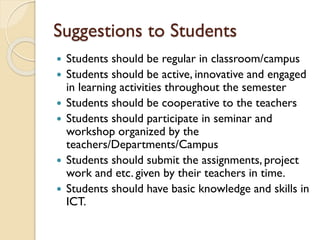
 Students should be regular in classroom/campus
 Students should be active, innovative and engaged
in learning activities throughout the semester
 Students should be cooperative to the teachers
 Students should participate in seminar and
workshop organized by the
teachers/Departments/Campus
 Students should submit the assignments, project
work and etc. given by their teachers in time.
 Students should have basic knowledge and skills in
ICT.
Suggestions to Students
 Five minutes for discussion, and question.

Semester system in nepal

  • 1.
    By: Shantiram Dahal andKamalraj Dahal Faculty of Education Janta Multiple Campus, Itahari Welcome to The Orientation Programme Semester System in M.Ed. Education 2074/12/01
  • 2.
  • 3.
    AnnualVs Semester System In semester system, examination held at the end of each semester, as course outlines divided into semesters,  therefore students prepare and perform better and obtain better marks. ...  Therefore, annual exam should be replaced with semester system in government schools across country.
  • 4.
     Semester systemis quite different from annual system.  One academic year is divided into equal parts of six months of each semester.  A semester is a period of six months during which teaching work is conducted.  Credit hour concept and grading system.  Student centered practical based learning (students are active rather than teacher) Features of Semester System
  • 5.
     Ongoing Evaluationprocess, i.e. in semester evaluation-Tests/Exam, Assignments, group discussion, interaction, personal presentation etc.  After the end of teaching work of the six months, end semester examinations are held.  Students develop the habit of regular study.  Global recognition,  Maintain Minimum percentage of class attendance Contd…
  • 6.
    Value of PostGraduate Degree
  • 7.
     It willprovide an opportunity to the students for continuous learning, assessment and feedback.  It facilitates the better understanding of the subject.  More emphasis is laid on class interaction because of constant engagement between teachers and students.  It facilitates in evaluating the performance of students twice a year. Contd..
  • 8.
     A semestersystem allows greater freedom and scope for designing and delivering a variety of courses that the students can pick to enhance the quality of learning.  Through this system, students attend the college regularly without failing as there is a regulation of compulsory 80% attendance.  Students can develop skills and subject related knowledge in a better way though this system  The students will not have more burden of syllabus as it is divided into two halves. Contd..
  • 9.
    Contd..  Developing highlevel mastery of knowledge, skill and competency in related area.  Seeking higher career opportunity.  Career development as researcher, teacher, civil service officer or consultant service provider etc.  Upgrading social status.  Living quality life.
  • 10.
    Academic Terms  Annualsystem  A semester system  A trimester system  A quarter system
  • 11.
    A Quarter System Dividesthe academic year into four terms, one per season, with attendance required in three quarters per year to total 32 to 36 weeks of instruction.
  • 12.
    Trimester System  Atrimester system divides the academic year into three terms of 14 to 16 weeks .
  • 13.
    s] xf] ;]d]:6/k|0ffnL < (What is Semester System?)  cGt/fli6«o ?kdf Volt k|Kt / dfGotf k|fKt z}lIfs k|0ffnL.  ;]d]:6/ k|0fnL 5 dlxgfdf k/LIff ;+rfng x'g] k/LIff k|0fnLdfq x}g, of] t ljBfyL{sf] 1fg, ;Lk / Ifdtf lgvfg]{ / ltvfg]{ z}lIfs k|lqmof xf] .  -Semester system is not only an examination system .The main ’ knowledge, skill and capacity depth)  gofF lzIff k4lt ;+u} o;sf] k|of]u g]kfndf ;?jft ePsf] kfOG5 .  lqljn] r/0fj4?kdf la;+ @)&@ ;fnb]lv of] k|0ffnL nfu' u/]sf] xf] .
  • 14.
    lsg ;]d]:6/ k|0ffnL< (Why Semester System?)  ljBfyL{sf] z}lIfs pknJwL a[l4 ug{ -To upgrade academic performance of learner)  cGt/fli6«o :t/ cg';f/sf] ljZjljBfno lzIff k|bfg ug{ .-To meet international standard of university education.)  k/Dk/fut lzIf0f k|lqmofnfO{ cfw'lgs gjk|jt{g åf/f lj:yfkg ug{ .-To replace traditional (telling /selling ) teaching learning process by latest innovation of education.)  k|l1s?kdf bIf hgzlQmsf] ljsfz ug{ . -to produce academically qualified human resources.)
  • 15.
    Ef}lts k'jf{wf/ -Infrastractures) cfw'lgs / ;'ljwf ;DkGg sIffsf]7fsf] Joj:yf,  sfof{no ;xof]lu ;lxt ;'ljwf ;DkGg sfof{no,  lzIfs sIfsf] Joj:yf /  ;'ljwf ;DkGg k':tsfno / ;"rgf sIf .
  • 16.
    k|fl1s cj:yf -AcademicStatus)  Uf'0f:tl/o ljBfyL{ dfq} egf{ ul/g] 5 .  ljifo ljlzli6s/0fdf hf]8 lbOPsf] 5.  lzIf0f l;sfO / cg';Gwfgdf hf]8 lbOPsf] 5.  k':ts tyf ;Gbe{ ;fdu|Lsf] pknJwtf ;'lglZrt ul/Pssf] 5 .  :tl/o kf7oqmd / OG6/g]6sf] kx'“r ;'lglZrt ul/Psf] 5.
  • 17.
    Features of M.Ed.Education  k|yd, bf];|f] / t];|f] ;]d]:6/ !* qm]l86 cfj/sf (Credit Hours) x'g]5g .  / rf}yf] ;]d]:6/ !% qm]l86 cfj/sf] (Credit Hours) x'g]5.  !qm]l86 cfj/ a/fa/ !^ lzIf0f 306fsf] cjlw u0fgf x'G5 .  Ps lzIf0f 306f a/fa/ b'O l;sfO 306f u0fgf x'G5 .  cfGtl/s k/LIff sf] ;dofjlw ;d]t qm]l86 cfj/df u0fgf ul/G5 .
  • 18.
    Contd…  ljBfyL{ egf{sf]nflu k|j]z k/LIff clgjfo{ ?kdf pTtL0f{ x'g' kg]{ 5 .  ljBfyL{sf] of]Uotfqmd cg';f/ egf{ lnOG5 .  Ps z}lIfs zqdf Psk6s dfq laBfyL{ egf{ lnOg] 5 .  sIff ;'?x'g' eGbf cufl8g} ljBfyL{ sIffdf k|j]z ul/;Sg' kg]{ 5 .  ljBfyL{n] sfIffdf lgoldt pkl:ylt x'g' kg]{ 5 .  ljBfyL{sf] sIff pkl:ylt *) k|ltzt x'g' kg]{ 5 .  sIffdf gf]6 n]vfpg] sfo{ k"0f{?kdf alh{t ul/Psf] 5 .  x/]s 3l06df lgoldt xf“lhl/ ul/g] 5 .
  • 19.
     *) k|ltztpk:yLlt gx'g] ljBfyL{x?nfO{ clGtd k/LIffdf ;xeflu u/fOg] 5}g .  t/ l;ls:t lj/fld k/]sf] 8fS6/L ;l6{lkms]6 NofPdf &) k|ltzt pkl:ylt ePsf ljBfyL{nfO{ k/LIffdf ;fd]n u/fOg] 5 .  ;f7L dlxgfsf] cjlw leq :gftsf]Q/ tx pTtL0f{ x'g g;s]df k'gM k|j]z k/LIff lbO egf{ lng' kg]{ 5 . Contd…
  • 20.
    Courses: First Semester CoreCourses 1 Ed. 511 Foundation of Education 3 2 Ed. 512Advanced Educational Psychology 3 3 Specialization Courses 515, 516, 517, 518 12 Total Credits 18
  • 21.
    Courses: Second Semester CoreCourses 1 Ed. 521 Curriculum Practice 3 2 Ed. 522 Education and Development 3 3 Specialization courses 525, 526, 527, 528 12 Total Credits 18
  • 22.
    Courses:Third Semester Core Courses 1Ed. 531Measurement and Evaluation 3 2 Ed. 532 Research Methodology 3 3 Specialization courses 535, 536, 537, 538 12 Total Credits 18
  • 23.
    Courses: Fourth Semester CoreCourses 1 Ed. 541 Contemporary Educational Issus 3 2 Ed. 542Teaching Practice/Ed.543 Practicum 3 3 Ed. 544Thesis 6 Specialization Elective 545 3 Total 15
  • 24.
    What is creditand teaching hour?  One credit hours means 16 teaching hours.  One teaching hour = two learning hours. I.e (1:2)  Every student has to spend six hours time per day in college .(three hours at library/self study/internet and three hours at home)
  • 25.
  • 26.
    Instructional Techniques  Thisprogram is based on the student-centered learning approach. The general teaching methodology of the program includes:  interactive lectures,  students’ presentations,  Case studies, and projects.  Group work  lecture with discussion  Demonstration  Home/ class assignment and self study  Paper writing
  • 27.
    Student assessment  Internalassessment 40%  1. attendance and participation 10%  2. First assignment (book review/ written assignment/ quizes) 10%  3. second assignment (paper writing and presentation) 10%  4.Third assignment (written test 1 or2) 10% Student Assessment
  • 28.
    Assignment Cycle  Conductedin three terms.  10 marks for each term.  Students must submit their assignments within the deadlines.  If not, they cant be qualified for final exam.
  • 29.
    First Assignment  Duration:3-5 weeks from the class start.  Activities: ◦ class presentation, ◦ book review, ◦ project work, ◦ home assignment
  • 30.
    Second Assignment  Duration:8-10 weeks from the class start.  Activities: ◦ class presentation, ◦ Report writing ◦ project work, ◦ home assignment ◦ Term paper
  • 31.
    Third Assignment  Duration:13-15 weeks from the class start.  Activities: ◦ Unit test ◦ Pre final test ◦ project work, ◦ home assignment
  • 32.
    Student Assessment  Incase a student remains absent in internal examination due to serious illness will given one-time opportunity to appear in the exam if he/sheis able to produce anauthorized medical certificate  In case, the percentage of marks obtained in internal exam exceeds the semester examination by more than 20 percent, the marks obtained in the internal exam will be reduced to 80 percent
  • 33.
    Final Examination  Deanoffice will conduct final examination at the end of semester.  Question format:  Objective 10x1=10  Short Questions 6x5=30  Long Questions 2x10=20  no alternative/ choice in each category.
  • 34.
    Final Examination  Semesterexam will be held two times in a year.  Semester exam contains 60 percent weight. Students have to secure at least 50 percent marks in each subject to pass the semester exam.  Result of the semester exam will be published with in 3 months from the final day of exams.The last semester’s result will be published within 2 months from the final day of exam.  All answer books are corrected at the concerned dean’s office exam section.
  • 35.
    Make Up andRe - take Examination  Students failing in no more than two subjects in first, second and third semester exams shall appear in make-up exams in the following cycle of exams.  Students failing in two subjects in the fourth semester shall be given opportunity to appear in make up exam within one month after the final result
  • 36.
  • 37.
    Analysis of Grades Students securing only 2.7 in grade point are considered as“pass in individual subject”.They should not get transcript.  In order to pass the semester examination the student must secure a minimum of Grade “B” or Cumulative Grade Point Average (CGPA) of 3.0.  A student who secures CGPA less than 3 may request for the opportunity to improve the grade in two subjects.The office of the dean will provide one time opportunity to appear in semester exam.
  • 38.
     pRr lzIffnfO{uxg, a[xQ/ / cGt/tli6«o klxrfg sfod ub{5 . Makes higher education intensive and broad based, global recognition.  ljZjJoflk?kdf rn]sf] qm]l86 k|lqmofnfO{ cjnDjg u/]sf] 5 . A credit system can facilitate recognition procedures as well as access to higher education in the world.  Ps z}lIfs ;+:yfaf6 csf]{df qm]l86 :yfgfGt/0f ug{ ;lsG5 . Credits earned at one institution can be transferred to another Advantages of Semester System
  • 39.
    Advantages of SemesterSystem  cfGtl/s d"NofÍgn] ubf{ ljBfyL{x?sf] k|ltZkwL{ Ifdtf j[l4 x'G5 . Due to internal evaluation through seminars, home assignments, etc., students can learn more and become capable to compete in global labour market.  lzIfs / ljBfyL{ jLr ;xsfo{sf] efjgf ljsf; x'G5 . The system will lead to better coordination between teachers and students  ;]d]:6/ cjlwe/ ljBfyL{x? cWoog cg';Gwfgdf Jo:t /xG5g . Students are kept engaged throughout semester.
  • 40.
     lzIfs /ljBfyL{df ef/ ylkG5 .This system will impose heavy burden upon the teachers as well as the students  ljBfyL{x? lg/Gt/ k/Liffsf] tgfjdf /xG5g . In this system students are constantly under the hammer of examination.  k¥ofKt cWoog ;fdu|Lsf] cfj:ostf kb{5 . It demands availability and accessibility of reading materials  cfGtl/s d"NofÍgdf kIfkftsf] ;Defjgf /xG5 . the chances of favouritism and biases in internal evaluation.  ljByL{x?nfO{ cltl/Qm sfo{sf nflu sd ;do x'G5 . Students have less time to their extra co-curricular activities Challenges/Disadvantages
  • 41.
     Students shouldbe regular in classroom/campus  Students should be active, innovative and engaged in learning activities throughout the semester  Students should be cooperative to the teachers  Students should participate in seminar and workshop organized by the teachers/Departments/Campus  Students should submit the assignments, project work and etc. given by their teachers in time.  Students should have basic knowledge and skills in ICT. Suggestions to Students
  • 44.
     Five minutesfor discussion, and question.