Service and
Communication

2
Effective Planning
and Writing
COMMUNICATION
communication 2

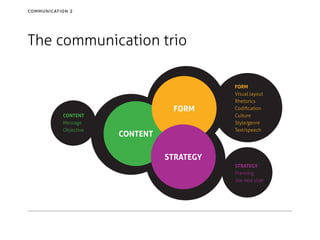
The communication trio

CONTENT
Message
Objective

FORM
CONTENT

FORM
Visual layout
Rhetorics
Codification
Culture
Style/genre
Text/speech

STRATEGY
STRATEGY
Planning
See next slide
communication 2

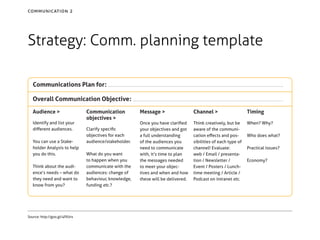
Strategy: Comm. planning template
Communications Plan for :
Overall Communication Objective :
Audience >
Identify and list your
different audiences.
You can use a Stakeholder Analysis to help
you do this.
Think about the audience’s needs – what do
they need and want to
know from you?

Source: http://goo.gl/4fXUrx

Communication
objectives >
Clarify specific
objectives for each
audience/stakeholder.
What do you want
to happen when you
communicate with the
audiences: change of
behaviour, knowledge,
funding etc.?

Message >

Channel >

Timing

Once you have clarified
your objectives and got
a full understanding
of the audiences you
need to communicate
with, it’s time to plan
the messages needed
to meet your objectives and when and how
these will be delivered.

Think creatively, but be
aware of the communication effects and possibilities of each type of
channel! Evaluate:
web / Email / presentation / Newsletter /
Event / Posters / Lunchtime meeting / Article /
Podcast on intranet etc.

When? Why?
Who does what?
Practical issues?
Economy?
communication 2

Content and form: Business writing
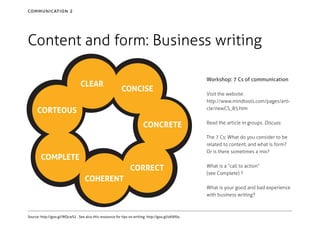
CLEAR

Workshop: 7 Cs of communication

CONCISE

CORTEOUS
CONCRETE

Visit the website:
http://www.mindtools.com/pages/article/newCS_85.htm
Read the article in groups. Discuss:
The 7 Cs; What do you consider to be
related to content, and what is form?
Or is there sometimes a mix?

COMPLETE
CORRECT
COHERENT

What is a “call to action”
(see Complete) ?
What is your good and bad experience
with business writing?

Source: http://goo.gl/WQcwS2 . See also this ressource for tips on writing: http://goo.gl/oKAf0a
communication 2

Content, strategy and form:
Online service writing
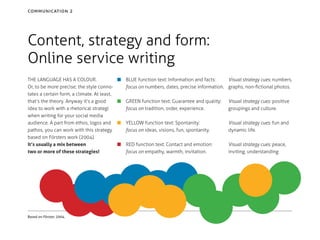
THE LANGUAGE HAS A COLOUR.
Or, to be more precise; the style connotates a certain form, a climate. At least,
that’s the theory. Anyway it’s a good
idea to work with a rhetorical strategi
when writing for your social media
audience. A part from ethos, logos and
pathos, you can work with this strategy
based on Försters work (2004).
It’s usually a mix between
two or more of these strategies!

Based on Förster, 2004.

■ 
BLUE function text: Information and facts:
Visual strategy cues: numbers,
focus on numbers, dates, precise information. graphs, non-fictional photos.
■ 
GREEN function text: Guarantee and quality:
focus on tradition, order, experience.

Visual strategy cues: positive
groupings and culture.

■ 
YELLOW function text: Spontanity:
focus on ideas, visions, fun, spontanity.

Visual strategy cues: fun and
dynamic life.

■ 
RED function text: Contact and emotion:
focus on empathy, warmth, invitation.

Visual strategy cues: peace,
inviting, understanding
communication 2

Form: Layout 101 via AIDA
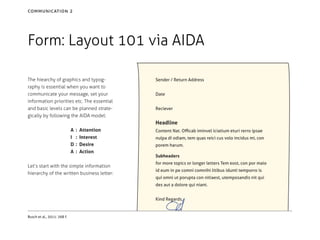
The hiearchy of graphics and typography is essential when you want to
communicate your message, set your
information priorities etc. The essential
and basic levels can be planned strategically by following the AIDA model:

Sender / Return Address
Date
Reciever

Headline
A	 :
I	 :
D	 :
A	 :

Attention
Interest
Desire
Action

Let’s start with the simple information
hierarchy of the written business letter:

Content Nat. Officab iminvel iciatium eturi rerro ipsae
nulpa di odiam, tem quas reici cus volo incidus mi, con
porem harum.
Subheaders
for more topics or longer letters Tem eost, con por maio
id eum in pe comni comnihi litibus idunti temporro is
qui omni ut porupta con nitiaest, utemposandis nit qui
des aut a dolore qui niant.
Kind Regards,

Busch et al., 2011: 268 f.
communication 2

Form: Layout 101 via AIDA
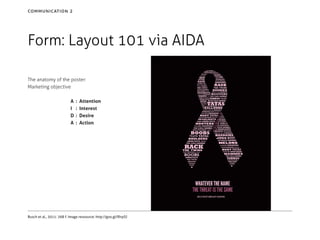
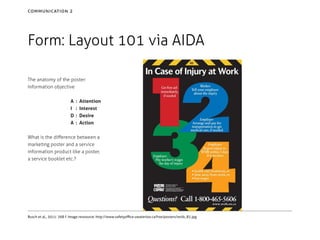
The anatomy of the poster:
Marketing objective
A	 :
I	 :
D	 :
A	 :

Attention
Interest
Desire
Action

Busch et al., 2011: 268 f. Image ressource: http://goo.gl/RIrpSJ
communication 2

Form: Layout 101 via AIDA
The anatomy of the poster:
Information objective
A	 :
I	 :
D	 :
A	 :

Attention
Interest
Desire
Action

What is the difference between a
marketing poster and a service
information product like a poster,
a service booklet etc.?

Busch et al., 2011: 268 f. Image ressource: http://www.safetyoffice.uwaterloo.ca/hse/posters/wsib_82.jpg
communication 2

Form: Layout 101
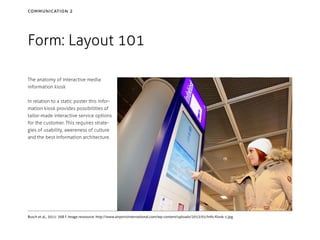
The anatomy of interactive media:
information kiosk
In relation to a static poster this information kiosk provides possibilities of
tailor-made interactive service options
for the customer. This requires strategies of usability, awereness of culture
and the best information architecture.

Busch et al., 2011: 268 f. Image ressource: http://www.airportsinternational.com/wp-content/uploads/2013/01/Info-Kiosk-1.jpg
communication 2

Bibliography

References

Background literature/ressources

Anne Mette Busch et al. (2011):
Kommunikation i multimediedesign.
Hans Reitzel/Gyldendal Akademisk.

Gay Walley (2012):
“The Smart Guide to Business Writing”.
bookboon.com publising.
Download the document here (PDF):
http://goo.gl/oKAf0a

Hans Peter Förster (2004):
Texten wie ein Profi.
Frankfurter Algemeine Buch.

Communication planning (simple):
http://goo.gl/4fXUrx
7 Cs of communication:
http://goo.gl/WQcwS2
Business letters (examples):
http://goo.gl/WWu0Zk

Graphic design by D. Engelby
Slideshare profile:
http://www.slideshare.net/engelby

Service and communication / Writing strategies (Service Management_2nd semester)

  • 1.
  • 2.
    communication 2 The communicationtrio CONTENT Message Objective FORM CONTENT FORM Visual layout Rhetorics Codification Culture Style/genre Text/speech STRATEGY STRATEGY Planning See next slide
  • 3.
    communication 2 Strategy: Comm.planning template Communications Plan for : Overall Communication Objective : Audience > Identify and list your different audiences. You can use a Stakeholder Analysis to help you do this. Think about the audience’s needs – what do they need and want to know from you? Source: http://goo.gl/4fXUrx Communication objectives > Clarify specific objectives for each audience/stakeholder. What do you want to happen when you communicate with the audiences: change of behaviour, knowledge, funding etc.? Message > Channel > Timing Once you have clarified your objectives and got a full understanding of the audiences you need to communicate with, it’s time to plan the messages needed to meet your objectives and when and how these will be delivered. Think creatively, but be aware of the communication effects and possibilities of each type of channel! Evaluate: web / Email / presentation / Newsletter / Event / Posters / Lunchtime meeting / Article / Podcast on intranet etc. When? Why? Who does what? Practical issues? Economy?
  • 4.
    communication 2 Content andform: Business writing CLEAR Workshop: 7 Cs of communication CONCISE CORTEOUS CONCRETE Visit the website: http://www.mindtools.com/pages/article/newCS_85.htm Read the article in groups. Discuss: The 7 Cs; What do you consider to be related to content, and what is form? Or is there sometimes a mix? COMPLETE CORRECT COHERENT What is a “call to action” (see Complete) ? What is your good and bad experience with business writing? Source: http://goo.gl/WQcwS2 . See also this ressource for tips on writing: http://goo.gl/oKAf0a
  • 5.
    communication 2 Content, strategyand form: Online service writing THE LANGUAGE HAS A COLOUR. Or, to be more precise; the style connotates a certain form, a climate. At least, that’s the theory. Anyway it’s a good idea to work with a rhetorical strategi when writing for your social media audience. A part from ethos, logos and pathos, you can work with this strategy based on Försters work (2004). It’s usually a mix between two or more of these strategies! Based on Förster, 2004. ■  BLUE function text: Information and facts: Visual strategy cues: numbers, focus on numbers, dates, precise information. graphs, non-fictional photos. ■  GREEN function text: Guarantee and quality: focus on tradition, order, experience. Visual strategy cues: positive groupings and culture. ■  YELLOW function text: Spontanity: focus on ideas, visions, fun, spontanity. Visual strategy cues: fun and dynamic life. ■  RED function text: Contact and emotion: focus on empathy, warmth, invitation. Visual strategy cues: peace, inviting, understanding
  • 6.
    communication 2 Form: Layout101 via AIDA The hiearchy of graphics and typography is essential when you want to communicate your message, set your information priorities etc. The essential and basic levels can be planned strategically by following the AIDA model: Sender / Return Address Date Reciever Headline A : I : D : A : Attention Interest Desire Action Let’s start with the simple information hierarchy of the written business letter: Content Nat. Officab iminvel iciatium eturi rerro ipsae nulpa di odiam, tem quas reici cus volo incidus mi, con porem harum. Subheaders for more topics or longer letters Tem eost, con por maio id eum in pe comni comnihi litibus idunti temporro is qui omni ut porupta con nitiaest, utemposandis nit qui des aut a dolore qui niant. Kind Regards, Busch et al., 2011: 268 f.
  • 7.
    communication 2 Form: Layout101 via AIDA The anatomy of the poster: Marketing objective A : I : D : A : Attention Interest Desire Action Busch et al., 2011: 268 f. Image ressource: http://goo.gl/RIrpSJ
  • 8.
    communication 2 Form: Layout101 via AIDA The anatomy of the poster: Information objective A : I : D : A : Attention Interest Desire Action What is the difference between a marketing poster and a service information product like a poster, a service booklet etc.? Busch et al., 2011: 268 f. Image ressource: http://www.safetyoffice.uwaterloo.ca/hse/posters/wsib_82.jpg
  • 9.
    communication 2 Form: Layout101 The anatomy of interactive media: information kiosk In relation to a static poster this information kiosk provides possibilities of tailor-made interactive service options for the customer. This requires strategies of usability, awereness of culture and the best information architecture. Busch et al., 2011: 268 f. Image ressource: http://www.airportsinternational.com/wp-content/uploads/2013/01/Info-Kiosk-1.jpg
  • 10.
    communication 2 Bibliography References Background literature/ressources AnneMette Busch et al. (2011): Kommunikation i multimediedesign. Hans Reitzel/Gyldendal Akademisk. Gay Walley (2012): “The Smart Guide to Business Writing”. bookboon.com publising. Download the document here (PDF): http://goo.gl/oKAf0a Hans Peter Förster (2004): Texten wie ein Profi. Frankfurter Algemeine Buch. Communication planning (simple): http://goo.gl/4fXUrx 7 Cs of communication: http://goo.gl/WQcwS2 Business letters (examples): http://goo.gl/WWu0Zk Graphic design by D. Engelby Slideshare profile: http://www.slideshare.net/engelby