Pierre Bourdieu        FIELD THEORY
KEYWORDS               The French sociologist Pierre Bourdieu is one of the key
Field Theory           thinkers of the 20th Century in relation to ways of working with
Sociology              the understanding of our actions and our positions in cultures
Structuralism          and in society. In relation to philosophy of science, Bourdieu
Agent Theory           takes a position between structuralism (which has an objective
Interpretive Methods   view on people as agents in society) and a subjective
Social rooms           approach to his objects of study. That means, that people are
Capital                free agents, but they are also affected by the structures of their
Habitus                social environments. Bourdieu's theory aims at research of
Doxa                   people in their environment by mapping their actions, their
                       preferences and how they look at other people. This mapping
                       can then be interpreted by using theoretical concepts like
                       capital and doxa. In this small article, you will be introduced to
                       the keypoints of Bourdieu's field theory.


                       The Field Theory
                       Society is defined by what Bourdieu calls the social room. This
                       social room is divided into several fields, that operates with
                       each of their own set of rules of access. For example, in the
                       field of education, the rules of access are exams; in the field of
                       religion, the rules of access are faith and dogmas; in the field
                       of business, the rule of access is success and proactivity etc.
                       The concept of field theory is an analytical concept, that can
                       be used to map people's preferences, their actions, and their
                       social practises. Every field is often a limited area of society,
                       which has a certain practise. This practise involves the social
                       actions we use when we are together in these fields and when
                       we communicate to- and from a field. We don't always know
                       why we are performing our actions, but it often just feels right in
                       a given field. There are certain, almost objectively assumed,
                       qualities of our thinking in a given field. For example, the way
we act and make use of the rules in a given field is what
Bourdieu calls to strengthen our position in a given field. In
every field we fight for good positions by making use of the
rules of the game. These rules are called doxa in Bourdieu's
theoretical approach. We tend not to question doxa in a field.
We respect the rules of the game, be it official rules or more
subtle directions in a given field. But these rules can of course
be changed by the agent's actions in these spaces of
possibilities. It is very typical, says Bourdieu, that the given
field has an effect on us. The field can regulate our behaviour.
So battles for better positions within a field is regulated by the
doxa of the field. However, there are elements of the agent's
own autonomous actions: only the agents of the given field can
define the value of the the field's position. For example, an
adult may not care about the playground in the park. But the
children who get together to play here are trying to establish
positions in terms of who it is to decide what to play, who may
be invited to play etc. Sometimes you don't even have to
belong to the field to be willing to ascribe a high value to the
field: In the field of politics we often don't get a lot to say after
the elections, but we respect the political-debate field and we
accept its doxa. The positions in the field of political power also
marks the distinction between us and them: those with a high
ranking position in the field has this certain value because of
the difference between the positions in the field and the
difference between those who are inside and those who are
outside. The ruling class often has agents with invested
prestige. Now, how can we define the different types of
strengths in these fields? Let's move on to the concepts of
capital.


Capital and habitus
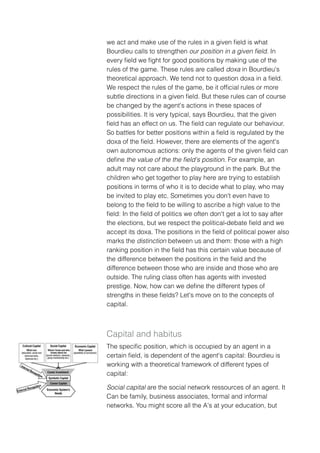
The specific position, which is occupied by an agent in a
certain field, is dependent of the agent's capital: Bourdieu is
working with a theoretical framework of different types of
capital:

Social capital are the social network ressources of an agent. It
Can be family, business associates, formal and informal
networks. You might score all the A's at your education, but
without a good network to support you, you might get problems
in your search for a job after your graduation.

Economic capital are all the accumulated ressources such as
money, property etc. This is also related to the certain life styles
of a social room/field.

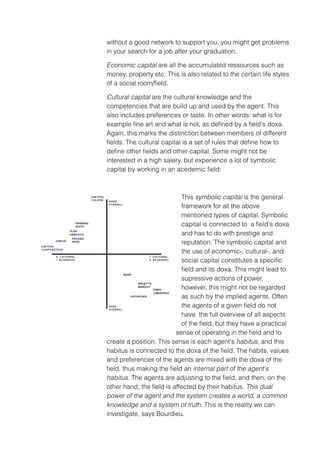
Cultural capital are the cultural knowledge and the
competencies that are build up and used by the agent. This
also includes preferences or taste. In other words: what is for
example fine art and what is not, as defined by a field's doxa.
Again, this marks the distinction between members of different
fields. The cultural capital is a set of rules that define how to
define other fields and other capital. Some might not be
interested in a high salery, but experience a lot of symbolic
capital by working in an acedemic field:


                           This symbolic capital is the general
                           framework for all the above
                           mentioned types of capital. Symbolic
                           capital is connected to a field's doxa
                           and has to do with prestige and
                           reputation. The symbolic capital and
                           the use of economic-, cultural-, and
                           social capital constitutes a specific
                           field and its doxa. This might lead to
                           supressive actions of power,
                           however, this might not be regarded
                           as such by the implied agents. Often
                           the agents of a given field do not
                           have the full overview of all aspects
                           of the field, but they have a practical
                         sense of operating in the field and to
create a position. This sense is each agent's habitus, and this
habitus is connected to the doxa of the field. The habits, values
and preferences of the agents are mixed with the doxa of the
field, thus making the field an internal part of the agent's
habitus. The agents are adjusting to the field, and then, on the
other hand, the field is affected by their habitus. This dual
power of the agent and the system creates a world, a common
knowledge and a system of truth. This is the reality we can
investigate, says Bourdieu.
The logic conclusion of this theoretical approach is to look at
culture and power as being defined and reproduced in fields of
preferences and doxa. And, more important, we can take a
look at the concepts as they are defined by a field.

Field theory pierre_bourdieu

  • 1.
    Pierre Bourdieu FIELD THEORY KEYWORDS The French sociologist Pierre Bourdieu is one of the key Field Theory thinkers of the 20th Century in relation to ways of working with Sociology the understanding of our actions and our positions in cultures Structuralism and in society. In relation to philosophy of science, Bourdieu Agent Theory takes a position between structuralism (which has an objective Interpretive Methods view on people as agents in society) and a subjective Social rooms approach to his objects of study. That means, that people are Capital free agents, but they are also affected by the structures of their Habitus social environments. Bourdieu's theory aims at research of Doxa people in their environment by mapping their actions, their preferences and how they look at other people. This mapping can then be interpreted by using theoretical concepts like capital and doxa. In this small article, you will be introduced to the keypoints of Bourdieu's field theory. The Field Theory Society is defined by what Bourdieu calls the social room. This social room is divided into several fields, that operates with each of their own set of rules of access. For example, in the field of education, the rules of access are exams; in the field of religion, the rules of access are faith and dogmas; in the field of business, the rule of access is success and proactivity etc. The concept of field theory is an analytical concept, that can be used to map people's preferences, their actions, and their social practises. Every field is often a limited area of society, which has a certain practise. This practise involves the social actions we use when we are together in these fields and when we communicate to- and from a field. We don't always know why we are performing our actions, but it often just feels right in a given field. There are certain, almost objectively assumed, qualities of our thinking in a given field. For example, the way
  • 2.
    we act andmake use of the rules in a given field is what Bourdieu calls to strengthen our position in a given field. In every field we fight for good positions by making use of the rules of the game. These rules are called doxa in Bourdieu's theoretical approach. We tend not to question doxa in a field. We respect the rules of the game, be it official rules or more subtle directions in a given field. But these rules can of course be changed by the agent's actions in these spaces of possibilities. It is very typical, says Bourdieu, that the given field has an effect on us. The field can regulate our behaviour. So battles for better positions within a field is regulated by the doxa of the field. However, there are elements of the agent's own autonomous actions: only the agents of the given field can define the value of the the field's position. For example, an adult may not care about the playground in the park. But the children who get together to play here are trying to establish positions in terms of who it is to decide what to play, who may be invited to play etc. Sometimes you don't even have to belong to the field to be willing to ascribe a high value to the field: In the field of politics we often don't get a lot to say after the elections, but we respect the political-debate field and we accept its doxa. The positions in the field of political power also marks the distinction between us and them: those with a high ranking position in the field has this certain value because of the difference between the positions in the field and the difference between those who are inside and those who are outside. The ruling class often has agents with invested prestige. Now, how can we define the different types of strengths in these fields? Let's move on to the concepts of capital. Capital and habitus The specific position, which is occupied by an agent in a certain field, is dependent of the agent's capital: Bourdieu is working with a theoretical framework of different types of capital: Social capital are the social network ressources of an agent. It Can be family, business associates, formal and informal networks. You might score all the A's at your education, but
  • 3.
    without a goodnetwork to support you, you might get problems in your search for a job after your graduation. Economic capital are all the accumulated ressources such as money, property etc. This is also related to the certain life styles of a social room/field. Cultural capital are the cultural knowledge and the competencies that are build up and used by the agent. This also includes preferences or taste. In other words: what is for example fine art and what is not, as defined by a field's doxa. Again, this marks the distinction between members of different fields. The cultural capital is a set of rules that define how to define other fields and other capital. Some might not be interested in a high salery, but experience a lot of symbolic capital by working in an acedemic field: This symbolic capital is the general framework for all the above mentioned types of capital. Symbolic capital is connected to a field's doxa and has to do with prestige and reputation. The symbolic capital and the use of economic-, cultural-, and social capital constitutes a specific field and its doxa. This might lead to supressive actions of power, however, this might not be regarded as such by the implied agents. Often the agents of a given field do not have the full overview of all aspects of the field, but they have a practical sense of operating in the field and to create a position. This sense is each agent's habitus, and this habitus is connected to the doxa of the field. The habits, values and preferences of the agents are mixed with the doxa of the field, thus making the field an internal part of the agent's habitus. The agents are adjusting to the field, and then, on the other hand, the field is affected by their habitus. This dual power of the agent and the system creates a world, a common knowledge and a system of truth. This is the reality we can investigate, says Bourdieu.
  • 4.
    The logic conclusionof this theoretical approach is to look at culture and power as being defined and reproduced in fields of preferences and doxa. And, more important, we can take a look at the concepts as they are defined by a field.