1

SEMEN ANALYSIS
WHO 2010
Notes on semen analysis (WHO 2010 criteria) .. By Dr. Ashish V. Jawarkar
Contact: pathologybasics@gmail.com Website: pathologybasics.wix.com/notes
2

Overview
1. Contents of seminal fluid
2. indications of semen analysis
3. collection of sample
4. Examination of seminal fluid
a. in infertility
i. physical examination
1. visual appearance
2. viscosity
3. volume
4. pH
ii. microscopic examination
1. motility
2. viability
3. count
4. morphology
iii. immunologic analysis
1. sperm MAR test – direct, indirect
2. immunobead test
iv. biochemical analysis
1. fructose – seminal vesicle marker
2. total zinc
3. total acid phosphatase
prostate marker
4. total citric acid
5. alpha glucosidase
epididymis
6. carnitine
v. sperm function tests
1. post coital (Sims-Huhner test)
2. Cervical mucous penetration test
3. Hamster egg penetration test
4. Hypoosmotic swelling of flagella
5. computer assisted semen analysis
b. in medicolegal cases
c. to check effectiveness of vasectomy
5. Normal values (according to WHO 1999 and WHO 2010 criteria)
6. Nomenclature related to semen quality

Notes on semen analysis (WHO 2010 criteria) .. By Dr. Ashish V. Jawarkar
Contact: pathologybasics@gmail.com Website: pathologybasics.wix.com/notes
3

* Contents of semen

Part
1. Testes
2. Epididymis (sperms mature
here, storage site)

3. Vas deferens (also storage
site)
4. Seminal Vesicle (nutritive
fluid secreted during
ejaculation)
5. Prostate

6. Bulbourethral glands of
Cooper

Produces
Spermatozoa
1. choline (energy source for
sperms)
2. Alpha glucosidase
3. Carnitine
Ergothioneine

% of semen volume
5

Fructose

50

1. citric acid
2. acid phosphatase
3. proteolytic enzymes
4. zinc
Mucous

40

* Indications of semen analysis
1.
2.
3.
4.
5.

Investigation of infertility
check effectiveness of vasectomy
Paternity testing
Rape cases
Selection of donors for artificial insemination/ assisted reproductive technology

Notes on semen analysis (WHO 2010 criteria) .. By Dr. Ashish V. Jawarkar
Contact: pathologybasics@gmail.com Website: pathologybasics.wix.com/notes
4

* collection of sample
Higher abstinence – decreased motility
Abstinence of three days
Lesser abstinence – decreased count

Collection by masturbation, whole sample collected
(Condom collection is not recommended; collection through coitus interruptus leads to loss of
first portion of the ejaculate that is most concentrated, hence not recommended)

In a clean, wide mouthed, leak proof container

Transport within 1 hr to laboratory, and keep temperature as close to body temperature as
possible (inside pocket)

Examine two specimen, two to three weeks apart
* Examination of seminal fluid
(i) Examination of seminal fluid in infertility
1. Physical examination
A. Visual appearance: opaque – gray white
After abstinence, it is slightly yellow
B. Viscosity:
Assessed by filling a pipette with semen and allowing it to flow back into the container.
Normal semen will fall drop by drop.
If droplets form thread >2cm long – viscosity is increased.
Normal semen liquefies in 30 min, if liquefaction doesnot occur in 60 min – there is
abnormal increase in viscosity – which decreases sperm motility.
C. Volume
Normal >= 1.5 ml

Notes on semen analysis (WHO 2010 criteria) .. By Dr. Ashish V. Jawarkar
Contact: pathologybasics@gmail.com Website: pathologybasics.wix.com/notes
5

D. pH
Normal >=7.2
Seminal vesicle secretion is basic, prostatic secretion is acidic.
pH 7 with absence of sperm indicates
a. obstructin of ejaculatory duct or b. absence of vas deferens
2. Microscopic examination
A. Motility
Ability of the sperms to move.
Three types of motility noted:
a. Rapidly progressive – moving fast and forward in a straight line
b. Slowly progressive – Crooked, curved, slow forward movement
c. Non progressive – movements of tail only
Only those sperms with rapid progressive motility are capable of fertilizing
ovum.
Method
A drop of semen is placed on the slide, covered with coverslip and ringed
With petroleum jelly

Examine under 40x, count atleast 200 spermatozoa

Find out % of sperms with rapid progressive, slowly progressive, non progressive and non motile
sperms
NORMAL VALUES
>32%
progressive motility
>40%
progressive + non progressive motility
B. Vitality
Number of live sperms are called viable
A viable sperm will have intact cell membrane and wont take up eosin Y dye
Method
1 drop semen + 1 drop eosin – nigrosin

Wait for 30 sec

Put a drop on the slide

Air dry
Notes on semen analysis (WHO 2010 criteria) .. By Dr. Ashish V. Jawarkar
Contact: pathologybasics@gmail.com Website: pathologybasics.wix.com/notes
6

Examine under oil immersion and count atleast 200 sperms

Red sperms are not viable, white sperms are viable
Normal Values
>58% Normally viable
C. Count
Method:
Wait for liquefaction

Mix 1ml liquefied semen with 20ml diluting fluid (Sodium Bicarbonate – formalin)

Charge Neubauer’s chamber with pasteur’s pipette

Place chamber in humid conditions for 10-15 min

Count in four large corners
Calculation:
Count (/ml) = sperms counted

x

correction for dilution

No. of squares counted x Volume of one square
=

N x 20
4

x

x

1000

0.1

= N x 50000
Normal:
>15 million/ml
D. Morphology
Method:
Drop of seminal fluid on slide

Stain with Pap/eosin-nigrosin/Rose Bengal-toluidine blue
Notes on semen analysis (WHO 2010 criteria) .. By Dr. Ashish V. Jawarkar
Contact: pathologybasics@gmail.com Website: pathologybasics.wix.com/notes

x

1000
7

Look for morphology of atleast 200 sperms
Normal:
>4% - spermatozoa should show normal morphology
Normal morphology:

-

5
micron

-

5
micron

Tail – 50 micron

Head: Consists of nucleus with condensed chromatin and some nuclear vacuoles
Acrosome: Anterior 2/3rd of head shows an acrosome cap, secretes enzymes that
dissolves the cells of corona radiate and zona pellucida of ovum during fertilization.
Middle piece: contains mitochondria that provide energy

Notes on semen analysis (WHO 2010 criteria) .. By Dr. Ashish V. Jawarkar
Contact: pathologybasics@gmail.com Website: pathologybasics.wix.com/notes
8

Some abnormal morphologies:

3. Immunological analysis (antisperm antibody determination)

- antibody against head will prevent penetration

- antibody against tail will prevent motility

These antibodies may be tested in serum, seminal fluid or cervical mucous.

Notes on semen analysis (WHO 2010 criteria) .. By Dr. Ashish V. Jawarkar
Contact: pathologybasics@gmail.com Website: pathologybasics.wix.com/notes
9

A. SPERM MAR TEST

Direct sperm MAR test

For detection of sperms For detection of sperms
Coated with IgG
coated with IgA

Indirect sperm MAR test

To detect antisperm IgG/A in serum

Method:
Direct Test (Scenario 1)–
There are sperms coated with antibodies
Semen with sperms coated with IgG or IgA
+
Anti human globulin (Anti IgG or Anti IgA)
+
IgG/A coated Latex particles

No clumping (Because sperms bind to anti IgG/A and latex particles remain free)
Direct Test (Scenario 2)–
The sperms are not coated with antibodies
Semen with sperms not coated with IgG or IgA
+
Antihuman globulin (Anti IgG or IgA)
+
IgG/A coated latex particles

Clumping is seen (because the sperms donot carry IgG/A, hence latex particles attach to anti
human globulin and clump together)
Indirect Test:
Suspected serum (containing antibodies) is incubated with donor sperms.
Onwards the procedure is similar to direct test.
B. IMMUNOBEAD TEST:

Notes on semen analysis (WHO 2010 criteria) .. By Dr. Ashish V. Jawarkar
Contact: pathologybasics@gmail.com Website: pathologybasics.wix.com/notes
10

Similar to above test except instead of latex particles, plastic beads are used.
Normals
<50%

Motile spermatozoa with bound particles

4. Biochemical Analysis
Seminal Vesicle marker (Fructose)
50 mg resorcinol in 33ml conc. HCl (diluted in 100 ml D.W.)
+
0.5ml seminal fluid
Heated
Red colored ppt. in 30 sec
Absence of fructose indicates – No seminal vesicle component is present due to
- obstructed vas deferens OR
- Lack of seminal vesicle
5. Sperm function tests
A. Post coital (Sims-Huhner test)
PRINCIPLE –
1. Examination of quality of cervical mucous post coitus can give an idea about the
quality of cervical mucous and ability of the sperms to penetrate it .
2. Normally in proliferative phase (estrogen phase) the mucous is watery (fluid) and
sperms can penetrate easily.
3. During secretory phase (progesterone phase), the mucous is viscous.
4. Hence mucous testing is scheduled just before ovulation.
METHOD –
Cervical mucous is aspirated with a syringe 2-12 hours after intercourse.
Gross and microsocopic examination is carried out.
Gross:
Normal
1. Mucous stretches atleast 2 inches
2. Dries in a fern like manner
Microscopy:
Normal
>= 10 motile sperms

Abnormal
1. Cannot stretch 2 inches
2. doesnot form fern like pattern
Abnormal
Less than 10 motile sperms
Causes:
1. antisperm antibodies
2. cervicitis
3. wrong judgement of date

Notes on semen analysis (WHO 2010 criteria) .. By Dr. Ashish V. Jawarkar
Contact: pathologybasics@gmail.com Website: pathologybasics.wix.com/notes
11

B. Cervical mucous penetration test

Sperms

capillary containing bovine mucous

See for distance traveled in capillary by sperms

Fertile men
Sperms travel >30mm

Infertile men
sperms travel <20mm

C. Hamster egg penetration assay

Enymatically treated to remove outer layer

Hamster egg with outer coat

Hamster egg w/o coat

Incubate with sperms

Look for

No. of sperms penetrating the egg
And penetration per egg

No. of eggs penetrated

Normal >= 5%

<15% indicates low
fertility

D. Hypoosmotic swelling of flagella
Notes on semen analysis (WHO 2010 criteria) .. By Dr. Ashish V. Jawarkar
Contact: pathologybasics@gmail.com Website: pathologybasics.wix.com/notes
12

If sperm is exposed to hypoosmotic conditions, the sperm curls up, if plasma membrane
Is abnormal.
Thus it assesses the functional integrity of plasma membrane.
E. Computer assisted semen analysis
Automated system where all the above parameters are measured.
(ii) Examination of seminal fluid in medicolegal cases
Done in cases of alleged rape or sexual assault
Collection of sample
1. Vagina – direct aspiration or saline lavage
2. clothing of accused / victim
3. skin, hair or other body parts for semen
Method
Area (cloth) to be examined is identified when scanned with ultraviolet light

Semen produces green fluorescence

That portion is soaked in physiological saline for 1hr

Area that doesnot fluorescence is used as control
Tests
1. Microscopic examination : motile sperms indicate interval of <8hrs
2. Acid phosphatase : level >= 50 IU/sample is indicated as evidence of semen
3. Blood group substance : 80% individuals are secretors and secrete blood group
substance in body fluids including semen
4. Florence test: detects presence of choline secreted by epididymis
(iii) Examination of semen to check for effectiveness of vasectomy
Started 12 weeks or 15 ejaculations after vasectomy

Two successive samples should be free of sperms to consider vasectomy to be effective

Notes on semen analysis (WHO 2010 criteria) .. By Dr. Ashish V. Jawarkar
Contact: pathologybasics@gmail.com Website: pathologybasics.wix.com/notes
13

SUMMARY OF NORMAL VALUES IN SEMEN ANALYSIS (WHO 1999)

1. VOLUME
2. Ph
3. SPERM COUNT
4. MORPHOLOGY
5. VIABILITY
6. MOTILITY
7. WBC
8. MAR TEST
9. IMMUNOBEAD TEST

VALUE
>2 ml
7.2 to 8.0
>20 MILLION/ML
>30% WITH NORMAL MORPHOLOGY
>75% VIABLE
CLASS A (RAPID PROGRESSIVE) - >25%
CLASS B (RAPID+SLOW PROGRESSIVE) - >50%
<1 MILLION / ML
<50% MOTILE SPERMS WITH ADHERENT PARTICLES

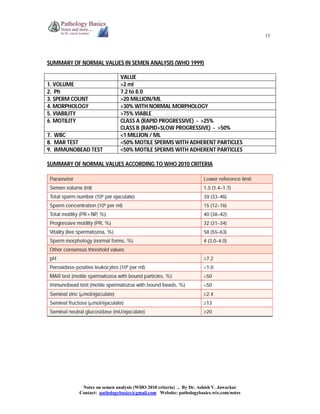
SUMMARY OF NORMAL VALUES ACCORDING TO WHO 2010 CRITERIA

Notes on semen analysis (WHO 2010 criteria) .. By Dr. Ashish V. Jawarkar
Contact: pathologybasics@gmail.com Website: pathologybasics.wix.com/notes
14

NOMENCLATURE RELATED TO SPERM QUALITY

Notes on semen analysis (WHO 2010 criteria) .. By Dr. Ashish V. Jawarkar
Contact: pathologybasics@gmail.com Website: pathologybasics.wix.com/notes

SEMEN ANALYSIS (WHO 2010)

  • 1.
    1 SEMEN ANALYSIS WHO 2010 Noteson semen analysis (WHO 2010 criteria) .. By Dr. Ashish V. Jawarkar Contact: pathologybasics@gmail.com Website: pathologybasics.wix.com/notes
  • 2.
    2 Overview 1. Contents ofseminal fluid 2. indications of semen analysis 3. collection of sample 4. Examination of seminal fluid a. in infertility i. physical examination 1. visual appearance 2. viscosity 3. volume 4. pH ii. microscopic examination 1. motility 2. viability 3. count 4. morphology iii. immunologic analysis 1. sperm MAR test – direct, indirect 2. immunobead test iv. biochemical analysis 1. fructose – seminal vesicle marker 2. total zinc 3. total acid phosphatase prostate marker 4. total citric acid 5. alpha glucosidase epididymis 6. carnitine v. sperm function tests 1. post coital (Sims-Huhner test) 2. Cervical mucous penetration test 3. Hamster egg penetration test 4. Hypoosmotic swelling of flagella 5. computer assisted semen analysis b. in medicolegal cases c. to check effectiveness of vasectomy 5. Normal values (according to WHO 1999 and WHO 2010 criteria) 6. Nomenclature related to semen quality Notes on semen analysis (WHO 2010 criteria) .. By Dr. Ashish V. Jawarkar Contact: pathologybasics@gmail.com Website: pathologybasics.wix.com/notes
  • 3.
    3 * Contents ofsemen Part 1. Testes 2. Epididymis (sperms mature here, storage site) 3. Vas deferens (also storage site) 4. Seminal Vesicle (nutritive fluid secreted during ejaculation) 5. Prostate 6. Bulbourethral glands of Cooper Produces Spermatozoa 1. choline (energy source for sperms) 2. Alpha glucosidase 3. Carnitine Ergothioneine % of semen volume 5 Fructose 50 1. citric acid 2. acid phosphatase 3. proteolytic enzymes 4. zinc Mucous 40 * Indications of semen analysis 1. 2. 3. 4. 5. Investigation of infertility check effectiveness of vasectomy Paternity testing Rape cases Selection of donors for artificial insemination/ assisted reproductive technology Notes on semen analysis (WHO 2010 criteria) .. By Dr. Ashish V. Jawarkar Contact: pathologybasics@gmail.com Website: pathologybasics.wix.com/notes
  • 4.
    4 * collection ofsample Higher abstinence – decreased motility Abstinence of three days Lesser abstinence – decreased count Collection by masturbation, whole sample collected (Condom collection is not recommended; collection through coitus interruptus leads to loss of first portion of the ejaculate that is most concentrated, hence not recommended) In a clean, wide mouthed, leak proof container Transport within 1 hr to laboratory, and keep temperature as close to body temperature as possible (inside pocket) Examine two specimen, two to three weeks apart * Examination of seminal fluid (i) Examination of seminal fluid in infertility 1. Physical examination A. Visual appearance: opaque – gray white After abstinence, it is slightly yellow B. Viscosity: Assessed by filling a pipette with semen and allowing it to flow back into the container. Normal semen will fall drop by drop. If droplets form thread >2cm long – viscosity is increased. Normal semen liquefies in 30 min, if liquefaction doesnot occur in 60 min – there is abnormal increase in viscosity – which decreases sperm motility. C. Volume Normal >= 1.5 ml Notes on semen analysis (WHO 2010 criteria) .. By Dr. Ashish V. Jawarkar Contact: pathologybasics@gmail.com Website: pathologybasics.wix.com/notes
  • 5.
    5 D. pH Normal >=7.2 Seminalvesicle secretion is basic, prostatic secretion is acidic. pH 7 with absence of sperm indicates a. obstructin of ejaculatory duct or b. absence of vas deferens 2. Microscopic examination A. Motility Ability of the sperms to move. Three types of motility noted: a. Rapidly progressive – moving fast and forward in a straight line b. Slowly progressive – Crooked, curved, slow forward movement c. Non progressive – movements of tail only Only those sperms with rapid progressive motility are capable of fertilizing ovum. Method A drop of semen is placed on the slide, covered with coverslip and ringed With petroleum jelly Examine under 40x, count atleast 200 spermatozoa Find out % of sperms with rapid progressive, slowly progressive, non progressive and non motile sperms NORMAL VALUES >32% progressive motility >40% progressive + non progressive motility B. Vitality Number of live sperms are called viable A viable sperm will have intact cell membrane and wont take up eosin Y dye Method 1 drop semen + 1 drop eosin – nigrosin Wait for 30 sec Put a drop on the slide Air dry Notes on semen analysis (WHO 2010 criteria) .. By Dr. Ashish V. Jawarkar Contact: pathologybasics@gmail.com Website: pathologybasics.wix.com/notes
  • 6.
    6 Examine under oilimmersion and count atleast 200 sperms Red sperms are not viable, white sperms are viable Normal Values >58% Normally viable C. Count Method: Wait for liquefaction Mix 1ml liquefied semen with 20ml diluting fluid (Sodium Bicarbonate – formalin) Charge Neubauer’s chamber with pasteur’s pipette Place chamber in humid conditions for 10-15 min Count in four large corners Calculation: Count (/ml) = sperms counted x correction for dilution No. of squares counted x Volume of one square = N x 20 4 x x 1000 0.1 = N x 50000 Normal: >15 million/ml D. Morphology Method: Drop of seminal fluid on slide Stain with Pap/eosin-nigrosin/Rose Bengal-toluidine blue Notes on semen analysis (WHO 2010 criteria) .. By Dr. Ashish V. Jawarkar Contact: pathologybasics@gmail.com Website: pathologybasics.wix.com/notes x 1000
  • 7.
    7 Look for morphologyof atleast 200 sperms Normal: >4% - spermatozoa should show normal morphology Normal morphology: - 5 micron - 5 micron Tail – 50 micron Head: Consists of nucleus with condensed chromatin and some nuclear vacuoles Acrosome: Anterior 2/3rd of head shows an acrosome cap, secretes enzymes that dissolves the cells of corona radiate and zona pellucida of ovum during fertilization. Middle piece: contains mitochondria that provide energy Notes on semen analysis (WHO 2010 criteria) .. By Dr. Ashish V. Jawarkar Contact: pathologybasics@gmail.com Website: pathologybasics.wix.com/notes
  • 8.
    8 Some abnormal morphologies: 3.Immunological analysis (antisperm antibody determination) - antibody against head will prevent penetration - antibody against tail will prevent motility These antibodies may be tested in serum, seminal fluid or cervical mucous. Notes on semen analysis (WHO 2010 criteria) .. By Dr. Ashish V. Jawarkar Contact: pathologybasics@gmail.com Website: pathologybasics.wix.com/notes
  • 9.
    9 A. SPERM MARTEST Direct sperm MAR test For detection of sperms For detection of sperms Coated with IgG coated with IgA Indirect sperm MAR test To detect antisperm IgG/A in serum Method: Direct Test (Scenario 1)– There are sperms coated with antibodies Semen with sperms coated with IgG or IgA + Anti human globulin (Anti IgG or Anti IgA) + IgG/A coated Latex particles No clumping (Because sperms bind to anti IgG/A and latex particles remain free) Direct Test (Scenario 2)– The sperms are not coated with antibodies Semen with sperms not coated with IgG or IgA + Antihuman globulin (Anti IgG or IgA) + IgG/A coated latex particles Clumping is seen (because the sperms donot carry IgG/A, hence latex particles attach to anti human globulin and clump together) Indirect Test: Suspected serum (containing antibodies) is incubated with donor sperms. Onwards the procedure is similar to direct test. B. IMMUNOBEAD TEST: Notes on semen analysis (WHO 2010 criteria) .. By Dr. Ashish V. Jawarkar Contact: pathologybasics@gmail.com Website: pathologybasics.wix.com/notes
  • 10.
    10 Similar to abovetest except instead of latex particles, plastic beads are used. Normals <50% Motile spermatozoa with bound particles 4. Biochemical Analysis Seminal Vesicle marker (Fructose) 50 mg resorcinol in 33ml conc. HCl (diluted in 100 ml D.W.) + 0.5ml seminal fluid Heated Red colored ppt. in 30 sec Absence of fructose indicates – No seminal vesicle component is present due to - obstructed vas deferens OR - Lack of seminal vesicle 5. Sperm function tests A. Post coital (Sims-Huhner test) PRINCIPLE – 1. Examination of quality of cervical mucous post coitus can give an idea about the quality of cervical mucous and ability of the sperms to penetrate it . 2. Normally in proliferative phase (estrogen phase) the mucous is watery (fluid) and sperms can penetrate easily. 3. During secretory phase (progesterone phase), the mucous is viscous. 4. Hence mucous testing is scheduled just before ovulation. METHOD – Cervical mucous is aspirated with a syringe 2-12 hours after intercourse. Gross and microsocopic examination is carried out. Gross: Normal 1. Mucous stretches atleast 2 inches 2. Dries in a fern like manner Microscopy: Normal >= 10 motile sperms Abnormal 1. Cannot stretch 2 inches 2. doesnot form fern like pattern Abnormal Less than 10 motile sperms Causes: 1. antisperm antibodies 2. cervicitis 3. wrong judgement of date Notes on semen analysis (WHO 2010 criteria) .. By Dr. Ashish V. Jawarkar Contact: pathologybasics@gmail.com Website: pathologybasics.wix.com/notes
  • 11.
    11 B. Cervical mucouspenetration test Sperms capillary containing bovine mucous See for distance traveled in capillary by sperms Fertile men Sperms travel >30mm Infertile men sperms travel <20mm C. Hamster egg penetration assay Enymatically treated to remove outer layer Hamster egg with outer coat Hamster egg w/o coat Incubate with sperms Look for No. of sperms penetrating the egg And penetration per egg No. of eggs penetrated Normal >= 5% <15% indicates low fertility D. Hypoosmotic swelling of flagella Notes on semen analysis (WHO 2010 criteria) .. By Dr. Ashish V. Jawarkar Contact: pathologybasics@gmail.com Website: pathologybasics.wix.com/notes
  • 12.
    12 If sperm isexposed to hypoosmotic conditions, the sperm curls up, if plasma membrane Is abnormal. Thus it assesses the functional integrity of plasma membrane. E. Computer assisted semen analysis Automated system where all the above parameters are measured. (ii) Examination of seminal fluid in medicolegal cases Done in cases of alleged rape or sexual assault Collection of sample 1. Vagina – direct aspiration or saline lavage 2. clothing of accused / victim 3. skin, hair or other body parts for semen Method Area (cloth) to be examined is identified when scanned with ultraviolet light Semen produces green fluorescence That portion is soaked in physiological saline for 1hr Area that doesnot fluorescence is used as control Tests 1. Microscopic examination : motile sperms indicate interval of <8hrs 2. Acid phosphatase : level >= 50 IU/sample is indicated as evidence of semen 3. Blood group substance : 80% individuals are secretors and secrete blood group substance in body fluids including semen 4. Florence test: detects presence of choline secreted by epididymis (iii) Examination of semen to check for effectiveness of vasectomy Started 12 weeks or 15 ejaculations after vasectomy Two successive samples should be free of sperms to consider vasectomy to be effective Notes on semen analysis (WHO 2010 criteria) .. By Dr. Ashish V. Jawarkar Contact: pathologybasics@gmail.com Website: pathologybasics.wix.com/notes
  • 13.
    13 SUMMARY OF NORMALVALUES IN SEMEN ANALYSIS (WHO 1999) 1. VOLUME 2. Ph 3. SPERM COUNT 4. MORPHOLOGY 5. VIABILITY 6. MOTILITY 7. WBC 8. MAR TEST 9. IMMUNOBEAD TEST VALUE >2 ml 7.2 to 8.0 >20 MILLION/ML >30% WITH NORMAL MORPHOLOGY >75% VIABLE CLASS A (RAPID PROGRESSIVE) - >25% CLASS B (RAPID+SLOW PROGRESSIVE) - >50% <1 MILLION / ML <50% MOTILE SPERMS WITH ADHERENT PARTICLES <50% MOTILE SPERMS WITH ADHERENT PARTICLES SUMMARY OF NORMAL VALUES ACCORDING TO WHO 2010 CRITERIA Notes on semen analysis (WHO 2010 criteria) .. By Dr. Ashish V. Jawarkar Contact: pathologybasics@gmail.com Website: pathologybasics.wix.com/notes
  • 14.
    14 NOMENCLATURE RELATED TOSPERM QUALITY Notes on semen analysis (WHO 2010 criteria) .. By Dr. Ashish V. Jawarkar Contact: pathologybasics@gmail.com Website: pathologybasics.wix.com/notes