SEMEN ANALYSIS
Presented by: Dr Shamim Ahmad
Moderator : Dr. Ashish Koshti
ASSO. Prof. (M.D.)
Department of Pathology,
G.M.C. Bhopal
INTRODUCTION
 Semen is a fluid that is emitted from male genital
tract and contains sperms that are capable of
fertilising female ova.
 Semen analysis also called ‘SEMINOGRAM’
evaluates following characteristics of semen and the
sperms contained within:
>To judge the quantity and quality of semen
> To detect male infertility.
SPERMATOGENESIS
INDICATIONS FOR SEMEN ANALYSIS
 INFERTILITY:
>First step in the investigation of infertility
 To check the effectiveness of vasectomy by
confirming the absence of sperm.
 To support or disprove a denial of paternity on the
ground of sterility
 For selection of assisted reproductive technology :
>IVF
>GIFT
INDICATIONS
 Medicolegal case:
>To examine vaginal secretions or clothing stains
for presence of semen (in case of rape)
• For artificial insemination (for selection of donors)
SAMPLE COLLECTION AND TRANSPORT
 The patient should be given clear written oral
instruction concerning the collection, handling and
transport of the semen.
 Sample s/b collected after min of 48 hrs of
abstinence, but not later than 7 days (ideal 3-5 days)
 Ejaculate should be collected in privacy near the
laboratory.
 It should be delivered to the lab within 1 hr of
collection.
SAMPLE COLLECTION……
 The sample is obtained by MASURBATION in a
clean wide mouthed container made up of glass or
plastic.
 Condom must not be used because spermicides
(menfegol etc).
TESA : Testicular sperm extraction.
SAMPLE COLLECTION…
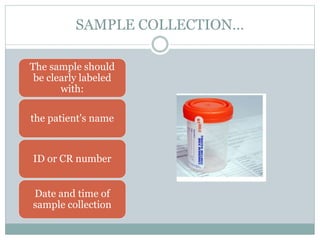
The sample should
be clearly labeled
with:
the patient's name
ID or CR number
Date and time of
sample collection
EXAMINATION OF SEMINAL FLUID
PHYSICAL EXAMINATION
: COAGULATION- Ejaculated in liquid state, it get coagulated.
Absence of coagulation indicates CAVD.
: LIQUEFATION – Liquified within 30 minutes after ejaculation.
If not liquified then t/t with plasmin or
chymotrypsinogen may be needed.
: ODOUR- Pungent.
Absence of smell=Impaired prostate.
: COLOUR- Cloudy white to grey.
Yelllow coloured= Pyospermia
white= Azoospermia,
Brown/ Red= Haemospermia
: Volume- 1.5 to 4.5 ml
Less than 1.5 ml= Abnormal
: PH- Measured in PH paper.
Normal 7.2 to 8.0
< 7 = Dysgenesis of vas deferens or
Seminal vesicle or
Epididymis.
> 8= Bacterial contamination.
MICROSCOPIC EXAMINATION
SPERM COUNT
 Count is done after liquefaction in improved neubaur’s chamber.
 Semen is diluted 1:20 with semen diluting fluid (NaHCO3 formalin)
 Sperm count per ml is calculated by:
 Sperm counted X Correction factor for diluent
…..……………………………………………………………............ X 1000 (sperms/ml)
No. of square counted X Volume of One Square
Sperm counted X 20
 …………………………....... X 1000 (sperms/ml)
4 X 0.1
 Sperm counted X 50000 (sperms/ml)
SPERM MOTILITY
 All motile and non motile sperms are counted in randomly chosen field in a
wet preparation under 40x.
 A drop of semen is placed in a glass slide, covered with a coverslip and
examined under 40 x objective.
 Minimum 200 sperms are counted.
 Motility is graded as:
> Grade IV- Progressive motility: Actively moving.
> Grade III- Slow or sluggish motility: Zig-zag movement.
> Grade II- Non progressive motility: Twitching or shaking.
> Grade I - Immotility: Non motile.
MOTILE SPERMS SEEN IN MICROSCOPE
SPERM MORPHOLOGY
60 MICRON
NORMAL SHAPED ABNORMAL SHAPED
 Head is oval shaped
and smooth.
 Midportion of sperm is
thinner than head.
 Tail is long and thinner
than head and mid
portion.
 Head is either
abnormally large or
small and shape is
other than oval.
 Double headed,
vacuolations present
 Mid portion is divided.
 Tail defect.
NORMAL VS ABNORMAL MORPHOLOGY
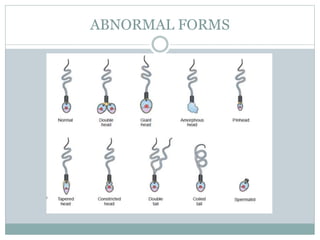
ABNORMAL FORMS
 If normal morphology of sperms is less than 4 %
then it is considered as ABNORMAL.
 Abnormal morphology play an important role in
investigation of infertility but other factors are also
important:
> Sperm concentration
>Semen volume
>Sperm motility
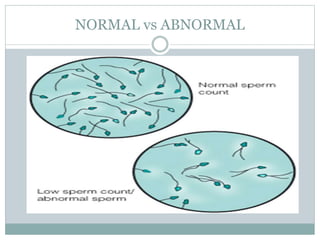
NORMAL vs ABNORMAL
ABNORMAL FORMS
VITALITY ASSESSMENT
 Eosin-nigrosin stain
 Eosin (1%) stain
Usually 1:1 ratio of semen to dye mixture, mix well
and made smear into a slide.
Read immediately at 40 x objective.
Dead sperm stains pink/red and viable sperm stains
white colour.
VITALITY ASSESMENT
OTHER CELLS IN SEMEN
Leukocytes :- Normal Range…….1-4/HPF
Leukocytospermia:- >increased in number
>in reproductive tract infection
Epithelial cells:- normal Range …1-2/HPF
Spermatocytes :- >Immature germ cells
>Normal Range …….1-2/HPF.
OTHER CELLS IN SEMEN
 Erythrocytes :- Normal Range…..1-2/HPF.
Increased number may indicate
A reproductive tract infection or
Damage to a small capillary during
sample production.
 Bacteria and protozoan such as
Trichomonas vaginalis are uncommon in human semen.
but their presence is indicative of possible male
reproductive tract infection.
BIOCHEMICAL ANALYSIS
 Fructose : Seminal vesicle marker
Low or absent indicates CAVD.
(Congenital absence of vas deferens)
 Acid phosphatase, Zinc and citric acid:
>Low level indicate prostatic dysfunction
 Neutral glucosidase and Carnitine:
>Epididymis marker
WHO REFERENCE VALUES(2010)
WHO NOMENCLATURE FOR SEMEN
VARIABLES
 Normozoospermia > Normal semen parameters.
 Oligospermia > Sperm count less than 15 million/ml.
 Azoospermia > Absence of sperms in Seminal fluid.
 Aspermia > Absence of ejaculate.
 Asthenzooospermia > Reduced sperm motility
 Teratozoospermia > Incresed abnormal form
 Lekocytospermia > More than 1 million WBCs/ ml
 Necrozoospermia > All non motile and non viable
sperms.
IMMUNOLOGICAL ANALYSIS
 Detects antisperm antibodies.
 IMMUNOBEAD TEST.
 MIXED ANTIGLOBULIN REATION: Detect Ig G
and Ig A antibodies against sperm surface.
SPERM FUNCTION TEST
 Post Coital test (Sim’s Huhnar’s test)
 Cervical mucous penetration test.
 Hamster egg penetration assay.
 Computer assisted semen analysis.
EXAMINATION OF SEMEN IN MEDICOLEGAL
CASES
 Sample obtained from vagina, stain from clothing,
skin, hair or other body parts for semen.
 TESTS : >Microscopic examination for sperm.
 >Acid Phosphatase detection.
 >Florence test- For presence of choline.
TO CHECK EFFECTIVENESS OF VASECTOMY
 Aim is to detect presence or absence of spermatozoa.
 Successful Vasectomy: Count should be zero (within
12 weaks).
 Semen is considered free of sperm: If 2 successsive
samples are negative for sperm.
THANK YOU

Semen analysis

  • 1.
    SEMEN ANALYSIS Presented by:Dr Shamim Ahmad Moderator : Dr. Ashish Koshti ASSO. Prof. (M.D.) Department of Pathology, G.M.C. Bhopal
  • 2.
    INTRODUCTION  Semen isa fluid that is emitted from male genital tract and contains sperms that are capable of fertilising female ova.  Semen analysis also called ‘SEMINOGRAM’ evaluates following characteristics of semen and the sperms contained within: >To judge the quantity and quality of semen > To detect male infertility.
  • 6.
  • 7.
    INDICATIONS FOR SEMENANALYSIS  INFERTILITY: >First step in the investigation of infertility  To check the effectiveness of vasectomy by confirming the absence of sperm.  To support or disprove a denial of paternity on the ground of sterility  For selection of assisted reproductive technology : >IVF >GIFT
  • 8.
    INDICATIONS  Medicolegal case: >Toexamine vaginal secretions or clothing stains for presence of semen (in case of rape) • For artificial insemination (for selection of donors)
  • 9.
    SAMPLE COLLECTION ANDTRANSPORT  The patient should be given clear written oral instruction concerning the collection, handling and transport of the semen.  Sample s/b collected after min of 48 hrs of abstinence, but not later than 7 days (ideal 3-5 days)  Ejaculate should be collected in privacy near the laboratory.  It should be delivered to the lab within 1 hr of collection.
  • 10.
    SAMPLE COLLECTION……  Thesample is obtained by MASURBATION in a clean wide mouthed container made up of glass or plastic.  Condom must not be used because spermicides (menfegol etc). TESA : Testicular sperm extraction.
  • 11.
    SAMPLE COLLECTION… The sampleshould be clearly labeled with: the patient's name ID or CR number Date and time of sample collection
  • 13.
    EXAMINATION OF SEMINALFLUID PHYSICAL EXAMINATION : COAGULATION- Ejaculated in liquid state, it get coagulated. Absence of coagulation indicates CAVD. : LIQUEFATION – Liquified within 30 minutes after ejaculation. If not liquified then t/t with plasmin or chymotrypsinogen may be needed. : ODOUR- Pungent. Absence of smell=Impaired prostate. : COLOUR- Cloudy white to grey. Yelllow coloured= Pyospermia white= Azoospermia, Brown/ Red= Haemospermia
  • 14.
    : Volume- 1.5to 4.5 ml Less than 1.5 ml= Abnormal : PH- Measured in PH paper. Normal 7.2 to 8.0 < 7 = Dysgenesis of vas deferens or Seminal vesicle or Epididymis. > 8= Bacterial contamination.
  • 15.
    MICROSCOPIC EXAMINATION SPERM COUNT Count is done after liquefaction in improved neubaur’s chamber.  Semen is diluted 1:20 with semen diluting fluid (NaHCO3 formalin)  Sperm count per ml is calculated by:  Sperm counted X Correction factor for diluent …..……………………………………………………………............ X 1000 (sperms/ml) No. of square counted X Volume of One Square Sperm counted X 20  …………………………....... X 1000 (sperms/ml) 4 X 0.1  Sperm counted X 50000 (sperms/ml)
  • 16.
    SPERM MOTILITY  Allmotile and non motile sperms are counted in randomly chosen field in a wet preparation under 40x.  A drop of semen is placed in a glass slide, covered with a coverslip and examined under 40 x objective.  Minimum 200 sperms are counted.  Motility is graded as: > Grade IV- Progressive motility: Actively moving. > Grade III- Slow or sluggish motility: Zig-zag movement. > Grade II- Non progressive motility: Twitching or shaking. > Grade I - Immotility: Non motile.
  • 17.
    MOTILE SPERMS SEENIN MICROSCOPE
  • 18.
  • 19.
    NORMAL SHAPED ABNORMALSHAPED  Head is oval shaped and smooth.  Midportion of sperm is thinner than head.  Tail is long and thinner than head and mid portion.  Head is either abnormally large or small and shape is other than oval.  Double headed, vacuolations present  Mid portion is divided.  Tail defect. NORMAL VS ABNORMAL MORPHOLOGY
  • 20.
  • 21.
     If normalmorphology of sperms is less than 4 % then it is considered as ABNORMAL.  Abnormal morphology play an important role in investigation of infertility but other factors are also important: > Sperm concentration >Semen volume >Sperm motility
  • 22.
  • 23.
  • 24.
    VITALITY ASSESSMENT  Eosin-nigrosinstain  Eosin (1%) stain Usually 1:1 ratio of semen to dye mixture, mix well and made smear into a slide. Read immediately at 40 x objective. Dead sperm stains pink/red and viable sperm stains white colour.
  • 25.
  • 26.
    OTHER CELLS INSEMEN Leukocytes :- Normal Range…….1-4/HPF Leukocytospermia:- >increased in number >in reproductive tract infection Epithelial cells:- normal Range …1-2/HPF Spermatocytes :- >Immature germ cells >Normal Range …….1-2/HPF.
  • 27.
    OTHER CELLS INSEMEN  Erythrocytes :- Normal Range…..1-2/HPF. Increased number may indicate A reproductive tract infection or Damage to a small capillary during sample production.  Bacteria and protozoan such as Trichomonas vaginalis are uncommon in human semen. but their presence is indicative of possible male reproductive tract infection.
  • 28.
    BIOCHEMICAL ANALYSIS  Fructose: Seminal vesicle marker Low or absent indicates CAVD. (Congenital absence of vas deferens)  Acid phosphatase, Zinc and citric acid: >Low level indicate prostatic dysfunction  Neutral glucosidase and Carnitine: >Epididymis marker
  • 29.
  • 30.
    WHO NOMENCLATURE FORSEMEN VARIABLES  Normozoospermia > Normal semen parameters.  Oligospermia > Sperm count less than 15 million/ml.  Azoospermia > Absence of sperms in Seminal fluid.  Aspermia > Absence of ejaculate.  Asthenzooospermia > Reduced sperm motility  Teratozoospermia > Incresed abnormal form  Lekocytospermia > More than 1 million WBCs/ ml  Necrozoospermia > All non motile and non viable sperms.
  • 31.
    IMMUNOLOGICAL ANALYSIS  Detectsantisperm antibodies.  IMMUNOBEAD TEST.  MIXED ANTIGLOBULIN REATION: Detect Ig G and Ig A antibodies against sperm surface.
  • 32.
    SPERM FUNCTION TEST Post Coital test (Sim’s Huhnar’s test)  Cervical mucous penetration test.  Hamster egg penetration assay.  Computer assisted semen analysis.
  • 33.
    EXAMINATION OF SEMENIN MEDICOLEGAL CASES  Sample obtained from vagina, stain from clothing, skin, hair or other body parts for semen.  TESTS : >Microscopic examination for sperm.  >Acid Phosphatase detection.  >Florence test- For presence of choline.
  • 34.
    TO CHECK EFFECTIVENESSOF VASECTOMY  Aim is to detect presence or absence of spermatozoa.  Successful Vasectomy: Count should be zero (within 12 weaks).  Semen is considered free of sperm: If 2 successsive samples are negative for sperm.
  • 35.