Gayatri Spivak and The Sub
altern Theory
Prepared by : Avni Dave
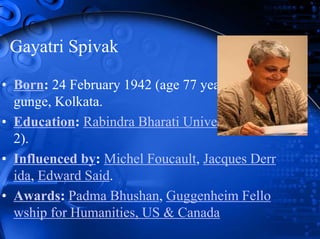
Gayatri Spivak
• Born: 24 February 1942 (age 77 years), Bally
gunge, Kolkata.
• Education: Rabindra Bharati University (201
2).
• Influenced by: Michel Foucault, Jacques Derr
ida, Edward Said.
• Awards: Padma Bhushan, Guggenheim Fello
wship for Humanities, US & Canada
What is Subaltern ?
• A subaltern is someone with a love ranking in
a social, political or other hierarchy. It can als
o mean someone who has been marginalized o
r oppressed.
• The subaltern is a technical term for a certain
kind of disposed person.
• It is person who fits within the model of the op
pressed as the being so marginalized as to not
even have the ‘voice’ of the oppressed
• The ‘subaltern’ is a term Spivak borrows from
the Italian Marxist Antonio Gramsci to signify
the oppressed class.
• Spivak’s well-know argument is that the
subaltern cannot speak for him/herself because
the very structure for colonial power prevents
the speaking.
• For the colonised woman speaking is even
more impossible because both colonialism and
partiarchy ensure that she keeps quiet.
• The subaltern cannot, therefore, represent
herself.
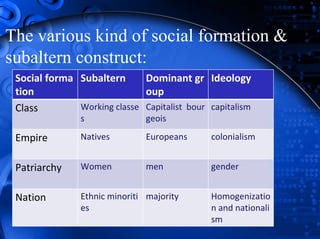
The various kind of social formation &
subaltern construct:
Social forma
tion
Subaltern Dominant gr
oup
Ideology
Class Working classe
s
Capitalist bour
geois
capitalism
Empire Natives Europeans colonialism
Patriarchy Women men gender
Nation Ethnic minoriti
es
majority Homogenizatio
n and nationali
sm
Example of subalterns
• Eklavay in the Purpose
• Karna in the Mahabharta
• Rosencrants and Guidenstern
• In lagaan movie in kachara has belonging to
low cast
• In Gulami movie Dharmendra is subaltern.
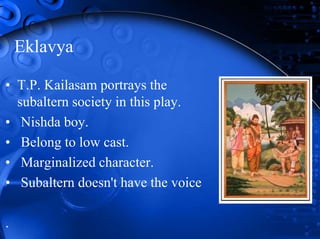
Eklavya
• T.P. Kailasam portrays the
subaltern society in this play.
• Nishda boy.
• Belong to low cast.
• Marginalized character.
• Subaltern doesn't have the voice
.
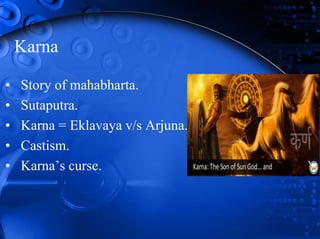
Karna
• Story of mahabharta.
• Sutaputra.
• Karna = Eklavaya v/s Arjuna.
• Castism.
• Karna’s curse.
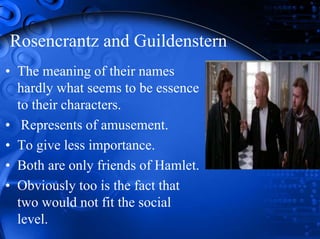
Rosencrantz and Guildenstern
• The meaning of their names
hardly what seems to be essence
to their characters.
• Represents of amusement.
• To give less importance.
• Both are only friends of Hamlet.
• Obviously too is the fact that
two would not fit the social
level.
Conclusion
• In ‘Can the Subaltern speak?’, Spivak propounds her
theory of subalternity. The crux of her theory is that
‘the subalterns cannot speak.’ The tenets of theory
became controversial as they were interpreted with
false conviction.
• The subalterns were subjected to the colonial rule
and only colonizer had the voice.
• The entire concept of ‘voice’ is determined by
the ‘subject’ and the category of the ‘other’
does not have a voice of his/her own.
• After the colonial rule, the subalterns were
again subordinated to the elite upper class.
• The subaltern women continue to suffer and
there is little scope for further improvement.s
• http://shodhganga.inflibnet.ac.in/bitstream/10603/
22597/10/10_chapter3.pdf
• google.com/search?q=about+gaytri+spivak&rlz=1
C1KMZB_enIN554IN554&source=lnms&tbm=is
ch&sa=X&ved=0ahUKEwjMu8zliqXhAhWYV30
KHY-
zDogQ_AUIECgD&biw=1366&bih=657#imgrc=
_

Sem 2 ppt 4

  • 1.
    Gayatri Spivak andThe Sub altern Theory Prepared by : Avni Dave
  • 2.
    Gayatri Spivak • Born:24 February 1942 (age 77 years), Bally gunge, Kolkata. • Education: Rabindra Bharati University (201 2). • Influenced by: Michel Foucault, Jacques Derr ida, Edward Said. • Awards: Padma Bhushan, Guggenheim Fello wship for Humanities, US & Canada
  • 3.
    What is Subaltern? • A subaltern is someone with a love ranking in a social, political or other hierarchy. It can als o mean someone who has been marginalized o r oppressed. • The subaltern is a technical term for a certain kind of disposed person. • It is person who fits within the model of the op pressed as the being so marginalized as to not even have the ‘voice’ of the oppressed
  • 4.
    • The ‘subaltern’is a term Spivak borrows from the Italian Marxist Antonio Gramsci to signify the oppressed class. • Spivak’s well-know argument is that the subaltern cannot speak for him/herself because the very structure for colonial power prevents the speaking. • For the colonised woman speaking is even more impossible because both colonialism and partiarchy ensure that she keeps quiet. • The subaltern cannot, therefore, represent herself.
  • 5.
    The various kindof social formation & subaltern construct: Social forma tion Subaltern Dominant gr oup Ideology Class Working classe s Capitalist bour geois capitalism Empire Natives Europeans colonialism Patriarchy Women men gender Nation Ethnic minoriti es majority Homogenizatio n and nationali sm
  • 6.
    Example of subalterns •Eklavay in the Purpose • Karna in the Mahabharta • Rosencrants and Guidenstern • In lagaan movie in kachara has belonging to low cast • In Gulami movie Dharmendra is subaltern.
  • 7.
    Eklavya • T.P. Kailasamportrays the subaltern society in this play. • Nishda boy. • Belong to low cast. • Marginalized character. • Subaltern doesn't have the voice .
  • 8.
    Karna • Story ofmahabharta. • Sutaputra. • Karna = Eklavaya v/s Arjuna. • Castism. • Karna’s curse.
  • 9.
    Rosencrantz and Guildenstern •The meaning of their names hardly what seems to be essence to their characters. • Represents of amusement. • To give less importance. • Both are only friends of Hamlet. • Obviously too is the fact that two would not fit the social level.
  • 10.
    Conclusion • In ‘Canthe Subaltern speak?’, Spivak propounds her theory of subalternity. The crux of her theory is that ‘the subalterns cannot speak.’ The tenets of theory became controversial as they were interpreted with false conviction. • The subalterns were subjected to the colonial rule and only colonizer had the voice.
  • 11.
    • The entireconcept of ‘voice’ is determined by the ‘subject’ and the category of the ‘other’ does not have a voice of his/her own. • After the colonial rule, the subalterns were again subordinated to the elite upper class. • The subaltern women continue to suffer and there is little scope for further improvement.s
  • 13.