Dental Implants
By
Mohamed Mahmoud Abdul-Monem
Assistant lecturer
Dental Biomaterials Department
Faculty of Dentistry
Alexandria University
Content
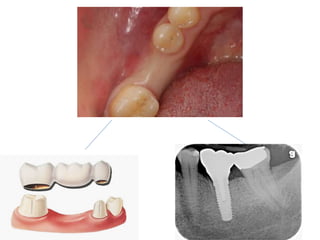
1. Difference between tooth-supported and
implant supported restoration
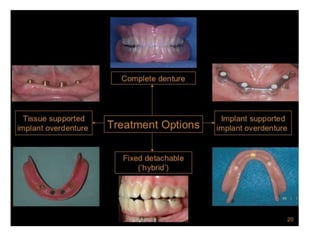
2. Implant Overdentures
3. Impression techniques for implant
supported restorations
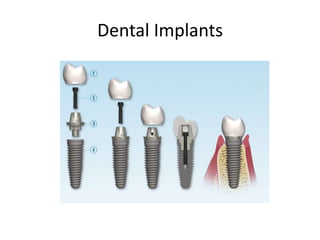
Dental Implants
Osseointegration
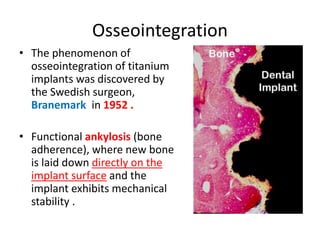
• The phenomenon of
osseointegration of titanium
implants was discovered by
the Swedish surgeon,
Branemark in 1952 .
• Functional ankylosis (bone
adherence), where new bone
is laid down directly on the
implant surface and the
implant exhibits mechanical
stability .
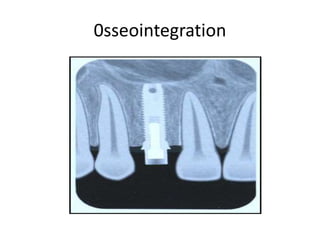
0sseointegration
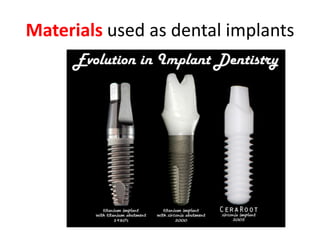
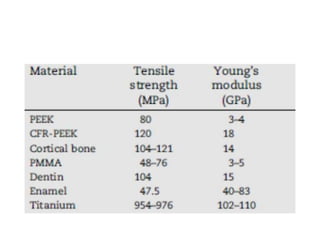
Materials used as dental implants
1.Difference between tooth
supported and implant supported
restorations
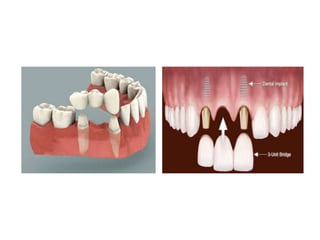
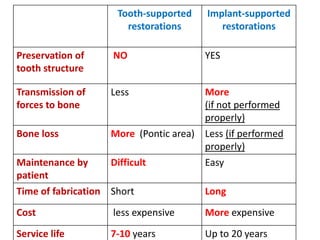
Tooth-supported
restorations
Implant-supported
restorations
Preservation of
tooth structure
NO YES
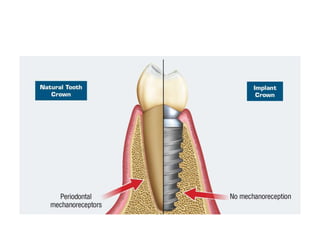
Transmission of
forces to bone
Less More
(if not performed
properly)
Bone loss More (Pontic area) Less (if performed
properly)
Maintenance by
patient
Difficult Easy
Time of fabrication Short Long
Cost less expensive More expensive
Service life 7-10 years Up to 20 years
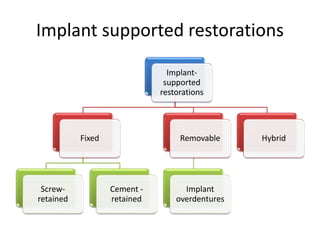
Implant supported restorations
Implant-
supported
restorations
Fixed
Screw-
retained
Cement -
retained
Removable
Implant
overdentures
Hybrid
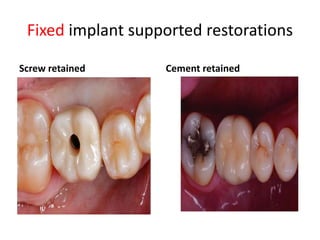
Fixed implant supported restorations
Screw retained Cement retained
2.Implant Overdentures
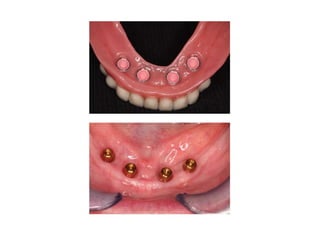
• A removable implant overdenture is a
prosthesis which is removable by the patient
and is supported or retained by dental
implants .
• The prosthesis has to be removed for the
purpose of cleaning around the abutments
Types of implant overdentures
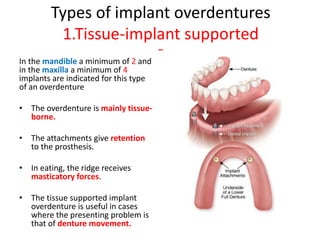
1.Tissue-implant supported
–
In the mandible a minimum of 2 and
in the maxilla a minimum of 4
implants are indicated for this type
of an overdenture
• The overdenture is mainly tissue-
borne.
• The attachments give retention
to the prosthesis.
• In eating, the ridge receives
masticatory forces.
• The tissue supported implant
overdenture is useful in cases
where the presenting problem is
that of denture movement.
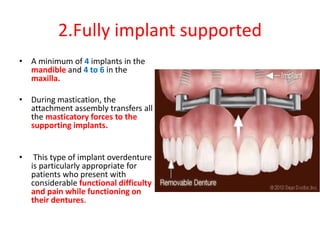
2.Fully implant supported
• A minimum of 4 implants in the
mandible and 4 to 6 in the
maxilla.
• During mastication, the
attachment assembly transfers all
the masticatory forces to the
supporting implants.
• This type of implant overdenture
is particularly appropriate for
patients who present with
considerable functional difficulty
and pain while functioning on
their dentures.
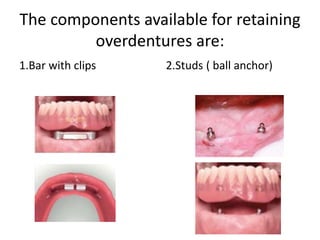
The components available for retaining
overdentures are:
1.Bar with clips 2.Studs ( ball anchor)
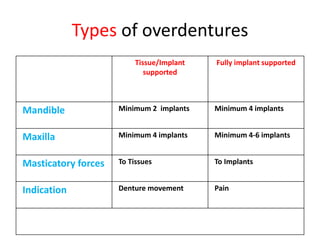
Types of overdentures
Tissue/Implant
supported
Fully implant supported
Mandible Minimum 2 implants Minimum 4 implants
Maxilla Minimum 4 implants Minimum 4-6 implants
Masticatory forces To Tissues To Implants
Indication Denture movement Pain
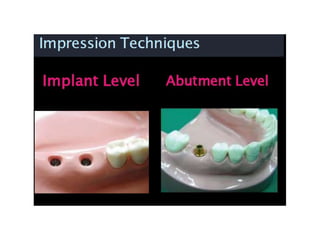
3.Impression techniques for
implant supported restorations
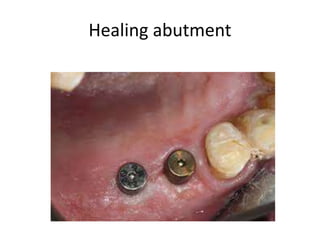
Healing abutment
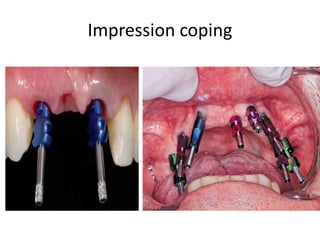
Impression coping
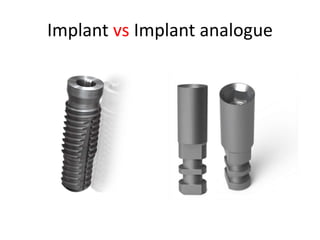
Implant vs Implant analogue
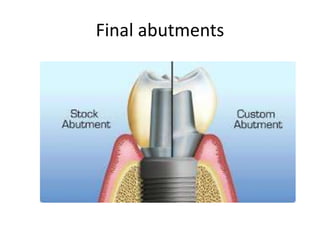
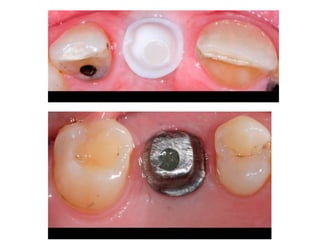
Final abutments
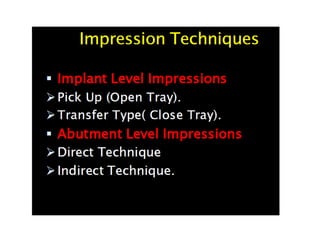
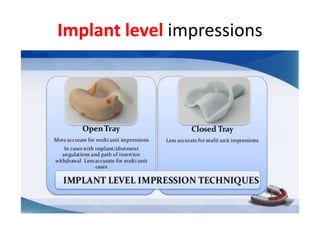
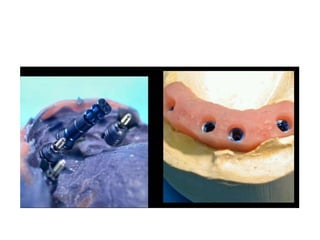
Implant level impressions
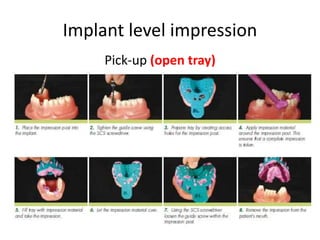
Implant level impression
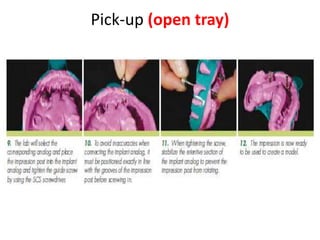
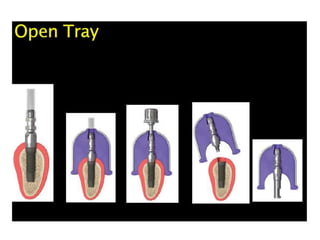
Pick-up (open tray)
Pick-up (open tray)
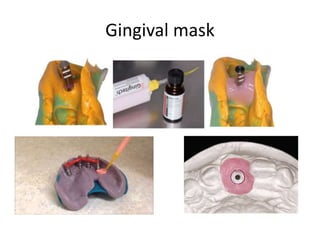
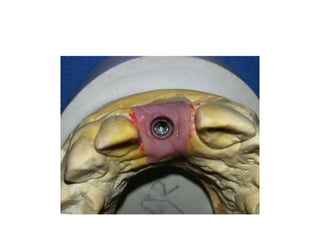
Gingival mask
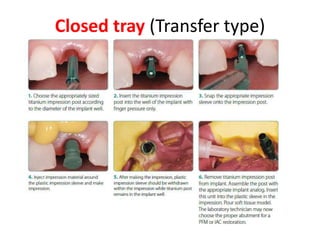
Closed tray (Transfer type)
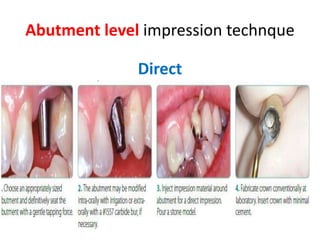
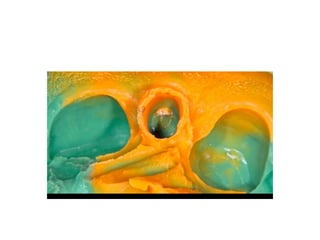
Abutment level impression technque
Direct
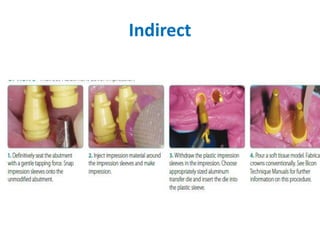
Indirect
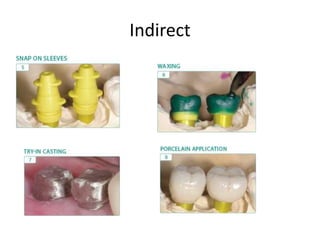
Indirect
Dental implants,Implant  overdentures & impression techniques .

Dental implants,Implant overdentures & impression techniques .