Module 4.3

Promoting Behaviour Change
For individuals and populations

Produced by The Alfred Workforce Development Team
on behalf of DHS Public Health Diabetes Prevention and Management Initiative
June 2005
Presentation purpose
Target audience


Service providers and project workers on DPMI projects

Aim


To explore the concepts of behaviour change and self management

Objectives






Provide an overview of behaviour change and self management
Explore best practice models of behaviour change
Discuss the key concepts of self management and empowerment
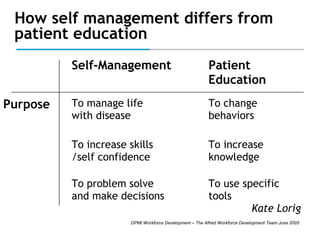
Explore self management models and evidence
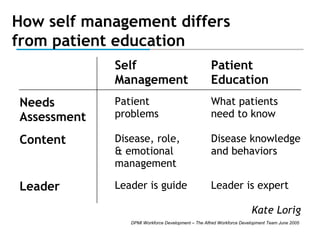
Discuss and workshop problem solving and goal setting
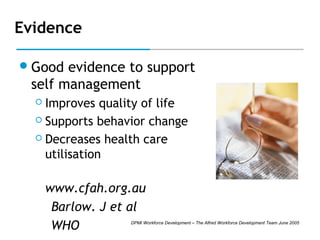
DPMI Workforce Development – The Alfred Workforce Development Team June 2005
Communicating risk
 Factors

influencing thinking on risk

People underestimate risk related to chronic
disease overestimate communicable disease
 Trust


 Who



is telling me are they trustworthy?

Risk less acceptable if:
 Imposed
 Distributed

unevenly
 Resulting from man made
 Hidden/irreversible
DPMI Workforce Development – The Alfred Workforce Development Team June 2005
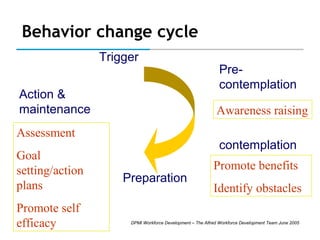
Behavior change cycle
Trigger
Action &
maintenance

Awareness raising

Assessment
Goal
setting/action
plans
Promote self
efficacy

Precontemplation

contemplation
Preparation

Promote benefits
Identify obstacles

DPMI Workforce Development – The Alfred Workforce Development Team June 2005
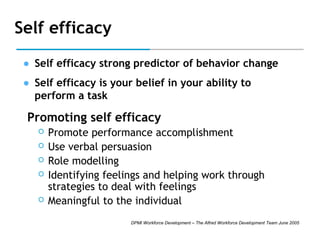
Self efficacy
• Self efficacy strong predictor of behavior change
• Self efficacy is your belief in your ability to
perform a task

Promoting self efficacy







Promote performance accomplishment
Use verbal persuasion
Role modelling
Identifying feelings and helping work through
strategies to deal with feelings
Meaningful to the individual
DPMI Workforce Development – The Alfred Workforce Development Team June 2005
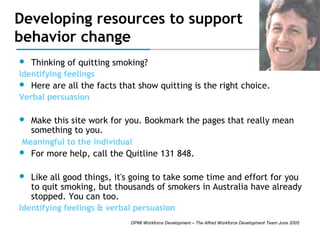
Developing resources to support
behavior change


Thinking of quitting smoking?

Identifying feelings


Here are all the facts that show quitting is the right choice.

Verbal persuasion


Make this site work for you. Bookmark the pages that really mean
something to you.

Meaningful to the individual


For more help, call the Quitline 131 848.



Like all good things, it's going to take some time and effort for you
to quit smoking, but thousands of smokers in Australia have already
stopped. You can too.

Identifying feelings & verbal persuasion
DPMI Workforce Development – The Alfred Workforce Development Team June 2005
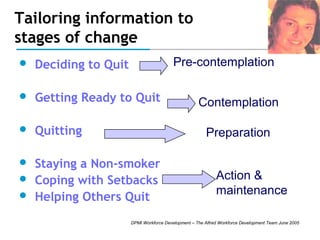
Tailoring information to
stages of change
  Deciding


to Quit 

Getting Ready to Quit 

  Quitting 
  Staying

Pre-contemplation
Contemplation
Preparation

a Non-smoker 
  Coping with Setbacks 
  Helping Others Quit 

Action &
maintenance

DPMI Workforce Development – The Alfred Workforce Development Team June 2005
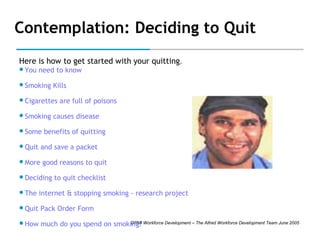
Contemplation: Deciding to Quit
Here is how to get started with your quitting.
You

need to know

Smoking

Kills

Cigarettes
Smoking
Some
Quit

are full of poisons

causes disease

benefits of quitting

and save a packet

More

good reasons to quit

Deciding

to quit checklist

The

internet & stopping smoking - research project

Quit

Pack Order Form

How

DPMI
much do you spend on smoking? Workforce Development – The Alfred Workforce Development Team June 2005
Deciding to quit checklist









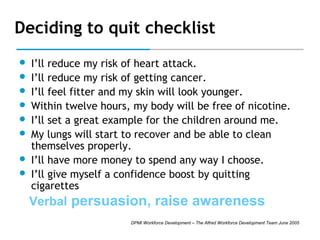
I’ll reduce my risk of heart attack.
I’ll reduce my risk of getting cancer.
I’ll feel fitter and my skin will look younger.
Within twelve hours, my body will be free of nicotine.
I’ll set a great example for the children around me.
My lungs will start to recover and be able to clean
themselves properly.
I’ll have more money to spend any way I choose.
I’ll give myself a confidence boost by quitting
cigarettes

Verbal persuasion, raise awareness
DPMI Workforce Development – The Alfred Workforce Development Team June 2005
Contemplation: Deciding to Quit
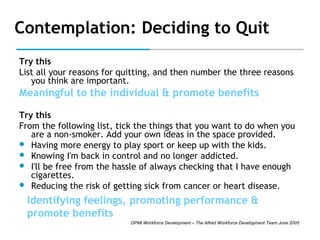
Try this
List all your reasons for quitting, and then number the three reasons
you think are important.

Meaningful to the individual & promote benefits
Try this
From the following list, tick the things that you want to do when you
are a non-smoker. Add your own ideas in the space provided.
 Having more energy to play sport or keep up with the kids.
 Knowing I'm back in control and no longer addicted.
 I'll be free from the hassle of always checking that I have enough
cigarettes.
 Reducing the risk of getting sick from cancer or heart disease.

Identifying feelings, promoting performance &
promote benefits
DPMI Workforce Development – The Alfred Workforce Development Team June 2005
Preparation: Getting ready to Quit
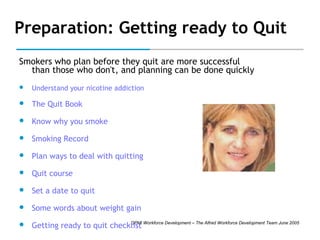
Smokers who plan before they quit are more successful
than those who don't, and planning can be done quickly


Understand your nicotine addiction



The Quit Book



Know why you smoke



Smoking Record



Plan ways to deal with quitting



Quit course



Set a date to quit



Some words about weight gain



DPMI
Getting ready to quit checklist Workforce Development – The Alfred Workforce Development Team June 2005
Set a date to quit
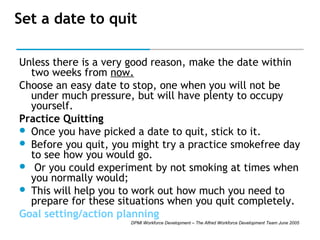
Unless there is a very good reason, make the date within
two weeks from now.
Choose an easy date to stop, one when you will not be
under much pressure, but will have plenty to occupy
yourself.
Practice Quitting  
 Once you have picked a date to quit, stick to it. 
 Before you quit, you might try a practice smokefree day
to see how you would go. 
 Or you could experiment by not smoking at times when
you normally would;
 This will help you to work out how much you need to
prepare for these situations when you quit completely.
Goal setting/action planning
DPMI Workforce Development – The Alfred Workforce Development Team June 2005
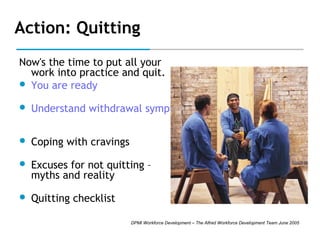
Action: Quitting
Now's the time to put all your
work into practice and quit.
 You are ready


Understand withdrawal symptoms



Coping with cravings



Excuses for not quitting –
myths and reality



Quitting checklist
DPMI Workforce Development – The Alfred Workforce Development Team June 2005
Action: Quitting
You are ready
 You've made your decision to quit.
 You have any extra information or support you feel you need.
 You've done your planning.
 You've set your quit date.
 Stick to your decision. You're doing the right thing.
Choose an approach that will work for you
 You could go cold turkey. For many people, this is a successful
method.
 You could cut down by reducing gradually
 If you choose to cut down make sure your quit date is set for two
weeks after you start reducing your smoking.
 On your quit date, cut out cigarettes altogether.
DPMI Workforce Development – The Alfred Workforce Development Team June 2005
Quitting checklist




I will choose whether to stop suddenly or gradually.
Withdrawal symptoms are a good sign
I can confront cravings by remembering the 4Ds: 











Delay
Deep breathe
Drink water
Do something else.

I will congratulate myself every time I resist the urge for a
cigarette.
Reminding myself of my reasons to quit will make it easier to
refuse cigarettes.
I have the right to refuse a cigarette and can do so without
upsetting others
I can keep my hands busy
Even if I decide to have alcohol, I’ll stick to my decision to quit.
DPMI Workforce Development – The Alfred Workforce Development Team June 2005
Maintenance:Staying a Non-smoker
The worst is over. You'll feel the urge to smoke less and
less, and soon you'll hardly think about cigarettes.
But the urge to smoke can return when you least expect
it.
You can stay stopped, but you need to be prepared.
There is always something better than a cigarette.
 The new you


Find new ways to relax & other things to do



Staying a non-smoker checklist
DPMI Workforce Development – The Alfred Workforce Development Team June 2005
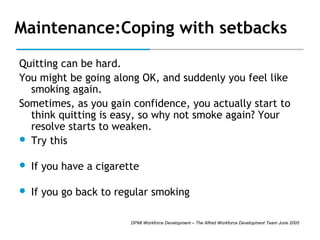
Maintenance:Coping with setbacks
Quitting can be hard.
You might be going along OK, and suddenly you feel like
smoking again.
Sometimes, as you gain confidence, you actually start to
think quitting is easy, so why not smoke again? Your
resolve starts to weaken.
 Try this


If you have a cigarette



If you go back to regular smoking
DPMI Workforce Development – The Alfred Workforce Development Team June 2005
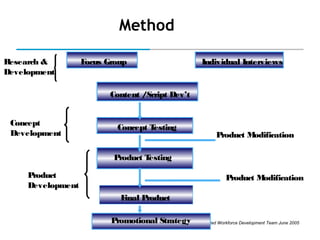
Method
R
esearch &
Development

F
ocus Group

Individual Interviews

Content /Script Dev’t
Concept
Development

Concept T
esting

P
roduct M
odification

Product T
esting
Product
Development

P
roduct M
odification
F
inal P
roduct
Promotional Strategy – The Alfred Workforce Development Team June 2005
DPMI Workforce Development
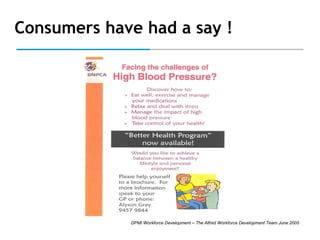
Consumers have had a say !

DPMI Workforce Development – The Alfred Workforce Development Team June 2005
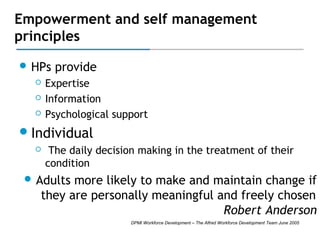
Empowerment and self management
principles
 HPs




provide

Expertise
Information
Psychological support

 Individual


The daily decision making in the treatment of their
condition

 Adults

more likely to make and maintain change if
they are personally meaningful and freely chosen
Robert Anderson
DPMI Workforce Development – The Alfred Workforce Development Team June 2005
Key concepts of self management
 Recognition

of problems as seen by the
person and encouraging them to identify
solution


“Identifying problems often means HP needs to
be silent!!” (Skinner)

 Discovery

and enhancement of internal
reinforcement for behavior change
 Encompasses social learning and behavioral
theories
DPMI Workforce Development – The Alfred Workforce Development Team June 2005
How self management differs from
patient education
Self-Management
Purpose
Purpose:

Self-Management

Patient
Education

With Disease

Behaviors

To Increase Skills/SelfConfidence

To Increase
Knowledge

To manage life
To Manage Life disease
with
To Change
To increase skills
To Use Specific
Tools
/self confidence

To Problem Solve
And Make Decisions

Patient
Education
To change
behaviors
To increase
knowledge

Kat e Lor ig

To problem solve
and make decisions

To use specific
tools
Kate Lorig

DPMI Workforce Development – The Alfred Workforce Development Team June 2005
How self management differs
from patient education
Self
Management

Patient
Education

Needs
Assessment

Patient
problems

What patients
need to know

Content

Disease, role,
& emotional
management

Disease knowledge
and behaviors

Leader

Leader is guide

Leader is expert
Kate Lorig

DPMI Workforce Development – The Alfred Workforce Development Team June 2005
Evidence
 Good

evidence to support
self management
Improves quality of life
 Supports behavior change
 Decreases health care
utilisation


www.cfah.org.au
Barlow. J et al
WHO

DPMI Workforce Development – The Alfred Workforce Development Team June 2005
References







Robert Anderson et al “Using the empowerment
approach to help clients” Chapter 17 in “Practical
psychology for diabetes Clinicians” Anderson, B and
Rubin, R. Published ADA Alexandria Virginia 1996.
Barlow J. et a “Self – management approaches for
people with chronic conditions: a review” Patient
Education and Counseling 48 (2002) 177-187
“Patients as effective collaborators in managing chronic
conditions”
www.cfah.org.au
Adherence to long term therapies www.who.org go to
publications link

DPMI Workforce Development – The Alfred Workforce Development Team June 2005
Diabetes self management education
in Australia


Norsworthy document reviewed




8 articles / 153 studies of the effectiveness of diabetes
interventions.

Concluding the evidence presented provides
powerful arguments that diabetes self management
education is:





Able to influence behaviour change and improve knowledge
and skill for diabetes self management
Can result in a reduction in secondary complication rates
Can reduce the person’s reliance on health services.

DPMI Workforce Development – The Alfred Workforce Development Team June 2005
Diabetes self management education in
Australia


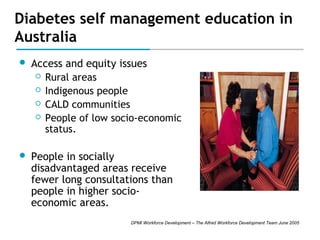
Access and equity issues
 Rural areas
 Indigenous people
 CALD communities
 People of low socio-economic
status.



People in socially
disadvantaged areas receive
fewer long consultations than
people in higher socioeconomic areas.
DPMI Workforce Development – The Alfred Workforce Development Team June 2005
Lois’s Story

DPMI Workforce Development – The Alfred Workforce Development Team June 2005
Self management models


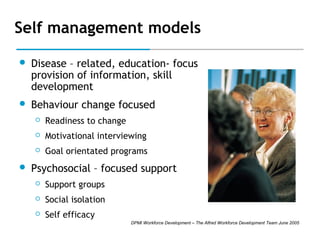
Disease – related, education- focus
provision of information, skill
development



Behaviour change focused



Motivational interviewing





Readiness to change
Goal orientated programs

Psychosocial – focused support


Support groups



Social isolation



Self efficacy
DPMI Workforce Development – The Alfred Workforce Development Team June 2005
Delivery of self management
programs
 Provided

through a variety
of modalities





Face to face
Telephone
Email
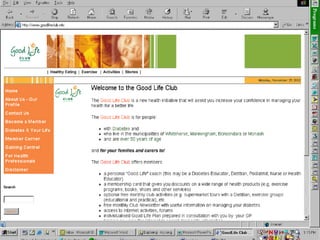
Web based

 Principles

can be
incorporated into group or
individual counselling
sessions
DPMI Workforce Development – The Alfred Workforce Development Team June 2005
Automated telephone disease
management



RCT : People with diabetes
Intervention:





Received weekly calls from automated telephone system
To discuss self-care activities and hear self-care tips

Control: Normal office visits and information

FINDINGS:
 Intervention Group





Reported fewer depressive symptoms
Higher self efficacy for self care
Greater satisfaction with services received
Improvement in health related quality of life

Petitte et al
Medical Care 38, 2000

DPMI Workforce Development – The Alfred Workforce Development Team June 2005
Automated telephone disease
management
FINDINGS:
 Intervention Group
Reported fewer depressive symptoms
 Higher self efficacy for self care
 Greater satisfaction with services received
 Improvement in health related quality of life


DPMI Workforce Development – The Alfred Workforce Development Team June 2005
Back pain email discussion group


RCT 580 subjects



Intervention:




Closed moderated email discussion group & back pain book
and video tape

Controls:


Non health magazine subscription of their choice

 Findings at 1- year:


Significant improvements in pain, disability, role function
and health distress



Less physician visits and hospitalisation days

DPMI Workforce Development – The Alfred Workforce Development Team June 2005
Kate Lorig
Stanford Patient Education Centre
Behavioural weight loss program
 Objective: Determine effectiveness of Internet

behavioural weight loss program compared to weight loss
education website
 RCT 6 months, 91 subjects, 18-60yrs, 81 female, BMI 25-36
 Control

loss

Group: web based information relating to weight

 Intervention: as above plus weekly email messages,

online submission of diaries, therapist feedback

 FINDINGS



Mean weight loss in intervention group at 6 months 4.1kg (4.5)
Mean weight loss in control group at 6 months 1.6kg (3.3)
DPMI Workforce Development – The Alfred Workforce Development Team June 2005

Tate
Essential elements of self
management interventions
 Disease,

medication and health management
 Role management
 Emotional management
 Support enhancement of self efficacy
 Problem solving training
 Follow up
 Tracking and ensuring implementation
The Robert Wood Johnson Foundation
The Centre for the Advancement of Health
www.cfah.org

DPMI Workforce Development – The Alfred Workforce Development Team June 2005
Ray’s story

DPMI Workforce Development – The Alfred Workforce Development Team June 2005
Motivational interviewing


Seeks to understand the persons
frame of reference – reflective
listening



Expresses acceptance and affirmation



Elicits and selectively reinforces the
patients own self motivational
statement, expression of problem,
concern, desire and intention and
ability to change.

Helen Linder
Latrobe university
DPMI Workforce Development – The Alfred Workforce Development Team June 2005
Assessment/Problem definition
Aim
 To help clients realise they are
responsible for, and in charge of, their
condition
 Prioritise problems and identify situations
they want to improve
 Experience emotional and psychological
commitment
 Develop a plan of action
DPMI Workforce Development – The Alfred Workforce Development Team June 2005
Assessment/Problem definition
Interview questions

What part of living with your condition
is the most difficult or unsatisfying for
you?
2. How does the situation make you feel?
3. How does this situation have to change
for you to feel better about it?
1.

Robert Anderson
DPMI Workforce Development – The Alfred Workforce Development Team June 2005
Assessment/Problem definition
4.

Are you willing to take action to improve the
situation for yourself?

5.

What are the steps that you can take to bring
you closer to where you want to be?

6.

Is there one thing that you will do when you
leave here to improve things for yourself?
Robert Anderson
DPMI Workforce Development – The Alfred Workforce Development Team June 2005
Problem solving and decision making
 Identifying

problems

 Set

goals
 Helping find alternative ways of to
accomplish goals
 Setting contracts with themselves
 Checking the results
 Making changes as needed
DPMI Workforce Development – The Alfred Workforce Development Team June 2005
Goal setting- Getting started


Choose long term goal


Goals should be something you want to do

 Identify

steps needed to reach long term

goal
 Choose

one of those steps to start
working towards goal
DPMI Workforce Development – The Alfred Workforce Development Team June 2005
SMART
 Specific
 Measurable
 Achievable
 Realistic
 Timely

Flinders University
DPMI Workforce Development – The Alfred Workforce Development Team June 2005
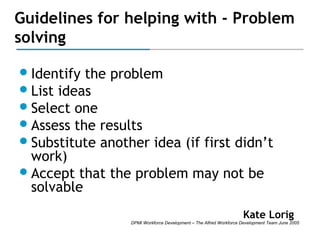
Guidelines for helping with - Problem
solving
 Identify

the problem
 List ideas
 Select one
 Assess the results
 Substitute another idea (if first didn’t
work)
 Accept that the problem may not be
solvable
Kate Lorig

DPMI Workforce Development – The Alfred Workforce Development Team June 2005
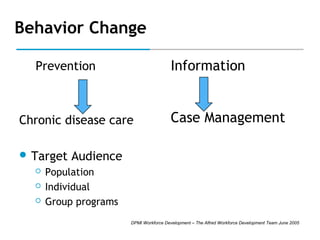
Behavior Change
Information

Prevention

Chronic disease care
 Target




Case Management

Audience

Population
Individual
Group programs
DPMI Workforce Development – The Alfred Workforce Development Team June 2005
Implementing change
 Individual

practice
 Program changes
 Organisational approach
 Small incremental changes can still have an
effect
Can require philosophical shift
 Education process/skill development
 Reorganisation of services
 Systematic approach to assessment and care planning
using tools that support identification of problem &
patient generated goals


DPMI Workforce Development – The Alfred Workforce Development Team June 2005
Our changing roles
 Patient:

Manager
 Health Professional: Assistant


Responsible to clients rather than for them



Sharing knowledge and expertise to help
make informed decisions to about their care



Collaborative approach with client generated
solutions to problems as perceived by client
DPMI Workforce Development – The Alfred Workforce Development Team June 2005
EDWARD DE BONO
 It

is better to have enough ideas for
some of them to be wrong, than to be
always right by having no ideas at all.

DPMI Workforce Development – The Alfred Workforce Development Team June 2005

Self empowerment

  • 1.
    Module 4.3 Promoting BehaviourChange For individuals and populations Produced by The Alfred Workforce Development Team on behalf of DHS Public Health Diabetes Prevention and Management Initiative June 2005
  • 2.
    Presentation purpose Target audience  Serviceproviders and project workers on DPMI projects Aim  To explore the concepts of behaviour change and self management Objectives      Provide an overview of behaviour change and self management Explore best practice models of behaviour change Discuss the key concepts of self management and empowerment Explore self management models and evidence Discuss and workshop problem solving and goal setting DPMI Workforce Development – The Alfred Workforce Development Team June 2005
  • 3.
    Communicating risk  Factors influencingthinking on risk People underestimate risk related to chronic disease overestimate communicable disease  Trust   Who  is telling me are they trustworthy? Risk less acceptable if:  Imposed  Distributed unevenly  Resulting from man made  Hidden/irreversible DPMI Workforce Development – The Alfred Workforce Development Team June 2005
  • 4.
    Behavior change cycle Trigger Action& maintenance Awareness raising Assessment Goal setting/action plans Promote self efficacy Precontemplation contemplation Preparation Promote benefits Identify obstacles DPMI Workforce Development – The Alfred Workforce Development Team June 2005
  • 5.
    Self efficacy • Selfefficacy strong predictor of behavior change • Self efficacy is your belief in your ability to perform a task Promoting self efficacy      Promote performance accomplishment Use verbal persuasion Role modelling Identifying feelings and helping work through strategies to deal with feelings Meaningful to the individual DPMI Workforce Development – The Alfred Workforce Development Team June 2005
  • 6.
    Developing resources tosupport behavior change  Thinking of quitting smoking? Identifying feelings  Here are all the facts that show quitting is the right choice. Verbal persuasion  Make this site work for you. Bookmark the pages that really mean something to you. Meaningful to the individual  For more help, call the Quitline 131 848.  Like all good things, it's going to take some time and effort for you to quit smoking, but thousands of smokers in Australia have already stopped. You can too. Identifying feelings & verbal persuasion DPMI Workforce Development – The Alfred Workforce Development Team June 2005
  • 7.
    Tailoring information to stagesof change   Deciding  to Quit  Getting Ready to Quit    Quitting    Staying Pre-contemplation Contemplation Preparation a Non-smoker    Coping with Setbacks    Helping Others Quit  Action & maintenance DPMI Workforce Development – The Alfred Workforce Development Team June 2005
  • 8.
    Contemplation: Deciding toQuit Here is how to get started with your quitting. You need to know Smoking Kills Cigarettes Smoking Some Quit are full of poisons causes disease benefits of quitting and save a packet More good reasons to quit Deciding to quit checklist The internet & stopping smoking - research project Quit Pack Order Form How DPMI much do you spend on smoking? Workforce Development – The Alfred Workforce Development Team June 2005
  • 9.
    Deciding to quitchecklist         I’ll reduce my risk of heart attack. I’ll reduce my risk of getting cancer. I’ll feel fitter and my skin will look younger. Within twelve hours, my body will be free of nicotine. I’ll set a great example for the children around me. My lungs will start to recover and be able to clean themselves properly. I’ll have more money to spend any way I choose. I’ll give myself a confidence boost by quitting cigarettes Verbal persuasion, raise awareness DPMI Workforce Development – The Alfred Workforce Development Team June 2005
  • 10.
    Contemplation: Deciding toQuit Try this List all your reasons for quitting, and then number the three reasons you think are important. Meaningful to the individual & promote benefits Try this From the following list, tick the things that you want to do when you are a non-smoker. Add your own ideas in the space provided.  Having more energy to play sport or keep up with the kids.  Knowing I'm back in control and no longer addicted.  I'll be free from the hassle of always checking that I have enough cigarettes.  Reducing the risk of getting sick from cancer or heart disease. Identifying feelings, promoting performance & promote benefits DPMI Workforce Development – The Alfred Workforce Development Team June 2005
  • 11.
    Preparation: Getting readyto Quit Smokers who plan before they quit are more successful than those who don't, and planning can be done quickly  Understand your nicotine addiction  The Quit Book  Know why you smoke  Smoking Record  Plan ways to deal with quitting  Quit course  Set a date to quit  Some words about weight gain  DPMI Getting ready to quit checklist Workforce Development – The Alfred Workforce Development Team June 2005
  • 12.
    Set a dateto quit Unless there is a very good reason, make the date within two weeks from now. Choose an easy date to stop, one when you will not be under much pressure, but will have plenty to occupy yourself. Practice Quitting    Once you have picked a date to quit, stick to it.   Before you quit, you might try a practice smokefree day to see how you would go.   Or you could experiment by not smoking at times when you normally would;  This will help you to work out how much you need to prepare for these situations when you quit completely. Goal setting/action planning DPMI Workforce Development – The Alfred Workforce Development Team June 2005
  • 13.
    Action: Quitting Now's thetime to put all your work into practice and quit.  You are ready  Understand withdrawal symptoms  Coping with cravings  Excuses for not quitting – myths and reality  Quitting checklist DPMI Workforce Development – The Alfred Workforce Development Team June 2005
  • 14.
    Action: Quitting You areready  You've made your decision to quit.  You have any extra information or support you feel you need.  You've done your planning.  You've set your quit date.  Stick to your decision. You're doing the right thing. Choose an approach that will work for you  You could go cold turkey. For many people, this is a successful method.  You could cut down by reducing gradually  If you choose to cut down make sure your quit date is set for two weeks after you start reducing your smoking.  On your quit date, cut out cigarettes altogether. DPMI Workforce Development – The Alfred Workforce Development Team June 2005
  • 15.
    Quitting checklist    I willchoose whether to stop suddenly or gradually. Withdrawal symptoms are a good sign I can confront cravings by remembering the 4Ds:           Delay Deep breathe Drink water Do something else. I will congratulate myself every time I resist the urge for a cigarette. Reminding myself of my reasons to quit will make it easier to refuse cigarettes. I have the right to refuse a cigarette and can do so without upsetting others I can keep my hands busy Even if I decide to have alcohol, I’ll stick to my decision to quit. DPMI Workforce Development – The Alfred Workforce Development Team June 2005
  • 16.
    Maintenance:Staying a Non-smoker Theworst is over. You'll feel the urge to smoke less and less, and soon you'll hardly think about cigarettes. But the urge to smoke can return when you least expect it. You can stay stopped, but you need to be prepared. There is always something better than a cigarette.  The new you  Find new ways to relax & other things to do  Staying a non-smoker checklist DPMI Workforce Development – The Alfred Workforce Development Team June 2005
  • 17.
    Maintenance:Coping with setbacks Quittingcan be hard. You might be going along OK, and suddenly you feel like smoking again. Sometimes, as you gain confidence, you actually start to think quitting is easy, so why not smoke again? Your resolve starts to weaken.  Try this  If you have a cigarette  If you go back to regular smoking DPMI Workforce Development – The Alfred Workforce Development Team June 2005
  • 18.
    Method R esearch & Development F ocus Group IndividualInterviews Content /Script Dev’t Concept Development Concept T esting P roduct M odification Product T esting Product Development P roduct M odification F inal P roduct Promotional Strategy – The Alfred Workforce Development Team June 2005 DPMI Workforce Development
  • 19.
    Consumers have hada say ! DPMI Workforce Development – The Alfred Workforce Development Team June 2005
  • 20.
    Empowerment and selfmanagement principles  HPs    provide Expertise Information Psychological support  Individual  The daily decision making in the treatment of their condition  Adults more likely to make and maintain change if they are personally meaningful and freely chosen Robert Anderson DPMI Workforce Development – The Alfred Workforce Development Team June 2005
  • 21.
    Key concepts ofself management  Recognition of problems as seen by the person and encouraging them to identify solution  “Identifying problems often means HP needs to be silent!!” (Skinner)  Discovery and enhancement of internal reinforcement for behavior change  Encompasses social learning and behavioral theories DPMI Workforce Development – The Alfred Workforce Development Team June 2005
  • 22.
    How self managementdiffers from patient education Self-Management Purpose Purpose: Self-Management Patient Education With Disease Behaviors To Increase Skills/SelfConfidence To Increase Knowledge To manage life To Manage Life disease with To Change To increase skills To Use Specific Tools /self confidence To Problem Solve And Make Decisions Patient Education To change behaviors To increase knowledge Kat e Lor ig To problem solve and make decisions To use specific tools Kate Lorig DPMI Workforce Development – The Alfred Workforce Development Team June 2005
  • 23.
    How self managementdiffers from patient education Self Management Patient Education Needs Assessment Patient problems What patients need to know Content Disease, role, & emotional management Disease knowledge and behaviors Leader Leader is guide Leader is expert Kate Lorig DPMI Workforce Development – The Alfred Workforce Development Team June 2005
  • 24.
    Evidence  Good evidence tosupport self management Improves quality of life  Supports behavior change  Decreases health care utilisation  www.cfah.org.au Barlow. J et al WHO DPMI Workforce Development – The Alfred Workforce Development Team June 2005
  • 25.
    References     Robert Anderson etal “Using the empowerment approach to help clients” Chapter 17 in “Practical psychology for diabetes Clinicians” Anderson, B and Rubin, R. Published ADA Alexandria Virginia 1996. Barlow J. et a “Self – management approaches for people with chronic conditions: a review” Patient Education and Counseling 48 (2002) 177-187 “Patients as effective collaborators in managing chronic conditions” www.cfah.org.au Adherence to long term therapies www.who.org go to publications link DPMI Workforce Development – The Alfred Workforce Development Team June 2005
  • 26.
    Diabetes self managementeducation in Australia  Norsworthy document reviewed   8 articles / 153 studies of the effectiveness of diabetes interventions. Concluding the evidence presented provides powerful arguments that diabetes self management education is:    Able to influence behaviour change and improve knowledge and skill for diabetes self management Can result in a reduction in secondary complication rates Can reduce the person’s reliance on health services. DPMI Workforce Development – The Alfred Workforce Development Team June 2005
  • 27.
    Diabetes self managementeducation in Australia  Access and equity issues  Rural areas  Indigenous people  CALD communities  People of low socio-economic status.  People in socially disadvantaged areas receive fewer long consultations than people in higher socioeconomic areas. DPMI Workforce Development – The Alfred Workforce Development Team June 2005
  • 28.
    Lois’s Story DPMI WorkforceDevelopment – The Alfred Workforce Development Team June 2005
  • 29.
    Self management models  Disease– related, education- focus provision of information, skill development  Behaviour change focused   Motivational interviewing   Readiness to change Goal orientated programs Psychosocial – focused support  Support groups  Social isolation  Self efficacy DPMI Workforce Development – The Alfred Workforce Development Team June 2005
  • 30.
    Delivery of selfmanagement programs  Provided through a variety of modalities     Face to face Telephone Email Web based  Principles can be incorporated into group or individual counselling sessions DPMI Workforce Development – The Alfred Workforce Development Team June 2005
  • 31.
    DPMI Workforce Development– The Alfred Workforce Development Team June 2005
  • 32.
    Automated telephone disease management   RCT: People with diabetes Intervention:    Received weekly calls from automated telephone system To discuss self-care activities and hear self-care tips Control: Normal office visits and information FINDINGS:  Intervention Group     Reported fewer depressive symptoms Higher self efficacy for self care Greater satisfaction with services received Improvement in health related quality of life Petitte et al Medical Care 38, 2000 DPMI Workforce Development – The Alfred Workforce Development Team June 2005
  • 33.
    Automated telephone disease management FINDINGS: Intervention Group Reported fewer depressive symptoms  Higher self efficacy for self care  Greater satisfaction with services received  Improvement in health related quality of life  DPMI Workforce Development – The Alfred Workforce Development Team June 2005
  • 34.
    Back pain emaildiscussion group  RCT 580 subjects  Intervention:   Closed moderated email discussion group & back pain book and video tape Controls:  Non health magazine subscription of their choice  Findings at 1- year:  Significant improvements in pain, disability, role function and health distress  Less physician visits and hospitalisation days DPMI Workforce Development – The Alfred Workforce Development Team June 2005 Kate Lorig Stanford Patient Education Centre
  • 35.
    Behavioural weight lossprogram  Objective: Determine effectiveness of Internet behavioural weight loss program compared to weight loss education website  RCT 6 months, 91 subjects, 18-60yrs, 81 female, BMI 25-36  Control loss Group: web based information relating to weight  Intervention: as above plus weekly email messages, online submission of diaries, therapist feedback  FINDINGS   Mean weight loss in intervention group at 6 months 4.1kg (4.5) Mean weight loss in control group at 6 months 1.6kg (3.3) DPMI Workforce Development – The Alfred Workforce Development Team June 2005 Tate
  • 36.
    Essential elements ofself management interventions  Disease, medication and health management  Role management  Emotional management  Support enhancement of self efficacy  Problem solving training  Follow up  Tracking and ensuring implementation The Robert Wood Johnson Foundation The Centre for the Advancement of Health www.cfah.org DPMI Workforce Development – The Alfred Workforce Development Team June 2005
  • 37.
    Ray’s story DPMI WorkforceDevelopment – The Alfred Workforce Development Team June 2005
  • 38.
    Motivational interviewing  Seeks tounderstand the persons frame of reference – reflective listening  Expresses acceptance and affirmation  Elicits and selectively reinforces the patients own self motivational statement, expression of problem, concern, desire and intention and ability to change. Helen Linder Latrobe university DPMI Workforce Development – The Alfred Workforce Development Team June 2005
  • 39.
    Assessment/Problem definition Aim  Tohelp clients realise they are responsible for, and in charge of, their condition  Prioritise problems and identify situations they want to improve  Experience emotional and psychological commitment  Develop a plan of action DPMI Workforce Development – The Alfred Workforce Development Team June 2005
  • 40.
    Assessment/Problem definition Interview questions Whatpart of living with your condition is the most difficult or unsatisfying for you? 2. How does the situation make you feel? 3. How does this situation have to change for you to feel better about it? 1. Robert Anderson DPMI Workforce Development – The Alfred Workforce Development Team June 2005
  • 41.
    Assessment/Problem definition 4. Are youwilling to take action to improve the situation for yourself? 5. What are the steps that you can take to bring you closer to where you want to be? 6. Is there one thing that you will do when you leave here to improve things for yourself? Robert Anderson DPMI Workforce Development – The Alfred Workforce Development Team June 2005
  • 42.
    Problem solving anddecision making  Identifying problems  Set goals  Helping find alternative ways of to accomplish goals  Setting contracts with themselves  Checking the results  Making changes as needed DPMI Workforce Development – The Alfred Workforce Development Team June 2005
  • 43.
    Goal setting- Gettingstarted  Choose long term goal  Goals should be something you want to do  Identify steps needed to reach long term goal  Choose one of those steps to start working towards goal DPMI Workforce Development – The Alfred Workforce Development Team June 2005
  • 44.
    SMART  Specific  Measurable Achievable  Realistic  Timely Flinders University DPMI Workforce Development – The Alfred Workforce Development Team June 2005
  • 45.
    Guidelines for helpingwith - Problem solving  Identify the problem  List ideas  Select one  Assess the results  Substitute another idea (if first didn’t work)  Accept that the problem may not be solvable Kate Lorig DPMI Workforce Development – The Alfred Workforce Development Team June 2005
  • 46.
    Behavior Change Information Prevention Chronic diseasecare  Target    Case Management Audience Population Individual Group programs DPMI Workforce Development – The Alfred Workforce Development Team June 2005
  • 47.
    Implementing change  Individual practice Program changes  Organisational approach  Small incremental changes can still have an effect Can require philosophical shift  Education process/skill development  Reorganisation of services  Systematic approach to assessment and care planning using tools that support identification of problem & patient generated goals  DPMI Workforce Development – The Alfred Workforce Development Team June 2005
  • 48.
    Our changing roles Patient: Manager  Health Professional: Assistant  Responsible to clients rather than for them  Sharing knowledge and expertise to help make informed decisions to about their care  Collaborative approach with client generated solutions to problems as perceived by client DPMI Workforce Development – The Alfred Workforce Development Team June 2005
  • 49.
    EDWARD DE BONO It is better to have enough ideas for some of them to be wrong, than to be always right by having no ideas at all. DPMI Workforce Development – The Alfred Workforce Development Team June 2005

Editor's Notes

  • #3 <number> 26/01/14
  • #5 Teeth Flossing example
  • #20 Our views have been essential in deciding on engagement strategies and appropriate segmentation for the focus groups The CRG has been actively involved in the development all the project consumer resources and have played a key role in promotion of the courses.
  • #22 Do self Efficacy Role play here
  • #40 Role Play of problem definition here
  • #44 Break into pairs to do following steps
  • #45 Ask group to write down goal share with group
  • #46 Role Play if Possible in pairs