Ethics & Values
Mrs. Asma Falak
MSN ( Silver Medal), PRN,CCN ( Silver Medal ), RM,RN
Nursing Instructor, SON & Midwifery , PIMS Islamabad
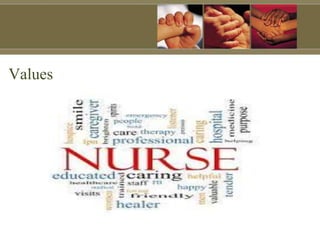
Values
Objectives
Define Values, belief and Attitude
Explain Values Transmission
Elaborate personal and professional values
Elaborate values clarification
Introduction
• Nurses encounter human events like birth, death
and suffering daily
• Nurses have to support and advocate client,
family and other healthcare team members.
• Present environment is of cost containment and
shortage of nurses, this pose importance for
nurses to know their values as well as of their
patients.
Values
• Values
– Personal beliefs about truth and worth of behaviors,
thought, objects
Beliefs
• Belief or opinion are interpretation or conclusions
that people accept as true.
• Based on faith than fact
• Belief do not necessarily involves values
• Example: “If I study hard I will get a good grade”
( belief but no value): “Goods grades are really
important to and I have to study hard to get good
grades” ( Belief with value)
Attitudes
• Attitude is a psychological construct, a mental and
emotional entity that inheres in, or characterizes a
person. They are complex and are an acquired
state through experiences.
• Belief lasts briefly while attitude last over times.
• Attitude are often judged as good or bad but
beliefs are judged as correct or incorrect.
Value system are:
 Basic to a way of life
Give direction to life
Form the basis of behavior especially used in
decision making
Values System
Values Development
• Personal values develop from:
– Individual social traditions
– Cultural, ethnic religious norms
• Professional values develop from:
– Socialization into nursing profession
– Established code of ethics
– Faculty and other nurses
– Clinical and life experiences
• Values clarification:
Values clarification:
– Choosing (Cognitive) Beliefs are chosen
– Prizing (Affective) Chosen beliefs are prized
and cherished
– Acting (Behavioral) Chosen beliefs are
Value Clarification
Choosing (Cognitive) Beliefs are chosen
• Freely, without outside pressure
• From among alternatives
• After reflecting and considering consequences.
Example: A person learns about energy resources,
production, and consumption; the greenhouse effect; and
other environmental issues, including ways to minimize
use of and to recycle limited resources.
Value Clarification
Prizing (Affective)
• Chosen beliefs are prized and cherished.
Example: The person is proud of the belief that he or she
has an obligation to participate in some way in reducing
environmental waste.
Value Clarification
• Acting (Behavioral) Chosen beliefs are • Affirmed to
others • Incorporated into one’s behavior • Repeated
consistently in one’s life.
Example: The person participates in the city recycling
program for household waste, uses public transportation
rather than driving a personal car when possible, helps
organize recycling in the workplace, and is active in
legislative and political activities related to environmental
issues.
Clarifying Client Values
• Purpose
– Client’s values influence, relate to problem
• Processes
– List alternatives
– Examine possible consequences of choices
– Choose freely; feel good about choice
– Affirm choice; act on choice
– Act with pattern
Clarifying Nurse Values
• Nurses and nursing students need to reflect on the values
they hold about life, death, health, and illness.
• Nurses hold both personal and professional values.
• One strategy for gaining awareness of personal values is
to consider attitudes about specific issues such as
abortion or euthanasia, asking: “Can I accept this, or live
with this?” “What would I do or want done in this
situation?”
Professional Values
• Autonomy
• Human dignity
• Integrity
• Social justice
What are the 5 common modes of value
transmission?
Modeling
Moralizing
Laissez-faire
Rewarding and Punishing
Responsible choice
Value Transmission
About Ethics
• Ethics
– System of moral principles governing behaviors
and relationships
– Standards of right and wrong
• Morality
– Private, personal standards of right and wrong
• Laws reflect moral values of society
• Nurses have ethical responsibility to be client
advocates
Moral Principles
Moral principles are statements about broad,
general, philosophical concepts such as autonomy
and justice. They provide the foundation for moral
rules, which are specific prescriptions for actions.
• Autonomy
• Beneficence
• Non-maleficence
• Justice
• Veracity
Moral Principles
• Autonomy
• Beneficence
• Non-maleficence
• Justice
• Veracity
• Accountability
Nursing Codes of Ethics
• A code of ethics is a formal statement of a group’s
ideals and values.
• It is a set of ethical principles that ;
(a) is shared by members of the group,
(b) reflects their moral judgments over time, and
(c) serves as a standard for their professional
actions.
Nursing Codes of Ethics
• General codes of ethics
• American Nurses Association (ANA) Code of
Ethics for Nurses
• International Council of Nurses Code of Ethics
( See P#110, Box5-3, Kozier & Erb’s 10th Ed.)
Models of Ethical Decision Making
• Responsible decision making
– Rational
– Systematic
– Based on ethical principles and codes
• Ethical obligations to clients, agency, primary
care provider
• First step: determine whether moral dilemma
exists
Advocacy
• Advocacy for nursing stems from a philosophy
of nursing in which nursing practice is the
support of an individual to promote his or her own
well-being, as understood by that individual. It is
an ethic of practice.
Advocacy-is protection and support of another's
rights
• Primary commitment to the patient
• Prioritization of good of individual patient rather
than society in general
• Evaluation of competing claims of patient’s
autonomy and patient well-being
Advocacy in Nursing Practice
Areas of Concern for Patient Advocates
• Representation of patients-nurses often intermediary between
patient and family, patient and medical profession
• Promoting self-determination-nurses do not make ethical
decisions for the patient, they facilitate the decision making of
the patient
• Whistle-blowing-every nurse who witnesses unsafe care has a
duty to patients
• Being politically active-nursing has a voice in the political
arena on behalf of those least well served by the health care
system
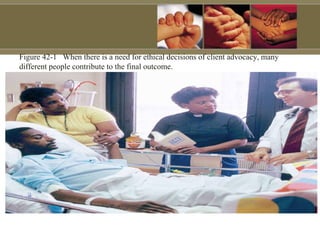
Figure 42-1 When there is a need for ethical decisions of client advocacy, many
different people contribute to the final outcome.
References
• Erb, G & Kozier, B. (2016). Fundamentals of
Nursing Concepts, Process and practice (10th
edition): Addison- Welsy.

Ethics and values in nursing

  • 1.
    Ethics & Values Mrs.Asma Falak MSN ( Silver Medal), PRN,CCN ( Silver Medal ), RM,RN Nursing Instructor, SON & Midwifery , PIMS Islamabad
  • 2.
  • 3.
    Objectives Define Values, beliefand Attitude Explain Values Transmission Elaborate personal and professional values Elaborate values clarification
  • 4.
    Introduction • Nurses encounterhuman events like birth, death and suffering daily • Nurses have to support and advocate client, family and other healthcare team members. • Present environment is of cost containment and shortage of nurses, this pose importance for nurses to know their values as well as of their patients.
  • 5.
    Values • Values – Personalbeliefs about truth and worth of behaviors, thought, objects
  • 6.
    Beliefs • Belief oropinion are interpretation or conclusions that people accept as true. • Based on faith than fact • Belief do not necessarily involves values • Example: “If I study hard I will get a good grade” ( belief but no value): “Goods grades are really important to and I have to study hard to get good grades” ( Belief with value)
  • 7.
    Attitudes • Attitude isa psychological construct, a mental and emotional entity that inheres in, or characterizes a person. They are complex and are an acquired state through experiences. • Belief lasts briefly while attitude last over times. • Attitude are often judged as good or bad but beliefs are judged as correct or incorrect.
  • 8.
    Value system are: Basic to a way of life Give direction to life Form the basis of behavior especially used in decision making Values System
  • 9.
    Values Development • Personalvalues develop from: – Individual social traditions – Cultural, ethnic religious norms • Professional values develop from: – Socialization into nursing profession – Established code of ethics – Faculty and other nurses – Clinical and life experiences • Values clarification:
  • 10.
    Values clarification: – Choosing(Cognitive) Beliefs are chosen – Prizing (Affective) Chosen beliefs are prized and cherished – Acting (Behavioral) Chosen beliefs are
  • 11.
    Value Clarification Choosing (Cognitive)Beliefs are chosen • Freely, without outside pressure • From among alternatives • After reflecting and considering consequences. Example: A person learns about energy resources, production, and consumption; the greenhouse effect; and other environmental issues, including ways to minimize use of and to recycle limited resources.
  • 12.
    Value Clarification Prizing (Affective) •Chosen beliefs are prized and cherished. Example: The person is proud of the belief that he or she has an obligation to participate in some way in reducing environmental waste.
  • 13.
    Value Clarification • Acting(Behavioral) Chosen beliefs are • Affirmed to others • Incorporated into one’s behavior • Repeated consistently in one’s life. Example: The person participates in the city recycling program for household waste, uses public transportation rather than driving a personal car when possible, helps organize recycling in the workplace, and is active in legislative and political activities related to environmental issues.
  • 14.
    Clarifying Client Values •Purpose – Client’s values influence, relate to problem • Processes – List alternatives – Examine possible consequences of choices – Choose freely; feel good about choice – Affirm choice; act on choice – Act with pattern
  • 15.
    Clarifying Nurse Values •Nurses and nursing students need to reflect on the values they hold about life, death, health, and illness. • Nurses hold both personal and professional values. • One strategy for gaining awareness of personal values is to consider attitudes about specific issues such as abortion or euthanasia, asking: “Can I accept this, or live with this?” “What would I do or want done in this situation?”
  • 16.
    Professional Values • Autonomy •Human dignity • Integrity • Social justice
  • 18.
    What are the5 common modes of value transmission? Modeling Moralizing Laissez-faire Rewarding and Punishing Responsible choice Value Transmission
  • 19.
    About Ethics • Ethics –System of moral principles governing behaviors and relationships – Standards of right and wrong • Morality – Private, personal standards of right and wrong • Laws reflect moral values of society • Nurses have ethical responsibility to be client advocates
  • 20.
    Moral Principles Moral principlesare statements about broad, general, philosophical concepts such as autonomy and justice. They provide the foundation for moral rules, which are specific prescriptions for actions. • Autonomy • Beneficence • Non-maleficence • Justice • Veracity
  • 21.
    Moral Principles • Autonomy •Beneficence • Non-maleficence • Justice • Veracity • Accountability
  • 22.
    Nursing Codes ofEthics • A code of ethics is a formal statement of a group’s ideals and values. • It is a set of ethical principles that ; (a) is shared by members of the group, (b) reflects their moral judgments over time, and (c) serves as a standard for their professional actions.
  • 23.
    Nursing Codes ofEthics • General codes of ethics • American Nurses Association (ANA) Code of Ethics for Nurses • International Council of Nurses Code of Ethics ( See P#110, Box5-3, Kozier & Erb’s 10th Ed.)
  • 24.
    Models of EthicalDecision Making • Responsible decision making – Rational – Systematic – Based on ethical principles and codes • Ethical obligations to clients, agency, primary care provider • First step: determine whether moral dilemma exists
  • 26.
    Advocacy • Advocacy fornursing stems from a philosophy of nursing in which nursing practice is the support of an individual to promote his or her own well-being, as understood by that individual. It is an ethic of practice.
  • 27.
    Advocacy-is protection andsupport of another's rights • Primary commitment to the patient • Prioritization of good of individual patient rather than society in general • Evaluation of competing claims of patient’s autonomy and patient well-being Advocacy in Nursing Practice
  • 28.
    Areas of Concernfor Patient Advocates • Representation of patients-nurses often intermediary between patient and family, patient and medical profession • Promoting self-determination-nurses do not make ethical decisions for the patient, they facilitate the decision making of the patient • Whistle-blowing-every nurse who witnesses unsafe care has a duty to patients • Being politically active-nursing has a voice in the political arena on behalf of those least well served by the health care system
  • 29.
    Figure 42-1 Whenthere is a need for ethical decisions of client advocacy, many different people contribute to the final outcome.
  • 30.
    References • Erb, G& Kozier, B. (2016). Fundamentals of Nursing Concepts, Process and practice (10th edition): Addison- Welsy.