HOW EMAIL MARKETING HELPS
ONLINE MEDIA ENHANCE AUDIENCE
& REVENUE
Solving these issues boils down to two tasks: unique
top-of-the-line content creation and its targeted, timely and effec-
tive distribution.
Creating killer content is certainly a top priority for every publisher.
But this column is devoted to the second task. What methods do
publishers have to effectively bring content to their audience?
The first method is social networks. Today social media makes up
the lion’s share of overall traffic to websites (over 31%, according
to Shareaholic Social Media Traffic Report). But they are too
clogged with useless information, and the competitive battle for
readers’ attention is fierce. With information selection algorithms
used by Facebook, Google+ and Twitter, the chances that your
content will be noticed are next to nothing, unless you are Buzz-
Feed or Huffington Post.
The second method is RSS feeds and news aggregators such as
Feedly, Flipboard etc. But competition here is very high as well.
20 articles may appear almost simultaneously and your content
ends up somewhere at the bottom of the page.
The development of Internet and social networks creates
three major problems that online media publishers must
handle to stay on top. Most readers are eyeballs, ad reve-
nues are plummeting, and limited technical & financial
resources do not allow them to effectively engage users.
The third method is email marketing. Email remains one of the
most effective channels. With the right approach, you can be sure
that sooner or later your content will be seen by the reader.
According to Email Marketing Industry Census 2014, 68% of
companies rate email ‘excellent’ or ‘good’ for return on investment
(ROI). Thus, email is the #1 marketing channel for ROI, leapfrog-
ging SEO for the first time since 2009.
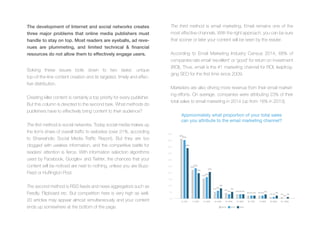
Marketers are also driving more revenue from their email market-
ing efforts. On average, companies were attributing 23% of their
total sales to email marketing in 2014 (up from 18% in 2013).
Approximately what proportion of your total sales
can you attribute to the email marketing channel?
2012 2013 2014
45%
50%
40%
35%
30%
25%
20%
15%
10%
5%
0%
0–10% 11–20% 21–30% 31–40% 41–50% 51–60% 61–70% 71–80% 81–90% 91–100%
46%
45%
39%
22%
23%
19%
15%
16%
20%
5%
6%
8%
4%
3%
5%
3% 3% 3%
2% 2% 2% 2% 2%
3%
1% 1%
2%
1%
0%
1%
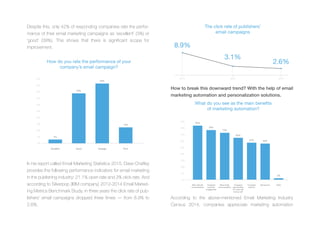
Despite this, only 42% of responding companies rate the perfor-
mance of their email marketing campaigns as ‘excellent’ (3%) or
‘good’ (39%). This shows that there is significant scope for
improvement.
In his report called Email Marketing Statistics 2015, Dave Chaffey
provides the following performance indicators for email marketing
in the publishing industry: 21.1% open rate and 3% click rate. And
according to Silverpop (IBM company) 2012-2014 Email Market-
ing Metrics Benchmark Study, in three years the click rate of pub-
lishers’ email campaigns dropped three times — from 8.9% to
2.6%.
How to break this downward trend? With the help of email
marketing automation and personalization solutions.
According to the above-mentioned Email Marketing Industry
Census 2014, companies appreciate marketing automation
8.9%
3.1%
2.6%
2012 2013 2014
The click rate of publishers’
email campaigns
How do you rate the performance of your
company’s email campaign?
50%
45%
40%
35%
30%
25%
20%
15%
10%
5%
0%
Excellent
3%
Good
39%
Average
46%
Poor
12%
What do you see as the main benefits
of marketing automation?
90%
80%
70%
60%
50%
40%
30%
20%
10%
0%
More relevant
communication
Increased
customer
engagement
More timely
communication
Increased
opportunities
for cross-sell
and up-sell
Increased
revenue
Saving time Other
83%
76%
73%
65%
57% 56%
2%
opportunities, with 83% declaring ‘more relevant communication’
as one of the main benefits. Most organizations are also aware that
marketing automation can help ‘increase customer engagement’
(76%) and help facilitate ‘more timely communication’ with custom-
ers (73%). 89% of companies have access to marketing automa-
tion capabilities provided by their email providers.
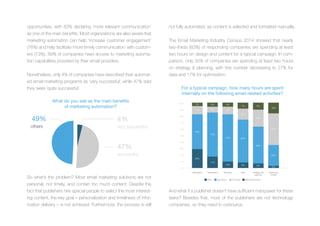
Nonetheless, only 4% of companies have described their automat-
ed email marketing programs as ‘very successful’, while 47% said
they were ‘quite successful’.
So what’s the problem? Most email marketing solutions are not
personal, not timely, and contain too much content. Despite the
fact that publishers hire special people to select the most interest-
ing content, the key goal – personalization and timeliness of infor-
mation delivery – is not achieved. Furthermore, the process is still
not fully automated, as content is selected and formatted manually.
The Email Marketing Industry Census 2014 showed that nearly
two-thirds (63%) of responding companies are spending at least
two hours on design and content for a typical campaign. In com-
parison, only 35% of companies are spending at least two hours
on strategy & planning, with this number decreasing to 27% for
data and 17% for optimization.
And what if a publisher doesn't have sufficient manpower for these
tasks? Besides that, most of the publishers are not technology
companies, so they need to outsource.
For a typical campagn, how many hours are spent
internally on the following email-related activities?
90%
100%
80%
70%
60%
50%
40%
30%
20%
10%
0%
Optimisation Transmission Reporting Data Strategy and
planning
Desing and
content
29%
54%
14%
3%
17%
70%
9%
4%
10%
73%
13%
4%
9%
64%
20%
7%
8%
56%
26%
9%
2%
35%
47%
16%
None Up 2 hours 2–8 hours More than 8 hours
What do you see as the main benefits
of marketing automation?
47%
successful
4%
very successful
49%
others
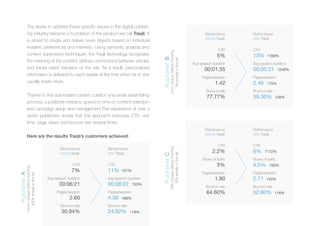
The desire to address these specific issues in the digital publish-
ing industry became a foundation of the product we call Traqli. It
is aimed to create and deliver news digests based on individual
readers’ preferences and interests. Using semantic analysis and
content supervision techniques, the Traqli technology recognizes
the meaning of the content, defines connections between articles
and tracks users’ behavior on the site. As a result, personalized
information is delivered to each reader at the time when he or she
usually reads news.
Thanks to this automated content curation and email assembling
process, a publisher needs to spend no time on content selection
and campaign setup and management.The experience of over a
dozen publishers shows that this approach improves CTR, visit
time, page views and bounce rate several times.
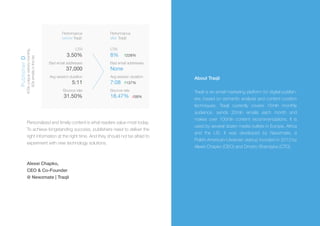
Here are the results Traqli’s customers achieved:
CTR
Avg session duration
Pages/session
Bounce rate
Performance
before Traqli:
Performance
after Traqli:
7%
00:06:21
2.60
30.94%
CTR
Avg session duration
Pages/session
Bounce rate
11%
00:08:22
4.39
24.92%
57%
33%
68%
19%
CTR
Avg session duration
Pages/session
Bounce rate
Performance
before Traqli:
Performance
after Traqli:
5%
00:01:35
1.42
77.77%
CTR
Avg session duration
Pages/session
Bounce rate
13%
00:05:31
2.49
55.30%
160%
248%
75%
28%
CTR
Share of traffic
Pages/session
Bounce rate
Performance
before Traqli:
Performance
after Traqli:
2.2%
3%
1.90
64.60%
CTR
Share of traffic
Pages/session
Bounce rate
6%
4.5%
2.71
52.80%
172%
50%
43%
18%
Personalized and timely content is what readers value most today.
To achieve longstanding success, publishers need to deliver the
right information at the right time. And they should not be afraid to
experiment with new technology solutions.
Alexei Chapko,
CEO & Co-Founder
@ Newzmate | Traqli
About Traqli
Traqli is an email marketing platform for digital publish-
ers, based on semantic analysis and content curation
techniques. Traqli currently covers 15mln monthly
audience, sends 20mln emails each month and
makes over 100mln content recommendations. It is
used by several dozen media outlets in Europe, Africa
and the US. It was developed by Newzmate, a
Polish-American-Ukrainian startup founded in 2013 by
Alexei Chapko (CEO) and Dmytro Shandyba (CTO).
CTR
Bad email addresses
Avg session duration
Bounce rate
Performance
before Traqli:
Performance
after Traqli:
3.50%
37,000
5:11
31.50%
CTR
Bad email addresses
Avg session duration
Bounce rate
8%
None
7:08
18.47%
228%
137%
58%

HOW EMAIL MARKETING HELPS ONLINE MEDIA ENHANCE AUDIENCE & REVENUE

  • 1.
    HOW EMAIL MARKETINGHELPS ONLINE MEDIA ENHANCE AUDIENCE & REVENUE
  • 2.
    Solving these issuesboils down to two tasks: unique top-of-the-line content creation and its targeted, timely and effec- tive distribution. Creating killer content is certainly a top priority for every publisher. But this column is devoted to the second task. What methods do publishers have to effectively bring content to their audience? The first method is social networks. Today social media makes up the lion’s share of overall traffic to websites (over 31%, according to Shareaholic Social Media Traffic Report). But they are too clogged with useless information, and the competitive battle for readers’ attention is fierce. With information selection algorithms used by Facebook, Google+ and Twitter, the chances that your content will be noticed are next to nothing, unless you are Buzz- Feed or Huffington Post. The second method is RSS feeds and news aggregators such as Feedly, Flipboard etc. But competition here is very high as well. 20 articles may appear almost simultaneously and your content ends up somewhere at the bottom of the page. The development of Internet and social networks creates three major problems that online media publishers must handle to stay on top. Most readers are eyeballs, ad reve- nues are plummeting, and limited technical & financial resources do not allow them to effectively engage users. The third method is email marketing. Email remains one of the most effective channels. With the right approach, you can be sure that sooner or later your content will be seen by the reader. According to Email Marketing Industry Census 2014, 68% of companies rate email ‘excellent’ or ‘good’ for return on investment (ROI). Thus, email is the #1 marketing channel for ROI, leapfrog- ging SEO for the first time since 2009. Marketers are also driving more revenue from their email market- ing efforts. On average, companies were attributing 23% of their total sales to email marketing in 2014 (up from 18% in 2013). Approximately what proportion of your total sales can you attribute to the email marketing channel? 2012 2013 2014 45% 50% 40% 35% 30% 25% 20% 15% 10% 5% 0% 0–10% 11–20% 21–30% 31–40% 41–50% 51–60% 61–70% 71–80% 81–90% 91–100% 46% 45% 39% 22% 23% 19% 15% 16% 20% 5% 6% 8% 4% 3% 5% 3% 3% 3% 2% 2% 2% 2% 2% 3% 1% 1% 2% 1% 0% 1%
  • 3.
    Despite this, only42% of responding companies rate the perfor- mance of their email marketing campaigns as ‘excellent’ (3%) or ‘good’ (39%). This shows that there is significant scope for improvement. In his report called Email Marketing Statistics 2015, Dave Chaffey provides the following performance indicators for email marketing in the publishing industry: 21.1% open rate and 3% click rate. And according to Silverpop (IBM company) 2012-2014 Email Market- ing Metrics Benchmark Study, in three years the click rate of pub- lishers’ email campaigns dropped three times — from 8.9% to 2.6%. How to break this downward trend? With the help of email marketing automation and personalization solutions. According to the above-mentioned Email Marketing Industry Census 2014, companies appreciate marketing automation 8.9% 3.1% 2.6% 2012 2013 2014 The click rate of publishers’ email campaigns How do you rate the performance of your company’s email campaign? 50% 45% 40% 35% 30% 25% 20% 15% 10% 5% 0% Excellent 3% Good 39% Average 46% Poor 12% What do you see as the main benefits of marketing automation? 90% 80% 70% 60% 50% 40% 30% 20% 10% 0% More relevant communication Increased customer engagement More timely communication Increased opportunities for cross-sell and up-sell Increased revenue Saving time Other 83% 76% 73% 65% 57% 56% 2%
  • 4.
    opportunities, with 83%declaring ‘more relevant communication’ as one of the main benefits. Most organizations are also aware that marketing automation can help ‘increase customer engagement’ (76%) and help facilitate ‘more timely communication’ with custom- ers (73%). 89% of companies have access to marketing automa- tion capabilities provided by their email providers. Nonetheless, only 4% of companies have described their automat- ed email marketing programs as ‘very successful’, while 47% said they were ‘quite successful’. So what’s the problem? Most email marketing solutions are not personal, not timely, and contain too much content. Despite the fact that publishers hire special people to select the most interest- ing content, the key goal – personalization and timeliness of infor- mation delivery – is not achieved. Furthermore, the process is still not fully automated, as content is selected and formatted manually. The Email Marketing Industry Census 2014 showed that nearly two-thirds (63%) of responding companies are spending at least two hours on design and content for a typical campaign. In com- parison, only 35% of companies are spending at least two hours on strategy & planning, with this number decreasing to 27% for data and 17% for optimization. And what if a publisher doesn't have sufficient manpower for these tasks? Besides that, most of the publishers are not technology companies, so they need to outsource. For a typical campagn, how many hours are spent internally on the following email-related activities? 90% 100% 80% 70% 60% 50% 40% 30% 20% 10% 0% Optimisation Transmission Reporting Data Strategy and planning Desing and content 29% 54% 14% 3% 17% 70% 9% 4% 10% 73% 13% 4% 9% 64% 20% 7% 8% 56% 26% 9% 2% 35% 47% 16% None Up 2 hours 2–8 hours More than 8 hours What do you see as the main benefits of marketing automation? 47% successful 4% very successful 49% others
  • 5.
    The desire toaddress these specific issues in the digital publish- ing industry became a foundation of the product we call Traqli. It is aimed to create and deliver news digests based on individual readers’ preferences and interests. Using semantic analysis and content supervision techniques, the Traqli technology recognizes the meaning of the content, defines connections between articles and tracks users’ behavior on the site. As a result, personalized information is delivered to each reader at the time when he or she usually reads news. Thanks to this automated content curation and email assembling process, a publisher needs to spend no time on content selection and campaign setup and management.The experience of over a dozen publishers shows that this approach improves CTR, visit time, page views and bounce rate several times. Here are the results Traqli’s customers achieved: CTR Avg session duration Pages/session Bounce rate Performance before Traqli: Performance after Traqli: 7% 00:06:21 2.60 30.94% CTR Avg session duration Pages/session Bounce rate 11% 00:08:22 4.39 24.92% 57% 33% 68% 19% CTR Avg session duration Pages/session Bounce rate Performance before Traqli: Performance after Traqli: 5% 00:01:35 1.42 77.77% CTR Avg session duration Pages/session Bounce rate 13% 00:05:31 2.49 55.30% 160% 248% 75% 28% CTR Share of traffic Pages/session Bounce rate Performance before Traqli: Performance after Traqli: 2.2% 3% 1.90 64.60% CTR Share of traffic Pages/session Bounce rate 6% 4.5% 2.71 52.80% 172% 50% 43% 18%
  • 6.
    Personalized and timelycontent is what readers value most today. To achieve longstanding success, publishers need to deliver the right information at the right time. And they should not be afraid to experiment with new technology solutions. Alexei Chapko, CEO & Co-Founder @ Newzmate | Traqli About Traqli Traqli is an email marketing platform for digital publish- ers, based on semantic analysis and content curation techniques. Traqli currently covers 15mln monthly audience, sends 20mln emails each month and makes over 100mln content recommendations. It is used by several dozen media outlets in Europe, Africa and the US. It was developed by Newzmate, a Polish-American-Ukrainian startup founded in 2013 by Alexei Chapko (CEO) and Dmytro Shandyba (CTO). CTR Bad email addresses Avg session duration Bounce rate Performance before Traqli: Performance after Traqli: 3.50% 37,000 5:11 31.50% CTR Bad email addresses Avg session duration Bounce rate 8% None 7:08 18.47% 228% 137% 58%