Outline
Uniqueness of web app testing
Heterogonous system
Dynamic pages
Load
Security
Selenium WebDriver
Course project 4
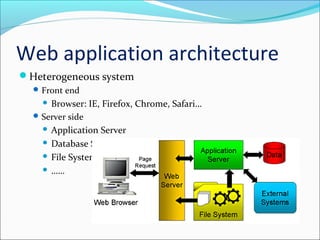
Web application architecture
Heterogeneous system
Front end
 Browser: IE, Firefox, Chrome, Safari…
Server side
 Application Server
 Database Server
 File System
 ……
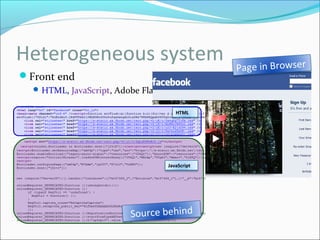
Heterogeneous system
Front end
HTML, JavaScript, Adobe Flash……
HTML
JavaScript
Page in Browser
Source behind
Heterogeneous system
Should test all involved parts
Everything can go wrong…
However, only front end is accessible for tests
Can not directly test the Server code and SQL
Have to drive the execution and test
 Frontend
 HTML: Malformed HTML page? (demo)
 JavaScript: Runtime Errors? (demo)
 Server script
 PHP, Java…: Runtime Errors? (demo)
 SQL: Malformed SQL query string? (demo)
Test from the front end
Good things
Hide the complexity of the backend
Uniformed interface
Can put a robot in the front end and automate the tests
Bad things
The front end is not trustable
 Crafted malicious requests
Good things of testing from the
front end
 Automated web app testing
 Compare to commend-line program testing…
 Sensitive to input values (the same)
 GUI testing: event driven (the difference)
 “Button A” then “Button B”  OK
 “Button B” then “Button A”  FAIL
 The robot should be able to
 Provide input values
 Simulate user actions
 Selenium
 A tool set automates web app testing across platforms
 Can simulate user interactions in browser
 Two components
 Selenium IDE
 Selenium WebDriver (aka. Selenium 2)
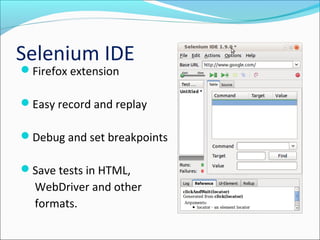
Selenium IDE
Firefox extension
Easy record and replay
Debug and set breakpoints
Save tests in HTML,
WebDriver and other
formats.
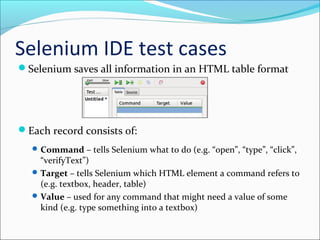
Selenium IDE test cases
Selenium saves all information in an HTML table format
Each record consists of:
Command – tells Selenium what to do (e.g. “open”, “type”, “click”,
“verifyText”)
Target – tells Selenium which HTML element a command refers to
(e.g. textbox, header, table)
Value – used for any command that might need a value of some
kind (e.g. type something into a textbox)
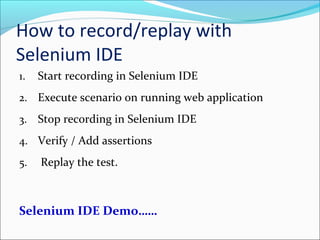
How to record/replay with
Selenium IDE
1. Start recording in Selenium IDE
2. Execute scenario on running web application
3. Stop recording in Selenium IDE
4. Verify / Add assertions
5. Replay the test.
Selenium IDE Demo……
Bad things of testing from the front end
The front end is not trustable
Front end code can be accessed to anybody
They can infer the input parameters
 Crafted requests!
Demo
Front end limits the length of the input values
Front end limits the content of the input values
Front end limits the combination of the input values
Uniqueness 2: Dynamic pages
Client page is dynamic
 It can change itself in the runtime
 HTML can be modified by JavaScript
 JavaScript can modify itself
 Demo
Server script is dynamic
 Client pages are constructed in the runtime
 A same server script can produce completely different client
pages
 Demo
 SchoolMate
Uniqueness 3: Performance
Performance is crucial to the success of a web app
 Recall the experience to register for a class in the first days of
the semester…
 Are the servers powerful enough?
Performance testing evaluates system performance under
normal and heavy usage
 Load testing
 For expected concurrent number of users
 Stress testing
 To understand the upper limits of capacity
Performance testing can be automated
Uniqueness 4: Security
Web app usually deals with sensitive info, e.g.
Credit card number
SSN
Billing / Shipping address
Security is the biggest concern
Security testing should simulate possible attacks
Uniqueness 4: Security
SQL Injection
The untrusted input is used to construct dynamic SQL
queries.
E.g, update my own password
$str = "UPDATE users SET password = ” “ . $_POST['newPass’] .
“” WHERE username =”“ . $_POST['username'] . “””;
mysql_query( $str );
$_POST['newPass’] = pass, $_POST['username'] = me
Query String: UPDATE users SET password = “pass” WHERE username =“me”
$_POST['newPass’] = pass, $_POST['username'] = “ OR 1=1 --
Query String: UPDATE users SET password = “pass” WHERE username =“” OR 1=1 --”
Normal Case
Attack
PHP ScriptPHP Script
Uniqueness 4: Security
Cross Site Scripting (XSS)
The untrusted input is used to construct dynamic
HTML pages.
The malicious JS injected executes in victim’s browser
The malicious JS can steal sensitive info
Demo
Solution: Never trust user inputs
Design test cases to simulate attacks
Outline
Uniqueness of web app testing
Heterogonous system
Dynamic pages
Load
Security
Selenium WebDriver
Course project 4
Limitation of Selenium IDE
No multiple browsers support
It runs only in Mozilla Firefox.
No manual scripts
E.g. conditions and Loops for Data Driven Testing
Fancy test cases  Selenium WebDriver
Selenium WebDriver (Selenium 2)
 Selenium-WebDriver
 A piece of program
 Control the browser by programming
 More flexible and powerful
 Selenium-WebDriver supports multiple browsers in multiple
platforms
 Google Chrome 12.0.712.0+
 Internet Explorer 6+
 Firefox 3.0+
 Opera 11.5+
 Android – 2.3+ for phones and tablets
 iOS 3+ for phones
 iOS 3.2+ for tablets
Selenium WebDriver
WebDriver is designed to providing a simpler and
uniformed programming interface
Same WebDriver script runs for different platforms
Support multiple programming language:
Java, C#, Python, Ruby, PHP, Perl…
It’s efficient
WebDriver leverages each browser’s native support for
automation.
What Selenium can do
A solution for the automated testing
Simulate user actions
Functional testing
 Create regression tests to verify functionality and user
acceptance.
Browser compatibility testing
 The same script can run on any Selenium platform
Load testing
Stress testing
How to use Selenium WebDriver
(1) Go to a page
(2) Locate an element
(3) Do something with that element
......
(i) Locate an element
(i+1) Do something with that element
(i+2) Verify / Assert the result
Demo: Verify page title
public static void main( String[] args )
{
// Create a new instance of the Firefox driver
WebDriver driver = new FirefoxDriver();
// (1) Go to a page
driver.get("http://www.google.com");
// (2) Locate an element
WebElement element = driver.findElement(By.name("q"));
// (3-1) Enter something to search for
element.sendKeys("Purdue Univeristy");
// (3-2) Now submit the form. WebDriver will find the form for us from the element
element.submit();
// (3-3) Wait up to 10 seconds for a condition
WebDriverWait waiting = new WebDriverWait(driver, 10);
waiting.until( ExpectedConditions.presenceOfElementLocated( By.id("pnnext") ) );
// (4) Check the title of the page
if( driver.getTitle().equals("purdue univeristy - Google Search") )
System.out.println("PASS");
else
System.err.println("FAIL");
//Close the browser
driver.quit();
}
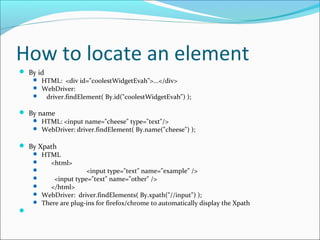
How to locate an element
 By id
 HTML: <div id="coolestWidgetEvah">...</div>
 WebDriver:
 driver.findElement( By.id("coolestWidgetEvah") );
 By name
 HTML: <input name="cheese" type="text"/>
 WebDriver: driver.findElement( By.name("cheese") );
 By Xpath
 HTML
 <html>
 <input type="text" name="example" />
 <input type="text" name="other" />
 </html>
 WebDriver: driver.findElements( By.xpath("//input") );
 There are plug-ins for firefox/chrome to automatically display the Xpath

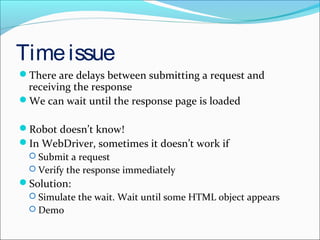
Timeissue
There are delays between submitting a request and
receiving the response
We can wait until the response page is loaded
Robot doesn’t know!
In WebDriver, sometimes it doesn’t work if
 Submit a request
 Verify the response immediately
Solution:
 Simulate the wait. Wait until some HTML object appears
 Demo
Outline
What to test for a web application
Test web app with selenium
What’s Selenium?
Why Selenium?
How to use Selenium
Course project 4
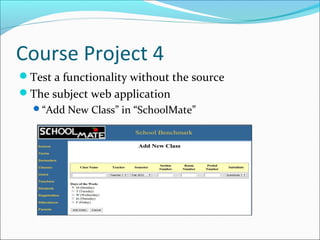
Course Project 4
Test a functionality without the source
The subject web application
“Add New Class” in “SchoolMate”
Course Project 4
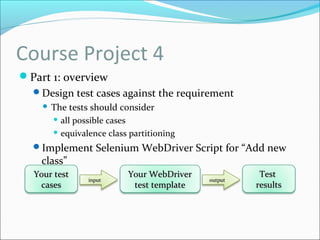
Part 1: overview
Design test cases against the requirement
 The tests should consider
 all possible cases
 equivalence class partitioning
Implement Selenium WebDriver Script for “Add new
class”
Your testYour test
casescases
Your WebDriverYour WebDriver
test templatetest template
inputinput outputoutput
TestTest
resultsresults
Part 1: requirement analysis
Requirement for the “add” function
After clicking the “Add class” button…
[R-6] The class record added is successfully shown in
the table.
[R-7] The values are exactly the same as those were
entered or selected.
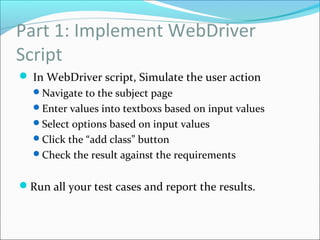
Part 1: Implement WebDriver
Script
 In WebDriver script, Simulate the user action
Navigate to the subject page
Enter values into textboxs based on input values
Select options based on input values
Click the “add class” button
Check the result against the requirements
Run all your test cases and report the results.
Course Project 4
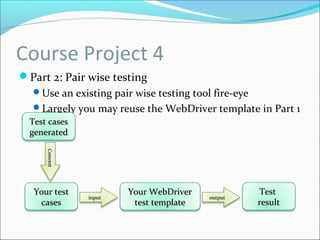
Part 2: Pair wise testing
Use an existing pair wise testing tool fire-eye
Largely you may reuse the WebDriver template in Part 1
Your testYour test
casescases
Your WebDriverYour WebDriver
test templatetest template
inputinput outputoutput
TestTest
resultresult
Test casesTest cases
generatedgenerated
ConvertConvert

Selenium

  • 2.
    Outline Uniqueness of webapp testing Heterogonous system Dynamic pages Load Security Selenium WebDriver Course project 4
  • 3.
    Web application architecture Heterogeneoussystem Front end  Browser: IE, Firefox, Chrome, Safari… Server side  Application Server  Database Server  File System  ……
  • 4.
    Heterogeneous system Front end HTML,JavaScript, Adobe Flash…… HTML JavaScript Page in Browser Source behind
  • 5.
    Heterogeneous system Should testall involved parts Everything can go wrong… However, only front end is accessible for tests Can not directly test the Server code and SQL Have to drive the execution and test  Frontend  HTML: Malformed HTML page? (demo)  JavaScript: Runtime Errors? (demo)  Server script  PHP, Java…: Runtime Errors? (demo)  SQL: Malformed SQL query string? (demo)
  • 6.
    Test from thefront end Good things Hide the complexity of the backend Uniformed interface Can put a robot in the front end and automate the tests Bad things The front end is not trustable  Crafted malicious requests
  • 7.
    Good things oftesting from the front end  Automated web app testing  Compare to commend-line program testing…  Sensitive to input values (the same)  GUI testing: event driven (the difference)  “Button A” then “Button B”  OK  “Button B” then “Button A”  FAIL  The robot should be able to  Provide input values  Simulate user actions  Selenium  A tool set automates web app testing across platforms  Can simulate user interactions in browser  Two components  Selenium IDE  Selenium WebDriver (aka. Selenium 2)
  • 8.
    Selenium IDE Firefox extension Easyrecord and replay Debug and set breakpoints Save tests in HTML, WebDriver and other formats.
  • 9.
    Selenium IDE testcases Selenium saves all information in an HTML table format Each record consists of: Command – tells Selenium what to do (e.g. “open”, “type”, “click”, “verifyText”) Target – tells Selenium which HTML element a command refers to (e.g. textbox, header, table) Value – used for any command that might need a value of some kind (e.g. type something into a textbox)
  • 10.
    How to record/replaywith Selenium IDE 1. Start recording in Selenium IDE 2. Execute scenario on running web application 3. Stop recording in Selenium IDE 4. Verify / Add assertions 5. Replay the test. Selenium IDE Demo……
  • 11.
    Bad things oftesting from the front end The front end is not trustable Front end code can be accessed to anybody They can infer the input parameters  Crafted requests! Demo Front end limits the length of the input values Front end limits the content of the input values Front end limits the combination of the input values
  • 12.
    Uniqueness 2: Dynamicpages Client page is dynamic  It can change itself in the runtime  HTML can be modified by JavaScript  JavaScript can modify itself  Demo Server script is dynamic  Client pages are constructed in the runtime  A same server script can produce completely different client pages  Demo  SchoolMate
  • 13.
    Uniqueness 3: Performance Performanceis crucial to the success of a web app  Recall the experience to register for a class in the first days of the semester…  Are the servers powerful enough? Performance testing evaluates system performance under normal and heavy usage  Load testing  For expected concurrent number of users  Stress testing  To understand the upper limits of capacity Performance testing can be automated
  • 14.
    Uniqueness 4: Security Webapp usually deals with sensitive info, e.g. Credit card number SSN Billing / Shipping address Security is the biggest concern Security testing should simulate possible attacks
  • 15.
    Uniqueness 4: Security SQLInjection The untrusted input is used to construct dynamic SQL queries. E.g, update my own password $str = "UPDATE users SET password = ” “ . $_POST['newPass’] . “” WHERE username =”“ . $_POST['username'] . “””; mysql_query( $str ); $_POST['newPass’] = pass, $_POST['username'] = me Query String: UPDATE users SET password = “pass” WHERE username =“me” $_POST['newPass’] = pass, $_POST['username'] = “ OR 1=1 -- Query String: UPDATE users SET password = “pass” WHERE username =“” OR 1=1 --” Normal Case Attack PHP ScriptPHP Script
  • 16.
    Uniqueness 4: Security CrossSite Scripting (XSS) The untrusted input is used to construct dynamic HTML pages. The malicious JS injected executes in victim’s browser The malicious JS can steal sensitive info Demo Solution: Never trust user inputs Design test cases to simulate attacks
  • 17.
    Outline Uniqueness of webapp testing Heterogonous system Dynamic pages Load Security Selenium WebDriver Course project 4
  • 18.
    Limitation of SeleniumIDE No multiple browsers support It runs only in Mozilla Firefox. No manual scripts E.g. conditions and Loops for Data Driven Testing Fancy test cases  Selenium WebDriver
  • 19.
    Selenium WebDriver (Selenium2)  Selenium-WebDriver  A piece of program  Control the browser by programming  More flexible and powerful  Selenium-WebDriver supports multiple browsers in multiple platforms  Google Chrome 12.0.712.0+  Internet Explorer 6+  Firefox 3.0+  Opera 11.5+  Android – 2.3+ for phones and tablets  iOS 3+ for phones  iOS 3.2+ for tablets
  • 20.
    Selenium WebDriver WebDriver isdesigned to providing a simpler and uniformed programming interface Same WebDriver script runs for different platforms Support multiple programming language: Java, C#, Python, Ruby, PHP, Perl… It’s efficient WebDriver leverages each browser’s native support for automation.
  • 21.
    What Selenium cando A solution for the automated testing Simulate user actions Functional testing  Create regression tests to verify functionality and user acceptance. Browser compatibility testing  The same script can run on any Selenium platform Load testing Stress testing
  • 22.
    How to useSelenium WebDriver (1) Go to a page (2) Locate an element (3) Do something with that element ...... (i) Locate an element (i+1) Do something with that element (i+2) Verify / Assert the result
  • 23.
    Demo: Verify pagetitle public static void main( String[] args ) { // Create a new instance of the Firefox driver WebDriver driver = new FirefoxDriver(); // (1) Go to a page driver.get("http://www.google.com"); // (2) Locate an element WebElement element = driver.findElement(By.name("q")); // (3-1) Enter something to search for element.sendKeys("Purdue Univeristy"); // (3-2) Now submit the form. WebDriver will find the form for us from the element element.submit(); // (3-3) Wait up to 10 seconds for a condition WebDriverWait waiting = new WebDriverWait(driver, 10); waiting.until( ExpectedConditions.presenceOfElementLocated( By.id("pnnext") ) ); // (4) Check the title of the page if( driver.getTitle().equals("purdue univeristy - Google Search") ) System.out.println("PASS"); else System.err.println("FAIL"); //Close the browser driver.quit(); }
  • 24.
    How to locatean element  By id  HTML: <div id="coolestWidgetEvah">...</div>  WebDriver:  driver.findElement( By.id("coolestWidgetEvah") );  By name  HTML: <input name="cheese" type="text"/>  WebDriver: driver.findElement( By.name("cheese") );  By Xpath  HTML  <html>  <input type="text" name="example" />  <input type="text" name="other" />  </html>  WebDriver: driver.findElements( By.xpath("//input") );  There are plug-ins for firefox/chrome to automatically display the Xpath 
  • 25.
    Timeissue There are delaysbetween submitting a request and receiving the response We can wait until the response page is loaded Robot doesn’t know! In WebDriver, sometimes it doesn’t work if  Submit a request  Verify the response immediately Solution:  Simulate the wait. Wait until some HTML object appears  Demo
  • 26.
    Outline What to testfor a web application Test web app with selenium What’s Selenium? Why Selenium? How to use Selenium Course project 4
  • 27.
    Course Project 4 Testa functionality without the source The subject web application “Add New Class” in “SchoolMate”
  • 28.
    Course Project 4 Part1: overview Design test cases against the requirement  The tests should consider  all possible cases  equivalence class partitioning Implement Selenium WebDriver Script for “Add new class” Your testYour test casescases Your WebDriverYour WebDriver test templatetest template inputinput outputoutput TestTest resultsresults
  • 29.
    Part 1: requirementanalysis Requirement for the “add” function After clicking the “Add class” button… [R-6] The class record added is successfully shown in the table. [R-7] The values are exactly the same as those were entered or selected.
  • 30.
    Part 1: ImplementWebDriver Script  In WebDriver script, Simulate the user action Navigate to the subject page Enter values into textboxs based on input values Select options based on input values Click the “add class” button Check the result against the requirements Run all your test cases and report the results.
  • 31.
    Course Project 4 Part2: Pair wise testing Use an existing pair wise testing tool fire-eye Largely you may reuse the WebDriver template in Part 1 Your testYour test casescases Your WebDriverYour WebDriver test templatetest template inputinput outputoutput TestTest resultresult Test casesTest cases generatedgenerated ConvertConvert