SELECTION PROCEDURE FOR
PACKAGED AIR CONDITIONERS
It is always in mind to select packaged air conditioners to condition the air of Office
buildings, Mosques, Commercial stores etc. In middle east I have seen that packaged air
conditioners are used extensively where chilled water system is not an option. Here I am
presenting how to select a Packaged air conditioner with an example, using Zamil air
conditioning company's package Unit catalogue.
The technique for selection is simple. First we select Packaged A/C at nominal conditions
satisfying the design heat load generated by software such as TRACE, HAP or manual
calculation . And then to remove the heat generated from motor of the blower fan in
operation (At design flow and Total static pressure), from the selected Unit's Total and
Sensible cooling load. After this we have to check if cooling loads are more or equal than
the calculated total and sensible heat load. If NOT then we have to move to the next
higher Unit.
This same technique can be applied to select any packaged air conditioners from any
company. Let us begin with an example, Let the Heat Load software gives the following
data.
1. Data:
Nominal Conditions are :
Condenser entering air temperature : 95 ºF
Evaporator entering air temperature : 80 ºF DBT / 67 ºF WBT
Designed air flow is: 7500 CFM
Required Total cooling capacity : 230,000 BTUHr.
Total Sensible heat capacity : 155,000 BTUH
Required heating capacity : 20 kW
External static pressure : 1.235 INCH WG.
Power supply (V-Ph-Hz) : 400-3-60
2. Unit selection based on above cooling capacity
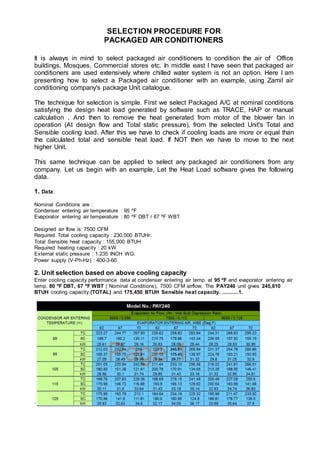
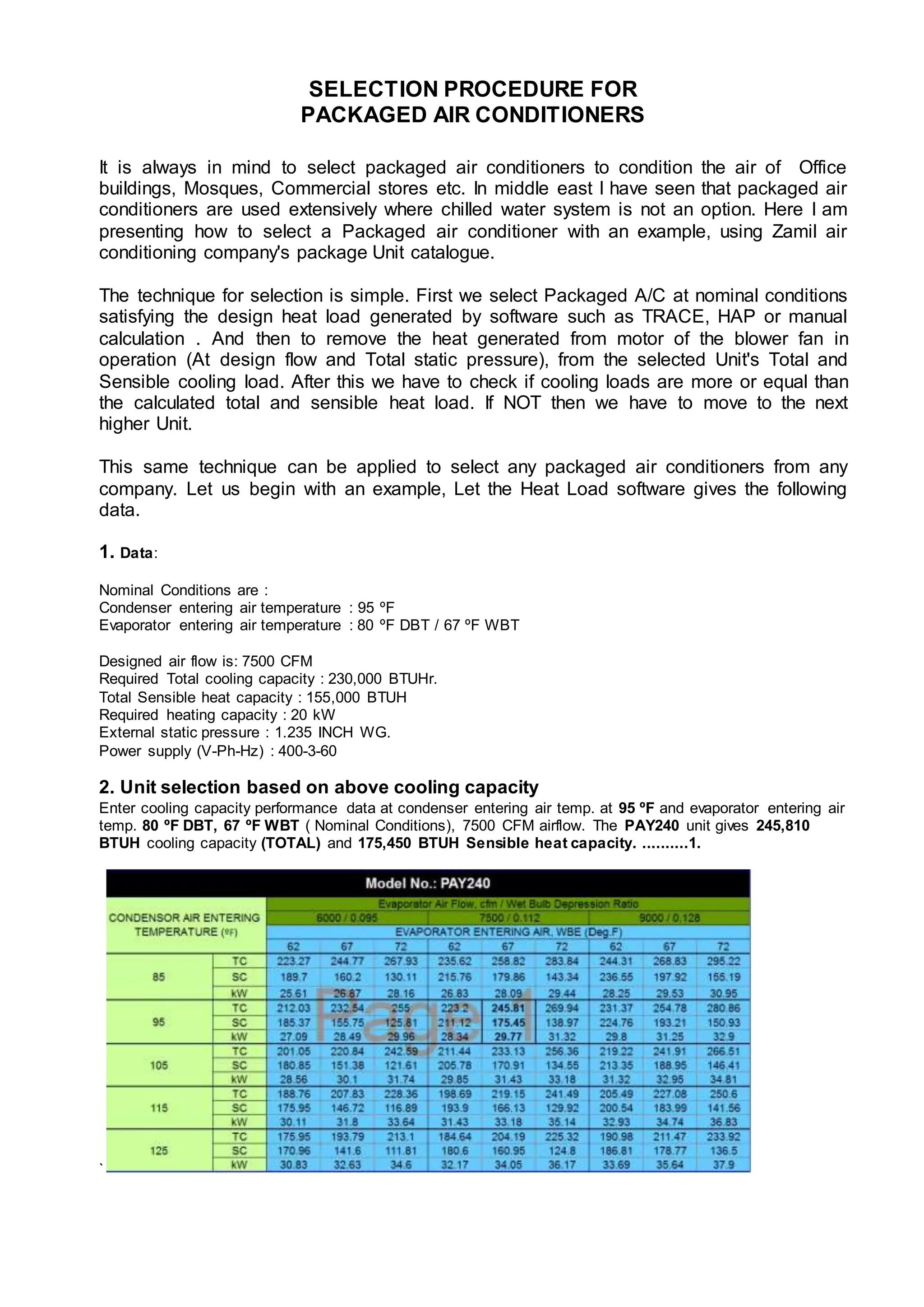
Enter cooling capacity performance data at condenser entering air temp. at 95 ºF and evaporator entering air
temp. 80 ºF DBT, 67 ºF WBT ( Nominal Conditions), 7500 CFM airflow. The PAY240 unit gives 245,810
BTUH cooling capacity (TOTAL) and 175,450 BTUH Sensible heat capacity. ..........1.
`
3. Electric heater selection
Heating capacity required =20 kW.
Enter electric heating table for PAY240 at 380-3-60 (4 wire) power supply.
20 kW heater at 380 volts satisfies the required heating.
Note : If there is no Electric Heating, you can ignore this step.
4. Determining fan speed and power requirements at design conditions
Before entering the fan performance tables, We have to calculate the Total external static pressure for the
blower fan motor has to take care off, to deliver the required air flow to the space to be cooled / heated.
Total Duct External static pressure : 1.235 INCH WG.
Electric heater air flow resistance : 0.165 INCH WG.......... This data can be obtained from Manufacturer
(Note: If NO heater ignore this resistance)
Net Total static pressure fan has to built up to deliver designed air flow to the room = 1.40 INCH WG.
Static Pressure Drop OR Flow resistance from Heater Module, Data from Manufacturer:
MODELS: PY240 - PY360 : STATIC PRESSURE DROP IN HEATER MODULE.
COMPONENT
CFM
6000 6600 7200 7800 8400 9000 9600 10200 10800 11400 12000
1 HEATER
MODULE
.05 0.06 0.07 0.08 0.09 0.10 0.11 0.12 0.13 0.14 0.15
2 HEATER
MODULE
0.14 0.15 0.16 0.17 0.18 0.19 0.20 0.21 0.22 0.23 0.24
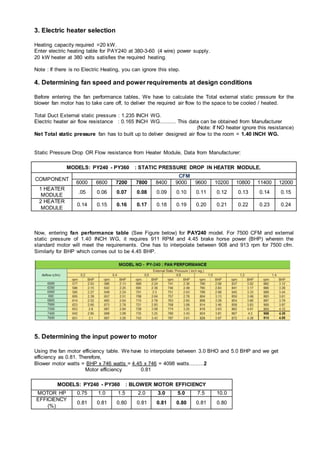
Now, entering fan performance table (See Figure below) for PAY240 model. For 7500 CFM and external
static pressure of 1.40 INCH WG, it requires 911 RPM and 4.45 brake horse power (BHP) wherein the
standard motor will meet the requirements. One has to interpolate between 908 and 913 rpm for 7500 cfm.
Similarly for BHP which comes out to be 4.45 BHP.
5. Determining the input power to motor
Using the fan motor efficiency table. We have to interpolate between 3.0 BHO and 5.0 BHP and we get
efficiency as 0.81. Therefore,
Blower motor watts = BHP x 746 watts = 4.45 x 746 = 4098 watts.........2
Motor efficiency 0.81
MODELS: PY240 - PY360 : BLOWER MOTOR EFFICIENCY
MOTOR HP 0.75 1.0 1.5 2.0 3.0 5.0 7.5 10.0
EFFICIENCY
(%)
0.81 0.81 0.80 0.81 0.81 0.80 0.81 0.80
6. Now Determining net capacities
Above capacities are gross and do not include blower motor heat gain.
Determine net capacities as follows:
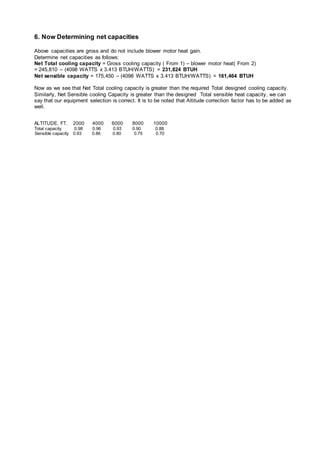
Net Total cooling capacity = Gross cooling capacity ( From 1) – blower motor heat( From 2)
= 245,810 – (4098 WATTS x 3.413 BTUH/WATTS) = 231,824 BTUH
Net sensible capacity = 175,450 – (4098 WATTS x 3.413 BTUH/WATTS) = 161,464 BTUH
Now as we see that Net Total cooling capacity is greater than the required Total designed cooling capacity.
Similarly, Net Sensible cooling Capacity is greater than the designed Total sensible heat capacity, we can
say that our equipment selection is correct. It is to be noted that Altitude correction factor has to be added as
well.
ALTITUDE, FT. 2000 4000 6000 8000 10000
Total capacity 0.98 0.96 0.93 0.90 0.88
Sensible capacity 0.93 0.86 0.80 0.75 0.70

Selection of packaged Air COnditioner

  • 1.
    SELECTION PROCEDURE FOR PACKAGEDAIR CONDITIONERS It is always in mind to select packaged air conditioners to condition the air of Office buildings, Mosques, Commercial stores etc. In middle east I have seen that packaged air conditioners are used extensively where chilled water system is not an option. Here I am presenting how to select a Packaged air conditioner with an example, using Zamil air conditioning company's package Unit catalogue. The technique for selection is simple. First we select Packaged A/C at nominal conditions satisfying the design heat load generated by software such as TRACE, HAP or manual calculation . And then to remove the heat generated from motor of the blower fan in operation (At design flow and Total static pressure), from the selected Unit's Total and Sensible cooling load. After this we have to check if cooling loads are more or equal than the calculated total and sensible heat load. If NOT then we have to move to the next higher Unit. This same technique can be applied to select any packaged air conditioners from any company. Let us begin with an example, Let the Heat Load software gives the following data. 1. Data: Nominal Conditions are : Condenser entering air temperature : 95 ºF Evaporator entering air temperature : 80 ºF DBT / 67 ºF WBT Designed air flow is: 7500 CFM Required Total cooling capacity : 230,000 BTUHr. Total Sensible heat capacity : 155,000 BTUH Required heating capacity : 20 kW External static pressure : 1.235 INCH WG. Power supply (V-Ph-Hz) : 400-3-60 2. Unit selection based on above cooling capacity Enter cooling capacity performance data at condenser entering air temp. at 95 ºF and evaporator entering air temp. 80 ºF DBT, 67 ºF WBT ( Nominal Conditions), 7500 CFM airflow. The PAY240 unit gives 245,810 BTUH cooling capacity (TOTAL) and 175,450 BTUH Sensible heat capacity. ..........1. `
  • 2.
    3. Electric heaterselection Heating capacity required =20 kW. Enter electric heating table for PAY240 at 380-3-60 (4 wire) power supply. 20 kW heater at 380 volts satisfies the required heating. Note : If there is no Electric Heating, you can ignore this step. 4. Determining fan speed and power requirements at design conditions Before entering the fan performance tables, We have to calculate the Total external static pressure for the blower fan motor has to take care off, to deliver the required air flow to the space to be cooled / heated. Total Duct External static pressure : 1.235 INCH WG. Electric heater air flow resistance : 0.165 INCH WG.......... This data can be obtained from Manufacturer (Note: If NO heater ignore this resistance) Net Total static pressure fan has to built up to deliver designed air flow to the room = 1.40 INCH WG. Static Pressure Drop OR Flow resistance from Heater Module, Data from Manufacturer: MODELS: PY240 - PY360 : STATIC PRESSURE DROP IN HEATER MODULE. COMPONENT CFM 6000 6600 7200 7800 8400 9000 9600 10200 10800 11400 12000 1 HEATER MODULE .05 0.06 0.07 0.08 0.09 0.10 0.11 0.12 0.13 0.14 0.15 2 HEATER MODULE 0.14 0.15 0.16 0.17 0.18 0.19 0.20 0.21 0.22 0.23 0.24 Now, entering fan performance table (See Figure below) for PAY240 model. For 7500 CFM and external static pressure of 1.40 INCH WG, it requires 911 RPM and 4.45 brake horse power (BHP) wherein the standard motor will meet the requirements. One has to interpolate between 908 and 913 rpm for 7500 cfm. Similarly for BHP which comes out to be 4.45 BHP. 5. Determining the input power to motor Using the fan motor efficiency table. We have to interpolate between 3.0 BHO and 5.0 BHP and we get efficiency as 0.81. Therefore, Blower motor watts = BHP x 746 watts = 4.45 x 746 = 4098 watts.........2 Motor efficiency 0.81 MODELS: PY240 - PY360 : BLOWER MOTOR EFFICIENCY MOTOR HP 0.75 1.0 1.5 2.0 3.0 5.0 7.5 10.0 EFFICIENCY (%) 0.81 0.81 0.80 0.81 0.81 0.80 0.81 0.80
  • 3.
    6. Now Determiningnet capacities Above capacities are gross and do not include blower motor heat gain. Determine net capacities as follows: Net Total cooling capacity = Gross cooling capacity ( From 1) – blower motor heat( From 2) = 245,810 – (4098 WATTS x 3.413 BTUH/WATTS) = 231,824 BTUH Net sensible capacity = 175,450 – (4098 WATTS x 3.413 BTUH/WATTS) = 161,464 BTUH Now as we see that Net Total cooling capacity is greater than the required Total designed cooling capacity. Similarly, Net Sensible cooling Capacity is greater than the designed Total sensible heat capacity, we can say that our equipment selection is correct. It is to be noted that Altitude correction factor has to be added as well. ALTITUDE, FT. 2000 4000 6000 8000 10000 Total capacity 0.98 0.96 0.93 0.90 0.88 Sensible capacity 0.93 0.86 0.80 0.75 0.70