By
Hawkar Hashim Ibrahim
hawkar.ibrahim@su.edu.krd
https://academics.su.edu.krd/hawkar.ibrahim
Selecting ground
improvement methods
for different types of
soil
1
Background
Soil Replacement
Water Removal
Site Strengthening
Methods
Grouting
Thermal Method
Geosynthetics
Conclusion
References
Outline
2
Background
Soil Replacement
Water Removal
Site Strengthening Methods
Grouting
Thermal Method
Geosynthetics
Conclusion
References
Background
Soil Replacement
Water Removal
Site Strengthening
Methods
Grouting
Thermal Method
Geosynthetics
Conclusion
References
Background
3
The selection of soil improvement method is
governed by several factors like
 Soil type,
 Equipment availability,
 Cost,
 Construction period,
 Skills, and
 Experiences.
Background
Soil Replacement
Water Removal
Site Strengthening
Methods
Grouting
Thermal Method
Geosynthetics
Conclusion
References
Background
4
Soil type is one of the critical factors that can
influence the selection of one soil improvement
method over another.
The soil type alters both the effectiveness and cost
of the soil improvement technique.
Some of the soil improvement methods are
Soil Replacement
Water Removal
Site Strengthening Methods
Grouting
Thermal Method
Geosynthetics
Background
Soil Replacement
Water Removal
Site Strengthening
Methods
Grouting
Thermal Method
Geosynthetics
Conclusion
References
Soil Replacement
5
 The former is suitable for any ,
provided that the soft soil layer is near the surface,
 The weak soil thickness is not greater than
 It involves the removal of soft soil and replacing it with
structural fill during grading operations.
Background
Soil Replacement
Water Removal
Site Strengthening
Methods
Grouting
Thermal Method
Geosynthetics
Conclusion
References
Water Removal
6
The water removal method is appropriate for sites
with an underlying compressible cohesive soil
layer. There are four techniques by which water is
removed from the soil to improve its strength:
1. Trenching technique
2. Preloading technique
3. Preloading with vertical drain
Background
Soil Replacement
Water Removal
Site Strengthening
Methods
Grouting
Thermal Method
Geosynthetics
Conclusion
References
Water Removal
7
1. Trenching technique
2. Preloading technique
Background
Soil Replacement
Water Removal
Site Strengthening
Methods
Grouting
Thermal Method
Geosynthetics
Conclusion
References
Water Removal
8
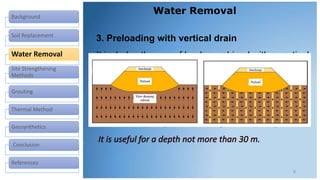
3. Preloading with vertical drain
It includes the use of loads combined with a vertical
drain to consolidate the soil layer before the start of
the construction work.
Background
Soil Replacement
Water Removal
Site Strengthening
Methods
Grouting
Thermal Method
Geosynthetics
Conclusion
References
Site Strengthening Methods
9
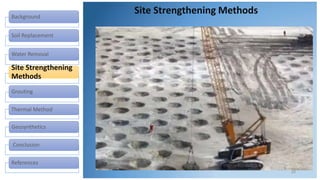
There are several site strengthening methods from
which engineers can select a suitable technique
based on equipment availability, cost, local
experiences, etc. Different types of site
strengthening methods are:
1. Dynamic Compaction
2. Vibro-compaction
3. Vibro-replacement
4. Vibro-displacement
Background
Soil Replacement
Water Removal
Site Strengthening
Methods
Grouting
Thermal Method
Geosynthetics
Conclusion
References
Site Strengthening Methods
10
1. Dynamic Compaction
Dynamic compaction is an efficient and cost-effective
soil improvement technique that uses the dynamic effect
of high energy impacts to densify weak soil.
The dynamic effect is generated by dropping a
static weight (15-40 tones) from a defined height
(10-30 m). It is the best choice for cohesionless soil,
and possibly suitable for soils with fines.
Background
Soil Replacement
Water Removal
Site Strengthening
Methods
Grouting
Thermal Method
Geosynthetics
Conclusion
References
Site Strengthening Methods
11
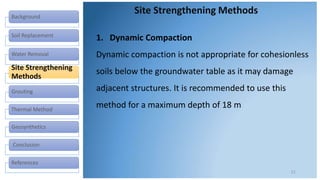
1. Dynamic Compaction
Dynamic compaction is not appropriate for cohesionless
soils below the groundwater table as it may damage
adjacent structures. It is recommended to use this
method for a maximum depth of 18 m
Background
Soil Replacement
Water Removal
Site Strengthening
Methods
Grouting
Thermal Method
Geosynthetics
Conclusion
References
Site Strengthening Methods
12
2. Vibro-compaction
It is appropriate for cohesionless soils with less than 20%
fines, and useful for 30 m depth.
Background
Soil Replacement
Water Removal
Site Strengthening
Methods
Grouting
Thermal Method
Geosynthetics
Conclusion
References
Site Strengthening Methods
13
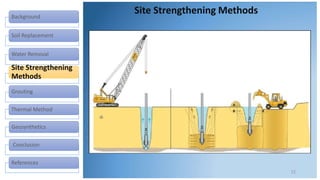
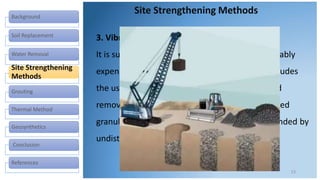
3. Vibro-replacement
It is suitable for soft cohesive soil and is considerably
expensive. The vibro-replacement technique includes
the use of jetting and vibration to penetrate and
remove soil, and then the placement of compacted
granular fill into a hole to create columns surrounded by
undisturbed soil.
Background
Soil Replacement
Water Removal
Site Strengthening
Methods
Grouting
Thermal Method
Geosynthetics
Conclusion
References
Site Strengthening Methods
14
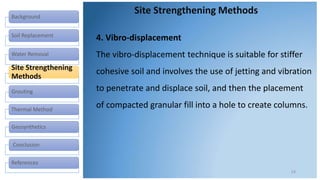
4. Vibro-displacement
The vibro-displacement technique is suitable for stiffer
cohesive soil and involves the use of jetting and vibration
to penetrate and displace soil, and then the placement
of compacted granular fill into a hole to create columns.
Background
Soil Replacement
Water Removal
Site Strengthening
Methods
Grouting
Thermal Method
Geosynthetics
Conclusion
References
Grouting
15
Grouting is the injection of grout into the ground to
fill underground voids, joints, and fractures and
consequently improve soil strength.
1. Injection of Grout
2. Deep Mixing
Background
Soil Replacement
Water Removal
Site Strengthening
Methods
Grouting
Thermal Method
Geosynthetics
Conclusion
References
Grouting
16
1. Injection of Grout
It is applicable for a broad spectrum of coarse and fine-
grained soils.
Expansive grouts are necessary to grout finer grain soils.
The injection of grouts reduces the permeability of the
soil strata.
Background
Soil Replacement
Water Removal
Site Strengthening
Methods
Grouting
Thermal Method
Geosynthetics
Conclusion
References
Grouting
17
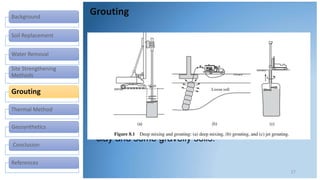
2. Deep Mixing
It includes the use of jetting or auger to mix the soil
with grouts.
It is a useful option for a broad spectrum of coarse
and fine-grained soils for a depth of nearly 52 m.
Deep mixing is a wrong choice for highly cohesive
clay and some gravelly soils.
Background
Soil Replacement
Water Removal
Site Strengthening
Methods
Grouting
Thermal Method
Geosynthetics
Conclusion
References
18
Heating and freezing are two techniques to improve
the soil properties. The former is suitable for
cohesive soil, whereas the latter is applicable for
soil types below the groundwater table and
cohesive soil above the groundwater table.
Thermal Method
Background
Soil Replacement
Water Removal
Site Strengthening
Methods
Grouting
Thermal Method
Geosynthetics
Conclusion
References
19
The heating process generates irreversible
strength, but the need for high energy restricts its
practicality. Freezing reduces permeability and
increases the bearing capacity of the soil. It is
suitable for tunneling and excavation to reduce or
stop the inflow of groundwater.
Thermal Method
Background
Soil Replacement
Water Removal
Site Strengthening
Methods
Grouting
Thermal Method
Geosynthetics
Conclusion
References
Geosynthetics
20
The geosynthetic materials can be used for erosion
control, filter, drains, water barrier, and soil
reinforcement.
It is an effective filter for all soil types and
reinforcement for soft soil.
Background
Soil Replacement
Water Removal
Site Strengthening
Methods
Grouting
Thermal Method
Geosynthetics
Conclusion
References
21
ANY QUESTION?
?
22
THANK YOU FOR
YOUR ATTENTION
23

Selecting ground improvement methods for different types of soil.pptx

  • 1.
  • 2.
    Background Soil Replacement Water Removal SiteStrengthening Methods Grouting Thermal Method Geosynthetics Conclusion References Outline 2 Background Soil Replacement Water Removal Site Strengthening Methods Grouting Thermal Method Geosynthetics Conclusion References
  • 3.
    Background Soil Replacement Water Removal SiteStrengthening Methods Grouting Thermal Method Geosynthetics Conclusion References Background 3 The selection of soil improvement method is governed by several factors like  Soil type,  Equipment availability,  Cost,  Construction period,  Skills, and  Experiences.
  • 4.
    Background Soil Replacement Water Removal SiteStrengthening Methods Grouting Thermal Method Geosynthetics Conclusion References Background 4 Soil type is one of the critical factors that can influence the selection of one soil improvement method over another. The soil type alters both the effectiveness and cost of the soil improvement technique. Some of the soil improvement methods are Soil Replacement Water Removal Site Strengthening Methods Grouting Thermal Method Geosynthetics
  • 5.
    Background Soil Replacement Water Removal SiteStrengthening Methods Grouting Thermal Method Geosynthetics Conclusion References Soil Replacement 5  The former is suitable for any , provided that the soft soil layer is near the surface,  The weak soil thickness is not greater than  It involves the removal of soft soil and replacing it with structural fill during grading operations.
  • 6.
    Background Soil Replacement Water Removal SiteStrengthening Methods Grouting Thermal Method Geosynthetics Conclusion References Water Removal 6 The water removal method is appropriate for sites with an underlying compressible cohesive soil layer. There are four techniques by which water is removed from the soil to improve its strength: 1. Trenching technique 2. Preloading technique 3. Preloading with vertical drain
  • 7.
    Background Soil Replacement Water Removal SiteStrengthening Methods Grouting Thermal Method Geosynthetics Conclusion References Water Removal 7 1. Trenching technique 2. Preloading technique
  • 8.
    Background Soil Replacement Water Removal SiteStrengthening Methods Grouting Thermal Method Geosynthetics Conclusion References Water Removal 8 3. Preloading with vertical drain It includes the use of loads combined with a vertical drain to consolidate the soil layer before the start of the construction work.
  • 9.
    Background Soil Replacement Water Removal SiteStrengthening Methods Grouting Thermal Method Geosynthetics Conclusion References Site Strengthening Methods 9 There are several site strengthening methods from which engineers can select a suitable technique based on equipment availability, cost, local experiences, etc. Different types of site strengthening methods are: 1. Dynamic Compaction 2. Vibro-compaction 3. Vibro-replacement 4. Vibro-displacement
  • 10.
    Background Soil Replacement Water Removal SiteStrengthening Methods Grouting Thermal Method Geosynthetics Conclusion References Site Strengthening Methods 10 1. Dynamic Compaction Dynamic compaction is an efficient and cost-effective soil improvement technique that uses the dynamic effect of high energy impacts to densify weak soil. The dynamic effect is generated by dropping a static weight (15-40 tones) from a defined height (10-30 m). It is the best choice for cohesionless soil, and possibly suitable for soils with fines.
  • 11.
    Background Soil Replacement Water Removal SiteStrengthening Methods Grouting Thermal Method Geosynthetics Conclusion References Site Strengthening Methods 11 1. Dynamic Compaction Dynamic compaction is not appropriate for cohesionless soils below the groundwater table as it may damage adjacent structures. It is recommended to use this method for a maximum depth of 18 m
  • 12.
    Background Soil Replacement Water Removal SiteStrengthening Methods Grouting Thermal Method Geosynthetics Conclusion References Site Strengthening Methods 12 2. Vibro-compaction It is appropriate for cohesionless soils with less than 20% fines, and useful for 30 m depth.
  • 13.
    Background Soil Replacement Water Removal SiteStrengthening Methods Grouting Thermal Method Geosynthetics Conclusion References Site Strengthening Methods 13 3. Vibro-replacement It is suitable for soft cohesive soil and is considerably expensive. The vibro-replacement technique includes the use of jetting and vibration to penetrate and remove soil, and then the placement of compacted granular fill into a hole to create columns surrounded by undisturbed soil.
  • 14.
    Background Soil Replacement Water Removal SiteStrengthening Methods Grouting Thermal Method Geosynthetics Conclusion References Site Strengthening Methods 14 4. Vibro-displacement The vibro-displacement technique is suitable for stiffer cohesive soil and involves the use of jetting and vibration to penetrate and displace soil, and then the placement of compacted granular fill into a hole to create columns.
  • 15.
    Background Soil Replacement Water Removal SiteStrengthening Methods Grouting Thermal Method Geosynthetics Conclusion References Grouting 15 Grouting is the injection of grout into the ground to fill underground voids, joints, and fractures and consequently improve soil strength. 1. Injection of Grout 2. Deep Mixing
  • 16.
    Background Soil Replacement Water Removal SiteStrengthening Methods Grouting Thermal Method Geosynthetics Conclusion References Grouting 16 1. Injection of Grout It is applicable for a broad spectrum of coarse and fine- grained soils. Expansive grouts are necessary to grout finer grain soils. The injection of grouts reduces the permeability of the soil strata.
  • 17.
    Background Soil Replacement Water Removal SiteStrengthening Methods Grouting Thermal Method Geosynthetics Conclusion References Grouting 17 2. Deep Mixing It includes the use of jetting or auger to mix the soil with grouts. It is a useful option for a broad spectrum of coarse and fine-grained soils for a depth of nearly 52 m. Deep mixing is a wrong choice for highly cohesive clay and some gravelly soils.
  • 18.
    Background Soil Replacement Water Removal SiteStrengthening Methods Grouting Thermal Method Geosynthetics Conclusion References 18 Heating and freezing are two techniques to improve the soil properties. The former is suitable for cohesive soil, whereas the latter is applicable for soil types below the groundwater table and cohesive soil above the groundwater table. Thermal Method
  • 19.
    Background Soil Replacement Water Removal SiteStrengthening Methods Grouting Thermal Method Geosynthetics Conclusion References 19 The heating process generates irreversible strength, but the need for high energy restricts its practicality. Freezing reduces permeability and increases the bearing capacity of the soil. It is suitable for tunneling and excavation to reduce or stop the inflow of groundwater. Thermal Method
  • 20.
    Background Soil Replacement Water Removal SiteStrengthening Methods Grouting Thermal Method Geosynthetics Conclusion References Geosynthetics 20 The geosynthetic materials can be used for erosion control, filter, drains, water barrier, and soil reinforcement. It is an effective filter for all soil types and reinforcement for soft soil.
  • 21.
    Background Soil Replacement Water Removal SiteStrengthening Methods Grouting Thermal Method Geosynthetics Conclusion References 21
  • 22.
  • 23.
    THANK YOU FOR YOURATTENTION 23

Editor's Notes

  • #11 Dynamic compaction is not appropriate for cohesionless soils below the groundwater table as it may damage adjacent structures. It is recommended to use this method for a maximum depth of 18 m