Download to read offline
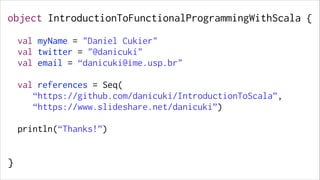
![object IntroductionToFunctionalProgrammingWithScala {
!
val myName = "Daniel Cukier"
val twitter = "@danicuki"
val email = “danicuki@ime.usp.br"
!
def main(args: Array[String]) {
println(“Hello People!”)
}
!
}](https://image.slidesharecdn.com/functionalprogrammingscala-140130094939-phpapp02/85/Introduction-to-Functional-Programming-with-Scala-1-320.jpg)
![object IntroductionToFunctionalProgrammingWithScala {
!
val myName = "Daniel Cukier"
val twitter = "@danicuki"
val email = “danicuki@ime.usp.br"
!
def main(args: Array[String]) {
println(“Hello People!”)
}
!
}](https://image.slidesharecdn.com/functionalprogrammingscala-140130094939-phpapp02/75/Introduction-to-Functional-Programming-with-Scala-1-2048.jpg)

![object IntroductionToFunctionalProgrammingWithScala {
!
val myName = "Daniel Cukier"
val twitter = "@danicuki"
val email = “danicuki@ime.usp.br"
!
def main(args: Array[String]) {
println(“Hello People!”)
}
!
}](https://image.slidesharecdn.com/functionalprogrammingscala-140130094939-phpapp02/85/Introduction-to-Functional-Programming-with-Scala-3-320.jpg)
![qsort:
@ Takes three parameters:
@
a:
Pointer to base of array a to be sorted (arrives in r0)
@
left: First of the range of indexes to sort (arrives in r1)
@
right: One past last of range of indexes to sort (arrives in r2)
@ This function destroys: r1, r2, r3, r4, r5, r7
stmfd
sp!, {r4, r6, lr}
@ Save r4 and r6 for caller
mov
r6, r2
@ r6 <- right
qsort_tailcall_entry:
sub
r7, r6, r1
@ If right - left <= 1 (already sorted),
cmp
r7, #1
ldmlefd sp!, {r1, r6, pc}
@ Return, moving r4->r1, restoring r6
ldr
r7, [r0, r1, asl #2] @ r7 <- a[left], gets pivot element
add
r2, r1, #1
@ l <- left + 1
mov
r4, r6
@ r <- right
partition_loop:
ldr
r3, [r0, r2, asl #2] @ r3 <- a[l]
cmp
r3, r7
@ If a[l] <= pivot_element,
addle
r2, r2, #1
@ ... increment l, and
ble
partition_test
@ ... continue to next iteration.
sub
r4, r4, #1
@ Otherwise, decrement r,
ldr
r5, [r0, r4, asl #2] @ ... and swap a[l] and a[r].
str
r5, [r0, r2, asl #2]
str
r3, [r0, r4, asl #2]
partition_test:
cmp
r2, r4
@ If l < r,
blt
partition_loop
@ ... continue iterating.
partition_finish:
sub
r2, r2, #1
@ Decrement l
ldr
r3, [r0, r2, asl #2] @ Swap a[l] and pivot
str
r3, [r0, r1, asl #2]
str
r7, [r0, r2, asl #2]
bl
qsort
@ Call self recursively on left part,
@ with args a (r0), left (r1), r (r2),
@ also preserves r6 and
@ moves r4 (l) to 2nd arg register (r1)
b
qsort_tailcall_entry @ Tail-call self on right part,
@ with args a (r0), l (r1), right (r6)](https://image.slidesharecdn.com/functionalprogrammingscala-140130094939-phpapp02/85/Introduction-to-Functional-Programming-with-Scala-4-320.jpg)
![qsort:
@ Takes three parameters:
@
a:
Pointer to base of array a to be sorted (arrives in r0)
@
left: First of the range of indexes to sort (arrives in r1)
@
right: One past last of range of indexes to sort (arrives in r2)
@ This function destroys: r1, r2, r3, r4, r5, r7
stmfd
sp!, {r4, r6, lr}
@ Save r4 and r6 for caller
mov
r6, r2
@ r6 <- right
qsort_tailcall_entry:
sub
r7, r6, r1
@ If right - left <= 1 (already sorted),
cmp
r7, #1
ldmlefd sp!, {r1, r6, pc}
@ Return, moving r4->r1, restoring r6
ldr
r7, [r0, r1, asl #2] @ r7 <- a[left], gets pivot element
add
r2, r1, #1
@ l <- left + 1
mov
r4, r6
@ r <- right
partition_loop:
ldr
r3, [r0, r2, asl #2] @ r3 <- a[l]
cmp
r3, r7
@ If a[l] <= pivot_element,
addle
r2, r2, #1
@ ... increment l, and
ble
partition_test
@ ... continue to next iteration.
sub
r4, r4, #1
@ Otherwise, decrement r,
ldr
r5, [r0, r4, asl #2] @ ... and swap a[l] and a[r].](https://image.slidesharecdn.com/functionalprogrammingscala-140130094939-phpapp02/85/Introduction-to-Functional-Programming-with-Scala-5-320.jpg)
![qsort:
@ Takes three parameters:
@
a:
Pointer to base of array a to be sorted (arrives in r0)
@
left: First of the range of indexes to sort (arrives in r1)
@
right: One past last of range of indexes to sort (arrives in r2)
@ This function destroys: r1, r2, r3, r4, r5, r7
stmfd
sp!, {r4, r6, lr}
@ Save r4 and r6 for caller
mov
r6, r2
@ r6 <- right
qsort_tailcall_entry:
sub
r7, r6, r1
@ If right - left <= 1 (already sorted),
cmp
r7, #1
ldmlefd sp!, {r1, r6, pc}
@ Return, moving r4->r1, restoring r6
ldr
r7, [r0, r1, asl #2] @ r7 <- a[left], gets pivot element
add
r2, r1, #1
@ l <- left + 1
mov
r4, r6
@ r <- right
partition_loop:
ldr
r3, [r0, r2, asl #2] @ r3 <- a[l]
cmp
r3, r7
@ If a[l] <= pivot_element,
addle
r2, r2, #1
@ ... increment l, and
ble
partition_test
@ ... continue to next iteration.
sub
r4, r4, #1
@ Otherwise, decrement r,
ldr
r5, [r0, r4, asl #2] @ ... and swap a[l] and a[r].
str
r5, [r0, r2, asl #2]
str
r3, [r0, r4, asl #2]
partition_test:
cmp
r2, r4
@ If l < r,
blt
partition_loop
@ ... continue iterating.
partition_finish:
sub
r2, r2, #1
@ Decrement l
ldr
r3, [r0, r2, asl #2] @ Swap a[l] and pivot
str
r3, [r0, r1, asl #2]
str
r7, [r0, r2, asl #2]
bl
qsort
@ Call self recursively on left part,
@ with args a (r0), left (r1), r (r2),
@ also preserves r6 and
@ moves r4 (l) to 2nd arg register (r1)
b
qsort_tailcall_entry @ Tail-call self on right part,
@ with args a (r0), l (r1), right (r6)
void swap(int* a, int* b) {
int tmp;
tmp = *a;
* a = *b;
* b = tmp;
}
!
int partition(int vec[], int left, int right) {
int i, j;
!
!
i = left;
for (j = left + 1; j <= right; ++j) {
if (vec[j] < vec[left]) {
++i;
swap(&vec[i], &vec[j]);
}
}
swap(&vec[left], &vec[i]);
return i;
}
!
void quickSort(int vec[], int left, int right) {
int r;
!
}
if (right > left) {
r = partition(vec, left, right);
quickSort(vec, left, r - 1);
quickSort(vec, r + 1, right);
}](https://image.slidesharecdn.com/functionalprogrammingscala-140130094939-phpapp02/85/Introduction-to-Functional-Programming-with-Scala-6-320.jpg)
![void swap(int* a, int* b) {
int tmp;
tmp = *a;
* a = *b;
* b = tmp;
}
!
int partition(int vec[], int left, int right) {
int i, j;
!
i = left;
for (j = left + 1; j <= right; ++j) {
if (vec[j] < vec[left]) {
++i;
swap(&vec[i], &vec[j]);
}
}
swap(&vec[left], &vec[i]);](https://image.slidesharecdn.com/functionalprogrammingscala-140130094939-phpapp02/85/Introduction-to-Functional-Programming-with-Scala-7-320.jpg)
![def sort(list: List[Int]): List[Int] = {
list match {
case Nil => list
case _ => sort(list.tail.filter(_ <= list.head)) :::
list.head ::
sort(list.tail.filter(_ > list.head))
}
}](https://image.slidesharecdn.com/functionalprogrammingscala-140130094939-phpapp02/85/Introduction-to-Functional-Programming-with-Scala-8-320.jpg)
![sort :: (Ord a)
=> [a] -> [a]
sort []
= []
sort (pivot:rest) = (sort [y | y <- rest, y < pivot])
++ [pivot] ++
(sort [y | y <- rest, y >=pivot])](https://image.slidesharecdn.com/functionalprogrammingscala-140130094939-phpapp02/85/Introduction-to-Functional-Programming-with-Scala-9-320.jpg)
![def sort(list: List[Int]): List[Int] = {
list match {
case Nil => list
case _ => sort(list.tail.filter(_ <= list.head)) :::
list.head ::
sort(list.tail.filter(_ > list.head))
}
}
sort :: (Ord a)
=> [a] -> [a]
sort []
= []
sort (pivot:rest) = (sort [y | y <- rest, y < pivot])
++ [pivot] ++
(sort [y | y <- rest, y >=pivot])](https://image.slidesharecdn.com/functionalprogrammingscala-140130094939-phpapp02/85/Introduction-to-Functional-Programming-with-Scala-10-320.jpg)
![qsort:
asm
@ Takes three parameters:
@
a:
Pointer to base of array a to be sorted (arrives in r0)
@
left: First of the range of indexes to sort (arrives in r1)
@
right: One past last of range of indexes to sort (arrives in r2)
@ This function destroys: r1, r2, r3, r4, r5, r7
stmfd
sp!, {r4, r6, lr}
@ Save r4 and r6 for caller
mov
r6, r2
@ r6 <- right
qsort_tailcall_entry:
sub
r7, r6, r1
@ If right - left <= 1 (already sorted),
cmp
r7, #1
ldmlefd sp!, {r1, r6, pc}
@ Return, moving r4->r1, restoring r6
ldr
r7, [r0, r1, asl #2] @ r7 <- a[left], gets pivot element
add
r2, r1, #1
@ l <- left + 1
mov
r4, r6
@ r <- right
partition_loop:
ldr
r3, [r0, r2, asl #2] @ r3 <- a[l]
cmp
r3, r7
@ If a[l] <= pivot_element,
addle
r2, r2, #1
@ ... increment l, and
ble
partition_test
@ ... continue to next iteration.
sub
r4, r4, #1
@ Otherwise, decrement r,
ldr
r5, [r0, r4, asl #2] @ ... and swap a[l] and a[r].
str
r5, [r0, r2, asl #2]
str
r3, [r0, r4, asl #2]
partition_test:
cmp
r2, r4
@ If l < r,
blt
partition_loop
@ ... continue iterating.
partition_finish:
sub
r2, r2, #1
@ Decrement l
ldr
r3, [r0, r2, asl #2] @ Swap a[l] and pivot
str
r3, [r0, r1, asl #2]
str
r7, [r0, r2, asl #2]
bl
qsort
@ Call self recursively on left part,
@ with args a (r0), left (r1), r (r2),
@ also preserves r6 and
@ moves r4 (l) to 2nd arg register (r1)
b
qsort_tailcall_entry @ Tail-call self on right part,
@ with args a (r0), l (r1), right (r6)
void swap(int* a, int* b) {
int tmp;
tmp = *a;
* a = *b;
* b = tmp;
}
!
int partition(int vec[], int left, int right) {
int i, j;
!
C
!
i = left;
for (j = left + 1; j <= right; ++j) {
if (vec[j] < vec[left]) {
++i;
swap(&vec[i], &vec[j]);
}
}
swap(&vec[left], &vec[i]);
return i;
}
!
void quickSort(int vec[], int left, int right) {
int r;
!
if (right > left) {
r = partition(vec, left, right);
quickSort(vec, left, r - 1);
quickSort(vec, r + 1, right);
}
}
def sort(list: List[Int]): List[Int] = {
list match {
case Nil => list
case _ => sort(list.tail.filter(_ <= list.head)) :::
list.head ::
sort(list.tail.filter(_ > list.head))
}
}
Scala](https://image.slidesharecdn.com/functionalprogrammingscala-140130094939-phpapp02/85/Introduction-to-Functional-Programming-with-Scala-11-320.jpg)
![object ConcurrencyAndDistribution {
!
def factorial(n: Int) = Range(1, n+1).foldLeft(1D)(_ * _)
!
def main(args: Array[String]) {
val x = future { factorial(100) }
val y = future { factorial(200) }
val z = for (a <- x; b <- y) yield a * b
for (c <- z) println("Result: " + c)
println("Meanwhile, the main thread goes on!")
}
!
}](https://image.slidesharecdn.com/functionalprogrammingscala-140130094939-phpapp02/85/Introduction-to-Functional-Programming-with-Scala-15-320.jpg)
![object HigherOrderAndFirstClassFunctions {
val root: PartialFunction[Double, Double] = {
case d if (d >= 0) => math.sqrt(d)
}
!
!
!
!
!
!
!
!
root(3)
//Double = 1.7320508075688772
List(0.5, -0.2, 4).collect(root)
//List[Double] = List(0.7071067811865476, 2.0)
!
!
}
//vai dar nó no cérebro](https://image.slidesharecdn.com/functionalprogrammingscala-140130094939-phpapp02/85/Introduction-to-Functional-Programming-with-Scala-20-320.jpg)

![http://www.scala-sbt.org/
$ mkdir hello
$ cd hello
$ echo 'object Hi { def main(args: Array[String]) =
println("Hi!") }' > hw.scala
$ sbt run
Hi!
!
$ mkdir project
$ echo 'addSbtPlugin("com.typesafe.sbteclipse" %
"sbteclipse-plugin" % "2.4.0")' > project/plugins.sbt
$ sbt eclipse
[info] Successfully created Eclipse project files for
project(s): hello](https://image.slidesharecdn.com/functionalprogrammingscala-140130094939-phpapp02/85/Introduction-to-Functional-Programming-with-Scala-23-320.jpg)
![object TypeInference {
case class Person(val name: String, val age: Int)
!
def underagePeopleNames(persons: List[Person]) = {
for (person <- persons; if person.age < 18)
yield person.name
}
!
!
!
!
!
!
!
!
!
}
!
def createRandomPeople() = {
val names = List("Alice", "Bob", "Carol", “Dave”)
for (name <- names) yield {
val age = (Random.nextGaussian() * 8 + 20).toInt
new Person(name, age)
}
}
val people = createRandomPeople()
//people: List[Person] = List(Alice (16),…))
underagePeopleNames(people)
//res1: List[String] = List(Alice, Bob, Frank)](https://image.slidesharecdn.com/functionalprogrammingscala-140130094939-phpapp02/85/Introduction-to-Functional-Programming-with-Scala-26-320.jpg)
![object Actors {
class HelloActor extends Actor {
def act() {
loop {
receive {
case "hello" => println("hello back at you")
case _ => println("huh?")
}
}
}
}
!
!
!
!
!
!
!
!
!
!
}
!
def main(args: Array[String]) {
val helloActor = new Actors.HelloActor
helloActor.start
helloActor ! "hello"
helloActor ! “good bye"
}](https://image.slidesharecdn.com/functionalprogrammingscala-140130094939-phpapp02/85/Introduction-to-Functional-Programming-with-Scala-28-320.jpg)

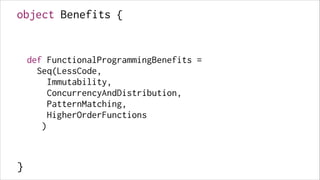
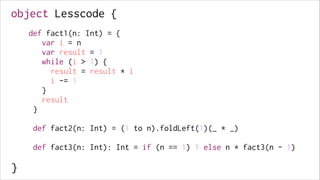
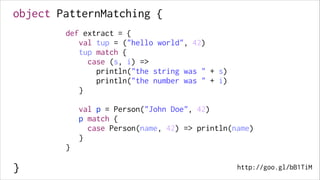
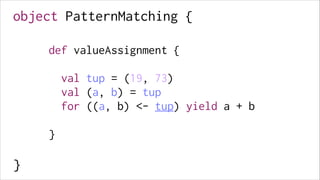
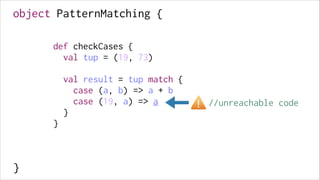
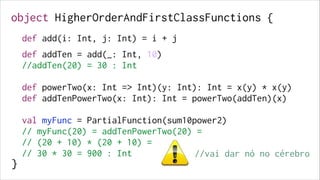
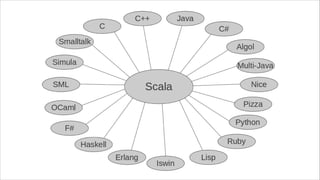
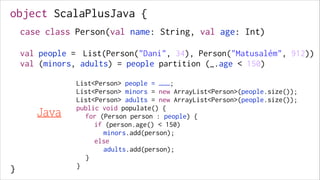
The document discusses the benefits of functional programming including less code, immutability, concurrency and distribution, pattern matching, and higher-order functions. It provides code examples in Scala demonstrating each of these benefits. Specifically, it shows how functional programming can reduce lines of code for calculating factorials, enable concurrency through futures and distribution through parallelization, utilize pattern matching to extract values from data structures and match on types, and leverage higher-order functions like map and fold to operate on collections in a declarative way.


![[Expert Fridays] Александр Чичигин - Как перестать бояться и полюбить COQ](https://cdn.slidesharecdn.com/ss_thumbnails/slides-funcmeetup2017-170926091324-thumbnail.jpg?width=640&height=640&fit=bounds)


![UNIT V Searching Sorting Hashing Techniques [Autosaved].pptx](https://cdn.slidesharecdn.com/ss_thumbnails/unitvsearchingsortinghashingtechniquesautosaved-241126054304-95a69c51-thumbnail.jpg?width=640&height=640&fit=bounds)

![UNIT V Searching Sorting Hashing Techniques [Autosaved].pptx](https://cdn.slidesharecdn.com/ss_thumbnails/unitvsearchingsortinghashingtechniquesautosaved-241014040608-74caa0f6-thumbnail.jpg?width=640&height=640&fit=bounds)


