Rahim Lotfi
AhmadReza Ghasemian

1
Table of Contents
Introduction









Need for empirical studies in the context of software engineering.
Goals and Benefits
Basic Concepts: Measurement, Collection, Analysis
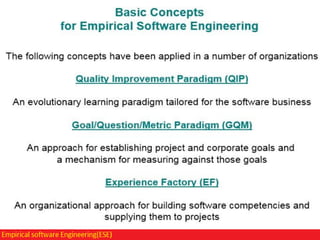
Basic Concepts for Empirical Software Engineering
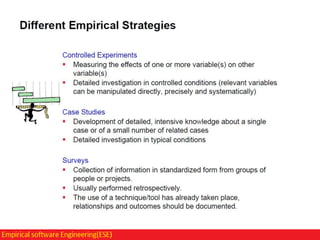
Empirical Strategies: survey, case study, controlled experiment
Process of an empirical study
Tools
State of the art
Empirical Software Engineering
•
•
•

•

•

Using other people’s experiences in management and development of softwares
Empirical, included in all areas of science
“I could have told you that from the start” or “That’s obvious.”
Software engineering needs to follow the model of other physical sciences and
develop an experimental paradigm for the field.
Judging empirical work by the standards of statistics texts would lead to
the suppression of many interesting results
ESE in the Literature
• “Empirical Software Engineering”
• “Experimentation in Software Engineering”
• “ESEM - Empirical Software Engineering and Measurement “
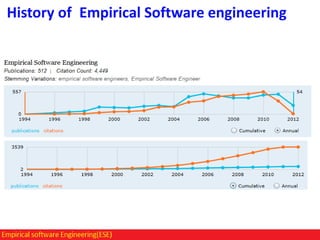
History of Empirical Software engineering

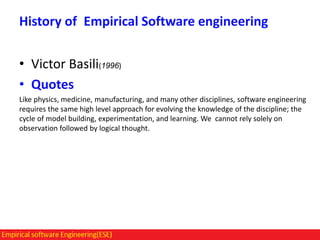
• Victor Basili(1996)
• Quotes
Like physics, medicine, manufacturing, and many other disciplines, software engineering
requires the same high level approach for evolving the knowledge of the discipline; the
cycle of model building, experimentation, and learning. We cannot rely solely on
observation followed by logical thought.
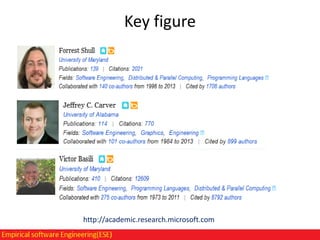
Key figure

http://academic.research.microsoft.com
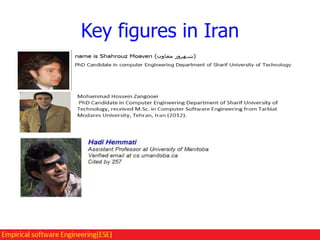
Key figures in Iran
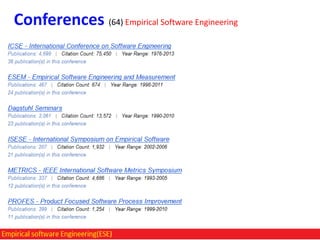
Conferences (64) Empirical Software Engineering
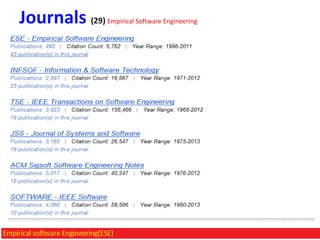
Journals (29)

Empirical Software Engineering
Table of Contents
Introduction
 Need for empirical studies in the context of software engineering.








Goals and Benefits
Basic Concepts: Measurement, Collection, Analysis
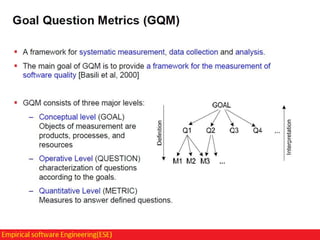
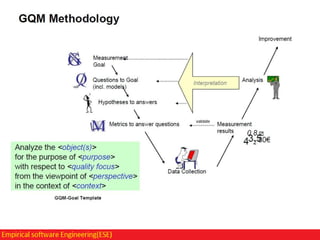
Goal Question Metric
Empirical Strategies: survey, case study, controlled experiment
Process of an empirical study
Tools
State of the art
Need of Empirical Studies
Why should we conduct empirical studies?
Product evaluation, e.g., prototyping.
Process evaluation
1. Prototypes are not possible (simulation based on models).
2. A process is just a description until it is used by people
 Important for research: experimentation is mandatory in
other disciplines(e.g., medicine, physics, etc.)
Need of Empirical Studies
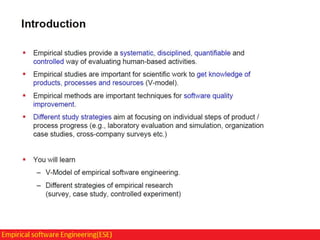
Empirical studies provides a systematic, disciplined,
quantifiable and controlled way of evaluating
human-based activities.
You will learn how to select, plan, conduct and analyse an empirical study.
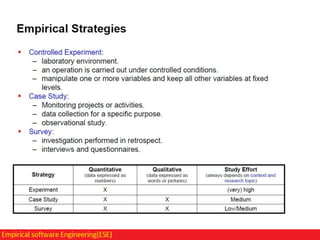
Table of Contents
 Introduction
 Need for empirical studies in the context of software engineering.

 Goals and Benefits







Basic Concepts: Measurement, Collection, Analysis
Basic Concepts for Empirical Software Engineering
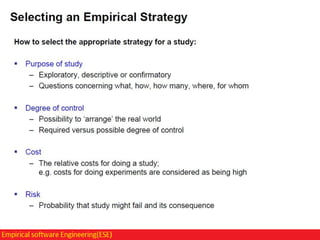
Empirical Strategies: survey, case study, controlled experiment
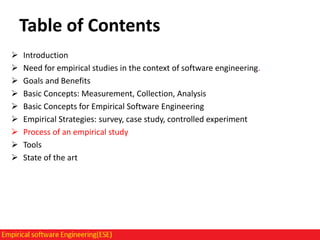
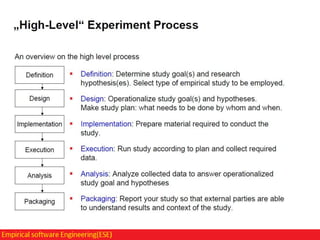
Process of an empirical study
Tools
State of the art
Goals and Benefits
• The purpose of a study is

• The purpose of a study is
to explore ...
to find out what’s happening
to seek for new insights
to ask questions and to find answers
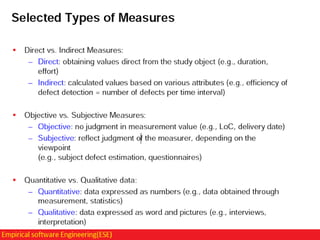
Measurement: usually qualitative

• to describe ...
portray accurate profile of situations, events, projects , technologies

•

•

Measurement: quantitative/qualitative
to explain ...
seek explanation of a situation/problem, usual in the form of causal
Relationships
Measurement: quantitative/qualitative
relationships, differences, changes
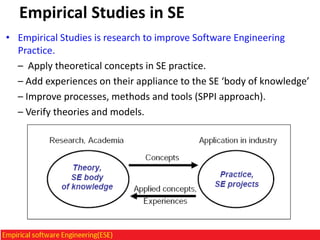
Empirical Studies in SE
• Empirical Studies is research to improve Software Engineering
Practice.
– Apply theoretical concepts in SE practice.
– Add experiences on their appliance to the SE ‘body of knowledge’
– Improve processes, methods and tools (SPPI approach).
– Verify theories and models.
Table of Contents
 Introduction
 Need for empirical studies in the context of software engineering.
 Goals and Benefits

 Basic Concepts: Measurement, Collection, Analysis






Basic Concepts for Empirical Software Engineering
Empirical Strategies: survey, case study, controlled experiment
Process of an empirical study
Tools
State of the art
Some Basic Concepts
• Measurement
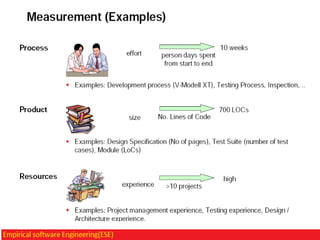
- is the process of capturing data which are connected to real-world attributes to
describe them.
- Why is measurement important?

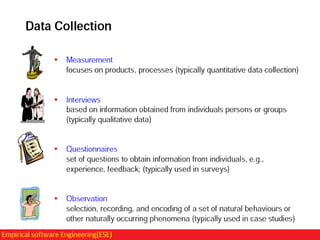
• Data Collection
Collection of qualitative / quantitative data according to research questions

• Data Analysis
Analyzing the results according to the research questions ;
statistical tests
Measurement
• Quotes
- “You can’t manage what you can’t measure”, Tom DeMarco
– “What is not measurable make measurable”, Galileo Galilei

• Objectives
One objective of science is to find ways to measure attributes of entities
we are interested in.
– Measurement makes concepts more visible and thus more
understandable and controllable.

• Definition
Measurement is the process by which numbers or symbols are mapped
to attributes of entities in the real world in such a way as to describe
them according to clearly defined rules.
Table of Contents





Introduction
Need for empirical studies in the context of software engineering.
Goals and Benefits
Basic Concepts: Measurement, Collection, Analysis

 Basic Concepts for Empirical Software Engineering





Empirical Strategies: survey, case study, controlled experiment
Process of an empirical study
Tools
State of the art
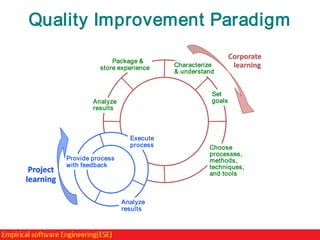
Quality Improvement Paradigm
Package &
store experience

Set
goals

Analyze
results

Execute
process

Project
learning

Characterize
& understand

Corporate
learning

Provide process
with feedback

Analyze
results

Choose
processes,
methods,
techniques,
and tools
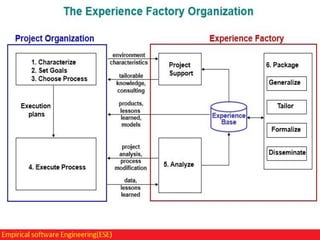
The Experience Factory Organization
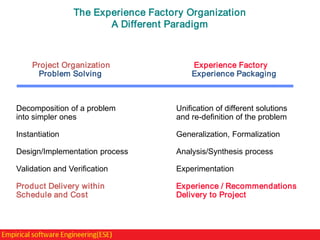
A Different Paradigm

Project Organization
Problem Solving

Experience Factory
Experience Packaging

Decomposition of a problem
into simpler ones

Unification of different solutions
and re-definition of the problem

Instantiation

Generalization, Formalization

Design/Implementation process

Analysis/Synthesis process

Validation and Verification

Experimentation

Product Delivery within
Schedule and Cost

Experience / Recommendations
Delivery to Project
Table of Contents










Introduction
Need for empirical studies in the context of software engineering.
Goals and Benefits
Basic Concepts: Measurement, Collection, Analysis
Basic Concepts for Empirical Software Engineering
Empirical Strategies: survey, case study, controlled experiment
Process of an empirical study
Tools
State of the art
Table of Contents










Introduction
Need for empirical studies in the context of software engineering.
Goals and Benefits
Basic Concepts: Measurement, Collection, Analysis
Basic Concepts for Empirical Software Engineering
Empirical Strategies: survey, case study, controlled experiment
Process of an empirical study
Tools
State of the art
Table of Contents








Introduction
Need for empirical studies in the context of software engineering.
Goals and Benefits
Basic Concepts: Measurement, Collection, Analysis
Goal Question Metric
Empirical Strategies: survey, case study, controlled experiment
Process of an empirical study

 Tools
 State of the art
Table of Contents









Introduction
Need for empirical studies in the context of software engineering.
Goals and Benefits
Basic Concepts: Measurement, Collection, Analysis
Basic Concepts for Empirical Software Engineering
Empirical Strategies: survey, case study, controlled experiment
Process of an empirical study
Tools

 State of the art
State of the art
• Finding better ways to experiment and integrate the results of
the studies
• Propagate the empirical discipline
•

Build an empirical research engine for software engineering

•

Build test beds for experimentation and evolution of
processes

•

Build product models that allow us to make trade-off
decisions

•

Build decision support systems offering the best empirical
advice for selecting and tailoring the right processes for the
problem
• References
•
•
•
•
•
•
•
•
•
•
•
•
•
•
•
•
•

V. Basili, G. Caldiera, D. Rombach: „The Goal Question Metric Approach“,2000.
B. Boehm, H.D. Rombach, M.V. Zelkowitz: „Foundations of Empirical
Software Engineering – The Legacy of Victor R. Basili“, Springer, 2005.
Freimut et al.: "Empirical Studies in Software Engineering", Tutorial, VISEK
Technical Report, 2002.
IESE Tutorials on Empirical Software Engineering.
A. Jedlitschka and D. Pfahl: "Reporting Guidelines for Controlled
Experiments in Software Engineering", ISESE, 2005.
B. Kitchenham: “Evidence-Based Software Engineering and Systematic
Literature Review”, Profes, 2006.
C. Wohlin, P. Runeson, M. Höst, M.C. Ohlsson, B. Regnell and A. Wesslen:
"Introduction to Experimentation in Software Engineering", Kluver, 2000.
M. V. Zelkowitz, D. R. Wallace: “Experimental Models for Validating
Technology”, IEEE Computer, 1997.
Site : http:// www.microstrategy.com
Site : http:// www.jamasoftware.com
Site : http://academic.research.microsoft.com
Acknowledgments
Bahman Zamani

Thank you for your attention

This research work has been supported by University of Isfahan

Empirical Software Engineering

  • 1.
  • 2.
    Table of Contents Introduction         Needfor empirical studies in the context of software engineering. Goals and Benefits Basic Concepts: Measurement, Collection, Analysis Basic Concepts for Empirical Software Engineering Empirical Strategies: survey, case study, controlled experiment Process of an empirical study Tools State of the art
  • 3.
    Empirical Software Engineering • • • • • Usingother people’s experiences in management and development of softwares Empirical, included in all areas of science “I could have told you that from the start” or “That’s obvious.” Software engineering needs to follow the model of other physical sciences and develop an experimental paradigm for the field. Judging empirical work by the standards of statistics texts would lead to the suppression of many interesting results
  • 4.
    ESE in theLiterature • “Empirical Software Engineering” • “Experimentation in Software Engineering” • “ESEM - Empirical Software Engineering and Measurement “
  • 5.
    History of EmpiricalSoftware engineering
  • 6.
    History of EmpiricalSoftware engineering • Victor Basili(1996) • Quotes Like physics, medicine, manufacturing, and many other disciplines, software engineering requires the same high level approach for evolving the knowledge of the discipline; the cycle of model building, experimentation, and learning. We cannot rely solely on observation followed by logical thought.
  • 7.
  • 8.
  • 9.
    Conferences (64) EmpiricalSoftware Engineering
  • 10.
  • 11.
    Table of Contents Introduction Need for empirical studies in the context of software engineering.        Goals and Benefits Basic Concepts: Measurement, Collection, Analysis Goal Question Metric Empirical Strategies: survey, case study, controlled experiment Process of an empirical study Tools State of the art
  • 12.
    Need of EmpiricalStudies Why should we conduct empirical studies? Product evaluation, e.g., prototyping. Process evaluation 1. Prototypes are not possible (simulation based on models). 2. A process is just a description until it is used by people  Important for research: experimentation is mandatory in other disciplines(e.g., medicine, physics, etc.)
  • 13.
    Need of EmpiricalStudies Empirical studies provides a systematic, disciplined, quantifiable and controlled way of evaluating human-based activities. You will learn how to select, plan, conduct and analyse an empirical study.
  • 14.
    Table of Contents Introduction  Need for empirical studies in the context of software engineering.  Goals and Benefits       Basic Concepts: Measurement, Collection, Analysis Basic Concepts for Empirical Software Engineering Empirical Strategies: survey, case study, controlled experiment Process of an empirical study Tools State of the art
  • 15.
    Goals and Benefits •The purpose of a study is • The purpose of a study is to explore ... to find out what’s happening to seek for new insights to ask questions and to find answers Measurement: usually qualitative • to describe ... portray accurate profile of situations, events, projects , technologies • • Measurement: quantitative/qualitative to explain ... seek explanation of a situation/problem, usual in the form of causal Relationships Measurement: quantitative/qualitative relationships, differences, changes
  • 16.
    Empirical Studies inSE • Empirical Studies is research to improve Software Engineering Practice. – Apply theoretical concepts in SE practice. – Add experiences on their appliance to the SE ‘body of knowledge’ – Improve processes, methods and tools (SPPI approach). – Verify theories and models.
  • 18.
    Table of Contents Introduction  Need for empirical studies in the context of software engineering.  Goals and Benefits  Basic Concepts: Measurement, Collection, Analysis      Basic Concepts for Empirical Software Engineering Empirical Strategies: survey, case study, controlled experiment Process of an empirical study Tools State of the art
  • 19.
    Some Basic Concepts •Measurement - is the process of capturing data which are connected to real-world attributes to describe them. - Why is measurement important? • Data Collection Collection of qualitative / quantitative data according to research questions • Data Analysis Analyzing the results according to the research questions ; statistical tests
  • 20.
    Measurement • Quotes - “Youcan’t manage what you can’t measure”, Tom DeMarco – “What is not measurable make measurable”, Galileo Galilei • Objectives One objective of science is to find ways to measure attributes of entities we are interested in. – Measurement makes concepts more visible and thus more understandable and controllable. • Definition Measurement is the process by which numbers or symbols are mapped to attributes of entities in the real world in such a way as to describe them according to clearly defined rules.
  • 25.
    Table of Contents     Introduction Needfor empirical studies in the context of software engineering. Goals and Benefits Basic Concepts: Measurement, Collection, Analysis  Basic Concepts for Empirical Software Engineering     Empirical Strategies: survey, case study, controlled experiment Process of an empirical study Tools State of the art
  • 27.
    Quality Improvement Paradigm Package& store experience Set goals Analyze results Execute process Project learning Characterize & understand Corporate learning Provide process with feedback Analyze results Choose processes, methods, techniques, and tools
  • 29.
    The Experience FactoryOrganization A Different Paradigm Project Organization Problem Solving Experience Factory Experience Packaging Decomposition of a problem into simpler ones Unification of different solutions and re-definition of the problem Instantiation Generalization, Formalization Design/Implementation process Analysis/Synthesis process Validation and Verification Experimentation Product Delivery within Schedule and Cost Experience / Recommendations Delivery to Project
  • 34.
    Table of Contents          Introduction Needfor empirical studies in the context of software engineering. Goals and Benefits Basic Concepts: Measurement, Collection, Analysis Basic Concepts for Empirical Software Engineering Empirical Strategies: survey, case study, controlled experiment Process of an empirical study Tools State of the art
  • 44.
    Table of Contents          Introduction Needfor empirical studies in the context of software engineering. Goals and Benefits Basic Concepts: Measurement, Collection, Analysis Basic Concepts for Empirical Software Engineering Empirical Strategies: survey, case study, controlled experiment Process of an empirical study Tools State of the art
  • 46.
    Table of Contents        Introduction Needfor empirical studies in the context of software engineering. Goals and Benefits Basic Concepts: Measurement, Collection, Analysis Goal Question Metric Empirical Strategies: survey, case study, controlled experiment Process of an empirical study  Tools  State of the art
  • 48.
    Table of Contents         Introduction Needfor empirical studies in the context of software engineering. Goals and Benefits Basic Concepts: Measurement, Collection, Analysis Basic Concepts for Empirical Software Engineering Empirical Strategies: survey, case study, controlled experiment Process of an empirical study Tools  State of the art
  • 49.
    State of theart • Finding better ways to experiment and integrate the results of the studies • Propagate the empirical discipline • Build an empirical research engine for software engineering • Build test beds for experimentation and evolution of processes • Build product models that allow us to make trade-off decisions • Build decision support systems offering the best empirical advice for selecting and tailoring the right processes for the problem
  • 50.
    • References • • • • • • • • • • • • • • • • • V. Basili,G. Caldiera, D. Rombach: „The Goal Question Metric Approach“,2000. B. Boehm, H.D. Rombach, M.V. Zelkowitz: „Foundations of Empirical Software Engineering – The Legacy of Victor R. Basili“, Springer, 2005. Freimut et al.: "Empirical Studies in Software Engineering", Tutorial, VISEK Technical Report, 2002. IESE Tutorials on Empirical Software Engineering. A. Jedlitschka and D. Pfahl: "Reporting Guidelines for Controlled Experiments in Software Engineering", ISESE, 2005. B. Kitchenham: “Evidence-Based Software Engineering and Systematic Literature Review”, Profes, 2006. C. Wohlin, P. Runeson, M. Höst, M.C. Ohlsson, B. Regnell and A. Wesslen: "Introduction to Experimentation in Software Engineering", Kluver, 2000. M. V. Zelkowitz, D. R. Wallace: “Experimental Models for Validating Technology”, IEEE Computer, 1997. Site : http:// www.microstrategy.com Site : http:// www.jamasoftware.com Site : http://academic.research.microsoft.com
  • 51.
    Acknowledgments Bahman Zamani Thank youfor your attention This research work has been supported by University of Isfahan