Ticking Mind Classics
SELECTED
WORDSWORTH
POEMS
HOW TO READ THEM,UNDERSTAND THEM
& WRITE TRULY INSIGHTFUL ANALYSES OF THEM
Preview
2
Selected Wordsworth poems: how to read them,
understand them and wrote a truly insightful analyses
of them
Copyright © Ticking Mind 2019
All rights reserved.
Except under the conditions described in the
Copyright Act 1968 of Australia and subsequent
amendments, no part of this publications may
be reproduced, stored in a retrieval system,
or transmitted in any form or by any means,
electronic, mechanical, photocopying, recording
or otherwise, without the prior permission of the
copyright owner.
First Published 2019 by:
Ticking Mind Publications, Northcote.
ISBN 978-0-9944258-6-7
Preview
3SELECTED WORDSWORTH POEMS
CONTENTS
Romanticism..................................................................................... 4
The key ideas.................................................................................... 4
Imagery............................................................................................ 6
How to read poems............................................................................ 8
Essay questions.............................................................................. 14
We should praise & embrace nature
Composed upon Westminster Bridge, September 3 .........................................................................16
My heart leaps up when I behold......................................................................................................... 22
The world is too much with us.............................................................................................................. 26
To the cuckoo.........................................................................................................................................30
Lines composed a few miles above Tintern Abbey............................................................................36
Death is an essential & unstoppable element of nature
A slumber did my spirit seal..................................................................................................................54
Strange fits of passion I have known ..................................................................................................58
Surprised by joy—impatient as the Wind.............................................................................................64
Simplon Pass...........................................................................................................................................70
Reflection and contemplation are essential to life
Travelling................................................................................................................................................. 76
I wandered lonely as a cloud.................................................................................................................80
The solitary reaper.................................................................................................................................86
Art, poetry & an appreciation of the epic nature of life
are important
London, 1802..........................................................................................................................................94
Extempore effusion upon the death of James Hogg........................................................................98
Preview
4
ROMANTICISM
One of the reasons that Wordsworth is an important poet is that he (and a couple of other poets and
writers) was one of the leading thinkers in an intellectual ideal called the Romantic Period. Although the
name ‘romantic’ might make you think of mushy kisses, red roses and bad ’90s rom-coms, it actually
means a bit more than this. Reading Wordsworth’s poetry will give you a pretty good indication of
what the Romantic Period meant, so you really don’t need to do any more research (unless you’re
super-keen, but remember that doing more research won’t necessarily help you write an awesome
essay). However, it might help you to remember that the Romantic movement was a reaction to the
Age of Enlightenment – a period of time just before the romantic movement that focused on scien-
tific advances (when cool theories were developed, like needing oxygen to breath), development in
technology and people moving to the cities. The Romantic movement found all of this science stuff
super-boring and they hated the new cities because cities were smoggy and filled with other people.
Listed below are a few essential things the Romantics did believe in:
•	 Nature is awesome: the Romantic movement was all about describing how amazing nature is.
•	 Emotions are super-cool: having emotions was important to Romantics because it separated
them from the rational, scientific thinkers who only liked logic and were basically robots.
•	 Life was better in the good old days: and when they said ‘good old days’, Romantics meant the
Medieval period when men were heroes and women were delicate damsels who needed to be
rescued.
•	 Art is awesome: music, poetry and literature will help make you a better person. Way better
than boring old science will. And people who write music, poetry or literature? Heroes.
•	 Everyone needs a bit of shush: Romantics thought that being surrounded by people stifled
creativity, so it was important to get out into nature on your own and just…feel it.
THE KEY IDEAS
While all Wordsworth’s poems generally espouse romantic ideals, he also reflects on different, specific
aspects of romanticism in each of his poems. To allow you to better see how Wordsworth develops
these specific themes in his poetry, this guide divides his poems into four different groups, based upon
the romantic principles they explore. At the top of each category is the main principle and beneath
this are different ways of thinking about them. However, as you read through the poems and their
analyses, you will also realise that while a poem might focus on a certain romantic principle (like ‘death
is an essential and unstoppable element of nature’), it will invariably also include other ideas (such as
‘reflection and contemplation are essential to life’).
Preview
5SELECTED WORDSWORTH POEMS
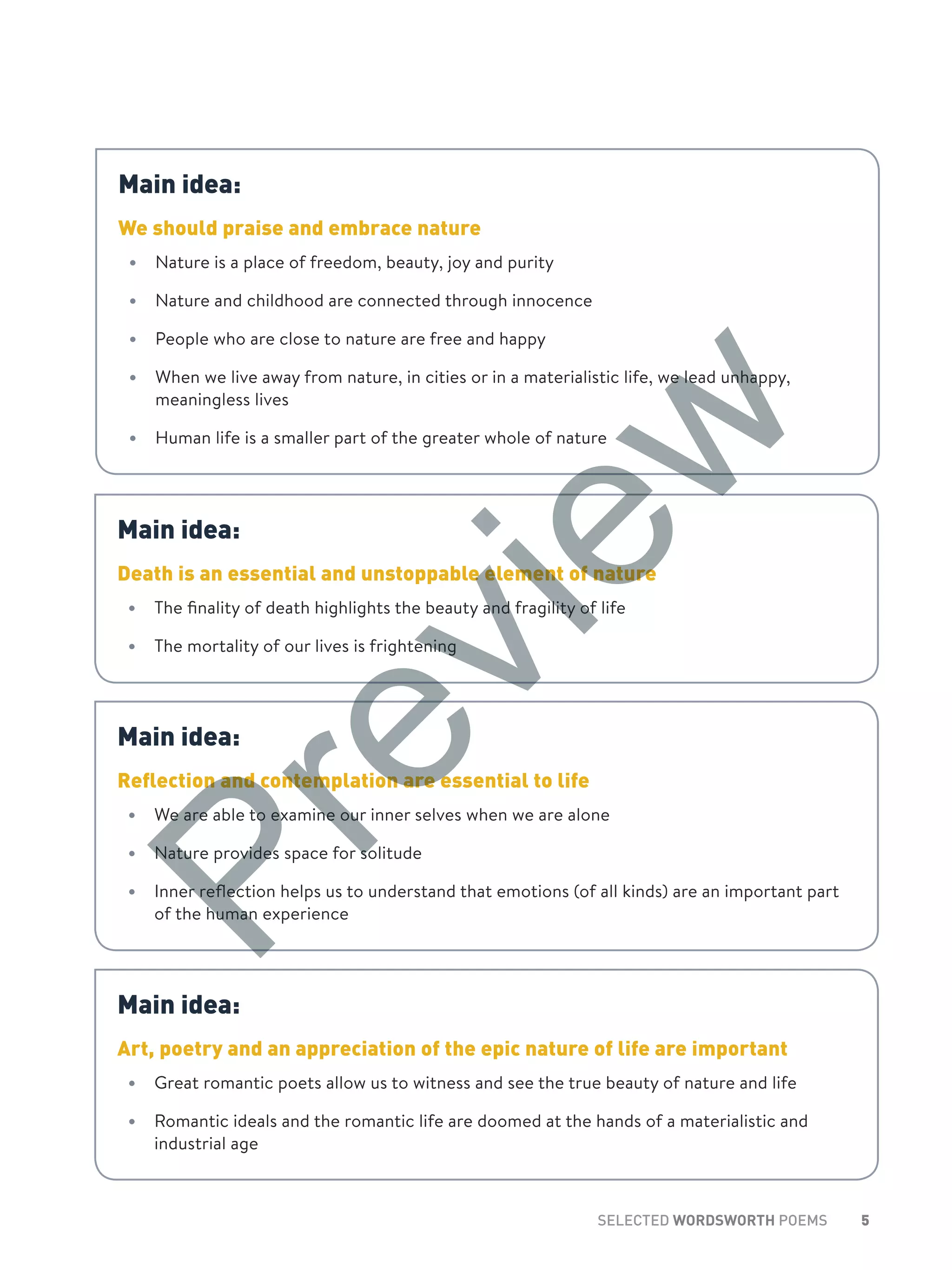
Main idea:
We should praise and embrace nature
•	 Nature is a place of freedom, beauty, joy and purity
•	 Nature and childhood are connected through innocence
•	 People who are close to nature are free and happy
•	 When we live away from nature, in cities or in a materialistic life, we lead unhappy,
meaningless lives
•	 Human life is a smaller part of the greater whole of nature
Main idea:
Death is an essential and unstoppable element of nature
•	 The finality of death highlights the beauty and fragility of life
•	 The mortality of our lives is frightening
Main idea:
Reflection and contemplation are essential to life
•	 We are able to examine our inner selves when we are alone
•	 Nature provides space for solitude
•	 Inner reflection helps us to understand that emotions (of all kinds) are an important part
of the human experience
Main idea:
Art, poetry and an appreciation of the epic nature of life are important
•	 Great romantic poets allow us to witness and see the true beauty of nature and life
•	 Romantic ideals and the romantic life are doomed at the hands of a materialistic and
industrial age
Preview
6
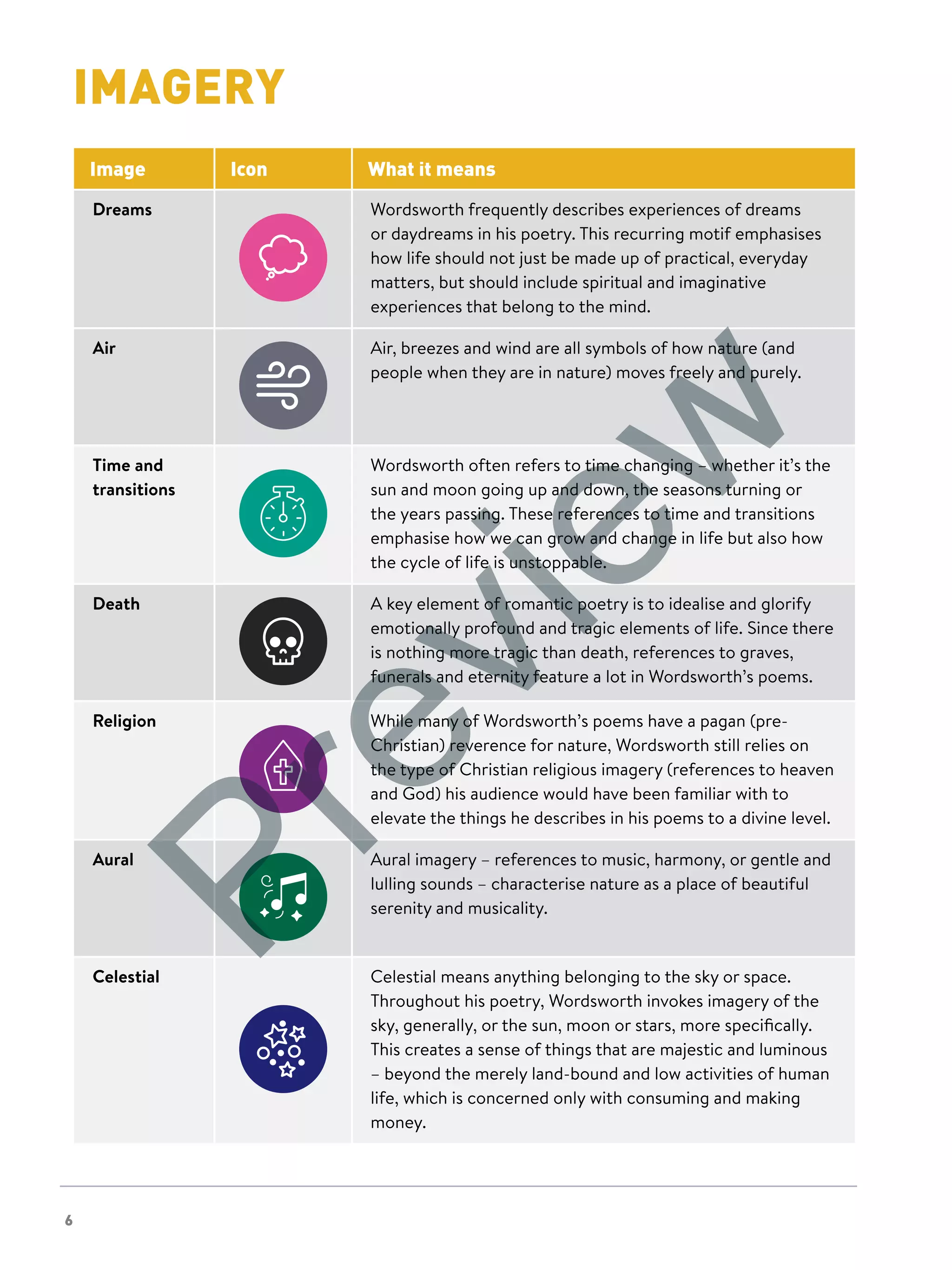
Image Icon What it means
Dreams Wordsworth frequently describes experiences of dreams
or daydreams in his poetry. This recurring motif emphasises
how life should not just be made up of practical, everyday
matters, but should include spiritual and imaginative
experiences that belong to the mind.
Air Air, breezes and wind are all symbols of how nature (and
people when they are in nature) moves freely and purely.
Time and
transitions
Wordsworth often refers to time changing – whether it’s the
sun and moon going up and down, the seasons turning or
the years passing. These references to time and transitions
emphasise how we can grow and change in life but also how
the cycle of life is unstoppable.
Death A key element of romantic poetry is to idealise and glorify
emotionally profound and tragic elements of life. Since there
is nothing more tragic than death, references to graves,
funerals and eternity feature a lot in Wordsworth’s poems.
Religion While many of Wordsworth’s poems have a pagan (pre-
Christian) reverence for nature, Wordsworth still relies on
the type of Christian religious imagery (references to heaven
and God) his audience would have been familiar with to
elevate the things he describes in his poems to a divine level.
Aural Aural imagery – references to music, harmony, or gentle and
lulling sounds – characterise nature as a place of beautiful
serenity and musicality.
Celestial Celestial means anything belonging to the sky or space.
Throughout his poetry, Wordsworth invokes imagery of the
sky, generally, or the sun, moon or stars, more specifically.
This creates a sense of things that are majestic and luminous
– beyond the merely land-bound and low activities of human
life, which is concerned only with consuming and making
money.
IMAGERY
Preview
7SELECTED WORDSWORTH POEMS
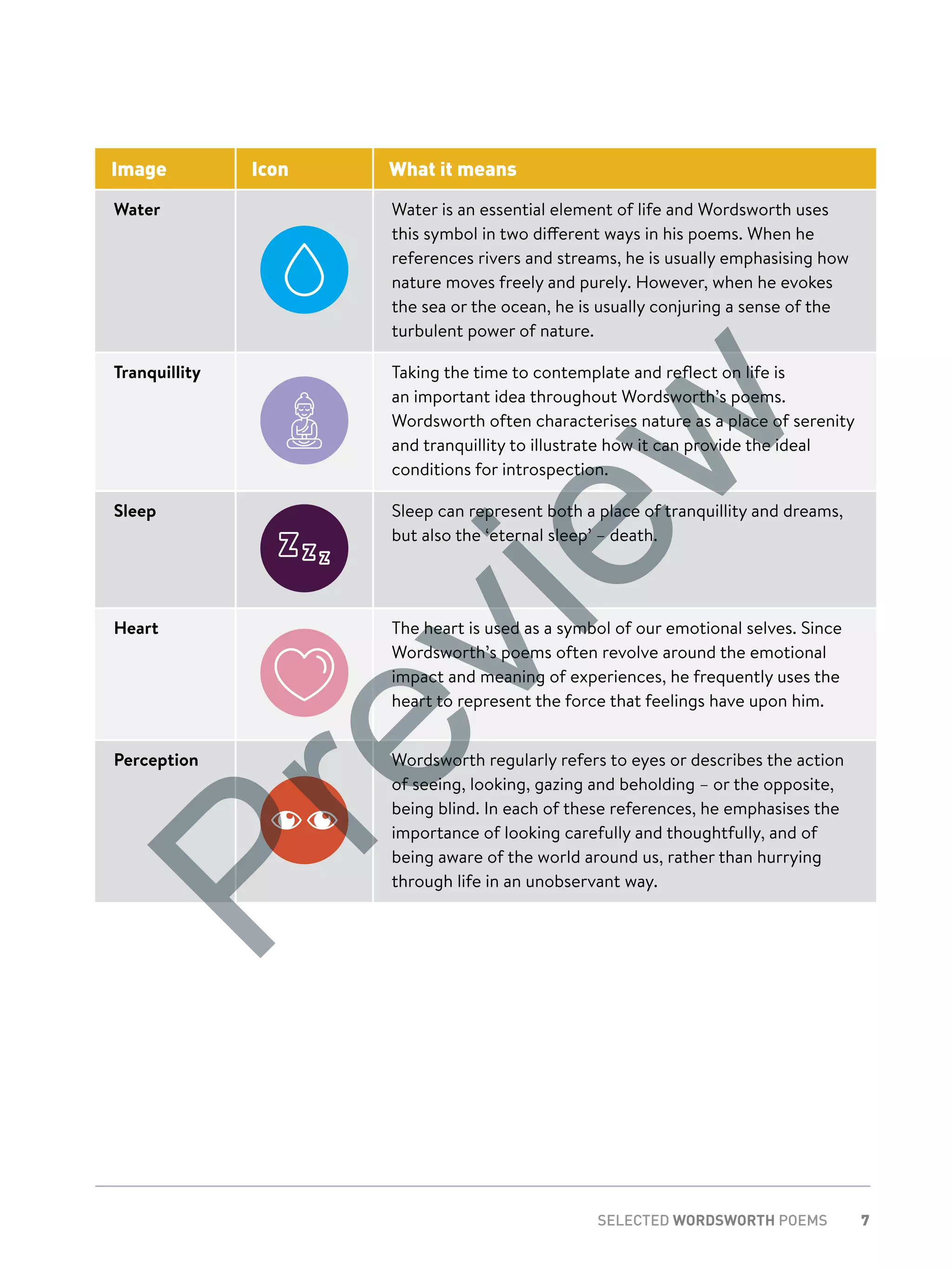
Image Icon What it means
Water Water is an essential element of life and Wordsworth uses
this symbol in two different ways in his poems. When he
references rivers and streams, he is usually emphasising how
nature moves freely and purely. However, when he evokes
the sea or the ocean, he is usually conjuring a sense of the
turbulent power of nature.
Tranquillity Taking the time to contemplate and reflect on life is
an important idea throughout Wordsworth’s poems.
Wordsworth often characterises nature as a place of serenity
and tranquillity to illustrate how it can provide the ideal
conditions for introspection.
Sleep Sleep can represent both a place of tranquillity and dreams,
but also the ‘eternal sleep’ – death.
Heart The heart is used as a symbol of our emotional selves. Since
Wordsworth’s poems often revolve around the emotional
impact and meaning of experiences, he frequently uses the
heart to represent the force that feelings have upon him.
Perception Wordsworth regularly refers to eyes or describes the action
of seeing, looking, gazing and beholding – or the opposite,
being blind. In each of these references, he emphasises the
importance of looking carefully and thoughtfully, and of
being aware of the world around us, rather than hurrying
through life in an unobservant way.
Preview
8
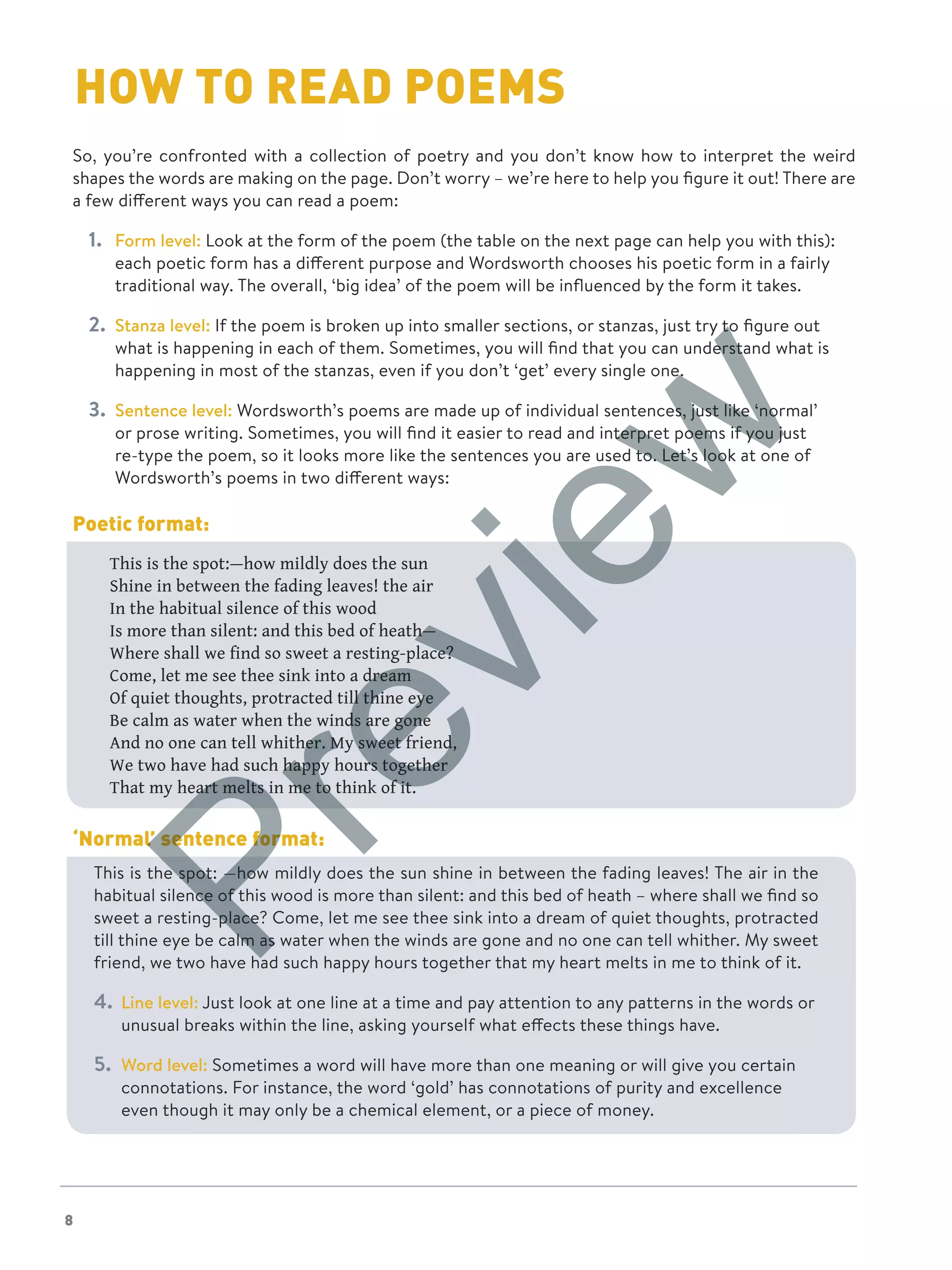
So, you’re confronted with a collection of poetry and you don’t know how to interpret the weird
shapes the words are making on the page. Don’t worry – we’re here to help you figure it out! There are
a few different ways you can read a poem:
1.	 Form level: Look at the form of the poem (the table on the next page can help you with this):
each poetic form has a different purpose and Wordsworth chooses his poetic form in a fairly
traditional way. The overall, ‘big idea’ of the poem will be influenced by the form it takes.
2.	 Stanza level: If the poem is broken up into smaller sections, or stanzas, just try to figure out
what is happening in each of them. Sometimes, you will find that you can understand what is
happening in most of the stanzas, even if you don’t ‘get’ every single one.
3.	 Sentence level: Wordsworth’s poems are made up of individual sentences, just like ‘normal’
or prose writing. Sometimes, you will find it easier to read and interpret poems if you just
re-type the poem, so it looks more like the sentences you are used to. Let’s look at one of
Wordsworth’s poems in two different ways:
Poetic format:
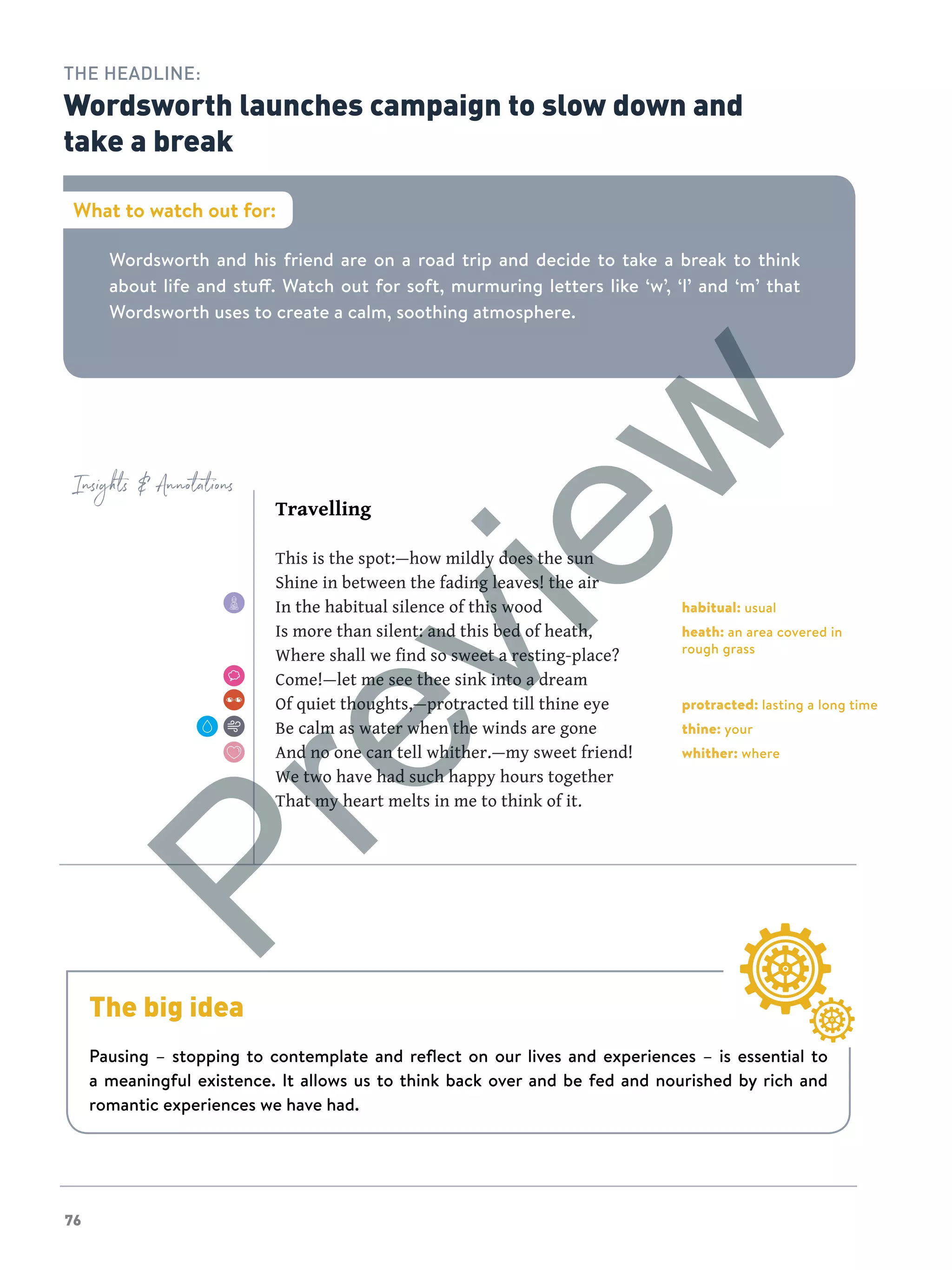
This is the spot:—how mildly does the sun
Shine in between the fading leaves! the air
In the habitual silence of this wood
Is more than silent: and this bed of heath—
Where shall we find so sweet a resting-place?
Come, let me see thee sink into a dream
Of quiet thoughts, protracted till thine eye
Be calm as water when the winds are gone
And no one can tell whither. My sweet friend,
We two have had such happy hours together
That my heart melts in me to think of it.
‘Normal’ sentence format:
This is the spot: —how mildly does the sun shine in between the fading leaves! The air in the
habitual silence of this wood is more than silent: and this bed of heath – where shall we find so
sweet a resting-place? Come, let me see thee sink into a dream of quiet thoughts, protracted
till thine eye be calm as water when the winds are gone and no one can tell whither. My sweet
friend, we two have had such happy hours together that my heart melts in me to think of it.
4.	 Line level: Just look at one line at a time and pay attention to any patterns in the words or
unusual breaks within the line, asking yourself what effects these things have.
5.	 Word level: Sometimes a word will have more than one meaning or will give you certain
connotations. For instance, the word ‘gold’ has connotations of purity and excellence
even though it may only be a chemical element, or a piece of money.
HOW TO READ POEMS
Preview
9SELECTED WORDSWORTH POEMS
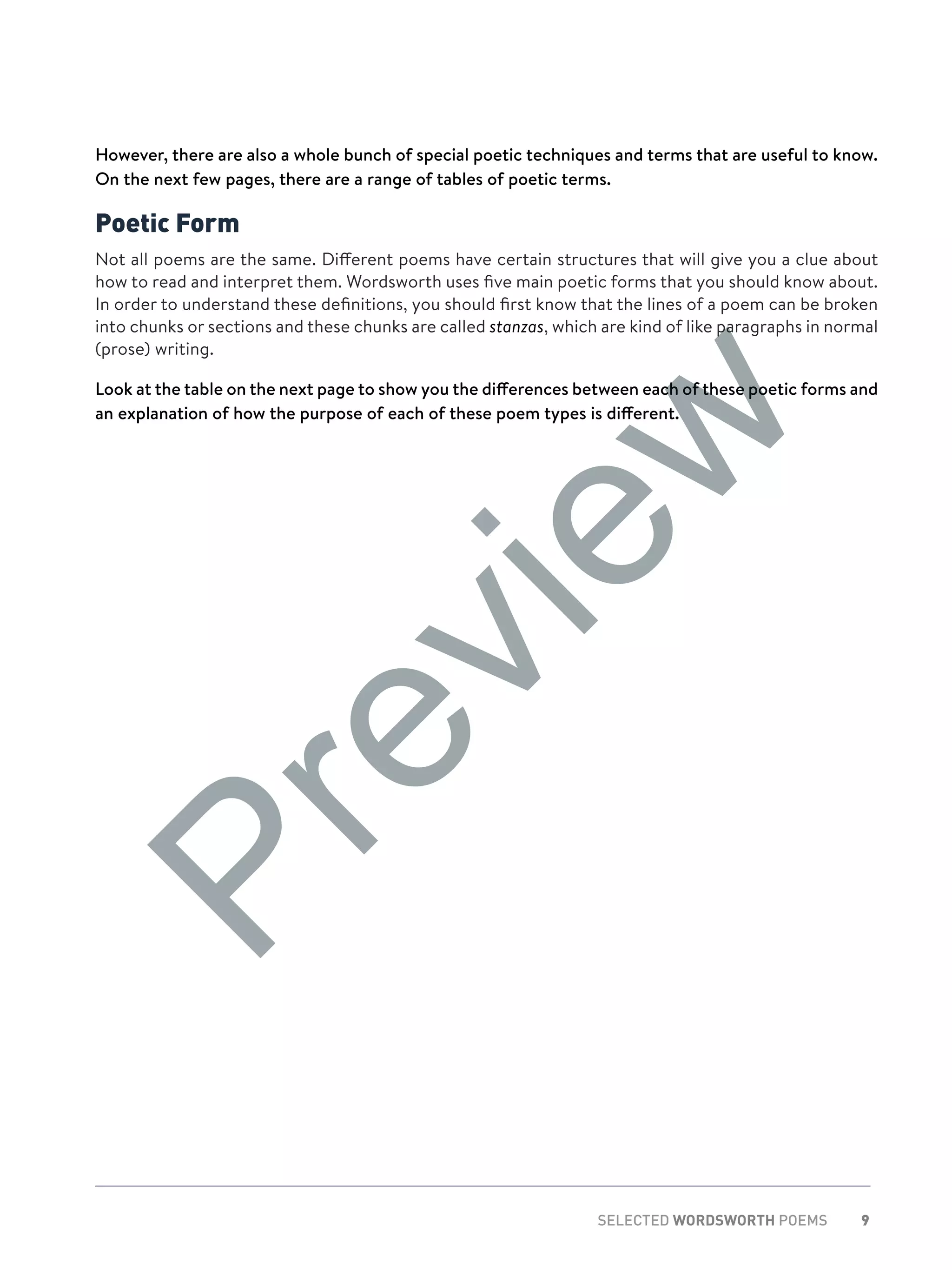
However, there are also a whole bunch of special poetic techniques and terms that are useful to know.
On the next few pages, there are a range of tables of poetic terms.
Poetic Form
Not all poems are the same. Different poems have certain structures that will give you a clue about
how to read and interpret them. Wordsworth uses five main poetic forms that you should know about.
In order to understand these definitions, you should first know that the lines of a poem can be broken
into chunks or sections and these chunks are called stanzas, which are kind of like paragraphs in normal
(prose) writing.
Look at the table on the next page to show you the differences between each of these poetic forms and
an explanation of how the purpose of each of these poem types is different.
Preview
10
Poem Type Form Purpose
Sonnet Fourteen lines in total: the first eight
lines are called an ‘octet’ and the
last six lines are called a ‘sestet’, or
‘sextet’.
The ninth line of a sonnet is called
the ‘volte’, or turning point, because
it marks a turning point in the poet’s
thoughts.
Wordsworth writes Petrarchan
or classical sonnets (different to
Shakespearean sonnets).
A sonnet compares two
different aspects to the one
idea: the octet shows one
idea and the sestet offers an
alternative.
Ballad A ballad is several stanzas long and
typically each stanza has four lines in
a rhyming ABAB pattern.
A ballad is a story-telling poem.
Lyric This sort of poem is quite common
in modern poetry, but it was more
unusual in Wordsworth’s time.
Lyric poetry does not have any
formal structure, and it may be
written without stanzas and without
any formal rhyming or rhythmic
sequence. However, there will be
other ways that the ideas and images
in the poem will be linked.
A lyric poem explores emotions,
feelings and ideas.
Ode Usually, an ode has a regular rhyming
sequence and can be divided into
stanzas, but each ode can be slightly
different.
An ode is designed to praise,
celebrate or otherwise describe
how awesome a person or thing
is.
Elegy Traditionally, an elegy is written in
a set rhyming sequence and the
stanzas have four lines in each, so it
can look a bit like a ballad, but it has
an entirely different purpose.
An elegy expresses sadness or
regret about a tragic event,
particularly a person dying.
Preview
11SELECTED WORDSWORTH POEMS
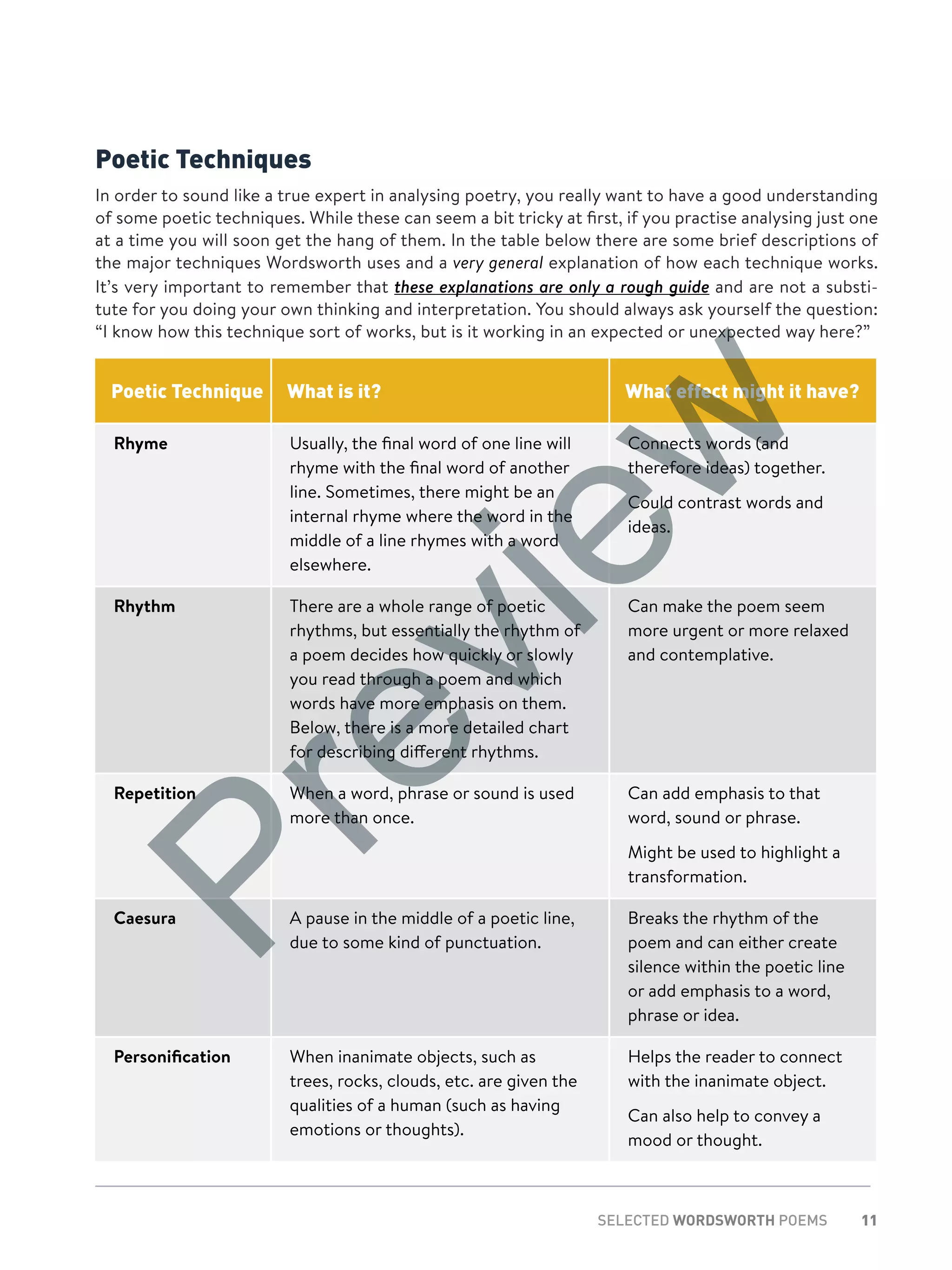
Poetic Techniques
In order to sound like a true expert in analysing poetry, you really want to have a good understanding
of some poetic techniques. While these can seem a bit tricky at first, if you practise analysing just one
at a time you will soon get the hang of them. In the table below there are some brief descriptions of
the major techniques Wordsworth uses and a very general explanation of how each technique works.
It’s very important to remember that these explanations are only a rough guide and are not a substi-
tute for you doing your own thinking and interpretation. You should always ask yourself the question:
“I know how this technique sort of works, but is it working in an expected or unexpected way here?”
Poetic Technique What is it? What effect might it have?
Rhyme Usually, the final word of one line will
rhyme with the final word of another
line. Sometimes, there might be an
internal rhyme where the word in the
middle of a line rhymes with a word
elsewhere.
Connects words (and
therefore ideas) together.
Could contrast words and
ideas.
Rhythm There are a whole range of poetic
rhythms, but essentially the rhythm of
a poem decides how quickly or slowly
you read through a poem and which
words have more emphasis on them.
Below, there is a more detailed chart
for describing different rhythms.
Can make the poem seem
more urgent or more relaxed
and contemplative.
Repetition When a word, phrase or sound is used
more than once.
Can add emphasis to that
word, sound or phrase.
Might be used to highlight a
transformation.
Caesura A pause in the middle of a poetic line,
due to some kind of punctuation.
Breaks the rhythm of the
poem and can either create
silence within the poetic line
or add emphasis to a word,
phrase or idea.
Personification When inanimate objects, such as
trees, rocks, clouds, etc. are given the
qualities of a human (such as having
emotions or thoughts).
Helps the reader to connect
with the inanimate object.
Can also help to convey a
mood or thought.
Preview
12
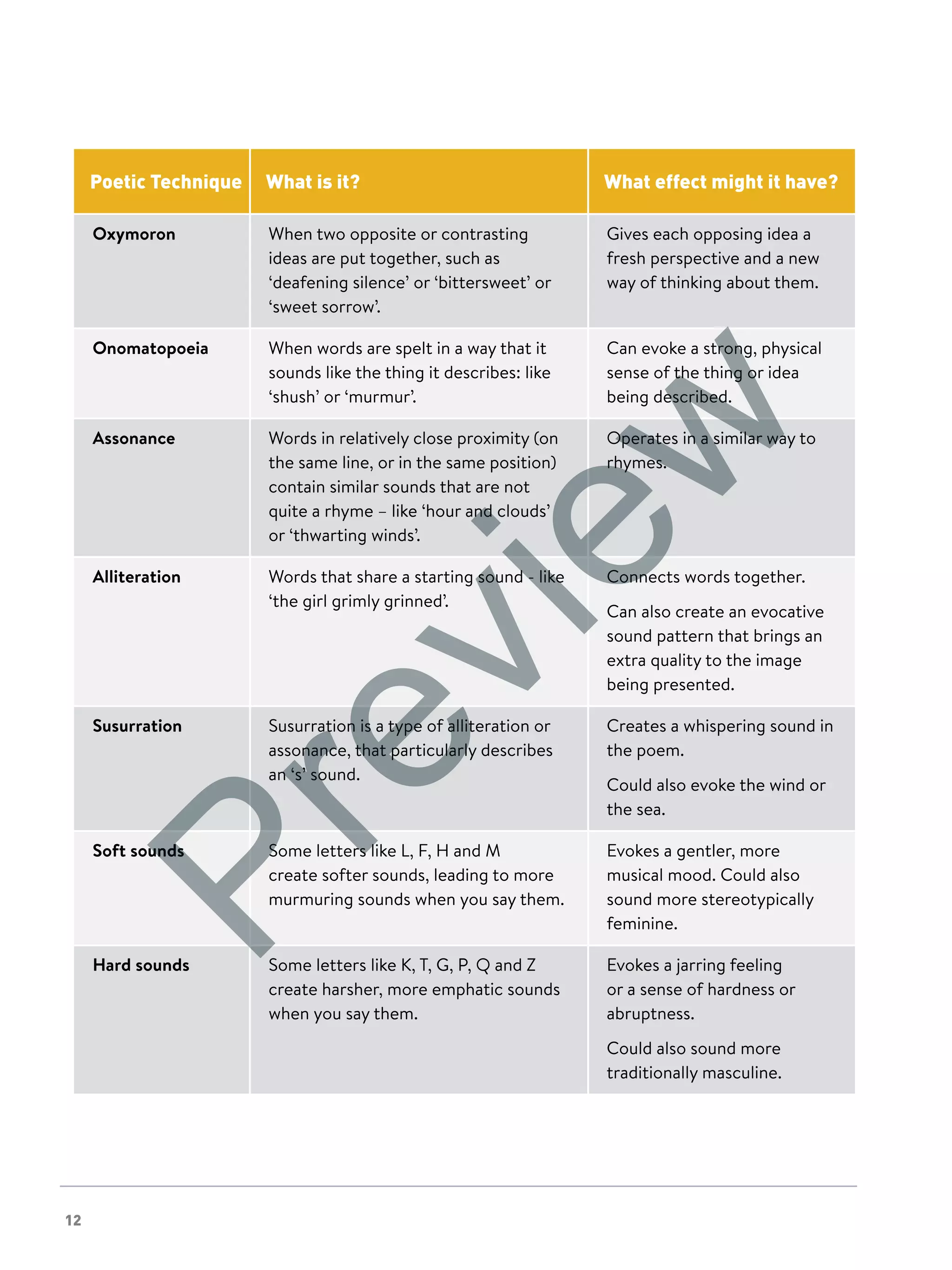
Poetic Technique What is it? What effect might it have?
Oxymoron When two opposite or contrasting
ideas are put together, such as
‘deafening silence’ or ‘bittersweet’ or
‘sweet sorrow’.
Gives each opposing idea a
fresh perspective and a new
way of thinking about them.
Onomatopoeia When words are spelt in a way that it
sounds like the thing it describes: like
‘shush’ or ‘murmur’.
Can evoke a strong, physical
sense of the thing or idea
being described.
Assonance Words in relatively close proximity (on
the same line, or in the same position)
contain similar sounds that are not
quite a rhyme – like ‘hour and clouds’
or ‘thwarting winds’.
Operates in a similar way to
rhymes.
Alliteration Words that share a starting sound - like
‘the girl grimly grinned’.
Connects words together.
Can also create an evocative
sound pattern that brings an
extra quality to the image
being presented.
Susurration Susurration is a type of alliteration or
assonance, that particularly describes
an ‘s’ sound.
Creates a whispering sound in
the poem.
Could also evoke the wind or
the sea.
Soft sounds Some letters like L, F, H and M
create softer sounds, leading to more
murmuring sounds when you say them.
Evokes a gentler, more
musical mood. Could also
sound more stereotypically
feminine.
Hard sounds Some letters like K, T, G, P, Q and Z
create harsher, more emphatic sounds
when you say them.
Evokes a jarring feeling
or a sense of hardness or
abruptness.
Could also sound more
traditionally masculine.
Preview
13SELECTED WORDSWORTH POEMS
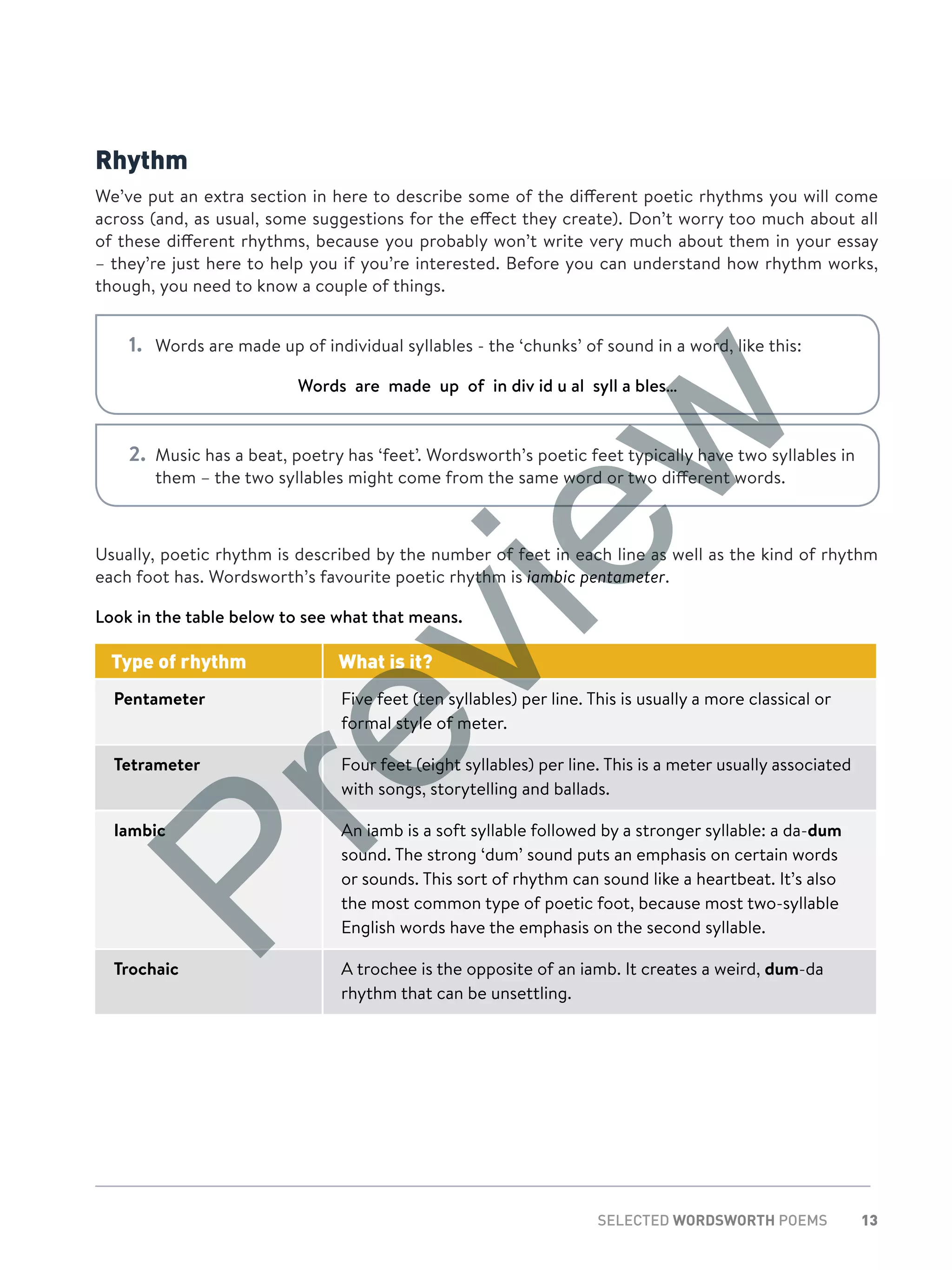
Rhythm
We’ve put an extra section in here to describe some of the different poetic rhythms you will come
across (and, as usual, some suggestions for the effect they create). Don’t worry too much about all
of these different rhythms, because you probably won’t write very much about them in your essay
– they’re just here to help you if you’re interested. Before you can understand how rhythm works,
though, you need to know a couple of things.
1.	 Words are made up of individual syllables - the ‘chunks’ of sound in a word, like this:
Words are made up of in div id u al syll a bles…
2.	 Music has a beat, poetry has ‘feet’. Wordsworth’s poetic feet typically have two syllables in
them – the two syllables might come from the same word or two different words.
Usually, poetic rhythm is described by the number of feet in each line as well as the kind of rhythm
each foot has. Wordsworth’s favourite poetic rhythm is iambic pentameter.
Look in the table below to see what that means.
Type of rhythm What is it?
Pentameter Five feet (ten syllables) per line. This is usually a more classical or
formal style of meter.
Tetrameter Four feet (eight syllables) per line. This is a meter usually associated
with songs, storytelling and ballads.
Iambic An iamb is a soft syllable followed by a stronger syllable: a da-dum
sound. The strong ‘dum’ sound puts an emphasis on certain words
or sounds. This sort of rhythm can sound like a heartbeat. It’s also
the most common type of poetic foot, because most two-syllable
English words have the emphasis on the second syllable.
Trochaic A trochee is the opposite of an iamb. It creates a weird, dum-da
rhythm that can be unsettling.
Preview
NOW IT'S YOUR TURN
14
NOW IT'S YOUR TURNESSAY QUESTIONS
“Tumult and peace, the darkness and the light.”
‘While Wordsworth celebrates the beauty of nature,
he also represents the darkness of death.’ Discuss.
How does Wordsworth illustrate the romantic beauty
of nature in his poetry?
‘Wordsworth shows that it is essential to reflect on our
existence in order to lead a meaningful life.’ Discuss.
‘Wordsworth’s poetry shows that it is more important to connect
with nature than lead a life dedicated to consuming.’ Discuss.
Discuss the role of solitude in Wordsworth’s poetry.
‘It is Wordsworth’s imagery that gives his poetry its power.’ Discuss.
“My heart leaps up when I behold / A rainbow in the sky.”
‘Wordsworth’s poetry expresses both joy and melancholy about the beauty of life.’
Discuss.
‘Wordsworth’s poems are filled with allusions to both the stunning power
and tranquillity of nature.’ Discuss.
“England hath need of thee: she is a fen.”
How is Wordsworth’s poetry a critique of society’s values?
‘Wordsworth’s poetry reveals both an awe of nature and a fear of its destructive
powers.’ Discuss.
‘It is only when we are alone in nature that we can truly understand ourselves.’
How do Wordsworth’s poems explore this idea?
Preview
15SELECTED WORDSWORTH POEMS
WE SHOULD
PRAISE
 EMBRACE
NATURE
Preview
1616
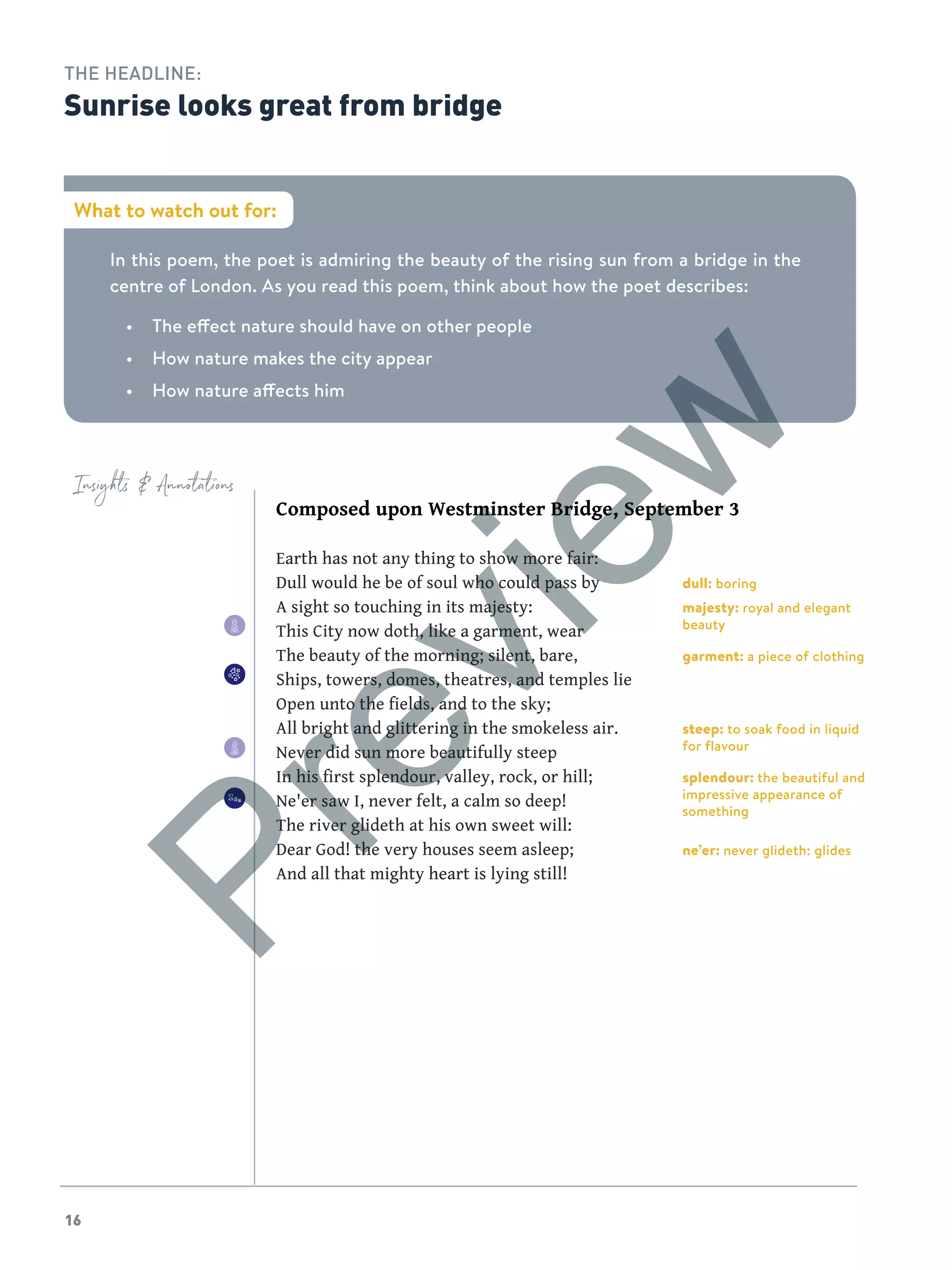
In this poem, the poet is admiring the beauty of the rising sun from a bridge in the
centre of London. As you read this poem, think about how the poet describes:
•	 The effect nature should have on other people
•	 How nature makes the city appear
•	 How nature affects him
What to watch out for:
THE HEADLINE:
Sunrise looks great from bridge
Insights  Annotations
Composed upon Westminster Bridge, September 3
Earth has not any thing to show more fair:
Dull would he be of soul who could pass by
A sight so touching in its majesty:
This City now doth, like a garment, wear
The beauty of the morning; silent, bare,
Ships, towers, domes, theatres, and temples lie
Open unto the fields, and to the sky;
All bright and glittering in the smokeless air.
Never did sun more beautifully steep
In his first splendour, valley, rock, or hill;
Ne'er saw I, never felt, a calm so deep!
The river glideth at his own sweet will:
Dear God! the very houses seem asleep;
And all that mighty heart is lying still!
dull: boring
majesty: royal and elegant
beauty
garment: a piece of clothing
steep: to soak food in liquid
for flavour
splendour: the beautiful and
impressive appearance of
something
ne’er: never glideth: glides
Preview
17SELECTED WORDSWORTH POEMS 17SELECTED WORDSWORTH POEMS
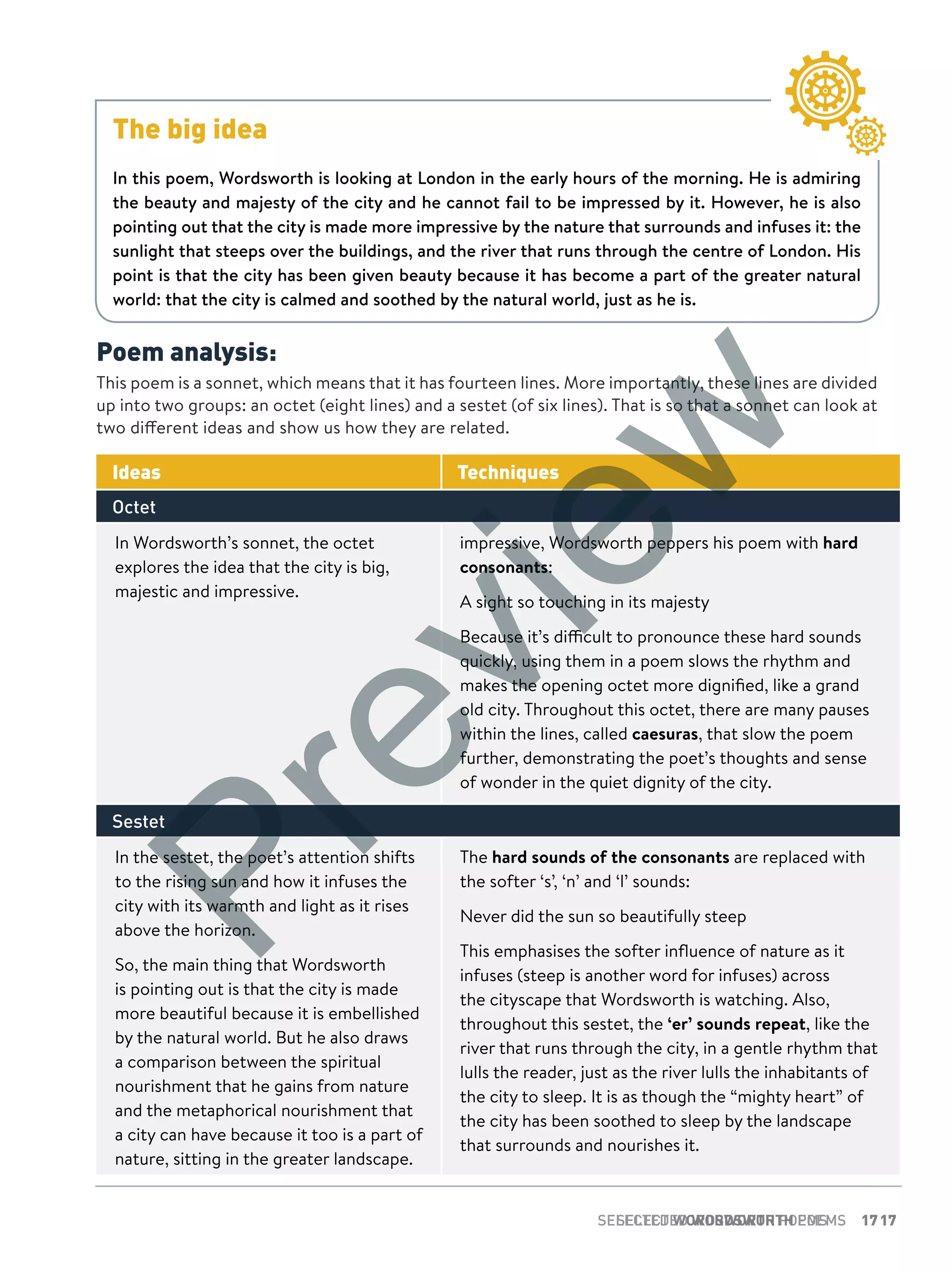
Poem analysis:
This poem is a sonnet, which means that it has fourteen lines. More importantly, these lines are divided
up into two groups: an octet (eight lines) and a sestet (of six lines). That is so that a sonnet can look at
two different ideas and show us how they are related.
Ideas Techniques
Octet
In Wordsworth’s sonnet, the octet
explores the idea that the city is big,
majestic and impressive.
impressive, Wordsworth peppers his poem with hard
consonants:
A sight so touching in its majesty
Because it’s difficult to pronounce these hard sounds
quickly, using them in a poem slows the rhythm and
makes the opening octet more dignified, like a grand
old city. Throughout this octet, there are many pauses
within the lines, called caesuras, that slow the poem
further, demonstrating the poet’s thoughts and sense
of wonder in the quiet dignity of the city.
Sestet
In the sestet, the poet’s attention shifts
to the rising sun and how it infuses the
city with its warmth and light as it rises
above the horizon.
So, the main thing that Wordsworth
is pointing out is that the city is made
more beautiful because it is embellished
by the natural world. But he also draws
a comparison between the spiritual
nourishment that he gains from nature
and the metaphorical nourishment that
a city can have because it too is a part of
nature, sitting in the greater landscape.
The hard sounds of the consonants are replaced with
the softer ‘s’, ‘n’ and ‘l’ sounds:
Never did the sun so beautifully steep
This emphasises the softer influence of nature as it
infuses (steep is another word for infuses) across
the cityscape that Wordsworth is watching. Also,
throughout this sestet, the ‘er’ sounds repeat, like the
river that runs through the city, in a gentle rhythm that
lulls the reader, just as the river lulls the inhabitants of
the city to sleep. It is as though the “mighty heart” of
the city has been soothed to sleep by the landscape
that surrounds and nourishes it.
The big idea
In this poem, Wordsworth is looking at London in the early hours of the morning. He is admiring
the beauty and majesty of the city and he cannot fail to be impressed by it. However, he is also
pointing out that the city is made more impressive by the nature that surrounds and infuses it: the
sunlight that steeps over the buildings, and the river that runs through the centre of London. His
point is that the city has been given beauty because it has become a part of the greater natural
world: that the city is calmed and soothed by the natural world, just as he is.
Preview
18
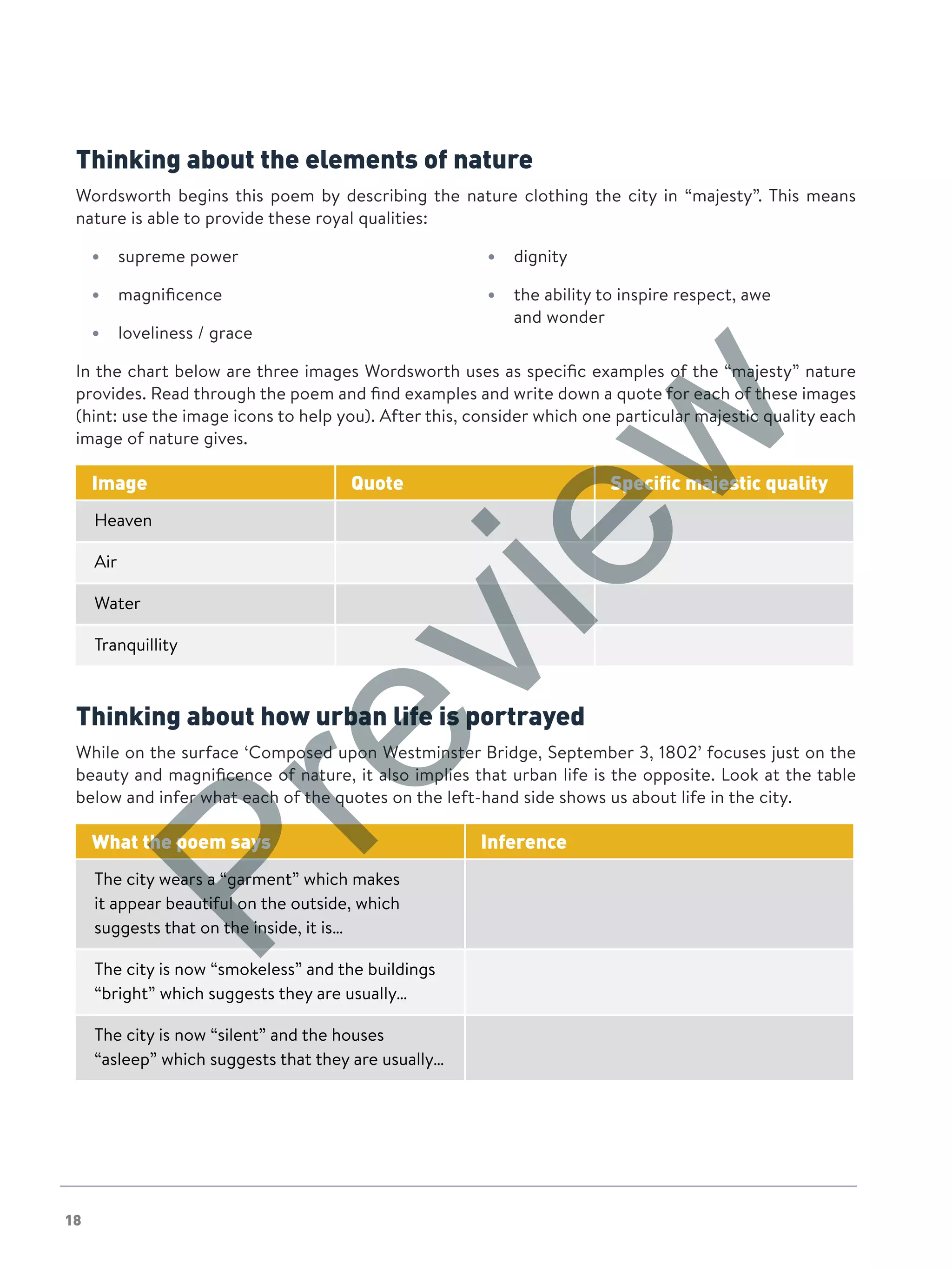
Thinking about the elements of nature
Wordsworth begins this poem by describing the nature clothing the city in “majesty”. This means
nature is able to provide these royal qualities:
•	 supreme power
•	 magnificence
•	 loveliness / grace
•	 dignity
•	 the ability to inspire respect, awe
and wonder
In the chart below are three images Wordsworth uses as specific examples of the “majesty” nature
provides. Read through the poem and find examples and write down a quote for each of these images
(hint: use the image icons to help you). After this, consider which one particular majestic quality each
image of nature gives.
Image Quote Specific majestic quality
Heaven
Air
Water
Tranquillity
Thinking about how urban life is portrayed
While on the surface ‘Composed upon Westminster Bridge, September 3, 1802’ focuses just on the
beauty and magnificence of nature, it also implies that urban life is the opposite. Look at the table
below and infer what each of the quotes on the left-hand side shows us about life in the city.
What the poem says Inference
The city wears a “garment” which makes
it appear beautiful on the outside, which
suggests that on the inside, it is…
The city is now “smokeless” and the buildings
“bright” which suggests they are usually…
The city is now “silent” and the houses
“asleep” which suggests that they are usually…
Preview
19SELECTED WORDSWORTH POEMS
Writing activity
Since this is this first poem you’ve studied, let’s try just practising some basic analytic writing proce-
dures. Below are words and phrases you can use to analyse the poem at three levels: the whole of the
poem, parts of the poem and individual techniques. The model sentences at the start of each section
will give you an example of how to analyse the poem. Pay attention to how the examples use quotes.
When constructing your sentences, look back through the poem and consider what word or phrase
you might quote in your sentence to aid your analysis.
Writing about the poem as a whole:
In ‘Composed upon Westminster Bridge, September 3, 1802’, Wordsworth lauds the “majesty” of
nature.
In ‘Composed upon Westminster Bridge,
September 3, 1802’, Wordsworth…
celebrates the…of nature…
celebrates nature as…
praises the power of nature as…
describes how nature can…
contrasts the…of nature to…of urban life.
Writing about the ideas:
In the octet of the poem, the poet focuses on how nature touches the “soul” because of its “fair”
beauty.
In the octet of the poem, the poet…
…highlights
…emphasises
…focuses on
…reflects on
the way nature can…
that nature is…
the capacity for nature to…
Throughout the poem, the poet…
At the turning point of the poem, the poet…
develops a picture of nature as…
praises individual elements of nature such as…
and…
highlights how nature can…and suggests that,
by contrast, urban life is…
In his sestet, the poet…
The poet closes the poem…
by emphasising…
with the conclusion that…
and emphasises that idea that…
Preview
20
Writing about the images
When the poet describes the river as gliding “at his own sweet will”, he uses the image of freely moving
water to create the sense that nature is a place of liberty.
The poet uses the image of…
When the poet describes…as…, he uses
the image of…
to…
to create the sense that…
to invoke a picture of…
to emphasise a feeling that…
to build an association with…
Through the image of…embedded in the
words…, the poet…
By using the imagery of…to describe…as,
the poet
invokes a sense of…
create a sense of…
builds a picture of…
Preview
21SELECTED WORDSWORTH POEMS
Notes:
Preview
22
Insights  Annotations
behold: see
bound: to be tied to
something
piety: a strong religious
belief about the right way to
behave
My heart leaps up when I behold
A rainbow in the sky:
So was it when my life began;
So is it now I am a man;
So be it when I shall grow old,
Or let me die!
The Child is the father of the Man;
And I could wish my days to be
Bound each to each by natural piety.
What to watch out for:
In this poem, Wordsworth sets out his belief that as we grow old, we should maintain a
childish, innocent joy in nature and life. Now, you’ve already read one other Wordsworth
poem, so as you read this one consider:
•	 How the idea of nature as being innocent connects to nature in ‘Composed upon
Westminster Bridge, September 3, 1802’
•	 How the use of sky imagery also connects to that poem
THE HEADLINE:
Man really likes rainbows
Preview
23SELECTED WORDSWORTH POEMS
Poem analysis:
Ideas Techniques
The first six lines are almost a series of
couplets, of a thought that is begun in one line
and finished in the next. However, these are
not traditional couplets that rhyme, but are
a new kind of spontaneous couplet that is as
unexpected as the nature that inspired it. The
initial couplet establishes this pattern – the
poet explains that he is filled with joy on one
line and then on the following line explains the
source of his joy.
The first couplet does not rhyme, one line is
longer than the other, so the rhythm does not
match and the reader is taken by surprise, just
as the poet was surprised by the sight of the
rainbow.
The second couplet is far more traditional, the
rhyme and the rhythm match and the reader
is lulled back into a sense of the familiar, but
straight away Wordsworth confounds us with
his third couplet: another unrhymed pair with
an irregular rhythm. The point the poet is
making is that nature is constantly new and
constantly surprising, and it is this sense of
novelty that is so delightful.
The final three lines, the last third of the
poem, read as an extended thought, a proverb
that Wordsworth is trying to create. What
Wordsworth the man wants from his inner
child is that naive sense of devotion and
worship of nature: as a child he worshipped
nature, so nature is like a religion to him.
He even begins this tercet (group of three
lines) with words that sound like a proverb:
“The Child is the father of the Man”, using
words that are both simple and familiar, but
giving them a new meaning – twisting what we
would expect. Readers are familiar with the
idea of a man being a father, but here it is the
child who is the father.
The big idea
Nature regularly surprises and delights us with new things to see: like rainbows. Wordsworth is
so inspired by these unexpected gifts that he is filled with a childish joyfulness that bursts out of
him in a rush and finds expression in his poetry.
Preview
24
NOW IT'S YOUR TURNNOW IT'S YOUR TURN
Thinking activity
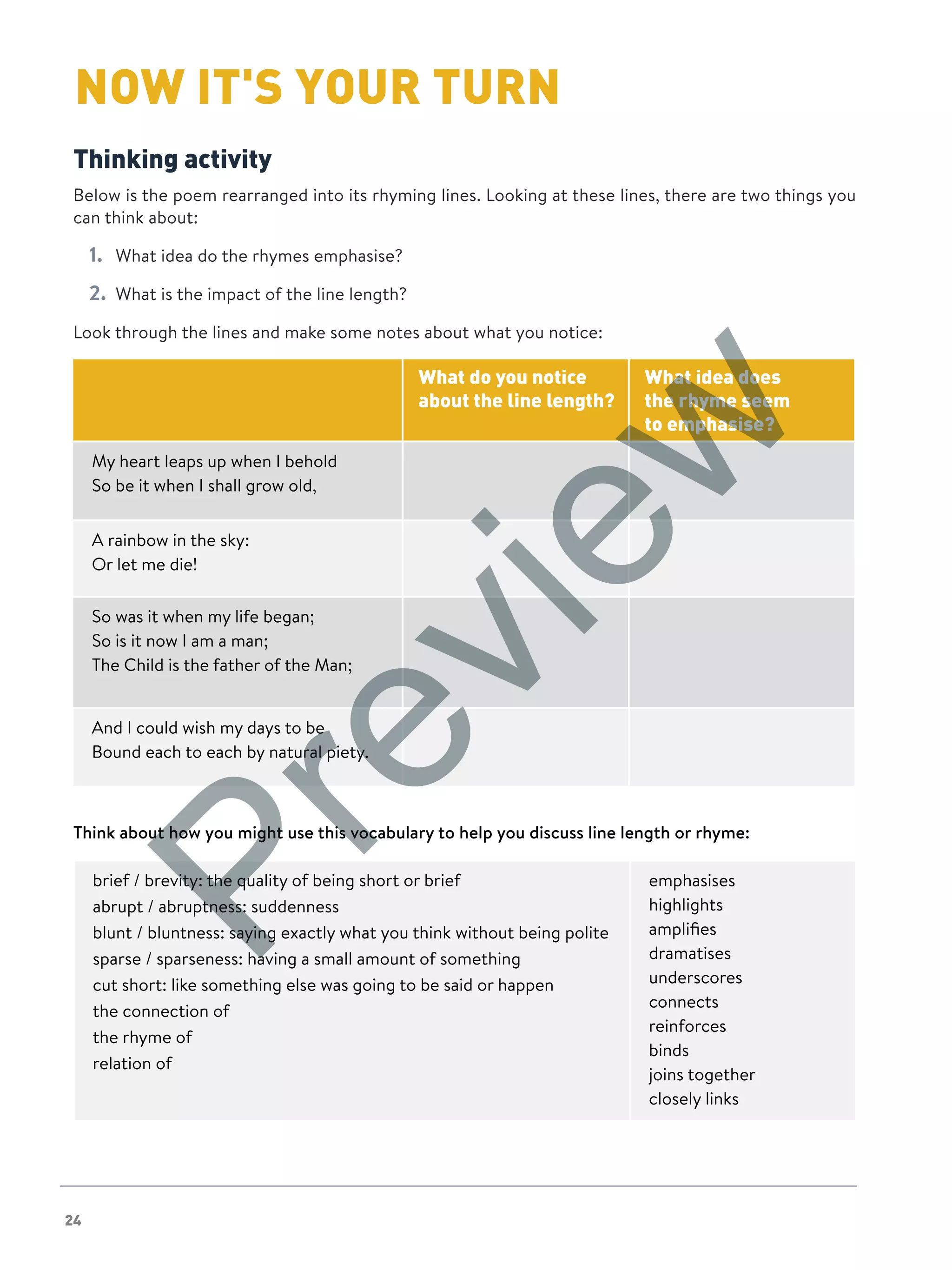
Below is the poem rearranged into its rhyming lines. Looking at these lines, there are two things you
can think about:
1.	 What idea do the rhymes emphasise?
2.	 What is the impact of the line length?
Look through the lines and make some notes about what you notice:
What do you notice
about the line length?
What idea does
the rhyme seem
to emphasise?
My heart leaps up when I behold
So be it when I shall grow old,
A rainbow in the sky:
Or let me die!
So was it when my life began;
So is it now I am a man;
The Child is the father of the Man;
And I could wish my days to be
Bound each to each by natural piety.
Think about how you might use this vocabulary to help you discuss line length or rhyme:
brief / brevity: the quality of being short or brief
abrupt / abruptness: suddenness
blunt / bluntness: saying exactly what you think without being polite
sparse / sparseness: having a small amount of something
cut short: like something else was going to be said or happen
the connection of
the rhyme of
relation of
emphasises
highlights
amplifies
dramatises
underscores
connects
reinforces
binds
joins together
closely links
Preview
25SELECTED WORDSWORTH POEMS
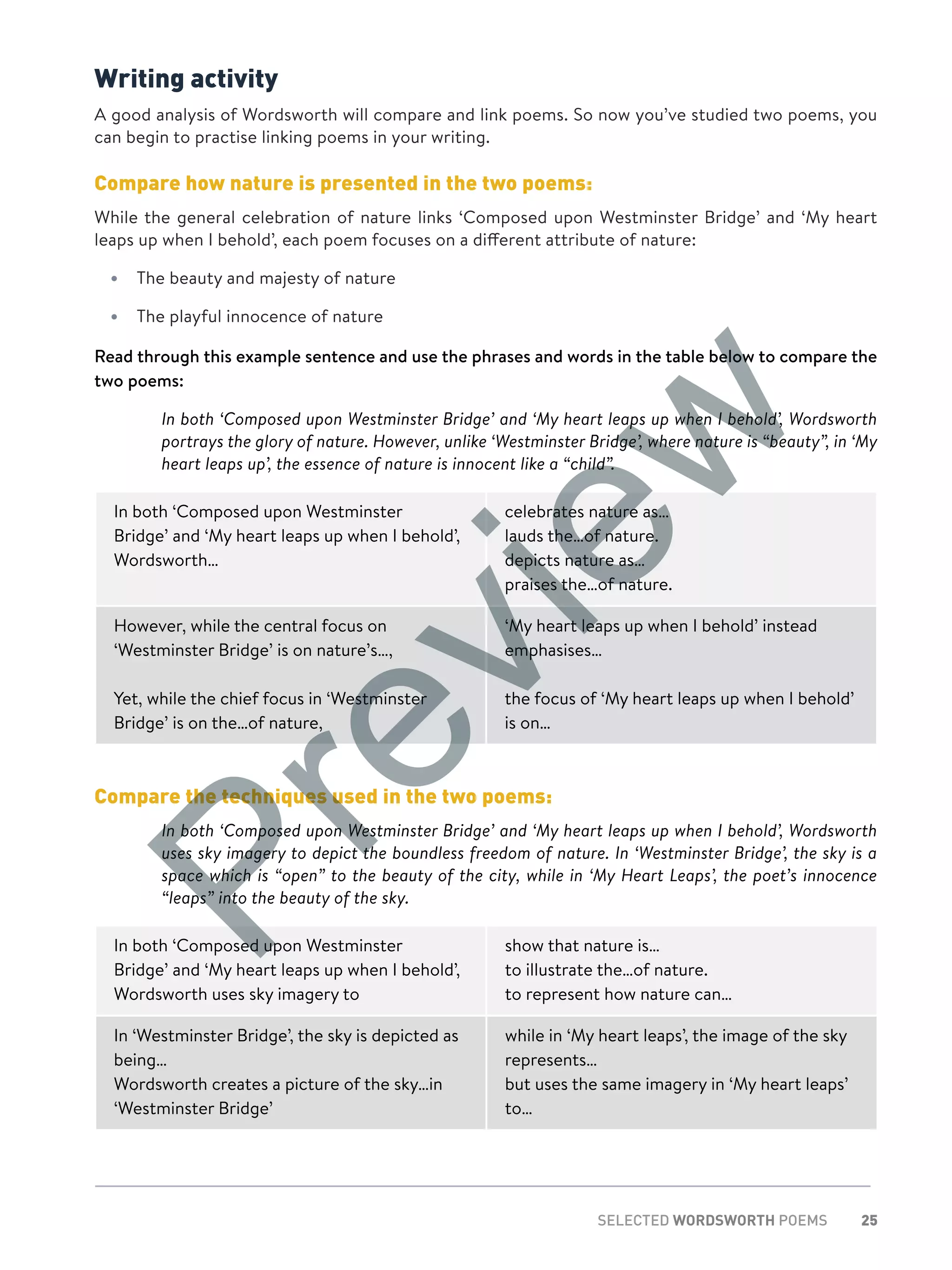
Writing activity
A good analysis of Wordsworth will compare and link poems. So now you’ve studied two poems, you
can begin to practise linking poems in your writing.
Compare how nature is presented in the two poems:
While the general celebration of nature links ‘Composed upon Westminster Bridge’ and ‘My heart
leaps up when I behold’, each poem focuses on a different attribute of nature:
•	 The beauty and majesty of nature
•	 The playful innocence of nature
Read through this example sentence and use the phrases and words in the table below to compare the
two poems:
	In both ‘Composed upon Westminster Bridge’ and ‘My heart leaps up when I behold’, Wordsworth
portrays the glory of nature. However, unlike ‘Westminster Bridge’, where nature is “beauty”, in ‘My
heart leaps up’, the essence of nature is innocent like a “child”.
In both ‘Composed upon Westminster
Bridge’ and ‘My heart leaps up when I behold’,
Wordsworth…
celebrates nature as…
lauds the…of nature.
depicts nature as…
praises the…of nature.
However, while the central focus on
‘Westminster Bridge’ is on nature’s…,
Yet, while the chief focus in ‘Westminster
Bridge’ is on the…of nature,
‘My heart leaps up when I behold’ instead
emphasises…
the focus of ‘My heart leaps up when I behold’
is on…
Compare the techniques used in the two poems:
	In both ‘Composed upon Westminster Bridge’ and ‘My heart leaps up when I behold’, Wordsworth
uses sky imagery to depict the boundless freedom of nature. In ‘Westminster Bridge’, the sky is a
space which is “open” to the beauty of the city, while in ‘My Heart Leaps’, the poet’s innocence
“leaps” into the beauty of the sky.
In both ‘Composed upon Westminster
Bridge’ and ‘My heart leaps up when I behold’,
Wordsworth uses sky imagery to
show that nature is…
to illustrate the…of nature.
to represent how nature can…
In ‘Westminster Bridge’, the sky is depicted as
being…
Wordsworth creates a picture of the sky…in
‘Westminster Bridge’
while in ‘My heart leaps’, the image of the sky
represents…
but uses the same imagery in ‘My heart leaps’
to…
Preview
26
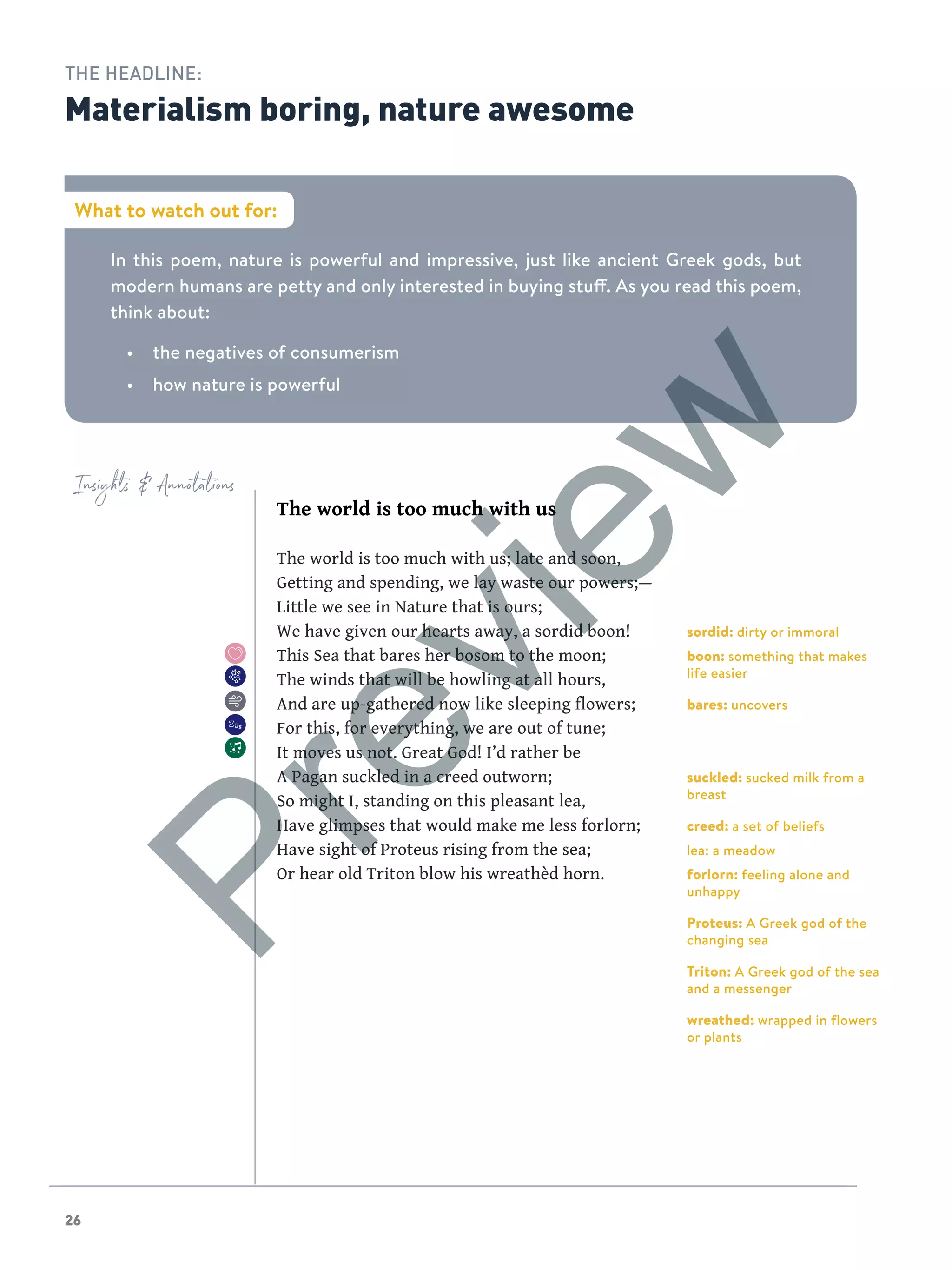
Insights  Annotations
In this poem, nature is powerful and impressive, just like ancient Greek gods, but
modern humans are petty and only interested in buying stuff. As you read this poem,
think about:
•	 the negatives of consumerism
•	 how nature is powerful
The world is too much with us
The world is too much with us; late and soon,
Getting and spending, we lay waste our powers;—
Little we see in Nature that is ours;
We have given our hearts away, a sordid boon!
This Sea that bares her bosom to the moon;
The winds that will be howling at all hours,
And are up-gathered now like sleeping flowers;
For this, for everything, we are out of tune;
It moves us not. Great God! I’d rather be
A Pagan suckled in a creed outworn;
So might I, standing on this pleasant lea,
Have glimpses that would make me less forlorn;
Have sight of Proteus rising from the sea;
Or hear old Triton blow his wreathèd horn.
sordid: dirty or immoral
boon: something that makes
life easier
bares: uncovers
suckled: sucked milk from a
breast
creed: a set of beliefs
lea: a meadow
forlorn: feeling alone and
unhappy
Proteus: A Greek god of the
changing sea
Triton: A Greek god of the sea
and a messenger
wreathed: wrapped in flowers
or plants
What to watch out for:
THE HEADLINE:
Materialism boring, nature awesome
Preview
27SELECTED WORDSWORTH POEMS
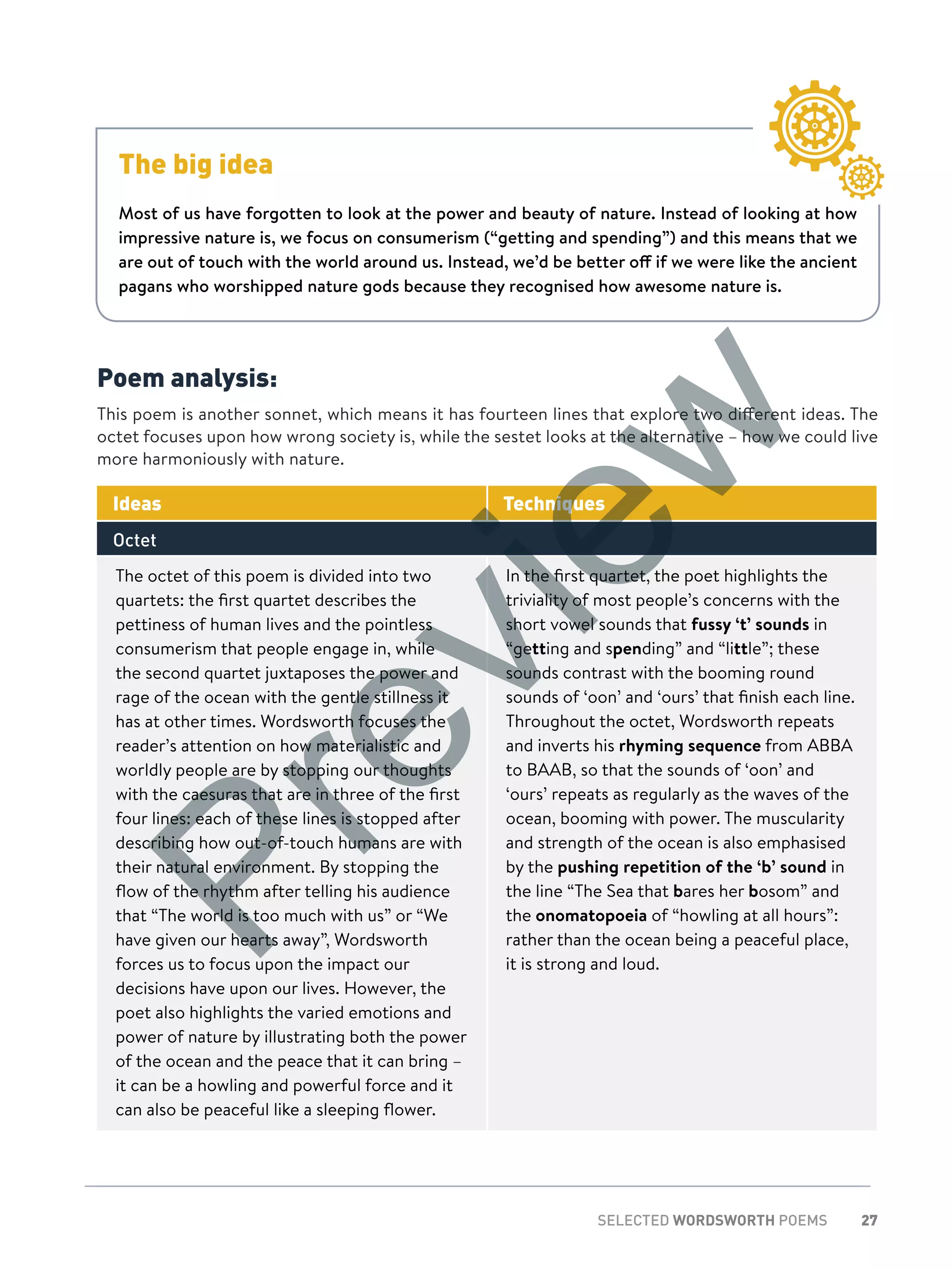
Poem analysis:
This poem is another sonnet, which means it has fourteen lines that explore two different ideas. The
octet focuses upon how wrong society is, while the sestet looks at the alternative – how we could live
more harmoniously with nature.
Ideas Techniques
Octet
The octet of this poem is divided into two
quartets: the first quartet describes the
pettiness of human lives and the pointless
consumerism that people engage in, while
the second quartet juxtaposes the power and
rage of the ocean with the gentle stillness it
has at other times. Wordsworth focuses the
reader’s attention on how materialistic and
worldly people are by stopping our thoughts
with the caesuras that are in three of the first
four lines: each of these lines is stopped after
describing how out-of-touch humans are with
their natural environment. By stopping the
flow of the rhythm after telling his audience
that “The world is too much with us” or “We
have given our hearts away”, Wordsworth
forces us to focus upon the impact our
decisions have upon our lives. However, the
poet also highlights the varied emotions and
power of nature by illustrating both the power
of the ocean and the peace that it can bring –
it can be a howling and powerful force and it
can also be peaceful like a sleeping flower.
In the first quartet, the poet highlights the
triviality of most people’s concerns with the
short vowel sounds that fussy ‘t’ sounds in
“getting and spending” and “little”; these
sounds contrast with the booming round
sounds of ‘oon’ and ‘ours’ that finish each line.
Throughout the octet, Wordsworth repeats
and inverts his rhyming sequence from ABBA
to BAAB, so that the sounds of ‘oon’ and
‘ours’ repeats as regularly as the waves of the
ocean, booming with power. The muscularity
and strength of the ocean is also emphasised
by the pushing repetition of the ‘b’ sound in
the line “The Sea that bares her bosom” and
the onomatopoeia of “howling at all hours”:
rather than the ocean being a peaceful place,
it is strong and loud.
The big idea
Most of us have forgotten to look at the power and beauty of nature. Instead of looking at how
impressive nature is, we focus on consumerism (“getting and spending”) and this means that we
are out of touch with the world around us. Instead, we’d be better off if we were like the ancient
pagans who worshipped nature gods because they recognised how awesome nature is.
Preview
28
NOW IT'S YOUR TURN
Ideas Techniques
Sestet
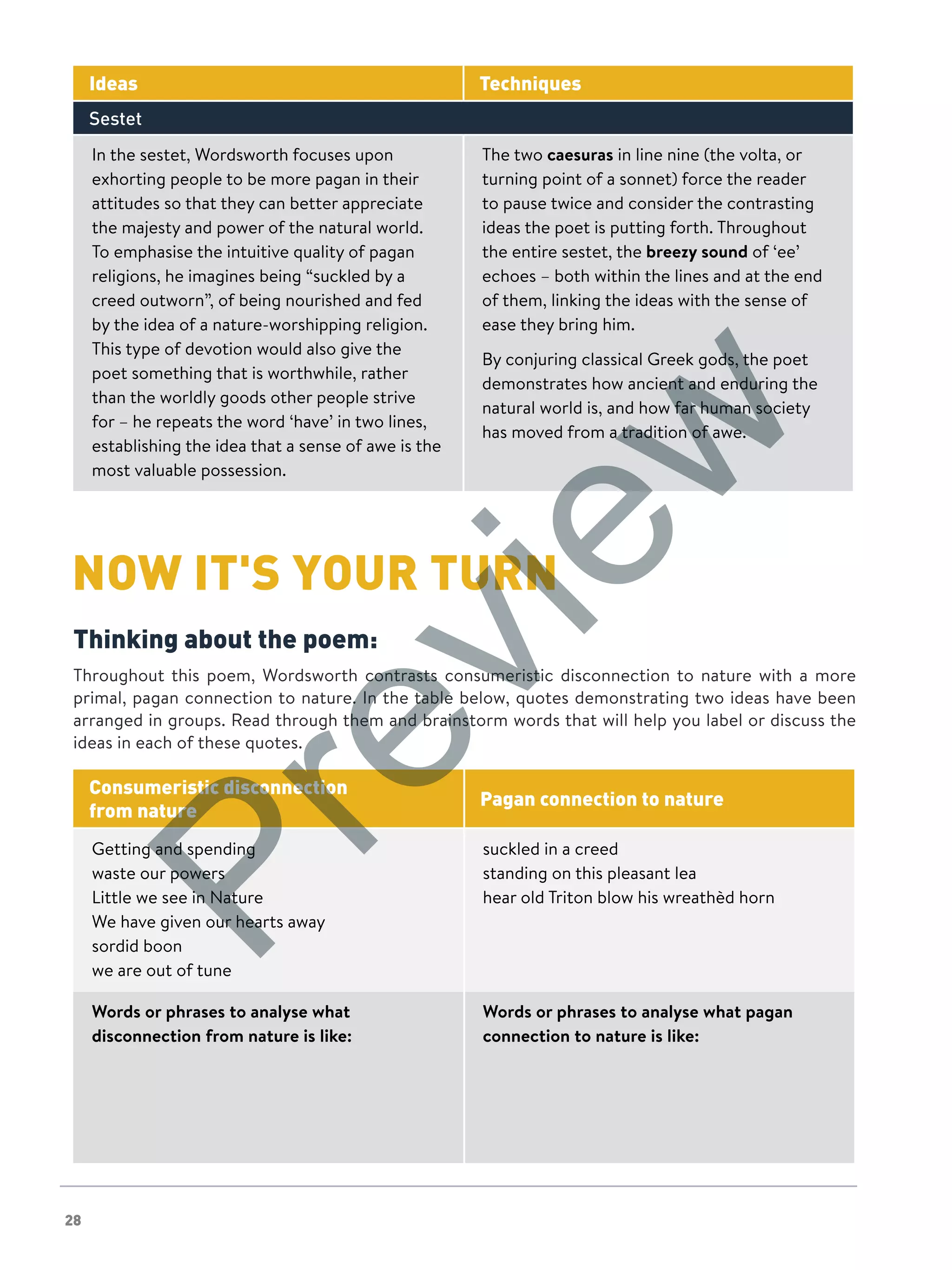
In the sestet, Wordsworth focuses upon
exhorting people to be more pagan in their
attitudes so that they can better appreciate
the majesty and power of the natural world.
To emphasise the intuitive quality of pagan
religions, he imagines being “suckled by a
creed outworn”, of being nourished and fed
by the idea of a nature-worshipping religion.
This type of devotion would also give the
poet something that is worthwhile, rather
than the worldly goods other people strive
for – he repeats the word ‘have’ in two lines,
establishing the idea that a sense of awe is the
most valuable possession.
The two caesuras in line nine (the volta, or
turning point of a sonnet) force the reader
to pause twice and consider the contrasting
ideas the poet is putting forth. Throughout
the entire sestet, the breezy sound of ‘ee’
echoes – both within the lines and at the end
of them, linking the ideas with the sense of
ease they bring him.
By conjuring classical Greek gods, the poet
demonstrates how ancient and enduring the
natural world is, and how far human society
has moved from a tradition of awe.
Thinking about the poem:
Throughout this poem, Wordsworth contrasts consumeristic disconnection to nature with a more
primal, pagan connection to nature. In the table below, quotes demonstrating two ideas have been
arranged in groups. Read through them and brainstorm words that will help you label or discuss the
ideas in each of these quotes.
Consumeristic disconnection
from nature
Pagan connection to nature
Getting and spending
waste our powers
Little we see in Nature
We have given our hearts away
sordid boon
we are out of tune
suckled in a creed
standing on this pleasant lea
hear old Triton blow his wreathèd horn
Words or phrases to analyse what
disconnection from nature is like:
Words or phrases to analyse what pagan
connection to nature is like:
Preview
29SELECTED WORDSWORTH POEMS
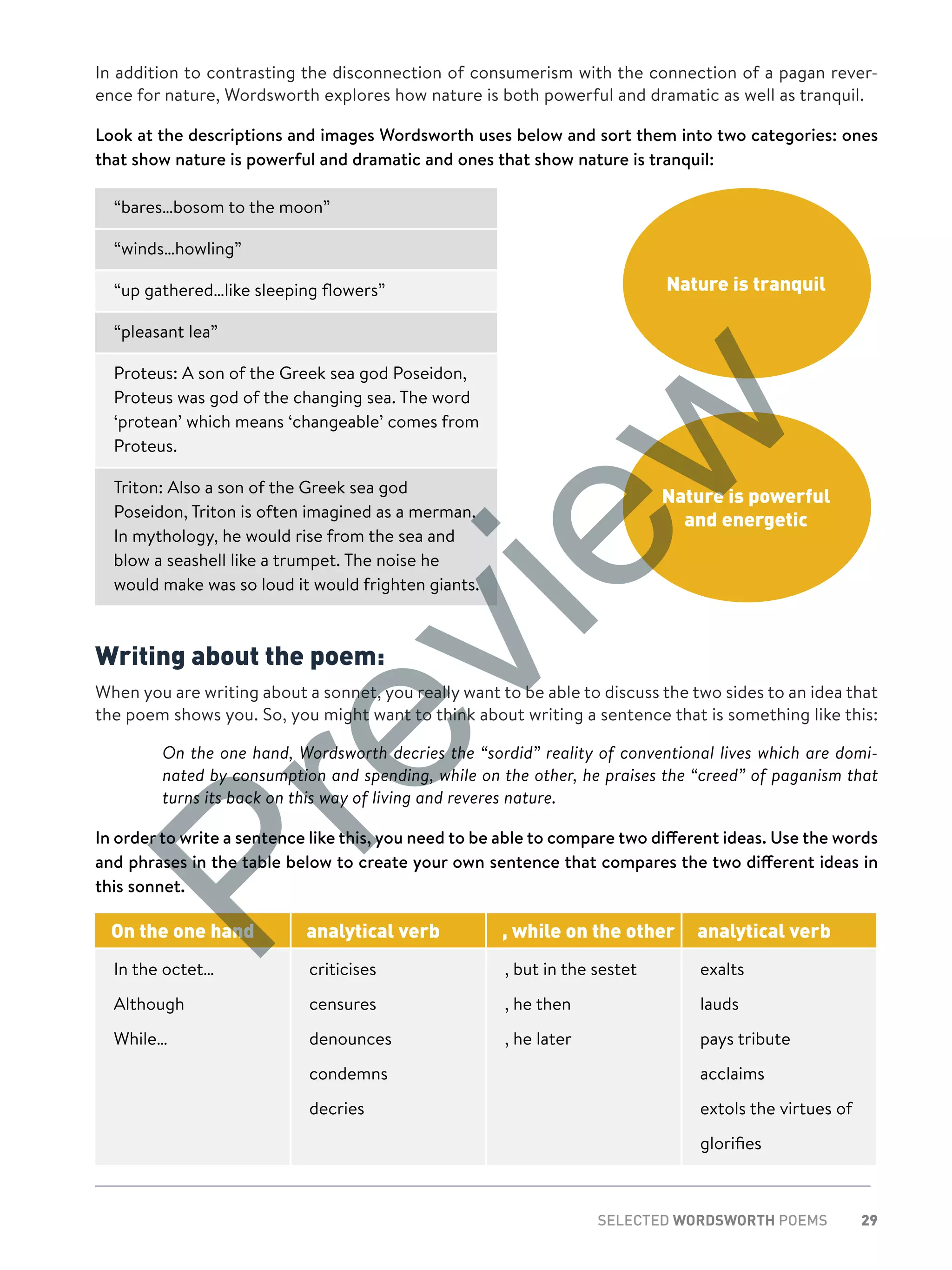
In addition to contrasting the disconnection of consumerism with the connection of a pagan rever-
ence for nature, Wordsworth explores how nature is both powerful and dramatic as well as tranquil.
Look at the descriptions and images Wordsworth uses below and sort them into two categories: ones
that show nature is powerful and dramatic and ones that show nature is tranquil:
“bares…bosom to the moon”
“winds…howling”
“up gathered…like sleeping flowers”
“pleasant lea”
Proteus: A son of the Greek sea god Poseidon,
Proteus was god of the changing sea. The word
‘protean’ which means ‘changeable’ comes from
Proteus.
Triton: Also a son of the Greek sea god
Poseidon, Triton is often imagined as a merman.
In mythology, he would rise from the sea and
blow a seashell like a trumpet. The noise he
would make was so loud it would frighten giants.
Writing about the poem:
When you are writing about a sonnet, you really want to be able to discuss the two sides to an idea that
the poem shows you. So, you might want to think about writing a sentence that is something like this:
	On the one hand, Wordsworth decries the “sordid” reality of conventional lives which are domi-
nated by consumption and spending, while on the other, he praises the “creed” of paganism that
turns its back on this way of living and reveres nature.
In order to write a sentence like this, you need to be able to compare two different ideas. Use the words
and phrases in the table below to create your own sentence that compares the two different ideas in
this sonnet.
On the one hand analytical verb , while on the other analytical verb
In the octet…
Although
While…
criticises
censures
denounces
condemns
decries
, but in the sestet
, he then
, he later
exalts
lauds
pays tribute
acclaims
extols the virtues of
glorifies
Nature is tranquil
Nature is powerful
and energetic
Preview
30
Insights  Annotations
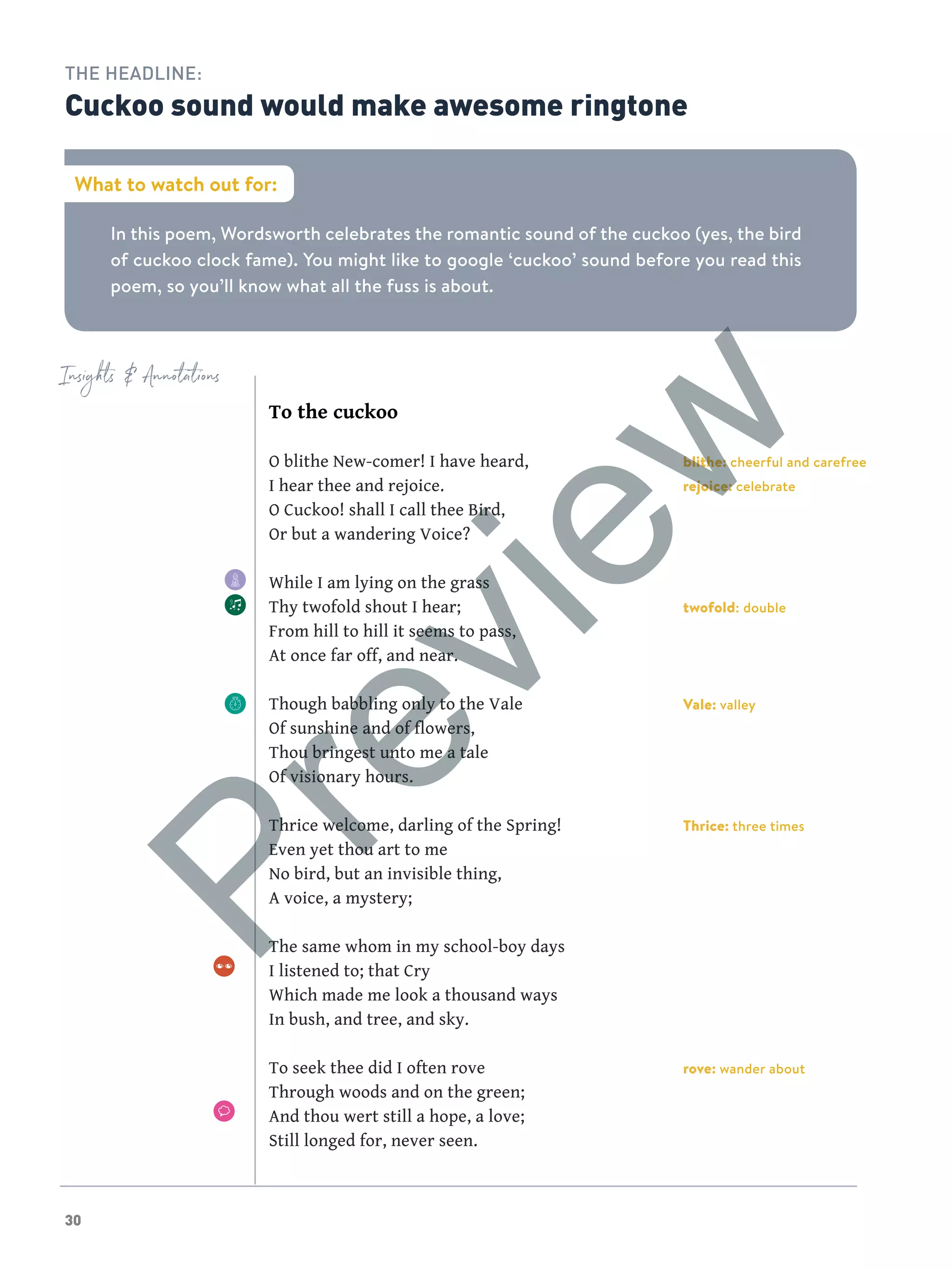
In this poem, Wordsworth celebrates the romantic sound of the cuckoo (yes, the bird
of cuckoo clock fame). You might like to google ‘cuckoo’ sound before you read this
poem, so you’ll know what all the fuss is about.
What to watch out for:
THE HEADLINE:
Cuckoo sound would make awesome ringtone
blithe: cheerful and carefree
rejoice: celebrate
twofold: double
Vale: valley
Thrice: three times
rove: wander about
To the cuckoo
O blithe New-comer! I have heard,
I hear thee and rejoice.
O Cuckoo! shall I call thee Bird,
Or but a wandering Voice?
While I am lying on the grass
Thy twofold shout I hear;
From hill to hill it seems to pass,
At once far off, and near.
Though babbling only to the Vale
Of sunshine and of flowers,
Thou bringest unto me a tale
Of visionary hours.
Thrice welcome, darling of the Spring!
Even yet thou art to me
No bird, but an invisible thing,
A voice, a mystery;
The same whom in my school-boy days
I listened to; that Cry
Which made me look a thousand ways
In bush, and tree, and sky.
To seek thee did I often rove
Through woods and on the green;
And thou wert still a hope, a love;
Still longed for, never seen.
Preview
31SELECTED WORDSWORTH POEMS
Insights  Annotations
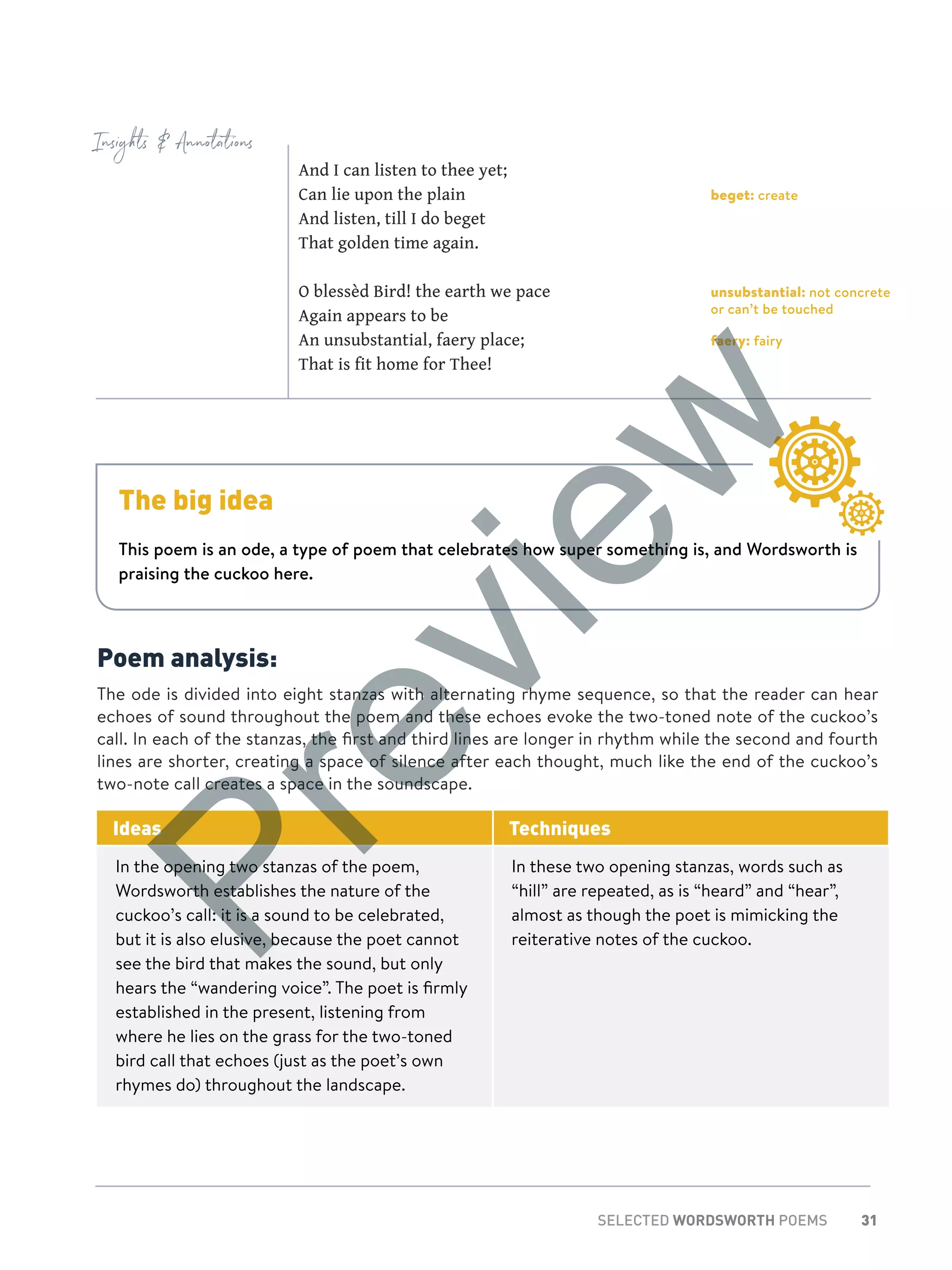
beget: create
unsubstantial: not concrete
or can’t be touched
faery: fairy
The big idea
This poem is an ode, a type of poem that celebrates how super something is, and Wordsworth is
praising the cuckoo here.
And I can listen to thee yet;
Can lie upon the plain
And listen, till I do beget
That golden time again.
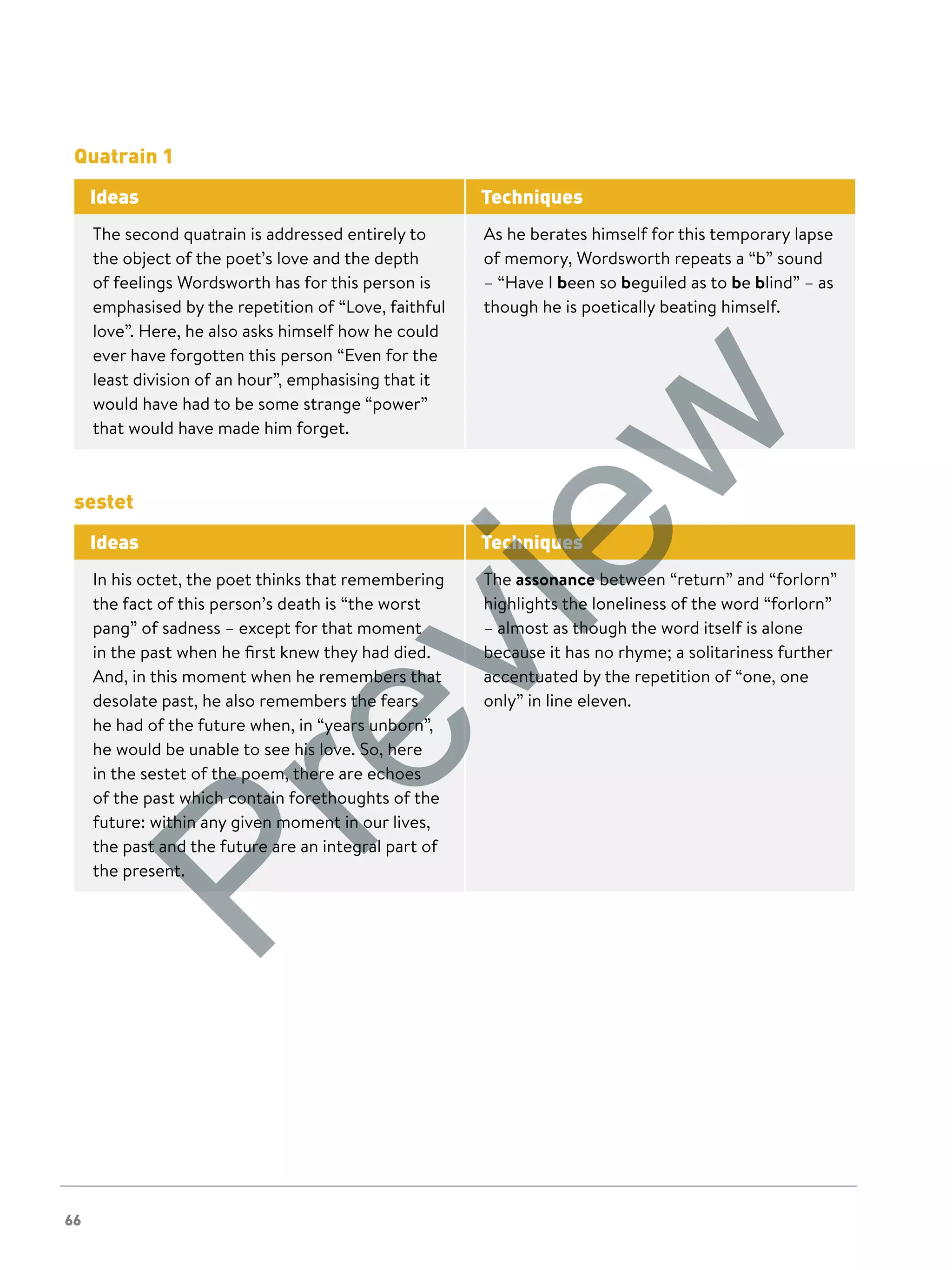
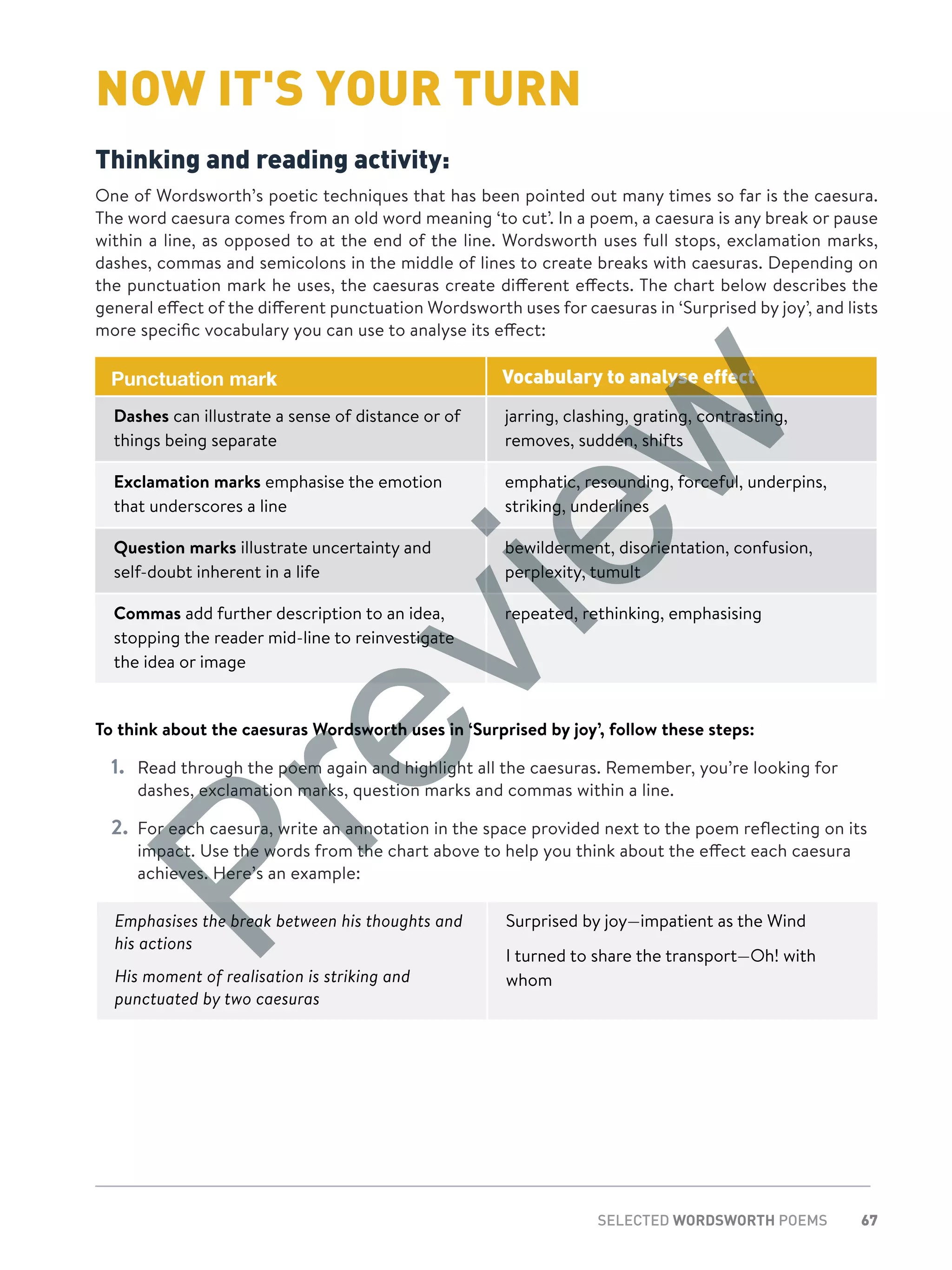
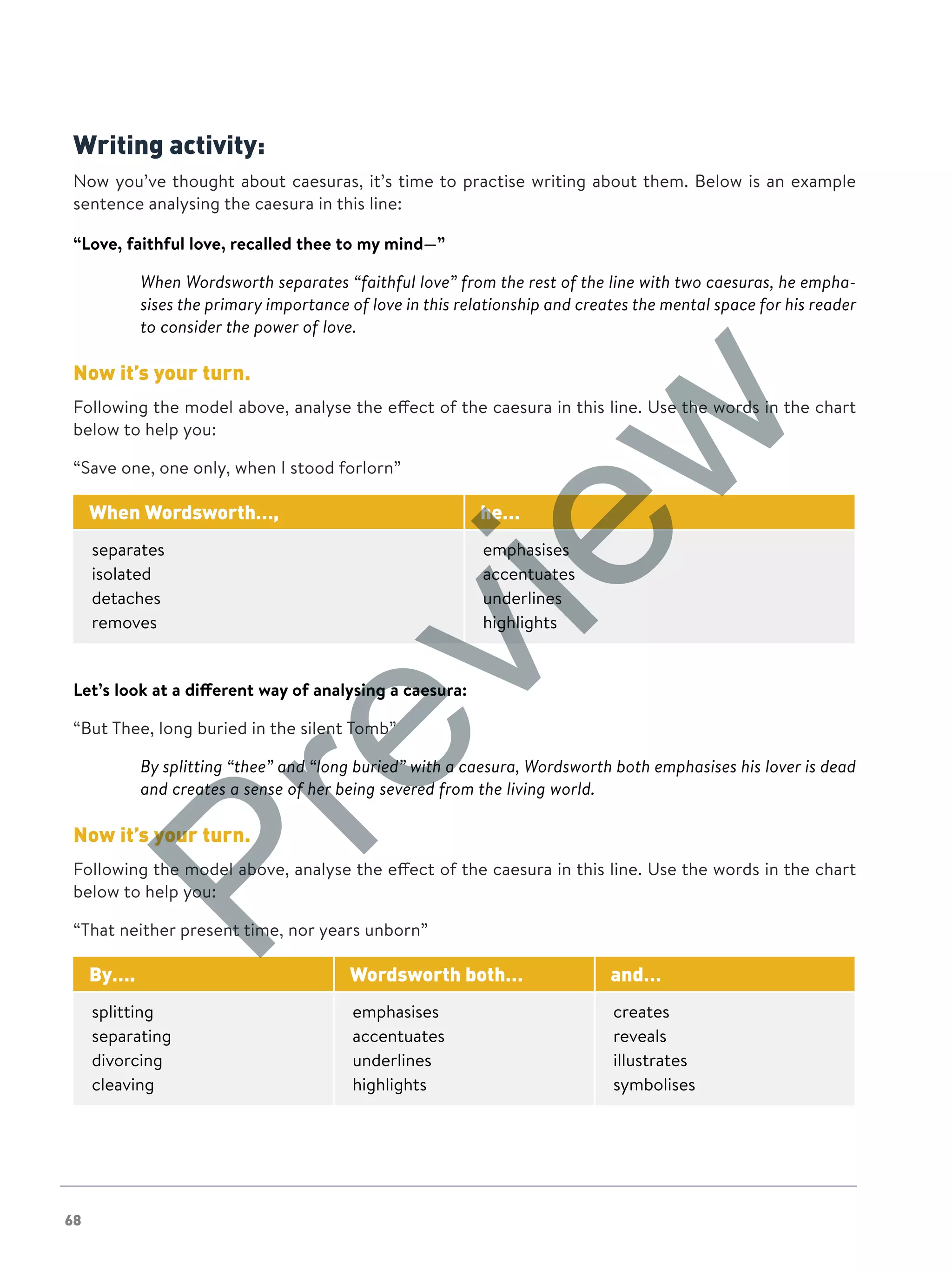
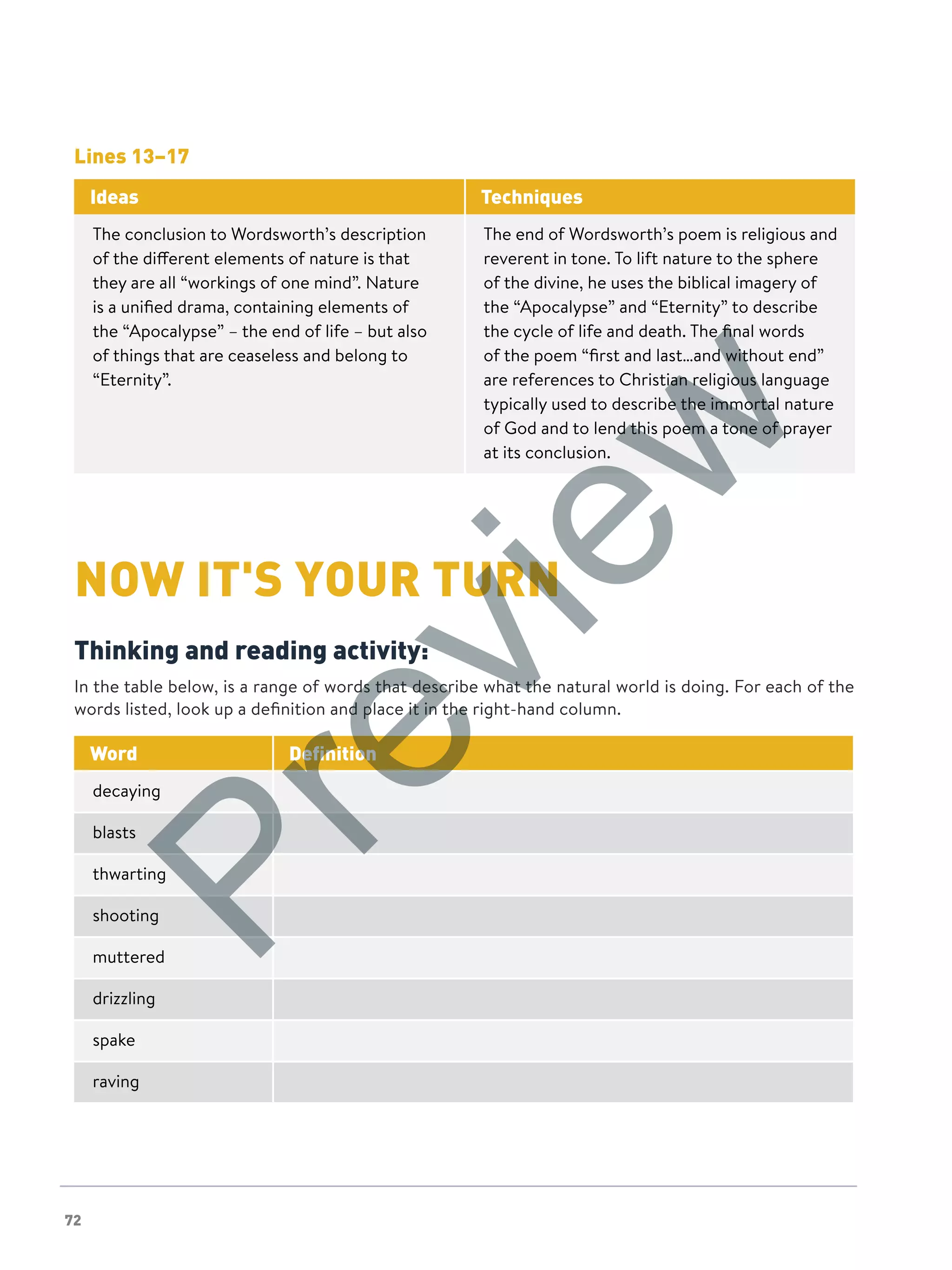
O blessèd Bird! the earth we pace
Again appears to be
An unsubstantial, faery place;
That is fit home for Thee!
Poem analysis:
The ode is divided into eight stanzas with alternating rhyme sequence, so that the reader can hear
echoes of sound throughout the poem and these echoes evoke the two-toned note of the cuckoo’s
call. In each of the stanzas, the first and third lines are longer in rhythm while the second and fourth
lines are shorter, creating a space of silence after each thought, much like the end of the cuckoo’s
two-note call creates a space in the soundscape.
Ideas Techniques
In the opening two stanzas of the poem,
Wordsworth establishes the nature of the
cuckoo’s call: it is a sound to be celebrated,
but it is also elusive, because the poet cannot
see the bird that makes the sound, but only
hears the “wandering voice”. The poet is firmly
established in the present, listening from
where he lies on the grass for the two-toned
bird call that echoes (just as the poet’s own
rhymes do) throughout the landscape.
In these two opening stanzas, words such as
“hill” are repeated, as is “heard” and “hear”,
almost as though the poet is mimicking the
reiterative notes of the cuckoo.
Preview
32
Ideas Techniques
The poet delves further into his imagination
in the third and fourth stanzas, connecting
the sound of the cuckoo with the sound of
time; just as the wooden cuckoo can keep time
within a cuckoo clock, this real bird can bring
the sense of “visionary hours” to Wordsworth.
The poet also imagines that the bird is singing
romantically of “sunshine and flowers”,
creating a sense of shared joy in beauty
between the two of them.
In the fourth stanza, the connection to time
is strengthened as the poet refers to “thrice”,
which follows his reference to “twofold” from
earlier in the poem – it is as though this real
cuckoo is marking time, just as the wooden
birds in a clock do. And so here the bird is
representative of the elusive nature of time,
“an invisible thing” that marks our lives. Time
is also made more concrete because the poet
points out that the cuckoo is a herald of spring
and so, in its own way, does actually mark time
– it’s just that the real cuckoo calls out the
passing of seasons, not hours.
In the fifth and sixth stanzas, the poet moves
backwards through memories to when he
was a “schoolboy” and here he conjures the
searching and yearning that are so much a part
of childhood. In these stanzas, the boy poet
“look[s] a thousand ways” and “longed for”
things he cannot see.
He emphasises this stilted searching in the
final line of the fifth stanza, with its two
caesuras that highlight the multiple directions
of his childish gaze. It is as though the cuckoo
represents all of his youthful hopes and dreams
and all of the discoveries of adulthood that lie
ahead of him.
In closing his poem, Wordsworth refers to the
future, to the pleasure that will come to him
when he listens to the cuckoo again. And here
in this future are evocations of the past: “that
golden time”, since the future is made even
more pleasurable with references to the past.
However, the future is unknowable,
“unsubstantial, faery”, just as the cuckoo’s
voice is. Because the cuckoo can represent the
past, the present, the spring, the future and
time itself, it is an object of wonder and awe
for Wordsworth and he articulates all of these
feelings in this ode.
Preview
33SELECTED WORDSWORTH POEMS
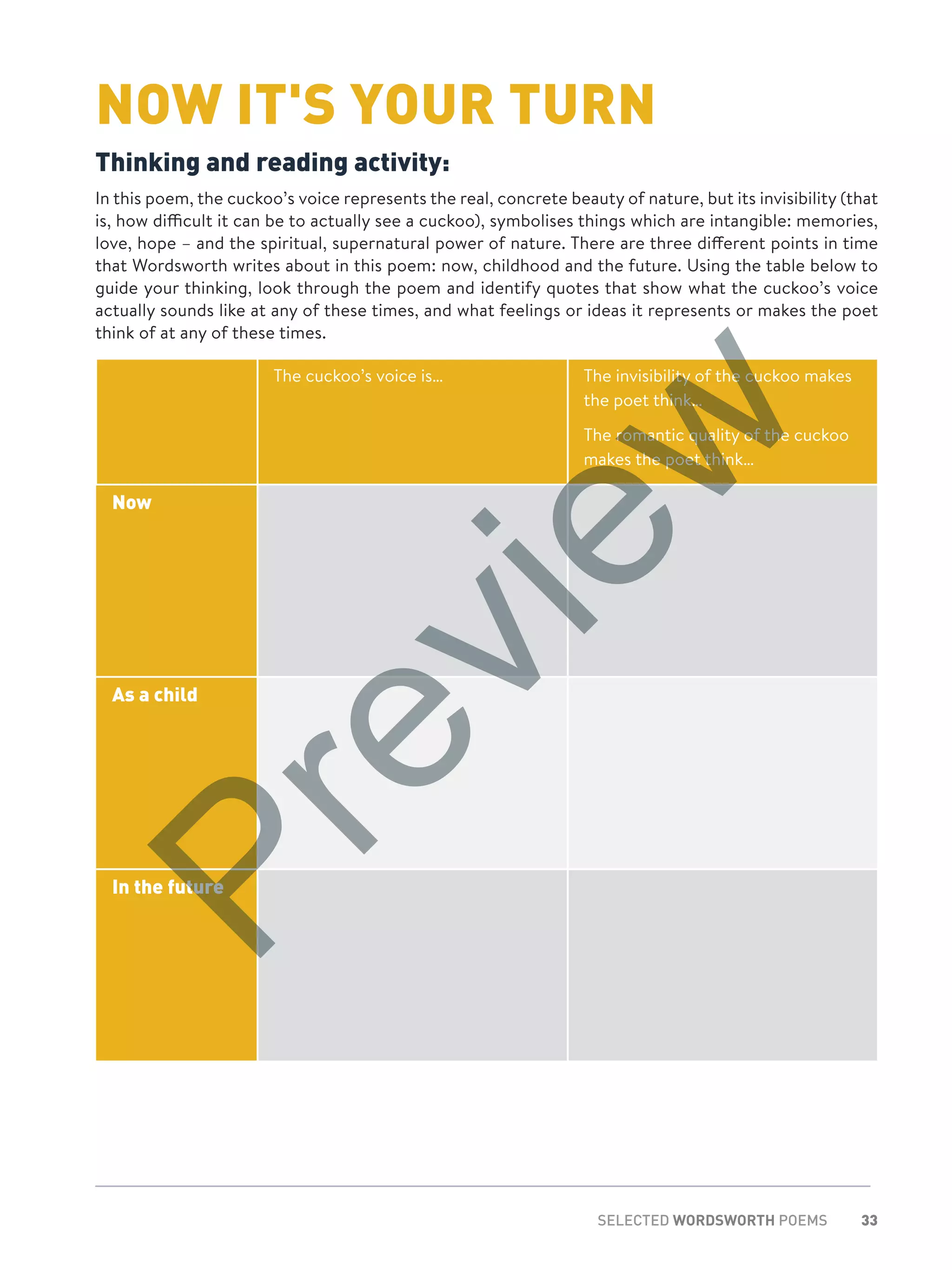
NOW IT'S YOUR TURN
Thinking and reading activity:
In this poem, the cuckoo’s voice represents the real, concrete beauty of nature, but its invisibility (that
is, how difficult it can be to actually see a cuckoo), symbolises things which are intangible: memories,
love, hope – and the spiritual, supernatural power of nature. There are three different points in time
that Wordsworth writes about in this poem: now, childhood and the future. Using the table below to
guide your thinking, look through the poem and identify quotes that show what the cuckoo’s voice
actually sounds like at any of these times, and what feelings or ideas it represents or makes the poet
think of at any of these times.
The cuckoo’s voice is… The invisibility of the cuckoo makes
the poet think…
The romantic quality of the cuckoo
makes the poet think…
Now
As a child
In the future
Preview
34
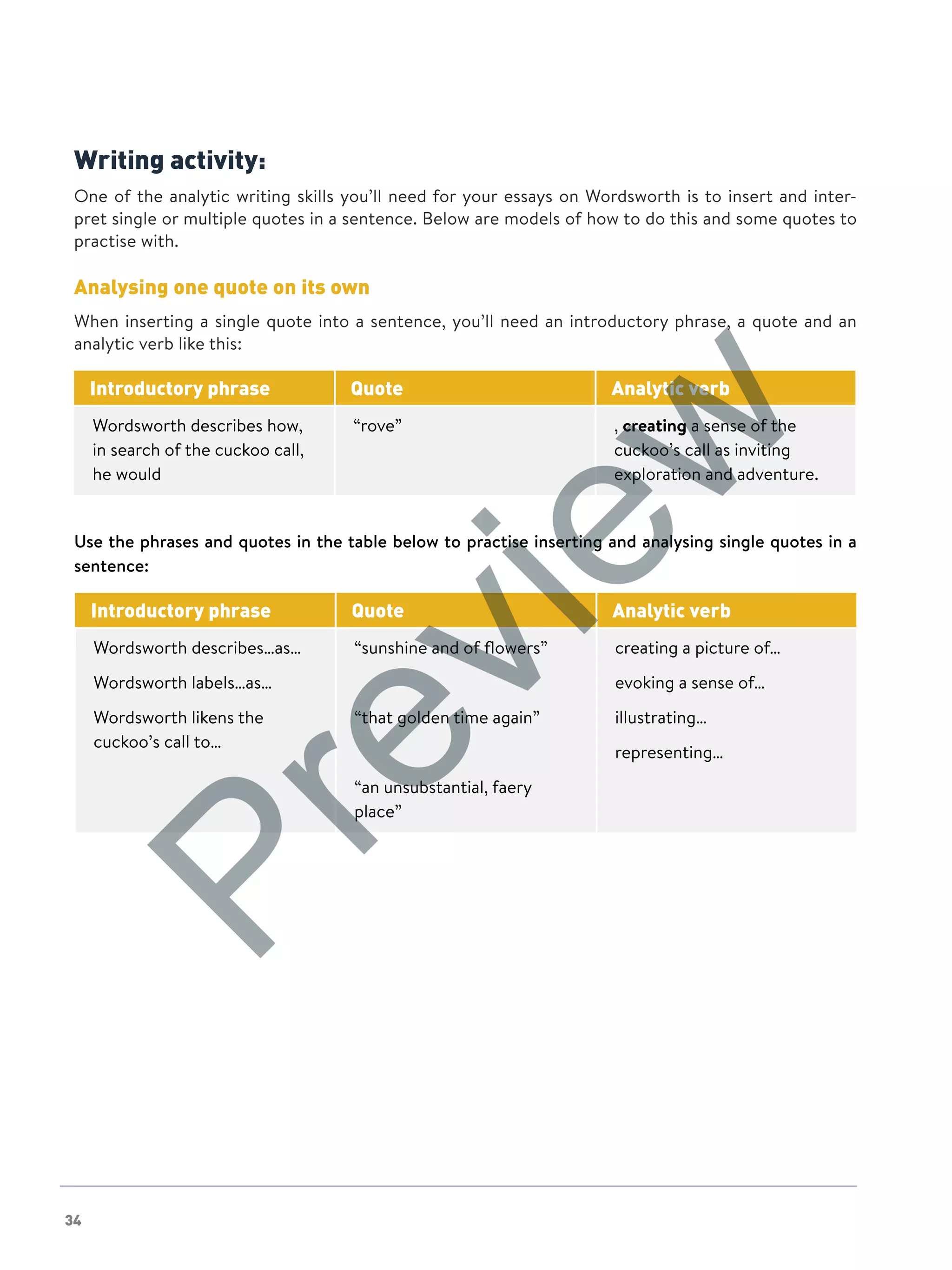
Writing activity:
One of the analytic writing skills you’ll need for your essays on Wordsworth is to insert and inter-
pret single or multiple quotes in a sentence. Below are models of how to do this and some quotes to
practise with.
Analysing one quote on its own
When inserting a single quote into a sentence, you’ll need an introductory phrase, a quote and an
analytic verb like this:
Introductory phrase Quote Analytic verb
Wordsworth describes how,
in search of the cuckoo call,
he would
“rove” , creating a sense of the
cuckoo’s call as inviting
exploration and adventure.
Use the phrases and quotes in the table below to practise inserting and analysing single quotes in a
sentence:
Introductory phrase Quote Analytic verb
Wordsworth describes…as…
Wordsworth labels…as…
Wordsworth likens the
cuckoo’s call to…
“sunshine and of flowers”
“that golden time again”
“an unsubstantial, faery
place”
creating a picture of…
evoking a sense of…
illustrating…
representing…
Preview
35SELECTED WORDSWORTH POEMS
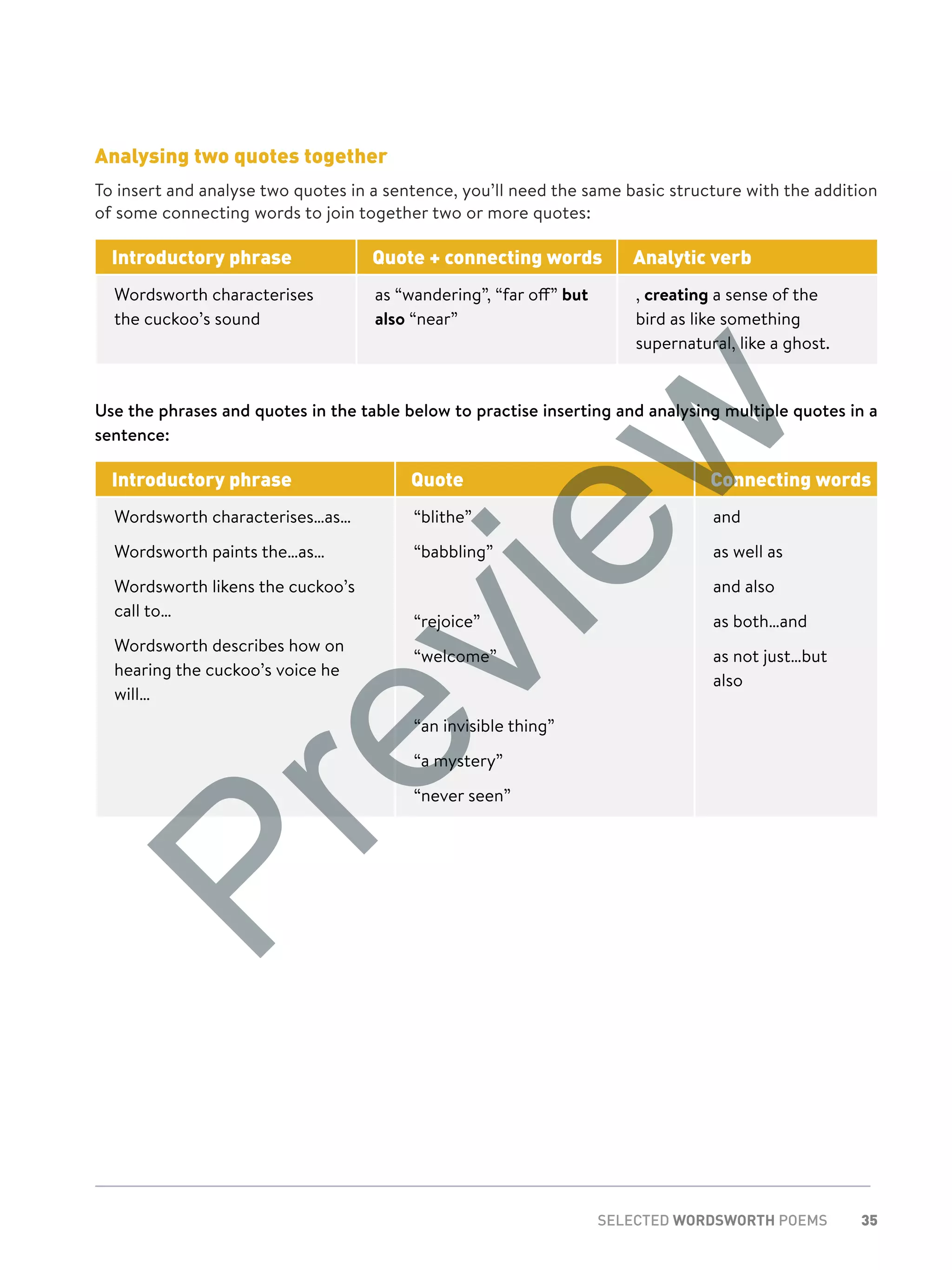
Analysing two quotes together
To insert and analyse two quotes in a sentence, you’ll need the same basic structure with the addition
of some connecting words to join together two or more quotes:
Introductory phrase Quote + connecting words Analytic verb
Wordsworth characterises
the cuckoo’s sound
as “wandering”, “far off” but
also “near”
, creating a sense of the
bird as like something
supernatural, like a ghost.
Use the phrases and quotes in the table below to practise inserting and analysing multiple quotes in a
sentence:
Introductory phrase Quote Connecting words
Wordsworth characterises…as…
Wordsworth paints the…as…
Wordsworth likens the cuckoo’s
call to…
Wordsworth describes how on
hearing the cuckoo’s voice he
will…
“blithe”
“babbling”
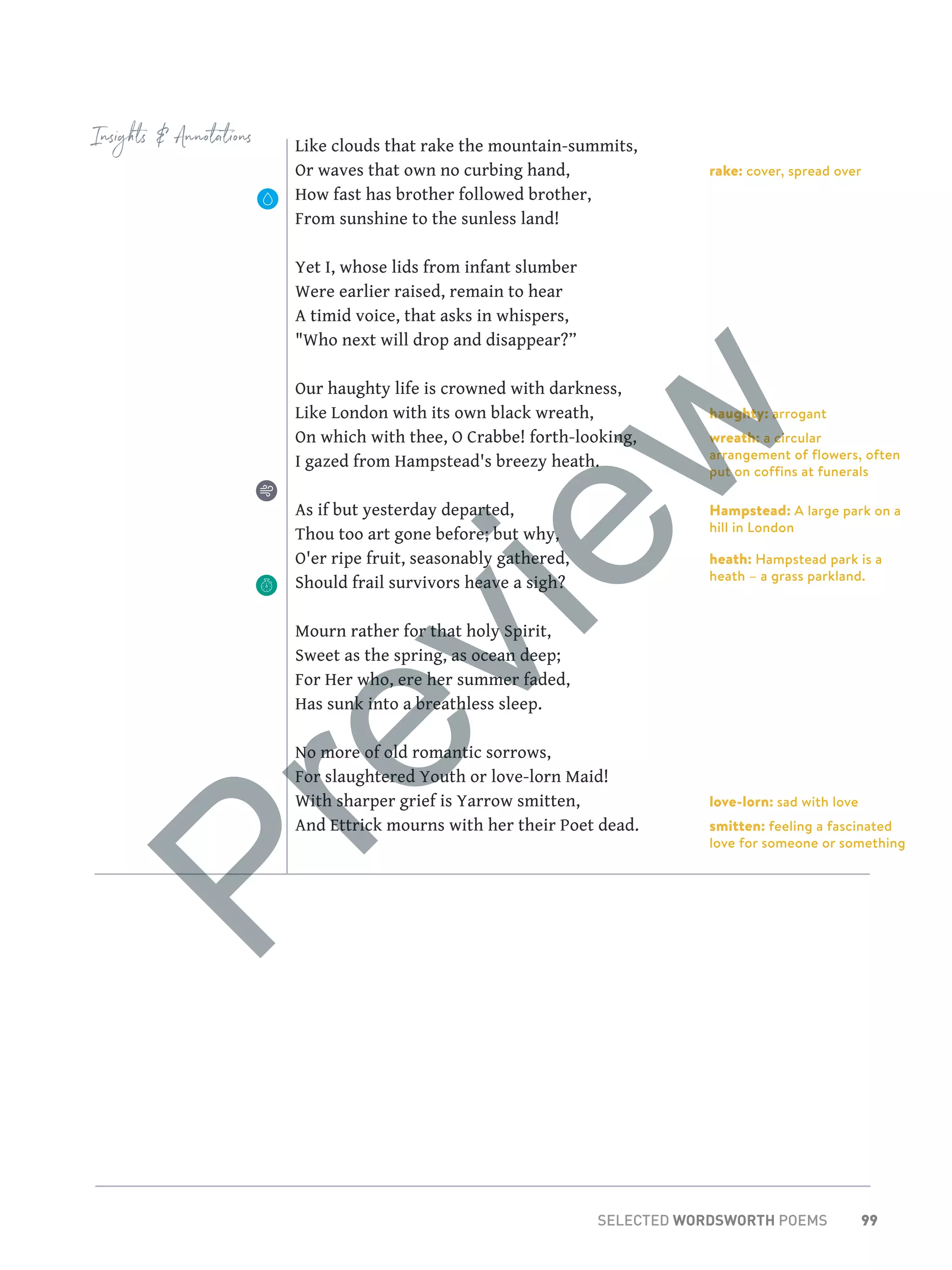
“rejoice”
“welcome”
“an invisible thing”
“a mystery”
“never seen”
and
as well as
and also
as both…and
as not just…but
also
Preview
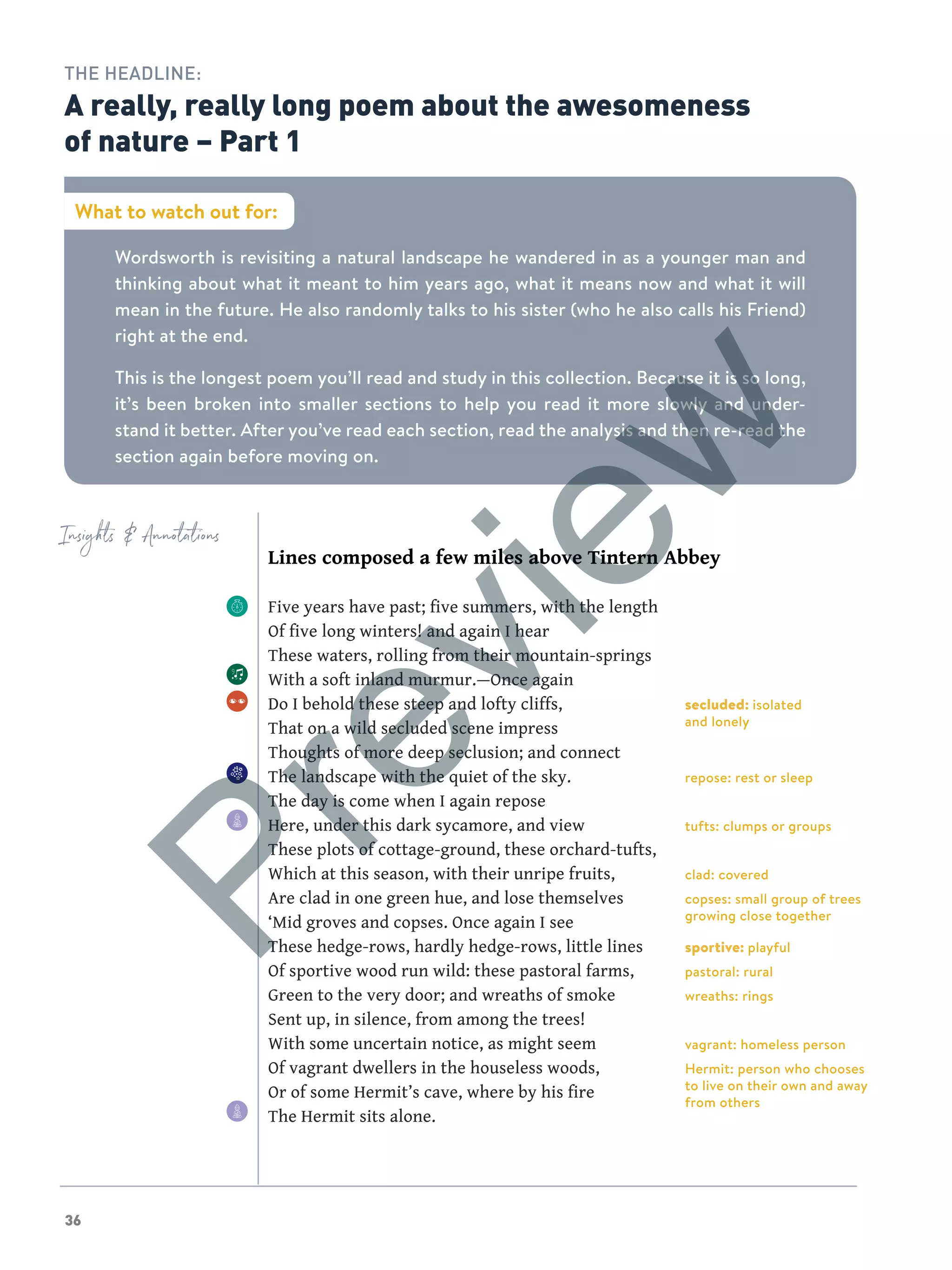
36
secluded: isolated
and lonely
repose: rest or sleep
tufts: clumps or groups
clad: covered
copses: small group of trees
growing close together
sportive: playful
pastoral: rural
wreaths: rings
vagrant: homeless person
Hermit: person who chooses
to live on their own and away
from others
Insights  Annotations
Lines composed a few miles above Tintern Abbey
Five years have past; five summers, with the length
Of five long winters! and again I hear
These waters, rolling from their mountain-springs
With a soft inland murmur.—Once again
Do I behold these steep and lofty cliffs,
That on a wild secluded scene impress
Thoughts of more deep seclusion; and connect
The landscape with the quiet of the sky.
The day is come when I again repose
Here, under this dark sycamore, and view
These plots of cottage-ground, these orchard-tufts,
Which at this season, with their unripe fruits,
Are clad in one green hue, and lose themselves
‘Mid groves and copses. Once again I see
These hedge-rows, hardly hedge-rows, little lines
Of sportive wood run wild: these pastoral farms,
Green to the very door; and wreaths of smoke
Sent up, in silence, from among the trees!
With some uncertain notice, as might seem
Of vagrant dwellers in the houseless woods,
Or of some Hermit’s cave, where by his fire
The Hermit sits alone.
Wordsworth is revisiting a natural landscape he wandered in as a younger man and
thinking about what it meant to him years ago, what it means now and what it will
mean in the future. He also randomly talks to his sister (who he also calls his Friend)
right at the end.
This is the longest poem you’ll read and study in this collection. Because it is so long,
it’s been broken into smaller sections to help you read it more slowly and under-
stand it better. After you’ve read each section, read the analysis and then re-read the
section again before moving on.
What to watch out for:
THE HEADLINE:
A really, really long poem about the awesomeness
of nature – Part 1
Preview
37SELECTED WORDSWORTH POEMS
Poem analysis:
Ideas Techniques
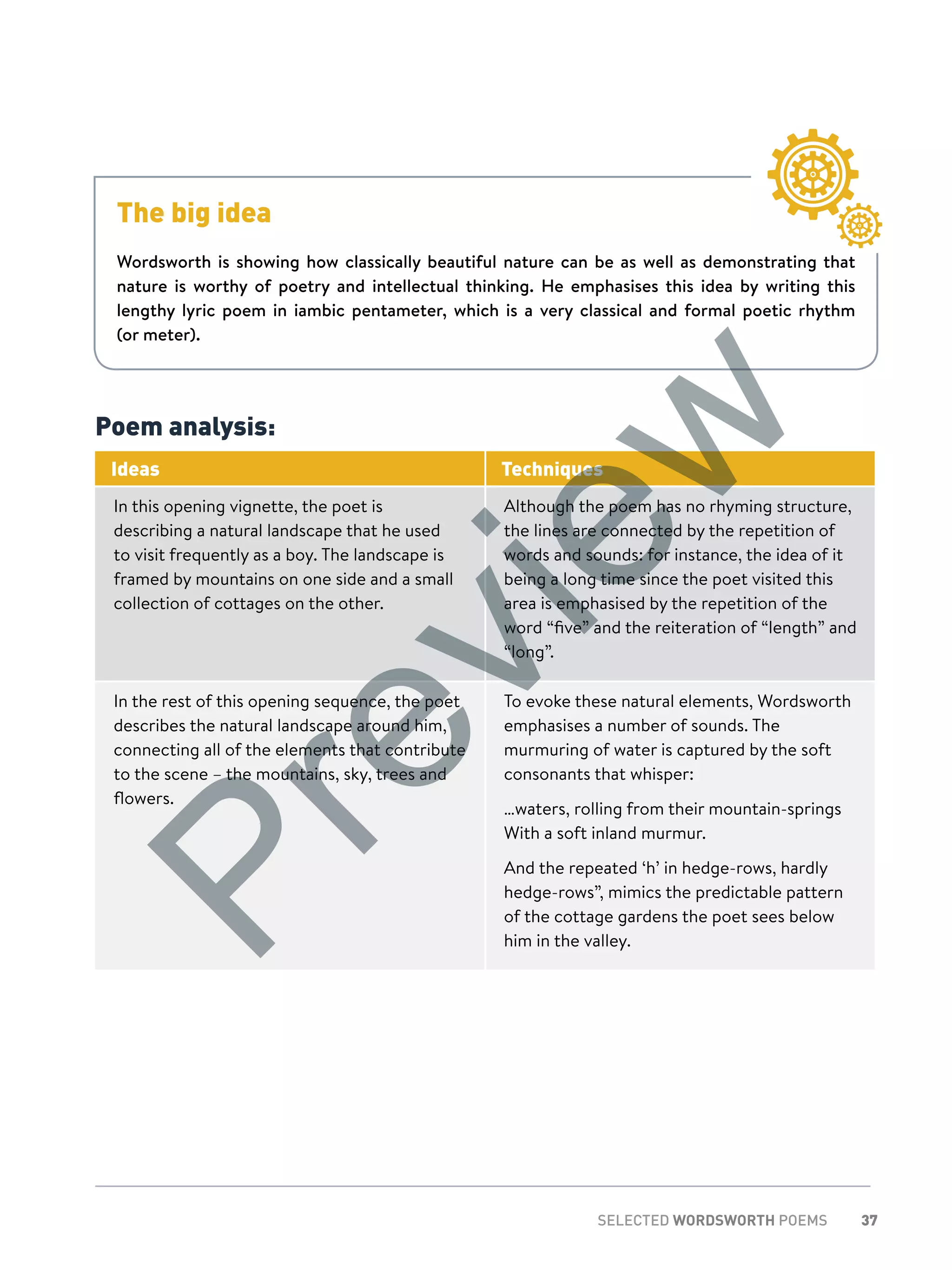
In this opening vignette, the poet is
describing a natural landscape that he used
to visit frequently as a boy. The landscape is
framed by mountains on one side and a small
collection of cottages on the other.
Although the poem has no rhyming structure,
the lines are connected by the repetition of
words and sounds: for instance, the idea of it
being a long time since the poet visited this
area is emphasised by the repetition of the
word “five” and the reiteration of “length” and
“long”.
In the rest of this opening sequence, the poet
describes the natural landscape around him,
connecting all of the elements that contribute
to the scene – the mountains, sky, trees and
flowers.
To evoke these natural elements, Wordsworth
emphasises a number of sounds. The
murmuring of water is captured by the soft
consonants that whisper:
…waters, rolling from their mountain-springs
With a soft inland murmur.
And the repeated ‘h’ in hedge-rows, hardly
hedge-rows”, mimics the predictable pattern
of the cottage gardens the poet sees below
him in the valley.
The big idea
Wordsworth is showing how classically beautiful nature can be as well as demonstrating that
nature is worthy of poetry and intellectual thinking. He emphasises this idea by writing this
lengthy lyric poem in iambic pentameter, which is a very classical and formal poetic rhythm
(or meter).
Preview
38
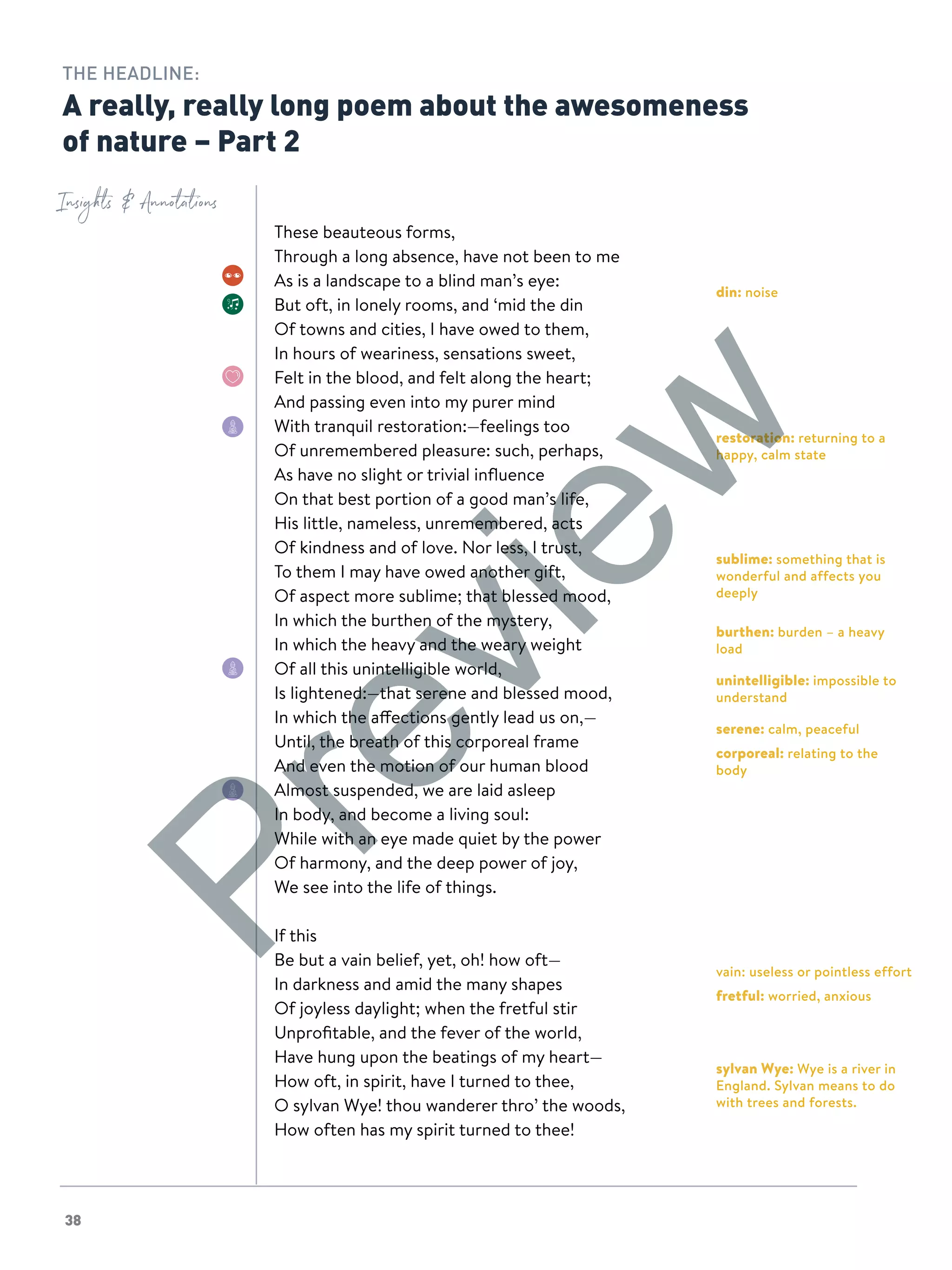
din: noise
restoration: returning to a
happy, calm state
sublime: something that is
wonderful and affects you
deeply
burthen: burden – a heavy
load
unintelligible: impossible to
understand
serene: calm, peaceful
corporeal: relating to the
body
vain: useless or pointless effort
fretful: worried, anxious
sylvan Wye: Wye is a river in
England. Sylvan means to do
with trees and forests.
Insights  Annotations
THE HEADLINE:
A really, really long poem about the awesomeness
of nature – Part 2
These beauteous forms,
Through a long absence, have not been to me
As is a landscape to a blind man’s eye:
But oft, in lonely rooms, and ‘mid the din
Of towns and cities, I have owed to them,
In hours of weariness, sensations sweet,
Felt in the blood, and felt along the heart;
And passing even into my purer mind
With tranquil restoration:—feelings too
Of unremembered pleasure: such, perhaps,
As have no slight or trivial influence
On that best portion of a good man’s life,
His little, nameless, unremembered, acts
Of kindness and of love. Nor less, I trust,
To them I may have owed another gift,
Of aspect more sublime; that blessed mood,
In which the burthen of the mystery,
In which the heavy and the weary weight
Of all this unintelligible world,
Is lightened:—that serene and blessed mood,
In which the affections gently lead us on,—
Until, the breath of this corporeal frame
And even the motion of our human blood
Almost suspended, we are laid asleep
In body, and become a living soul:
While with an eye made quiet by the power
Of harmony, and the deep power of joy,
We see into the life of things.
If this
Be but a vain belief, yet, oh! how oft—
In darkness and amid the many shapes
Of joyless daylight; when the fretful stir
Unprofitable, and the fever of the world,
Have hung upon the beatings of my heart—
How oft, in spirit, have I turned to thee,
O sylvan Wye! thou wanderer thro’ the woods,
How often has my spirit turned to thee!
Preview
39SELECTED WORDSWORTH POEMS
Poem analysis:
Ideas Techniques
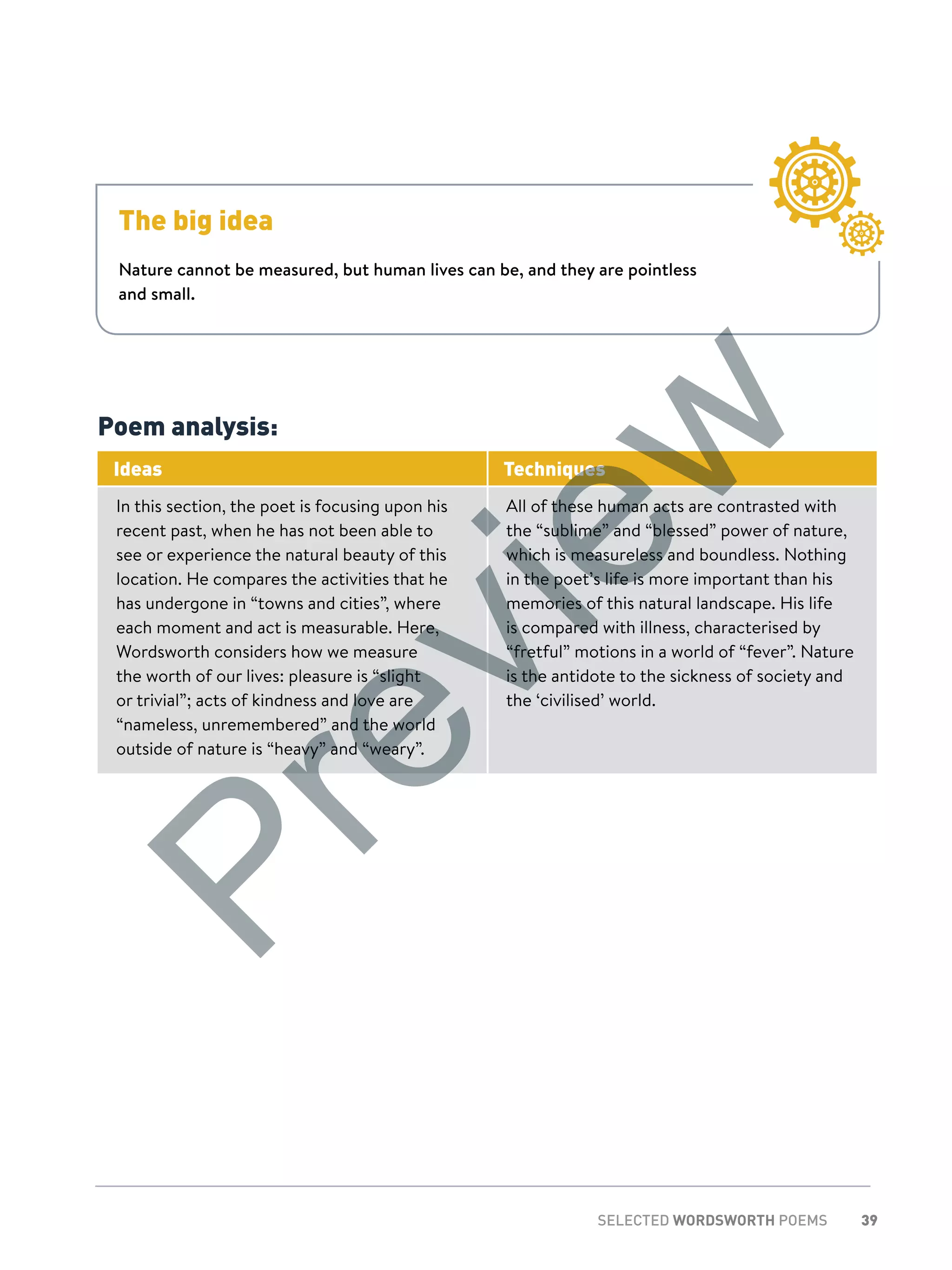
In this section, the poet is focusing upon his
recent past, when he has not been able to
see or experience the natural beauty of this
location. He compares the activities that he
has undergone in “towns and cities”, where
each moment and act is measurable. Here,
Wordsworth considers how we measure
the worth of our lives: pleasure is “slight
or trivial”; acts of kindness and love are
“nameless, unremembered” and the world
outside of nature is “heavy” and “weary”.
All of these human acts are contrasted with
the “sublime” and “blessed” power of nature,
which is measureless and boundless. Nothing
in the poet’s life is more important than his
memories of this natural landscape. His life
is compared with illness, characterised by
“fretful” motions in a world of “fever”. Nature
is the antidote to the sickness of society and
the ‘civilised’ world.
The big idea
Nature cannot be measured, but human lives can be, and they are pointless
and small.
Preview
40
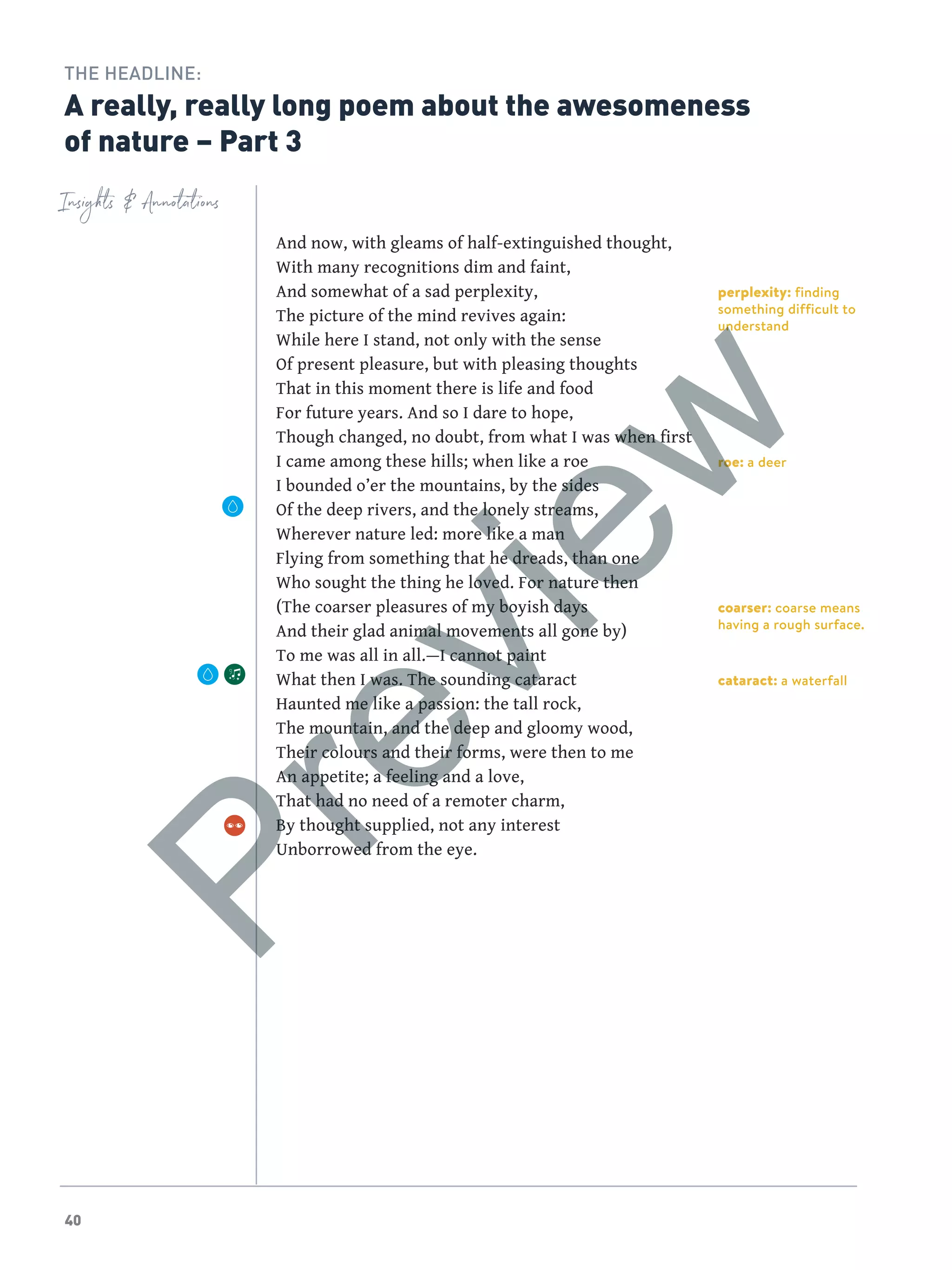
perplexity: finding
something difficult to
understand
roe: a deer
coarser: coarse means
having a rough surface.
cataract: a waterfall
Insights  Annotations
THE HEADLINE:
A really, really long poem about the awesomeness
of nature – Part 3
And now, with gleams of half-extinguished thought,
With many recognitions dim and faint,
And somewhat of a sad perplexity,
The picture of the mind revives again:
While here I stand, not only with the sense
Of present pleasure, but with pleasing thoughts
That in this moment there is life and food
For future years. And so I dare to hope,
Though changed, no doubt, from what I was when first
I came among these hills; when like a roe
I bounded o’er the mountains, by the sides
Of the deep rivers, and the lonely streams,
Wherever nature led: more like a man
Flying from something that he dreads, than one
Who sought the thing he loved. For nature then
(The coarser pleasures of my boyish days
And their glad animal movements all gone by)
To me was all in all.—I cannot paint
What then I was. The sounding cataract
Haunted me like a passion: the tall rock,
The mountain, and the deep and gloomy wood,
Their colours and their forms, were then to me
An appetite; a feeling and a love,
That had no need of a remoter charm,
By thought supplied, not any interest
Unborrowed from the eye.
Preview
41SELECTED WORDSWORTH POEMS
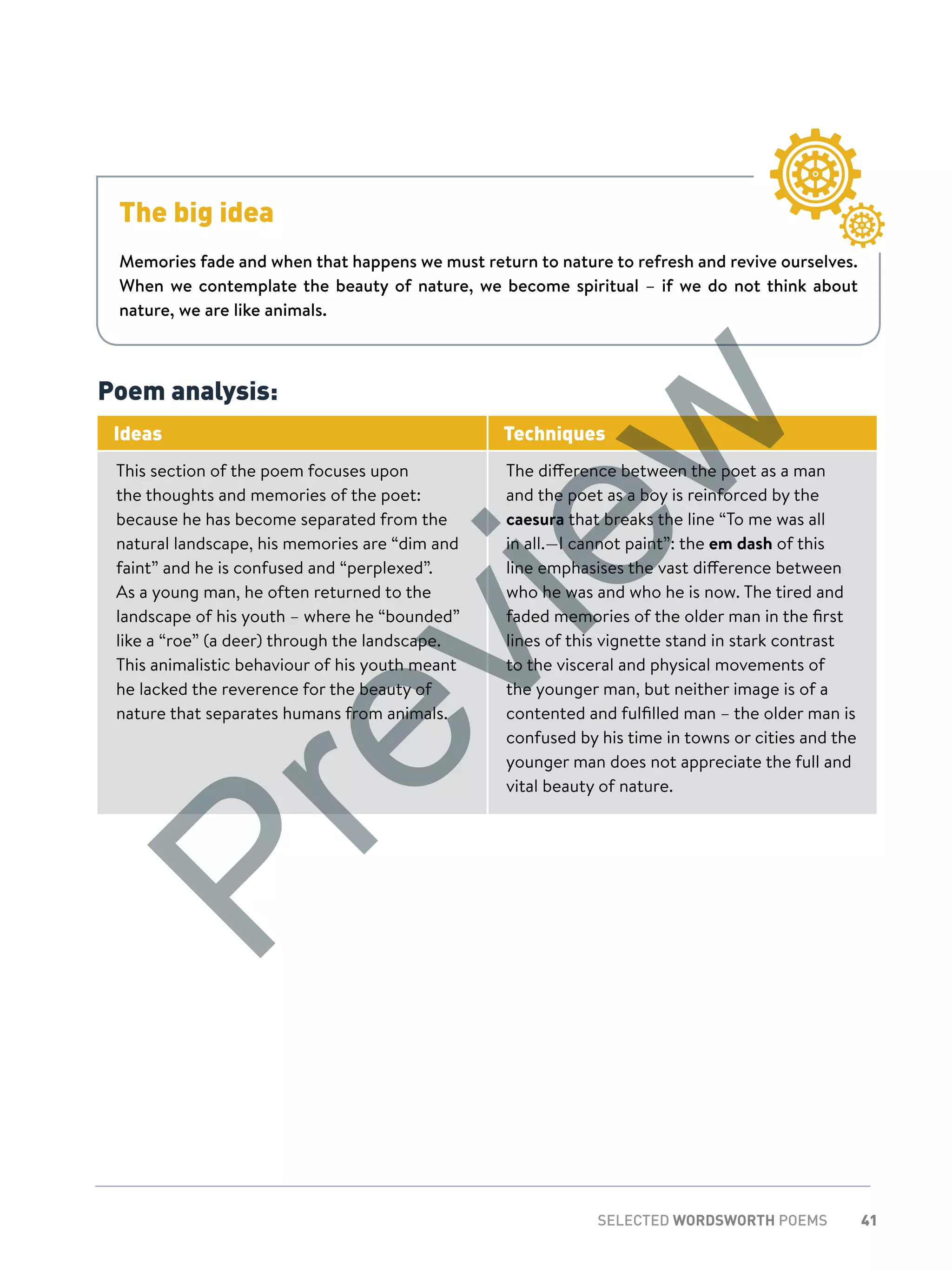
The big idea
Memories fade and when that happens we must return to nature to refresh and revive ourselves.
When we contemplate the beauty of nature, we become spiritual – if we do not think about
nature, we are like animals.
Poem analysis:
Ideas Techniques
This section of the poem focuses upon
the thoughts and memories of the poet:
because he has become separated from the
natural landscape, his memories are “dim and
faint” and he is confused and “perplexed”.
As a young man, he often returned to the
landscape of his youth – where he “bounded”
like a “roe” (a deer) through the landscape.
This animalistic behaviour of his youth meant
he lacked the reverence for the beauty of
nature that separates humans from animals.
The difference between the poet as a man
and the poet as a boy is reinforced by the
caesura that breaks the line “To me was all
in all.—I cannot paint”: the em dash of this
line emphasises the vast difference between
who he was and who he is now. The tired and
faded memories of the older man in the first
lines of this vignette stand in stark contrast
to the visceral and physical movements of
the younger man, but neither image is of a
contented and fulfilled man – the older man is
confused by his time in towns or cities and the
younger man does not appreciate the full and
vital beauty of nature.
Preview
42
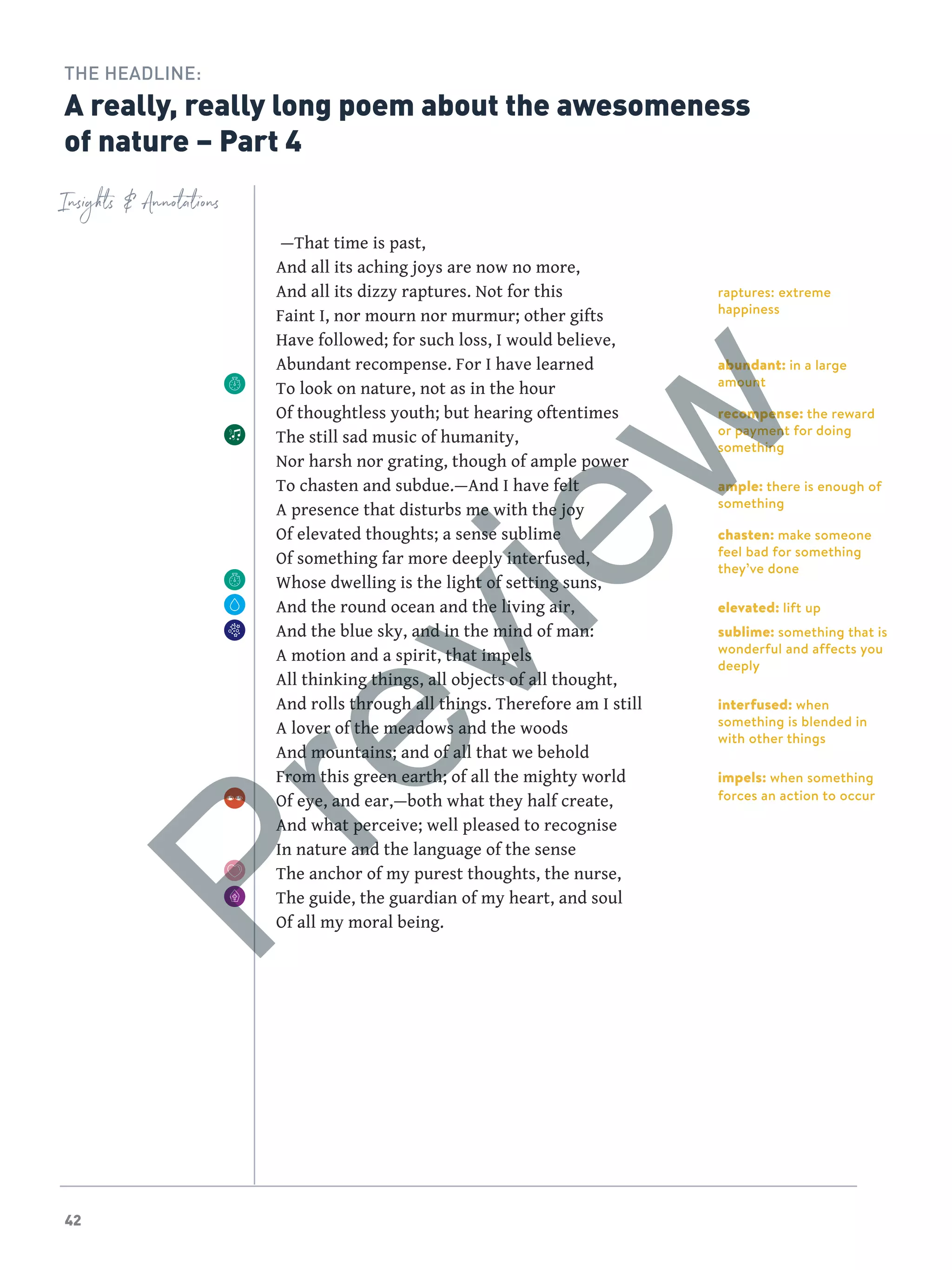
raptures: extreme
happiness
abundant: in a large
amount
recompense: the reward
or payment for doing
something
ample: there is enough of
something
chasten: make someone
feel bad for something
they’ve done
elevated: lift up
sublime: something that is
wonderful and affects you
deeply
interfused: when
something is blended in
with other things
impels: when something
forces an action to occur
Insights  Annotations
THE HEADLINE:
A really, really long poem about the awesomeness
of nature – Part 4
 —That time is past,
And all its aching joys are now no more,
And all its dizzy raptures. Not for this
Faint I, nor mourn nor murmur; other gifts
Have followed; for such loss, I would believe,
Abundant recompense. For I have learned
To look on nature, not as in the hour
Of thoughtless youth; but hearing oftentimes
The still sad music of humanity,
Nor harsh nor grating, though of ample power
To chasten and subdue.—And I have felt
A presence that disturbs me with the joy
Of elevated thoughts; a sense sublime
Of something far more deeply interfused,
Whose dwelling is the light of setting suns,
And the round ocean and the living air,
And the blue sky, and in the mind of man:
A motion and a spirit, that impels
All thinking things, all objects of all thought,
And rolls through all things. Therefore am I still
A lover of the meadows and the woods
And mountains; and of all that we behold
From this green earth; of all the mighty world
Of eye, and ear,—both what they half create,
And what perceive; well pleased to recognise
In nature and the language of the sense
The anchor of my purest thoughts, the nurse,
The guide, the guardian of my heart, and soul
Of all my moral being.
Preview
43SELECTED WORDSWORTH POEMS
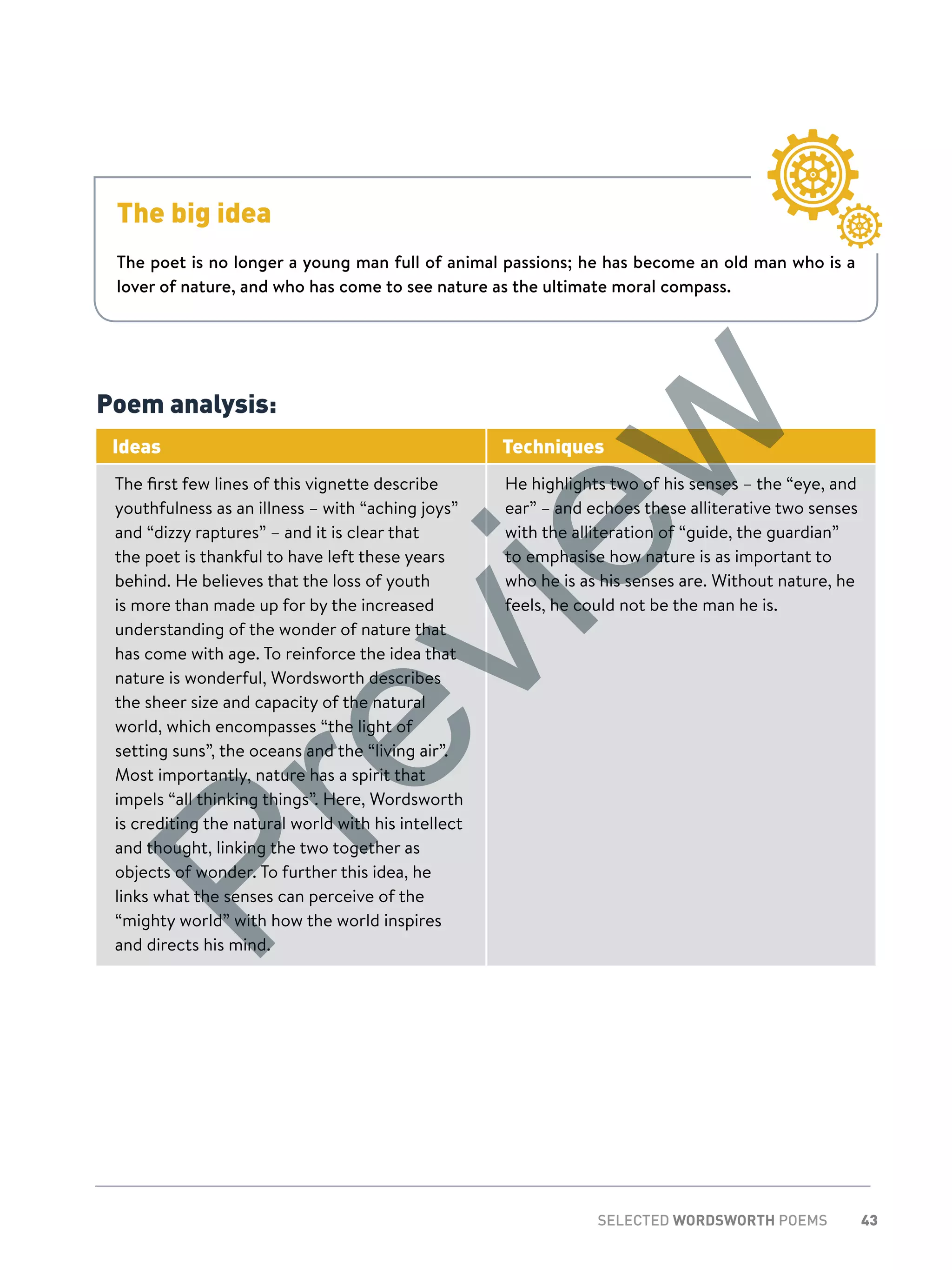
The big idea
The poet is no longer a young man full of animal passions; he has become an old man who is a
lover of nature, and who has come to see nature as the ultimate moral compass.
Poem analysis:
Ideas Techniques
The first few lines of this vignette describe
youthfulness as an illness – with “aching joys”
and “dizzy raptures” – and it is clear that
the poet is thankful to have left these years
behind. He believes that the loss of youth
is more than made up for by the increased
understanding of the wonder of nature that
has come with age. To reinforce the idea that
nature is wonderful, Wordsworth describes
the sheer size and capacity of the natural
world, which encompasses “the light of
setting suns”, the oceans and the “living air”.
Most importantly, nature has a spirit that
impels “all thinking things”. Here, Wordsworth
is crediting the natural world with his intellect
and thought, linking the two together as
objects of wonder. To further this idea, he
links what the senses can perceive of the
“mighty world” with how the world inspires
and directs his mind.
He highlights two of his senses – the “eye, and
ear” – and echoes these alliterative two senses
with the alliteration of “guide, the guardian”
to emphasise how nature is as important to
who he is as his senses are. Without nature, he
feels, he could not be the man he is.
Preview
44
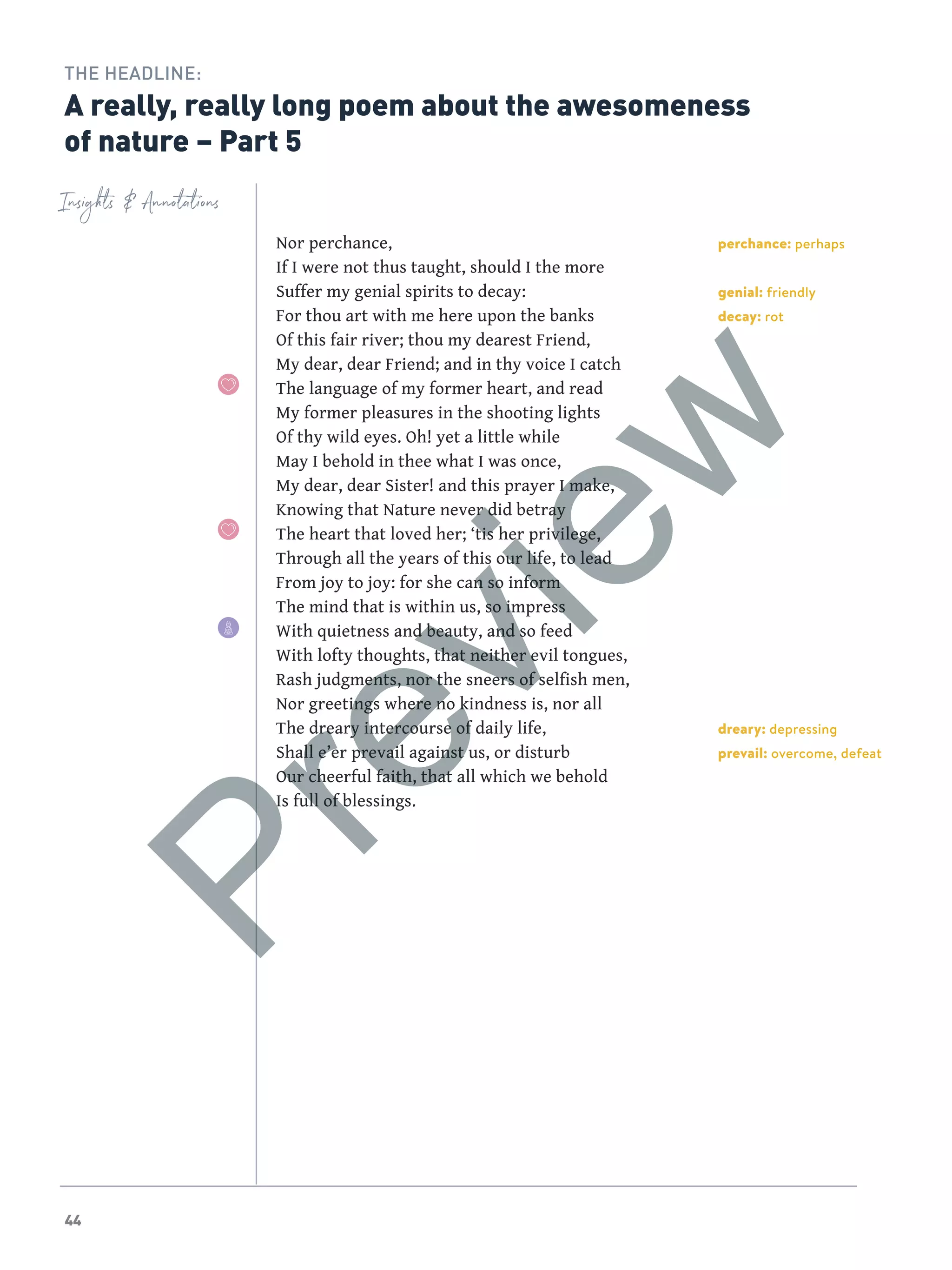
perchance: perhaps
genial: friendly
decay: rot
dreary: depressing
prevail: overcome, defeat
Insights  Annotations
THE HEADLINE:
A really, really long poem about the awesomeness
of nature – Part 5
Nor perchance,
If I were not thus taught, should I the more
Suffer my genial spirits to decay:
For thou art with me here upon the banks
Of this fair river; thou my dearest Friend,
My dear, dear Friend; and in thy voice I catch
The language of my former heart, and read
My former pleasures in the shooting lights
Of thy wild eyes. Oh! yet a little while
May I behold in thee what I was once,
My dear, dear Sister! and this prayer I make,
Knowing that Nature never did betray
The heart that loved her; ‘tis her privilege,
Through all the years of this our life, to lead
From joy to joy: for she can so inform
The mind that is within us, so impress
With quietness and beauty, and so feed
With lofty thoughts, that neither evil tongues,
Rash judgments, nor the sneers of selfish men,
Nor greetings where no kindness is, nor all
The dreary intercourse of daily life,
Shall e’er prevail against us, or disturb
Our cheerful faith, that all which we behold
Is full of blessings.
Preview
45SELECTED WORDSWORTH POEMS
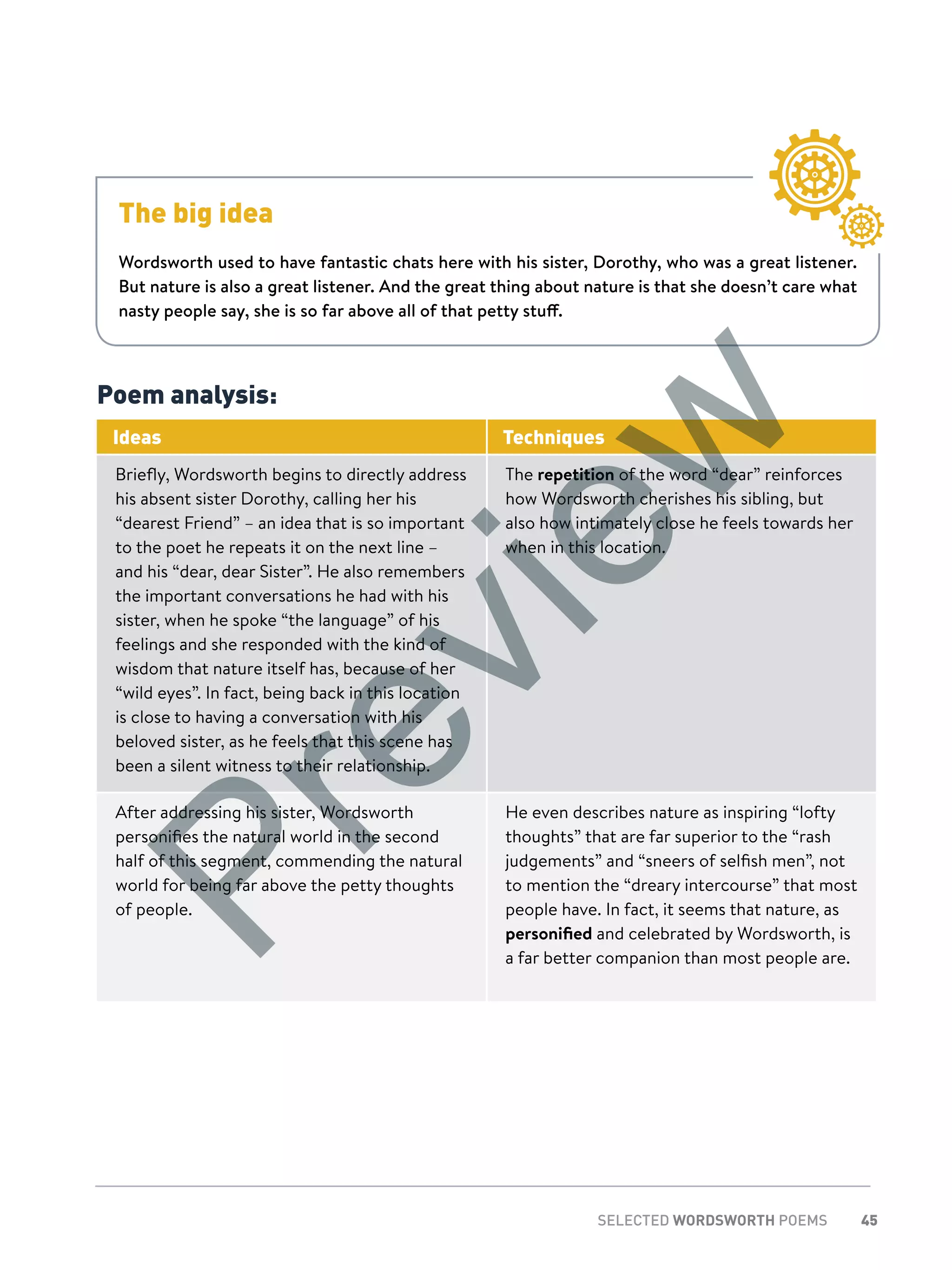
The big idea
Wordsworth used to have fantastic chats here with his sister, Dorothy, who was a great listener.
But nature is also a great listener. And the great thing about nature is that she doesn’t care what
nasty people say, she is so far above all of that petty stuff.
Poem analysis:
Ideas Techniques
Briefly, Wordsworth begins to directly address
his absent sister Dorothy, calling her his
“dearest Friend” – an idea that is so important
to the poet he repeats it on the next line –
and his “dear, dear Sister”. He also remembers
the important conversations he had with his
sister, when he spoke “the language” of his
feelings and she responded with the kind of
wisdom that nature itself has, because of her
“wild eyes”. In fact, being back in this location
is close to having a conversation with his
beloved sister, as he feels that this scene has
been a silent witness to their relationship.
The repetition of the word “dear” reinforces
how Wordsworth cherishes his sibling, but
also how intimately close he feels towards her
when in this location.
After addressing his sister, Wordsworth
personifies the natural world in the second
half of this segment, commending the natural
world for being far above the petty thoughts
of people.
He even describes nature as inspiring “lofty
thoughts” that are far superior to the “rash
judgements” and “sneers of selfish men”, not
to mention the “dreary intercourse” that most
people have. In fact, it seems that nature, as
personified and celebrated by Wordsworth, is
a far better companion than most people are.
Preview
46
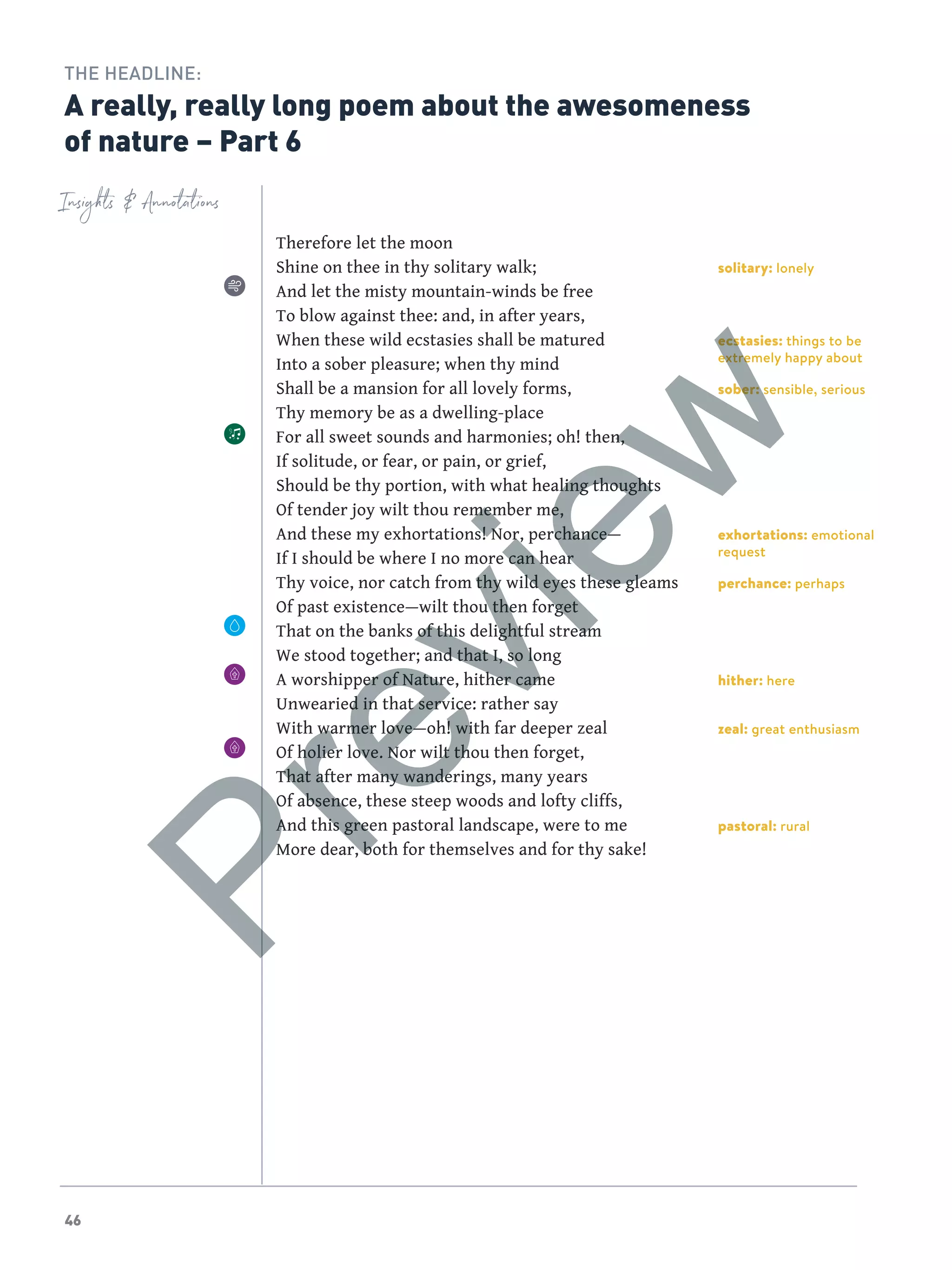
solitary: lonely
ecstasies: things to be
extremely happy about
sober: sensible, serious
exhortations: emotional
request
perchance: perhaps
hither: here
zeal: great enthusiasm
pastoral: rural
Insights  Annotations
THE HEADLINE:
A really, really long poem about the awesomeness
of nature – Part 6
Therefore let the moon
Shine on thee in thy solitary walk;
And let the misty mountain-winds be free
To blow against thee: and, in after years,
When these wild ecstasies shall be matured
Into a sober pleasure; when thy mind
Shall be a mansion for all lovely forms,
Thy memory be as a dwelling-place
For all sweet sounds and harmonies; oh! then,
If solitude, or fear, or pain, or grief,
Should be thy portion, with what healing thoughts
Of tender joy wilt thou remember me,
And these my exhortations! Nor, perchance—
If I should be where I no more can hear
Thy voice, nor catch from thy wild eyes these gleams
Of past existence—wilt thou then forget
That on the banks of this delightful stream
We stood together; and that I, so long
A worshipper of Nature, hither came
Unwearied in that service: rather say
With warmer love—oh! with far deeper zeal
Of holier love. Nor wilt thou then forget,
That after many wanderings, many years
Of absence, these steep woods and lofty cliffs,
And this green pastoral landscape, were to me
More dear, both for themselves and for thy sake!
Preview
47SELECTED WORDSWORTH POEMS
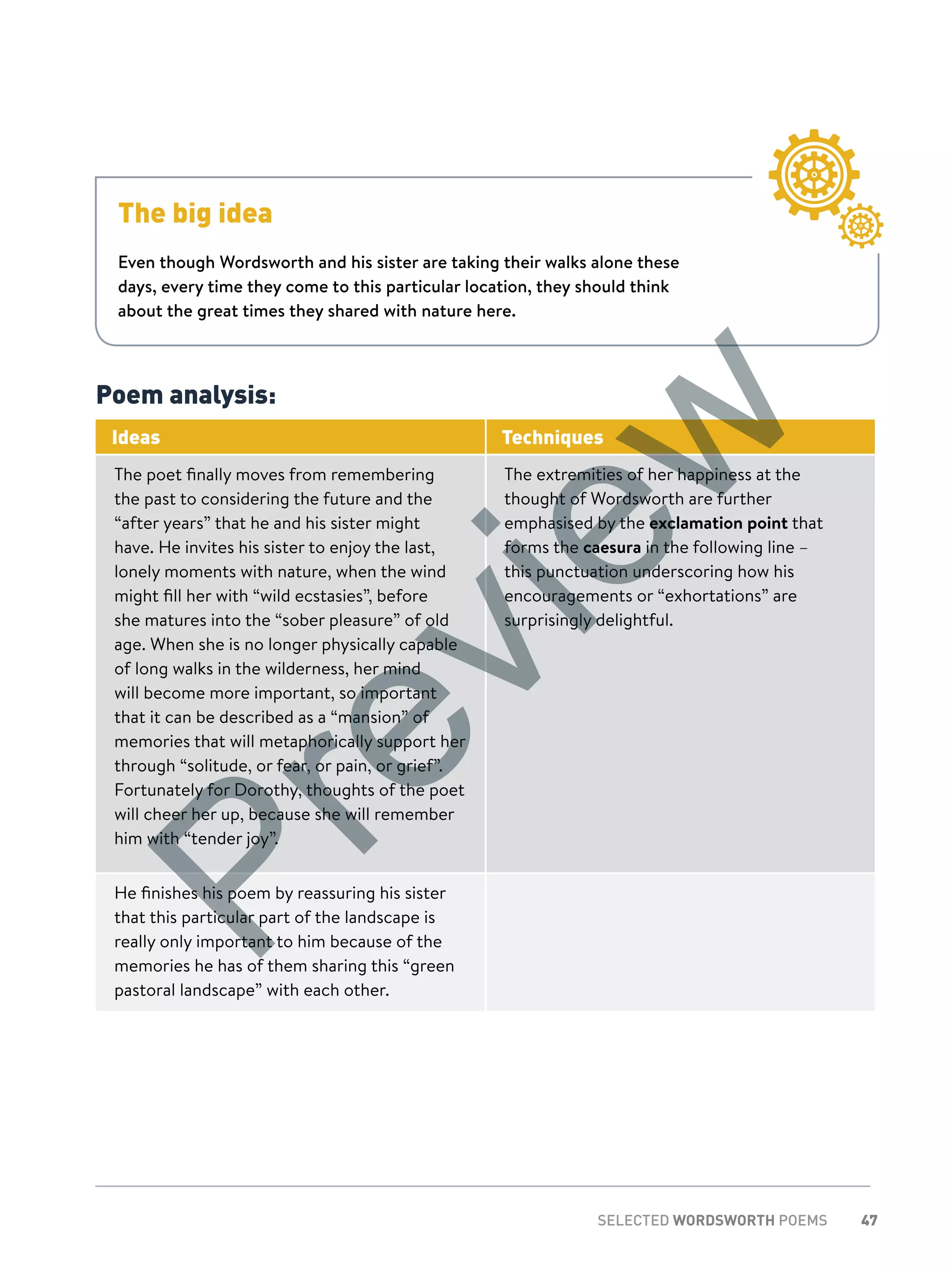
The big idea
Even though Wordsworth and his sister are taking their walks alone these
days, every time they come to this particular location, they should think
about the great times they shared with nature here.
Poem analysis:
Ideas Techniques
The poet finally moves from remembering
the past to considering the future and the
“after years” that he and his sister might
have. He invites his sister to enjoy the last,
lonely moments with nature, when the wind
might fill her with “wild ecstasies”, before
she matures into the “sober pleasure” of old
age. When she is no longer physically capable
of long walks in the wilderness, her mind
will become more important, so important
that it can be described as a “mansion” of
memories that will metaphorically support her
through “solitude, or fear, or pain, or grief”.
Fortunately for Dorothy, thoughts of the poet
will cheer her up, because she will remember
him with “tender joy”.
The extremities of her happiness at the
thought of Wordsworth are further
emphasised by the exclamation point that
forms the caesura in the following line –
this punctuation underscoring how his
encouragements or “exhortations” are
surprisingly delightful.
He finishes his poem by reassuring his sister
that this particular part of the landscape is
really only important to him because of the
memories he has of them sharing this “green
pastoral landscape” with each other.
Preview
48
NOW IT'S YOUR TURNNOW IT'S YOUR TURNNOW IT'S YOUR TURN
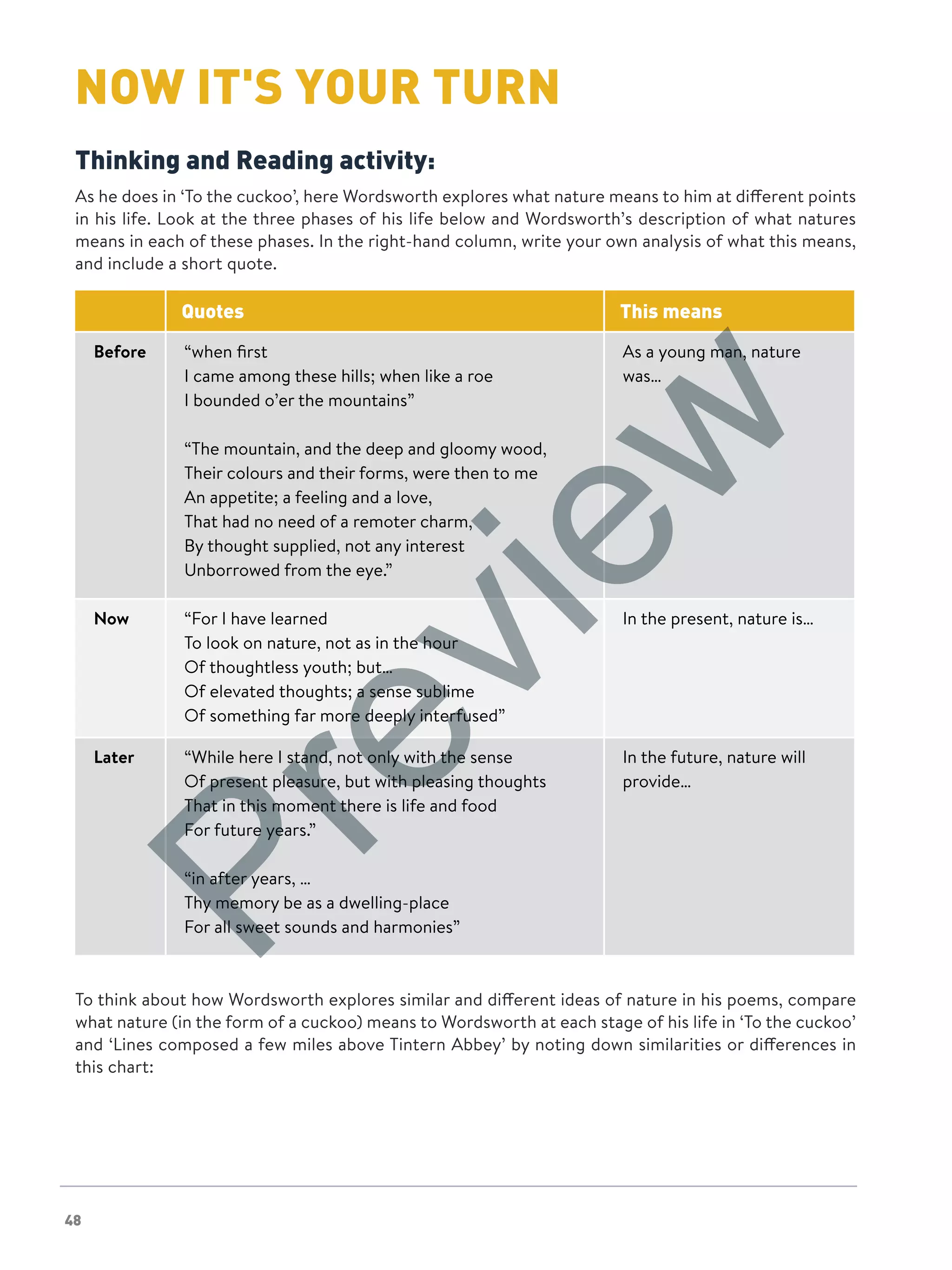
Thinking and Reading activity:
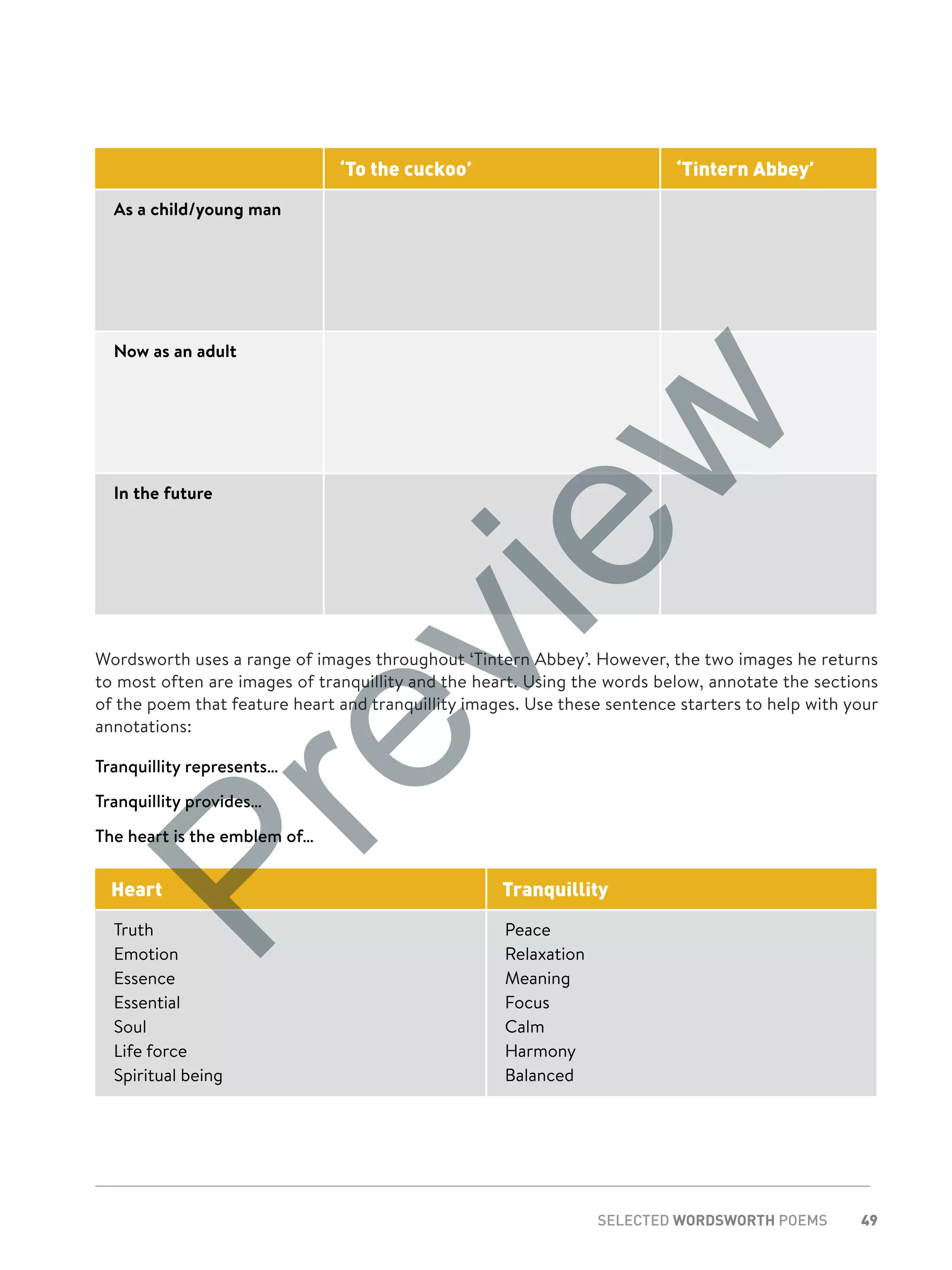
As he does in ‘To the cuckoo’, here Wordsworth explores what nature means to him at different points
in his life. Look at the three phases of his life below and Wordsworth’s description of what natures
means in each of these phases. In the right-hand column, write your own analysis of what this means,
and include a short quote.
Quotes This means
Before “when first
I came among these hills; when like a roe
I bounded o’er the mountains”
“The mountain, and the deep and gloomy wood,
Their colours and their forms, were then to me
An appetite; a feeling and a love,
That had no need of a remoter charm,
By thought supplied, not any interest
Unborrowed from the eye.”
As a young man, nature
was…
Now “For I have learned
To look on nature, not as in the hour
Of thoughtless youth; but…
Of elevated thoughts; a sense sublime
Of something far more deeply interfused”
In the present, nature is…
Later “While here I stand, not only with the sense
Of present pleasure, but with pleasing thoughts
That in this moment there is life and food
For future years.”
“in after years, …
Thy memory be as a dwelling-place
For all sweet sounds and harmonies”
In the future, nature will
provide…
To think about how Wordsworth explores similar and different ideas of nature in his poems, compare
what nature (in the form of a cuckoo) means to Wordsworth at each stage of his life in ‘To the cuckoo’
and ‘Lines composed a few miles above Tintern Abbey’ by noting down similarities or differences in
this chart:
Preview
49SELECTED WORDSWORTH POEMS
‘To the cuckoo’ ‘Tintern Abbey’
As a child/young man
Now as an adult
In the future
Wordsworth uses a range of images throughout ‘Tintern Abbey’. However, the two images he returns
to most often are images of tranquillity and the heart. Using the words below, annotate the sections
of the poem that feature heart and tranquillity images. Use these sentence starters to help with your
annotations:
Tranquillity represents…
Tranquillity provides…
The heart is the emblem of…
Heart Tranquillity
Truth
Emotion
Essence
Essential
Soul
Life force
Spiritual being
Peace
Relaxation
Meaning
Focus
Calm
Harmony
Balanced
Preview
50
NOW IT'S YOUR TURNNOW IT'S YOUR TURN
Writing activity:
Now you’ve studied a set of poems about the key idea of celebrating nature, you can practise writing
in more detail about the poems. Let’s have a go responding to a basic essay topic about Wordsworth:
	 Wordsworth’s poems demonstrate that nature provides meaning to all stages of our life.
Below is an example paragraph that responds to this essay topic by focusing on how nature provides
meaning to his childhood. The example paragraph also demonstrates some of the essential analytic
skills you need to develop in writing about Wordsworth’s poems:
•	 Elaborating on what ideas mean
•	 Inserting quotes to demonstrate ideas
•	 Comparing how an idea is represented in different poems
Read through the example paragraph and pay attention to how it’s been structured – you’ll write your
own paragraph following this structure:
Topic sentence In his collection of poetry, Wordsworth celebrates the energising
effect of the natural world on his mind and body as a young person.
Explanation
of terms
He believes that nature was a place of exploration and intense physical
delight for him as a child.
Quote that
demonstrates idea
In ‘Lines composed a few miles above Tintern Abbey’, the poet refers
to the delight of his “boyish days” when he exercised in the natural
landscape.
Analysis that links
to topic
In his memory, nature has created a safe space for physical exhilaration
and primal pleasures.
Image or technique
to demonstrate
idea
In fact, so intense was his boyhood experience, that when he sums
it up with “all in all”, he separates his childish self from his adult self
with a caesura break in the middle of the line. The em dash of this line
emphasises the vast difference between who he was and who he is now.
Analysis that links
to topic
Although there is a great difference between Wordsworth as a man
and who he was as a boy, at each stage of his life, this natural scene has
helped him to understand himself.
Preview
51SELECTED WORDSWORTH POEMS
Link to other poem The boyish delight in nature Wordsworth describes in ‘Tintern Abbey’
is echoed in ‘To the Cuckoo’, where Wordsworth remembers roving
“through the woods and on the green” in his “schoolboy days”, just
to find the elusive cuckoo whose song he can hear. To underline his
connection with nature, Wordsworth describes his search for the
cuckoo as “a hope, a love”, highlighting how his childish emotions and
dreams are intrinsically linked to the natural world.
Concluding analysis
that links to topic
Wordsworth’s commemoration of these early, simple memories
underscores just how vital the landscape was to his younger self.
Now it’s time for you to write your own paragraph. Below are two topic sentences that focus on how
nature connects to other stages of life in Wordsworth’s poems.
Pick one to start a paragraph.
	However, Wordsworth’s poetry demonstrates that adulthood brings a more refined, intellectual
relationship with nature.
	In contrast to the immediate, primal pleasure nature offers in childhood, Wordsworth presents
nature as offering long-lasting sustenance in the future as a person ages.
Before writing your paragraph, plan what you will say. Fill in this table, starting with yourtopic sentence.
For the second row, consider what the key words in the topic sentence mean and provide more expla-
nation. After that, identify quotes and examples you can use from ‘Tintern Abbey’ and other poems.
Topic sentence
Explanation
of terms
Quote that
demonstrates idea
Analysis that links
to topic
Image or technique
to demonstrate idea
Analysis that links
to topic
Link to other poem
Concluding analysis
that links to topic
Preview
52
NOW IT'S YOUR TURN
Preview
53SELECTED WORDSWORTH POEMS
DEATH IS AN
ESSENTIAL 
UNSTOPPABLE
ELEMENT OF
NATURE
Preview
54
In this poem, Wordsworth explores how sleep can shut our spirit off from the worries
of life. He repeatedly uses the pronoun ‘She’ throughout the poem and this could
refer to a particular woman or even sleep itself.
What to watch out for:
THE HEADLINE:
Sleep great cure for being awake
Insights  Annotations
A slumber did my spirit seal
A slumber did my spirit seal;
I had no human fears:
She seemed a thing that could not feel
The touch of earthly years.
No motion has she now, no force;
She neither hears nor sees;
Rolled round in earth’s diurnal course,
With rocks, and stones, and trees.
slumber: sleep
seal: close, shut
diurnal: daily, cyclic
Preview
55SELECTED WORDSWORTH POEMS
Poem analysis:
In this very simple lyric poem of two rhymed stanzas, Wordsworth draws an analogy between sleep and
death. Each stanza consists of just one sentence – a single idea that has different sub-ideas associated
with it.
Stanza 1:
Ideas Techniques
The opening stanza focuses on sleep and its
importance in our lives. In the second line,
Wordsworth describes the effect of this rest
– it removes him from the “fears” that plague
him while he is awake. Sleep is something
that removes emotions and ageing from the
human experience. As such, the reader can
see that sleep is a restorative and necessary
process, keeping us safe from the more
confronting aspects of life.
The susurration of the ’s’ sounds whispers
through the first line, creating a sense of hush
that readers would easily associate with rest:
“A slumber did my spirit seal”
The inhuman nature of sleep is further
emphasised by the rhyme that links “human
fears” with “earthly years”. However, In the
second half of this stanza, sleep is partially
personified as a woman – “She” – but she has
no other human attributes, and cannot “feel”,
much as the poet himself does not feel while
he is asleep.
Stanza 2:
Ideas Techniques
However, this separation from life reminds
Wordsworth of death and, in the second
stanza, he shifts the focus of the poem from
the disembodied concept of sleep to the
imagined death of a young woman who no
longer has “motion” or “force” and has been
removed from the sensory perception of
life. Wordsworth suggests that life and death
are an essential part of the “earth’s diurnal
course”, just as wakefulness and sleep are a
part of humans’ diurnal rhythm.
The lifelessness of the imagined young woman
is further emphasised by the heavy, stopped
rhythm of the final line that pictures other
inanimate natural elements: rocks, stones,
trees.
Preview
56
NOW IT'S YOUR TURNNOW IT'S YOUR TURN
Thinking and reading activity:
The interpretation of the poem that is provided above is only one possible interpretation of the words
you can read. Many analysts have suggested that this poem is written to ‘Lucy’ an imaginary woman
who features in other Wordsworth poems. In Wordsworth’s ‘Lucy poems’, he draws upon one of the
weirder elements of Romantic thinking: that women (or men) who die young embody perfect beauty
that will be untouched by time. Re-read the poem, this time mentally substituting the name ‘Lucy’
for the pronoun ‘she’ every time you read it. How does this change your understanding of the poem?
But what if the poem is not about Lucy at all? Wordsworth himself never explicitly said that this was a
‘Lucy poem’, so it’s possible that the critics just got this wrong in their efforts to say something clever.
What if this is just a poem about how important sleep is to the human spirit? After all, if we don’t sleep,
our brains stop working and we can become psychotic. It’s possible that Wordsworth’s poem is simply
about the natural process of sleep, and we all know how important natural processes are to this poet.
Now re-read the poem and mentally substitute the word ‘sleep’ for the pronoun ‘she’ every time you
read it. How does this change your understanding of the poem?
Which reading do you prefer?
Writing activity:
An important part of poetry analysis is to label the ideas you are discussing and analysing in a detailed
and thoughtful way. Below are two examples – a poor one and good one – that label an idea in ‘A
slumber did my spirit seal’:
Poor example In ‘A slumber did my spirit seal’, Wordsworth explores the power of sleep.
Good example
In ‘A slumber did my spirit seal’, Wordsworth explores the restorative
power of sleep.
The poor example only provides a general label for the idea of ‘power of sleep’. The key to the good
example is that it more specifically labels the idea by adding the description ‘restorative’.
Now it’s your turn.
Following the model of the above good example sentence, write two sentences that more specifically
label the power of sleep in Wordsworth’s poem:
More specific description General idea
protective
cocooning
curative
liberating
cyclical
vital
power of sleep
nature of sleep
capacity of sleep
Preview
57SELECTED WORDSWORTH POEMS
Now let’s look at some more detailed sentences:
	In ‘A slumber did my spirit seal’, Wordsworth illustrates the restorative capacity of sleep to protect
against dispiriting anxieties of life.
	OR
	In ‘A slumber…’, Wordsworth creates an analogy between the cyclical nature of sleep and wakeful-
ness to the everyday reality of death
It’s your turn.
Following the models above, write two sentences that specifically label and compare different ideas
in Wordsworth’s poem:
undeniability
inescapability
universality
of death
crippling
debilitating
bleak
anxieties of life
Preview
58
Insights  Annotations
This is a ballad which means the poem tells a story and it’s this: as he rides his horse
to visit his lover, Wordsworth is overcome with dread that his lover might be dead…
or that she’s secretly watched the next episode of that Netflix show they both like.
What to watch out for:
THE HEADLINE:
When you stop and think about it, life’s scary because
someone you love could die
Strange fits of passion I have known
Strange fits of passion I have known:
And I will dare to tell,
But in the Lover's ear alone,
What once to me befell.
When she I loved looked every day,
Fresh as a rose in June,
I to her cottage bent my way,
Beneath the evening Moon.
Upon the Moon I fixed my eye,
All over the wide lea:
With quickening pace my horse drew nigh
Those paths so dear to me.
And now we reached the orchard plot;
And, as we climbed the hill,
The sinking moon to Lucy’s cot
Came near, and nearer still.
In one of those sweet dreams I slept,
Kind Nature's gentlest boon!
And, all the while, my eyes I kept
On the descending Moon.
My Horse moved on; hoof after hoof
He raised, and never stopped:
When down behind the cottage roof
At once the bright Moon dropped.
What fond and wayward thoughts will slide
Into a Lover's head—
“O mercy! to myself I cried,
“If Lucy should be dead!”
fit: uncontrollable emotional
outburst
befell: happened
fixed: stared at
lea: a field
quickening: getting faster;
the first feelings of a baby’s
movements inside a mother
nigh: near
boon: something that makes
life better or easier
Preview
59SELECTED WORDSWORTH POEMS
Poem analysis:
This poem is a ballad about a man riding on horseback to meet his girlfriend and the thoughts that he
has on the way there. One of the weirdest and most disturbing thoughts is that his Lucy has died, and
it is this gloomy thought that concludes the poem.
Stanza 1:
Ideas Techniques
The opening stanza establishes the poet’s
message and presages the disturbing thoughts
that end the poem. Wordsworth is admitting
to odd and unusual emotions, but they are
the sorts of beliefs that only another person
in love could understand, so he is reluctant to
“dare to tell” anyone who is not a “Lover”.
The privacy of these thoughts and feelings
is highlighted by the rhyme of “known” and
“alone”; the poet is clearly describing some of
his most intimate “passions”.
Stanza 2:
Ideas Techniques
In the second stanza, Wordsworth describes
the object of his love in a fairly traditional
manner – she is like “a rose in June”, and we
know that she is young because he describes
her as “fresh”. He then describes how he set
off to visit her at “her cottage” one evening.
The story he is about to tell us in this ballad
is of a night “when” she was young and
beautiful, so this early description of Lucy
juxtaposes grimly with his later fears for her
death and highlights just how “strange” and
aberrant his feelings are.
The rhyme of “June” and “moon” also
underscores the contrast of Lucy’s youth
with Wordsworth’s dread of her inevitable
death. While she is like the flower of summer
(remember, June in the northern hemisphere
is in summer), he is moving through the night-
time, traditionally associated with death.
The big idea
Wordsworth explores how death is inevitable and how this realisation can strike us
and fill us with dread that those we love will die.
Preview
60
Stanza 3:
Ideas Techniques
In the third stanza, the poet describes his
journey under the light of the moon. To begin
with, he is travelling across a “wide lea” –
a field that is expansive and open, but as
he approaches the cottage, this feeling of
freedom shifts.
The third line of this stanza – “With quickening
pace my horse drew nigh” – includes an extra
ninth syllable rather than the usual eight. This
irregular length represents the “quickening”
change of pace of the horse and the change in
mood of the poem.
Stanza 4:
Ideas Techniques
He moves into an orchard in the fourth stanza,
where the trees must crowd him overhead,
and he and his horse begin to exert themselves
as they climb “the hill”. Here, in this confined
space, as he and his horse begin to feel the
effort of their journey, the moon, which earlier
served as a guide seems to be “sinking”. And
not only is the moon getting lower but, to
the tired poet’s eyes, it appears to be getting
“near, and nearer” to his beloved Lucy’s house.
The repetition of “near” and “nearer”
underscores the relentless cycle of life and
creates an ominous and foreboding sense of
the future.
Stanza 5:
Ideas Techniques
The fifth stanza begins to describe the
thoughts of the poet: “In one” of the thoughts
that cross his mind, he is home asleep and
resting – a very appealing thought to the tired
man. But even as this thought crosses his mind,
the poet keeps his eye on “the descending
moon”, focused upon finishing his journey and
visiting his Lucy.
The universal appeal of sleep for the weary is
ironically underscored with the exclamation
point after “gentlest boon!” Every reader of
this poem can relate to the idea that sleep
feels like a gift when people are tired.
Preview
61SELECTED WORDSWORTH POEMS
Stanza 6:
Ideas Techniques
Fortunately for the poet, the horse is
continuing the journey for him in the sixth
stanza – the steady movements of the horse
are soothing and repetitive and echoed
in “hoof after hoof”. But while the horse
is constant, the moon that has guided the
journey up until now has “dropped” behind the
cottage and the poet is plunged into literal
and metaphorical darkness.
The three caesuras in this stanza further
accentuate the break between the calm
and lover-like thoughts that have thus
far dominated the poem and presage his
increasingly disordered thoughts.
Stanza 6:
Ideas Techniques
Fortunately for the poet, the horse is
continuing the journey for him in the sixth
stanza – the steady movements of the horse
are soothing and repetitive and echoed
in “hoof after hoof”. But while the horse
is constant, the moon that has guided the
journey up until now has “dropped” behind the
cottage and the poet is plunged into literal
and metaphorical darkness.
The three caesuras in this stanza further
accentuate the break between the calm
and lover-like thoughts that have thus
far dominated the poem and presage his
increasingly disordered thoughts.
Stanza 7:
Ideas Techniques
Without the light of the moon, “wayward
thoughts” come into the poet’s mind. The
unexpected and grim conclusion to the poet’s
journey – that Lucy could be “dead” – is both
poignant and serious; while love is an emotion
that brings many positive feelings that are
celebrated, it also ushers in the fear of loss
and there is no greater fear than of losing one
you love.
The absurdity of Wordsworth’s thoughts is
accentuated by the many exclamation points
in this final stanza, but the final word of the
poem is serious and final – “dead”.
Preview
62
NOW IT'S YOUR TURN
Thinking and reading activity:
In this poem, Wordsworth uses repetition to illustrate the inevitability of death. By repeatedly refer-
ring to certain images, Wordsworth create a strong sense that death cannot be escaped and occurs
again and again, just like the reiterated images do.
Look through the poem, identify the following repeated images and use the questions to guide your
thinking about the impact this repetition creates:
1.	 Highlight in one colour all the lines that refer to the moon.
•	 Where in each stanza are the moon references? What feeling does the placement of these
references emphasise?
•	 What type of action is the moon doing in many of these lines? What feeling about death does
this word reinforce?
2.	 Highlight in a different colour all the lines that refer to or describe the horse and how it walks.
•	 Which of these words describes the motion of both the horse and the moon:
inexorable a process which cannot be prevented from continuing
waning decreasing gradually in size, strength or power
diminishing reducing in size, importance or intensity
inescapable something you cannot prevent yourself being impacted by
dogged determined and stubborn
•	 How does the walk of the horse symbolise life and death?
Writing activity:
As well as writing about the images in Wordsworth’s poems, you could also write about how the form
of a poem contributes to our understanding of the ideas and themes it presents. In this case, the form
of the poem is a ballad. Here are the conventions of ballads:
•	 They tell a story – often about love
•	 They are divided into stanzas of four lines (called quatrains)
•	 Each stanza follows an ABAB rhyme scheme
•	 The lines of each stanza usually contain four stresses; in the case of this poem, the lines
alternate between a rhythm of four stresses and three stresses like in the example on the
next page:
Preview
63SELECTED WORDSWORTH POEMS
Strange fits of pa ssion I have known
da dum da dum da dum da dum
And I will dare to tell
da dum da dum da dum
These conventions make the ballad form predictable and formulaic. Wordsworth uses the predictabil-
ity of the form in ‘Strange fits of passion have I known’ to highlight the inevitability and universality
of the fear of death. Here’s an example of what it would look like to link the poetic form to an idea in
an analysis:
	The regular and alternating rhyming sequence of this ballad underscores the cyclical nature of life,
illustrating that there are both moments brimming with energy and enthusiasm and times of grief,
fear and sadness.
Now it’s your turn.
Using the words and phrases in the table below, construct your own sentences analysing how the form
of the ballad is used to emphasise an idea in Wordsworth’s ‘Strange fits of passion have I known’.
The regular and
alternating rhyming
sequence of this ballad
underscores the cyclical nature
of life
, illustrating that there
are both moments
brimming with energy
and enthusiasm and
times of grief, fear and
sadness.
The familiar structure
of the ballad
The repetitive rhyme
of the ballad
The predictable rhythm
of the ballad
The certain and fixed
character of the
ballad’s rhythm
represents
mirrors
echoes
reflects
parallels
the certain nature of
death
the inevitable
pattern of life and
death
the unalterable
cycle of life
, representing…
, depicting…
, portraying…
Preview
64
Insights  Annotations
This poem is a sonnet, which means it discusses two ideas. In the first eight lines,
Wordsworth describes the grief of momentarily forgetting then remembering his
lover has died. The last six lines compare this momentary lapse to the initial grief he
experienced when she first died.
What to watch out for:
THE HEADLINE:
Man has awesome story to tell lover, but remembers
she’s dead
Surprised by joy—impatient as the Wind
I turned to share the transport—Oh! with whom
But Thee, deep buried in the silent Tomb,
That spot which no vicissitude can find?
Love, faithful love, recalled thee to my mind—
But how could I forget thee? Through what power,
Even for the least division of an hour,
Have I been so beguiled as to be blind
To my most grievous loss!—That thought’s return
Was the worst pang that sorrow ever bore,
Save one, one only, when I stood forlorn,
Knowing my heart’s best treasure was no more;
That neither present time, nor years unborn
Could to my sight that heavenly face restore.
vicissitude: the fluctuation
of good and bad things
happening
beguiled: be attracted to
something
bore: carried
forlorn: feeling alone and
unhappy
Preview
65SELECTED WORDSWORTH POEMS
Poem analysis:
In this sonnet, Wordsworth explores how simple and distinct moments in our present create echoes
with the past and with the future, so that the present is never only one moment, but is a mix of our
memories and our hope and fears for the future.
Quatrain 1
Ideas Techniques
In the first quatrain, Wordsworth describes
having a feeling of intense joy then turning “to
share” these emotions with someone else only
to remember that this person has died. His
wild joy is compared with a personified Wind,
who is “impatient”, which emphasises how
natural and wild the poet’s joy is.
Wordsworth’s fresh and blustery joy is further
epitomised by the rushing ’s’ sounds of “share
the transport” in the following line. However,
this present moment experienced by the poet
is broken with a caesura as he remembers that
the person “with whom” he wants to share
this moment is no longer alive. The rhyme of
“whom” and “tomb” underscores this personal
connection with death. The final line of this
quatrain fails to rhyme completely with the
first line – “wind” and “find” assonate, rather
than rhyme – and this mismatch echoes the
way the poet’s emotion of joy feels out of step
with his reality.
The big idea
Although it sounds strange, sometimes you can forget that a person you loved has died, espe-
cially when you’re having a really happy moment. It’s only when you stop and think of telling that
person that you remember that sharing your thoughts with them will be impossible. So, then your
feeling of joy is mingled with grief, creating a weird happy-sad feeling.
Preview
66
Quatrain 1
Ideas Techniques
The second quatrain is addressed entirely to
the object of the poet’s love and the depth
of feelings Wordsworth has for this person is
emphasised by the repetition of “Love, faithful
love”. Here, he also asks himself how he could
ever have forgotten this person “Even for the
least division of an hour”, emphasising that it
would have had to be some strange “power”
that would have made him forget.
As he berates himself for this temporary lapse
of memory, Wordsworth repeats a “b” sound
– “Have I been so beguiled as to be blind” – as
though he is poetically beating himself.
sestet
Ideas Techniques
In his octet, the poet thinks that remembering
the fact of this person’s death is “the worst
pang” of sadness – except for that moment
in the past when he first knew they had died.
And, in this moment when he remembers that
desolate past, he also remembers the fears
he had of the future when, in “years unborn”,
he would be unable to see his love. So, here
in the sestet of the poem, there are echoes
of the past which contain forethoughts of the
future: within any given moment in our lives,
the past and the future are an integral part of
the present.
The assonance between “return” and “forlorn”
highlights the loneliness of the word “forlorn”
– almost as though the word itself is alone
because it has no rhyme; a solitariness further
accentuated by the repetition of “one, one
only” in line eleven.
Preview
67SELECTED WORDSWORTH POEMS
NOW IT'S YOUR TURN
Thinking and reading activity:
One of Wordsworth’s poetic techniques that has been pointed out many times so far is the caesura.
The word caesura comes from an old word meaning ‘to cut’. In a poem, a caesura is any break or pause
within a line, as opposed to at the end of the line. Wordsworth uses full stops, exclamation marks,
dashes, commas and semicolons in the middle of lines to create breaks with caesuras. Depending on
the punctuation mark he uses, the caesuras create different effects. The chart below describes the
general effect of the different punctuation Wordsworth uses for caesuras in ‘Surprised by joy’, and lists
more specific vocabulary you can use to analyse its effect:
Punctuation mark Vocabulary to analyse effect
Dashes can illustrate a sense of distance or of
things being separate
jarring, clashing, grating, contrasting,
removes, sudden, shifts
Exclamation marks emphasise the emotion
that underscores a line
emphatic, resounding, forceful, underpins,
striking, underlines
Question marks illustrate uncertainty and
self-doubt inherent in a life
bewilderment, disorientation, confusion,
perplexity, tumult
Commas add further description to an idea,
stopping the reader mid-line to reinvestigate
the idea or image
repeated, rethinking, emphasising
To think about the caesuras Wordsworth uses in ‘Surprised by joy’, follow these steps:
1.	 Read through the poem again and highlight all the caesuras. Remember, you’re looking for
dashes, exclamation marks, question marks and commas within a line.
2.	 For each caesura, write an annotation in the space provided next to the poem reflecting on its
impact. Use the words from the chart above to help you think about the effect each caesura
achieves. Here’s an example:
Emphasises the break between his thoughts and
his actions
His moment of realisation is striking and
punctuated by two caesuras
Surprised by joy—impatient as the Wind
I turned to share the transport—Oh! with
whom
Preview
68
Writing activity:
Now you’ve thought about caesuras, it’s time to practise writing about them. Below is an example
sentence analysing the caesura in this line:
“Love, faithful love, recalled thee to my mind—”
	When Wordsworth separates “faithful love” from the rest of the line with two caesuras, he empha-
sises the primary importance of love in this relationship and creates the mental space for his reader
to consider the power of love.
Now it’s your turn.
Following the model above, analyse the effect of the caesura in this line. Use the words in the chart
below to help you:
“Save one, one only, when I stood forlorn”
When Wordsworth…, he…
separates
isolated
detaches
removes
emphasises
accentuates
underlines
highlights
Let’s look at a different way of analysing a caesura:
“But Thee, long buried in the silent Tomb”
	By splitting “thee” and “long buried” with a caesura, Wordsworth both emphasises his lover is dead
and creates a sense of her being severed from the living world.
Now it’s your turn.
Following the model above, analyse the effect of the caesura in this line. Use the words in the chart
below to help you:
“That neither present time, nor years unborn”
By…. Wordsworth both… and…
splitting
separating
divorcing
cleaving
emphasises
accentuates
underlines
highlights
creates
reveals
illustrates
symbolises
Preview
69SELECTED WORDSWORTH POEMS
Notes:
Preview
70
THE HEADLINE:
Man and friends terrified by nature, think the end of the
world is coming
Insights  Annotations
Throughout this poem, Wordsworth uses many oxymorons – making an idea seem
contradictory like “woods decaying, never to be decayed”. This idea seems impossi-
ble, but when you think about it, woods are always breaking down and regenerating,
so this oxymoron makes us think about forests in a new way. The poem also contains
a great deal of personification – when inanimate things like waterfalls and winds are
given human qualities and emotions.
What to watch out for:
Simplon Pass
—Brook and road
Were fellow-travellers in this gloomy Pass,
And with them did we journey several hours
At a slow step. The immeasurable height
Of woods decaying, never to be decayed,
The stationary blasts of waterfalls,
And in the narrow rent, at every turn,
Winds thwarting winds bewildered and forlorn,
The torrents shooting from the clear blue sky,
The rocks that muttered close upon our ears,
Black drizzling crags that spake by the wayside
As if a voice were in them, the sick sight
And giddy prospect of the raving stream,
The unfettered clouds and region of the heavens,
Tumult and peace, the darkness and the light—
Were all like workings of one mind, the features
Of the same face, blossoms upon one tree,
Characters of the great Apocalypse,
The types and symbols of Eternity,
Of first, and last, and midst, and without end.
Pass: a passageway or path
rent: a tear in something
(in this case in the side of a
mountain
crags: a steep cliff or rock
face
spake: spoke
unfettered: not tied down
tumult: a state of confusion or
disorder
Apocalypse: the end of the
world
Preview
71SELECTED WORDSWORTH POEMS
Poem analysis:
Lines 1–4
Ideas Techniques
In the first four lines, Wordsworth describes
travelling along a narrow passage through
a mountain. In this passage or valley, both
he and nature are “fellow-travellers” bound
together on a “journey”.
The simplicity of the first line – “Brook
and road” – highlights the inextricable link
between nature (as represented by the brook)
and humans (the road).
Lines 4–12
Ideas Techniques
The middle section of the poem portrays
the eternal cycles of nature – elements that
continuously live and die, rise and fall, thunder
and whisper. The woods are places which rot
but are never “decayed” and the waterfall
“blasts” but also remains “stationary” – that is,
it is ceaseless and will last forever. Everywhere
Wordsworth turns, he sees in nature dramatic
representations of the continual rhythm of
living and dying, from the sad “forlorn” winds
to the dramatic bursts or “torrents” of life
and rain that come from the sky. What these
representations suggest to Wordsworth is
not just a force that is eternal, but a force
that is free. The words are “immeasurable”,
the waterfall “blasts” and the clouds are
“unfettered” – all unrestricted and without
limits.
Wordsworth uses oxymorons to characterise
the duality of life and death in nature through
his description of the woods as “decaying”
and “never to be decayed”. An oxymoron
is also used in the description of the falling
waters of a waterfall as “stationary blasts”,
highlighting how the life of nature is transient
in the passing “blasts” of a waterfall, but
that nature is immortal and “stationary”. The
personification later in this section, with the
rocks that “muttered”, crags that “spake” and
a “raving stream” illustrate that the essence of
nature is not just in transient physicality, but is
also in its capacity to communicate enduring
truths.
The big idea
In ‘Simplon Pass’, Wordsworth presents nature as a dramatic place in which an epic cycle of life
and death is played out continuously and eternally.
Preview
72
Lines 13–17
Ideas Techniques
The conclusion to Wordsworth’s description
of the different elements of nature is that
they are all “workings of one mind”. Nature
is a unified drama, containing elements of
the “Apocalypse” – the end of life – but also
of things that are ceaseless and belong to
“Eternity”.
The end of Wordsworth’s poem is religious and
reverent in tone. To lift nature to the sphere
of the divine, he uses the biblical imagery of
the “Apocalypse” and “Eternity” to describe
the cycle of life and death. The final words
of the poem “first and last…and without end”
are references to Christian religious language
typically used to describe the immortal nature
of God and to lend this poem a tone of prayer
at its conclusion.
NOW IT'S YOUR TURN
Thinking and reading activity:
In the table below, is a range of words that describe what the natural world is doing. For each of the
words listed, look up a definition and place it in the right-hand column.
Word Definition
decaying
blasts
thwarting
shooting
muttered
drizzling
spake
raving
Preview
73SELECTED WORDSWORTH POEMS
All of these words are actions – that is, they are describing what the elements in the landscape are
doing. They also tell us what kind of a landscape Wordsworth is describing. Look at the words in the
chart below and circle all of the words you think apply to the scene in this poem:
friendly sinister intimidating tedious
menacing monotonous callous macabre
vicious savage frightening uncontrollable
tame harsh interesting wild
boring spiritless threatening hostile
uncaring violent tough contemptuous
Writing Activity:
Now that you have done some thinking about the personification in this poem, it’s time for you to do
some writing. Let’s have a look at an example analysis:
	The personification in Wordsworth’s ‘Simplon Pass’ provides an illustration of a landscape that is
savage and threatening, and leads him to conclude that the natural world can be a representation
of our fear of our own annihilation.
To create a sentence like the one above, you will need to use the vocabulary words you have already
circled above, as well as the words in the table below:
Opener Analytic verb Ideas phrase
The personification
in Wordsworth’s
‘Simplon Pass’…
provides
contributes
produces
demonstrates
conclude that
demonstrate that
the belief that
an understanding of
anxieties about
worries over
apprehension of
dread of
our own destruction
our own extinction
our own obliteration
the end of our world
Preview
74
NOW IT'S YOUR TURN
Preview
75SELECTED WORDSWORTH POEMS
REFLECTION AND
CONTEMPLATION
ARE ESSENTIAL
TO LIFE
Preview
76
Insights  Annotations
Wordsworth and his friend are on a road trip and decide to take a break to think
about life and stuff. Watch out for soft, murmuring letters like ‘w’, ‘l’ and ‘m’ that
Wordsworth uses to create a calm, soothing atmosphere.
What to watch out for:
THE HEADLINE:
Wordsworth launches campaign to slow down and
take a break
Travelling
This is the spot:—how mildly does the sun
Shine in between the fading leaves! the air
In the habitual silence of this wood
Is more than silent: and this bed of heath,
Where shall we find so sweet a resting-place?
Come!—let me see thee sink into a dream
Of quiet thoughts,—protracted till thine eye
Be calm as water when the winds are gone
And no one can tell whither.—my sweet friend!
We two have had such happy hours together
That my heart melts in me to think of it.
habitual: usual
heath: an area covered in
rough grass
protracted: lasting a long time
thine: your
whither: where
The big idea
Pausing – stopping to contemplate and reflect on our lives and experiences – is essential to
a meaningful existence. It allows us to think back over and be fed and nourished by rich and
romantic experiences we have had.
Preview
77SELECTED WORDSWORTH POEMS
Poem analysis:
Lines 1–5
Ideas Techniques
In the first section of the poem, Wordsworth
picks out an ideal place for himself and his
friend to stop and rest during their travels.
He lists the features of the “spot” which
make it perfect: the romantic quality of the
light which “mildly” shines; the tranquillity
and “silence”; and a natural “bed” of “heath”
(thick grass). All of these elements combine to
create an atmosphere conducive to deep and
nourishing reflection.
The caesura after “spot” in the first line
emphasises how this tranquil place stands
out as ideal for rest and contemplation. The
brevity of the third line about the “habitual
silence” further highlights how tranquil and
“silent” it is.
Lines 6–9
Ideas Techniques
Wordsworth exhorts his friend to “sink into
a dream” in the middle section of the poem.
For Wordsworth, dreaming is an act of
becoming not only “calm” and “quiet”, but
also entering into a spiritual realm which is
eternal (“protracted”) and, like the winds that
disappear “and no one can tell whither”, it is
mysterious.
The bracketing caesuras of lines 6–7 that
separate out “dream / of quiet thoughts”,
represent how deep contemplation will allow
Wordsworth’s friend to separate himself from
the everyday world. This separation from
the physical world is heightened through
Wordsworth’s reference to becoming calm
as if the “winds are gone”. Here, Wordsworth
is inverting his usual use of wind and air to
symbolise movement and freedom. Instead,
becoming “calm” will liberate us from the
movement of the natural, everyday world.
Lines 10–11
Ideas Techniques
The final two lines of the poem contain its
central message: our experiences are not
momentary but create memories which are
eternal. For Wordsworth, the “happy hours”
he and his friend have spent so far together
travelling have now become the source
of spiritual sustenance: “to think of” the
experiences, his “heart melts”.
The word order in the final two lines draws
our attention to what is most important. The
combination of “We two” at the beginning
of the second last line emphasises the
unity of Wordsworth and his friend in their
experiences. The last line begins with “my
heart melts” declaring the importance of
reflection to our emotional lives.
Preview
78
NOW IT'S YOUR TURNNOW IT'S YOUR TURN
Thinking and reading activity:
Many of Wordsworth’s poems are about the importance of contemplation and reflection and how
nature can provide the seclusion necessary to sink into a “dream / Of quiet thoughts” and where
silence is “sweet”. Look at some of the key words that Wordsworth uses in his poem:
calm
melts
mild
resting protracted
quiet
Each of these words is about creating space and softness in Wordsworth’s life, but they are also a
criticism of everyday life. For each of the six words above, brainstorm (or use a thesaurus) to find
the antonym (opposite) and note them in the table below. Then, use the sentence stem underneath
the table to sum up Wordsworth’s critique of everyday life.
Word Antonyms
quiet
calm
mild
resting
protracted
melts
For Wordsworth, silence and contemplation are an essential escape from the…and…of everyday life.
Preview
79SELECTED WORDSWORTH POEMS
Writing activity:
Combine the words in the table below to create a series of sentences about the idea of contempla-
tion in Wordsworth’s poem.
Follow these steps:
1.	 Combine the three words in the top row to create a sentence. You can use the words in
any order and add as many other words as you want. For example, the three words ‘calm’,
‘escape’ and ‘noise’ in the top row could be combined to create this sentence: In ‘Travelling’,
contemplation provides calm and an escape from noise.
2.	 Follow the same process for step 1 for the remaining rows, then all the columns and finally the
diagonals.
calm escape noise
rest contemplation agitation
restorative necessary peace
When you have finished these sentences, make them more detailed by getting rid of the full
stop at the end of each of the sentences and using one (or more) of the extra information
words below:
since
because
due to
as
and
, furthermore
, also
, in addition
however,
, yet
, on the other hand,
, but
Preview
80
Insights  Annotations
The daffodils in this poem are a symbol of higher living – of being taken outside of the
‘normal’ life of working, buying and consuming.
What to watch out for:
THE HEADLINE:
Man has awesome time remembering huge field
of daffodils
I wandered lonely as a cloud
That floats on high o'er vales and hills,
When all at once I saw a crowd,
A host, of golden daffodils;
Beside the lake, beneath the trees,
Fluttering and dancing in the breeze.
Continuous as the stars that shine
And twinkle on the milky way,
They stretched in never-ending line
Along the margin of a bay:
Ten thousand saw I at a glance,
Tossing their heads in sprightly dance.
The waves beside them danced; but they
Out-did the sparkling waves in glee:
A poet could not but be gay,
In such a jocund company:
I gazed—and gazed—but little thought
What wealth the show to me had brought:
For oft, when on my couch I lie
In vacant or in pensive mood,
They flash upon that inward eye
Which is the bliss of solitude;
And then my heart with pleasure fills,
And dances with the daffodils.
vales: a valley
host: 1) a person who invites
you to their home or a meal
and entertains you; 2) a very
large number of something
sprightly: doing something in
a lively and energetic way
jocund: happy and joyful
pensive: in deep thought,
often about something that
is a bit worrying
Preview
81SELECTED WORDSWORTH POEMS
Stanza analysis:
Ideas Techniques
The poem begins with the poet himself,
floating “cloud”-like above the natural world,
lonely and separate from the world that
contains him. He is disconnected from the
environment, but also from other people – he
is dissociating from the world and everyone in
it. However, from this isolated and friendless
position, he spies a massed planting of
daffodils, a “host” that can, quite literally,
welcome him, warm him and provide a respite
from his sulky solitude.
The daffodils are grounded in the earth in a
way that is sharply juxtaposed with the poet’s
detached floating: “Beside the lake, beneath
the trees”.
The repetition of the gentle “b” sound in the
prepositions “Beside” and “beneath” evokes
the poet bumping softly back to earth where
he belongs.
The second stanza moves to contemplate
the infinite stars in the night sky. What
Wordsworth is doing here is taking the
ordinary – spring flowers – and comparing
them with the extraordinary – the universe
– allowing us to understand how we take for
granted the things we encounter every day.
By imbuing the daffodils with the grandeur of
the stars, these ephemeral flowers take on a
different significance in our lives.
The rhyme of “shine” and “line” further
links and juxtaposes the daffodils with the
stars. The rounded vowels in “Ten thousand”
further emphasise the magnitude of the
daffodils, making them seem both majestic
and innumerable. But Wordsworth doesn’t
only compare the daffodils to stars, he
personifies them, making them toss “their
heads in sprightly dance”; here, the daffodils
have feelings of pride and delight in their
very existence (a pride that humans should
emulate).
The big idea
In this lyric poem, Wordsworth focuses upon the simple beauty of flowers and deliberately turns
his back upon the “advances” brought about by modernisation and city living. Each stanza has an
alternating rhyme sequence for the first four lines that describes an aspect of the daffodils he is
viewing, and the final rhyming couplet of each stanza sums up why the ideas in each stanza are
important.
In his celebration of the natural world, Wordsworth not only criticises the “vacant” lives that
many people live, he also emphasises how nature can provide an important inspiration for con-
templation and reflection.
Preview
82
NOW IT'S YOUR TURN
Ideas Techniques
In the third stanza, the poet turns to the water
of the lake alongside the daffodils. This water
also has its share of beauty; the water dances
in waves in a joyful imitation of the daffodils.
Indeed, as the poet looks at the water and
the daffodils dancing, the reader cannot help
but compare this joy to the pointless and
“lonely” wandering of the poet himself. Faced
with such joking – “jocund” – and delightful
enjoyment of a spring day, the poet is forced
out of his ennui and “could not be but gay”.
The poet now forces his reader to stop and
consider the view that has been conjured for
them with the caesura in the final couplet of
this stanza. The repetition of the “w” in this
line creates a sense of questioning, and the
reader is faced with an incongruous idea about
riches: in a world where we value money and
material goods, these daffodils provide a
different measure of success and worth.
In the final stanza, the poet makes all of his
ideas clear: the daffodils are an important
image in his brain because they lift him out of
boredom or a “pensive mood”. Their bright,
remembered colour can “flash” upon his mind
and fill him with “pleasure”. With the memory
of these daffodils, the poet no longer feels
“lonely” but instead the “bliss of solitude”:
even the memory of the natural world is
enough to sustain the poet and to lift him out
of any sense of loneliness.
The first line begins with a caesura that
breaks the rhythm of the poem and allows the
reader to pause and think, just as the poet is.
“Flash” onomatopoeically represents the fizz
of the brief and vibrant image in the poet’s
mind. Finally, the poet uses assonance to link
“bliss” with the rhyming couplet of “fills” and
“daffodils”, creating a clear link between the
reader’s and the poet’s minds.
Thinking about the poem:
Visualising the poem
Show your understanding of the poem by adding details to and annotating this flowchart.
You should:
Draw further images in the boxes at the top of the flowchart that represent feelings and ideas in the
poem (i.e clouds, stars etc…).
Add short quotes (1-4 words) from the poem that show the feelings and ideas in the pictures.
Around any of the images in the flowchart, write short phrases analysing what the poet is feeling.
Each phrase should use one of these: experiences, imagines, celebrates, illustrates, creates a sense
of…, emphasises
Preview
83SELECTED WORDSWORTH POEMS
Stanza 1 Stanza 2 Stanza 3
Stanza 4
Preview
84
Writing about the poem:
	The poet’s description of himself as a “cloud” draws an image of him as an isolated and aimless
roamer of the natural landscape.
If we break the above example sentence into parts, it looks like this:
Picture noun
phrase
Picture verb Picture noun phrase
Negative picture
adjectives
The poet’s
description of
himself as a “cloud”
draws an image of as an isolated and
aimless roamer
of the natural
landscape.
Now it’s your turn.
Identify a quote from the poem which creates an image. Write a sentence analysing the image it
creates using the words from the chart below to help you:
Picture verbs
Picture noun
phrases
Positive
picture
adjectives
Negative
picture
adjectives
Emphatic
picture
adjectives
create
draw
cast
illustrate
accentuate
sketch
reveal
illuminate
presents
image of…
picture of…
vision of…
account of…
description of…
impression of…
rich
fulfilled
unfettered
joyful
peaceful
magnificent
natural
superior
eternal
glorious
grim
dark
bleak
cold
lonely
violent
hard
isolated
alienated
unnatural
inferior
damaged
stark
vivid
visceral
powerful
strong
startling
striking
immense
profound
deep
complex
intricate
grave
dramatic
Preview
85SELECTED WORDSWORTH POEMS
Notes:
Preview
86
Insights  Annotations
In ‘The solitary reaper’, Wordsworth describes a lone girl who is singing a sad song as
she works. As you read this poem, think about how some of the elements and ideas
in it link to other poems:
•	 Birds make beautiful, mysterious sounds which represent romantic ideals of life
•	 The natural wonder of music is eternal, like nature itself
What to watch out for:
THE HEADLINE:
Man secretly watches girl singing while she works
(not creepy at all!)
The solitary reaper
Behold her, single in the field,
Yon solitary Highland Lass!
Reaping and singing by herself;
Stop here, or gently pass!
Alone she cuts and binds the grain,
And sings a melancholy strain;
O listen! for the Vale profound
Is overflowing with the sound.
No Nightingale did ever chaunt
More welcome notes to weary bands
Of travellers in some shady haunt,
Among Arabian sands:
A voice so thrilling ne'er was heard
In spring-time from the Cuckoo-bird,
Breaking the silence of the seas
Among the farthest Hebrides.
Will no one tell me what she sings?—
Perhaps the plaintive numbers flow
For old, unhappy, far-off things,
And battles long ago:
Or is it some more humble lay,
Familiar matter of to-day?
Some natural sorrow, loss, or pain,
That has been, and may be again?
Yon: that
Highland Lass: a girl from the
remote mountains of Scotland
Reaping: harvesting
strain: tune, melody
Vale: valley
chaunt: chant, sing
Hebrides: isolated islands off
the coast of Scotland
plaintive: sorrowful
lay: song arrangement
Preview
87SELECTED WORDSWORTH POEMS
Poem analysis:
The poem is a kind of lyric ballad, with a regular ABABCCDD rhyming sequence. So, the first half of
each stanza is very much like a traditional ballad – and is similar to the sort of ballad the Highland Lass
might be singing – and the second half of each stanza is in more formal, rhyming couplets. So, the very
form of this poem is a composite of music and poetry.
Stanza 1:
Ideas Techniques
In the first stanza, the poet introduces the
subject of the poem, and her importance is
highlighted with the use of capitalisation on
“Highland Lass” – it is almost as if this girl is
the very epitome of a young Scottish woman.
As well as cutting and tying the grain into
sheaves, the girl is singing a “melancholy
strain” and it is the music of this song that
has stopped Wordsworth in his tracks – he
thinks that the effect she is producing is so
beautiful that people should “Stop here”
or, if they do not, they should “gently pass”
without disturbing her in her work and song.
The overwhelming beauty of the song is such
that the valley is “overflowing” with the sound,
as though art and nature have combined to
create a far more beautiful combination than
either could produce on their own.
The idea of isolation is repeated in the words
“single”, “solitary”, “by herself” and “alone”,
underscoring the seclusion of the girl.
Wordsworth further emphasises her solitude
by showing she is not just isolated physically
but also in time – his description of her
being “Yon” evoking older and more remote
traditions such as those he imagines this girl
lives by. The depth of the emotions she is
evoking are echoed in the dual meaning of
“profound”, which describes both the physical
depth of the valley as well as the intense, deep
nature of her feelings.
Insights  Annotations
Maiden: a young girl or
woman
sickle: a tool for cutting crops
bore: carried
Whate’er the theme, the Maiden sang
As if her song could have no ending;
I saw her singing at her work,
And o'er the sickle bending;—
I listened, motionless and still;
And, as I mounted up the hill,
The music in my heart I bore,
Long after it was heard no more.
The big idea
There are really two big ideas here. The first is that songs and art enhance our enjoyment of the
natural world and the natural world may actually be necessary to produce this sort of pure beauty.
The second idea is that we store memories of beauty in our minds, and this is an important spiri-
tual nourishment.
Preview
88
Stanza 2:
Ideas Techniques
The exoticism of the Scottish song is compared
with other strange and beautiful sounds in the
second stanza. Travellers through the alien
lands of Arabia have never heard a nightingale
that sings more beautifully than this girl. Given
that the nightingale is traditionally believed
to have the most beautiful song, this is a
remarkable observation.
Wordsworth even suggests that the young
woman’s song is more “thrilling” and
impressive than his favourite bird, the cuckoo.
In the final couplet of this stanza, the poet
reminds us of how remote and alien this
landscape is – it is in the “farthest Hebrides”,
the most remote islands off the coast of
Scotland.
The admiration with which a nightingale’s song
is regarded is emphasised by the alliteration
that links “welcome” to “weary” – even tired
people can see how impressive this bird’s song
is. To further underscore the bird-like beauty
of the girl’s song, the musicality of the word
“thrilling” onomatopoeically evokes the trill
of birdsong. Towards the end of the stanza,
the sound of the landscape is echoed in the
susurrating “s” sounds of “silence of the seas
/ Among the farthest Hebrides”, as though the
sea itself is providing a natural accompaniment
to the song.
Stanza 3:
Ideas Techniques
In the third stanza, the poet wonders what the girl is
singing about and directly addresses the reader, breaking
away from the wonder of the moment he is witnessing
to think about the wider implications of human thoughts,
feelings and preoccupations. So, Wordsworth is connecting
this single moment in time to the ongoing and universal
concerns of human nature. And here, Wordsworth cannot
resist the Romantic nature of “battles long ago” and the
notions of brave chivalry that these words evoke. However,
in the second half of the stanza, the poet considers that
the girl may be in fact singing a more modern song that
is “humble” and “familiar” to her. However, rather than
dismissing these concerns, Wordsworth recognises that
these more common concerns are central to the human
condition. He even suggests that sorrow is a “natural”
part of being human and is as eternal as the natural world
around them, given that they have always “been, and may
be again”. Both types of sorrow are important and worthy
to the poet and both must be experienced in order to lead
a full, human existence.
The balladic rhythm and rhyme of
the first half of this stanza mirror
the putative ballad that the girl
may be singing. Here, the poet is
entering a long balladic tradition
of sentimentally dramatising
ancient wars and creating
romantic heroes and sorrowing
women.
Preview
89SELECTED WORDSWORTH POEMS
Stanza 4:
Ideas Techniques
Finally, the poet dismisses his questions and
even the girl herself with the “Whate’er”
that begins the final stanza. Once again,
Wordsworth sees her as a symbol of young
womanhood, capitalising “Maiden” to
emphasise that she is representative of a
group, rather than an individual in her own
right. The final rhyming couplets return from
song to poetry and from singer to poet:
Wordsworth inserts his figure into the scene
again, describing his “motionless and still”
listening which is a direct juxtaposition with
the working and singing action of the girl.
Although the image of the young woman
singing as she reaps the grain has been
presented as a single picture, the poet draws a
distinction between the beauty of her singing
and the physical labour she is completing by
failing to rhyme “sang” with “work” – this
break in the rhyme scheme highlights the
disconnect between a practical activity and
artistic endeavour. However, the alliteration
of “sang”, “song”, “singing” and “sickle”
link these ideas and the susurration of the
“s” sound mimics the sound of the scythe
shearing through the stalks, as though the
sound of the girl’s work is intrinsically linked
to her song. As he describes himself moving
away from the girl, the sound of the song
lingers in the murmuring hum of the “m”
sounds of these final four lines - “motionless”,
“mounted”, “music” and “more”. Further, the
song remains in his memory, another moment
of beauty that can be savoured by the poet.
Preview
90
NOW IT'S YOUR TURNNOW IT'S YOUR TURN
Thinking and reading activity:
The ideas in ‘The solitary reaper’ connect to ‘I wandered lonely as a cloud’. Both poems are about the
importance of solitude in nature and, in both poems, Wordsworth establishes a sense of how beauty
creates a space for thoughtful reflection. Listed below are a range of connected quotes from the two
poems. Follow the steps below to think about and compare the ideas in the quotes:
1.	 Read each set of quotes and identify which of the ideas below connects the quotes. Some
of these ideas are repeated in more than one set of quotes. Write the connecting idea in the
space provided.
•	 emotions can be overwhelming and boundless like nature
•	 the memory of emotional experiences are eternal and fuel future reflections
•	 art and nature are both beautiful and boundless
2.	 Consider whether an idea is being presented in the same way in each of the quotes. Is one
poem emphasising something different about the quote or are they the same?
Write down your thoughts in the space provided.
I wandered lonely as a cloud The solitary reaper
And then my heart with pleasure fills,
And dances with the daffodils.
The music in my heart I bore,
Long after it was heard no
more.
Connecting idea:
Similar or different?
I wandered lonely as a cloud The solitary reaper
Continuous as the stars that shine
And twinkle on the milky way,
They stretched in never-ending line
Whate’er the theme, the
Maiden sang
As if her song could have no
ending;
Connecting idea:
Similar or different?
Preview
91SELECTED WORDSWORTH POEMS
I wandered lonely as a cloud The solitary reaper
They stretched in never-ending line
Along the margin of a bay:
Ten thousand saw I at a glance,
O listen! for the Vale profound
Is overflowing with the sound.
Connecting idea:
Similar or different?
I wandered lonely as a cloud The solitary reaper
The waves beside them danced; but they
Out-did the sparkling waves in glee:
A poet could not but be gay,
Alone she cuts and binds the grain,
And sings a melancholy strain;
Connecting idea:
Similar or different?
I wandered lonely as a cloud The solitary reaper
For oft, when on my couch I lie
In vacant or in pensive mood,
They flash upon that inward eye
The music in my heart I bore,
Long after it was heard no more.
Connecting idea:
Similar or different?
Preview
Writing activity:
Linking, comparing and contrasting ideas and elements across Wordsworth’s poems is one the basic
skills you’ll need in an effective analytic essay about his poetry. So now you’ve thought about the links
between ‘The solitary reaper’ and ‘I wandered lonely as a cloud’, it’s time to practise comparing them in
writing. Below is an example topic sentence for a paragraph that could compare and contrast examples
from the two poems:
	In many of his poems, Wordsworth illustrates the importance of solitary contemplation and how
nature can both enrich and provide a space for our reflections.
Now it’s your turn.
Use the thinking you did about the pairs of quotes in the thinking and reading activityto write a complete
paragraph for this topic sentence. Below you’ll find a simple paragraph planning template. Use this to
plan your ideas before writing your paragraph.
Topic sentence
In many of his poems, Wordsworth illustrates the importance of solitary
contemplation and how nature can both enrich and provide a space for
our reflections.
Explanation of terms He believes that…
Quote which
demonstrates idea
In…
Analysis that links
to topic
Here, Wordsworth emphasises…
Link to other poem
However, a different aspect to this idea is…
This idea of…is echoed in…
This idea of…is mirrored in…
Concluding analysis
that links to topic
Preview
ART, POETRY  AN
APPRECIATION OF
THE EPIC NATURE
OF LIFE ARE
IMPORTANT
Preview
94
Insights  Annotations
In this poem, Wordsworth speaks to his hero – the poet John Milton who lived about
150 years before Wordsworth and wrote a long poem called ‘Paradise Lost’ (which
dramatises the biblical stories of Adam and Eve and the fall of Satan). Many people
consider this poem one of the greatest ever written.
What to watch out for:
THE HEADLINE:
Wordsworth Loves Milton 4 Eva!
London, 1802
Milton! thou shouldst be living at this hour:
England hath need of thee: she is a fen
Of stagnant waters: altar, sword, and pen,
Fireside, the heroic wealth of hall and bower,
Have forfeited their ancient English dower
Of inward happiness. We are selfish men;
Oh! raise us up, return to us again;
And give us manners, virtue, freedom, power.
Thy soul was like a Star, and dwelt apart:
Thou hadst a voice whose sound was like the sea:
Pure as the naked heavens, majestic, free,
So didst thou travel on life's common way,
In cheerful godliness; and yet thy heart
The lowliest duties on herself did lay.
fen: swamp
stagnant: unflowing, stinking
water
bower: a lady’s private room
in a castle
dower: the money a wife
inherits when her husband dies
dwelt: existed
Preview
95SELECTED WORDSWORTH POEMS
Poem analysis:
In this sonnet, Wordsworth compares his lazy, selfish contemporaries with the poetic greatness of
Milton. The octet outlines the problems with Englishmen who are concerned with their own material
comfort and ignore the importance of intellectual and artistic pursuits. These faults are contrasted, in
the sestet, with the simple living of Milton who concentrated on producing great poetry, rather than
living in luxury.
Ideas Techniques
Octet
At the very beginning of the poem,
Wordsworth addresses his idol directly,
wishing that Milton were still alive. For the
rest of the octet, Wordsworth explains his
plea to Milton, outlining how England’s
intellectual life has become a “fen / of
stagnant waters”. He enumerates all of the
areas in which England is failing – “altar,
sword, and pen” – that is the spiritual leaders
of the day (as represented by the “altar”)
are uninspiring; there are no great battles
(“sword”) and there are no great writers
(“pen”). Wordsworth considers those three
elements to be part of England’s heritage.
Interestingly, he chooses the word “dower” to
represent the heritage of religion, militia and
writing and this word conjures images of the
money a widow receives when her husband
dies; Wordsworth is therefore comparing
England to an old woman (and not in a good
way). Wordsworth also posits that losing this
heritage has meant that English people no
longer look for “inward happiness”, but instead
turn to “selfish” pursuits. In the final two lines
of this octet, Wordsworth again exclaims to
his hero – this time in the single syllable “Oh!”.
Wordsworth separates Milton from the rest
of the octet with an exclamation point that
creates an immediate and arresting caesura.
By pausing after just one name, Wordsworth
allows Milton’s fame and eminence to speak
for itself. As he compares the current state
of England unfavourably to an old woman,
he emphasises this comparison by rhyming
“dower” with “bower”, which is a common
description for a lady’s private room. The
inference is clear: England is becoming an
old woman who sits “fireside” dreaming of
the glory days of the past. At the end of this
section, Wordsworth again separates Milton
from the majority of Englishmen with a
caesura, highlighting just how different they
are. His alliterative “raise us up, return to
us again” is almost biblical in its phrasing, as
though he is treating this historical poet like a
messiah.
The big idea
Wordsworth thinks that England needs more great poets like Milton because, without his
influence, the intellectual life of English people is stagnating.
Preview
96
NOW IT'S YOUR TURNIdeas Techniques
Sestet
To begin the sestet, Wordsworth extravagantly
praises his hero as someone whose soul
shines like a “star” in contrast to the current
dark “fen” of England that was described at
the start of the poem. However, in the final
three lines of this octet, Wordsworth brings
his praise back into perspective, pointing out
that although Milton held many great virtues,
he was a humble man who travelled “on life’s
common way”. Rather than the sweeping
and majestic phrases such as “pure as the
naked heavens”, Wordsworth employs the
smaller, more human-sized praise of “cheerful
godliness”. Milton’s heart is so pure that it
does the “lowliest” of duties.
Wordsworth links Milton to the eternal with
the alliteration in the phrase “Thy soul was like
a Star” and the assonance in “Thou hadst a
voice whose sound was like the sea”. In fact, so
incredible does Wordsworth consider Milton
that he uses the celestial imagery of “pure” as
the “heavens” to describe the older poet as a
force of nature. He also personifies Milton’s
heart as feminine, with the pronoun “she”;
however, this fictitious woman does not sit by
the fireside, but does her duty. Wordsworth
repeats the lilting ‘l’ sound in his last line,
almost as if these duties contain the ‘lalala’
sound of singing.
NOW IT'S YOUR TURN
Thinking and reading activity:
In ‘London, 1802’, Wordsworth is celebrating Milton and his poetry as the embodiment of romantic
ideals. He’s arguing that it’s essential to espouse and live by romantic ideals in life as well as art in order
to have an existence that is spiritually meaningful. One way he develops this argument in the poem is
to contrast the unromantic, material attributes of his own England with the spiritual, romantic quali-
ties Milton represents. To think about how he does this, follow these steps:
1.	 The quotes below either describe the unromantic nature of Wordsworth’s England or the
romantic nature of Milton. Read through and arrange them in the chart underneath.
fen freedom stagnant waters like a star
English dower virtue selfish men forfeited like the sea
Unromantic, material attributes of
Worsworth’s England
Romantic, spiritual qualities of Milton
Preview
97SELECTED WORDSWORTH POEMS
2.	 Now, consider the opposing romantic and materialistic ideals below. Annotate parts of the
poem which represent these ideas:
Romantic ideals Material, unromantic attitudes
Heroism and bravery that is celebrated
through the ages
Cowardice or doing things that are safe and
easy
Chivalry, selflessness and morality: the codes
and rules we follow to do things for others
and behave in a noble way
Materialism, greed, individualism, immorality
Society values music, art, poetry and
storytelling as tools to celebrate the beauty
of humanity and nature
Society values facts and practical pursuits
such as making money and consuming, but
does not value intellectual pursuits
Self-reflection and solitude are important so
that people can think about how to lead their
best lives
People don’t reflect upon their own
behaviour, but just behave in a normative,
mediocre way
Writing activity:
Since, at their heart, every Wordsworth poem is a manifesto of romantic ideals, it’s important to
practise writing about how he represents these values in his poetry. Here’s an example of a couple of
sentences that do this:
	In ‘London, 1802’, Wordsworth holds up Milton as a model of the romantic ideals of “virtue” and
“freedom”. In contrast, he denounces his contemporary England as a “fen” and the embodiment of
materialism.
Now it’s your turn.
Following the model sentences above, write your own two sentences analysing how Wordsworth rep-
resents romantic ideals in ‘London, 1802’. The table below will help you with phrases to include in your
sentences:
In ‘London, 1802’, Wordsworth… In contrast,…
•	 espouses the romantic ideals of…
•	 praises Milton as the embodiment of…
•	 champions Milton as hero and symbol of…
•	 urges society to adopt Milton’s romantic attributes of…
•	 proclaims the romantic virtues of…through celebrating Milton as…
he labels…
he criticises…
he denigrates…
he decries…
he attacks…
Preview
98
Extempore effusion upon the death of James Hogg
When first, descending from the moorlands,
I saw the Stream of Yarrow glide
Along a bare and open valley,
The Ettrick Shepherd was my guide.
When last along its banks I wandered,
Through groves that had begun to shed
Their golden leaves upon the pathways,
My steps the Border-minstrel led.
The mighty Minstrel breathes no longer,
'Mid mouldering ruins low he lies;
And death upon the braes of Yarrow,
Has closed the Shepherd-poet's eyes:
Nor has the rolling year twice measured,
From sign to sign, its stedfast course,
Since every mortal power of Coleridge
Was frozen at its marvellous source;
The rapt One, of the godlike forehead,
The heaven-eyed creature sleeps in earth:
And Lamb, the frolic and the gentle,
Has vanished from his lonely hearth.
Insights  Annotations
‘Effusion’ means an enthusiastic expression of feelings while ‘extempore’ is a Latin
word for ‘at the time’. So, the title of this poem means ‘Strong feelings about what
James Hogg’s death means for our times’. James Hogg was a Scottish poet who wrote
about the romantic beauty of the Scottish landscape. However, this poem isn’t just
about his death (which happened in 1835), it also refers to the recent deaths of three
other poets who were significant influences for Wordsworth: Samuel Taylor Coleridge
(d. 1834), Charles Lamb (d. 1834) and George Crabbe (d. 1832).
What to watch out for:
THE HEADLINE:
Death toll for poets reaches all-time high
moorlands: large, open areas
covered in grass
Yarrow: A river in Scotland
Etttrick Shepherd: Hogg’s
nickname – he grew up on a
farm near the village of Ettrick
groves: a group of trees close
together
Border-minstrel: minstrel
means poet. Hogg lived near
the border of Scotland and
England.
braes: hillsides
stedfast: determined,
rapt: fascinated, engrossed
frolic: play, playful
Preview
99SELECTED WORDSWORTH POEMS
rake: cover, spread over
haughty: arrogant
wreath: a circular
arrangement of flowers, often
put on coffins at funerals
Hampstead: A large park on a
hill in London
heath: Hampstead park is a
heath – a grass parkland.
love-lorn: sad with love
smitten: feeling a fascinated
love for someone or something
Insights  Annotations Like clouds that rake the mountain-summits,
Or waves that own no curbing hand,
How fast has brother followed brother,
From sunshine to the sunless land!
Yet I, whose lids from infant slumber
Were earlier raised, remain to hear
A timid voice, that asks in whispers,
Who next will drop and disappear?”
Our haughty life is crowned with darkness,
Like London with its own black wreath,
On which with thee, O Crabbe! forth-looking,
I gazed from Hampstead's breezy heath.
As if but yesterday departed,
Thou too art gone before; but why,
O'er ripe fruit, seasonably gathered,
Should frail survivors heave a sigh?
Mourn rather for that holy Spirit,
Sweet as the spring, as ocean deep;
For Her who, ere her summer faded,
Has sunk into a breathless sleep.
No more of old romantic sorrows,
For slaughtered Youth or love-lorn Maid!
With sharper grief is Yarrow smitten,
And Ettrick mourns with her their Poet dead.
Preview
100
Stanzas 1–3
The big idea
This poem is an elegy, which is a poem of sorrow and regret. In this particular elegy, Wordsworth
is reflecting upon how the deaths of these poets heralds the death of romantic ideals. In the
opening stanzas, Wordsworth is visiting the River Yarrow and the last time he was here he read
James Hogg’s poems as he walked through the landscape. It was the poetry of Hogg that guided
him and provided spiritual nourishment in this unfamiliar landscape.
Poem analysis:
Ideas Techniques
In the first stanza, Wordsworth emphasises
how Hogg’s poetry reveals the landscape to
him through describing the valley as “bare and
open” as if it were naked. In the second stanza,
Wordsworth develops the idea of Hogg’s
poetry as a source of instruction. He describes
how he has “wandered” the banks of the
River Yarrow where overhanging trees have
scattered his path with “golden leaves”. Here,
the act of wandering is unrestricted but is
also something that is being directed or “led”
by Hogg. The golden leaves that are strewn
in Wordsworth’s path represent the romantic
ideals and wisdom he absorbs as he journeys
through the landscape of Hogg’s poetry.
However, now Hogg is dead, the romantic
landscape has become barren. In the third
stanza, Wordsworth describes the earth after
Hogg’s death as “mouldering ruins”. Unlike the
activity and openness of the first two stanzas,
Hogg’s death has left a moribund atmosphere
where things no longer move and are “closed”.
The rhyme of “glide” and “guide” in the first
stanza create an image of Hogg’s poetry
as a transformative source of instruction
which moves Wordsworth both emotionally
and actually through the landscape. In the
second stanza, Wordsworth plays upon the
word “shed”, using it not only to show the
trees dropping leaves of romantic wisdom,
but also to create a more general image of
Wordsworth himself shedding off the material
world as he journeys through the meaningful
romantic territory of Hogg. As the mood
of the poem changes when Wordsworth
describes Hogg’s death, so does the sound
of the poem. The visceral physicality of
the ‘g’ sounds in the first two stanzas,
which represented Wordsworth’s vibrant
interactions with nature, give way to soft,
melting ‘m’ and ‘l’ sounds in the third stanza
of ‘mid’ and ‘mouldering’ and ‘low’ and ‘lies’,
signifying not only the sadness brought about
by Hogg’s death but also the fact that the
romantic world has now become less vital.
Preview
101SELECTED WORDSWORTH POEMS
Stanzas 4–6
The big idea
The power of nature and death is unstoppable and has claimed other poets, like Coleridge and
Lamb who have also died recently.
Poem analysis:
Ideas Techniques
It has been two years (“year twice measured”)
since Coleridge has died and, as with Hogg,
Wordsworth describes how the death of
a romantic poet has left life stagnating. In
the case of Coleridge, his work has become
“frozen” by death and by extension, his work is
now stuck in the past. Coleridge is also praised
as being “godlike” and “heaven-eyed”. It is
almost as if Wordsworth imagines Coleridge
as a deity, so influential has his poetry been.
Next, Wordsworth pays homage to Charles
Lamb. Here, because of both his name and
poetry, Lamb is a symbol of innocence,
whose poetry “frolic[s]”. The sixth stanza
emphasises the inevitability of death. Already,
Wordsworth has described time and nature
as “stedfast” (i.e. unstoppable), and in this
stanza he sees the force of nature and death
as like waves which are controlled by “no
curbing hand” or like clouds which “rake” or
can completely cover the highest mountains
(poets being the mountains in this metaphor).
Wordsworth inverts his usual use of water
imagery to symbolise the romantic ideals
of the free-flowing movement of ideas and
feelings in nature to describe Coleridge as like
a river that has been “frozen”. However, in the
sixth stanza, he returns to his more usual use
of water and air imagery. In this stanza, nature
and death are symbolised as unstoppable
clouds and waves – two elements above and
beyond the human earth. As such, these
elements are beyond human control and we
must submit to them.
Preview
102
Stanza 7
The big idea
Wordsworth is older than any of these other poets who have died, and he is afraid of who will die
next; it is a natural part of life to fear death.
Poem analysis:
Ideas Techniques
Having described the death of three major
poets, Wordsworth now finds his mind
naturally turns to thoughts of “who next will
drop” and die. Confronted with the adult
reality of death, Wordsworth describes
himself as the eldest of these men, the first
to wake from “infant slumber”. The voice in
his head that asks who will die next is not
strong but “timid” and comes in “whispers”.
This timidity highlights the fearfulness of the
question and the fear that, in fact, the person
who dies next might be him (when he wrote
this poem, Wordsworth was 65).
The rhyme of “hear” and “disappear”, along
with the fragility in meaning of words such as
“timid” and “whispers”, emphasises the idea
of becoming “vanished” which Wordsworth
developed in the previous section. His fear is
not only in the death of his physical self, but,
as he will begin to relate in the rest of the
elegy, the death of romantic ideals.
Preview
103SELECTED WORDSWORTH POEMS
Stanzas 8–9
The big idea
It’s a natural part of life for death to harvest people and a relief when we haven’t been picked by
death.
Poem analysis:
Ideas Techniques
Wordsworth is afraid that the luminous
ideals of romanticism are being overrun
by the “darkness” of a “haughty” material
“life”. The death of so many great romantic
poets who championed romantic principles
accentuates this fear, and the “black wreath”
of pollution that wraps around London also
serves as a funereal symbol of the death of
romanticism. In this section, he speaks of the
death of another poet – Crabbe – who has
also guided Wordsworth in his vision of nature.
Crabbe is “forth-looking” and, through him,
Wordsworth has “gazed” upon the natural
world of Hampstead heath. In the ninth
stanza, Wordsworth says that Crabbe’s death
seems recent or like “yesterday”, even though
it happened several years ago. This experience
of grief, feeling Crabbe’s death as though it
was recent, means he again turns to thoughts
of his own mortality. He likens himself to a
“frail” survivor – someone whose sense of the
fragility of life has been heightened by the
death of those around him.
The caesura before “O Crabbe!” (in the
middle of the third line of the ninth stanza)
highlights the strong emotional connection
Wordsworth still has to Crabbe and how
central Crabbe is to Wordsworth’s vision of
the world. A caesura is used again in the next
stanza, the abrupt introduction of “but why”
revealing our instinctive desire to consider our
own mortality when someone else has died. In
this stanza, Wordsworth also uses a metaphor
to compare Crabbe’s death to “oe’r ripe fruit”
being “gathered”. Here, Wordsworth is playing
upon Crabbe’s name – ‘crab’ is also a type of
apple. The image he creates is of people as
pieces of fruit hanging from a tree and death
as a force that harvests the ripe fruit. The
“frail” fruit or people who remain unplucked
by death naturally “sigh” with relief that they
remain alive.
Preview
104
Stanzas 10–11
The big idea
We must grieve both for the loss of romantic poets and the romantic ideals
they represent.
Poem analysis:
Ideas Techniques
The final stanzas of this elegy sum up
Wordsworth’s concerns. The poem has
alternated between mourning ‘someone’
(dead poets) and the death of ‘something’
– the romantic era and movement. Here, in
the conclusion, Wordsworth merges these
two losses. He urges us in the second-last
stanza of the poem to “mourn” for the “holy
Spirit” of romanticism, likening romanticism
to not only the holy spirit of Christian belief
(a spiritual, life-giving and creating force),
but also to a pagan, nature spirit that is as
“deep” as the ocean. The spirit is not the
“ripe” fruit of people who have died when
they should, but a force which has slipped
into a “breathless sleep” before or “ere” its
“summer” is over or “faded”. The final stanza
grieves that the things romantic poetry
proclaims and idealises – our “sorrows”, heroic
deaths (“slaughtered Youth”) and loves (“love-
lorn Maid”) – have died with the great poets
who have gone. The final two lines of the
poem describe Yarrow (Ettrick’s home) being
“smitten” with a “shaper grief”. Ironically here,
by characterising Yarrow as being “smitten”
or taken almost with love by an agonising
“grief”, Wordsworth is lamenting the death
of romanticism with the very sentiments and
conventions he claims have disappeared.
The repetition of the ’s’ sound across the
second last stanza (Spirit, sweet, spring,
summer, sunk, breathless, sleep) manifests
the ethereal, sacred nature of the spirit of
romanticism, and also symbolises its tragic
and dismal decline. Throughout the final
two stanzas, the spirit of romanticism is
personified as a goddess type force, with
“Spirit”, “Her”, “Youth” and “love-lorn Maid”
all capitalised to signify the significance and
actuality of these elements of romanticism,
but also to liken them to a deity.
Preview
105SELECTED WORDSWORTH POEMS
NOW IT'S YOUR TURN
Reading and thinking activity:
When you see a poem that references other poets, you might be tempted to read and research them
so that you can understand what Wordsworth is talking about. But this sort of research will just lead
you into a rabbit-hole of endless wasted hours in Google and won’t help you to write a better essay.
Instead, we should look at what Wordsworth has said in this poem, because he’s given us all of the
information we already need:
James Hogg
“shepherd”
“guide”
“minstrel”
Samuel Coleridge
“marvellous source”
“godlike forehead”
“rapt One”
“heaven-eyed”
Charles Lamb
“frolic”
“gentle”
“lonely”
George Crabbe
“forth-looking”
“seasonably gathered”
Preview
106
It’s not actually important what each of these four poets wrote or did in their lives (so you don’t need
to give a biography of them in your essays); what matters is how Wordsworth believes the Romantic
movement has been influenced by these men.
In the table below is a list of the epithets (short descriptions) Wordsworth gives each of the poets he
refers to.
1.	 Make sure you know what each of these description means by googling the phrases or looking
them up in a dictionary.
2.	 After this, look through Wordsworth’s other poems and see if you can identify other ideas or
things which are described with similar epithets. Write down the name of the poem and the
thing which is similar or put down a quote.
Epithet Meaning
Similar example in other
poem
shepherd
guide
minstrel
marvellous
source
godlike forehead
rapt One
heaven-eyed
frolic
gentle
Preview
107SELECTED WORDSWORTH POEMS
Epithet Meaning
Similar example in other
poem
lonely
forth-looking
seasonably
gathered
Writing activity:
In this writing activity, you will use the grid below to create your own sentences that analyse this
poem. Firstly, you will need to look up each of the words in the grid so that you know and understand
what each word means. Then, you should start writing your sentences, following the rules outlined
here:
3.	 You must combine the words in the grid into sentences
4.	You must use each word at least once
5.	 You must combine two or more words in a row, column or diagonal to write a sentence
6.	 You can use the words in any order – except the words in bold, which must go at the start of a
sentence
7.	 Every time you write a sentence, cross out the words you have used. You can use these words
again in different combinations, but crossing out the ones you’ve already used will allow you to
keep track of which words remain.
Wordsworth’s yearning past pastoral The poet’s
idealisation golden inspired repeated response
mournfulness marvelling caesura stanza juxtaposition
symbolised fears impression recurring arcadian
In ‘Extempore
Effusion’,
bucolic sorrowful reflection
By
memorialising
Preview
108
Notes:
Preview
Ticking Mind
9 780994 425867 
ISBN 978-0-9944258-6-7
Preview

Selected Wordsworth Poems: How to read them, understand them and write truly insightful analyses on them

  • 1.
    Ticking Mind Classics SELECTED WORDSWORTH POEMS HOWTO READ THEM,UNDERSTAND THEM & WRITE TRULY INSIGHTFUL ANALYSES OF THEM Preview
  • 2.
    2 Selected Wordsworth poems:how to read them, understand them and wrote a truly insightful analyses of them Copyright © Ticking Mind 2019 All rights reserved. Except under the conditions described in the Copyright Act 1968 of Australia and subsequent amendments, no part of this publications may be reproduced, stored in a retrieval system, or transmitted in any form or by any means, electronic, mechanical, photocopying, recording or otherwise, without the prior permission of the copyright owner. First Published 2019 by: Ticking Mind Publications, Northcote. ISBN 978-0-9944258-6-7 Preview
  • 3.
    3SELECTED WORDSWORTH POEMS CONTENTS Romanticism.....................................................................................4 The key ideas.................................................................................... 4 Imagery............................................................................................ 6 How to read poems............................................................................ 8 Essay questions.............................................................................. 14 We should praise & embrace nature Composed upon Westminster Bridge, September 3 .........................................................................16 My heart leaps up when I behold......................................................................................................... 22 The world is too much with us.............................................................................................................. 26 To the cuckoo.........................................................................................................................................30 Lines composed a few miles above Tintern Abbey............................................................................36 Death is an essential & unstoppable element of nature A slumber did my spirit seal..................................................................................................................54 Strange fits of passion I have known ..................................................................................................58 Surprised by joy—impatient as the Wind.............................................................................................64 Simplon Pass...........................................................................................................................................70 Reflection and contemplation are essential to life Travelling................................................................................................................................................. 76 I wandered lonely as a cloud.................................................................................................................80 The solitary reaper.................................................................................................................................86 Art, poetry & an appreciation of the epic nature of life are important London, 1802..........................................................................................................................................94 Extempore effusion upon the death of James Hogg........................................................................98 Preview
  • 4.
    4 ROMANTICISM One of thereasons that Wordsworth is an important poet is that he (and a couple of other poets and writers) was one of the leading thinkers in an intellectual ideal called the Romantic Period. Although the name ‘romantic’ might make you think of mushy kisses, red roses and bad ’90s rom-coms, it actually means a bit more than this. Reading Wordsworth’s poetry will give you a pretty good indication of what the Romantic Period meant, so you really don’t need to do any more research (unless you’re super-keen, but remember that doing more research won’t necessarily help you write an awesome essay). However, it might help you to remember that the Romantic movement was a reaction to the Age of Enlightenment – a period of time just before the romantic movement that focused on scien- tific advances (when cool theories were developed, like needing oxygen to breath), development in technology and people moving to the cities. The Romantic movement found all of this science stuff super-boring and they hated the new cities because cities were smoggy and filled with other people. Listed below are a few essential things the Romantics did believe in: • Nature is awesome: the Romantic movement was all about describing how amazing nature is. • Emotions are super-cool: having emotions was important to Romantics because it separated them from the rational, scientific thinkers who only liked logic and were basically robots. • Life was better in the good old days: and when they said ‘good old days’, Romantics meant the Medieval period when men were heroes and women were delicate damsels who needed to be rescued. • Art is awesome: music, poetry and literature will help make you a better person. Way better than boring old science will. And people who write music, poetry or literature? Heroes. • Everyone needs a bit of shush: Romantics thought that being surrounded by people stifled creativity, so it was important to get out into nature on your own and just…feel it. THE KEY IDEAS While all Wordsworth’s poems generally espouse romantic ideals, he also reflects on different, specific aspects of romanticism in each of his poems. To allow you to better see how Wordsworth develops these specific themes in his poetry, this guide divides his poems into four different groups, based upon the romantic principles they explore. At the top of each category is the main principle and beneath this are different ways of thinking about them. However, as you read through the poems and their analyses, you will also realise that while a poem might focus on a certain romantic principle (like ‘death is an essential and unstoppable element of nature’), it will invariably also include other ideas (such as ‘reflection and contemplation are essential to life’). Preview
  • 5.
    5SELECTED WORDSWORTH POEMS Mainidea: We should praise and embrace nature • Nature is a place of freedom, beauty, joy and purity • Nature and childhood are connected through innocence • People who are close to nature are free and happy • When we live away from nature, in cities or in a materialistic life, we lead unhappy, meaningless lives • Human life is a smaller part of the greater whole of nature Main idea: Death is an essential and unstoppable element of nature • The finality of death highlights the beauty and fragility of life • The mortality of our lives is frightening Main idea: Reflection and contemplation are essential to life • We are able to examine our inner selves when we are alone • Nature provides space for solitude • Inner reflection helps us to understand that emotions (of all kinds) are an important part of the human experience Main idea: Art, poetry and an appreciation of the epic nature of life are important • Great romantic poets allow us to witness and see the true beauty of nature and life • Romantic ideals and the romantic life are doomed at the hands of a materialistic and industrial age Preview
  • 6.
    6 Image Icon Whatit means Dreams Wordsworth frequently describes experiences of dreams or daydreams in his poetry. This recurring motif emphasises how life should not just be made up of practical, everyday matters, but should include spiritual and imaginative experiences that belong to the mind. Air Air, breezes and wind are all symbols of how nature (and people when they are in nature) moves freely and purely. Time and transitions Wordsworth often refers to time changing – whether it’s the sun and moon going up and down, the seasons turning or the years passing. These references to time and transitions emphasise how we can grow and change in life but also how the cycle of life is unstoppable. Death A key element of romantic poetry is to idealise and glorify emotionally profound and tragic elements of life. Since there is nothing more tragic than death, references to graves, funerals and eternity feature a lot in Wordsworth’s poems. Religion While many of Wordsworth’s poems have a pagan (pre- Christian) reverence for nature, Wordsworth still relies on the type of Christian religious imagery (references to heaven and God) his audience would have been familiar with to elevate the things he describes in his poems to a divine level. Aural Aural imagery – references to music, harmony, or gentle and lulling sounds – characterise nature as a place of beautiful serenity and musicality. Celestial Celestial means anything belonging to the sky or space. Throughout his poetry, Wordsworth invokes imagery of the sky, generally, or the sun, moon or stars, more specifically. This creates a sense of things that are majestic and luminous – beyond the merely land-bound and low activities of human life, which is concerned only with consuming and making money. IMAGERY Preview
  • 7.
    7SELECTED WORDSWORTH POEMS ImageIcon What it means Water Water is an essential element of life and Wordsworth uses this symbol in two different ways in his poems. When he references rivers and streams, he is usually emphasising how nature moves freely and purely. However, when he evokes the sea or the ocean, he is usually conjuring a sense of the turbulent power of nature. Tranquillity Taking the time to contemplate and reflect on life is an important idea throughout Wordsworth’s poems. Wordsworth often characterises nature as a place of serenity and tranquillity to illustrate how it can provide the ideal conditions for introspection. Sleep Sleep can represent both a place of tranquillity and dreams, but also the ‘eternal sleep’ – death. Heart The heart is used as a symbol of our emotional selves. Since Wordsworth’s poems often revolve around the emotional impact and meaning of experiences, he frequently uses the heart to represent the force that feelings have upon him. Perception Wordsworth regularly refers to eyes or describes the action of seeing, looking, gazing and beholding – or the opposite, being blind. In each of these references, he emphasises the importance of looking carefully and thoughtfully, and of being aware of the world around us, rather than hurrying through life in an unobservant way. Preview
  • 8.
    8 So, you’re confrontedwith a collection of poetry and you don’t know how to interpret the weird shapes the words are making on the page. Don’t worry – we’re here to help you figure it out! There are a few different ways you can read a poem: 1. Form level: Look at the form of the poem (the table on the next page can help you with this): each poetic form has a different purpose and Wordsworth chooses his poetic form in a fairly traditional way. The overall, ‘big idea’ of the poem will be influenced by the form it takes. 2. Stanza level: If the poem is broken up into smaller sections, or stanzas, just try to figure out what is happening in each of them. Sometimes, you will find that you can understand what is happening in most of the stanzas, even if you don’t ‘get’ every single one. 3. Sentence level: Wordsworth’s poems are made up of individual sentences, just like ‘normal’ or prose writing. Sometimes, you will find it easier to read and interpret poems if you just re-type the poem, so it looks more like the sentences you are used to. Let’s look at one of Wordsworth’s poems in two different ways: Poetic format: This is the spot:—how mildly does the sun Shine in between the fading leaves! the air In the habitual silence of this wood Is more than silent: and this bed of heath— Where shall we find so sweet a resting-place? Come, let me see thee sink into a dream Of quiet thoughts, protracted till thine eye Be calm as water when the winds are gone And no one can tell whither. My sweet friend, We two have had such happy hours together That my heart melts in me to think of it. ‘Normal’ sentence format: This is the spot: —how mildly does the sun shine in between the fading leaves! The air in the habitual silence of this wood is more than silent: and this bed of heath – where shall we find so sweet a resting-place? Come, let me see thee sink into a dream of quiet thoughts, protracted till thine eye be calm as water when the winds are gone and no one can tell whither. My sweet friend, we two have had such happy hours together that my heart melts in me to think of it. 4. Line level: Just look at one line at a time and pay attention to any patterns in the words or unusual breaks within the line, asking yourself what effects these things have. 5. Word level: Sometimes a word will have more than one meaning or will give you certain connotations. For instance, the word ‘gold’ has connotations of purity and excellence even though it may only be a chemical element, or a piece of money. HOW TO READ POEMS Preview
  • 9.
    9SELECTED WORDSWORTH POEMS However,there are also a whole bunch of special poetic techniques and terms that are useful to know. On the next few pages, there are a range of tables of poetic terms. Poetic Form Not all poems are the same. Different poems have certain structures that will give you a clue about how to read and interpret them. Wordsworth uses five main poetic forms that you should know about. In order to understand these definitions, you should first know that the lines of a poem can be broken into chunks or sections and these chunks are called stanzas, which are kind of like paragraphs in normal (prose) writing. Look at the table on the next page to show you the differences between each of these poetic forms and an explanation of how the purpose of each of these poem types is different. Preview
  • 10.
    10 Poem Type FormPurpose Sonnet Fourteen lines in total: the first eight lines are called an ‘octet’ and the last six lines are called a ‘sestet’, or ‘sextet’. The ninth line of a sonnet is called the ‘volte’, or turning point, because it marks a turning point in the poet’s thoughts. Wordsworth writes Petrarchan or classical sonnets (different to Shakespearean sonnets). A sonnet compares two different aspects to the one idea: the octet shows one idea and the sestet offers an alternative. Ballad A ballad is several stanzas long and typically each stanza has four lines in a rhyming ABAB pattern. A ballad is a story-telling poem. Lyric This sort of poem is quite common in modern poetry, but it was more unusual in Wordsworth’s time. Lyric poetry does not have any formal structure, and it may be written without stanzas and without any formal rhyming or rhythmic sequence. However, there will be other ways that the ideas and images in the poem will be linked. A lyric poem explores emotions, feelings and ideas. Ode Usually, an ode has a regular rhyming sequence and can be divided into stanzas, but each ode can be slightly different. An ode is designed to praise, celebrate or otherwise describe how awesome a person or thing is. Elegy Traditionally, an elegy is written in a set rhyming sequence and the stanzas have four lines in each, so it can look a bit like a ballad, but it has an entirely different purpose. An elegy expresses sadness or regret about a tragic event, particularly a person dying. Preview
  • 11.
    11SELECTED WORDSWORTH POEMS PoeticTechniques In order to sound like a true expert in analysing poetry, you really want to have a good understanding of some poetic techniques. While these can seem a bit tricky at first, if you practise analysing just one at a time you will soon get the hang of them. In the table below there are some brief descriptions of the major techniques Wordsworth uses and a very general explanation of how each technique works. It’s very important to remember that these explanations are only a rough guide and are not a substi- tute for you doing your own thinking and interpretation. You should always ask yourself the question: “I know how this technique sort of works, but is it working in an expected or unexpected way here?” Poetic Technique What is it? What effect might it have? Rhyme Usually, the final word of one line will rhyme with the final word of another line. Sometimes, there might be an internal rhyme where the word in the middle of a line rhymes with a word elsewhere. Connects words (and therefore ideas) together. Could contrast words and ideas. Rhythm There are a whole range of poetic rhythms, but essentially the rhythm of a poem decides how quickly or slowly you read through a poem and which words have more emphasis on them. Below, there is a more detailed chart for describing different rhythms. Can make the poem seem more urgent or more relaxed and contemplative. Repetition When a word, phrase or sound is used more than once. Can add emphasis to that word, sound or phrase. Might be used to highlight a transformation. Caesura A pause in the middle of a poetic line, due to some kind of punctuation. Breaks the rhythm of the poem and can either create silence within the poetic line or add emphasis to a word, phrase or idea. Personification When inanimate objects, such as trees, rocks, clouds, etc. are given the qualities of a human (such as having emotions or thoughts). Helps the reader to connect with the inanimate object. Can also help to convey a mood or thought. Preview
  • 12.
    12 Poetic Technique Whatis it? What effect might it have? Oxymoron When two opposite or contrasting ideas are put together, such as ‘deafening silence’ or ‘bittersweet’ or ‘sweet sorrow’. Gives each opposing idea a fresh perspective and a new way of thinking about them. Onomatopoeia When words are spelt in a way that it sounds like the thing it describes: like ‘shush’ or ‘murmur’. Can evoke a strong, physical sense of the thing or idea being described. Assonance Words in relatively close proximity (on the same line, or in the same position) contain similar sounds that are not quite a rhyme – like ‘hour and clouds’ or ‘thwarting winds’. Operates in a similar way to rhymes. Alliteration Words that share a starting sound - like ‘the girl grimly grinned’. Connects words together. Can also create an evocative sound pattern that brings an extra quality to the image being presented. Susurration Susurration is a type of alliteration or assonance, that particularly describes an ‘s’ sound. Creates a whispering sound in the poem. Could also evoke the wind or the sea. Soft sounds Some letters like L, F, H and M create softer sounds, leading to more murmuring sounds when you say them. Evokes a gentler, more musical mood. Could also sound more stereotypically feminine. Hard sounds Some letters like K, T, G, P, Q and Z create harsher, more emphatic sounds when you say them. Evokes a jarring feeling or a sense of hardness or abruptness. Could also sound more traditionally masculine. Preview
  • 13.
    13SELECTED WORDSWORTH POEMS Rhythm We’veput an extra section in here to describe some of the different poetic rhythms you will come across (and, as usual, some suggestions for the effect they create). Don’t worry too much about all of these different rhythms, because you probably won’t write very much about them in your essay – they’re just here to help you if you’re interested. Before you can understand how rhythm works, though, you need to know a couple of things. 1. Words are made up of individual syllables - the ‘chunks’ of sound in a word, like this: Words are made up of in div id u al syll a bles… 2. Music has a beat, poetry has ‘feet’. Wordsworth’s poetic feet typically have two syllables in them – the two syllables might come from the same word or two different words. Usually, poetic rhythm is described by the number of feet in each line as well as the kind of rhythm each foot has. Wordsworth’s favourite poetic rhythm is iambic pentameter. Look in the table below to see what that means. Type of rhythm What is it? Pentameter Five feet (ten syllables) per line. This is usually a more classical or formal style of meter. Tetrameter Four feet (eight syllables) per line. This is a meter usually associated with songs, storytelling and ballads. Iambic An iamb is a soft syllable followed by a stronger syllable: a da-dum sound. The strong ‘dum’ sound puts an emphasis on certain words or sounds. This sort of rhythm can sound like a heartbeat. It’s also the most common type of poetic foot, because most two-syllable English words have the emphasis on the second syllable. Trochaic A trochee is the opposite of an iamb. It creates a weird, dum-da rhythm that can be unsettling. Preview
  • 14.
    NOW IT'S YOURTURN 14 NOW IT'S YOUR TURNESSAY QUESTIONS “Tumult and peace, the darkness and the light.” ‘While Wordsworth celebrates the beauty of nature, he also represents the darkness of death.’ Discuss. How does Wordsworth illustrate the romantic beauty of nature in his poetry? ‘Wordsworth shows that it is essential to reflect on our existence in order to lead a meaningful life.’ Discuss. ‘Wordsworth’s poetry shows that it is more important to connect with nature than lead a life dedicated to consuming.’ Discuss. Discuss the role of solitude in Wordsworth’s poetry. ‘It is Wordsworth’s imagery that gives his poetry its power.’ Discuss. “My heart leaps up when I behold / A rainbow in the sky.” ‘Wordsworth’s poetry expresses both joy and melancholy about the beauty of life.’ Discuss. ‘Wordsworth’s poems are filled with allusions to both the stunning power and tranquillity of nature.’ Discuss. “England hath need of thee: she is a fen.” How is Wordsworth’s poetry a critique of society’s values? ‘Wordsworth’s poetry reveals both an awe of nature and a fear of its destructive powers.’ Discuss. ‘It is only when we are alone in nature that we can truly understand ourselves.’ How do Wordsworth’s poems explore this idea? Preview
  • 15.
    15SELECTED WORDSWORTH POEMS WESHOULD PRAISE EMBRACE NATURE Preview
  • 16.
    1616 In this poem,the poet is admiring the beauty of the rising sun from a bridge in the centre of London. As you read this poem, think about how the poet describes: • The effect nature should have on other people • How nature makes the city appear • How nature affects him What to watch out for: THE HEADLINE: Sunrise looks great from bridge Insights Annotations Composed upon Westminster Bridge, September 3 Earth has not any thing to show more fair: Dull would he be of soul who could pass by A sight so touching in its majesty: This City now doth, like a garment, wear The beauty of the morning; silent, bare, Ships, towers, domes, theatres, and temples lie Open unto the fields, and to the sky; All bright and glittering in the smokeless air. Never did sun more beautifully steep In his first splendour, valley, rock, or hill; Ne'er saw I, never felt, a calm so deep! The river glideth at his own sweet will: Dear God! the very houses seem asleep; And all that mighty heart is lying still! dull: boring majesty: royal and elegant beauty garment: a piece of clothing steep: to soak food in liquid for flavour splendour: the beautiful and impressive appearance of something ne’er: never glideth: glides Preview
  • 17.
    17SELECTED WORDSWORTH POEMS17SELECTED WORDSWORTH POEMS Poem analysis: This poem is a sonnet, which means that it has fourteen lines. More importantly, these lines are divided up into two groups: an octet (eight lines) and a sestet (of six lines). That is so that a sonnet can look at two different ideas and show us how they are related. Ideas Techniques Octet In Wordsworth’s sonnet, the octet explores the idea that the city is big, majestic and impressive. impressive, Wordsworth peppers his poem with hard consonants: A sight so touching in its majesty Because it’s difficult to pronounce these hard sounds quickly, using them in a poem slows the rhythm and makes the opening octet more dignified, like a grand old city. Throughout this octet, there are many pauses within the lines, called caesuras, that slow the poem further, demonstrating the poet’s thoughts and sense of wonder in the quiet dignity of the city. Sestet In the sestet, the poet’s attention shifts to the rising sun and how it infuses the city with its warmth and light as it rises above the horizon. So, the main thing that Wordsworth is pointing out is that the city is made more beautiful because it is embellished by the natural world. But he also draws a comparison between the spiritual nourishment that he gains from nature and the metaphorical nourishment that a city can have because it too is a part of nature, sitting in the greater landscape. The hard sounds of the consonants are replaced with the softer ‘s’, ‘n’ and ‘l’ sounds: Never did the sun so beautifully steep This emphasises the softer influence of nature as it infuses (steep is another word for infuses) across the cityscape that Wordsworth is watching. Also, throughout this sestet, the ‘er’ sounds repeat, like the river that runs through the city, in a gentle rhythm that lulls the reader, just as the river lulls the inhabitants of the city to sleep. It is as though the “mighty heart” of the city has been soothed to sleep by the landscape that surrounds and nourishes it. The big idea In this poem, Wordsworth is looking at London in the early hours of the morning. He is admiring the beauty and majesty of the city and he cannot fail to be impressed by it. However, he is also pointing out that the city is made more impressive by the nature that surrounds and infuses it: the sunlight that steeps over the buildings, and the river that runs through the centre of London. His point is that the city has been given beauty because it has become a part of the greater natural world: that the city is calmed and soothed by the natural world, just as he is. Preview
  • 18.
    18 Thinking about theelements of nature Wordsworth begins this poem by describing the nature clothing the city in “majesty”. This means nature is able to provide these royal qualities: • supreme power • magnificence • loveliness / grace • dignity • the ability to inspire respect, awe and wonder In the chart below are three images Wordsworth uses as specific examples of the “majesty” nature provides. Read through the poem and find examples and write down a quote for each of these images (hint: use the image icons to help you). After this, consider which one particular majestic quality each image of nature gives. Image Quote Specific majestic quality Heaven Air Water Tranquillity Thinking about how urban life is portrayed While on the surface ‘Composed upon Westminster Bridge, September 3, 1802’ focuses just on the beauty and magnificence of nature, it also implies that urban life is the opposite. Look at the table below and infer what each of the quotes on the left-hand side shows us about life in the city. What the poem says Inference The city wears a “garment” which makes it appear beautiful on the outside, which suggests that on the inside, it is… The city is now “smokeless” and the buildings “bright” which suggests they are usually… The city is now “silent” and the houses “asleep” which suggests that they are usually… Preview
  • 19.
    19SELECTED WORDSWORTH POEMS Writingactivity Since this is this first poem you’ve studied, let’s try just practising some basic analytic writing proce- dures. Below are words and phrases you can use to analyse the poem at three levels: the whole of the poem, parts of the poem and individual techniques. The model sentences at the start of each section will give you an example of how to analyse the poem. Pay attention to how the examples use quotes. When constructing your sentences, look back through the poem and consider what word or phrase you might quote in your sentence to aid your analysis. Writing about the poem as a whole: In ‘Composed upon Westminster Bridge, September 3, 1802’, Wordsworth lauds the “majesty” of nature. In ‘Composed upon Westminster Bridge, September 3, 1802’, Wordsworth… celebrates the…of nature… celebrates nature as… praises the power of nature as… describes how nature can… contrasts the…of nature to…of urban life. Writing about the ideas: In the octet of the poem, the poet focuses on how nature touches the “soul” because of its “fair” beauty. In the octet of the poem, the poet… …highlights …emphasises …focuses on …reflects on the way nature can… that nature is… the capacity for nature to… Throughout the poem, the poet… At the turning point of the poem, the poet… develops a picture of nature as… praises individual elements of nature such as… and… highlights how nature can…and suggests that, by contrast, urban life is… In his sestet, the poet… The poet closes the poem… by emphasising… with the conclusion that… and emphasises that idea that… Preview
  • 20.
    20 Writing about theimages When the poet describes the river as gliding “at his own sweet will”, he uses the image of freely moving water to create the sense that nature is a place of liberty. The poet uses the image of… When the poet describes…as…, he uses the image of… to… to create the sense that… to invoke a picture of… to emphasise a feeling that… to build an association with… Through the image of…embedded in the words…, the poet… By using the imagery of…to describe…as, the poet invokes a sense of… create a sense of… builds a picture of… Preview
  • 21.
  • 22.
    22 Insights Annotations behold:see bound: to be tied to something piety: a strong religious belief about the right way to behave My heart leaps up when I behold My heart leaps up when I behold A rainbow in the sky: So was it when my life began; So is it now I am a man; So be it when I shall grow old, Or let me die! The Child is the father of the Man; And I could wish my days to be Bound each to each by natural piety. What to watch out for: In this poem, Wordsworth sets out his belief that as we grow old, we should maintain a childish, innocent joy in nature and life. Now, you’ve already read one other Wordsworth poem, so as you read this one consider: • How the idea of nature as being innocent connects to nature in ‘Composed upon Westminster Bridge, September 3, 1802’ • How the use of sky imagery also connects to that poem THE HEADLINE: Man really likes rainbows Preview
  • 23.
    23SELECTED WORDSWORTH POEMS Poemanalysis: Ideas Techniques The first six lines are almost a series of couplets, of a thought that is begun in one line and finished in the next. However, these are not traditional couplets that rhyme, but are a new kind of spontaneous couplet that is as unexpected as the nature that inspired it. The initial couplet establishes this pattern – the poet explains that he is filled with joy on one line and then on the following line explains the source of his joy. The first couplet does not rhyme, one line is longer than the other, so the rhythm does not match and the reader is taken by surprise, just as the poet was surprised by the sight of the rainbow. The second couplet is far more traditional, the rhyme and the rhythm match and the reader is lulled back into a sense of the familiar, but straight away Wordsworth confounds us with his third couplet: another unrhymed pair with an irregular rhythm. The point the poet is making is that nature is constantly new and constantly surprising, and it is this sense of novelty that is so delightful. The final three lines, the last third of the poem, read as an extended thought, a proverb that Wordsworth is trying to create. What Wordsworth the man wants from his inner child is that naive sense of devotion and worship of nature: as a child he worshipped nature, so nature is like a religion to him. He even begins this tercet (group of three lines) with words that sound like a proverb: “The Child is the father of the Man”, using words that are both simple and familiar, but giving them a new meaning – twisting what we would expect. Readers are familiar with the idea of a man being a father, but here it is the child who is the father. The big idea Nature regularly surprises and delights us with new things to see: like rainbows. Wordsworth is so inspired by these unexpected gifts that he is filled with a childish joyfulness that bursts out of him in a rush and finds expression in his poetry. Preview
  • 24.
    24 NOW IT'S YOURTURNNOW IT'S YOUR TURN Thinking activity Below is the poem rearranged into its rhyming lines. Looking at these lines, there are two things you can think about: 1. What idea do the rhymes emphasise? 2. What is the impact of the line length? Look through the lines and make some notes about what you notice: What do you notice about the line length? What idea does the rhyme seem to emphasise? My heart leaps up when I behold So be it when I shall grow old, A rainbow in the sky: Or let me die! So was it when my life began; So is it now I am a man; The Child is the father of the Man; And I could wish my days to be Bound each to each by natural piety. Think about how you might use this vocabulary to help you discuss line length or rhyme: brief / brevity: the quality of being short or brief abrupt / abruptness: suddenness blunt / bluntness: saying exactly what you think without being polite sparse / sparseness: having a small amount of something cut short: like something else was going to be said or happen the connection of the rhyme of relation of emphasises highlights amplifies dramatises underscores connects reinforces binds joins together closely links Preview
  • 25.
    25SELECTED WORDSWORTH POEMS Writingactivity A good analysis of Wordsworth will compare and link poems. So now you’ve studied two poems, you can begin to practise linking poems in your writing. Compare how nature is presented in the two poems: While the general celebration of nature links ‘Composed upon Westminster Bridge’ and ‘My heart leaps up when I behold’, each poem focuses on a different attribute of nature: • The beauty and majesty of nature • The playful innocence of nature Read through this example sentence and use the phrases and words in the table below to compare the two poems: In both ‘Composed upon Westminster Bridge’ and ‘My heart leaps up when I behold’, Wordsworth portrays the glory of nature. However, unlike ‘Westminster Bridge’, where nature is “beauty”, in ‘My heart leaps up’, the essence of nature is innocent like a “child”. In both ‘Composed upon Westminster Bridge’ and ‘My heart leaps up when I behold’, Wordsworth… celebrates nature as… lauds the…of nature. depicts nature as… praises the…of nature. However, while the central focus on ‘Westminster Bridge’ is on nature’s…, Yet, while the chief focus in ‘Westminster Bridge’ is on the…of nature, ‘My heart leaps up when I behold’ instead emphasises… the focus of ‘My heart leaps up when I behold’ is on… Compare the techniques used in the two poems: In both ‘Composed upon Westminster Bridge’ and ‘My heart leaps up when I behold’, Wordsworth uses sky imagery to depict the boundless freedom of nature. In ‘Westminster Bridge’, the sky is a space which is “open” to the beauty of the city, while in ‘My Heart Leaps’, the poet’s innocence “leaps” into the beauty of the sky. In both ‘Composed upon Westminster Bridge’ and ‘My heart leaps up when I behold’, Wordsworth uses sky imagery to show that nature is… to illustrate the…of nature. to represent how nature can… In ‘Westminster Bridge’, the sky is depicted as being… Wordsworth creates a picture of the sky…in ‘Westminster Bridge’ while in ‘My heart leaps’, the image of the sky represents… but uses the same imagery in ‘My heart leaps’ to… Preview
  • 26.
    26 Insights Annotations Inthis poem, nature is powerful and impressive, just like ancient Greek gods, but modern humans are petty and only interested in buying stuff. As you read this poem, think about: • the negatives of consumerism • how nature is powerful The world is too much with us The world is too much with us; late and soon, Getting and spending, we lay waste our powers;— Little we see in Nature that is ours; We have given our hearts away, a sordid boon! This Sea that bares her bosom to the moon; The winds that will be howling at all hours, And are up-gathered now like sleeping flowers; For this, for everything, we are out of tune; It moves us not. Great God! I’d rather be A Pagan suckled in a creed outworn; So might I, standing on this pleasant lea, Have glimpses that would make me less forlorn; Have sight of Proteus rising from the sea; Or hear old Triton blow his wreathèd horn. sordid: dirty or immoral boon: something that makes life easier bares: uncovers suckled: sucked milk from a breast creed: a set of beliefs lea: a meadow forlorn: feeling alone and unhappy Proteus: A Greek god of the changing sea Triton: A Greek god of the sea and a messenger wreathed: wrapped in flowers or plants What to watch out for: THE HEADLINE: Materialism boring, nature awesome Preview
  • 27.
    27SELECTED WORDSWORTH POEMS Poemanalysis: This poem is another sonnet, which means it has fourteen lines that explore two different ideas. The octet focuses upon how wrong society is, while the sestet looks at the alternative – how we could live more harmoniously with nature. Ideas Techniques Octet The octet of this poem is divided into two quartets: the first quartet describes the pettiness of human lives and the pointless consumerism that people engage in, while the second quartet juxtaposes the power and rage of the ocean with the gentle stillness it has at other times. Wordsworth focuses the reader’s attention on how materialistic and worldly people are by stopping our thoughts with the caesuras that are in three of the first four lines: each of these lines is stopped after describing how out-of-touch humans are with their natural environment. By stopping the flow of the rhythm after telling his audience that “The world is too much with us” or “We have given our hearts away”, Wordsworth forces us to focus upon the impact our decisions have upon our lives. However, the poet also highlights the varied emotions and power of nature by illustrating both the power of the ocean and the peace that it can bring – it can be a howling and powerful force and it can also be peaceful like a sleeping flower. In the first quartet, the poet highlights the triviality of most people’s concerns with the short vowel sounds that fussy ‘t’ sounds in “getting and spending” and “little”; these sounds contrast with the booming round sounds of ‘oon’ and ‘ours’ that finish each line. Throughout the octet, Wordsworth repeats and inverts his rhyming sequence from ABBA to BAAB, so that the sounds of ‘oon’ and ‘ours’ repeats as regularly as the waves of the ocean, booming with power. The muscularity and strength of the ocean is also emphasised by the pushing repetition of the ‘b’ sound in the line “The Sea that bares her bosom” and the onomatopoeia of “howling at all hours”: rather than the ocean being a peaceful place, it is strong and loud. The big idea Most of us have forgotten to look at the power and beauty of nature. Instead of looking at how impressive nature is, we focus on consumerism (“getting and spending”) and this means that we are out of touch with the world around us. Instead, we’d be better off if we were like the ancient pagans who worshipped nature gods because they recognised how awesome nature is. Preview
  • 28.
    28 NOW IT'S YOURTURN Ideas Techniques Sestet In the sestet, Wordsworth focuses upon exhorting people to be more pagan in their attitudes so that they can better appreciate the majesty and power of the natural world. To emphasise the intuitive quality of pagan religions, he imagines being “suckled by a creed outworn”, of being nourished and fed by the idea of a nature-worshipping religion. This type of devotion would also give the poet something that is worthwhile, rather than the worldly goods other people strive for – he repeats the word ‘have’ in two lines, establishing the idea that a sense of awe is the most valuable possession. The two caesuras in line nine (the volta, or turning point of a sonnet) force the reader to pause twice and consider the contrasting ideas the poet is putting forth. Throughout the entire sestet, the breezy sound of ‘ee’ echoes – both within the lines and at the end of them, linking the ideas with the sense of ease they bring him. By conjuring classical Greek gods, the poet demonstrates how ancient and enduring the natural world is, and how far human society has moved from a tradition of awe. Thinking about the poem: Throughout this poem, Wordsworth contrasts consumeristic disconnection to nature with a more primal, pagan connection to nature. In the table below, quotes demonstrating two ideas have been arranged in groups. Read through them and brainstorm words that will help you label or discuss the ideas in each of these quotes. Consumeristic disconnection from nature Pagan connection to nature Getting and spending waste our powers Little we see in Nature We have given our hearts away sordid boon we are out of tune suckled in a creed standing on this pleasant lea hear old Triton blow his wreathèd horn Words or phrases to analyse what disconnection from nature is like: Words or phrases to analyse what pagan connection to nature is like: Preview
  • 29.
    29SELECTED WORDSWORTH POEMS Inaddition to contrasting the disconnection of consumerism with the connection of a pagan rever- ence for nature, Wordsworth explores how nature is both powerful and dramatic as well as tranquil. Look at the descriptions and images Wordsworth uses below and sort them into two categories: ones that show nature is powerful and dramatic and ones that show nature is tranquil: “bares…bosom to the moon” “winds…howling” “up gathered…like sleeping flowers” “pleasant lea” Proteus: A son of the Greek sea god Poseidon, Proteus was god of the changing sea. The word ‘protean’ which means ‘changeable’ comes from Proteus. Triton: Also a son of the Greek sea god Poseidon, Triton is often imagined as a merman. In mythology, he would rise from the sea and blow a seashell like a trumpet. The noise he would make was so loud it would frighten giants. Writing about the poem: When you are writing about a sonnet, you really want to be able to discuss the two sides to an idea that the poem shows you. So, you might want to think about writing a sentence that is something like this: On the one hand, Wordsworth decries the “sordid” reality of conventional lives which are domi- nated by consumption and spending, while on the other, he praises the “creed” of paganism that turns its back on this way of living and reveres nature. In order to write a sentence like this, you need to be able to compare two different ideas. Use the words and phrases in the table below to create your own sentence that compares the two different ideas in this sonnet. On the one hand analytical verb , while on the other analytical verb In the octet… Although While… criticises censures denounces condemns decries , but in the sestet , he then , he later exalts lauds pays tribute acclaims extols the virtues of glorifies Nature is tranquil Nature is powerful and energetic Preview
  • 30.
    30 Insights Annotations Inthis poem, Wordsworth celebrates the romantic sound of the cuckoo (yes, the bird of cuckoo clock fame). You might like to google ‘cuckoo’ sound before you read this poem, so you’ll know what all the fuss is about. What to watch out for: THE HEADLINE: Cuckoo sound would make awesome ringtone blithe: cheerful and carefree rejoice: celebrate twofold: double Vale: valley Thrice: three times rove: wander about To the cuckoo O blithe New-comer! I have heard, I hear thee and rejoice. O Cuckoo! shall I call thee Bird, Or but a wandering Voice? While I am lying on the grass Thy twofold shout I hear; From hill to hill it seems to pass, At once far off, and near. Though babbling only to the Vale Of sunshine and of flowers, Thou bringest unto me a tale Of visionary hours. Thrice welcome, darling of the Spring! Even yet thou art to me No bird, but an invisible thing, A voice, a mystery; The same whom in my school-boy days I listened to; that Cry Which made me look a thousand ways In bush, and tree, and sky. To seek thee did I often rove Through woods and on the green; And thou wert still a hope, a love; Still longed for, never seen. Preview
  • 31.
    31SELECTED WORDSWORTH POEMS Insights Annotations beget: create unsubstantial: not concrete or can’t be touched faery: fairy The big idea This poem is an ode, a type of poem that celebrates how super something is, and Wordsworth is praising the cuckoo here. And I can listen to thee yet; Can lie upon the plain And listen, till I do beget That golden time again. O blessèd Bird! the earth we pace Again appears to be An unsubstantial, faery place; That is fit home for Thee! Poem analysis: The ode is divided into eight stanzas with alternating rhyme sequence, so that the reader can hear echoes of sound throughout the poem and these echoes evoke the two-toned note of the cuckoo’s call. In each of the stanzas, the first and third lines are longer in rhythm while the second and fourth lines are shorter, creating a space of silence after each thought, much like the end of the cuckoo’s two-note call creates a space in the soundscape. Ideas Techniques In the opening two stanzas of the poem, Wordsworth establishes the nature of the cuckoo’s call: it is a sound to be celebrated, but it is also elusive, because the poet cannot see the bird that makes the sound, but only hears the “wandering voice”. The poet is firmly established in the present, listening from where he lies on the grass for the two-toned bird call that echoes (just as the poet’s own rhymes do) throughout the landscape. In these two opening stanzas, words such as “hill” are repeated, as is “heard” and “hear”, almost as though the poet is mimicking the reiterative notes of the cuckoo. Preview
  • 32.
    32 Ideas Techniques The poetdelves further into his imagination in the third and fourth stanzas, connecting the sound of the cuckoo with the sound of time; just as the wooden cuckoo can keep time within a cuckoo clock, this real bird can bring the sense of “visionary hours” to Wordsworth. The poet also imagines that the bird is singing romantically of “sunshine and flowers”, creating a sense of shared joy in beauty between the two of them. In the fourth stanza, the connection to time is strengthened as the poet refers to “thrice”, which follows his reference to “twofold” from earlier in the poem – it is as though this real cuckoo is marking time, just as the wooden birds in a clock do. And so here the bird is representative of the elusive nature of time, “an invisible thing” that marks our lives. Time is also made more concrete because the poet points out that the cuckoo is a herald of spring and so, in its own way, does actually mark time – it’s just that the real cuckoo calls out the passing of seasons, not hours. In the fifth and sixth stanzas, the poet moves backwards through memories to when he was a “schoolboy” and here he conjures the searching and yearning that are so much a part of childhood. In these stanzas, the boy poet “look[s] a thousand ways” and “longed for” things he cannot see. He emphasises this stilted searching in the final line of the fifth stanza, with its two caesuras that highlight the multiple directions of his childish gaze. It is as though the cuckoo represents all of his youthful hopes and dreams and all of the discoveries of adulthood that lie ahead of him. In closing his poem, Wordsworth refers to the future, to the pleasure that will come to him when he listens to the cuckoo again. And here in this future are evocations of the past: “that golden time”, since the future is made even more pleasurable with references to the past. However, the future is unknowable, “unsubstantial, faery”, just as the cuckoo’s voice is. Because the cuckoo can represent the past, the present, the spring, the future and time itself, it is an object of wonder and awe for Wordsworth and he articulates all of these feelings in this ode. Preview
  • 33.
    33SELECTED WORDSWORTH POEMS NOWIT'S YOUR TURN Thinking and reading activity: In this poem, the cuckoo’s voice represents the real, concrete beauty of nature, but its invisibility (that is, how difficult it can be to actually see a cuckoo), symbolises things which are intangible: memories, love, hope – and the spiritual, supernatural power of nature. There are three different points in time that Wordsworth writes about in this poem: now, childhood and the future. Using the table below to guide your thinking, look through the poem and identify quotes that show what the cuckoo’s voice actually sounds like at any of these times, and what feelings or ideas it represents or makes the poet think of at any of these times. The cuckoo’s voice is… The invisibility of the cuckoo makes the poet think… The romantic quality of the cuckoo makes the poet think… Now As a child In the future Preview
  • 34.
    34 Writing activity: One ofthe analytic writing skills you’ll need for your essays on Wordsworth is to insert and inter- pret single or multiple quotes in a sentence. Below are models of how to do this and some quotes to practise with. Analysing one quote on its own When inserting a single quote into a sentence, you’ll need an introductory phrase, a quote and an analytic verb like this: Introductory phrase Quote Analytic verb Wordsworth describes how, in search of the cuckoo call, he would “rove” , creating a sense of the cuckoo’s call as inviting exploration and adventure. Use the phrases and quotes in the table below to practise inserting and analysing single quotes in a sentence: Introductory phrase Quote Analytic verb Wordsworth describes…as… Wordsworth labels…as… Wordsworth likens the cuckoo’s call to… “sunshine and of flowers” “that golden time again” “an unsubstantial, faery place” creating a picture of… evoking a sense of… illustrating… representing… Preview
  • 35.
    35SELECTED WORDSWORTH POEMS Analysingtwo quotes together To insert and analyse two quotes in a sentence, you’ll need the same basic structure with the addition of some connecting words to join together two or more quotes: Introductory phrase Quote + connecting words Analytic verb Wordsworth characterises the cuckoo’s sound as “wandering”, “far off” but also “near” , creating a sense of the bird as like something supernatural, like a ghost. Use the phrases and quotes in the table below to practise inserting and analysing multiple quotes in a sentence: Introductory phrase Quote Connecting words Wordsworth characterises…as… Wordsworth paints the…as… Wordsworth likens the cuckoo’s call to… Wordsworth describes how on hearing the cuckoo’s voice he will… “blithe” “babbling” “rejoice” “welcome” “an invisible thing” “a mystery” “never seen” and as well as and also as both…and as not just…but also Preview
  • 36.
    36 secluded: isolated and lonely repose:rest or sleep tufts: clumps or groups clad: covered copses: small group of trees growing close together sportive: playful pastoral: rural wreaths: rings vagrant: homeless person Hermit: person who chooses to live on their own and away from others Insights Annotations Lines composed a few miles above Tintern Abbey Five years have past; five summers, with the length Of five long winters! and again I hear These waters, rolling from their mountain-springs With a soft inland murmur.—Once again Do I behold these steep and lofty cliffs, That on a wild secluded scene impress Thoughts of more deep seclusion; and connect The landscape with the quiet of the sky. The day is come when I again repose Here, under this dark sycamore, and view These plots of cottage-ground, these orchard-tufts, Which at this season, with their unripe fruits, Are clad in one green hue, and lose themselves ‘Mid groves and copses. Once again I see These hedge-rows, hardly hedge-rows, little lines Of sportive wood run wild: these pastoral farms, Green to the very door; and wreaths of smoke Sent up, in silence, from among the trees! With some uncertain notice, as might seem Of vagrant dwellers in the houseless woods, Or of some Hermit’s cave, where by his fire The Hermit sits alone. Wordsworth is revisiting a natural landscape he wandered in as a younger man and thinking about what it meant to him years ago, what it means now and what it will mean in the future. He also randomly talks to his sister (who he also calls his Friend) right at the end. This is the longest poem you’ll read and study in this collection. Because it is so long, it’s been broken into smaller sections to help you read it more slowly and under- stand it better. After you’ve read each section, read the analysis and then re-read the section again before moving on. What to watch out for: THE HEADLINE: A really, really long poem about the awesomeness of nature – Part 1 Preview
  • 37.
    37SELECTED WORDSWORTH POEMS Poemanalysis: Ideas Techniques In this opening vignette, the poet is describing a natural landscape that he used to visit frequently as a boy. The landscape is framed by mountains on one side and a small collection of cottages on the other. Although the poem has no rhyming structure, the lines are connected by the repetition of words and sounds: for instance, the idea of it being a long time since the poet visited this area is emphasised by the repetition of the word “five” and the reiteration of “length” and “long”. In the rest of this opening sequence, the poet describes the natural landscape around him, connecting all of the elements that contribute to the scene – the mountains, sky, trees and flowers. To evoke these natural elements, Wordsworth emphasises a number of sounds. The murmuring of water is captured by the soft consonants that whisper: …waters, rolling from their mountain-springs With a soft inland murmur. And the repeated ‘h’ in hedge-rows, hardly hedge-rows”, mimics the predictable pattern of the cottage gardens the poet sees below him in the valley. The big idea Wordsworth is showing how classically beautiful nature can be as well as demonstrating that nature is worthy of poetry and intellectual thinking. He emphasises this idea by writing this lengthy lyric poem in iambic pentameter, which is a very classical and formal poetic rhythm (or meter). Preview
  • 38.
    38 din: noise restoration: returningto a happy, calm state sublime: something that is wonderful and affects you deeply burthen: burden – a heavy load unintelligible: impossible to understand serene: calm, peaceful corporeal: relating to the body vain: useless or pointless effort fretful: worried, anxious sylvan Wye: Wye is a river in England. Sylvan means to do with trees and forests. Insights Annotations THE HEADLINE: A really, really long poem about the awesomeness of nature – Part 2 These beauteous forms, Through a long absence, have not been to me As is a landscape to a blind man’s eye: But oft, in lonely rooms, and ‘mid the din Of towns and cities, I have owed to them, In hours of weariness, sensations sweet, Felt in the blood, and felt along the heart; And passing even into my purer mind With tranquil restoration:—feelings too Of unremembered pleasure: such, perhaps, As have no slight or trivial influence On that best portion of a good man’s life, His little, nameless, unremembered, acts Of kindness and of love. Nor less, I trust, To them I may have owed another gift, Of aspect more sublime; that blessed mood, In which the burthen of the mystery, In which the heavy and the weary weight Of all this unintelligible world, Is lightened:—that serene and blessed mood, In which the affections gently lead us on,— Until, the breath of this corporeal frame And even the motion of our human blood Almost suspended, we are laid asleep In body, and become a living soul: While with an eye made quiet by the power Of harmony, and the deep power of joy, We see into the life of things. If this Be but a vain belief, yet, oh! how oft— In darkness and amid the many shapes Of joyless daylight; when the fretful stir Unprofitable, and the fever of the world, Have hung upon the beatings of my heart— How oft, in spirit, have I turned to thee, O sylvan Wye! thou wanderer thro’ the woods, How often has my spirit turned to thee! Preview
  • 39.
    39SELECTED WORDSWORTH POEMS Poemanalysis: Ideas Techniques In this section, the poet is focusing upon his recent past, when he has not been able to see or experience the natural beauty of this location. He compares the activities that he has undergone in “towns and cities”, where each moment and act is measurable. Here, Wordsworth considers how we measure the worth of our lives: pleasure is “slight or trivial”; acts of kindness and love are “nameless, unremembered” and the world outside of nature is “heavy” and “weary”. All of these human acts are contrasted with the “sublime” and “blessed” power of nature, which is measureless and boundless. Nothing in the poet’s life is more important than his memories of this natural landscape. His life is compared with illness, characterised by “fretful” motions in a world of “fever”. Nature is the antidote to the sickness of society and the ‘civilised’ world. The big idea Nature cannot be measured, but human lives can be, and they are pointless and small. Preview
  • 40.
    40 perplexity: finding something difficultto understand roe: a deer coarser: coarse means having a rough surface. cataract: a waterfall Insights Annotations THE HEADLINE: A really, really long poem about the awesomeness of nature – Part 3 And now, with gleams of half-extinguished thought, With many recognitions dim and faint, And somewhat of a sad perplexity, The picture of the mind revives again: While here I stand, not only with the sense Of present pleasure, but with pleasing thoughts That in this moment there is life and food For future years. And so I dare to hope, Though changed, no doubt, from what I was when first I came among these hills; when like a roe I bounded o’er the mountains, by the sides Of the deep rivers, and the lonely streams, Wherever nature led: more like a man Flying from something that he dreads, than one Who sought the thing he loved. For nature then (The coarser pleasures of my boyish days And their glad animal movements all gone by) To me was all in all.—I cannot paint What then I was. The sounding cataract Haunted me like a passion: the tall rock, The mountain, and the deep and gloomy wood, Their colours and their forms, were then to me An appetite; a feeling and a love, That had no need of a remoter charm, By thought supplied, not any interest Unborrowed from the eye. Preview
  • 41.
    41SELECTED WORDSWORTH POEMS Thebig idea Memories fade and when that happens we must return to nature to refresh and revive ourselves. When we contemplate the beauty of nature, we become spiritual – if we do not think about nature, we are like animals. Poem analysis: Ideas Techniques This section of the poem focuses upon the thoughts and memories of the poet: because he has become separated from the natural landscape, his memories are “dim and faint” and he is confused and “perplexed”. As a young man, he often returned to the landscape of his youth – where he “bounded” like a “roe” (a deer) through the landscape. This animalistic behaviour of his youth meant he lacked the reverence for the beauty of nature that separates humans from animals. The difference between the poet as a man and the poet as a boy is reinforced by the caesura that breaks the line “To me was all in all.—I cannot paint”: the em dash of this line emphasises the vast difference between who he was and who he is now. The tired and faded memories of the older man in the first lines of this vignette stand in stark contrast to the visceral and physical movements of the younger man, but neither image is of a contented and fulfilled man – the older man is confused by his time in towns or cities and the younger man does not appreciate the full and vital beauty of nature. Preview
  • 42.
    42 raptures: extreme happiness abundant: ina large amount recompense: the reward or payment for doing something ample: there is enough of something chasten: make someone feel bad for something they’ve done elevated: lift up sublime: something that is wonderful and affects you deeply interfused: when something is blended in with other things impels: when something forces an action to occur Insights Annotations THE HEADLINE: A really, really long poem about the awesomeness of nature – Part 4  —That time is past, And all its aching joys are now no more, And all its dizzy raptures. Not for this Faint I, nor mourn nor murmur; other gifts Have followed; for such loss, I would believe, Abundant recompense. For I have learned To look on nature, not as in the hour Of thoughtless youth; but hearing oftentimes The still sad music of humanity, Nor harsh nor grating, though of ample power To chasten and subdue.—And I have felt A presence that disturbs me with the joy Of elevated thoughts; a sense sublime Of something far more deeply interfused, Whose dwelling is the light of setting suns, And the round ocean and the living air, And the blue sky, and in the mind of man: A motion and a spirit, that impels All thinking things, all objects of all thought, And rolls through all things. Therefore am I still A lover of the meadows and the woods And mountains; and of all that we behold From this green earth; of all the mighty world Of eye, and ear,—both what they half create, And what perceive; well pleased to recognise In nature and the language of the sense The anchor of my purest thoughts, the nurse, The guide, the guardian of my heart, and soul Of all my moral being. Preview
  • 43.
    43SELECTED WORDSWORTH POEMS Thebig idea The poet is no longer a young man full of animal passions; he has become an old man who is a lover of nature, and who has come to see nature as the ultimate moral compass. Poem analysis: Ideas Techniques The first few lines of this vignette describe youthfulness as an illness – with “aching joys” and “dizzy raptures” – and it is clear that the poet is thankful to have left these years behind. He believes that the loss of youth is more than made up for by the increased understanding of the wonder of nature that has come with age. To reinforce the idea that nature is wonderful, Wordsworth describes the sheer size and capacity of the natural world, which encompasses “the light of setting suns”, the oceans and the “living air”. Most importantly, nature has a spirit that impels “all thinking things”. Here, Wordsworth is crediting the natural world with his intellect and thought, linking the two together as objects of wonder. To further this idea, he links what the senses can perceive of the “mighty world” with how the world inspires and directs his mind. He highlights two of his senses – the “eye, and ear” – and echoes these alliterative two senses with the alliteration of “guide, the guardian” to emphasise how nature is as important to who he is as his senses are. Without nature, he feels, he could not be the man he is. Preview
  • 44.
    44 perchance: perhaps genial: friendly decay:rot dreary: depressing prevail: overcome, defeat Insights Annotations THE HEADLINE: A really, really long poem about the awesomeness of nature – Part 5 Nor perchance, If I were not thus taught, should I the more Suffer my genial spirits to decay: For thou art with me here upon the banks Of this fair river; thou my dearest Friend, My dear, dear Friend; and in thy voice I catch The language of my former heart, and read My former pleasures in the shooting lights Of thy wild eyes. Oh! yet a little while May I behold in thee what I was once, My dear, dear Sister! and this prayer I make, Knowing that Nature never did betray The heart that loved her; ‘tis her privilege, Through all the years of this our life, to lead From joy to joy: for she can so inform The mind that is within us, so impress With quietness and beauty, and so feed With lofty thoughts, that neither evil tongues, Rash judgments, nor the sneers of selfish men, Nor greetings where no kindness is, nor all The dreary intercourse of daily life, Shall e’er prevail against us, or disturb Our cheerful faith, that all which we behold Is full of blessings. Preview
  • 45.
    45SELECTED WORDSWORTH POEMS Thebig idea Wordsworth used to have fantastic chats here with his sister, Dorothy, who was a great listener. But nature is also a great listener. And the great thing about nature is that she doesn’t care what nasty people say, she is so far above all of that petty stuff. Poem analysis: Ideas Techniques Briefly, Wordsworth begins to directly address his absent sister Dorothy, calling her his “dearest Friend” – an idea that is so important to the poet he repeats it on the next line – and his “dear, dear Sister”. He also remembers the important conversations he had with his sister, when he spoke “the language” of his feelings and she responded with the kind of wisdom that nature itself has, because of her “wild eyes”. In fact, being back in this location is close to having a conversation with his beloved sister, as he feels that this scene has been a silent witness to their relationship. The repetition of the word “dear” reinforces how Wordsworth cherishes his sibling, but also how intimately close he feels towards her when in this location. After addressing his sister, Wordsworth personifies the natural world in the second half of this segment, commending the natural world for being far above the petty thoughts of people. He even describes nature as inspiring “lofty thoughts” that are far superior to the “rash judgements” and “sneers of selfish men”, not to mention the “dreary intercourse” that most people have. In fact, it seems that nature, as personified and celebrated by Wordsworth, is a far better companion than most people are. Preview
  • 46.
    46 solitary: lonely ecstasies: thingsto be extremely happy about sober: sensible, serious exhortations: emotional request perchance: perhaps hither: here zeal: great enthusiasm pastoral: rural Insights Annotations THE HEADLINE: A really, really long poem about the awesomeness of nature – Part 6 Therefore let the moon Shine on thee in thy solitary walk; And let the misty mountain-winds be free To blow against thee: and, in after years, When these wild ecstasies shall be matured Into a sober pleasure; when thy mind Shall be a mansion for all lovely forms, Thy memory be as a dwelling-place For all sweet sounds and harmonies; oh! then, If solitude, or fear, or pain, or grief, Should be thy portion, with what healing thoughts Of tender joy wilt thou remember me, And these my exhortations! Nor, perchance— If I should be where I no more can hear Thy voice, nor catch from thy wild eyes these gleams Of past existence—wilt thou then forget That on the banks of this delightful stream We stood together; and that I, so long A worshipper of Nature, hither came Unwearied in that service: rather say With warmer love—oh! with far deeper zeal Of holier love. Nor wilt thou then forget, That after many wanderings, many years Of absence, these steep woods and lofty cliffs, And this green pastoral landscape, were to me More dear, both for themselves and for thy sake! Preview
  • 47.
    47SELECTED WORDSWORTH POEMS Thebig idea Even though Wordsworth and his sister are taking their walks alone these days, every time they come to this particular location, they should think about the great times they shared with nature here. Poem analysis: Ideas Techniques The poet finally moves from remembering the past to considering the future and the “after years” that he and his sister might have. He invites his sister to enjoy the last, lonely moments with nature, when the wind might fill her with “wild ecstasies”, before she matures into the “sober pleasure” of old age. When she is no longer physically capable of long walks in the wilderness, her mind will become more important, so important that it can be described as a “mansion” of memories that will metaphorically support her through “solitude, or fear, or pain, or grief”. Fortunately for Dorothy, thoughts of the poet will cheer her up, because she will remember him with “tender joy”. The extremities of her happiness at the thought of Wordsworth are further emphasised by the exclamation point that forms the caesura in the following line – this punctuation underscoring how his encouragements or “exhortations” are surprisingly delightful. He finishes his poem by reassuring his sister that this particular part of the landscape is really only important to him because of the memories he has of them sharing this “green pastoral landscape” with each other. Preview
  • 48.
    48 NOW IT'S YOURTURNNOW IT'S YOUR TURNNOW IT'S YOUR TURN Thinking and Reading activity: As he does in ‘To the cuckoo’, here Wordsworth explores what nature means to him at different points in his life. Look at the three phases of his life below and Wordsworth’s description of what natures means in each of these phases. In the right-hand column, write your own analysis of what this means, and include a short quote. Quotes This means Before “when first I came among these hills; when like a roe I bounded o’er the mountains” “The mountain, and the deep and gloomy wood, Their colours and their forms, were then to me An appetite; a feeling and a love, That had no need of a remoter charm, By thought supplied, not any interest Unborrowed from the eye.” As a young man, nature was… Now “For I have learned To look on nature, not as in the hour Of thoughtless youth; but… Of elevated thoughts; a sense sublime Of something far more deeply interfused” In the present, nature is… Later “While here I stand, not only with the sense Of present pleasure, but with pleasing thoughts That in this moment there is life and food For future years.” “in after years, … Thy memory be as a dwelling-place For all sweet sounds and harmonies” In the future, nature will provide… To think about how Wordsworth explores similar and different ideas of nature in his poems, compare what nature (in the form of a cuckoo) means to Wordsworth at each stage of his life in ‘To the cuckoo’ and ‘Lines composed a few miles above Tintern Abbey’ by noting down similarities or differences in this chart: Preview
  • 49.
    49SELECTED WORDSWORTH POEMS ‘Tothe cuckoo’ ‘Tintern Abbey’ As a child/young man Now as an adult In the future Wordsworth uses a range of images throughout ‘Tintern Abbey’. However, the two images he returns to most often are images of tranquillity and the heart. Using the words below, annotate the sections of the poem that feature heart and tranquillity images. Use these sentence starters to help with your annotations: Tranquillity represents… Tranquillity provides… The heart is the emblem of… Heart Tranquillity Truth Emotion Essence Essential Soul Life force Spiritual being Peace Relaxation Meaning Focus Calm Harmony Balanced Preview
  • 50.
    50 NOW IT'S YOURTURNNOW IT'S YOUR TURN Writing activity: Now you’ve studied a set of poems about the key idea of celebrating nature, you can practise writing in more detail about the poems. Let’s have a go responding to a basic essay topic about Wordsworth: Wordsworth’s poems demonstrate that nature provides meaning to all stages of our life. Below is an example paragraph that responds to this essay topic by focusing on how nature provides meaning to his childhood. The example paragraph also demonstrates some of the essential analytic skills you need to develop in writing about Wordsworth’s poems: • Elaborating on what ideas mean • Inserting quotes to demonstrate ideas • Comparing how an idea is represented in different poems Read through the example paragraph and pay attention to how it’s been structured – you’ll write your own paragraph following this structure: Topic sentence In his collection of poetry, Wordsworth celebrates the energising effect of the natural world on his mind and body as a young person. Explanation of terms He believes that nature was a place of exploration and intense physical delight for him as a child. Quote that demonstrates idea In ‘Lines composed a few miles above Tintern Abbey’, the poet refers to the delight of his “boyish days” when he exercised in the natural landscape. Analysis that links to topic In his memory, nature has created a safe space for physical exhilaration and primal pleasures. Image or technique to demonstrate idea In fact, so intense was his boyhood experience, that when he sums it up with “all in all”, he separates his childish self from his adult self with a caesura break in the middle of the line. The em dash of this line emphasises the vast difference between who he was and who he is now. Analysis that links to topic Although there is a great difference between Wordsworth as a man and who he was as a boy, at each stage of his life, this natural scene has helped him to understand himself. Preview
  • 51.
    51SELECTED WORDSWORTH POEMS Linkto other poem The boyish delight in nature Wordsworth describes in ‘Tintern Abbey’ is echoed in ‘To the Cuckoo’, where Wordsworth remembers roving “through the woods and on the green” in his “schoolboy days”, just to find the elusive cuckoo whose song he can hear. To underline his connection with nature, Wordsworth describes his search for the cuckoo as “a hope, a love”, highlighting how his childish emotions and dreams are intrinsically linked to the natural world. Concluding analysis that links to topic Wordsworth’s commemoration of these early, simple memories underscores just how vital the landscape was to his younger self. Now it’s time for you to write your own paragraph. Below are two topic sentences that focus on how nature connects to other stages of life in Wordsworth’s poems. Pick one to start a paragraph. However, Wordsworth’s poetry demonstrates that adulthood brings a more refined, intellectual relationship with nature. In contrast to the immediate, primal pleasure nature offers in childhood, Wordsworth presents nature as offering long-lasting sustenance in the future as a person ages. Before writing your paragraph, plan what you will say. Fill in this table, starting with yourtopic sentence. For the second row, consider what the key words in the topic sentence mean and provide more expla- nation. After that, identify quotes and examples you can use from ‘Tintern Abbey’ and other poems. Topic sentence Explanation of terms Quote that demonstrates idea Analysis that links to topic Image or technique to demonstrate idea Analysis that links to topic Link to other poem Concluding analysis that links to topic Preview
  • 52.
    52 NOW IT'S YOURTURN Preview
  • 53.
    53SELECTED WORDSWORTH POEMS DEATHIS AN ESSENTIAL UNSTOPPABLE ELEMENT OF NATURE Preview
  • 54.
    54 In this poem,Wordsworth explores how sleep can shut our spirit off from the worries of life. He repeatedly uses the pronoun ‘She’ throughout the poem and this could refer to a particular woman or even sleep itself. What to watch out for: THE HEADLINE: Sleep great cure for being awake Insights Annotations A slumber did my spirit seal A slumber did my spirit seal; I had no human fears: She seemed a thing that could not feel The touch of earthly years. No motion has she now, no force; She neither hears nor sees; Rolled round in earth’s diurnal course, With rocks, and stones, and trees. slumber: sleep seal: close, shut diurnal: daily, cyclic Preview
  • 55.
    55SELECTED WORDSWORTH POEMS Poemanalysis: In this very simple lyric poem of two rhymed stanzas, Wordsworth draws an analogy between sleep and death. Each stanza consists of just one sentence – a single idea that has different sub-ideas associated with it. Stanza 1: Ideas Techniques The opening stanza focuses on sleep and its importance in our lives. In the second line, Wordsworth describes the effect of this rest – it removes him from the “fears” that plague him while he is awake. Sleep is something that removes emotions and ageing from the human experience. As such, the reader can see that sleep is a restorative and necessary process, keeping us safe from the more confronting aspects of life. The susurration of the ’s’ sounds whispers through the first line, creating a sense of hush that readers would easily associate with rest: “A slumber did my spirit seal” The inhuman nature of sleep is further emphasised by the rhyme that links “human fears” with “earthly years”. However, In the second half of this stanza, sleep is partially personified as a woman – “She” – but she has no other human attributes, and cannot “feel”, much as the poet himself does not feel while he is asleep. Stanza 2: Ideas Techniques However, this separation from life reminds Wordsworth of death and, in the second stanza, he shifts the focus of the poem from the disembodied concept of sleep to the imagined death of a young woman who no longer has “motion” or “force” and has been removed from the sensory perception of life. Wordsworth suggests that life and death are an essential part of the “earth’s diurnal course”, just as wakefulness and sleep are a part of humans’ diurnal rhythm. The lifelessness of the imagined young woman is further emphasised by the heavy, stopped rhythm of the final line that pictures other inanimate natural elements: rocks, stones, trees. Preview
  • 56.
    56 NOW IT'S YOURTURNNOW IT'S YOUR TURN Thinking and reading activity: The interpretation of the poem that is provided above is only one possible interpretation of the words you can read. Many analysts have suggested that this poem is written to ‘Lucy’ an imaginary woman who features in other Wordsworth poems. In Wordsworth’s ‘Lucy poems’, he draws upon one of the weirder elements of Romantic thinking: that women (or men) who die young embody perfect beauty that will be untouched by time. Re-read the poem, this time mentally substituting the name ‘Lucy’ for the pronoun ‘she’ every time you read it. How does this change your understanding of the poem? But what if the poem is not about Lucy at all? Wordsworth himself never explicitly said that this was a ‘Lucy poem’, so it’s possible that the critics just got this wrong in their efforts to say something clever. What if this is just a poem about how important sleep is to the human spirit? After all, if we don’t sleep, our brains stop working and we can become psychotic. It’s possible that Wordsworth’s poem is simply about the natural process of sleep, and we all know how important natural processes are to this poet. Now re-read the poem and mentally substitute the word ‘sleep’ for the pronoun ‘she’ every time you read it. How does this change your understanding of the poem? Which reading do you prefer? Writing activity: An important part of poetry analysis is to label the ideas you are discussing and analysing in a detailed and thoughtful way. Below are two examples – a poor one and good one – that label an idea in ‘A slumber did my spirit seal’: Poor example In ‘A slumber did my spirit seal’, Wordsworth explores the power of sleep. Good example In ‘A slumber did my spirit seal’, Wordsworth explores the restorative power of sleep. The poor example only provides a general label for the idea of ‘power of sleep’. The key to the good example is that it more specifically labels the idea by adding the description ‘restorative’. Now it’s your turn. Following the model of the above good example sentence, write two sentences that more specifically label the power of sleep in Wordsworth’s poem: More specific description General idea protective cocooning curative liberating cyclical vital power of sleep nature of sleep capacity of sleep Preview
  • 57.
    57SELECTED WORDSWORTH POEMS Nowlet’s look at some more detailed sentences: In ‘A slumber did my spirit seal’, Wordsworth illustrates the restorative capacity of sleep to protect against dispiriting anxieties of life. OR In ‘A slumber…’, Wordsworth creates an analogy between the cyclical nature of sleep and wakeful- ness to the everyday reality of death It’s your turn. Following the models above, write two sentences that specifically label and compare different ideas in Wordsworth’s poem: undeniability inescapability universality of death crippling debilitating bleak anxieties of life Preview
  • 58.
    58 Insights Annotations Thisis a ballad which means the poem tells a story and it’s this: as he rides his horse to visit his lover, Wordsworth is overcome with dread that his lover might be dead… or that she’s secretly watched the next episode of that Netflix show they both like. What to watch out for: THE HEADLINE: When you stop and think about it, life’s scary because someone you love could die Strange fits of passion I have known Strange fits of passion I have known: And I will dare to tell, But in the Lover's ear alone, What once to me befell. When she I loved looked every day, Fresh as a rose in June, I to her cottage bent my way, Beneath the evening Moon. Upon the Moon I fixed my eye, All over the wide lea: With quickening pace my horse drew nigh Those paths so dear to me. And now we reached the orchard plot; And, as we climbed the hill, The sinking moon to Lucy’s cot Came near, and nearer still. In one of those sweet dreams I slept, Kind Nature's gentlest boon! And, all the while, my eyes I kept On the descending Moon. My Horse moved on; hoof after hoof He raised, and never stopped: When down behind the cottage roof At once the bright Moon dropped. What fond and wayward thoughts will slide Into a Lover's head— “O mercy! to myself I cried, “If Lucy should be dead!” fit: uncontrollable emotional outburst befell: happened fixed: stared at lea: a field quickening: getting faster; the first feelings of a baby’s movements inside a mother nigh: near boon: something that makes life better or easier Preview
  • 59.
    59SELECTED WORDSWORTH POEMS Poemanalysis: This poem is a ballad about a man riding on horseback to meet his girlfriend and the thoughts that he has on the way there. One of the weirdest and most disturbing thoughts is that his Lucy has died, and it is this gloomy thought that concludes the poem. Stanza 1: Ideas Techniques The opening stanza establishes the poet’s message and presages the disturbing thoughts that end the poem. Wordsworth is admitting to odd and unusual emotions, but they are the sorts of beliefs that only another person in love could understand, so he is reluctant to “dare to tell” anyone who is not a “Lover”. The privacy of these thoughts and feelings is highlighted by the rhyme of “known” and “alone”; the poet is clearly describing some of his most intimate “passions”. Stanza 2: Ideas Techniques In the second stanza, Wordsworth describes the object of his love in a fairly traditional manner – she is like “a rose in June”, and we know that she is young because he describes her as “fresh”. He then describes how he set off to visit her at “her cottage” one evening. The story he is about to tell us in this ballad is of a night “when” she was young and beautiful, so this early description of Lucy juxtaposes grimly with his later fears for her death and highlights just how “strange” and aberrant his feelings are. The rhyme of “June” and “moon” also underscores the contrast of Lucy’s youth with Wordsworth’s dread of her inevitable death. While she is like the flower of summer (remember, June in the northern hemisphere is in summer), he is moving through the night- time, traditionally associated with death. The big idea Wordsworth explores how death is inevitable and how this realisation can strike us and fill us with dread that those we love will die. Preview
  • 60.
    60 Stanza 3: Ideas Techniques Inthe third stanza, the poet describes his journey under the light of the moon. To begin with, he is travelling across a “wide lea” – a field that is expansive and open, but as he approaches the cottage, this feeling of freedom shifts. The third line of this stanza – “With quickening pace my horse drew nigh” – includes an extra ninth syllable rather than the usual eight. This irregular length represents the “quickening” change of pace of the horse and the change in mood of the poem. Stanza 4: Ideas Techniques He moves into an orchard in the fourth stanza, where the trees must crowd him overhead, and he and his horse begin to exert themselves as they climb “the hill”. Here, in this confined space, as he and his horse begin to feel the effort of their journey, the moon, which earlier served as a guide seems to be “sinking”. And not only is the moon getting lower but, to the tired poet’s eyes, it appears to be getting “near, and nearer” to his beloved Lucy’s house. The repetition of “near” and “nearer” underscores the relentless cycle of life and creates an ominous and foreboding sense of the future. Stanza 5: Ideas Techniques The fifth stanza begins to describe the thoughts of the poet: “In one” of the thoughts that cross his mind, he is home asleep and resting – a very appealing thought to the tired man. But even as this thought crosses his mind, the poet keeps his eye on “the descending moon”, focused upon finishing his journey and visiting his Lucy. The universal appeal of sleep for the weary is ironically underscored with the exclamation point after “gentlest boon!” Every reader of this poem can relate to the idea that sleep feels like a gift when people are tired. Preview
  • 61.
    61SELECTED WORDSWORTH POEMS Stanza6: Ideas Techniques Fortunately for the poet, the horse is continuing the journey for him in the sixth stanza – the steady movements of the horse are soothing and repetitive and echoed in “hoof after hoof”. But while the horse is constant, the moon that has guided the journey up until now has “dropped” behind the cottage and the poet is plunged into literal and metaphorical darkness. The three caesuras in this stanza further accentuate the break between the calm and lover-like thoughts that have thus far dominated the poem and presage his increasingly disordered thoughts. Stanza 6: Ideas Techniques Fortunately for the poet, the horse is continuing the journey for him in the sixth stanza – the steady movements of the horse are soothing and repetitive and echoed in “hoof after hoof”. But while the horse is constant, the moon that has guided the journey up until now has “dropped” behind the cottage and the poet is plunged into literal and metaphorical darkness. The three caesuras in this stanza further accentuate the break between the calm and lover-like thoughts that have thus far dominated the poem and presage his increasingly disordered thoughts. Stanza 7: Ideas Techniques Without the light of the moon, “wayward thoughts” come into the poet’s mind. The unexpected and grim conclusion to the poet’s journey – that Lucy could be “dead” – is both poignant and serious; while love is an emotion that brings many positive feelings that are celebrated, it also ushers in the fear of loss and there is no greater fear than of losing one you love. The absurdity of Wordsworth’s thoughts is accentuated by the many exclamation points in this final stanza, but the final word of the poem is serious and final – “dead”. Preview
  • 62.
    62 NOW IT'S YOURTURN Thinking and reading activity: In this poem, Wordsworth uses repetition to illustrate the inevitability of death. By repeatedly refer- ring to certain images, Wordsworth create a strong sense that death cannot be escaped and occurs again and again, just like the reiterated images do. Look through the poem, identify the following repeated images and use the questions to guide your thinking about the impact this repetition creates: 1. Highlight in one colour all the lines that refer to the moon. • Where in each stanza are the moon references? What feeling does the placement of these references emphasise? • What type of action is the moon doing in many of these lines? What feeling about death does this word reinforce? 2. Highlight in a different colour all the lines that refer to or describe the horse and how it walks. • Which of these words describes the motion of both the horse and the moon: inexorable a process which cannot be prevented from continuing waning decreasing gradually in size, strength or power diminishing reducing in size, importance or intensity inescapable something you cannot prevent yourself being impacted by dogged determined and stubborn • How does the walk of the horse symbolise life and death? Writing activity: As well as writing about the images in Wordsworth’s poems, you could also write about how the form of a poem contributes to our understanding of the ideas and themes it presents. In this case, the form of the poem is a ballad. Here are the conventions of ballads: • They tell a story – often about love • They are divided into stanzas of four lines (called quatrains) • Each stanza follows an ABAB rhyme scheme • The lines of each stanza usually contain four stresses; in the case of this poem, the lines alternate between a rhythm of four stresses and three stresses like in the example on the next page: Preview
  • 63.
    63SELECTED WORDSWORTH POEMS Strangefits of pa ssion I have known da dum da dum da dum da dum And I will dare to tell da dum da dum da dum These conventions make the ballad form predictable and formulaic. Wordsworth uses the predictabil- ity of the form in ‘Strange fits of passion have I known’ to highlight the inevitability and universality of the fear of death. Here’s an example of what it would look like to link the poetic form to an idea in an analysis: The regular and alternating rhyming sequence of this ballad underscores the cyclical nature of life, illustrating that there are both moments brimming with energy and enthusiasm and times of grief, fear and sadness. Now it’s your turn. Using the words and phrases in the table below, construct your own sentences analysing how the form of the ballad is used to emphasise an idea in Wordsworth’s ‘Strange fits of passion have I known’. The regular and alternating rhyming sequence of this ballad underscores the cyclical nature of life , illustrating that there are both moments brimming with energy and enthusiasm and times of grief, fear and sadness. The familiar structure of the ballad The repetitive rhyme of the ballad The predictable rhythm of the ballad The certain and fixed character of the ballad’s rhythm represents mirrors echoes reflects parallels the certain nature of death the inevitable pattern of life and death the unalterable cycle of life , representing… , depicting… , portraying… Preview
  • 64.
    64 Insights Annotations Thispoem is a sonnet, which means it discusses two ideas. In the first eight lines, Wordsworth describes the grief of momentarily forgetting then remembering his lover has died. The last six lines compare this momentary lapse to the initial grief he experienced when she first died. What to watch out for: THE HEADLINE: Man has awesome story to tell lover, but remembers she’s dead Surprised by joy—impatient as the Wind Surprised by joy—impatient as the Wind I turned to share the transport—Oh! with whom But Thee, deep buried in the silent Tomb, That spot which no vicissitude can find? Love, faithful love, recalled thee to my mind— But how could I forget thee? Through what power, Even for the least division of an hour, Have I been so beguiled as to be blind To my most grievous loss!—That thought’s return Was the worst pang that sorrow ever bore, Save one, one only, when I stood forlorn, Knowing my heart’s best treasure was no more; That neither present time, nor years unborn Could to my sight that heavenly face restore. vicissitude: the fluctuation of good and bad things happening beguiled: be attracted to something bore: carried forlorn: feeling alone and unhappy Preview
  • 65.
    65SELECTED WORDSWORTH POEMS Poemanalysis: In this sonnet, Wordsworth explores how simple and distinct moments in our present create echoes with the past and with the future, so that the present is never only one moment, but is a mix of our memories and our hope and fears for the future. Quatrain 1 Ideas Techniques In the first quatrain, Wordsworth describes having a feeling of intense joy then turning “to share” these emotions with someone else only to remember that this person has died. His wild joy is compared with a personified Wind, who is “impatient”, which emphasises how natural and wild the poet’s joy is. Wordsworth’s fresh and blustery joy is further epitomised by the rushing ’s’ sounds of “share the transport” in the following line. However, this present moment experienced by the poet is broken with a caesura as he remembers that the person “with whom” he wants to share this moment is no longer alive. The rhyme of “whom” and “tomb” underscores this personal connection with death. The final line of this quatrain fails to rhyme completely with the first line – “wind” and “find” assonate, rather than rhyme – and this mismatch echoes the way the poet’s emotion of joy feels out of step with his reality. The big idea Although it sounds strange, sometimes you can forget that a person you loved has died, espe- cially when you’re having a really happy moment. It’s only when you stop and think of telling that person that you remember that sharing your thoughts with them will be impossible. So, then your feeling of joy is mingled with grief, creating a weird happy-sad feeling. Preview
  • 66.
    66 Quatrain 1 Ideas Techniques Thesecond quatrain is addressed entirely to the object of the poet’s love and the depth of feelings Wordsworth has for this person is emphasised by the repetition of “Love, faithful love”. Here, he also asks himself how he could ever have forgotten this person “Even for the least division of an hour”, emphasising that it would have had to be some strange “power” that would have made him forget. As he berates himself for this temporary lapse of memory, Wordsworth repeats a “b” sound – “Have I been so beguiled as to be blind” – as though he is poetically beating himself. sestet Ideas Techniques In his octet, the poet thinks that remembering the fact of this person’s death is “the worst pang” of sadness – except for that moment in the past when he first knew they had died. And, in this moment when he remembers that desolate past, he also remembers the fears he had of the future when, in “years unborn”, he would be unable to see his love. So, here in the sestet of the poem, there are echoes of the past which contain forethoughts of the future: within any given moment in our lives, the past and the future are an integral part of the present. The assonance between “return” and “forlorn” highlights the loneliness of the word “forlorn” – almost as though the word itself is alone because it has no rhyme; a solitariness further accentuated by the repetition of “one, one only” in line eleven. Preview
  • 67.
    67SELECTED WORDSWORTH POEMS NOWIT'S YOUR TURN Thinking and reading activity: One of Wordsworth’s poetic techniques that has been pointed out many times so far is the caesura. The word caesura comes from an old word meaning ‘to cut’. In a poem, a caesura is any break or pause within a line, as opposed to at the end of the line. Wordsworth uses full stops, exclamation marks, dashes, commas and semicolons in the middle of lines to create breaks with caesuras. Depending on the punctuation mark he uses, the caesuras create different effects. The chart below describes the general effect of the different punctuation Wordsworth uses for caesuras in ‘Surprised by joy’, and lists more specific vocabulary you can use to analyse its effect: Punctuation mark Vocabulary to analyse effect Dashes can illustrate a sense of distance or of things being separate jarring, clashing, grating, contrasting, removes, sudden, shifts Exclamation marks emphasise the emotion that underscores a line emphatic, resounding, forceful, underpins, striking, underlines Question marks illustrate uncertainty and self-doubt inherent in a life bewilderment, disorientation, confusion, perplexity, tumult Commas add further description to an idea, stopping the reader mid-line to reinvestigate the idea or image repeated, rethinking, emphasising To think about the caesuras Wordsworth uses in ‘Surprised by joy’, follow these steps: 1. Read through the poem again and highlight all the caesuras. Remember, you’re looking for dashes, exclamation marks, question marks and commas within a line. 2. For each caesura, write an annotation in the space provided next to the poem reflecting on its impact. Use the words from the chart above to help you think about the effect each caesura achieves. Here’s an example: Emphasises the break between his thoughts and his actions His moment of realisation is striking and punctuated by two caesuras Surprised by joy—impatient as the Wind I turned to share the transport—Oh! with whom Preview
  • 68.
    68 Writing activity: Now you’vethought about caesuras, it’s time to practise writing about them. Below is an example sentence analysing the caesura in this line: “Love, faithful love, recalled thee to my mind—” When Wordsworth separates “faithful love” from the rest of the line with two caesuras, he empha- sises the primary importance of love in this relationship and creates the mental space for his reader to consider the power of love. Now it’s your turn. Following the model above, analyse the effect of the caesura in this line. Use the words in the chart below to help you: “Save one, one only, when I stood forlorn” When Wordsworth…, he… separates isolated detaches removes emphasises accentuates underlines highlights Let’s look at a different way of analysing a caesura: “But Thee, long buried in the silent Tomb” By splitting “thee” and “long buried” with a caesura, Wordsworth both emphasises his lover is dead and creates a sense of her being severed from the living world. Now it’s your turn. Following the model above, analyse the effect of the caesura in this line. Use the words in the chart below to help you: “That neither present time, nor years unborn” By…. Wordsworth both… and… splitting separating divorcing cleaving emphasises accentuates underlines highlights creates reveals illustrates symbolises Preview
  • 69.
  • 70.
    70 THE HEADLINE: Man andfriends terrified by nature, think the end of the world is coming Insights Annotations Throughout this poem, Wordsworth uses many oxymorons – making an idea seem contradictory like “woods decaying, never to be decayed”. This idea seems impossi- ble, but when you think about it, woods are always breaking down and regenerating, so this oxymoron makes us think about forests in a new way. The poem also contains a great deal of personification – when inanimate things like waterfalls and winds are given human qualities and emotions. What to watch out for: Simplon Pass —Brook and road Were fellow-travellers in this gloomy Pass, And with them did we journey several hours At a slow step. The immeasurable height Of woods decaying, never to be decayed, The stationary blasts of waterfalls, And in the narrow rent, at every turn, Winds thwarting winds bewildered and forlorn, The torrents shooting from the clear blue sky, The rocks that muttered close upon our ears, Black drizzling crags that spake by the wayside As if a voice were in them, the sick sight And giddy prospect of the raving stream, The unfettered clouds and region of the heavens, Tumult and peace, the darkness and the light— Were all like workings of one mind, the features Of the same face, blossoms upon one tree, Characters of the great Apocalypse, The types and symbols of Eternity, Of first, and last, and midst, and without end. Pass: a passageway or path rent: a tear in something (in this case in the side of a mountain crags: a steep cliff or rock face spake: spoke unfettered: not tied down tumult: a state of confusion or disorder Apocalypse: the end of the world Preview
  • 71.
    71SELECTED WORDSWORTH POEMS Poemanalysis: Lines 1–4 Ideas Techniques In the first four lines, Wordsworth describes travelling along a narrow passage through a mountain. In this passage or valley, both he and nature are “fellow-travellers” bound together on a “journey”. The simplicity of the first line – “Brook and road” – highlights the inextricable link between nature (as represented by the brook) and humans (the road). Lines 4–12 Ideas Techniques The middle section of the poem portrays the eternal cycles of nature – elements that continuously live and die, rise and fall, thunder and whisper. The woods are places which rot but are never “decayed” and the waterfall “blasts” but also remains “stationary” – that is, it is ceaseless and will last forever. Everywhere Wordsworth turns, he sees in nature dramatic representations of the continual rhythm of living and dying, from the sad “forlorn” winds to the dramatic bursts or “torrents” of life and rain that come from the sky. What these representations suggest to Wordsworth is not just a force that is eternal, but a force that is free. The words are “immeasurable”, the waterfall “blasts” and the clouds are “unfettered” – all unrestricted and without limits. Wordsworth uses oxymorons to characterise the duality of life and death in nature through his description of the woods as “decaying” and “never to be decayed”. An oxymoron is also used in the description of the falling waters of a waterfall as “stationary blasts”, highlighting how the life of nature is transient in the passing “blasts” of a waterfall, but that nature is immortal and “stationary”. The personification later in this section, with the rocks that “muttered”, crags that “spake” and a “raving stream” illustrate that the essence of nature is not just in transient physicality, but is also in its capacity to communicate enduring truths. The big idea In ‘Simplon Pass’, Wordsworth presents nature as a dramatic place in which an epic cycle of life and death is played out continuously and eternally. Preview
  • 72.
    72 Lines 13–17 Ideas Techniques Theconclusion to Wordsworth’s description of the different elements of nature is that they are all “workings of one mind”. Nature is a unified drama, containing elements of the “Apocalypse” – the end of life – but also of things that are ceaseless and belong to “Eternity”. The end of Wordsworth’s poem is religious and reverent in tone. To lift nature to the sphere of the divine, he uses the biblical imagery of the “Apocalypse” and “Eternity” to describe the cycle of life and death. The final words of the poem “first and last…and without end” are references to Christian religious language typically used to describe the immortal nature of God and to lend this poem a tone of prayer at its conclusion. NOW IT'S YOUR TURN Thinking and reading activity: In the table below, is a range of words that describe what the natural world is doing. For each of the words listed, look up a definition and place it in the right-hand column. Word Definition decaying blasts thwarting shooting muttered drizzling spake raving Preview
  • 73.
    73SELECTED WORDSWORTH POEMS Allof these words are actions – that is, they are describing what the elements in the landscape are doing. They also tell us what kind of a landscape Wordsworth is describing. Look at the words in the chart below and circle all of the words you think apply to the scene in this poem: friendly sinister intimidating tedious menacing monotonous callous macabre vicious savage frightening uncontrollable tame harsh interesting wild boring spiritless threatening hostile uncaring violent tough contemptuous Writing Activity: Now that you have done some thinking about the personification in this poem, it’s time for you to do some writing. Let’s have a look at an example analysis: The personification in Wordsworth’s ‘Simplon Pass’ provides an illustration of a landscape that is savage and threatening, and leads him to conclude that the natural world can be a representation of our fear of our own annihilation. To create a sentence like the one above, you will need to use the vocabulary words you have already circled above, as well as the words in the table below: Opener Analytic verb Ideas phrase The personification in Wordsworth’s ‘Simplon Pass’… provides contributes produces demonstrates conclude that demonstrate that the belief that an understanding of anxieties about worries over apprehension of dread of our own destruction our own extinction our own obliteration the end of our world Preview
  • 74.
    74 NOW IT'S YOURTURN Preview
  • 75.
    75SELECTED WORDSWORTH POEMS REFLECTIONAND CONTEMPLATION ARE ESSENTIAL TO LIFE Preview
  • 76.
    76 Insights Annotations Wordsworthand his friend are on a road trip and decide to take a break to think about life and stuff. Watch out for soft, murmuring letters like ‘w’, ‘l’ and ‘m’ that Wordsworth uses to create a calm, soothing atmosphere. What to watch out for: THE HEADLINE: Wordsworth launches campaign to slow down and take a break Travelling This is the spot:—how mildly does the sun Shine in between the fading leaves! the air In the habitual silence of this wood Is more than silent: and this bed of heath, Where shall we find so sweet a resting-place? Come!—let me see thee sink into a dream Of quiet thoughts,—protracted till thine eye Be calm as water when the winds are gone And no one can tell whither.—my sweet friend! We two have had such happy hours together That my heart melts in me to think of it. habitual: usual heath: an area covered in rough grass protracted: lasting a long time thine: your whither: where The big idea Pausing – stopping to contemplate and reflect on our lives and experiences – is essential to a meaningful existence. It allows us to think back over and be fed and nourished by rich and romantic experiences we have had. Preview
  • 77.
    77SELECTED WORDSWORTH POEMS Poemanalysis: Lines 1–5 Ideas Techniques In the first section of the poem, Wordsworth picks out an ideal place for himself and his friend to stop and rest during their travels. He lists the features of the “spot” which make it perfect: the romantic quality of the light which “mildly” shines; the tranquillity and “silence”; and a natural “bed” of “heath” (thick grass). All of these elements combine to create an atmosphere conducive to deep and nourishing reflection. The caesura after “spot” in the first line emphasises how this tranquil place stands out as ideal for rest and contemplation. The brevity of the third line about the “habitual silence” further highlights how tranquil and “silent” it is. Lines 6–9 Ideas Techniques Wordsworth exhorts his friend to “sink into a dream” in the middle section of the poem. For Wordsworth, dreaming is an act of becoming not only “calm” and “quiet”, but also entering into a spiritual realm which is eternal (“protracted”) and, like the winds that disappear “and no one can tell whither”, it is mysterious. The bracketing caesuras of lines 6–7 that separate out “dream / of quiet thoughts”, represent how deep contemplation will allow Wordsworth’s friend to separate himself from the everyday world. This separation from the physical world is heightened through Wordsworth’s reference to becoming calm as if the “winds are gone”. Here, Wordsworth is inverting his usual use of wind and air to symbolise movement and freedom. Instead, becoming “calm” will liberate us from the movement of the natural, everyday world. Lines 10–11 Ideas Techniques The final two lines of the poem contain its central message: our experiences are not momentary but create memories which are eternal. For Wordsworth, the “happy hours” he and his friend have spent so far together travelling have now become the source of spiritual sustenance: “to think of” the experiences, his “heart melts”. The word order in the final two lines draws our attention to what is most important. The combination of “We two” at the beginning of the second last line emphasises the unity of Wordsworth and his friend in their experiences. The last line begins with “my heart melts” declaring the importance of reflection to our emotional lives. Preview
  • 78.
    78 NOW IT'S YOURTURNNOW IT'S YOUR TURN Thinking and reading activity: Many of Wordsworth’s poems are about the importance of contemplation and reflection and how nature can provide the seclusion necessary to sink into a “dream / Of quiet thoughts” and where silence is “sweet”. Look at some of the key words that Wordsworth uses in his poem: calm melts mild resting protracted quiet Each of these words is about creating space and softness in Wordsworth’s life, but they are also a criticism of everyday life. For each of the six words above, brainstorm (or use a thesaurus) to find the antonym (opposite) and note them in the table below. Then, use the sentence stem underneath the table to sum up Wordsworth’s critique of everyday life. Word Antonyms quiet calm mild resting protracted melts For Wordsworth, silence and contemplation are an essential escape from the…and…of everyday life. Preview
  • 79.
    79SELECTED WORDSWORTH POEMS Writingactivity: Combine the words in the table below to create a series of sentences about the idea of contempla- tion in Wordsworth’s poem. Follow these steps: 1. Combine the three words in the top row to create a sentence. You can use the words in any order and add as many other words as you want. For example, the three words ‘calm’, ‘escape’ and ‘noise’ in the top row could be combined to create this sentence: In ‘Travelling’, contemplation provides calm and an escape from noise. 2. Follow the same process for step 1 for the remaining rows, then all the columns and finally the diagonals. calm escape noise rest contemplation agitation restorative necessary peace When you have finished these sentences, make them more detailed by getting rid of the full stop at the end of each of the sentences and using one (or more) of the extra information words below: since because due to as and , furthermore , also , in addition however, , yet , on the other hand, , but Preview
  • 80.
    80 Insights Annotations Thedaffodils in this poem are a symbol of higher living – of being taken outside of the ‘normal’ life of working, buying and consuming. What to watch out for: THE HEADLINE: Man has awesome time remembering huge field of daffodils I wandered lonely as a cloud I wandered lonely as a cloud That floats on high o'er vales and hills, When all at once I saw a crowd, A host, of golden daffodils; Beside the lake, beneath the trees, Fluttering and dancing in the breeze. Continuous as the stars that shine And twinkle on the milky way, They stretched in never-ending line Along the margin of a bay: Ten thousand saw I at a glance, Tossing their heads in sprightly dance. The waves beside them danced; but they Out-did the sparkling waves in glee: A poet could not but be gay, In such a jocund company: I gazed—and gazed—but little thought What wealth the show to me had brought: For oft, when on my couch I lie In vacant or in pensive mood, They flash upon that inward eye Which is the bliss of solitude; And then my heart with pleasure fills, And dances with the daffodils. vales: a valley host: 1) a person who invites you to their home or a meal and entertains you; 2) a very large number of something sprightly: doing something in a lively and energetic way jocund: happy and joyful pensive: in deep thought, often about something that is a bit worrying Preview
  • 81.
    81SELECTED WORDSWORTH POEMS Stanzaanalysis: Ideas Techniques The poem begins with the poet himself, floating “cloud”-like above the natural world, lonely and separate from the world that contains him. He is disconnected from the environment, but also from other people – he is dissociating from the world and everyone in it. However, from this isolated and friendless position, he spies a massed planting of daffodils, a “host” that can, quite literally, welcome him, warm him and provide a respite from his sulky solitude. The daffodils are grounded in the earth in a way that is sharply juxtaposed with the poet’s detached floating: “Beside the lake, beneath the trees”. The repetition of the gentle “b” sound in the prepositions “Beside” and “beneath” evokes the poet bumping softly back to earth where he belongs. The second stanza moves to contemplate the infinite stars in the night sky. What Wordsworth is doing here is taking the ordinary – spring flowers – and comparing them with the extraordinary – the universe – allowing us to understand how we take for granted the things we encounter every day. By imbuing the daffodils with the grandeur of the stars, these ephemeral flowers take on a different significance in our lives. The rhyme of “shine” and “line” further links and juxtaposes the daffodils with the stars. The rounded vowels in “Ten thousand” further emphasise the magnitude of the daffodils, making them seem both majestic and innumerable. But Wordsworth doesn’t only compare the daffodils to stars, he personifies them, making them toss “their heads in sprightly dance”; here, the daffodils have feelings of pride and delight in their very existence (a pride that humans should emulate). The big idea In this lyric poem, Wordsworth focuses upon the simple beauty of flowers and deliberately turns his back upon the “advances” brought about by modernisation and city living. Each stanza has an alternating rhyme sequence for the first four lines that describes an aspect of the daffodils he is viewing, and the final rhyming couplet of each stanza sums up why the ideas in each stanza are important. In his celebration of the natural world, Wordsworth not only criticises the “vacant” lives that many people live, he also emphasises how nature can provide an important inspiration for con- templation and reflection. Preview
  • 82.
    82 NOW IT'S YOURTURN Ideas Techniques In the third stanza, the poet turns to the water of the lake alongside the daffodils. This water also has its share of beauty; the water dances in waves in a joyful imitation of the daffodils. Indeed, as the poet looks at the water and the daffodils dancing, the reader cannot help but compare this joy to the pointless and “lonely” wandering of the poet himself. Faced with such joking – “jocund” – and delightful enjoyment of a spring day, the poet is forced out of his ennui and “could not be but gay”. The poet now forces his reader to stop and consider the view that has been conjured for them with the caesura in the final couplet of this stanza. The repetition of the “w” in this line creates a sense of questioning, and the reader is faced with an incongruous idea about riches: in a world where we value money and material goods, these daffodils provide a different measure of success and worth. In the final stanza, the poet makes all of his ideas clear: the daffodils are an important image in his brain because they lift him out of boredom or a “pensive mood”. Their bright, remembered colour can “flash” upon his mind and fill him with “pleasure”. With the memory of these daffodils, the poet no longer feels “lonely” but instead the “bliss of solitude”: even the memory of the natural world is enough to sustain the poet and to lift him out of any sense of loneliness. The first line begins with a caesura that breaks the rhythm of the poem and allows the reader to pause and think, just as the poet is. “Flash” onomatopoeically represents the fizz of the brief and vibrant image in the poet’s mind. Finally, the poet uses assonance to link “bliss” with the rhyming couplet of “fills” and “daffodils”, creating a clear link between the reader’s and the poet’s minds. Thinking about the poem: Visualising the poem Show your understanding of the poem by adding details to and annotating this flowchart. You should: Draw further images in the boxes at the top of the flowchart that represent feelings and ideas in the poem (i.e clouds, stars etc…). Add short quotes (1-4 words) from the poem that show the feelings and ideas in the pictures. Around any of the images in the flowchart, write short phrases analysing what the poet is feeling. Each phrase should use one of these: experiences, imagines, celebrates, illustrates, creates a sense of…, emphasises Preview
  • 83.
    83SELECTED WORDSWORTH POEMS Stanza1 Stanza 2 Stanza 3 Stanza 4 Preview
  • 84.
    84 Writing about thepoem: The poet’s description of himself as a “cloud” draws an image of him as an isolated and aimless roamer of the natural landscape. If we break the above example sentence into parts, it looks like this: Picture noun phrase Picture verb Picture noun phrase Negative picture adjectives The poet’s description of himself as a “cloud” draws an image of as an isolated and aimless roamer of the natural landscape. Now it’s your turn. Identify a quote from the poem which creates an image. Write a sentence analysing the image it creates using the words from the chart below to help you: Picture verbs Picture noun phrases Positive picture adjectives Negative picture adjectives Emphatic picture adjectives create draw cast illustrate accentuate sketch reveal illuminate presents image of… picture of… vision of… account of… description of… impression of… rich fulfilled unfettered joyful peaceful magnificent natural superior eternal glorious grim dark bleak cold lonely violent hard isolated alienated unnatural inferior damaged stark vivid visceral powerful strong startling striking immense profound deep complex intricate grave dramatic Preview
  • 85.
  • 86.
    86 Insights Annotations In‘The solitary reaper’, Wordsworth describes a lone girl who is singing a sad song as she works. As you read this poem, think about how some of the elements and ideas in it link to other poems: • Birds make beautiful, mysterious sounds which represent romantic ideals of life • The natural wonder of music is eternal, like nature itself What to watch out for: THE HEADLINE: Man secretly watches girl singing while she works (not creepy at all!) The solitary reaper Behold her, single in the field, Yon solitary Highland Lass! Reaping and singing by herself; Stop here, or gently pass! Alone she cuts and binds the grain, And sings a melancholy strain; O listen! for the Vale profound Is overflowing with the sound. No Nightingale did ever chaunt More welcome notes to weary bands Of travellers in some shady haunt, Among Arabian sands: A voice so thrilling ne'er was heard In spring-time from the Cuckoo-bird, Breaking the silence of the seas Among the farthest Hebrides. Will no one tell me what she sings?— Perhaps the plaintive numbers flow For old, unhappy, far-off things, And battles long ago: Or is it some more humble lay, Familiar matter of to-day? Some natural sorrow, loss, or pain, That has been, and may be again? Yon: that Highland Lass: a girl from the remote mountains of Scotland Reaping: harvesting strain: tune, melody Vale: valley chaunt: chant, sing Hebrides: isolated islands off the coast of Scotland plaintive: sorrowful lay: song arrangement Preview
  • 87.
    87SELECTED WORDSWORTH POEMS Poemanalysis: The poem is a kind of lyric ballad, with a regular ABABCCDD rhyming sequence. So, the first half of each stanza is very much like a traditional ballad – and is similar to the sort of ballad the Highland Lass might be singing – and the second half of each stanza is in more formal, rhyming couplets. So, the very form of this poem is a composite of music and poetry. Stanza 1: Ideas Techniques In the first stanza, the poet introduces the subject of the poem, and her importance is highlighted with the use of capitalisation on “Highland Lass” – it is almost as if this girl is the very epitome of a young Scottish woman. As well as cutting and tying the grain into sheaves, the girl is singing a “melancholy strain” and it is the music of this song that has stopped Wordsworth in his tracks – he thinks that the effect she is producing is so beautiful that people should “Stop here” or, if they do not, they should “gently pass” without disturbing her in her work and song. The overwhelming beauty of the song is such that the valley is “overflowing” with the sound, as though art and nature have combined to create a far more beautiful combination than either could produce on their own. The idea of isolation is repeated in the words “single”, “solitary”, “by herself” and “alone”, underscoring the seclusion of the girl. Wordsworth further emphasises her solitude by showing she is not just isolated physically but also in time – his description of her being “Yon” evoking older and more remote traditions such as those he imagines this girl lives by. The depth of the emotions she is evoking are echoed in the dual meaning of “profound”, which describes both the physical depth of the valley as well as the intense, deep nature of her feelings. Insights Annotations Maiden: a young girl or woman sickle: a tool for cutting crops bore: carried Whate’er the theme, the Maiden sang As if her song could have no ending; I saw her singing at her work, And o'er the sickle bending;— I listened, motionless and still; And, as I mounted up the hill, The music in my heart I bore, Long after it was heard no more. The big idea There are really two big ideas here. The first is that songs and art enhance our enjoyment of the natural world and the natural world may actually be necessary to produce this sort of pure beauty. The second idea is that we store memories of beauty in our minds, and this is an important spiri- tual nourishment. Preview
  • 88.
    88 Stanza 2: Ideas Techniques Theexoticism of the Scottish song is compared with other strange and beautiful sounds in the second stanza. Travellers through the alien lands of Arabia have never heard a nightingale that sings more beautifully than this girl. Given that the nightingale is traditionally believed to have the most beautiful song, this is a remarkable observation. Wordsworth even suggests that the young woman’s song is more “thrilling” and impressive than his favourite bird, the cuckoo. In the final couplet of this stanza, the poet reminds us of how remote and alien this landscape is – it is in the “farthest Hebrides”, the most remote islands off the coast of Scotland. The admiration with which a nightingale’s song is regarded is emphasised by the alliteration that links “welcome” to “weary” – even tired people can see how impressive this bird’s song is. To further underscore the bird-like beauty of the girl’s song, the musicality of the word “thrilling” onomatopoeically evokes the trill of birdsong. Towards the end of the stanza, the sound of the landscape is echoed in the susurrating “s” sounds of “silence of the seas / Among the farthest Hebrides”, as though the sea itself is providing a natural accompaniment to the song. Stanza 3: Ideas Techniques In the third stanza, the poet wonders what the girl is singing about and directly addresses the reader, breaking away from the wonder of the moment he is witnessing to think about the wider implications of human thoughts, feelings and preoccupations. So, Wordsworth is connecting this single moment in time to the ongoing and universal concerns of human nature. And here, Wordsworth cannot resist the Romantic nature of “battles long ago” and the notions of brave chivalry that these words evoke. However, in the second half of the stanza, the poet considers that the girl may be in fact singing a more modern song that is “humble” and “familiar” to her. However, rather than dismissing these concerns, Wordsworth recognises that these more common concerns are central to the human condition. He even suggests that sorrow is a “natural” part of being human and is as eternal as the natural world around them, given that they have always “been, and may be again”. Both types of sorrow are important and worthy to the poet and both must be experienced in order to lead a full, human existence. The balladic rhythm and rhyme of the first half of this stanza mirror the putative ballad that the girl may be singing. Here, the poet is entering a long balladic tradition of sentimentally dramatising ancient wars and creating romantic heroes and sorrowing women. Preview
  • 89.
    89SELECTED WORDSWORTH POEMS Stanza4: Ideas Techniques Finally, the poet dismisses his questions and even the girl herself with the “Whate’er” that begins the final stanza. Once again, Wordsworth sees her as a symbol of young womanhood, capitalising “Maiden” to emphasise that she is representative of a group, rather than an individual in her own right. The final rhyming couplets return from song to poetry and from singer to poet: Wordsworth inserts his figure into the scene again, describing his “motionless and still” listening which is a direct juxtaposition with the working and singing action of the girl. Although the image of the young woman singing as she reaps the grain has been presented as a single picture, the poet draws a distinction between the beauty of her singing and the physical labour she is completing by failing to rhyme “sang” with “work” – this break in the rhyme scheme highlights the disconnect between a practical activity and artistic endeavour. However, the alliteration of “sang”, “song”, “singing” and “sickle” link these ideas and the susurration of the “s” sound mimics the sound of the scythe shearing through the stalks, as though the sound of the girl’s work is intrinsically linked to her song. As he describes himself moving away from the girl, the sound of the song lingers in the murmuring hum of the “m” sounds of these final four lines - “motionless”, “mounted”, “music” and “more”. Further, the song remains in his memory, another moment of beauty that can be savoured by the poet. Preview
  • 90.
    90 NOW IT'S YOURTURNNOW IT'S YOUR TURN Thinking and reading activity: The ideas in ‘The solitary reaper’ connect to ‘I wandered lonely as a cloud’. Both poems are about the importance of solitude in nature and, in both poems, Wordsworth establishes a sense of how beauty creates a space for thoughtful reflection. Listed below are a range of connected quotes from the two poems. Follow the steps below to think about and compare the ideas in the quotes: 1. Read each set of quotes and identify which of the ideas below connects the quotes. Some of these ideas are repeated in more than one set of quotes. Write the connecting idea in the space provided. • emotions can be overwhelming and boundless like nature • the memory of emotional experiences are eternal and fuel future reflections • art and nature are both beautiful and boundless 2. Consider whether an idea is being presented in the same way in each of the quotes. Is one poem emphasising something different about the quote or are they the same? Write down your thoughts in the space provided. I wandered lonely as a cloud The solitary reaper And then my heart with pleasure fills, And dances with the daffodils. The music in my heart I bore, Long after it was heard no more. Connecting idea: Similar or different? I wandered lonely as a cloud The solitary reaper Continuous as the stars that shine And twinkle on the milky way, They stretched in never-ending line Whate’er the theme, the Maiden sang As if her song could have no ending; Connecting idea: Similar or different? Preview
  • 91.
    91SELECTED WORDSWORTH POEMS Iwandered lonely as a cloud The solitary reaper They stretched in never-ending line Along the margin of a bay: Ten thousand saw I at a glance, O listen! for the Vale profound Is overflowing with the sound. Connecting idea: Similar or different? I wandered lonely as a cloud The solitary reaper The waves beside them danced; but they Out-did the sparkling waves in glee: A poet could not but be gay, Alone she cuts and binds the grain, And sings a melancholy strain; Connecting idea: Similar or different? I wandered lonely as a cloud The solitary reaper For oft, when on my couch I lie In vacant or in pensive mood, They flash upon that inward eye The music in my heart I bore, Long after it was heard no more. Connecting idea: Similar or different? Preview
  • 92.
    Writing activity: Linking, comparingand contrasting ideas and elements across Wordsworth’s poems is one the basic skills you’ll need in an effective analytic essay about his poetry. So now you’ve thought about the links between ‘The solitary reaper’ and ‘I wandered lonely as a cloud’, it’s time to practise comparing them in writing. Below is an example topic sentence for a paragraph that could compare and contrast examples from the two poems: In many of his poems, Wordsworth illustrates the importance of solitary contemplation and how nature can both enrich and provide a space for our reflections. Now it’s your turn. Use the thinking you did about the pairs of quotes in the thinking and reading activityto write a complete paragraph for this topic sentence. Below you’ll find a simple paragraph planning template. Use this to plan your ideas before writing your paragraph. Topic sentence In many of his poems, Wordsworth illustrates the importance of solitary contemplation and how nature can both enrich and provide a space for our reflections. Explanation of terms He believes that… Quote which demonstrates idea In… Analysis that links to topic Here, Wordsworth emphasises… Link to other poem However, a different aspect to this idea is… This idea of…is echoed in… This idea of…is mirrored in… Concluding analysis that links to topic Preview
  • 93.
    ART, POETRY AN APPRECIATION OF THE EPIC NATURE OF LIFE ARE IMPORTANT Preview
  • 94.
    94 Insights Annotations Inthis poem, Wordsworth speaks to his hero – the poet John Milton who lived about 150 years before Wordsworth and wrote a long poem called ‘Paradise Lost’ (which dramatises the biblical stories of Adam and Eve and the fall of Satan). Many people consider this poem one of the greatest ever written. What to watch out for: THE HEADLINE: Wordsworth Loves Milton 4 Eva! London, 1802 Milton! thou shouldst be living at this hour: England hath need of thee: she is a fen Of stagnant waters: altar, sword, and pen, Fireside, the heroic wealth of hall and bower, Have forfeited their ancient English dower Of inward happiness. We are selfish men; Oh! raise us up, return to us again; And give us manners, virtue, freedom, power. Thy soul was like a Star, and dwelt apart: Thou hadst a voice whose sound was like the sea: Pure as the naked heavens, majestic, free, So didst thou travel on life's common way, In cheerful godliness; and yet thy heart The lowliest duties on herself did lay. fen: swamp stagnant: unflowing, stinking water bower: a lady’s private room in a castle dower: the money a wife inherits when her husband dies dwelt: existed Preview
  • 95.
    95SELECTED WORDSWORTH POEMS Poemanalysis: In this sonnet, Wordsworth compares his lazy, selfish contemporaries with the poetic greatness of Milton. The octet outlines the problems with Englishmen who are concerned with their own material comfort and ignore the importance of intellectual and artistic pursuits. These faults are contrasted, in the sestet, with the simple living of Milton who concentrated on producing great poetry, rather than living in luxury. Ideas Techniques Octet At the very beginning of the poem, Wordsworth addresses his idol directly, wishing that Milton were still alive. For the rest of the octet, Wordsworth explains his plea to Milton, outlining how England’s intellectual life has become a “fen / of stagnant waters”. He enumerates all of the areas in which England is failing – “altar, sword, and pen” – that is the spiritual leaders of the day (as represented by the “altar”) are uninspiring; there are no great battles (“sword”) and there are no great writers (“pen”). Wordsworth considers those three elements to be part of England’s heritage. Interestingly, he chooses the word “dower” to represent the heritage of religion, militia and writing and this word conjures images of the money a widow receives when her husband dies; Wordsworth is therefore comparing England to an old woman (and not in a good way). Wordsworth also posits that losing this heritage has meant that English people no longer look for “inward happiness”, but instead turn to “selfish” pursuits. In the final two lines of this octet, Wordsworth again exclaims to his hero – this time in the single syllable “Oh!”. Wordsworth separates Milton from the rest of the octet with an exclamation point that creates an immediate and arresting caesura. By pausing after just one name, Wordsworth allows Milton’s fame and eminence to speak for itself. As he compares the current state of England unfavourably to an old woman, he emphasises this comparison by rhyming “dower” with “bower”, which is a common description for a lady’s private room. The inference is clear: England is becoming an old woman who sits “fireside” dreaming of the glory days of the past. At the end of this section, Wordsworth again separates Milton from the majority of Englishmen with a caesura, highlighting just how different they are. His alliterative “raise us up, return to us again” is almost biblical in its phrasing, as though he is treating this historical poet like a messiah. The big idea Wordsworth thinks that England needs more great poets like Milton because, without his influence, the intellectual life of English people is stagnating. Preview
  • 96.
    96 NOW IT'S YOURTURNIdeas Techniques Sestet To begin the sestet, Wordsworth extravagantly praises his hero as someone whose soul shines like a “star” in contrast to the current dark “fen” of England that was described at the start of the poem. However, in the final three lines of this octet, Wordsworth brings his praise back into perspective, pointing out that although Milton held many great virtues, he was a humble man who travelled “on life’s common way”. Rather than the sweeping and majestic phrases such as “pure as the naked heavens”, Wordsworth employs the smaller, more human-sized praise of “cheerful godliness”. Milton’s heart is so pure that it does the “lowliest” of duties. Wordsworth links Milton to the eternal with the alliteration in the phrase “Thy soul was like a Star” and the assonance in “Thou hadst a voice whose sound was like the sea”. In fact, so incredible does Wordsworth consider Milton that he uses the celestial imagery of “pure” as the “heavens” to describe the older poet as a force of nature. He also personifies Milton’s heart as feminine, with the pronoun “she”; however, this fictitious woman does not sit by the fireside, but does her duty. Wordsworth repeats the lilting ‘l’ sound in his last line, almost as if these duties contain the ‘lalala’ sound of singing. NOW IT'S YOUR TURN Thinking and reading activity: In ‘London, 1802’, Wordsworth is celebrating Milton and his poetry as the embodiment of romantic ideals. He’s arguing that it’s essential to espouse and live by romantic ideals in life as well as art in order to have an existence that is spiritually meaningful. One way he develops this argument in the poem is to contrast the unromantic, material attributes of his own England with the spiritual, romantic quali- ties Milton represents. To think about how he does this, follow these steps: 1. The quotes below either describe the unromantic nature of Wordsworth’s England or the romantic nature of Milton. Read through and arrange them in the chart underneath. fen freedom stagnant waters like a star English dower virtue selfish men forfeited like the sea Unromantic, material attributes of Worsworth’s England Romantic, spiritual qualities of Milton Preview
  • 97.
    97SELECTED WORDSWORTH POEMS 2. Now, consider the opposing romantic and materialistic ideals below. Annotate parts of the poem which represent these ideas: Romantic ideals Material, unromantic attitudes Heroism and bravery that is celebrated through the ages Cowardice or doing things that are safe and easy Chivalry, selflessness and morality: the codes and rules we follow to do things for others and behave in a noble way Materialism, greed, individualism, immorality Society values music, art, poetry and storytelling as tools to celebrate the beauty of humanity and nature Society values facts and practical pursuits such as making money and consuming, but does not value intellectual pursuits Self-reflection and solitude are important so that people can think about how to lead their best lives People don’t reflect upon their own behaviour, but just behave in a normative, mediocre way Writing activity: Since, at their heart, every Wordsworth poem is a manifesto of romantic ideals, it’s important to practise writing about how he represents these values in his poetry. Here’s an example of a couple of sentences that do this: In ‘London, 1802’, Wordsworth holds up Milton as a model of the romantic ideals of “virtue” and “freedom”. In contrast, he denounces his contemporary England as a “fen” and the embodiment of materialism. Now it’s your turn. Following the model sentences above, write your own two sentences analysing how Wordsworth rep- resents romantic ideals in ‘London, 1802’. The table below will help you with phrases to include in your sentences: In ‘London, 1802’, Wordsworth… In contrast,… • espouses the romantic ideals of… • praises Milton as the embodiment of… • champions Milton as hero and symbol of… • urges society to adopt Milton’s romantic attributes of… • proclaims the romantic virtues of…through celebrating Milton as… he labels… he criticises… he denigrates… he decries… he attacks… Preview
  • 98.
    98 Extempore effusion uponthe death of James Hogg When first, descending from the moorlands, I saw the Stream of Yarrow glide Along a bare and open valley, The Ettrick Shepherd was my guide. When last along its banks I wandered, Through groves that had begun to shed Their golden leaves upon the pathways, My steps the Border-minstrel led. The mighty Minstrel breathes no longer, 'Mid mouldering ruins low he lies; And death upon the braes of Yarrow, Has closed the Shepherd-poet's eyes: Nor has the rolling year twice measured, From sign to sign, its stedfast course, Since every mortal power of Coleridge Was frozen at its marvellous source; The rapt One, of the godlike forehead, The heaven-eyed creature sleeps in earth: And Lamb, the frolic and the gentle, Has vanished from his lonely hearth. Insights Annotations ‘Effusion’ means an enthusiastic expression of feelings while ‘extempore’ is a Latin word for ‘at the time’. So, the title of this poem means ‘Strong feelings about what James Hogg’s death means for our times’. James Hogg was a Scottish poet who wrote about the romantic beauty of the Scottish landscape. However, this poem isn’t just about his death (which happened in 1835), it also refers to the recent deaths of three other poets who were significant influences for Wordsworth: Samuel Taylor Coleridge (d. 1834), Charles Lamb (d. 1834) and George Crabbe (d. 1832). What to watch out for: THE HEADLINE: Death toll for poets reaches all-time high moorlands: large, open areas covered in grass Yarrow: A river in Scotland Etttrick Shepherd: Hogg’s nickname – he grew up on a farm near the village of Ettrick groves: a group of trees close together Border-minstrel: minstrel means poet. Hogg lived near the border of Scotland and England. braes: hillsides stedfast: determined, rapt: fascinated, engrossed frolic: play, playful Preview
  • 99.
    99SELECTED WORDSWORTH POEMS rake:cover, spread over haughty: arrogant wreath: a circular arrangement of flowers, often put on coffins at funerals Hampstead: A large park on a hill in London heath: Hampstead park is a heath – a grass parkland. love-lorn: sad with love smitten: feeling a fascinated love for someone or something Insights Annotations Like clouds that rake the mountain-summits, Or waves that own no curbing hand, How fast has brother followed brother, From sunshine to the sunless land! Yet I, whose lids from infant slumber Were earlier raised, remain to hear A timid voice, that asks in whispers, Who next will drop and disappear?” Our haughty life is crowned with darkness, Like London with its own black wreath, On which with thee, O Crabbe! forth-looking, I gazed from Hampstead's breezy heath. As if but yesterday departed, Thou too art gone before; but why, O'er ripe fruit, seasonably gathered, Should frail survivors heave a sigh? Mourn rather for that holy Spirit, Sweet as the spring, as ocean deep; For Her who, ere her summer faded, Has sunk into a breathless sleep. No more of old romantic sorrows, For slaughtered Youth or love-lorn Maid! With sharper grief is Yarrow smitten, And Ettrick mourns with her their Poet dead. Preview
  • 100.
    100 Stanzas 1–3 The bigidea This poem is an elegy, which is a poem of sorrow and regret. In this particular elegy, Wordsworth is reflecting upon how the deaths of these poets heralds the death of romantic ideals. In the opening stanzas, Wordsworth is visiting the River Yarrow and the last time he was here he read James Hogg’s poems as he walked through the landscape. It was the poetry of Hogg that guided him and provided spiritual nourishment in this unfamiliar landscape. Poem analysis: Ideas Techniques In the first stanza, Wordsworth emphasises how Hogg’s poetry reveals the landscape to him through describing the valley as “bare and open” as if it were naked. In the second stanza, Wordsworth develops the idea of Hogg’s poetry as a source of instruction. He describes how he has “wandered” the banks of the River Yarrow where overhanging trees have scattered his path with “golden leaves”. Here, the act of wandering is unrestricted but is also something that is being directed or “led” by Hogg. The golden leaves that are strewn in Wordsworth’s path represent the romantic ideals and wisdom he absorbs as he journeys through the landscape of Hogg’s poetry. However, now Hogg is dead, the romantic landscape has become barren. In the third stanza, Wordsworth describes the earth after Hogg’s death as “mouldering ruins”. Unlike the activity and openness of the first two stanzas, Hogg’s death has left a moribund atmosphere where things no longer move and are “closed”. The rhyme of “glide” and “guide” in the first stanza create an image of Hogg’s poetry as a transformative source of instruction which moves Wordsworth both emotionally and actually through the landscape. In the second stanza, Wordsworth plays upon the word “shed”, using it not only to show the trees dropping leaves of romantic wisdom, but also to create a more general image of Wordsworth himself shedding off the material world as he journeys through the meaningful romantic territory of Hogg. As the mood of the poem changes when Wordsworth describes Hogg’s death, so does the sound of the poem. The visceral physicality of the ‘g’ sounds in the first two stanzas, which represented Wordsworth’s vibrant interactions with nature, give way to soft, melting ‘m’ and ‘l’ sounds in the third stanza of ‘mid’ and ‘mouldering’ and ‘low’ and ‘lies’, signifying not only the sadness brought about by Hogg’s death but also the fact that the romantic world has now become less vital. Preview
  • 101.
    101SELECTED WORDSWORTH POEMS Stanzas4–6 The big idea The power of nature and death is unstoppable and has claimed other poets, like Coleridge and Lamb who have also died recently. Poem analysis: Ideas Techniques It has been two years (“year twice measured”) since Coleridge has died and, as with Hogg, Wordsworth describes how the death of a romantic poet has left life stagnating. In the case of Coleridge, his work has become “frozen” by death and by extension, his work is now stuck in the past. Coleridge is also praised as being “godlike” and “heaven-eyed”. It is almost as if Wordsworth imagines Coleridge as a deity, so influential has his poetry been. Next, Wordsworth pays homage to Charles Lamb. Here, because of both his name and poetry, Lamb is a symbol of innocence, whose poetry “frolic[s]”. The sixth stanza emphasises the inevitability of death. Already, Wordsworth has described time and nature as “stedfast” (i.e. unstoppable), and in this stanza he sees the force of nature and death as like waves which are controlled by “no curbing hand” or like clouds which “rake” or can completely cover the highest mountains (poets being the mountains in this metaphor). Wordsworth inverts his usual use of water imagery to symbolise the romantic ideals of the free-flowing movement of ideas and feelings in nature to describe Coleridge as like a river that has been “frozen”. However, in the sixth stanza, he returns to his more usual use of water and air imagery. In this stanza, nature and death are symbolised as unstoppable clouds and waves – two elements above and beyond the human earth. As such, these elements are beyond human control and we must submit to them. Preview
  • 102.
    102 Stanza 7 The bigidea Wordsworth is older than any of these other poets who have died, and he is afraid of who will die next; it is a natural part of life to fear death. Poem analysis: Ideas Techniques Having described the death of three major poets, Wordsworth now finds his mind naturally turns to thoughts of “who next will drop” and die. Confronted with the adult reality of death, Wordsworth describes himself as the eldest of these men, the first to wake from “infant slumber”. The voice in his head that asks who will die next is not strong but “timid” and comes in “whispers”. This timidity highlights the fearfulness of the question and the fear that, in fact, the person who dies next might be him (when he wrote this poem, Wordsworth was 65). The rhyme of “hear” and “disappear”, along with the fragility in meaning of words such as “timid” and “whispers”, emphasises the idea of becoming “vanished” which Wordsworth developed in the previous section. His fear is not only in the death of his physical self, but, as he will begin to relate in the rest of the elegy, the death of romantic ideals. Preview
  • 103.
    103SELECTED WORDSWORTH POEMS Stanzas8–9 The big idea It’s a natural part of life for death to harvest people and a relief when we haven’t been picked by death. Poem analysis: Ideas Techniques Wordsworth is afraid that the luminous ideals of romanticism are being overrun by the “darkness” of a “haughty” material “life”. The death of so many great romantic poets who championed romantic principles accentuates this fear, and the “black wreath” of pollution that wraps around London also serves as a funereal symbol of the death of romanticism. In this section, he speaks of the death of another poet – Crabbe – who has also guided Wordsworth in his vision of nature. Crabbe is “forth-looking” and, through him, Wordsworth has “gazed” upon the natural world of Hampstead heath. In the ninth stanza, Wordsworth says that Crabbe’s death seems recent or like “yesterday”, even though it happened several years ago. This experience of grief, feeling Crabbe’s death as though it was recent, means he again turns to thoughts of his own mortality. He likens himself to a “frail” survivor – someone whose sense of the fragility of life has been heightened by the death of those around him. The caesura before “O Crabbe!” (in the middle of the third line of the ninth stanza) highlights the strong emotional connection Wordsworth still has to Crabbe and how central Crabbe is to Wordsworth’s vision of the world. A caesura is used again in the next stanza, the abrupt introduction of “but why” revealing our instinctive desire to consider our own mortality when someone else has died. In this stanza, Wordsworth also uses a metaphor to compare Crabbe’s death to “oe’r ripe fruit” being “gathered”. Here, Wordsworth is playing upon Crabbe’s name – ‘crab’ is also a type of apple. The image he creates is of people as pieces of fruit hanging from a tree and death as a force that harvests the ripe fruit. The “frail” fruit or people who remain unplucked by death naturally “sigh” with relief that they remain alive. Preview
  • 104.
    104 Stanzas 10–11 The bigidea We must grieve both for the loss of romantic poets and the romantic ideals they represent. Poem analysis: Ideas Techniques The final stanzas of this elegy sum up Wordsworth’s concerns. The poem has alternated between mourning ‘someone’ (dead poets) and the death of ‘something’ – the romantic era and movement. Here, in the conclusion, Wordsworth merges these two losses. He urges us in the second-last stanza of the poem to “mourn” for the “holy Spirit” of romanticism, likening romanticism to not only the holy spirit of Christian belief (a spiritual, life-giving and creating force), but also to a pagan, nature spirit that is as “deep” as the ocean. The spirit is not the “ripe” fruit of people who have died when they should, but a force which has slipped into a “breathless sleep” before or “ere” its “summer” is over or “faded”. The final stanza grieves that the things romantic poetry proclaims and idealises – our “sorrows”, heroic deaths (“slaughtered Youth”) and loves (“love- lorn Maid”) – have died with the great poets who have gone. The final two lines of the poem describe Yarrow (Ettrick’s home) being “smitten” with a “shaper grief”. Ironically here, by characterising Yarrow as being “smitten” or taken almost with love by an agonising “grief”, Wordsworth is lamenting the death of romanticism with the very sentiments and conventions he claims have disappeared. The repetition of the ’s’ sound across the second last stanza (Spirit, sweet, spring, summer, sunk, breathless, sleep) manifests the ethereal, sacred nature of the spirit of romanticism, and also symbolises its tragic and dismal decline. Throughout the final two stanzas, the spirit of romanticism is personified as a goddess type force, with “Spirit”, “Her”, “Youth” and “love-lorn Maid” all capitalised to signify the significance and actuality of these elements of romanticism, but also to liken them to a deity. Preview
  • 105.
    105SELECTED WORDSWORTH POEMS NOWIT'S YOUR TURN Reading and thinking activity: When you see a poem that references other poets, you might be tempted to read and research them so that you can understand what Wordsworth is talking about. But this sort of research will just lead you into a rabbit-hole of endless wasted hours in Google and won’t help you to write a better essay. Instead, we should look at what Wordsworth has said in this poem, because he’s given us all of the information we already need: James Hogg “shepherd” “guide” “minstrel” Samuel Coleridge “marvellous source” “godlike forehead” “rapt One” “heaven-eyed” Charles Lamb “frolic” “gentle” “lonely” George Crabbe “forth-looking” “seasonably gathered” Preview
  • 106.
    106 It’s not actuallyimportant what each of these four poets wrote or did in their lives (so you don’t need to give a biography of them in your essays); what matters is how Wordsworth believes the Romantic movement has been influenced by these men. In the table below is a list of the epithets (short descriptions) Wordsworth gives each of the poets he refers to. 1. Make sure you know what each of these description means by googling the phrases or looking them up in a dictionary. 2. After this, look through Wordsworth’s other poems and see if you can identify other ideas or things which are described with similar epithets. Write down the name of the poem and the thing which is similar or put down a quote. Epithet Meaning Similar example in other poem shepherd guide minstrel marvellous source godlike forehead rapt One heaven-eyed frolic gentle Preview
  • 107.
    107SELECTED WORDSWORTH POEMS EpithetMeaning Similar example in other poem lonely forth-looking seasonably gathered Writing activity: In this writing activity, you will use the grid below to create your own sentences that analyse this poem. Firstly, you will need to look up each of the words in the grid so that you know and understand what each word means. Then, you should start writing your sentences, following the rules outlined here: 3. You must combine the words in the grid into sentences 4. You must use each word at least once 5. You must combine two or more words in a row, column or diagonal to write a sentence 6. You can use the words in any order – except the words in bold, which must go at the start of a sentence 7. Every time you write a sentence, cross out the words you have used. You can use these words again in different combinations, but crossing out the ones you’ve already used will allow you to keep track of which words remain. Wordsworth’s yearning past pastoral The poet’s idealisation golden inspired repeated response mournfulness marvelling caesura stanza juxtaposition symbolised fears impression recurring arcadian In ‘Extempore Effusion’, bucolic sorrowful reflection By memorialising Preview
  • 108.
  • 109.
    Ticking Mind 9 780994425867 ISBN 978-0-9944258-6-7 Preview