Opening a Group Home for Adolescents:   An effective High-Profile approach will lead to the best outcomes for group home residents and community members Rob Henderson
Background Group homes may: Allow individuals to integrate back into the community  Serve as a means to educate the public about stigmatized populations Be a deterrent to crime- residents usually have to maintain positive behaviors to stay there  (Jason, Groh, Durocher, Alvarez, Aase, & Ferrari, 2008)
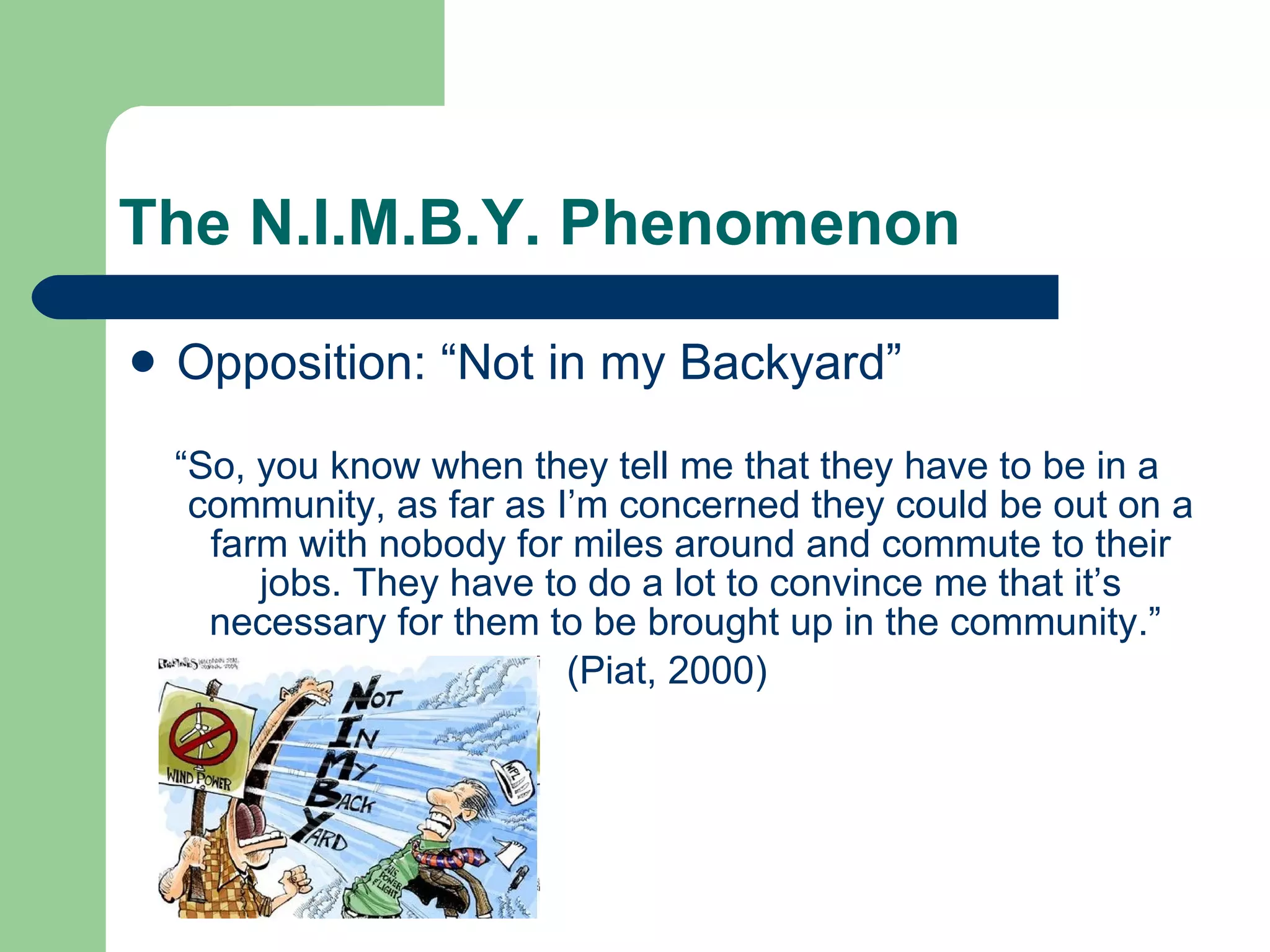
The N.I.M.B.Y. Phenomenon Opposition: “Not in my Backyard” “ So, you know when they tell me that they have to be in a community, as far as I’m concerned they could be out on a farm with nobody for miles around and commute to their jobs. They have to do a lot to convince me that it’s necessary for them to be brought up in the community.”  (Piat, 2000)
Some Terms Deinstitutionalization : Transitioning out of institutionalized care Social Reintegration : Being incorporated back into society Stakeholders-  Community members Postsiting-  events to encourage group home resident and stakeholder relations after the group home is opened
Opening a Group Home 2 methods:  Low-profile: Group-home is opened without consultation or notification of stakeholders High-profile: Group-home is opened after consultation and/or notification of stakeholders Before deciding which method is better we need a better understanding of stakeholder opposition
Underlying Beliefs  Stakeholder’s opposition seems to be grounded in underlying beliefs and concerns about the feasibility of: Deinstitutionalization Social Integration (Piat, 2000)
Underlying beliefs: Deinstitutionalization Group homes = financial venture for making money  “ I cannot, as an intelligent and reasonable individual, accept the fact that we take handicapped individuals ... that we place them with families, or in the hospital ... the major reason is to save money. Because that’s the goal of politicians. The most important goal for politicians, in all this is money.” (Piat, 2000)
Underlying beliefs: Deinstitutionalization Believed that group homes were no less restrictive than institutions.  “ These kids are being put in a prison. If they would be in an institution there would be no difference at all. It’s just because it’s a house. But it’s not different. In an institution they will be locked in. Here they are locked in too.”  (Piat, 2000)
Underlying beliefs: Social Integration Stakeholders believed that integration into community was unrealistic Integration Barriers (Piat, 2000): Unwilling/unable to integrate  Developers did not plan to integrate group home residents  Integration would not be beneficial for the group home residents or the community.
Stakeholder’s Fears Fears:  Safety (Schwartz & Rabinovitz, 2001)  Thought that property values would decrease (Piat, 2000; Cook, 1997) Negative impact on neighborhood and resident’s quality of life (Piat, 2000) Increased traffic, noise, inappropriate behavior (Cook, 1997)
Research shows Safety Not negatively affected by group homes (Center for Community Corrections, 2002) Property Values Have been found to remain stable (Dear, 1977) and may actually increase when a group home is present (Center for Community Corrections, 2002) Impact on neighborhood/quality of life Group homes blended into the community (Cook, 1997) Many stakeholders don’t know the group home is there (Healing Homes Video)
So what? We can use what we know about stakeholder concerns to promote the opening of a group home.  Knowing these concerns, which type of approach will be most effective in opening and maintaining a group home?
Low-profile Approach Rationale: Informing the community ahead of time could lead to stakeholders blocking the group-home from being built (Piat, 2000) Advantage: Less likely to encounter initial opposition from stakeholders (Zippay, 2007) Disadvantage: Unaware of stakeholder concerns Opposition begins as soon as group-home is built Could this have a negative effect on group-home residents?
Example of Low-profile Approach Mansfield Group Home 8 Children with multiple disabilities Ages 11-17 Middle Income Residential Community Single-family dwelling adapted for children with disabilities. (Piat, 2000)
What happened? Residents found out about the group home at a public information meeting after the group home had already opened. Residents mobilized opposition efforts Petitions Public Information Meeting: Resident’s rejected the group home Community residents forced to accept group home (Piat, 2000)
High-Profile Approach Rationale: Educate stakeholders and encourage  discussion to decrease opposition to the group home.  Advantages Uses educational measures to inform neighborhood    increased satisfaction (Schwartz & Rabinovitz, 2001). Educates community about mental-health needs More likely to make use of postsiting (Zippay, 2007).  Increases contact between group home residents and stakeholders (Jason, et. al., 2008). Disadvantages Increased initial opposition (Zippay, 2007)
Example of High-Profile Approach: Camden DREAMS D eveloping successful permanent housing R enewing their love for themselves and others E xperiencing healthy, productive independent living A chieving the ability to visualize positive futures M astering household budgeting and responsible decision-making S trengthening and improving communities and neighborhoods” (http://www.centerffs.org/programs/CamdenDREAMS.htm)
Camden DREAMS Supportive Housing program for youth aging out of foster care Ages 18-21 Apartments- Residents have access to voluntary support services onsite. (Stagliano & Henderson, 2008)
What happened? Center for Family Services (CFS) targeted improvement of neighborhood, safety, and the city to encourage community support Educational Campaign to show residents benefits of programs Engaged important members of the community (e.g. Neighborhood Association, City Officials, etc.) (Stagliano & Henderson, 2008)
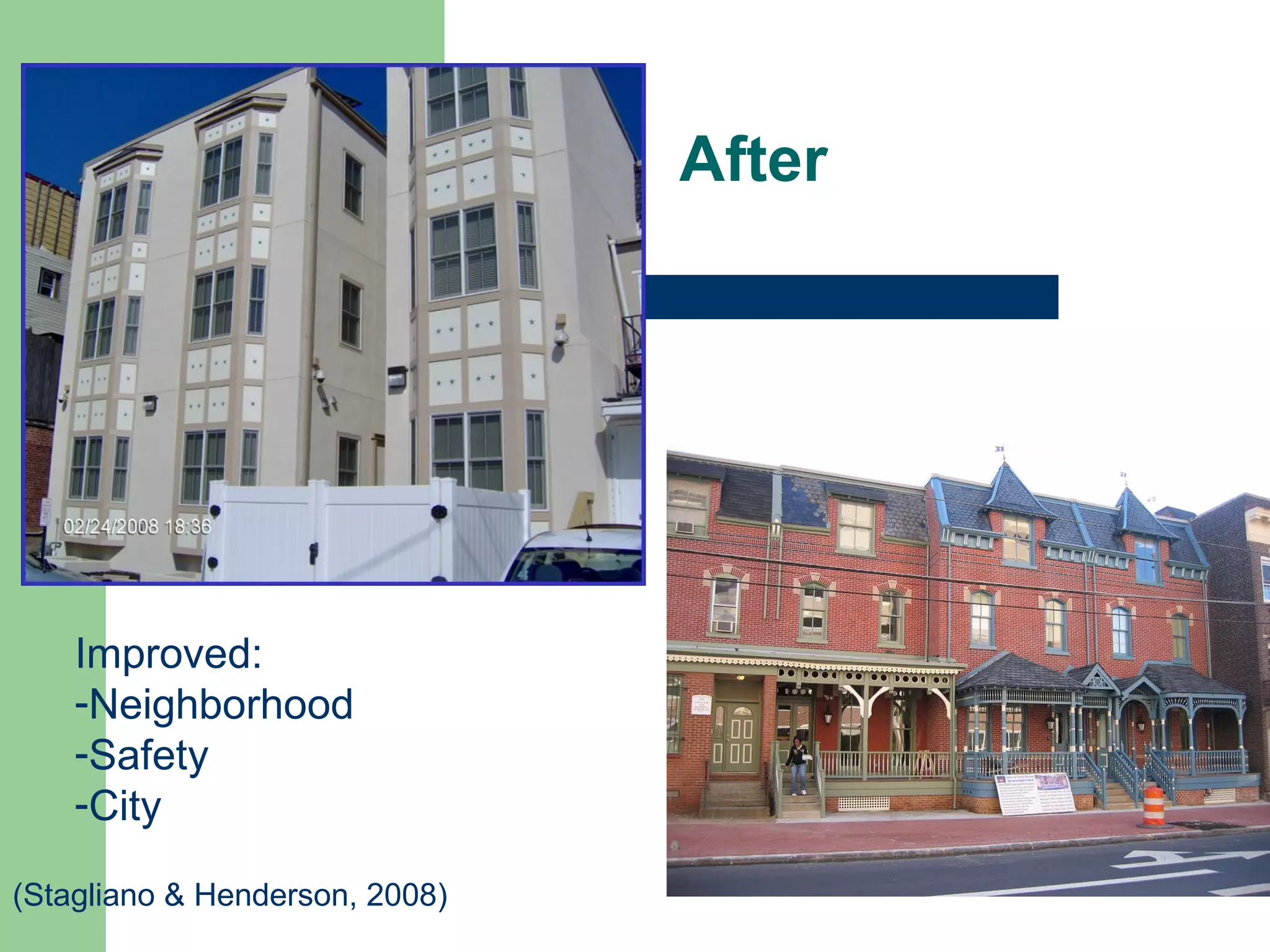
Educational Campaign Targeted:  Neighborhood Improvement of the block   increases property value Safety Added lighting and security cameras City Group-home residents are potential homeowners and consumers Cleaning up a condemned property (Stagliano & Henderson, 2008)
Before: Condemned Property Site for Prostitution and Drug Use Eyesore for city residents (Stagliano & Henderson, 2008)  Camden Dreams Before
After Improved: Neighborhood Safety City (Stagliano & Henderson, 2008)
What happened? Initially, opposition to group-home Long-term- Camden DREAMS has become a success story Important to use high-profile approach correctly  Know your community Target aspects of community that can be benefited by a group-home
So why is a High Profile approach best method for opening a group home?  Allows planners to rebuke myths (e.g. safety, property values, etc.  Stakeholders don’t feel betrayed or tricked into having the home in their neighborhood Using high-profile approach makes community aware of the benefits of group-homes.  Better for residents- less opposition is less stressful Better for community- group-home residents can become contributing community members
Healing Homes Support for Planners who want to use a high-profile approach http://www.youtube.com/watch?v=EleuBNiIICU&NR=1 http://www.youtube.com/watch?v=3B1BL9pyDrM
Healing Homes Offers resources to group-home planners for engaging the community Launched an educational campaign to increase the understanding and support of group-homes for children with mental health and other needs. (Healing Homes Release, 2009) Handouts, Video, Flyers Resources on Fair Housing Act & Anti-Disability Laws
Summary  High-Profile Approach is the best method for opening and maintaining success of a youth/adolescent group home Builds ties with community Encourages adolescent integration into community Engages stakeholders and addresses their concerns to make transition less stressful Provides accurate information on group homes to refute myths.
References Cook, J.R. (1997). Neighbors’ perceptions of group homes . Community  Mental Health Journa l, 33, 287–299 Center for Community Corrections, in Partnership with Doble Research  Associates, Inc. (2002). Public outreach and halfway houses research  and intergovernmental solutions final report: Summary of Findings.  Washington, DC Center for Family Services (2010, April 26). Camden DREAMS. Retrieved  from:  http:// www.centerffs.org/programs/CamdenDREAMS.htm Dear, M. (1977). Impact of mental health facilities on property values.  Community Mental Health   Journal , 13, 150–157. Healing Homes (2010, April 26). Part 1: Healing homes, a road to recovery  for NJ  Youth. Retrieved from  http:// www.youtube.com/watch?v = EleuBNiIICU&NR =1 Healing Homes (2010, April 26). Part 2: Healing homes, a road to recovery  for NJ  Youth. Retrieved from  http://www.youtube.com/watch?v=3B1BL9pyDrM Healing Homes Release (2009, May 13). New child advocate campaign  debunks myths about youth homes. Press Release.  Healing Homes Flyer (n.d.) A road to recovery for New Jersey’s Youth. Flyer.
References (continued) Jason, L., Groh, D., Durocher, M., Alvarez, J., Aase, D. M., & Ferrari, J. R.  (2008). Counteracting “Not in my backyard”: The positive effects of  greater occupancy within mutual help recovery homes.  Journal of  Community Psychology, 36,  947-958. Piat, M. (2000). The NIMBY phenomenon: community residents’ concerns  about housing for deinstitutionalized people.  Health & Social Work, 25,   127-138. Schwartz, C., & Rabinovitz, S. (2001). Residential facilities in the community  for people with intellectual disability: How neighbours’ perceptions are  affected by the interaction of facility and neighbour variables . Journal  of Applied Research in Intellectual Disabilities, 14,  100–110. Stagliano, R. & Henderson, E. (October, 2008). Camden DREAMS: A  permanent supportive housing opportunity for youth aging out of foster  care. Powerpoint presented at the National Conference for the  Alliance of Children and Families, Baltimore. Zippay, A. L. (2007). Psychiatric residences: Notification, NIMBY, and  neighborhood relations.  Psychiatric Services, 58,  109-113.

Opening A Group Home For Adolescents

  • 1.
    Opening a GroupHome for Adolescents: An effective High-Profile approach will lead to the best outcomes for group home residents and community members Rob Henderson
  • 2.
    Background Group homesmay: Allow individuals to integrate back into the community Serve as a means to educate the public about stigmatized populations Be a deterrent to crime- residents usually have to maintain positive behaviors to stay there (Jason, Groh, Durocher, Alvarez, Aase, & Ferrari, 2008)
  • 3.
    The N.I.M.B.Y. PhenomenonOpposition: “Not in my Backyard” “ So, you know when they tell me that they have to be in a community, as far as I’m concerned they could be out on a farm with nobody for miles around and commute to their jobs. They have to do a lot to convince me that it’s necessary for them to be brought up in the community.” (Piat, 2000)
  • 4.
    Some Terms Deinstitutionalization: Transitioning out of institutionalized care Social Reintegration : Being incorporated back into society Stakeholders- Community members Postsiting- events to encourage group home resident and stakeholder relations after the group home is opened
  • 5.
    Opening a GroupHome 2 methods: Low-profile: Group-home is opened without consultation or notification of stakeholders High-profile: Group-home is opened after consultation and/or notification of stakeholders Before deciding which method is better we need a better understanding of stakeholder opposition
  • 6.
    Underlying Beliefs Stakeholder’s opposition seems to be grounded in underlying beliefs and concerns about the feasibility of: Deinstitutionalization Social Integration (Piat, 2000)
  • 7.
    Underlying beliefs: DeinstitutionalizationGroup homes = financial venture for making money “ I cannot, as an intelligent and reasonable individual, accept the fact that we take handicapped individuals ... that we place them with families, or in the hospital ... the major reason is to save money. Because that’s the goal of politicians. The most important goal for politicians, in all this is money.” (Piat, 2000)
  • 8.
    Underlying beliefs: DeinstitutionalizationBelieved that group homes were no less restrictive than institutions. “ These kids are being put in a prison. If they would be in an institution there would be no difference at all. It’s just because it’s a house. But it’s not different. In an institution they will be locked in. Here they are locked in too.” (Piat, 2000)
  • 9.
    Underlying beliefs: SocialIntegration Stakeholders believed that integration into community was unrealistic Integration Barriers (Piat, 2000): Unwilling/unable to integrate Developers did not plan to integrate group home residents Integration would not be beneficial for the group home residents or the community.
  • 10.
    Stakeholder’s Fears Fears: Safety (Schwartz & Rabinovitz, 2001) Thought that property values would decrease (Piat, 2000; Cook, 1997) Negative impact on neighborhood and resident’s quality of life (Piat, 2000) Increased traffic, noise, inappropriate behavior (Cook, 1997)
  • 11.
    Research shows SafetyNot negatively affected by group homes (Center for Community Corrections, 2002) Property Values Have been found to remain stable (Dear, 1977) and may actually increase when a group home is present (Center for Community Corrections, 2002) Impact on neighborhood/quality of life Group homes blended into the community (Cook, 1997) Many stakeholders don’t know the group home is there (Healing Homes Video)
  • 12.
    So what? Wecan use what we know about stakeholder concerns to promote the opening of a group home. Knowing these concerns, which type of approach will be most effective in opening and maintaining a group home?
  • 13.
    Low-profile Approach Rationale:Informing the community ahead of time could lead to stakeholders blocking the group-home from being built (Piat, 2000) Advantage: Less likely to encounter initial opposition from stakeholders (Zippay, 2007) Disadvantage: Unaware of stakeholder concerns Opposition begins as soon as group-home is built Could this have a negative effect on group-home residents?
  • 14.
    Example of Low-profileApproach Mansfield Group Home 8 Children with multiple disabilities Ages 11-17 Middle Income Residential Community Single-family dwelling adapted for children with disabilities. (Piat, 2000)
  • 15.
    What happened? Residentsfound out about the group home at a public information meeting after the group home had already opened. Residents mobilized opposition efforts Petitions Public Information Meeting: Resident’s rejected the group home Community residents forced to accept group home (Piat, 2000)
  • 16.
    High-Profile Approach Rationale:Educate stakeholders and encourage discussion to decrease opposition to the group home. Advantages Uses educational measures to inform neighborhood  increased satisfaction (Schwartz & Rabinovitz, 2001). Educates community about mental-health needs More likely to make use of postsiting (Zippay, 2007). Increases contact between group home residents and stakeholders (Jason, et. al., 2008). Disadvantages Increased initial opposition (Zippay, 2007)
  • 17.
    Example of High-ProfileApproach: Camden DREAMS D eveloping successful permanent housing R enewing their love for themselves and others E xperiencing healthy, productive independent living A chieving the ability to visualize positive futures M astering household budgeting and responsible decision-making S trengthening and improving communities and neighborhoods” (http://www.centerffs.org/programs/CamdenDREAMS.htm)
  • 18.
    Camden DREAMS SupportiveHousing program for youth aging out of foster care Ages 18-21 Apartments- Residents have access to voluntary support services onsite. (Stagliano & Henderson, 2008)
  • 19.
    What happened? Centerfor Family Services (CFS) targeted improvement of neighborhood, safety, and the city to encourage community support Educational Campaign to show residents benefits of programs Engaged important members of the community (e.g. Neighborhood Association, City Officials, etc.) (Stagliano & Henderson, 2008)
  • 20.
    Educational Campaign Targeted: Neighborhood Improvement of the block  increases property value Safety Added lighting and security cameras City Group-home residents are potential homeowners and consumers Cleaning up a condemned property (Stagliano & Henderson, 2008)
  • 21.
    Before: Condemned PropertySite for Prostitution and Drug Use Eyesore for city residents (Stagliano & Henderson, 2008) Camden Dreams Before
  • 22.
    After Improved: NeighborhoodSafety City (Stagliano & Henderson, 2008)
  • 23.
    What happened? Initially,opposition to group-home Long-term- Camden DREAMS has become a success story Important to use high-profile approach correctly Know your community Target aspects of community that can be benefited by a group-home
  • 24.
    So why isa High Profile approach best method for opening a group home? Allows planners to rebuke myths (e.g. safety, property values, etc. Stakeholders don’t feel betrayed or tricked into having the home in their neighborhood Using high-profile approach makes community aware of the benefits of group-homes. Better for residents- less opposition is less stressful Better for community- group-home residents can become contributing community members
  • 25.
    Healing Homes Supportfor Planners who want to use a high-profile approach http://www.youtube.com/watch?v=EleuBNiIICU&NR=1 http://www.youtube.com/watch?v=3B1BL9pyDrM
  • 26.
    Healing Homes Offersresources to group-home planners for engaging the community Launched an educational campaign to increase the understanding and support of group-homes for children with mental health and other needs. (Healing Homes Release, 2009) Handouts, Video, Flyers Resources on Fair Housing Act & Anti-Disability Laws
  • 27.
    Summary High-ProfileApproach is the best method for opening and maintaining success of a youth/adolescent group home Builds ties with community Encourages adolescent integration into community Engages stakeholders and addresses their concerns to make transition less stressful Provides accurate information on group homes to refute myths.
  • 28.
    References Cook, J.R.(1997). Neighbors’ perceptions of group homes . Community Mental Health Journa l, 33, 287–299 Center for Community Corrections, in Partnership with Doble Research Associates, Inc. (2002). Public outreach and halfway houses research and intergovernmental solutions final report: Summary of Findings. Washington, DC Center for Family Services (2010, April 26). Camden DREAMS. Retrieved from: http:// www.centerffs.org/programs/CamdenDREAMS.htm Dear, M. (1977). Impact of mental health facilities on property values. Community Mental Health Journal , 13, 150–157. Healing Homes (2010, April 26). Part 1: Healing homes, a road to recovery for NJ Youth. Retrieved from http:// www.youtube.com/watch?v = EleuBNiIICU&NR =1 Healing Homes (2010, April 26). Part 2: Healing homes, a road to recovery for NJ Youth. Retrieved from http://www.youtube.com/watch?v=3B1BL9pyDrM Healing Homes Release (2009, May 13). New child advocate campaign debunks myths about youth homes. Press Release. Healing Homes Flyer (n.d.) A road to recovery for New Jersey’s Youth. Flyer.
  • 29.
    References (continued) Jason,L., Groh, D., Durocher, M., Alvarez, J., Aase, D. M., & Ferrari, J. R. (2008). Counteracting “Not in my backyard”: The positive effects of greater occupancy within mutual help recovery homes. Journal of Community Psychology, 36, 947-958. Piat, M. (2000). The NIMBY phenomenon: community residents’ concerns about housing for deinstitutionalized people. Health & Social Work, 25, 127-138. Schwartz, C., & Rabinovitz, S. (2001). Residential facilities in the community for people with intellectual disability: How neighbours’ perceptions are affected by the interaction of facility and neighbour variables . Journal of Applied Research in Intellectual Disabilities, 14, 100–110. Stagliano, R. & Henderson, E. (October, 2008). Camden DREAMS: A permanent supportive housing opportunity for youth aging out of foster care. Powerpoint presented at the National Conference for the Alliance of Children and Families, Baltimore. Zippay, A. L. (2007). Psychiatric residences: Notification, NIMBY, and neighborhood relations. Psychiatric Services, 58, 109-113.

Editor's Notes

  • #11 Personal Security concerns, such as fear of criminal acts and physical aggression toward one’s family