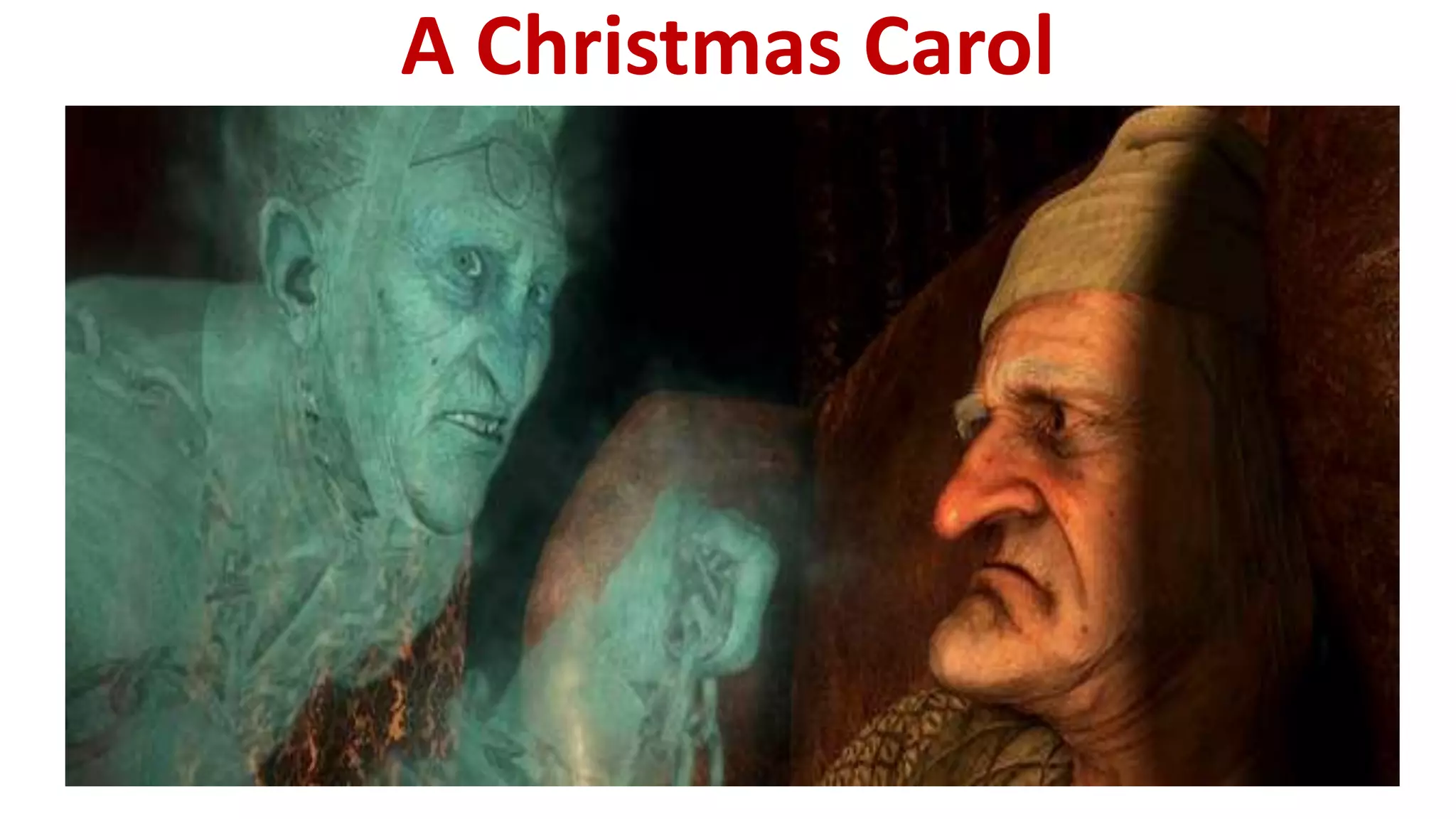
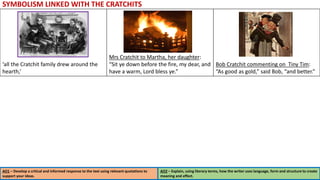
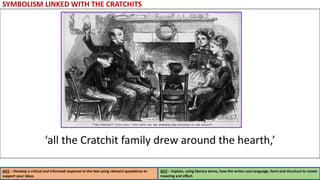
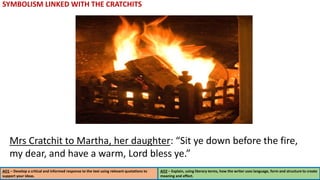
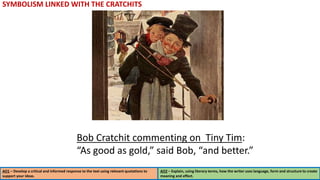
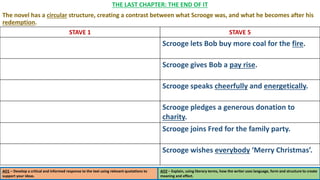
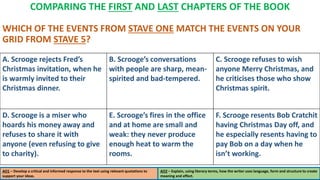
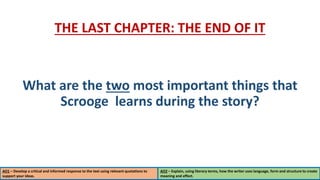
A Christmas Carol
A Christmas Carol
by Charles Dickens
English Literature Paper 1
Section B: 19th Century Novel
A03 – Show understanding of
relationships between texts and
the context they were written in.
AO2 – Explain, using literary
terms, how the writer uses
language, form and structure to
create meaning and effect.
AO1 – Develop a critical and
informed response to the text
using relevant quotations to
support your ideas.
AO4 – Use a range of vocabulary
and sentences with accurate
spelling and grammar.
A Christmas Carol
https://www.youtube.com/watch?v=zhL5DCizj5c
(Industrial revolution)
https://www.youtube.com/watch?v=s9JL3d_pCOc
(Lives of ordinary people)
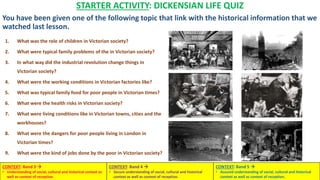
STARTER ACTIVITY: DICKENSIAN LIFE QUIZ
You have been given one of the following topic that link with the historical information that we
watched last lesson.
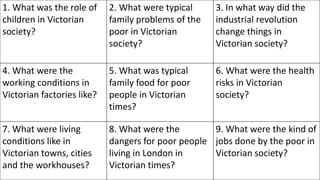
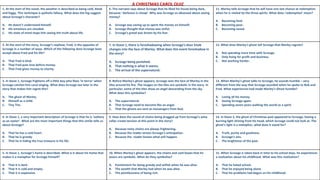
1. What was the role of children in Victorian society?
2. What were typical family problems of the in Victorian society?
3. In what way did the industrial revolution change things in
Victorian society?
4. What were the working conditions in Victorian factories like?
5. What was typical family food for poor people in Victorian times?
6. What were the health risks in Victorian society?
7. What were living conditions like in Victorian towns, cities and the
workhouses?
8. What were the dangers for poor people living in London in
Victorian times?
9. What were the kind of jobs done by the poor in Victorian society?
CONTEXT: Band 3 
• Understanding of social, cultural and historical context as
well as context of reception.
CONTEXT: Band 4 
• Secure understanding of social, cultural and historical
context as well as context of reception.
CONTEXT: Band 5 
• Assured understanding of social, cultural and historical
context as well as context of reception.
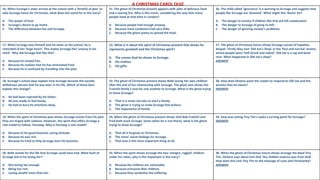
1. What was the role of
children in Victorian
society?
2. What were typical
family problems of the
poor in Victorian
society?
3. In what way did the
industrial revolution
change things in
Victorian society?
4. What were the
working conditions in
Victorian factories like?
5. What was typical
family food for poor
people in Victorian
times?
6. What were the health
risks in Victorian
society?
7. What were living
conditions like in
Victorian towns, cities
and the workhouses?
8. What were the
dangers for poor people
living in London in
Victorian times?
9. What were the kind of
jobs done by the poor in
Victorian society?
A Christmas Carol
by Charles Dickens
Link for an audio version of the book:
https://www.youtube.com/watch?v=n3fN_-rupwo
Link for a 12:28 min. introduction to the background to the story:
https://www.youtube.com/watch?v=cTHAN3_P7uE
Link for a 30 min. analysis of the book, perhaps for the two highest sets:
https://www.youtube.com/watch?v=3R5COTmeBfI
Social commentary is the act of using rhetorical means to provide commentary
on issues in a society. This is often done with the idea of implementing or
promoting change by informing the general populace about a given problem and
appealing to people's sense of justice.
Allegory is a piece of literature in which the apparent meaning of the characters
and events is used to symbolize a deeper moral or spiritual meaning.
Allegory is more than just symbolism, it is a complete narrative which involves
characters, and events that stand for an abstract idea or an event.
STARTER ACTIVITY…
Copy down the following onto your Christmas Carol title page:
CONTEXT: Band 3 
• Understanding of social, cultural and historical context as
well as context of reception.
CONTEXT: Band 4 
• Secure understanding of social, cultural and historical
context as well as context of reception.
CONTEXT: Band 5 
• Assured understanding of social, cultural and historical
context as well as context of reception.
DISCUSS…
Using your knowledge of contextual information of the
Victorian Era, why do you think that writing a social
commentary was something that Dickens thought was
important to do?
CONTEXT: Band 3 
• Understanding of social, cultural and historical context as
well as context of reception.
CONTEXT: Band 4 
• Secure understanding of social, cultural and historical
context as well as context of reception.
CONTEXT: Band 5 
• Assured understanding of social, cultural and historical
context as well as context of reception.
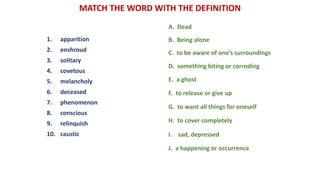
MATCH THE WORD WITH THE DEFINITION
1. apparition
2. enshroud
3. solitary
4. covetous
5. melancholy
6. deceased
7. phenomenon
8. conscious
9. relinquish
10. caustic
A. Dead
B. Being alone
C. to be aware of one’s surroundings
D. something biting or corroding
E. a ghost
F. to release or give up
G. to want all things for oneself
H. to cover completely
I. sad, depressed
J. a happening or occurrence
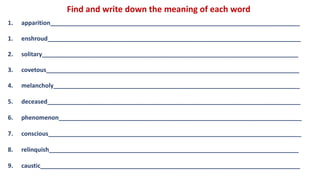
Find and write down the meaning of each word
1. apparition___________________________________________________________________________
1. enshroud____________________________________________________________________________
2. solitary_____________________________________________________________________________
3. covetous____________________________________________________________________________
4. melancholy__________________________________________________________________________
5. deceased____________________________________________________________________________
6. phenomenon_________________________________________________________________________
7. conscious____________________________________________________________________________
8. relinquish___________________________________________________________________________
9. caustic______________________________________________________________________________
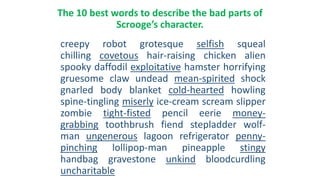
The 10 best words to describe the bad parts of
Scrooge’s character.
creepy robot grotesque selfish squeal
chilling covetous hair-raising chicken alien
spooky daffodil exploitative hamster horrifying
gruesome claw undead mean-spirited shock
gnarled body blanket cold-hearted howling
spine-tingling miserly ice-cream scream slipper
zombie tight-fisted pencil eerie money-
grabbing toothbrush fiend stepladder wolf-
man ungenerous lagoon refrigerator penny-
pinching lollipop-man pineapple stingy
handbag gravestone unkind bloodcurdling
uncharitable
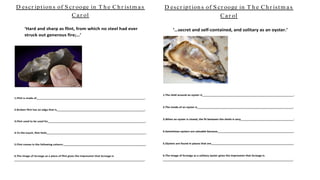
D escr iption s of S cr ooge in T h e Ch r istm as
Car ol
‘Hard and sharp as flint, from which no steel had ever
struck out generous fire;…’
1.Flint is made of______________________________________________________________________.
2.Broken flint has an edge that is_________________________________________________________.
3.Flint used to be used for_______________________________________________________________.
4.To the touch, flint feels________________________________________________________________.
5.Flint comes in the following colours:_____________________________________________________.
6.The image of Scrooge as a piece of flint gives the impression that Scrooge is
____________________________________________________________________________________.
D escr iption s of S cr ooge in T h e Ch r istm as
Car ol
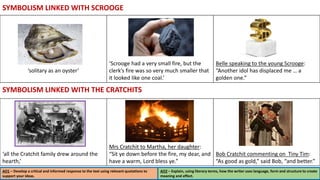
‘…secret and self-contained, and solitary as an oyster.’
1.The shell around an oyster is___________________________________________________________.
2.The inside of an oyster is______________________________________________________________.
3.When an oyster is closed, the fit between the shells is very__________________________________.
4.Sometimes oysters are valuable because_________________________________________________.
5.Oysters are found in places that are_____________________________________________________.
6.The image of Scrooge as a solitary oyster gives the impression that Scrooge is
____________________________________________________________________________________.
Lesson 1 - Context
LO: To understand social conditions at the
time when Dickens was writing.
A03 – Show understanding of
relationships between texts and
the context they were written in.
LO: To understand social conditions at the time when Dickens was writing.
A03 – Show understanding of
relationships between texts and
the context they were written in.
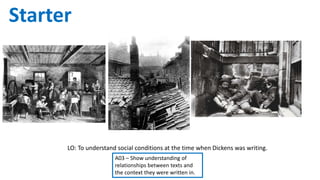
Starter What can you tell from these images about life in
the 19th Century?
LO: To understand social conditions at the time when Dickens was writing.
A03 – Show understanding of
relationships between texts and
the context they were written in.
Task
Complete research into:
• Difference in living conditions for the rich and the poor
• Industrial revolution
• Dickens as a social reformer
• Workhouses
Split into eight groups. Create a poster and presentation about
what you have researched regarding life in the 19th Century.
LO: To understand social conditions at the time when Dickens was writing.
A03 – Show understanding of
relationships between texts and
the context they were written in.
As you listen to the presentations you need to write three facts about each
of the four topics:
• Difference in living conditions for the rich and the poor
• Industrial revolution
• Dickens as a social reformer
• Workhouses
Present Your Research
LO: Explore the introduction of
Scrooge in the novel.
AO2 – Explain, using literary
terms, how the writer uses
language, form and structure to
create meaning and effect.
Lesson 2 – first impression of Scrooge.
AO1 – Develop a critical and
informed response to the text
using relevant quotations to
support your ideas.
LO: Explore the introduction of Scrooge in the novel.
AO2 – Explain, using literary
terms, how the writer uses
language, form and structure to
create meaning and effect.
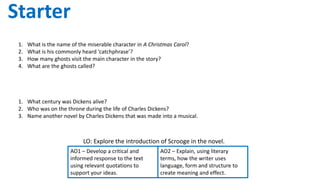
Starter
AO1 – Develop a critical and
informed response to the text
using relevant quotations to
support your ideas.
How much do you know about A Christmas Carol?
1. What is the name of the miserable character in A Christmas Carol?
2. What is his commonly heard ‘catchphrase’?
3. How many ghosts visit the main character in the story?
4. What are the ghosts called?
How much do you know about Charles Dickens?
1. What century was Dickens alive?
2. Who was on the throne during the life of Charles Dickens?
3. Name another novel by Charles Dickens that was made into a musical.
LO: Explore the introduction of Scrooge in the novel.
AO2 – Explain, using literary
terms, how the writer uses
language, form and structure to
create meaning and effect.
AO1 – Develop a critical and
informed response to the text
using relevant quotations to
support your ideas.
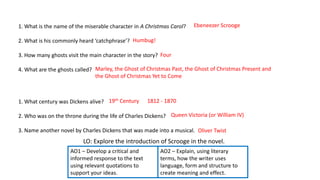
How much do you know about A Christmas Carol?
1. What is the name of the miserable character in A Christmas Carol?
2. What is his commonly heard ‘catchphrase’?
3. How many ghosts visit the main character in the story?
4. What are the ghosts called?
How much do you know about Charles Dickens?
1. What century was Dickens alive?
2. Who was on the throne during the life of Charles Dickens?
3. Name another novel by Charles Dickens that was made into a musical.
Ebeneezer Scrooge
Humbug!
Four
Marley, the Ghost of Christmas Past, the Ghost of Christmas Present and
the Ghost of Christmas Yet to Come
19th Century 1812 - 1870
Queen Victoria (or William IV)
Oliver Twist
LO: Explore the introduction of Scrooge in the novel.
AO2 – Explain, using literary
terms, how the writer uses
language, form and structure to
create meaning and effect.
Read pages 1 – 8
Introduction to Scrooge
AO1 – Develop a critical and
informed response to the text
using relevant quotations to
support your ideas.
What impressions have you built from these pages?
Pick out the 5 best words to describe
Scrooge’s character.
creepy; robot; grotesque; selfish; squeal;
chilling; covetous; hair-raising; chicken; alien;
spooky; daffodil; exploitative; hamster;
horrifying; gruesome; claw; undead; mean-
spirited; shock; gnarled; body; blanket; cold-
hearted; howling; spine-tingling; miserly; ice-
cream; scream; slipper; zombie; tight-fisted;
pencil; eerie; money-grabbing; toothbrush;
fiend; stepladder; wolf-man; ungenerous;
lagoon; refrigerator; penny-pinching; lollipop-
man; pineapple; stingy; handbag; gravestone;
unkind; bloodcurdling; uncharitable
Learning Objective
By the end of the lesson…
You will have explored
language in the text and
explained how Dickens
presents Scrooge’s
personality
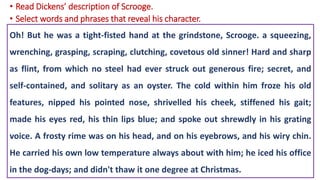
Oh! But he was a tight-fisted hand at the grindstone, Scrooge. a squeezing,
wrenching, grasping, scraping, clutching, covetous old sinner! Hard and sharp
as flint, from which no steel had ever struck out generous fire; secret, and
self-contained, and solitary as an oyster. The cold within him froze his old
features, nipped his pointed nose, shrivelled his cheek, stiffened his gait;
made his eyes red, his thin lips blue; and spoke out shrewdly in his grating
voice. A frosty rime was on his head, and on his eyebrows, and his wiry chin.
He carried his own low temperature always about with him; he iced his office
in the dog-days; and didn't thaw it one degree at Christmas.
• Read Dickens’ description of Scrooge.
• Select words and phrases that reveal his character.
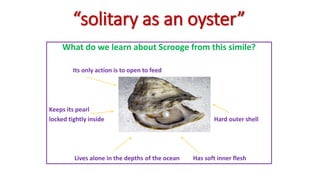
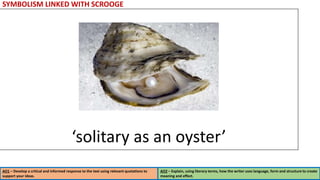
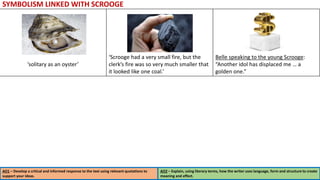
“solitary as an oyster”
What do we learn about Scrooge from this simile?
Its only action is to open to feed
Keeps its pearl
locked tightly inside Hard outer shell
Lives alone in the depths of the ocean Has soft inner flesh
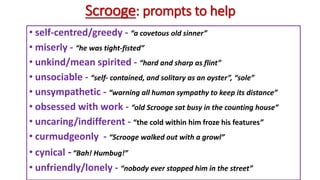
Scrooge: prompts to help
• self-centred/greedy - “a covetous old sinner”
• miserly - “he was tight-fisted”
• unkind/mean spirited - “hard and sharp as flint”
• unsociable - “self- contained, and solitary as an oyster”, “sole”
• unsympathetic - “warning all human sympathy to keep its distance”
• obsessed with work - “old Scrooge sat busy in the counting house”
• uncaring/indifferent - “the cold within him froze his features”
• curmudgeonly - “Scrooge walked out with a growl”
• cynical -“Bah! Humbug!”
• unfriendly/lonely - “nobody ever stopped him in the street”
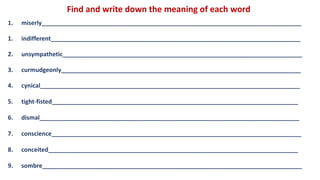
Find and write down the meaning of each word
1. miserly______________________________________________________________________________
1. indifferent___________________________________________________________________________
2. unsympathetic________________________________________________________________________
3. curmudgeonly________________________________________________________________________
4. cynical______________________________________________________________________________
5. tight-fisted__________________________________________________________________________
6. dismal______________________________________________________________________________
7. conscience___________________________________________________________________________
8. conceited___________________________________________________________________________
9. sombre______________________________________________________________________________
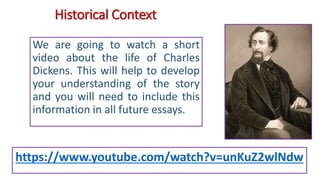
https://www.youtube.com/watch?v=unKuZ2wlNdw
Historical Context
We are going to watch a short
video about the life of Charles
Dickens. This will help to develop
your understanding of the story
and you will need to include this
information in all future essays.
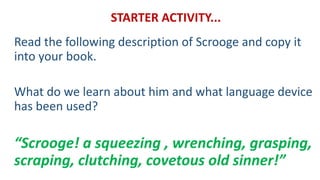
STARTER ACTIVITY...
Read the following description of Scrooge and copy it
into your book.
What do we learn about him and what language device
has been used?
“Scrooge! a squeezing , wrenching, grasping,
scraping, clutching, covetous old sinner!”
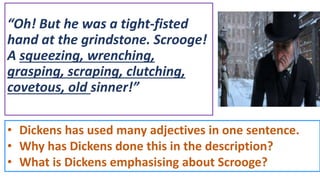
“Oh! But he was a tight-fisted
hand at the grindstone. Scrooge!
A squeezing, wrenching,
grasping, scraping, clutching,
covetous, old sinner!”
• Dickens has used many adjectives in one sentence.
• Why has Dickens done this in the description?
• What is Dickens emphasising about Scrooge?
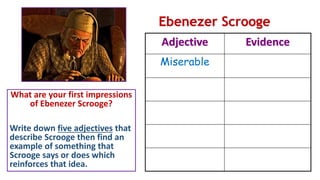
Ebenezer Scrooge
What are your first impressions
of Ebenezer Scrooge?
Write down five adjectives that
describe Scrooge then find an
example of something that
Scrooge says or does which
reinforces that idea.
Adjective Evidence
Miserable
Plenary Activity: “solitary as an oyster”
In your exercise books, write a paragraph that explores the above quotation.
Structure your response as follows:
• Point: one sentence; a clear idea about Scrooge’s personality.
• Evidence: one sentence; embed the quotation.
• Explanation: a detailed analysis that explores individual words (add layers of
meaning).
• Historical context: add information that shows you understand the relationship
between Scrooge in the story and the kind of person he is representing from the
Victorian period: the greedy, uncaring, selfish rich who had no feelings of love, pity or
compassion for the plight of the poor.
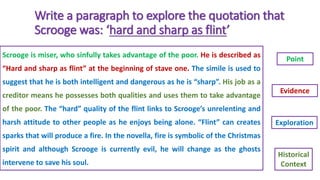
Write a paragraph to explore the quotation that
Scrooge was: ‘hard and sharp as flint’
Scrooge is miser, who sinfully takes advantage of the poor. He is described as
“Hard and sharp as flint” at the beginning of stave one. The simile is used to
suggest that he is both intelligent and dangerous as he is “sharp”. His job as a
creditor means he possesses both qualities and uses them to take advantage
of the poor. The “hard” quality of the flint links to Scrooge’s unrelenting and
harsh attitude to other people as he enjoys being alone. “Flint” can creates
sparks that will produce a fire. In the novella, fire is symbolic of the Christmas
spirit and although Scrooge is currently evil, he will change as the ghosts
intervene to save his soul.
Point
Evidence
Exploration
Historical
Context
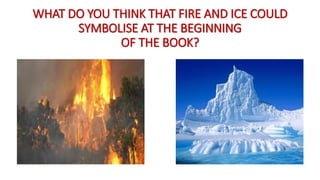
WHAT DO YOU THINK THAT FIRE AND ICE COULD
SYMBOLISE AT THE BEGINNING
OF THE BOOK?
The relationship between Scrooge and his Clerk (Bob Cratchit)
“The door of Scrooge's counting-house was open that he might keep
his eye upon his clerk, who in a dismal little cell beyond, a sort of
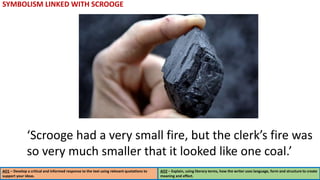
tank, was copying letters. Scrooge had a very small fire, but the
clerk's fire was so very much smaller that it looked like one coal. But
he couldn't replenish it, for Scrooge kept the coal-box in his own
room…the clerk put on his white comforter and tried to warm
himself; in which effort...he failed ”
1. What do we learn about the relationship between Scrooge and his clerk
(Bob Cratchit) in this extract?
2. What impression do we get of Bob’s social positions?
3. Dickens makes reference to fire. What contrasting things could fire and
ice symbolise in the opening pages of the book?
AO1 – Develop a critical and informed response to the text using relevant quotations to
support your ideas.
AO2 – Explain, using literary terms, how the writer uses language, form and structure to create
meaning and effect.
CORE CHRISTIAN VALUES DICKENS’ SENSE OF ‘SIN’
• Justice
• Kindness
• Humility
• Selfishness
• Greed
• Living only for financial
profit
1. THE HOT AND THE COLD
Scrooge is described as being icy: ‘the
cold within him froze his old features’
Contrastingly, Scrooge’s nephew, Fred,
is described as a warm character: ‘all in
a glow’. Fred says that Christmas is a
‘kind, charitable, pleasant time’, whist
Scrooge says that everyone who wishes
others ‘Merry Christmas’ is an ‘idiot’.
Explain the difference that Dickens wanted to emphasise between Scrooge and Fred.
Why is the ‘cold’ and ‘hot’ imagery important in the story?
2. ATTITUDE TOWARDS THE POOR
Some gentlemen collecting for charity
visit Scrooge asking for money. They
say: ‘hundreds of thousands are in want
of common comforts , sir.’ Scrooge’s
response is to comment that the poor
are ‘surplus population’ who only
deserve the workhouse or death.
Scrooge, like the famous economist
Malthus, blamed poverty on poor
people having too many children.
What different views towards humanity do the charity collectors and Scrooge represent?
In what ways could Scrooges views be seen as unchristian?
3. PATHETIC FALLACY
Pathetic fallacy means that the state of
the weather also tells the reader
something about the mood, personality
or emotional state of a character in the
story. The weather in A Christmas Carol
reflects Scrooges emotions and state of
mind. The freezing cold and fog is
described as though it is alive and
smothering London: ‘pouring in at every
chink and keyhole.’
What is the effect of Dickens using pathetic fallacy to add to the characterisation of Scrooge?
We have already discussed what the frost and ice might represent, but what in Scrooge’s mind and heart could the fog stand for?
CHARACTERISATION OF SCROOGE IN STAVE 1 OF A CHRISTMAS CAROL
AO1 – Develop a critical and informed response to the text using relevant quotations to
support your ideas.
AO2 – Explain, using literary terms, how the writer uses language, form and structure to create
meaning and effect.
1. THE HOT AND THE COLD
Scrooge is described as being
icy: ‘the cold within him froze
his old features’
Contrastingly, Scrooge’s
nephew, Fred, is described as a
warm character: ‘all in a glow’.
Fred says that Christmas is a
‘kind, charitable, pleasant
time’, whist Scrooge says that
everyone who wishes others
‘Merry Christmas’ is an ‘idiot’.
Explain the difference that
Dickens wanted to emphasise
between Scrooge and Fred.
Why is the ‘cold’ and ‘hot’
imagery important in the story?
CHARACTERISATION OF SCROOGE IN STAVE 1 OF A CHRISTMAS CAROL
AO1 – Develop a critical and informed response to the text using relevant quotations to
support your ideas.
AO2 – Explain, using literary terms, how the writer uses language, form and structure to create
meaning and effect.
2. ATTITUDE TOWARDS THE
POOR
Some gentlemen collecting for
charity visit Scrooge asking for
money. They say: ‘hundreds of
thousands are in want of
common comforts , sir.’
Scrooge’s response is to
comment that the poor are
‘surplus population’ who only
deserve the workhouse or
death. Scrooge, like the famous
economist Malthus, blamed
poverty on poor people having
too many children.
What different views towards
humanity do the charity collectors
and Scrooge represent?
In what ways could Scrooges views
be seen as unchristian?
CHARACTERISATION OF SCROOGE IN STAVE 1 OF A CHRISTMAS CAROL
AO1 – Develop a critical and informed response to the text using relevant quotations to
support your ideas.
AO2 – Explain, using literary terms, how the writer uses language, form and structure to create
meaning and effect.
3. PATHETIC FALLACY
Pathetic fallacy means that the
state of the weather also tells the
reader something about the
mood, personality or emotional
state of a character in the story.
The weather in A Christmas Carol
reflects Scrooges emotions and
state of mind. The freezing cold
and fog is described as though it
is alive and smothering London:
‘pouring in at every chink and
keyhole.’
What is the effect of Dickens using
pathetic fallacy to add to the
characterisation of Scrooge?
We have already discussed what
the frost and ice might represent,
but what in Scrooge’s mind and
heart could the fog stand for?
CHARACTERISATION OF SCROOGE IN STAVE 1 OF A CHRISTMAS CAROL
AO1 – Develop a critical and informed response to the text using relevant quotations to
support your ideas.
AO2 – Explain, using literary terms, how the writer uses language, form and structure to create
meaning and effect.
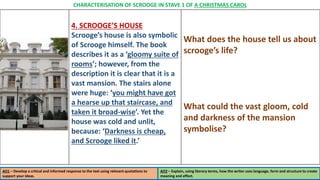
4. SCROOGE’S HOUSE
Scrooge’s house is also symbolic of
Scrooge himself. The book describes it
as a ‘gloomy suite of rooms’; however,
from the description it is clear that it is a
vast mansion. The stairs alone were
huge: ‘you might have got a hearse up
that staircase, and taken it broad-wise’.
Yet the house was cold and unlit,
because: ‘Darkness is cheap, and
Scrooge liked it.’
What does the house tell us about scrooge’s life?
What could the vast gloom, cold and darkness of the mansion symbolise?
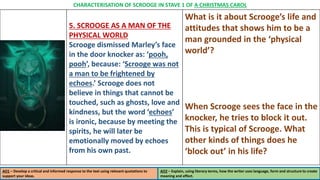
5. SCROOGE AS A MAN OF THE
PHYSICAL WORLD
Scrooge dismissed Marley’s face in the
door knocker as: ‘pooh, pooh’, because:
‘Scrooge was not a man to be frightened
by echoes.’ Scrooge does not believe in
things that cannot be touched, such as
ghosts, love and kindness, but the word
‘echoes’ is ironic, because by meeting
the spirits, he will later be emotionally
moved by echoes from his own past.
What is it about Scrooge’s life and attitudes that shows him to be a man grounded in the ‘physical world’?
When Scrooge sees the face in the knocker, he tries to block it out. This is typical of Scrooge. What other kinds of things does he
‘block out’ in his life?
6. IRONY AND FORESHADOWING
The description of the tiles around
Scrooge’s fireplace in his house are both
ironic and foreshadowing: ’the tiles
around the fire were designed to
illustrate the Scriptures ..[with].. Angelic
messengers descending through the air
on clouds’. The ‘messengers’
foreshadow the spirits to come, and the
irony is that the tiles had had no
spiritual impact on Scrooge whatsoever.
By explaining that a rich Dutch merchant had the tiles fitted in the house many years ago, what is Dickens showing the reader about
the difference between Scrooge and some of the other rich businessmen in London?
Why would Dickens want the description of the tiles to foreshadow later ‘spiritual’ events in the story?
AO1 – Develop a critical and informed response to the text using relevant quotations to
support your ideas.
AO2 – Explain, using literary terms, how the writer uses language, form and structure to create
meaning and effect.
CHARACTERISATION OF SCROOGE IN STAVE 1 OF A CHRISTMAS CAROL
4. SCROOGE’S HOUSE
Scrooge’s house is also symbolic
of Scrooge himself. The book
describes it as a ‘gloomy suite of
rooms’; however, from the
description it is clear that it is a
vast mansion. The stairs alone
were huge: ‘you might have got
a hearse up that staircase, and
taken it broad-wise’. Yet the
house was cold and unlit,
because: ‘Darkness is cheap,
and Scrooge liked it.’
What does the house tell us about
scrooge’s life?
What could the vast gloom, cold
and darkness of the mansion
symbolise?
AO1 – Develop a critical and informed response to the text using relevant quotations to
support your ideas.
AO2 – Explain, using literary terms, how the writer uses language, form and structure to create
meaning and effect.
CHARACTERISATION OF SCROOGE IN STAVE 1 OF A CHRISTMAS CAROL
5. SCROOGE AS A MAN OF THE
PHYSICAL WORLD
Scrooge dismissed Marley’s face
in the door knocker as: ‘pooh,
pooh’, because: ‘Scrooge was not
a man to be frightened by
echoes.’ Scrooge does not
believe in things that cannot be
touched, such as ghosts, love and
kindness, but the word ‘echoes’
is ironic, because by meeting the
spirits, he will later be
emotionally moved by echoes
from his own past.
What is it about Scrooge’s life and
attitudes that shows him to be a
man grounded in the ‘physical
world’?
When Scrooge sees the face in the
knocker, he tries to block it out.
This is typical of Scrooge. What
other kinds of things does he
‘block out’ in his life?
AO1 – Develop a critical and informed response to the text using relevant quotations to
support your ideas.
AO2 – Explain, using literary terms, how the writer uses language, form and structure to create
meaning and effect.
CHARACTERISATION OF SCROOGE IN STAVE 1 OF A CHRISTMAS CAROL
6. IRONY AND FORESHADOWING
The description of the tiles around
Scrooge’s fireplace in his house are
both ironic and foreshadowing:
’the tiles around the fire were
designed to illustrate the
Scriptures ..[with].. Angelic
messengers descending through
the air on clouds’. The
‘messengers’ foreshadow the
spirits to come, and the irony is
that the tiles had had no spiritual
impact on Scrooge whatsoever.
By explaining that a rich Dutch
merchant had the tiles fitted in the
house many years ago, what is
Dickens showing the reader about
the difference between Scrooge and
some of the other rich businessmen
in London?
Why would Dickens want the
description of the tiles to
foreshadow later ‘spiritual’ events in
the story?
AO1 – Develop a critical and informed response to the text using relevant quotations to
support your ideas.
AO2 – Explain, using literary terms, how the writer uses language, form and structure to create
meaning and effect.
CHARACTERISATION OF SCROOGE IN STAVE 1 OF A CHRISTMAS CAROL
AO1 – Develop a critical and informed response to the text using relevant quotations to
support your ideas.
AO2 – Explain, using literary terms, how the writer uses language, form and structure to create
meaning and effect.
CORE CHRISTIAN VALUES DICKENS’ SENSE OF ‘SIN’
• Justice
• Kindness
• Humility
• Selfishness
• Greed
• Living only for financial
profit
FROM THE EXTRACTS, HOW DOES DICKENS SHOW SCROOGE TO BE A SINNER?
Marley’s Ghost
1. Marley’s main purpose is to prepare Scrooge for the visit of the three spirits.
2. Marley’s main purpose is to create tension by warning Scrooge that his
actions on earth will affect him after his death.
3. Marley’s main purpose is to persuade Scrooge to change his ways.
4. Marley’s main purpose is to create a supernatural atmosphere in the first
chapter.
5. Marley’s main purpose is to introduce the theme of true values: that people
are more important than business.
Marley’s Ghost – relevant quotes
• a clanking noise, deep down below; as if some person
were dragging a heavy chain over the casks in the wine
merchant's cellar.
• Though he looked the phantom through and through,
and saw it standing before him; though he felt the
chilling influence of its death-cold eyes;
• The truth is, that [Scrooge] tried to be smart, as a
means of distracting his own attention, and keeping
down his terror; for the spectre's voice disturbed the
very marrow in his bones.
• "Mercy!" [Scrooge said]. "Dreadful apparition, why do
you trouble me?"
• "I wear the chain I forged in life," replied the Ghost. "I
made it link by link, and yard by yard; I girded it on of
my own free will, and of my own free will I wore it. Is
its pattern strange to you?"
• "Business!" cried the Ghost, wringing its hands again.
"Mankind was my business. The common welfare was
my business; charity, mercy, forbearance, and
benevolence, were, all, my business.
• Marley’s Ghost: "I am here to-night to warn you, that
you have yet a chance and hope of escaping my fate. A
chance and hope of my procuring, Ebenezer."
• "You will be haunted," resumed the Ghost, "by Three
Spirits."
• "Without their visits," said the Ghost, "you cannot
hope to shun the path I tread. Expect the first
tomorrow, when the bell tolls one."
• [Scrooge] became sensible of confused noises in the
air; incoherent sounds of lamentation and regret;
• The air was filled with phantoms, wandering hither
and thither in restless haste, and moaning as they
went. Every one of them wore chains like Marley's
Ghost; … Many had been personally known to Scrooge
in their lives.
• Scrooge … examined the door by which the Ghost had
entered. It was double-locked, … He tried to say
"Humbug!" but stopped at the first syllable.
AO1 – Develop a critical and informed response to the text using relevant quotations to
support your ideas.
AO2 – Explain, using literary terms, how the writer uses language, form and structure to create
meaning and effect.
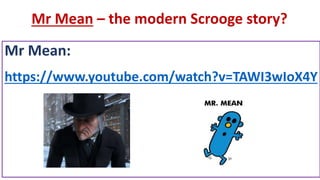
Mr Mean:
https://www.youtube.com/watch?v=TAWI3wIoX4Y
Mr Mean – the modern Scrooge story?
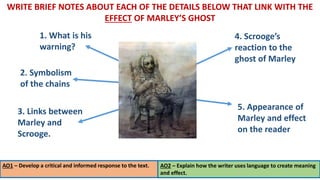
5. Appearance of
Marley and effect
on the reader
2. Symbolism
of the chains
4. Scrooge’s
reaction to the
ghost of Marley
1. What is his
warning?
3. Links between
Marley and
Scrooge.
WRITE BRIEF NOTES ABOUT EACH OF THE DETAILS BELOW THAT LINK WITH THE
EFFECT OF MARLEY’S GHOST
AO1 – Develop a critical and informed response to the text. AO2 – Explain how the writer uses language to create meaning
and effect.
A Christmas Carol
The Ghost of Christmas Past
A Christmas Carol
The Ghost of Christmas Present
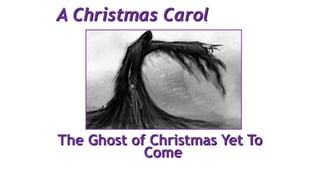
A Christmas Carol
The Ghost of Christmas Yet To
Come
Task Look at extract 1 in your booklet.
Complete the table on page 6 of your booklet by extracting words/phrases from the extract
that present Scrooge as unfriendly.
Use PEEDL to
structure
your answer.
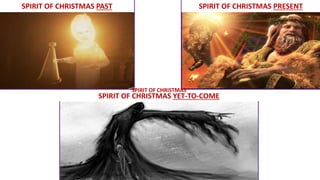
SPIRIT OF CHRISTMAS PAST SPIRIT OF CHRISTMAS PRESENT
SPIRIT OF CHRISTMAS YET-TO-COME
SPIRIT OF CHRISTMAS
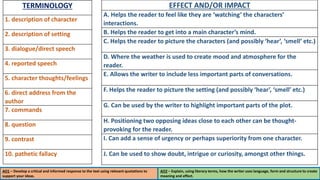
EFFECT AND/OR IMPACT
A. Helps the reader to feel like they are ‘watching’ the characters’
interactions.
B. Helps the reader to get into a main character’s mind.
C. Helps the reader to picture the characters (and possibly ‘hear’, ‘smell’ etc.)
D. Where the weather is used to create mood and atmosphere for the
reader.
E. Allows the writer to include less important parts of conversations.
F. Helps the reader to picture the setting (and possibly ‘hear’, ‘smell’ etc.)
G. Can be used by the writer to highlight important parts of the plot.
H. Positioning two opposing ideas close to each other can be thought-
provoking for the reader.
I. Can add a sense of urgency or perhaps superiority from one character.
J. Can be used to show doubt, intrigue or curiosity, amongst other things.
TERMINOLOGY
1. description of character
2. description of setting
3. dialogue/direct speech
4. reported speech
5. character thoughts/feelings
6. direct address from the
author
7. commands
8. question
9. contrast
10. pathetic fallacy
AO1 – Develop a critical and informed response to the text using relevant quotations to
support your ideas.
AO2 – Explain, using literary terms, how the writer uses language, form and structure to create
meaning and effect.
AO1 – Develop a critical and informed response to the text using relevant quotations to
support your ideas.
AO2 – Explain, using literary terms, how the writer uses language, form and structure to create
meaning and effect.
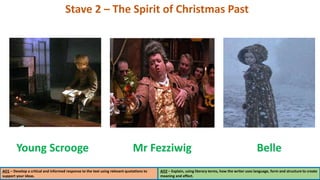
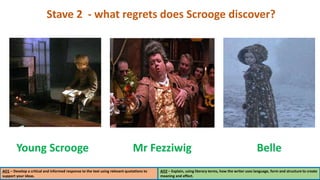
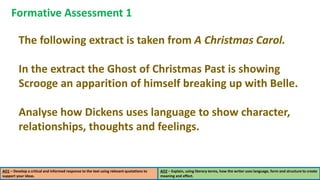
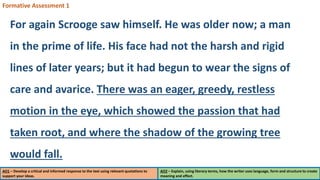
Stave 2 – The Spirit of Christmas Past
Young Scrooge Mr Fezziwig Belle
AO1 – Develop a critical and informed response to the text using relevant quotations to
support your ideas.
AO2 – Explain, using literary terms, how the writer uses language, form and structure to create
meaning and effect.
Stave 2 - what regrets does Scrooge discover?
Young Scrooge Mr Fezziwig Belle
AO1 – Develop a critical and informed response to the text using relevant quotations to
support your ideas.
AO2 – Explain, using literary terms, how the writer uses language, form and structure to create
meaning and effect.
Formative Assessment 1
The following extract is taken from A Christmas Carol.
In the extract the Ghost of Christmas Past is showing
Scrooge an apparition of himself breaking up with Belle.
Analyse how Dickens uses language to show character,
relationships, thoughts and feelings.
AO1 – Develop a critical and informed response to the text using relevant quotations to
support your ideas.
AO2 – Explain, using literary terms, how the writer uses language, form and structure to create
meaning and effect.
Formative Assessment 1
For again Scrooge saw himself. He was older now; a man
in the prime of life. His face had not the harsh and rigid
lines of later years; but it had begun to wear the signs of
care and avarice. There was an eager, greedy, restless
motion in the eye, which showed the passion that had
taken root, and where the shadow of the growing tree
would fall.
AO1 – Develop a critical and informed response to the text using relevant quotations to
support your ideas.
AO2 – Explain, using literary terms, how the writer uses language, form and structure to create
meaning and effect.
Formative Assessment 1
He was not alone, but sat by the side of a fair young girl in a
mourning-dress: in whose eyes there were tears, which
sparkled in the light that shone out of the Ghost of Christmas
Past.
“It matters little,” she said, softly. “To you, very little. Another
idol has displaced me; and if it can cheer and comfort you in
time to come, as I would have tried to do, I have no just cause
to grieve.”
AO1 – Develop a critical and informed response to the text using relevant quotations to
support your ideas.
AO2 – Explain, using literary terms, how the writer uses language, form and structure to create
meaning and effect.
Formative Assessment 1
“What Idol has displaced you?” he rejoined.
“A golden one.”
“This is the even-handed dealing of the world!” he said.
“There is nothing on which it is so hard as poverty; and there
is nothing it professes to condemn with such severity as the
pursuit of wealth!”
AO1 – Develop a critical and informed response to the text using relevant quotations to
support your ideas.
AO2 – Explain, using literary terms, how the writer uses language, form and structure to create
meaning and effect.
Formative Assessment 1
“You fear the world too much,” she answered, gently.
“All your other hopes have merged into the hope of
being beyond the chance of its sordid reproach. I have
seen your nobler aspirations fall off one by one, until the
master-passion, Gain, engrosses you. Have I not?”
“What then?” he retorted. “Even if I have grown so much
wiser, what then? I am not changed towards you.”
AO1 – Develop a critical and informed response to the text using relevant quotations to
support your ideas.
AO2 – Explain, using literary terms, how the writer uses language, form and structure to create
meaning and effect.
Formative Assessment 1
She shook her head.
“Am I?”
“Our contract is an old one. It was made when we were both
poor and content to be so, until, in good season, we could
improve our worldly fortune by our patient industry. You are
changed. When it was made, you were another man.”
“I was a boy,” he said impatiently.
AO1 – Develop a critical and informed response to the text using relevant quotations to
support your ideas.
AO2 – Explain, using literary terms, how the writer uses language, form and structure to create
meaning and effect.
Formative Assessment 1
“Your own feeling tells you that you were not what you
are,” she returned. “I am. That which promised
happiness when we were one in heart, is fraught with
misery now that we are two. How often and how keenly
I have thought of this, I will not say. It is enough that I
have thought of it, and can release you.”
AO1 – Develop a critical and informed response to the text using relevant quotations to
support your ideas.
AO2 – Explain, using literary terms, how the writer uses language, form and structure to create
meaning and effect.
Formative Assessment 1
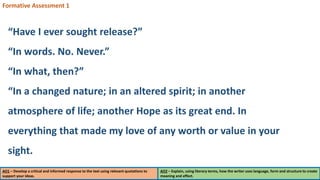
“Have I ever sought release?”
“In words. No. Never.”
“In what, then?”
“In a changed nature; in an altered spirit; in another
atmosphere of life; another Hope as its great end. In
everything that made my love of any worth or value in your
sight.
AO1 – Develop a critical and informed response to the text using relevant quotations to
support your ideas.
AO2 – Explain, using literary terms, how the writer uses language, form and structure to create
meaning and effect.
Formative Assessment 1
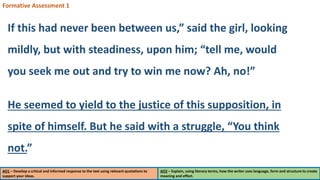
If this had never been between us,” said the girl, looking
mildly, but with steadiness, upon him; “tell me, would
you seek me out and try to win me now? Ah, no!”
He seemed to yield to the justice of this supposition, in
spite of himself. But he said with a struggle, “You think
not.”
AO1 – Develop a critical and informed response to the text using relevant quotations to
support your ideas.
AO2 – Explain, using literary terms, how the writer uses language, form and structure to create
meaning and effect.
Formative Assessment 1
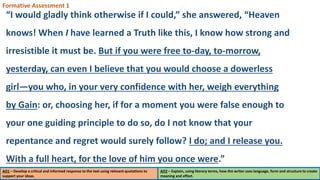
“I would gladly think otherwise if I could,” she answered, “Heaven
knows! When I have learned a Truth like this, I know how strong and
irresistible it must be. But if you were free to-day, to-morrow,
yesterday, can even I believe that you would choose a dowerless
girl—you who, in your very confidence with her, weigh everything
by Gain: or, choosing her, if for a moment you were false enough to
your one guiding principle to do so, do I not know that your
repentance and regret would surely follow? I do; and I release you.
With a full heart, for the love of him you once were.”
AO1 – Develop a critical and informed response to the text using relevant quotations to
support your ideas.
AO2 – Explain, using literary terms, how the writer uses language, form and structure to create
meaning and effect.
Formative Assessment 1
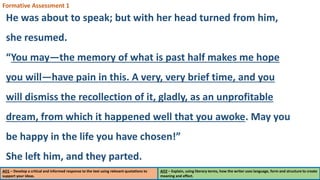
He was about to speak; but with her head turned from him,
she resumed.
“You may—the memory of what is past half makes me hope
you will—have pain in this. A very, very brief time, and you
will dismiss the recollection of it, gladly, as an unprofitable
dream, from which it happened well that you awoke. May you
be happy in the life you have chosen!”
She left him, and they parted.
AO1 – Develop a critical and informed response to the text using relevant quotations to
support your ideas.
AO2 – Explain, using literary terms, how the writer uses language, form and structure to create
meaning and effect.
Formative Assessment 1
“Spirit!” said Scrooge, “show me no more! Conduct me home.
Why do you delight to torture me?”
“One shadow more!” exclaimed the Ghost.
“No more!” cried Scrooge. “No more. I don’t wish to see it.
Show me no more!”
But the relentless Ghost pinioned him in both his arms, and
forced him to observe what happened next.
AO1 – Develop a critical and informed response to the text using relevant quotations to
support your ideas.
AO2 – Explain, using literary terms, how the writer uses language, form and structure to create
meaning and effect.
Formative Assessment 1
The following extract is taken from A Christmas Carol.
In the extract the Ghost of Christmas Past is showing
Scrooge and apparition of himself breaking up with
Belle.
Analyse how Dickens uses language to show character,
relationships, thoughts and feelings.
AO1 – Develop a critical and informed response to the text using relevant quotations to
support your ideas.
AO2 – Explain, using literary terms, how the writer uses language, form and structure to create
meaning and effect.
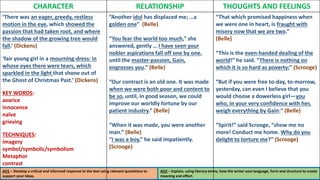
CHARACTER RELATIONSHIP THOUGHTS AND FEELINGS
‘There was an eager, greedy, restless
motion in the eye, which showed the
passion that had taken root, and where
the shadow of the growing tree would
fall.’ (Dickens)
‘fair young girl in a mourning-dress: in
whose eyes there were tears, which
sparkled in the light that shone out of
the Ghost of Christmas Past.’ (Dickens)
KEY WORDS:
avarice
innocence
naïve
grieving
TECHNIQUES:
imagery
symbol/symbolic/symbolism
Metaphor
contrast
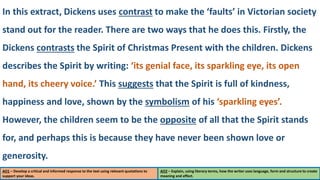
“Another idol has displaced me; …a
golden one” (Belle)
“You fear the world too much,” she
answered, gently … I have seen your
nobler aspirations fall off one by one,
until the master-passion, Gain,
engrosses you.” (Belle)
“Our contract is an old one. It was made
when we were both poor and content to
be so, until, in good season, we could
improve our worldly fortune by our
patient industry.” (Belle)
“When it was made, you were another
man.” (Belle)
“I was a boy,” he said impatiently.
(Scrooge)
“That which promised happiness when
we were one in heart, is fraught with
misery now that we are two.”
(Belle)
“This is the even-handed dealing of the
world!” he said. “There is nothing on
which it is so hard as poverty;” (Scrooge)
“But if you were free to-day, to-morrow,
yesterday, can even I believe that you
would choose a dowerless girl—you
who, in your very confidence with her,
weigh everything by Gain:” (Belle)
“Spirit!” said Scrooge, “show me no
more! Conduct me home. Why do you
delight to torture me?” (Scrooge)
AO1 – Develop a critical and informed response to the text using relevant quotations to
support your ideas.
AO2 – Explain, using literary terms, how the writer uses language, form and structure to create
meaning and effect.
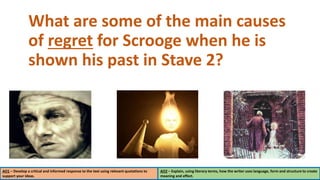
What are some of the main causes
of regret for Scrooge when he is
shown his past in Stave 2?
Perhaps, Scrooge could not have told anybody why, if
anybody could have asked him; but he had a special
desire to see the Spirit in his cap; and begged him to
be covered.
"What!" exclaimed the Ghost, "Would you so soon put
out, with worldly hands, the light I give? Is it not
enough that you are one of those whose passions
made this cap, and force me through whole trains of
years to wear it low upon my brow!"
Given what we know about the symbolism of light, what might it suggest when Scrooge asks the spirit to cover the flame the spirit’s head?
What might the spirit mean when it says that Scrooge was one of those who ‘made’ the spirit’s snuffing cap?
He was conscious of a thousand odours floating in the
air, each one connected with a thousand thoughts, and
hopes, and joys, and cares long, long, forgotten.
"Your lip is trembling," said the Ghost. "And what is
that upon your cheek?"
Scrooge muttered, with an unusual catching in his
voice, that it was a pimple; and begged the Ghost to
lead him where he would.
When Scrooge returns to the place of his childhood Dickens says that the smells of that place ‘connected with a thousand thoughts, and hopes, and joys, and cares long, long, forgotten.’ By mentioning Scrooge’s recollection of ‘joys, hopes and cares’ what does it tell us
about Scrooge as a child?
What was ‘upon [Scrooge’s] cheek’? And why did Scrooge have ‘an unusual catching in his voice’?
"Why, it's Ali Baba!" Scrooge exclaimed in ecstasy. "It's
dear old honest Ali Baba. Yes, yes, I know. One
Christmas time, when yonder solitary child was left
here all alone, he did come, for the first time, just like
that … "There's the Parrot." cried Scrooge. "Green
body and yellow tail, with a thing like a lettuce
growing out of the top of his head; there he is! Poor
Robin Crusoe, he called him…
In this extract, the spirit takes Scrooge into the mind of his childhood self. The people mentioned: ‘Ali Baba’ and ‘Robinson Crusoe’ were the fictional characters who Scrooge was reading about as a child, when he was left all alone at school by his father at Christmas, and
the other children had gone home. What does this tell us about Scrooge’s childhood, and how could these early events have shaped the man who he grew into?
[The scene changes,moving forward in time. Years have passed,
but it is suggested that poor, young Scrooge has not left the school
since we last saw him.] - He was not reading now, but walking up
and down despairingly. Scrooge looked at the Ghost,and with a
mournful shakingof his head,glanced anxiouslytowards the door.
It opened;and a little girl, much youngerthan the boy, came
dartingin, and puttingher arms about his neck, and often kissing
him, addressed him as her "Dear, dear brother."
"I have come to bring you home, dear brother!" said the child,
clappingher tiny hands,and bending down to laugh. "To bring you
home, home, home!"
"Home, little Fan?" returnedthe boy.
"Yes!" said the child, brimful of glee. "Home, for good and all.
Home, for ever and ever. Fatheris so much kinder than he used to
be, that home's like Heaven!
When Scrooge is described as ‘walking up and down despairingly’, what does it suggest about the emotional impact of Scrooge being neglected by his father and left at school over successive Christmases?
Despite Scrooge’s father’s attitude towards him, what impression do we get of Fan’s feelings for her brother? Write down a few of the words from the quote which best describe Fan’s character, and explain what they tell us about her.
Old Fezziwig laid down his pen, and looked up at the clock, which
pointed to the hour of seven. He rubbedhis hands;adjusted his
capaciouswaistcoat; laughed all over himself, from his shows to
his organ of benevolence; and called out in a comfortable, oily,
rich, fat, jovial voice:
"Yo ho, there! Ebenezer! Dick!"
[Scrooge watching the dancing and the fiddling at Fezziwig’s
Christmas party]
During the whole of this time, Scrooge had acted like a man out of
his wits. His heart and soul were in the scene, and with his former
self. He corroboratedeverything,remembered everything,
enjoyed everything,and underwent the strangest agitation.
What impression of Fezziwig do we get from the way that his behaviour and voice are described in this quote?
Dicken’s describes Scrooge’s reaction to seeing Fezziwig, by saying that Scrooge acted like a man ‘out of his wits’, saying that Scrooge ‘remembered everything, enjoyed everything, and underwent the strangest agitation’. What does this tell us about his feelings for
Fezziwig, and how does this reaction help Scrooge to arrive at a realisation about his own behaviour?
AO1 – Develop a critical and informed response to the text using relevant quotations to
support your ideas.
AO2 – Explain, using literary terms, how the writer uses language, form and structure to create
meaning and effect.
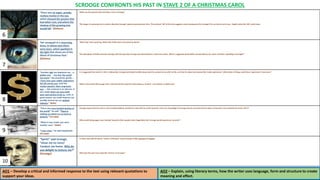
SCROOGE CONFRONTS HIS PAST IN STAVE 2 OF A CHRISTMAS CAROL
1
2
3
4
5
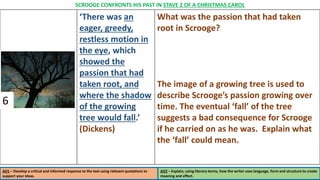
‘There was an eager, greedy,
restless motion in the eye,
which showed the passion that
had taken root, and where the
shadow of the growing tree
would fall.’ (Dickens)
What was the passion that had taken root in Scrooge?
The image of a growing tree is used to describe Scrooge’s passion growing over time. The eventual ‘fall’ of the tree suggests a bad consequence for Scrooge if he carried on as he was. Explain what the ‘fall’ could mean.
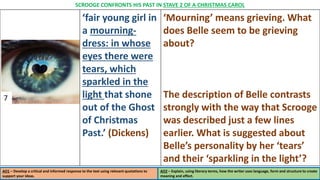
‘fair young girl in a mourning-
dress: in whose eyes there
were tears, which sparkled in
the light that shone out of the
Ghost of Christmas Past.’
(Dickens)
‘Mourning’ means grieving. What does Belle seem to be grieving about?
The description of Belle contrasts strongly with the way that Scrooge was described just a few lines earlier. What is suggested about Belle’s personality by her ‘tears’ and their ‘sparkling in the light’?
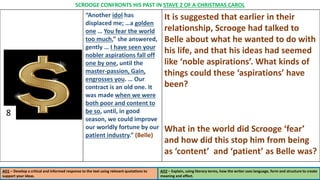
“Another idol has displaced me; …a
golden one … You fear the world
too much,” she answered, gently …
I have seen your nobler aspirations
fall off one by one, until the
master-passion, Gain, engrosses
you. … Our contract is an old one. It
was made when we were both
poor and content to be so, until, in
good season, we could improve our
worldly fortune by our patient
industry.” (Belle)
It is suggested that earlier in their relationship, Scrooge had talked to Belle about what he wanted to do with his life, and that his ideas had seemed like ‘noble aspirations’. What kinds of things could these ‘aspirations’ have been?
What in the world did Scrooge ‘fear’ and how did this stop him from being as ‘content’ and ‘patient’ as Belle was?
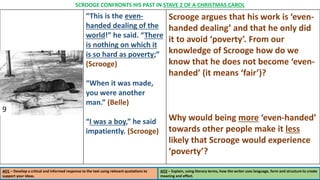
“This is the even-handed dealing of
the world!” he said. “There is
nothing on which it is so hard as
poverty;” (Scrooge)
“When it was made, you were
another man.” (Belle)
“I was a boy,” he said impatiently.
(Scrooge)
Scrooge argues that his work is ‘even-handed dealing’ and that he only did it to avoid ‘poverty’. From our knowledge of Scrooge how do we know that he does not become ‘even-handed’ (it means ‘fair’)?
Why would being more ‘even-handed’ towards other people make it less likely that Scrooge would experience ‘poverty’?
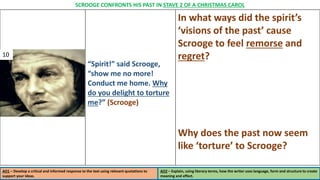
“Spirit!” said Scrooge,
“show me no more!
Conduct me home. Why do
you delight to torture me?”
(Scrooge)
In what ways did the spirit’s ‘visions of the past’ cause Scrooge to feel remorse and regret?
Why does the past now seem like ‘torture’ to Scrooge?
AO1 – Develop a critical and informed response to the text using relevant quotations to
support your ideas.
AO2 – Explain, using literary terms, how the writer uses language, form and structure to create
meaning and effect.
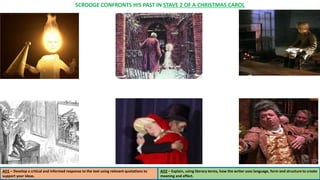
SCROOGE CONFRONTS HIS PAST IN STAVE 2 OF A CHRISTMAS CAROL
6
7
8
9
10
AO1 – Develop a critical and informed response to the text using relevant quotations to
support your ideas.
AO2 – Explain, using literary terms, how the writer uses language, form and structure to create
meaning and effect.
SCROOGE CONFRONTS HIS PAST IN STAVE 2 OF A CHRISTMAS CAROL
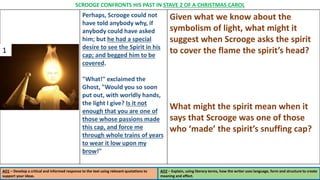
Perhaps, Scrooge could not
have told anybody why, if
anybody could have asked
him; but he had a special
desire to see the Spirit in his
cap; and begged him to be
covered.
"What!" exclaimed the
Ghost, "Would you so soon
put out, with worldly hands,
the light I give? Is it not
enough that you are one of
those whose passions made
this cap, and force me
through whole trains of years
to wear it low upon my
brow!"
Given what we know about the
symbolism of light, what might it
suggest when Scrooge asks the spirit
to cover the flame the spirit’s head?
What might the spirit mean when it
says that Scrooge was one of those
who ‘made’ the spirit’s snuffing cap?
AO1 – Develop a critical and informed response to the text using relevant quotations to
support your ideas.
AO2 – Explain, using literary terms, how the writer uses language, form and structure to create
meaning and effect.
SCROOGE CONFRONTS HIS PAST IN STAVE 2 OF A CHRISTMAS CAROL
1
He was conscious of a
thousand odours floating
in the air, each one
connected with a
thousand thoughts, and
hopes, and joys, and cares
long, long, forgotten.
"Your lip is trembling,"
said the Ghost. "And what
is that upon your cheek?"
Scrooge muttered, with an
unusual catching in his
voice, that it was a
pimple; and begged the
Ghost to lead him where
he would.
When Scrooge returns to the place of his
childhood Dickens says that the smells of
that place ‘connected with a thousand
thoughts, and hopes, and joys, and cares
long, long, forgotten.’ By mentioning
Scrooge’s recollection of ‘joys, hopes and
cares’ what does it tell us about Scrooge
as a child?
What was ‘upon [Scrooge’s] cheek’? And
why did Scrooge have ‘an unusual catching
in his voice’?
AO1 – Develop a critical and informed response to the text using relevant quotations to
support your ideas.
AO2 – Explain, using literary terms, how the writer uses language, form and structure to create
meaning and effect.
SCROOGE CONFRONTS HIS PAST IN STAVE 2 OF A CHRISTMAS CAROL
2
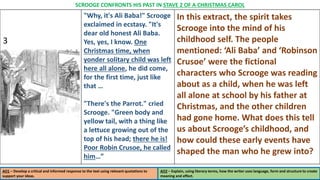
"Why, it's Ali Baba!" Scrooge
exclaimed in ecstasy. "It's
dear old honest Ali Baba.
Yes, yes, I know. One
Christmas time, when
yonder solitary child was left
here all alone, he did come,
for the first time, just like
that …
"There's the Parrot." cried
Scrooge. "Green body and
yellow tail, with a thing like
a lettuce growing out of the
top of his head; there he is!
Poor Robin Crusoe, he called
him…”
In this extract, the spirit takes
Scrooge into the mind of his
childhood self. The people
mentioned: ‘Ali Baba’ and ‘Robinson
Crusoe’ were the fictional
characters who Scrooge was reading
about as a child, when he was left
all alone at school by his father at
Christmas, and the other children
had gone home. What does this tell
us about Scrooge’s childhood, and
how could these early events have
shaped the man who he grew into?
AO1 – Develop a critical and informed response to the text using relevant quotations to
support your ideas.
AO2 – Explain, using literary terms, how the writer uses language, form and structure to create
meaning and effect.
SCROOGE CONFRONTS HIS PAST IN STAVE 2 OF A CHRISTMAS CAROL
3
[The scene changes, moving forward in
time. Years have passed, but it is
suggested that poor, young Scrooge has
not left the school since we last saw him.]
- He was not reading now, but walking up
and down despairingly. Scrooge looked at
the Ghost, and with a mournful shaking
of his head, glanced anxiously towards
the door.
It opened; and a little girl, much younger
than the boy, came darting in, and
putting her arms about his neck, and
often kissing him, addressed him as her
"Dear, dear brother."
"I have come to bring you home, dear
brother!" said the child, clapping her tiny
hands, and bending down to laugh. "To
bring you home, home, home!"
"Home, little Fan?" returned the boy.
"Yes!" said the child, brimful of glee.
"Home, for good and all. Home, for ever
and ever. Father is so much kinder than
he used to be, that home's like Heaven!
When Scrooge is described as ‘walking
up and down despairingly’, what does it
suggest about the emotional impact of
Scrooge being neglected by his father
and left at school over successive
Christmases?
Despite Scrooge’s father’s attitude
towards him, what impression do we get
of Fan’s feelings for her brother? Write
down a few of the words from the quote
which best describe Fan’s character, and
explain what they tell us about her.
AO1 – Develop a critical and informed response to the text using relevant quotations to
support your ideas.
AO2 – Explain, using literary terms, how the writer uses language, form and structure to create
meaning and effect.
SCROOGE CONFRONTS HIS PAST IN STAVE 2 OF A CHRISTMAS CAROL
4
Old Fezziwig laid down his pen, and
looked up at the clock, which pointed
to the hour of seven. He rubbed his
hands; adjusted his capacious
waistcoat; laughed all over himself,
from his shows to his organ of
benevolence; and called out in a
comfortable, oily, rich, fat, jovial
voice:
"Yo ho, there! Ebenezer! Dick!"
[Scrooge watching the dancing and
the fiddling at Fezziwig’s Christmas
party]
During the whole of this time,
Scrooge had acted like a man out of
his wits. His heart and soul were in
the scene, and with his former self.
He corroborated everything,
remembered everything, enjoyed
everything, and underwent the
strangest agitation.
What impression of Fezziwig do we get
from the way that his behaviour and
voice are described in this quote?
Dicken’s describes Scrooge’s reaction to
seeing Fezziwig, by saying that Scrooge
acted like a man ‘out of his wits’, saying
that Scrooge ‘remembered everything,
enjoyed everything, and underwent the
strangest agitation’. What does this tell
us about his feelings for Fezziwig, and
how does this reaction help Scrooge to
arrive at a realisation about his own
behaviour?
AO1 – Develop a critical and informed response to the text using relevant quotations to
support your ideas.
AO2 – Explain, using literary terms, how the writer uses language, form and structure to create
meaning and effect.
SCROOGE CONFRONTS HIS PAST IN STAVE 2 OF A CHRISTMAS CAROL
5
‘There was an
eager, greedy,
restless motion in
the eye, which
showed the
passion that had
taken root, and
where the shadow
of the growing
tree would fall.’
(Dickens)
What was the passion that had taken
root in Scrooge?
The image of a growing tree is used to
describe Scrooge’s passion growing over
time. The eventual ‘fall’ of the tree
suggests a bad consequence for Scrooge
if he carried on as he was. Explain what
the ‘fall’ could mean.
AO1 – Develop a critical and informed response to the text using relevant quotations to
support your ideas.
AO2 – Explain, using literary terms, how the writer uses language, form and structure to create
meaning and effect.
SCROOGE CONFRONTS HIS PAST IN STAVE 2 OF A CHRISTMAS CAROL
6
‘fair young girl in
a mourning-
dress: in whose
eyes there were
tears, which
sparkled in the
light that shone
out of the Ghost
of Christmas
Past.’ (Dickens)
‘Mourning’ means grieving. What
does Belle seem to be grieving
about?
The description of Belle contrasts
strongly with the way that Scrooge
was described just a few lines
earlier. What is suggested about
Belle’s personality by her ‘tears’
and their ‘sparkling in the light’?
AO1 – Develop a critical and informed response to the text using relevant quotations to
support your ideas.
AO2 – Explain, using literary terms, how the writer uses language, form and structure to create
meaning and effect.
SCROOGE CONFRONTS HIS PAST IN STAVE 2 OF A CHRISTMAS CAROL
7
“Another idol has
displaced me; …a golden
one … You fear the world
too much,” she answered,
gently … I have seen your
nobler aspirations fall off
one by one, until the
master-passion, Gain,
engrosses you. … Our
contract is an old one. It
was made when we were
both poor and content to
be so, until, in good
season, we could improve
our worldly fortune by our
patient industry.” (Belle)
It is suggested that earlier in their
relationship, Scrooge had talked to
Belle about what he wanted to do with
his life, and that his ideas had seemed
like ‘noble aspirations’. What kinds of
things could these ‘aspirations’ have
been?
What in the world did Scrooge ‘fear’
and how did this stop him from being
as ‘content’ and ‘patient’ as Belle was?
AO1 – Develop a critical and informed response to the text using relevant quotations to
support your ideas.
AO2 – Explain, using literary terms, how the writer uses language, form and structure to create
meaning and effect.
SCROOGE CONFRONTS HIS PAST IN STAVE 2 OF A CHRISTMAS CAROL
8
“This is the even-
handed dealing of the
world!” he said. “There
is nothing on which it
is so hard as poverty;”
(Scrooge)
“When it was made,
you were another
man.” (Belle)
“I was a boy,” he said
impatiently. (Scrooge)
Scrooge argues that his work is ‘even-
handed dealing’ and that he only did
it to avoid ‘poverty’. From our
knowledge of Scrooge how do we
know that he does not become ‘even-
handed’ (it means ‘fair’)?
Why would being more ‘even-handed’
towards other people make it less
likely that Scrooge would experience
‘poverty’?
AO1 – Develop a critical and informed response to the text using relevant quotations to
support your ideas.
AO2 – Explain, using literary terms, how the writer uses language, form and structure to create
meaning and effect.
SCROOGE CONFRONTS HIS PAST IN STAVE 2 OF A CHRISTMAS CAROL
9
“Spirit!” said Scrooge,
“show me no more!
Conduct me home. Why
do you delight to torture
me?” (Scrooge)
In what ways did the spirit’s
‘visions of the past’ cause
Scrooge to feel remorse and
regret?
Why does the past now seem
like ‘torture’ to Scrooge?
AO1 – Develop a critical and informed response to the text using relevant quotations to
support your ideas.
AO2 – Explain, using literary terms, how the writer uses language, form and structure to create
meaning and effect.
SCROOGE CONFRONTS HIS PAST IN STAVE 2 OF A CHRISTMAS CAROL
10
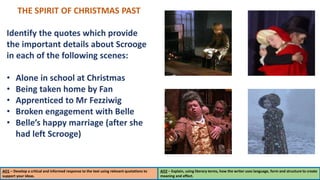
THE SPIRIT OF CHRISTMAS PAST
Identify the quotes which provide
the important details about Scrooge
in each of the following scenes:
• Alone in school at Christmas
• Being taken home by Fan
• Apprenticed to Mr Fezziwig
• Broken engagement with Belle
• Belle’s happy marriage (after she
had left Scrooge)
AO1 – Develop a critical and informed response to the text using relevant quotations to
support your ideas.
AO2 – Explain, using literary terms, how the writer uses language, form and structure to create
meaning and effect.
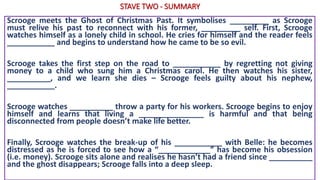
STAVE TWO - SUMMARY
Scrooge meets the Ghost of Christmas Past. It symbolises _________ as Scrooge
must relive his past to reconnect with his former, _________ self. First, Scrooge
watches himself as a lonely child in school. He cries for himself and the reader feels
___________ and begins to understand how he came to be so evil.
Scrooge takes the first step on the road to ___________ by regretting not giving
money to a child who sung him a Christmas carol. He then watches his sister,
__________, and we learn she dies – Scrooge feels guilty about his nephew,
___________.
Scrooge watches __________ throw a party for his workers. Scrooge begins to enjoy
himself and learns that living a _______________ is harmful and that being
disconnected from people doesn’t make life better.
Finally, Scrooge watches the break-up of his ___________ with Belle: he becomes
distressed as he is forced to see how a “____________” has become his obsession
(i.e. money). Scrooge sits alone and realises he hasn’t had a friend since __________
and the ghost disappears; Scrooge falls into a deep sleep.
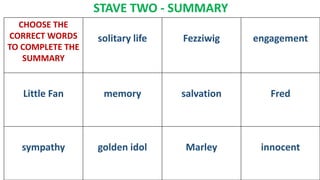
STAVE TWO - SUMMARY
CHOOSE THE
CORRECT WORDS
TO COMPLETE THE
SUMMARY
solitary life Fezziwig engagement
Little Fan memory salvation Fred
sympathy golden idol Marley innocent
STAVE TWO - SUMMARY
Scrooge meets the Ghost of Christmas Past. It symbolises memory as Scrooge must relive his
past to reconnect with his former, innocent self. First, Scrooge watches himself as a lonely
child in school. He cries for himself and the reader feels sympathy and begins to understand
how he came to be so evil.
Scrooge takes the first step on the road to salvation by regretting not giving money to a child
who sung him a Christmas carol. He then watches his sister, Little Fan, and we learn she dies –
Scrooge feels guilty about his nephew, Fred.
Scrooge watches Fezziwig throw a party for his workers. Scrooge begins to enjoy himself and
learns that living a solitary life is harmful and that being disconnected from people doesn’t
make life better.
Finally, Scrooge watches the break-up of his engagement with Belle: he becomes distressed as
he is forced to see how a “golden idol” has become his obsession (i.e. money). Scrooge sits
alone and realises he hasn’t had a friend since Marley and the ghost disappears; Scrooge falls
into a deep sleep.
Find and write down the meaning of each word
1. displace_______________________________________________________________________________
__
1. profess________________________________________________________________________________
2. mourning______________________________________________________________________________
3. aspirations_____________________________________________________________________________
4. noble_________________________________________________________________________________
5. engrossed_____________________________________________________________________________
6. supposition____________________________________________________________________________
7. repentence____________________________________________________________________________
8. naive_________________________________________________________________________________
9. even-handed ___________________________________________________________________________
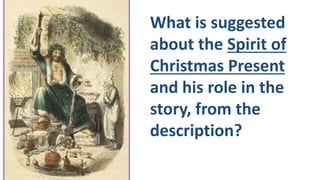
What is suggested
about the Spirit of
Christmas Present
and his role in the
story, from the
description?
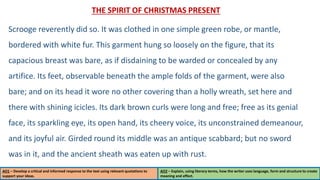
THE SPIRIT OF CHRISTMAS PRESENT
The walls and ceiling were so hung with living
green, that it looked a perfect grove; from every
part of which, bright gleaming berries glistened.
The crisp leaves of holly, mistletoe, and ivy
reflected back the light, as if so many little
mirrors had been scattered there; and such a
mighty blaze went roaring up the chimney, as
that dull petrification of a hearth had never
known in Scrooge's time, or Marley's, or for
many and many a winter season gone. Heaped
up on the floor, to form a kind of throne, were
turkeys, geese, game, poultry, brawn, great joints
of meat, sucking-pigs, long wreaths of sausages,
mince-pies, plum-puddings, barrels of oysters,
red-hot chestnuts, cherry-cheeked apples, juicy
oranges, luscious pears, immense twelfth-cakes,
and seething bowls of punch, that made the
chamber dim with their delicious steam.
A ‘grove’ is a sheltered wooded area created by a group of closely growing trees. The Spirit
of Christmas Present has created a ‘grove’ in the room next to Scrooge’s bedroom. (It is a
little like a Christmas grotto.)
What do the references to light and heat suggest about the Spirit and his purpose (‘bright
gleaming berries’; ‘ivy reflected back the light’; ‘a might blaze went roaring up the
chimney’)?
________________________________________
________________________________________
________________________________________
Dickens uses several descriptive words and phrases to emphasises the large amounts of
Christmas food piled around the Spirit (‘heaped..’; ‘long wreathes of..’; ‘barrels of..’;
‘juicy..’; ‘immense..’; ‘luscious..’; ‘seething..’)
What does this bountiful description tell us about the Spirit’s role at Christmas? What
feelings and experiences does the Spirit want to spread among all of the various people
that he visits?
_____________________________________
_____________________________________
_____________________________________
THE SPIRIT OF CHRISTMAS PRESENT
Scrooge reverently did so. It was clothed in one simple green robe, or mantle,
bordered with white fur. This garment hung so loosely on the figure, that its
capacious breast was bare, as if disdaining to be warded or concealed by any
artifice. Its feet, observable beneath the ample folds of the garment, were also
bare; and on its head it wore no other covering than a holly wreath, set here and
there with shining icicles. Its dark brown curls were long and free; free as its genial
face, its sparkling eye, its open hand, its cheery voice, its unconstrained demeanour,
and its joyful air. Girded round its middle was an antique scabbard; but no sword
was in it, and the ancient sheath was eaten up with rust.
AO1 – Develop a critical and informed response to the text using relevant quotations to
support your ideas.
AO2 – Explain, using literary terms, how the writer uses language, form and structure to create
meaning and effect.
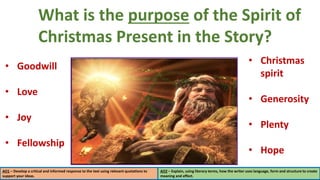
What is the purpose of the Spirit of
Christmas Present in the Story? hat
present Scrooge as unfriendly.
Use PEEDL to
structure
your answer.
AO1 – Develop a critical and informed response to the text using relevant quotations to
support your ideas.
AO2 – Explain, using literary terms, how the writer uses language, form and structure to create
meaning and effect.
• Goodwill
• Love
• Joy
• Fellowship
• Christmas
spirit
• Generosity
• Plenty
• Hope
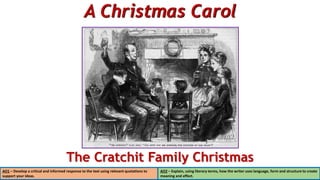
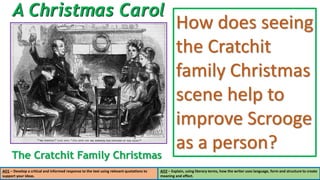
A Christmas Carol
The Cratchit Family Christmas
AO1 – Develop a critical and informed response to the text using relevant quotations to
support your ideas.
AO2 – Explain, using literary terms, how the writer uses language, form and structure to create
meaning and effect.
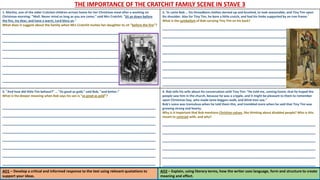
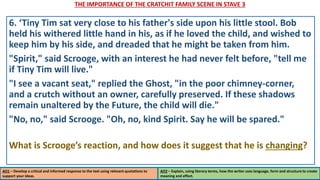
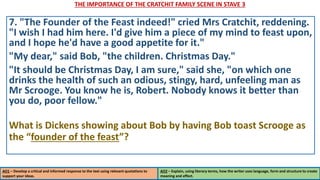
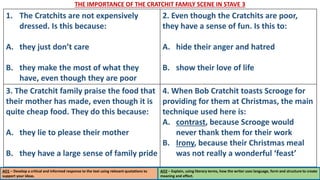
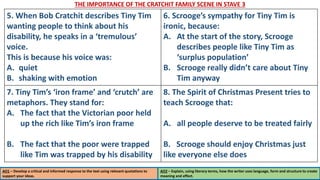
THE IMPORTANCE OF THE CRATCHIT FAMILY SCENE IN STAVE 3
AO1 – Develop a critical and informed response to the text using relevant quotations to
support your ideas.
AO2 – Explain, using literary terms, how the writer uses language, form and structure to create
meaning and effect.
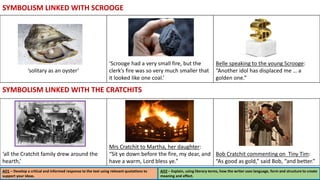
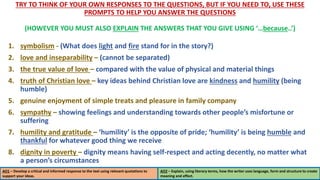
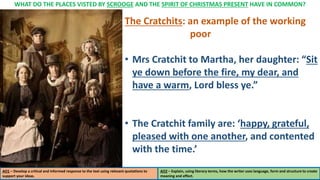
1. Martha, one of the older Cratchet children arrives home for her Christmas meal after a working on
Christmas morning: "Well. Never mind so long as you are come," said Mrs Cratchit. "Sit ye down before
the fire, my dear, and have a warm, Lord bless ye."
What does it suggest about the family when Mrs Cratchit invites her daughter to sit “before the fire”?
______________________________________________
______________________________________________
______________________________________________
______________________________________________
______________________________________________
______________________________________________
____________________________________
2. ‘In came Bob … his threadbare clothes darned up and brushed, to look seasonable; and Tiny Tim upon
his shoulder. Alas for Tiny Tim, he bore a little crutch, and had his limbs supported by an iron frame.‘
What is the symbolism of Bob carrying Tiny Tim on his back?
______________________________________________
______________________________________________
______________________________________________
______________________________________________
______________________________________________
______________________________________________
______________________________________________
______________________________________
3. "And how did little Tim behave?" … "As good as gold," said Bob, "and better.“
What is the deeper meaning when Bob says his son is “as good as gold”?
______________________________________________
______________________________________________
______________________________________________
______________________________________________
______________________________________________
______________________________________________
______________________________________________
______________________________________________
4. Bob tells his wife about his conversation with Tiny Tim: “He told me, coming home, that he hoped the
people saw him in the church, because he was a cripple, and it might be pleasant to them to remember
upon Christmas Day, who made lame beggars walk, and blind men see."
Bob's voice was tremulous when he told them this, and trembled more when he said that Tiny Tim was
growing strong and hearty.
Why is it important that Bob mentions Christian values, like thinking about disabled people? Who is this
meant to contrast with, and why?
______________________________________________
______________________________________________
______________________________________________
______________________________________________
______________________________________________
______________________________________________
THE IMPORTANCE OF THE CRATCHIT FAMILY SCENE IN STAVE 3
AO1 – Develop a critical and informed response to the text using relevant quotations to
support your ideas.
AO2 – Explain, using literary terms, how the writer uses language, form and structure to create
meaning and effect.
5. ‘At last the dishes were set on, and grace was said. It was succeeded by a breathless pause, as Mrs
Cratchit, looking slowly all along the carving-knife, prepared to plunge it in the breast; but when she
did, and when the long expected gush of stuffing issued forth, one murmur of delight arose all round
the board, and even Tiny Tim, excited by the two young Cratchits, beat on the table with the handle
of his knife, and feebly cried Hurrah!‘
How do the Cratchit family feel about their rather meagre Christmas meal?
______________________________________________
______________________________________________
______________________________________________
______________________________________________
______________________________________________
______________________________________________
6. ‘Tiny Tim sat very close to his father's side upon his little stool. Bob held his withered little hand in his,
as if he loved the child, and wished to keep him by his side, and dreaded that he might be taken from him.
"Spirit," said Scrooge, with an interest he had never felt before, "tell me if Tiny Tim will live."
"I see a vacant seat," replied the Ghost, "in the poor chimney-corner, and a crutch without an owner,
carefully preserved. If these shadows remain unaltered by the Future, the child will die."
"No, no," said Scrooge. "Oh, no, kind Spirit. Say he will be spared."
What is Scrooge’s reaction, and how does it suggest that he is changing?
______________________________________________
______________________________________________
______________________________________________
______________________________________________
______________________________________________
7. "The Founder of the Feast indeed!" cried Mrs Cratchit, reddening. "I wish I had him here. I'd give him a
piece of my mind to feast upon, and I hope he'd have a good appetite for it."
"My dear," said Bob, "the children. Christmas Day."
"It should be Christmas Day, I am sure," said she, "on which one drinks the health of such an odious,
stingy, hard, unfeeling man as Mr Scrooge. You know he is, Robert. Nobody knows it better than you do,
poor fellow."
What is Dickens showing about Bob by having Bob toast Scrooge as the “founder of the feast”?
______________________________________________
______________________________________________
______________________________________________
______________________________________________
______________________________________________
______________________________________________
8. What is the Spirit of Christmas Present showing Scrooge about people like the Cratchit family in this
scene, and what effect does it have on him?
______________________________________________
______________________________________________
______________________________________________
______________________________________________
______________________________________________
______________________________________________
______________________________________________
______________________________________________
WHAT DO THE PLACES VISTED BY SCROOGE AND THE SPIRIT OF CHRISTMAS PRESENT HAVE IN COMMON?
AO1 – Develop a critical and informed response to the text using relevant quotations to
support your ideas.
AO2 – Explain, using literary terms, how the writer uses language, form and structure to create
meaning and effect.
The Cratchits: an example of the working
poor
The miners on the moor: an example of
an isolated community
A solitary lighthouse … on which the waters
chafed and dashed
Scrooge’s nephew’s house: an example
of the Victorian middle classes
• Mrs Cratchit to Martha, her daughter:
“Sit ye down before the fire, my dear,
and have a warm, Lord bless ye.”
• The Cratchit family are: ‘happy, grateful,
pleased with one another, and
contented with the time.’
• ‘They stood upon a bleak and desert moor,
where monstrous masses of rude stone
were cast about..’
• ‘A light shone from the window of a hut..
[Inside] they found a cheerful company
assembled around a glowing fire.’
• ‘But even here, two men who watched the
light had made a fire that through a loophole
in the thick stone wall shed out a ray of
brightness on the awful sea.’
• ‘Joining their horny hands over the rough
table … they wished each other Merry
Christmas … the elder … struck up a sturdy
song that was like a Gale in itself.’
• [Scrooge found himself] … in a bright,
dry, gleaming room with the Spirit
standing smiling by his side, and looking
at that same nephew with an approving
affinity.’
• “Ha, ha!” laughed Scrooge’s nephew..
[playing games with] ‘..a fresh roar of
laughter’
SYMBOLISM LINKED WITH SCROOGE
AO1 – Develop a critical and informed response to the text using relevant quotations to
support your ideas.
AO2 – Explain, using literary terms, how the writer uses language, form and structure to create
meaning and effect.
‘all the Cratchit family drew around the
hearth,’
Mrs Cratchit to Martha, her daughter:
“Sit ye down before the fire, my dear, and
have a warm, Lord bless ye.”
Bob Cratchit commenting on Tiny Tim:
“As good as gold,” said Bob, “and better.”
‘solitary as an oyster’
‘Scrooge had a very small fire, but the
clerk’s fire was so very much smaller that
it looked like one coal.’
Belle speaking to the young Scrooge:
“Another idol has displaced me … a
golden one.”
SYMBOLISM LINKED WITH THE CRATCHITS
TRY TO THINK OF YOUR OWN RESPONSES TO THE QUESTIONS, BUT IF YOU NEED TO, USE THESE
PROMPTS TO HELP YOU ANSWER THE QUESTIONS
(HOWEVER YOU MUST ALSO EXPLAIN THE ANSWERS THAT YOU GIVE USING ‘…because..’)
1. symbolism - (What does light and fire stand for in the story?)
2. love and inseparability – (cannot be separated)
3. the true value of love – compared with the value of physical and material things
4. truth of Christian love – key ideas behind Christian love are kindness and humility (being
humble)
5. genuine enjoyment of simple treats and pleasure in family company
6. sympathy – showing feelings and understanding towards other people’s misfortune or
suffering
7. humility and gratitude – ‘humility’ is the opposite of pride; ‘humility’ is being humble and
thankful for whatever good thing we receive
8. dignity in poverty – dignity means having self-respect and acting decently, no matter what
a person’s circumstances
AO1 – Develop a critical and informed response to the text using relevant quotations to
support your ideas.
AO2 – Explain, using literary terms, how the writer uses language, form and structure to create
meaning and effect.
THE IMPORTANCE OF THE CRATCHIT FAMILY SCENE IN STAVE 3
AO1 – Develop a critical and informed response to the text using relevant quotations to
support your ideas.
AO2 – Explain, using literary terms, how the writer uses language, form and structure to create
meaning and effect.
1. Martha, one of the older Cratchet children arrives
home for her Christmas meal after a working on
Christmas morning: "Well. Never mind so long as you
are come," said Mrs Cratchit. "Sit ye down before the
fire, my dear, and have a warm, Lord bless ye.“
What does it suggest about the family when Mrs
Cratchit invites her daughter to sit “before the fire”?
THE IMPORTANCE OF THE CRATCHIT FAMILY SCENE IN STAVE 3
AO1 – Develop a critical and informed response to the text using relevant quotations to
support your ideas.
AO2 – Explain, using literary terms, how the writer uses language, form and structure to create
meaning and effect.
2. ‘In came Bob … his threadbare clothes darned
up and brushed, to look seasonable; and Tiny Tim
upon his shoulder. Alas for Tiny Tim, he bore a
little crutch, and had his limbs supported by an
iron frame.‘
What is the symbolism of Bob carrying Tiny Tim
on his back?
THE IMPORTANCE OF THE CRATCHIT FAMILY SCENE IN STAVE 3
AO1 – Develop a critical and informed response to the text using relevant quotations to
support your ideas.
AO2 – Explain, using literary terms, how the writer uses language, form and structure to create
meaning and effect.
3. "And how did little Tim behave?" … "As good
as gold," said Bob, "and better.“
What is the deeper meaning when Bob says his
son is “as good as gold”?
THE IMPORTANCE OF THE CRATCHIT FAMILY SCENE IN STAVE 3
AO1 – Develop a critical and informed response to the text using relevant quotations to
support your ideas.
AO2 – Explain, using literary terms, how the writer uses language, form and structure to create
meaning and effect.
4. Bob tells his wife about his conversation with Tiny Tim: “He told
me, coming home, that he hoped the people saw him in the church,
because he was a cripple, and it might be pleasant to them to
remember upon Christmas Day, who made lame beggars walk, and
blind men see."
Bob's voice was tremulous when he told them this, and trembled
more when he said that Tiny Tim was growing strong and hearty.
Why is it important that Bob mentions Christian values, like thinking
about disabled people? Who is this meant to contrast with, and
why?
THE IMPORTANCE OF THE CRATCHIT FAMILY SCENE IN STAVE 3
AO1 – Develop a critical and informed response to the text using relevant quotations to
support your ideas.
AO2 – Explain, using literary terms, how the writer uses language, form and structure to create
meaning and effect.
5. ‘At last the dishes were set on, and grace was said. It was
succeeded by a breathless pause, as Mrs Cratchit, looking
slowly all along the carving-knife, prepared to plunge it in
the breast; but when she did, and when the long expected
gush of stuffing issued forth, one murmur of delight arose all
round the board, and even Tiny Tim, excited by the two
young Cratchits, beat on the table with the handle of his
knife, and feebly cried Hurrah!‘
How do the Cratchit family feel about their rather meagre Christmas
meal?
THE IMPORTANCE OF THE CRATCHIT FAMILY SCENE IN STAVE 3
AO1 – Develop a critical and informed response to the text using relevant quotations to
support your ideas.
AO2 – Explain, using literary terms, how the writer uses language, form and structure to create
meaning and effect.
6. ‘Tiny Tim sat very close to his father's side upon his little stool. Bob
held his withered little hand in his, as if he loved the child, and wished to
keep him by his side, and dreaded that he might be taken from him.
"Spirit," said Scrooge, with an interest he had never felt before, "tell me
if Tiny Tim will live."
"I see a vacant seat," replied the Ghost, "in the poor chimney-corner,
and a crutch without an owner, carefully preserved. If these shadows
remain unaltered by the Future, the child will die."
"No, no," said Scrooge. "Oh, no, kind Spirit. Say he will be spared."
What is Scrooge’s reaction, and how does it suggest that he is changing?
THE IMPORTANCE OF THE CRATCHIT FAMILY SCENE IN STAVE 3
AO1 – Develop a critical and informed response to the text using relevant quotations to
support your ideas.
AO2 – Explain, using literary terms, how the writer uses language, form and structure to create
meaning and effect.
7. "The Founder of the Feast indeed!" cried Mrs Cratchit, reddening.
"I wish I had him here. I'd give him a piece of my mind to feast upon,
and I hope he'd have a good appetite for it."
"My dear," said Bob, "the children. Christmas Day."
"It should be Christmas Day, I am sure," said she, "on which one
drinks the health of such an odious, stingy, hard, unfeeling man as
Mr Scrooge. You know he is, Robert. Nobody knows it better than
you do, poor fellow."
What is Dickens showing about Bob by having Bob toast Scrooge as
the “founder of the feast”?
THE IMPORTANCE OF THE CRATCHIT FAMILY SCENE IN STAVE 3
AO1 – Develop a critical and informed response to the text using relevant quotations to
support your ideas.
AO2 – Explain, using literary terms, how the writer uses language, form and structure to create
meaning and effect.
1. The Cratchits are not expensively
dressed. Is this because:
A. they just don’t care
B. they make the most of what they
have, even though they are poor
2. Even though the Cratchits are poor,
they have a sense of fun. Is this to:
A. hide their anger and hatred
B. show their love of life
3. The Cratchit family praise the food that
their mother has made, even though it is
quite cheap food. They do this because:
A. they lie to please their mother
B. they have a large sense of family pride
4. When Bob Cratchit toasts Scrooge for
providing for them at Christmas, the main
technique used here is:
A. contrast, because Scrooge would
never thank them for their work
B. Irony, because their Christmas meal
was not really a wonderful ‘feast’
THE IMPORTANCE OF THE CRATCHIT FAMILY SCENE IN STAVE 3
AO1 – Develop a critical and informed response to the text using relevant quotations to
support your ideas.
AO2 – Explain, using literary terms, how the writer uses language, form and structure to create
meaning and effect.
5. When Bob Cratchit describes Tiny Tim
wanting people to think about his
disability, he speaks in a ‘tremulous’
voice.
This is because his voice was:
A. quiet
B. shaking with emotion
6. Scrooge’s sympathy for Tiny Tim is
ironic, because:
A. At the start of the story, Scrooge
describes people like Tiny Tim as
‘surplus population’
B. Scrooge really didn’t care about Tiny
Tim anyway
7. Tiny Tim’s ‘iron frame’ and ‘crutch’ are
metaphors. They stand for:
A. The fact that the Victorian poor held
up the rich like Tim’s iron frame
B. The fact that the poor were trapped
like Tim was trapped by his disability
8. The Spirit of Christmas Present tries to
teach Scrooge that:
A. all people deserve to be treated fairly
B. Scrooge should enjoy Christmas just
like everyone else does
THE IMPORTANCE OF THE CRATCHIT FAMILY SCENE IN STAVE 3
AO1 – Develop a critical and informed response to the text using relevant quotations to
support your ideas.
AO2 – Explain, using literary terms, how the writer uses language, form and structure to create
meaning and effect.
8. What is the Spirit of Christmas Past
showing Scrooge about people like the
Cratchit family in this scene, and what
effect does it have on him?
A Christmas Carol
The Cratchit Family Christmas
AO1 – Develop a critical and informed response to the text using relevant quotations to
support your ideas.
AO2 – Explain, using literary terms, how the writer uses language, form and structure to create
meaning and effect.
How does seeing
the Cratchit
family Christmas
scene help to
improve Scrooge
as a person?
AO1 – Develop a critical and informed response to the text using relevant quotations to
support your ideas.
AO2 – Explain, using literary terms, how the writer uses language, form and structure to create
meaning and effect.
SYMBOLISM IN
A CHRISTMAS
CAROL
SYMBOLISM LINKED WITH SCROOGE
AO1 – Develop a critical and informed response to the text using relevant quotations to
support your ideas.
AO2 – Explain, using literary terms, how the writer uses language, form and structure to create
meaning and effect.
‘all the Cratchit family drew around the
hearth,’
Mrs Cratchit to Martha, her daughter:
“Sit ye down before the fire, my dear, and
have a warm, Lord bless ye.”
Bob Cratchit commenting on Tiny Tim:
“As good as gold,” said Bob, “and better.”
‘solitary as an oyster’
‘Scrooge had a very small fire, but the
clerk’s fire was so very much smaller that
it looked like one coal.’
Belle speaking to the young Scrooge:
“Another idol has displaced me … a
golden one.”
SYMBOLISM LINKED WITH THE CRATCHITS
SYMBOLISM LINKED WITH SCROOGE
AO1 – Develop a critical and informed response to the text using relevant quotations to
support your ideas.
AO2 – Explain, using literary terms, how the writer uses language, form and structure to create
meaning and effect.
‘solitary as an oyster’
‘Scrooge had a very small fire, but the
clerk’s fire was so very much smaller that
it looked like one coal.’
Belle speaking to the young Scrooge:
“Another idol has displaced me … a
golden one.”
SYMBOLISM LINKED WITH SCROOGE
AO1 – Develop a critical and informed response to the text using relevant quotations to
support your ideas.
AO2 – Explain, using literary terms, how the writer uses language, form and structure to create
meaning and effect.
‘solitary as an oyster’
SYMBOLISM LINKED WITH SCROOGE
AO1 – Develop a critical and informed response to the text using relevant quotations to
support your ideas.
AO2 – Explain, using literary terms, how the writer uses language, form and structure to create
meaning and effect.
‘Scrooge had a very small fire, but the clerk’s fire was
so very much smaller that it looked like one coal.’
SYMBOLISM LINKED WITH SCROOGE
AO1 – Develop a critical and informed response to the text using relevant quotations to
support your ideas.
AO2 – Explain, using literary terms, how the writer uses language, form and structure to create
meaning and effect.
Belle speaking to the young Scrooge: “Another idol has displaced
me … a golden one.”
AO1 – Develop a critical and informed response to the text using relevant quotations to
support your ideas.
AO2 – Explain, using literary terms, how the writer uses language, form and structure to create
meaning and effect.
‘all the Cratchit family drew around the
hearth,’
Mrs Cratchit to Martha, her daughter:
“Sit ye down before the fire, my dear, and
have a warm, Lord bless ye.”
Bob Cratchit commenting on Tiny Tim:
“As good as gold,” said Bob, “and better.”
SYMBOLISM LINKED WITH THE CRATCHITS
AO1 – Develop a critical and informed response to the text using relevant quotations to
support your ideas.
AO2 – Explain, using literary terms, how the writer uses language, form and structure to create
meaning and effect.
‘all the Cratchit family drew around the hearth,’
SYMBOLISM LINKED WITH THE CRATCHITS
AO1 – Develop a critical and informed response to the text using relevant quotations to
support your ideas.
AO2 – Explain, using literary terms, how the writer uses language, form and structure to create
meaning and effect.
SYMBOLISM LINKED WITH THE CRATCHITS
Mrs Cratchit to Martha, her daughter: “Sit ye down before the fire,
my dear, and have a warm, Lord bless ye.”
AO1 – Develop a critical and informed response to the text using relevant quotations to
support your ideas.
AO2 – Explain, using literary terms, how the writer uses language, form and structure to create
meaning and effect.
SYMBOLISM LINKED WITH THE CRATCHITS
Bob Cratchit commenting on Tiny Tim:
“As good as gold,” said Bob, “and better.”
WHAT DO THE PLACES VISTED BY SCROOGE AND THE SPIRIT OF CHRISTMAS PRESENT HAVE IN COMMON?
AO1 – Develop a critical and informed response to the text using relevant quotations to
support your ideas.
AO2 – Explain, using literary terms, how the writer uses language, form and structure to create
meaning and effect.
The Cratchits: an example of the working
poor
The miners on the moor: an example of
an isolated community
A solitary lighthouse … on which the waters
chafed and dashed
Scrooge’s nephew’s house: an example
of the Victorian middle classes
• Mrs Cratchit to Martha, her daughter:
“Sit ye down before the fire, my dear,
and have a warm, Lord bless ye.”
• The Cratchit family are: ‘happy, grateful,
pleased with one another, and
contented with the time.’
• ‘They stood upon a bleak and desert moor,
where monstrous masses of rude stone
were cast about..’
• ‘A light shone from the window of a hut..
[Inside] they found a cheerful company
assembled around a glowing fire.’
• ‘But even here, two men who watched the
light had made a fire that through a loophole
in the thick stone wall shed out a ray of
brightness on the awful sea.’
• ‘Joining their horny hands over the rough
table … they wished each other Merry
Christmas … the elder … struck up a sturdy
song that was like a Gale in itself.’
• [Scrooge found himself] … in a bright,
dry, gleaming room with the Spirit
standing smiling by his side, and looking
at that same nephew with an approving
affinity.’
• “Ha, ha!” laughed Scrooge’s nephew..
[playing games with] ‘..a fresh roar of
laughter’
WHAT DO THE PLACES VISTED BY SCROOGE AND THE SPIRIT OF CHRISTMAS PRESENT HAVE IN COMMON?
AO1 – Develop a critical and informed response to the text using relevant quotations to
support your ideas.
AO2 – Explain, using literary terms, how the writer uses language, form and structure to create
meaning and effect.
The miners on the moor: an example of
an isolated community
• ‘They stood upon a bleak and desert
moor, where monstrous masses of
rude stone were cast about..’
• ‘A light shone from the window of a
hut.. [Inside] they found a cheerful
company assembled around a glowing
fire.’
WHAT DO THE PLACES VISTED BY SCROOGE AND THE SPIRIT OF CHRISTMAS PRESENT HAVE IN COMMON?
AO1 – Develop a critical and informed response to the text using relevant quotations to
support your ideas.
AO2 – Explain, using literary terms, how the writer uses language, form and structure to create
meaning and effect.
The Cratchits: an example of the working
poor
• Mrs Cratchit to Martha, her daughter: “Sit
ye down before the fire, my dear, and
have a warm, Lord bless ye.”
• The Cratchit family are: ‘happy, grateful,
pleased with one another, and contented
with the time.’
WHAT DO THE PLACES VISTED BY SCROOGE AND THE SPIRIT OF CHRISTMAS PRESENT HAVE IN COMMON?
AO1 – Develop a critical and informed response to the text using relevant quotations to
support your ideas.
AO2 – Explain, using literary terms, how the writer uses language, form and structure to create
meaning and effect.
A solitary lighthouse … on which the waters
chafed and dashed
• ‘But even here, two men who watched the
light had made a fire that through a
loophole in the thick stone wall shed out a
ray of brightness on the awful sea.’
• ‘Joining their horny hands over the rough
table … they wished each other Merry
Christmas … the elder … struck up a sturdy
song that was like a Gale in itself.’
WHAT DO THE PLACES VISTED BY SCROOGE AND THE SPIRIT OF CHRISTMAS PRESENT HAVE IN COMMON?
AO1 – Develop a critical and informed response to the text using relevant quotations to
support your ideas.
AO2 – Explain, using literary terms, how the writer uses language, form and structure to create
meaning and effect.
Scrooge’s nephew’s house: an
example
of the Victorian middle classes
• [Scrooge found himself] … in a
bright, dry, gleaming room with the
Spirit standing smiling by his side,
and looking at that same nephew
with an approving affinity.’
• “Ha, ha!” laughed Scrooge’s
nephew.. [playing games with] ‘..a
fresh roar of laughter’
1. What do the following words mean? Use a
dictionary to help, if needed.
2. Use all of your knowledge of Victorian times
to suggest how they might be important to
the novel.
IGNORANCE WANT
AO1 – Develop a critical and informed response to the text using relevant quotations to
support your ideas.
AO2 – Explain, using literary terms, how the writer uses language, form and structure to create
meaning and effect.
ANALYSIS…
• Why has Dickens personified Ignorance and
Want as two small children?
• Why are Ignorance and Want two of the
main problems in Victorian society?
• Find three useful quotes from the text that
suggest the seriousness of the problems
caused by Ignorance and Want.
AO1 – Develop a critical and informed response to the text using relevant quotations to
support your ideas.
AO2 – Explain, using literary terms, how the writer uses language, form and structure to create
meaning and effect.
ANALYSIS…
IGNORANCE:
1) not taking notice of the things going on around you
2) lacking in general education and understanding about things in the world
• HOW MIGHT IGNORANCE HAVE LED TO SOME OF THE PROBLEMS IN VICTORIAN SOCIETY?
_________________________________________
_________________________________________
_________________________________________
• THE SPIRIT SAYS THAT THE CHILD NAMED ‘IGNORANCE’ HAS DOOM WRITTEN UPON HIS BROW.
HOW COULD IGNORANCE LEAD TO DOOM?
_________________________________________
_________________________________________
_________________________________________
AO1 – Develop a critical and informed response to the text using relevant quotations to
support your ideas.
AO2 – Explain, using literary terms, how the writer uses language, form and structure to create
meaning and effect.
IGNORANCE
ANALYSIS…
WANT:
1) being without the essential things that you need to live (food, clothing, a house etc.)
2) living without love and having no people caring for you
• WHAT KIND OF PROBLEMS WERE CAUSED BY WANT IN VICTORIAN SOCIETY?
_________________________________________
_________________________________________
_________________________________________
• IF IGNORANCE IS REMOVED, HOW WOULD THAT ALSO REDUCE WANT?
_________________________________________
_________________________________________
_________________________________________
AO1 – Develop a critical and informed response to the text using relevant quotations to
support your ideas.
AO2 – Explain, using literary terms, how the writer uses language, form and structure to create
meaning and effect.
WANT
AO1 – Develop a critical and informed response to the text using relevant quotations to
support your ideas.
AO2 – Explain, using literary terms, how the writer uses language, form and structure to create
meaning and effect.
Starting with this extract,
explain how Dickens tries to
show the faults in Victorian
society in A Christmas Carol.
AO1 – Develop a critical and informed response to the text using relevant quotations to
support your ideas.
AO2 – Explain, using literary terms, how the writer uses language, form and structure to create
meaning and effect.
From the foldings of its robe, it brought two children; wretched, abject,
frightful, hideous, miserable. They knelt down at its feet, and clung upon the
outside of its garment.
“Oh, Man! look here. Look, look, down here!” exclaimed the Ghost.
They were a boy and girl. Yellow, meagre, ragged, scowling, wolfish; but
prostrate, too, in their humility. Where graceful youth should have filled their
features out, and touched them with its freshest tints, a stale and shrivelled
hand, like that of age, had pinched, and twisted them, and pulled them into
shreds. Where angels might have sat enthroned, devils lurked, and glared out
menacing. No change, no degradation, no perversion of humanity, in any
grade, through all the mysteries of wonderful creation, has monsters half so
horrible and dread.
AO1 – Develop a critical and informed response to the text using relevant quotations to
support your ideas.
AO2 – Explain, using literary terms, how the writer uses language, form and structure to create
meaning and effect.
Scrooge started back, appalled. Having them shown to him in this way, he
tried to say they were fine children, but the words choked themselves,
rather than be parties to a lie of such enormous magnitude.
“Spirit! are they yours?” Scrooge could say no more.
“They are Man’s,” said the Spirit, looking down upon them. “And they cling
to me, appealing from their fathers. This boy is Ignorance. This girl is Want.
Beware them both, and all of their degree, but most of all beware this boy,
for on his brow I see that written which is Doom, unless the writing be
erased. Deny it!” cried the Spirit, stretching out its hand towards the city.
“Slander those who tell it ye! Admit it for your factious purposes, and make
it worse. And bide the end!”
HOW TO RESPOND TO THE QUESTION
Paragraph 1
Choose two short parts describing the children that show how bad Victorian society had become, and explain
what those two quotes suggest about Victorian society.
Paragraphs 2 and 3
At the start of the story, Scrooge stands for everything that is wrong in Victorian society. Explain what these
things tell us about Victorian society:
• How Bob Cratchit is treated at work
• Scrooge’s attitude towards other people (the poor and charity)
• The problems experienced by families like the Cratchits
• The future for Tiny Tim
(Try to explain the symbolism of the oyster and fire and what it tells us about Scrooge’s faults – and the faults of
some Victorian people.)
Paragraph 4
How does Dickens offer a solution to these problems:
• the Spirit of Christmas Present
• the Cratchits
HOW TO RESPOND TO THE QUESTION
Paragraph 1
Choose two short parts describing the children
that show how bad Victorian society had become,
and explain what those two quotes suggest about
Victorian society.
HOW TO RESPOND TO THE QUESTION
Paragraphs 2 and 3
At the start of the story, Scrooge stands for everything that is wrong in
Victorian society. Explain what these things tell us about Victorian
society:
• How Bob Cratchit is treated at work
• Scrooge’s attitude towards other people (the poor and charity)
• The problems experienced by families like the Cratchits
• The future for Tiny Tim
(Try to explain the symbolism of the oyster and fire and what it tells
us about Scrooge’s faults – and the faults of some Victorian people.)
HOW TO RESPOND TO THE QUESTION
Paragraph 4
How does Dickens offer a solution to these
problems:
• the Spirit of Christmas Present
• the Cratchits
SYMBOLISM LINKED WITH SCROOGE
AO1 – Develop a critical and informed response to the text using relevant quotations to
support your ideas.
AO2 – Explain, using literary terms, how the writer uses language, form and structure to create
meaning and effect.
‘all the Cratchit family drew around the
hearth,’
Mrs Cratchit to Martha, her daughter:
“Sit ye down before the fire, my dear, and
have a warm, Lord bless ye.”
Bob Cratchit commenting on Tiny Tim:
“As good as gold,” said Bob, “and better.”
‘solitary as an oyster’
‘Scrooge had a very small fire, but the
clerk’s fire was so very much smaller that
it looked like one coal.’
Belle speaking to the young Scrooge:
“Another idol has displaced me … a
golden one.”
SYMBOLISM LINKED WITH THE CRATCHITS
AO1 – Develop a critical and informed response to the text using relevant quotations to
support your ideas.
AO2 – Explain, using literary terms, how the writer uses language, form and structure to create
meaning and effect.
In this extract, Dickens uses contrast to make the ‘faults’ in Victorian society
stand out for the reader. There are two ways that he does this. Firstly, the
Dickens contrasts the Spirit of Christmas Present with the children. Dickens
describes the Spirit by writing: ‘its genial face, its sparkling eye, its open
hand, its cheery voice.’ This suggests that the Spirit is full of kindness,
happiness and love, shown by the symbolism of his ‘sparkling eyes’.
However, the children seem to be the opposite of all that the Spirit stands
for, and perhaps this is because they have never been shown love or
generosity.
AO1 – Develop a critical and informed response to the text using relevant quotations to
support your ideas.
AO2 – Explain, using literary terms, how the writer uses language, form and structure to create
meaning and effect.
It is also difficult to recognise Ignorance and Want as being ‘human’ from
the description, since they are described as: ‘yellow, meagre, ragged,
scowling, wolfish’. It is as though Victorian society has forced them to
become less than human, turning them into living corpses, devils or
dangerous animals. The imagery used to describe the children is
haunting, and both Scrooge and the reader are shocked by the way the
children look: ‘Scrooge started back, appalled.’ This emphasises Scrooge’s
horror, and makes us wonder how they could have become like that.
HOW TO RESPOND TO THE QUESTION
Paragraph 1
Choose two short parts describing the children that show how
bad Victorian society had become, and explain what those two
quotes suggest about Victorian society.
Paragraphs 2 and 3
At the start of the story, Scrooge stands for everything that is
wrong in Victorian society. Explain what these things tell us about
Victorian society:
• How Bob Cratchit is treated at work
• Scrooge’s attitude towards other people (the poor and
charity)
• The problems experienced by families like the Cratchits
• The future for Tiny Tim
(Try to explain the symbolism of the oyster and fire and what it
tells us about Scrooge’s faults – and the faults of some Victorian
people.)
Paragraph 4
How does Dickens offer a solution to these problems:
• the Spirit of Christmas Present
• the Cratchits
HOW TO RESPOND TO THE QUESTION
Paragraph 1
Choose two short parts describing the children that show how
bad Victorian society had become, and explain what those two
quotes suggest about Victorian society.
Paragraphs 2 and 3
At the start of the story, Scrooge stands for everything that is
wrong in Victorian society. Explain what these things tell us about
Victorian society:
• How Bob Cratchit is treated at work
• Scrooge’s attitude towards other people (the poor and
charity)
• The problems experienced by families like the Cratchits
• The future for Tiny Tim
(Try to explain the symbolism of the oyster and fire and what it
tells us about Scrooge’s faults – and the faults of some Victorian
people.)
Paragraph 4
How does Dickens offer a solution to these problems:
• the Spirit of Christmas Present
• the Cratchits
STAVE 4
In Stave 4, why does Dickens
show us Scrooge’s death, and
then immediately show us the
Cratchit family and the
aftermath of Tiny Tim’s death?
AO1 – Develop a critical and informed response to the text using relevant quotations to
support your ideas.
AO2 – Explain, using literary terms, how the writer uses language, form and structure to create
meaning and effect.
AO1 – Develop a critical and informed response to the text using relevant quotations to
support your ideas.
AO2 – Explain, using literary terms, how the writer uses language, form and structure to create
meaning and effect.
STAVE 4
Why is the death of Tiny
Tim crucial to Scrooge’s
transformation?
What does each of the ghosts add
to Scrooge’s transformation?
AO1 – Develop a critical and informed response to the text using relevant quotations to
support your ideas.
AO2 – Explain, using literary terms, how the writer uses language, form and structure to create
meaning and effect.
AO1 – Develop a critical and informed response to the text using relevant quotations to
support your ideas.
AO2 – Explain, using literary terms, how the writer uses language, form and structure to create
meaning and effect.
THE LAST CHAPTER: THE END OF IT
The novel has a circular structure, creating a contrast between what Scrooge was, and what he becomes after his
redemption.
STAVE 1 STAVE 5
Scrooge lets Bob buy more coal for the fire.
Scrooge gives Bob a pay rise.
Scrooge speaks cheerfully and energetically.
Scrooge pledges a generous donation to
charity.
Scrooge joins Fred for the family party.
Scrooge wishes everybody ‘Merry Christmas’.
AO1 – Develop a critical and informed response to the text using relevant quotations to
support your ideas.
AO2 – Explain, using literary terms, how the writer uses language, form and structure to create
meaning and effect.
COMPARING THE FIRST AND LAST CHAPTERS OF THE BOOK
WHICH OF THE EVENTS FROM STAVE ONE MATCH THE EVENTS ON YOUR
GRID FROM STAVE 5?
A. Scrooge rejects Fred’s
Christmas invitation, when he
is warmly invited to their
Christmas dinner.
B. Scrooge’s conversations
with people are sharp, mean-
spirited and bad-tempered.
C. Scrooge refuses to wish
anyone Merry Christmas, and
he criticises those who show
Christmas spirit.
D. Scrooge is a miser who
hoards his money away and
refuses to share it with
anyone (even refusing to give
to charity).
E. Scrooge’s fires in the office
and at home are small and
weak: they never produce
enough heat to warm the
rooms.
F. Scrooge resents Bob Cratchit
having Christmas Day off, and
he especially resents having to
pay Bob on a day when he
isn’t working.
AO1 – Develop a critical and informed response to the text using relevant quotations to
support your ideas.
AO2 – Explain, using literary terms, how the writer uses language, form and structure to create
meaning and effect.
THE LAST CHAPTER: THE END OF IT
What are the two most important things that
Scrooge learns during the story?
Write a paragraph to explore the quotation that
Scrooge was: ‘hard and sharp as flint’
Scrooge is miser, who sinfully takes advantage of the poor. He is described as
“Hard and sharp as flint” at the beginning of stave one. The simile is used to
suggest that he is both intelligent and dangerous as he is “sharp”. His job as a
creditor means he possesses both qualities and uses them to take advantage
of the poor. The “hard” quality of the flint links to Scrooge’s unrelenting and
harsh attitude to other people as he enjoys being alone. “Flint” can creates
sparks that will produce a fire. In the novella, fire is symbolic of the Christmas
spirit and although Scrooge is currently evil, he will change as the ghosts
intervene to save his soul.
Point
Evidence
Exploration
Historical
Context
AO1 – Develop a critical and informed response to the text using relevant quotations to
support your ideas.
AO2 – Explain, using literary terms, how the writer uses language, form and structure to create
meaning and effect.
It is also difficult to recognise Ignorance and Want as being ‘human’ from
the description, since they are described as: ‘yellow, meagre, ragged,
scowling, wolfish’. It is as though Victorian society has forced them to
become less than human, turning them into living corpses, devils or
dangerous animals. The imagery used to describe the children is
haunting, and both Scrooge and the reader are shocked by the way the
children look: ‘Scrooge started back, appalled.’ This emphasises Scrooge’s
horror, and makes us wonder how they could have become like that.
AO1 – Develop a critical and informed response to the text using relevant quotations to
support your ideas.
AO2 – Explain, using literary terms, how the writer uses language, form and structure to create
meaning and effect.
END OF MODULE ASSESSMENT
Starting with this extract, how does Dickens present Scrooge as
a reformed character?
Write about:
•How Dickens presents Scrooge as a reformed character in this
extract
•How Dickens presents Scrooge’s reformation in the novel as a
whole
A03 – Show understanding of relationships between texts and the context they were
written in.
AO4 – Use a range of vocabulary and sentences with accurate spelling and grammar.
AO1 – Develop a critical and informed response to the text using relevant quotations to
support your ideas.
AO2 – Explain, using literary terms, how the writer uses language, form and structure to create
meaning and effect.
Scrooge was better than his word. He did it all, and infinitely
more; and to Tiny Tim, who did not die, he was a second father.
He became as good a friend, as good a master, and as good a
man, as the good old city knew, or any other good old city, town,
or borough, in the good old world. Some people laughed…
A03 – Show understanding of relationships between texts and the context they were
written in.
AO4 – Use a range of vocabulary and sentences with accurate spelling and grammar.
AO1 – Develop a critical and informed response to the text using relevant quotations to
support your ideas.
AO2 – Explain, using literary terms, how the writer uses language, form and structure to create
meaning and effect.
Some people laughed to see the alteration in him, but he let
them laugh, and little heeded them; for he was wise enough to
know that nothing ever happened on this globe, for good, at
which some people did not their fill of laughter in the outset;
and knowing that such as these would be blind anyway,…
A03 – Show understanding of relationships between texts and the context they were
written in.
AO4 – Use a range of vocabulary and sentences with accurate spelling and grammar.
AO1 – Develop a critical and informed response to the text using relevant quotations to
support your ideas.
AO2 – Explain, using literary terms, how the writer uses language, form and structure to create
meaning and effect.
…and knowing that such as these would be blind anyway, he
thought it quite as well that they should wrinkle up their eyes
in their grins, as have the malady in less attractive forms. His
own heart laughed: and that was quite enough for him.
A03 – Show understanding of relationships between texts and the context they were
written in.
AO4 – Use a range of vocabulary and sentences with accurate spelling and grammar.
AO1 – Develop a critical and informed response to the text using relevant quotations to
support your ideas.
AO2 – Explain, using literary terms, how the writer uses language, form and structure to create
meaning and effect.
He had no further intercourse with Spirits, but lived upon the Total
Abstinence Principle, ever afterwards; and it was always said of him,
that he knew how to keep Christmas well, if any man alive possessed
the knowledge. May that be truly said of us, and all of us! And so, as
Tiny Tim observed, God Bless Us, Every One!
A03 – Show understanding of relationships between texts and the context they were
written in.
AO4 – Use a range of vocabulary and sentences with accurate spelling and grammar.
SYMBOLISM LINKED WITH SCROOGE
AO1 – Develop a critical and informed response to the text using relevant quotations to
support your ideas.
AO2 – Explain, using literary terms, how the writer uses language, form and structure to create
meaning and effect.
‘solitary as an oyster’
‘Scrooge had a very small fire, but the
clerk’s fire was so very much smaller that
it looked like one coal.’
Belle speaking to the young Scrooge:
“Another idol has displaced me … a
golden one.”
AO1 – Develop a critical and informed response to the text using relevant quotations to
support your ideas.
AO2 – Explain, using literary terms, how the writer uses language, form and structure to create
meaning and effect.
SCROOGE’S CHANGE
What is the evidence for
Scrooge’s change of
character?
A03 – Show understanding of relationships between texts and the context they were
written in.
AO4 – Use a range of vocabulary and sentences with accurate spelling and grammar.
1. At the start of the novel, the weather is described as being cold, bleak
and foggy. This technique is pathetic fallacy. What does the fog suggest
about Scrooge’s character?
A. He doesn’t understand himself.
B. His emotions are clouded.
C. His state of mind stops him seeing the truth about life.
6. The narrator says about Scrooge that he liked his house being dark,
because: ‘darkness is cheap’. Why was Scrooge so obsessed about saving
money?
A. Scrooge was saving up to spent the money on himself.
B. Scrooge thought that money was sinful.
C. Scrooge’s greed was driven by his fear.
11. Marley tells Scrooge that he will have one last chance at redemption
when he is visited by the three spirits. What does ‘redemption’ mean?
A. Becoming kind.
B. Becoming poor.
C. Becoming saved.
2. At the start of the story, Scrooge’s nephew, Fred, is the opposite of
Scrooge in a number of ways. Which of the following does Scrooge least
accept about Fred and his life?
A. That Fred is kind.
B. That Fred puts love before money.
C. That Fred gives money to charity.
7. In Stave 1, there is foreshadowing when Scrooge’s door knob
changes into the face of Marley. What does this event foreshadow in
the story?
A. Scrooge being punished.
B. That nothing is what it seems.
C. The arrival of the supernatural.
12. What does Marley’s ghost tell Scrooge that Marley regrets?
A. Not spending more time with Scrooge.
B. Only living for profit and business.
C. Not working harder.
3. In Stave 1, Scrooge frightens off a little boy who flees ‘in terror’ when
Scrooge catches him carol singing. What does Scrooge see later in the
story that makes him regret this?
A. The ghost of Marley.
B. Himself as a child.
C. Tiny Tim.
8. Before Marley’s ghost appears, Scrooge sees the face of Marley in the
tiles around his fire. The images on the tiles are symbolic in the story. In
particular, some of the tiles show an angel descending from the sky.
What does this symbolise?
A. The supernatural.
B. That Scrooge need to become like an angel.
C. That the ghosts are sent as messengers from God.
13. When Marley’s ghost talks to Scrooge, he sounds humble – very
different from the way that Scrooge sounded when he spoke to Bob and
Fred. What experiences had made Marley’s Ghost humble?
A. Losing all his money.
B. Seeing Scrooge again.
C. Spending seven years walking the world as a spirit.
4. In Stave 1, a very important description of Scrooge is that he is ‘solitary
as an oyster’. What are the most important things that this simile tells us
about Scrooge?
A. That he has a cold heart.
B. That he is greedy.
C. That he is hiding the true treasure in his life.
9. How does the sound of chains being dragged up from Scrooge’s wine
cellar create tension at this point in the story?
A. Because noisy chains are always frightening.
B. Because the reader senses Scrooge’s anticipation.
C. Because the reader knows what will happen.
14. In Stave 2, the ghost of Christmas past appeared to Scrooge, having a
burning light shining from his head, which Scrooge could not look at. The
ghost’s light is a metaphor, what does it stand for?
A. Truth, purity and goodness.
B. Scrooge’s sins.
C. The brightness of the past.
5. In Stave 1, Scrooge’s home is described. What is it about his home that
makes it a metaphor for Scrooge himself?
A. That it is dark.
B. That it is cold and empty.
C. That it is expensive.
10. When Marley’s ghost appears, the chains and cash boxes that he
wears are symbolic. What do they symbolise?
A. Punishment for being greedy and selfish when he was alive.
B. The wealth that Marley had when he was alive.
C. The pointlessness of being rich.
15. When Scrooge is taken back in time to his school days, he experiences
a realisation about his childhood. What was this realisation?
A. That he hated school.
B. That he enjoyed being alone.
C. That his problems had begun un his childhood.
A CHRISTMAS CAROL QUIZ
16. When Scrooge’s sister arrives at the school with a ‘brimful of glee’ to
take Scrooge home for Christmas, what does she stand for in the story?
A. The power of love.
B. Scrooge’s desire to go home.
C. The difference between fan and Scrooge.
21. The ghost of Christmas present appears with piles of delicious food
and a roaring fire. Why is this ironic, considering the way that many
people lived at that time in London?
A. Because people had enough anyway.
B. Because most Londoners had very little.
C. Because the ghost wants to spread the food.
26. The child called ‘Ignorance’ is a warning to Scrooge and suggests that
people like Scrooge are ‘doomed’. What might this ‘doom’ be?
A. The danger to society if children like that are left uneducated.
B. The danger to Scrooge of going to hell .
C. The danger of ignoring society’s problems.
17. When Scrooge sees himself and his sister at the school, he is
reminded of her ‘large heart’. This makes Scrooge feel ‘uneasy in his
mind’. Why did Scrooge feel like this?
A. Because he missed Fan.
B. Because he realises that he has mistreated Fred.
C. Because he is confused by travelling into the past.
22. What is it about the spirit of Christmas present that shows he
represents goodwill and the Christmas spirit?
A. The scenes that he shows to Scrooge.
B. His clothes.
C. His gifts.
27. The ghost of Christmas future shows Scrooge scenes of hopeless
despair. Firstly they visit ‘Old Joe’s Shop’ in the ‘foul and narrow’ streets,
where people were ‘half-drunk and naked’. Old Joe is a rag and bone
man. What happened in Old Joe’s shop?
ANSWER:
18. Scrooge’s school days explain how Scrooge became the socially
withdrawn person that he was later in his life. Which of these best
explain this change?
A. He had been rejected by his father.
B. He was made to feel lonely.
C. He had to bury his emotions deep.
23. The ghost of Christmas present shows Belle loving her own children
after the end of her relationship with Scrooge. The ghost also shows the
Cratchit family’s love for one another to Scrooge. What is the ghost trying
to show Scrooge?
A. That it is never too late to start a family.
B. The ghost is trying to make Scrooge feel jealous.
C. The importance of family.
28. How does Dickens want the reader to respond to Old Joe and the
women that he meets?
ANSWER:
19. When the spirit of Christmas past shows Scrooge scenes from his past
they are tinged with sadness. However, the spirit also offers Scrooge a
role model to follow: Fezziwig. Why is Fezziwig a role model?
A. Because of his good-hearted, caring attitude.
B. Because he was rich.
C. Because he tried to help Scrooge start his business.
24. When the ghost of Christmas present shows that Bob Cratchit and
Fred both toast Scrooge (even when he is not there), what is the ghost
trying to show Scrooge?
A. That all is forgiven at Christmas.
B. The mens’ warm feelings for Scrooge.
C. That love is the most important thing of all.
29. How was seeing Tiny Tim’s wake a turning point for Scrooge?
ANSWER:
20. Belle stands for the life that Scrooge could have had. What fault of
Scrooge led to his losing her?
A. Not loving her enough.
B. Being too rich.
C. Loving wealth more than her.
25. When the spirit shows Scrooge the two ‘meagre, ragged’ children
under his robes, why is this important in the story?
A. Because the children are vulnerable.
B. Because everyone likes children.
C. Because they symbolise the suffering.
30. When the ghost of Christmas future shows Scrooge the dead Tiny
Tim, Dickens says about him that ‘thy childish essence was from God’.
How does this Link Tiny Tim to the message of Love and Christianity?
ANSWER:
A CHRISTMAS CAROL QUIZ

A Christmas Carol - GCSE lesson resources and activities

  • 1.
  • 2.
    A Christmas Carol byCharles Dickens English Literature Paper 1 Section B: 19th Century Novel A03 – Show understanding of relationships between texts and the context they were written in. AO2 – Explain, using literary terms, how the writer uses language, form and structure to create meaning and effect. AO1 – Develop a critical and informed response to the text using relevant quotations to support your ideas. AO4 – Use a range of vocabulary and sentences with accurate spelling and grammar.
  • 3.
    A Christmas Carol https://www.youtube.com/watch?v=zhL5DCizj5c (Industrialrevolution) https://www.youtube.com/watch?v=s9JL3d_pCOc (Lives of ordinary people)
  • 4.
    STARTER ACTIVITY: DICKENSIANLIFE QUIZ You have been given one of the following topic that link with the historical information that we watched last lesson. 1. What was the role of children in Victorian society? 2. What were typical family problems of the in Victorian society? 3. In what way did the industrial revolution change things in Victorian society? 4. What were the working conditions in Victorian factories like? 5. What was typical family food for poor people in Victorian times? 6. What were the health risks in Victorian society? 7. What were living conditions like in Victorian towns, cities and the workhouses? 8. What were the dangers for poor people living in London in Victorian times? 9. What were the kind of jobs done by the poor in Victorian society? CONTEXT: Band 3  • Understanding of social, cultural and historical context as well as context of reception. CONTEXT: Band 4  • Secure understanding of social, cultural and historical context as well as context of reception. CONTEXT: Band 5  • Assured understanding of social, cultural and historical context as well as context of reception.
  • 5.
    1. What wasthe role of children in Victorian society? 2. What were typical family problems of the poor in Victorian society? 3. In what way did the industrial revolution change things in Victorian society? 4. What were the working conditions in Victorian factories like? 5. What was typical family food for poor people in Victorian times? 6. What were the health risks in Victorian society? 7. What were living conditions like in Victorian towns, cities and the workhouses? 8. What were the dangers for poor people living in London in Victorian times? 9. What were the kind of jobs done by the poor in Victorian society?
  • 6.
    A Christmas Carol byCharles Dickens Link for an audio version of the book: https://www.youtube.com/watch?v=n3fN_-rupwo Link for a 12:28 min. introduction to the background to the story: https://www.youtube.com/watch?v=cTHAN3_P7uE Link for a 30 min. analysis of the book, perhaps for the two highest sets: https://www.youtube.com/watch?v=3R5COTmeBfI
  • 7.
    Social commentary isthe act of using rhetorical means to provide commentary on issues in a society. This is often done with the idea of implementing or promoting change by informing the general populace about a given problem and appealing to people's sense of justice. Allegory is a piece of literature in which the apparent meaning of the characters and events is used to symbolize a deeper moral or spiritual meaning. Allegory is more than just symbolism, it is a complete narrative which involves characters, and events that stand for an abstract idea or an event. STARTER ACTIVITY… Copy down the following onto your Christmas Carol title page: CONTEXT: Band 3  • Understanding of social, cultural and historical context as well as context of reception. CONTEXT: Band 4  • Secure understanding of social, cultural and historical context as well as context of reception. CONTEXT: Band 5  • Assured understanding of social, cultural and historical context as well as context of reception.
  • 8.
    DISCUSS… Using your knowledgeof contextual information of the Victorian Era, why do you think that writing a social commentary was something that Dickens thought was important to do? CONTEXT: Band 3  • Understanding of social, cultural and historical context as well as context of reception. CONTEXT: Band 4  • Secure understanding of social, cultural and historical context as well as context of reception. CONTEXT: Band 5  • Assured understanding of social, cultural and historical context as well as context of reception.
  • 9.
    MATCH THE WORDWITH THE DEFINITION 1. apparition 2. enshroud 3. solitary 4. covetous 5. melancholy 6. deceased 7. phenomenon 8. conscious 9. relinquish 10. caustic A. Dead B. Being alone C. to be aware of one’s surroundings D. something biting or corroding E. a ghost F. to release or give up G. to want all things for oneself H. to cover completely I. sad, depressed J. a happening or occurrence
  • 10.
    Find and writedown the meaning of each word 1. apparition___________________________________________________________________________ 1. enshroud____________________________________________________________________________ 2. solitary_____________________________________________________________________________ 3. covetous____________________________________________________________________________ 4. melancholy__________________________________________________________________________ 5. deceased____________________________________________________________________________ 6. phenomenon_________________________________________________________________________ 7. conscious____________________________________________________________________________ 8. relinquish___________________________________________________________________________ 9. caustic______________________________________________________________________________
  • 11.
    The 10 bestwords to describe the bad parts of Scrooge’s character. creepy robot grotesque selfish squeal chilling covetous hair-raising chicken alien spooky daffodil exploitative hamster horrifying gruesome claw undead mean-spirited shock gnarled body blanket cold-hearted howling spine-tingling miserly ice-cream scream slipper zombie tight-fisted pencil eerie money- grabbing toothbrush fiend stepladder wolf- man ungenerous lagoon refrigerator penny- pinching lollipop-man pineapple stingy handbag gravestone unkind bloodcurdling uncharitable
  • 12.
    D escr iptions of S cr ooge in T h e Ch r istm as Car ol ‘Hard and sharp as flint, from which no steel had ever struck out generous fire;…’ 1.Flint is made of______________________________________________________________________. 2.Broken flint has an edge that is_________________________________________________________. 3.Flint used to be used for_______________________________________________________________. 4.To the touch, flint feels________________________________________________________________. 5.Flint comes in the following colours:_____________________________________________________. 6.The image of Scrooge as a piece of flint gives the impression that Scrooge is ____________________________________________________________________________________. D escr iption s of S cr ooge in T h e Ch r istm as Car ol ‘…secret and self-contained, and solitary as an oyster.’ 1.The shell around an oyster is___________________________________________________________. 2.The inside of an oyster is______________________________________________________________. 3.When an oyster is closed, the fit between the shells is very__________________________________. 4.Sometimes oysters are valuable because_________________________________________________. 5.Oysters are found in places that are_____________________________________________________. 6.The image of Scrooge as a solitary oyster gives the impression that Scrooge is ____________________________________________________________________________________.
  • 13.
    Lesson 1 -Context LO: To understand social conditions at the time when Dickens was writing. A03 – Show understanding of relationships between texts and the context they were written in.
  • 14.
    LO: To understandsocial conditions at the time when Dickens was writing. A03 – Show understanding of relationships between texts and the context they were written in. Starter What can you tell from these images about life in the 19th Century?
  • 15.
    LO: To understandsocial conditions at the time when Dickens was writing. A03 – Show understanding of relationships between texts and the context they were written in. Task Complete research into: • Difference in living conditions for the rich and the poor • Industrial revolution • Dickens as a social reformer • Workhouses Split into eight groups. Create a poster and presentation about what you have researched regarding life in the 19th Century.
  • 16.
    LO: To understandsocial conditions at the time when Dickens was writing. A03 – Show understanding of relationships between texts and the context they were written in. As you listen to the presentations you need to write three facts about each of the four topics: • Difference in living conditions for the rich and the poor • Industrial revolution • Dickens as a social reformer • Workhouses Present Your Research
  • 17.
    LO: Explore theintroduction of Scrooge in the novel. AO2 – Explain, using literary terms, how the writer uses language, form and structure to create meaning and effect. Lesson 2 – first impression of Scrooge. AO1 – Develop a critical and informed response to the text using relevant quotations to support your ideas.
  • 18.
    LO: Explore theintroduction of Scrooge in the novel. AO2 – Explain, using literary terms, how the writer uses language, form and structure to create meaning and effect. Starter AO1 – Develop a critical and informed response to the text using relevant quotations to support your ideas. How much do you know about A Christmas Carol? 1. What is the name of the miserable character in A Christmas Carol? 2. What is his commonly heard ‘catchphrase’? 3. How many ghosts visit the main character in the story? 4. What are the ghosts called? How much do you know about Charles Dickens? 1. What century was Dickens alive? 2. Who was on the throne during the life of Charles Dickens? 3. Name another novel by Charles Dickens that was made into a musical.
  • 19.
    LO: Explore theintroduction of Scrooge in the novel. AO2 – Explain, using literary terms, how the writer uses language, form and structure to create meaning and effect. AO1 – Develop a critical and informed response to the text using relevant quotations to support your ideas. How much do you know about A Christmas Carol? 1. What is the name of the miserable character in A Christmas Carol? 2. What is his commonly heard ‘catchphrase’? 3. How many ghosts visit the main character in the story? 4. What are the ghosts called? How much do you know about Charles Dickens? 1. What century was Dickens alive? 2. Who was on the throne during the life of Charles Dickens? 3. Name another novel by Charles Dickens that was made into a musical. Ebeneezer Scrooge Humbug! Four Marley, the Ghost of Christmas Past, the Ghost of Christmas Present and the Ghost of Christmas Yet to Come 19th Century 1812 - 1870 Queen Victoria (or William IV) Oliver Twist
  • 20.
    LO: Explore theintroduction of Scrooge in the novel. AO2 – Explain, using literary terms, how the writer uses language, form and structure to create meaning and effect. Read pages 1 – 8 Introduction to Scrooge AO1 – Develop a critical and informed response to the text using relevant quotations to support your ideas. What impressions have you built from these pages?
  • 21.
    Pick out the5 best words to describe Scrooge’s character. creepy; robot; grotesque; selfish; squeal; chilling; covetous; hair-raising; chicken; alien; spooky; daffodil; exploitative; hamster; horrifying; gruesome; claw; undead; mean- spirited; shock; gnarled; body; blanket; cold- hearted; howling; spine-tingling; miserly; ice- cream; scream; slipper; zombie; tight-fisted; pencil; eerie; money-grabbing; toothbrush; fiend; stepladder; wolf-man; ungenerous; lagoon; refrigerator; penny-pinching; lollipop- man; pineapple; stingy; handbag; gravestone; unkind; bloodcurdling; uncharitable
  • 22.
    Learning Objective By theend of the lesson… You will have explored language in the text and explained how Dickens presents Scrooge’s personality
  • 23.
    Oh! But hewas a tight-fisted hand at the grindstone, Scrooge. a squeezing, wrenching, grasping, scraping, clutching, covetous old sinner! Hard and sharp as flint, from which no steel had ever struck out generous fire; secret, and self-contained, and solitary as an oyster. The cold within him froze his old features, nipped his pointed nose, shrivelled his cheek, stiffened his gait; made his eyes red, his thin lips blue; and spoke out shrewdly in his grating voice. A frosty rime was on his head, and on his eyebrows, and his wiry chin. He carried his own low temperature always about with him; he iced his office in the dog-days; and didn't thaw it one degree at Christmas. • Read Dickens’ description of Scrooge. • Select words and phrases that reveal his character.
  • 24.
    “solitary as anoyster” What do we learn about Scrooge from this simile? Its only action is to open to feed Keeps its pearl locked tightly inside Hard outer shell Lives alone in the depths of the ocean Has soft inner flesh
  • 25.
    Scrooge: prompts tohelp • self-centred/greedy - “a covetous old sinner” • miserly - “he was tight-fisted” • unkind/mean spirited - “hard and sharp as flint” • unsociable - “self- contained, and solitary as an oyster”, “sole” • unsympathetic - “warning all human sympathy to keep its distance” • obsessed with work - “old Scrooge sat busy in the counting house” • uncaring/indifferent - “the cold within him froze his features” • curmudgeonly - “Scrooge walked out with a growl” • cynical -“Bah! Humbug!” • unfriendly/lonely - “nobody ever stopped him in the street”
  • 26.
    Find and writedown the meaning of each word 1. miserly______________________________________________________________________________ 1. indifferent___________________________________________________________________________ 2. unsympathetic________________________________________________________________________ 3. curmudgeonly________________________________________________________________________ 4. cynical______________________________________________________________________________ 5. tight-fisted__________________________________________________________________________ 6. dismal______________________________________________________________________________ 7. conscience___________________________________________________________________________ 8. conceited___________________________________________________________________________ 9. sombre______________________________________________________________________________
  • 27.
    https://www.youtube.com/watch?v=unKuZ2wlNdw Historical Context We aregoing to watch a short video about the life of Charles Dickens. This will help to develop your understanding of the story and you will need to include this information in all future essays.
  • 28.
    STARTER ACTIVITY... Read thefollowing description of Scrooge and copy it into your book. What do we learn about him and what language device has been used? “Scrooge! a squeezing , wrenching, grasping, scraping, clutching, covetous old sinner!”
  • 29.
    “Oh! But hewas a tight-fisted hand at the grindstone. Scrooge! A squeezing, wrenching, grasping, scraping, clutching, covetous, old sinner!” • Dickens has used many adjectives in one sentence. • Why has Dickens done this in the description? • What is Dickens emphasising about Scrooge?
  • 30.
    Ebenezer Scrooge What areyour first impressions of Ebenezer Scrooge? Write down five adjectives that describe Scrooge then find an example of something that Scrooge says or does which reinforces that idea. Adjective Evidence Miserable
  • 31.
    Plenary Activity: “solitaryas an oyster” In your exercise books, write a paragraph that explores the above quotation. Structure your response as follows: • Point: one sentence; a clear idea about Scrooge’s personality. • Evidence: one sentence; embed the quotation. • Explanation: a detailed analysis that explores individual words (add layers of meaning). • Historical context: add information that shows you understand the relationship between Scrooge in the story and the kind of person he is representing from the Victorian period: the greedy, uncaring, selfish rich who had no feelings of love, pity or compassion for the plight of the poor.
  • 32.
    Write a paragraphto explore the quotation that Scrooge was: ‘hard and sharp as flint’ Scrooge is miser, who sinfully takes advantage of the poor. He is described as “Hard and sharp as flint” at the beginning of stave one. The simile is used to suggest that he is both intelligent and dangerous as he is “sharp”. His job as a creditor means he possesses both qualities and uses them to take advantage of the poor. The “hard” quality of the flint links to Scrooge’s unrelenting and harsh attitude to other people as he enjoys being alone. “Flint” can creates sparks that will produce a fire. In the novella, fire is symbolic of the Christmas spirit and although Scrooge is currently evil, he will change as the ghosts intervene to save his soul. Point Evidence Exploration Historical Context
  • 33.
    WHAT DO YOUTHINK THAT FIRE AND ICE COULD SYMBOLISE AT THE BEGINNING OF THE BOOK?
  • 34.
    The relationship betweenScrooge and his Clerk (Bob Cratchit) “The door of Scrooge's counting-house was open that he might keep his eye upon his clerk, who in a dismal little cell beyond, a sort of tank, was copying letters. Scrooge had a very small fire, but the clerk's fire was so very much smaller that it looked like one coal. But he couldn't replenish it, for Scrooge kept the coal-box in his own room…the clerk put on his white comforter and tried to warm himself; in which effort...he failed ” 1. What do we learn about the relationship between Scrooge and his clerk (Bob Cratchit) in this extract? 2. What impression do we get of Bob’s social positions? 3. Dickens makes reference to fire. What contrasting things could fire and ice symbolise in the opening pages of the book?
  • 35.
    AO1 – Developa critical and informed response to the text using relevant quotations to support your ideas. AO2 – Explain, using literary terms, how the writer uses language, form and structure to create meaning and effect. CORE CHRISTIAN VALUES DICKENS’ SENSE OF ‘SIN’ • Justice • Kindness • Humility • Selfishness • Greed • Living only for financial profit
  • 36.
    1. THE HOTAND THE COLD Scrooge is described as being icy: ‘the cold within him froze his old features’ Contrastingly, Scrooge’s nephew, Fred, is described as a warm character: ‘all in a glow’. Fred says that Christmas is a ‘kind, charitable, pleasant time’, whist Scrooge says that everyone who wishes others ‘Merry Christmas’ is an ‘idiot’. Explain the difference that Dickens wanted to emphasise between Scrooge and Fred. Why is the ‘cold’ and ‘hot’ imagery important in the story? 2. ATTITUDE TOWARDS THE POOR Some gentlemen collecting for charity visit Scrooge asking for money. They say: ‘hundreds of thousands are in want of common comforts , sir.’ Scrooge’s response is to comment that the poor are ‘surplus population’ who only deserve the workhouse or death. Scrooge, like the famous economist Malthus, blamed poverty on poor people having too many children. What different views towards humanity do the charity collectors and Scrooge represent? In what ways could Scrooges views be seen as unchristian? 3. PATHETIC FALLACY Pathetic fallacy means that the state of the weather also tells the reader something about the mood, personality or emotional state of a character in the story. The weather in A Christmas Carol reflects Scrooges emotions and state of mind. The freezing cold and fog is described as though it is alive and smothering London: ‘pouring in at every chink and keyhole.’ What is the effect of Dickens using pathetic fallacy to add to the characterisation of Scrooge? We have already discussed what the frost and ice might represent, but what in Scrooge’s mind and heart could the fog stand for? CHARACTERISATION OF SCROOGE IN STAVE 1 OF A CHRISTMAS CAROL AO1 – Develop a critical and informed response to the text using relevant quotations to support your ideas. AO2 – Explain, using literary terms, how the writer uses language, form and structure to create meaning and effect.
  • 37.
    1. THE HOTAND THE COLD Scrooge is described as being icy: ‘the cold within him froze his old features’ Contrastingly, Scrooge’s nephew, Fred, is described as a warm character: ‘all in a glow’. Fred says that Christmas is a ‘kind, charitable, pleasant time’, whist Scrooge says that everyone who wishes others ‘Merry Christmas’ is an ‘idiot’. Explain the difference that Dickens wanted to emphasise between Scrooge and Fred. Why is the ‘cold’ and ‘hot’ imagery important in the story? CHARACTERISATION OF SCROOGE IN STAVE 1 OF A CHRISTMAS CAROL AO1 – Develop a critical and informed response to the text using relevant quotations to support your ideas. AO2 – Explain, using literary terms, how the writer uses language, form and structure to create meaning and effect.
  • 38.
    2. ATTITUDE TOWARDSTHE POOR Some gentlemen collecting for charity visit Scrooge asking for money. They say: ‘hundreds of thousands are in want of common comforts , sir.’ Scrooge’s response is to comment that the poor are ‘surplus population’ who only deserve the workhouse or death. Scrooge, like the famous economist Malthus, blamed poverty on poor people having too many children. What different views towards humanity do the charity collectors and Scrooge represent? In what ways could Scrooges views be seen as unchristian? CHARACTERISATION OF SCROOGE IN STAVE 1 OF A CHRISTMAS CAROL AO1 – Develop a critical and informed response to the text using relevant quotations to support your ideas. AO2 – Explain, using literary terms, how the writer uses language, form and structure to create meaning and effect.
  • 39.
    3. PATHETIC FALLACY Patheticfallacy means that the state of the weather also tells the reader something about the mood, personality or emotional state of a character in the story. The weather in A Christmas Carol reflects Scrooges emotions and state of mind. The freezing cold and fog is described as though it is alive and smothering London: ‘pouring in at every chink and keyhole.’ What is the effect of Dickens using pathetic fallacy to add to the characterisation of Scrooge? We have already discussed what the frost and ice might represent, but what in Scrooge’s mind and heart could the fog stand for? CHARACTERISATION OF SCROOGE IN STAVE 1 OF A CHRISTMAS CAROL AO1 – Develop a critical and informed response to the text using relevant quotations to support your ideas. AO2 – Explain, using literary terms, how the writer uses language, form and structure to create meaning and effect.
  • 40.
    4. SCROOGE’S HOUSE Scrooge’shouse is also symbolic of Scrooge himself. The book describes it as a ‘gloomy suite of rooms’; however, from the description it is clear that it is a vast mansion. The stairs alone were huge: ‘you might have got a hearse up that staircase, and taken it broad-wise’. Yet the house was cold and unlit, because: ‘Darkness is cheap, and Scrooge liked it.’ What does the house tell us about scrooge’s life? What could the vast gloom, cold and darkness of the mansion symbolise? 5. SCROOGE AS A MAN OF THE PHYSICAL WORLD Scrooge dismissed Marley’s face in the door knocker as: ‘pooh, pooh’, because: ‘Scrooge was not a man to be frightened by echoes.’ Scrooge does not believe in things that cannot be touched, such as ghosts, love and kindness, but the word ‘echoes’ is ironic, because by meeting the spirits, he will later be emotionally moved by echoes from his own past. What is it about Scrooge’s life and attitudes that shows him to be a man grounded in the ‘physical world’? When Scrooge sees the face in the knocker, he tries to block it out. This is typical of Scrooge. What other kinds of things does he ‘block out’ in his life? 6. IRONY AND FORESHADOWING The description of the tiles around Scrooge’s fireplace in his house are both ironic and foreshadowing: ’the tiles around the fire were designed to illustrate the Scriptures ..[with].. Angelic messengers descending through the air on clouds’. The ‘messengers’ foreshadow the spirits to come, and the irony is that the tiles had had no spiritual impact on Scrooge whatsoever. By explaining that a rich Dutch merchant had the tiles fitted in the house many years ago, what is Dickens showing the reader about the difference between Scrooge and some of the other rich businessmen in London? Why would Dickens want the description of the tiles to foreshadow later ‘spiritual’ events in the story? AO1 – Develop a critical and informed response to the text using relevant quotations to support your ideas. AO2 – Explain, using literary terms, how the writer uses language, form and structure to create meaning and effect. CHARACTERISATION OF SCROOGE IN STAVE 1 OF A CHRISTMAS CAROL
  • 41.
    4. SCROOGE’S HOUSE Scrooge’shouse is also symbolic of Scrooge himself. The book describes it as a ‘gloomy suite of rooms’; however, from the description it is clear that it is a vast mansion. The stairs alone were huge: ‘you might have got a hearse up that staircase, and taken it broad-wise’. Yet the house was cold and unlit, because: ‘Darkness is cheap, and Scrooge liked it.’ What does the house tell us about scrooge’s life? What could the vast gloom, cold and darkness of the mansion symbolise? AO1 – Develop a critical and informed response to the text using relevant quotations to support your ideas. AO2 – Explain, using literary terms, how the writer uses language, form and structure to create meaning and effect. CHARACTERISATION OF SCROOGE IN STAVE 1 OF A CHRISTMAS CAROL
  • 42.
    5. SCROOGE ASA MAN OF THE PHYSICAL WORLD Scrooge dismissed Marley’s face in the door knocker as: ‘pooh, pooh’, because: ‘Scrooge was not a man to be frightened by echoes.’ Scrooge does not believe in things that cannot be touched, such as ghosts, love and kindness, but the word ‘echoes’ is ironic, because by meeting the spirits, he will later be emotionally moved by echoes from his own past. What is it about Scrooge’s life and attitudes that shows him to be a man grounded in the ‘physical world’? When Scrooge sees the face in the knocker, he tries to block it out. This is typical of Scrooge. What other kinds of things does he ‘block out’ in his life? AO1 – Develop a critical and informed response to the text using relevant quotations to support your ideas. AO2 – Explain, using literary terms, how the writer uses language, form and structure to create meaning and effect. CHARACTERISATION OF SCROOGE IN STAVE 1 OF A CHRISTMAS CAROL
  • 43.
    6. IRONY ANDFORESHADOWING The description of the tiles around Scrooge’s fireplace in his house are both ironic and foreshadowing: ’the tiles around the fire were designed to illustrate the Scriptures ..[with].. Angelic messengers descending through the air on clouds’. The ‘messengers’ foreshadow the spirits to come, and the irony is that the tiles had had no spiritual impact on Scrooge whatsoever. By explaining that a rich Dutch merchant had the tiles fitted in the house many years ago, what is Dickens showing the reader about the difference between Scrooge and some of the other rich businessmen in London? Why would Dickens want the description of the tiles to foreshadow later ‘spiritual’ events in the story? AO1 – Develop a critical and informed response to the text using relevant quotations to support your ideas. AO2 – Explain, using literary terms, how the writer uses language, form and structure to create meaning and effect. CHARACTERISATION OF SCROOGE IN STAVE 1 OF A CHRISTMAS CAROL
  • 44.
    AO1 – Developa critical and informed response to the text using relevant quotations to support your ideas. AO2 – Explain, using literary terms, how the writer uses language, form and structure to create meaning and effect. CORE CHRISTIAN VALUES DICKENS’ SENSE OF ‘SIN’ • Justice • Kindness • Humility • Selfishness • Greed • Living only for financial profit FROM THE EXTRACTS, HOW DOES DICKENS SHOW SCROOGE TO BE A SINNER?
  • 45.
    Marley’s Ghost 1. Marley’smain purpose is to prepare Scrooge for the visit of the three spirits. 2. Marley’s main purpose is to create tension by warning Scrooge that his actions on earth will affect him after his death. 3. Marley’s main purpose is to persuade Scrooge to change his ways. 4. Marley’s main purpose is to create a supernatural atmosphere in the first chapter. 5. Marley’s main purpose is to introduce the theme of true values: that people are more important than business.
  • 46.
    Marley’s Ghost –relevant quotes • a clanking noise, deep down below; as if some person were dragging a heavy chain over the casks in the wine merchant's cellar. • Though he looked the phantom through and through, and saw it standing before him; though he felt the chilling influence of its death-cold eyes; • The truth is, that [Scrooge] tried to be smart, as a means of distracting his own attention, and keeping down his terror; for the spectre's voice disturbed the very marrow in his bones. • "Mercy!" [Scrooge said]. "Dreadful apparition, why do you trouble me?" • "I wear the chain I forged in life," replied the Ghost. "I made it link by link, and yard by yard; I girded it on of my own free will, and of my own free will I wore it. Is its pattern strange to you?" • "Business!" cried the Ghost, wringing its hands again. "Mankind was my business. The common welfare was my business; charity, mercy, forbearance, and benevolence, were, all, my business. • Marley’s Ghost: "I am here to-night to warn you, that you have yet a chance and hope of escaping my fate. A chance and hope of my procuring, Ebenezer." • "You will be haunted," resumed the Ghost, "by Three Spirits." • "Without their visits," said the Ghost, "you cannot hope to shun the path I tread. Expect the first tomorrow, when the bell tolls one." • [Scrooge] became sensible of confused noises in the air; incoherent sounds of lamentation and regret; • The air was filled with phantoms, wandering hither and thither in restless haste, and moaning as they went. Every one of them wore chains like Marley's Ghost; … Many had been personally known to Scrooge in their lives. • Scrooge … examined the door by which the Ghost had entered. It was double-locked, … He tried to say "Humbug!" but stopped at the first syllable. AO1 – Develop a critical and informed response to the text using relevant quotations to support your ideas. AO2 – Explain, using literary terms, how the writer uses language, form and structure to create meaning and effect.
  • 47.
  • 48.
    5. Appearance of Marleyand effect on the reader 2. Symbolism of the chains 4. Scrooge’s reaction to the ghost of Marley 1. What is his warning? 3. Links between Marley and Scrooge. WRITE BRIEF NOTES ABOUT EACH OF THE DETAILS BELOW THAT LINK WITH THE EFFECT OF MARLEY’S GHOST AO1 – Develop a critical and informed response to the text. AO2 – Explain how the writer uses language to create meaning and effect.
  • 49.
    A Christmas Carol TheGhost of Christmas Past
  • 50.
    A Christmas Carol TheGhost of Christmas Present
  • 51.
    A Christmas Carol TheGhost of Christmas Yet To Come
  • 52.
    Task Look atextract 1 in your booklet. Complete the table on page 6 of your booklet by extracting words/phrases from the extract that present Scrooge as unfriendly. Use PEEDL to structure your answer. SPIRIT OF CHRISTMAS PAST SPIRIT OF CHRISTMAS PRESENT SPIRIT OF CHRISTMAS YET-TO-COME SPIRIT OF CHRISTMAS
  • 53.
    EFFECT AND/OR IMPACT A.Helps the reader to feel like they are ‘watching’ the characters’ interactions. B. Helps the reader to get into a main character’s mind. C. Helps the reader to picture the characters (and possibly ‘hear’, ‘smell’ etc.) D. Where the weather is used to create mood and atmosphere for the reader. E. Allows the writer to include less important parts of conversations. F. Helps the reader to picture the setting (and possibly ‘hear’, ‘smell’ etc.) G. Can be used by the writer to highlight important parts of the plot. H. Positioning two opposing ideas close to each other can be thought- provoking for the reader. I. Can add a sense of urgency or perhaps superiority from one character. J. Can be used to show doubt, intrigue or curiosity, amongst other things. TERMINOLOGY 1. description of character 2. description of setting 3. dialogue/direct speech 4. reported speech 5. character thoughts/feelings 6. direct address from the author 7. commands 8. question 9. contrast 10. pathetic fallacy AO1 – Develop a critical and informed response to the text using relevant quotations to support your ideas. AO2 – Explain, using literary terms, how the writer uses language, form and structure to create meaning and effect.
  • 54.
    AO1 – Developa critical and informed response to the text using relevant quotations to support your ideas. AO2 – Explain, using literary terms, how the writer uses language, form and structure to create meaning and effect. Stave 2 – The Spirit of Christmas Past Young Scrooge Mr Fezziwig Belle
  • 55.
    AO1 – Developa critical and informed response to the text using relevant quotations to support your ideas. AO2 – Explain, using literary terms, how the writer uses language, form and structure to create meaning and effect. Stave 2 - what regrets does Scrooge discover? Young Scrooge Mr Fezziwig Belle
  • 56.
    AO1 – Developa critical and informed response to the text using relevant quotations to support your ideas. AO2 – Explain, using literary terms, how the writer uses language, form and structure to create meaning and effect. Formative Assessment 1 The following extract is taken from A Christmas Carol. In the extract the Ghost of Christmas Past is showing Scrooge an apparition of himself breaking up with Belle. Analyse how Dickens uses language to show character, relationships, thoughts and feelings.
  • 57.
    AO1 – Developa critical and informed response to the text using relevant quotations to support your ideas. AO2 – Explain, using literary terms, how the writer uses language, form and structure to create meaning and effect. Formative Assessment 1 For again Scrooge saw himself. He was older now; a man in the prime of life. His face had not the harsh and rigid lines of later years; but it had begun to wear the signs of care and avarice. There was an eager, greedy, restless motion in the eye, which showed the passion that had taken root, and where the shadow of the growing tree would fall.
  • 58.
    AO1 – Developa critical and informed response to the text using relevant quotations to support your ideas. AO2 – Explain, using literary terms, how the writer uses language, form and structure to create meaning and effect. Formative Assessment 1 He was not alone, but sat by the side of a fair young girl in a mourning-dress: in whose eyes there were tears, which sparkled in the light that shone out of the Ghost of Christmas Past. “It matters little,” she said, softly. “To you, very little. Another idol has displaced me; and if it can cheer and comfort you in time to come, as I would have tried to do, I have no just cause to grieve.”
  • 59.
    AO1 – Developa critical and informed response to the text using relevant quotations to support your ideas. AO2 – Explain, using literary terms, how the writer uses language, form and structure to create meaning and effect. Formative Assessment 1 “What Idol has displaced you?” he rejoined. “A golden one.” “This is the even-handed dealing of the world!” he said. “There is nothing on which it is so hard as poverty; and there is nothing it professes to condemn with such severity as the pursuit of wealth!”
  • 60.
    AO1 – Developa critical and informed response to the text using relevant quotations to support your ideas. AO2 – Explain, using literary terms, how the writer uses language, form and structure to create meaning and effect. Formative Assessment 1 “You fear the world too much,” she answered, gently. “All your other hopes have merged into the hope of being beyond the chance of its sordid reproach. I have seen your nobler aspirations fall off one by one, until the master-passion, Gain, engrosses you. Have I not?” “What then?” he retorted. “Even if I have grown so much wiser, what then? I am not changed towards you.”
  • 61.
    AO1 – Developa critical and informed response to the text using relevant quotations to support your ideas. AO2 – Explain, using literary terms, how the writer uses language, form and structure to create meaning and effect. Formative Assessment 1 She shook her head. “Am I?” “Our contract is an old one. It was made when we were both poor and content to be so, until, in good season, we could improve our worldly fortune by our patient industry. You are changed. When it was made, you were another man.” “I was a boy,” he said impatiently.
  • 62.
    AO1 – Developa critical and informed response to the text using relevant quotations to support your ideas. AO2 – Explain, using literary terms, how the writer uses language, form and structure to create meaning and effect. Formative Assessment 1 “Your own feeling tells you that you were not what you are,” she returned. “I am. That which promised happiness when we were one in heart, is fraught with misery now that we are two. How often and how keenly I have thought of this, I will not say. It is enough that I have thought of it, and can release you.”
  • 63.
    AO1 – Developa critical and informed response to the text using relevant quotations to support your ideas. AO2 – Explain, using literary terms, how the writer uses language, form and structure to create meaning and effect. Formative Assessment 1 “Have I ever sought release?” “In words. No. Never.” “In what, then?” “In a changed nature; in an altered spirit; in another atmosphere of life; another Hope as its great end. In everything that made my love of any worth or value in your sight.
  • 64.
    AO1 – Developa critical and informed response to the text using relevant quotations to support your ideas. AO2 – Explain, using literary terms, how the writer uses language, form and structure to create meaning and effect. Formative Assessment 1 If this had never been between us,” said the girl, looking mildly, but with steadiness, upon him; “tell me, would you seek me out and try to win me now? Ah, no!” He seemed to yield to the justice of this supposition, in spite of himself. But he said with a struggle, “You think not.”
  • 65.
    AO1 – Developa critical and informed response to the text using relevant quotations to support your ideas. AO2 – Explain, using literary terms, how the writer uses language, form and structure to create meaning and effect. Formative Assessment 1 “I would gladly think otherwise if I could,” she answered, “Heaven knows! When I have learned a Truth like this, I know how strong and irresistible it must be. But if you were free to-day, to-morrow, yesterday, can even I believe that you would choose a dowerless girl—you who, in your very confidence with her, weigh everything by Gain: or, choosing her, if for a moment you were false enough to your one guiding principle to do so, do I not know that your repentance and regret would surely follow? I do; and I release you. With a full heart, for the love of him you once were.”
  • 66.
    AO1 – Developa critical and informed response to the text using relevant quotations to support your ideas. AO2 – Explain, using literary terms, how the writer uses language, form and structure to create meaning and effect. Formative Assessment 1 He was about to speak; but with her head turned from him, she resumed. “You may—the memory of what is past half makes me hope you will—have pain in this. A very, very brief time, and you will dismiss the recollection of it, gladly, as an unprofitable dream, from which it happened well that you awoke. May you be happy in the life you have chosen!” She left him, and they parted.
  • 67.
    AO1 – Developa critical and informed response to the text using relevant quotations to support your ideas. AO2 – Explain, using literary terms, how the writer uses language, form and structure to create meaning and effect. Formative Assessment 1 “Spirit!” said Scrooge, “show me no more! Conduct me home. Why do you delight to torture me?” “One shadow more!” exclaimed the Ghost. “No more!” cried Scrooge. “No more. I don’t wish to see it. Show me no more!” But the relentless Ghost pinioned him in both his arms, and forced him to observe what happened next.
  • 68.
    AO1 – Developa critical and informed response to the text using relevant quotations to support your ideas. AO2 – Explain, using literary terms, how the writer uses language, form and structure to create meaning and effect. Formative Assessment 1 The following extract is taken from A Christmas Carol. In the extract the Ghost of Christmas Past is showing Scrooge and apparition of himself breaking up with Belle. Analyse how Dickens uses language to show character, relationships, thoughts and feelings.
  • 69.
    AO1 – Developa critical and informed response to the text using relevant quotations to support your ideas. AO2 – Explain, using literary terms, how the writer uses language, form and structure to create meaning and effect. CHARACTER RELATIONSHIP THOUGHTS AND FEELINGS ‘There was an eager, greedy, restless motion in the eye, which showed the passion that had taken root, and where the shadow of the growing tree would fall.’ (Dickens) ‘fair young girl in a mourning-dress: in whose eyes there were tears, which sparkled in the light that shone out of the Ghost of Christmas Past.’ (Dickens) KEY WORDS: avarice innocence naïve grieving TECHNIQUES: imagery symbol/symbolic/symbolism Metaphor contrast “Another idol has displaced me; …a golden one” (Belle) “You fear the world too much,” she answered, gently … I have seen your nobler aspirations fall off one by one, until the master-passion, Gain, engrosses you.” (Belle) “Our contract is an old one. It was made when we were both poor and content to be so, until, in good season, we could improve our worldly fortune by our patient industry.” (Belle) “When it was made, you were another man.” (Belle) “I was a boy,” he said impatiently. (Scrooge) “That which promised happiness when we were one in heart, is fraught with misery now that we are two.” (Belle) “This is the even-handed dealing of the world!” he said. “There is nothing on which it is so hard as poverty;” (Scrooge) “But if you were free to-day, to-morrow, yesterday, can even I believe that you would choose a dowerless girl—you who, in your very confidence with her, weigh everything by Gain:” (Belle) “Spirit!” said Scrooge, “show me no more! Conduct me home. Why do you delight to torture me?” (Scrooge)
  • 70.
    AO1 – Developa critical and informed response to the text using relevant quotations to support your ideas. AO2 – Explain, using literary terms, how the writer uses language, form and structure to create meaning and effect. What are some of the main causes of regret for Scrooge when he is shown his past in Stave 2?
  • 71.
    Perhaps, Scrooge couldnot have told anybody why, if anybody could have asked him; but he had a special desire to see the Spirit in his cap; and begged him to be covered. "What!" exclaimed the Ghost, "Would you so soon put out, with worldly hands, the light I give? Is it not enough that you are one of those whose passions made this cap, and force me through whole trains of years to wear it low upon my brow!" Given what we know about the symbolism of light, what might it suggest when Scrooge asks the spirit to cover the flame the spirit’s head? What might the spirit mean when it says that Scrooge was one of those who ‘made’ the spirit’s snuffing cap? He was conscious of a thousand odours floating in the air, each one connected with a thousand thoughts, and hopes, and joys, and cares long, long, forgotten. "Your lip is trembling," said the Ghost. "And what is that upon your cheek?" Scrooge muttered, with an unusual catching in his voice, that it was a pimple; and begged the Ghost to lead him where he would. When Scrooge returns to the place of his childhood Dickens says that the smells of that place ‘connected with a thousand thoughts, and hopes, and joys, and cares long, long, forgotten.’ By mentioning Scrooge’s recollection of ‘joys, hopes and cares’ what does it tell us about Scrooge as a child? What was ‘upon [Scrooge’s] cheek’? And why did Scrooge have ‘an unusual catching in his voice’? "Why, it's Ali Baba!" Scrooge exclaimed in ecstasy. "It's dear old honest Ali Baba. Yes, yes, I know. One Christmas time, when yonder solitary child was left here all alone, he did come, for the first time, just like that … "There's the Parrot." cried Scrooge. "Green body and yellow tail, with a thing like a lettuce growing out of the top of his head; there he is! Poor Robin Crusoe, he called him… In this extract, the spirit takes Scrooge into the mind of his childhood self. The people mentioned: ‘Ali Baba’ and ‘Robinson Crusoe’ were the fictional characters who Scrooge was reading about as a child, when he was left all alone at school by his father at Christmas, and the other children had gone home. What does this tell us about Scrooge’s childhood, and how could these early events have shaped the man who he grew into? [The scene changes,moving forward in time. Years have passed, but it is suggested that poor, young Scrooge has not left the school since we last saw him.] - He was not reading now, but walking up and down despairingly. Scrooge looked at the Ghost,and with a mournful shakingof his head,glanced anxiouslytowards the door. It opened;and a little girl, much youngerthan the boy, came dartingin, and puttingher arms about his neck, and often kissing him, addressed him as her "Dear, dear brother." "I have come to bring you home, dear brother!" said the child, clappingher tiny hands,and bending down to laugh. "To bring you home, home, home!" "Home, little Fan?" returnedthe boy. "Yes!" said the child, brimful of glee. "Home, for good and all. Home, for ever and ever. Fatheris so much kinder than he used to be, that home's like Heaven! When Scrooge is described as ‘walking up and down despairingly’, what does it suggest about the emotional impact of Scrooge being neglected by his father and left at school over successive Christmases? Despite Scrooge’s father’s attitude towards him, what impression do we get of Fan’s feelings for her brother? Write down a few of the words from the quote which best describe Fan’s character, and explain what they tell us about her. Old Fezziwig laid down his pen, and looked up at the clock, which pointed to the hour of seven. He rubbedhis hands;adjusted his capaciouswaistcoat; laughed all over himself, from his shows to his organ of benevolence; and called out in a comfortable, oily, rich, fat, jovial voice: "Yo ho, there! Ebenezer! Dick!" [Scrooge watching the dancing and the fiddling at Fezziwig’s Christmas party] During the whole of this time, Scrooge had acted like a man out of his wits. His heart and soul were in the scene, and with his former self. He corroboratedeverything,remembered everything, enjoyed everything,and underwent the strangest agitation. What impression of Fezziwig do we get from the way that his behaviour and voice are described in this quote? Dicken’s describes Scrooge’s reaction to seeing Fezziwig, by saying that Scrooge acted like a man ‘out of his wits’, saying that Scrooge ‘remembered everything, enjoyed everything, and underwent the strangest agitation’. What does this tell us about his feelings for Fezziwig, and how does this reaction help Scrooge to arrive at a realisation about his own behaviour? AO1 – Develop a critical and informed response to the text using relevant quotations to support your ideas. AO2 – Explain, using literary terms, how the writer uses language, form and structure to create meaning and effect. SCROOGE CONFRONTS HIS PAST IN STAVE 2 OF A CHRISTMAS CAROL 1 2 3 4 5
  • 72.
    ‘There was aneager, greedy, restless motion in the eye, which showed the passion that had taken root, and where the shadow of the growing tree would fall.’ (Dickens) What was the passion that had taken root in Scrooge? The image of a growing tree is used to describe Scrooge’s passion growing over time. The eventual ‘fall’ of the tree suggests a bad consequence for Scrooge if he carried on as he was. Explain what the ‘fall’ could mean. ‘fair young girl in a mourning- dress: in whose eyes there were tears, which sparkled in the light that shone out of the Ghost of Christmas Past.’ (Dickens) ‘Mourning’ means grieving. What does Belle seem to be grieving about? The description of Belle contrasts strongly with the way that Scrooge was described just a few lines earlier. What is suggested about Belle’s personality by her ‘tears’ and their ‘sparkling in the light’? “Another idol has displaced me; …a golden one … You fear the world too much,” she answered, gently … I have seen your nobler aspirations fall off one by one, until the master-passion, Gain, engrosses you. … Our contract is an old one. It was made when we were both poor and content to be so, until, in good season, we could improve our worldly fortune by our patient industry.” (Belle) It is suggested that earlier in their relationship, Scrooge had talked to Belle about what he wanted to do with his life, and that his ideas had seemed like ‘noble aspirations’. What kinds of things could these ‘aspirations’ have been? What in the world did Scrooge ‘fear’ and how did this stop him from being as ‘content’ and ‘patient’ as Belle was? “This is the even-handed dealing of the world!” he said. “There is nothing on which it is so hard as poverty;” (Scrooge) “When it was made, you were another man.” (Belle) “I was a boy,” he said impatiently. (Scrooge) Scrooge argues that his work is ‘even-handed dealing’ and that he only did it to avoid ‘poverty’. From our knowledge of Scrooge how do we know that he does not become ‘even-handed’ (it means ‘fair’)? Why would being more ‘even-handed’ towards other people make it less likely that Scrooge would experience ‘poverty’? “Spirit!” said Scrooge, “show me no more! Conduct me home. Why do you delight to torture me?” (Scrooge) In what ways did the spirit’s ‘visions of the past’ cause Scrooge to feel remorse and regret? Why does the past now seem like ‘torture’ to Scrooge? AO1 – Develop a critical and informed response to the text using relevant quotations to support your ideas. AO2 – Explain, using literary terms, how the writer uses language, form and structure to create meaning and effect. SCROOGE CONFRONTS HIS PAST IN STAVE 2 OF A CHRISTMAS CAROL 6 7 8 9 10
  • 73.
    AO1 – Developa critical and informed response to the text using relevant quotations to support your ideas. AO2 – Explain, using literary terms, how the writer uses language, form and structure to create meaning and effect. SCROOGE CONFRONTS HIS PAST IN STAVE 2 OF A CHRISTMAS CAROL
  • 74.
    Perhaps, Scrooge couldnot have told anybody why, if anybody could have asked him; but he had a special desire to see the Spirit in his cap; and begged him to be covered. "What!" exclaimed the Ghost, "Would you so soon put out, with worldly hands, the light I give? Is it not enough that you are one of those whose passions made this cap, and force me through whole trains of years to wear it low upon my brow!" Given what we know about the symbolism of light, what might it suggest when Scrooge asks the spirit to cover the flame the spirit’s head? What might the spirit mean when it says that Scrooge was one of those who ‘made’ the spirit’s snuffing cap? AO1 – Develop a critical and informed response to the text using relevant quotations to support your ideas. AO2 – Explain, using literary terms, how the writer uses language, form and structure to create meaning and effect. SCROOGE CONFRONTS HIS PAST IN STAVE 2 OF A CHRISTMAS CAROL 1
  • 75.
    He was consciousof a thousand odours floating in the air, each one connected with a thousand thoughts, and hopes, and joys, and cares long, long, forgotten. "Your lip is trembling," said the Ghost. "And what is that upon your cheek?" Scrooge muttered, with an unusual catching in his voice, that it was a pimple; and begged the Ghost to lead him where he would. When Scrooge returns to the place of his childhood Dickens says that the smells of that place ‘connected with a thousand thoughts, and hopes, and joys, and cares long, long, forgotten.’ By mentioning Scrooge’s recollection of ‘joys, hopes and cares’ what does it tell us about Scrooge as a child? What was ‘upon [Scrooge’s] cheek’? And why did Scrooge have ‘an unusual catching in his voice’? AO1 – Develop a critical and informed response to the text using relevant quotations to support your ideas. AO2 – Explain, using literary terms, how the writer uses language, form and structure to create meaning and effect. SCROOGE CONFRONTS HIS PAST IN STAVE 2 OF A CHRISTMAS CAROL 2
  • 76.
    "Why, it's AliBaba!" Scrooge exclaimed in ecstasy. "It's dear old honest Ali Baba. Yes, yes, I know. One Christmas time, when yonder solitary child was left here all alone, he did come, for the first time, just like that … "There's the Parrot." cried Scrooge. "Green body and yellow tail, with a thing like a lettuce growing out of the top of his head; there he is! Poor Robin Crusoe, he called him…” In this extract, the spirit takes Scrooge into the mind of his childhood self. The people mentioned: ‘Ali Baba’ and ‘Robinson Crusoe’ were the fictional characters who Scrooge was reading about as a child, when he was left all alone at school by his father at Christmas, and the other children had gone home. What does this tell us about Scrooge’s childhood, and how could these early events have shaped the man who he grew into? AO1 – Develop a critical and informed response to the text using relevant quotations to support your ideas. AO2 – Explain, using literary terms, how the writer uses language, form and structure to create meaning and effect. SCROOGE CONFRONTS HIS PAST IN STAVE 2 OF A CHRISTMAS CAROL 3
  • 77.
    [The scene changes,moving forward in time. Years have passed, but it is suggested that poor, young Scrooge has not left the school since we last saw him.] - He was not reading now, but walking up and down despairingly. Scrooge looked at the Ghost, and with a mournful shaking of his head, glanced anxiously towards the door. It opened; and a little girl, much younger than the boy, came darting in, and putting her arms about his neck, and often kissing him, addressed him as her "Dear, dear brother." "I have come to bring you home, dear brother!" said the child, clapping her tiny hands, and bending down to laugh. "To bring you home, home, home!" "Home, little Fan?" returned the boy. "Yes!" said the child, brimful of glee. "Home, for good and all. Home, for ever and ever. Father is so much kinder than he used to be, that home's like Heaven! When Scrooge is described as ‘walking up and down despairingly’, what does it suggest about the emotional impact of Scrooge being neglected by his father and left at school over successive Christmases? Despite Scrooge’s father’s attitude towards him, what impression do we get of Fan’s feelings for her brother? Write down a few of the words from the quote which best describe Fan’s character, and explain what they tell us about her. AO1 – Develop a critical and informed response to the text using relevant quotations to support your ideas. AO2 – Explain, using literary terms, how the writer uses language, form and structure to create meaning and effect. SCROOGE CONFRONTS HIS PAST IN STAVE 2 OF A CHRISTMAS CAROL 4
  • 78.
    Old Fezziwig laiddown his pen, and looked up at the clock, which pointed to the hour of seven. He rubbed his hands; adjusted his capacious waistcoat; laughed all over himself, from his shows to his organ of benevolence; and called out in a comfortable, oily, rich, fat, jovial voice: "Yo ho, there! Ebenezer! Dick!" [Scrooge watching the dancing and the fiddling at Fezziwig’s Christmas party] During the whole of this time, Scrooge had acted like a man out of his wits. His heart and soul were in the scene, and with his former self. He corroborated everything, remembered everything, enjoyed everything, and underwent the strangest agitation. What impression of Fezziwig do we get from the way that his behaviour and voice are described in this quote? Dicken’s describes Scrooge’s reaction to seeing Fezziwig, by saying that Scrooge acted like a man ‘out of his wits’, saying that Scrooge ‘remembered everything, enjoyed everything, and underwent the strangest agitation’. What does this tell us about his feelings for Fezziwig, and how does this reaction help Scrooge to arrive at a realisation about his own behaviour? AO1 – Develop a critical and informed response to the text using relevant quotations to support your ideas. AO2 – Explain, using literary terms, how the writer uses language, form and structure to create meaning and effect. SCROOGE CONFRONTS HIS PAST IN STAVE 2 OF A CHRISTMAS CAROL 5
  • 79.
    ‘There was an eager,greedy, restless motion in the eye, which showed the passion that had taken root, and where the shadow of the growing tree would fall.’ (Dickens) What was the passion that had taken root in Scrooge? The image of a growing tree is used to describe Scrooge’s passion growing over time. The eventual ‘fall’ of the tree suggests a bad consequence for Scrooge if he carried on as he was. Explain what the ‘fall’ could mean. AO1 – Develop a critical and informed response to the text using relevant quotations to support your ideas. AO2 – Explain, using literary terms, how the writer uses language, form and structure to create meaning and effect. SCROOGE CONFRONTS HIS PAST IN STAVE 2 OF A CHRISTMAS CAROL 6
  • 80.
    ‘fair young girlin a mourning- dress: in whose eyes there were tears, which sparkled in the light that shone out of the Ghost of Christmas Past.’ (Dickens) ‘Mourning’ means grieving. What does Belle seem to be grieving about? The description of Belle contrasts strongly with the way that Scrooge was described just a few lines earlier. What is suggested about Belle’s personality by her ‘tears’ and their ‘sparkling in the light’? AO1 – Develop a critical and informed response to the text using relevant quotations to support your ideas. AO2 – Explain, using literary terms, how the writer uses language, form and structure to create meaning and effect. SCROOGE CONFRONTS HIS PAST IN STAVE 2 OF A CHRISTMAS CAROL 7
  • 81.
    “Another idol has displacedme; …a golden one … You fear the world too much,” she answered, gently … I have seen your nobler aspirations fall off one by one, until the master-passion, Gain, engrosses you. … Our contract is an old one. It was made when we were both poor and content to be so, until, in good season, we could improve our worldly fortune by our patient industry.” (Belle) It is suggested that earlier in their relationship, Scrooge had talked to Belle about what he wanted to do with his life, and that his ideas had seemed like ‘noble aspirations’. What kinds of things could these ‘aspirations’ have been? What in the world did Scrooge ‘fear’ and how did this stop him from being as ‘content’ and ‘patient’ as Belle was? AO1 – Develop a critical and informed response to the text using relevant quotations to support your ideas. AO2 – Explain, using literary terms, how the writer uses language, form and structure to create meaning and effect. SCROOGE CONFRONTS HIS PAST IN STAVE 2 OF A CHRISTMAS CAROL 8
  • 82.
    “This is theeven- handed dealing of the world!” he said. “There is nothing on which it is so hard as poverty;” (Scrooge) “When it was made, you were another man.” (Belle) “I was a boy,” he said impatiently. (Scrooge) Scrooge argues that his work is ‘even- handed dealing’ and that he only did it to avoid ‘poverty’. From our knowledge of Scrooge how do we know that he does not become ‘even- handed’ (it means ‘fair’)? Why would being more ‘even-handed’ towards other people make it less likely that Scrooge would experience ‘poverty’? AO1 – Develop a critical and informed response to the text using relevant quotations to support your ideas. AO2 – Explain, using literary terms, how the writer uses language, form and structure to create meaning and effect. SCROOGE CONFRONTS HIS PAST IN STAVE 2 OF A CHRISTMAS CAROL 9
  • 83.
    “Spirit!” said Scrooge, “showme no more! Conduct me home. Why do you delight to torture me?” (Scrooge) In what ways did the spirit’s ‘visions of the past’ cause Scrooge to feel remorse and regret? Why does the past now seem like ‘torture’ to Scrooge? AO1 – Develop a critical and informed response to the text using relevant quotations to support your ideas. AO2 – Explain, using literary terms, how the writer uses language, form and structure to create meaning and effect. SCROOGE CONFRONTS HIS PAST IN STAVE 2 OF A CHRISTMAS CAROL 10
  • 84.
    THE SPIRIT OFCHRISTMAS PAST Identify the quotes which provide the important details about Scrooge in each of the following scenes: • Alone in school at Christmas • Being taken home by Fan • Apprenticed to Mr Fezziwig • Broken engagement with Belle • Belle’s happy marriage (after she had left Scrooge) AO1 – Develop a critical and informed response to the text using relevant quotations to support your ideas. AO2 – Explain, using literary terms, how the writer uses language, form and structure to create meaning and effect.
  • 85.
    STAVE TWO -SUMMARY Scrooge meets the Ghost of Christmas Past. It symbolises _________ as Scrooge must relive his past to reconnect with his former, _________ self. First, Scrooge watches himself as a lonely child in school. He cries for himself and the reader feels ___________ and begins to understand how he came to be so evil. Scrooge takes the first step on the road to ___________ by regretting not giving money to a child who sung him a Christmas carol. He then watches his sister, __________, and we learn she dies – Scrooge feels guilty about his nephew, ___________. Scrooge watches __________ throw a party for his workers. Scrooge begins to enjoy himself and learns that living a _______________ is harmful and that being disconnected from people doesn’t make life better. Finally, Scrooge watches the break-up of his ___________ with Belle: he becomes distressed as he is forced to see how a “____________” has become his obsession (i.e. money). Scrooge sits alone and realises he hasn’t had a friend since __________ and the ghost disappears; Scrooge falls into a deep sleep.
  • 86.
    STAVE TWO -SUMMARY CHOOSE THE CORRECT WORDS TO COMPLETE THE SUMMARY solitary life Fezziwig engagement Little Fan memory salvation Fred sympathy golden idol Marley innocent
  • 87.
    STAVE TWO -SUMMARY Scrooge meets the Ghost of Christmas Past. It symbolises memory as Scrooge must relive his past to reconnect with his former, innocent self. First, Scrooge watches himself as a lonely child in school. He cries for himself and the reader feels sympathy and begins to understand how he came to be so evil. Scrooge takes the first step on the road to salvation by regretting not giving money to a child who sung him a Christmas carol. He then watches his sister, Little Fan, and we learn she dies – Scrooge feels guilty about his nephew, Fred. Scrooge watches Fezziwig throw a party for his workers. Scrooge begins to enjoy himself and learns that living a solitary life is harmful and that being disconnected from people doesn’t make life better. Finally, Scrooge watches the break-up of his engagement with Belle: he becomes distressed as he is forced to see how a “golden idol” has become his obsession (i.e. money). Scrooge sits alone and realises he hasn’t had a friend since Marley and the ghost disappears; Scrooge falls into a deep sleep.
  • 88.
    Find and writedown the meaning of each word 1. displace_______________________________________________________________________________ __ 1. profess________________________________________________________________________________ 2. mourning______________________________________________________________________________ 3. aspirations_____________________________________________________________________________ 4. noble_________________________________________________________________________________ 5. engrossed_____________________________________________________________________________ 6. supposition____________________________________________________________________________ 7. repentence____________________________________________________________________________ 8. naive_________________________________________________________________________________ 9. even-handed ___________________________________________________________________________
  • 89.
    What is suggested aboutthe Spirit of Christmas Present and his role in the story, from the description?
  • 90.
    THE SPIRIT OFCHRISTMAS PRESENT The walls and ceiling were so hung with living green, that it looked a perfect grove; from every part of which, bright gleaming berries glistened. The crisp leaves of holly, mistletoe, and ivy reflected back the light, as if so many little mirrors had been scattered there; and such a mighty blaze went roaring up the chimney, as that dull petrification of a hearth had never known in Scrooge's time, or Marley's, or for many and many a winter season gone. Heaped up on the floor, to form a kind of throne, were turkeys, geese, game, poultry, brawn, great joints of meat, sucking-pigs, long wreaths of sausages, mince-pies, plum-puddings, barrels of oysters, red-hot chestnuts, cherry-cheeked apples, juicy oranges, luscious pears, immense twelfth-cakes, and seething bowls of punch, that made the chamber dim with their delicious steam. A ‘grove’ is a sheltered wooded area created by a group of closely growing trees. The Spirit of Christmas Present has created a ‘grove’ in the room next to Scrooge’s bedroom. (It is a little like a Christmas grotto.) What do the references to light and heat suggest about the Spirit and his purpose (‘bright gleaming berries’; ‘ivy reflected back the light’; ‘a might blaze went roaring up the chimney’)? ________________________________________ ________________________________________ ________________________________________ Dickens uses several descriptive words and phrases to emphasises the large amounts of Christmas food piled around the Spirit (‘heaped..’; ‘long wreathes of..’; ‘barrels of..’; ‘juicy..’; ‘immense..’; ‘luscious..’; ‘seething..’) What does this bountiful description tell us about the Spirit’s role at Christmas? What feelings and experiences does the Spirit want to spread among all of the various people that he visits? _____________________________________ _____________________________________ _____________________________________
  • 91.
    THE SPIRIT OFCHRISTMAS PRESENT Scrooge reverently did so. It was clothed in one simple green robe, or mantle, bordered with white fur. This garment hung so loosely on the figure, that its capacious breast was bare, as if disdaining to be warded or concealed by any artifice. Its feet, observable beneath the ample folds of the garment, were also bare; and on its head it wore no other covering than a holly wreath, set here and there with shining icicles. Its dark brown curls were long and free; free as its genial face, its sparkling eye, its open hand, its cheery voice, its unconstrained demeanour, and its joyful air. Girded round its middle was an antique scabbard; but no sword was in it, and the ancient sheath was eaten up with rust. AO1 – Develop a critical and informed response to the text using relevant quotations to support your ideas. AO2 – Explain, using literary terms, how the writer uses language, form and structure to create meaning and effect.
  • 92.
    What is thepurpose of the Spirit of Christmas Present in the Story? hat present Scrooge as unfriendly. Use PEEDL to structure your answer. AO1 – Develop a critical and informed response to the text using relevant quotations to support your ideas. AO2 – Explain, using literary terms, how the writer uses language, form and structure to create meaning and effect. • Goodwill • Love • Joy • Fellowship • Christmas spirit • Generosity • Plenty • Hope
  • 93.
    A Christmas Carol TheCratchit Family Christmas AO1 – Develop a critical and informed response to the text using relevant quotations to support your ideas. AO2 – Explain, using literary terms, how the writer uses language, form and structure to create meaning and effect.
  • 94.
    THE IMPORTANCE OFTHE CRATCHIT FAMILY SCENE IN STAVE 3 AO1 – Develop a critical and informed response to the text using relevant quotations to support your ideas. AO2 – Explain, using literary terms, how the writer uses language, form and structure to create meaning and effect. 1. Martha, one of the older Cratchet children arrives home for her Christmas meal after a working on Christmas morning: "Well. Never mind so long as you are come," said Mrs Cratchit. "Sit ye down before the fire, my dear, and have a warm, Lord bless ye." What does it suggest about the family when Mrs Cratchit invites her daughter to sit “before the fire”? ______________________________________________ ______________________________________________ ______________________________________________ ______________________________________________ ______________________________________________ ______________________________________________ ____________________________________ 2. ‘In came Bob … his threadbare clothes darned up and brushed, to look seasonable; and Tiny Tim upon his shoulder. Alas for Tiny Tim, he bore a little crutch, and had his limbs supported by an iron frame.‘ What is the symbolism of Bob carrying Tiny Tim on his back? ______________________________________________ ______________________________________________ ______________________________________________ ______________________________________________ ______________________________________________ ______________________________________________ ______________________________________________ ______________________________________ 3. "And how did little Tim behave?" … "As good as gold," said Bob, "and better.“ What is the deeper meaning when Bob says his son is “as good as gold”? ______________________________________________ ______________________________________________ ______________________________________________ ______________________________________________ ______________________________________________ ______________________________________________ ______________________________________________ ______________________________________________ 4. Bob tells his wife about his conversation with Tiny Tim: “He told me, coming home, that he hoped the people saw him in the church, because he was a cripple, and it might be pleasant to them to remember upon Christmas Day, who made lame beggars walk, and blind men see." Bob's voice was tremulous when he told them this, and trembled more when he said that Tiny Tim was growing strong and hearty. Why is it important that Bob mentions Christian values, like thinking about disabled people? Who is this meant to contrast with, and why? ______________________________________________ ______________________________________________ ______________________________________________ ______________________________________________ ______________________________________________ ______________________________________________
  • 95.
    THE IMPORTANCE OFTHE CRATCHIT FAMILY SCENE IN STAVE 3 AO1 – Develop a critical and informed response to the text using relevant quotations to support your ideas. AO2 – Explain, using literary terms, how the writer uses language, form and structure to create meaning and effect. 5. ‘At last the dishes were set on, and grace was said. It was succeeded by a breathless pause, as Mrs Cratchit, looking slowly all along the carving-knife, prepared to plunge it in the breast; but when she did, and when the long expected gush of stuffing issued forth, one murmur of delight arose all round the board, and even Tiny Tim, excited by the two young Cratchits, beat on the table with the handle of his knife, and feebly cried Hurrah!‘ How do the Cratchit family feel about their rather meagre Christmas meal? ______________________________________________ ______________________________________________ ______________________________________________ ______________________________________________ ______________________________________________ ______________________________________________ 6. ‘Tiny Tim sat very close to his father's side upon his little stool. Bob held his withered little hand in his, as if he loved the child, and wished to keep him by his side, and dreaded that he might be taken from him. "Spirit," said Scrooge, with an interest he had never felt before, "tell me if Tiny Tim will live." "I see a vacant seat," replied the Ghost, "in the poor chimney-corner, and a crutch without an owner, carefully preserved. If these shadows remain unaltered by the Future, the child will die." "No, no," said Scrooge. "Oh, no, kind Spirit. Say he will be spared." What is Scrooge’s reaction, and how does it suggest that he is changing? ______________________________________________ ______________________________________________ ______________________________________________ ______________________________________________ ______________________________________________ 7. "The Founder of the Feast indeed!" cried Mrs Cratchit, reddening. "I wish I had him here. I'd give him a piece of my mind to feast upon, and I hope he'd have a good appetite for it." "My dear," said Bob, "the children. Christmas Day." "It should be Christmas Day, I am sure," said she, "on which one drinks the health of such an odious, stingy, hard, unfeeling man as Mr Scrooge. You know he is, Robert. Nobody knows it better than you do, poor fellow." What is Dickens showing about Bob by having Bob toast Scrooge as the “founder of the feast”? ______________________________________________ ______________________________________________ ______________________________________________ ______________________________________________ ______________________________________________ ______________________________________________ 8. What is the Spirit of Christmas Present showing Scrooge about people like the Cratchit family in this scene, and what effect does it have on him? ______________________________________________ ______________________________________________ ______________________________________________ ______________________________________________ ______________________________________________ ______________________________________________ ______________________________________________ ______________________________________________
  • 96.
    WHAT DO THEPLACES VISTED BY SCROOGE AND THE SPIRIT OF CHRISTMAS PRESENT HAVE IN COMMON? AO1 – Develop a critical and informed response to the text using relevant quotations to support your ideas. AO2 – Explain, using literary terms, how the writer uses language, form and structure to create meaning and effect. The Cratchits: an example of the working poor The miners on the moor: an example of an isolated community A solitary lighthouse … on which the waters chafed and dashed Scrooge’s nephew’s house: an example of the Victorian middle classes • Mrs Cratchit to Martha, her daughter: “Sit ye down before the fire, my dear, and have a warm, Lord bless ye.” • The Cratchit family are: ‘happy, grateful, pleased with one another, and contented with the time.’ • ‘They stood upon a bleak and desert moor, where monstrous masses of rude stone were cast about..’ • ‘A light shone from the window of a hut.. [Inside] they found a cheerful company assembled around a glowing fire.’ • ‘But even here, two men who watched the light had made a fire that through a loophole in the thick stone wall shed out a ray of brightness on the awful sea.’ • ‘Joining their horny hands over the rough table … they wished each other Merry Christmas … the elder … struck up a sturdy song that was like a Gale in itself.’ • [Scrooge found himself] … in a bright, dry, gleaming room with the Spirit standing smiling by his side, and looking at that same nephew with an approving affinity.’ • “Ha, ha!” laughed Scrooge’s nephew.. [playing games with] ‘..a fresh roar of laughter’
  • 97.
    SYMBOLISM LINKED WITHSCROOGE AO1 – Develop a critical and informed response to the text using relevant quotations to support your ideas. AO2 – Explain, using literary terms, how the writer uses language, form and structure to create meaning and effect. ‘all the Cratchit family drew around the hearth,’ Mrs Cratchit to Martha, her daughter: “Sit ye down before the fire, my dear, and have a warm, Lord bless ye.” Bob Cratchit commenting on Tiny Tim: “As good as gold,” said Bob, “and better.” ‘solitary as an oyster’ ‘Scrooge had a very small fire, but the clerk’s fire was so very much smaller that it looked like one coal.’ Belle speaking to the young Scrooge: “Another idol has displaced me … a golden one.” SYMBOLISM LINKED WITH THE CRATCHITS
  • 98.
    TRY TO THINKOF YOUR OWN RESPONSES TO THE QUESTIONS, BUT IF YOU NEED TO, USE THESE PROMPTS TO HELP YOU ANSWER THE QUESTIONS (HOWEVER YOU MUST ALSO EXPLAIN THE ANSWERS THAT YOU GIVE USING ‘…because..’) 1. symbolism - (What does light and fire stand for in the story?) 2. love and inseparability – (cannot be separated) 3. the true value of love – compared with the value of physical and material things 4. truth of Christian love – key ideas behind Christian love are kindness and humility (being humble) 5. genuine enjoyment of simple treats and pleasure in family company 6. sympathy – showing feelings and understanding towards other people’s misfortune or suffering 7. humility and gratitude – ‘humility’ is the opposite of pride; ‘humility’ is being humble and thankful for whatever good thing we receive 8. dignity in poverty – dignity means having self-respect and acting decently, no matter what a person’s circumstances AO1 – Develop a critical and informed response to the text using relevant quotations to support your ideas. AO2 – Explain, using literary terms, how the writer uses language, form and structure to create meaning and effect.
  • 99.
    THE IMPORTANCE OFTHE CRATCHIT FAMILY SCENE IN STAVE 3 AO1 – Develop a critical and informed response to the text using relevant quotations to support your ideas. AO2 – Explain, using literary terms, how the writer uses language, form and structure to create meaning and effect. 1. Martha, one of the older Cratchet children arrives home for her Christmas meal after a working on Christmas morning: "Well. Never mind so long as you are come," said Mrs Cratchit. "Sit ye down before the fire, my dear, and have a warm, Lord bless ye.“ What does it suggest about the family when Mrs Cratchit invites her daughter to sit “before the fire”?
  • 100.
    THE IMPORTANCE OFTHE CRATCHIT FAMILY SCENE IN STAVE 3 AO1 – Develop a critical and informed response to the text using relevant quotations to support your ideas. AO2 – Explain, using literary terms, how the writer uses language, form and structure to create meaning and effect. 2. ‘In came Bob … his threadbare clothes darned up and brushed, to look seasonable; and Tiny Tim upon his shoulder. Alas for Tiny Tim, he bore a little crutch, and had his limbs supported by an iron frame.‘ What is the symbolism of Bob carrying Tiny Tim on his back?
  • 101.
    THE IMPORTANCE OFTHE CRATCHIT FAMILY SCENE IN STAVE 3 AO1 – Develop a critical and informed response to the text using relevant quotations to support your ideas. AO2 – Explain, using literary terms, how the writer uses language, form and structure to create meaning and effect. 3. "And how did little Tim behave?" … "As good as gold," said Bob, "and better.“ What is the deeper meaning when Bob says his son is “as good as gold”?
  • 102.
    THE IMPORTANCE OFTHE CRATCHIT FAMILY SCENE IN STAVE 3 AO1 – Develop a critical and informed response to the text using relevant quotations to support your ideas. AO2 – Explain, using literary terms, how the writer uses language, form and structure to create meaning and effect. 4. Bob tells his wife about his conversation with Tiny Tim: “He told me, coming home, that he hoped the people saw him in the church, because he was a cripple, and it might be pleasant to them to remember upon Christmas Day, who made lame beggars walk, and blind men see." Bob's voice was tremulous when he told them this, and trembled more when he said that Tiny Tim was growing strong and hearty. Why is it important that Bob mentions Christian values, like thinking about disabled people? Who is this meant to contrast with, and why?
  • 103.
    THE IMPORTANCE OFTHE CRATCHIT FAMILY SCENE IN STAVE 3 AO1 – Develop a critical and informed response to the text using relevant quotations to support your ideas. AO2 – Explain, using literary terms, how the writer uses language, form and structure to create meaning and effect. 5. ‘At last the dishes were set on, and grace was said. It was succeeded by a breathless pause, as Mrs Cratchit, looking slowly all along the carving-knife, prepared to plunge it in the breast; but when she did, and when the long expected gush of stuffing issued forth, one murmur of delight arose all round the board, and even Tiny Tim, excited by the two young Cratchits, beat on the table with the handle of his knife, and feebly cried Hurrah!‘ How do the Cratchit family feel about their rather meagre Christmas meal?
  • 104.
    THE IMPORTANCE OFTHE CRATCHIT FAMILY SCENE IN STAVE 3 AO1 – Develop a critical and informed response to the text using relevant quotations to support your ideas. AO2 – Explain, using literary terms, how the writer uses language, form and structure to create meaning and effect. 6. ‘Tiny Tim sat very close to his father's side upon his little stool. Bob held his withered little hand in his, as if he loved the child, and wished to keep him by his side, and dreaded that he might be taken from him. "Spirit," said Scrooge, with an interest he had never felt before, "tell me if Tiny Tim will live." "I see a vacant seat," replied the Ghost, "in the poor chimney-corner, and a crutch without an owner, carefully preserved. If these shadows remain unaltered by the Future, the child will die." "No, no," said Scrooge. "Oh, no, kind Spirit. Say he will be spared." What is Scrooge’s reaction, and how does it suggest that he is changing?
  • 105.
    THE IMPORTANCE OFTHE CRATCHIT FAMILY SCENE IN STAVE 3 AO1 – Develop a critical and informed response to the text using relevant quotations to support your ideas. AO2 – Explain, using literary terms, how the writer uses language, form and structure to create meaning and effect. 7. "The Founder of the Feast indeed!" cried Mrs Cratchit, reddening. "I wish I had him here. I'd give him a piece of my mind to feast upon, and I hope he'd have a good appetite for it." "My dear," said Bob, "the children. Christmas Day." "It should be Christmas Day, I am sure," said she, "on which one drinks the health of such an odious, stingy, hard, unfeeling man as Mr Scrooge. You know he is, Robert. Nobody knows it better than you do, poor fellow." What is Dickens showing about Bob by having Bob toast Scrooge as the “founder of the feast”?
  • 106.
    THE IMPORTANCE OFTHE CRATCHIT FAMILY SCENE IN STAVE 3 AO1 – Develop a critical and informed response to the text using relevant quotations to support your ideas. AO2 – Explain, using literary terms, how the writer uses language, form and structure to create meaning and effect. 1. The Cratchits are not expensively dressed. Is this because: A. they just don’t care B. they make the most of what they have, even though they are poor 2. Even though the Cratchits are poor, they have a sense of fun. Is this to: A. hide their anger and hatred B. show their love of life 3. The Cratchit family praise the food that their mother has made, even though it is quite cheap food. They do this because: A. they lie to please their mother B. they have a large sense of family pride 4. When Bob Cratchit toasts Scrooge for providing for them at Christmas, the main technique used here is: A. contrast, because Scrooge would never thank them for their work B. Irony, because their Christmas meal was not really a wonderful ‘feast’
  • 107.
    THE IMPORTANCE OFTHE CRATCHIT FAMILY SCENE IN STAVE 3 AO1 – Develop a critical and informed response to the text using relevant quotations to support your ideas. AO2 – Explain, using literary terms, how the writer uses language, form and structure to create meaning and effect. 5. When Bob Cratchit describes Tiny Tim wanting people to think about his disability, he speaks in a ‘tremulous’ voice. This is because his voice was: A. quiet B. shaking with emotion 6. Scrooge’s sympathy for Tiny Tim is ironic, because: A. At the start of the story, Scrooge describes people like Tiny Tim as ‘surplus population’ B. Scrooge really didn’t care about Tiny Tim anyway 7. Tiny Tim’s ‘iron frame’ and ‘crutch’ are metaphors. They stand for: A. The fact that the Victorian poor held up the rich like Tim’s iron frame B. The fact that the poor were trapped like Tim was trapped by his disability 8. The Spirit of Christmas Present tries to teach Scrooge that: A. all people deserve to be treated fairly B. Scrooge should enjoy Christmas just like everyone else does
  • 108.
    THE IMPORTANCE OFTHE CRATCHIT FAMILY SCENE IN STAVE 3 AO1 – Develop a critical and informed response to the text using relevant quotations to support your ideas. AO2 – Explain, using literary terms, how the writer uses language, form and structure to create meaning and effect. 8. What is the Spirit of Christmas Past showing Scrooge about people like the Cratchit family in this scene, and what effect does it have on him?
  • 109.
    A Christmas Carol TheCratchit Family Christmas AO1 – Develop a critical and informed response to the text using relevant quotations to support your ideas. AO2 – Explain, using literary terms, how the writer uses language, form and structure to create meaning and effect. How does seeing the Cratchit family Christmas scene help to improve Scrooge as a person?
  • 110.
    AO1 – Developa critical and informed response to the text using relevant quotations to support your ideas. AO2 – Explain, using literary terms, how the writer uses language, form and structure to create meaning and effect. SYMBOLISM IN A CHRISTMAS CAROL
  • 111.
    SYMBOLISM LINKED WITHSCROOGE AO1 – Develop a critical and informed response to the text using relevant quotations to support your ideas. AO2 – Explain, using literary terms, how the writer uses language, form and structure to create meaning and effect. ‘all the Cratchit family drew around the hearth,’ Mrs Cratchit to Martha, her daughter: “Sit ye down before the fire, my dear, and have a warm, Lord bless ye.” Bob Cratchit commenting on Tiny Tim: “As good as gold,” said Bob, “and better.” ‘solitary as an oyster’ ‘Scrooge had a very small fire, but the clerk’s fire was so very much smaller that it looked like one coal.’ Belle speaking to the young Scrooge: “Another idol has displaced me … a golden one.” SYMBOLISM LINKED WITH THE CRATCHITS
  • 112.
    SYMBOLISM LINKED WITHSCROOGE AO1 – Develop a critical and informed response to the text using relevant quotations to support your ideas. AO2 – Explain, using literary terms, how the writer uses language, form and structure to create meaning and effect. ‘solitary as an oyster’ ‘Scrooge had a very small fire, but the clerk’s fire was so very much smaller that it looked like one coal.’ Belle speaking to the young Scrooge: “Another idol has displaced me … a golden one.”
  • 113.
    SYMBOLISM LINKED WITHSCROOGE AO1 – Develop a critical and informed response to the text using relevant quotations to support your ideas. AO2 – Explain, using literary terms, how the writer uses language, form and structure to create meaning and effect. ‘solitary as an oyster’
  • 114.
    SYMBOLISM LINKED WITHSCROOGE AO1 – Develop a critical and informed response to the text using relevant quotations to support your ideas. AO2 – Explain, using literary terms, how the writer uses language, form and structure to create meaning and effect. ‘Scrooge had a very small fire, but the clerk’s fire was so very much smaller that it looked like one coal.’
  • 115.
    SYMBOLISM LINKED WITHSCROOGE AO1 – Develop a critical and informed response to the text using relevant quotations to support your ideas. AO2 – Explain, using literary terms, how the writer uses language, form and structure to create meaning and effect. Belle speaking to the young Scrooge: “Another idol has displaced me … a golden one.”
  • 116.
    AO1 – Developa critical and informed response to the text using relevant quotations to support your ideas. AO2 – Explain, using literary terms, how the writer uses language, form and structure to create meaning and effect. ‘all the Cratchit family drew around the hearth,’ Mrs Cratchit to Martha, her daughter: “Sit ye down before the fire, my dear, and have a warm, Lord bless ye.” Bob Cratchit commenting on Tiny Tim: “As good as gold,” said Bob, “and better.” SYMBOLISM LINKED WITH THE CRATCHITS
  • 117.
    AO1 – Developa critical and informed response to the text using relevant quotations to support your ideas. AO2 – Explain, using literary terms, how the writer uses language, form and structure to create meaning and effect. ‘all the Cratchit family drew around the hearth,’ SYMBOLISM LINKED WITH THE CRATCHITS
  • 118.
    AO1 – Developa critical and informed response to the text using relevant quotations to support your ideas. AO2 – Explain, using literary terms, how the writer uses language, form and structure to create meaning and effect. SYMBOLISM LINKED WITH THE CRATCHITS Mrs Cratchit to Martha, her daughter: “Sit ye down before the fire, my dear, and have a warm, Lord bless ye.”
  • 119.
    AO1 – Developa critical and informed response to the text using relevant quotations to support your ideas. AO2 – Explain, using literary terms, how the writer uses language, form and structure to create meaning and effect. SYMBOLISM LINKED WITH THE CRATCHITS Bob Cratchit commenting on Tiny Tim: “As good as gold,” said Bob, “and better.”
  • 120.
    WHAT DO THEPLACES VISTED BY SCROOGE AND THE SPIRIT OF CHRISTMAS PRESENT HAVE IN COMMON? AO1 – Develop a critical and informed response to the text using relevant quotations to support your ideas. AO2 – Explain, using literary terms, how the writer uses language, form and structure to create meaning and effect. The Cratchits: an example of the working poor The miners on the moor: an example of an isolated community A solitary lighthouse … on which the waters chafed and dashed Scrooge’s nephew’s house: an example of the Victorian middle classes • Mrs Cratchit to Martha, her daughter: “Sit ye down before the fire, my dear, and have a warm, Lord bless ye.” • The Cratchit family are: ‘happy, grateful, pleased with one another, and contented with the time.’ • ‘They stood upon a bleak and desert moor, where monstrous masses of rude stone were cast about..’ • ‘A light shone from the window of a hut.. [Inside] they found a cheerful company assembled around a glowing fire.’ • ‘But even here, two men who watched the light had made a fire that through a loophole in the thick stone wall shed out a ray of brightness on the awful sea.’ • ‘Joining their horny hands over the rough table … they wished each other Merry Christmas … the elder … struck up a sturdy song that was like a Gale in itself.’ • [Scrooge found himself] … in a bright, dry, gleaming room with the Spirit standing smiling by his side, and looking at that same nephew with an approving affinity.’ • “Ha, ha!” laughed Scrooge’s nephew.. [playing games with] ‘..a fresh roar of laughter’
  • 121.
    WHAT DO THEPLACES VISTED BY SCROOGE AND THE SPIRIT OF CHRISTMAS PRESENT HAVE IN COMMON? AO1 – Develop a critical and informed response to the text using relevant quotations to support your ideas. AO2 – Explain, using literary terms, how the writer uses language, form and structure to create meaning and effect. The miners on the moor: an example of an isolated community • ‘They stood upon a bleak and desert moor, where monstrous masses of rude stone were cast about..’ • ‘A light shone from the window of a hut.. [Inside] they found a cheerful company assembled around a glowing fire.’
  • 122.
    WHAT DO THEPLACES VISTED BY SCROOGE AND THE SPIRIT OF CHRISTMAS PRESENT HAVE IN COMMON? AO1 – Develop a critical and informed response to the text using relevant quotations to support your ideas. AO2 – Explain, using literary terms, how the writer uses language, form and structure to create meaning and effect. The Cratchits: an example of the working poor • Mrs Cratchit to Martha, her daughter: “Sit ye down before the fire, my dear, and have a warm, Lord bless ye.” • The Cratchit family are: ‘happy, grateful, pleased with one another, and contented with the time.’
  • 123.
    WHAT DO THEPLACES VISTED BY SCROOGE AND THE SPIRIT OF CHRISTMAS PRESENT HAVE IN COMMON? AO1 – Develop a critical and informed response to the text using relevant quotations to support your ideas. AO2 – Explain, using literary terms, how the writer uses language, form and structure to create meaning and effect. A solitary lighthouse … on which the waters chafed and dashed • ‘But even here, two men who watched the light had made a fire that through a loophole in the thick stone wall shed out a ray of brightness on the awful sea.’ • ‘Joining their horny hands over the rough table … they wished each other Merry Christmas … the elder … struck up a sturdy song that was like a Gale in itself.’
  • 124.
    WHAT DO THEPLACES VISTED BY SCROOGE AND THE SPIRIT OF CHRISTMAS PRESENT HAVE IN COMMON? AO1 – Develop a critical and informed response to the text using relevant quotations to support your ideas. AO2 – Explain, using literary terms, how the writer uses language, form and structure to create meaning and effect. Scrooge’s nephew’s house: an example of the Victorian middle classes • [Scrooge found himself] … in a bright, dry, gleaming room with the Spirit standing smiling by his side, and looking at that same nephew with an approving affinity.’ • “Ha, ha!” laughed Scrooge’s nephew.. [playing games with] ‘..a fresh roar of laughter’
  • 125.
    1. What dothe following words mean? Use a dictionary to help, if needed. 2. Use all of your knowledge of Victorian times to suggest how they might be important to the novel. IGNORANCE WANT AO1 – Develop a critical and informed response to the text using relevant quotations to support your ideas. AO2 – Explain, using literary terms, how the writer uses language, form and structure to create meaning and effect.
  • 126.
    ANALYSIS… • Why hasDickens personified Ignorance and Want as two small children? • Why are Ignorance and Want two of the main problems in Victorian society? • Find three useful quotes from the text that suggest the seriousness of the problems caused by Ignorance and Want. AO1 – Develop a critical and informed response to the text using relevant quotations to support your ideas. AO2 – Explain, using literary terms, how the writer uses language, form and structure to create meaning and effect.
  • 127.
    ANALYSIS… IGNORANCE: 1) not takingnotice of the things going on around you 2) lacking in general education and understanding about things in the world • HOW MIGHT IGNORANCE HAVE LED TO SOME OF THE PROBLEMS IN VICTORIAN SOCIETY? _________________________________________ _________________________________________ _________________________________________ • THE SPIRIT SAYS THAT THE CHILD NAMED ‘IGNORANCE’ HAS DOOM WRITTEN UPON HIS BROW. HOW COULD IGNORANCE LEAD TO DOOM? _________________________________________ _________________________________________ _________________________________________ AO1 – Develop a critical and informed response to the text using relevant quotations to support your ideas. AO2 – Explain, using literary terms, how the writer uses language, form and structure to create meaning and effect. IGNORANCE
  • 128.
    ANALYSIS… WANT: 1) being withoutthe essential things that you need to live (food, clothing, a house etc.) 2) living without love and having no people caring for you • WHAT KIND OF PROBLEMS WERE CAUSED BY WANT IN VICTORIAN SOCIETY? _________________________________________ _________________________________________ _________________________________________ • IF IGNORANCE IS REMOVED, HOW WOULD THAT ALSO REDUCE WANT? _________________________________________ _________________________________________ _________________________________________ AO1 – Develop a critical and informed response to the text using relevant quotations to support your ideas. AO2 – Explain, using literary terms, how the writer uses language, form and structure to create meaning and effect. WANT
  • 129.
    AO1 – Developa critical and informed response to the text using relevant quotations to support your ideas. AO2 – Explain, using literary terms, how the writer uses language, form and structure to create meaning and effect. Starting with this extract, explain how Dickens tries to show the faults in Victorian society in A Christmas Carol.
  • 130.
    AO1 – Developa critical and informed response to the text using relevant quotations to support your ideas. AO2 – Explain, using literary terms, how the writer uses language, form and structure to create meaning and effect. From the foldings of its robe, it brought two children; wretched, abject, frightful, hideous, miserable. They knelt down at its feet, and clung upon the outside of its garment. “Oh, Man! look here. Look, look, down here!” exclaimed the Ghost. They were a boy and girl. Yellow, meagre, ragged, scowling, wolfish; but prostrate, too, in their humility. Where graceful youth should have filled their features out, and touched them with its freshest tints, a stale and shrivelled hand, like that of age, had pinched, and twisted them, and pulled them into shreds. Where angels might have sat enthroned, devils lurked, and glared out menacing. No change, no degradation, no perversion of humanity, in any grade, through all the mysteries of wonderful creation, has monsters half so horrible and dread.
  • 131.
    AO1 – Developa critical and informed response to the text using relevant quotations to support your ideas. AO2 – Explain, using literary terms, how the writer uses language, form and structure to create meaning and effect. Scrooge started back, appalled. Having them shown to him in this way, he tried to say they were fine children, but the words choked themselves, rather than be parties to a lie of such enormous magnitude. “Spirit! are they yours?” Scrooge could say no more. “They are Man’s,” said the Spirit, looking down upon them. “And they cling to me, appealing from their fathers. This boy is Ignorance. This girl is Want. Beware them both, and all of their degree, but most of all beware this boy, for on his brow I see that written which is Doom, unless the writing be erased. Deny it!” cried the Spirit, stretching out its hand towards the city. “Slander those who tell it ye! Admit it for your factious purposes, and make it worse. And bide the end!”
  • 132.
    HOW TO RESPONDTO THE QUESTION Paragraph 1 Choose two short parts describing the children that show how bad Victorian society had become, and explain what those two quotes suggest about Victorian society. Paragraphs 2 and 3 At the start of the story, Scrooge stands for everything that is wrong in Victorian society. Explain what these things tell us about Victorian society: • How Bob Cratchit is treated at work • Scrooge’s attitude towards other people (the poor and charity) • The problems experienced by families like the Cratchits • The future for Tiny Tim (Try to explain the symbolism of the oyster and fire and what it tells us about Scrooge’s faults – and the faults of some Victorian people.) Paragraph 4 How does Dickens offer a solution to these problems: • the Spirit of Christmas Present • the Cratchits
  • 133.
    HOW TO RESPONDTO THE QUESTION Paragraph 1 Choose two short parts describing the children that show how bad Victorian society had become, and explain what those two quotes suggest about Victorian society.
  • 134.
    HOW TO RESPONDTO THE QUESTION Paragraphs 2 and 3 At the start of the story, Scrooge stands for everything that is wrong in Victorian society. Explain what these things tell us about Victorian society: • How Bob Cratchit is treated at work • Scrooge’s attitude towards other people (the poor and charity) • The problems experienced by families like the Cratchits • The future for Tiny Tim (Try to explain the symbolism of the oyster and fire and what it tells us about Scrooge’s faults – and the faults of some Victorian people.)
  • 135.
    HOW TO RESPONDTO THE QUESTION Paragraph 4 How does Dickens offer a solution to these problems: • the Spirit of Christmas Present • the Cratchits
  • 136.
    SYMBOLISM LINKED WITHSCROOGE AO1 – Develop a critical and informed response to the text using relevant quotations to support your ideas. AO2 – Explain, using literary terms, how the writer uses language, form and structure to create meaning and effect. ‘all the Cratchit family drew around the hearth,’ Mrs Cratchit to Martha, her daughter: “Sit ye down before the fire, my dear, and have a warm, Lord bless ye.” Bob Cratchit commenting on Tiny Tim: “As good as gold,” said Bob, “and better.” ‘solitary as an oyster’ ‘Scrooge had a very small fire, but the clerk’s fire was so very much smaller that it looked like one coal.’ Belle speaking to the young Scrooge: “Another idol has displaced me … a golden one.” SYMBOLISM LINKED WITH THE CRATCHITS
  • 137.
    AO1 – Developa critical and informed response to the text using relevant quotations to support your ideas. AO2 – Explain, using literary terms, how the writer uses language, form and structure to create meaning and effect. In this extract, Dickens uses contrast to make the ‘faults’ in Victorian society stand out for the reader. There are two ways that he does this. Firstly, the Dickens contrasts the Spirit of Christmas Present with the children. Dickens describes the Spirit by writing: ‘its genial face, its sparkling eye, its open hand, its cheery voice.’ This suggests that the Spirit is full of kindness, happiness and love, shown by the symbolism of his ‘sparkling eyes’. However, the children seem to be the opposite of all that the Spirit stands for, and perhaps this is because they have never been shown love or generosity.
  • 138.
    AO1 – Developa critical and informed response to the text using relevant quotations to support your ideas. AO2 – Explain, using literary terms, how the writer uses language, form and structure to create meaning and effect. It is also difficult to recognise Ignorance and Want as being ‘human’ from the description, since they are described as: ‘yellow, meagre, ragged, scowling, wolfish’. It is as though Victorian society has forced them to become less than human, turning them into living corpses, devils or dangerous animals. The imagery used to describe the children is haunting, and both Scrooge and the reader are shocked by the way the children look: ‘Scrooge started back, appalled.’ This emphasises Scrooge’s horror, and makes us wonder how they could have become like that.
  • 139.
    HOW TO RESPONDTO THE QUESTION Paragraph 1 Choose two short parts describing the children that show how bad Victorian society had become, and explain what those two quotes suggest about Victorian society. Paragraphs 2 and 3 At the start of the story, Scrooge stands for everything that is wrong in Victorian society. Explain what these things tell us about Victorian society: • How Bob Cratchit is treated at work • Scrooge’s attitude towards other people (the poor and charity) • The problems experienced by families like the Cratchits • The future for Tiny Tim (Try to explain the symbolism of the oyster and fire and what it tells us about Scrooge’s faults – and the faults of some Victorian people.) Paragraph 4 How does Dickens offer a solution to these problems: • the Spirit of Christmas Present • the Cratchits HOW TO RESPOND TO THE QUESTION Paragraph 1 Choose two short parts describing the children that show how bad Victorian society had become, and explain what those two quotes suggest about Victorian society. Paragraphs 2 and 3 At the start of the story, Scrooge stands for everything that is wrong in Victorian society. Explain what these things tell us about Victorian society: • How Bob Cratchit is treated at work • Scrooge’s attitude towards other people (the poor and charity) • The problems experienced by families like the Cratchits • The future for Tiny Tim (Try to explain the symbolism of the oyster and fire and what it tells us about Scrooge’s faults – and the faults of some Victorian people.) Paragraph 4 How does Dickens offer a solution to these problems: • the Spirit of Christmas Present • the Cratchits
  • 140.
    STAVE 4 In Stave4, why does Dickens show us Scrooge’s death, and then immediately show us the Cratchit family and the aftermath of Tiny Tim’s death? AO1 – Develop a critical and informed response to the text using relevant quotations to support your ideas. AO2 – Explain, using literary terms, how the writer uses language, form and structure to create meaning and effect.
  • 141.
    AO1 – Developa critical and informed response to the text using relevant quotations to support your ideas. AO2 – Explain, using literary terms, how the writer uses language, form and structure to create meaning and effect. STAVE 4 Why is the death of Tiny Tim crucial to Scrooge’s transformation?
  • 142.
    What does eachof the ghosts add to Scrooge’s transformation? AO1 – Develop a critical and informed response to the text using relevant quotations to support your ideas. AO2 – Explain, using literary terms, how the writer uses language, form and structure to create meaning and effect.
  • 143.
    AO1 – Developa critical and informed response to the text using relevant quotations to support your ideas. AO2 – Explain, using literary terms, how the writer uses language, form and structure to create meaning and effect. THE LAST CHAPTER: THE END OF IT The novel has a circular structure, creating a contrast between what Scrooge was, and what he becomes after his redemption. STAVE 1 STAVE 5 Scrooge lets Bob buy more coal for the fire. Scrooge gives Bob a pay rise. Scrooge speaks cheerfully and energetically. Scrooge pledges a generous donation to charity. Scrooge joins Fred for the family party. Scrooge wishes everybody ‘Merry Christmas’.
  • 144.
    AO1 – Developa critical and informed response to the text using relevant quotations to support your ideas. AO2 – Explain, using literary terms, how the writer uses language, form and structure to create meaning and effect. COMPARING THE FIRST AND LAST CHAPTERS OF THE BOOK WHICH OF THE EVENTS FROM STAVE ONE MATCH THE EVENTS ON YOUR GRID FROM STAVE 5? A. Scrooge rejects Fred’s Christmas invitation, when he is warmly invited to their Christmas dinner. B. Scrooge’s conversations with people are sharp, mean- spirited and bad-tempered. C. Scrooge refuses to wish anyone Merry Christmas, and he criticises those who show Christmas spirit. D. Scrooge is a miser who hoards his money away and refuses to share it with anyone (even refusing to give to charity). E. Scrooge’s fires in the office and at home are small and weak: they never produce enough heat to warm the rooms. F. Scrooge resents Bob Cratchit having Christmas Day off, and he especially resents having to pay Bob on a day when he isn’t working.
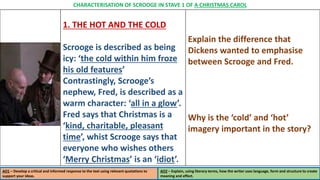
  • 145.
    AO1 – Developa critical and informed response to the text using relevant quotations to support your ideas. AO2 – Explain, using literary terms, how the writer uses language, form and structure to create meaning and effect. THE LAST CHAPTER: THE END OF IT What are the two most important things that Scrooge learns during the story?
  • 146.
    Write a paragraphto explore the quotation that Scrooge was: ‘hard and sharp as flint’ Scrooge is miser, who sinfully takes advantage of the poor. He is described as “Hard and sharp as flint” at the beginning of stave one. The simile is used to suggest that he is both intelligent and dangerous as he is “sharp”. His job as a creditor means he possesses both qualities and uses them to take advantage of the poor. The “hard” quality of the flint links to Scrooge’s unrelenting and harsh attitude to other people as he enjoys being alone. “Flint” can creates sparks that will produce a fire. In the novella, fire is symbolic of the Christmas spirit and although Scrooge is currently evil, he will change as the ghosts intervene to save his soul. Point Evidence Exploration Historical Context
  • 147.
    AO1 – Developa critical and informed response to the text using relevant quotations to support your ideas. AO2 – Explain, using literary terms, how the writer uses language, form and structure to create meaning and effect. It is also difficult to recognise Ignorance and Want as being ‘human’ from the description, since they are described as: ‘yellow, meagre, ragged, scowling, wolfish’. It is as though Victorian society has forced them to become less than human, turning them into living corpses, devils or dangerous animals. The imagery used to describe the children is haunting, and both Scrooge and the reader are shocked by the way the children look: ‘Scrooge started back, appalled.’ This emphasises Scrooge’s horror, and makes us wonder how they could have become like that.
  • 148.
    AO1 – Developa critical and informed response to the text using relevant quotations to support your ideas. AO2 – Explain, using literary terms, how the writer uses language, form and structure to create meaning and effect. END OF MODULE ASSESSMENT Starting with this extract, how does Dickens present Scrooge as a reformed character? Write about: •How Dickens presents Scrooge as a reformed character in this extract •How Dickens presents Scrooge’s reformation in the novel as a whole A03 – Show understanding of relationships between texts and the context they were written in. AO4 – Use a range of vocabulary and sentences with accurate spelling and grammar.
  • 149.
    AO1 – Developa critical and informed response to the text using relevant quotations to support your ideas. AO2 – Explain, using literary terms, how the writer uses language, form and structure to create meaning and effect. Scrooge was better than his word. He did it all, and infinitely more; and to Tiny Tim, who did not die, he was a second father. He became as good a friend, as good a master, and as good a man, as the good old city knew, or any other good old city, town, or borough, in the good old world. Some people laughed… A03 – Show understanding of relationships between texts and the context they were written in. AO4 – Use a range of vocabulary and sentences with accurate spelling and grammar.
  • 150.
    AO1 – Developa critical and informed response to the text using relevant quotations to support your ideas. AO2 – Explain, using literary terms, how the writer uses language, form and structure to create meaning and effect. Some people laughed to see the alteration in him, but he let them laugh, and little heeded them; for he was wise enough to know that nothing ever happened on this globe, for good, at which some people did not their fill of laughter in the outset; and knowing that such as these would be blind anyway,… A03 – Show understanding of relationships between texts and the context they were written in. AO4 – Use a range of vocabulary and sentences with accurate spelling and grammar.
  • 151.
    AO1 – Developa critical and informed response to the text using relevant quotations to support your ideas. AO2 – Explain, using literary terms, how the writer uses language, form and structure to create meaning and effect. …and knowing that such as these would be blind anyway, he thought it quite as well that they should wrinkle up their eyes in their grins, as have the malady in less attractive forms. His own heart laughed: and that was quite enough for him. A03 – Show understanding of relationships between texts and the context they were written in. AO4 – Use a range of vocabulary and sentences with accurate spelling and grammar.
  • 152.
    AO1 – Developa critical and informed response to the text using relevant quotations to support your ideas. AO2 – Explain, using literary terms, how the writer uses language, form and structure to create meaning and effect. He had no further intercourse with Spirits, but lived upon the Total Abstinence Principle, ever afterwards; and it was always said of him, that he knew how to keep Christmas well, if any man alive possessed the knowledge. May that be truly said of us, and all of us! And so, as Tiny Tim observed, God Bless Us, Every One! A03 – Show understanding of relationships between texts and the context they were written in. AO4 – Use a range of vocabulary and sentences with accurate spelling and grammar.
  • 153.
    SYMBOLISM LINKED WITHSCROOGE AO1 – Develop a critical and informed response to the text using relevant quotations to support your ideas. AO2 – Explain, using literary terms, how the writer uses language, form and structure to create meaning and effect. ‘solitary as an oyster’ ‘Scrooge had a very small fire, but the clerk’s fire was so very much smaller that it looked like one coal.’ Belle speaking to the young Scrooge: “Another idol has displaced me … a golden one.”
  • 154.
    AO1 – Developa critical and informed response to the text using relevant quotations to support your ideas. AO2 – Explain, using literary terms, how the writer uses language, form and structure to create meaning and effect. SCROOGE’S CHANGE What is the evidence for Scrooge’s change of character? A03 – Show understanding of relationships between texts and the context they were written in. AO4 – Use a range of vocabulary and sentences with accurate spelling and grammar.
  • 155.
    1. At thestart of the novel, the weather is described as being cold, bleak and foggy. This technique is pathetic fallacy. What does the fog suggest about Scrooge’s character? A. He doesn’t understand himself. B. His emotions are clouded. C. His state of mind stops him seeing the truth about life. 6. The narrator says about Scrooge that he liked his house being dark, because: ‘darkness is cheap’. Why was Scrooge so obsessed about saving money? A. Scrooge was saving up to spent the money on himself. B. Scrooge thought that money was sinful. C. Scrooge’s greed was driven by his fear. 11. Marley tells Scrooge that he will have one last chance at redemption when he is visited by the three spirits. What does ‘redemption’ mean? A. Becoming kind. B. Becoming poor. C. Becoming saved. 2. At the start of the story, Scrooge’s nephew, Fred, is the opposite of Scrooge in a number of ways. Which of the following does Scrooge least accept about Fred and his life? A. That Fred is kind. B. That Fred puts love before money. C. That Fred gives money to charity. 7. In Stave 1, there is foreshadowing when Scrooge’s door knob changes into the face of Marley. What does this event foreshadow in the story? A. Scrooge being punished. B. That nothing is what it seems. C. The arrival of the supernatural. 12. What does Marley’s ghost tell Scrooge that Marley regrets? A. Not spending more time with Scrooge. B. Only living for profit and business. C. Not working harder. 3. In Stave 1, Scrooge frightens off a little boy who flees ‘in terror’ when Scrooge catches him carol singing. What does Scrooge see later in the story that makes him regret this? A. The ghost of Marley. B. Himself as a child. C. Tiny Tim. 8. Before Marley’s ghost appears, Scrooge sees the face of Marley in the tiles around his fire. The images on the tiles are symbolic in the story. In particular, some of the tiles show an angel descending from the sky. What does this symbolise? A. The supernatural. B. That Scrooge need to become like an angel. C. That the ghosts are sent as messengers from God. 13. When Marley’s ghost talks to Scrooge, he sounds humble – very different from the way that Scrooge sounded when he spoke to Bob and Fred. What experiences had made Marley’s Ghost humble? A. Losing all his money. B. Seeing Scrooge again. C. Spending seven years walking the world as a spirit. 4. In Stave 1, a very important description of Scrooge is that he is ‘solitary as an oyster’. What are the most important things that this simile tells us about Scrooge? A. That he has a cold heart. B. That he is greedy. C. That he is hiding the true treasure in his life. 9. How does the sound of chains being dragged up from Scrooge’s wine cellar create tension at this point in the story? A. Because noisy chains are always frightening. B. Because the reader senses Scrooge’s anticipation. C. Because the reader knows what will happen. 14. In Stave 2, the ghost of Christmas past appeared to Scrooge, having a burning light shining from his head, which Scrooge could not look at. The ghost’s light is a metaphor, what does it stand for? A. Truth, purity and goodness. B. Scrooge’s sins. C. The brightness of the past. 5. In Stave 1, Scrooge’s home is described. What is it about his home that makes it a metaphor for Scrooge himself? A. That it is dark. B. That it is cold and empty. C. That it is expensive. 10. When Marley’s ghost appears, the chains and cash boxes that he wears are symbolic. What do they symbolise? A. Punishment for being greedy and selfish when he was alive. B. The wealth that Marley had when he was alive. C. The pointlessness of being rich. 15. When Scrooge is taken back in time to his school days, he experiences a realisation about his childhood. What was this realisation? A. That he hated school. B. That he enjoyed being alone. C. That his problems had begun un his childhood. A CHRISTMAS CAROL QUIZ
  • 156.
    16. When Scrooge’ssister arrives at the school with a ‘brimful of glee’ to take Scrooge home for Christmas, what does she stand for in the story? A. The power of love. B. Scrooge’s desire to go home. C. The difference between fan and Scrooge. 21. The ghost of Christmas present appears with piles of delicious food and a roaring fire. Why is this ironic, considering the way that many people lived at that time in London? A. Because people had enough anyway. B. Because most Londoners had very little. C. Because the ghost wants to spread the food. 26. The child called ‘Ignorance’ is a warning to Scrooge and suggests that people like Scrooge are ‘doomed’. What might this ‘doom’ be? A. The danger to society if children like that are left uneducated. B. The danger to Scrooge of going to hell . C. The danger of ignoring society’s problems. 17. When Scrooge sees himself and his sister at the school, he is reminded of her ‘large heart’. This makes Scrooge feel ‘uneasy in his mind’. Why did Scrooge feel like this? A. Because he missed Fan. B. Because he realises that he has mistreated Fred. C. Because he is confused by travelling into the past. 22. What is it about the spirit of Christmas present that shows he represents goodwill and the Christmas spirit? A. The scenes that he shows to Scrooge. B. His clothes. C. His gifts. 27. The ghost of Christmas future shows Scrooge scenes of hopeless despair. Firstly they visit ‘Old Joe’s Shop’ in the ‘foul and narrow’ streets, where people were ‘half-drunk and naked’. Old Joe is a rag and bone man. What happened in Old Joe’s shop? ANSWER: 18. Scrooge’s school days explain how Scrooge became the socially withdrawn person that he was later in his life. Which of these best explain this change? A. He had been rejected by his father. B. He was made to feel lonely. C. He had to bury his emotions deep. 23. The ghost of Christmas present shows Belle loving her own children after the end of her relationship with Scrooge. The ghost also shows the Cratchit family’s love for one another to Scrooge. What is the ghost trying to show Scrooge? A. That it is never too late to start a family. B. The ghost is trying to make Scrooge feel jealous. C. The importance of family. 28. How does Dickens want the reader to respond to Old Joe and the women that he meets? ANSWER: 19. When the spirit of Christmas past shows Scrooge scenes from his past they are tinged with sadness. However, the spirit also offers Scrooge a role model to follow: Fezziwig. Why is Fezziwig a role model? A. Because of his good-hearted, caring attitude. B. Because he was rich. C. Because he tried to help Scrooge start his business. 24. When the ghost of Christmas present shows that Bob Cratchit and Fred both toast Scrooge (even when he is not there), what is the ghost trying to show Scrooge? A. That all is forgiven at Christmas. B. The mens’ warm feelings for Scrooge. C. That love is the most important thing of all. 29. How was seeing Tiny Tim’s wake a turning point for Scrooge? ANSWER: 20. Belle stands for the life that Scrooge could have had. What fault of Scrooge led to his losing her? A. Not loving her enough. B. Being too rich. C. Loving wealth more than her. 25. When the spirit shows Scrooge the two ‘meagre, ragged’ children under his robes, why is this important in the story? A. Because the children are vulnerable. B. Because everyone likes children. C. Because they symbolise the suffering. 30. When the ghost of Christmas future shows Scrooge the dead Tiny Tim, Dickens says about him that ‘thy childish essence was from God’. How does this Link Tiny Tim to the message of Love and Christianity? ANSWER: A CHRISTMAS CAROL QUIZ