From Imaging to Inversion


             Ian F. Jones
      SEG 2012 Honorary Lecture
Acknowledgements


     Society of Exploration Geophysicists


     Shell Sponsorship


     ION GX Technology
SEG Membership
 SEG Digital Library - full text articles
 Technical Journals in Print and Online
 Networking Opportunities
 Receive Membership Discounts on:
   Continuing Education Courses
   Publications (35% off list price)
   Workshops and Meetings
SEG materials are available today!
Join Online    http://seg.org/join
Student Opportunities
 Student Chapters available
  Student Chapter Book Program
  SEG/Chevron Student Leadership Symposium
  Challenge Bowl

 Student Membership Resources
  Scholarships
  SEG/ExxonMobil Student
   Education Program
  Annual Meeting Travel Grants
  Student Expos
  the Anomaly newsletter

   More information please visit:
                 http://seg.org/students
From Imaging to Inversion


             Ian F. Jones
      SEG 2012 Honorary Lecture
But before I start…
But before I start…


A big thanks to Judy Wall at the
   SEG for her sterling work
   organizing my schedule !
Talk Outline
To a large extent, this presentation is
speculative, in that I’m looking at what ‘might
come next’ moving beyond the current industrial
practise of:

- data pre-conditioning (multiple suppression),
- velocity model building,
- migrating data and then
- analysing amplitude information….
Talk Outline
•   Hydrocarbon exploration
•   Subsurface Imaging
•   Waves versus rays
•   Velocity model building
•   Migration
•   Attribute estimation
•   Full waveform inversion
What is it
that hydrocarbon exploration
geoscientists set out to do …
Find oil and gas !
But how ?
Drill here ???
… or here ???
How do we decide where to drill?


… we use sound waves reflecting of the rock
layers to make pictures (similar to ultrasound
medical imaging) and then analyse the amplitude
behaviour of the data to infer what types of rocks
and fluids are present
The process currently involves several key
stages:

1) Removal of noise and undesired signal

2) Velocity model building

3) Migration

4) Attribute estimation
The process currently involves several key
stages:

1) Removal of noise and undesired signal

2) Velocity model building

3) Migration

4) Attribute estimation
Attribute estimation

Once we have estimated the speed of sound
(velocity) in the different rock layers, and then
formed an image from the recorded data
(‘migration’), we can analyse the amplitudes of
the reflections to estimate rock properties
(which helps us distinguish between oil, gas,
water, etc)
The geophysical problem

                     We need to relocate recorded
V1(x,y,z)            energy to its ‘true’ position using
                     an appropriate approximate
                     solution to the visco-elastic
V2(x,y,z)            two-way wave equation

etc


                          target location


   (and what is ‘appropriate’, depends on our objectives)
What do these images of
the subsurface look like?
Southern North Sea example
Image dimensions are typically several hundred square
kilometres in area, extending to several kilometres depth

Migrated image       Sea bed
        30km              chalk
                       30km
                                     1600m/s

                                     1800m/s
                                     2000m/s
                                     3000m/s


                                     3500m/s

                          3.5 km


                        anhydrite
Gas-bearing layers       salt       Sound speed in the rocks
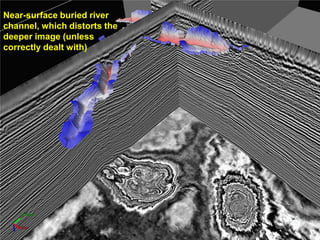
Near-surface buried river
channel, which distorts the
deeper image (unless
correctly dealt with)
How do we describe the way in which
  sound travels through the earth?
Waves versus Rays
Waves versus Rays
The theoretical description of wave phenomena
falls into two categories:

Ray-based

and

Wave- (diffraction or scattering) based

- Both migration and model update depend on
one or other of these paradigms
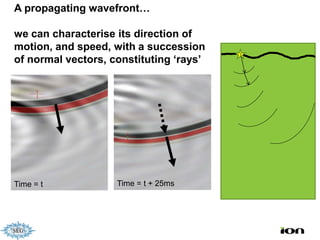
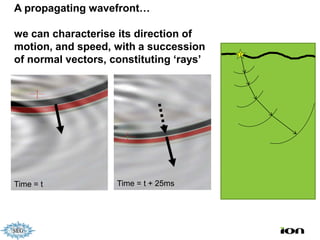
A propagating wavefront…

we can characterise its direction of
motion, and speed, with a succession
of normal vectors, constituting ‘rays’


Time = t            Time = t + 25ms
A propagating wavefront…

we can characterise its direction of
motion, and speed, with a succession
of normal vectors, constituting ‘rays’


Time = t            Time = t + 25ms
A propagating wavefront…

we can characterise its direction of
motion, and speed, with a succession
of normal vectors, constituting ‘rays’


Time = t            Time = t + 25ms
A propagating wavefront…

we can characterise its direction of
motion, and speed, with a succession
of normal vectors, constituting ‘rays’


Time = t            Time = t + 25ms
A propagating wavefront…

we can characterise its direction of
motion, and speed, with a succession
of normal vectors, constituting ‘rays’


Time = t            Time = t + 25ms
A propagating wavefront…

we can characterise its direction of
motion, and speed, with a succession
of normal vectors, constituting ‘rays’


Time = t            Time = t + 25ms
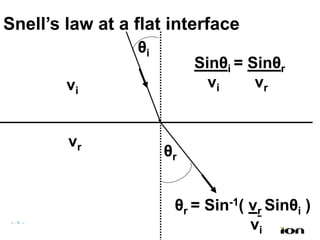
Snell’s law at a flat interface
                 θi
                           Sinθi = Sinθr
        vi                   vi     vr


        vr
                      θr


                       θr = Sin-1( vr Sinθi )
                                   vi
The high frequency approximation


                            Seismic wavelength much
                            smaller than the anomaly
                            we are trying to resolve


                               Velocity anomaly


    The propagating wavefront can
    adequately be described by ray-paths

Snell’s law adequately describes the wave propagation
… ray-based methods (Kirchhoff, beam, …) are OK
The high frequency approximation


                              Seismic wavelength larger or
                              similar to the anomaly we are
                              trying to resolve
    Small scale-length
    velocity anomaly                The velocity feature behaves
                                    more like a scatterer than a
                                    simple refracting surface element


                Trying to describe the propagation behaviour as
                ‘rays’ obeying Snell’s law, is no longer appropriate


Ray-based methods (Kirchhoff, beam, …) using the ‘high
frequency approximation’ begin to fail
A propagating wavefront…


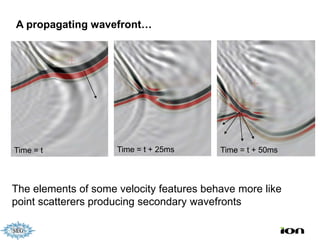
Time = t             Time = t + 25ms      Time = t + 50ms


The elements of some velocity features behave more like
point scatterers producing secondary wavefronts
Velocity Model Building
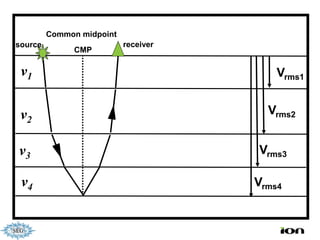
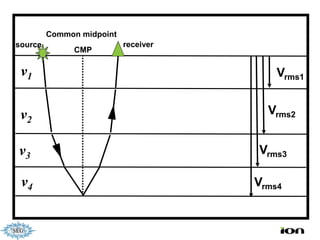
Common midpoint
source                     receiver
              CMP

 v1                                       Vrms1


 v2                                     Vrms2


v3                                    Vrms3

 v4                                   Vrms4
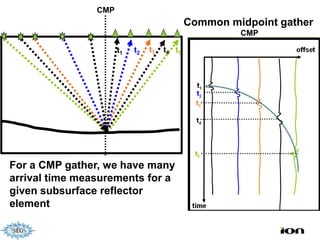
CMP
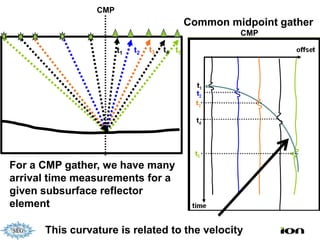
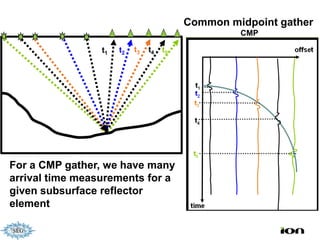
                                             Common midpoint gather
                                                      CMP

                      t1   t2   t3   t4 t5


For a CMP gather, we have many
arrival time measurements for a
given subsurface reflector
element
CMP
                                             Common midpoint gather
                                                      CMP

                      t1   t2   t3   t4 t5


For a CMP gather, we have many
arrival time measurements for a
given subsurface reflector
element

      This curvature is related to the velocity
 To estimate velocity for flat layers….
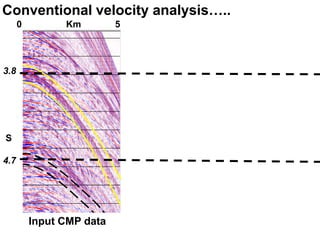
Conventional velocity analysis…..
      0         Km         5


3.8


S

4.7


          Input CMP data
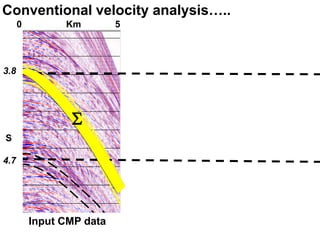
Conventional velocity analysis…..
      0         Km         5


3.8


                 Σ
S

4.7


          Input CMP data
Conventional velocity analysis…..
      0         Km         5      Km          5 1.5     2.5     3.5
                                                         Km/s


3.8


S

4.7


          Input CMP data       scan along       pick corresponding
                               trajectories          velocity
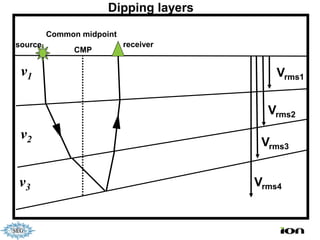
 To estimate velocity for dipping layers….


  The notion of the CMP no longer has any meaning,
  as the mid-points do not sit above the same
  subsurface location for all offsets
Dipping layers

         Common midpoint
source                     receiver
              CMP

 v1                                        Vrms1


                                         Vrms2
 v2
                                        Vrms3


v3                                     Vrms4
 To estimate velocity for dipping layers….


  The notion of the CMP no longer has any meaning,
  as the mid-points do not sit above the same
  subsurface location for all offsets


    We have to assess the travel times
    for each offset separately
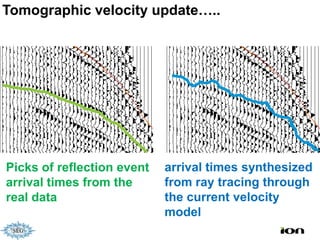
Tomographic velocity update…..


Trace raypaths through the current version of
the model and note arrival times
Tomographic velocity update…..


Picks of reflection event   arrival times synthesized
arrival times from the      from ray tracing through
real data                   the current velocity
                            model
Tomographic velocity update…..


  Tomography iteratively modifies the
  velocity model so as to minimize the
  difference between observed arrival
  times on the real data, and ray-traced
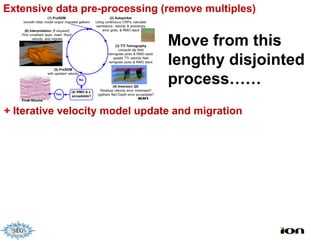
  times through the current velocity
  model
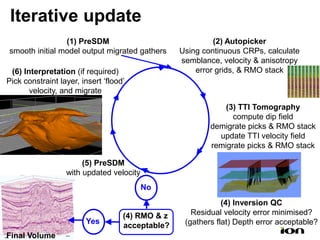
Iterative update
                (1) PreSDM                                 (2) Autopicker
smooth initial model output migrated gathers      Using continuous CRPs, calculate
                                                  semblance, velocity & anisotropy
 (6) Interpretation (if required)                     error grids, & RMO stack
Pick constraint layer, insert ‘flood’
       velocity, and migrate

                                                              (3) TTI Tomography
                                                                compute dip field
                                                          demigrate picks & RMO stack
                                                            update TTI velocity field
                                                          remigrate picks & RMO stack

                       (5) PreSDM
                  with updated velocity
                                          No
                                                              (4) Inversion QC
                                    (4) RMO & z      Residual velocity error minimised?
                        Yes                        (gathers flat) Depth error acceptable?
                                    acceptable?
Final Volume
Iterative update
                (1) PreSDM                                 (2) Autopicker
smooth initial model output migrated gathers      Using continuous CRPs, calculate
                                                  semblance, velocity & anisotropy
 (6) Interpretation (if required)                     error grids, & RMO stack
Pick constraint layer, insert ‘flood’
       velocity, and migrate

                                  This process       (3) TTI Tomography
                                 usually involves demigrate picksdipRMO stack
                                                       compute
                                                                  &
                                                                    field

                                  6-8 iterations    update TTI velocity field
                                                          remigrate picks & RMO stack

                       (5) PreSDM
                  with updated velocity
                                          No
                                                              (4) Inversion QC
                                    (4) RMO & z      Residual velocity error minimised?
                        Yes                        (gathers flat) Depth error acceptable?
                                    acceptable?
Final Volume
Iteration 1, 3D preSDM


0


                             Top Chalk

k
m


2
Iteration 2, 3D preSDM


0


                             Top Chalk

k
m


2
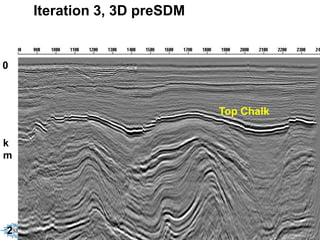
Iteration 3, 3D preSDM


0


                             Top Chalk

k
m


2
Iteration 1 Velocities


0


k
m


2
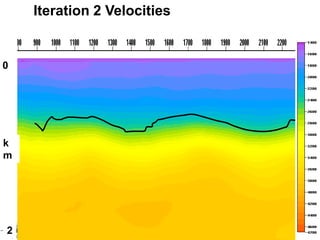
Iteration 2 Velocities


0


k
m


2
Iteration 3 Velocities


0


k
m


2
Migration:

putting the recorded data
back where it came from
Common midpoint
source                     receiver
              CMP

 v1                                       Vrms1


 v2                                     Vrms2


v3                                    Vrms3

 v4                                   Vrms4
Common midpoint
source                     receiver
              CMP

 v1                                       Vrms1


 v2                                     Vrms2


v3                                    Vrms3

 v4                                   Vrms4
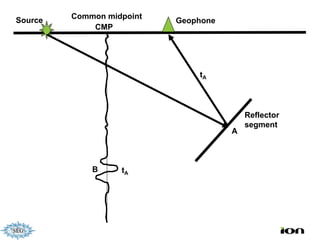
Plot all the traces from various common midpoints to
form a picture of the subsurface…
Common midpoint
Source                     Geophone
             CMP


                               tA


                                          Reflector
                                          segment
                                      A


             B     tA
Common midpoint
Source                         Geophone
             CMP


                                     tA


                                                 Reflector
                                                 segment
                                             A


             B     tA
                           ‘Migration’ moves the recorded data
                           back to where it came from
Main migration algorithms in use today

       - Kirchhoff
 Ray   - Beam
       - (GB, CRAM, CRS, CFP, ….)

       - Wavefield extrapolation (WEM)
Wave
       - Reverse-Time (two-way)
Migration algorithms

 relocate recorded energy to its ‘true’ position
 using an appropriate approximate solution to the
 two-way visco-elastic wave equation (but what is
 ‘appropriate’, depends on our objectives)
Migration algorithms
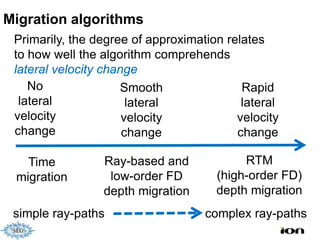
 Primarily, the degree of approximation relates
 to how well the algorithm comprehends
 lateral velocity change
Migration algorithms
 Primarily, the degree of approximation relates
 to how well the algorithm comprehends
 lateral velocity change
    No               Smooth                Rapid
  lateral              lateral             lateral
 velocity             velocity            velocity
 change               change              change
Migration algorithms
 Primarily, the degree of approximation relates
 to how well the algorithm comprehends
 lateral velocity change
    No               Smooth                Rapid
  lateral              lateral             lateral
 velocity             velocity            velocity
 change               change              change

   Time          Ray-based and             RTM
 migration        low-order FD        (high-order FD)
                 depth migration      depth migration
Migration algorithms
 Primarily, the degree of approximation relates
 to how well the algorithm comprehends
 lateral velocity change
    No               Smooth                Rapid
  lateral              lateral             lateral
 velocity             velocity            velocity
 change               change              change

   Time          Ray-based and             RTM
 migration        low-order FD        (high-order FD)
                 depth migration      depth migration
 simple ray-paths                   complex ray-paths
1km
           Velocity-depth model
1490 m/s


1600 m/s


2000 m/s


2200 m/s


3500 m/s
Acoustic shot gather             3km   6km
                            1s
Energy travelling in the
water (the ‘direct’ wave)

Reflection from
water bottom
                            3s


Reflections from            4s
deeper rock layers

                            5s
1km
           Velocity-depth model
1490 m/s


1600 m/s


2000 m/s


2200 m/s


3500 m/s
1km
           preSDM
1500 m/s
1600 m/s


2000 m/s


2200 m/s


3500 m/s
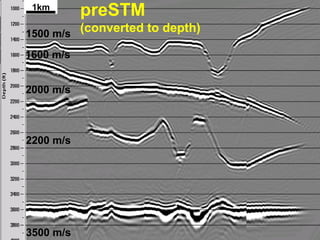
1km
           preSTM
1500 m/s (converted to depth)
1600 m/s


2000 m/s


2200 m/s


3500 m/s
Migration Issues:

Lateral velocity variation:
         Kirchhoff preSTM
      vs Kirchhoff preSDM
      vs RTM


      Norwegian Sea shallow water gas example
Interval velocity model
Autopicking @50*50m   1km    Courtesy of ConocoPhillips Norway
Tomo @250*250*50m
Kirchhoff preSTM (initial model)
               1km      Courtesy of ConocoPhillips Norway
Kirchhoff preSDM
Autopicking @50*50m   1km   Courtesy of ConocoPhillips Norway
Tomo @250*250*50m
RTM
Autopicking @50*50m   1km   Courtesy of ConocoPhillips Norway
Tomo @250*250*50m
Migration Issues:

In addition to the degree of
lateral velocity change, we also
have the issue of ray-path
complexity to consider in the
migration…
Migration Issues:


Multi-pathing:
What is multi-pathing?
 There is more than one path from a surface location to a
 subsurface point


                            salt


A Kirchhoff scheme usually only computes travel times for
one ray path… what happens to the energy from the rest
of the ray paths from input data?
Migration Issues:


Multi-pathing:
       Kirchhoff vs WEM


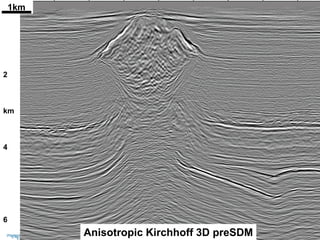
      North Sea shallow water diapir example
1km


          salt
2


km


4


6
          Vi(z)
1km


2


km


4


6
          Anisotropic Kirchhoff 3D preSDM
1km


2


km


4


6
          Anisotropic one-way SSFPI (WEM) 3D preSDM
Migration Issues:


Two-way propagation:
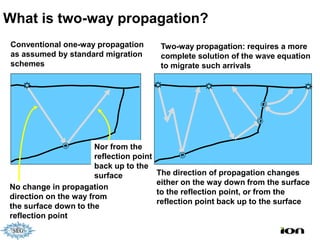
What is two-way propagation?
Conventional one-way propagation           Two-way propagation: requires a more
as assumed by standard migration           complete solution of the wave equation
schemes                                    to migrate such arrivals


                       Nor from the
                       reflection point
                       back up to the
                       surface            The direction of propagation changes
                                          either on the way down from the surface
No change in propagation
                                          to the reflection point, or from the
direction on the way from
                                          reflection point back up to the surface
the surface down to the
reflection point
Migration Issues:


Two way ray paths:
     WEM vs RTM


      North Sea shallow water diapir example
1km


2


km


4


6
          Anisotropic one-way SSFPI (WEM) 3D preSDM
1km


2


km


4


6
          Anisotropic two-way RTM 3D preSDM
1km


2


km


4


6
          Anisotropic two-way RTM 3D preSDM
Migration Issues:


Two way ray paths:
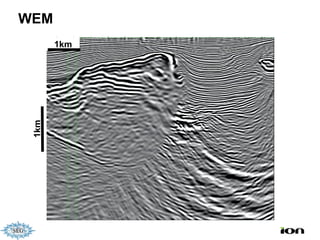
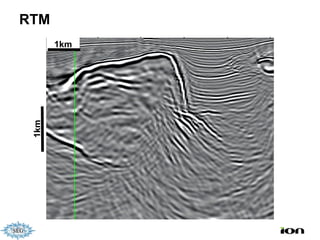
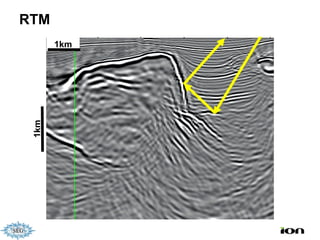
     WEM vs RTM


      West African deep water diapir example
WEM
       1km
 1km
RTM
       1km
 1km
RTM
       1km
 1km
RTM
       1km
 1km
RTM
       1km
 1km
Once we have estimated velocity, and
migrated the data to obtain gathers in
their correct spatial location, we can
     begin to analyse amplitude
             information
Extracting other rock attributes
       (as well as velocity):

    rock type, fluid type, density,
saturation, pressure, attenuation, ….
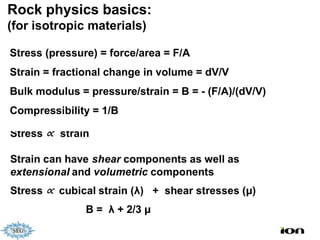
Rock physics basics:
(for isotropic materials)

Stress (pressure) = force/area = F/A
Strain = fractional change in volume = dV/V
Bulk modulus = pressure/strain = B = - (F/A)/(dV/V)
Compressibility = 1/B


               B = λ + 2/3 μ
Common midpoint gather
                                                   CMP

                 t1   t2   t3   t4   t5


For a CMP gather, we have many
arrival time measurements for a
given subsurface reflector
element
Common image gather
                                                 CIG or CRP

               t1   t2   t3   t4   t5                         offset


After depth migration with an
acceptable velocity model, all
events in the gather should
line-up  ‘flat gathers’
                                         Migrated depth
Having obtained estimates of velocity:


we can then estimate other parameters from
amplitude behaviour
Gathers output from preSDM - not exactly flat
After final residual event alignment and noise suppression

                                        These data are
                                        now suitable for
                                        analyzing
                                        variations in
                                        amplitude:
After final residual event alignment and noise suppression

                                        These data are
                                        now suitable for
                                        analyzing
                                        variations in
                                        amplitude:

                                        vertically from
                                        reflector-to-
                                        reflector:
                                        (ρ2v2 – ρ1v1)/(ρ2v2 + ρ1v1)
After final residual event alignment and noise suppression

                                        These data are
                                        now suitable for
                                        analyzing
                                        variations in
                                        amplitude:

                                        vertically from
                                        reflector-to-
                                        reflector

                                        and laterally
                                        versus incidence
                                        angle at the
                                        reflectors
Incident P wave

                 Transmitted P wave


                 Reflected P wave


     text


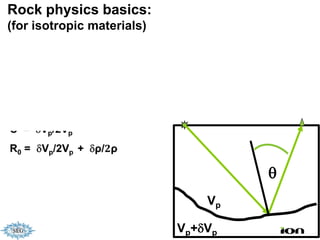
The Knott-Zoeppritz equations relate the
amplitude change as a function of incident
angle, to Vp, Vs, and density
Rock physics basics:
(for isotropic materials)


                                     θ
                                Vp

                            Vp+δVp
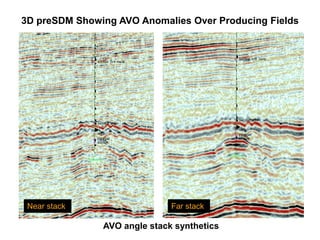
3D preSDM Showing AVO Anomalies Over Producing Fields


 Near stack                   Far stack

               AVO angle stack synthetics
3D preSDM Showing AVO Anomalies Over Producing Fields


Near stack (0º-25º)               Far stack (25º-50º)
      Average absolute amplitude Top Balder +50 - +200
MacCulloch
    15/24b-6 Far-angle stack EI Inversion
N                   S     W                          E
                               15/24b-6
     15/24b-6

                                             Top
                                            Balder


                  Low EI Oil                     650

                    Sand                         600

                                                 550

                                                 500

                                                 450
N                          15/25b-3                     S


    Top Balder


                               Brenda
                                Field


                                                       650

                                                       600

                  Possible low EI Oil Sand on flank?   550

                                                       500

             15/25b-3 Far-stack Inversion (inline)     450
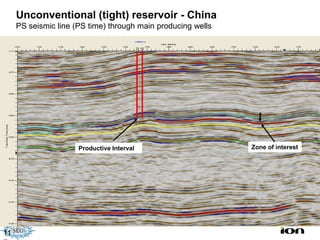
Unconventional (tight) reservoir - China
     PS seismic line (PS time) through main producing wells


                      Productive Interval                     Zone of interest


11
Unconventional (tight) reservoir - China
     Characterizing Lithological Variations

            shale               sand

Record P-wave only
Impute shear-wave measurement
using simultaneous inversion (AVO)
Attempt to infer sand-shale variations


                                              Record shear-waves directly
                                              More accurate depiction of
                                              sand-shale variations

11
Unconventional (tight) reservoir - China
     Full-wave explains well productivity – fracture characterization


             Same lithology                                   Note presence of
             No fractures                                       fractures in
             No production                                    producing zone


                                    New well location


11
What we’ve reviewed so far, has
been the ‘state of the art’:

    1) velocity model building
    2) migration
    3) attribute estimation
What next?

Can we do all this in one step?

= full elastic waveform inversion
To accomplish this task, we must accurately
model the behaviour of the recorded data:
To accomplish this task, we must accurately
model the behaviour of the recorded data:


- we start with initial estimates of the rock physics
parameters (P-wave velocity, S-wave velocity,
density, anisotropy, absorption, ..)
To accomplish this task, we must accurately
model the behaviour of the recorded data:


- we start with initial estimates of the rock physics
parameters (P-wave velocity, S-wave velocity,
density, anisotropy, absorption, ..)

- make synthetic data and compare it to the real
data
To accomplish this task, we must accurately
model the behaviour of the recorded data:


- we start with initial estimates of the rock physics
parameters (P-wave velocity, S-wave velocity,
density, anisotropy, absorption, ...)

- make synthetic data and compare it to the real
data

- iteratively adjust the parameters until modelled
and real data match
Real shot       Modelled shot


            -                   = residual
Recall the conventional approach:
(Tomographic velocity update)…..

 Tomography iteratively modifies the
 velocity model so as to
 minimize the difference
 between observed arrival times on the real
 data, and ray-traced times through the
 current velocity model
Waveform inversion update…..


 Waveform inversion iteratively modifies
 the parameter model so as to
 minimize the difference
 between observed amplitudes on the real
 data, and modelled amplitudes created
 using the current parameter model
What’s involved in getting the amplitude right?
  -Visco elastic wave propagation (incorporates
   attenuation and shear modes)

  -Elastic wave propagation (shear modes)

  -Acoustic wave propagation (P-wave only, thus
   ignoring density)

  -Anisotropy

  -Source wavelet (and are ghosts present?)

  -Source wavelet time delay

  -Cycle skipping (offset and frequency dependent)
Ignoring density
 Reflection strength (amplitude) is related to impedance
 contrast:

 (ρ2v2 – ρ1v1)/(ρ2v2 + ρ1v1)

 By ignoring density, we are saying that impedance is
 only a function of P velocity:

 Thus, if we invert using reflection events, we will have
 an amplitude error

 So, to avoid this error perhaps use only refractions
 (diving, turning waves)
Where are the refractions?


 Perform some forward modelling to assess how deeply
 the diving waves penetrate

 The region of validity of the model update will be
 related to this depth of penetration
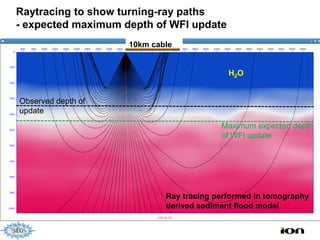
Raytracing to show turning-ray paths
- expected maximum depth of WFI update
                             10km cable


                                                        H2O


Observed depth of
update    Insert Velocity Model Here with Rays for Cable we are using
                                                      Maximum expected depth
                                                      of WFI update


                                       Ray tracing performed in tomography
                                       derived sediment flood model
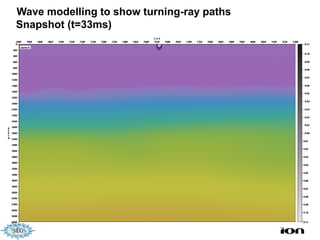
Wave modelling to show turning-ray paths
Snapshot (t=33ms)
Wave modelling to show turning-ray paths
Snapshot (t=1407ms)
Wave modelling to show turning-ray paths
Snapshot (t=1865ms)
Wave modelling to show turning-ray paths
Snapshot (t=2454ms)
Wave modelling to show turning-ray paths
Snapshot (t=3272ms)


         Max Depth of Turning Rays ~3400m
                 for cable length
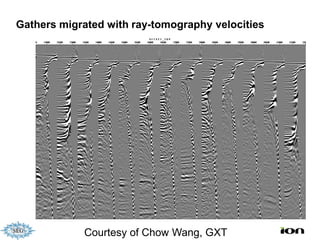
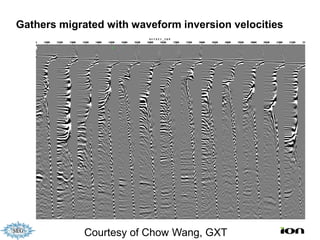
Do we obtain a better earth-model parameters?


 One way to confirm if FWI has produced better earth-
 model parameters is to use the FWI velocity to perform
 a new migration
Gathers migrated with ray-tomography velocities


            Courtesy of Chow Wang, GXT
Gathers migrated with waveform inversion velocities


             Courtesy of Chow Wang, GXT
Shallow Section Before WFI


            Courtesy of Chow Wang, GXT
Shallow Section After WFI


            Courtesy of Chow Wang, GXT
BP in-house project: Valhall

(courtesy of Jan Kommedal & Laurent Sirgue)


                                   Courtesy of BP Norway
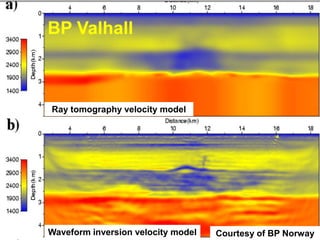
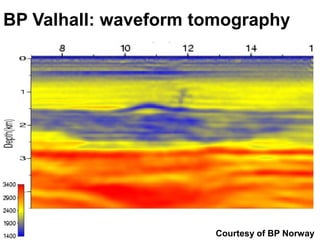
BP Valhall


Ray tomography velocity model


Waveform inversion velocity model   Courtesy of BP Norway
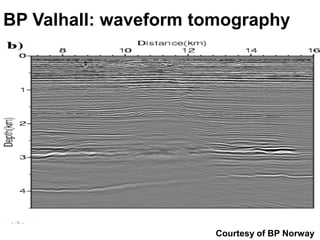
BP Valhall: ray-based tomography


                       Courtesy of BP Norway
BP Valhall: waveform tomography


                      Courtesy of BP Norway
BP Valhall: waveform tomography


                      Courtesy of BP Norway
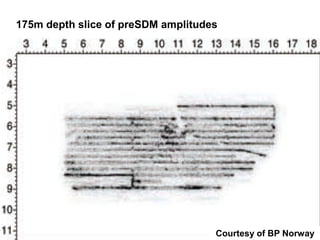
175m depth slice of preSDM amplitudes


                                    Courtesy of BP Norway
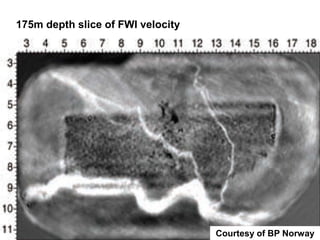
175m depth slice of FWI velocity


                                   Courtesy of BP Norway
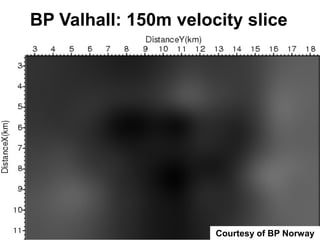
BP Valhall: 150m velocity slice


                      Courtesy of BP Norway
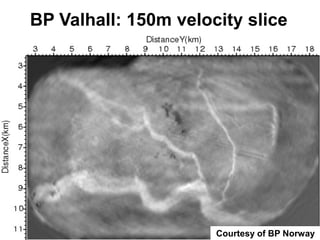
BP Valhall: 150m velocity slice


                      Courtesy of BP Norway
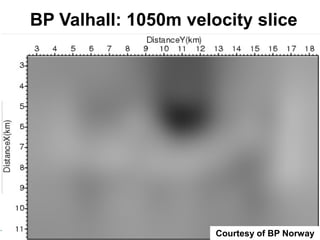
BP Valhall: 1050m velocity slice


                      Courtesy of BP Norway
BP Valhall: 1050m velocity slice


                      Courtesy of BP Norway
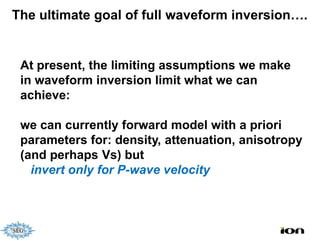
The ultimate goal of full waveform inversion….


 At present, the limiting assumptions we make
 in waveform inversion limit what we can
 achieve:

 we can currently forward model with a priori
 parameters for: density, attenuation, anisotropy
 (and perhaps Vs) but
   invert only for P-wave velocity
The ultimate goal of full waveform inversion….


 IFF we can move beyond the present limiting
 assumptions, then we may be able to invert so
 as to update all these parameters thereby
 recovering density, Vp, Vs, Q, and other
 parameters.

 Interpretation would then be performed on
 these parameter fields directly, rather than on
 inversions of migrated data obtained using the
 velocity parameter
The ultimate goal of full waveform inversion….
    Vp         Vs          ρ        ε            δ
                        model


                       Inversion
                         result


    Courtesy of Olga Podgornova
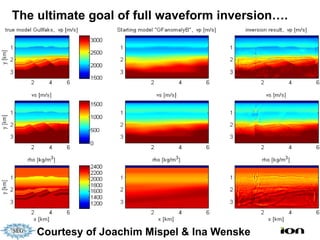
The ultimate goal of full waveform inversion….


    Courtesy of Joachim Mispel & Ina Wenske
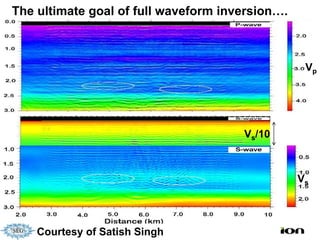
The ultimate goal of full waveform inversion….


                                                  Vp


                                      Vs/10


                                                 Vs


    Courtesy of Satish Singh
In other words ….
Move from this
lengthy disjointed
process……
Extensive data pre-processing (remove multiples)


                               Move from this
                               lengthy disjointed
                               process……
Extensive data pre-processing (remove multiples)


                                Move from this
                                lengthy disjointed
                                process……
+ Iterative velocity model update and migration
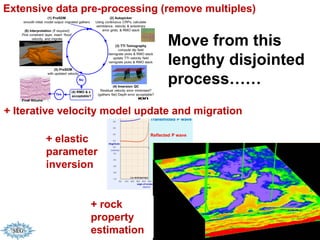
Extensive data pre-processing (remove multiples)


                                Move from this
                                lengthy disjointed
                                process……
+ Iterative velocity model update and migration

        + elastic
        parameter
        inversion
Extensive data pre-processing (remove multiples)


                                Move from this
                                lengthy disjointed
                                process……
+ Iterative velocity model update and migration

        + elastic
        parameter
        inversion


                 + rock
                 property
                 estimation
To this ……
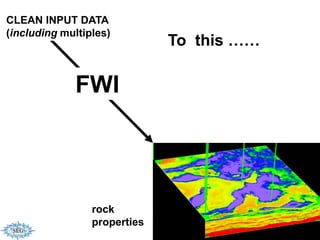
CLEAN INPUT DATA
(including multiples)
                              To this ……

             FWI


                 rock
                 properties
But perhaps we shouldn’t
    ‘hold our breath’
        just yet !
Thank you !

Від побудови сейсмічних зображень до інверсії

  • 1.
    From Imaging toInversion Ian F. Jones SEG 2012 Honorary Lecture
  • 2.
    Acknowledgements  Society of Exploration Geophysicists  Shell Sponsorship  ION GX Technology
  • 3.
    SEG Membership  SEGDigital Library - full text articles  Technical Journals in Print and Online  Networking Opportunities  Receive Membership Discounts on:  Continuing Education Courses  Publications (35% off list price)  Workshops and Meetings SEG materials are available today! Join Online    http://seg.org/join
  • 4.
    Student Opportunities  StudentChapters available  Student Chapter Book Program  SEG/Chevron Student Leadership Symposium  Challenge Bowl  Student Membership Resources  Scholarships  SEG/ExxonMobil Student Education Program  Annual Meeting Travel Grants  Student Expos  the Anomaly newsletter More information please visit:    http://seg.org/students
  • 5.
    From Imaging toInversion Ian F. Jones SEG 2012 Honorary Lecture
  • 6.
    But before Istart…
  • 7.
    But before Istart… A big thanks to Judy Wall at the SEG for her sterling work organizing my schedule !
  • 8.
    Talk Outline To alarge extent, this presentation is speculative, in that I’m looking at what ‘might come next’ moving beyond the current industrial practise of: - data pre-conditioning (multiple suppression), - velocity model building, - migrating data and then - analysing amplitude information….
  • 9.
    Talk Outline • Hydrocarbon exploration • Subsurface Imaging • Waves versus rays • Velocity model building • Migration • Attribute estimation • Full waveform inversion
  • 10.
    What is it thathydrocarbon exploration geoscientists set out to do …
  • 11.
  • 12.
  • 13.
  • 14.
  • 15.
    How do wedecide where to drill?
  • 16.
    How do wedecide where to drill? … we use sound waves reflecting of the rock layers to make pictures (similar to ultrasound medical imaging) and then analyse the amplitude behaviour of the data to infer what types of rocks and fluids are present
  • 17.
    The process currentlyinvolves several key stages: 1) Removal of noise and undesired signal 2) Velocity model building 3) Migration 4) Attribute estimation
  • 18.
    The process currentlyinvolves several key stages: 1) Removal of noise and undesired signal 2) Velocity model building 3) Migration 4) Attribute estimation
  • 19.
    Attribute estimation Once wehave estimated the speed of sound (velocity) in the different rock layers, and then formed an image from the recorded data (‘migration’), we can analyse the amplitudes of the reflections to estimate rock properties (which helps us distinguish between oil, gas, water, etc)
  • 20.
    The geophysical problem We need to relocate recorded V1(x,y,z) energy to its ‘true’ position using an appropriate approximate solution to the visco-elastic V2(x,y,z) two-way wave equation etc target location (and what is ‘appropriate’, depends on our objectives)
  • 21.
    What do theseimages of the subsurface look like?
  • 22.
    Southern North Seaexample Image dimensions are typically several hundred square kilometres in area, extending to several kilometres depth Migrated image Sea bed 30km chalk 30km 1600m/s 1800m/s 2000m/s 3000m/s 3500m/s 3.5 km anhydrite Gas-bearing layers salt Sound speed in the rocks
  • 23.
    Near-surface buried river channel,which distorts the deeper image (unless correctly dealt with)
  • 24.
    How do wedescribe the way in which sound travels through the earth?
  • 25.
  • 26.
    Waves versus Rays Thetheoretical description of wave phenomena falls into two categories: Ray-based and Wave- (diffraction or scattering) based - Both migration and model update depend on one or other of these paradigms
  • 27.
    A propagating wavefront… wecan characterise its direction of motion, and speed, with a succession of normal vectors, constituting ‘rays’ Time = t Time = t + 25ms
  • 28.
    A propagating wavefront… wecan characterise its direction of motion, and speed, with a succession of normal vectors, constituting ‘rays’ Time = t Time = t + 25ms
  • 29.
    A propagating wavefront… wecan characterise its direction of motion, and speed, with a succession of normal vectors, constituting ‘rays’ Time = t Time = t + 25ms
  • 30.
    A propagating wavefront… wecan characterise its direction of motion, and speed, with a succession of normal vectors, constituting ‘rays’ Time = t Time = t + 25ms
  • 31.
    A propagating wavefront… wecan characterise its direction of motion, and speed, with a succession of normal vectors, constituting ‘rays’ Time = t Time = t + 25ms
  • 32.
    A propagating wavefront… wecan characterise its direction of motion, and speed, with a succession of normal vectors, constituting ‘rays’ Time = t Time = t + 25ms
  • 33.
    Snell’s law ata flat interface θi Sinθi = Sinθr vi vi vr vr θr θr = Sin-1( vr Sinθi ) vi
  • 34.
    The high frequencyapproximation Seismic wavelength much smaller than the anomaly we are trying to resolve Velocity anomaly The propagating wavefront can adequately be described by ray-paths Snell’s law adequately describes the wave propagation … ray-based methods (Kirchhoff, beam, …) are OK
  • 35.
    The high frequencyapproximation Seismic wavelength larger or similar to the anomaly we are trying to resolve Small scale-length velocity anomaly The velocity feature behaves more like a scatterer than a simple refracting surface element Trying to describe the propagation behaviour as ‘rays’ obeying Snell’s law, is no longer appropriate Ray-based methods (Kirchhoff, beam, …) using the ‘high frequency approximation’ begin to fail
  • 36.
    A propagating wavefront… Time= t Time = t + 25ms Time = t + 50ms The elements of some velocity features behave more like point scatterers producing secondary wavefronts
  • 37.
  • 38.
    Common midpoint source receiver CMP v1 Vrms1 v2 Vrms2 v3 Vrms3 v4 Vrms4
  • 39.
    CMP Common midpoint gather CMP t1 t2 t3 t4 t5 For a CMP gather, we have many arrival time measurements for a given subsurface reflector element
  • 40.
    CMP Common midpoint gather CMP t1 t2 t3 t4 t5 For a CMP gather, we have many arrival time measurements for a given subsurface reflector element This curvature is related to the velocity
  • 41.
     To estimatevelocity for flat layers….
  • 42.
    Conventional velocity analysis….. 0 Km 5 3.8 S 4.7 Input CMP data
  • 43.
    Conventional velocity analysis….. 0 Km 5 3.8 Σ S 4.7 Input CMP data
  • 44.
    Conventional velocity analysis….. 0 Km 5 Km 5 1.5 2.5 3.5 Km/s 3.8 S 4.7 Input CMP data scan along pick corresponding trajectories velocity
  • 45.
     To estimatevelocity for dipping layers….
  • 46.
     To estimatevelocity for dipping layers…. The notion of the CMP no longer has any meaning, as the mid-points do not sit above the same subsurface location for all offsets
  • 47.
    Dipping layers Common midpoint source receiver CMP v1 Vrms1 Vrms2 v2 Vrms3 v3 Vrms4
  • 48.
     To estimatevelocity for dipping layers…. The notion of the CMP no longer has any meaning, as the mid-points do not sit above the same subsurface location for all offsets We have to assess the travel times for each offset separately
  • 49.
    Tomographic velocity update….. Traceraypaths through the current version of the model and note arrival times
  • 50.
    Tomographic velocity update….. Picksof reflection event arrival times synthesized arrival times from the from ray tracing through real data the current velocity model
  • 51.
    Tomographic velocity update….. Tomography iteratively modifies the velocity model so as to minimize the difference between observed arrival times on the real data, and ray-traced times through the current velocity model
  • 52.
    Iterative update (1) PreSDM (2) Autopicker smooth initial model output migrated gathers Using continuous CRPs, calculate semblance, velocity & anisotropy (6) Interpretation (if required) error grids, & RMO stack Pick constraint layer, insert ‘flood’ velocity, and migrate (3) TTI Tomography compute dip field demigrate picks & RMO stack update TTI velocity field remigrate picks & RMO stack (5) PreSDM with updated velocity No (4) Inversion QC (4) RMO & z Residual velocity error minimised? Yes (gathers flat) Depth error acceptable? acceptable? Final Volume
  • 53.
    Iterative update (1) PreSDM (2) Autopicker smooth initial model output migrated gathers Using continuous CRPs, calculate semblance, velocity & anisotropy (6) Interpretation (if required) error grids, & RMO stack Pick constraint layer, insert ‘flood’ velocity, and migrate This process (3) TTI Tomography usually involves demigrate picksdipRMO stack compute & field 6-8 iterations update TTI velocity field remigrate picks & RMO stack (5) PreSDM with updated velocity No (4) Inversion QC (4) RMO & z Residual velocity error minimised? Yes (gathers flat) Depth error acceptable? acceptable? Final Volume
  • 54.
    Iteration 1, 3DpreSDM 0 Top Chalk k m 2
  • 55.
    Iteration 2, 3DpreSDM 0 Top Chalk k m 2
  • 56.
    Iteration 3, 3DpreSDM 0 Top Chalk k m 2
  • 57.
  • 58.
  • 59.
  • 60.
    Migration: putting the recordeddata back where it came from
  • 61.
    Common midpoint source receiver CMP v1 Vrms1 v2 Vrms2 v3 Vrms3 v4 Vrms4
  • 62.
    Common midpoint source receiver CMP v1 Vrms1 v2 Vrms2 v3 Vrms3 v4 Vrms4
  • 63.
    Plot all thetraces from various common midpoints to form a picture of the subsurface…
  • 64.
    Common midpoint Source Geophone CMP tA Reflector segment A B tA
  • 65.
    Common midpoint Source Geophone CMP tA Reflector segment A B tA ‘Migration’ moves the recorded data back to where it came from
  • 66.
    Main migration algorithmsin use today - Kirchhoff Ray - Beam - (GB, CRAM, CRS, CFP, ….) - Wavefield extrapolation (WEM) Wave - Reverse-Time (two-way)
  • 67.
    Migration algorithms relocaterecorded energy to its ‘true’ position using an appropriate approximate solution to the two-way visco-elastic wave equation (but what is ‘appropriate’, depends on our objectives)
  • 68.
    Migration algorithms Primarily,the degree of approximation relates to how well the algorithm comprehends lateral velocity change
  • 69.
    Migration algorithms Primarily,the degree of approximation relates to how well the algorithm comprehends lateral velocity change No Smooth Rapid lateral lateral lateral velocity velocity velocity change change change
  • 70.
    Migration algorithms Primarily,the degree of approximation relates to how well the algorithm comprehends lateral velocity change No Smooth Rapid lateral lateral lateral velocity velocity velocity change change change Time Ray-based and RTM migration low-order FD (high-order FD) depth migration depth migration
  • 71.
    Migration algorithms Primarily,the degree of approximation relates to how well the algorithm comprehends lateral velocity change No Smooth Rapid lateral lateral lateral velocity velocity velocity change change change Time Ray-based and RTM migration low-order FD (high-order FD) depth migration depth migration simple ray-paths complex ray-paths
  • 72.
    1km Velocity-depth model 1490 m/s 1600 m/s 2000 m/s 2200 m/s 3500 m/s
  • 73.
    Acoustic shot gather 3km 6km 1s Energy travelling in the water (the ‘direct’ wave) Reflection from water bottom 3s Reflections from 4s deeper rock layers 5s
  • 74.
    1km Velocity-depth model 1490 m/s 1600 m/s 2000 m/s 2200 m/s 3500 m/s
  • 75.
    1km preSDM 1500 m/s 1600 m/s 2000 m/s 2200 m/s 3500 m/s
  • 76.
    1km preSTM 1500 m/s (converted to depth) 1600 m/s 2000 m/s 2200 m/s 3500 m/s
  • 77.
    Migration Issues: Lateral velocityvariation: Kirchhoff preSTM vs Kirchhoff preSDM vs RTM Norwegian Sea shallow water gas example
  • 78.
    Interval velocity model Autopicking@50*50m 1km Courtesy of ConocoPhillips Norway Tomo @250*250*50m
  • 79.
    Kirchhoff preSTM (initialmodel) 1km Courtesy of ConocoPhillips Norway
  • 80.
    Kirchhoff preSDM Autopicking @50*50m 1km Courtesy of ConocoPhillips Norway Tomo @250*250*50m
  • 81.
    RTM Autopicking @50*50m 1km Courtesy of ConocoPhillips Norway Tomo @250*250*50m
  • 82.
    Migration Issues: In additionto the degree of lateral velocity change, we also have the issue of ray-path complexity to consider in the migration…
  • 83.
  • 84.
    What is multi-pathing? There is more than one path from a surface location to a subsurface point salt A Kirchhoff scheme usually only computes travel times for one ray path… what happens to the energy from the rest of the ray paths from input data?
  • 85.
    Migration Issues: Multi-pathing: Kirchhoff vs WEM North Sea shallow water diapir example
  • 86.
    1km salt 2 km 4 6 Vi(z)
  • 87.
    1km 2 km 4 6 Anisotropic Kirchhoff 3D preSDM
  • 88.
    1km 2 km 4 6 Anisotropic one-way SSFPI (WEM) 3D preSDM
  • 89.
  • 90.
    What is two-waypropagation? Conventional one-way propagation Two-way propagation: requires a more as assumed by standard migration complete solution of the wave equation schemes to migrate such arrivals Nor from the reflection point back up to the surface The direction of propagation changes either on the way down from the surface No change in propagation to the reflection point, or from the direction on the way from reflection point back up to the surface the surface down to the reflection point
  • 91.
    Migration Issues: Two wayray paths: WEM vs RTM North Sea shallow water diapir example
  • 92.
    1km 2 km 4 6 Anisotropic one-way SSFPI (WEM) 3D preSDM
  • 93.
    1km 2 km 4 6 Anisotropic two-way RTM 3D preSDM
  • 94.
    1km 2 km 4 6 Anisotropic two-way RTM 3D preSDM
  • 95.
    Migration Issues: Two wayray paths: WEM vs RTM West African deep water diapir example
  • 96.
    WEM 1km 1km
  • 97.
    RTM 1km 1km
  • 98.
    RTM 1km 1km
  • 99.
    RTM 1km 1km
  • 100.
    RTM 1km 1km
  • 101.
    Once we haveestimated velocity, and migrated the data to obtain gathers in their correct spatial location, we can begin to analyse amplitude information
  • 102.
    Extracting other rockattributes (as well as velocity): rock type, fluid type, density, saturation, pressure, attenuation, ….
  • 103.
    Rock physics basics: (forisotropic materials) Stress (pressure) = force/area = F/A Strain = fractional change in volume = dV/V Bulk modulus = pressure/strain = B = - (F/A)/(dV/V) Compressibility = 1/B B = λ + 2/3 μ
  • 104.
    Common midpoint gather CMP t1 t2 t3 t4 t5 For a CMP gather, we have many arrival time measurements for a given subsurface reflector element
  • 105.
    Common image gather CIG or CRP t1 t2 t3 t4 t5 offset After depth migration with an acceptable velocity model, all events in the gather should line-up  ‘flat gathers’ Migrated depth
  • 106.
    Having obtained estimatesof velocity: we can then estimate other parameters from amplitude behaviour
  • 107.
    Gathers output frompreSDM - not exactly flat
  • 108.
    After final residualevent alignment and noise suppression These data are now suitable for analyzing variations in amplitude:
  • 109.
    After final residualevent alignment and noise suppression These data are now suitable for analyzing variations in amplitude: vertically from reflector-to- reflector: (ρ2v2 – ρ1v1)/(ρ2v2 + ρ1v1)
  • 110.
    After final residualevent alignment and noise suppression These data are now suitable for analyzing variations in amplitude: vertically from reflector-to- reflector and laterally versus incidence angle at the reflectors
  • 111.
    Incident P wave Transmitted P wave Reflected P wave text The Knott-Zoeppritz equations relate the amplitude change as a function of incident angle, to Vp, Vs, and density
  • 112.
    Rock physics basics: (forisotropic materials) θ Vp Vp+δVp
  • 113.
    3D preSDM ShowingAVO Anomalies Over Producing Fields Near stack Far stack AVO angle stack synthetics
  • 114.
    3D preSDM ShowingAVO Anomalies Over Producing Fields Near stack (0º-25º) Far stack (25º-50º) Average absolute amplitude Top Balder +50 - +200
  • 115.
    MacCulloch 15/24b-6 Far-angle stack EI Inversion N S W E 15/24b-6 15/24b-6 Top Balder Low EI Oil 650 Sand 600 550 500 450
  • 116.
    N 15/25b-3 S Top Balder Brenda Field 650 600 Possible low EI Oil Sand on flank? 550 500 15/25b-3 Far-stack Inversion (inline) 450
  • 117.
    Unconventional (tight) reservoir- China PS seismic line (PS time) through main producing wells Productive Interval Zone of interest 11
  • 118.
    Unconventional (tight) reservoir- China Characterizing Lithological Variations shale sand Record P-wave only Impute shear-wave measurement using simultaneous inversion (AVO) Attempt to infer sand-shale variations Record shear-waves directly More accurate depiction of sand-shale variations 11
  • 119.
    Unconventional (tight) reservoir- China Full-wave explains well productivity – fracture characterization Same lithology Note presence of No fractures fractures in No production producing zone New well location 11
  • 120.
    What we’ve reviewedso far, has been the ‘state of the art’: 1) velocity model building 2) migration 3) attribute estimation
  • 121.
    What next? Can wedo all this in one step? = full elastic waveform inversion
  • 122.
    To accomplish thistask, we must accurately model the behaviour of the recorded data:
  • 123.
    To accomplish thistask, we must accurately model the behaviour of the recorded data: - we start with initial estimates of the rock physics parameters (P-wave velocity, S-wave velocity, density, anisotropy, absorption, ..)
  • 124.
    To accomplish thistask, we must accurately model the behaviour of the recorded data: - we start with initial estimates of the rock physics parameters (P-wave velocity, S-wave velocity, density, anisotropy, absorption, ..) - make synthetic data and compare it to the real data
  • 125.
    To accomplish thistask, we must accurately model the behaviour of the recorded data: - we start with initial estimates of the rock physics parameters (P-wave velocity, S-wave velocity, density, anisotropy, absorption, ...) - make synthetic data and compare it to the real data - iteratively adjust the parameters until modelled and real data match
  • 126.
    Real shot Modelled shot - = residual
  • 127.
    Recall the conventionalapproach: (Tomographic velocity update)….. Tomography iteratively modifies the velocity model so as to minimize the difference between observed arrival times on the real data, and ray-traced times through the current velocity model
  • 128.
    Waveform inversion update….. Waveform inversion iteratively modifies the parameter model so as to minimize the difference between observed amplitudes on the real data, and modelled amplitudes created using the current parameter model
  • 129.
    What’s involved ingetting the amplitude right? -Visco elastic wave propagation (incorporates attenuation and shear modes) -Elastic wave propagation (shear modes) -Acoustic wave propagation (P-wave only, thus ignoring density) -Anisotropy -Source wavelet (and are ghosts present?) -Source wavelet time delay -Cycle skipping (offset and frequency dependent)
  • 130.
    Ignoring density Reflectionstrength (amplitude) is related to impedance contrast: (ρ2v2 – ρ1v1)/(ρ2v2 + ρ1v1) By ignoring density, we are saying that impedance is only a function of P velocity: Thus, if we invert using reflection events, we will have an amplitude error So, to avoid this error perhaps use only refractions (diving, turning waves)
  • 131.
    Where are therefractions? Perform some forward modelling to assess how deeply the diving waves penetrate The region of validity of the model update will be related to this depth of penetration
  • 132.
    Raytracing to showturning-ray paths - expected maximum depth of WFI update 10km cable H2O Observed depth of update Insert Velocity Model Here with Rays for Cable we are using Maximum expected depth of WFI update Ray tracing performed in tomography derived sediment flood model
  • 133.
    Wave modelling toshow turning-ray paths Snapshot (t=33ms)
  • 134.
    Wave modelling toshow turning-ray paths Snapshot (t=1407ms)
  • 135.
    Wave modelling toshow turning-ray paths Snapshot (t=1865ms)
  • 136.
    Wave modelling toshow turning-ray paths Snapshot (t=2454ms)
  • 137.
    Wave modelling toshow turning-ray paths Snapshot (t=3272ms) Max Depth of Turning Rays ~3400m for cable length
  • 138.
    Do we obtaina better earth-model parameters? One way to confirm if FWI has produced better earth- model parameters is to use the FWI velocity to perform a new migration
  • 139.
    Gathers migrated withray-tomography velocities Courtesy of Chow Wang, GXT
  • 140.
    Gathers migrated withwaveform inversion velocities Courtesy of Chow Wang, GXT
  • 141.
    Shallow Section BeforeWFI Courtesy of Chow Wang, GXT
  • 142.
    Shallow Section AfterWFI Courtesy of Chow Wang, GXT
  • 143.
    BP in-house project:Valhall (courtesy of Jan Kommedal & Laurent Sirgue) Courtesy of BP Norway
  • 144.
    BP Valhall Ray tomographyvelocity model Waveform inversion velocity model Courtesy of BP Norway
  • 145.
    BP Valhall: ray-basedtomography Courtesy of BP Norway
  • 146.
    BP Valhall: waveformtomography Courtesy of BP Norway
  • 147.
    BP Valhall: waveformtomography Courtesy of BP Norway
  • 148.
    175m depth sliceof preSDM amplitudes Courtesy of BP Norway
  • 149.
    175m depth sliceof FWI velocity Courtesy of BP Norway
  • 150.
    BP Valhall: 150mvelocity slice Courtesy of BP Norway
  • 151.
    BP Valhall: 150mvelocity slice Courtesy of BP Norway
  • 152.
    BP Valhall: 1050mvelocity slice Courtesy of BP Norway
  • 153.
    BP Valhall: 1050mvelocity slice Courtesy of BP Norway
  • 154.
    The ultimate goalof full waveform inversion…. At present, the limiting assumptions we make in waveform inversion limit what we can achieve: we can currently forward model with a priori parameters for: density, attenuation, anisotropy (and perhaps Vs) but invert only for P-wave velocity
  • 155.
    The ultimate goalof full waveform inversion…. IFF we can move beyond the present limiting assumptions, then we may be able to invert so as to update all these parameters thereby recovering density, Vp, Vs, Q, and other parameters. Interpretation would then be performed on these parameter fields directly, rather than on inversions of migrated data obtained using the velocity parameter
  • 156.
    The ultimate goalof full waveform inversion…. Vp Vs ρ ε δ model Inversion result Courtesy of Olga Podgornova
  • 157.
    The ultimate goalof full waveform inversion…. Courtesy of Joachim Mispel & Ina Wenske
  • 158.
    The ultimate goalof full waveform inversion…. Vp Vs/10 Vs Courtesy of Satish Singh
  • 159.
  • 160.
    Move from this lengthydisjointed process……
  • 161.
    Extensive data pre-processing(remove multiples) Move from this lengthy disjointed process……
  • 162.
    Extensive data pre-processing(remove multiples) Move from this lengthy disjointed process…… + Iterative velocity model update and migration
  • 163.
    Extensive data pre-processing(remove multiples) Move from this lengthy disjointed process…… + Iterative velocity model update and migration + elastic parameter inversion
  • 164.
    Extensive data pre-processing(remove multiples) Move from this lengthy disjointed process…… + Iterative velocity model update and migration + elastic parameter inversion + rock property estimation
  • 165.
  • 166.
    CLEAN INPUT DATA (includingmultiples) To this …… FWI rock properties
  • 167.
    But perhaps weshouldn’t ‘hold our breath’ just yet !
  • 168.