Download to read offline
![1
General Analytical Framework for Cooperative
Sensing and Access Trade-off Optimization
Le Thanh Tan and Long Bao Le
Abstract—In this paper, we investigate the joint cooperative
spectrum sensing and access design problem for multi-channel
cognitive radio networks. A general heterogeneous setting is
considered where the probabilities that different channels are
available, SNRs of the signals received at secondary users (SUs)
due to transmissions from primary users (PUs) for different
users and channels can be different. We assume a cooperative
sensing strategy with a general a-out-of-b aggregation rule and
design a synchronized MAC protocol so that SUs can exploit
available channels. We analyze the sensing performance and
the throughput achieved by the joint sensing and access design.
Based on this analysis, we develop algorithms to find optimal
parameters for the sensing and access protocols and to determine
channel assignment for SUs to maximize the system throughput.
Finally, numerical results are presented to verify the effectiveness
of our design and demonstrate the relative performance of our
proposed algorithms and the optimal ones.
Index Terms—MAC protocol, cooperative spectrum sensing,
throughput maximization, channel assignment, cognitive radio.
I. INTRODUCTION
Design and analysis of MAC protocols for cognitive radio
networks is an important research topic. There has been
growing literature on this topic over the last few years [1]
and [12] (see [1] for a survey of recent works). However,
most existing works either assume perfect spectrum sensing
or do not explicitly model the sensing imperfection in their
design and analysis. In [2], we design and optimize the sensing
and MAC protocol parameters where each SU is assumed
to perform parallel sensing on all channels and it can use
all available channels for data transmission. This can be
considered as an extension of throughput-sensing optimization
framework of [4] from the single-user to the multi-user setting.
In [3], we consider a scenario where each SU can exploit at
most one channel for transmission. All these works do not
consider cooperative sensing and its design issues.
Cooperative spectrum sensing has been shown to improve
the sensing performance [5]–[10]. In a cooperative sensing
strategy, each SU performs sensing independently and then
sends its sensing results to an access point (AP). The AP
then makes decisions on the idle/busy status of each chan-
nel by using certain aggregation rule. In [6], weighted data
based fusion is proposed to improve sensing performance. In
[7]-[9], the optimization of cooperative sensing using an a-
out-of-b rule is performed. In [8], the game-theoretic based
method is taken to develop a cooperative spectrum sensing
strategy. However, these works only focus on design and
The authors are with INRS-EMT, University of Quebec, Montr´eal, Qu´ebec,
Canada. Emails: {lethanh,long.le}@emt.inrs.ca.
optimization of cooperative sensing without considering the
spectrum access problem (i.e., how SUs share the available
spectrum). Furthermore, these sensing optimization works are
performed for a single channel and homogeneous scenario
where channel parameters such as SNRs, probabilities that
different channels are available are the same. In [10], the
authors investigate a multi-channel scenario where each SU
simultaneously senses all channels using one receiver per
channel and calculates the log-likelihood ratio of observed
measurement. Then AP collects these statistics to decide when
to terminate the process. All of these existing works do not
consider the joint cooperative sensing and access design under
the heterogeneous setting.
In this paper, we propose the general cooperative sensing-
access framework for the non-homogeneous scenario where
a general a-out-of-b aggregation rule is assumed at the AP.
Specifically, the contributions of this paper can be summa-
rized as follows: i) we design joint cooperative sensing and
synchronized MAC protocols for a multi-channel cognitive
radio network. We derive the spectrum sensing performance
for a-out-of-b aggregation rule and we perform the throughput
analysis of our proposed sensing and access design. ii) we
propose solutions for two parameter optimization problems of
our proposed design. Specifically, given a channel assignment,
we study how to determine the sensing time and contention
window of the MAC protocol. Moreover, we consider the
channel assignment problem for throughput maximization
where we present both brute-force search optimal algorithm
and the low-complexity greedy algorithm. iii) we present
numerical results to illustrate the performance of the proposed
MAC protocols and the throughput gains due to optimized
design compared to the non-optimized one.
The remaining of this paper is organized as follows. Sec-
tion II describes the system model, sensing, and access de-
sign. Throughput analysis, optimization of spectrum sensing,
access, and channel assignment are performed in Section III.
Section IV presents numerical results followed by concluding
remarks in Section V.
II. SPECTRUM SENSING AND ACCESS DESIGN
In this section, we describe the system model, spectrum
sensing, and access design for the cognitive radio networks.
A. System Model
We consider a network setting where N pairs of secondary
users (SUs) opportunistically exploit available frequency bands
in M channels for data transmission. For simplicity, we refer
978-1-4673-5939-9/13/$31.00 ©2013 IEEE978-1-4673-5939-9/13/$31.00 ©2013 IEEE
2013 IEEE Wireless Communications and Networking Conference (WCNC): NETWORKS2013 IEEE Wireless Communications and Networking Conference (WCNC): NETWORKS
1697](https://image.slidesharecdn.com/06554819-130814160143-phpapp02/85/General-analytical-framework-for-cooperative-sensing-and-access-trade-off-optimization-1-320.jpg)
![1
General Analytical Framework for Cooperative
Sensing and Access Trade-off Optimization
Le Thanh Tan and Long Bao Le
Abstract—In this paper, we investigate the joint cooperative
spectrum sensing and access design problem for multi-channel
cognitive radio networks. A general heterogeneous setting is
considered where the probabilities that different channels are
available, SNRs of the signals received at secondary users (SUs)
due to transmissions from primary users (PUs) for different
users and channels can be different. We assume a cooperative
sensing strategy with a general a-out-of-b aggregation rule and
design a synchronized MAC protocol so that SUs can exploit
available channels. We analyze the sensing performance and
the throughput achieved by the joint sensing and access design.
Based on this analysis, we develop algorithms to find optimal
parameters for the sensing and access protocols and to determine
channel assignment for SUs to maximize the system throughput.
Finally, numerical results are presented to verify the effectiveness
of our design and demonstrate the relative performance of our
proposed algorithms and the optimal ones.
Index Terms—MAC protocol, cooperative spectrum sensing,
throughput maximization, channel assignment, cognitive radio.
I. INTRODUCTION
Design and analysis of MAC protocols for cognitive radio
networks is an important research topic. There has been
growing literature on this topic over the last few years [1]
and [12] (see [1] for a survey of recent works). However,
most existing works either assume perfect spectrum sensing
or do not explicitly model the sensing imperfection in their
design and analysis. In [2], we design and optimize the sensing
and MAC protocol parameters where each SU is assumed
to perform parallel sensing on all channels and it can use
all available channels for data transmission. This can be
considered as an extension of throughput-sensing optimization
framework of [4] from the single-user to the multi-user setting.
In [3], we consider a scenario where each SU can exploit at
most one channel for transmission. All these works do not
consider cooperative sensing and its design issues.
Cooperative spectrum sensing has been shown to improve
the sensing performance [5]–[10]. In a cooperative sensing
strategy, each SU performs sensing independently and then
sends its sensing results to an access point (AP). The AP
then makes decisions on the idle/busy status of each chan-
nel by using certain aggregation rule. In [6], weighted data
based fusion is proposed to improve sensing performance. In
[7]-[9], the optimization of cooperative sensing using an a-
out-of-b rule is performed. In [8], the game-theoretic based
method is taken to develop a cooperative spectrum sensing
strategy. However, these works only focus on design and
The authors are with INRS-EMT, University of Quebec, Montr´eal, Qu´ebec,
Canada. Emails: {lethanh,long.le}@emt.inrs.ca.
optimization of cooperative sensing without considering the
spectrum access problem (i.e., how SUs share the available
spectrum). Furthermore, these sensing optimization works are
performed for a single channel and homogeneous scenario
where channel parameters such as SNRs, probabilities that
different channels are available are the same. In [10], the
authors investigate a multi-channel scenario where each SU
simultaneously senses all channels using one receiver per
channel and calculates the log-likelihood ratio of observed
measurement. Then AP collects these statistics to decide when
to terminate the process. All of these existing works do not
consider the joint cooperative sensing and access design under
the heterogeneous setting.
In this paper, we propose the general cooperative sensing-
access framework for the non-homogeneous scenario where
a general a-out-of-b aggregation rule is assumed at the AP.
Specifically, the contributions of this paper can be summa-
rized as follows: i) we design joint cooperative sensing and
synchronized MAC protocols for a multi-channel cognitive
radio network. We derive the spectrum sensing performance
for a-out-of-b aggregation rule and we perform the throughput
analysis of our proposed sensing and access design. ii) we
propose solutions for two parameter optimization problems of
our proposed design. Specifically, given a channel assignment,
we study how to determine the sensing time and contention
window of the MAC protocol. Moreover, we consider the
channel assignment problem for throughput maximization
where we present both brute-force search optimal algorithm
and the low-complexity greedy algorithm. iii) we present
numerical results to illustrate the performance of the proposed
MAC protocols and the throughput gains due to optimized
design compared to the non-optimized one.
The remaining of this paper is organized as follows. Sec-
tion II describes the system model, sensing, and access de-
sign. Throughput analysis, optimization of spectrum sensing,
access, and channel assignment are performed in Section III.
Section IV presents numerical results followed by concluding
remarks in Section V.
II. SPECTRUM SENSING AND ACCESS DESIGN
In this section, we describe the system model, spectrum
sensing, and access design for the cognitive radio networks.
A. System Model
We consider a network setting where N pairs of secondary
users (SUs) opportunistically exploit available frequency bands
in M channels for data transmission. For simplicity, we refer
978-1-4673-5939-9/13/$31.00 ©2013 IEEE978-1-4673-5939-9/13/$31.00 ©2013 IEEE
2013 IEEE Wireless Communications and Networking Conference (WCNC): NETWORKS2013 IEEE Wireless Communications and Networking Conference (WCNC): NETWORKS
1697](https://image.slidesharecdn.com/06554819-130814160143-phpapp02/75/General-analytical-framework-for-cooperative-sensing-and-access-trade-off-optimization-1-2048.jpg)
![3 +
Fig. 1. Network model (PU: primary user, SU: secondary user)
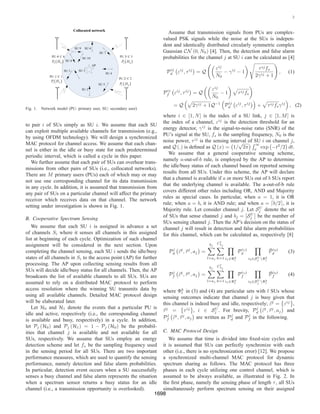
to pair i of SUs simply as SU i. We assume that each SU
can exploit multiple available channels for transmission (e.g.,
by using OFDM technology). We will design a synchronized
MAC protocol for channel access. We assume that each chan-
nel is either in the idle or busy state for each predetermined
periodic interval, which is called a cycle in this paper.
We further assume that each pair of SUs can overhear trans-
missions from other pairs of SUs (i.e., collocated networks).
There are M primary users (PUs) each of which may or may
not use one corresponding channel for its data transmission
in any cycle. In addition, it is assumed that transmission from
any pair of SUs on a particular channel will affect the primary
receiver which receives data on that channel. The network
setting under investigation is shown in Fig. 1.
B. Cooperative Spectrum Sensing
We assume that each SU i is assigned in advance a set
of channels Si where it senses all channels in this assigned
list at beginning of each cycle. Optimization of such channel
assignment will be considered in the next section. Upon
completing the channel sensing, each SU i sends the idle/busy
states of all channels in Si to the access point (AP) for further
processing. The AP upon collecting sensing results from all
SUs will decide idle/busy status for all channels. Then, the AP
broadcasts the list of available channels to all SUs. SUs are
assumed to rely on a distributed MAC protocol to perform
access resolution where the winning SU transmits data by
using all available channels. Detailed MAC protocol design
will be elaborated later.
Let H0 and H1 denote the events that a particular PU is
idle and active, respectively (i.e., the corresponding channel
is available and busy, respectively) in a cycle. In addition,
let Pj (H0) and Pj (H1) = 1 − Pj (H0) be the probabil-
ities that channel j is available and not available for all
SUs, respectively. We assume that SUs employ an energy
detection scheme and let fs be the sampling frequency used
in the sensing period for all SUs. There are two important
performance measures, which are used to quantify the sensing
performance, namely detection and false alarm probabilities.
In particular, detection event occurs when a SU successfully
senses a busy channel and false alarm represents the situation
when a spectrum sensor returns a busy status for an idle
channel (i.e., a transmission opportunity is overlooked).
Assume that transmission signals from PUs are complex-
valued PSK signals while the noise at the SUs is indepen-
dent and identically distributed circularly symmetric complex
Gaussian CN (0, N0) [4]. Then, the detection and false alarm
probabilities for the channel j at SU i can be calculated as [4]
Pij
d εij
, τij
= Q
εij
N0
− γij
− 1
τijfs
2γij + 1
, (1)
Pij
f εij
, τij
= Q
εij
N0
− 1 τijfs
= Q 2γij + 1Q−1
Pij
d εij
, τij
+ τijfsγij
, (2)
where i ∈ [1, N] is the index of a SU link, j ∈ [1, M] is
the index of a channel, εij
is the detection threshold for an
energy detector, γij
is the signal-to-noise ratio (SNR) of the
PU’s signal at the SU, fs is the sampling frequency, N0 is the
noise power, τij
is the sensing interval of SU i on channel j,
and Q (.) is defined as Q (x) = 1/
√
2π
∞
x
exp −t2
/2 dt.
We assume that a general cooperative sensing scheme,
namely a-out-of-b rule, is employed by the AP to determine
the idle/busy status of each channel based on reported sensing
results from all SUs. Under this scheme, the AP will declare
that a channel is available if a or more SUs out of b SUs report
that the underlying channel is available. The a-out-of-b rule
covers different other rules including OR, AND and Majority
rules as special cases. In particular, when a = 1, it is OR
rule; when a = b, it is AND rule; and when a = b/2 , it is
Majority rule. Let consider channel j. Let SU
j denote the set
of SUs that sense channel j and bj = SU
j be the number of
SUs sensing channel j. Then the AP’s decision on the status of
channel j will result in detection and false alarm probabilities
for this channel, which can be calculated as, respectively [8]
Pj
d εj
, τj
, aj =
bj
l=aj
Cl
bj
k=1 i1∈Φk
l
Pi1j
d
i2∈SU
j Φk
l
¯Pi2j
d (3)
Pj
f εj
, τj
, aj =
bj
l=aj
Cl
bj
k=1 i1∈Φk
l
Pi1j
f
i2∈SU
j Φk
l
¯Pi2j
f (4)
where Φk
l in (3) and (4) are particular sets with l SUs whose
sensing outcomes indicate that channel j is busy given that
this channel is indeed busy and idle, respectively; εj
= εij
,
τj
= τij
, i ∈ SU
j . For brevity, Pj
d εj
, τj
, aj and
Pj
f εj
, τj
, aj are written as Pj
d and Pj
f in the following.
C. MAC Protocol Design
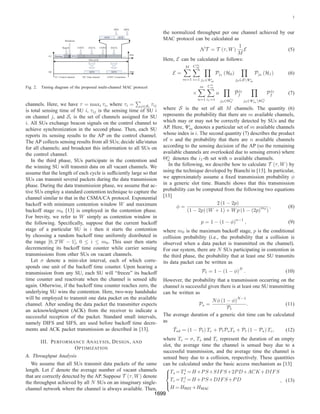
We assume that time is divided into fixed-size cycles and
it is assumed that SUs can perfectly synchronize with each
other (i.e., there is no synchronization error) [12]. We propose
a synchronized multi-channel MAC protocol for dynamic
spectrum sharing as follows. The MAC protocol has three
phases in each cycle utilizing one control channel, which is
assumed to be always available, as illustrated in Fig. 2. In
the first phase, namely the sensing phase of length τ, all SUs
simultaneously perform spectrum sensing on their assigned
1698](https://image.slidesharecdn.com/06554819-130814160143-phpapp02/85/General-analytical-framework-for-cooperative-sensing-and-access-trade-off-optimization-6-320.jpg)

This paper presents a framework for optimizing cooperative spectrum sensing and access in multi-channel cognitive radio networks, addressing challenges in heterogeneous settings where channel conditions vary. It proposes a synchronized medium access control (MAC) protocol to enhance throughput, along with algorithms to optimize sensing time and channel assignments. Numerical results demonstrate the effectiveness of the proposed design compared to non-optimized approaches, indicating significant performance improvements in spectrum utilization.


