

Binary Consensus
Algorithm
MOHAMED SEIF
COMMUNICATIONS AND ELECTRONICS DEPARTMENT
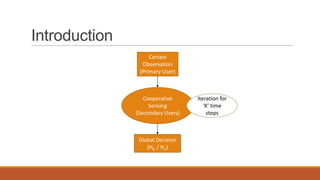
Introduction
Certain
Observation
(Primary User)

Cooperative
Sensing
(Secondary Users)

Global Decision
(H0 / H1)

Iteration for
‘K’ time
steps
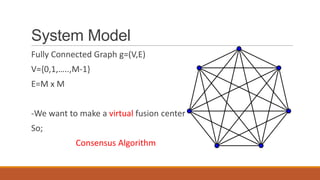
System Model
Fully Connected Graph g=(V,E)
V={0,1,…..,M-1}

E=M x M
-We want to make a virtual fusion center
So;
Consensus Algorithm
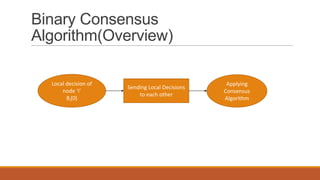
Binary Consensus
Algorithm(Overview)
Local decision of
node ‘i’
Bi(0)

Sending Local Decisions
to each other

Applying
Consensus
Algorithm
Analysis
First Phase (initial decision) for each agent

Second Phase (Sending Decisions to each other)

-nj,i(k) : a zero-mean Gaussian random variable with variance of σn2.
Analysis(Cont’d)
Each agent will update its vote based on the received in information as fellows : R

So, the Decision Rule :
Analysis(Cont’d )
Markov Chain Representation

-Pi,j will have a binomial distribution as follows :

-ki : represents the probability that any agent votes 1 in the next time step, S(k)=I,
(i.e current state =i)
Markov Chain
Representation(Cont’d)
Some Important Properties of P(Transition Matrix):
-By Applying Perron’s theorem, we will have :
1. λo =1, as a simple eigenvalue
2.|λi|< 1 for i ≠ 0

-We are interested in calculating the second largest eigenvalue λ1, which is
important for time convergence analysis
Steady State Behavior
A. Case of σn = 0
In this ideal case, the network will reach an accurate consensus in one time step
(all ones / all zeros)

B. Case of σn ≠ 0
The network will reach a steady state asymptotically and is independent of the
initial state
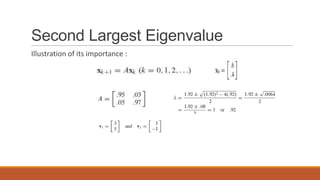
Second Largest Eigenvalue
Illustration of its importance :
Second Largest Eigenvalue(Cont’d)

Steady
State
Part
Transient
Part
Second Largest Eigenvalue(Cont’d)
Results
Results(Cont’d)
Conclusion
Censoring should beat this algorithm in two considerations :
1-The asymptotic behavior in case of σn ≠ 0

2-The time convergence should be smaller than the original case
Thank you

Binary consensus