Market Segments
A marketsegment represents "a group of present or potential customers with
some common characteristic which is relevant in explaining (and predicting)
their response to a supplier's marketing stimuli"
3.
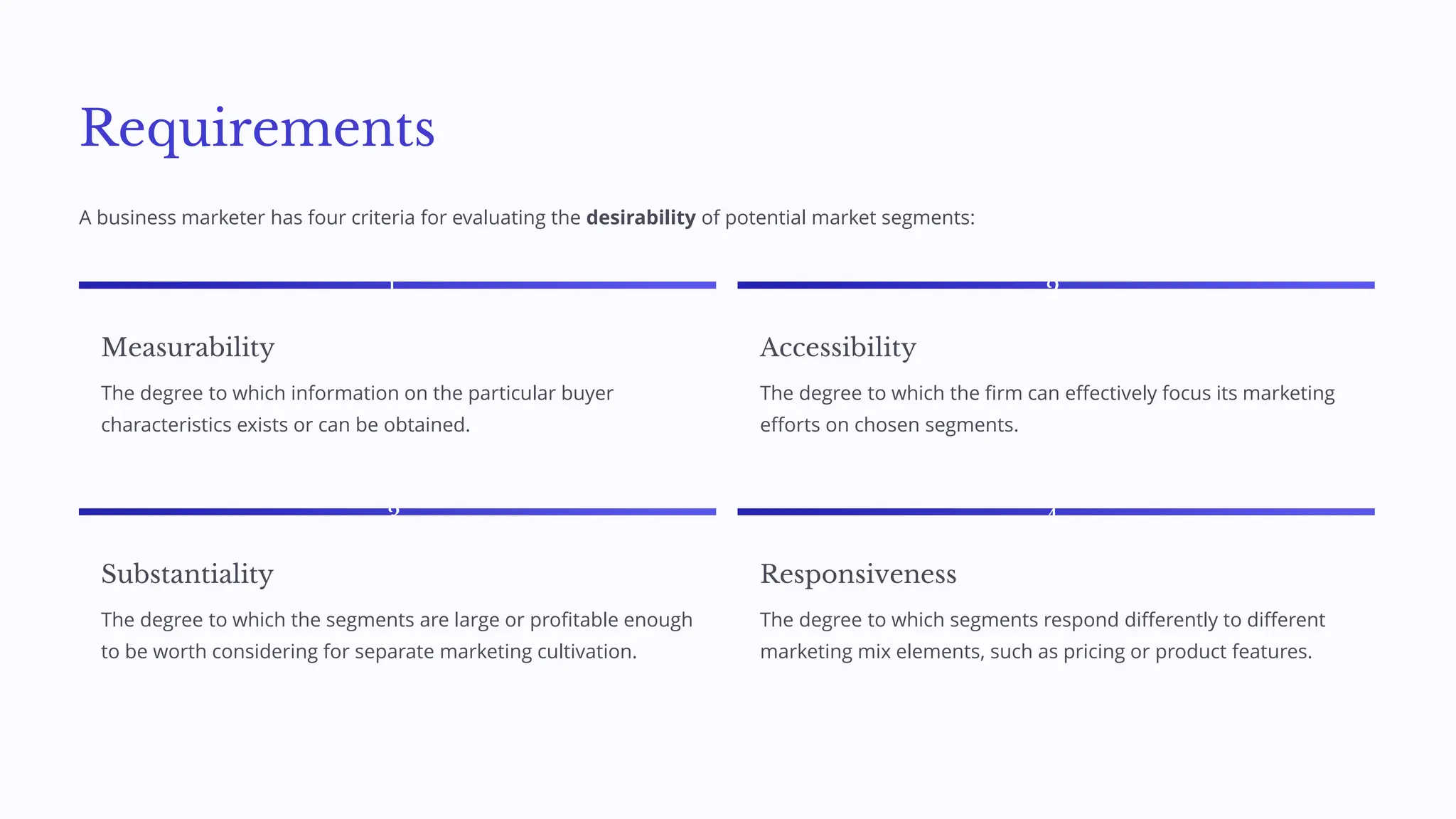
Requirements
A business marketerhas four criteria for evaluating the desirability of potential market segments:
1
Measurability
The degree to which information on the particular buyer
characteristics exists or can be obtained.
2
Accessibility
The degree to which the firm can effectively focus its marketing
efforts on chosen segments.
3
Substantiality
The degree to which the segments are large or profitable enough
to be worth considering for separate marketing cultivation.
4
Responsiveness
The degree to which segments respond differently to different
marketing mix elements, such as pricing or product features.
4.
Benefits of Segmentation
Themere attempt to segment the
business market forces the marketer
to become more attuned to the
unique needs of customer
segments.
Knowing the needs of particular
market segments helps the market
segments business marketer focus
product-development efforts, develop
profitable pricing strategies, select
appropriate channels of distribution,
develop and target advertising
messages, and train and deploy the
sales force. Thus, market
segmentation provides the
foundation for efficient and
effective business marketing
strategies.
Market segmentation provides the
business marketer with valuable
guidelines for allocating marketing
resources.
5.
Bases for SegmentingBusiness Markets
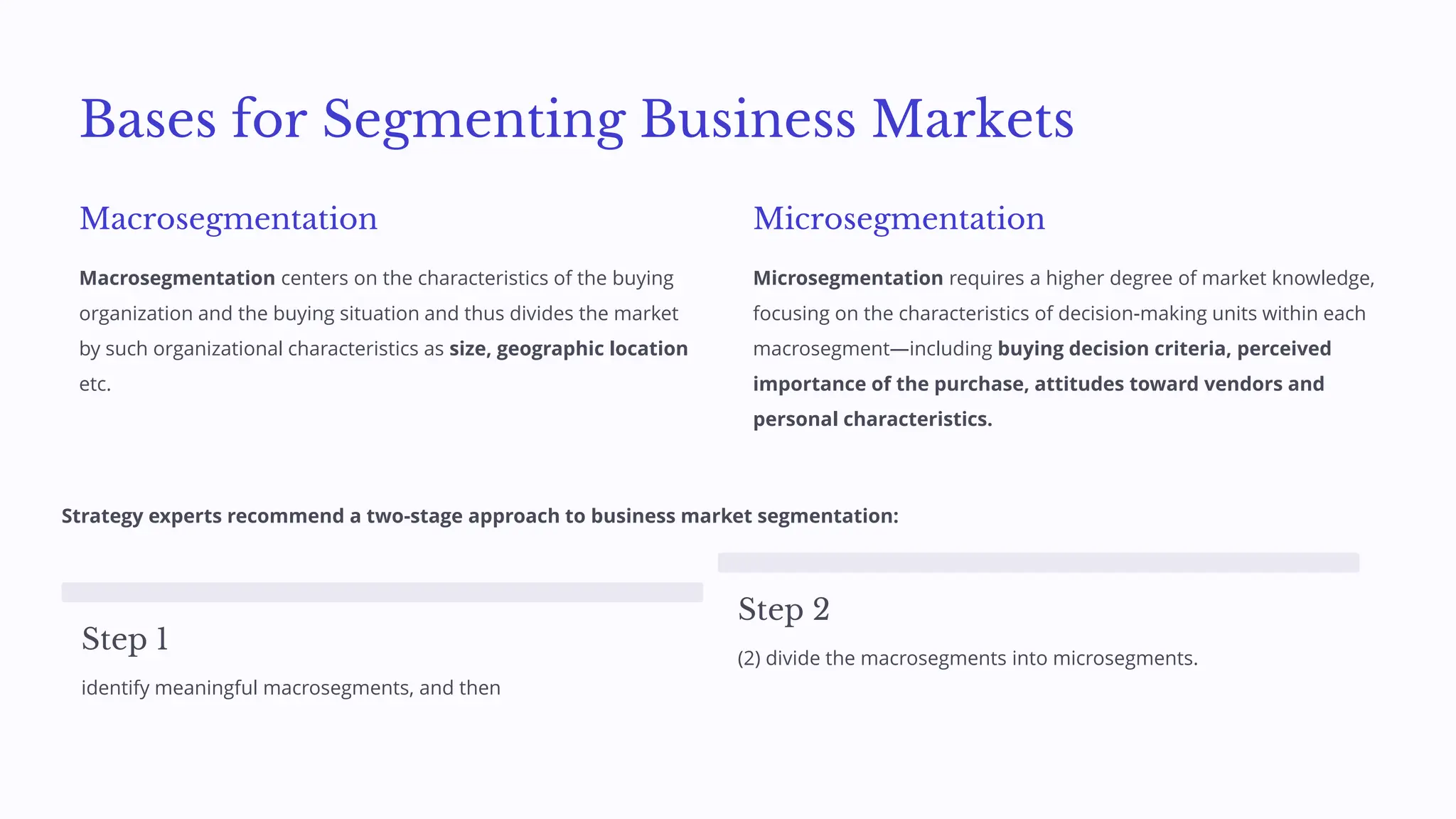
Macrosegmentation
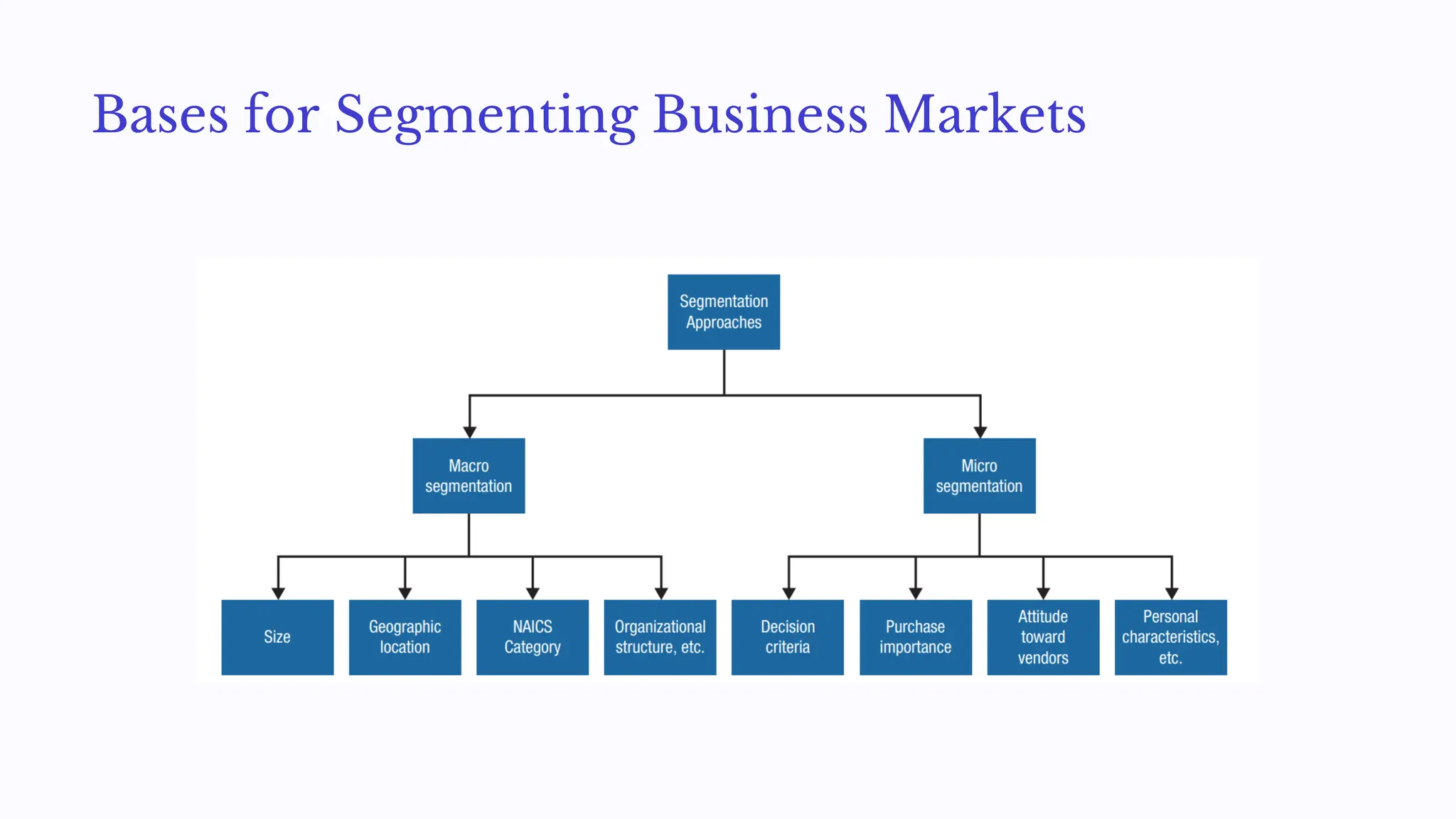
Macrosegmentation centers on the characteristics of the buying
organization and the buying situation and thus divides the market
by such organizational characteristics as size, geographic location
etc.
Microsegmentation
Microsegmentation requires a higher degree of market knowledge,
focusing on the characteristics of decision-making units within each
macrosegment—including buying decision criteria, perceived
importance of the purchase, attitudes toward vendors and
personal characteristics.
Strategy experts recommend a two-stage approach to business market segmentation:
Step 1
identify meaningful macrosegments, and then
Step 2
(2) divide the macrosegments into microsegments.
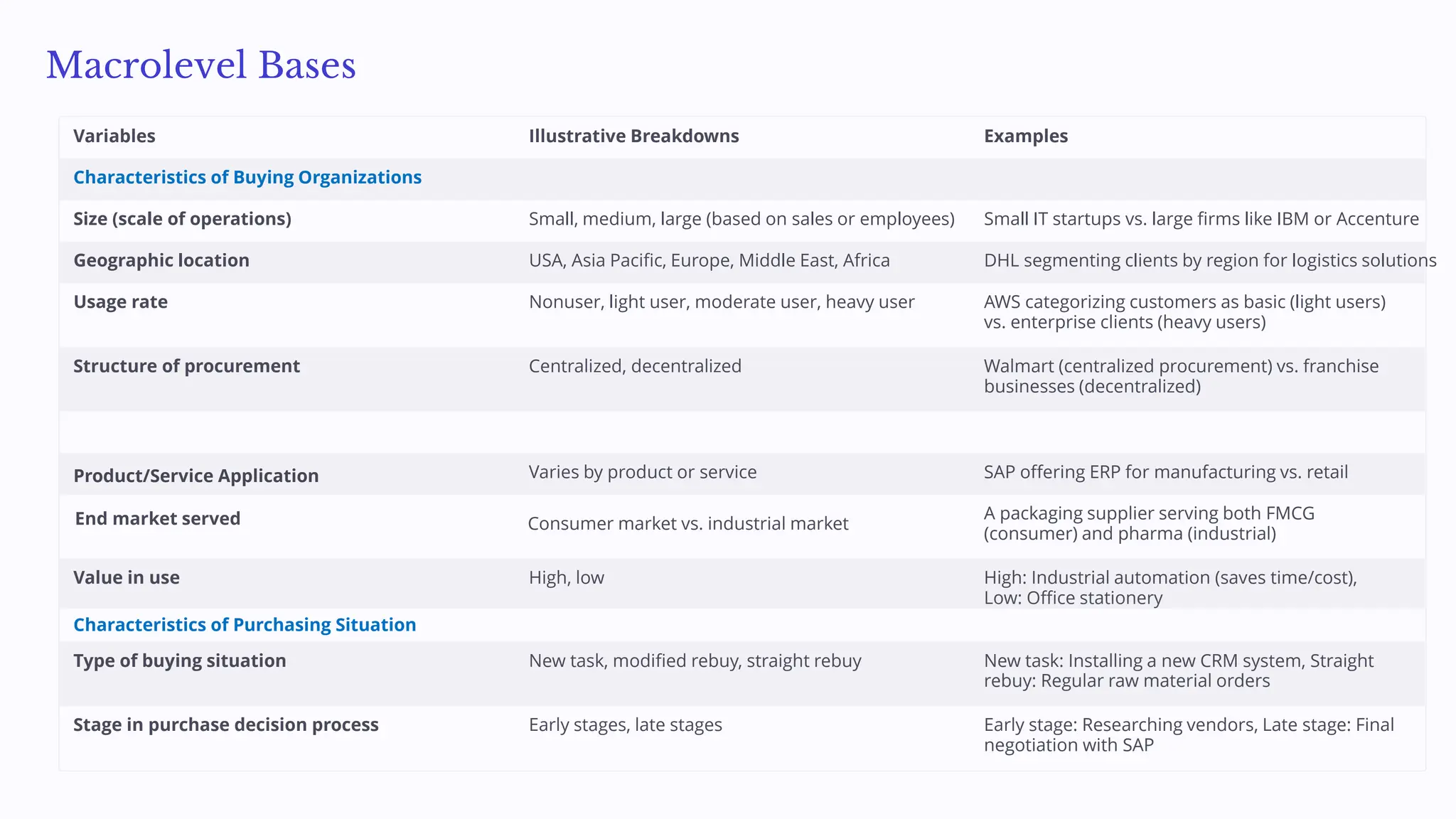
Macrolevel Bases
Variables IllustrativeBreakdowns Examples
Characteristics of Buying Organizations
Size (scale of operations) Small, medium, large (based on sales or employees) Small IT startups vs. large firms like IBM or Accenture
Geographic location USA, Asia Pacific, Europe, Middle East, Africa DHL segmenting clients by region for logistics solutions
Usage rate Nonuser, light user, moderate user, heavy user AWS categorizing customers as basic (light users)
vs. enterprise clients (heavy users)
Structure of procurement Centralized, decentralized Walmart (centralized procurement) vs. franchise
businesses (decentralized)
Product/Service Application Varies by product or service SAP offering ERP for manufacturing vs. retail
End market served Consumer market vs. industrial market
A packaging supplier serving both FMCG
(consumer) and pharma (industrial)
Value in use High, low High: Industrial automation (saves time/cost),
Low: Office stationery
Characteristics of Purchasing Situation
Type of buying situation New task, modified rebuy, straight rebuy New task: Installing a new CRM system, Straight
rebuy: Regular raw material orders
Stage in purchase decision process Early stages, late stages Early stage: Researching vendors, Late stage: Final
negotiation with SAP
8.
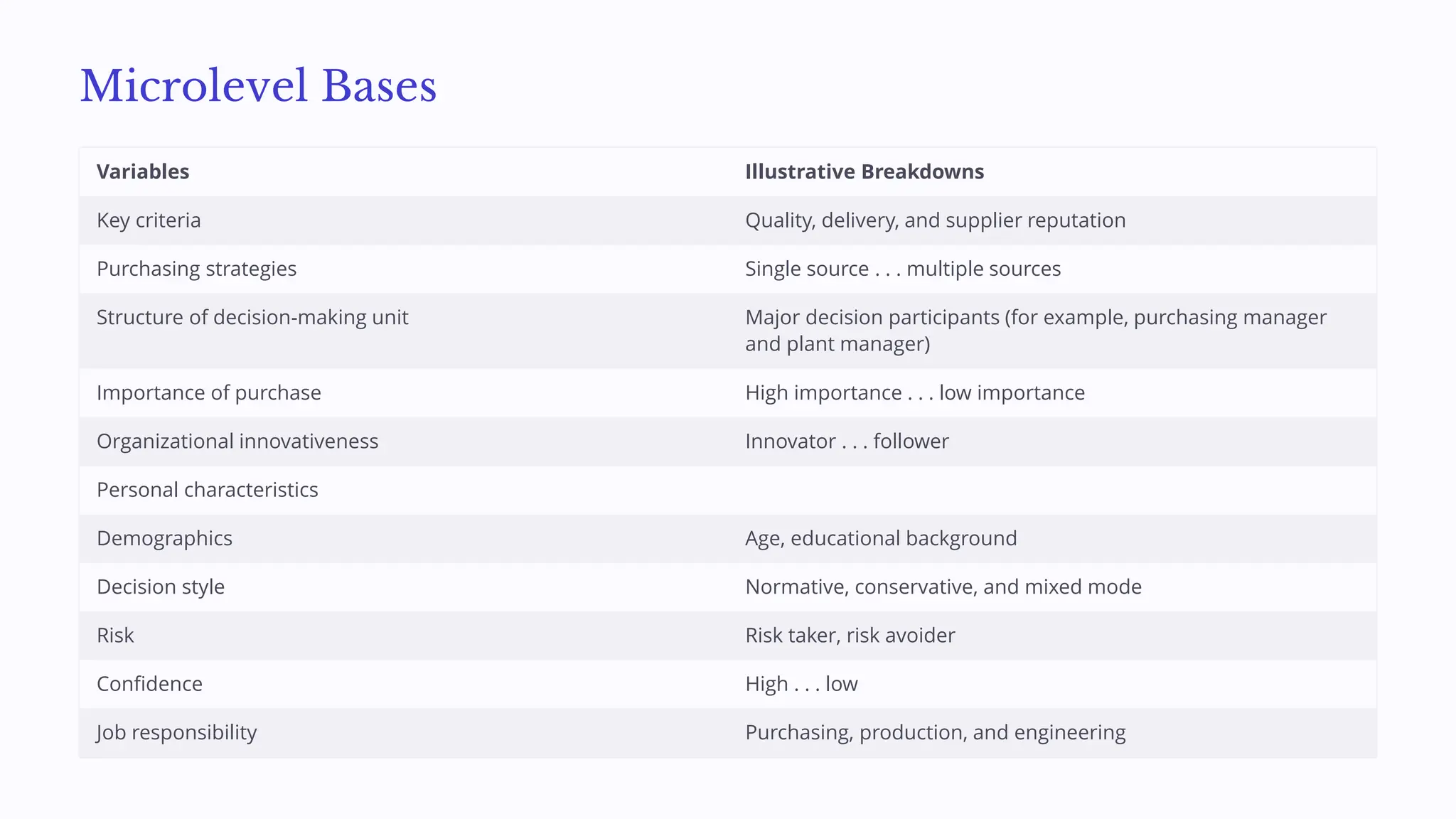
Microlevel Bases
Variables IllustrativeBreakdowns
Key criteria Quality, delivery, and supplier reputation
Purchasing strategies Single source . . . multiple sources
Structure of decision-making unit Major decision participants (for example, purchasing manager
and plant manager)
Importance of purchase High importance . . . low importance
Organizational innovativeness Innovator . . . follower
Personal characteristics
Demographics Age, educational background
Decision style Normative, conservative, and mixed mode
Risk Risk taker, risk avoider
Confidence High . . . low
Job responsibility Purchasing, production, and engineering
9.
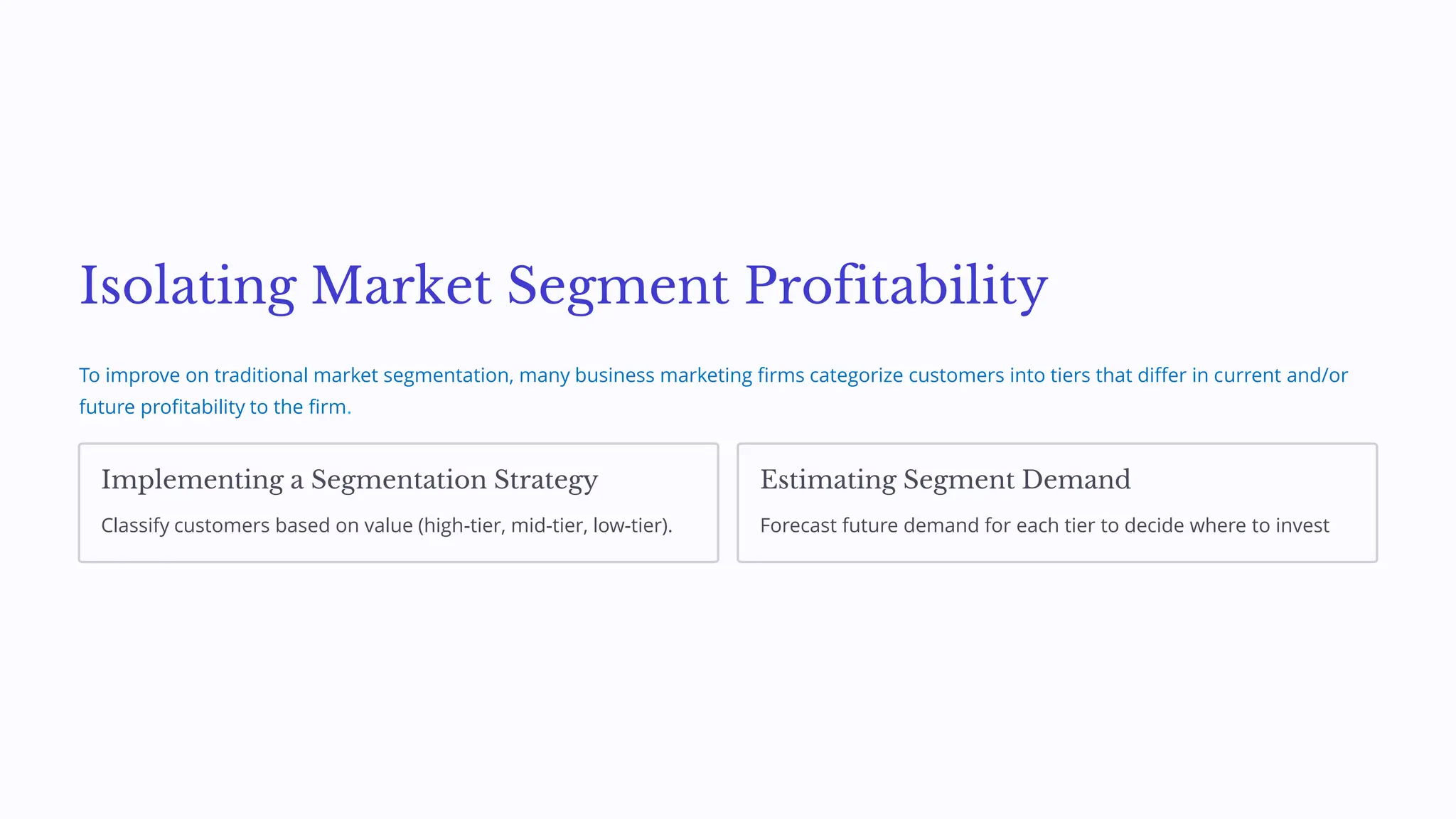
Isolating Market SegmentProfitability
To improve on traditional market segmentation, many business marketing firms categorize customers into tiers that differ in current and/or
future profitability to the firm.
Implementing a Segmentation Strategy
Classify customers based on value (high-tier, mid-tier, low-tier).
Estimating Segment Demand
Forecast future demand for each tier to decide where to invest
10.
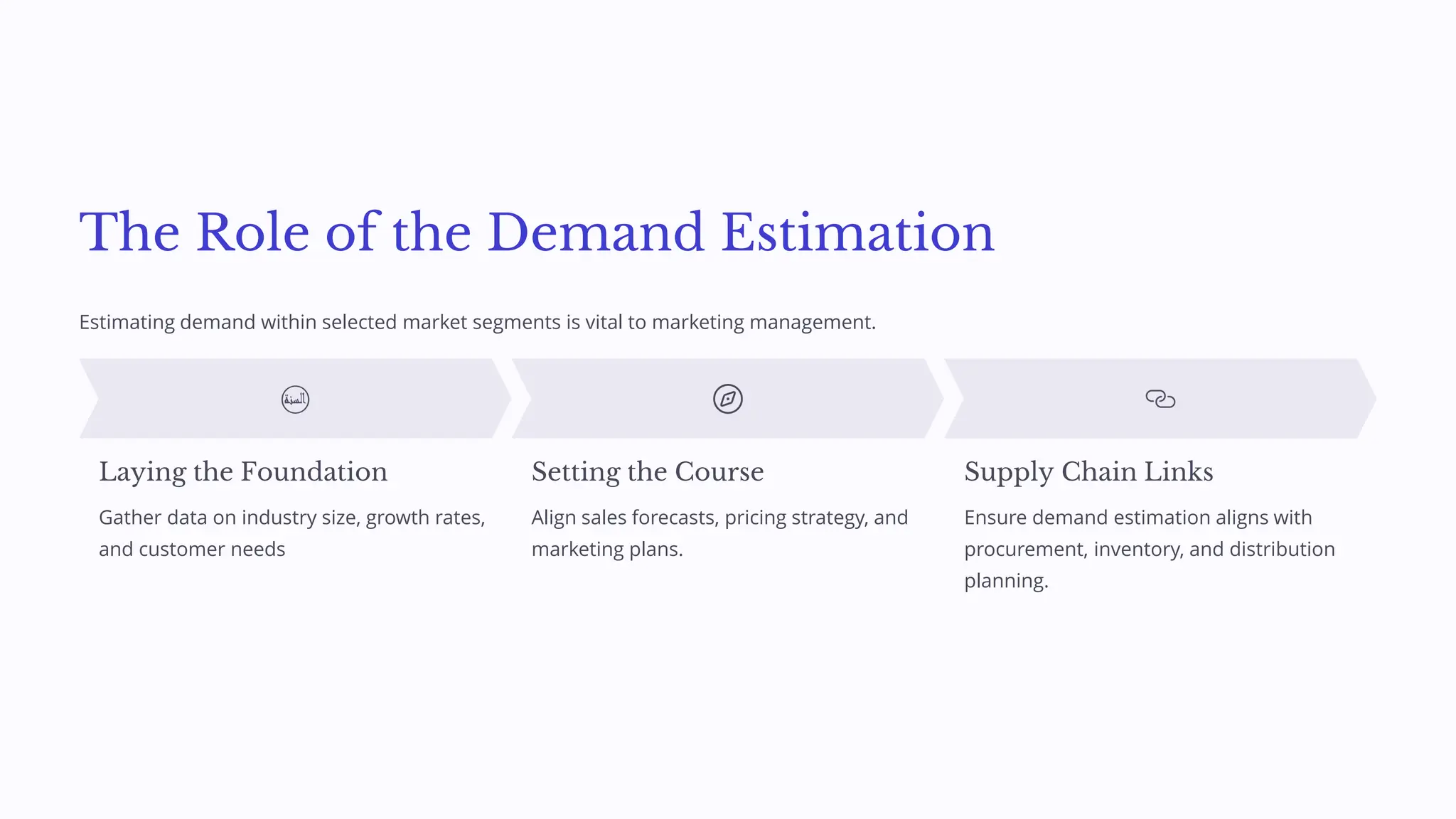
The Role ofthe Demand Estimation
Estimating demand within selected market segments is vital to marketing management.
Laying the Foundation
Gather data on industry size, growth rates,
and customer needs
Setting the Course
Align sales forecasts, pricing strategy, and
marketing plans.
Supply Chain Links
Ensure demand estimation aligns with
procurement, inventory, and distribution
planning.
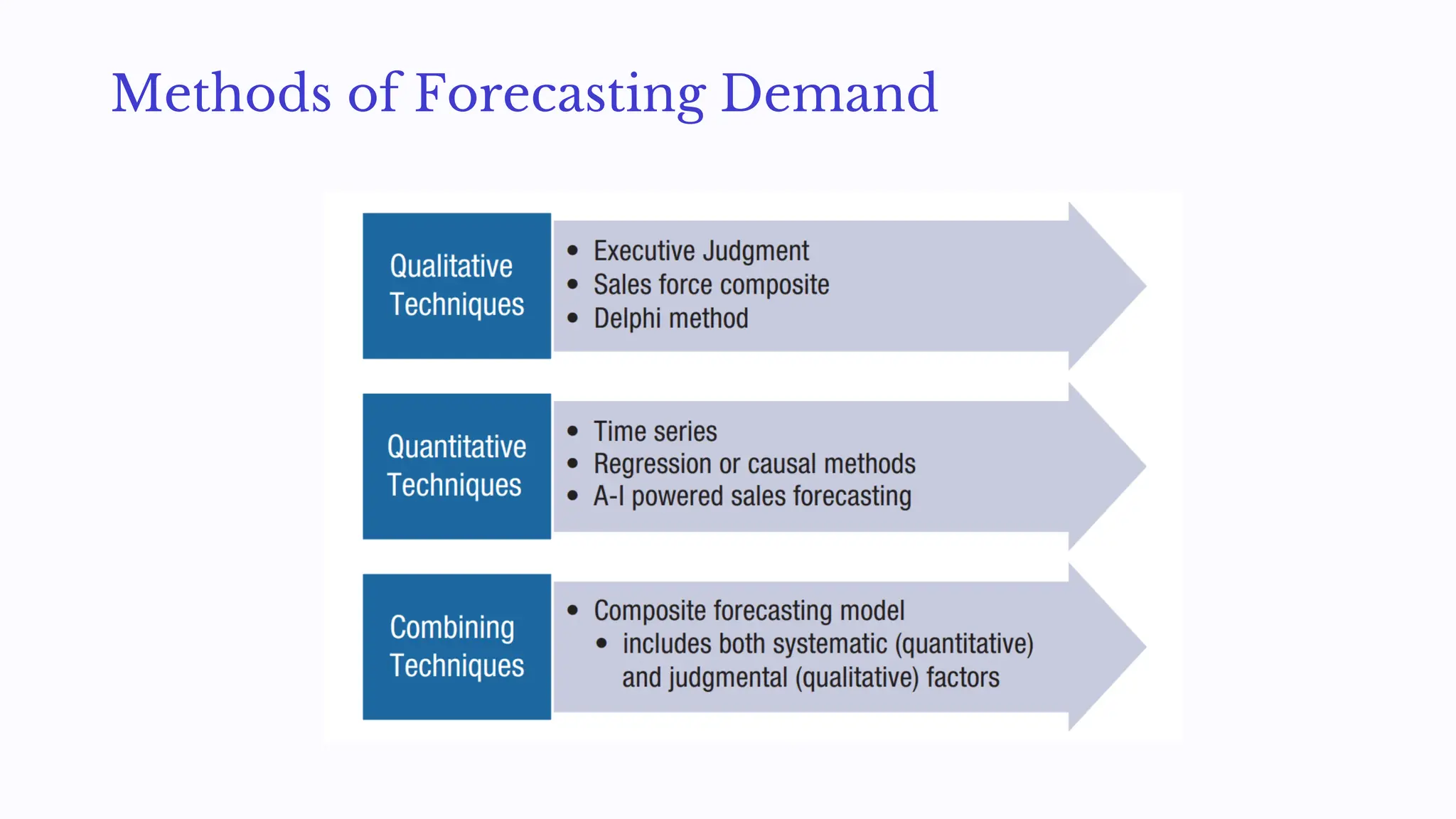
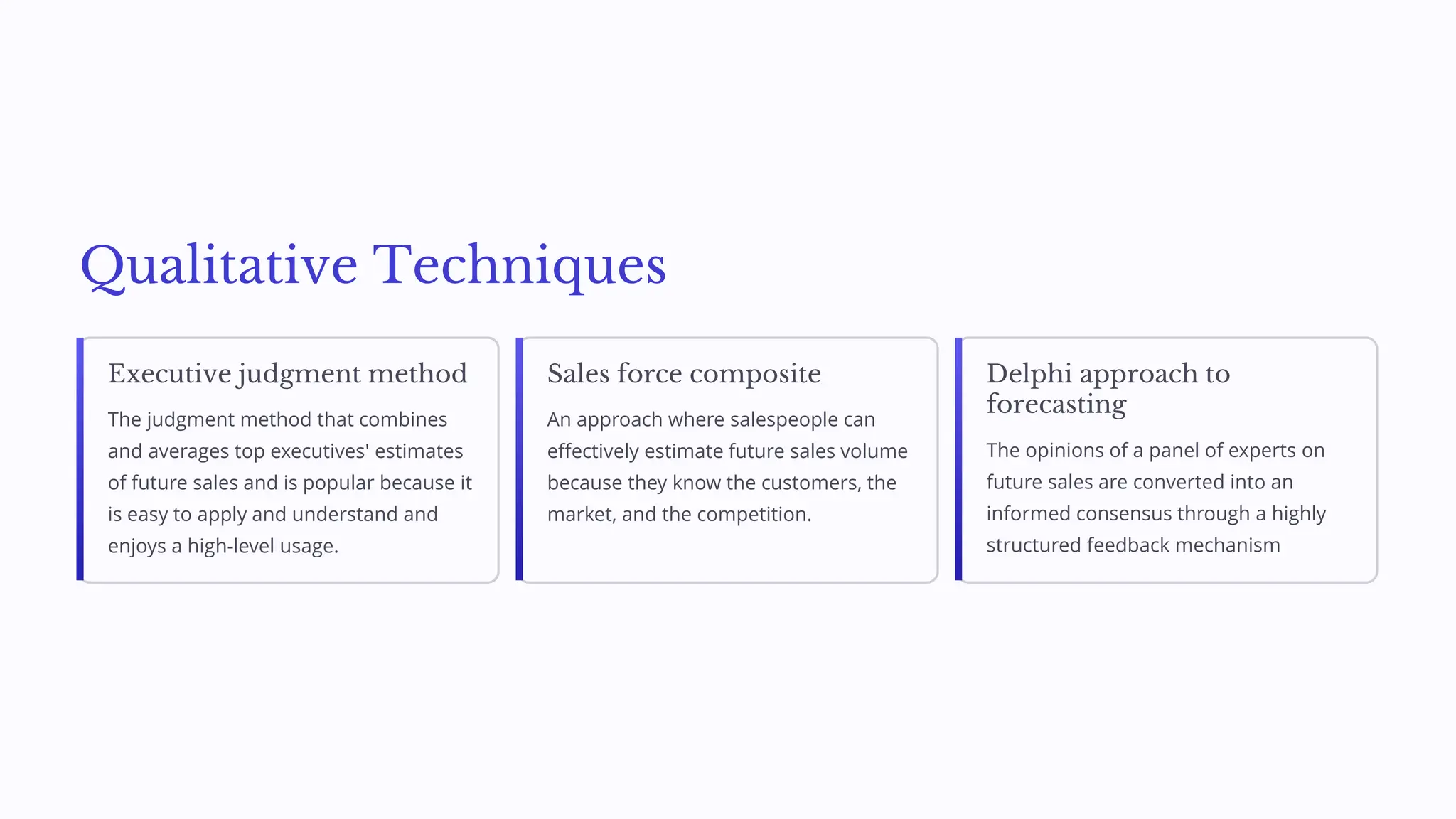
Qualitative Techniques
Executive judgmentmethod
The judgment method that combines
and averages top executives' estimates
of future sales and is popular because it
is easy to apply and understand and
enjoys a high-level usage.
Sales force composite
An approach where salespeople can
effectively estimate future sales volume
because they know the customers, the
market, and the competition.
Delphi approach to
forecasting
The opinions of a panel of experts on
future sales are converted into an
informed consensus through a highly
structured feedback mechanism
13.
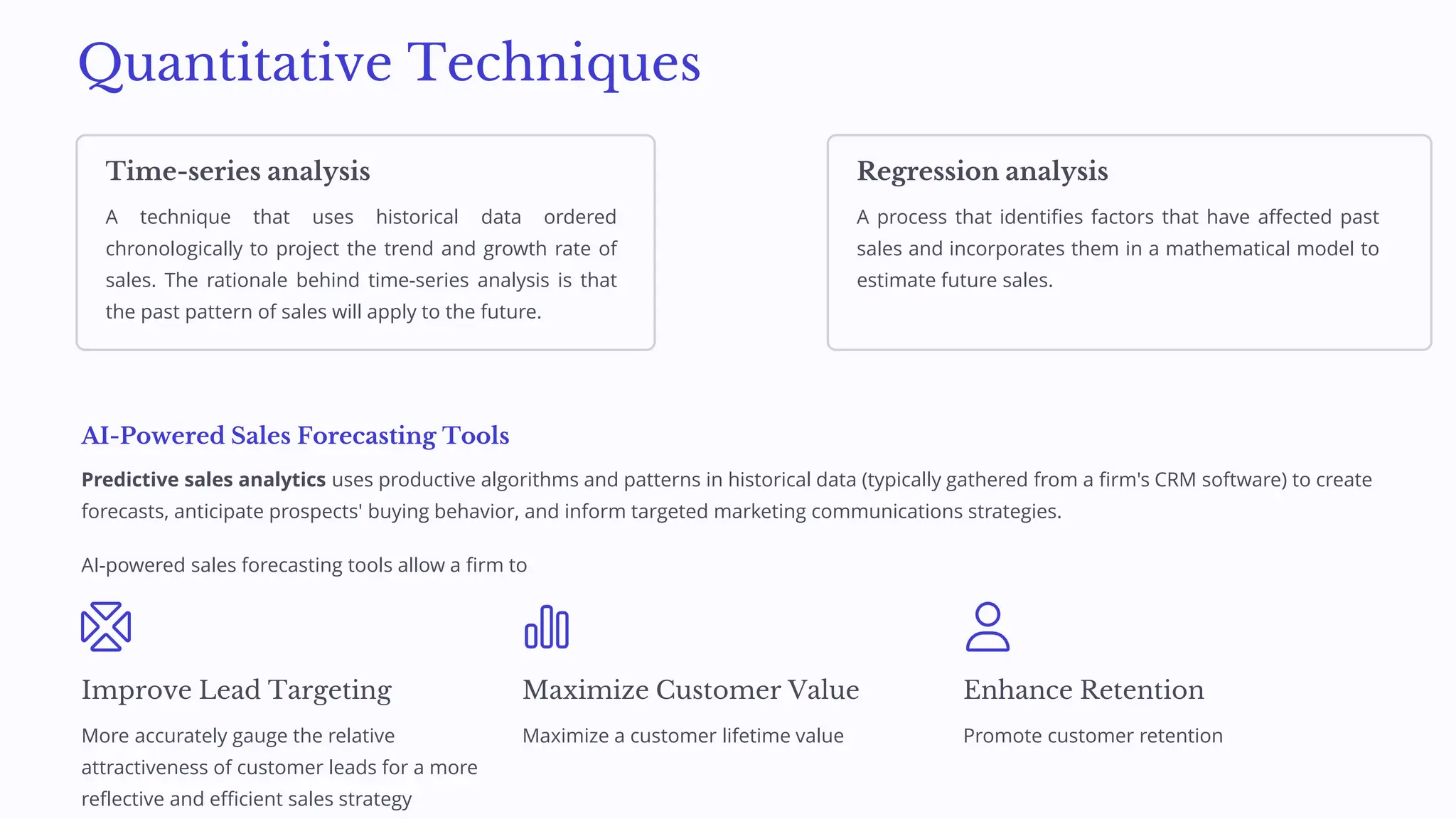
Quantitative Techniques
Time-series analysis
Atechnique that uses historical data ordered
chronologically to project the trend and growth rate of
sales. The rationale behind time-series analysis is that
the past pattern of sales will apply to the future.
Regression analysis
A process that identifies factors that have affected past
sales and incorporates them in a mathematical model to
estimate future sales.
AI-Powered Sales Forecasting Tools
Predictive sales analytics uses productive algorithms and patterns in historical data (typically gathered from a firm's CRM software) to create
forecasts, anticipate prospects' buying behavior, and inform targeted marketing communications strategies.
AI-powered sales forecasting tools allow a firm to
Improve Lead Targeting
More accurately gauge the relative
attractiveness of customer leads for a more
reflective and efficient sales strategy
Maximize Customer Value
Maximize a customer lifetime value
Enhance Retention
Promote customer retention
14.
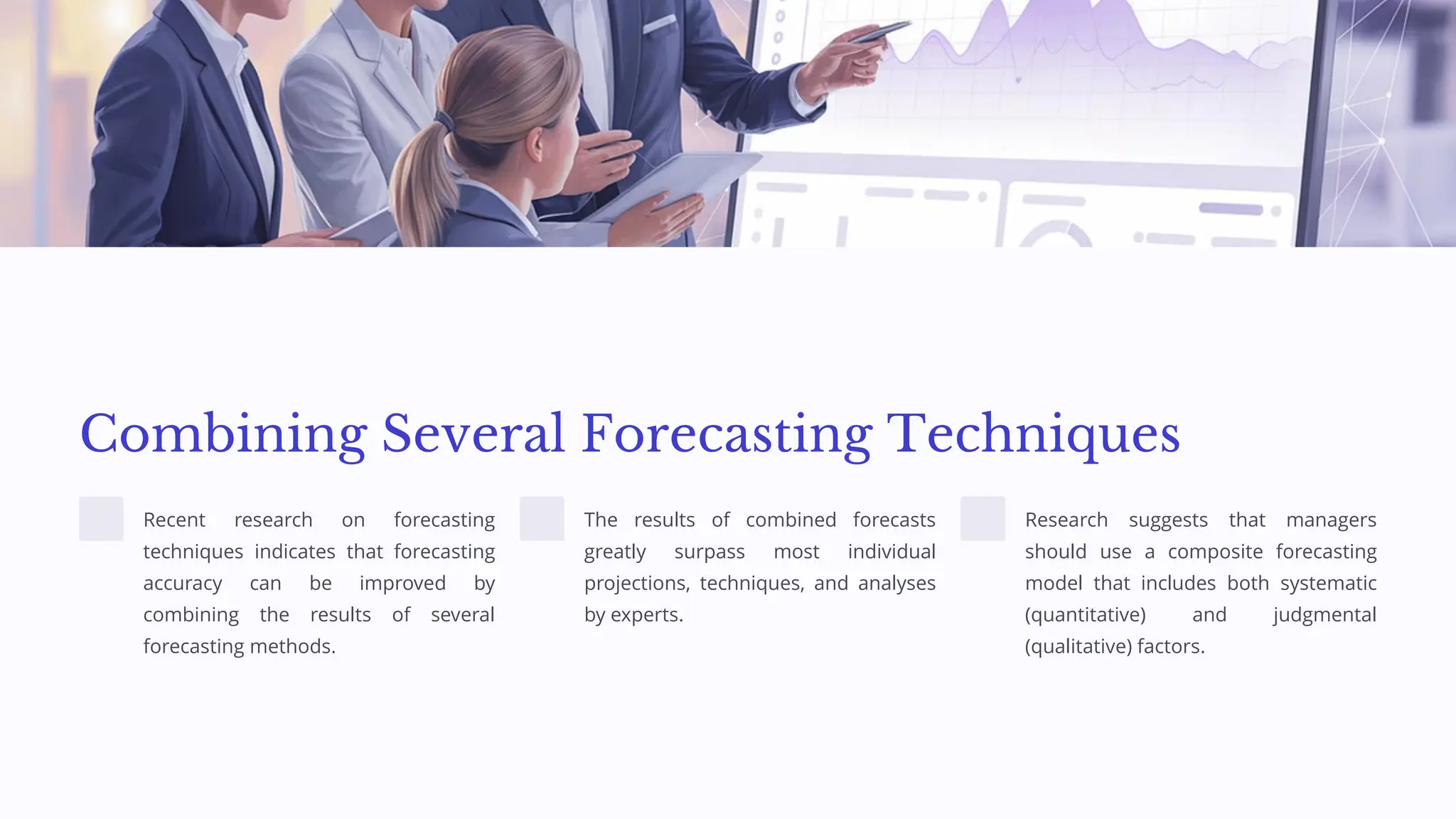
Combining Several ForecastingTechniques
Recent research on forecasting
techniques indicates that forecasting
accuracy can be improved by
combining the results of several
forecasting methods.
The results of combined forecasts
greatly surpass most individual
projections, techniques, and analyses
by experts.
Research suggests that managers
should use a composite forecasting
model that includes both systematic
(quantitative) and judgmental
(qualitative) factors.