David Rook

Agnitio
It’s static analysis, but not as we know it

SecurityBSides, London
if (slide == introduction)
            System.out.println("I’m David Rook");

• Security Analyst, Realex Payments, Ireland
  CISSP, CISA, GCIH and many other acronyms


• Security Ninja (www.securityninja.co.uk)

• Speaker at international security conferences

• Nominated for multiple blog awards

• A mentor in the InfoSecMentors project

• Developed and released Agnitio
Agenda


• What is static analysis?

• Security code reviews: the good, the bad and the ugly

• The principles of secure development

• Agnitio: It’s static analysis, but not as we know it

• A sneak preview of Agnitio v2.0
Static analysis


• What do I mean by static analysis?

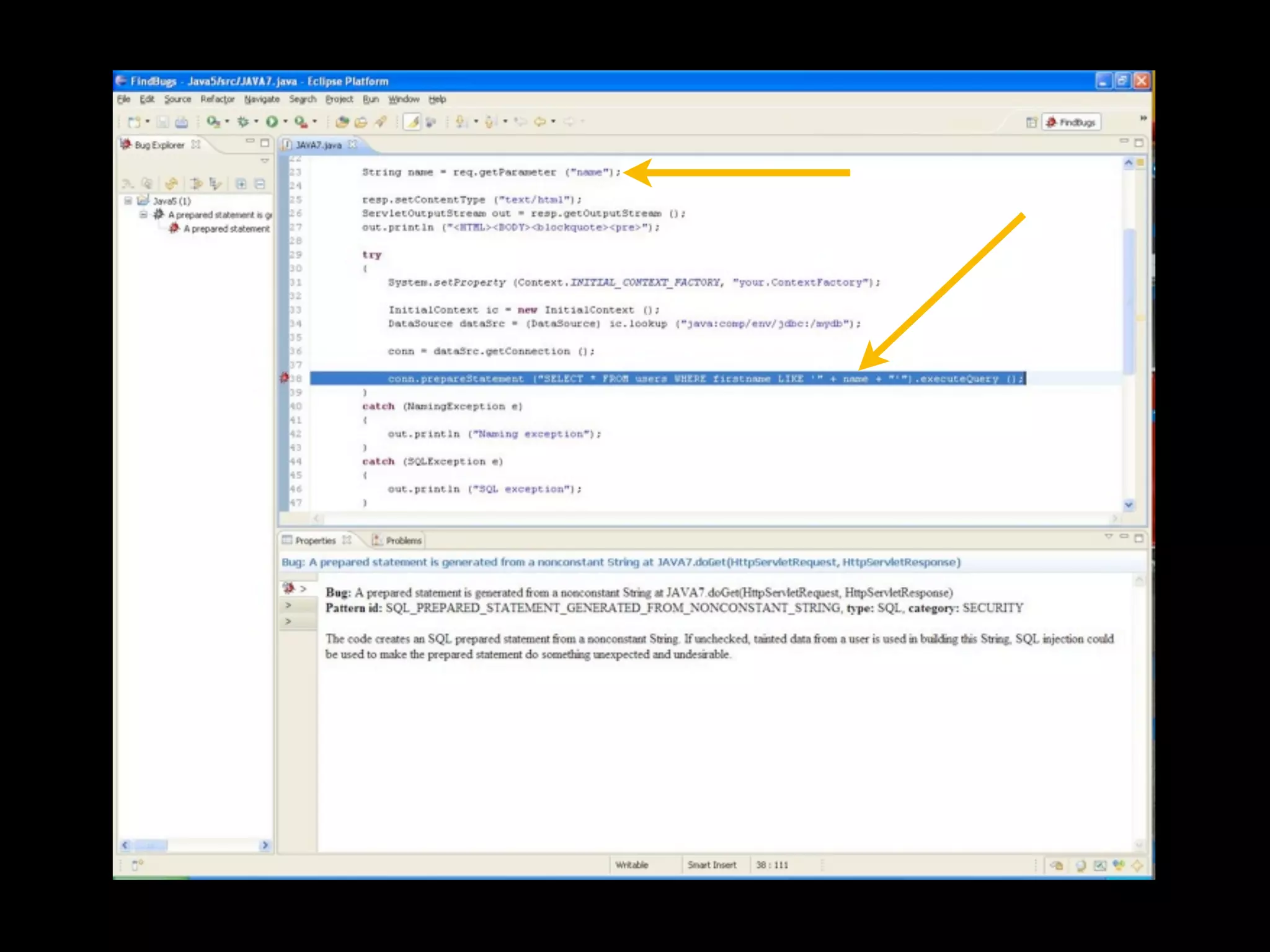
  • A review of source code without executing the application
  • Can be either manual or automated through one or more tools
  • Human and/or tools analysing application source code
Static analysis


• Wetware or software?

  • Humans are needed with or without static analysis tools
  • The best thing about humans is that they aren’t software
  • The worst thing about humans is that they are humans
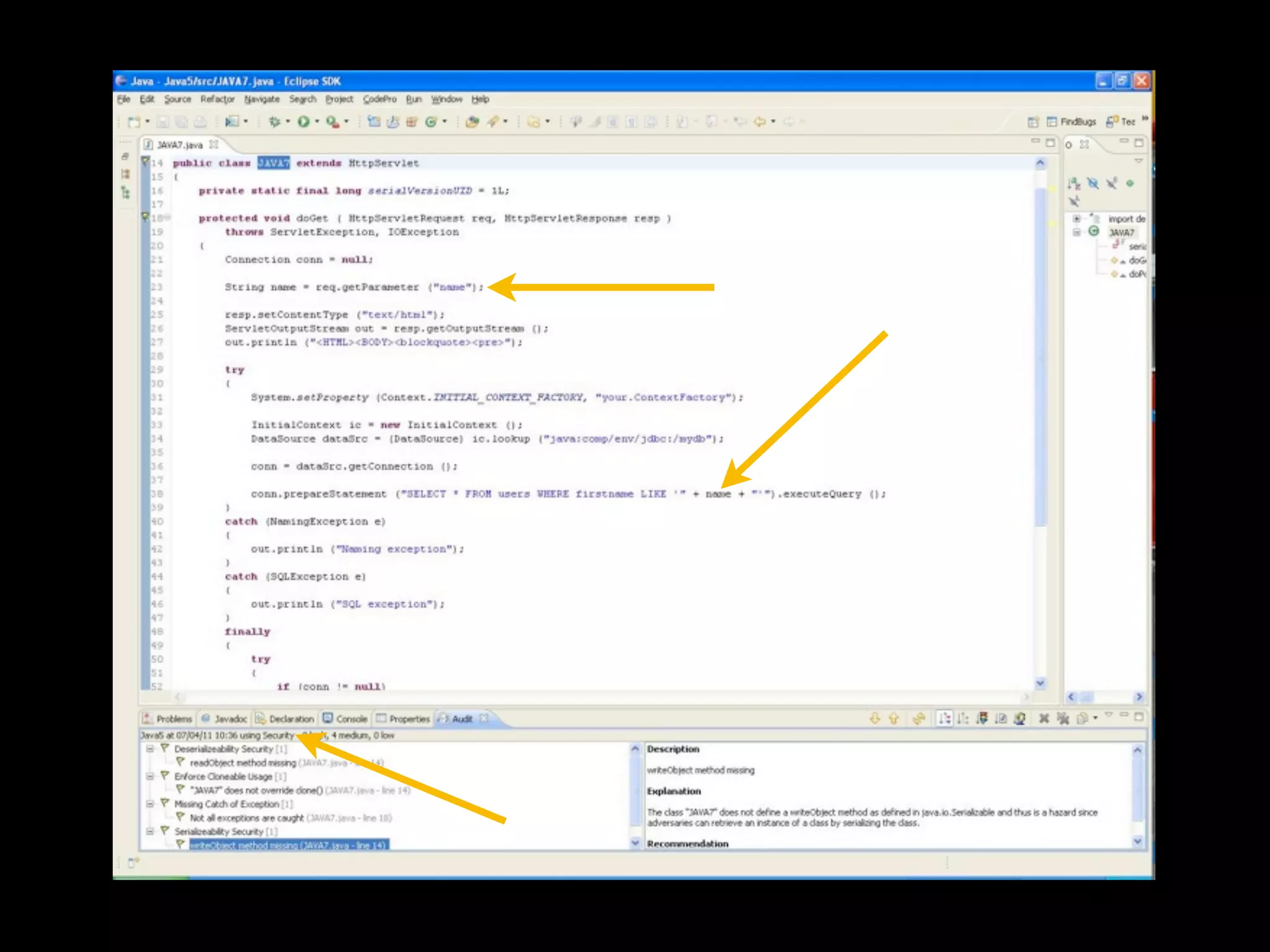
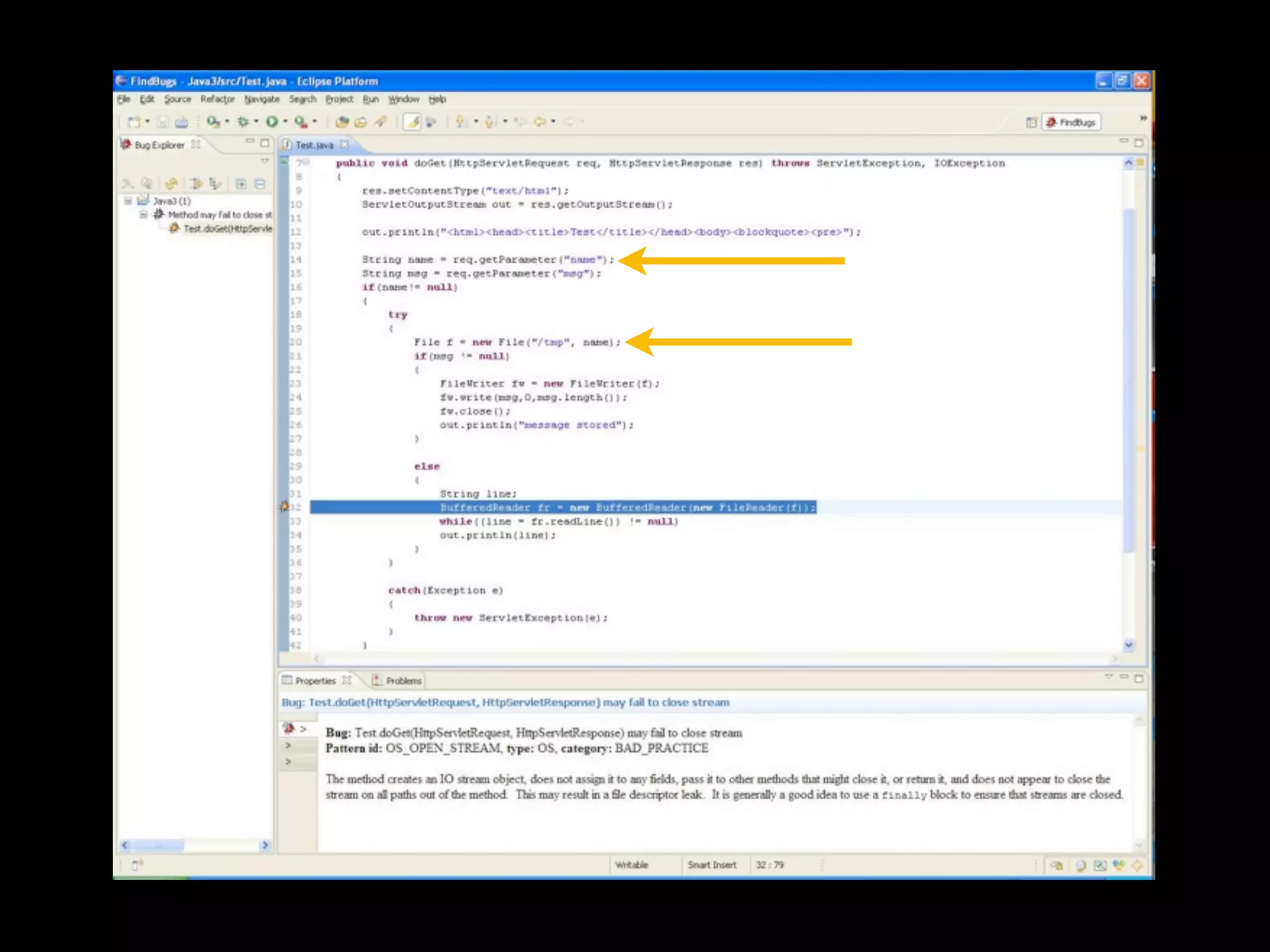
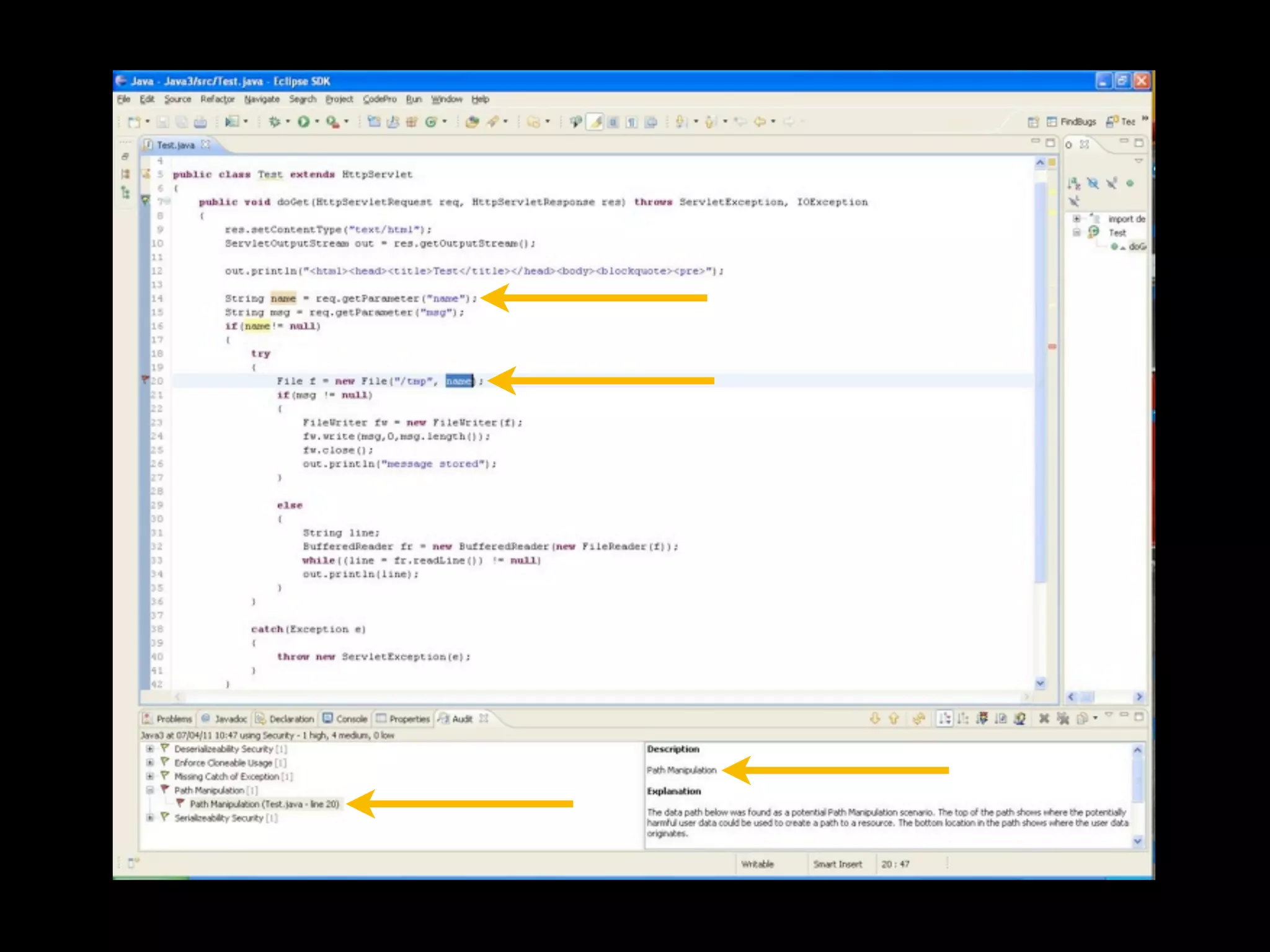
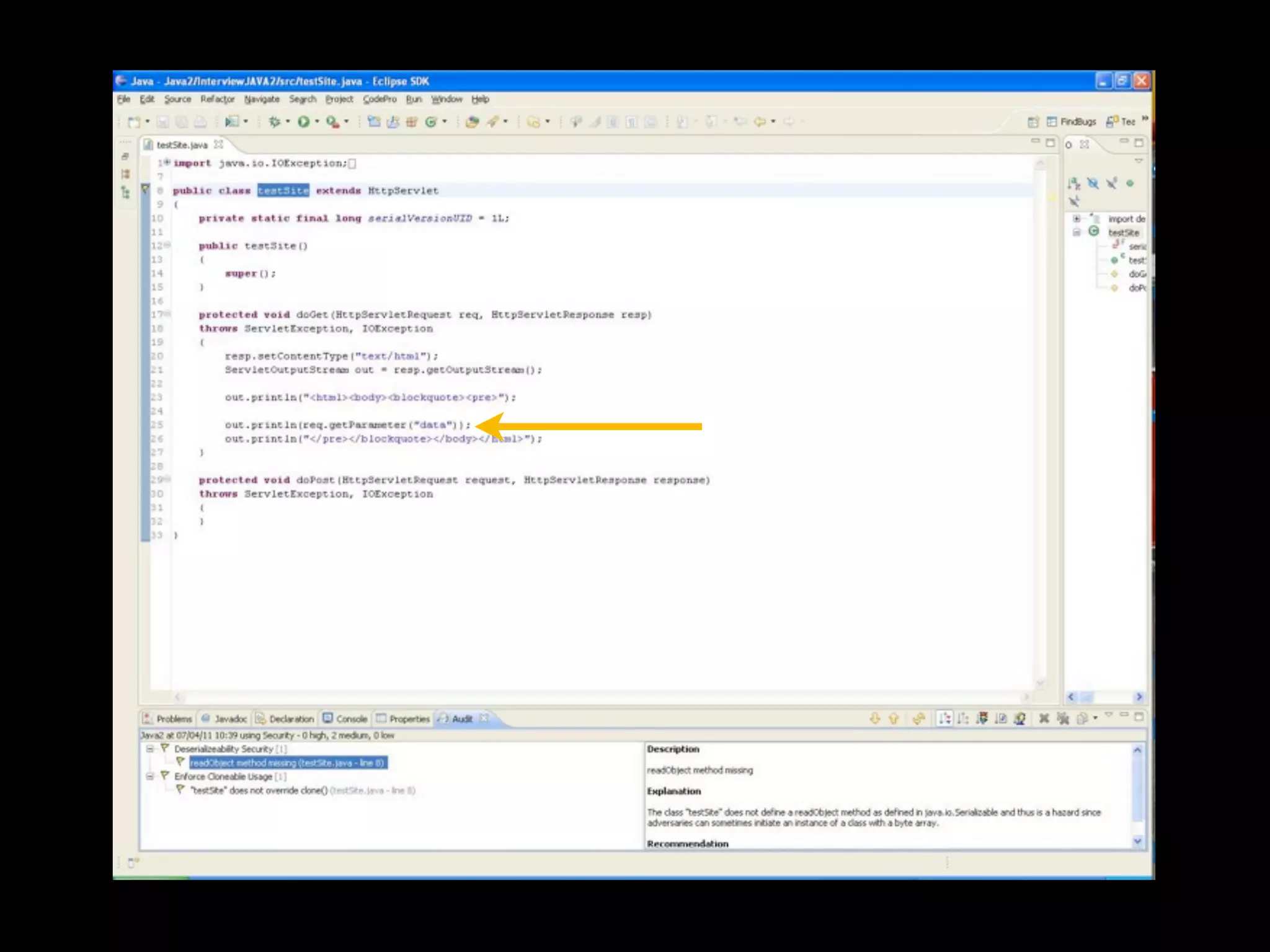
Static analysis


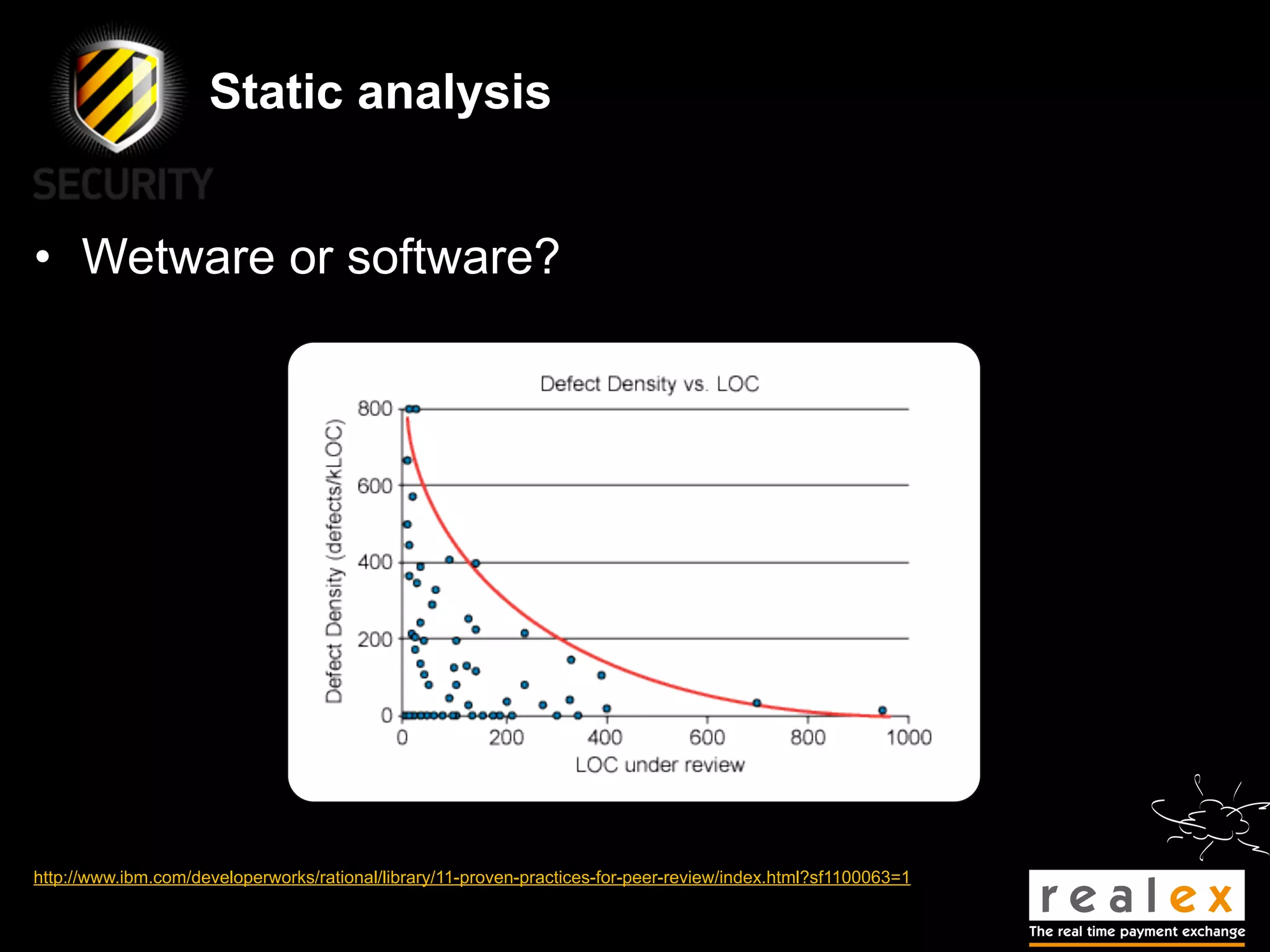
• Wetware or software?


http://www.ibm.com/developerworks/rational/library/11-proven-practices-for-peer-review/index.html?sf1100063=1
Static analysis


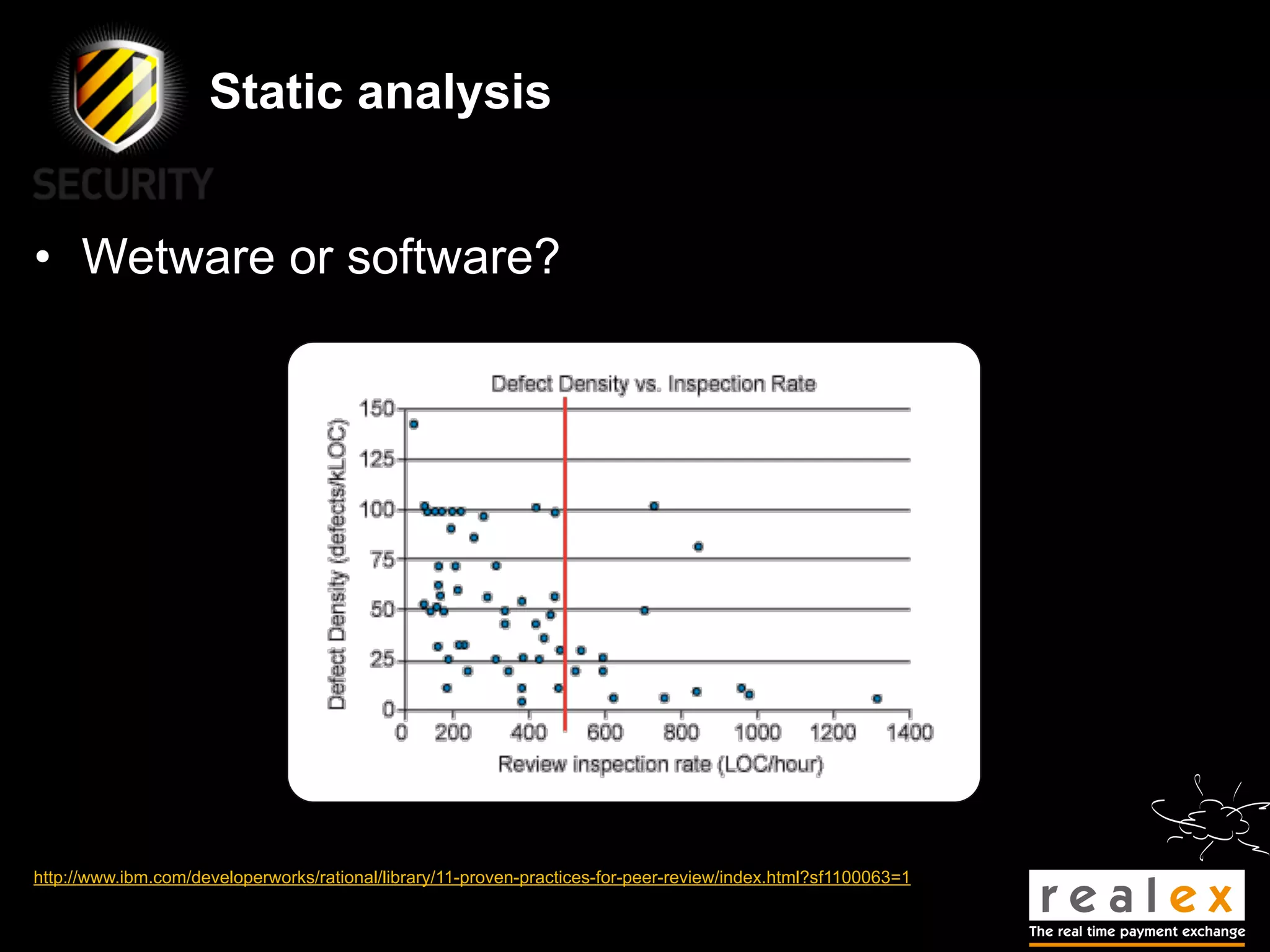
• Wetware or software?


http://www.ibm.com/developerworks/rational/library/11-proven-practices-for-peer-review/index.html?sf1100063=1
Static analysis


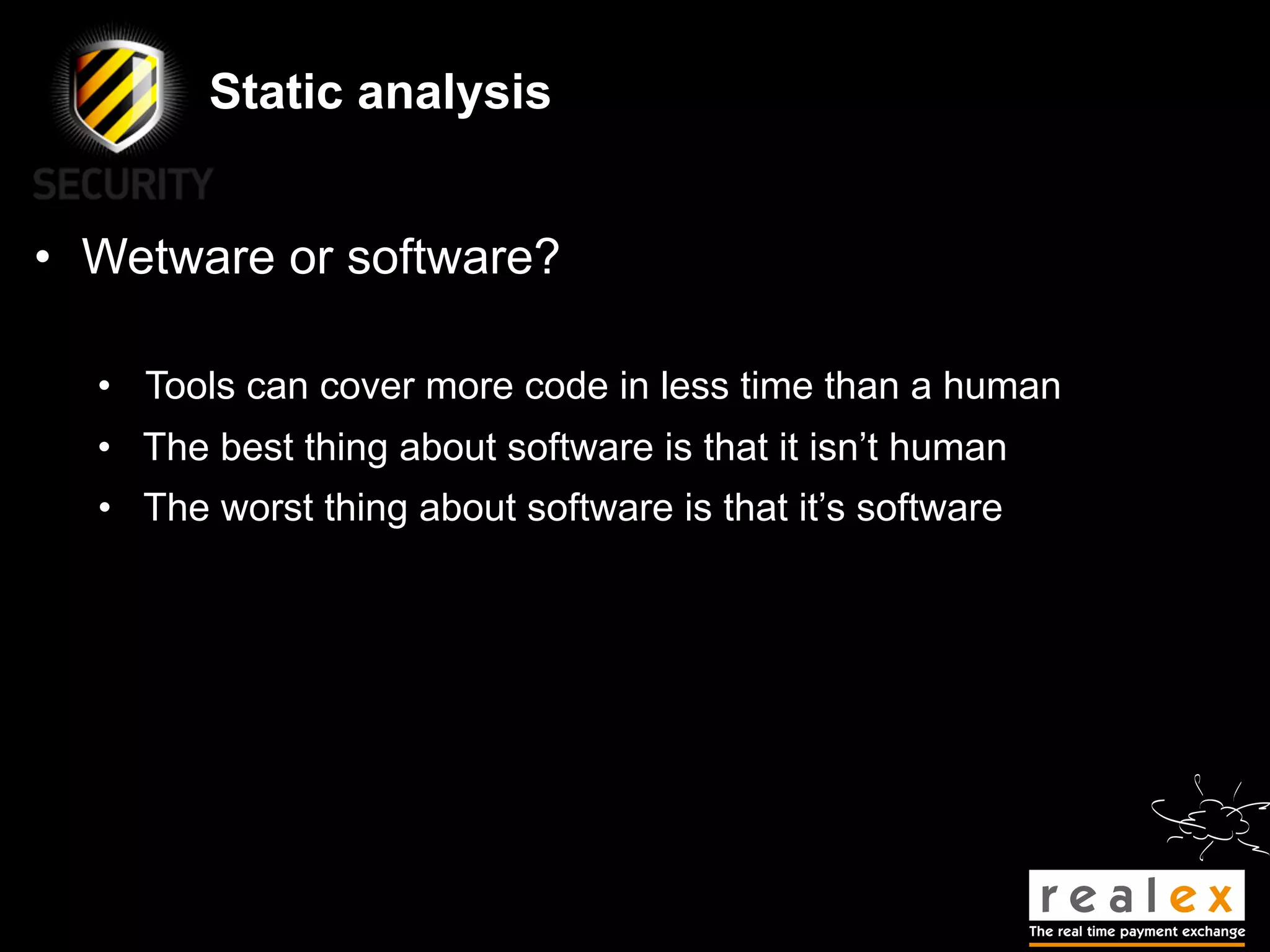
• Wetware or software?

  • Tools can cover more code in less time than a human
  • The best thing about software is that it isn’t human
  • The worst thing about software is that it’s software
The ugly security code reviews


• “Ugly reviews” implies you do actually review code

  • An unplanned magical mystery tour at the end of the SDLC
  • Unstructured, not repeatable and heavily reliant on C H N O
                                                        8   10   4   2


  • Too late in the SDLC making findings very expensive to fix
  • Completely manual process, no tools used during reviews
  • No audit trails, no metrics........no security?
  • Better than nothing?
The bad security code reviews


• “Bad reviews” might be fine for some companies

  • A single planned code review in your SDLC
  • Some structure, normally based on finding the OWASP top 10
  • Still too late in the SDLC making findings very expensive to fix
  • Some automation, usually basic code analysis tools
  • Basic audit trails still no metrics so hard to measure “anything”
  • Better than ugly reviews, might be fine for some companies
The good security code reviews


• “Good reviews” don’t happen by accident

  • Multiple reviews defined as deliverables in your SDLC
  • Structured, repeatable process with management support
  • Reviews are exit criteria for the development and test phases
  • Automation used where useful freeing up the reviewer
  • Ability to produce reports, metrics and measure improvements
  • External validation of the review process and SDLC
The principles of secure development


• What are the principles of secure development?
The principles of secure development


• We put the cart before the application security horse

  • Security guys tell developers about specific vulnerabilities
  • We hope they figure out how to prevent them
  • Inevitably security flaws end up in live code
  • Security guys complain when data gets stolen
The principles of secure development


• What if we taught drivers in the same way?

  • Instructor tells driver about the different ways to crash
  • We hope the driver figures out how not to crash
  • Inevitably the driver will crash
  • People complain when they get crashed into
The principles of secure development


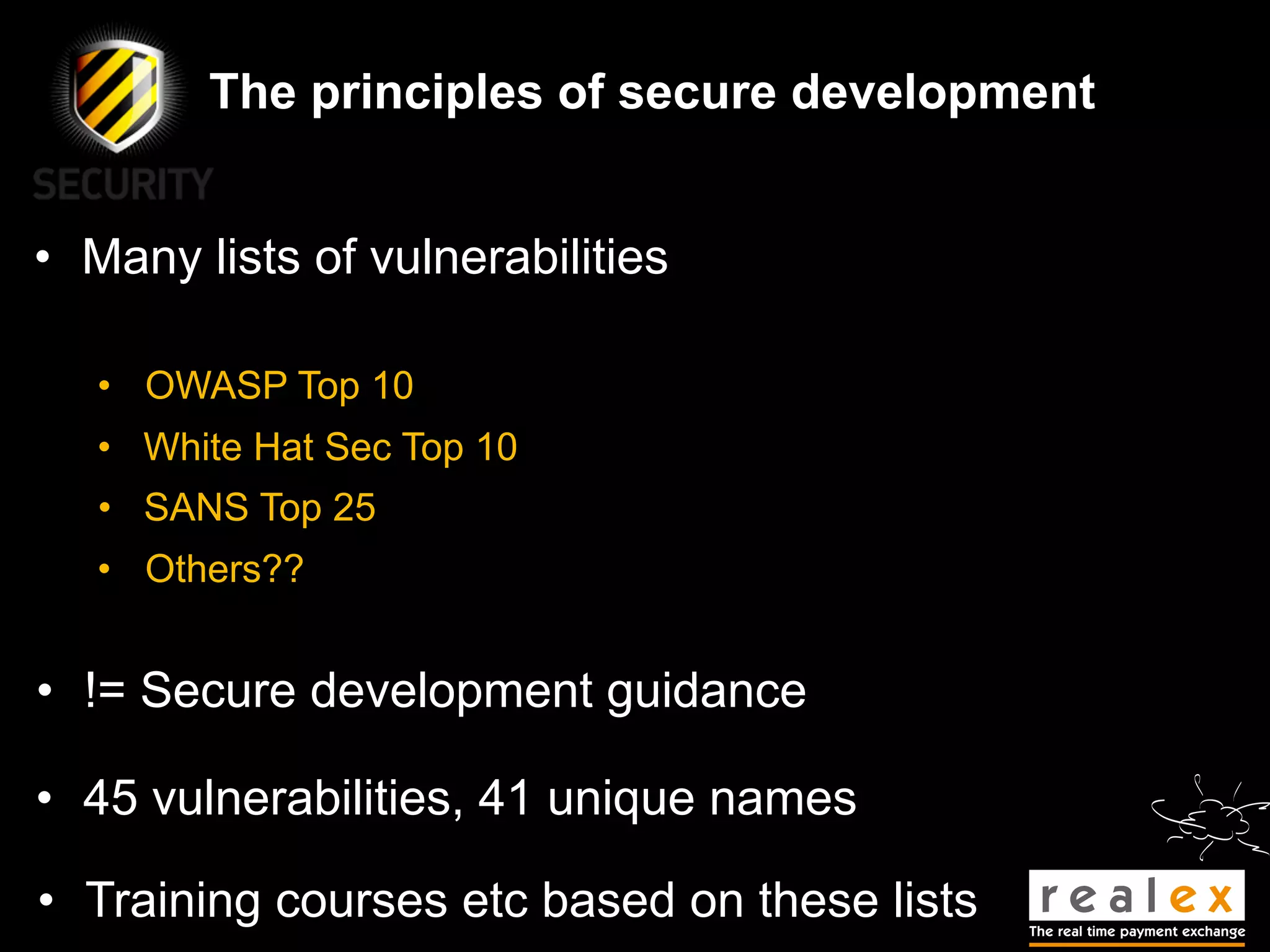
• Many lists of vulnerabilities

   • OWASP Top 10
   • White Hat Sec Top 10
   • SANS Top 25
   • Others??
The principles of secure development
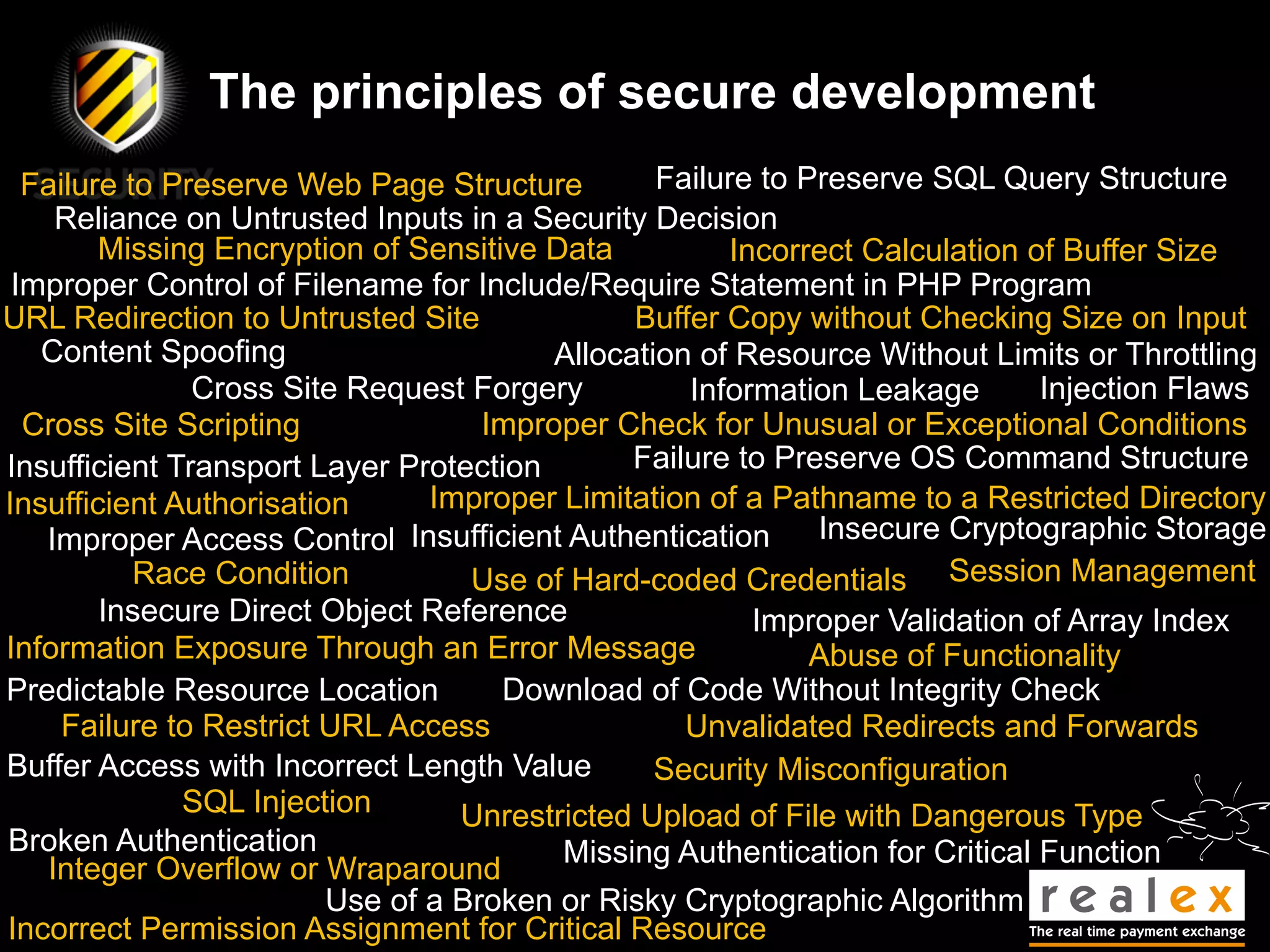
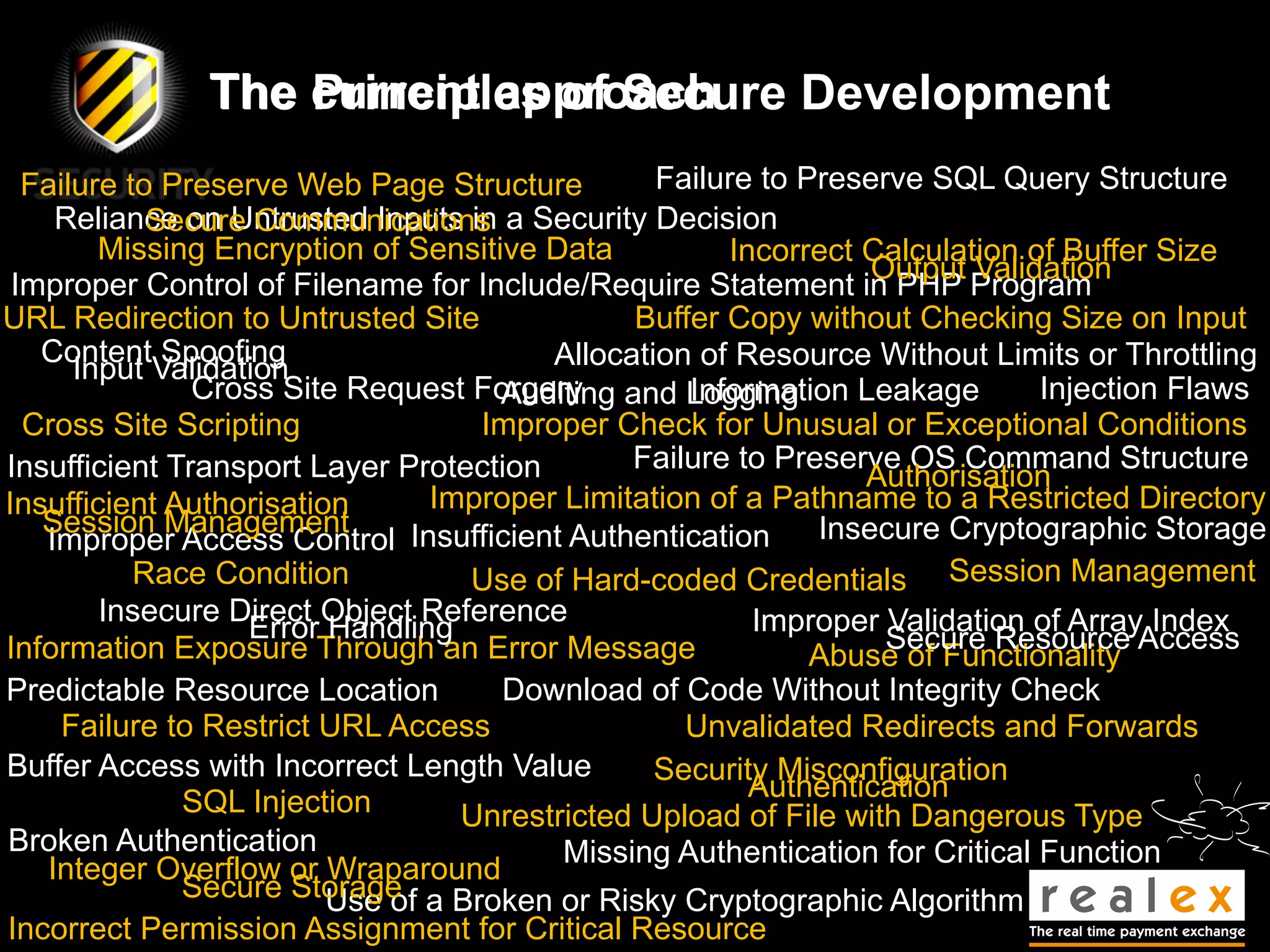
  Failure to Preserve Web Page Structure         Failure to Preserve SQL Query Structure
    Reliance on Untrusted Inputs in a Security Decision
        Missing Encryption of Sensitive Data          Incorrect Calculation of Buffer Size
 Improper Control of Filename for Include/Require Statement in PHP Program
URL Redirection to Untrusted Site              Buffer Copy without Checking Size on Input
   Content Spoofing                      Allocation of Resource Without Limits or Throttling
               Cross Site Request Forgery          Information Leakage       Injection Flaws
  Cross Site Scripting              Improper Check for Unusual or Exceptional Conditions
Insufficient Transport Layer Protection        Failure to Preserve OS Command Structure
Insufficient Authorisation      Improper Limitation of a Pathname to a Restricted Directory
   Improper Access Control Insufficient Authentication       Insecure Cryptographic Storage
           Race Condition          Use of Hard-coded Credentials Session Management
        Insecure Direct Object Reference                Improper Validation of Array Index
Information Exposure Through an Error Message                Abuse of Functionality
Predictable Resource Location        Download of Code Without Integrity Check
     Failure to Restrict URL Access                Unvalidated Redirects and Forwards
Buffer Access with Incorrect Length Value        Security Misconfiguration
              SQL Injection       Unrestricted Upload of File with Dangerous Type
Broken Authentication                    Missing Authentication for Critical Function
   Integer Overflow or Wraparound
                         Use of a Broken or Risky Cryptographic Algorithm
Incorrect Permission Assignment for Critical Resource
The principles of secure development


• Many lists of vulnerabilities

   • OWASP Top 10
   • White Hat Sec Top 10
   • SANS Top 25
   • Others??


• != Secure development guidance

• 45 vulnerabilities, 41 unique names

• Training courses etc based on these lists
Philosophical Application Security


Give a man a fish and you feed him for a day, teach
him to fish and you feed him for a lifetime.

I want to apply this to secure development education:

Teach a developer about a vulnerability and he will
prevent it, teach him how to develop securely and
he will prevent many vulnerabilities.
What we need to do


• Put the application security horse before the cart

  • Security guys tell developers how to write secure code
  • Developer doesn’t need to guess anymore
   • Common vulnerabilities prevented in applications
  • Realistic or just a caffeine fueled dream?
The current approach
                   Principles of Secure Development
  Failure to Preserve Web Page Structure        Failure to Preserve SQL Query Structure
    Reliance on Untrusted Inputs in a Security Decision
            Secure Communications
        Missing Encryption of Sensitive Data         Incorrect Calculation of Buffer Size
                                                                Output Validation
 Improper Control of Filename for Include/Require Statement in PHP Program
URL Redirection to Untrusted Site             Buffer Copy without Checking Size on Input
   Content Spoofing                     Allocation of Resource Without Limits or Throttling
      Input Validation
               Cross Site Request Forgery and Logging
                                     Auditing     Information Leakage        Injection Flaws
  Cross Site Scripting             Improper Check for Unusual or Exceptional Conditions
Insufficient Transport Layer Protection       Failure to Preserve OS Command Structure
                                                               Authorisation
Insufficient Authorisation      Improper Limitation of a Pathname to a Restricted Directory
   Session Management                                       Insecure Cryptographic Storage
   Improper Access Control Insufficient Authentication
           Race Condition         Use of Hard-coded Credentials Session Management
        Insecure Direct Object Reference               Improper Validation of Array Index
                   Error Handling                                Secure Resource Access
Information Exposure Through an Error Message               Abuse of Functionality
Predictable Resource Location        Download of Code Without Integrity Check
     Failure to Restrict URL Access               Unvalidated Redirects and Forwards
Buffer Access with Incorrect Length Value       Security Misconfiguration
              SQL Injection                            Authentication
                                  Unrestricted Upload of File with Dangerous Type
Broken Authentication                    Missing Authentication for Critical Function
   Integer Overflow or Wraparound
              Secure Storage a Broken or Risky Cryptographic Algorithm
                         Use of
Incorrect Permission Assignment for Critical Resource
Agnitio


• What is Agnitio?

  • Tool to help with manual static analysis
  • Checklist based with reviewer & developer guidance
  • Produces audit trails & enforces integrity checks
  • Single tool for security code review reports & metrics
Agnitio


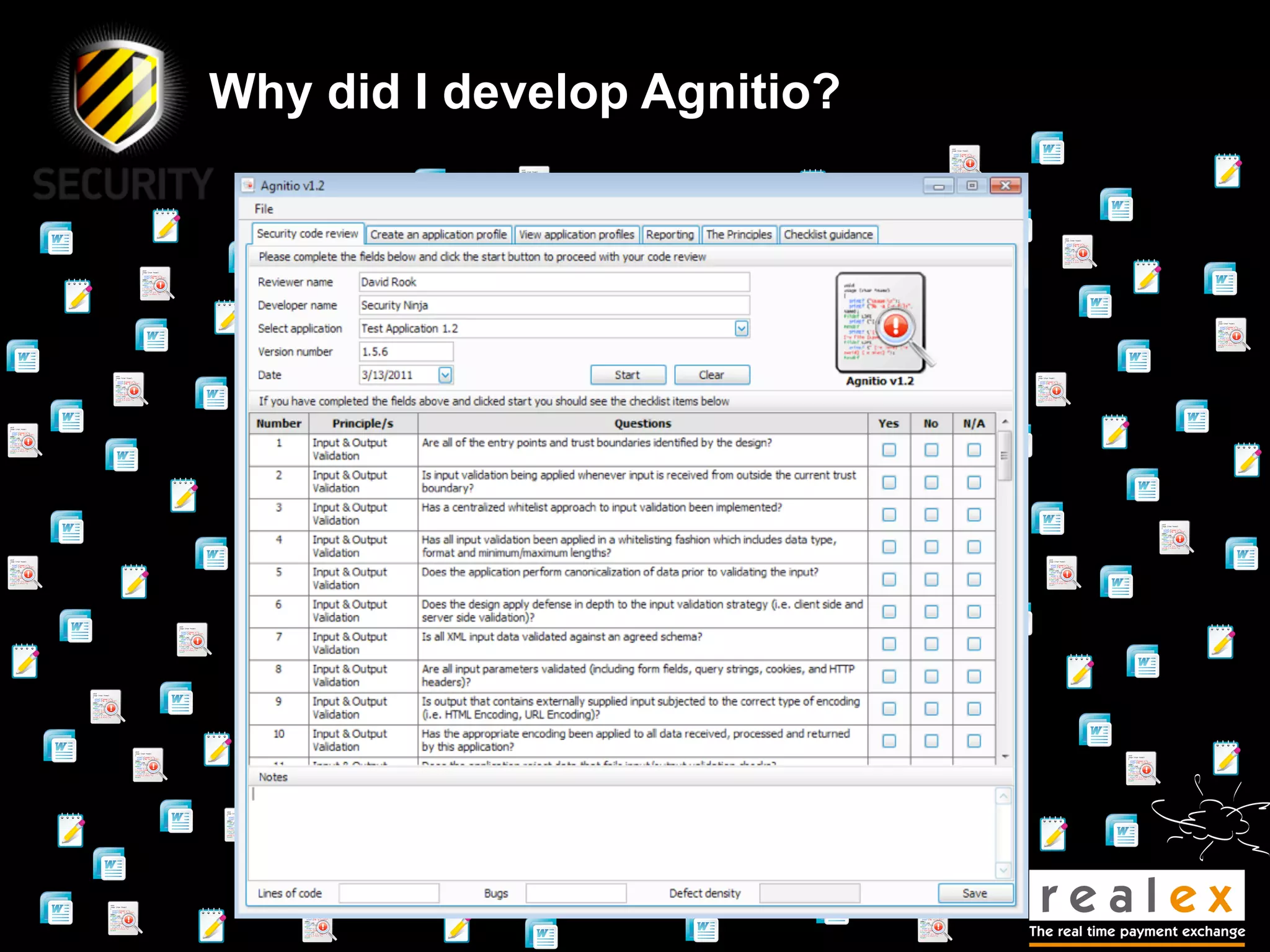
• Why did I develop Agnitio?

  • Even if your review process is good it might not be smart
  • Is your review process really repeatable and easy to audit?
  • How about producing metrics, useful reports & integrity checks?
  • No? That’s why I developed Agnitio!
Agnitio


• Why did I develop Agnitio?

  • My own review process was good but it wasn’t smart
  • Minimum of 2 code reviews per release
  • Three pieces of evidence produced per review
  • One central Excel sheet for metrics and “audit” trail
Why did I develop Agnitio?


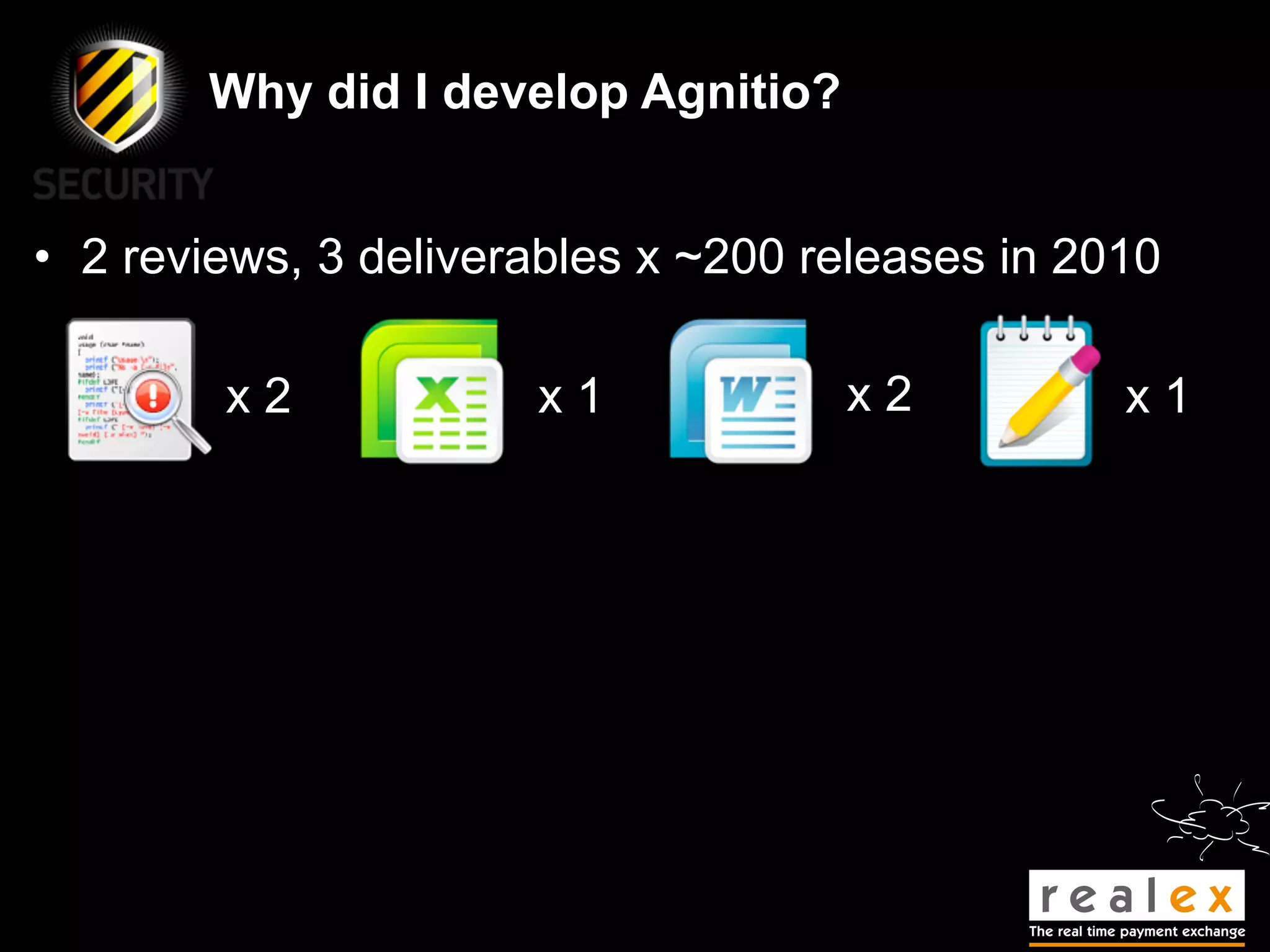
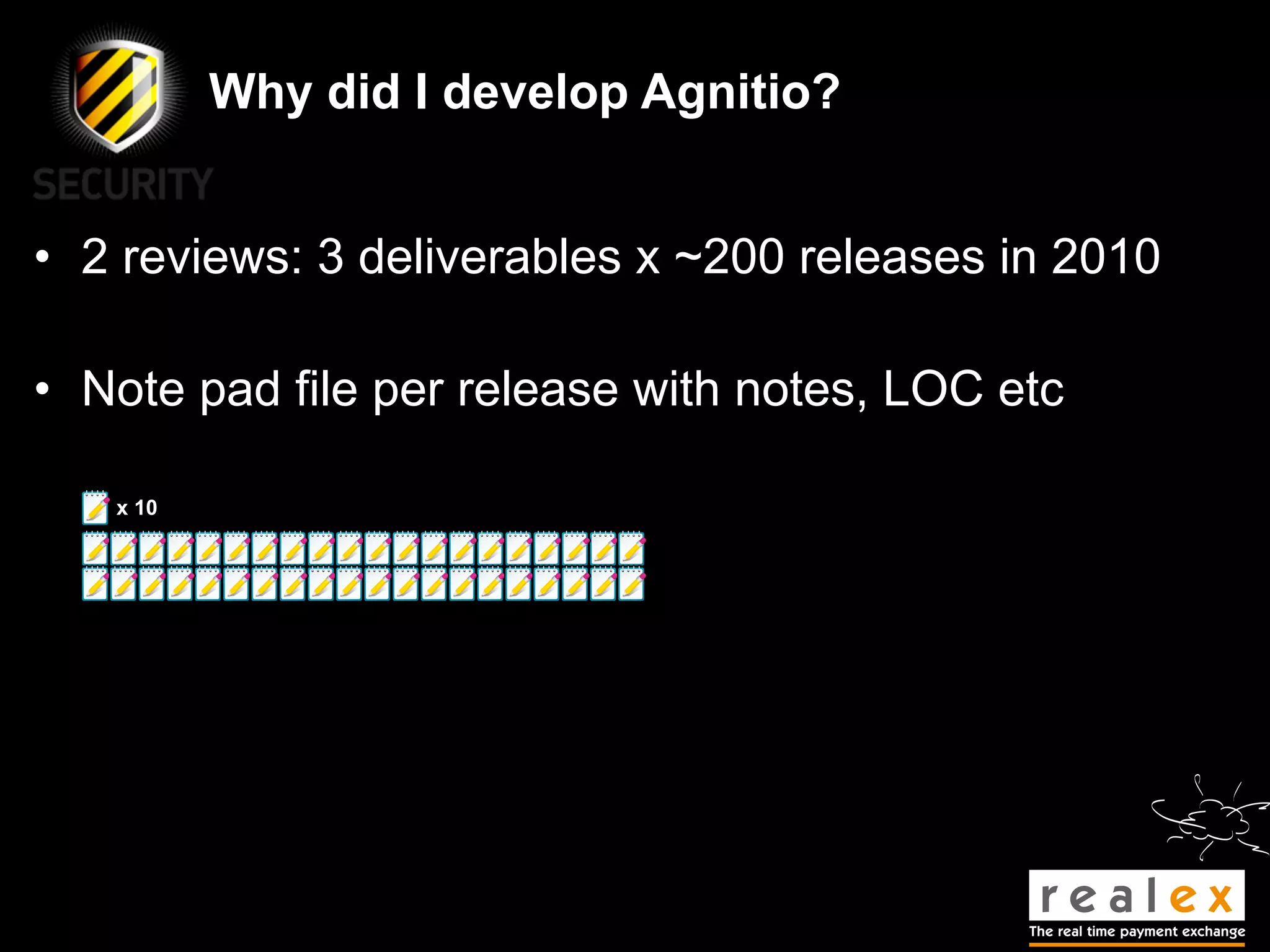
• 2 reviews, 3 deliverables x ~200 releases in 2010

        x2            x1            x2           x1
Why did I develop Agnitio?


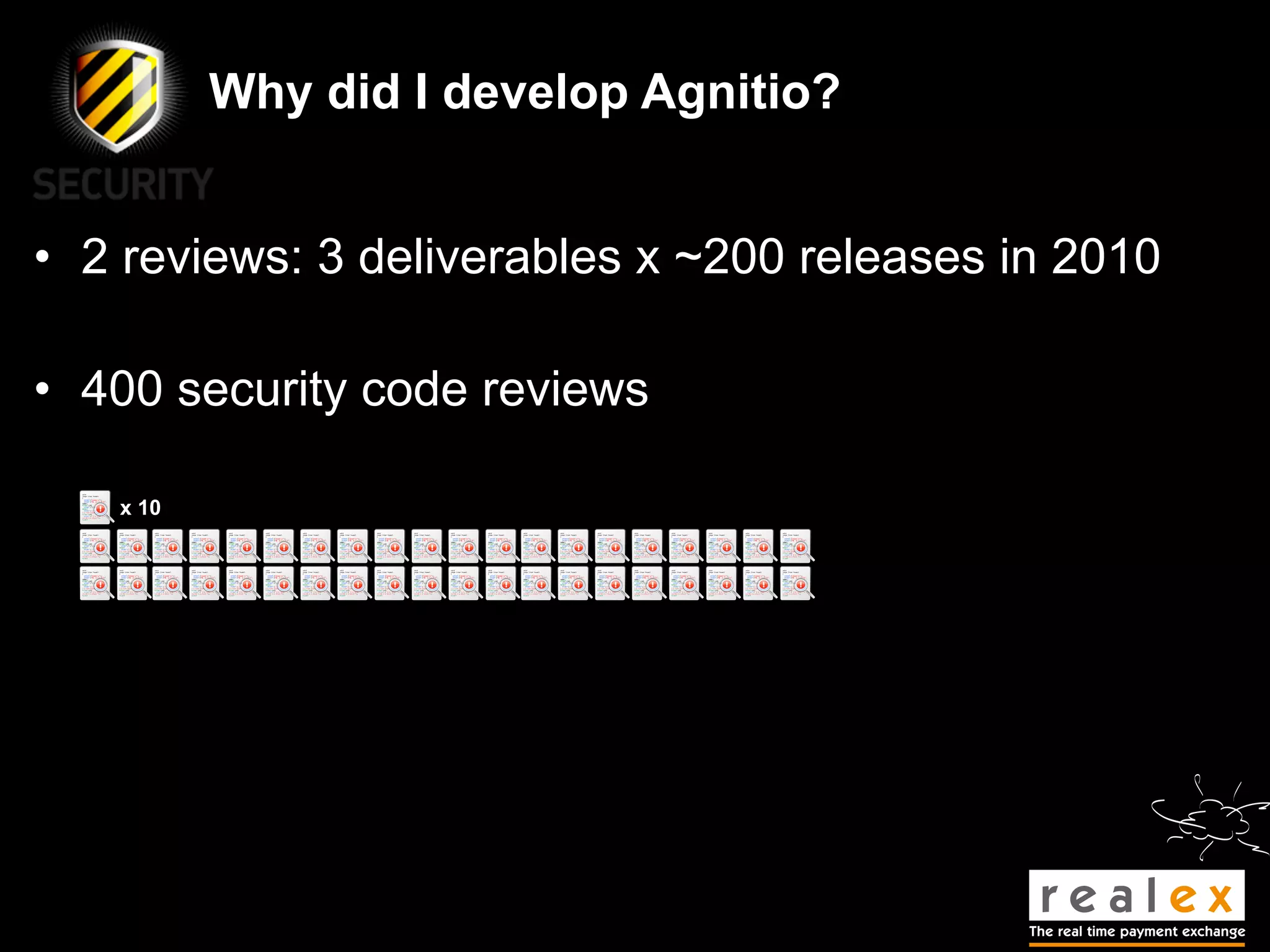
• 2 reviews: 3 deliverables x ~200 releases in 2010

• 400 security code reviews

   x 10
Why did I develop Agnitio?


• Demonstration: security code reviews
Why did I develop Agnitio?


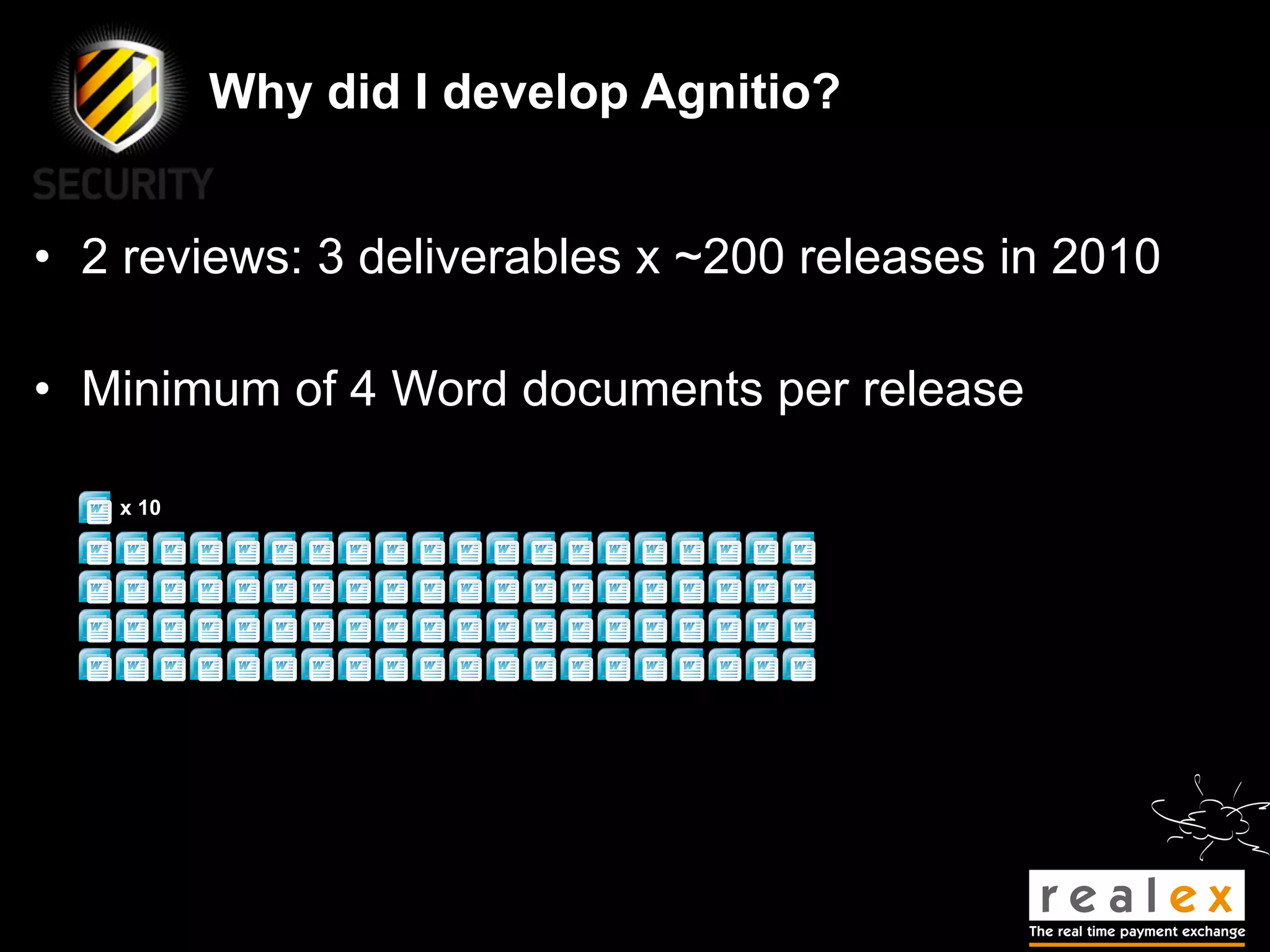
• 2 reviews: 3 deliverables x ~200 releases in 2010

• Minimum of 4 Word documents per release

   x 10
Why did I develop Agnitio?


• Demonstration: security code review reports
Why did I develop Agnitio?


• 2 reviews: 3 deliverables x ~200 releases in 2010

• Note pad file per release with notes, LOC etc

   x 10
Why did I develop Agnitio?


• Demonstration: application security metrics
Why did I develop Agnitio?
Agnitio v2.0


• Automated code analysis module linked to checklist

• Data editor for developer and checklist guidance text

• Checklist and guidance in multiple languages

• Plus lots of user suggested changes!
Agnitio v2.0


• Agnitio v2.0 super early, Alpha demonstration
My “shoot for the moon” vision for Agnitio


“we pretty much need a Burp Pro equivalent for Static
Analysis – awesome, powerful in the right hands, and
completely affordable!”
http://www.securityninja.co.uk/application-security/can-you-implement-static-analysis-without-breaking-the-bank/comment-page-1#comment-9777
Using the principles and Agnitio


• How you can apply the principles approach

  • Download principles documentation from Security Ninja
  • Focus secure development training on code not exploits
  • Use your language/s in all code examples
  • Use Agnitio to conduct principles based security code reviews
  • Tie all security findings back to specific principles
QUESTIONS?
www.securityninja.co.uk


     @securityninja

     /realexninja

     /securityninja

     /realexninja

SecurityBSides London - Agnitio: it's static analysis but not as we know it

  • 1.
    David Rook Agnitio It’s staticanalysis, but not as we know it SecurityBSides, London
  • 2.
    if (slide ==introduction) System.out.println("I’m David Rook"); • Security Analyst, Realex Payments, Ireland CISSP, CISA, GCIH and many other acronyms • Security Ninja (www.securityninja.co.uk) • Speaker at international security conferences • Nominated for multiple blog awards • A mentor in the InfoSecMentors project • Developed and released Agnitio
  • 3.
    Agenda • What isstatic analysis? • Security code reviews: the good, the bad and the ugly • The principles of secure development • Agnitio: It’s static analysis, but not as we know it • A sneak preview of Agnitio v2.0
  • 4.
    Static analysis • Whatdo I mean by static analysis? • A review of source code without executing the application • Can be either manual or automated through one or more tools • Human and/or tools analysing application source code
  • 5.
    Static analysis • Wetwareor software? • Humans are needed with or without static analysis tools • The best thing about humans is that they aren’t software • The worst thing about humans is that they are humans
  • 6.
    Static analysis • Wetwareor software? http://www.ibm.com/developerworks/rational/library/11-proven-practices-for-peer-review/index.html?sf1100063=1
  • 7.
    Static analysis • Wetwareor software? http://www.ibm.com/developerworks/rational/library/11-proven-practices-for-peer-review/index.html?sf1100063=1
  • 8.
    Static analysis • Wetwareor software? • Tools can cover more code in less time than a human • The best thing about software is that it isn’t human • The worst thing about software is that it’s software
  • 16.
    The ugly securitycode reviews • “Ugly reviews” implies you do actually review code • An unplanned magical mystery tour at the end of the SDLC • Unstructured, not repeatable and heavily reliant on C H N O 8 10 4 2 • Too late in the SDLC making findings very expensive to fix • Completely manual process, no tools used during reviews • No audit trails, no metrics........no security? • Better than nothing?
  • 17.
    The bad securitycode reviews • “Bad reviews” might be fine for some companies • A single planned code review in your SDLC • Some structure, normally based on finding the OWASP top 10 • Still too late in the SDLC making findings very expensive to fix • Some automation, usually basic code analysis tools • Basic audit trails still no metrics so hard to measure “anything” • Better than ugly reviews, might be fine for some companies
  • 18.
    The good securitycode reviews • “Good reviews” don’t happen by accident • Multiple reviews defined as deliverables in your SDLC • Structured, repeatable process with management support • Reviews are exit criteria for the development and test phases • Automation used where useful freeing up the reviewer • Ability to produce reports, metrics and measure improvements • External validation of the review process and SDLC
  • 19.
    The principles ofsecure development • What are the principles of secure development?
  • 20.
    The principles ofsecure development • We put the cart before the application security horse • Security guys tell developers about specific vulnerabilities • We hope they figure out how to prevent them • Inevitably security flaws end up in live code • Security guys complain when data gets stolen
  • 21.
    The principles ofsecure development • What if we taught drivers in the same way? • Instructor tells driver about the different ways to crash • We hope the driver figures out how not to crash • Inevitably the driver will crash • People complain when they get crashed into
  • 22.
    The principles ofsecure development • Many lists of vulnerabilities • OWASP Top 10 • White Hat Sec Top 10 • SANS Top 25 • Others??
  • 23.
    The principles ofsecure development Failure to Preserve Web Page Structure Failure to Preserve SQL Query Structure Reliance on Untrusted Inputs in a Security Decision Missing Encryption of Sensitive Data Incorrect Calculation of Buffer Size Improper Control of Filename for Include/Require Statement in PHP Program URL Redirection to Untrusted Site Buffer Copy without Checking Size on Input Content Spoofing Allocation of Resource Without Limits or Throttling Cross Site Request Forgery Information Leakage Injection Flaws Cross Site Scripting Improper Check for Unusual or Exceptional Conditions Insufficient Transport Layer Protection Failure to Preserve OS Command Structure Insufficient Authorisation Improper Limitation of a Pathname to a Restricted Directory Improper Access Control Insufficient Authentication Insecure Cryptographic Storage Race Condition Use of Hard-coded Credentials Session Management Insecure Direct Object Reference Improper Validation of Array Index Information Exposure Through an Error Message Abuse of Functionality Predictable Resource Location Download of Code Without Integrity Check Failure to Restrict URL Access Unvalidated Redirects and Forwards Buffer Access with Incorrect Length Value Security Misconfiguration SQL Injection Unrestricted Upload of File with Dangerous Type Broken Authentication Missing Authentication for Critical Function Integer Overflow or Wraparound Use of a Broken or Risky Cryptographic Algorithm Incorrect Permission Assignment for Critical Resource
  • 24.
    The principles ofsecure development • Many lists of vulnerabilities • OWASP Top 10 • White Hat Sec Top 10 • SANS Top 25 • Others?? • != Secure development guidance • 45 vulnerabilities, 41 unique names • Training courses etc based on these lists
  • 25.
    Philosophical Application Security Givea man a fish and you feed him for a day, teach him to fish and you feed him for a lifetime. I want to apply this to secure development education: Teach a developer about a vulnerability and he will prevent it, teach him how to develop securely and he will prevent many vulnerabilities.
  • 26.
    What we needto do • Put the application security horse before the cart • Security guys tell developers how to write secure code • Developer doesn’t need to guess anymore • Common vulnerabilities prevented in applications • Realistic or just a caffeine fueled dream?
  • 27.
    The current approach Principles of Secure Development Failure to Preserve Web Page Structure Failure to Preserve SQL Query Structure Reliance on Untrusted Inputs in a Security Decision Secure Communications Missing Encryption of Sensitive Data Incorrect Calculation of Buffer Size Output Validation Improper Control of Filename for Include/Require Statement in PHP Program URL Redirection to Untrusted Site Buffer Copy without Checking Size on Input Content Spoofing Allocation of Resource Without Limits or Throttling Input Validation Cross Site Request Forgery and Logging Auditing Information Leakage Injection Flaws Cross Site Scripting Improper Check for Unusual or Exceptional Conditions Insufficient Transport Layer Protection Failure to Preserve OS Command Structure Authorisation Insufficient Authorisation Improper Limitation of a Pathname to a Restricted Directory Session Management Insecure Cryptographic Storage Improper Access Control Insufficient Authentication Race Condition Use of Hard-coded Credentials Session Management Insecure Direct Object Reference Improper Validation of Array Index Error Handling Secure Resource Access Information Exposure Through an Error Message Abuse of Functionality Predictable Resource Location Download of Code Without Integrity Check Failure to Restrict URL Access Unvalidated Redirects and Forwards Buffer Access with Incorrect Length Value Security Misconfiguration SQL Injection Authentication Unrestricted Upload of File with Dangerous Type Broken Authentication Missing Authentication for Critical Function Integer Overflow or Wraparound Secure Storage a Broken or Risky Cryptographic Algorithm Use of Incorrect Permission Assignment for Critical Resource
  • 28.
    Agnitio • What isAgnitio? • Tool to help with manual static analysis • Checklist based with reviewer & developer guidance • Produces audit trails & enforces integrity checks • Single tool for security code review reports & metrics
  • 29.
    Agnitio • Why didI develop Agnitio? • Even if your review process is good it might not be smart • Is your review process really repeatable and easy to audit? • How about producing metrics, useful reports & integrity checks? • No? That’s why I developed Agnitio!
  • 30.
    Agnitio • Why didI develop Agnitio? • My own review process was good but it wasn’t smart • Minimum of 2 code reviews per release • Three pieces of evidence produced per review • One central Excel sheet for metrics and “audit” trail
  • 31.
    Why did Idevelop Agnitio? • 2 reviews, 3 deliverables x ~200 releases in 2010 x2 x1 x2 x1
  • 32.
    Why did Idevelop Agnitio? • 2 reviews: 3 deliverables x ~200 releases in 2010 • 400 security code reviews x 10
  • 33.
    Why did Idevelop Agnitio? • Demonstration: security code reviews
  • 34.
    Why did Idevelop Agnitio? • 2 reviews: 3 deliverables x ~200 releases in 2010 • Minimum of 4 Word documents per release x 10
  • 35.
    Why did Idevelop Agnitio? • Demonstration: security code review reports
  • 36.
    Why did Idevelop Agnitio? • 2 reviews: 3 deliverables x ~200 releases in 2010 • Note pad file per release with notes, LOC etc x 10
  • 37.
    Why did Idevelop Agnitio? • Demonstration: application security metrics
  • 38.
    Why did Idevelop Agnitio?
  • 39.
    Agnitio v2.0 • Automatedcode analysis module linked to checklist • Data editor for developer and checklist guidance text • Checklist and guidance in multiple languages • Plus lots of user suggested changes!
  • 40.
    Agnitio v2.0 • Agnitiov2.0 super early, Alpha demonstration
  • 41.
    My “shoot forthe moon” vision for Agnitio “we pretty much need a Burp Pro equivalent for Static Analysis – awesome, powerful in the right hands, and completely affordable!” http://www.securityninja.co.uk/application-security/can-you-implement-static-analysis-without-breaking-the-bank/comment-page-1#comment-9777
  • 42.
    Using the principlesand Agnitio • How you can apply the principles approach • Download principles documentation from Security Ninja • Focus secure development training on code not exploits • Use your language/s in all code examples • Use Agnitio to conduct principles based security code reviews • Tie all security findings back to specific principles
  • 43.
    QUESTIONS? www.securityninja.co.uk @securityninja /realexninja /securityninja /realexninja