1
UEL-CN-7014 Security Management
Assignment 1
Damaine Franklin
Student #: R2104D12054733
08/26/2023
Security Management – Assignment 1 a1-Franklin-R2104D12054733
2
Table of Contents
Part 1A: Cyber Attack..................................................................................................................... 3
Introduction ................................................................................................................................. 3
Incident Overview ....................................................................................................................... 4
Incident Analysis ......................................................................................................................... 5
Lessons Learned .......................................................................................................................... 9
Lesson 1: Lack of Leadership .................................................................................................. 9
Lesson 2: Inadequate Authentication and Access Control..................................................... 10
Lesson 3: Lack of Awareness................................................................................................. 10
Lesson 4: Lack of Real-Time Threat Detection..................................................................... 11
Actions Taken............................................................................................................................ 11
Conclusion................................................................................................................................. 12
Part 1B: Cyber Kill Chain............................................................................................................. 13
Part 2: Disaster Recovery and Business Continuity ..................................................................... 15
A Brief Review of The Incident ................................................................................................ 15
How Should Affected Companies Respond .............................................................................. 15
Business Continuity Information Security Policy ..................................................................... 16
Part 3: Security Management Questions....................................................................................... 19
The Benefits of ISO/IEC 27001 Certification. .......................................................................... 19
Recommended Audit ................................................................................................................. 22
Risk Management Process......................................................................................................... 24
References..................................................................................................................................... 26
Security Management – Assignment 1 a1-Franklin-R2104D12054733
3
Part 1A: Cyber Attack
Report Analysis: Twitter’s Spear Phishing Attack July 2020
Introduction
As a result of the recent COVID-19 pandemic, cybercrime has become such a lucrative
industry that organizations around the world have had to adjust their cybersecurity postures to
defend against the rise of sophisticated attack vectors. Among these attack vectors is social
engineering, which, according to Fadhil (2023), is one of the most sophisticated cyber-attacks
because there are no available hardware or software countermeasures to defend against it. The
author further noted that the objective of social engineering tactics is to manipulate victims by
taking advantage of their psychological vulnerabilities, such as fear, anxiety, trust, curiosity, or
empathy, to gain access to secure facilities, systems, or data. There are numerous social
engineering techniques; however, the technique of particular interest to this study is phone spear
phishing, as it was reported to have been used in the July 2020 cyberattack against Twitter. Since
the attack, there has been much discussion as to whether Twitter's incident response team could
have preemptively identified and responded to the cyber intrusion much sooner. As a result, this
study aims to provide a comprehensive report analysis of the July 2020 incident. This report
analysis will begin with a brief overview of the incident. It then analyzes the incident to identify
who or what was affected by the attack, the nature and severity of the attack, the threat actors
involved, the systems and vulnerabilities exploited, and the actions taken. This report will also
include a discussion on the lessons learned from the attack followed by a conclusion.
Security Management – Assignment 1 a1-Franklin-R2104D12054733
4
Incident Overview
On July 15, 2020, Twitter an American social media company, and other media outlets
reported that hackers compromised 130 Twitter accounts of prominent users to promote
fraudulent bitcoin scams, which raises national security concerns (Iyengar, 2020). Details of the
attack indicated that the fraudsters employed a common social engineering technique known as
phone spear phishing to deceive several of Twitter’s employees into divulging sensitive
information, thereby granting them access to Twitter's internal tools and information systems
(Suciu, 2020). Other sources reported that just after the hackers gained access to Twitter’s
systems, the hackers were able to manipulate stolen user accounts and post tweets directly (BBC,
2020). This incident raised several security concerns in the United States since the accounts of
prominent US officials and businessmen were hacked and used for high-profile Bitcoin scams.
As a consequence of this assault against Twitter, the US Federal Bureau of Investigation
(FBI), arrested and charged three suspects for their alleged role in the Twitter attack that
occurred on July 15, 2020, (Witman & Mackelprang, 2021). According to the United States
Attorney's Office for the Northern District of California (NDCA), the three individuals involved
in the incident were 19-year-old Mason Sheppard from the United Kingdom, 22-year-old Nima
Fazeli from Orlando, Florida, USA, and a third suspect whose identity is unknown due to the
Federal Juvenile Delinquency Act, which protects juveniles during court proceedings (NDCA,
2020). The charges against these three individuals were identity theft, unauthorized access to a
protected computer, fraud, and money laundering.
Security Management – Assignment 1 a1-Franklin-R2104D12054733
5
The NDCA reported that the accomplices compromised more than 130 Twitter accounts
and deceived the account owners and other users into depositing bitcoin currency to an
anonymous bitcoin address with the promise of doubling the amount deposited as a charitable
gesture. According to Muneer (n.d.), Just before Twitter’s technical team was able to lock down
those compromised accounts, the hackers had already spoofed the victims and received 383
bitcoins which is equivalent to US$117,000. In addition, Muneer (n.d.) noted that the hackers
would have stolen approximately $1,350,000 from over 6000 bitcoin transfers if Twitter and
Bitcoin companies had not taken the necessary precautions. The following information will
provide a detailed analysis of the incident.
Incident Analysis
According to a 2020 investigation report published by the Department of Financial
Services in New York, Twitter became aware of the incident on July 15, however, the attack
began on July 14,
2020, (DFS, 2020). The investigation found that the attack was carried out in
three phases. Firstly, the attackers used social engineering to spoof vulnerable Twitter employees
in order to gain access to their Network. Secondly, they seized user accounts with short OG
Twitter handles and sold access to them. Thirdly, they seized and compromised the accounts of
several prominent users with the intent of defrauding victims in a massive Bitcoin scam.
According to the investigative report, the hackers began their assault against Twitter on
July 14th
. during that time many of Twitter’s employees were doing remote work because of the
COVID-19 pandemic which created a huge problem for Twitter's infrastructure. As a result of
the transition to working remotely, the hackers saw an opportunity to take advantage of
employees' complaints about the VPN connection to Twister’s internal tools and resources. As a
Security Management – Assignment 1 a1-Franklin-R2104D12054733
6
point of entry, the hackers used a social engineering technique known as phone spear phishing to
impersonate Twitter’s Help Desk representatives to lure several of Twitter’s employees into
providing their login credentials on a phishing website which resembles Twitters legitimate VPN
website. In a separate report, Muneer (n.d.) noted that in the initial phase of the attack, the
hackers realized that the stolen credentials lacked the necessary privileges to escalate their attack.
Consequently, Muneer (n.d.) also noted that on July 15, the attackers intensified their attack
method by searching Twitter's intranet for information on how to utilize Twitter's internal
applications. With this information, they were able to target those employees with higher
privileges and access to Twitters internals tools.
The 15th
of July 2020 marks the beginning of a new phase in the wave of attacks against
Twitter, as it was on that date that Twitter became aware of the incident. According to
information gathered from several sources, the hackers seized control and compromised a large
number of Twitter OG accounts in the early hours of the day with the intention of advertising
their sale through an online messaging portal in exchange for bitcoin (DFS, 2020; Muneer, n.d.;
Witman & Mackelprang, 2021). In another source, Thompson & Barrett (2020) reported that
Twitter's cyber incident response team had detected the network intrusion at this stage of the
attack, however, the chief technology officer (CTO) had not yet been notified. Due to this
oversight, the hackers had more time to their advantage to launch the third phase of their attack.
At this stage of the attack, both Muneer (n.d.) and DFS (2020) reported that the hackers targeted
verified user accounts, which Twitter defines as accounts belonging to prominent users such as
former U.S. president Barack Obama, businessman Bill Gates, Elon Musk, Jeff Bezos, Mike
Bloomberg, and celebrities Kim Kardashian and Kanye West among others. In addition, the user
accounts of popular companies were also seized and compromised such as Apple, Uber, and
Security Management – Assignment 1 a1-Franklin-R2104D12054733
7
well-known crypto currency companies and traders. This was yet another strategic move on the
part of the hackers, as it allowed them to capitalize on the public's trust in verified Twitter
accounts since people are more likely to respond to tweets from these accounts. The motive of
the hackers at this stage in the attack process is to launch a Bitcoin scam using those stolen
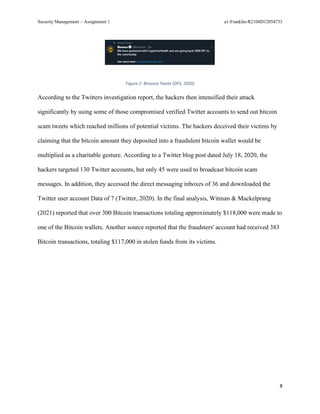
verified Twitter accounts. According to Twitter's investigation report, the hackers first hijacked a
Bitcoin trader named “AngelBTC” and tweeted the following message to multiple Twitter users.
Figure 1:Tweeted message from a hijacked crypto trader (DFS,2020).
The objective of this bitcoin scam is to make fraudulent demands by convincing Twitter users to
believe that the message originates from the legitimate owner of the account. The hackers then
escalated their attack by tweeting payment requests directly from the accounts of ten
cryptocurrency companies such as Binance, Gemini, Coinbase, and Square, Inc among others
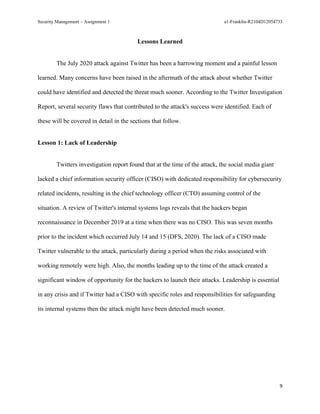
(DFS, 2020). In one such fraudulent scheme, the hackers sent a message with a link to a Bitcoin
wallet from the Binance user account. In the tweet, the hackers posed as Binance and claimed
that the company was returning millions of bitcoins to members of its community as shown
below.
Security Management – Assignment 1 a1-Franklin-R2104D12054733
8
Figure 2: Binance Tweet (DFS, 2020)
According to the Twitters investigation report, the hackers then intensified their attack
significantly by using some of those compromised verified Twitter accounts to send out bitcoin
scam tweets which reached millions of potential victims. The hackers deceived their victims by
claiming that the bitcoin amount they deposited into a fraudulent bitcoin wallet would be
multiplied as a charitable gesture. According to a Twitter blog post dated July 18, 2020, the
hackers targeted 130 Twitter accounts, but only 45 were used to broadcast bitcoin scam
messages. In addition, they accessed the direct messaging inboxes of 36 and downloaded the
Twitter user account Data of 7 (Twitter, 2020). In the final analysis, Witman & Mackelprang
(2021) reported that over 300 Bitcoin transactions totaling approximately $118,000 were made to
one of the Bitcoin wallets. Another source reported that the fraudsters' account had received 383
Bitcoin transactions, totaling $117,000 in stolen funds from its victims.
Security Management – Assignment 1 a1-Franklin-R2104D12054733
9
Lessons Learned
The July 2020 attack against Twitter has been a harrowing moment and a painful lesson
learned. Many concerns have been raised in the aftermath of the attack about whether Twitter
could have identified and detected the threat much sooner. According to the Twitter Investigation
Report, several security flaws that contributed to the attack's success were identified. Each of
these will be covered in detail in the sections that follow.
Lesson 1: Lack of Leadership
Twitters investigation report found that at the time of the attack, the social media giant
lacked a chief information security officer (CISO) with dedicated responsibility for cybersecurity
related incidents, resulting in the chief technology officer (CTO) assuming control of the
situation. A review of Twitter's internal systems logs reveals that the hackers began
reconnaissance in December 2019 at a time when there was no CISO. This was seven months
prior to the incident which occurred July 14 and 15 (DFS, 2020). The lack of a CISO made
Twitter vulnerable to the attack, particularly during a period when the risks associated with
working remotely were high. Also, the months leading up to the time of the attack created a
significant window of opportunity for the hackers to launch their attacks. Leadership is essential
in any crisis and if Twitter had a CISO with specific roles and responsibilities for safeguarding
its internal systems then the attack might have been detected much sooner.
Security Management – Assignment 1 a1-Franklin-R2104D12054733
10
Lesson 2: Inadequate Authentication and Access Control
The investigation report determines that although Twitter had some authentication and
access control measures in place, they were not enough to prevent the attack (DFS, 2020). The
report indicated that during the first phase of the attack, the attackers compromised the
credentials of several Twitter employees then used them to authenticate themselves then access
Twitters internal administrative tools. In a separate report, The New York Times discovered that
the hackers boasted confidently that they had effectively gained access to Twitter's support tools
and offered to sell coveted Twitter OG accounts (Popper & Conger, 2020). During the aftermath
of the attack the Twitter investigation report found that there were too many people with access
to Twitters administrative tools. Consequently, this vulnerability in authentication and access
control gave the attacks leverage in the attack as they were able to target 130 user accounts,
tweeted from 45, access the direct message of 36 users, and download the Twitter data of 8 users
(DFS, 2020). During the attack, the investigation report discovered that more than 1,000 of
Twitter’s employees had access to their internal tools. Thompson & Barnett (2020) noted that
access to Twitter's internal tools should have been restricted to a small group of employees with
specified job functions because too many people had access to too many things.
Lesson 3: Lack of Awareness
Since there are no hardware or software tools that can detect and defend against social
engineering, the most effective countermeasure for detecting and preventing social engineering
techniques is awareness training. Several sources reported that Twitter's staff lacked proper
awareness training to detect social engineering tactics. According to a Twitter investigation
report, the hackers used phone social engineering tactics to impersonate Twitter IT Helps Desk
Security Management – Assignment 1 a1-Franklin-R2104D12054733
11
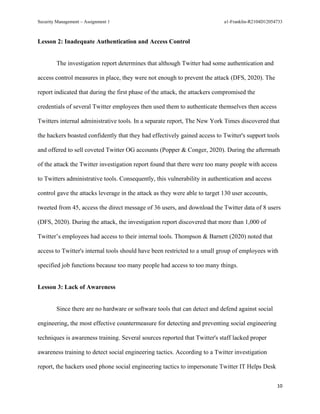
to spoof the employees into logging their credentials on a phishing website (DFS, 2020).
Considering the initiative to work remotely, it is common for Twitters employees to drop their
guard since one of the primary modes of communication is the use of a telephone. This would
provide Twitter with a convenient opportunity to have its employees aware of the tactics used in
social engineering attacks.
Lesson 4: Lack of Real-Time Threat Detection
An essential lesson learned from this attack is that Twitter only became aware of the
attack after the hackers had made significant progress on their network. The ability to detect and
respond to cyber threats in a timely manner is crucial as it enables a more proactive cyber threat
defense strategy. If Twitter had a comprehensive security monitoring program, it would have
been able to detect and respond swiftly to the presents of the hackers on their network much
sooner.
Actions Taken
In a series of blogs posted by Twitter on July 18 and 30, 2020, the company announced
that they had put new protocols in place to prevent similar social engineering attacks. According
to the blogs, one of the initial actions taken by Twitter was to secure and revoke access to
internal systems in order to prevent attackers from gaining further access to our systems or
individual accounts. Secondly, Twitter establishes an environment of zero trust by shutting down
the user accounts of all employees and requiring each employee to change their password under
supervision (Twitter, 2020). In an article published by Moon (2020), Twitter stated that they
implemented new background check protocols for employees with access to administrative tools
Security Management – Assignment 1 a1-Franklin-R2104D12054733
12
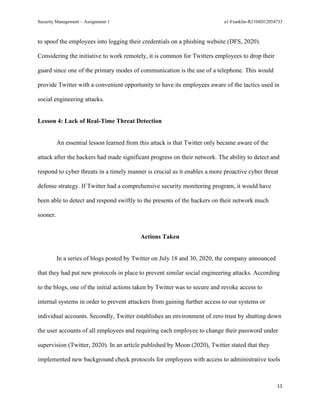
and user data. In addition, Moon (2020) further noted that Twitter has made it mandatory for all
employees involved in awareness training for future social engineering scams (Moon, 2020).
Moreover, Twitter has implemented an event and security information management system,
which is an anomaly detection system that records account usage, identifies insider threats, threat
actors, and malicious intent (DFS, 2020).
Conclusion
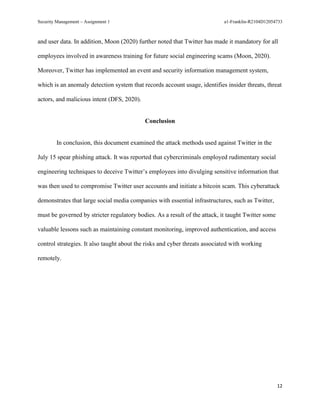
In conclusion, this document examined the attack methods used against Twitter in the
July 15 spear phishing attack. It was reported that cybercriminals employed rudimentary social
engineering techniques to deceive Twitter’s employees into divulging sensitive information that
was then used to compromise Twitter user accounts and initiate a bitcoin scam. This cyberattack
demonstrates that large social media companies with essential infrastructures, such as Twitter,
must be governed by stricter regulatory bodies. As a result of the attack, it taught Twitter some
valuable lessons such as maintaining constant monitoring, improved authentication, and access
control strategies. It also taught about the risks and cyber threats associated with working
remotely.
13
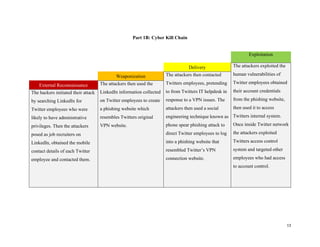
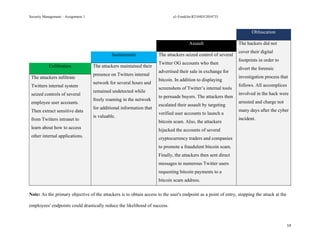
Part 1B: Cyber Kill Chain
Exploitation
Delivery The attackers exploited the
human vulnerabilities of
Twitter employees obtained
their account credentials
from the phishing website,
then used it to access
Twitters internal system.
Once inside Twitter network
the attackers exploited
Twitters access control
system and targeted other
employees who had access
to account control.
Weaponization The attackers then contacted
Twitters employees, pretending
to from Twitters IT helpdesk in
response to a VPN issues. The
attackers then used a social
engineering technique known as
phone spear phishing attack to
direct Twitter employees to log
into a phishing website that
resembled Twitter’s VPN
connection website.
External Reconnaissance The attackers then used the
LinkedIn information collected
on Twitter employees to create
a phishing website which
resembles Twitters original
VPN website.
The hackers initiated their attack
by searching LinkedIn for
Twitter employees who were
likely to have administrative
privileges. Then the attackers
posed as job recruiters on
LinkedIn, obtained the mobile
contact details of each Twitter
employee and contacted them.
Security Management – Assignment 1 a1-Franklin-R2104D12054733
14
Obfuscation
Assault The hackers did not
cover their digital
footprints in order to
divert the forensic
investigation process that
follows. All accomplices
involved in the hack were
arrested and charge not
many days after the cyber
incident.
Sustainment The attackers seized control of several
Twitter OG accounts who then
advertised their sale in exchange for
bitcoin. In addition to displaying
screenshots of Twitter’s internal tools
to persuade buyers. The attackers then
escalated their assault by targeting
verified user accounts to launch a
bitcoin scam. Also, the attackers
hijacked the accounts of several
cryptocurrency traders and companies
to promote a fraudulent bitcoin scam.
Finally, the attackers then sent direct
messages to numerous Twitter users
requesting bitcoin payments to a
bitcoin scam address.
Exfiltration The attackers maintained their
presence on Twitters internal
network for several hours and
remained undetected while
freely roaming in the network
for additional information that
is valuable.
The attackers infiltrate
Twitters internal system
seized controls of several
employee user accounts.
Then extract sensitive data
from Twitters intranet to
learn about how to access
other internal applications.
Note: As the primary objective of the attackers is to obtain access to the user's endpoint as a point of entry, stopping the attack at the
employees' endpoints could drastically reduce the likelihood of success.
15
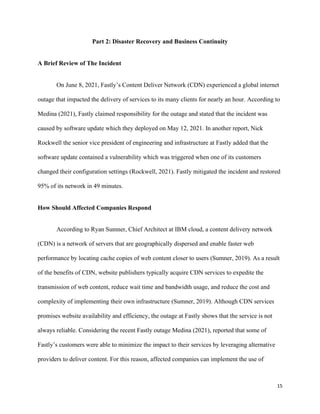
Part 2: Disaster Recovery and Business Continuity
A Brief Review of The Incident
On June 8, 2021, Fastly’s Content Deliver Network (CDN) experienced a global internet
outage that impacted the delivery of services to its many clients for nearly an hour. According to
Medina (2021), Fastly claimed responsibility for the outage and stated that the incident was
caused by software update which they deployed on May 12, 2021. In another report, Nick
Rockwell the senior vice president of engineering and infrastructure at Fastly added that the
software update contained a vulnerability which was triggered when one of its customers
changed their configuration settings (Rockwell, 2021). Fastly mitigated the incident and restored
95% of its network in 49 minutes.
How Should Affected Companies Respond
According to Ryan Sumner, Chief Architect at IBM cloud, a content delivery network
(CDN) is a network of servers that are geographically dispersed and enable faster web
performance by locating cache copies of web content closer to users (Sumner, 2019). As a result
of the benefits of CDN, website publishers typically acquire CDN services to expedite the
transmission of web content, reduce wait time and bandwidth usage, and reduce the cost and
complexity of implementing their own infrastructure (Sumner, 2019). Although CDN services
promises website availability and efficiency, the outage at Fastly shows that the service is not
always reliable. Considering the recent Fastly outage Medina (2021), reported that some of
Fastly’s customers were able to minimize the impact to their services by leveraging alternative
providers to deliver content. For this reason, affected companies can implement the use of
Security Management – Assignment 1 a1-Franklin-R2104D12054733
16
alternative CDN providers as an incident response and disaster recovery strategy. By utilizing
alternative CDN providers, website publishing companies can ensure business continuity, as
content delivery will continue in the event that the primary CDN provider experiences a service
interruption. This strategy also, reduces the risk of congestion or failure in a a single network
(Hazout, 2023).
Business Continuity Information Security Policy
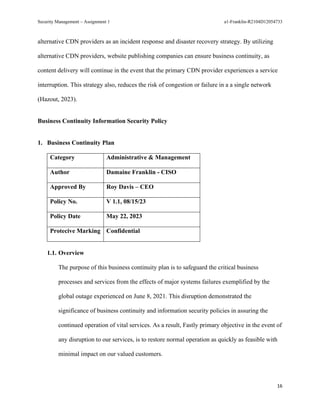
1. Business Continuity Plan
Category Administrative & Management
Author Damaine Franklin - CISO
Approved By Roy Davis – CEO
Policy No. V 1.1, 08/15/23
Policy Date May 22, 2023
Protecive Marking Confidential
1.1. Overview
The purpose of this business continuity plan is to safeguard the critical business
processes and services from the effects of major systems failures exemplified by the
global outage experienced on June 8, 2021. This disruption demonstrated the
significance of business continuity and information security policies in assuring the
continued operation of vital services. As a result, Fastly primary objective in the event of
any disruption to our services, is to restore normal operation as quickly as feasible with
minimal impact on our valued customers.
Security Management – Assignment 1 a1-Franklin-R2104D12054733
17
1.2. Policy Statement
This policy has been established to ensure the business continuity of Fastly’s services as
a leading content delivery network service provider. We value the satisfaction of our
customers and strive to maintain a long-term partnership both now and in the future. Our
dedication to our customers entails the implementation of a thoroughly evaluated and
sturdy business continuity strategy, with the aim of guaranteeing the resilience and
effective functioning of the services we provide.
1.3. Scope of the Policy
This policy applies to the incident response and disaster recovery department and staff at
Fastly. This policy must be communicated effectively and ensure that all parties are in
full compliance with this policy. Any violation of this policy will be considered
professional misconduct, and offenders will be disciplined.
1.4. Maintenance
Fastly’s chief information security officer (CISO) is responsible for the maintenance and
revision of this policy document.
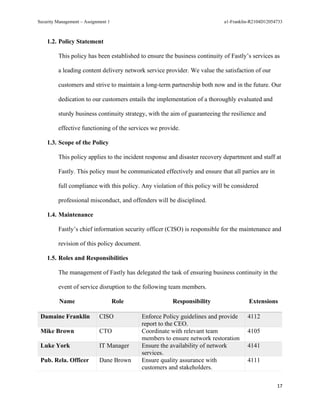
1.5. Roles and Responsibilities
The management of Fastly has delegated the task of ensuring business continuity in the
event of service disruption to the following team members.
Name Role Responsibility Extensions
Damaine Franklin CISO Enforce Policy guidelines and provide
report to the CEO.
4112
Mike Brown CTO Coordinate with relevant team
members to ensure network restoration
4105
Luke York IT Manager Ensure the availability of network
services.
4141
Pub. Rela. Officer Dane Brown Ensure quality assurance with
customers and stakeholders.
4111
Security Management – Assignment 1 a1-Franklin-R2104D12054733
18
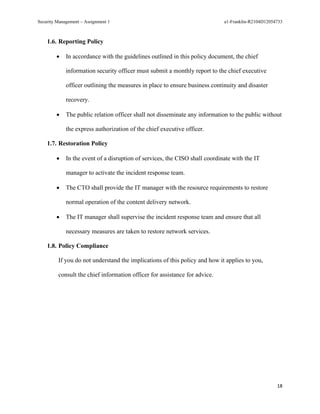
1.6. Reporting Policy
• In accordance with the guidelines outlined in this policy document, the chief
information security officer must submit a monthly report to the chief executive
officer outlining the measures in place to ensure business continuity and disaster
recovery.
• The public relation officer shall not disseminate any information to the public without
the express authorization of the chief executive officer.
1.7. Restoration Policy
• In the event of a disruption of services, the CISO shall coordinate with the IT
manager to activate the incident response team.
• The CTO shall provide the IT manager with the resource requirements to restore
normal operation of the content delivery network.
• The IT manager shall supervise the incident response team and ensure that all
necessary measures are taken to restore network services.
1.8. Policy Compliance
If you do not understand the implications of this policy and how it applies to you,
consult the chief information officer for assistance for advice.
Security Management – Assignment 1 a1-Franklin-R2104D12054733
19
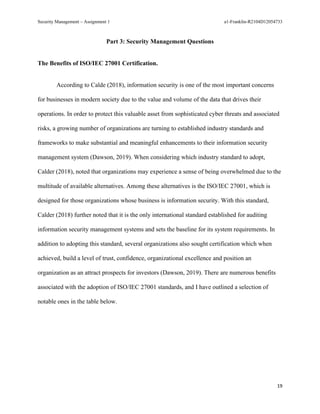
Part 3: Security Management Questions
The Benefits of ISO/IEC 27001 Certification.
According to Calde (2018), information security is one of the most important concerns
for businesses in modern society due to the value and volume of the data that drives their
operations. In order to protect this valuable asset from sophisticated cyber threats and associated
risks, a growing number of organizations are turning to established industry standards and
frameworks to make substantial and meaningful enhancements to their information security
management system (Dawson, 2019). When considering which industry standard to adopt,
Calder (2018), noted that organizations may experience a sense of being overwhelmed due to the
multitude of available alternatives. Among these alternatives is the ISO/IEC 27001, which is
designed for those organizations whose business is information security. With this standard,
Calder (2018) further noted that it is the only international standard established for auditing
information security management systems and sets the baseline for its system requirements. In
addition to adopting this standard, several organizations also sought certification which when
achieved, build a level of trust, confidence, organizational excellence and position an
organization as an attract prospects for investors (Dawson, 2019). There are numerous benefits
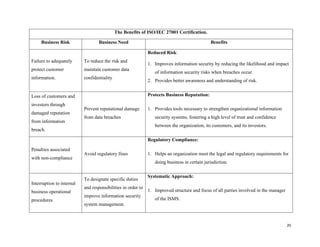
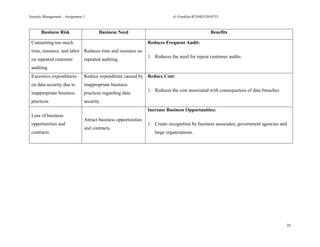
associated with the adoption of ISO/IEC 27001 standards, and I have outlined a selection of
notable ones in the table below.
20
The Benefits of ISO/IEC 27001 Certification.
Business Risk Business Need Benefits
Failure to adequately
protect customer
information.
To reduce the risk and
maintain customer data
confidentiality
Reduced Risk:
1. Improves information security by reducing the likelihood and impact
of information security risks when breaches occur.
2. Provides better awareness and understanding of risk.
Loss of customers and
investors through
damaged reputation
from information
breach.
Prevent reputational damage
from data breaches
Protects Business Reputation:
1. Provides tools necessary to strengthen organizational information
security systems, fostering a high level of trust and confidence
between the organization, its customers, and its investors.
Penalties associated
with non-compliance
Avoid regulatory fines
Regulatory Compliance:
1. Helps an organization meet the legal and regulatory requirements for
doing business in certain jurisdiction.
Interruption to internal
business operational
procedures
To designate specific duties
and responsibilities in order to
improve information security
system management.
Systematic Approach:
1. Improved structure and focus of all parties involved in the manager
of the ISMS.
Security Management – Assignment 1 a1-Franklin-R2104D12054733
21
Business Risk Business Need Benefits
Consuming too much
time, resource, and labor
on repeated customer
auditing
Reduces time and resource on
repeated auditing.
Reduces Frequent Audit:
1. Reduces the need for repeat customer audits.
Excessive expenditures
on data security due to
inappropriate business
practices
Reduce expenditure caused by
inappropriate business
practices regarding data
security.
Reduce Cost:
1. Reduces the cost associated with consequences of data breaches.
Loss of business
opportunities and
contracts
Attract business opportunities
and contracts.
Increase Business Opportunities:
1. Create recognition by business associates, government agencies and
large organizations.
22
Recommended Audit
On July 15, 2020, social media giant Twitter experienced a phone spear phishing attack
that affected affect its internal network, composed several user accounts, and launch a bitcoin
scam. The was a nightmare experience for Twitter and brought the company to its knees as they
had to create an environment of zero trust in order to restore normal operations. According to
Muneer (n.d.) the success of the attack was due to several vulnerabilities found in Twitters cyber
security protocols such as lack of dedicated personal with responsibility to safeguard information
security, inadequate access controls and poor monitoring systems among others. Although
Twitter had some number of safeguards in place, they were inadequate to prevent the twitter
attack. Twitter in a July 30, 2020, blob stated that there have been concerns following this
incident around the tool and levels of employee access as at the time of the incident more than
1000 employees had access to Twitter information systems (Twitter, 2020). It was reported in the
Twitter investigation report that at the beginning of the year, the IT Department guided the
regulated units to assess and determine the pandemic's novel security risks. However, based on
the report, Twitter did not implement any risk mitigation controls after March 2020 to manage
the remote working risks (DFS, 2020). This presented an opportunity for the hackers to leverage.
The problem would have been identified easily and fast with the regular recertification of access
to the account for the changed responsibilities and roles.
According to Twitter's investigation report (2020), the attack on Twitter demonstrates
that a cybersecurity vulnerability can have a far-reaching effect. The report found that a large
social media company like Twitter lacked adequate cybersecurity protection and did not have a
chief information security officer at the time of the attack. Although Twitter is subject to a
Security Management – Assignment 1 a1-Franklin-R2104D12054733
23
number of regulations, such as the Securities and Exchange Commission, the Federal Trade
Commission, and the New York SHIELD Act, the report notes that these regulations also apply
to other companies; therefore, a dedicated regulator for social media companies is required. An
important finding heighted in the report stated that Twitter and other large social media
companies lack a dedicated cybersecurity regulatory framework; instead, they are self-regulated
and bear no responsibility for significant cybersecurity breaches (DFS, 2020). The Twitter hack
shows the problems of being self-regulated and highlighted the significance of regulatory
guidance. The report further noted that it is imperative to establish proper controls in place to
address the ever-evolving risks (DFS, 2020).
Based on the previous discussion, it is obvious that Twitter was not in compliance with
any dedicated regulatory institution that governs privacy and security of its information security
systems. In context of this Twitter incident, an audit conducted in accordance with standards of
ISO/IEC 27001 would have uncovered the vulnerabilities in Twitter’s system and reduced the
impact of this attack. The ISO/IEC 27001 is the only standard which is specifically established to
audit information security management systems and set the baseline for its systems requirements
(ISO, 2013). Section 9.2 of the ISO/IEC 27001 framework contains guidelines for conducting
internal auditing such as its planning, implementation, and maintenance. In addition, the
ISO/IEC 27001 standard auditing guidelines ensure that an organization’s information system
has adequate controls in place to reduce the likelihood of cyber incidents and the potential risks.
If vulnerabilities are discovered during the auditing process, the ISO/IEC 27001 standard
provides the necessary guidelines for mitigating those vulnerabilities.
Security Management – Assignment 1 a1-Franklin-R2104D12054733
24
Risk Management Process
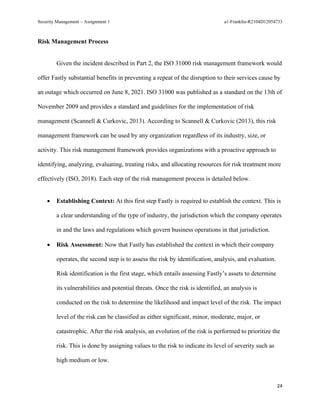
Given the incident described in Part 2, the ISO 31000 risk management framework would
offer Fastly substantial benefits in preventing a repeat of the disruption to their services cause by
an outage which occurred on June 8, 2021. ISO 31000 was published as a standard on the 13th of
November 2009 and provides a standard and guidelines for the implementation of risk
management (Scannell & Curkovic, 2013). According to Scannell & Curkovic (2013), this risk
management framework can be used by any organization regardless of its industry, size, or
activity. This risk management framework provides organizations with a proactive approach to
identifying, analyzing, evaluating, treating risks, and allocating resources for risk treatment more
effectively (ISO, 2018). Each step of the risk management process is detailed below.
• Establishing Context: At this first step Fastly is required to establish the context. This is
a clear understanding of the type of industry, the jurisdiction which the company operates
in and the laws and regulations which govern business operations in that jurisdiction.
• Risk Assessment: Now that Fastly has established the context in which their company
operates, the second step is to assess the risk by identification, analysis, and evaluation.
Risk identification is the first stage, which entails assessing Fastly’s assets to determine
its vulnerabilities and potential threats. Once the risk is identified, an analysis is
conducted on the risk to determine the likelihood and impact level of the risk. The impact
level of the risk can be classified as either significant, minor, moderate, major, or
catastrophic. After the risk analysis, an evolution of the risk is performed to prioritize the
risk. This is done by assigning values to the risk to indicate its level of severity such as
high medium or low.
Security Management – Assignment 1 a1-Franklin-R2104D12054733
25
• Risk Treatment: During the risk treatment stage, controls are designed and implemented
to decrease the likelihood of the risk such as occasionally, seldom, frequently, or
unlikely. The risk treatment also involves an impact assessment, a decision to either
avoid the risk entirely or transfer the risk to third-party control management.
• Monitoring and Review: Following the risk assessment, monitoring, and reviewing
procedures are implemented. This guarantees that Fastly has a resilient, proactive, and
ever-evolving risk assessment management process.
• Communication and Consultation: At this final stage, Fastly is required to open a line
of communication especially among the impacted asset's primary stakeholders. This
ensures that all stakeholders involved are made aware of and understand the decisions
surrounding the actions taken and the choice of treatment selected.
Security Management – Assignment 1 a1-Franklin-R2104D12054733
26
References
BBC, 2020. Twitter hack: Staff tricked by phone spear-phishing scam. [Online]
Available at: https://www.bbc.com/news/technology-53607374
[Accessed 31 July 2023].
Calder, A., 2018. Information Security & ISO 27001: An Introduction. s.l.:s.n.
Dawson, S., 2019. The Benefits of Implementing ISO 27001. [Online]
Available at: https://www.thecoresolution.com/the-benefits-of-implementing-iso-27001
[Accessed 19 August 2023].
DFS, 2020. Twitter Investigation Report, New York: Department of Financial Services.
Fadhil, H. S., 2023. Social Engineering Attacks Techniques. International Journal of Progresive
Research in Engineering Management and Science, 03(01), pp. 18-20.
Hazout, R., 2023. Multi-CDN Strategy: Benefits And Best Practices. [Online]
Available at: https://www.ioriver.io/blog/multi-cdn-strategy
[Accessed 14 August 2023].
Iyengar, R., 2020. CNN Business. [Online]
Available at: https://edition.cnn.com/2020/07/15/tech/twitter-hack-elon-musk-bill-
gates/index.html
[Accessed 29 July 2023].
Security Management – Assignment 1 a1-Franklin-R2104D12054733
27
Medina, A., 2021. Inside the Fastly Outage: Analysis and Lessons Learned. [Online]
Available at: https://www.thousandeyes.com/blog/inside-the-fastly-outage-analysis-and-lessons-
learned
[Accessed 14 August 2023].
Moon, M., 2020. Twitter's changes since the June attack include requiring security keys.
[Online]
Available at: https://www.engadget.com/twitters-security-changes-july-attack-054328827.html
[Accessed 11 August 2023].
Muneer, A., n.d. 2020 Phishing Attack on Twitter, its Analysis and Countermeasures, London:
Northumbria University.
NDCA, 2020. Three Individuals Charged For Alleged Roles In Twitter Hack. [Online]
Available at: https://www.justice.gov/usao-ndca/pr/three-individuals-charged-alleged-roles-
twitter-hack
[Accessed 31 July 2023].
Popper, N. & Conger, K., 2020. Hackers Tell the Story of the Twitter Attack From the Inside.
[Online]
Available at: https://www.nytimes.com/2020/07/17/technology/twitter-hackers-interview.html
[Accessed 10 August 2023].
Rockwell, N., 2021. Summary of June 8 outage. [Online]
Available at: https://www.fastly.com/blog/summary-of-june-8-outage
[Accessed 14 August 2023].
Security Management – Assignment 1 a1-Franklin-R2104D12054733
28
Statista, 2023. Most commonly reported cyber crime categories worldwide in 2022, by number of
individuals affected. [Online]
Available at: https://www.statista.com/statistics/184083/commonly-reported-types-of-cyber-
crime-global/
[Accessed 30 July 2023].
Suciu, P., 2020. Forbes. [Online]
Available at: https://www.forbes.com/sites/petersuciu/2020/08/01/twitter-spear-phishing-attack-
highlights-security-weaknesses-of-social-media/?sh=651f9f027a29
[Accessed 29 July 2023].
Sumner, R., 2019. What is a Content Delivery Network (CDN)?. [Online]
Available at: https://www.ibm.com/topics/content-delivery-networks
[Accessed 14 August 2023].
Thompson, N. & Barrett, B., 2020. How Twitter Survived Its Biggest Hack—and Plans to Stop
the Next One. [Online]
Available at: https://www.wired.com/story/inside-twitter-hack-election-plan/
[Accessed 8 August 2023].
Twitter, 2020. An update on our security incident. [Online]
Available at: https://blog.twitter.com/en_us/topics/company/2020/an-update-on-our-security-
incident
[Accessed 8 August 2023].
Security Management – Assignment 1 a1-Franklin-R2104D12054733
29
Witman, P. & Mackelprang, S. M., 2021. The 2020 Twitter Hack – So Many Lessons to Be
Learned. Journal of Cybersecurity Education, Research and Practice, 2(2), pp. 1-11.

Security Management

  • 1.
    1 UEL-CN-7014 Security Management Assignment1 Damaine Franklin Student #: R2104D12054733 08/26/2023
  • 2.
    Security Management –Assignment 1 a1-Franklin-R2104D12054733 2 Table of Contents Part 1A: Cyber Attack..................................................................................................................... 3 Introduction ................................................................................................................................. 3 Incident Overview ....................................................................................................................... 4 Incident Analysis ......................................................................................................................... 5 Lessons Learned .......................................................................................................................... 9 Lesson 1: Lack of Leadership .................................................................................................. 9 Lesson 2: Inadequate Authentication and Access Control..................................................... 10 Lesson 3: Lack of Awareness................................................................................................. 10 Lesson 4: Lack of Real-Time Threat Detection..................................................................... 11 Actions Taken............................................................................................................................ 11 Conclusion................................................................................................................................. 12 Part 1B: Cyber Kill Chain............................................................................................................. 13 Part 2: Disaster Recovery and Business Continuity ..................................................................... 15 A Brief Review of The Incident ................................................................................................ 15 How Should Affected Companies Respond .............................................................................. 15 Business Continuity Information Security Policy ..................................................................... 16 Part 3: Security Management Questions....................................................................................... 19 The Benefits of ISO/IEC 27001 Certification. .......................................................................... 19 Recommended Audit ................................................................................................................. 22 Risk Management Process......................................................................................................... 24 References..................................................................................................................................... 26
  • 3.
    Security Management –Assignment 1 a1-Franklin-R2104D12054733 3 Part 1A: Cyber Attack Report Analysis: Twitter’s Spear Phishing Attack July 2020 Introduction As a result of the recent COVID-19 pandemic, cybercrime has become such a lucrative industry that organizations around the world have had to adjust their cybersecurity postures to defend against the rise of sophisticated attack vectors. Among these attack vectors is social engineering, which, according to Fadhil (2023), is one of the most sophisticated cyber-attacks because there are no available hardware or software countermeasures to defend against it. The author further noted that the objective of social engineering tactics is to manipulate victims by taking advantage of their psychological vulnerabilities, such as fear, anxiety, trust, curiosity, or empathy, to gain access to secure facilities, systems, or data. There are numerous social engineering techniques; however, the technique of particular interest to this study is phone spear phishing, as it was reported to have been used in the July 2020 cyberattack against Twitter. Since the attack, there has been much discussion as to whether Twitter's incident response team could have preemptively identified and responded to the cyber intrusion much sooner. As a result, this study aims to provide a comprehensive report analysis of the July 2020 incident. This report analysis will begin with a brief overview of the incident. It then analyzes the incident to identify who or what was affected by the attack, the nature and severity of the attack, the threat actors involved, the systems and vulnerabilities exploited, and the actions taken. This report will also include a discussion on the lessons learned from the attack followed by a conclusion.
  • 4.
    Security Management –Assignment 1 a1-Franklin-R2104D12054733 4 Incident Overview On July 15, 2020, Twitter an American social media company, and other media outlets reported that hackers compromised 130 Twitter accounts of prominent users to promote fraudulent bitcoin scams, which raises national security concerns (Iyengar, 2020). Details of the attack indicated that the fraudsters employed a common social engineering technique known as phone spear phishing to deceive several of Twitter’s employees into divulging sensitive information, thereby granting them access to Twitter's internal tools and information systems (Suciu, 2020). Other sources reported that just after the hackers gained access to Twitter’s systems, the hackers were able to manipulate stolen user accounts and post tweets directly (BBC, 2020). This incident raised several security concerns in the United States since the accounts of prominent US officials and businessmen were hacked and used for high-profile Bitcoin scams. As a consequence of this assault against Twitter, the US Federal Bureau of Investigation (FBI), arrested and charged three suspects for their alleged role in the Twitter attack that occurred on July 15, 2020, (Witman & Mackelprang, 2021). According to the United States Attorney's Office for the Northern District of California (NDCA), the three individuals involved in the incident were 19-year-old Mason Sheppard from the United Kingdom, 22-year-old Nima Fazeli from Orlando, Florida, USA, and a third suspect whose identity is unknown due to the Federal Juvenile Delinquency Act, which protects juveniles during court proceedings (NDCA, 2020). The charges against these three individuals were identity theft, unauthorized access to a protected computer, fraud, and money laundering.
  • 5.
    Security Management –Assignment 1 a1-Franklin-R2104D12054733 5 The NDCA reported that the accomplices compromised more than 130 Twitter accounts and deceived the account owners and other users into depositing bitcoin currency to an anonymous bitcoin address with the promise of doubling the amount deposited as a charitable gesture. According to Muneer (n.d.), Just before Twitter’s technical team was able to lock down those compromised accounts, the hackers had already spoofed the victims and received 383 bitcoins which is equivalent to US$117,000. In addition, Muneer (n.d.) noted that the hackers would have stolen approximately $1,350,000 from over 6000 bitcoin transfers if Twitter and Bitcoin companies had not taken the necessary precautions. The following information will provide a detailed analysis of the incident. Incident Analysis According to a 2020 investigation report published by the Department of Financial Services in New York, Twitter became aware of the incident on July 15, however, the attack began on July 14, 2020, (DFS, 2020). The investigation found that the attack was carried out in three phases. Firstly, the attackers used social engineering to spoof vulnerable Twitter employees in order to gain access to their Network. Secondly, they seized user accounts with short OG Twitter handles and sold access to them. Thirdly, they seized and compromised the accounts of several prominent users with the intent of defrauding victims in a massive Bitcoin scam. According to the investigative report, the hackers began their assault against Twitter on July 14th . during that time many of Twitter’s employees were doing remote work because of the COVID-19 pandemic which created a huge problem for Twitter's infrastructure. As a result of the transition to working remotely, the hackers saw an opportunity to take advantage of employees' complaints about the VPN connection to Twister’s internal tools and resources. As a
  • 6.
    Security Management –Assignment 1 a1-Franklin-R2104D12054733 6 point of entry, the hackers used a social engineering technique known as phone spear phishing to impersonate Twitter’s Help Desk representatives to lure several of Twitter’s employees into providing their login credentials on a phishing website which resembles Twitters legitimate VPN website. In a separate report, Muneer (n.d.) noted that in the initial phase of the attack, the hackers realized that the stolen credentials lacked the necessary privileges to escalate their attack. Consequently, Muneer (n.d.) also noted that on July 15, the attackers intensified their attack method by searching Twitter's intranet for information on how to utilize Twitter's internal applications. With this information, they were able to target those employees with higher privileges and access to Twitters internals tools. The 15th of July 2020 marks the beginning of a new phase in the wave of attacks against Twitter, as it was on that date that Twitter became aware of the incident. According to information gathered from several sources, the hackers seized control and compromised a large number of Twitter OG accounts in the early hours of the day with the intention of advertising their sale through an online messaging portal in exchange for bitcoin (DFS, 2020; Muneer, n.d.; Witman & Mackelprang, 2021). In another source, Thompson & Barrett (2020) reported that Twitter's cyber incident response team had detected the network intrusion at this stage of the attack, however, the chief technology officer (CTO) had not yet been notified. Due to this oversight, the hackers had more time to their advantage to launch the third phase of their attack. At this stage of the attack, both Muneer (n.d.) and DFS (2020) reported that the hackers targeted verified user accounts, which Twitter defines as accounts belonging to prominent users such as former U.S. president Barack Obama, businessman Bill Gates, Elon Musk, Jeff Bezos, Mike Bloomberg, and celebrities Kim Kardashian and Kanye West among others. In addition, the user accounts of popular companies were also seized and compromised such as Apple, Uber, and
  • 7.
    Security Management –Assignment 1 a1-Franklin-R2104D12054733 7 well-known crypto currency companies and traders. This was yet another strategic move on the part of the hackers, as it allowed them to capitalize on the public's trust in verified Twitter accounts since people are more likely to respond to tweets from these accounts. The motive of the hackers at this stage in the attack process is to launch a Bitcoin scam using those stolen verified Twitter accounts. According to Twitter's investigation report, the hackers first hijacked a Bitcoin trader named “AngelBTC” and tweeted the following message to multiple Twitter users. Figure 1:Tweeted message from a hijacked crypto trader (DFS,2020). The objective of this bitcoin scam is to make fraudulent demands by convincing Twitter users to believe that the message originates from the legitimate owner of the account. The hackers then escalated their attack by tweeting payment requests directly from the accounts of ten cryptocurrency companies such as Binance, Gemini, Coinbase, and Square, Inc among others (DFS, 2020). In one such fraudulent scheme, the hackers sent a message with a link to a Bitcoin wallet from the Binance user account. In the tweet, the hackers posed as Binance and claimed that the company was returning millions of bitcoins to members of its community as shown below.
  • 8.
    Security Management –Assignment 1 a1-Franklin-R2104D12054733 8 Figure 2: Binance Tweet (DFS, 2020) According to the Twitters investigation report, the hackers then intensified their attack significantly by using some of those compromised verified Twitter accounts to send out bitcoin scam tweets which reached millions of potential victims. The hackers deceived their victims by claiming that the bitcoin amount they deposited into a fraudulent bitcoin wallet would be multiplied as a charitable gesture. According to a Twitter blog post dated July 18, 2020, the hackers targeted 130 Twitter accounts, but only 45 were used to broadcast bitcoin scam messages. In addition, they accessed the direct messaging inboxes of 36 and downloaded the Twitter user account Data of 7 (Twitter, 2020). In the final analysis, Witman & Mackelprang (2021) reported that over 300 Bitcoin transactions totaling approximately $118,000 were made to one of the Bitcoin wallets. Another source reported that the fraudsters' account had received 383 Bitcoin transactions, totaling $117,000 in stolen funds from its victims.
  • 9.
    Security Management –Assignment 1 a1-Franklin-R2104D12054733 9 Lessons Learned The July 2020 attack against Twitter has been a harrowing moment and a painful lesson learned. Many concerns have been raised in the aftermath of the attack about whether Twitter could have identified and detected the threat much sooner. According to the Twitter Investigation Report, several security flaws that contributed to the attack's success were identified. Each of these will be covered in detail in the sections that follow. Lesson 1: Lack of Leadership Twitters investigation report found that at the time of the attack, the social media giant lacked a chief information security officer (CISO) with dedicated responsibility for cybersecurity related incidents, resulting in the chief technology officer (CTO) assuming control of the situation. A review of Twitter's internal systems logs reveals that the hackers began reconnaissance in December 2019 at a time when there was no CISO. This was seven months prior to the incident which occurred July 14 and 15 (DFS, 2020). The lack of a CISO made Twitter vulnerable to the attack, particularly during a period when the risks associated with working remotely were high. Also, the months leading up to the time of the attack created a significant window of opportunity for the hackers to launch their attacks. Leadership is essential in any crisis and if Twitter had a CISO with specific roles and responsibilities for safeguarding its internal systems then the attack might have been detected much sooner.
  • 10.
    Security Management –Assignment 1 a1-Franklin-R2104D12054733 10 Lesson 2: Inadequate Authentication and Access Control The investigation report determines that although Twitter had some authentication and access control measures in place, they were not enough to prevent the attack (DFS, 2020). The report indicated that during the first phase of the attack, the attackers compromised the credentials of several Twitter employees then used them to authenticate themselves then access Twitters internal administrative tools. In a separate report, The New York Times discovered that the hackers boasted confidently that they had effectively gained access to Twitter's support tools and offered to sell coveted Twitter OG accounts (Popper & Conger, 2020). During the aftermath of the attack the Twitter investigation report found that there were too many people with access to Twitters administrative tools. Consequently, this vulnerability in authentication and access control gave the attacks leverage in the attack as they were able to target 130 user accounts, tweeted from 45, access the direct message of 36 users, and download the Twitter data of 8 users (DFS, 2020). During the attack, the investigation report discovered that more than 1,000 of Twitter’s employees had access to their internal tools. Thompson & Barnett (2020) noted that access to Twitter's internal tools should have been restricted to a small group of employees with specified job functions because too many people had access to too many things. Lesson 3: Lack of Awareness Since there are no hardware or software tools that can detect and defend against social engineering, the most effective countermeasure for detecting and preventing social engineering techniques is awareness training. Several sources reported that Twitter's staff lacked proper awareness training to detect social engineering tactics. According to a Twitter investigation report, the hackers used phone social engineering tactics to impersonate Twitter IT Helps Desk
  • 11.
    Security Management –Assignment 1 a1-Franklin-R2104D12054733 11 to spoof the employees into logging their credentials on a phishing website (DFS, 2020). Considering the initiative to work remotely, it is common for Twitters employees to drop their guard since one of the primary modes of communication is the use of a telephone. This would provide Twitter with a convenient opportunity to have its employees aware of the tactics used in social engineering attacks. Lesson 4: Lack of Real-Time Threat Detection An essential lesson learned from this attack is that Twitter only became aware of the attack after the hackers had made significant progress on their network. The ability to detect and respond to cyber threats in a timely manner is crucial as it enables a more proactive cyber threat defense strategy. If Twitter had a comprehensive security monitoring program, it would have been able to detect and respond swiftly to the presents of the hackers on their network much sooner. Actions Taken In a series of blogs posted by Twitter on July 18 and 30, 2020, the company announced that they had put new protocols in place to prevent similar social engineering attacks. According to the blogs, one of the initial actions taken by Twitter was to secure and revoke access to internal systems in order to prevent attackers from gaining further access to our systems or individual accounts. Secondly, Twitter establishes an environment of zero trust by shutting down the user accounts of all employees and requiring each employee to change their password under supervision (Twitter, 2020). In an article published by Moon (2020), Twitter stated that they implemented new background check protocols for employees with access to administrative tools
  • 12.
    Security Management –Assignment 1 a1-Franklin-R2104D12054733 12 and user data. In addition, Moon (2020) further noted that Twitter has made it mandatory for all employees involved in awareness training for future social engineering scams (Moon, 2020). Moreover, Twitter has implemented an event and security information management system, which is an anomaly detection system that records account usage, identifies insider threats, threat actors, and malicious intent (DFS, 2020). Conclusion In conclusion, this document examined the attack methods used against Twitter in the July 15 spear phishing attack. It was reported that cybercriminals employed rudimentary social engineering techniques to deceive Twitter’s employees into divulging sensitive information that was then used to compromise Twitter user accounts and initiate a bitcoin scam. This cyberattack demonstrates that large social media companies with essential infrastructures, such as Twitter, must be governed by stricter regulatory bodies. As a result of the attack, it taught Twitter some valuable lessons such as maintaining constant monitoring, improved authentication, and access control strategies. It also taught about the risks and cyber threats associated with working remotely.
  • 13.
    13 Part 1B: CyberKill Chain Exploitation Delivery The attackers exploited the human vulnerabilities of Twitter employees obtained their account credentials from the phishing website, then used it to access Twitters internal system. Once inside Twitter network the attackers exploited Twitters access control system and targeted other employees who had access to account control. Weaponization The attackers then contacted Twitters employees, pretending to from Twitters IT helpdesk in response to a VPN issues. The attackers then used a social engineering technique known as phone spear phishing attack to direct Twitter employees to log into a phishing website that resembled Twitter’s VPN connection website. External Reconnaissance The attackers then used the LinkedIn information collected on Twitter employees to create a phishing website which resembles Twitters original VPN website. The hackers initiated their attack by searching LinkedIn for Twitter employees who were likely to have administrative privileges. Then the attackers posed as job recruiters on LinkedIn, obtained the mobile contact details of each Twitter employee and contacted them.
  • 14.
    Security Management –Assignment 1 a1-Franklin-R2104D12054733 14 Obfuscation Assault The hackers did not cover their digital footprints in order to divert the forensic investigation process that follows. All accomplices involved in the hack were arrested and charge not many days after the cyber incident. Sustainment The attackers seized control of several Twitter OG accounts who then advertised their sale in exchange for bitcoin. In addition to displaying screenshots of Twitter’s internal tools to persuade buyers. The attackers then escalated their assault by targeting verified user accounts to launch a bitcoin scam. Also, the attackers hijacked the accounts of several cryptocurrency traders and companies to promote a fraudulent bitcoin scam. Finally, the attackers then sent direct messages to numerous Twitter users requesting bitcoin payments to a bitcoin scam address. Exfiltration The attackers maintained their presence on Twitters internal network for several hours and remained undetected while freely roaming in the network for additional information that is valuable. The attackers infiltrate Twitters internal system seized controls of several employee user accounts. Then extract sensitive data from Twitters intranet to learn about how to access other internal applications. Note: As the primary objective of the attackers is to obtain access to the user's endpoint as a point of entry, stopping the attack at the employees' endpoints could drastically reduce the likelihood of success.
  • 15.
    15 Part 2: DisasterRecovery and Business Continuity A Brief Review of The Incident On June 8, 2021, Fastly’s Content Deliver Network (CDN) experienced a global internet outage that impacted the delivery of services to its many clients for nearly an hour. According to Medina (2021), Fastly claimed responsibility for the outage and stated that the incident was caused by software update which they deployed on May 12, 2021. In another report, Nick Rockwell the senior vice president of engineering and infrastructure at Fastly added that the software update contained a vulnerability which was triggered when one of its customers changed their configuration settings (Rockwell, 2021). Fastly mitigated the incident and restored 95% of its network in 49 minutes. How Should Affected Companies Respond According to Ryan Sumner, Chief Architect at IBM cloud, a content delivery network (CDN) is a network of servers that are geographically dispersed and enable faster web performance by locating cache copies of web content closer to users (Sumner, 2019). As a result of the benefits of CDN, website publishers typically acquire CDN services to expedite the transmission of web content, reduce wait time and bandwidth usage, and reduce the cost and complexity of implementing their own infrastructure (Sumner, 2019). Although CDN services promises website availability and efficiency, the outage at Fastly shows that the service is not always reliable. Considering the recent Fastly outage Medina (2021), reported that some of Fastly’s customers were able to minimize the impact to their services by leveraging alternative providers to deliver content. For this reason, affected companies can implement the use of
  • 16.
    Security Management –Assignment 1 a1-Franklin-R2104D12054733 16 alternative CDN providers as an incident response and disaster recovery strategy. By utilizing alternative CDN providers, website publishing companies can ensure business continuity, as content delivery will continue in the event that the primary CDN provider experiences a service interruption. This strategy also, reduces the risk of congestion or failure in a a single network (Hazout, 2023). Business Continuity Information Security Policy 1. Business Continuity Plan Category Administrative & Management Author Damaine Franklin - CISO Approved By Roy Davis – CEO Policy No. V 1.1, 08/15/23 Policy Date May 22, 2023 Protecive Marking Confidential 1.1. Overview The purpose of this business continuity plan is to safeguard the critical business processes and services from the effects of major systems failures exemplified by the global outage experienced on June 8, 2021. This disruption demonstrated the significance of business continuity and information security policies in assuring the continued operation of vital services. As a result, Fastly primary objective in the event of any disruption to our services, is to restore normal operation as quickly as feasible with minimal impact on our valued customers.
  • 17.
    Security Management –Assignment 1 a1-Franklin-R2104D12054733 17 1.2. Policy Statement This policy has been established to ensure the business continuity of Fastly’s services as a leading content delivery network service provider. We value the satisfaction of our customers and strive to maintain a long-term partnership both now and in the future. Our dedication to our customers entails the implementation of a thoroughly evaluated and sturdy business continuity strategy, with the aim of guaranteeing the resilience and effective functioning of the services we provide. 1.3. Scope of the Policy This policy applies to the incident response and disaster recovery department and staff at Fastly. This policy must be communicated effectively and ensure that all parties are in full compliance with this policy. Any violation of this policy will be considered professional misconduct, and offenders will be disciplined. 1.4. Maintenance Fastly’s chief information security officer (CISO) is responsible for the maintenance and revision of this policy document. 1.5. Roles and Responsibilities The management of Fastly has delegated the task of ensuring business continuity in the event of service disruption to the following team members. Name Role Responsibility Extensions Damaine Franklin CISO Enforce Policy guidelines and provide report to the CEO. 4112 Mike Brown CTO Coordinate with relevant team members to ensure network restoration 4105 Luke York IT Manager Ensure the availability of network services. 4141 Pub. Rela. Officer Dane Brown Ensure quality assurance with customers and stakeholders. 4111
  • 18.
    Security Management –Assignment 1 a1-Franklin-R2104D12054733 18 1.6. Reporting Policy • In accordance with the guidelines outlined in this policy document, the chief information security officer must submit a monthly report to the chief executive officer outlining the measures in place to ensure business continuity and disaster recovery. • The public relation officer shall not disseminate any information to the public without the express authorization of the chief executive officer. 1.7. Restoration Policy • In the event of a disruption of services, the CISO shall coordinate with the IT manager to activate the incident response team. • The CTO shall provide the IT manager with the resource requirements to restore normal operation of the content delivery network. • The IT manager shall supervise the incident response team and ensure that all necessary measures are taken to restore network services. 1.8. Policy Compliance If you do not understand the implications of this policy and how it applies to you, consult the chief information officer for assistance for advice.
  • 19.
    Security Management –Assignment 1 a1-Franklin-R2104D12054733 19 Part 3: Security Management Questions The Benefits of ISO/IEC 27001 Certification. According to Calde (2018), information security is one of the most important concerns for businesses in modern society due to the value and volume of the data that drives their operations. In order to protect this valuable asset from sophisticated cyber threats and associated risks, a growing number of organizations are turning to established industry standards and frameworks to make substantial and meaningful enhancements to their information security management system (Dawson, 2019). When considering which industry standard to adopt, Calder (2018), noted that organizations may experience a sense of being overwhelmed due to the multitude of available alternatives. Among these alternatives is the ISO/IEC 27001, which is designed for those organizations whose business is information security. With this standard, Calder (2018) further noted that it is the only international standard established for auditing information security management systems and sets the baseline for its system requirements. In addition to adopting this standard, several organizations also sought certification which when achieved, build a level of trust, confidence, organizational excellence and position an organization as an attract prospects for investors (Dawson, 2019). There are numerous benefits associated with the adoption of ISO/IEC 27001 standards, and I have outlined a selection of notable ones in the table below.
  • 20.
    20 The Benefits ofISO/IEC 27001 Certification. Business Risk Business Need Benefits Failure to adequately protect customer information. To reduce the risk and maintain customer data confidentiality Reduced Risk: 1. Improves information security by reducing the likelihood and impact of information security risks when breaches occur. 2. Provides better awareness and understanding of risk. Loss of customers and investors through damaged reputation from information breach. Prevent reputational damage from data breaches Protects Business Reputation: 1. Provides tools necessary to strengthen organizational information security systems, fostering a high level of trust and confidence between the organization, its customers, and its investors. Penalties associated with non-compliance Avoid regulatory fines Regulatory Compliance: 1. Helps an organization meet the legal and regulatory requirements for doing business in certain jurisdiction. Interruption to internal business operational procedures To designate specific duties and responsibilities in order to improve information security system management. Systematic Approach: 1. Improved structure and focus of all parties involved in the manager of the ISMS.
  • 21.
    Security Management –Assignment 1 a1-Franklin-R2104D12054733 21 Business Risk Business Need Benefits Consuming too much time, resource, and labor on repeated customer auditing Reduces time and resource on repeated auditing. Reduces Frequent Audit: 1. Reduces the need for repeat customer audits. Excessive expenditures on data security due to inappropriate business practices Reduce expenditure caused by inappropriate business practices regarding data security. Reduce Cost: 1. Reduces the cost associated with consequences of data breaches. Loss of business opportunities and contracts Attract business opportunities and contracts. Increase Business Opportunities: 1. Create recognition by business associates, government agencies and large organizations.
  • 22.
    22 Recommended Audit On July15, 2020, social media giant Twitter experienced a phone spear phishing attack that affected affect its internal network, composed several user accounts, and launch a bitcoin scam. The was a nightmare experience for Twitter and brought the company to its knees as they had to create an environment of zero trust in order to restore normal operations. According to Muneer (n.d.) the success of the attack was due to several vulnerabilities found in Twitters cyber security protocols such as lack of dedicated personal with responsibility to safeguard information security, inadequate access controls and poor monitoring systems among others. Although Twitter had some number of safeguards in place, they were inadequate to prevent the twitter attack. Twitter in a July 30, 2020, blob stated that there have been concerns following this incident around the tool and levels of employee access as at the time of the incident more than 1000 employees had access to Twitter information systems (Twitter, 2020). It was reported in the Twitter investigation report that at the beginning of the year, the IT Department guided the regulated units to assess and determine the pandemic's novel security risks. However, based on the report, Twitter did not implement any risk mitigation controls after March 2020 to manage the remote working risks (DFS, 2020). This presented an opportunity for the hackers to leverage. The problem would have been identified easily and fast with the regular recertification of access to the account for the changed responsibilities and roles. According to Twitter's investigation report (2020), the attack on Twitter demonstrates that a cybersecurity vulnerability can have a far-reaching effect. The report found that a large social media company like Twitter lacked adequate cybersecurity protection and did not have a chief information security officer at the time of the attack. Although Twitter is subject to a
  • 23.
    Security Management –Assignment 1 a1-Franklin-R2104D12054733 23 number of regulations, such as the Securities and Exchange Commission, the Federal Trade Commission, and the New York SHIELD Act, the report notes that these regulations also apply to other companies; therefore, a dedicated regulator for social media companies is required. An important finding heighted in the report stated that Twitter and other large social media companies lack a dedicated cybersecurity regulatory framework; instead, they are self-regulated and bear no responsibility for significant cybersecurity breaches (DFS, 2020). The Twitter hack shows the problems of being self-regulated and highlighted the significance of regulatory guidance. The report further noted that it is imperative to establish proper controls in place to address the ever-evolving risks (DFS, 2020). Based on the previous discussion, it is obvious that Twitter was not in compliance with any dedicated regulatory institution that governs privacy and security of its information security systems. In context of this Twitter incident, an audit conducted in accordance with standards of ISO/IEC 27001 would have uncovered the vulnerabilities in Twitter’s system and reduced the impact of this attack. The ISO/IEC 27001 is the only standard which is specifically established to audit information security management systems and set the baseline for its systems requirements (ISO, 2013). Section 9.2 of the ISO/IEC 27001 framework contains guidelines for conducting internal auditing such as its planning, implementation, and maintenance. In addition, the ISO/IEC 27001 standard auditing guidelines ensure that an organization’s information system has adequate controls in place to reduce the likelihood of cyber incidents and the potential risks. If vulnerabilities are discovered during the auditing process, the ISO/IEC 27001 standard provides the necessary guidelines for mitigating those vulnerabilities.
  • 24.
    Security Management –Assignment 1 a1-Franklin-R2104D12054733 24 Risk Management Process Given the incident described in Part 2, the ISO 31000 risk management framework would offer Fastly substantial benefits in preventing a repeat of the disruption to their services cause by an outage which occurred on June 8, 2021. ISO 31000 was published as a standard on the 13th of November 2009 and provides a standard and guidelines for the implementation of risk management (Scannell & Curkovic, 2013). According to Scannell & Curkovic (2013), this risk management framework can be used by any organization regardless of its industry, size, or activity. This risk management framework provides organizations with a proactive approach to identifying, analyzing, evaluating, treating risks, and allocating resources for risk treatment more effectively (ISO, 2018). Each step of the risk management process is detailed below. • Establishing Context: At this first step Fastly is required to establish the context. This is a clear understanding of the type of industry, the jurisdiction which the company operates in and the laws and regulations which govern business operations in that jurisdiction. • Risk Assessment: Now that Fastly has established the context in which their company operates, the second step is to assess the risk by identification, analysis, and evaluation. Risk identification is the first stage, which entails assessing Fastly’s assets to determine its vulnerabilities and potential threats. Once the risk is identified, an analysis is conducted on the risk to determine the likelihood and impact level of the risk. The impact level of the risk can be classified as either significant, minor, moderate, major, or catastrophic. After the risk analysis, an evolution of the risk is performed to prioritize the risk. This is done by assigning values to the risk to indicate its level of severity such as high medium or low.
  • 25.
    Security Management –Assignment 1 a1-Franklin-R2104D12054733 25 • Risk Treatment: During the risk treatment stage, controls are designed and implemented to decrease the likelihood of the risk such as occasionally, seldom, frequently, or unlikely. The risk treatment also involves an impact assessment, a decision to either avoid the risk entirely or transfer the risk to third-party control management. • Monitoring and Review: Following the risk assessment, monitoring, and reviewing procedures are implemented. This guarantees that Fastly has a resilient, proactive, and ever-evolving risk assessment management process. • Communication and Consultation: At this final stage, Fastly is required to open a line of communication especially among the impacted asset's primary stakeholders. This ensures that all stakeholders involved are made aware of and understand the decisions surrounding the actions taken and the choice of treatment selected.
  • 26.
    Security Management –Assignment 1 a1-Franklin-R2104D12054733 26 References BBC, 2020. Twitter hack: Staff tricked by phone spear-phishing scam. [Online] Available at: https://www.bbc.com/news/technology-53607374 [Accessed 31 July 2023]. Calder, A., 2018. Information Security & ISO 27001: An Introduction. s.l.:s.n. Dawson, S., 2019. The Benefits of Implementing ISO 27001. [Online] Available at: https://www.thecoresolution.com/the-benefits-of-implementing-iso-27001 [Accessed 19 August 2023]. DFS, 2020. Twitter Investigation Report, New York: Department of Financial Services. Fadhil, H. S., 2023. Social Engineering Attacks Techniques. International Journal of Progresive Research in Engineering Management and Science, 03(01), pp. 18-20. Hazout, R., 2023. Multi-CDN Strategy: Benefits And Best Practices. [Online] Available at: https://www.ioriver.io/blog/multi-cdn-strategy [Accessed 14 August 2023]. Iyengar, R., 2020. CNN Business. [Online] Available at: https://edition.cnn.com/2020/07/15/tech/twitter-hack-elon-musk-bill- gates/index.html [Accessed 29 July 2023].
  • 27.
    Security Management –Assignment 1 a1-Franklin-R2104D12054733 27 Medina, A., 2021. Inside the Fastly Outage: Analysis and Lessons Learned. [Online] Available at: https://www.thousandeyes.com/blog/inside-the-fastly-outage-analysis-and-lessons- learned [Accessed 14 August 2023]. Moon, M., 2020. Twitter's changes since the June attack include requiring security keys. [Online] Available at: https://www.engadget.com/twitters-security-changes-july-attack-054328827.html [Accessed 11 August 2023]. Muneer, A., n.d. 2020 Phishing Attack on Twitter, its Analysis and Countermeasures, London: Northumbria University. NDCA, 2020. Three Individuals Charged For Alleged Roles In Twitter Hack. [Online] Available at: https://www.justice.gov/usao-ndca/pr/three-individuals-charged-alleged-roles- twitter-hack [Accessed 31 July 2023]. Popper, N. & Conger, K., 2020. Hackers Tell the Story of the Twitter Attack From the Inside. [Online] Available at: https://www.nytimes.com/2020/07/17/technology/twitter-hackers-interview.html [Accessed 10 August 2023]. Rockwell, N., 2021. Summary of June 8 outage. [Online] Available at: https://www.fastly.com/blog/summary-of-june-8-outage [Accessed 14 August 2023].
  • 28.
    Security Management –Assignment 1 a1-Franklin-R2104D12054733 28 Statista, 2023. Most commonly reported cyber crime categories worldwide in 2022, by number of individuals affected. [Online] Available at: https://www.statista.com/statistics/184083/commonly-reported-types-of-cyber- crime-global/ [Accessed 30 July 2023]. Suciu, P., 2020. Forbes. [Online] Available at: https://www.forbes.com/sites/petersuciu/2020/08/01/twitter-spear-phishing-attack- highlights-security-weaknesses-of-social-media/?sh=651f9f027a29 [Accessed 29 July 2023]. Sumner, R., 2019. What is a Content Delivery Network (CDN)?. [Online] Available at: https://www.ibm.com/topics/content-delivery-networks [Accessed 14 August 2023]. Thompson, N. & Barrett, B., 2020. How Twitter Survived Its Biggest Hack—and Plans to Stop the Next One. [Online] Available at: https://www.wired.com/story/inside-twitter-hack-election-plan/ [Accessed 8 August 2023]. Twitter, 2020. An update on our security incident. [Online] Available at: https://blog.twitter.com/en_us/topics/company/2020/an-update-on-our-security- incident [Accessed 8 August 2023].
  • 29.
    Security Management –Assignment 1 a1-Franklin-R2104D12054733 29 Witman, P. & Mackelprang, S. M., 2021. The 2020 Twitter Hack – So Many Lessons to Be Learned. Journal of Cybersecurity Education, Research and Practice, 2(2), pp. 1-11.