Seven Touch points for Software
Security
• The touch points are one of the three pillars of
software security
• You don't have to adopt all seven touchpoints
to begin to build security in (though doing so
is highly recommended).
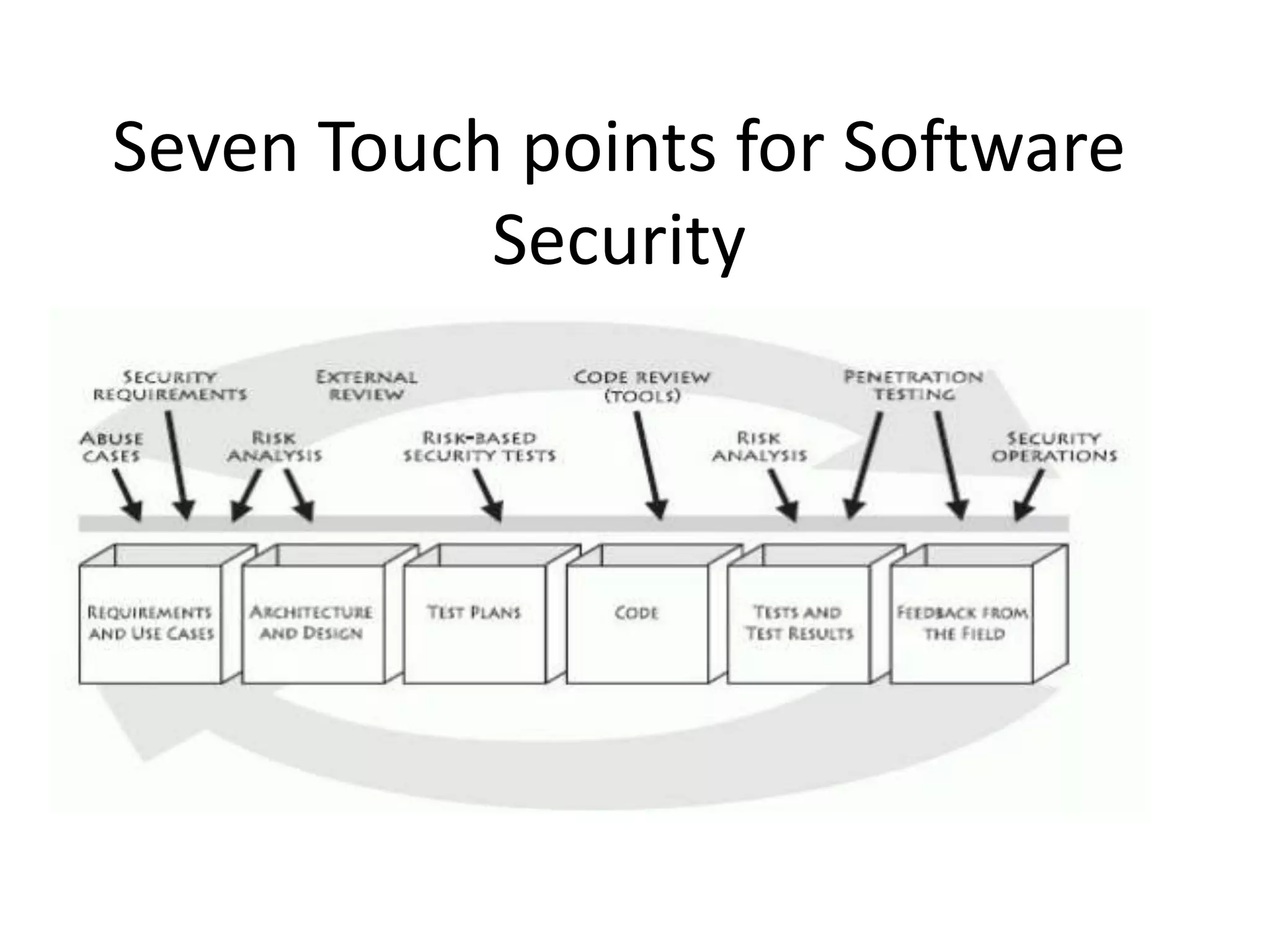
• The figure above shows the seven touchpoints
ordered according to effectiveness and
importance
• The touchpoints are designed to fill the gap
between the state of the art and the state of
the practice-something that can be done only
through the common adoption of best
practices
• Touchpoints are a mix of destructive and
constructive activities.
• Destructive activities are about attacks,
exploits, and breaking software.
• These kinds of things are represented by the
black hat (offense).
• Constructive activities are about design,
defense, and functionality.
• These are represented by the white hat
(defense).
• Both hats are necessary.
• Here are the touchpoints, in order of
effectiveness:
• 1. Code review
• 2. Architectural risk analysis
• 3. Penetration testing
• 4. Risk-based security tests
• 5. Abuse cases
• 6. Security requirements
• 7. Security operations
• 1. Code Review (Tools) Artifact: Code Example of risks found: Buffer
overflow on line 42
• All software projects produce at least one artifactcode.
• This fact moves code review to the number one slot on our list.
• At the code level, the focus is on implementation bugs, especially
those that static analysis tools that scan source code for common
vulnerabilities can discover.
• Several tools vendors now address this space.
• Code review is a necessary but not sufficient practice for achieving
secure software.
• Security bugs (especially in C and C++) are a real problem, but
architectural flaws are just as big a problem.
• you'll learn how to review code with static analysis tools in next
upcoming units
• Doing code review alone is an extremely useful
activity, but given that this kind of review can
only identify bugs, the best a code review can
uncover is around 50% of the security problems.
• Architectural problems are very difficult (and
mostly impossible) to find by staring at code.
• This is especially true for modern systems made
of hundreds of thousands of lines of code.
• A comprehensive approach to software security
involves holistically combining both code review
and architectural analysis.
• 2. Architectural Risk Analysis Artifact: Design
and specification
• Examples of risks found: Poor
compartmentalization and protection of
critical data; failure of a Web Service to
authenticate calling code and its user and to
make access control decisions based on
proper context
• At the design and architecture level, a system
must be coherent and present a unified
security front
• Designers, architects, and analysts should
clearly document assumptions and identify
possible attacks.
• At both the specifications-based architecture
stage and at the class-hierarchy design stage,
architectural risk analysis is a necessity.
• At this point, security analysts uncover and
rank architectural flaws so that mitigation can
begin.
• Disregarding risk analysis at this level will lead
to costly problems down the road.
• Note that risks crop up during all stages of the
software lifecycle, so a constant risk
management thread, with recurring risk-
tracking and monitoring activities, is highly
recommended.
• Chapter 2 describes the RMF process and how
to apply it. Chapter 5 teaches about
architectural risk analysis and will help you
ferret out flaws in software architecture.
Penetration Testing
Artifact: System in its environment
Example of risks found: Poor handling of program state in Web
interface
• Penetration testing is extremely useful, especially if an architectural
risk analysis informs the tests.
• The advantage of penetration testing is that it gives a good
understanding of fielded software in its real environment.
• Software that fails during the kind of canned black box testing
practiced by prefab application security testing tools is truly bad.
Thus, passing a low-octane penetration test reveals little about your
actual security posture, but failing a canned penetration test
indicates that you're in very deep trouble indeed.
• thank you
Risk-Based Security Testing
• Artifact: Units and system
• Example of risks found: Extent of data leakage
possible by leveraging data protection risk
• Security testing must encompass two strategies:
• (1) testing of security functionality with standard
functional testing techniques and
• (2) risk-based security testing based on attack
patterns, risk analysis results, and abuse cases.
• A good security test plan embraces both strategies.
• Security problems aren't always apparent, even when
you probe a system directly, so standard-issue quality
assurance is unlikely to uncover all critical security issues.
• QA is about making sure good things happen. Security
testing is about making sure bad things don't happen.
• Thinking like an attacker is essential.
• Guiding security testing with knowledge of software
architecture, common attacks, and the attacker's mindset
is thus extremely important.
Security Operations
Artifact: Fielded system
• Example of risks found: Insufficient logging to prosecute
a known attacker
• Software security can benefit greatly from network
security.
• Well-integrated security operations allow and encourage
network security professionals to get involved in applying
the touchpoints, providing experience and security
wisdom that might otherwise be missing from the
development team.
• Battle-scarred operations people carefully set up
and monitor fielded systems during use to enhance
the security posture.
• Attacks do happen, regardless of the strength of
design and implementation, so understanding
software behavior that leads to successful attack is
an essential defensive technique.
• Knowledge gained by understanding attacks and
exploits should be cycled back into software
development.
Abuse Cases
Artifact: Requirements and use cases
• Example of risks found: Susceptibility to well-known
tampering attack
• Building abuse cases is a great way to get into the mind
of the attacker.
• Similar to use cases, abuse cases describe the system's
behavior under attack
• Building abuse cases requires explicit coverage of what
should be protected, from whom, and for how long.
Security Requirements
Artifact: Requirements
• Example of risks found: No explicit description
of data protection needs
• Security must be explicitly worked into the
requirements level.
• Good security requirements cover both overt
functional security (say, the use of applied
cryptography)
• emergent characteristics (best captured by
abuse cases and attack patterns).
• The art of identifying and maintaining
security requirements is a complex
undertaking that deserves broad treatment.

Software Security

  • 1.
    Seven Touch pointsfor Software Security
  • 2.
    • The touchpoints are one of the three pillars of software security • You don't have to adopt all seven touchpoints to begin to build security in (though doing so is highly recommended).
  • 3.
    • The figureabove shows the seven touchpoints ordered according to effectiveness and importance • The touchpoints are designed to fill the gap between the state of the art and the state of the practice-something that can be done only through the common adoption of best practices
  • 4.
    • Touchpoints area mix of destructive and constructive activities. • Destructive activities are about attacks, exploits, and breaking software. • These kinds of things are represented by the black hat (offense).
  • 5.
    • Constructive activitiesare about design, defense, and functionality. • These are represented by the white hat (defense). • Both hats are necessary.
  • 6.
    • Here arethe touchpoints, in order of effectiveness: • 1. Code review • 2. Architectural risk analysis • 3. Penetration testing • 4. Risk-based security tests • 5. Abuse cases • 6. Security requirements • 7. Security operations
  • 7.
    • 1. CodeReview (Tools) Artifact: Code Example of risks found: Buffer overflow on line 42 • All software projects produce at least one artifactcode. • This fact moves code review to the number one slot on our list. • At the code level, the focus is on implementation bugs, especially those that static analysis tools that scan source code for common vulnerabilities can discover. • Several tools vendors now address this space. • Code review is a necessary but not sufficient practice for achieving secure software. • Security bugs (especially in C and C++) are a real problem, but architectural flaws are just as big a problem. • you'll learn how to review code with static analysis tools in next upcoming units
  • 8.
    • Doing codereview alone is an extremely useful activity, but given that this kind of review can only identify bugs, the best a code review can uncover is around 50% of the security problems. • Architectural problems are very difficult (and mostly impossible) to find by staring at code. • This is especially true for modern systems made of hundreds of thousands of lines of code. • A comprehensive approach to software security involves holistically combining both code review and architectural analysis.
  • 9.
    • 2. ArchitecturalRisk Analysis Artifact: Design and specification • Examples of risks found: Poor compartmentalization and protection of critical data; failure of a Web Service to authenticate calling code and its user and to make access control decisions based on proper context • At the design and architecture level, a system must be coherent and present a unified security front
  • 10.
    • Designers, architects,and analysts should clearly document assumptions and identify possible attacks. • At both the specifications-based architecture stage and at the class-hierarchy design stage, architectural risk analysis is a necessity. • At this point, security analysts uncover and rank architectural flaws so that mitigation can begin. • Disregarding risk analysis at this level will lead to costly problems down the road.
  • 11.
    • Note thatrisks crop up during all stages of the software lifecycle, so a constant risk management thread, with recurring risk- tracking and monitoring activities, is highly recommended. • Chapter 2 describes the RMF process and how to apply it. Chapter 5 teaches about architectural risk analysis and will help you ferret out flaws in software architecture.
  • 12.
    Penetration Testing Artifact: Systemin its environment Example of risks found: Poor handling of program state in Web interface • Penetration testing is extremely useful, especially if an architectural risk analysis informs the tests. • The advantage of penetration testing is that it gives a good understanding of fielded software in its real environment. • Software that fails during the kind of canned black box testing practiced by prefab application security testing tools is truly bad. Thus, passing a low-octane penetration test reveals little about your actual security posture, but failing a canned penetration test indicates that you're in very deep trouble indeed.
  • 13.
  • 14.
    Risk-Based Security Testing •Artifact: Units and system • Example of risks found: Extent of data leakage possible by leveraging data protection risk • Security testing must encompass two strategies: • (1) testing of security functionality with standard functional testing techniques and • (2) risk-based security testing based on attack patterns, risk analysis results, and abuse cases. • A good security test plan embraces both strategies.
  • 15.
    • Security problemsaren't always apparent, even when you probe a system directly, so standard-issue quality assurance is unlikely to uncover all critical security issues. • QA is about making sure good things happen. Security testing is about making sure bad things don't happen. • Thinking like an attacker is essential. • Guiding security testing with knowledge of software architecture, common attacks, and the attacker's mindset is thus extremely important.
  • 16.
    Security Operations Artifact: Fieldedsystem • Example of risks found: Insufficient logging to prosecute a known attacker • Software security can benefit greatly from network security. • Well-integrated security operations allow and encourage network security professionals to get involved in applying the touchpoints, providing experience and security wisdom that might otherwise be missing from the development team.
  • 17.
    • Battle-scarred operationspeople carefully set up and monitor fielded systems during use to enhance the security posture. • Attacks do happen, regardless of the strength of design and implementation, so understanding software behavior that leads to successful attack is an essential defensive technique. • Knowledge gained by understanding attacks and exploits should be cycled back into software development.
  • 18.
    Abuse Cases Artifact: Requirementsand use cases • Example of risks found: Susceptibility to well-known tampering attack • Building abuse cases is a great way to get into the mind of the attacker. • Similar to use cases, abuse cases describe the system's behavior under attack • Building abuse cases requires explicit coverage of what should be protected, from whom, and for how long.
  • 19.
    Security Requirements Artifact: Requirements •Example of risks found: No explicit description of data protection needs • Security must be explicitly worked into the requirements level. • Good security requirements cover both overt functional security (say, the use of applied cryptography)
  • 20.
    • emergent characteristics(best captured by abuse cases and attack patterns). • The art of identifying and maintaining security requirements is a complex undertaking that deserves broad treatment.