Secure LXC networking 
Marian HackMan Marinov 
<mm@1h.com> 
CEO of 1H Ltd. 
CTO of GetClouder.com
Who am I? 
➢ System Administrator since 1998 
➢ CEO of 1H Ltd. 
➢ CTO of GetClouder Ltd. 
➢ Head of DevOps for Siteground.com 
➢ Organizer of OpenFest, BG Perl workshops and 
others 
➢ This year I helped with the organization of 
YAPC europe and EuroBSDcon in Sofia 
➢ In my spare time I teach Linux System 
Administration and Network Security courses in 
Sofia University 
➢ For the past year I'm playing mainly with 
containers!
We don't really need networking...
MAC addresses 
➢ Keep a central DB with all MAC addresses to 
prevent collisions 
➢ Use a reliable way to generate MAC addresses 
➢ Keep in mind: 
➢local or global 
➢unicast or multicast
generate MAC address in bash 
function gen_mac() { 
mac_vars=(0 1 2 3 4 5 6 7 8 9 a b c d e f) 
mac_base='52:00:01:' 
ret='' 
for i in {1..6}; do 
n=$RANDOM 
let 'n %= 16' 
ret="${ret}${mac_vars[$n]}" 
if [ $i -eq 2 ] || [ $i -eq 4 ]; then 
ret="${ret}:" 
fi 
done 
echo "${mac_base}${ret}" 
}
generate mac address in PLPGSQL 
CREATE OR REPLACE FUNCTION generate_mac() RETURNS text 
LANGUAGE plpgsql 
AS $$DECLARE 
mac TEXT; 
a CHAR; 
count INTEGER; 
BEGIN 
mac='52:00:01:'; 
FOR count IN 1..6 LOOP 
SELECT substring('0123456789abcdef' FROM (random()*16)::int + 1 FOR 1) INTO a; 
-- This fixes an issue, where the above SELECT returns NULL or empty string 
-- If for some reason we concatenate with a NULL string, the result will be NULL string 
WHILE a IS NULL OR a = '' LOOP 
SELECT substring('0123456789abcdef' FROM (random()*16)::int + 1 FOR 1) 
INTO a; 
END LOOP; 
mac = mac || a; 
IF count = 2 OR count = 4 THEN 
mac = mac || ':'; 
END IF; 
END LOOP; 
RETURN mac; 
END;$$;
generate MAC address in Python 
#/usr/bin/python 
import random 
mac = [random.choice(range(256)) for i in range(6)] 
mac[0] |= 0x02 
mac[0] &= 0xfe 
print ':'.join('%02x' % m for m in mac)
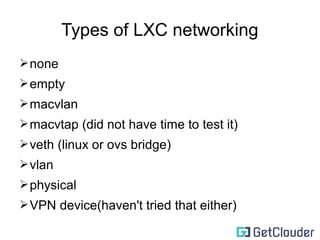
Types of LXC networking 
➢none 
➢empty 
➢macvlan 
➢macvtap (did not have time to test it) 
➢veth (linux or ovs bridge) 
➢vlan 
➢physical 
➢VPN device(haven't tried that either)
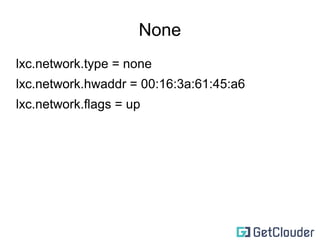
None 
lxc.network.type = none 
lxc.network.hwaddr = 00:16:3a:61:45:a6 
lxc.network.flags = up
Empty 
lxc.network.type = empty 
lxc.network.hwaddr = 00:16:3a:61:45:a6 
lxc.network.flags = up
VETH 
lxc.network.type = veth 
lxc.network.veth.pair = vethc3070 
lxc.network.flags = up 
lxc.network.name = eth0 
lxc.network.ipv4 = X.X.X.X/24 
lxc.network.ipv4.gateway = X.X.X.1 
lxc.network.hwaddr = 00:16:3e:28:73:b3
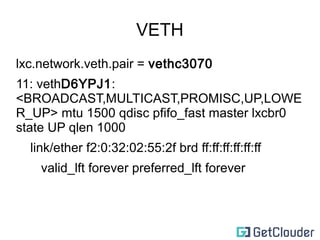
VETH 
lxc.network.veth.pair = vethc3070 
11: vethD6YPJ1: 
<BROADCAST,MULTICAST,PROMISC,UP,LOWE 
R_UP> mtu 1500 qdisc pfifo_fast master lxcbr0 
state UP qlen 1000 
link/ether f2:0:32:02:55:2f brd ff:ff:ff:ff:ff:ff 
valid_lft forever preferred_lft forever
MACVLAN 
lxc.network.type = macvlan 
lxc.network.macvlan.mode = bridge 
lxc.network.flags = up 
lxc.network.link = lxcbr1 
lxc.network.name = eth0 
lxc.network.ipv4 = X.X.X.X/24 
lxc.network.ipv4.gateway = X.X.X.1 
lxc.network.hwaddr = 00:16:3e:28:73:b3
MACVLAN 
➢ If you want to manually setup the networking 
ip link add link PARENT [NAME] type macvlan [address MAC] 
➢ Auto generated MAC adresses 
# ip link add link eth0 lxc0 type macvlan 
➢ Manually assigned 
# ip link add link eth0 lxc1 type macvlan address f0:de:f1:81:0a:2a 
➢ Additional parameter: mode 
➢ macvlan mode { private | vepa | bridge | passthru }
MACVLAN 
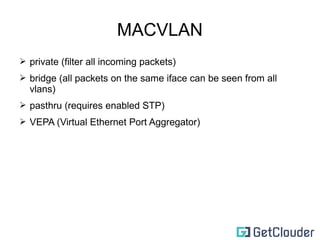
➢ private (filter all incoming packets) 
➢ bridge (all packets on the same iface can be seen from all 
vlans) 
➢ pasthru (requires enabled STP) 
➢ VEPA (Virtual Ethernet Port Aggregator)
MACVLAN 
➢ Edge Virtual Bridging EVB 
➢ Top-of-Rack (ToR) 
➢ End-of-Row (EoR) 
➢ Virtual Ethernet Bridge (VEB) 
➢ Linux bridge 
➢ OpenVswitch 
➢ Virtual Ethernet Port Aggregator (VEPA) 
➢ used for EVB 
➢ VEPA 802.1Qab - HP, IBM, Brocade, Juniper 
➢ Standard mode 
➢ Multi-channel VEPA (Q-in-Q) 
➢ VN-Tag 802.1Qbh - Cisco
VLAN 
lxc.network.type = vlan 
lxc.network.vlan.id = 10 
lxc.network.flags = up 
lxc.network.link = eth0 
lxc.network.name = eth0 
lxc.network.ipv4 = X.X.X.X/24 
lxc.network.ipv4.gateway = X.X.X.1 
lxc.network.hwaddr = 00:16:3e:28:73:b3
VLAN 
# vconfig add eth0 10 
# ip link add link eth0 vlan10 type vlan id 10 
# ip link show vlan10 
10: vlan10@eth0: <NO-CARRIER,BROADCAST,MULTICAST,UP> 
mtu 1500 qdisc noqueue state LOWERLAYERDOWN mode 
DEFAULT 
link/ether f0:de:f1:81:0a:2a brd ff:ff:ff:ff:ff:ff
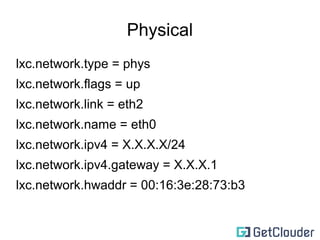
Physical 
lxc.network.type = phys 
lxc.network.flags = up 
lxc.network.link = eth2 
lxc.network.name = eth0 
lxc.network.ipv4 = X.X.X.X/24 
lxc.network.ipv4.gateway = X.X.X.1 
lxc.network.hwaddr = 00:16:3e:28:73:b3
Bridging :) 
➢Linux Bridge 
➢ setup with brctl 
➢ setup with ip route 
➢OpenVswitch (OVS) 
➢ setup with its tools
Bridging :) 
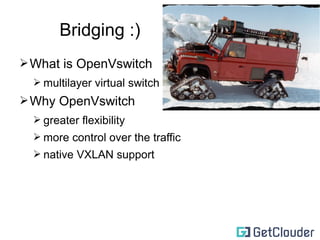
➢What is OpenVswitch 
➢multilayer virtual switch 
➢Why OpenVswitch 
➢ greater flexibility 
➢more control over the traffic 
➢ native VXLAN support
Bridging :) 
# brctl show 
bridge name bridge id STP enabled 
interfaces 
# brctl addbr br0 
# brctl show 
bridge name bridge id STP enabled 
interfaces 
br0 8000.000000000000 no
Bridging :) 
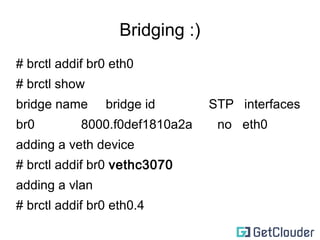
# brctl addif br0 eth0 
# brctl show 
bridge name bridge id STP interfaces 
br0 8000.f0def1810a2a no eth0 
adding a veth device 
# brctl addif br0 vethc3070 
adding a vlan 
# brctl addif br0 eth0.4
Bridging :) 
# ip link add name lxcbr0 type bridge 
# ip link set dev lxcbr0 up 
# ip link show lxcbr0 
7: lxcbr0: <BROADCAST,MULTICAST,UP,LOWER_UP> mtu 1500 
qdisc noqueue state UNKNOWN mode DEFAULT 
link/ether fe:d8:b2:55:ce:5b brd ff:ff:ff:ff:ff:ff 
# ip link set dev eth0 promisc on 
# ip link set dev eth0 up 
# ip link set dev eth0 master bridge_name 
# ip link set dev eth0 nomaster
Securing all of these 
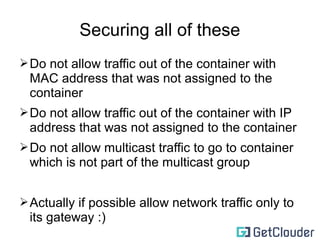
➢Do not allow traffic out of the container with 
MAC address that was not assigned to the 
container 
➢Do not allow traffic out of the container with IP 
address that was not assigned to the container 
➢Do not allow multicast traffic to go to container 
which is not part of the multicast group 
➢Actually if possible allow network traffic only to 
its gateway :)
Securing all of these 
➢Do not use NAT for connecting your containers 
➢NAT is susceptible to DoS. By spoofing many 
connections from one container can block the 
connectivity of the whole machine!
Broadcasts... 
➢It depends on your network design 
➢ Generally limit the broadcast destinations that a 
container can reach 
➢ If possible use source routing to route the traffic 
directly to where it is supposed to go
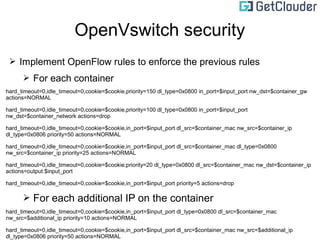
OpenVswitch security 
➢ Implement OpenFlow rules to enforce the previous rules 
➢ For each container 
hard_timeout=0,idle_timeout=0,cookie=$cookie,priority=150 dl_type=0x0800 in_port=$input_port nw_dst=$container_gw 
actions=NORMAL 
hard_timeout=0,idle_timeout=0,cookie=$cookie,priority=100 dl_type=0x0800 in_port=$input_port 
nw_dst=$container_network actions=drop 
hard_timeout=0,idle_timeout=0,cookie=$cookie,in_port=$input_port dl_src=$container_mac nw_src=$container_ip 
dl_type=0x0806 priority=50 actions=NORMAL 
hard_timeout=0,idle_timeout=0,cookie=$cookie,in_port=$input_port dl_src=$container_mac dl_type=0x0800 
nw_src=$container_ip priority=25 actions=NORMAL 
hard_timeout=0,idle_timeout=0,cookie=$cookie,priority=20 dl_type=0x0800 dl_src=$container_mac nw_dst=$container_ip 
actions=output:$input_port 
hard_timeout=0,idle_timeout=0,cookie=$cookie,in_port=$input_port priority=5 actions=drop 
➢ For each additional IP on the container 
hard_timeout=0,idle_timeout=0,cookie=$cookie,in_port=$input_port dl_type=0x0800 dl_src=$container_mac 
nw_src=$additional_ip priority=10 actions=NORMAL 
hard_timeout=0,idle_timeout=0,cookie=$cookie,in_port=$input_port dl_src=$container_mac nw_src=$additional_ip 
dl_type=0x0806 priority=50 actions=NORMAL
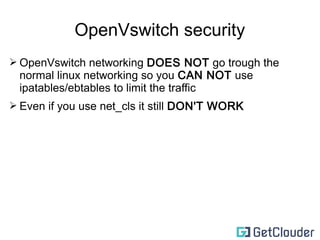
OpenVswitch security 
➢ OpenVswitch networking DOES NOT go trough the 
normal linux networking so you CAN NOT use 
ipatables/ebtables to limit the traffic 
➢ Even if you use net_cls it still DON'T WORK
TThhaannkk yyoouu!! 
QQuueessttiioonnss?? 
Marian Marinov <mm@1h.com> 
http://getclouder.com 
Jabber: hackman@jabber.org 
IRC: irc.freenode.net HackMan 
ICQ: 7556201 
GitHub: http://github.com/hackman

Secure LXC Networking

  • 1.
    Secure LXC networking Marian HackMan Marinov <mm@1h.com> CEO of 1H Ltd. CTO of GetClouder.com
  • 2.
    Who am I? ➢ System Administrator since 1998 ➢ CEO of 1H Ltd. ➢ CTO of GetClouder Ltd. ➢ Head of DevOps for Siteground.com ➢ Organizer of OpenFest, BG Perl workshops and others ➢ This year I helped with the organization of YAPC europe and EuroBSDcon in Sofia ➢ In my spare time I teach Linux System Administration and Network Security courses in Sofia University ➢ For the past year I'm playing mainly with containers!
  • 3.
    We don't reallyneed networking...
  • 4.
    MAC addresses ➢Keep a central DB with all MAC addresses to prevent collisions ➢ Use a reliable way to generate MAC addresses ➢ Keep in mind: ➢local or global ➢unicast or multicast
  • 5.
    generate MAC addressin bash function gen_mac() { mac_vars=(0 1 2 3 4 5 6 7 8 9 a b c d e f) mac_base='52:00:01:' ret='' for i in {1..6}; do n=$RANDOM let 'n %= 16' ret="${ret}${mac_vars[$n]}" if [ $i -eq 2 ] || [ $i -eq 4 ]; then ret="${ret}:" fi done echo "${mac_base}${ret}" }
  • 6.
    generate mac addressin PLPGSQL CREATE OR REPLACE FUNCTION generate_mac() RETURNS text LANGUAGE plpgsql AS $$DECLARE mac TEXT; a CHAR; count INTEGER; BEGIN mac='52:00:01:'; FOR count IN 1..6 LOOP SELECT substring('0123456789abcdef' FROM (random()*16)::int + 1 FOR 1) INTO a; -- This fixes an issue, where the above SELECT returns NULL or empty string -- If for some reason we concatenate with a NULL string, the result will be NULL string WHILE a IS NULL OR a = '' LOOP SELECT substring('0123456789abcdef' FROM (random()*16)::int + 1 FOR 1) INTO a; END LOOP; mac = mac || a; IF count = 2 OR count = 4 THEN mac = mac || ':'; END IF; END LOOP; RETURN mac; END;$$;
  • 7.
    generate MAC addressin Python #/usr/bin/python import random mac = [random.choice(range(256)) for i in range(6)] mac[0] |= 0x02 mac[0] &= 0xfe print ':'.join('%02x' % m for m in mac)
  • 8.
    Types of LXCnetworking ➢none ➢empty ➢macvlan ➢macvtap (did not have time to test it) ➢veth (linux or ovs bridge) ➢vlan ➢physical ➢VPN device(haven't tried that either)
  • 9.
    None lxc.network.type =none lxc.network.hwaddr = 00:16:3a:61:45:a6 lxc.network.flags = up
  • 10.
    Empty lxc.network.type =empty lxc.network.hwaddr = 00:16:3a:61:45:a6 lxc.network.flags = up
  • 11.
    VETH lxc.network.type =veth lxc.network.veth.pair = vethc3070 lxc.network.flags = up lxc.network.name = eth0 lxc.network.ipv4 = X.X.X.X/24 lxc.network.ipv4.gateway = X.X.X.1 lxc.network.hwaddr = 00:16:3e:28:73:b3
  • 12.
    VETH lxc.network.veth.pair =vethc3070 11: vethD6YPJ1: <BROADCAST,MULTICAST,PROMISC,UP,LOWE R_UP> mtu 1500 qdisc pfifo_fast master lxcbr0 state UP qlen 1000 link/ether f2:0:32:02:55:2f brd ff:ff:ff:ff:ff:ff valid_lft forever preferred_lft forever
  • 13.
    MACVLAN lxc.network.type =macvlan lxc.network.macvlan.mode = bridge lxc.network.flags = up lxc.network.link = lxcbr1 lxc.network.name = eth0 lxc.network.ipv4 = X.X.X.X/24 lxc.network.ipv4.gateway = X.X.X.1 lxc.network.hwaddr = 00:16:3e:28:73:b3
  • 14.
    MACVLAN ➢ Ifyou want to manually setup the networking ip link add link PARENT [NAME] type macvlan [address MAC] ➢ Auto generated MAC adresses # ip link add link eth0 lxc0 type macvlan ➢ Manually assigned # ip link add link eth0 lxc1 type macvlan address f0:de:f1:81:0a:2a ➢ Additional parameter: mode ➢ macvlan mode { private | vepa | bridge | passthru }
  • 15.
    MACVLAN ➢ private(filter all incoming packets) ➢ bridge (all packets on the same iface can be seen from all vlans) ➢ pasthru (requires enabled STP) ➢ VEPA (Virtual Ethernet Port Aggregator)
  • 16.
    MACVLAN ➢ EdgeVirtual Bridging EVB ➢ Top-of-Rack (ToR) ➢ End-of-Row (EoR) ➢ Virtual Ethernet Bridge (VEB) ➢ Linux bridge ➢ OpenVswitch ➢ Virtual Ethernet Port Aggregator (VEPA) ➢ used for EVB ➢ VEPA 802.1Qab - HP, IBM, Brocade, Juniper ➢ Standard mode ➢ Multi-channel VEPA (Q-in-Q) ➢ VN-Tag 802.1Qbh - Cisco
  • 17.
    VLAN lxc.network.type =vlan lxc.network.vlan.id = 10 lxc.network.flags = up lxc.network.link = eth0 lxc.network.name = eth0 lxc.network.ipv4 = X.X.X.X/24 lxc.network.ipv4.gateway = X.X.X.1 lxc.network.hwaddr = 00:16:3e:28:73:b3
  • 18.
    VLAN # vconfigadd eth0 10 # ip link add link eth0 vlan10 type vlan id 10 # ip link show vlan10 10: vlan10@eth0: <NO-CARRIER,BROADCAST,MULTICAST,UP> mtu 1500 qdisc noqueue state LOWERLAYERDOWN mode DEFAULT link/ether f0:de:f1:81:0a:2a brd ff:ff:ff:ff:ff:ff
  • 19.
    Physical lxc.network.type =phys lxc.network.flags = up lxc.network.link = eth2 lxc.network.name = eth0 lxc.network.ipv4 = X.X.X.X/24 lxc.network.ipv4.gateway = X.X.X.1 lxc.network.hwaddr = 00:16:3e:28:73:b3
  • 20.
    Bridging :) ➢LinuxBridge ➢ setup with brctl ➢ setup with ip route ➢OpenVswitch (OVS) ➢ setup with its tools
  • 21.
    Bridging :) ➢Whatis OpenVswitch ➢multilayer virtual switch ➢Why OpenVswitch ➢ greater flexibility ➢more control over the traffic ➢ native VXLAN support
  • 22.
    Bridging :) #brctl show bridge name bridge id STP enabled interfaces # brctl addbr br0 # brctl show bridge name bridge id STP enabled interfaces br0 8000.000000000000 no
  • 23.
    Bridging :) #brctl addif br0 eth0 # brctl show bridge name bridge id STP interfaces br0 8000.f0def1810a2a no eth0 adding a veth device # brctl addif br0 vethc3070 adding a vlan # brctl addif br0 eth0.4
  • 24.
    Bridging :) #ip link add name lxcbr0 type bridge # ip link set dev lxcbr0 up # ip link show lxcbr0 7: lxcbr0: <BROADCAST,MULTICAST,UP,LOWER_UP> mtu 1500 qdisc noqueue state UNKNOWN mode DEFAULT link/ether fe:d8:b2:55:ce:5b brd ff:ff:ff:ff:ff:ff # ip link set dev eth0 promisc on # ip link set dev eth0 up # ip link set dev eth0 master bridge_name # ip link set dev eth0 nomaster
  • 25.
    Securing all ofthese ➢Do not allow traffic out of the container with MAC address that was not assigned to the container ➢Do not allow traffic out of the container with IP address that was not assigned to the container ➢Do not allow multicast traffic to go to container which is not part of the multicast group ➢Actually if possible allow network traffic only to its gateway :)
  • 26.
    Securing all ofthese ➢Do not use NAT for connecting your containers ➢NAT is susceptible to DoS. By spoofing many connections from one container can block the connectivity of the whole machine!
  • 27.
    Broadcasts... ➢It dependson your network design ➢ Generally limit the broadcast destinations that a container can reach ➢ If possible use source routing to route the traffic directly to where it is supposed to go
  • 28.
    OpenVswitch security ➢Implement OpenFlow rules to enforce the previous rules ➢ For each container hard_timeout=0,idle_timeout=0,cookie=$cookie,priority=150 dl_type=0x0800 in_port=$input_port nw_dst=$container_gw actions=NORMAL hard_timeout=0,idle_timeout=0,cookie=$cookie,priority=100 dl_type=0x0800 in_port=$input_port nw_dst=$container_network actions=drop hard_timeout=0,idle_timeout=0,cookie=$cookie,in_port=$input_port dl_src=$container_mac nw_src=$container_ip dl_type=0x0806 priority=50 actions=NORMAL hard_timeout=0,idle_timeout=0,cookie=$cookie,in_port=$input_port dl_src=$container_mac dl_type=0x0800 nw_src=$container_ip priority=25 actions=NORMAL hard_timeout=0,idle_timeout=0,cookie=$cookie,priority=20 dl_type=0x0800 dl_src=$container_mac nw_dst=$container_ip actions=output:$input_port hard_timeout=0,idle_timeout=0,cookie=$cookie,in_port=$input_port priority=5 actions=drop ➢ For each additional IP on the container hard_timeout=0,idle_timeout=0,cookie=$cookie,in_port=$input_port dl_type=0x0800 dl_src=$container_mac nw_src=$additional_ip priority=10 actions=NORMAL hard_timeout=0,idle_timeout=0,cookie=$cookie,in_port=$input_port dl_src=$container_mac nw_src=$additional_ip dl_type=0x0806 priority=50 actions=NORMAL
  • 29.
    OpenVswitch security ➢OpenVswitch networking DOES NOT go trough the normal linux networking so you CAN NOT use ipatables/ebtables to limit the traffic ➢ Even if you use net_cls it still DON'T WORK
  • 30.
    TThhaannkk yyoouu!! QQuueessttiioonnss?? Marian Marinov <mm@1h.com> http://getclouder.com Jabber: hackman@jabber.org IRC: irc.freenode.net HackMan ICQ: 7556201 GitHub: http://github.com/hackman