1
Secure Inter-domain Routing with
RPKI
Srinivas (Sunny) Chendi
VNIX-NOG 2018, Da Nang
sunny@apnic.net
Chào buổi sáng
What is the fundamental
Problem?
An underlying problem in routing is
lack of certainty
• BGP is a giant ‘rumor’ system:
– What I hear I pass on.
– What I hear, I reflect on, deciding to route.
– Has two primary properties to be tested: Origination and Path
• Why do I believe what I hear?
An underlying problem in routing is
lack of certainty
• Origination binds a prefix to a specific Autonomous System (AS)
number
– The Origin-AS (of the prefix) is chosen by the prefix holder
– Bad actors can claim to originate. How do we limit this risk?
• Path binds an Origin-AS to the set of intermediate Autonomous
Systems forwarding between themselves (transit) towards the Origin-
AS
– The inter-AS relationships are chosen by the operators of the AS
– Therefore the AS-PATH elements over any given origin-AS/Prefix pair is a
reflection of the specific AS operator(s) along the path
– Bad actors can intermediate themselves into path. How do we limit this
risk?
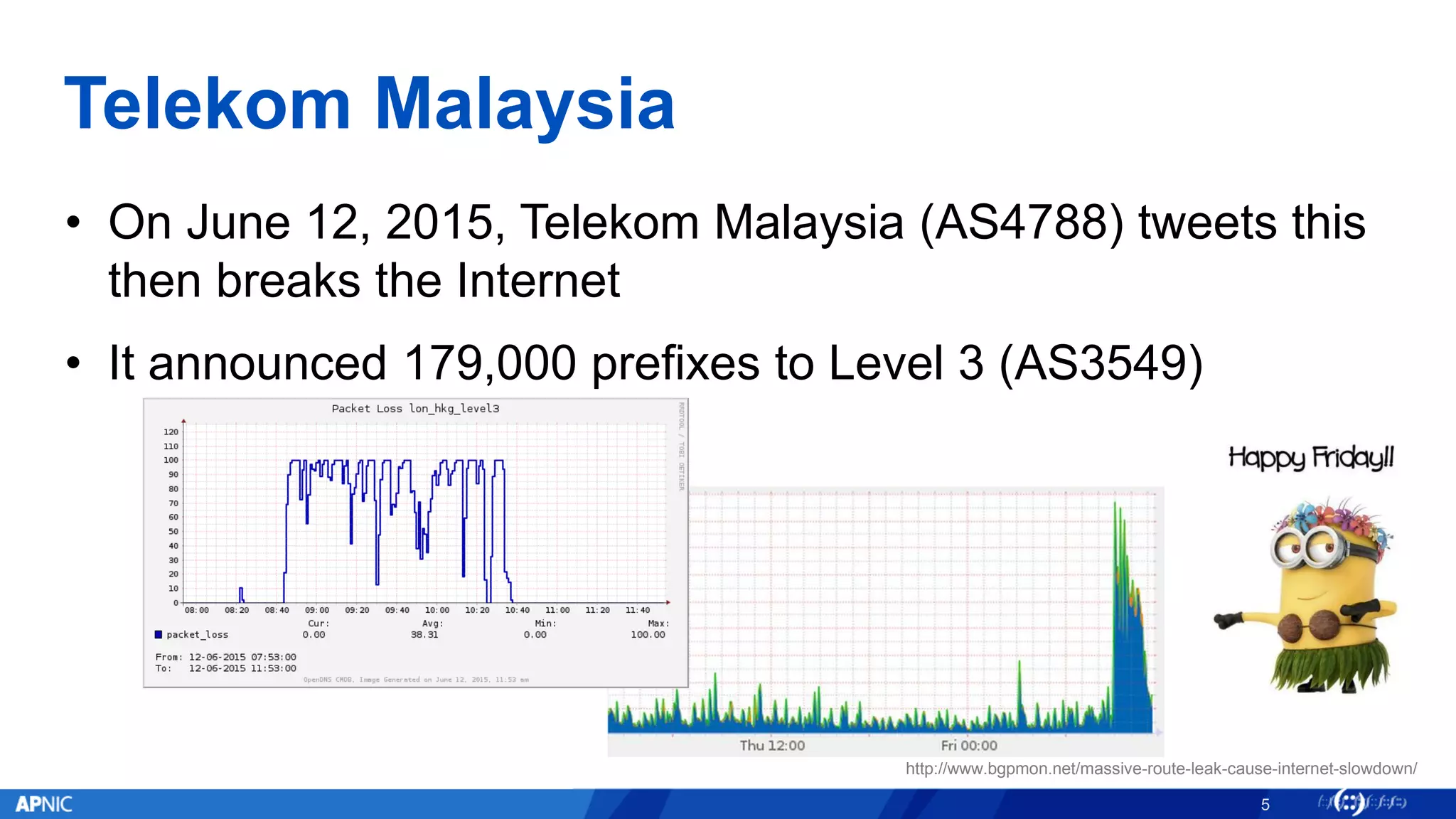
Telekom Malaysia
• On June 12, 2015, Telekom Malaysia (AS4788) tweets this
then breaks the Internet
• It announced 179,000 prefixes to Level 3 (AS3549)
5
http://www.bgpmon.net/massive-route-leak-cause-internet-slowdown/
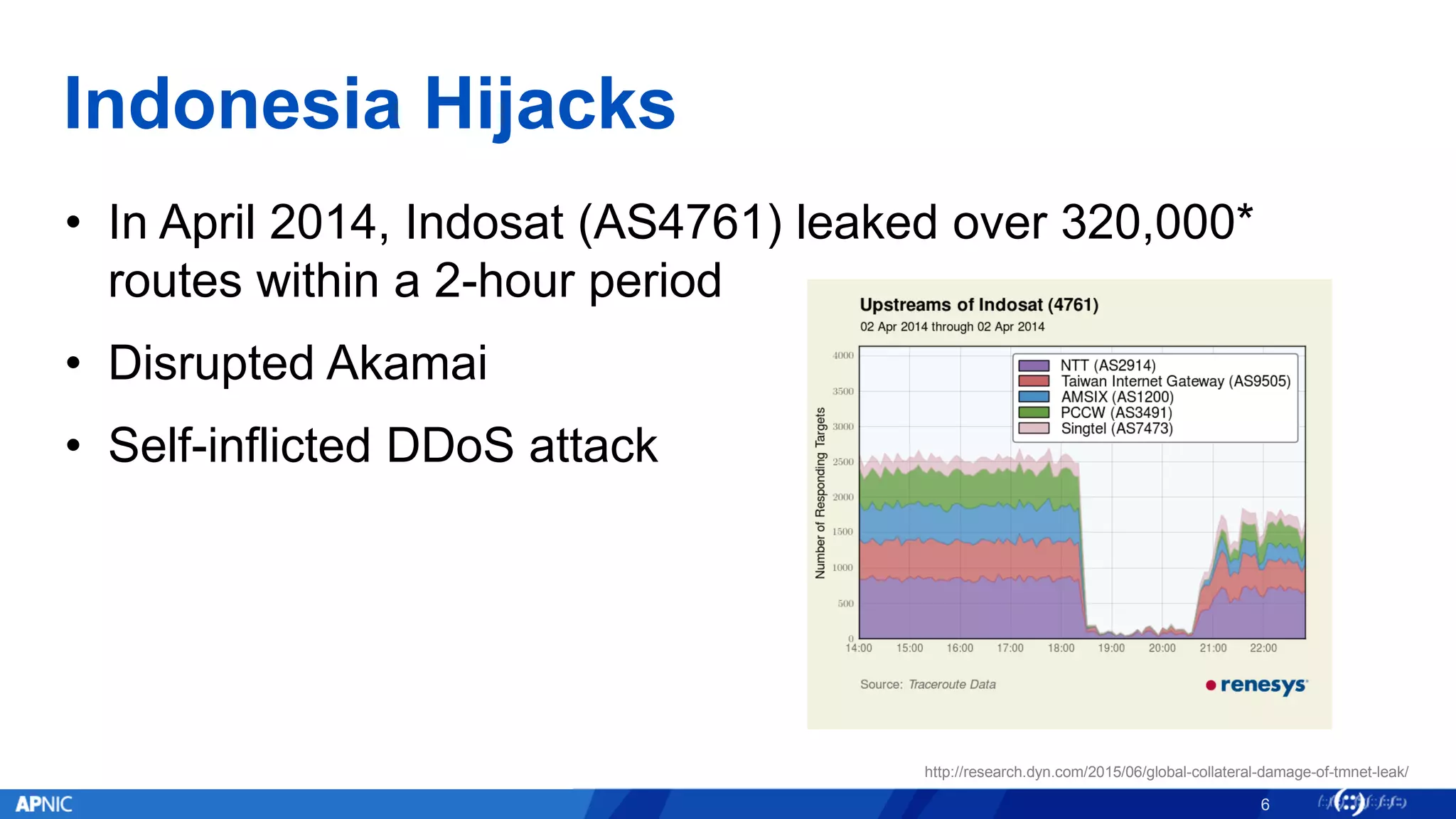
Indonesia Hijacks
• In April 2014, Indosat (AS4761) leaked over 320,000*
routes within a 2-hour period
• Disrupted Akamai
• Self-inflicted DDoS attack
6
http://research.dyn.com/2015/06/global-collateral-damage-of-tmnet-leak/
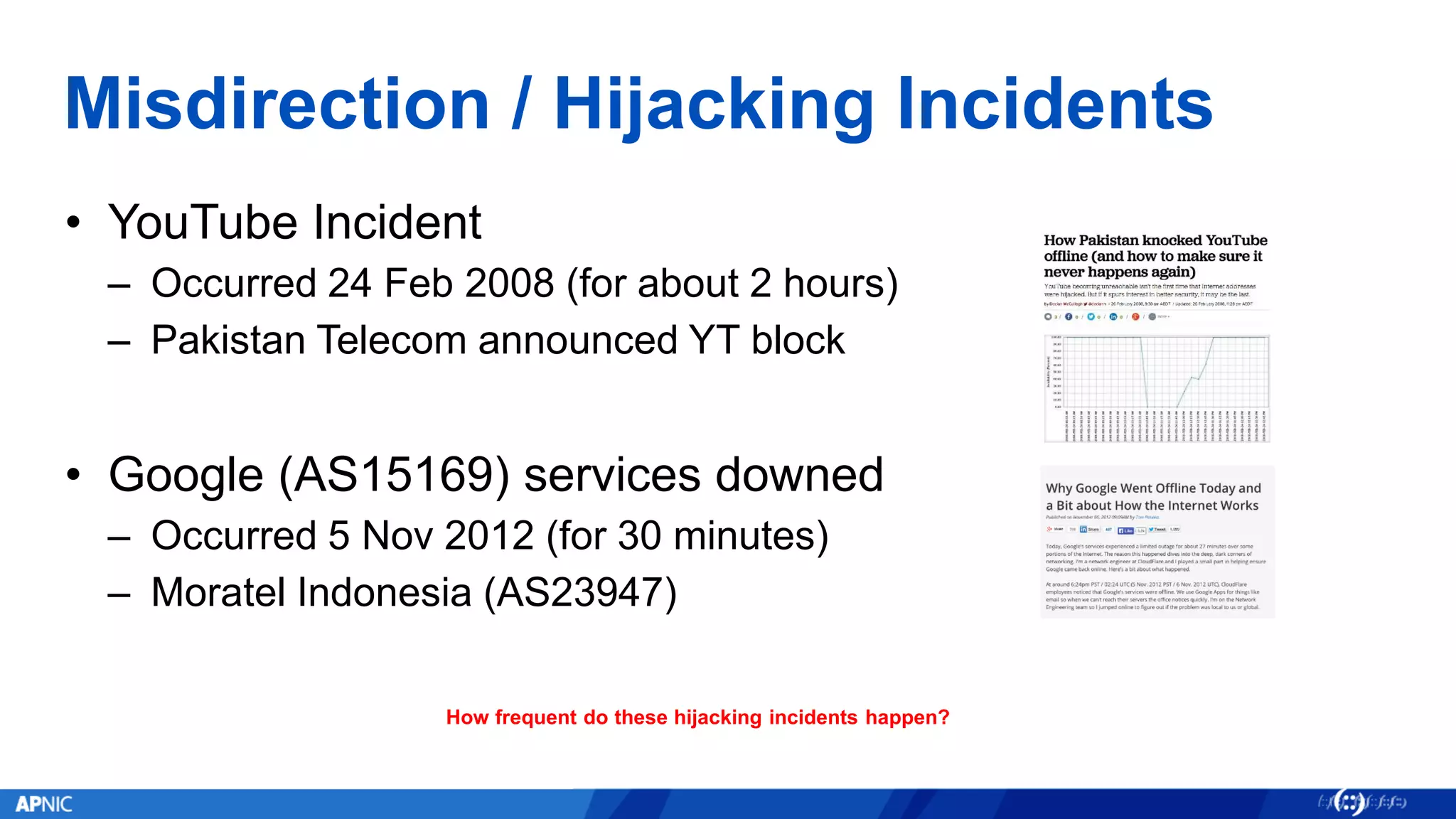
Misdirection / Hijacking Incidents
• YouTube Incident
– Occurred 24 Feb 2008 (for about 2 hours)
– Pakistan Telecom announced YT block
• Google (AS15169) services downed
– Occurred 5 Nov 2012 (for 30 minutes)
– Moratel Indonesia (AS23947)
How frequent do these hijacking incidents happen?
How Do We Collaboratively
Solve This Problem?
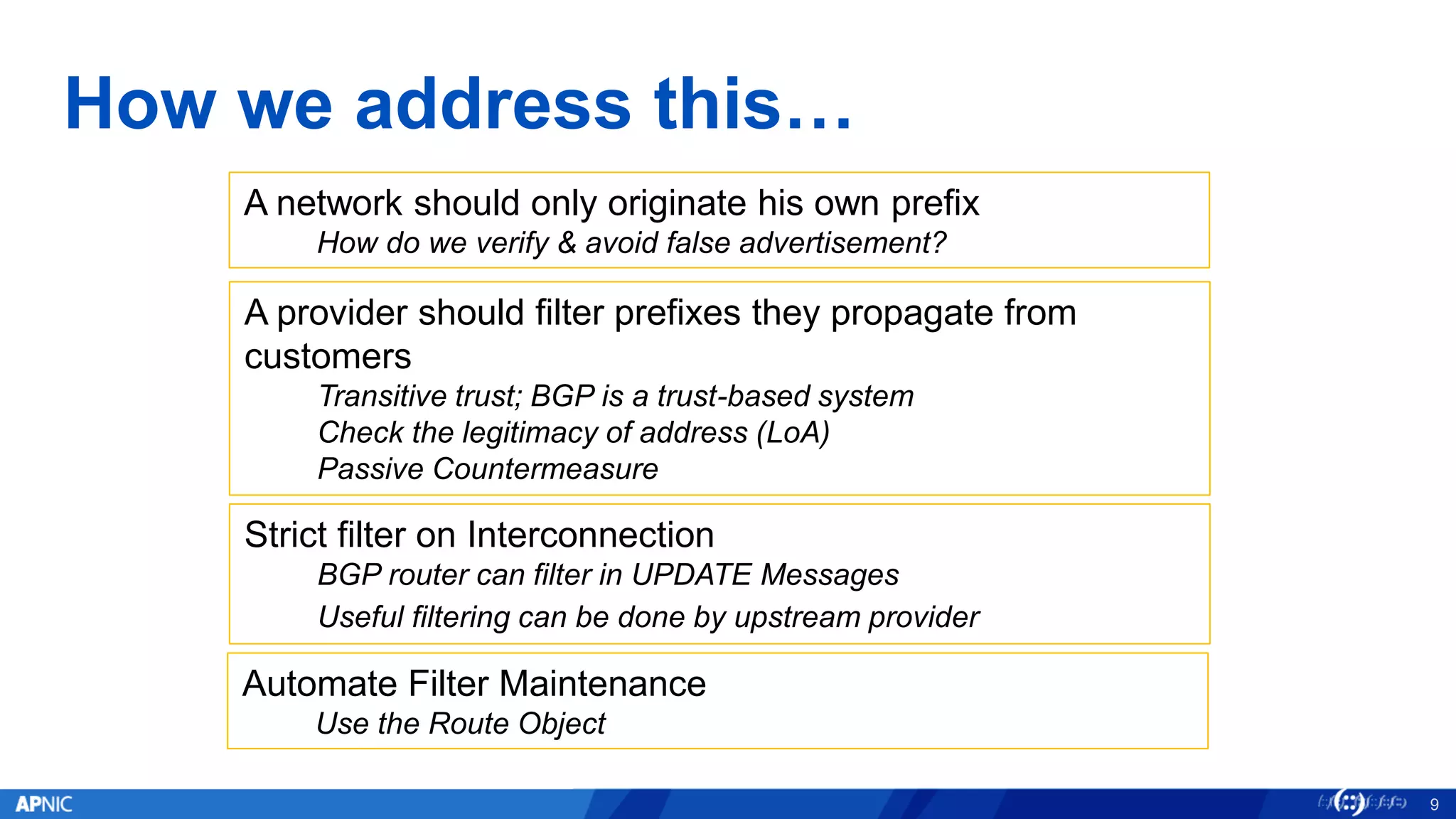
How we address this…
9
A network should only originate his own prefix
How do we verify & avoid false advertisement?
A provider should filter prefixes they propagate from
customers
Transitive trust; BGP is a trust-based system
Check the legitimacy of address (LoA)
Passive Countermeasure
Strict filter on Interconnection
BGP router can filter in UPDATE Messages
Useful filtering can be done by upstream provider
Automate Filter Maintenance
Use the Route Object
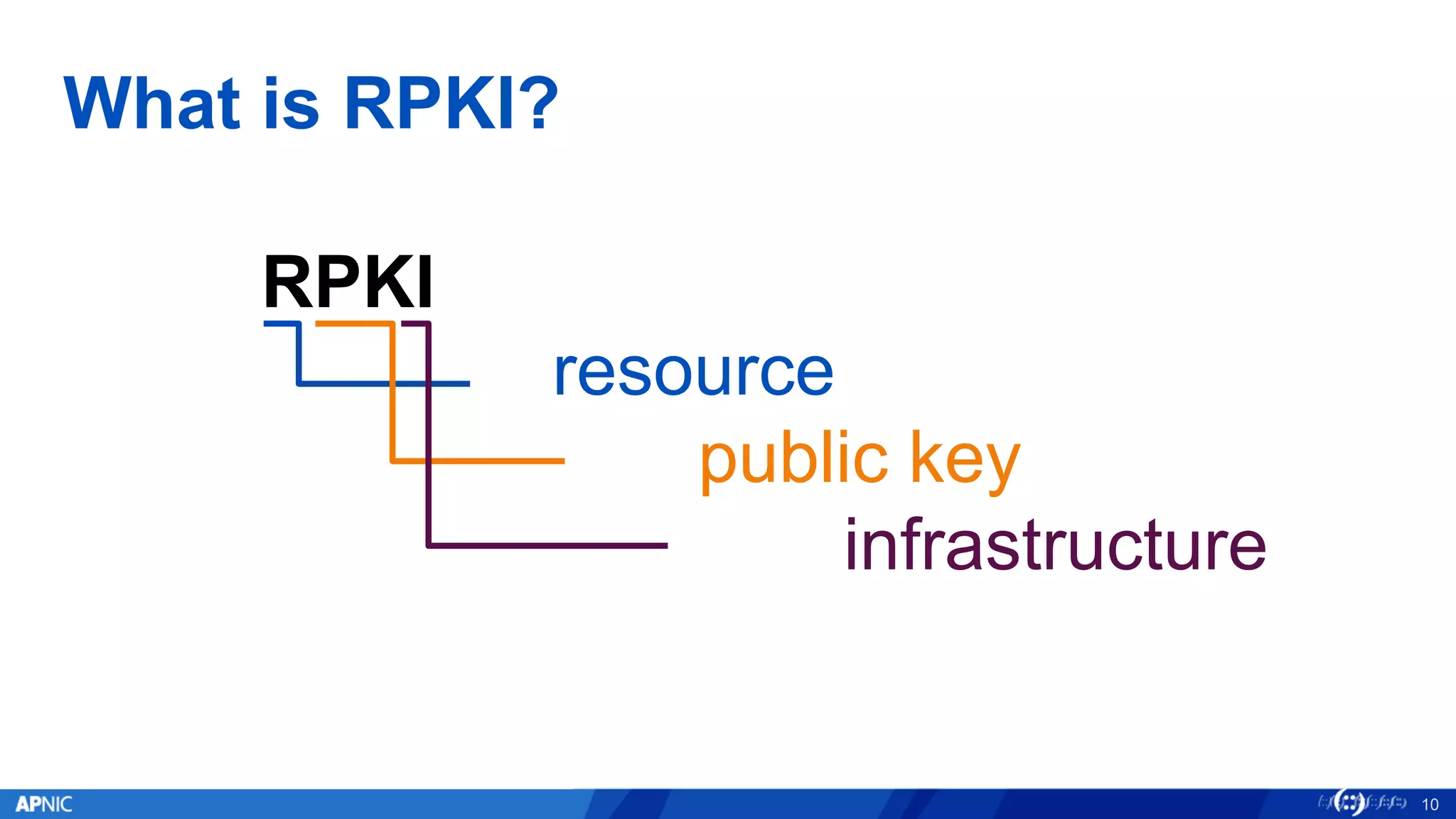
What is RPKI?
10
RPKI
resource
public key
infrastructure
What is RPKI?
• A robust security framework for verifying the association
between resource holder and Internet resource
• Helps to secure Internet routing by validating routes
11
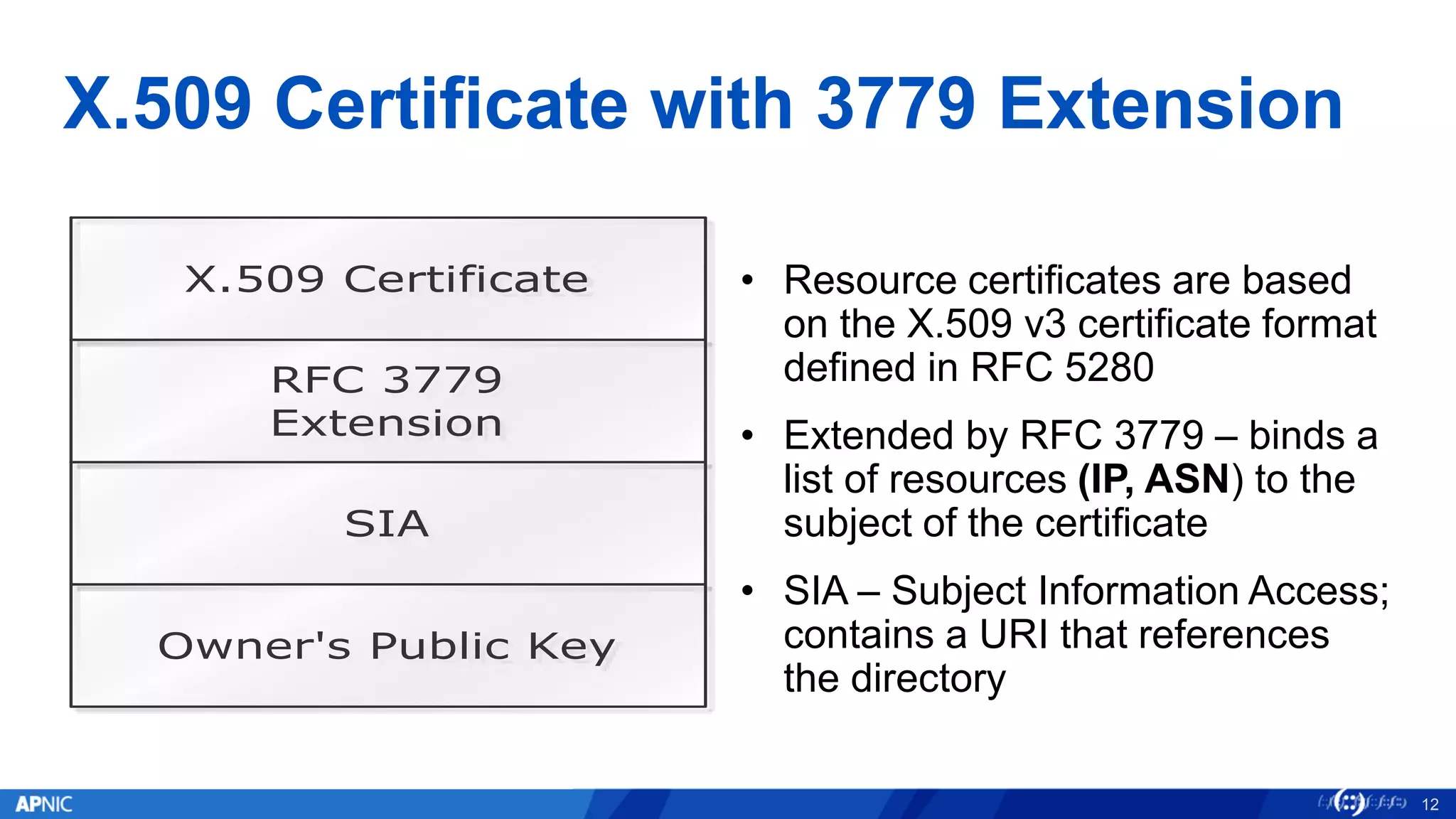
X.509 Certificate with 3779 Extension
• Resource certificates are based
on the X.509 v3 certificate format
defined in RFC 5280
• Extended by RFC 3779 – binds a
list of resources (IP, ASN) to the
subject of the certificate
• SIA – Subject Information Access;
contains a URI that references
the directory
X.509 Certificate
RFC 3779
Extension
SIA
Owner's Public Key
12
RPKI Building Blocks
1. PKI and Trust anchors
2. Route Origin Authorizations (ROA)
3. RPKI Validators
13
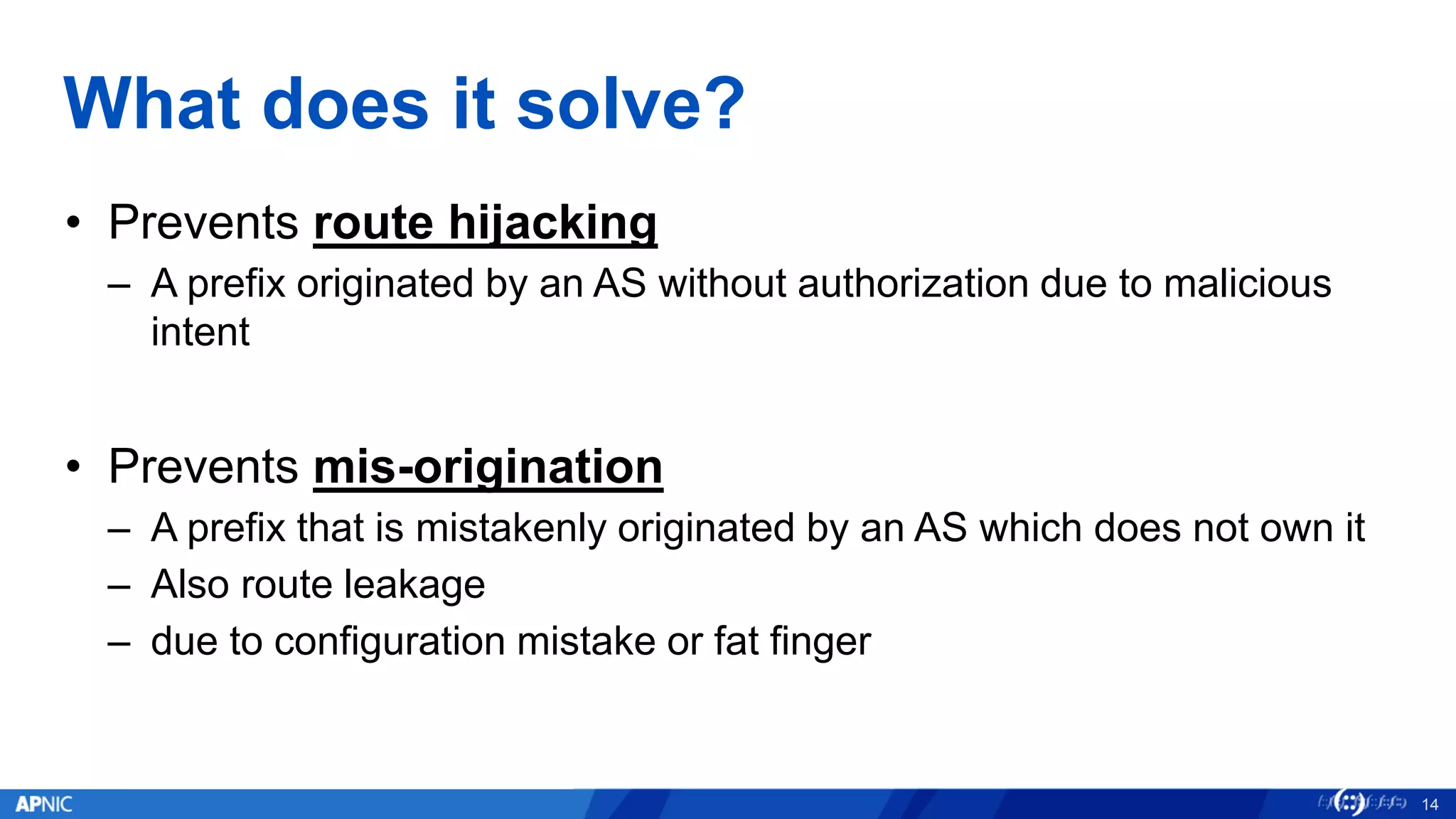
What does it solve?
• Prevents route hijacking
– A prefix originated by an AS without authorization due to malicious
intent
• Prevents mis-origination
– A prefix that is mistakenly originated by an AS which does not own it
– Also route leakage
– due to configuration mistake or fat finger
14
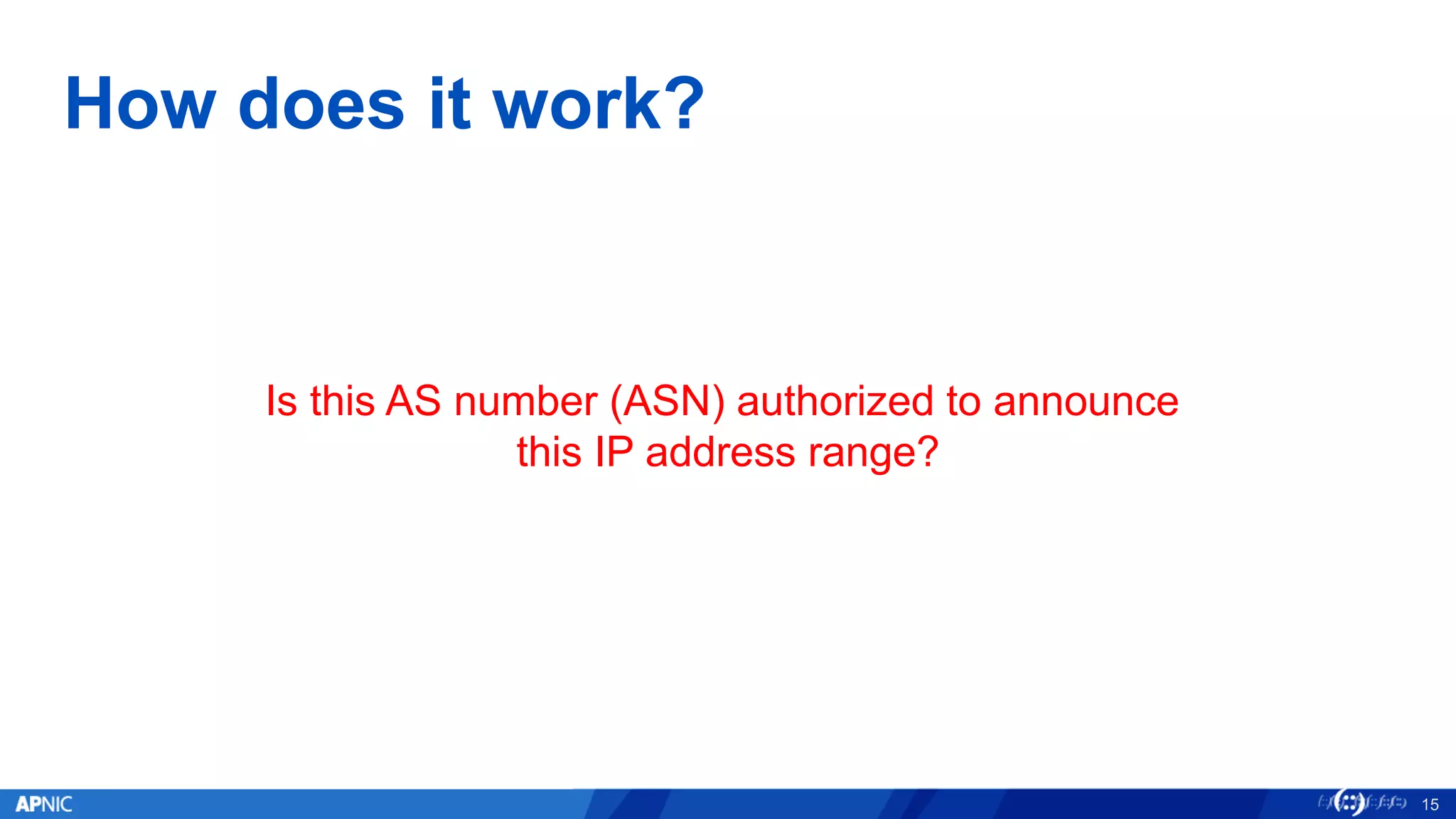
How does it work?
Is this AS number (ASN) authorized to announce
this IP address range?
15
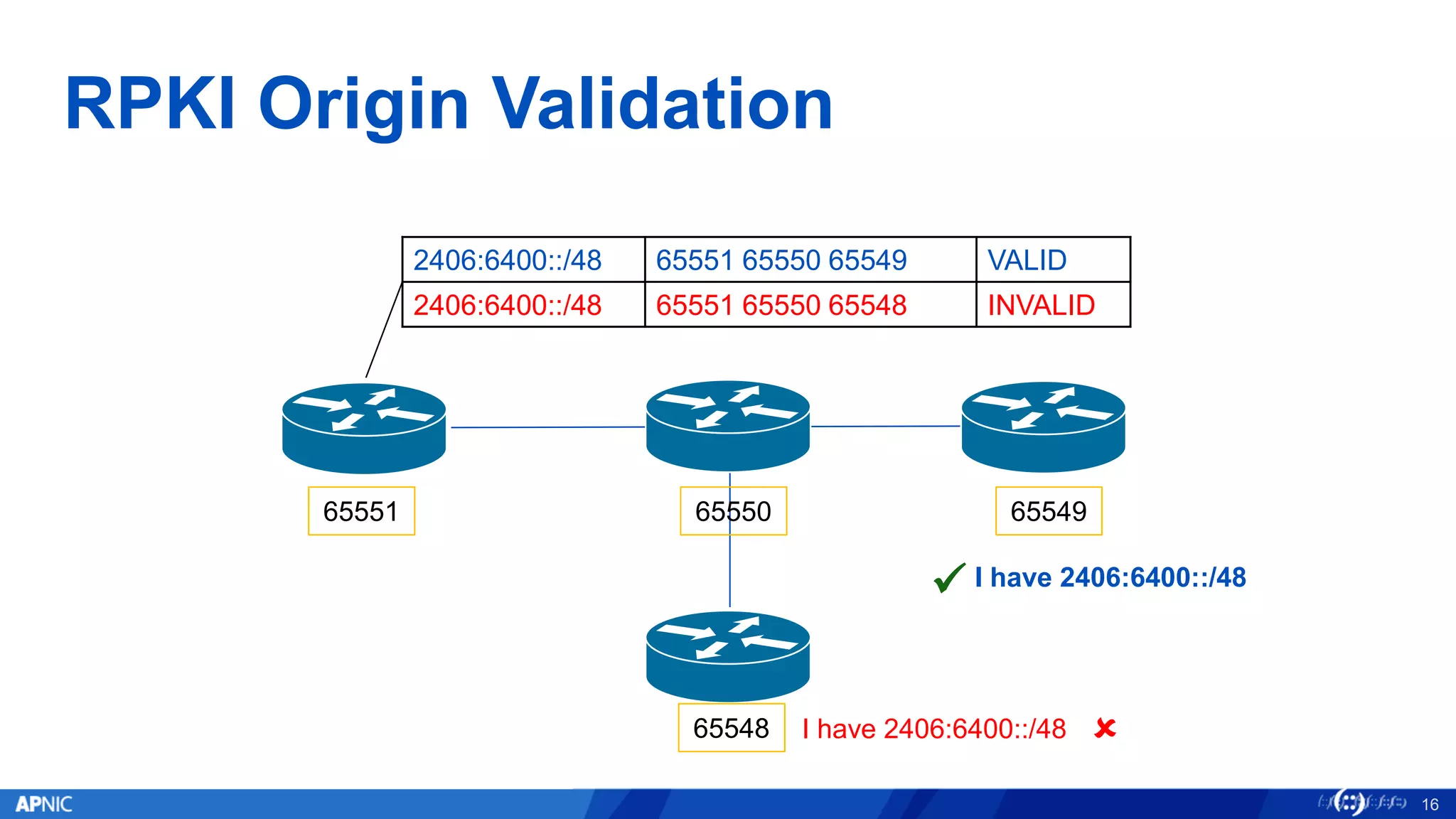
RPKI Origin Validation
16
2406:6400::/48 65551 65550 65549 VALID
2406:6400::/48 65551 65550 65548 INVALID
65549
65548
65551 65550
✓ I have 2406:6400::/48
I have 2406:6400::/48 
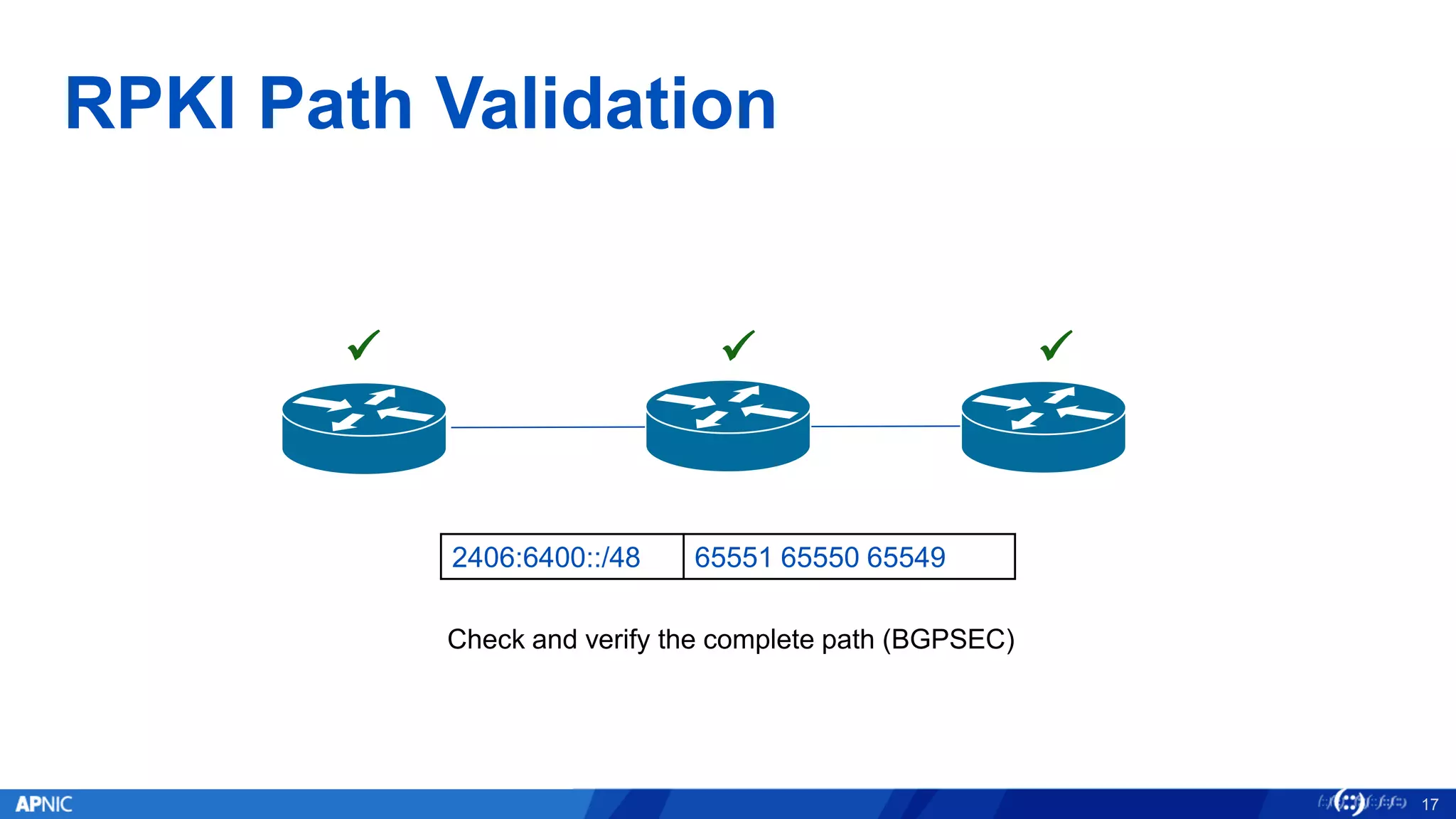
RPKI Path Validation
17
✓ ✓ ✓
2406:6400::/48 65551 65550 65549
Check and verify the complete path (BGPSEC)
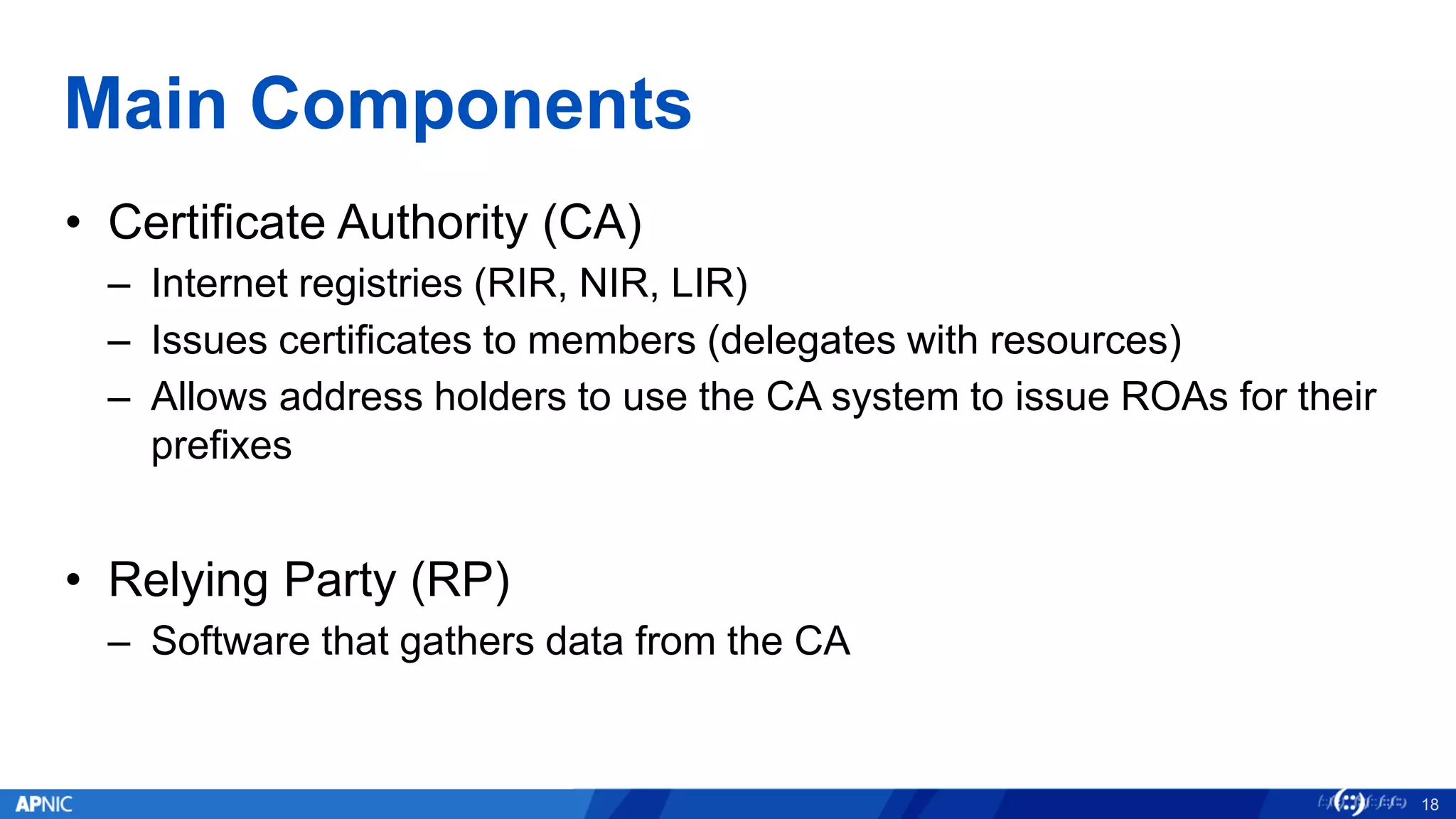
Main Components
• Certificate Authority (CA)
– Internet registries (RIR, NIR, LIR)
– Issues certificates to members (delegates with resources)
– Allows address holders to use the CA system to issue ROAs for their
prefixes
• Relying Party (RP)
– Software that gathers data from the CA
18
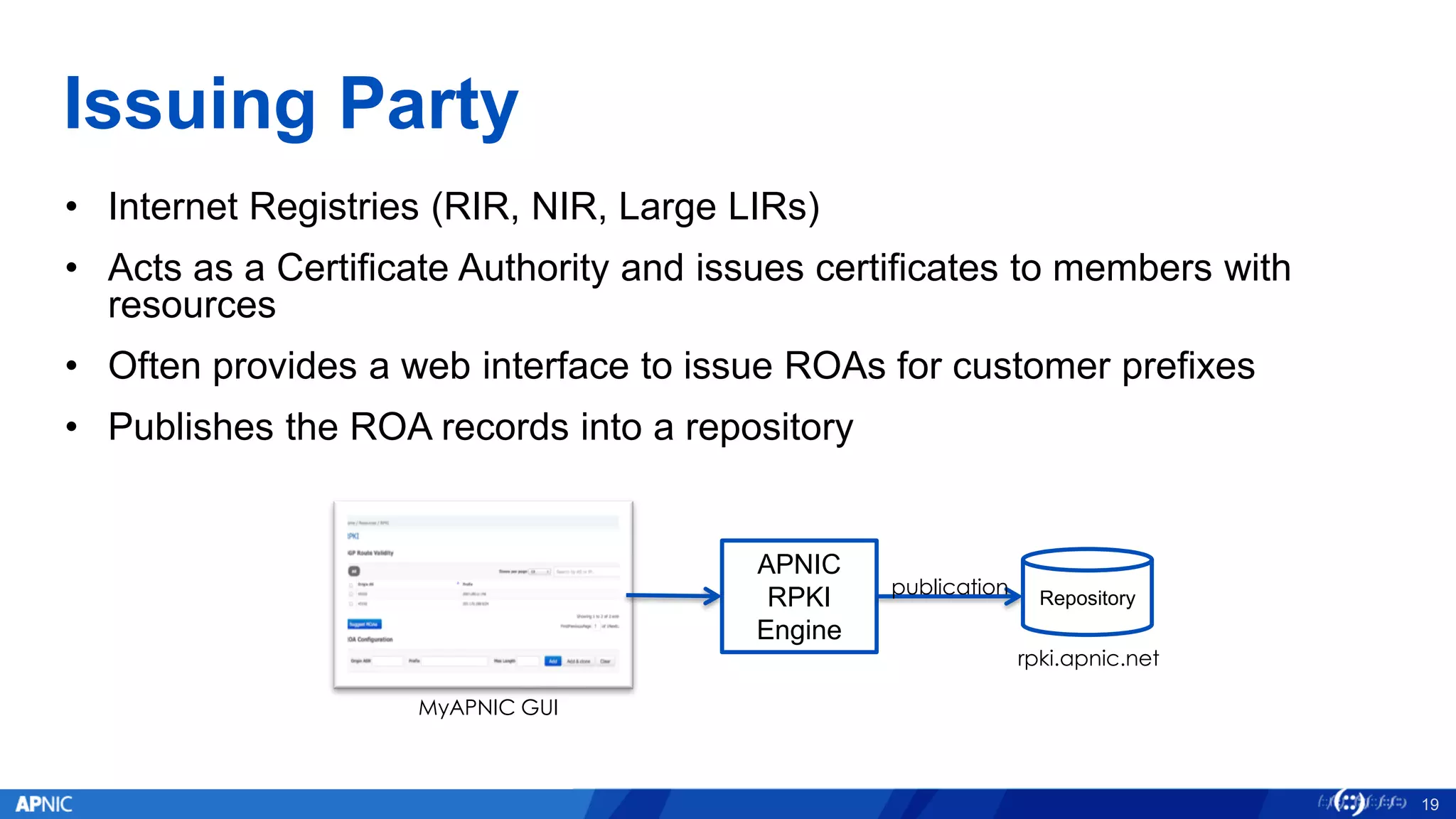
Issuing Party
• Internet Registries (RIR, NIR, Large LIRs)
• Acts as a Certificate Authority and issues certificates to members with
resources
• Often provides a web interface to issue ROAs for customer prefixes
• Publishes the ROA records into a repository
APNIC
RPKI
Engine
publication
MyAPNIC GUI
rpki.apnic.net
Repository
19
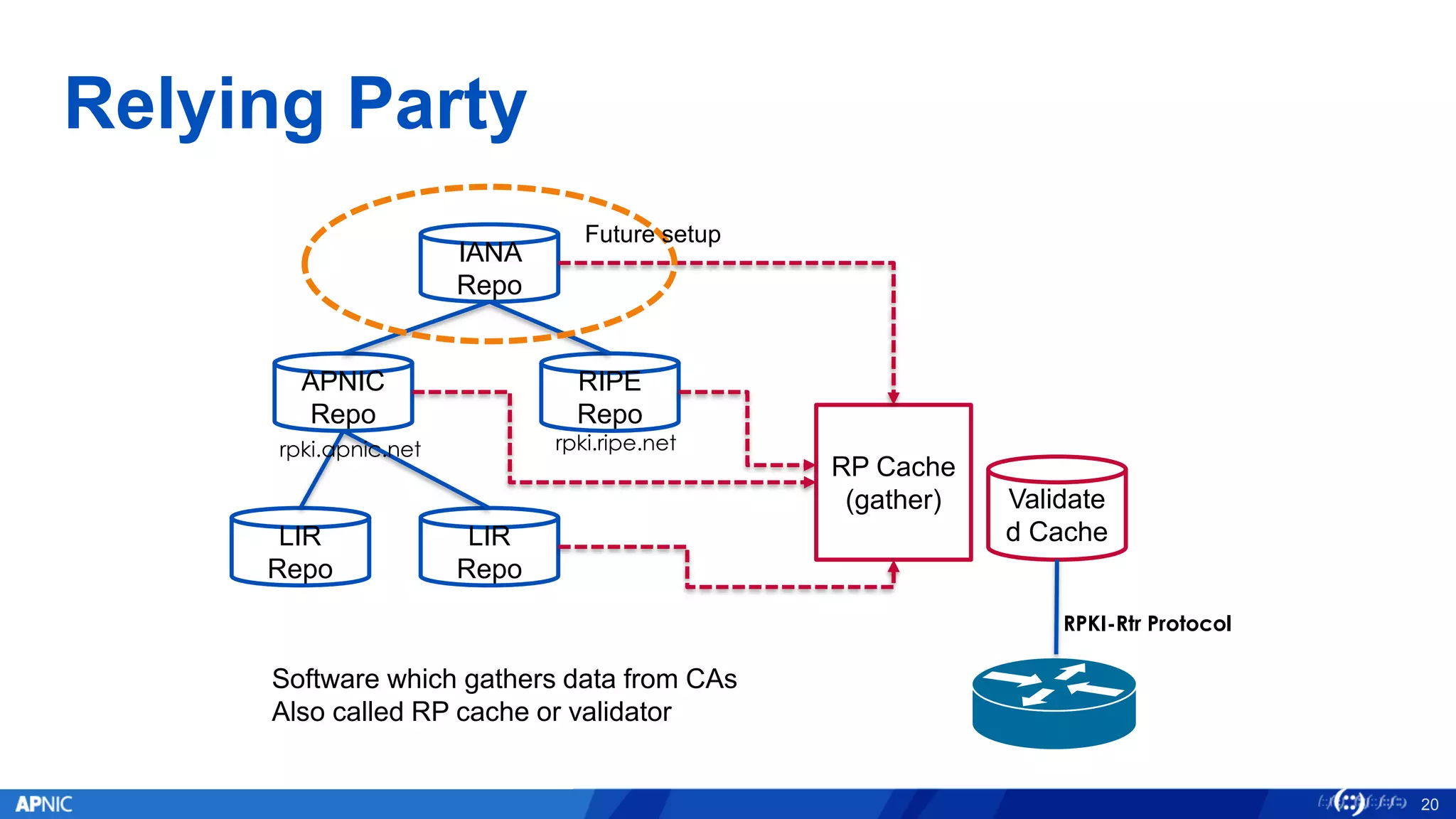
Relying Party
IANA
Repo
APNIC
Repo
RIPE
Repo
LIR
Repo
LIR
Repo
RP Cache
(gather) Validate
d Cache
RPKI-Rtr Protocol
rpki.ripe.net
Software which gathers data from CAs
Also called RP cache or validator
20
rpki.apnic.net
Future setup
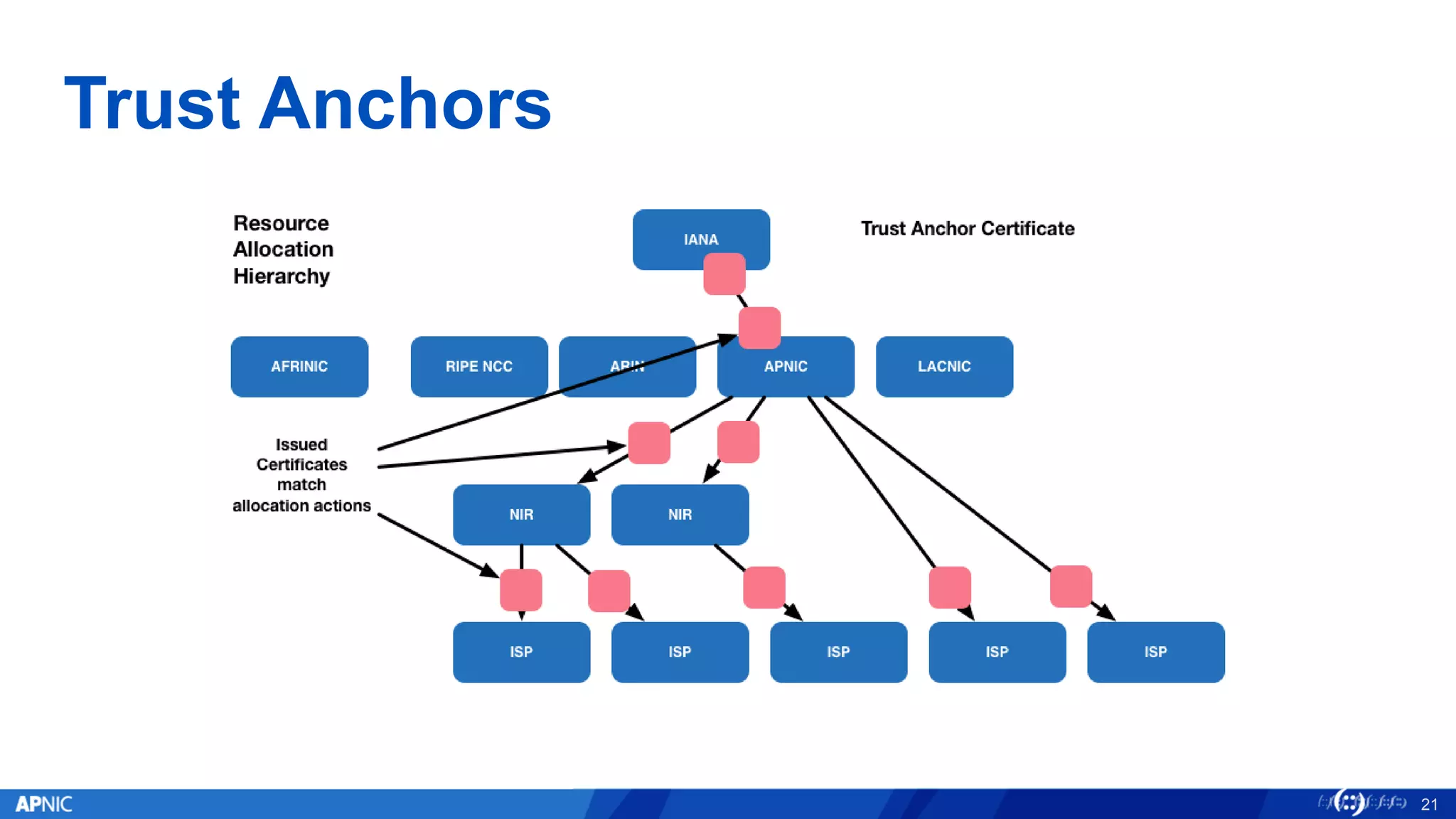
Trust Anchors
21
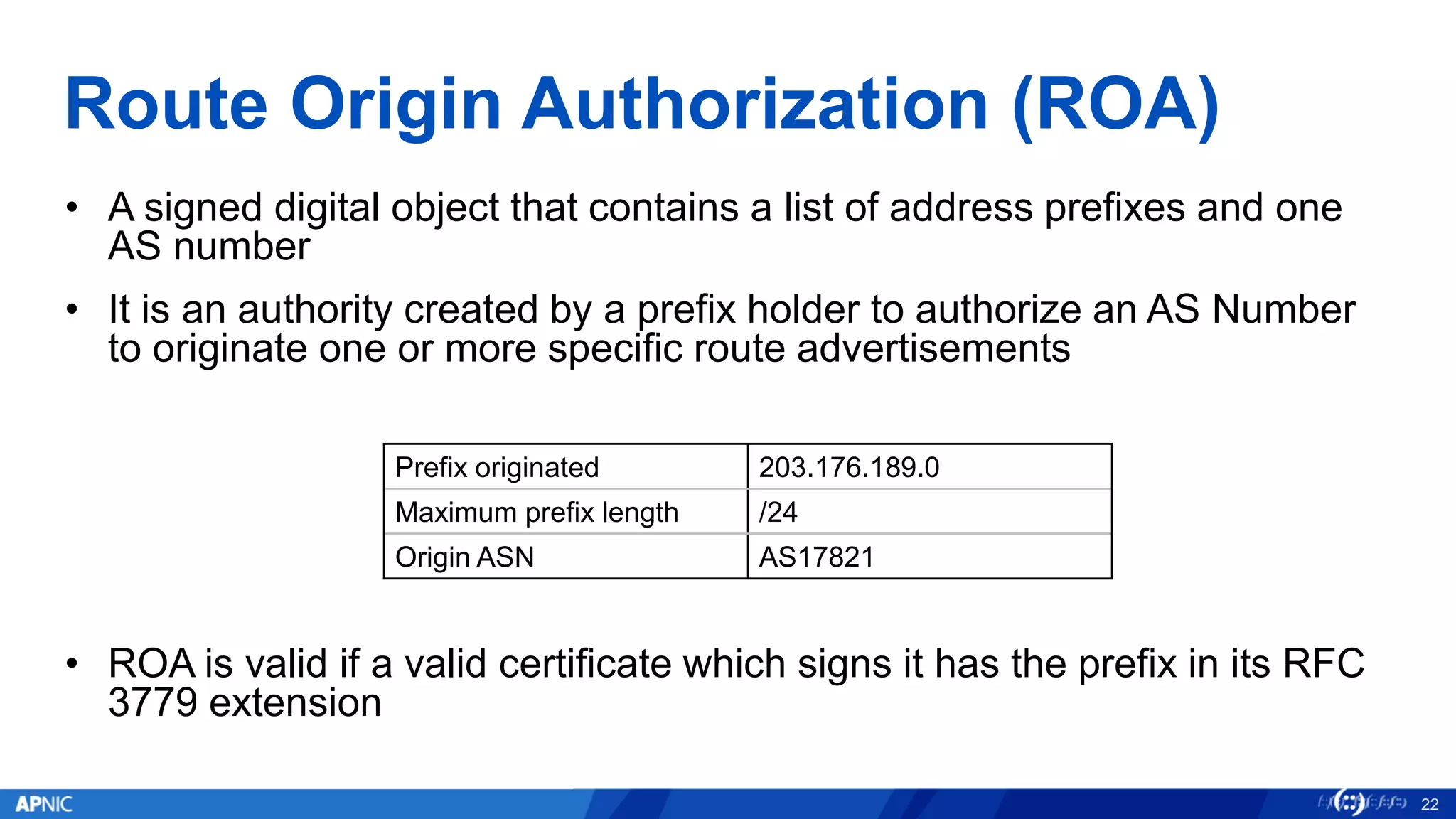
Route Origin Authorization (ROA)
• A signed digital object that contains a list of address prefixes and one
AS number
• It is an authority created by a prefix holder to authorize an AS Number
to originate one or more specific route advertisements
• ROA is valid if a valid certificate which signs it has the prefix in its RFC
3779 extension
22
Prefix originated 203.176.189.0
Maximum prefix length /24
Origin ASN AS17821
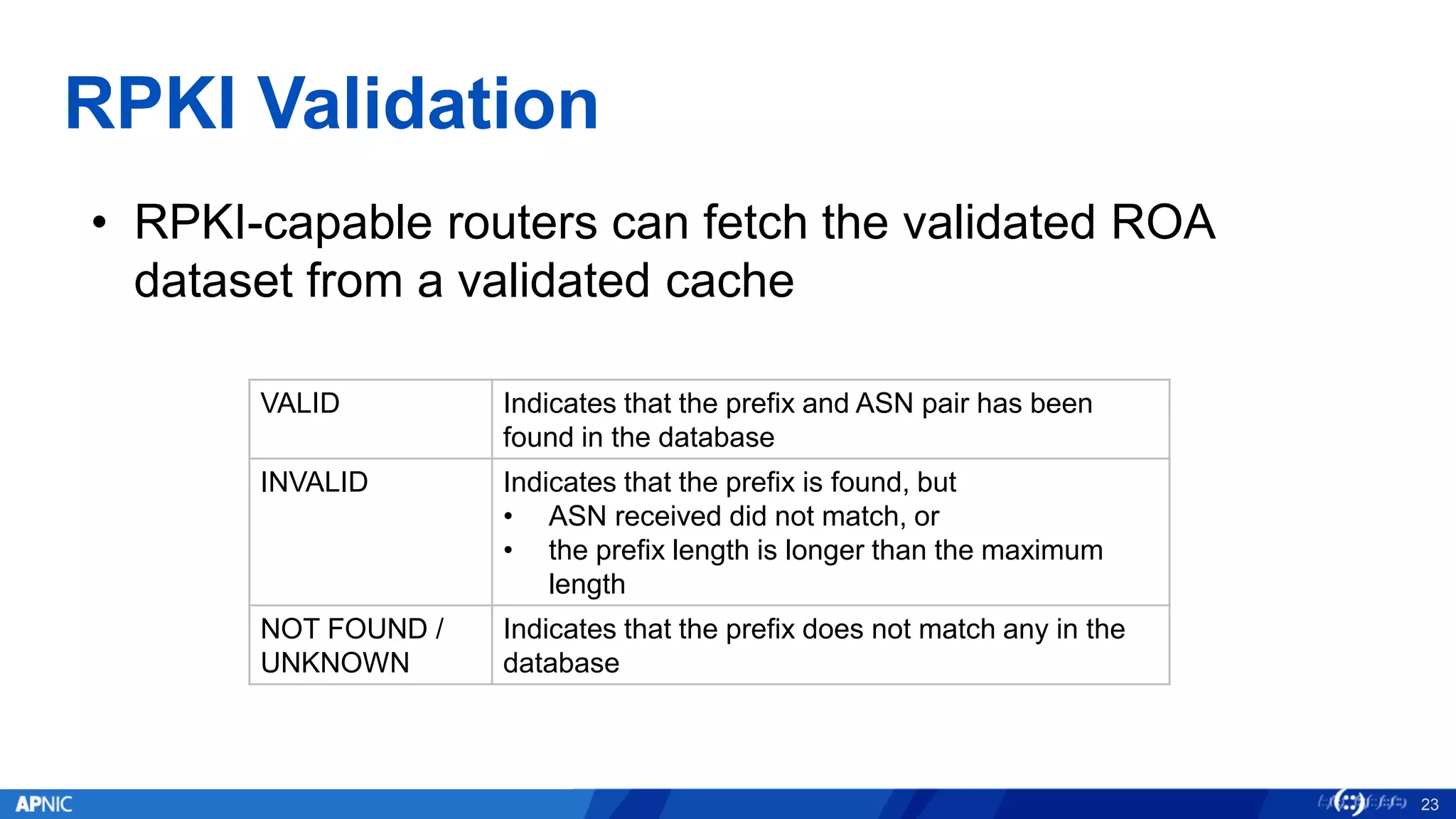
RPKI Validation
• RPKI-capable routers can fetch the validated ROA
dataset from a validated cache
VALID Indicates that the prefix and ASN pair has been
found in the database
INVALID Indicates that the prefix is found, but
• ASN received did not match, or
• the prefix length is longer than the maximum
length
NOT FOUND /
UNKNOWN
Indicates that the prefix does not match any in the
database
23
RPKI Deployment and
Operations
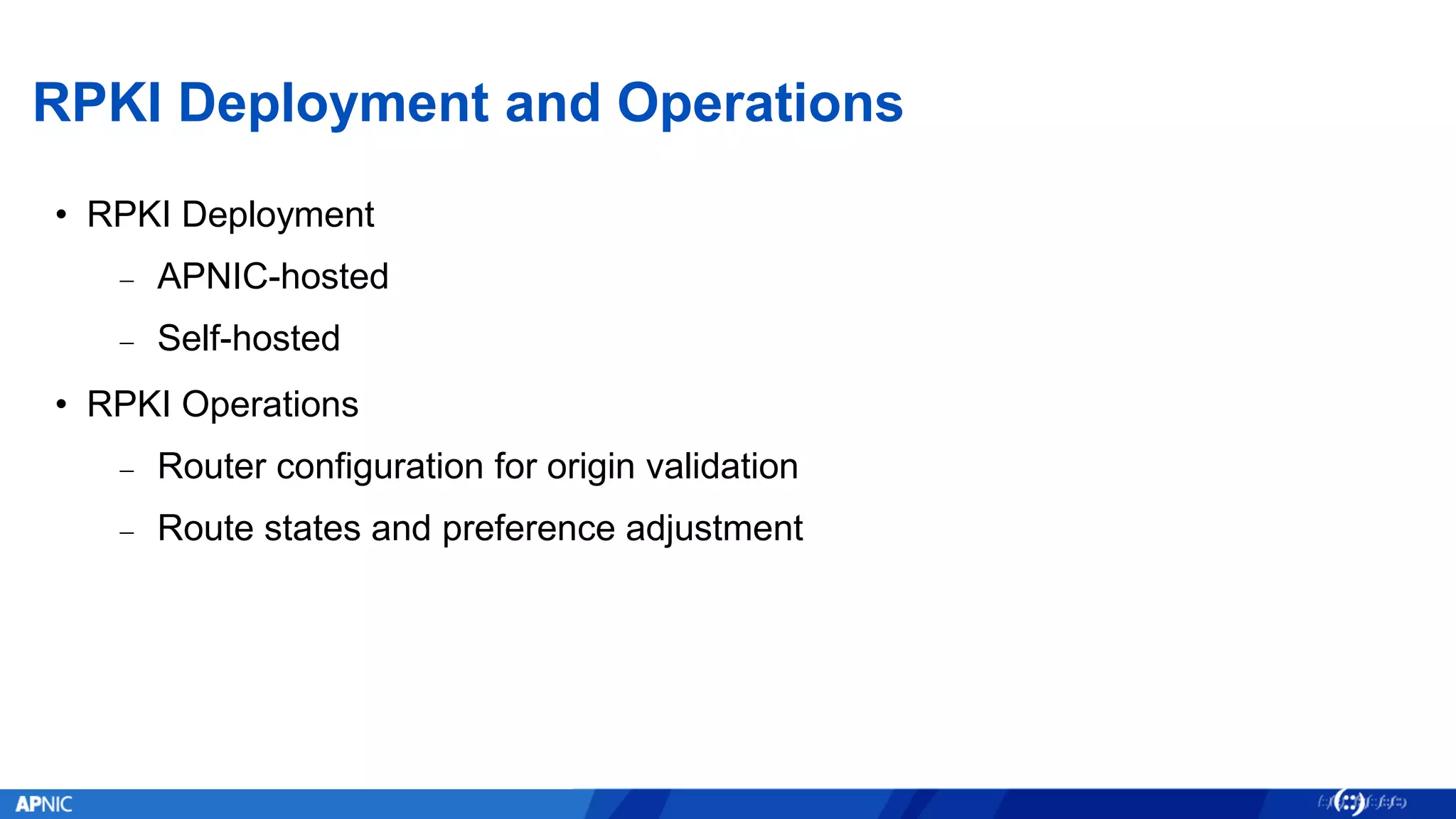
RPKI Deployment and Operations
• RPKI Deployment
− APNIC-hosted
− Self-hosted
• RPKI Operations
− Router configuration for origin validation
− Route states and preference adjustment
RPKI Deployment: APNIC-hosted
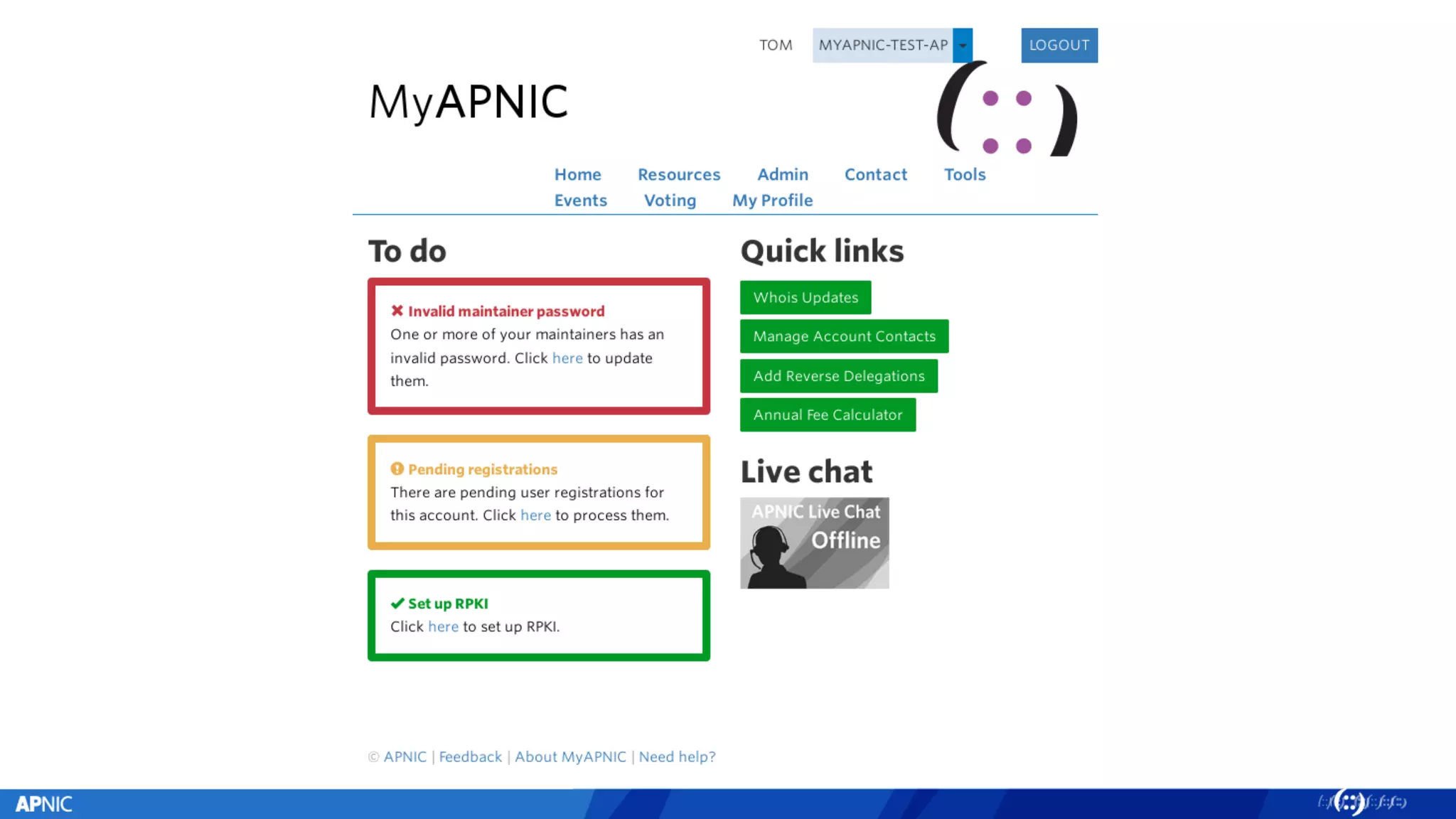
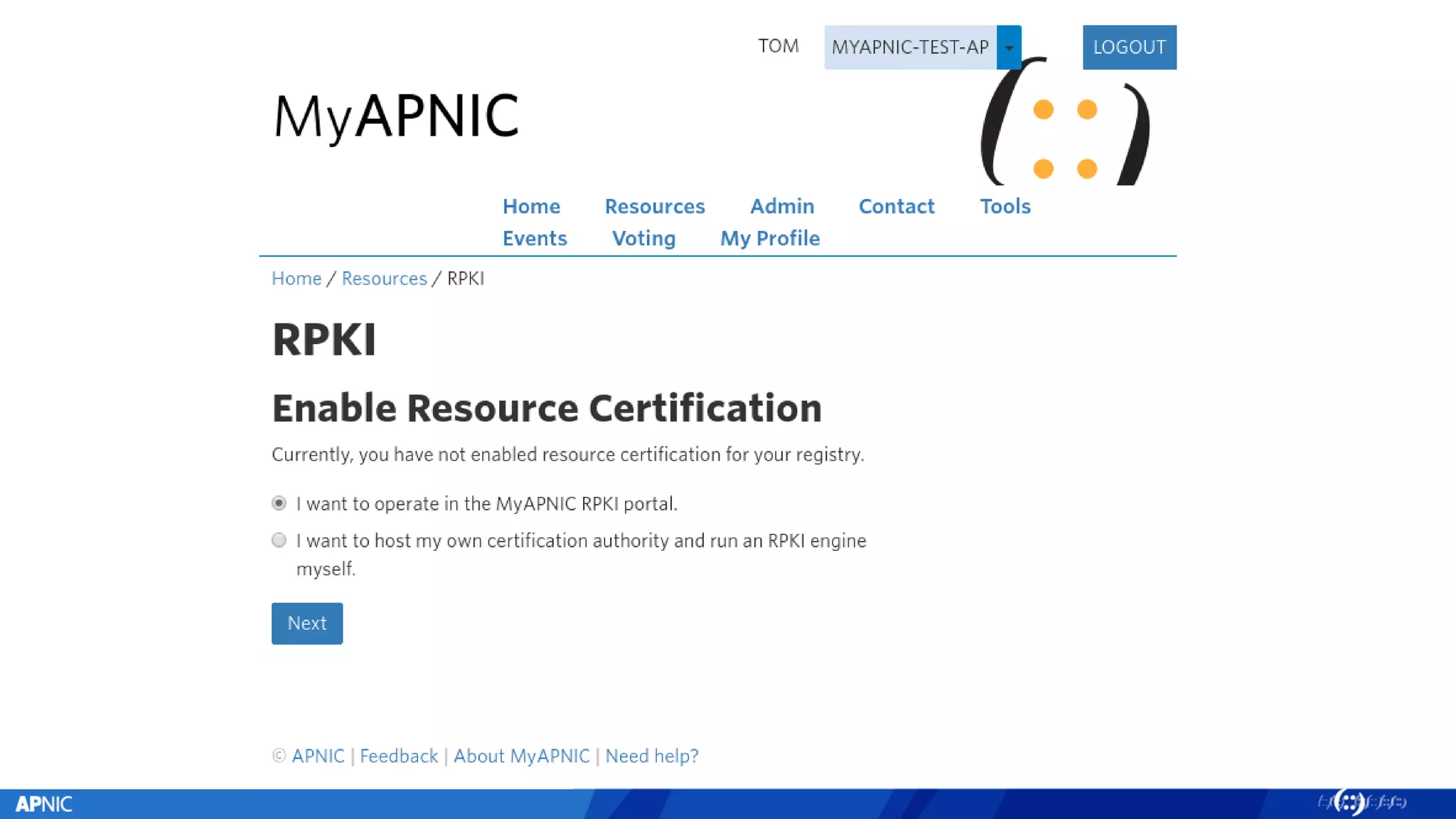
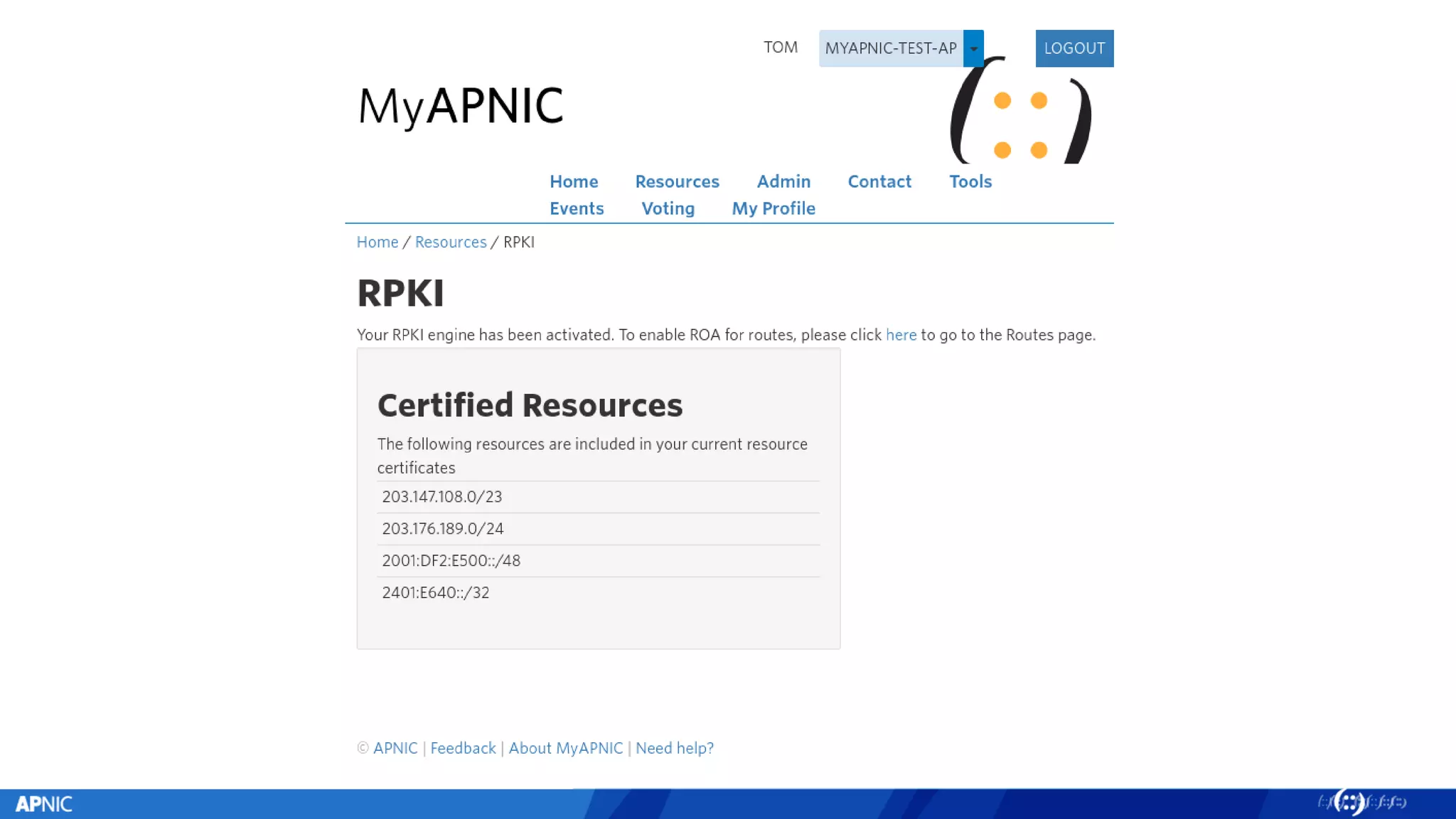
• Enable RPKI in MyAPNIC
− Set up two-factor authentication
− Ensure permissions are set correctly
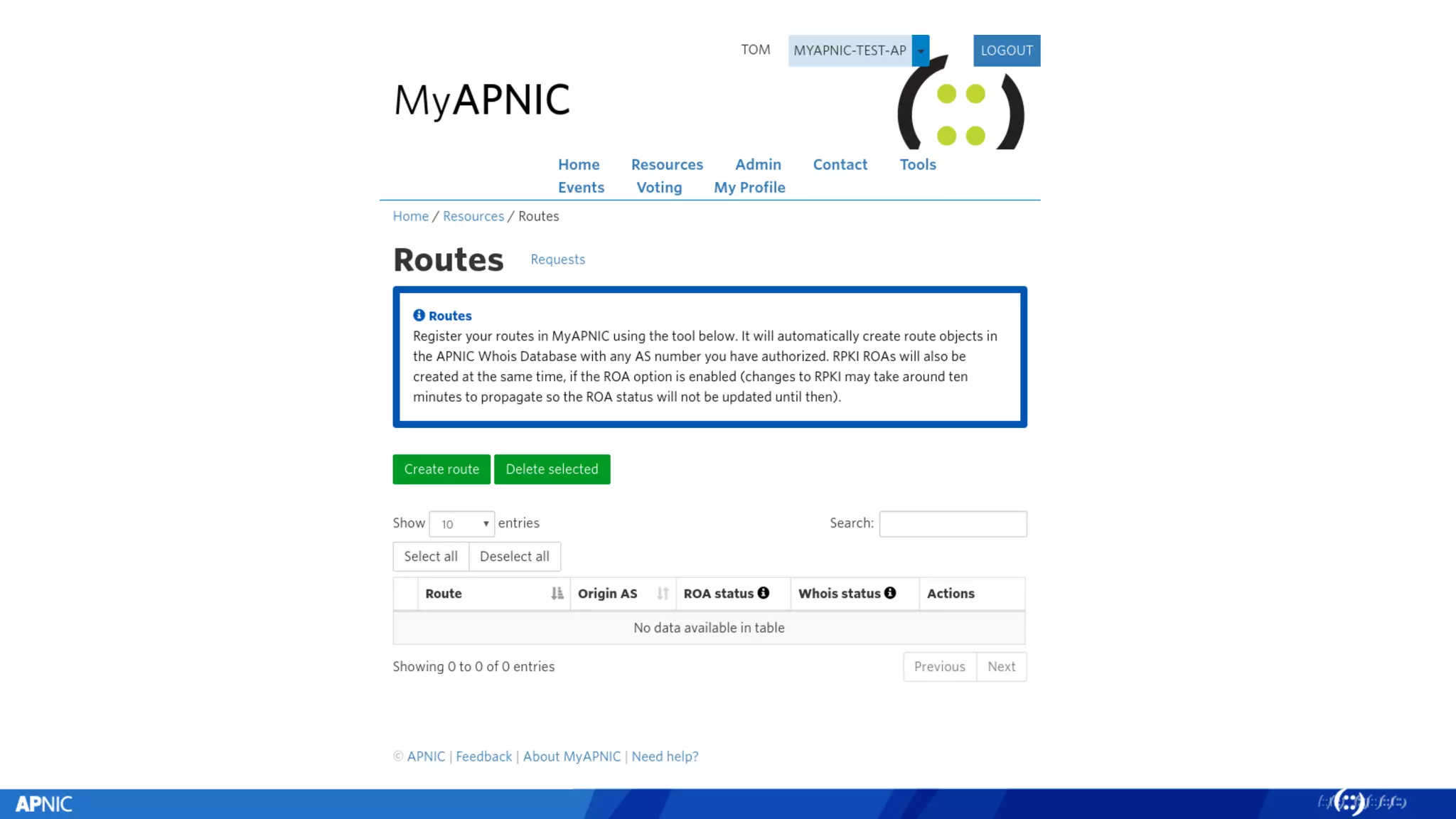
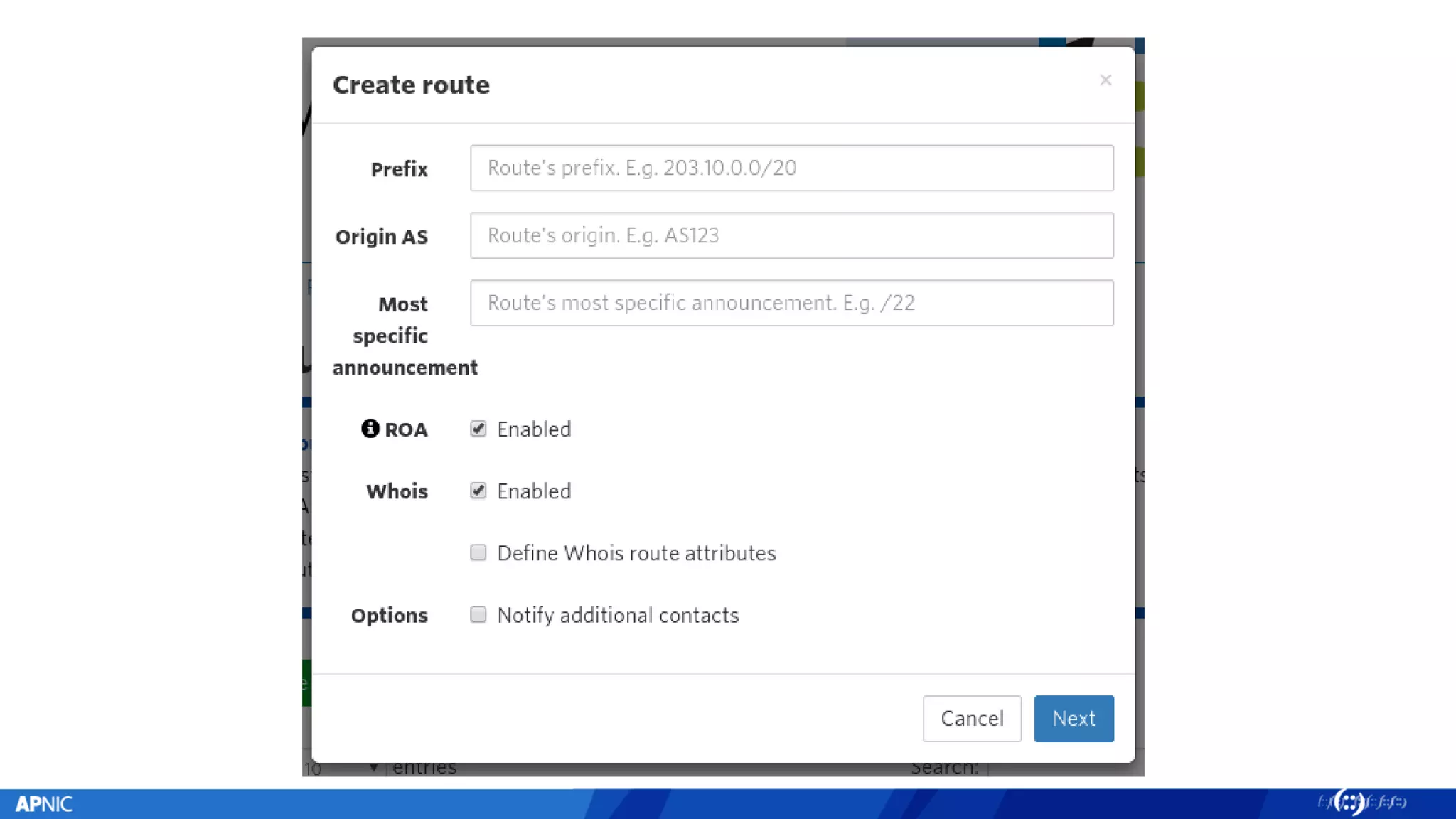
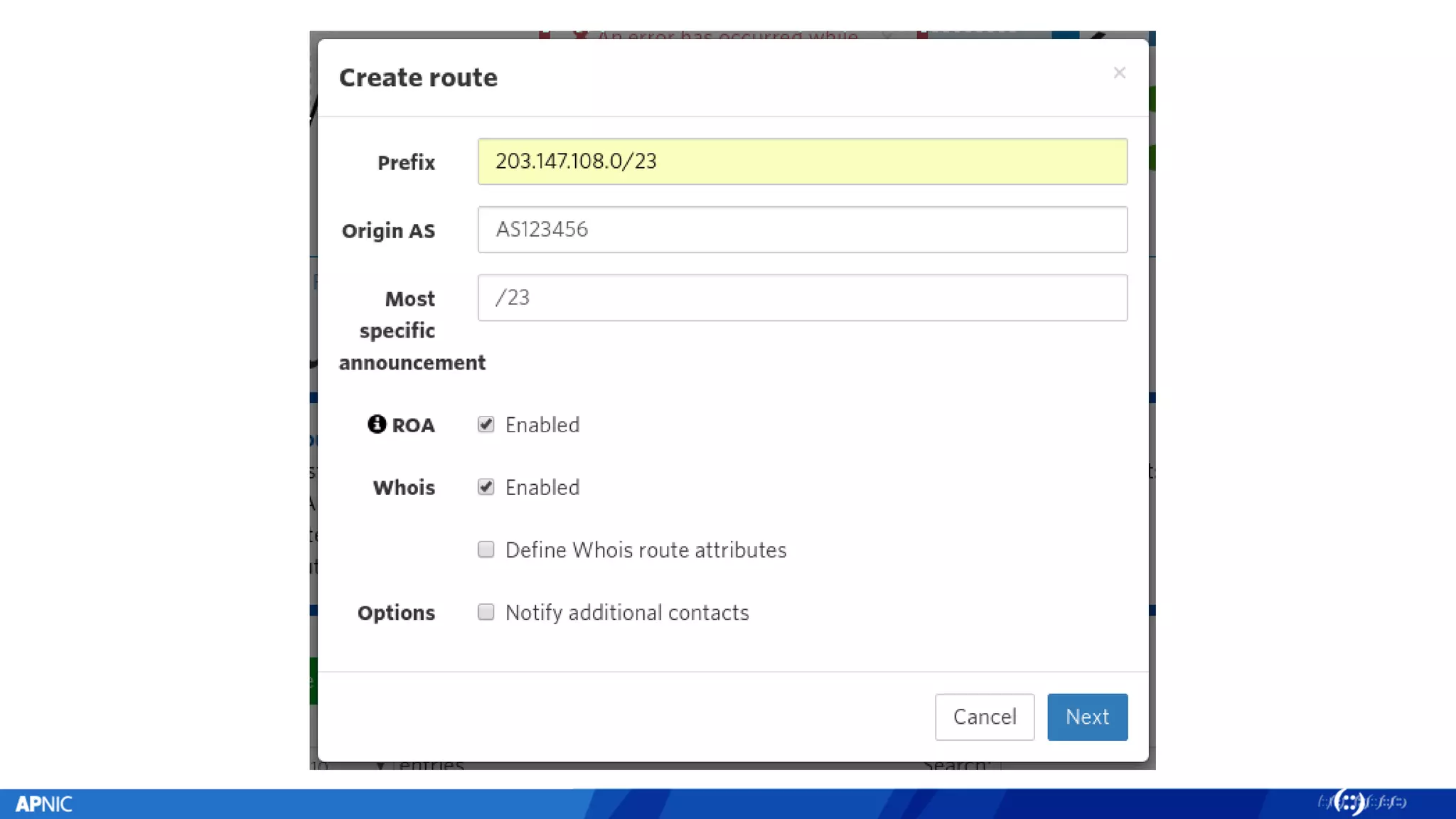
• Register routes using route management tool
− Covers both RPKI and Whois (IRR)
Where Are We In
Deployment Of RPKI?
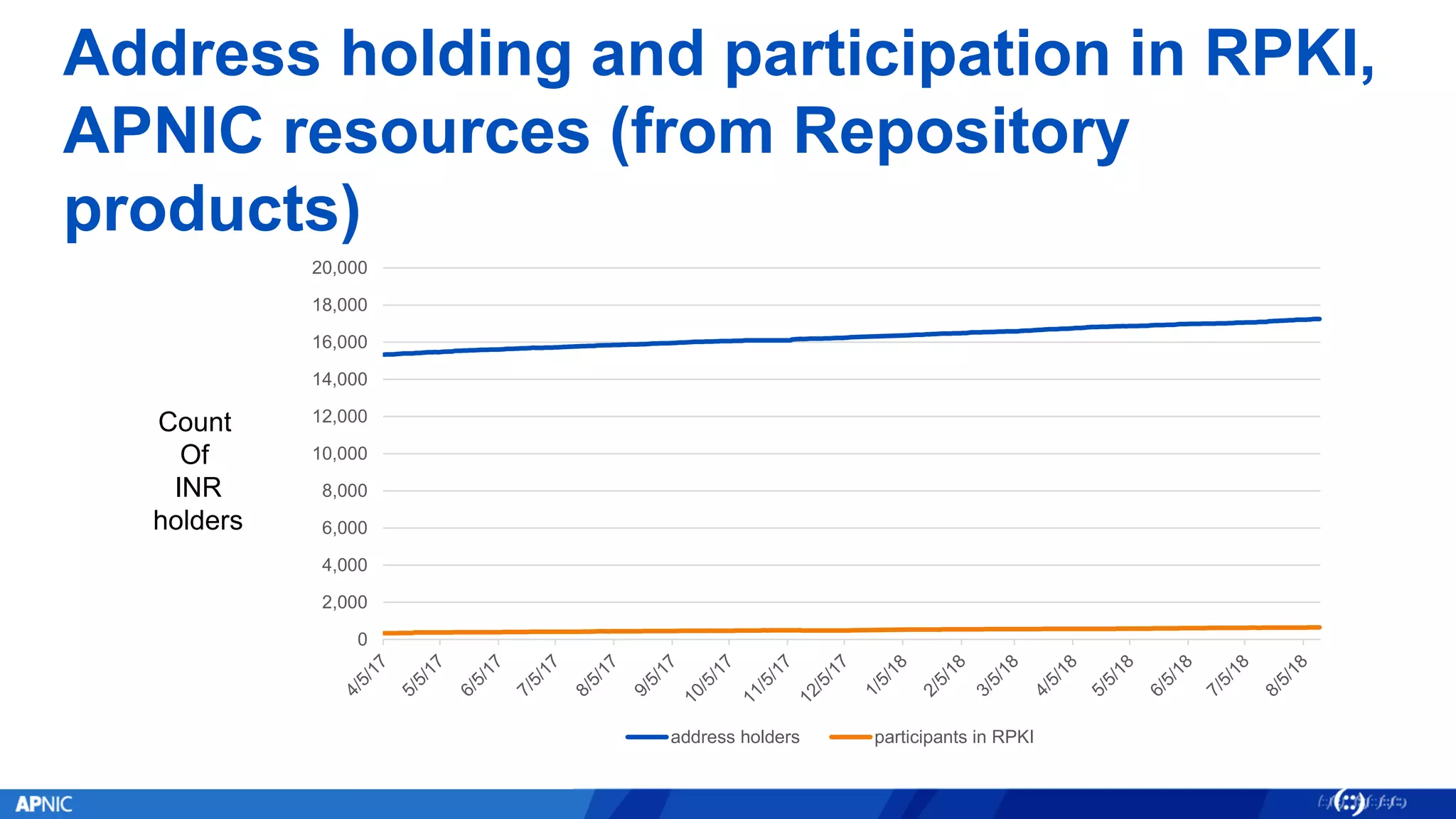
Address holding and participation in RPKI,
APNIC resources (from Repository
products)
0
2,000
4,000
6,000
8,000
10,000
12,000
14,000
16,000
18,000
20,000
address holders participants in RPKI
Count
Of
INR
holders
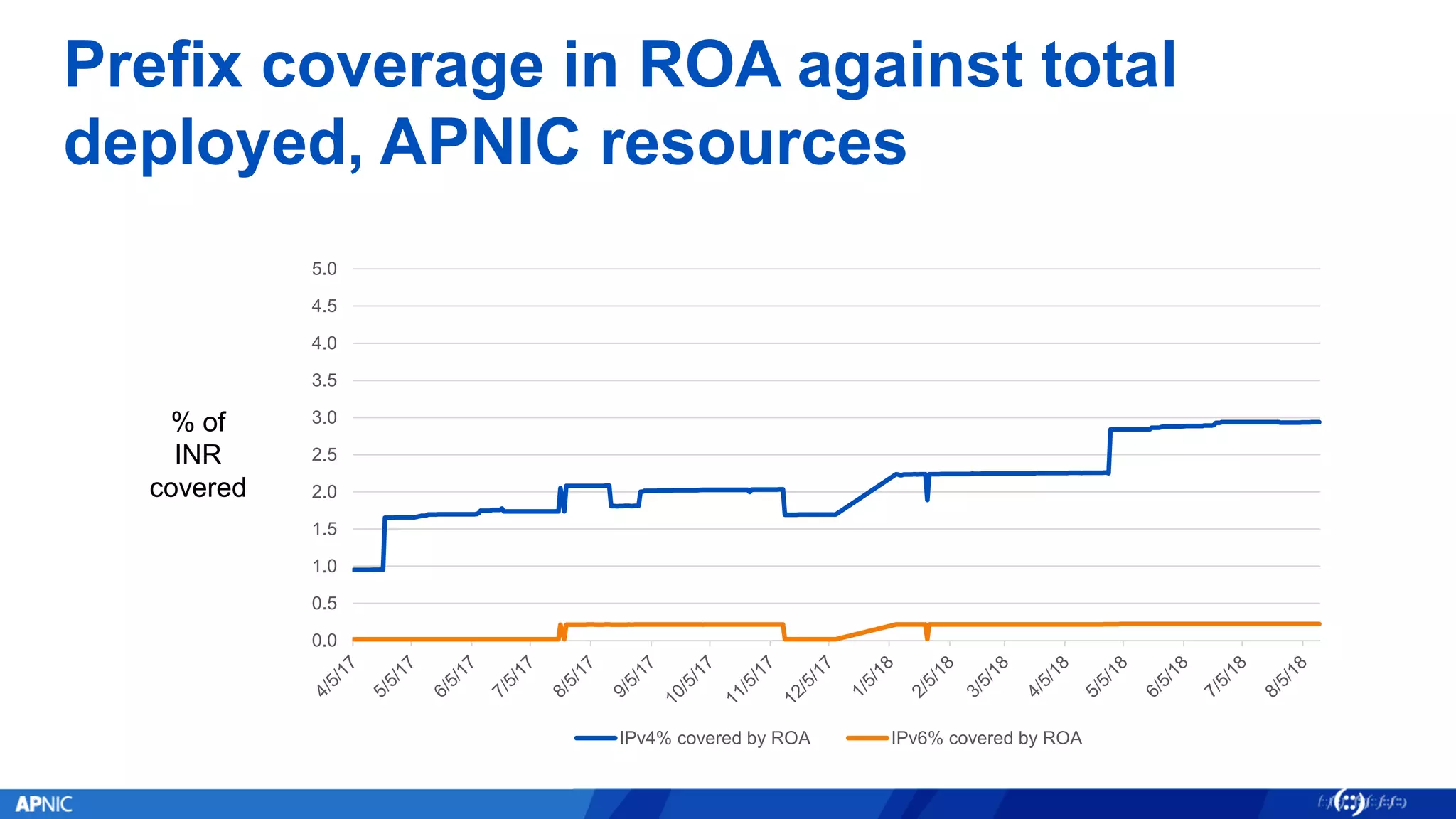
Prefix coverage in ROA against total
deployed, APNIC resources
0.0
0.5
1.0
1.5
2.0
2.5
3.0
3.5
4.0
4.5
5.0
IPv4% covered by ROA IPv6% covered by ROA
% of
INR
covered
“its not looking compelling”
• There is no strong visible trend in the last year suggestive of a surge in Asia-Pacific RPKI
participation
– There is increase, but its incremental, not exponential (I think)
– Even if it was exponential, its very very early-life
• Rate of growth is below the rate of growth in participation overall
– We give out more address space, to more people, than join to publish ROA
• Changes in ROA state are ‘lumpy’ correlating with specific ISPs changing their RPKI signing
state.
– Low levels of participation mean large swings visible
• Conclusion: we are still in early adoption phase of the life cycle of RPKI in the Asia-Pacific
region
– Key drivers are training, and directed engagement or outreach
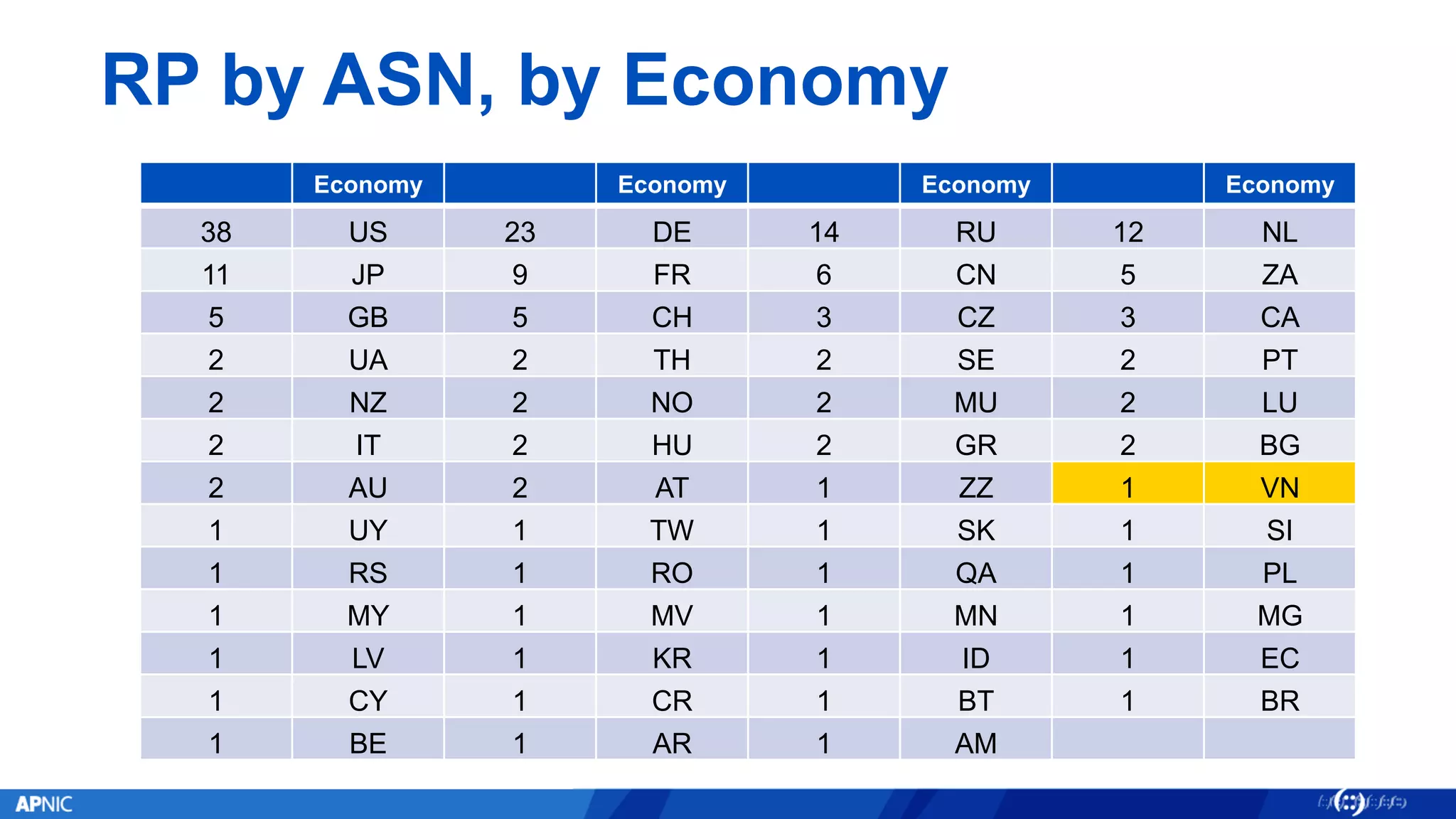
Economy Economy Economy Economy
38 US 23 DE 14 RU 12 NL
11 JP 9 FR 6 CN 5 ZA
5 GB 5 CH 3 CZ 3 CA
2 UA 2 TH 2 SE 2 PT
2 NZ 2 NO 2 MU 2 LU
2 IT 2 HU 2 GR 2 BG
2 AU 2 AT 1 ZZ 1 VN
1 UY 1 TW 1 SK 1 SI
1 RS 1 RO 1 QA 1 PL
1 MY 1 MV 1 MN 1 MG
1 LV 1 KR 1 ID 1 EC
1 CY 1 CR 1 BT 1 BR
1 BE 1 AR 1 AM
RP by ASN, by Economy
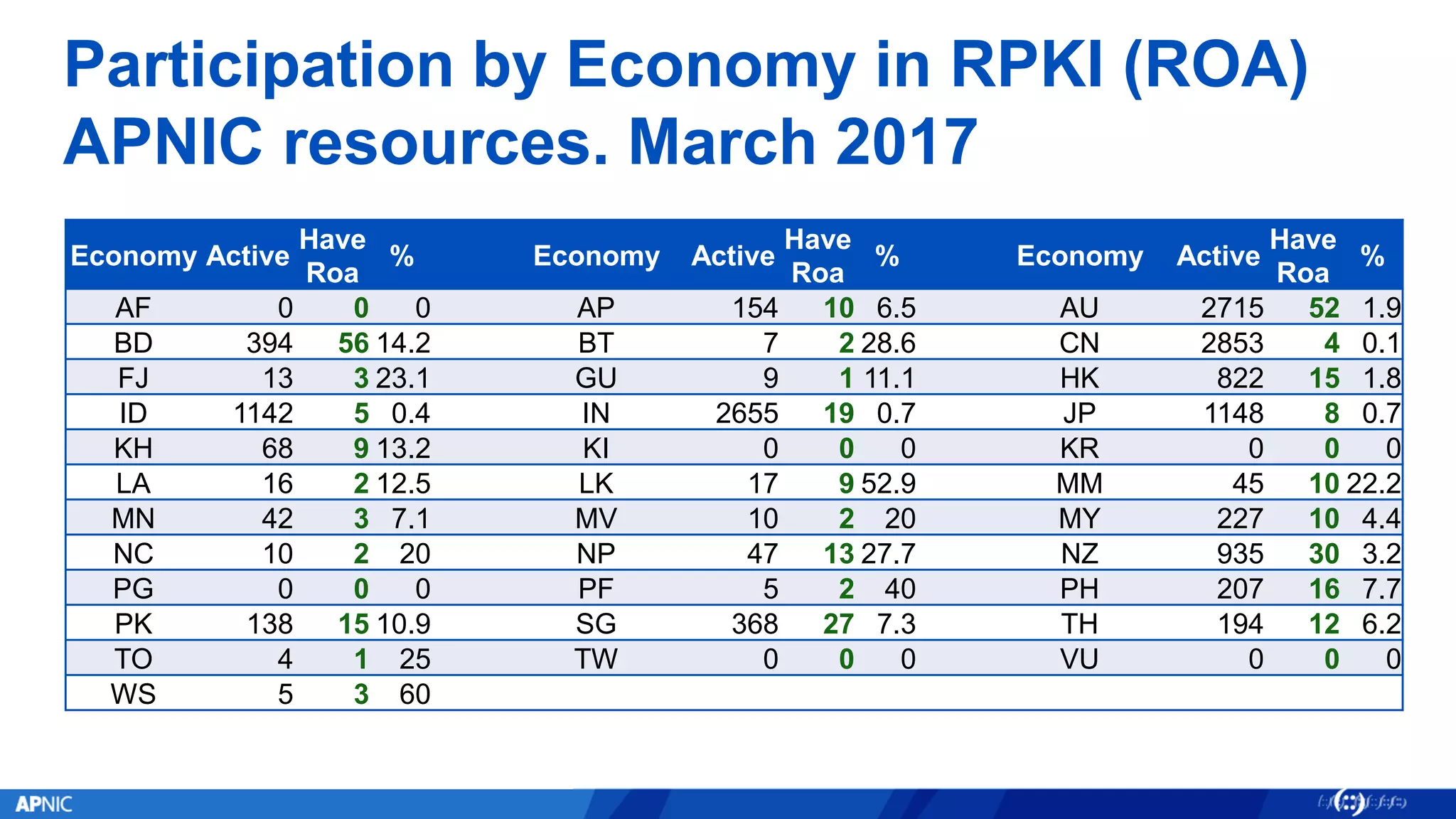
Participation by Economy in RPKI (ROA)
APNIC resources. March 2017
Economy Active
Have
Roa
% Economy Active
Have
Roa
% Economy Active
Have
Roa
%
AF 0 0 0 AP 154 10 6.5 AU 2715 52 1.9
BD 394 56 14.2 BT 7 2 28.6 CN 2853 4 0.1
FJ 13 3 23.1 GU 9 1 11.1 HK 822 15 1.8
ID 1142 5 0.4 IN 2655 19 0.7 JP 1148 8 0.7
KH 68 9 13.2 KI 0 0 0 KR 0 0 0
LA 16 2 12.5 LK 17 9 52.9 MM 45 10 22.2
MN 42 3 7.1 MV 10 2 20 MY 227 10 4.4
NC 10 2 20 NP 47 13 27.7 NZ 935 30 3.2
PG 0 0 0 PF 5 2 40 PH 207 16 7.7
PK 138 15 10.9 SG 368 27 7.3 TH 194 12 6.2
TO 4 1 25 TW 0 0 0 VU 0 0 0
WS 5 3 60
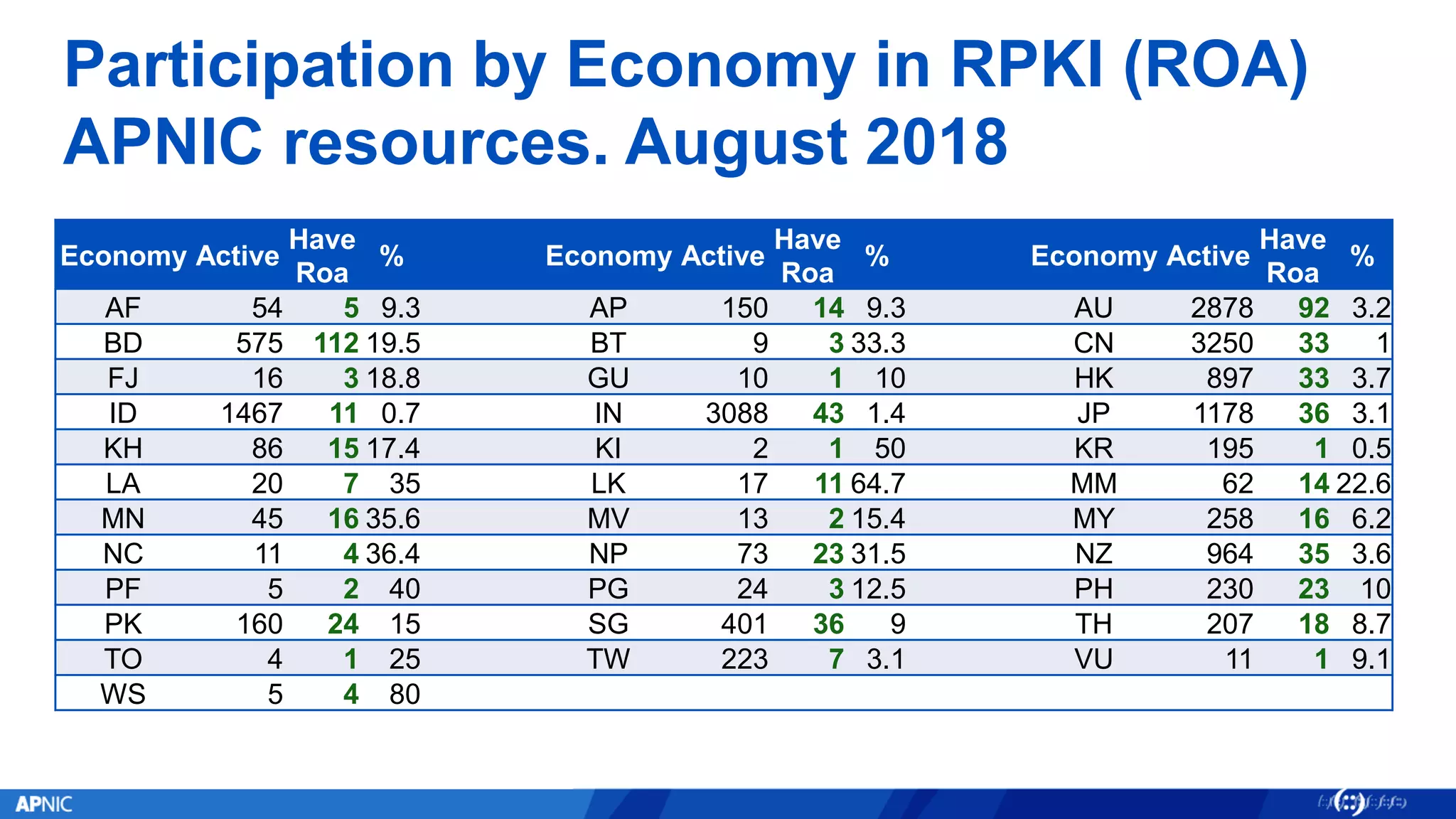
Participation by Economy in RPKI (ROA)
APNIC resources. August 2018
Economy Active
Have
Roa
% Economy Active
Have
Roa
% Economy Active
Have
Roa
%
AF 54 5 9.3 AP 150 14 9.3 AU 2878 92 3.2
BD 575 112 19.5 BT 9 3 33.3 CN 3250 33 1
FJ 16 3 18.8 GU 10 1 10 HK 897 33 3.7
ID 1467 11 0.7 IN 3088 43 1.4 JP 1178 36 3.1
KH 86 15 17.4 KI 2 1 50 KR 195 1 0.5
LA 20 7 35 LK 17 11 64.7 MM 62 14 22.6
MN 45 16 35.6 MV 13 2 15.4 MY 258 16 6.2
NC 11 4 36.4 NP 73 23 31.5 NZ 964 35 3.6
PF 5 2 40 PG 24 3 12.5 PH 230 23 10
PK 160 24 15 SG 401 36 9 TH 207 18 8.7
TO 4 1 25 TW 223 7 3.1 VU 11 1 9.1
WS 5 4 80
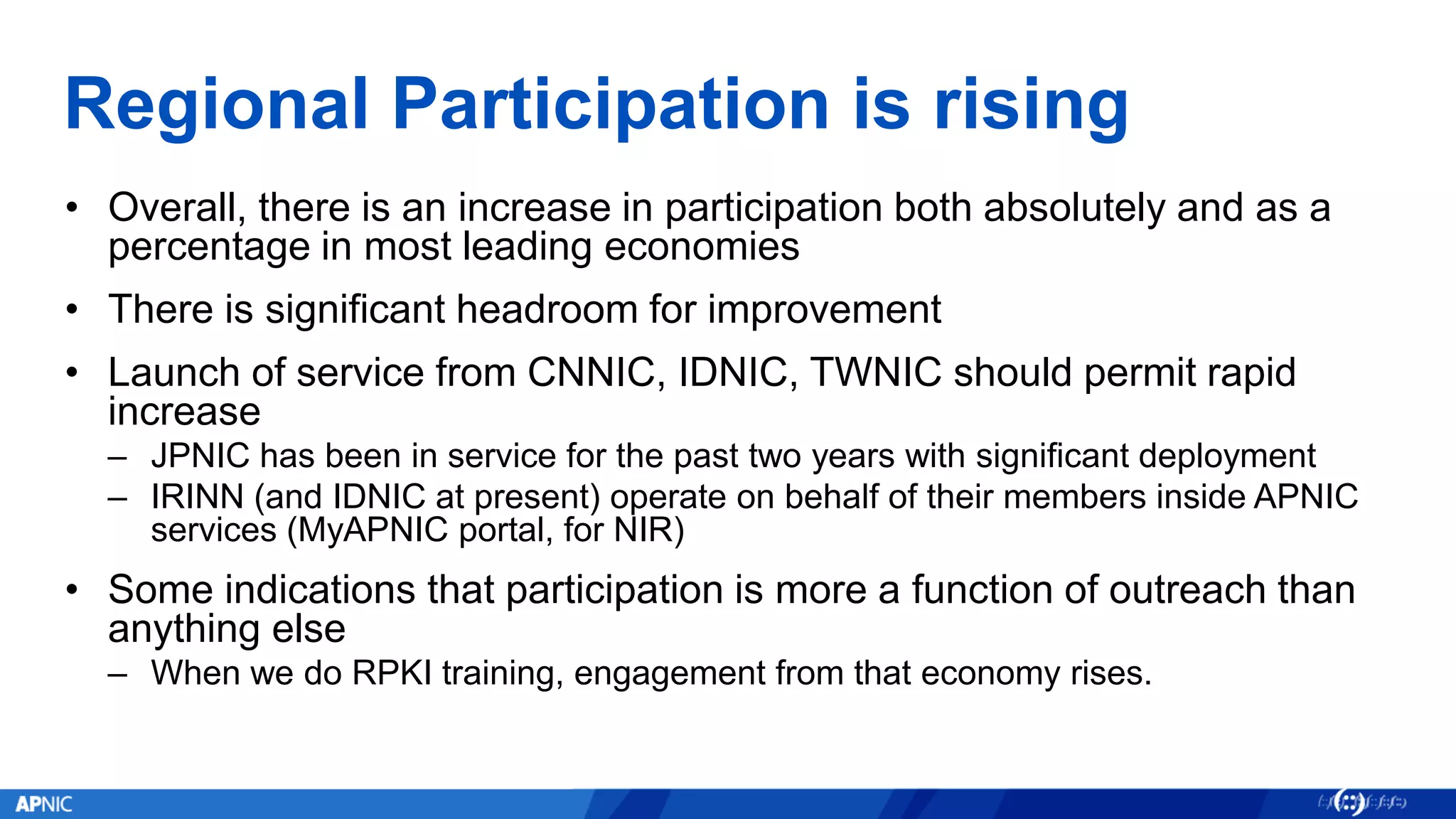
Regional Participation is rising
• Overall, there is an increase in participation both absolutely and as a
percentage in most leading economies
• There is significant headroom for improvement
• Launch of service from CNNIC, IDNIC, TWNIC should permit rapid
increase
– JPNIC has been in service for the past two years with significant deployment
– IRINN (and IDNIC at present) operate on behalf of their members inside APNIC
services (MyAPNIC portal, for NIR)
• Some indications that participation is more a function of outreach than
anything else
– When we do RPKI training, engagement from that economy rises.
Conclusions
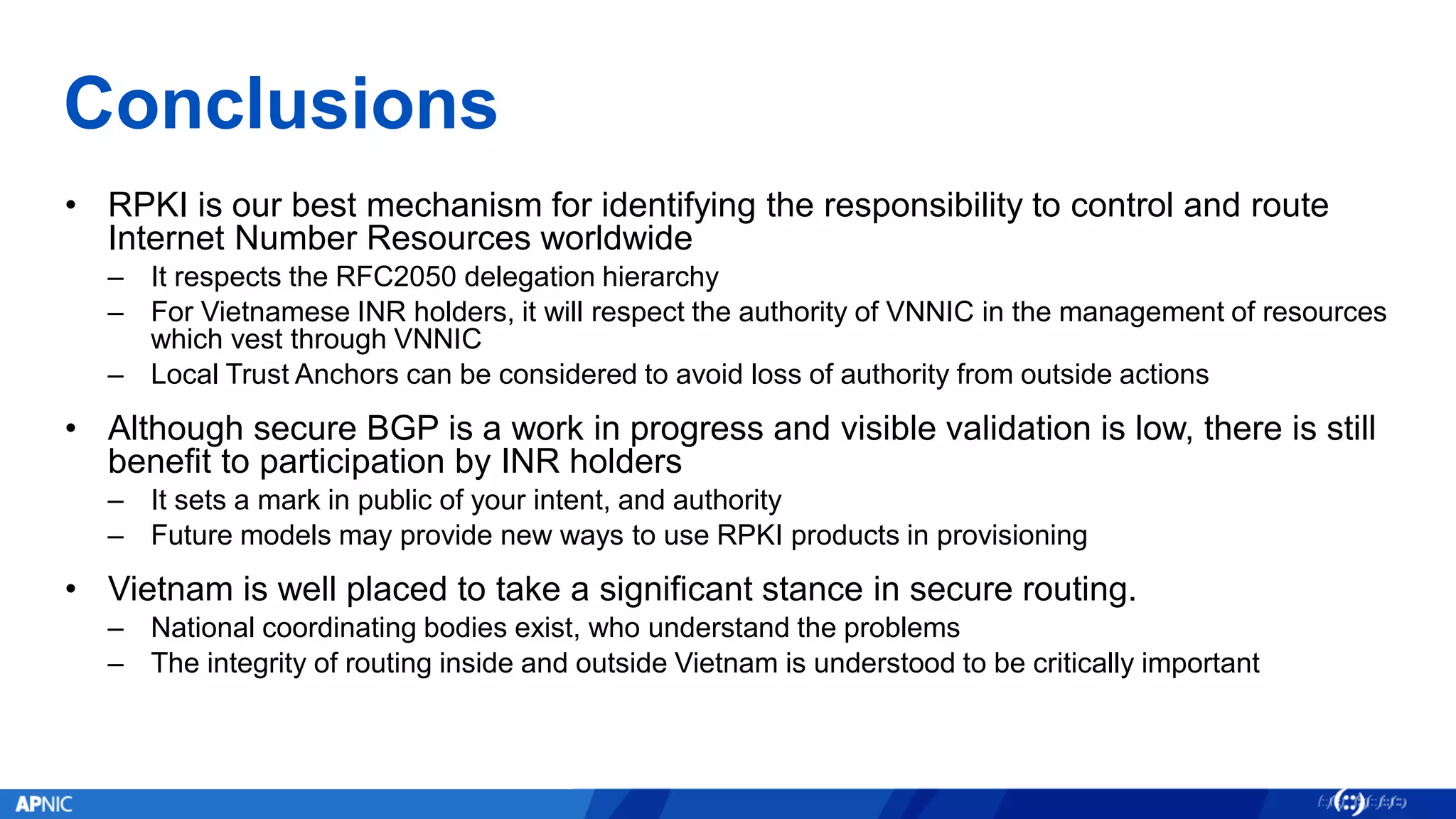
• RPKI is our best mechanism for identifying the responsibility to control and route
Internet Number Resources worldwide
– It respects the RFC2050 delegation hierarchy
– For Vietnamese INR holders, it will respect the authority of VNNIC in the management of resources
which vest through VNNIC
– Local Trust Anchors can be considered to avoid loss of authority from outside actions
• Although secure BGP is a work in progress and visible validation is low, there is still
benefit to participation by INR holders
– It sets a mark in public of your intent, and authority
– Future models may provide new ways to use RPKI products in provisioning
• Vietnam is well placed to take a significant stance in secure routing.
– National coordinating bodies exist, who understand the problems
– The integrity of routing inside and outside Vietnam is understood to be critically important
Cám ơn bạn
46
blog.apnic.net
apnic.net/social
Additional Information
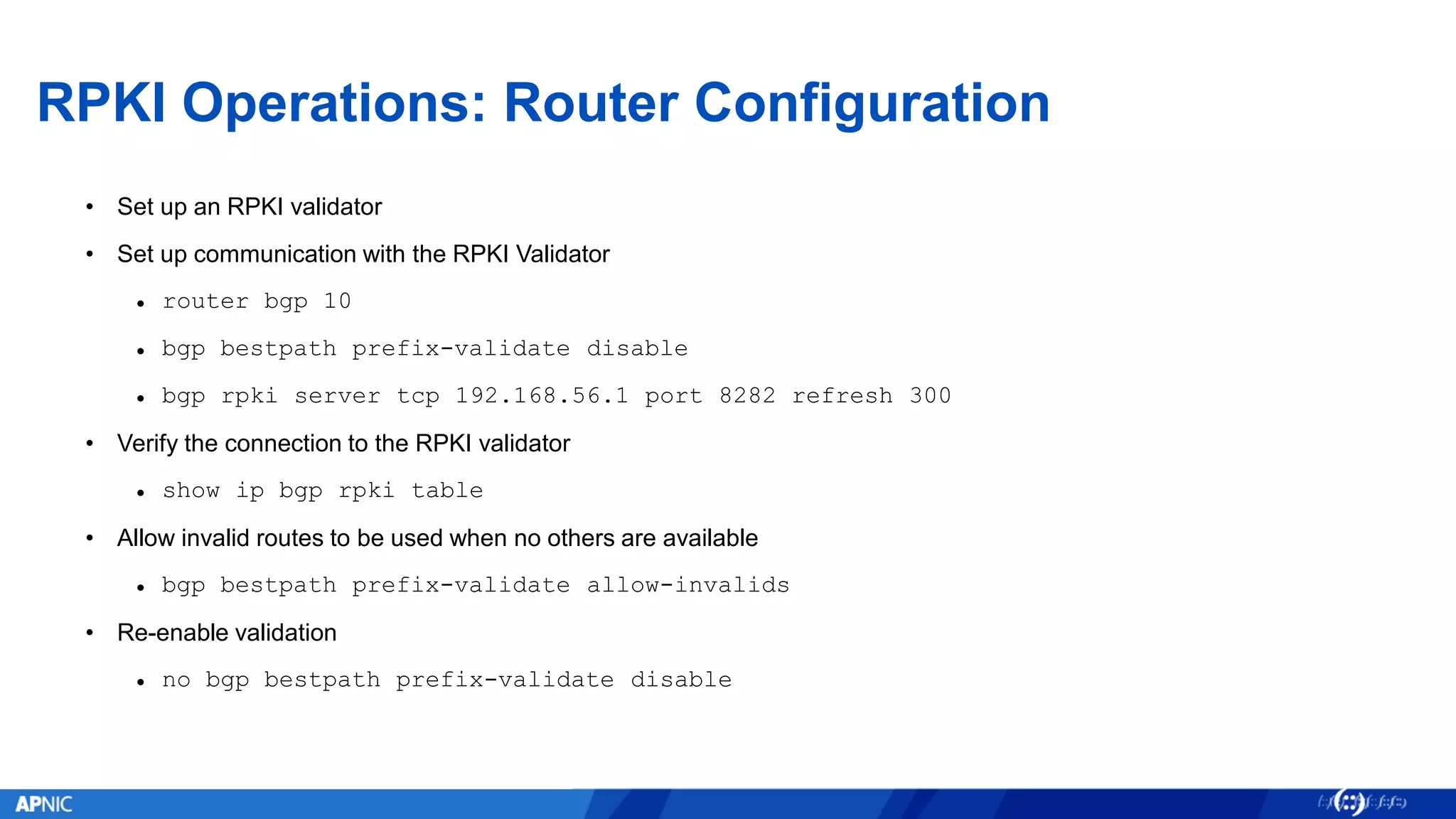
RPKI Operations: Router Configuration
• Set up an RPKI validator
• Set up communication with the RPKI Validator
⚫ router bgp 10
⚫ bgp bestpath prefix-validate disable
⚫ bgp rpki server tcp 192.168.56.1 port 8282 refresh 300
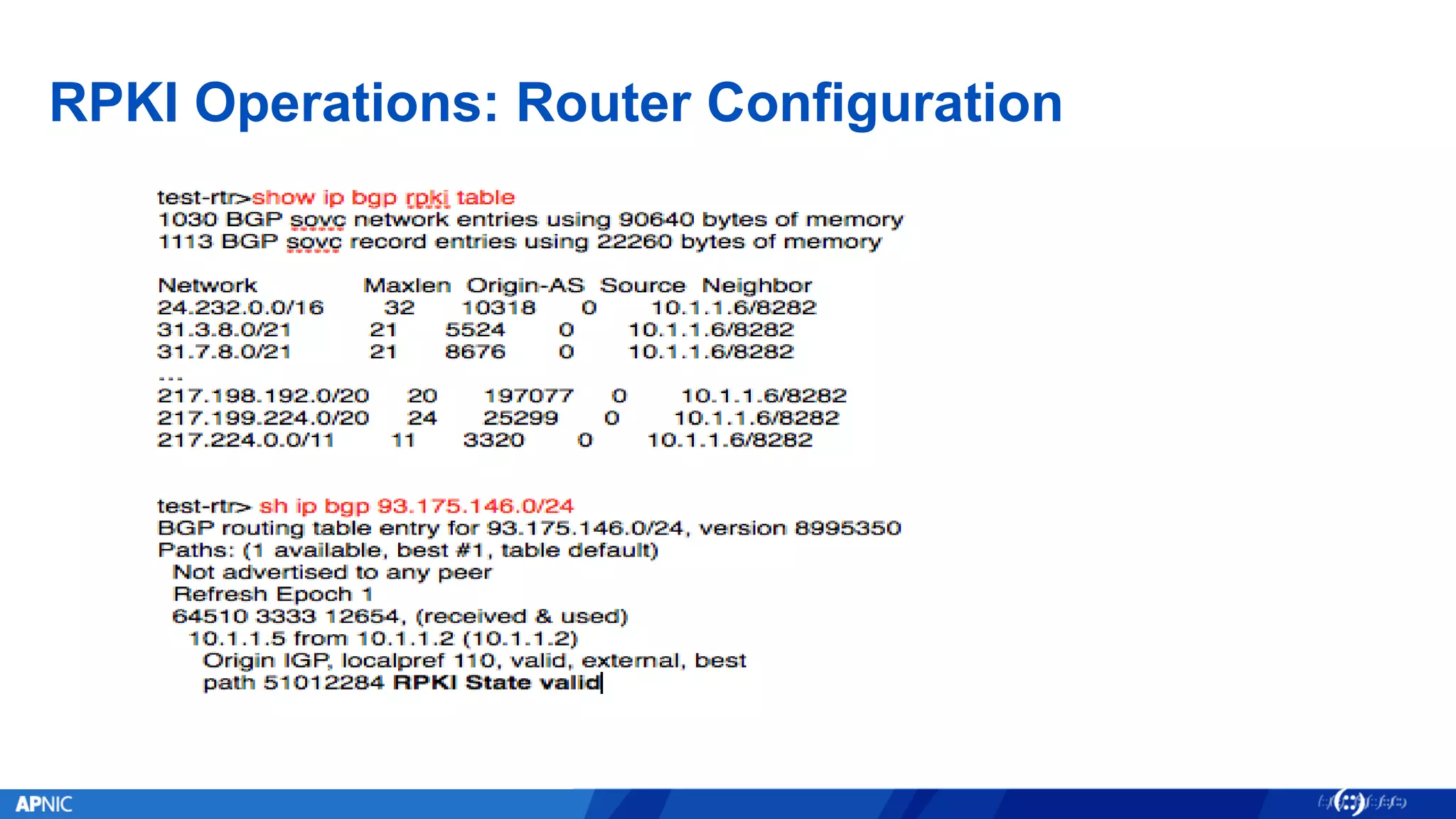
• Verify the connection to the RPKI validator
⚫ show ip bgp rpki table
• Allow invalid routes to be used when no others are available
⚫ bgp bestpath prefix-validate allow-invalids
• Re-enable validation
⚫ no bgp bestpath prefix-validate disable
RPKI Operations: Router Configuration
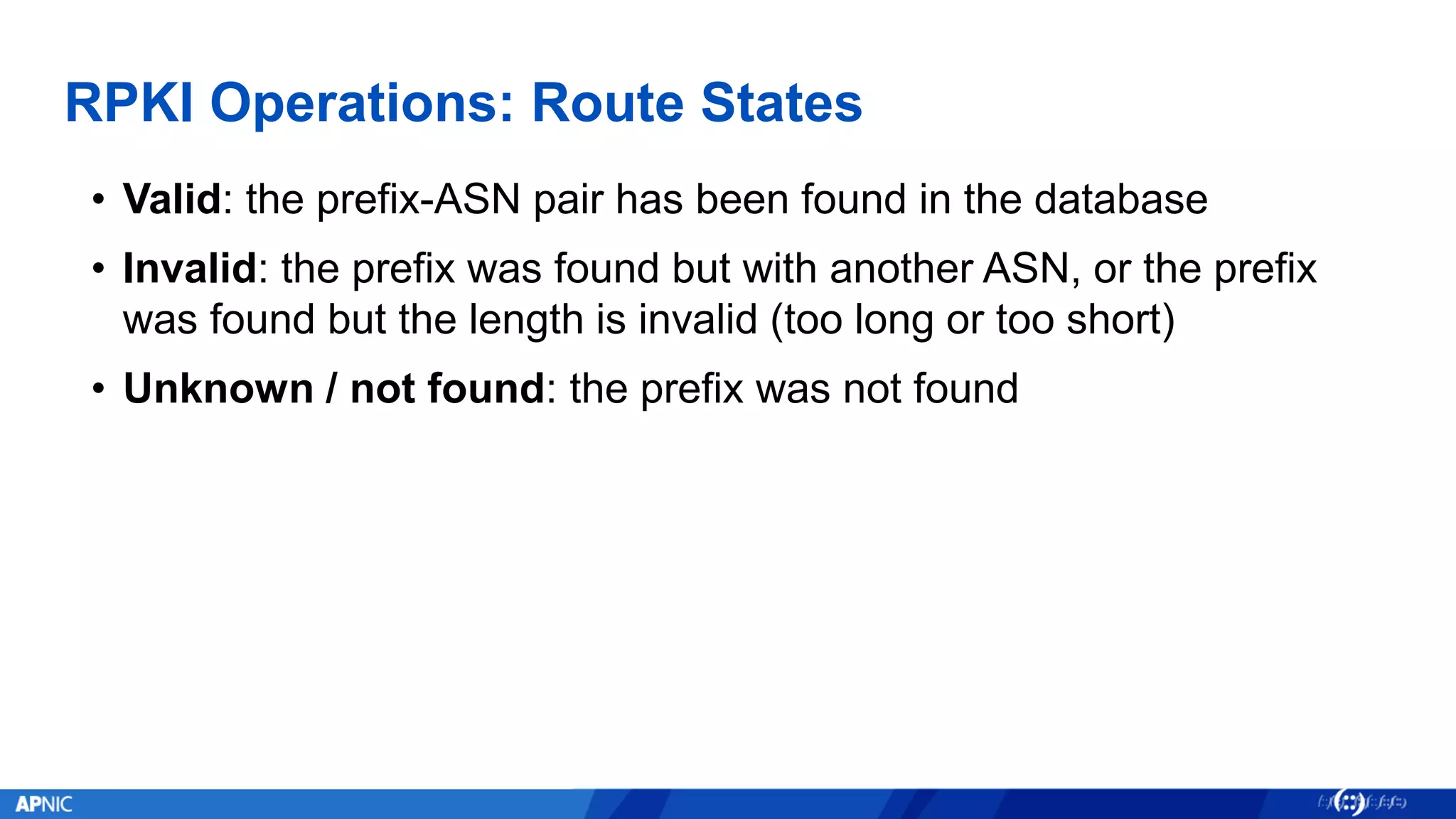
RPKI Operations: Route States
• Valid: the prefix-ASN pair has been found in the database
• Invalid: the prefix was found but with another ASN, or the prefix
was found but the length is invalid (too long or too short)
• Unknown / not found: the prefix was not found
RPKI Operations: Route States
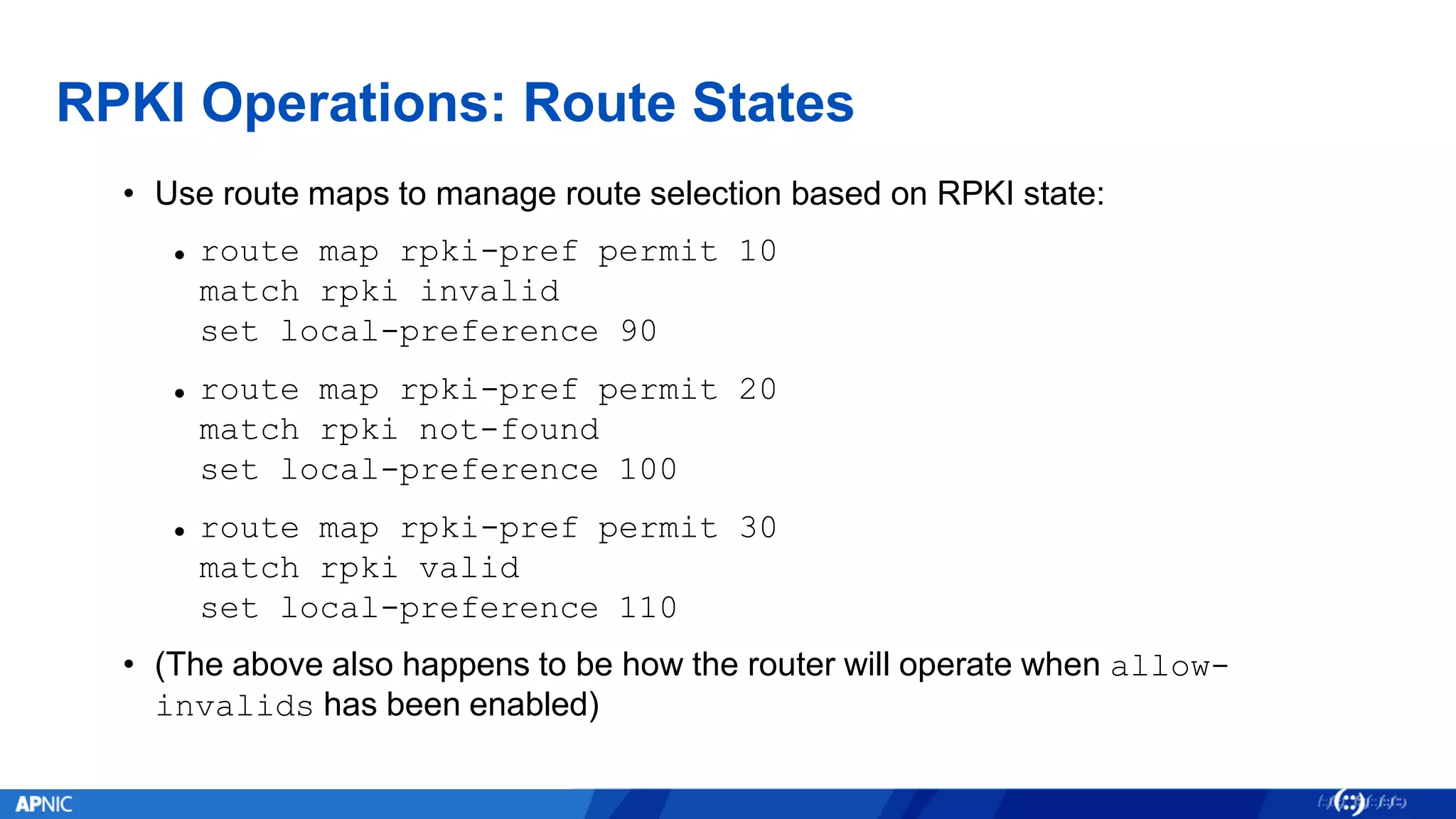
• Use route maps to manage route selection based on RPKI state:
⚫ route map rpki-pref permit 10
match rpki invalid
set local-preference 90
⚫ route map rpki-pref permit 20
match rpki not-found
set local-preference 100
⚫ route map rpki-pref permit 30
match rpki valid
set local-preference 110
• (The above also happens to be how the router will operate when allow-
invalids has been enabled)
References
• https://www.apnic.net/community/security/
• RFC 6480: Resource Public Key Infrastructure
• RFC 3779: Extensions for IP addresses and ASNs
52

Secure Inter-domain Routing with RPKI

  • 1.
    1 Secure Inter-domain Routingwith RPKI Srinivas (Sunny) Chendi VNIX-NOG 2018, Da Nang sunny@apnic.net Chào buổi sáng
  • 2.
    What is thefundamental Problem?
  • 3.
    An underlying problemin routing is lack of certainty • BGP is a giant ‘rumor’ system: – What I hear I pass on. – What I hear, I reflect on, deciding to route. – Has two primary properties to be tested: Origination and Path • Why do I believe what I hear?
  • 4.
    An underlying problemin routing is lack of certainty • Origination binds a prefix to a specific Autonomous System (AS) number – The Origin-AS (of the prefix) is chosen by the prefix holder – Bad actors can claim to originate. How do we limit this risk? • Path binds an Origin-AS to the set of intermediate Autonomous Systems forwarding between themselves (transit) towards the Origin- AS – The inter-AS relationships are chosen by the operators of the AS – Therefore the AS-PATH elements over any given origin-AS/Prefix pair is a reflection of the specific AS operator(s) along the path – Bad actors can intermediate themselves into path. How do we limit this risk?
  • 5.
    Telekom Malaysia • OnJune 12, 2015, Telekom Malaysia (AS4788) tweets this then breaks the Internet • It announced 179,000 prefixes to Level 3 (AS3549) 5 http://www.bgpmon.net/massive-route-leak-cause-internet-slowdown/
  • 6.
    Indonesia Hijacks • InApril 2014, Indosat (AS4761) leaked over 320,000* routes within a 2-hour period • Disrupted Akamai • Self-inflicted DDoS attack 6 http://research.dyn.com/2015/06/global-collateral-damage-of-tmnet-leak/
  • 7.
    Misdirection / HijackingIncidents • YouTube Incident – Occurred 24 Feb 2008 (for about 2 hours) – Pakistan Telecom announced YT block • Google (AS15169) services downed – Occurred 5 Nov 2012 (for 30 minutes) – Moratel Indonesia (AS23947) How frequent do these hijacking incidents happen?
  • 8.
    How Do WeCollaboratively Solve This Problem?
  • 9.
    How we addressthis… 9 A network should only originate his own prefix How do we verify & avoid false advertisement? A provider should filter prefixes they propagate from customers Transitive trust; BGP is a trust-based system Check the legitimacy of address (LoA) Passive Countermeasure Strict filter on Interconnection BGP router can filter in UPDATE Messages Useful filtering can be done by upstream provider Automate Filter Maintenance Use the Route Object
  • 10.
  • 11.
    What is RPKI? •A robust security framework for verifying the association between resource holder and Internet resource • Helps to secure Internet routing by validating routes 11
  • 12.
    X.509 Certificate with3779 Extension • Resource certificates are based on the X.509 v3 certificate format defined in RFC 5280 • Extended by RFC 3779 – binds a list of resources (IP, ASN) to the subject of the certificate • SIA – Subject Information Access; contains a URI that references the directory X.509 Certificate RFC 3779 Extension SIA Owner's Public Key 12
  • 13.
    RPKI Building Blocks 1.PKI and Trust anchors 2. Route Origin Authorizations (ROA) 3. RPKI Validators 13
  • 14.
    What does itsolve? • Prevents route hijacking – A prefix originated by an AS without authorization due to malicious intent • Prevents mis-origination – A prefix that is mistakenly originated by an AS which does not own it – Also route leakage – due to configuration mistake or fat finger 14
  • 15.
    How does itwork? Is this AS number (ASN) authorized to announce this IP address range? 15
  • 16.
    RPKI Origin Validation 16 2406:6400::/4865551 65550 65549 VALID 2406:6400::/48 65551 65550 65548 INVALID 65549 65548 65551 65550 ✓ I have 2406:6400::/48 I have 2406:6400::/48 
  • 17.
    RPKI Path Validation 17 ✓✓ ✓ 2406:6400::/48 65551 65550 65549 Check and verify the complete path (BGPSEC)
  • 18.
    Main Components • CertificateAuthority (CA) – Internet registries (RIR, NIR, LIR) – Issues certificates to members (delegates with resources) – Allows address holders to use the CA system to issue ROAs for their prefixes • Relying Party (RP) – Software that gathers data from the CA 18
  • 19.
    Issuing Party • InternetRegistries (RIR, NIR, Large LIRs) • Acts as a Certificate Authority and issues certificates to members with resources • Often provides a web interface to issue ROAs for customer prefixes • Publishes the ROA records into a repository APNIC RPKI Engine publication MyAPNIC GUI rpki.apnic.net Repository 19
  • 20.
    Relying Party IANA Repo APNIC Repo RIPE Repo LIR Repo LIR Repo RP Cache (gather)Validate d Cache RPKI-Rtr Protocol rpki.ripe.net Software which gathers data from CAs Also called RP cache or validator 20 rpki.apnic.net Future setup
  • 21.
  • 22.
    Route Origin Authorization(ROA) • A signed digital object that contains a list of address prefixes and one AS number • It is an authority created by a prefix holder to authorize an AS Number to originate one or more specific route advertisements • ROA is valid if a valid certificate which signs it has the prefix in its RFC 3779 extension 22 Prefix originated 203.176.189.0 Maximum prefix length /24 Origin ASN AS17821
  • 23.
    RPKI Validation • RPKI-capablerouters can fetch the validated ROA dataset from a validated cache VALID Indicates that the prefix and ASN pair has been found in the database INVALID Indicates that the prefix is found, but • ASN received did not match, or • the prefix length is longer than the maximum length NOT FOUND / UNKNOWN Indicates that the prefix does not match any in the database 23
  • 24.
  • 25.
    RPKI Deployment andOperations • RPKI Deployment − APNIC-hosted − Self-hosted • RPKI Operations − Router configuration for origin validation − Route states and preference adjustment
  • 26.
    RPKI Deployment: APNIC-hosted •Enable RPKI in MyAPNIC − Set up two-factor authentication − Ensure permissions are set correctly • Register routes using route management tool − Covers both RPKI and Whois (IRR)
  • 37.
    Where Are WeIn Deployment Of RPKI?
  • 38.
    Address holding andparticipation in RPKI, APNIC resources (from Repository products) 0 2,000 4,000 6,000 8,000 10,000 12,000 14,000 16,000 18,000 20,000 address holders participants in RPKI Count Of INR holders
  • 39.
    Prefix coverage inROA against total deployed, APNIC resources 0.0 0.5 1.0 1.5 2.0 2.5 3.0 3.5 4.0 4.5 5.0 IPv4% covered by ROA IPv6% covered by ROA % of INR covered
  • 40.
    “its not lookingcompelling” • There is no strong visible trend in the last year suggestive of a surge in Asia-Pacific RPKI participation – There is increase, but its incremental, not exponential (I think) – Even if it was exponential, its very very early-life • Rate of growth is below the rate of growth in participation overall – We give out more address space, to more people, than join to publish ROA • Changes in ROA state are ‘lumpy’ correlating with specific ISPs changing their RPKI signing state. – Low levels of participation mean large swings visible • Conclusion: we are still in early adoption phase of the life cycle of RPKI in the Asia-Pacific region – Key drivers are training, and directed engagement or outreach
  • 41.
    Economy Economy EconomyEconomy 38 US 23 DE 14 RU 12 NL 11 JP 9 FR 6 CN 5 ZA 5 GB 5 CH 3 CZ 3 CA 2 UA 2 TH 2 SE 2 PT 2 NZ 2 NO 2 MU 2 LU 2 IT 2 HU 2 GR 2 BG 2 AU 2 AT 1 ZZ 1 VN 1 UY 1 TW 1 SK 1 SI 1 RS 1 RO 1 QA 1 PL 1 MY 1 MV 1 MN 1 MG 1 LV 1 KR 1 ID 1 EC 1 CY 1 CR 1 BT 1 BR 1 BE 1 AR 1 AM RP by ASN, by Economy
  • 42.
    Participation by Economyin RPKI (ROA) APNIC resources. March 2017 Economy Active Have Roa % Economy Active Have Roa % Economy Active Have Roa % AF 0 0 0 AP 154 10 6.5 AU 2715 52 1.9 BD 394 56 14.2 BT 7 2 28.6 CN 2853 4 0.1 FJ 13 3 23.1 GU 9 1 11.1 HK 822 15 1.8 ID 1142 5 0.4 IN 2655 19 0.7 JP 1148 8 0.7 KH 68 9 13.2 KI 0 0 0 KR 0 0 0 LA 16 2 12.5 LK 17 9 52.9 MM 45 10 22.2 MN 42 3 7.1 MV 10 2 20 MY 227 10 4.4 NC 10 2 20 NP 47 13 27.7 NZ 935 30 3.2 PG 0 0 0 PF 5 2 40 PH 207 16 7.7 PK 138 15 10.9 SG 368 27 7.3 TH 194 12 6.2 TO 4 1 25 TW 0 0 0 VU 0 0 0 WS 5 3 60
  • 43.
    Participation by Economyin RPKI (ROA) APNIC resources. August 2018 Economy Active Have Roa % Economy Active Have Roa % Economy Active Have Roa % AF 54 5 9.3 AP 150 14 9.3 AU 2878 92 3.2 BD 575 112 19.5 BT 9 3 33.3 CN 3250 33 1 FJ 16 3 18.8 GU 10 1 10 HK 897 33 3.7 ID 1467 11 0.7 IN 3088 43 1.4 JP 1178 36 3.1 KH 86 15 17.4 KI 2 1 50 KR 195 1 0.5 LA 20 7 35 LK 17 11 64.7 MM 62 14 22.6 MN 45 16 35.6 MV 13 2 15.4 MY 258 16 6.2 NC 11 4 36.4 NP 73 23 31.5 NZ 964 35 3.6 PF 5 2 40 PG 24 3 12.5 PH 230 23 10 PK 160 24 15 SG 401 36 9 TH 207 18 8.7 TO 4 1 25 TW 223 7 3.1 VU 11 1 9.1 WS 5 4 80
  • 44.
    Regional Participation isrising • Overall, there is an increase in participation both absolutely and as a percentage in most leading economies • There is significant headroom for improvement • Launch of service from CNNIC, IDNIC, TWNIC should permit rapid increase – JPNIC has been in service for the past two years with significant deployment – IRINN (and IDNIC at present) operate on behalf of their members inside APNIC services (MyAPNIC portal, for NIR) • Some indications that participation is more a function of outreach than anything else – When we do RPKI training, engagement from that economy rises.
  • 45.
    Conclusions • RPKI isour best mechanism for identifying the responsibility to control and route Internet Number Resources worldwide – It respects the RFC2050 delegation hierarchy – For Vietnamese INR holders, it will respect the authority of VNNIC in the management of resources which vest through VNNIC – Local Trust Anchors can be considered to avoid loss of authority from outside actions • Although secure BGP is a work in progress and visible validation is low, there is still benefit to participation by INR holders – It sets a mark in public of your intent, and authority – Future models may provide new ways to use RPKI products in provisioning • Vietnam is well placed to take a significant stance in secure routing. – National coordinating bodies exist, who understand the problems – The integrity of routing inside and outside Vietnam is understood to be critically important
  • 46.
  • 47.
  • 48.
    RPKI Operations: RouterConfiguration • Set up an RPKI validator • Set up communication with the RPKI Validator ⚫ router bgp 10 ⚫ bgp bestpath prefix-validate disable ⚫ bgp rpki server tcp 192.168.56.1 port 8282 refresh 300 • Verify the connection to the RPKI validator ⚫ show ip bgp rpki table • Allow invalid routes to be used when no others are available ⚫ bgp bestpath prefix-validate allow-invalids • Re-enable validation ⚫ no bgp bestpath prefix-validate disable
  • 49.
  • 50.
    RPKI Operations: RouteStates • Valid: the prefix-ASN pair has been found in the database • Invalid: the prefix was found but with another ASN, or the prefix was found but the length is invalid (too long or too short) • Unknown / not found: the prefix was not found
  • 51.
    RPKI Operations: RouteStates • Use route maps to manage route selection based on RPKI state: ⚫ route map rpki-pref permit 10 match rpki invalid set local-preference 90 ⚫ route map rpki-pref permit 20 match rpki not-found set local-preference 100 ⚫ route map rpki-pref permit 30 match rpki valid set local-preference 110 • (The above also happens to be how the router will operate when allow- invalids has been enabled)
  • 52.
    References • https://www.apnic.net/community/security/ • RFC6480: Resource Public Key Infrastructure • RFC 3779: Extensions for IP addresses and ASNs 52