
Issue Date:
Revision:
ASN distribution and
interconnection in
Indonesia
12 June 2015
1.0
Overview
Introduction to ASN: What is it, how to
get it, and why is it important?
2-byte and 4-byte ASN
ASNs in Indonesia: Distribution and
Interconnection
AS interconnection: It’s about cost,
resiliency and performance
Looking ahead
Introduction to
ASN
Routing the Internet
• Every Internet router needs to know the relative location of
every destination address on the Internet
• Location information is distributed across the Internet using
routing architecture
• The Internet is divided into “clouds” of interconnection
called “networks”
– Interior routing protocols (OSPF, IS-IS, etc) maintain the internal
connectedness with a network
– Exterior routing protocols (BGP) maintain a map of how each of
these networks connect to each other
– BGP uses the concept of an Autonomous System Number to
uniquely identify each component network
Routing and ASN
• RFC 1930:
– An AS (Autonomous System) is a connected group of one or more IP
prefixes run by one or more network operators that has a SINGLE
and CLEARLY DEFINED routing policy.
– An AS has a globally unique number (sometimes referred to as an
ASN, or Autonomous System Number) associated with it. This
number is used in both the exchange of exterior routing information
(between neighbouring AS’s), and as an identifier of the AS itself.
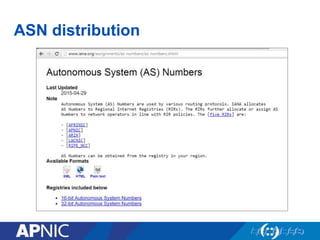
ASN distribution
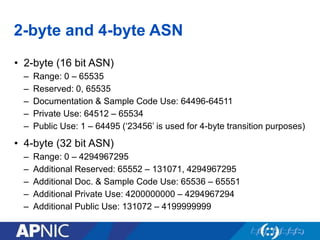
2-byte and 4-byte ASN
• 2-byte (16 bit ASN)
– Range: 0 – 65535
– Reserved: 0, 65535
– Documentation & Sample Code Use: 64496-64511
– Private Use: 64512 – 65534
– Public Use: 1 – 64495 (‘23456’ is used for 4-byte transition purposes)
• 4-byte (32 bit ASN)
– Range: 0 – 4294967295
– Additional Reserved: 65552 – 131071, 4294967295
– Additional Doc. & Sample Code Use: 65536 – 65551
– Additional Private Use: 4200000000 – 4294967294
– Additional Public Use: 131072 – 4199999999
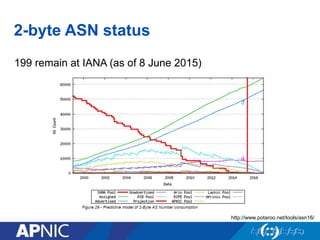
2-byte ASN status
199 remain at IANA (as of 8 June 2015)
http://www.potaroo.net/tools/asn16/
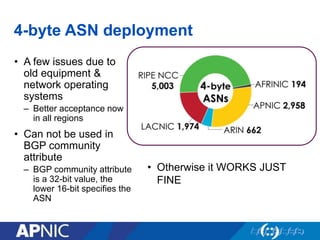
4-byte ASN deployment
• A few issues due to
old equipment &
network operating
systems
– Better acceptance now
in all regions
• Can not be used in
BGP community
attribute
– BGP community attribute
is a 32-bit value, the
lower 16-bit specifies the
ASN
• Otherwise it WORKS JUST
FINE
AS
interconnection
The Internet
11
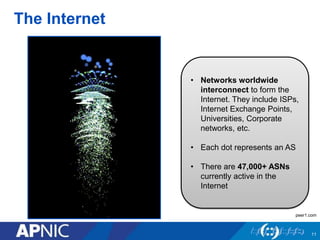
• Networks worldwide
interconnect to form the
Internet. They include ISPs,
Internet Exchange Points,
Universities, Corporate
networks, etc.
• Each dot represents an AS
• There are 47,000+ ASNs
currently active in the
Internet
peer1.com
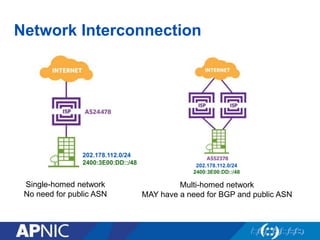
Network Interconnection
202.178.112.0/24
2400:3E00:DD::/48 202.178.112.0/24
2400:3E00:DD::/48
Multi-homed network
MAY have a need for BGP and public ASN
Single-homed network
No need for public ASN
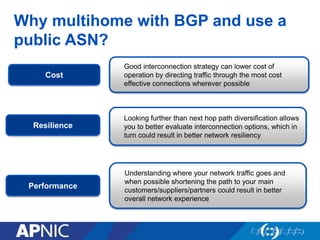
Why multihome with BGP and use a
public ASN?
Good interconnection strategy can lower cost of
operation by directing traffic through the most cost
effective connections wherever possible
Understanding where your network traffic goes and
when possible shortening the path to your main
customers/suppliers/partners could result in better
overall network experience
Looking further than next hop path diversification allows
you to better evaluate interconnection options, which in
turn could result in better network resiliency
Cost
Performance
Resilience
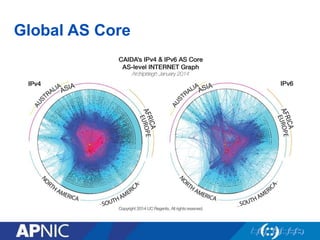
Global AS Core
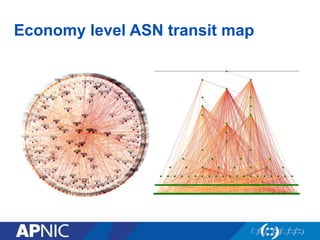
Economy level ASN transit map
Data source
• Routeviews.org
– RIBs from routers located in various locations (mostly Internet
Exchanges) around the world (US, Japan, Korea, UK, Australia,
Brazil, Singapore, Serbia)
• First week of April 2015 data
• RIBs collected every two hours
– This is a snapshot, not live data
• This visualisation tool is a work in progress
– APNIC values your feedback
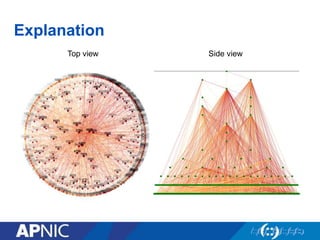
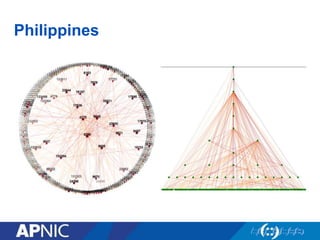
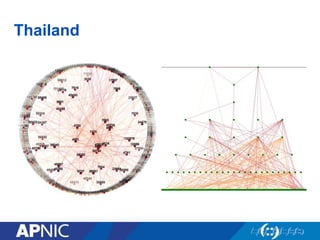
Explanation
Top view Side view
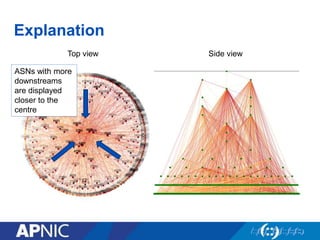
Explanation
Top view Side view
ASNs with more
downstreams
are displayed
closer to the
centre
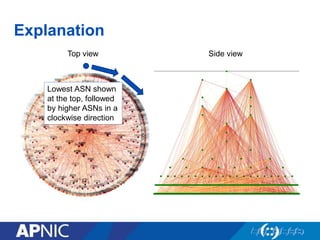
Explanation
Top view Side view
Lowest ASN shown
at the top, followed
by higher ASNs in a
clockwise direction
Explanation
Top view Side view
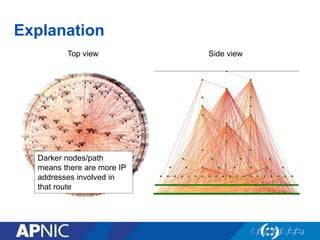
Darker nodes/path
means there are more IP
addresses involved in
that route
Explanation
Top view Side view
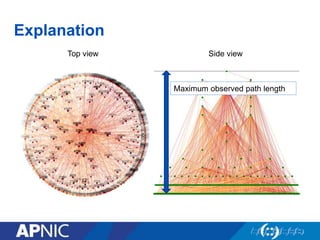
Maximum observed path length
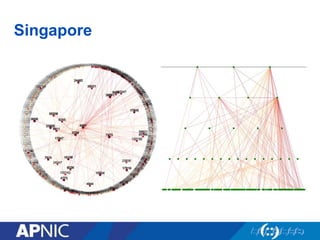
Singapore
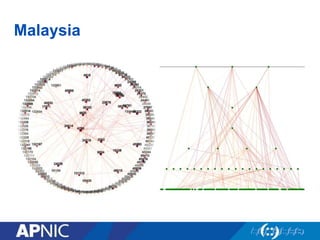
Malaysia
Philippines
Thailand
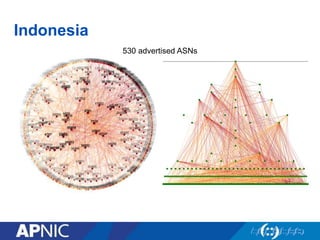
Indonesia
530 advertised ASNs
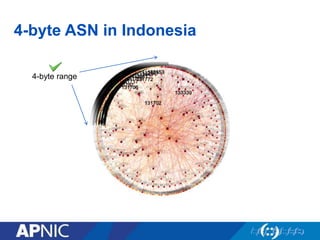
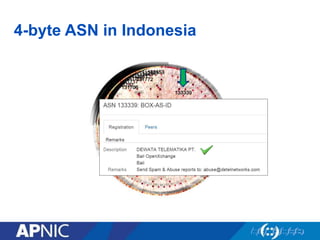
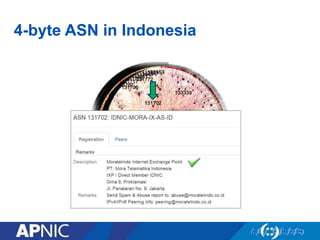
4-byte ASN in Indonesia
4-byte range
4-byte ASN in Indonesia
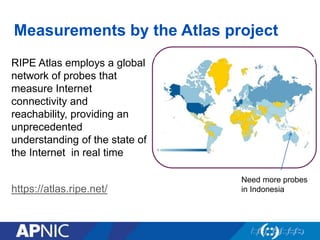
Measurements by the Atlas project
RIPE Atlas employs a global
network of probes that
measure Internet
connectivity and
reachability, providing an
unprecedented
understanding of the state of
the Internet in real time
https://atlas.ripe.net/
Need more probes
in Indonesia
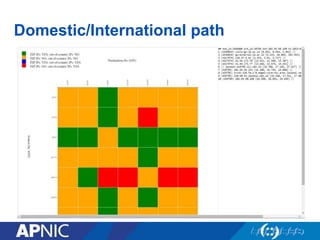
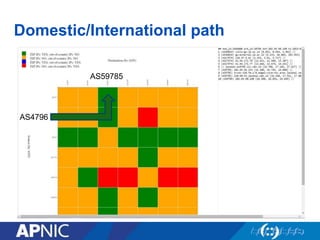
Domestic/International path
AS4796
AS59785
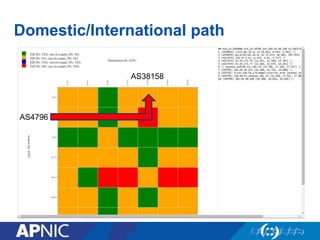
Domestic/International path
AS4796
AS38158
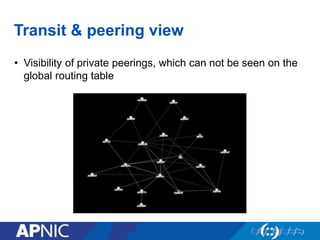
Transit & peering view
• Visibility of private peerings, which can not be seen on the
global routing table
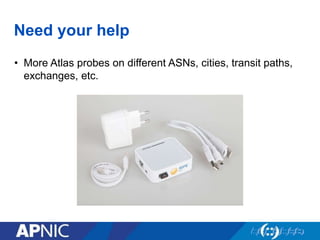
Need your help
• More Atlas probes on different ASNs, cities, transit paths,
exchanges, etc.
Looking ahead
• As more organisations interconnect with upstreams,
downstreams and peers, the number of advertised ASNs
will continue to grow
• Opportunities to reduce cost, improve resiliency and
performance will be available to those with awareness of
this rich network ecosystem
• New technologies such as SDN and network virtualisation
will drive innovations and change the way networks are
interconnected, so expect to see a more dynamic
ecosystem in the future
Things to consider if you operate an
ASN
Routing Security
Registration
Aggregation
Routing security
• As more networks interconnect, security and stability risks
such as route hijacking, accidental route leakage and other
issues can escalate
• Register and maintain your ‘route’ and ‘route6’ objects in
the APNIC Whois database
– Ensure the import and export attributes accurately reflect your actual
routing policy
• Create your ROA
– A ROA or Route Origin Authorization is an attestation of a BGP route
announcement. It attests that the origin AS number is authorized to
announce the prefix(es). The attestation can be verified
cryptographically using RPKI
ROA
• Create your ROA now in MyAPNIC (or ask IDNIC)
• Benefits
– Verify whether an AS is authorized to announce a specific IP prefix
– Minimize common routing errors
– Prevent most accidental hijacks
• What's contained in a ROA
– The AS number you authorize
– The prefix that is being originated from it
– The most specific prefix (maximum length) that the AS may announce
• Example of what a ROA says in plain language:
– "ISP 4 permits AS 65000 to originate a route for the prefix
192.2.200.0/24"
http://www.apnic.net/roa
Registration
• With IPv4 address space nearing exhaustion and transfers
taking place, it’s really important that everyone keeps the
resource registry updated
• Protect your Internet resource registration information
– Keep your APNIC Whois data up to date
• IPv4 range (inetnum)
• IPv6 range (inet6num)
• ASN (autnum)
• Admin contact (admin-c)
• Technical contact (tech-c)
• Incident Response Team contact (irt)
• Help everyone resolve operational issues quickly
– Report invalid contacts
Aggregation
• As more routing information entries get added to the global
routing table, it’s important that prefix announcements are
aggregated whenever possible
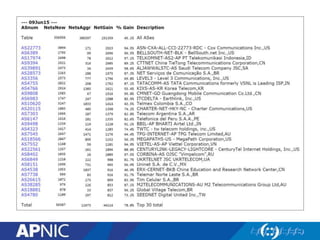
• The algorithm used in the report (see next slide) proposes
aggregation only when there is a precise match using AS
path so as to preserve traffic transit policies. Aggregation is
also proposed across non-advertised address space
('holes').
http://www.cidr-report.org
43

IDNOG 2: AS interconnection in indonesia

  • 1.
    Issue Date: Revision: ASN distributionand interconnection in Indonesia 12 June 2015 1.0
  • 2.
    Overview Introduction to ASN:What is it, how to get it, and why is it important? 2-byte and 4-byte ASN ASNs in Indonesia: Distribution and Interconnection AS interconnection: It’s about cost, resiliency and performance Looking ahead
  • 3.
  • 4.
    Routing the Internet •Every Internet router needs to know the relative location of every destination address on the Internet • Location information is distributed across the Internet using routing architecture • The Internet is divided into “clouds” of interconnection called “networks” – Interior routing protocols (OSPF, IS-IS, etc) maintain the internal connectedness with a network – Exterior routing protocols (BGP) maintain a map of how each of these networks connect to each other – BGP uses the concept of an Autonomous System Number to uniquely identify each component network
  • 5.
    Routing and ASN •RFC 1930: – An AS (Autonomous System) is a connected group of one or more IP prefixes run by one or more network operators that has a SINGLE and CLEARLY DEFINED routing policy. – An AS has a globally unique number (sometimes referred to as an ASN, or Autonomous System Number) associated with it. This number is used in both the exchange of exterior routing information (between neighbouring AS’s), and as an identifier of the AS itself.
  • 6.
  • 7.
    2-byte and 4-byteASN • 2-byte (16 bit ASN) – Range: 0 – 65535 – Reserved: 0, 65535 – Documentation & Sample Code Use: 64496-64511 – Private Use: 64512 – 65534 – Public Use: 1 – 64495 (‘23456’ is used for 4-byte transition purposes) • 4-byte (32 bit ASN) – Range: 0 – 4294967295 – Additional Reserved: 65552 – 131071, 4294967295 – Additional Doc. & Sample Code Use: 65536 – 65551 – Additional Private Use: 4200000000 – 4294967294 – Additional Public Use: 131072 – 4199999999
  • 8.
    2-byte ASN status 199remain at IANA (as of 8 June 2015) http://www.potaroo.net/tools/asn16/
  • 9.
    4-byte ASN deployment •A few issues due to old equipment & network operating systems – Better acceptance now in all regions • Can not be used in BGP community attribute – BGP community attribute is a 32-bit value, the lower 16-bit specifies the ASN • Otherwise it WORKS JUST FINE
  • 10.
  • 11.
    The Internet 11 • Networksworldwide interconnect to form the Internet. They include ISPs, Internet Exchange Points, Universities, Corporate networks, etc. • Each dot represents an AS • There are 47,000+ ASNs currently active in the Internet peer1.com
  • 12.
    Network Interconnection 202.178.112.0/24 2400:3E00:DD::/48 202.178.112.0/24 2400:3E00:DD::/48 Multi-homednetwork MAY have a need for BGP and public ASN Single-homed network No need for public ASN
  • 13.
    Why multihome withBGP and use a public ASN? Good interconnection strategy can lower cost of operation by directing traffic through the most cost effective connections wherever possible Understanding where your network traffic goes and when possible shortening the path to your main customers/suppliers/partners could result in better overall network experience Looking further than next hop path diversification allows you to better evaluate interconnection options, which in turn could result in better network resiliency Cost Performance Resilience
  • 14.
  • 15.
    Economy level ASNtransit map
  • 16.
    Data source • Routeviews.org –RIBs from routers located in various locations (mostly Internet Exchanges) around the world (US, Japan, Korea, UK, Australia, Brazil, Singapore, Serbia) • First week of April 2015 data • RIBs collected every two hours – This is a snapshot, not live data • This visualisation tool is a work in progress – APNIC values your feedback
  • 17.
  • 18.
    Explanation Top view Sideview ASNs with more downstreams are displayed closer to the centre
  • 19.
    Explanation Top view Sideview Lowest ASN shown at the top, followed by higher ASNs in a clockwise direction
  • 20.
    Explanation Top view Sideview Darker nodes/path means there are more IP addresses involved in that route
  • 21.
    Explanation Top view Sideview Maximum observed path length
  • 22.
  • 23.
  • 24.
  • 25.
  • 26.
  • 27.
    4-byte ASN inIndonesia 4-byte range
  • 28.
    4-byte ASN inIndonesia
  • 29.
    4-byte ASN inIndonesia
  • 30.
    Measurements by theAtlas project RIPE Atlas employs a global network of probes that measure Internet connectivity and reachability, providing an unprecedented understanding of the state of the Internet in real time https://atlas.ripe.net/ Need more probes in Indonesia
  • 31.
  • 32.
  • 33.
  • 34.
    Transit & peeringview • Visibility of private peerings, which can not be seen on the global routing table
  • 35.
    Need your help •More Atlas probes on different ASNs, cities, transit paths, exchanges, etc.
  • 36.
    Looking ahead • Asmore organisations interconnect with upstreams, downstreams and peers, the number of advertised ASNs will continue to grow • Opportunities to reduce cost, improve resiliency and performance will be available to those with awareness of this rich network ecosystem • New technologies such as SDN and network virtualisation will drive innovations and change the way networks are interconnected, so expect to see a more dynamic ecosystem in the future
  • 37.
    Things to considerif you operate an ASN Routing Security Registration Aggregation
  • 38.
    Routing security • Asmore networks interconnect, security and stability risks such as route hijacking, accidental route leakage and other issues can escalate • Register and maintain your ‘route’ and ‘route6’ objects in the APNIC Whois database – Ensure the import and export attributes accurately reflect your actual routing policy • Create your ROA – A ROA or Route Origin Authorization is an attestation of a BGP route announcement. It attests that the origin AS number is authorized to announce the prefix(es). The attestation can be verified cryptographically using RPKI
  • 39.
    ROA • Create yourROA now in MyAPNIC (or ask IDNIC) • Benefits – Verify whether an AS is authorized to announce a specific IP prefix – Minimize common routing errors – Prevent most accidental hijacks • What's contained in a ROA – The AS number you authorize – The prefix that is being originated from it – The most specific prefix (maximum length) that the AS may announce • Example of what a ROA says in plain language: – "ISP 4 permits AS 65000 to originate a route for the prefix 192.2.200.0/24" http://www.apnic.net/roa
  • 40.
    Registration • With IPv4address space nearing exhaustion and transfers taking place, it’s really important that everyone keeps the resource registry updated • Protect your Internet resource registration information – Keep your APNIC Whois data up to date • IPv4 range (inetnum) • IPv6 range (inet6num) • ASN (autnum) • Admin contact (admin-c) • Technical contact (tech-c) • Incident Response Team contact (irt) • Help everyone resolve operational issues quickly – Report invalid contacts
  • 41.
    Aggregation • As morerouting information entries get added to the global routing table, it’s important that prefix announcements are aggregated whenever possible • The algorithm used in the report (see next slide) proposes aggregation only when there is a precise match using AS path so as to preserve traffic transit policies. Aggregation is also proposed across non-advertised address space ('holes'). http://www.cidr-report.org
  • 43.