
RPKI Trust Anchor
Geoff Huston
APNIC
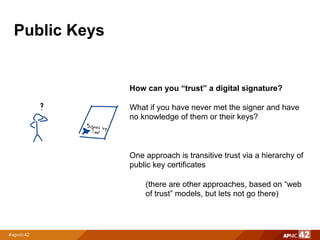
Public Keys
?
How can you “trust” a digital signature?
What if you have never met the signer and have
no knowledge of them or their keys?
One approach is transitive trust via a hierarchy of
public key certificates
(there are other approaches, based on “web
of trust” models, but lets not go there)
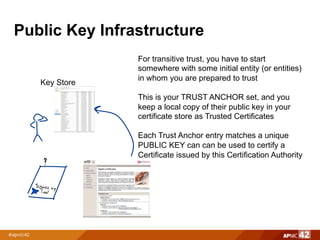
Public Key Infrastructure
?
For transitive trust, you have to start
somewhere with some initial entity (or entities)
in whom you are prepared to trust
This is your TRUST ANCHOR set, and you
keep a local copy of their public key in your
certificate store as Trusted Certificates
Each Trust Anchor entry matches a unique
PUBLIC KEY can can be used to certify a
Certificate issued by this Certification Authority
Key Store
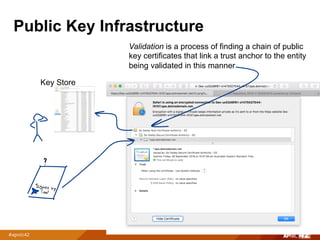
Public Key Infrastructure
?
Key Store
Validation is a process of finding a chain of public
key certificates that link a trust anchor to the entity
being validated in this manner
The Resource Public Key Infrastructure
The RPKI is a conventional PKI where the Certificate Issuer
certifies BOTH the public key of the subject and the subject’s
number resource holdings
As it is a conventional PKI, the RPKI needs to have Trust
Anchor(s)
What models can be used to publish proposed Trust Anchors
for the RPKI?
And who can (or should) publish this Trust Anchor Material?
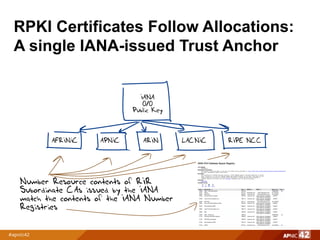
RPKI Certificates Follow Allocations:
A single IANA-issued Trust Anchor
IANA
0/0
Public Key
AFRINIC APNIC ARIN LACNIC RIPE NCC
Number Resource contents of RIR
Subordinate CAs issued by the IANA
match the contents of the IANA Number
Registries
RPKI Certificates Follow Allocations:
A single IANA-issued Trust Anchor
IANA
0/0
Public Key
AFRINIC APNIC ARIN LACNIC RIPE NCC
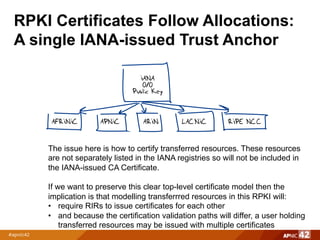
The issue here is how to certify transferred resources. These resources
are not separately listed in the IANA registries so will not be included in
the IANA-issued CA Certificate.
If we want to preserve this clear top-level certificate model then the
implication is that modelling transferrred resources in this RPKI will:
• require RIRs to issue certificates for each other
• and because the certification validation paths will differ, a user holding
transferred resources may be issued with multiple certificates
IANA TA, RPKI Certificates Follow
Allocations
IANA
0/0
Public Key
AFRINIC APNIC ARIN LACNIC RIPE NCC
From
AFRINIC
From
ARIN
From
LACNIC
From
RIPE NCC
From
APNIC
From
ARIN
From
LACNIC
From
RIPE NCC
From
AFRINIC
From
APNIC
From
LACNIC
From
RIPE NCC
From
AFRINIC
From
APNIC
From
ARIN
From
RIPE NCC
From
AFRINIC
From
APNIC
From
ARIN
From
LACNIC
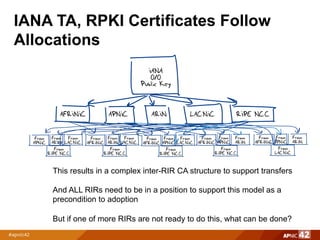
This results in a complex inter-RIR CA structure to support transfers
And ALL RIRs need to be in a position to support this model as a
precondition to adoption
But if one of more RIRs are not ready to do this, what can be done?
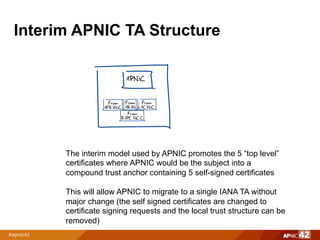
Interim APNIC TA Structure
APNIC
From
AFRINIC
From
ARIN
From
LACNIC
From
RIPE NCC
The interim model used by APNIC promotes the 5 “top level”
certificates where APNIC would be the subject into a
compound trust anchor containing 5 self-signed certificates
This will allow APNIC to migrate to a single IANA TA without
major change (the self signed certificates are changed to
certificate signing requests and the local trust structure can be
removed)
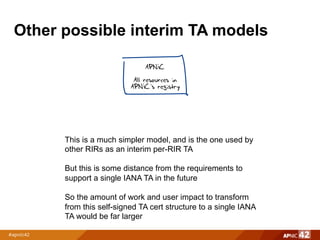
Other possible interim TA models
APNIC
All resources in
APNIC’s registry
This is a much simpler model, and is the one used by
other RIRs as an interim per-RIR TA
But this is some distance from the requirements to
support a single IANA TA in the future
So the amount of work and user impact to transform
from this self-signed TA cert structure to a single IANA
TA would be far larger
Other possible interim TA models
APNIC
0/0
All resources
This simplifies the TA structure further, as no changes are
required to the TA in the event of resource movement. The
published per RIR TA is essentially static so off-line (or even
one-shot use) keys can be used
However it does not reflect APNIC’s current resource
holdings in the TA certificate
Comments?
Questions?
14

RPKI Trust Anchor

  • 1.
  • 2.
    Public Keys ? How canyou “trust” a digital signature? What if you have never met the signer and have no knowledge of them or their keys? One approach is transitive trust via a hierarchy of public key certificates (there are other approaches, based on “web of trust” models, but lets not go there)
  • 3.
    Public Key Infrastructure ? Fortransitive trust, you have to start somewhere with some initial entity (or entities) in whom you are prepared to trust This is your TRUST ANCHOR set, and you keep a local copy of their public key in your certificate store as Trusted Certificates Each Trust Anchor entry matches a unique PUBLIC KEY can can be used to certify a Certificate issued by this Certification Authority Key Store
  • 4.
    Public Key Infrastructure ? KeyStore Validation is a process of finding a chain of public key certificates that link a trust anchor to the entity being validated in this manner
  • 5.
    The Resource PublicKey Infrastructure The RPKI is a conventional PKI where the Certificate Issuer certifies BOTH the public key of the subject and the subject’s number resource holdings As it is a conventional PKI, the RPKI needs to have Trust Anchor(s) What models can be used to publish proposed Trust Anchors for the RPKI? And who can (or should) publish this Trust Anchor Material?
  • 6.
    RPKI Certificates FollowAllocations: A single IANA-issued Trust Anchor IANA 0/0 Public Key AFRINIC APNIC ARIN LACNIC RIPE NCC Number Resource contents of RIR Subordinate CAs issued by the IANA match the contents of the IANA Number Registries
  • 7.
    RPKI Certificates FollowAllocations: A single IANA-issued Trust Anchor IANA 0/0 Public Key AFRINIC APNIC ARIN LACNIC RIPE NCC The issue here is how to certify transferred resources. These resources are not separately listed in the IANA registries so will not be included in the IANA-issued CA Certificate. If we want to preserve this clear top-level certificate model then the implication is that modelling transferrred resources in this RPKI will: • require RIRs to issue certificates for each other • and because the certification validation paths will differ, a user holding transferred resources may be issued with multiple certificates
  • 8.
    IANA TA, RPKICertificates Follow Allocations IANA 0/0 Public Key AFRINIC APNIC ARIN LACNIC RIPE NCC From AFRINIC From ARIN From LACNIC From RIPE NCC From APNIC From ARIN From LACNIC From RIPE NCC From AFRINIC From APNIC From LACNIC From RIPE NCC From AFRINIC From APNIC From ARIN From RIPE NCC From AFRINIC From APNIC From ARIN From LACNIC This results in a complex inter-RIR CA structure to support transfers And ALL RIRs need to be in a position to support this model as a precondition to adoption But if one of more RIRs are not ready to do this, what can be done?
  • 9.
    Interim APNIC TAStructure APNIC From AFRINIC From ARIN From LACNIC From RIPE NCC The interim model used by APNIC promotes the 5 “top level” certificates where APNIC would be the subject into a compound trust anchor containing 5 self-signed certificates This will allow APNIC to migrate to a single IANA TA without major change (the self signed certificates are changed to certificate signing requests and the local trust structure can be removed)
  • 10.
    Other possible interimTA models APNIC All resources in APNIC’s registry This is a much simpler model, and is the one used by other RIRs as an interim per-RIR TA But this is some distance from the requirements to support a single IANA TA in the future So the amount of work and user impact to transform from this self-signed TA cert structure to a single IANA TA would be far larger
  • 11.
    Other possible interimTA models APNIC 0/0 All resources This simplifies the TA structure further, as no changes are required to the TA in the event of resource movement. The published per RIR TA is essentially static so off-line (or even one-shot use) keys can be used However it does not reflect APNIC’s current resource holdings in the TA certificate
  • 13.
  • 14.