AUDIENCE THEORY 
AS Media Studies
A SUMMARY OF WHAT I HAVE 
LEARNED ABOUT AUDIENCE THEORY 
Under the topic of audience theory I have learned the following 
keywords; 
• Target audience – The audience we think we are making this 
product for. 
• Passive Audience – Those who listen to whatever the media 
states without gathering their own opinion or own information. 
• Active Audience – Those who make their own choices about the 
news they hear, practically the polar opposite of a ‘passive 
audience’. 
• David Morley – Media Theorist 
• Hypodermic Needle Model 
• Uses and Gratification
DEFINING THE AUDIENCE 
When choosing a target audience, they can be defined through 
subheadings such as; 
• Gender – Women are assumed to buy grocery items whereas 
men are assumed to deal with the technological side of life. 
• Age – For example, children are more typically assumed to be 
interested in cartoons and older people are assumed to be 
interested in documentaries. 
• Social Class – Advertisers have not yet been persuaded by 
the classless society in the UK and so media texts are often 
aimed towards those of higher class, etc.
DAVID MORLEY’S 3 WAYS TO 
INTERPRET MEDIA TEXT 
• Preferred reading is when the text that the media produces cause 
the audience to react in the way in which they wanted them to. 
• Negotiated reading is where only some members of the audience 
will agree with a text that the media has produced, such as films, 
documentaries and TV programmes. 
• Oppositional reading is when the audience are completely against 
and disagree with a text produced by the media.
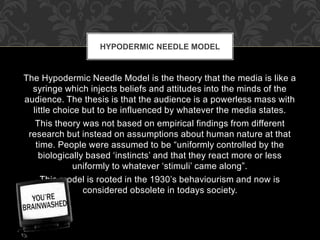
HYPODERMIC NEEDLE MODEL 
The Hypodermic Needle Model is the theory that the media is like a 
syringe which injects beliefs and attitudes into the minds of the 
audience. The thesis is that the audience is a powerless mass with 
little choice but to be influenced by whatever the media states. 
This theory was not based on empirical findings from different 
research but instead on assumptions about human nature at that 
time. People were assumed to be “uniformly controlled by the 
biologically based ‘instincts’ and that they react more or less 
uniformly to whatever ‘stimuli’ came along”. 
This model is rooted in the 1930’s behaviourism and now is 
considered obsolete in todays society.
USES AND GRATIFICATION 
The Uses and Gratification theory is the approach to understanding 
why and how people actively seek out specific media to satisfy 
specific needs. Gratification itself can be split up into four 
subheadings such as; 
• Personal Identity – This is how we may watch TV to look for 
models for our own behaviours. The characters help us decide 
what we feel about ourselves. 
• Surveillance – This is the process of simply gathering 
information. 
• Entertainment – Self explanatory. Used for enjoyment, relaxation 
or to fill time. 
• Personal Relationships – This is how we may form relationships 
based on knowledge or a similar enjoyment of certain media texts. 
Intergration provides a base for base for social interactions.

AS Media Research: Audience Theory

  • 1.
    AUDIENCE THEORY ASMedia Studies
  • 2.
    A SUMMARY OFWHAT I HAVE LEARNED ABOUT AUDIENCE THEORY Under the topic of audience theory I have learned the following keywords; • Target audience – The audience we think we are making this product for. • Passive Audience – Those who listen to whatever the media states without gathering their own opinion or own information. • Active Audience – Those who make their own choices about the news they hear, practically the polar opposite of a ‘passive audience’. • David Morley – Media Theorist • Hypodermic Needle Model • Uses and Gratification
  • 3.
    DEFINING THE AUDIENCE When choosing a target audience, they can be defined through subheadings such as; • Gender – Women are assumed to buy grocery items whereas men are assumed to deal with the technological side of life. • Age – For example, children are more typically assumed to be interested in cartoons and older people are assumed to be interested in documentaries. • Social Class – Advertisers have not yet been persuaded by the classless society in the UK and so media texts are often aimed towards those of higher class, etc.
  • 4.
    DAVID MORLEY’S 3WAYS TO INTERPRET MEDIA TEXT • Preferred reading is when the text that the media produces cause the audience to react in the way in which they wanted them to. • Negotiated reading is where only some members of the audience will agree with a text that the media has produced, such as films, documentaries and TV programmes. • Oppositional reading is when the audience are completely against and disagree with a text produced by the media.
  • 5.
    HYPODERMIC NEEDLE MODEL The Hypodermic Needle Model is the theory that the media is like a syringe which injects beliefs and attitudes into the minds of the audience. The thesis is that the audience is a powerless mass with little choice but to be influenced by whatever the media states. This theory was not based on empirical findings from different research but instead on assumptions about human nature at that time. People were assumed to be “uniformly controlled by the biologically based ‘instincts’ and that they react more or less uniformly to whatever ‘stimuli’ came along”. This model is rooted in the 1930’s behaviourism and now is considered obsolete in todays society.
  • 6.
    USES AND GRATIFICATION The Uses and Gratification theory is the approach to understanding why and how people actively seek out specific media to satisfy specific needs. Gratification itself can be split up into four subheadings such as; • Personal Identity – This is how we may watch TV to look for models for our own behaviours. The characters help us decide what we feel about ourselves. • Surveillance – This is the process of simply gathering information. • Entertainment – Self explanatory. Used for enjoyment, relaxation or to fill time. • Personal Relationships – This is how we may form relationships based on knowledge or a similar enjoyment of certain media texts. Intergration provides a base for base for social interactions.