Lecture - 18
Gaps Basics
CMT LEVEL - I
CMT LEVEL - I
Learning Objectives
 Gaps Basics
 Types of Gaps
- Breakaway (or Breakout)
Gaps
- Opening Gap
- Runaway Gaps (or
Measuring Gaps)
- Exhaustion Gaps
- Suspension Gaps
 Spike (or Wide-Range or
Large-Range Bar)
 Dead Cat Bounce (DCB)
 Island Reversal
Gaps Analysis
• Gaps occur when either the low for the current bar is above the high for the
previous bar or the high for the current bar is lower than the low of the
previous bar.
• A price gap might or might not have significance.
• We have seen them before in analyzing breakouts from classic patterns, trend
lines, and support or resistance zones, and in those instances, the gaps were
demonstrating the beginning of a new trend.
• Gaps result from extraordinary buying or selling interest developing while the
market is closed
• Gaps can offer evidence that something important has happened to the
fundamentals or the psychology of the crowd that accompanies this market
movement.
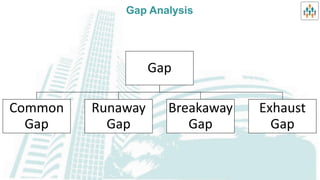
Gap Analysis
Gap
Common
Gap
Runaway
Gap
Breakaway
Gap
Exhaust
Gap
Common Gap
• Trading gap or an area gap, the
common gap is usually
uneventful.
• A common gap usually appears
in a trading range or congestion
area, and reinforces the
apparent lack of interest in the
stock at that time.
• These gaps are common and
usually get filled fairly quickly.
”Getting filled” means that the
price action at a later time (a few
days to a few weeks) usually
retraces at the least to the last
day before the gap.
Breakaway Gaps
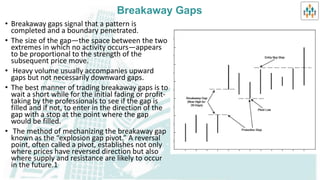
• Breakaway gaps signal that a pattern is
completed and a boundary penetrated.
• The size of the gap—the space between the two
extremes in which no activity occurs—appears
to be proportional to the strength of the
subsequent price move.
• Heavy volume usually accompanies upward
gaps but not necessarily downward gaps.
• The best manner of trading breakaway gaps is to
wait a short while for the initial fading or profit-
taking by the professionals to see if the gap is
filled and if not, to enter in the direction of the
gap with a stop at the point where the gap
would be filled.
• The method of mechanizing the breakaway gap
known as the “explosion gap pivot.” A reversal
point, often called a pivot, establishes not only
where prices have reversed direction but also
where supply and resistance are likely to occur
in the future.1
Runaway Gaps (or Measuring Gaps)
• Gaps that occur along a trend are called
runaway gaps.
• They can appear in strong trends that
have very few minor corrections and just
keep rising or declining without
retracements or other interruptions.
They are also called measuring gaps
• An upward runaway gap occurs on
average 43% of the distance from the
trend beginning and the eventual peak,
whereas a downward gap occurs on
average 57% of the distance
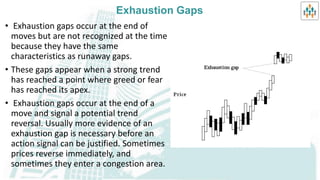
Exhaustion Gaps
• Exhaustion gaps occur at the end of
moves but are not recognized at the time
because they have the same
characteristics as runaway gaps.
• These gaps appear when a strong trend
has reached a point where greed or fear
has reached its apex.
• Exhaustion gaps occur at the end of a
move and signal a potential trend
reversal. Usually more evidence of an
exhaustion gap is necessary before an
action signal can be justified. Sometimes
prices reverse immediately, and
sometimes they enter a congestion area.
Opening Gap
• When the opening price for the day is outside
the range of the previous day, it is called an
opening gap.
• If the gap is not filled, usually within the first
half hour, the odds of the trend continuing in
the direction of the gap increase.
• One way potentially to profit from an opening
gap is to watch the first three five-minute bars
(a three-bar range) and determine the high
and low of this range.
• A breakout of that range in the direction of the
gap often indicates that the trend will continue
in the gap direction; a breakout that moves in
the direction of filling the gap will often
continue to fill the gap.
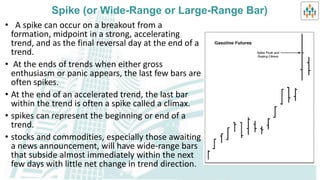
Spike (or Wide-Range or Large-Range Bar)
• A spike can occur on a breakout from a
formation, midpoint in a strong, accelerating
trend, and as the final reversal day at the end of a
trend.
• At the ends of trends when either gross
enthusiasm or panic appears, the last few bars are
often spikes.
• At the end of an accelerated trend, the last bar
within the trend is often a spike called a climax.
• spikes can represent the beginning or end of a
trend.
• stocks and commodities, especially those awaiting
a news announcement, will have wide-range bars
that subside almost immediately within the next
few days with little net change in trend direction.
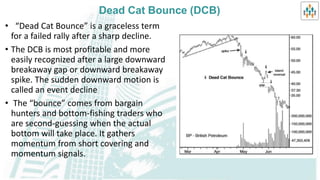
Dead Cat Bounce (DCB)
• “Dead Cat Bounce” is a graceless term
for a failed rally after a sharp decline.
• The DCB is most profitable and more
easily recognized after a large downward
breakaway gap or downward breakaway
spike. The sudden downward motion is
called an event decline
• The “bounce” comes from bargain
hunters and bottom-fishing traders who
are second-guessing when the actual
bottom will take place. It gathers
momentum from short covering and
momentum signals.
Island Reversal
• An island reversal can occur at either a top
or a bottom and only occurs after a relatively
lengthy trend.
• It can occur in a congestion area, but only
infrequently
• It requires two gaps at roughly the same
price: the first in the direction of the trend,
an exhaustion gap, and the second in the
reverse direction, a breakaway gap.
• The larger the gap, the more important is
the formation. Between the gaps, low
volatility trading can occur for a number of
days or even weeks.
• Volume usually increases on the second gap
from an island top but not necessarily from a
bottom. The extreme price in the island must
be either higher than previous highs at a top
or lower than previous lows at a bottom.
Introduction to Technical Analysis

Section 2 - Chapter 9 Part I - Short Tem Pattern - Gap Basics

  • 1.
    Lecture - 18 GapsBasics CMT LEVEL - I
  • 2.
    CMT LEVEL -I Learning Objectives  Gaps Basics  Types of Gaps - Breakaway (or Breakout) Gaps - Opening Gap - Runaway Gaps (or Measuring Gaps) - Exhaustion Gaps - Suspension Gaps  Spike (or Wide-Range or Large-Range Bar)  Dead Cat Bounce (DCB)  Island Reversal
  • 3.
    Gaps Analysis • Gapsoccur when either the low for the current bar is above the high for the previous bar or the high for the current bar is lower than the low of the previous bar. • A price gap might or might not have significance. • We have seen them before in analyzing breakouts from classic patterns, trend lines, and support or resistance zones, and in those instances, the gaps were demonstrating the beginning of a new trend. • Gaps result from extraordinary buying or selling interest developing while the market is closed • Gaps can offer evidence that something important has happened to the fundamentals or the psychology of the crowd that accompanies this market movement.
  • 4.
  • 5.
    Common Gap • Tradinggap or an area gap, the common gap is usually uneventful. • A common gap usually appears in a trading range or congestion area, and reinforces the apparent lack of interest in the stock at that time. • These gaps are common and usually get filled fairly quickly. ”Getting filled” means that the price action at a later time (a few days to a few weeks) usually retraces at the least to the last day before the gap.
  • 6.
    Breakaway Gaps • Breakawaygaps signal that a pattern is completed and a boundary penetrated. • The size of the gap—the space between the two extremes in which no activity occurs—appears to be proportional to the strength of the subsequent price move. • Heavy volume usually accompanies upward gaps but not necessarily downward gaps. • The best manner of trading breakaway gaps is to wait a short while for the initial fading or profit- taking by the professionals to see if the gap is filled and if not, to enter in the direction of the gap with a stop at the point where the gap would be filled. • The method of mechanizing the breakaway gap known as the “explosion gap pivot.” A reversal point, often called a pivot, establishes not only where prices have reversed direction but also where supply and resistance are likely to occur in the future.1
  • 7.
    Runaway Gaps (orMeasuring Gaps) • Gaps that occur along a trend are called runaway gaps. • They can appear in strong trends that have very few minor corrections and just keep rising or declining without retracements or other interruptions. They are also called measuring gaps • An upward runaway gap occurs on average 43% of the distance from the trend beginning and the eventual peak, whereas a downward gap occurs on average 57% of the distance
  • 8.
    Exhaustion Gaps • Exhaustiongaps occur at the end of moves but are not recognized at the time because they have the same characteristics as runaway gaps. • These gaps appear when a strong trend has reached a point where greed or fear has reached its apex. • Exhaustion gaps occur at the end of a move and signal a potential trend reversal. Usually more evidence of an exhaustion gap is necessary before an action signal can be justified. Sometimes prices reverse immediately, and sometimes they enter a congestion area.
  • 9.
    Opening Gap • Whenthe opening price for the day is outside the range of the previous day, it is called an opening gap. • If the gap is not filled, usually within the first half hour, the odds of the trend continuing in the direction of the gap increase. • One way potentially to profit from an opening gap is to watch the first three five-minute bars (a three-bar range) and determine the high and low of this range. • A breakout of that range in the direction of the gap often indicates that the trend will continue in the gap direction; a breakout that moves in the direction of filling the gap will often continue to fill the gap.
  • 10.
    Spike (or Wide-Rangeor Large-Range Bar) • A spike can occur on a breakout from a formation, midpoint in a strong, accelerating trend, and as the final reversal day at the end of a trend. • At the ends of trends when either gross enthusiasm or panic appears, the last few bars are often spikes. • At the end of an accelerated trend, the last bar within the trend is often a spike called a climax. • spikes can represent the beginning or end of a trend. • stocks and commodities, especially those awaiting a news announcement, will have wide-range bars that subside almost immediately within the next few days with little net change in trend direction.
  • 11.
    Dead Cat Bounce(DCB) • “Dead Cat Bounce” is a graceless term for a failed rally after a sharp decline. • The DCB is most profitable and more easily recognized after a large downward breakaway gap or downward breakaway spike. The sudden downward motion is called an event decline • The “bounce” comes from bargain hunters and bottom-fishing traders who are second-guessing when the actual bottom will take place. It gathers momentum from short covering and momentum signals.
  • 12.
    Island Reversal • Anisland reversal can occur at either a top or a bottom and only occurs after a relatively lengthy trend. • It can occur in a congestion area, but only infrequently • It requires two gaps at roughly the same price: the first in the direction of the trend, an exhaustion gap, and the second in the reverse direction, a breakaway gap. • The larger the gap, the more important is the formation. Between the gaps, low volatility trading can occur for a number of days or even weeks. • Volume usually increases on the second gap from an island top but not necessarily from a bottom. The extreme price in the island must be either higher than previous highs at a top or lower than previous lows at a bottom.
  • 13.