
Lecture - 12
Support & Resistance
CMT LEVEL - I
CMT LEVEL - I
Learning Objectives
 What Is Support and
Resistance?
 Reversal Points Determined
- De Mark or Williams Method
- Percentage Method
- Gann Two-Day Swing Method
- High Volume Method
 Support and Resistance Zones
Drawn
 Benefits of Support &
Resistance
What is Support & Resistance?
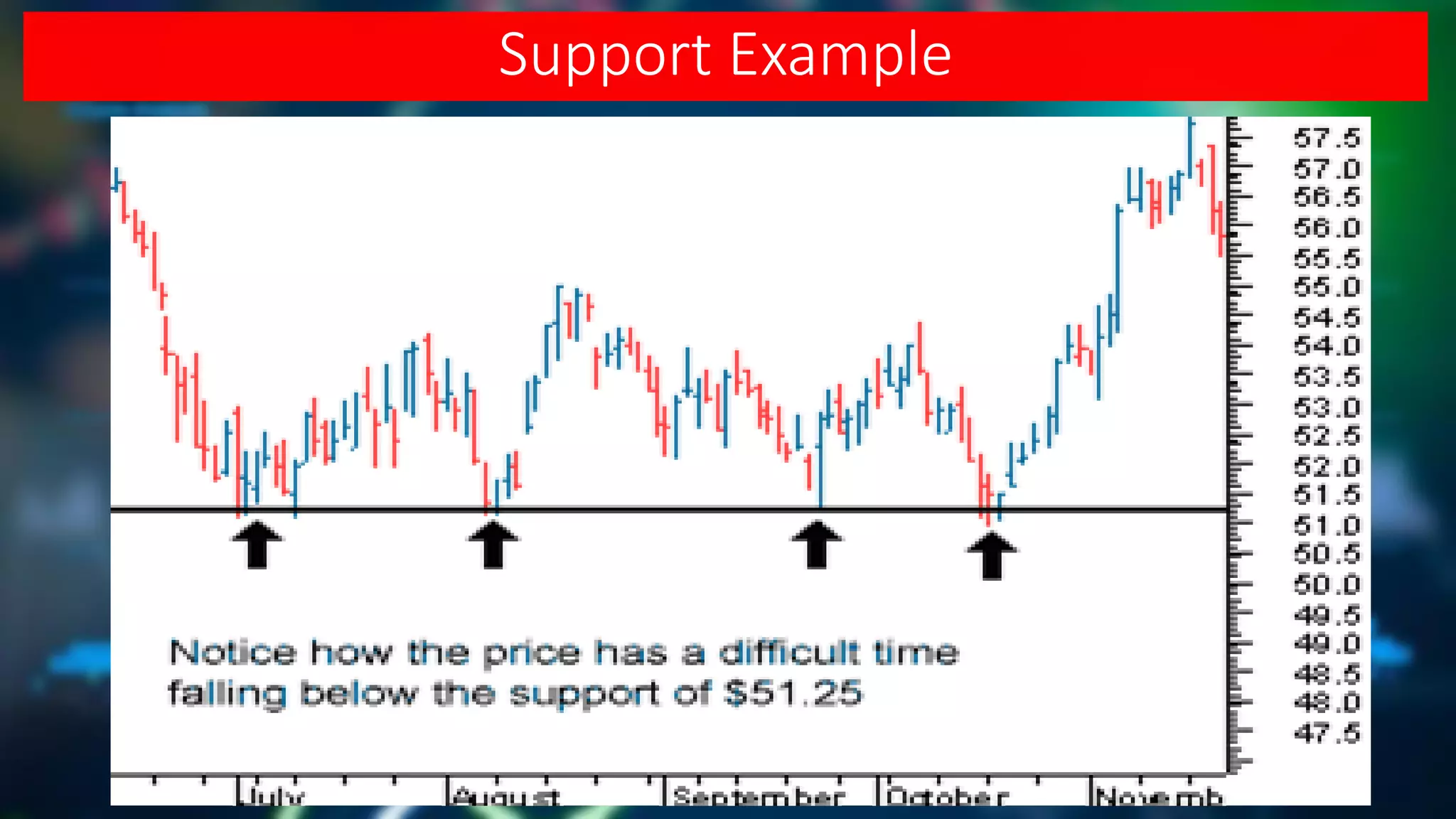
•Support is a price level where a downtrend can be
expected to pause due to a concentration of demand.
•As the price of a security drops, demand for the shares
increases, thus forming the support .
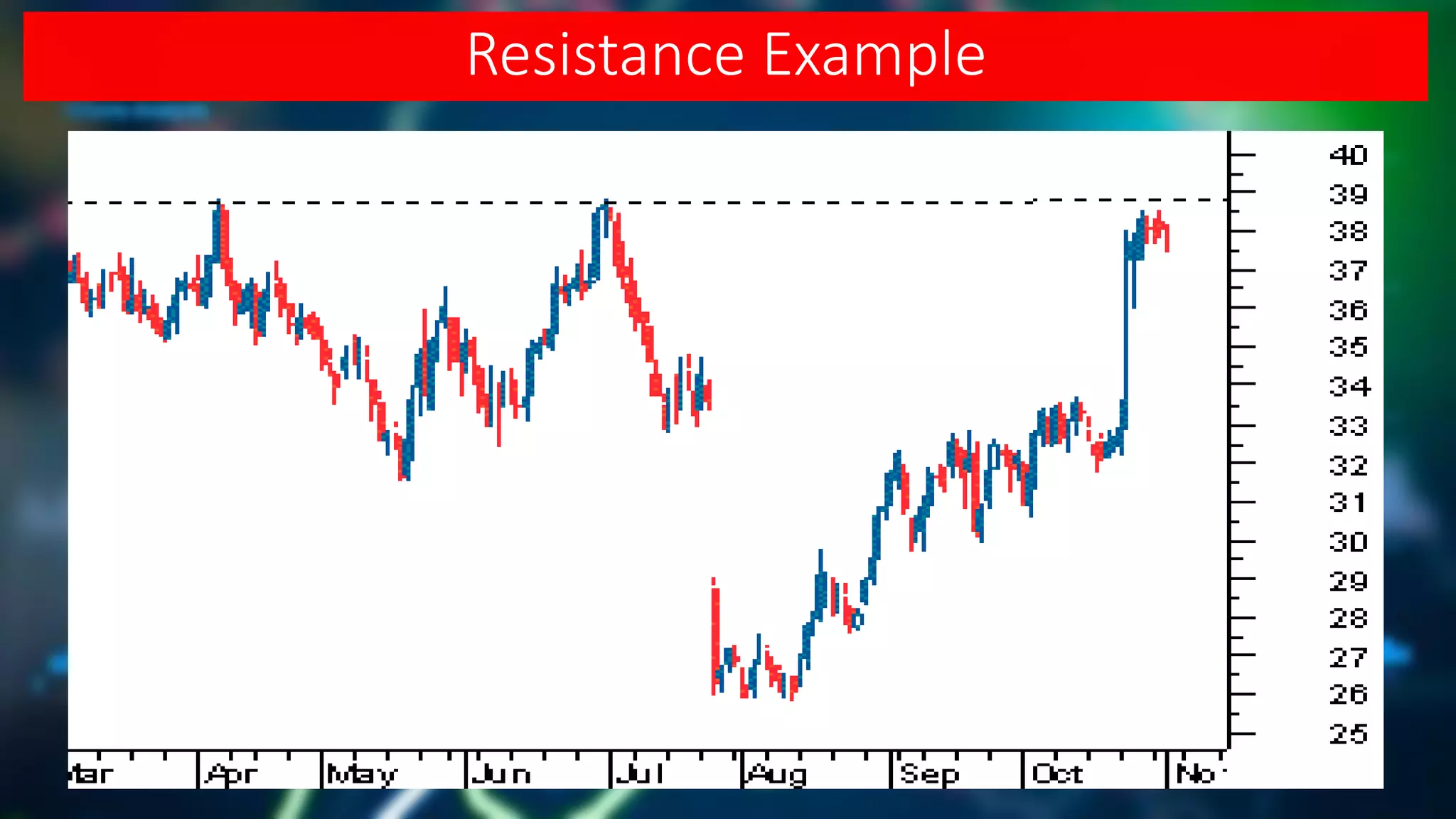
•Resistance is a price level where a Uptrend can be
expected to pause due to a concentration of Supply.
•As the price of a security Rise, Supply/Profit Booking
for the shares increases, thus forming the Resistance .
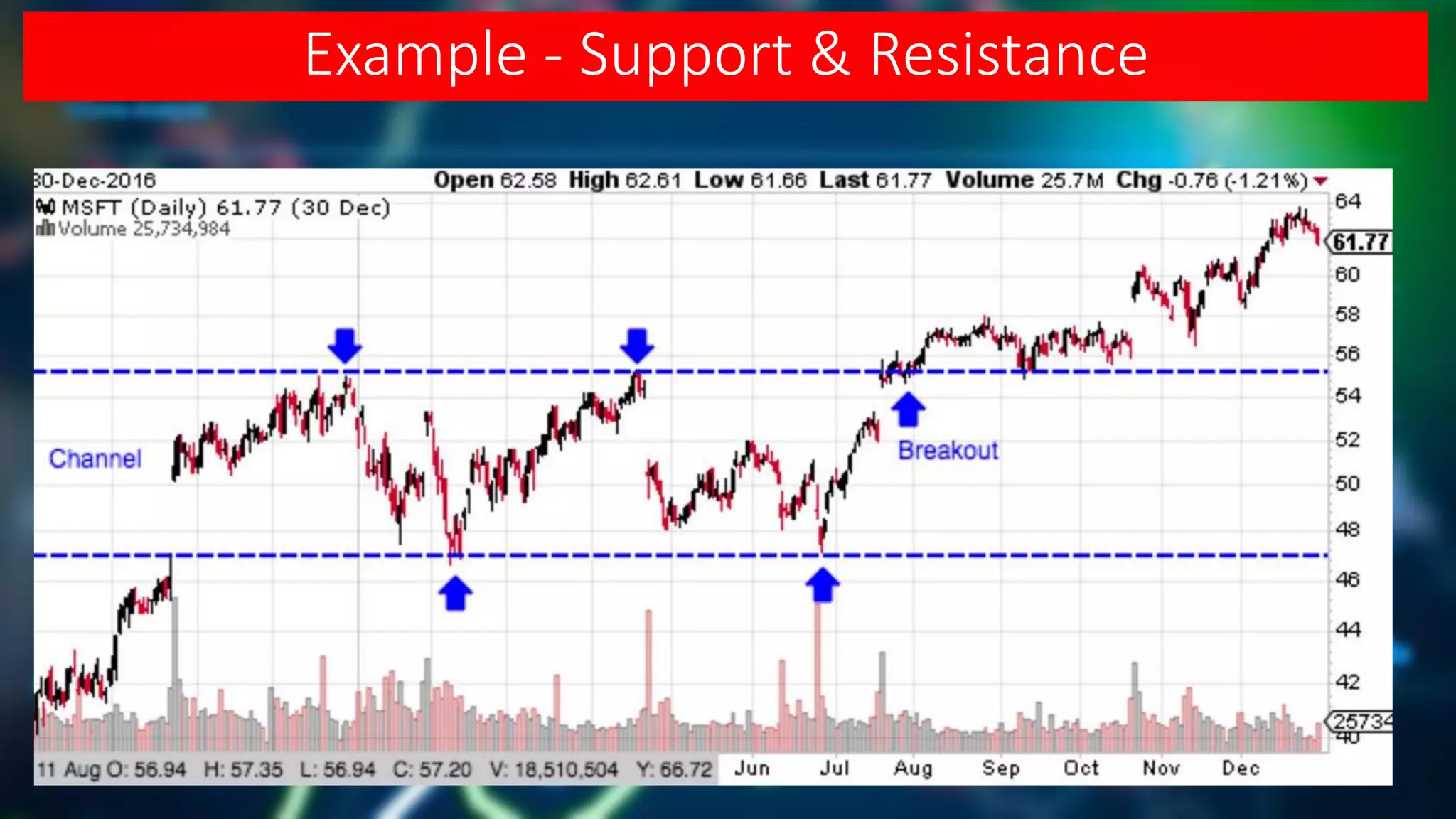
Example - Support & Resistance
•We used the terms "floor" for support and "ceiling" for
resistance?
•Continuing the house analogy, a security is how a rubber
ball that bounces in a room will hit the floor (support) and
then rebound off the ceiling (resistance).
•A ball that continues to bounce between the floor and the
ceiling is similar to a trading instrument that is
experiencing price consolidation between support and
resistance zones.
•Extra force, or enthusiasm from either the bulls or bears, is
needed to break through the support or resistance.
Example - Support & Resistance
•A support level will eventually become a resistance
level when the price attempts to move back up,
and conversely, a resistance level will become a
support level as the price temporarily falls back.
•Price charts allow traders and investors to visually
identify areas of support and resistance, and they give
clues regarding the significance of these price levels.
Example - Support & Resistance
Support Example
Resistance Example
How Support & Resistance Works?
•Technical analysts use support and resistance levels to
identify price points on a chart where the probabilities
favor a pause, or reversal, of a prevailing trend.
•Market psychology plays a major role as traders and
investors remember the past and react to changing
conditions to anticipate future market movement..
How Support & Resistance Works?
•Once an area or "zone" of support or resistance has
been identified, it provides valuable potential trade
entry or exit points.
•This is because, as a price reaches a point of support or
resistance, it will do one of two things
– bounce back away from the support or resistance
level,
- violate the price level and continue in its direction
until it hits the next support or resistance level.
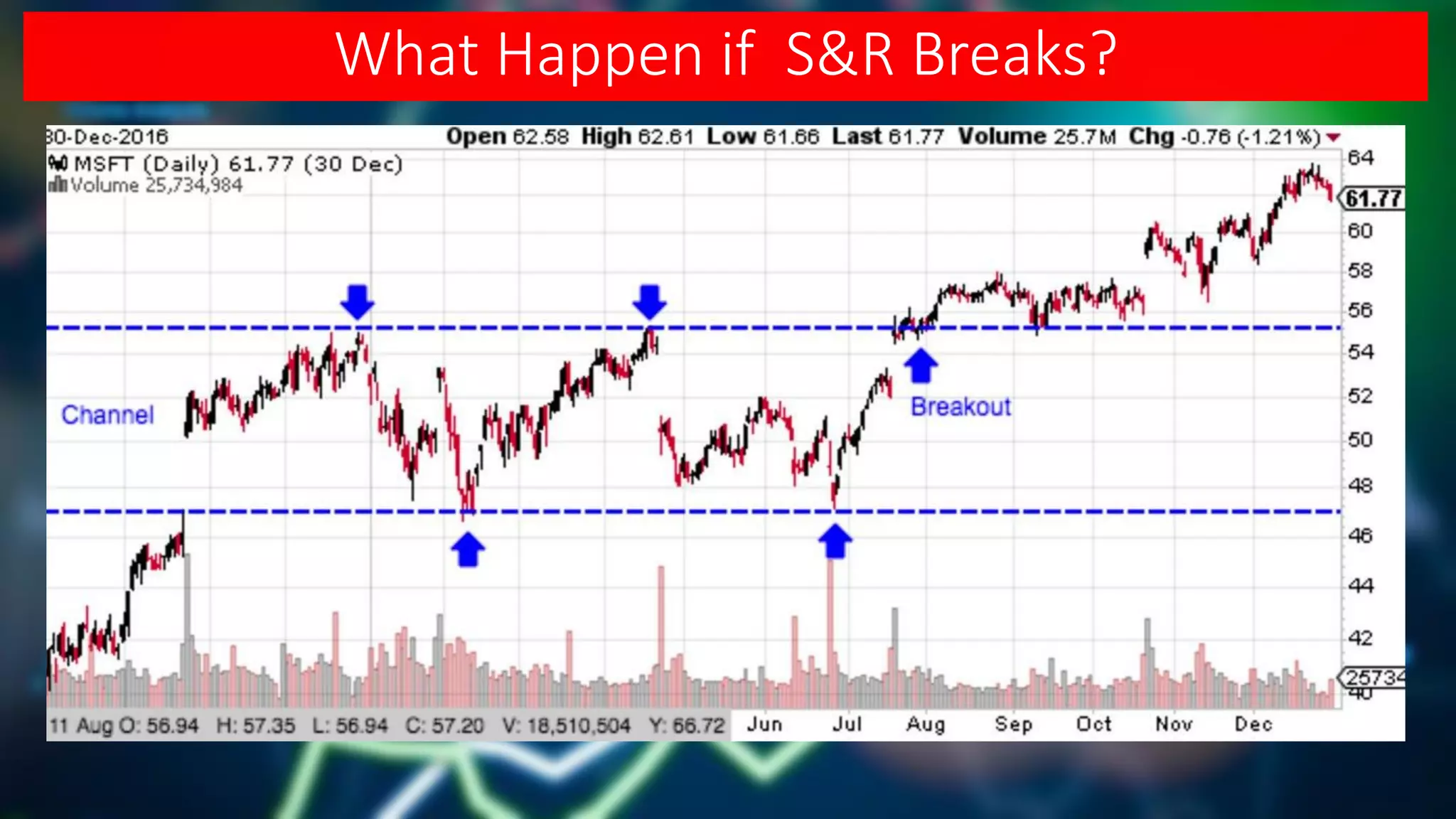
What Happen if S&R Breaks?
•Support and resistance levels are psychologically-
important levels where a lot of buyers and/or sellers
are willing to trade the stock.
• When the S&R are broken, the market psychology
shifts and new levels of support and resistance are
established.
What Happen if S&R Breaks?
Importance for S&R Zones
•Number of Touches. The more times the price tests a
support or resistance area, the more significant the
level becomes. When prices keep bouncing off a
support or resistance level, more buyers and sellers
notice and will base trading decisions on these levels.
Importance for S&R Zones
•Preceding Price Move. Support and resistance zones
are likely to be more significant when they are
preceded by steep advances or declines. For example,
a fast, steep advance or uptrend will be met with more
competition and enthusiasm and may be halted by a
more significant resistance level than a slow, steady
advance. A slow advance may not attract as much
attention.
Importance for S&R Zones
•Volume at Certain Price Levels. The more buying and
selling that has occurred at a particular price level, the
stronger the support or resistance level is likely to be.
•When strong activity occurs under high volume and
the price drops, a lot of selling will likely occur when
price returns to that level, since people are far more
comfortable closing out a trade at the breakeven point
rather than at a loss.
Importance for S&R Zones
•Time. Support and resistance zones become more
significant if the levels have been tested regularly over
an extended period of time.
Reversal Point Identified Methods
De Mark or Williams
Method
Percentage Method
Gann Two-Day Swing
Method
High Volume Method
De Mark or Williams Method
•In a low bar, for example, the analyst may look for two
bars with higher lows directly on either side of the
suspected trough bar.
•The number of bars on either side can be increased to
boost the importance of the trough, but the number of
troughs will be sacrificed.
•The higher the number of confirming lows necessary,
the more important but less common the trough.
De Mark or Williams Method
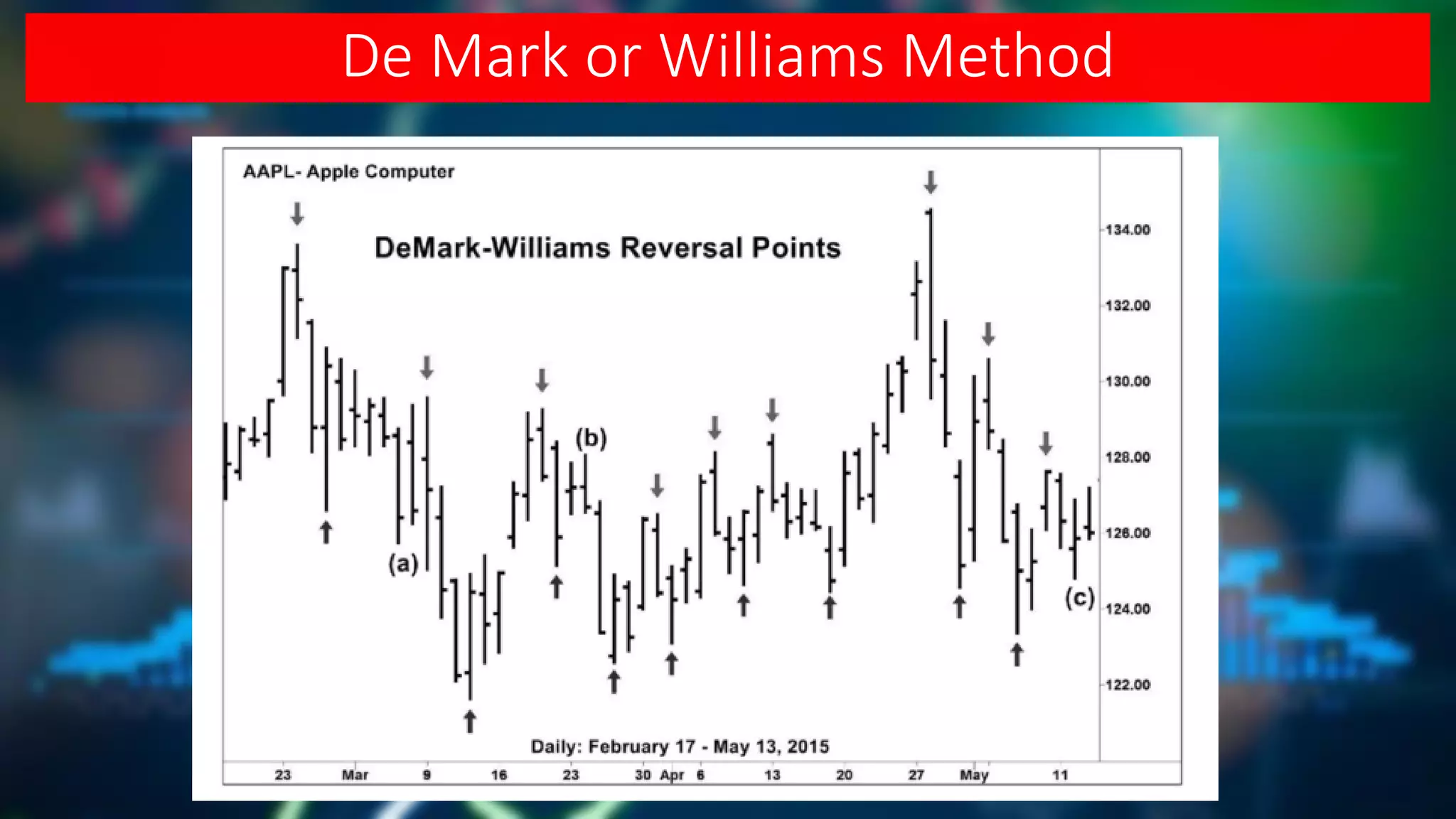
•Each of the two-bar lows and highs is marked with an
arrow.
•Point (a) is not a trough because it does not have at
least two bars on either side of it with higher lows.
Likewise, Point (b) is not a peak.
•It does not have two bars on either side of it with
lower highs.
•Is Point (c) a trough? We do not know because we
can't see if there are two bars to the right of the low to
judge Point (c).
De Mark or Williams Method
Percentage Method
•Another method of identifying significant troughs is by
deciding beforehand how much the price should
decline into and rally from the trough.
•A percentage is usually used. Using 1%, for example,
any time the price declines more than 1%, makes a
low, and then rallies more than 1% would define a 1%
trough.
•The larger the percentage used, the more important
but less frequent the reversal point.
Gann Two-Day Swing Method
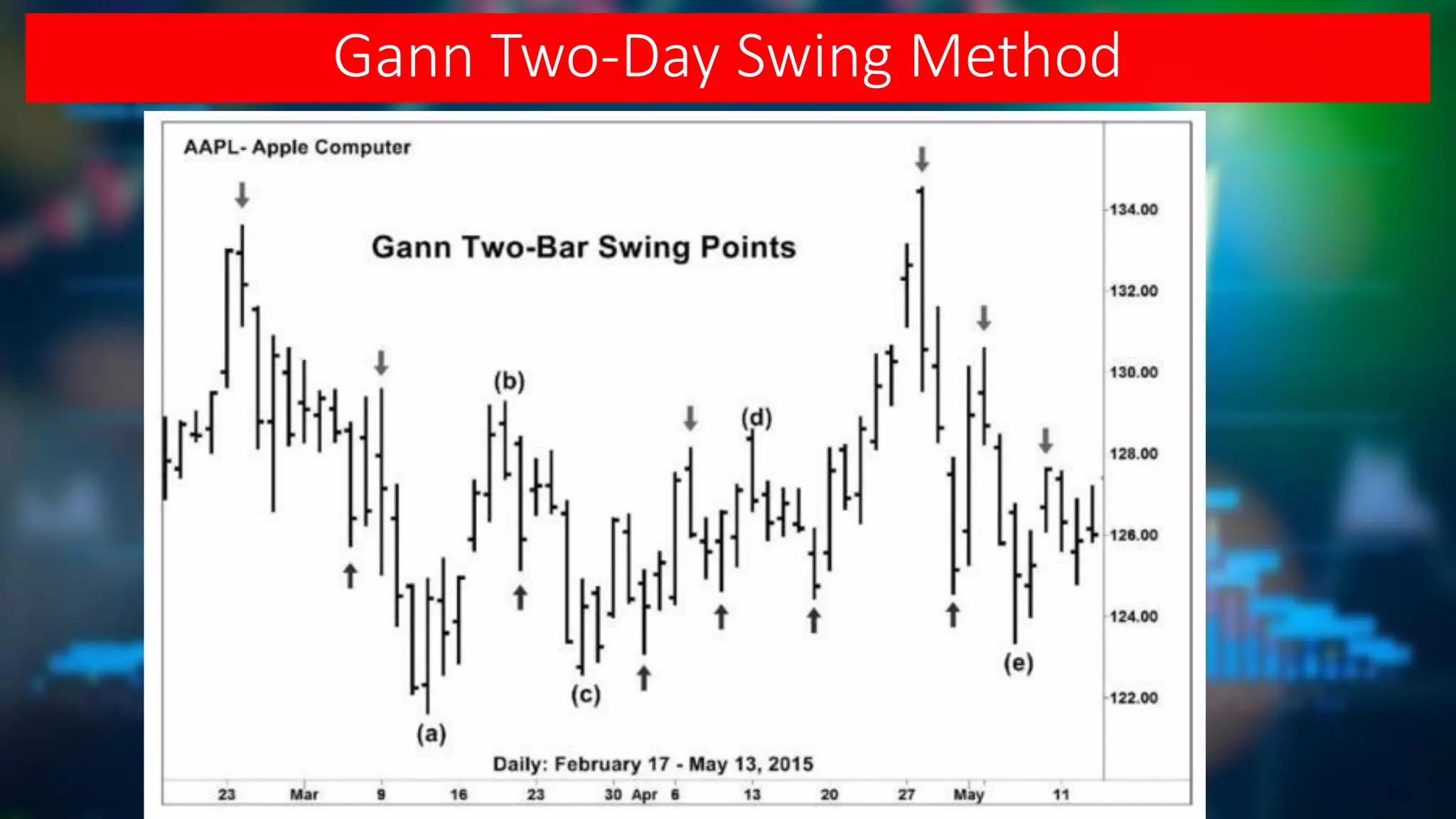
• W. D. Gann's swing method is similar to the DeMark's
or Williams's method.
•Once the low bar is identified, the two following
trading days are observed. If these two days have
higher highs than the low bar, the low bar is a support
point.
• A resistance point is defined as any high bar during an
uptrend that is followed by two successive bars with lower
lows.
Gann Two-Day Swing Method
High Volume Method
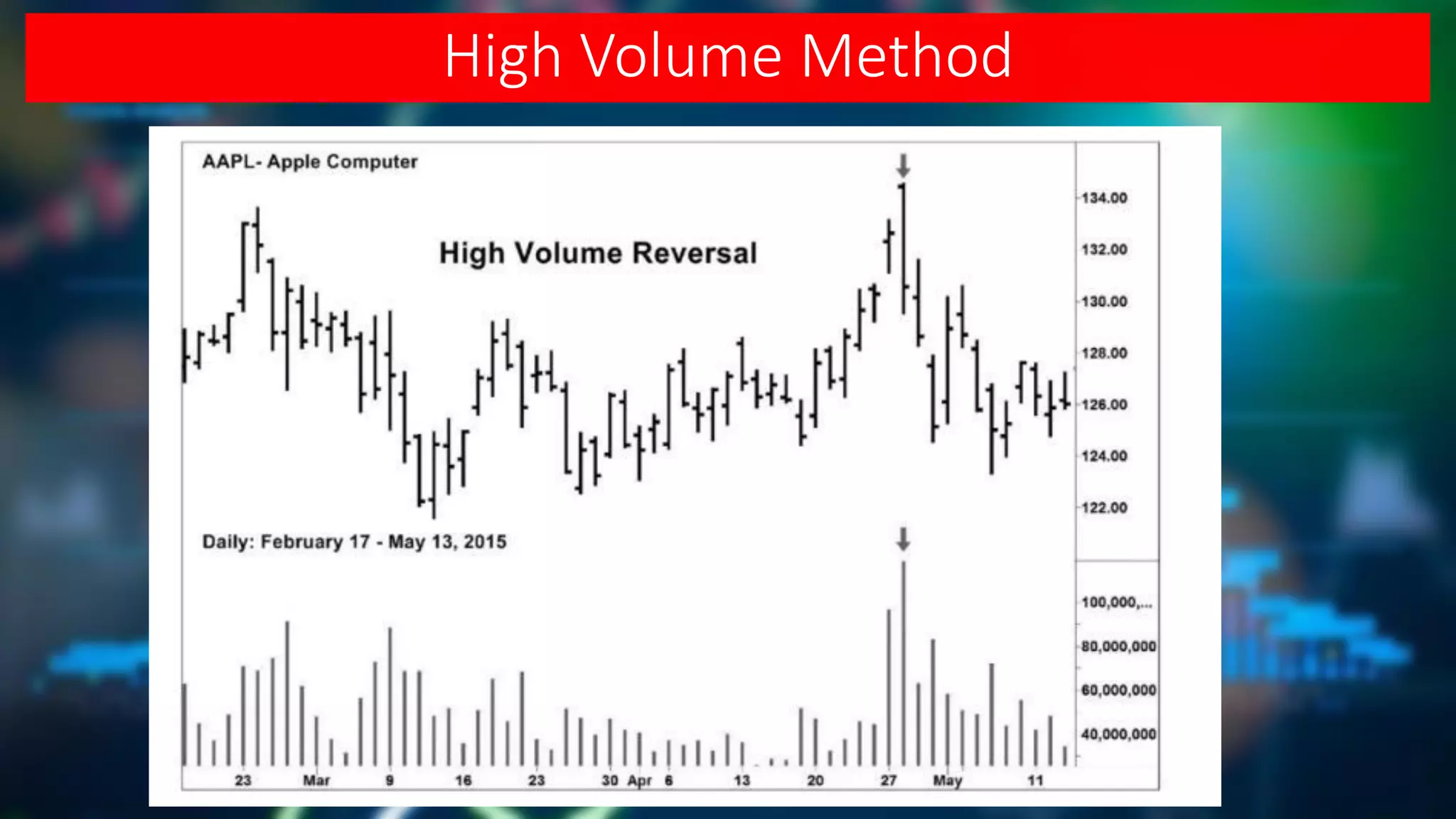
• High volume indicates that larger than usual activity occurred
on that trading day.
• One-day reversal on high volume at a high, creating a significant
reversal point and resistance level.
• One- or two-day patterns can occur at peaks or troughs. When these
occur on high volume, they usually signify important reversal points.
• The large spike in volume on April 28, 2015 occurred with a pattern
called an outside reversal day, where daily range is large, the high is
greater than the previous high, the low is lower than the previous low,
and the close is near the low.
• These patterns can occur without the large volume, but when large
volume is present, they are an excellent signal that the price rise has
reached a speculative peak and will be a strong resistance in the
future.
High Volume Method

Section 2 - Chapter 5 Part II - Support & Resistance Basics

  • 1.
    Lecture - 12 Support& Resistance CMT LEVEL - I
  • 2.
    CMT LEVEL -I Learning Objectives  What Is Support and Resistance?  Reversal Points Determined - De Mark or Williams Method - Percentage Method - Gann Two-Day Swing Method - High Volume Method  Support and Resistance Zones Drawn  Benefits of Support & Resistance
  • 3.
    What is Support& Resistance? •Support is a price level where a downtrend can be expected to pause due to a concentration of demand. •As the price of a security drops, demand for the shares increases, thus forming the support . •Resistance is a price level where a Uptrend can be expected to pause due to a concentration of Supply. •As the price of a security Rise, Supply/Profit Booking for the shares increases, thus forming the Resistance .
  • 4.
    Example - Support& Resistance •We used the terms "floor" for support and "ceiling" for resistance? •Continuing the house analogy, a security is how a rubber ball that bounces in a room will hit the floor (support) and then rebound off the ceiling (resistance). •A ball that continues to bounce between the floor and the ceiling is similar to a trading instrument that is experiencing price consolidation between support and resistance zones. •Extra force, or enthusiasm from either the bulls or bears, is needed to break through the support or resistance.
  • 5.
    Example - Support& Resistance •A support level will eventually become a resistance level when the price attempts to move back up, and conversely, a resistance level will become a support level as the price temporarily falls back. •Price charts allow traders and investors to visually identify areas of support and resistance, and they give clues regarding the significance of these price levels.
  • 6.
    Example - Support& Resistance
  • 7.
  • 8.
  • 9.
    How Support &Resistance Works? •Technical analysts use support and resistance levels to identify price points on a chart where the probabilities favor a pause, or reversal, of a prevailing trend. •Market psychology plays a major role as traders and investors remember the past and react to changing conditions to anticipate future market movement..
  • 10.
    How Support &Resistance Works? •Once an area or "zone" of support or resistance has been identified, it provides valuable potential trade entry or exit points. •This is because, as a price reaches a point of support or resistance, it will do one of two things – bounce back away from the support or resistance level, - violate the price level and continue in its direction until it hits the next support or resistance level.
  • 11.
    What Happen ifS&R Breaks? •Support and resistance levels are psychologically- important levels where a lot of buyers and/or sellers are willing to trade the stock. • When the S&R are broken, the market psychology shifts and new levels of support and resistance are established.
  • 12.
    What Happen ifS&R Breaks?
  • 13.
    Importance for S&RZones •Number of Touches. The more times the price tests a support or resistance area, the more significant the level becomes. When prices keep bouncing off a support or resistance level, more buyers and sellers notice and will base trading decisions on these levels.
  • 14.
    Importance for S&RZones •Preceding Price Move. Support and resistance zones are likely to be more significant when they are preceded by steep advances or declines. For example, a fast, steep advance or uptrend will be met with more competition and enthusiasm and may be halted by a more significant resistance level than a slow, steady advance. A slow advance may not attract as much attention.
  • 15.
    Importance for S&RZones •Volume at Certain Price Levels. The more buying and selling that has occurred at a particular price level, the stronger the support or resistance level is likely to be. •When strong activity occurs under high volume and the price drops, a lot of selling will likely occur when price returns to that level, since people are far more comfortable closing out a trade at the breakeven point rather than at a loss.
  • 16.
    Importance for S&RZones •Time. Support and resistance zones become more significant if the levels have been tested regularly over an extended period of time.
  • 17.
    Reversal Point IdentifiedMethods De Mark or Williams Method Percentage Method Gann Two-Day Swing Method High Volume Method
  • 18.
    De Mark orWilliams Method •In a low bar, for example, the analyst may look for two bars with higher lows directly on either side of the suspected trough bar. •The number of bars on either side can be increased to boost the importance of the trough, but the number of troughs will be sacrificed. •The higher the number of confirming lows necessary, the more important but less common the trough.
  • 19.
    De Mark orWilliams Method •Each of the two-bar lows and highs is marked with an arrow. •Point (a) is not a trough because it does not have at least two bars on either side of it with higher lows. Likewise, Point (b) is not a peak. •It does not have two bars on either side of it with lower highs. •Is Point (c) a trough? We do not know because we can't see if there are two bars to the right of the low to judge Point (c).
  • 20.
    De Mark orWilliams Method
  • 21.
    Percentage Method •Another methodof identifying significant troughs is by deciding beforehand how much the price should decline into and rally from the trough. •A percentage is usually used. Using 1%, for example, any time the price declines more than 1%, makes a low, and then rallies more than 1% would define a 1% trough. •The larger the percentage used, the more important but less frequent the reversal point.
  • 22.
    Gann Two-Day SwingMethod • W. D. Gann's swing method is similar to the DeMark's or Williams's method. •Once the low bar is identified, the two following trading days are observed. If these two days have higher highs than the low bar, the low bar is a support point. • A resistance point is defined as any high bar during an uptrend that is followed by two successive bars with lower lows.
  • 23.
  • 24.
    High Volume Method •High volume indicates that larger than usual activity occurred on that trading day. • One-day reversal on high volume at a high, creating a significant reversal point and resistance level. • One- or two-day patterns can occur at peaks or troughs. When these occur on high volume, they usually signify important reversal points. • The large spike in volume on April 28, 2015 occurred with a pattern called an outside reversal day, where daily range is large, the high is greater than the previous high, the low is lower than the previous low, and the close is near the low. • These patterns can occur without the large volume, but when large volume is present, they are an excellent signal that the price rise has reached a speculative peak and will be a strong resistance in the future.
  • 25.