












Section 4 - Chart Pattern Analysis
Chapter 1 – Classical Chart Patterns
Presented By :
This Content is Copyright Reserved Rights Copyright 2025@PTAIndia
Agenda
Classical Chart Patterns
Price Targets
Setup, Signal, and Reward-to-Risk
Ratio
Breakout Trading Vs. Range
Bound Trading
This Content is Copyright Reserved Rights Copyright 2025@PTAIndia
Head and Shoulders Top Chart Pattern
Chapter 1 – Classical Chart Patterns
Presented By :
This Content is Copyright Reserved Rights Copyright 2025@PTAIndia
Head and Shoulders Top Chart Pattern
This Content is Copyright Reserved Rights Copyright 2025@PTAIndia
D.webp
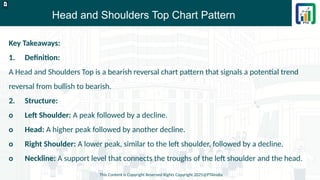
Key Takeaways:
1. Definition:
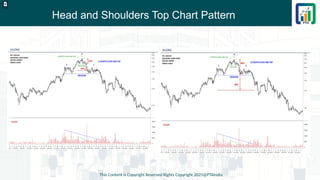
A Head and Shoulders Top is a bearish reversal chart pattern that signals a potential trend
reversal from bullish to bearish.
2. Structure:
o Left Shoulder: A peak followed by a decline.
o Head: A higher peak followed by another decline.
o Right Shoulder: A lower peak, similar to the left shoulder, followed by a decline.
o Neckline: A support level that connects the troughs of the left shoulder and the head.
Head and Shoulders Top Chart Pattern
This Content is Copyright Reserved Rights Copyright 2025@PTAIndia
D.webp
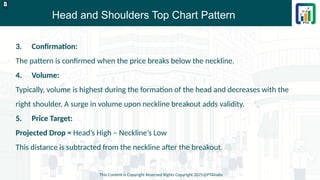
3. Confirmation:
The pattern is confirmed when the price breaks below the neckline.
4. Volume:
Typically, volume is highest during the formation of the head and decreases with the
right shoulder. A surge in volume upon neckline breakout adds validity.
5. Price Target:
Projected Drop = Head’s High – Neckline’s Low
This distance is subtracted from the neckline after the breakout.
Head and Shoulders Top Chart Pattern
This Content is Copyright Reserved Rights Copyright 2025@PTAIndia
D.webp
Head and Shoulders Top Chart Pattern
This Content is Copyright Reserved Rights Copyright 2025@PTAIndia
D.webp
Head and Shoulders Top Chart Pattern
This Content is Copyright Reserved Rights Copyright 2025@PTAIndia
D.webp
6. Common Mistakes:
Misidentifying the pattern before confirmation.
Trading without volume confirmation.
Ignoring market conditions and false breakouts.
7. Trading Strategy:
Entry: After neckline breakout, preferably with a retest.
Stop-Loss: Above the right shoulder or the neckline (if aggressive).
Take-Profit: Use the height of the pattern subtracted from the neckline.
Cheat Sheet: Head & Shoulders Top
This Content is Copyright Reserved Rights Copyright 2025@PTAIndia
Aspect Details
Pattern Type Bearish Reversal
Trend Before Formation Uptrend
Left Shoulder First peak, decline follows
Head Highest peak, decline follows
Right Shoulder Lower peak, decline follows
Neckline Connects the troughs of left shoulder & head
Breakout Point Price breaks below neckline
Volume Behavior Higher in head, lower in right shoulder, high at breakout
Confirmation Neckline break with volume surge
Entry Point After neckline breakout (or retest)
Stop-Loss Placement Above right shoulder or neckline
Target Price Distance from head to neckline subtracted from breakout point
Reliability High when confirmed with volume
Mistakes to Avoid False breakouts, trading without confirmation
Head and Shoulders Bottom Chart Pattern
Chapter 1 – Classical Chart Patterns
Presented By :
This Content is Copyright Reserved Rights Copyright 2025@PTAIndia
Head and Shoulders Bottom Chart Pattern
This Content is Copyright Reserved Rights Copyright 2025@PTAIndia
D.webp
Key Takeaways:
1. Definition:
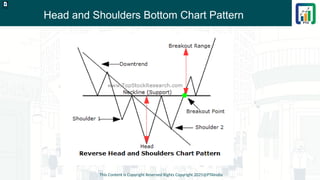
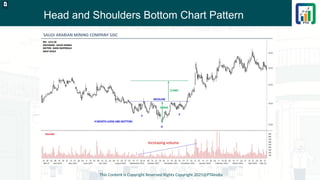
The Head and Shoulders Bottom (also called an Inverse Head and Shoulders) is a bullish
reversal pattern that signals a potential trend change from bearish to bullish.
2. Structure:
Left Shoulder: A low followed by a minor upward move.
Head: A lower low forming the lowest point, followed by an upward move.
Right Shoulder: A higher low, similar to the left shoulder, followed by an upward move.
Neckline: A resistance level that connects the peaks between the left shoulder and head.
Head and Shoulders Bottom Chart Pattern
This Content is Copyright Reserved Rights Copyright 2025@PTAIndia
D.webp
3. Confirmation:
The pattern is confirmed when the price breaks above the neckline.
4. Volume:
Volume is highest during the breakout and typically lower in the right shoulder.
5. Price Target Calculation:
Projected Rise = Head’s Low to Neckline Distance
Add this distance to the breakout point for a target.
Head and Shoulders Bottom Chart Pattern
This Content is Copyright Reserved Rights Copyright 2025@PTAIndia
D.webp
6. Common Mistakes:
Entering before confirmation (waiting for the neckline breakout is key).
Ignoring volume confirmation.
Failing to manage risk with proper stop-loss placement.
7. Trading Strategy:
Entry: After the neckline breakout (preferably with a retest).
Stop-Loss: Below the right shoulder or neckline (if aggressive).
Take-Profit: Measure the height from the head to the neckline and add it to the
breakout point.
Head and Shoulders Bottom Chart Pattern
This Content is Copyright Reserved Rights Copyright 2025@PTAIndia
D.webp
Head and Shoulders Bottom Chart Pattern
This Content is Copyright Reserved Rights Copyright 2025@PTAIndia
D.webp
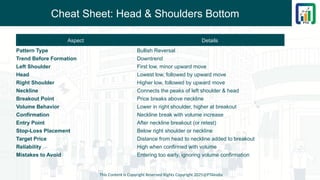
Cheat Sheet: Head & Shoulders Bottom
This Content is Copyright Reserved Rights Copyright 2025@PTAIndia
Aspect Details
Pattern Type Bullish Reversal
Trend Before Formation Downtrend
Left Shoulder First low, minor upward move
Head Lowest low, followed by upward move
Right Shoulder Higher low, followed by upward move
Neckline Connects the peaks of left shoulder & head
Breakout Point Price breaks above neckline
Volume Behavior Lower in right shoulder, higher at breakout
Confirmation Neckline break with volume increase
Entry Point After neckline breakout (or retest)
Stop-Loss Placement Below right shoulder or neckline
Target Price Distance from head to neckline added to breakout
Reliability High when confirmed with volume
Mistakes to Avoid Entering too early, ignoring volume confirmation
Symmetrical Triangle Chart Pattern
Chapter 1 – Classical Chart Patterns
Presented By :
This Content is Copyright Reserved Rights Copyright 2025@PTAIndia
Symmetrical Triangle Chart Pattern
Key Takeaways:
1. Definition:
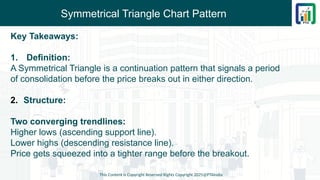
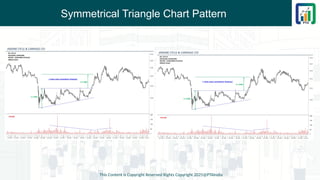
A Symmetrical Triangle is a continuation pattern that signals a period
of consolidation before the price breaks out in either direction.
2. Structure:
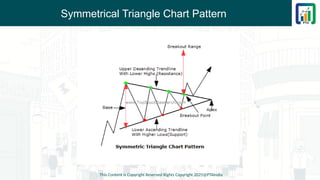
Two converging trendlines:
Higher lows (ascending support line).
Lower highs (descending resistance line).
Price gets squeezed into a tighter range before the breakout.
This Content is Copyright Reserved Rights Copyright 2025@PTAIndia
Symmetrical Triangle Chart Pattern
3. Breakout Direction:
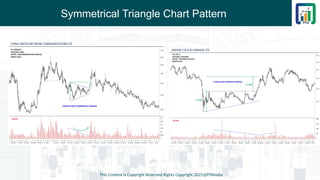
The price can break out in either direction (bullish or bearish).
Volume typically increases at the breakout.
4. Confirmation:
A breakout above the resistance line suggests a bullish move.
A breakdown below the support line suggests a bearish move.
5. Price Target Calculation:
Projected Move = Height of the Triangle at its Widest Point
Add to breakout point for bullish breakouts, subtract for bearish ones.
This Content is Copyright Reserved Rights Copyright 2025@PTAIndia
Symmetrical Triangle Chart Pattern
6. Common Mistakes:
Entering before a confirmed breakout.
Ignoring volume confirmation.
Not setting a stop-loss (false breakouts can occur).
7. Trading Strategy:
Entry: After breakout confirmation with strong volume.
Stop-Loss: Just inside the triangle (to protect against false breakouts).
Take-Profit: Measure the widest part of the triangle and project it in the
breakout direction.
This Content is Copyright Reserved Rights Copyright 2025@PTAIndia
Symmetrical Triangle Chart Pattern
This Content is Copyright Reserved Rights Copyright 2025@PTAIndia
Symmetrical Triangle Chart Pattern
This Content is Copyright Reserved Rights Copyright 2025@PTAIndia
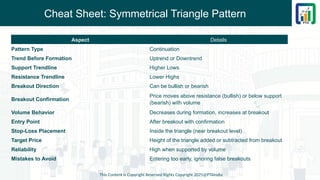
Cheat Sheet: Symmetrical Triangle Pattern
This Content is Copyright Reserved Rights Copyright 2025@PTAIndia
Aspect Details
Pattern Type Continuation
Trend Before Formation Uptrend or Downtrend
Support Trendline Higher Lows
Resistance Trendline Lower Highs
Breakout Direction Can be bullish or bearish
Breakout Confirmation
Price moves above resistance (bullish) or below support
(bearish) with volume
Volume Behavior Decreases during formation, increases at breakout
Entry Point After breakout with confirmation
Stop-Loss Placement Inside the triangle (near breakout level)
Target Price Height of the triangle added or subtracted from breakout
Reliability High when supported by volume
Mistakes to Avoid Entering too early, ignoring false breakouts
Ascending & Descending Triangle Patterns
Chapter 1 – Classical Chart Patterns
Presented By :
This Content is Copyright Reserved Rights Copyright 2025@PTAIndia
Ascending & Descending Triangle Patterns
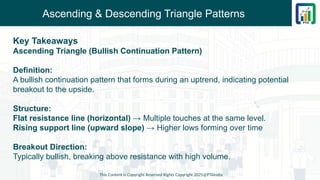
Key Takeaways
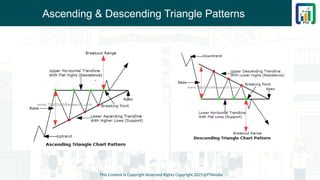
Ascending Triangle (Bullish Continuation Pattern)
Definition:
A bullish continuation pattern that forms during an uptrend, indicating potential
breakout to the upside.
Structure:
Flat resistance line (horizontal) → Multiple touches at the same level.
Rising support line (upward slope) → Higher lows forming over time
Breakout Direction:
Typically bullish, breaking above resistance with high volume.
This Content is Copyright Reserved Rights Copyright 2025@PTAIndia
Ascending & Descending Triangle Patterns
Key Takeaways
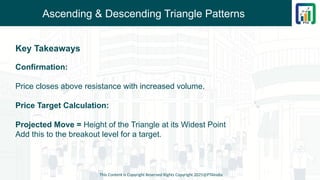
Confirmation:
Price closes above resistance with increased volume.
Price Target Calculation:
Projected Move = Height of the Triangle at its Widest Point
Add this to the breakout level for a target.
This Content is Copyright Reserved Rights Copyright 2025@PTAIndia
Ascending & Descending Triangle Patterns
Key Takeaways
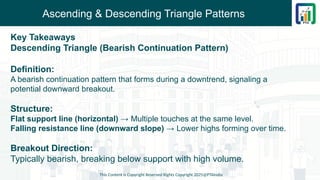
Descending Triangle (Bearish Continuation Pattern)
Definition:
A bearish continuation pattern that forms during a downtrend, signaling a
potential downward breakout.
Structure:
Flat support line (horizontal) → Multiple touches at the same level.
Falling resistance line (downward slope) → Lower highs forming over time.
Breakout Direction:
Typically bearish, breaking below support with high volume.
This Content is Copyright Reserved Rights Copyright 2025@PTAIndia
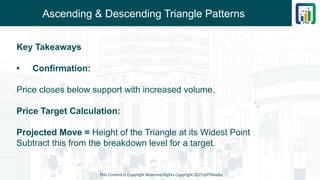
Ascending & Descending Triangle Patterns
Key Takeaways
• Confirmation:
Price closes below support with increased volume.
Price Target Calculation:
Projected Move = Height of the Triangle at its Widest Point
Subtract this from the breakdown level for a target.
This Content is Copyright Reserved Rights Copyright 2025@PTAIndia
Ascending & Descending Triangle Patterns
This Content is Copyright Reserved Rights Copyright 2025@PTAIndia
Symmetrical Triangle Chart Pattern
This Content is Copyright Reserved Rights Copyright 2025@PTAIndia
Cheat Sheet: Ascending & Descending Triangle Patterns
This Content is Copyright Reserved Rights Copyright 2025@PTAIndia
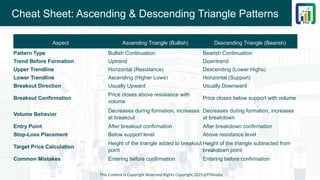
Aspect Ascending Triangle (Bullish) Descending Triangle (Bearish)
Pattern Type Bullish Continuation Bearish Continuation
Trend Before Formation Uptrend Downtrend
Upper Trendline Horizontal (Resistance) Descending (Lower Highs)
Lower Trendline Ascending (Higher Lows) Horizontal (Support)
Breakout Direction Usually Upward Usually Downward
Breakout Confirmation
Price closes above resistance with
volume
Price closes below support with volume
Volume Behavior
Decreases during formation, increases
at breakout
Decreases during formation, increases
at breakdown
Entry Point After breakout confirmation After breakdown confirmation
Stop-Loss Placement Below support level Above resistance level
Target Price Calculation
Height of the triangle added to breakout
point
Height of the triangle subtracted from
breakdown point
Common Mistakes Entering before confirmation Entering before confirmation
Rectangle Top (Double & Triple Top)
Chapter 1 – Classical Chart Patterns
Presented By :
This Content is Copyright Reserved Rights Copyright 2025@PTAIndia
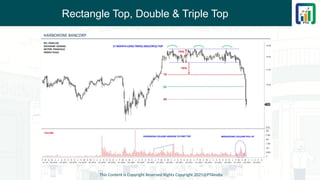
Rectangle Top
Key Takeaways
Rectangle Top Pattern (Consolidation & Reversal)
Definition:
A Rectangle Top is a bearish continuation or reversal pattern that forms when the
price moves between parallel support and resistance levels multiple times before
breaking downward.
Structure:
Resistance Level (Flat Upper Line): Price tests this level multiple times but fails
to break through.
Support Level (Flat Lower Line): Price finds support at the same level multiple
times.
This Content is Copyright Reserved Rights Copyright 2025@PTAIndia
Rectangle Top (Double & Triple Top)
Key Takeaways
Breakout Direction:
A downward breakout is more likely, but sometimes it can break upwards
(bullish continuation).
Volume Behavior:
Volume decreases within the rectangle and spikes on the breakout.
Confirmation:
A break below support with strong volume confirms a bearish move.
Price Target Calculation:
Projected Move = Height of the Rectangle
Subtract this from the breakdown point.
This Content is Copyright Reserved Rights Copyright 2025@PTAIndia
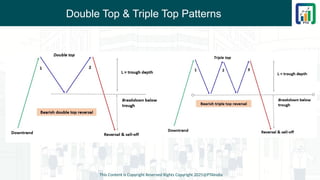
Double Top (Bearish Reversal Pattern)
Key Takeaways
Double Top (Bearish Reversal Pattern)
Definition:
A Double Top is a bearish reversal pattern that occurs after an uptrend and signals a trend
reversal to the downside.
Structure:
Two peaks at similar levels: Price tests the resistance twice but fails to break higher.
Neckline (Support Level): The lowest point between the two peaks.
This Content is Copyright Reserved Rights Copyright 2025@PTAIndia
Double Top (Bearish Reversal Pattern)
Key Takeaways
Breakout Direction:
A break below the neckline confirms a bearish reversal.
Volume Behavior:
High volume at the first peak, lower at the second peak, and spike in volume on
the neckline breakdown.
Confirmation:
A break below support with strong volume confirms a bearish move.
Price Target Calculation:
Projected Move = Distance from Peaks to Neckline
Subtract this from the breakdown point.
This Content is Copyright Reserved Rights Copyright 2025@PTAIndia
Double Top & Triple Top Patterns
This Content is Copyright Reserved Rights Copyright 2025@PTAIndia
Rectangle Top, Double & Triple Top
This Content is Copyright Reserved Rights Copyright 2025@PTAIndia
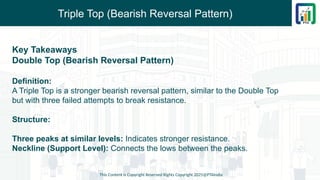
Triple Top (Bearish Reversal Pattern)
Key Takeaways
Double Top (Bearish Reversal Pattern)
Definition:
A Triple Top is a stronger bearish reversal pattern, similar to the Double Top
but with three failed attempts to break resistance.
Structure:
Three peaks at similar levels: Indicates stronger resistance.
Neckline (Support Level): Connects the lows between the peaks.
This Content is Copyright Reserved Rights Copyright 2025@PTAIndia
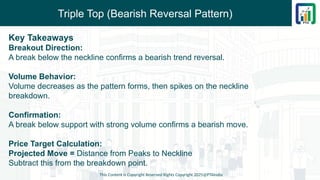
Triple Top (Bearish Reversal Pattern)
Key Takeaways
Breakout Direction:
A break below the neckline confirms a bearish trend reversal.
Volume Behavior:
Volume decreases as the pattern forms, then spikes on the neckline
breakdown.
Confirmation:
A break below support with strong volume confirms a bearish move.
Price Target Calculation:
Projected Move = Distance from Peaks to Neckline
Subtract this from the breakdown point.
This Content is Copyright Reserved Rights Copyright 2025@PTAIndia
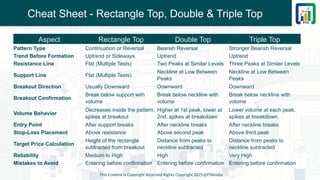
Cheat Sheet - Rectangle Top, Double & Triple Top
This Content is Copyright Reserved Rights Copyright 2025@PTAIndia
Aspect Rectangle Top Double Top Triple Top
Pattern Type Continuation or Reversal Bearish Reversal Stronger Bearish Reversal
Trend Before Formation Uptrend or Sideways Uptrend Uptrend
Resistance Line Flat (Multiple Tests) Two Peaks at Similar Levels Three Peaks at Similar Levels
Support Line Flat (Multiple Tests)
Neckline at Low Between
Peaks
Neckline at Low Between
Peaks
Breakout Direction Usually Downward Downward Downward
Breakout Confirmation
Break below support with
volume
Break below neckline with
volume
Break below neckline with
volume
Volume Behavior
Decreases inside the pattern,
spikes at breakout
Higher at 1st peak, lower at
2nd, spikes at breakdown
Lower volume at each peak,
spikes at breakdown
Entry Point After support breaks After neckline breaks After neckline breaks
Stop-Loss Placement Above resistance Above second peak Above third peak
Target Price Calculation
Height of the rectangle
subtracted from breakout
Distance from peaks to
neckline subtracted
Distance from peaks to
neckline subtracted
Reliability Medium to High High Very High
Mistakes to Avoid Entering before confirmation Entering before confirmation Entering before confirmation
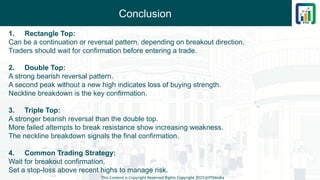
Conclusion
1. Rectangle Top:
Can be a continuation or reversal pattern, depending on breakout direction.
Traders should wait for confirmation before entering a trade.
2. Double Top:
A strong bearish reversal pattern.
A second peak without a new high indicates loss of buying strength.
Neckline breakdown is the key confirmation.
3. Triple Top:
A stronger bearish reversal than the double top.
More failed attempts to break resistance show increasing weakness.
The neckline breakdown signals the final confirmation.
4. Common Trading Strategy:
Wait for breakout confirmation.
Set a stop-loss above recent highs to manage risk.
This Content is Copyright Reserved Rights Copyright 2025@PTAIndia
Flags and Pennants
Chapter 1 – Classical Chart Patterns
Presented By :
This Content is Copyright Reserved Rights Copyright 2025@PTAIndia
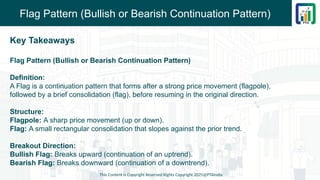
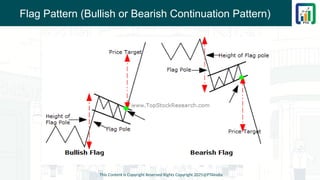
Flag Pattern (Bullish or Bearish Continuation Pattern)
Key Takeaways
Flag Pattern (Bullish or Bearish Continuation Pattern)
Definition:
A Flag is a continuation pattern that forms after a strong price movement (flagpole),
followed by a brief consolidation (flag), before resuming in the original direction.
Structure:
Flagpole: A sharp price movement (up or down).
Flag: A small rectangular consolidation that slopes against the prior trend.
Breakout Direction:
Bullish Flag: Breaks upward (continuation of an uptrend).
Bearish Flag: Breaks downward (continuation of a downtrend).
This Content is Copyright Reserved Rights Copyright 2025@PTAIndia
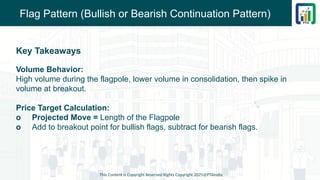
Flag Pattern (Bullish or Bearish Continuation Pattern)
Key Takeaways
Volume Behavior:
High volume during the flagpole, lower volume in consolidation, then spike in
volume at breakout.
Price Target Calculation:
o Projected Move = Length of the Flagpole
o Add to breakout point for bullish flags, subtract for bearish flags.
This Content is Copyright Reserved Rights Copyright 2025@PTAIndia
Flag Pattern (Bullish or Bearish Continuation Pattern)
This Content is Copyright Reserved Rights Copyright 2025@PTAIndia
Pennant Pattern (Bullish or Bearish Continuation Pattern)
Key Takeaways
Pennant Pattern (Bullish or Bearish Continuation Pattern)
Definition:
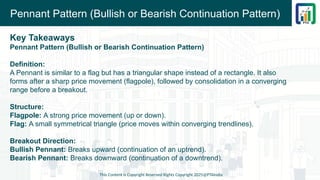
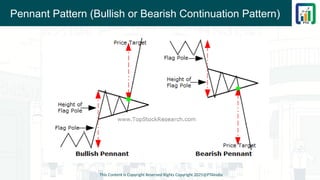
A Pennant is similar to a flag but has a triangular shape instead of a rectangle. It also
forms after a sharp price movement (flagpole), followed by consolidation in a converging
range before a breakout.
Structure:
Flagpole: A strong price movement (up or down).
Flag: A small symmetrical triangle (price moves within converging trendlines).
Breakout Direction:
Bullish Pennant: Breaks upward (continuation of an uptrend).
Bearish Pennant: Breaks downward (continuation of a downtrend).
This Content is Copyright Reserved Rights Copyright 2025@PTAIndia
Pennant Pattern (Bullish or Bearish Continuation Pattern)
Key Takeaways
Volume Behavior:
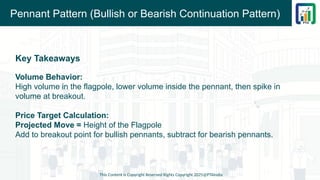
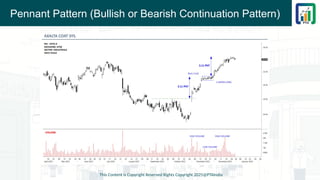
High volume in the flagpole, lower volume inside the pennant, then spike in
volume at breakout.
Price Target Calculation:
Projected Move = Height of the Flagpole
Add to breakout point for bullish pennants, subtract for bearish pennants.
This Content is Copyright Reserved Rights Copyright 2025@PTAIndia
Pennant Pattern (Bullish or Bearish Continuation Pattern)
This Content is Copyright Reserved Rights Copyright 2025@PTAIndia
Pennant Pattern (Bullish or Bearish Continuation Pattern)
This Content is Copyright Reserved Rights Copyright 2025@PTAIndia
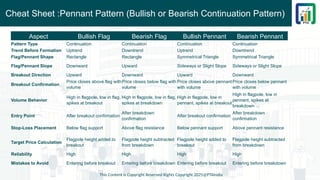
Cheat Sheet :Pennant Pattern (Bullish or Bearish Continuation Pattern)
This Content is Copyright Reserved Rights Copyright 2025@PTAIndia
Aspect Bullish Flag Bearish Flag Bullish Pennant Bearish Pennant
Pattern Type Continuation Continuation Continuation Continuation
Trend Before Formation Uptrend Downtrend Uptrend Downtrend
Flag/Pennant Shape Rectangle Rectangle Symmetrical Triangle Symmetrical Triangle
Flag/Pennant Slope Downward Upward Sideways or Slight Slope Sideways or Slight Slope
Breakout Direction Upward Downward Upward Downward
Breakout Confirmation
Price closes above flag with
volume
Price closes below flag with
volume
Price closes above pennant
with volume
Price closes below pennant
with volume
Volume Behavior
High in flagpole, low in flag,
spikes at breakout
High in flagpole, low in flag,
spikes at breakdown
High in flagpole, low in
pennant, spikes at breakout
High in flagpole, low in
pennant, spikes at
breakdown
Entry Point After breakout confirmation
After breakdown
confirmation
After breakout confirmation
After breakdown
confirmation
Stop-Loss Placement Below flag support Above flag resistance Below pennant support Above pennant resistance
Target Price Calculation
Flagpole height added to
breakout
Flagpole height subtracted
from breakdown
Flagpole height added to
breakout
Flagpole height subtracted
from breakdown
Reliability High High High High
Mistakes to Avoid Entering before breakout Entering before breakdown Entering before breakout Entering before breakdown
Conclusion
This Content is Copyright Reserved Rights Copyright 2025@PTAIndia
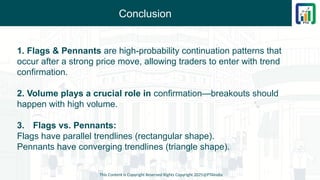
1. Flags & Pennants are high-probability continuation patterns that
occur after a strong price move, allowing traders to enter with trend
confirmation.
2. Volume plays a crucial role in confirmation—breakouts should
happen with high volume.
3. Flags vs. Pennants:
Flags have parallel trendlines (rectangular shape).
Pennants have converging trendlines (triangle shape).
Conclusion
This Content is Copyright Reserved Rights Copyright 2025@PTAIndia
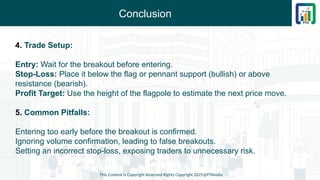
4. Trade Setup:
Entry: Wait for the breakout before entering.
Stop-Loss: Place it below the flag or pennant support (bullish) or above
resistance (bearish).
Profit Target: Use the height of the flagpole to estimate the next price move.
5. Common Pitfalls:
Entering too early before the breakout is confirmed.
Ignoring volume confirmation, leading to false breakouts.
Setting an incorrect stop-loss, exposing traders to unnecessary risk.
Setup, Signal, and Reward-to-Risk Ratio in Chart Patterns
This Content is Copyright Reserved Rights Copyright 2025@PTAIndia
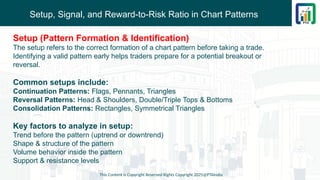
Setup (Pattern Formation & Identification)
The setup refers to the correct formation of a chart pattern before taking a trade.
Identifying a valid pattern early helps traders prepare for a potential breakout or
reversal.
Common setups include:
Continuation Patterns: Flags, Pennants, Triangles
Reversal Patterns: Head & Shoulders, Double/Triple Tops & Bottoms
Consolidation Patterns: Rectangles, Symmetrical Triangles
Key factors to analyze in setup:
Trend before the pattern (uptrend or downtrend)
Shape & structure of the pattern
Volume behavior inside the pattern
Support & resistance levels
Setup, Signal, and Reward-to-Risk Ratio in Chart Patterns
This Content is Copyright Reserved Rights Copyright 2025@PTAIndia
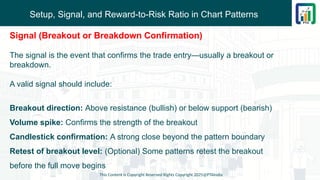
Signal (Breakout or Breakdown Confirmation)
The signal is the event that confirms the trade entry—usually a breakout or
breakdown.
A valid signal should include:
Breakout direction: Above resistance (bullish) or below support (bearish)
Volume spike: Confirms the strength of the breakout
Candlestick confirmation: A strong close beyond the pattern boundary
Retest of breakout level: (Optional) Some patterns retest the breakout
before the full move begins
Setup, Signal, and Reward-to-Risk Ratio in Chart Patterns
This Content is Copyright Reserved Rights Copyright 2025@PTAIndia
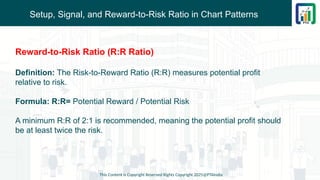
Reward-to-Risk Ratio (R:R Ratio)
Definition: The Risk-to-Reward Ratio (R:R) measures potential profit
relative to risk.
Formula: R:R= Potential Reward / Potential Risk
A minimum R:R of 2:1 is recommended, meaning the potential profit should
be at least twice the risk.
Setup, Signal, and Reward-to-Risk Ratio in Chart Patterns
This Content is Copyright Reserved Rights Copyright 2025@PTAIndia
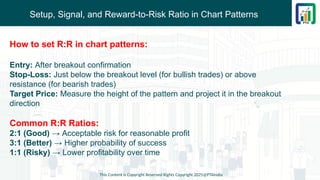
How to set R:R in chart patterns:
Entry: After breakout confirmation
Stop-Loss: Just below the breakout level (for bullish trades) or above
resistance (for bearish trades)
Target Price: Measure the height of the pattern and project it in the breakout
direction
Common R:R Ratios:
2:1 (Good) → Acceptable risk for reasonable profit
3:1 (Better) → Higher probability of success
1:1 (Risky) → Lower profitability over time
Gaps
Chapter 1 – Classical Chart Patterns
Presented By :
This Content is Copyright Reserved Rights Copyright 2025@PTAIndia
Gaps
This Content is Copyright Reserved Rights Copyright 2025@PTAIndia
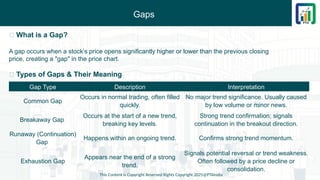
🔹 What is a Gap?
A gap occurs when a stock’s price opens significantly higher or lower than the previous closing
price, creating a "gap" in the price chart.
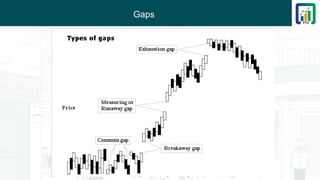
📌 Types of Gaps & Their Meaning
Gap Type Description Interpretation
Common Gap
Occurs in normal trading, often filled
quickly.
No major trend significance. Usually caused
by low volume or minor news.
Breakaway Gap
Occurs at the start of a new trend,
breaking key levels.
Strong trend confirmation; signals
continuation in the breakout direction.
Runaway (Continuation)
Gap
Happens within an ongoing trend. Confirms strong trend momentum.
Exhaustion Gap
Appears near the end of a strong
trend.
Signals potential reversal or trend weakness.
Often followed by a price decline or
consolidation.
Gaps
This Content is Copyright Reserved Rights Copyright 2025@PTAIndia
Gaps
This Content is Copyright Reserved Rights Copyright 2025@PTAIndia
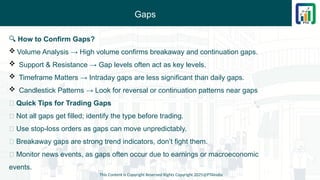
🔍 How to Confirm Gaps?
 Volume Analysis → High volume confirms breakaway and continuation gaps.
 Support & Resistance → Gap levels often act as key levels.
 Timeframe Matters → Intraday gaps are less significant than daily gaps.
 Candlestick Patterns → Look for reversal or continuation patterns near gaps
💡 Quick Tips for Trading Gaps
🔸 Not all gaps get filled; identify the type before trading.
🔸 Use stop-loss orders as gaps can move unpredictably.
🔸 Breakaway gaps are strong trend indicators, don’t fight them.
🔸 Monitor news events, as gaps often occur due to earnings or macroeconomic
events.
Gaps
This Content is Copyright Reserved Rights Copyright 2025@PTAIndia
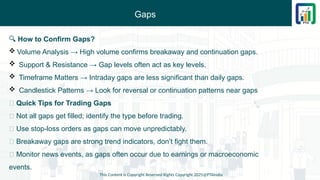
🔍 How to Confirm Gaps?
 Volume Analysis → High volume confirms breakaway and continuation gaps.
 Support & Resistance → Gap levels often act as key levels.
 Timeframe Matters → Intraday gaps are less significant than daily gaps.
 Candlestick Patterns → Look for reversal or continuation patterns near gaps
💡 Quick Tips for Trading Gaps
🔸 Not all gaps get filled; identify the type before trading.
🔸 Use stop-loss orders as gaps can move unpredictably.
🔸 Breakaway gaps are strong trend indicators, don’t fight them.
🔸 Monitor news events, as gaps often occur due to earnings or macroeconomic
events.
Common Gaps
This Content is Copyright Reserved Rights Copyright 2025@PTAIndia
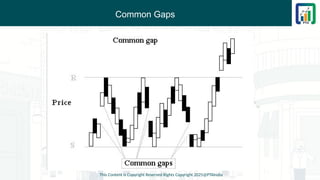
🔹 What is a Common Gap?
A Common Gap (also known as a Trading Gap) occurs when there is a break between prices, but
it is not associated with major news or trend shifts. These gaps usually happen in sideways or
range-bound markets and tend to be filled quickly as price returns to the previous level.
📌 Key Characteristics of Common Gaps
Feature Explanation
Occurs in Range-bound or non-trending markets
Volume Usually low
Gap Fill Often fills within a few days
Caused by Temporary supply/demand imbalance, random market events
Impact on Trend No strong directional trend signal
Common Gaps
This Content is Copyright Reserved Rights Copyright 2025@PTAIndia
Common Gaps
This Content is Copyright Reserved Rights Copyright 2025@PTAIndia
📊 Common Gap Trading Strategies
✅ Gap Fill Strategy (Mean Reversion)
• Since common gaps often fill, traders can bet on price returning to the previous level.
• Entry: Wait for confirmation (reversal candle, decreasing momentum).
• Exit: Target the gap close level.
✅ Support & Resistance Play
• If the gap occurs near support/resistance, price may react to these levels.
• Look for a rejection or bounce to trade in the direction of the reaction.
✅ Avoid Trend Confirmation Trades
• Unlike breakaway or continuation gaps, common gaps do not indicate strong trends.
• Be cautious of false breakouts if trading trend continuation.
Common Gaps
This Content is Copyright Reserved Rights Copyright 2025@PTAIndia
🔍 How to Identify Common Gaps?
📉 Check Volume:
• Low volume → More likely a common gap.
• High volume → Could be another gap type (breakaway, exhaustion).
📊 Look at Market Context:
• If the market is consolidating, it’s likely a common gap.
• If in a strong trend, reconsider—it may be a different gap type.
🕒 Gap Fill Speed:
• If the gap fills within a few sessions, it confirms it was a common gap.
💡 Quick Tips for Trading Common Gaps
🔸 Common gaps are not strong trend indicators—don’t chase them.
🔸 Use stop-loss orders, as gaps can sometimes evolve into breakaway gaps.
🔸 Watch for support/resistance reactions before entering a trade.
🔸 Ideal for short-term, mean-reversion strategies rather than trend trading.
Breakaway Gap
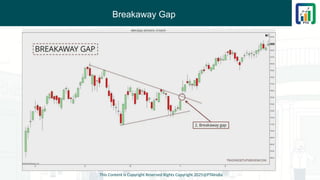
🔹 What is a Breakaway Gap?
A Breakaway Gap occurs when price breaks out of a consolidation zone, chart pattern, or key
support/resistance level with high volume, signaling the start of a strong new trend. These gaps do
not fill quickly and indicate a potential long-term movement in the breakout direction.
📌 Key Characteristics of a Breakaway Gap
Feature Explanation
Occurs in Start of a new trend after consolidation
Volume High volume confirms breakout
Gap Fill Unlikely to fill soon, strong continuation signal
Caused by
Major news, earnings reports, strong buying/selling
pressure
Impact on Trend
Strong trend signal, often leads to sustained
movement
Breakaway Gap
This Content is Copyright Reserved Rights Copyright 2025@PTAIndia
Breakaway Gap
This Content is Copyright Reserved Rights Copyright 2025@PTAIndia
Breakaway Gap Trading Strategies
✅ Breakout Confirmation Trade
• Identify a strong resistance/support level that the price gaps above/below.
• Enter after the first pullback or retest of the breakout zone.
• Stop-loss: Below (for bullish) or above (for bearish) the gap zone.
✅ Volume Confirmation Strategy
• If the gap occurs on high volume, it confirms strength—trade in the breakout direction.
• Weak volume may indicate a false breakout.
✅ Avoid Fading Breakaway Gaps
• Unlike common gaps, breakaway gaps usually do not get filled quickly.
• Trying to short these gaps is risky unless strong reversal signs appear.
Breakaway Gap
🔍 How to Identify a Breakaway Gap?
Check for a Prior Range or Consolidation:
• Breakaway gaps occur after price has been stuck in a range or pattern (e.g., triangle,
rectangle, head & shoulders).
Look at Volume:
• High volume = stronger confirmation of a true breakaway gap.
• Low volume = more likely a false breakout.
Watch Price Action After the Gap:
• If price holds above (bullish) or below (bearish) the gap zone, it confirms strength.
• If price rapidly retraces, the breakout may be weak or false.
💡 Quick Tips for Trading Breakaway Gap
🔸 Strong trends often start with a breakaway gap—trade in the direction of the breakout.
🔸 High volume is key—low volume gaps may be fakeouts.
🔸 Breakaway gaps are not easily filled, so don’t expect a quick price reversal.
🔸 Ideal for momentum traders and trend followers
Runaway (Continuation) Gap
🔹 What is a Runaway (Continuation) Gap?
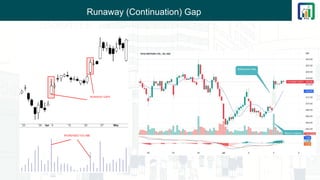
A Runaway Gap, also called a Continuation Gap, occurs mid-trend when strong momentum pushes the price
further in the same direction. It signals trend acceleration, meaning that buyers (in an uptrend) or sellers (in a
downtrend) are aggressively driving prices further.
Unlike Common Gaps, Runaway Gaps rarely fill quickly because they indicate sustained strength in the trend.
📌 Key Characteristics of a Runaway Gap
Feature Explanation
Occurs in Strong trending markets (bullish or bearish)
Volume Moderate to high, confirming strength
Gap Fill Rarely fills quickly, often continues in the same direction
Caused by Increased investor enthusiasm, strong buying/selling pressure
Impact on Trend Confirms trend continuation, suggests momentum
Runaway (Continuation) Gap
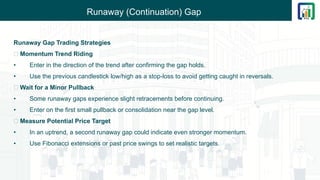
Runaway Gap Trading Strategies
✅ Momentum Trend Riding
• Enter in the direction of the trend after confirming the gap holds.
• Use the previous candlestick low/high as a stop-loss to avoid getting caught in reversals.
✅ Wait for a Minor Pullback
• Some runaway gaps experience slight retracements before continuing.
• Enter on the first small pullback or consolidation near the gap level.
✅ Measure Potential Price Target
• In an uptrend, a second runaway gap could indicate even stronger momentum.
• Use Fibonacci extensions or past price swings to set realistic targets.
Runaway (Continuation) Gap
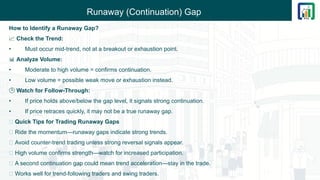
How to Identify a Runaway Gap?
📈 Check the Trend:
• Must occur mid-trend, not at a breakout or exhaustion point.
📊 Analyze Volume:
• Moderate to high volume = confirms continuation.
• Low volume = possible weak move or exhaustion instead.
🕒 Watch for Follow-Through:
• If price holds above/below the gap level, it signals strong continuation.
• If price retraces quickly, it may not be a true runaway gap.
💡 Quick Tips for Trading Runaway Gaps
🔸 Ride the momentum—runaway gaps indicate strong trends.
🔸 Avoid counter-trend trading unless strong reversal signals appear.
🔸 High volume confirms strength—watch for increased participation.
🔸 A second continuation gap could mean trend acceleration—stay in the trade.
🔸 Works well for trend-following traders and swing traders.
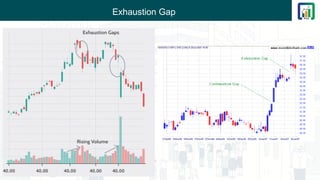
Exhaustion Gap
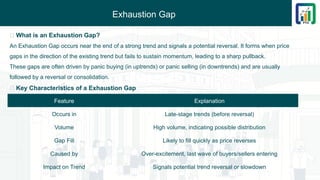
🔹 What is an Exhaustion Gap?
An Exhaustion Gap occurs near the end of a strong trend and signals a potential reversal. It forms when price
gaps in the direction of the existing trend but fails to sustain momentum, leading to a sharp pullback.
These gaps are often driven by panic buying (in uptrends) or panic selling (in downtrends) and are usually
followed by a reversal or consolidation.
📌 Key Characteristics of a Exhaustion Gap
Feature Explanation
Occurs in Late-stage trends (before reversal)
Volume High volume, indicating possible distribution
Gap Fill Likely to fill quickly as price reverses
Caused by Over-excitement, last wave of buyers/sellers entering
Impact on Trend Signals potential trend reversal or slowdown
Exhaustion Gap
Exhaustion Gap
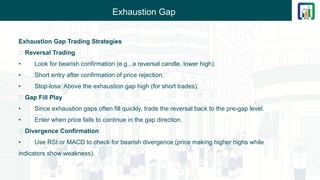
Exhaustion Gap Trading Strategies
✅ Reversal Trading
• Look for bearish confirmation (e.g., a reversal candle, lower high).
• Short entry after confirmation of price rejection.
• Stop-loss: Above the exhaustion gap high (for short trades).
✅ Gap Fill Play
• Since exhaustion gaps often fill quickly, trade the reversal back to the pre-gap level.
• Enter when price fails to continue in the gap direction.
✅ Divergence Confirmation
• Use RSI or MACD to check for bearish divergence (price making higher highs while
indicators show weakness).
Exhaustion Gap
How to Identify an Exhaustion Gap?
📉 Check for Overextension:
• If the price has been trending for a long time, an exhaustion gap is likely.
📊 Look at Volume:
• Extremely high volume with a gap suggests a final push before reversal.
🕒 Watch for Reversal Candles:
• A bearish engulfing candle or shooting star after the gap confirms weakness.
💡 Quick Tips for Trading Exhaustion Gaps
🔸 Do not chase the trend—exhaustion gaps are usually traps for late traders.
🔸 Wait for confirmation before entering a short or reversal trade.
🔸 High volume with a price stall = strong reversal signal.
🔸 Exhaustion gaps occur in both bull and bear markets—watch for extreme sentiment shifts.
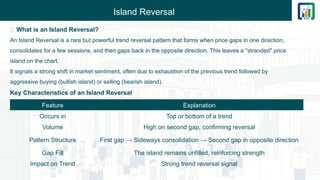
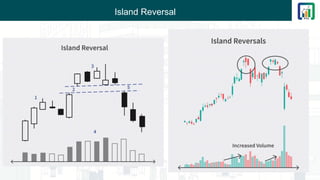
Island Reversal
🔹 What is an Island Reversal?
An Island Reversal is a rare but powerful trend reversal pattern that forms when price gaps in one direction,
consolidates for a few sessions, and then gaps back in the opposite direction. This leaves a "stranded" price
island on the chart.
It signals a strong shift in market sentiment, often due to exhaustion of the previous trend followed by
aggressive buying (bullish island) or selling (bearish island).
Key Characteristics of an Island Reversal
Feature Explanation
Occurs in Top or bottom of a trend
Volume High on second gap, confirming reversal
Pattern Structure First gap → Sideways consolidation → Second gap in opposite direction
Gap Fill The island remains unfilled, reinforcing strength
Impact on Trend Strong trend reversal signal
Island Reversal
Island Reversal
Island Reversal Trading Strategies
✅ Reversal Trade Setup
• Identify an island formation after an extended trend.
• Enter short (bearish island) or long (bullish island) after the second gap confirms reversal.
• Stop-loss: Above the island (for shorts) or below the island (for longs).
✅ Volume Confirmation
• High volume on the second gap confirms strength—low volume might indicate a false
signal.
• Watch for increasing bearish volume (for tops) or bullish volume (for bottoms).
✅ Support/Resistance Check
• If the island forms at key support/resistance levels, it strengthens the reversal signal.
Island Reversal
How to Identify an Island Reversal?
📈 Look for Two Opposite Gaps:
• The first gap follows the trend, the second gap moves against it.
• There should be no price overlap between gaps.
📊 Watch Consolidation Before the Second Gap:
• Price stalls on the island, forming a range before reversing sharply.
🕒 Confirm With Other Indicators:
• RSI overbought/oversold can strengthen the reversal case.
• MACD divergence adds confirmation.
💡 Quick Tips for Trading Island Reversals
🔸 Rare but powerful—trade only when both gaps are confirmed.
🔸 Higher volume on the second gap = stronger reversal signal.
🔸 Works well with candlestick patterns (e.g., engulfing candles on the second gap).
🔸 Ideal for swing traders & reversal traders, not trend followers.
Next Chapter 2 – Candlestick Patterns in the Real World
Section 4 – Chart Pattern Analysis
Presented By :
This Content is Copyright Reserved Rights Copyright 2025@PTAIndia

Section 4 – Chapter 1 - Classical Chart Patterns - CMT level 1 2025

  • 1.
    Section 4 -Chart Pattern Analysis Chapter 1 – Classical Chart Patterns Presented By : This Content is Copyright Reserved Rights Copyright 2025@PTAIndia
  • 2.
    Agenda Classical Chart Patterns PriceTargets Setup, Signal, and Reward-to-Risk Ratio Breakout Trading Vs. Range Bound Trading This Content is Copyright Reserved Rights Copyright 2025@PTAIndia
  • 3.
    Head and ShouldersTop Chart Pattern Chapter 1 – Classical Chart Patterns Presented By : This Content is Copyright Reserved Rights Copyright 2025@PTAIndia
  • 4.
    Head and ShouldersTop Chart Pattern This Content is Copyright Reserved Rights Copyright 2025@PTAIndia D.webp Key Takeaways: 1. Definition: A Head and Shoulders Top is a bearish reversal chart pattern that signals a potential trend reversal from bullish to bearish. 2. Structure: o Left Shoulder: A peak followed by a decline. o Head: A higher peak followed by another decline. o Right Shoulder: A lower peak, similar to the left shoulder, followed by a decline. o Neckline: A support level that connects the troughs of the left shoulder and the head.
  • 5.
    Head and ShouldersTop Chart Pattern This Content is Copyright Reserved Rights Copyright 2025@PTAIndia D.webp 3. Confirmation: The pattern is confirmed when the price breaks below the neckline. 4. Volume: Typically, volume is highest during the formation of the head and decreases with the right shoulder. A surge in volume upon neckline breakout adds validity. 5. Price Target: Projected Drop = Head’s High – Neckline’s Low This distance is subtracted from the neckline after the breakout.
  • 6.
    Head and ShouldersTop Chart Pattern This Content is Copyright Reserved Rights Copyright 2025@PTAIndia D.webp
  • 7.
    Head and ShouldersTop Chart Pattern This Content is Copyright Reserved Rights Copyright 2025@PTAIndia D.webp
  • 8.
    Head and ShouldersTop Chart Pattern This Content is Copyright Reserved Rights Copyright 2025@PTAIndia D.webp 6. Common Mistakes: Misidentifying the pattern before confirmation. Trading without volume confirmation. Ignoring market conditions and false breakouts. 7. Trading Strategy: Entry: After neckline breakout, preferably with a retest. Stop-Loss: Above the right shoulder or the neckline (if aggressive). Take-Profit: Use the height of the pattern subtracted from the neckline.
  • 9.
    Cheat Sheet: Head& Shoulders Top This Content is Copyright Reserved Rights Copyright 2025@PTAIndia Aspect Details Pattern Type Bearish Reversal Trend Before Formation Uptrend Left Shoulder First peak, decline follows Head Highest peak, decline follows Right Shoulder Lower peak, decline follows Neckline Connects the troughs of left shoulder & head Breakout Point Price breaks below neckline Volume Behavior Higher in head, lower in right shoulder, high at breakout Confirmation Neckline break with volume surge Entry Point After neckline breakout (or retest) Stop-Loss Placement Above right shoulder or neckline Target Price Distance from head to neckline subtracted from breakout point Reliability High when confirmed with volume Mistakes to Avoid False breakouts, trading without confirmation
  • 10.
    Head and ShouldersBottom Chart Pattern Chapter 1 – Classical Chart Patterns Presented By : This Content is Copyright Reserved Rights Copyright 2025@PTAIndia
  • 11.
    Head and ShouldersBottom Chart Pattern This Content is Copyright Reserved Rights Copyright 2025@PTAIndia D.webp Key Takeaways: 1. Definition: The Head and Shoulders Bottom (also called an Inverse Head and Shoulders) is a bullish reversal pattern that signals a potential trend change from bearish to bullish. 2. Structure: Left Shoulder: A low followed by a minor upward move. Head: A lower low forming the lowest point, followed by an upward move. Right Shoulder: A higher low, similar to the left shoulder, followed by an upward move. Neckline: A resistance level that connects the peaks between the left shoulder and head.
  • 12.
    Head and ShouldersBottom Chart Pattern This Content is Copyright Reserved Rights Copyright 2025@PTAIndia D.webp 3. Confirmation: The pattern is confirmed when the price breaks above the neckline. 4. Volume: Volume is highest during the breakout and typically lower in the right shoulder. 5. Price Target Calculation: Projected Rise = Head’s Low to Neckline Distance Add this distance to the breakout point for a target.
  • 13.
    Head and ShouldersBottom Chart Pattern This Content is Copyright Reserved Rights Copyright 2025@PTAIndia D.webp 6. Common Mistakes: Entering before confirmation (waiting for the neckline breakout is key). Ignoring volume confirmation. Failing to manage risk with proper stop-loss placement. 7. Trading Strategy: Entry: After the neckline breakout (preferably with a retest). Stop-Loss: Below the right shoulder or neckline (if aggressive). Take-Profit: Measure the height from the head to the neckline and add it to the breakout point.
  • 14.
    Head and ShouldersBottom Chart Pattern This Content is Copyright Reserved Rights Copyright 2025@PTAIndia D.webp
  • 15.
    Head and ShouldersBottom Chart Pattern This Content is Copyright Reserved Rights Copyright 2025@PTAIndia D.webp
  • 16.
    Cheat Sheet: Head& Shoulders Bottom This Content is Copyright Reserved Rights Copyright 2025@PTAIndia Aspect Details Pattern Type Bullish Reversal Trend Before Formation Downtrend Left Shoulder First low, minor upward move Head Lowest low, followed by upward move Right Shoulder Higher low, followed by upward move Neckline Connects the peaks of left shoulder & head Breakout Point Price breaks above neckline Volume Behavior Lower in right shoulder, higher at breakout Confirmation Neckline break with volume increase Entry Point After neckline breakout (or retest) Stop-Loss Placement Below right shoulder or neckline Target Price Distance from head to neckline added to breakout Reliability High when confirmed with volume Mistakes to Avoid Entering too early, ignoring volume confirmation
  • 17.
    Symmetrical Triangle ChartPattern Chapter 1 – Classical Chart Patterns Presented By : This Content is Copyright Reserved Rights Copyright 2025@PTAIndia
  • 18.
    Symmetrical Triangle ChartPattern Key Takeaways: 1. Definition: A Symmetrical Triangle is a continuation pattern that signals a period of consolidation before the price breaks out in either direction. 2. Structure: Two converging trendlines: Higher lows (ascending support line). Lower highs (descending resistance line). Price gets squeezed into a tighter range before the breakout. This Content is Copyright Reserved Rights Copyright 2025@PTAIndia
  • 19.
    Symmetrical Triangle ChartPattern 3. Breakout Direction: The price can break out in either direction (bullish or bearish). Volume typically increases at the breakout. 4. Confirmation: A breakout above the resistance line suggests a bullish move. A breakdown below the support line suggests a bearish move. 5. Price Target Calculation: Projected Move = Height of the Triangle at its Widest Point Add to breakout point for bullish breakouts, subtract for bearish ones. This Content is Copyright Reserved Rights Copyright 2025@PTAIndia
  • 20.
    Symmetrical Triangle ChartPattern 6. Common Mistakes: Entering before a confirmed breakout. Ignoring volume confirmation. Not setting a stop-loss (false breakouts can occur). 7. Trading Strategy: Entry: After breakout confirmation with strong volume. Stop-Loss: Just inside the triangle (to protect against false breakouts). Take-Profit: Measure the widest part of the triangle and project it in the breakout direction. This Content is Copyright Reserved Rights Copyright 2025@PTAIndia
  • 21.
    Symmetrical Triangle ChartPattern This Content is Copyright Reserved Rights Copyright 2025@PTAIndia
  • 22.
    Symmetrical Triangle ChartPattern This Content is Copyright Reserved Rights Copyright 2025@PTAIndia
  • 23.
    Cheat Sheet: SymmetricalTriangle Pattern This Content is Copyright Reserved Rights Copyright 2025@PTAIndia Aspect Details Pattern Type Continuation Trend Before Formation Uptrend or Downtrend Support Trendline Higher Lows Resistance Trendline Lower Highs Breakout Direction Can be bullish or bearish Breakout Confirmation Price moves above resistance (bullish) or below support (bearish) with volume Volume Behavior Decreases during formation, increases at breakout Entry Point After breakout with confirmation Stop-Loss Placement Inside the triangle (near breakout level) Target Price Height of the triangle added or subtracted from breakout Reliability High when supported by volume Mistakes to Avoid Entering too early, ignoring false breakouts
  • 24.
    Ascending & DescendingTriangle Patterns Chapter 1 – Classical Chart Patterns Presented By : This Content is Copyright Reserved Rights Copyright 2025@PTAIndia
  • 25.
    Ascending & DescendingTriangle Patterns Key Takeaways Ascending Triangle (Bullish Continuation Pattern) Definition: A bullish continuation pattern that forms during an uptrend, indicating potential breakout to the upside. Structure: Flat resistance line (horizontal) → Multiple touches at the same level. Rising support line (upward slope) → Higher lows forming over time Breakout Direction: Typically bullish, breaking above resistance with high volume. This Content is Copyright Reserved Rights Copyright 2025@PTAIndia
  • 26.
    Ascending & DescendingTriangle Patterns Key Takeaways Confirmation: Price closes above resistance with increased volume. Price Target Calculation: Projected Move = Height of the Triangle at its Widest Point Add this to the breakout level for a target. This Content is Copyright Reserved Rights Copyright 2025@PTAIndia
  • 27.
    Ascending & DescendingTriangle Patterns Key Takeaways Descending Triangle (Bearish Continuation Pattern) Definition: A bearish continuation pattern that forms during a downtrend, signaling a potential downward breakout. Structure: Flat support line (horizontal) → Multiple touches at the same level. Falling resistance line (downward slope) → Lower highs forming over time. Breakout Direction: Typically bearish, breaking below support with high volume. This Content is Copyright Reserved Rights Copyright 2025@PTAIndia
  • 28.
    Ascending & DescendingTriangle Patterns Key Takeaways • Confirmation: Price closes below support with increased volume. Price Target Calculation: Projected Move = Height of the Triangle at its Widest Point Subtract this from the breakdown level for a target. This Content is Copyright Reserved Rights Copyright 2025@PTAIndia
  • 29.
    Ascending & DescendingTriangle Patterns This Content is Copyright Reserved Rights Copyright 2025@PTAIndia
  • 30.
    Symmetrical Triangle ChartPattern This Content is Copyright Reserved Rights Copyright 2025@PTAIndia
  • 31.
    Cheat Sheet: Ascending& Descending Triangle Patterns This Content is Copyright Reserved Rights Copyright 2025@PTAIndia Aspect Ascending Triangle (Bullish) Descending Triangle (Bearish) Pattern Type Bullish Continuation Bearish Continuation Trend Before Formation Uptrend Downtrend Upper Trendline Horizontal (Resistance) Descending (Lower Highs) Lower Trendline Ascending (Higher Lows) Horizontal (Support) Breakout Direction Usually Upward Usually Downward Breakout Confirmation Price closes above resistance with volume Price closes below support with volume Volume Behavior Decreases during formation, increases at breakout Decreases during formation, increases at breakdown Entry Point After breakout confirmation After breakdown confirmation Stop-Loss Placement Below support level Above resistance level Target Price Calculation Height of the triangle added to breakout point Height of the triangle subtracted from breakdown point Common Mistakes Entering before confirmation Entering before confirmation
  • 32.
    Rectangle Top (Double& Triple Top) Chapter 1 – Classical Chart Patterns Presented By : This Content is Copyright Reserved Rights Copyright 2025@PTAIndia
  • 33.
    Rectangle Top Key Takeaways RectangleTop Pattern (Consolidation & Reversal) Definition: A Rectangle Top is a bearish continuation or reversal pattern that forms when the price moves between parallel support and resistance levels multiple times before breaking downward. Structure: Resistance Level (Flat Upper Line): Price tests this level multiple times but fails to break through. Support Level (Flat Lower Line): Price finds support at the same level multiple times. This Content is Copyright Reserved Rights Copyright 2025@PTAIndia
  • 34.
    Rectangle Top (Double& Triple Top) Key Takeaways Breakout Direction: A downward breakout is more likely, but sometimes it can break upwards (bullish continuation). Volume Behavior: Volume decreases within the rectangle and spikes on the breakout. Confirmation: A break below support with strong volume confirms a bearish move. Price Target Calculation: Projected Move = Height of the Rectangle Subtract this from the breakdown point. This Content is Copyright Reserved Rights Copyright 2025@PTAIndia
  • 35.
    Double Top (BearishReversal Pattern) Key Takeaways Double Top (Bearish Reversal Pattern) Definition: A Double Top is a bearish reversal pattern that occurs after an uptrend and signals a trend reversal to the downside. Structure: Two peaks at similar levels: Price tests the resistance twice but fails to break higher. Neckline (Support Level): The lowest point between the two peaks. This Content is Copyright Reserved Rights Copyright 2025@PTAIndia
  • 36.
    Double Top (BearishReversal Pattern) Key Takeaways Breakout Direction: A break below the neckline confirms a bearish reversal. Volume Behavior: High volume at the first peak, lower at the second peak, and spike in volume on the neckline breakdown. Confirmation: A break below support with strong volume confirms a bearish move. Price Target Calculation: Projected Move = Distance from Peaks to Neckline Subtract this from the breakdown point. This Content is Copyright Reserved Rights Copyright 2025@PTAIndia
  • 37.
    Double Top &Triple Top Patterns This Content is Copyright Reserved Rights Copyright 2025@PTAIndia
  • 38.
    Rectangle Top, Double& Triple Top This Content is Copyright Reserved Rights Copyright 2025@PTAIndia
  • 39.
    Triple Top (BearishReversal Pattern) Key Takeaways Double Top (Bearish Reversal Pattern) Definition: A Triple Top is a stronger bearish reversal pattern, similar to the Double Top but with three failed attempts to break resistance. Structure: Three peaks at similar levels: Indicates stronger resistance. Neckline (Support Level): Connects the lows between the peaks. This Content is Copyright Reserved Rights Copyright 2025@PTAIndia
  • 40.
    Triple Top (BearishReversal Pattern) Key Takeaways Breakout Direction: A break below the neckline confirms a bearish trend reversal. Volume Behavior: Volume decreases as the pattern forms, then spikes on the neckline breakdown. Confirmation: A break below support with strong volume confirms a bearish move. Price Target Calculation: Projected Move = Distance from Peaks to Neckline Subtract this from the breakdown point. This Content is Copyright Reserved Rights Copyright 2025@PTAIndia
  • 41.
    Cheat Sheet -Rectangle Top, Double & Triple Top This Content is Copyright Reserved Rights Copyright 2025@PTAIndia Aspect Rectangle Top Double Top Triple Top Pattern Type Continuation or Reversal Bearish Reversal Stronger Bearish Reversal Trend Before Formation Uptrend or Sideways Uptrend Uptrend Resistance Line Flat (Multiple Tests) Two Peaks at Similar Levels Three Peaks at Similar Levels Support Line Flat (Multiple Tests) Neckline at Low Between Peaks Neckline at Low Between Peaks Breakout Direction Usually Downward Downward Downward Breakout Confirmation Break below support with volume Break below neckline with volume Break below neckline with volume Volume Behavior Decreases inside the pattern, spikes at breakout Higher at 1st peak, lower at 2nd, spikes at breakdown Lower volume at each peak, spikes at breakdown Entry Point After support breaks After neckline breaks After neckline breaks Stop-Loss Placement Above resistance Above second peak Above third peak Target Price Calculation Height of the rectangle subtracted from breakout Distance from peaks to neckline subtracted Distance from peaks to neckline subtracted Reliability Medium to High High Very High Mistakes to Avoid Entering before confirmation Entering before confirmation Entering before confirmation
  • 42.
    Conclusion 1. Rectangle Top: Canbe a continuation or reversal pattern, depending on breakout direction. Traders should wait for confirmation before entering a trade. 2. Double Top: A strong bearish reversal pattern. A second peak without a new high indicates loss of buying strength. Neckline breakdown is the key confirmation. 3. Triple Top: A stronger bearish reversal than the double top. More failed attempts to break resistance show increasing weakness. The neckline breakdown signals the final confirmation. 4. Common Trading Strategy: Wait for breakout confirmation. Set a stop-loss above recent highs to manage risk. This Content is Copyright Reserved Rights Copyright 2025@PTAIndia
  • 43.
    Flags and Pennants Chapter1 – Classical Chart Patterns Presented By : This Content is Copyright Reserved Rights Copyright 2025@PTAIndia
  • 44.
    Flag Pattern (Bullishor Bearish Continuation Pattern) Key Takeaways Flag Pattern (Bullish or Bearish Continuation Pattern) Definition: A Flag is a continuation pattern that forms after a strong price movement (flagpole), followed by a brief consolidation (flag), before resuming in the original direction. Structure: Flagpole: A sharp price movement (up or down). Flag: A small rectangular consolidation that slopes against the prior trend. Breakout Direction: Bullish Flag: Breaks upward (continuation of an uptrend). Bearish Flag: Breaks downward (continuation of a downtrend). This Content is Copyright Reserved Rights Copyright 2025@PTAIndia
  • 45.
    Flag Pattern (Bullishor Bearish Continuation Pattern) Key Takeaways Volume Behavior: High volume during the flagpole, lower volume in consolidation, then spike in volume at breakout. Price Target Calculation: o Projected Move = Length of the Flagpole o Add to breakout point for bullish flags, subtract for bearish flags. This Content is Copyright Reserved Rights Copyright 2025@PTAIndia
  • 46.
    Flag Pattern (Bullishor Bearish Continuation Pattern) This Content is Copyright Reserved Rights Copyright 2025@PTAIndia
  • 47.
    Pennant Pattern (Bullishor Bearish Continuation Pattern) Key Takeaways Pennant Pattern (Bullish or Bearish Continuation Pattern) Definition: A Pennant is similar to a flag but has a triangular shape instead of a rectangle. It also forms after a sharp price movement (flagpole), followed by consolidation in a converging range before a breakout. Structure: Flagpole: A strong price movement (up or down). Flag: A small symmetrical triangle (price moves within converging trendlines). Breakout Direction: Bullish Pennant: Breaks upward (continuation of an uptrend). Bearish Pennant: Breaks downward (continuation of a downtrend). This Content is Copyright Reserved Rights Copyright 2025@PTAIndia
  • 48.
    Pennant Pattern (Bullishor Bearish Continuation Pattern) Key Takeaways Volume Behavior: High volume in the flagpole, lower volume inside the pennant, then spike in volume at breakout. Price Target Calculation: Projected Move = Height of the Flagpole Add to breakout point for bullish pennants, subtract for bearish pennants. This Content is Copyright Reserved Rights Copyright 2025@PTAIndia
  • 49.
    Pennant Pattern (Bullishor Bearish Continuation Pattern) This Content is Copyright Reserved Rights Copyright 2025@PTAIndia
  • 50.
    Pennant Pattern (Bullishor Bearish Continuation Pattern) This Content is Copyright Reserved Rights Copyright 2025@PTAIndia
  • 51.
    Cheat Sheet :PennantPattern (Bullish or Bearish Continuation Pattern) This Content is Copyright Reserved Rights Copyright 2025@PTAIndia Aspect Bullish Flag Bearish Flag Bullish Pennant Bearish Pennant Pattern Type Continuation Continuation Continuation Continuation Trend Before Formation Uptrend Downtrend Uptrend Downtrend Flag/Pennant Shape Rectangle Rectangle Symmetrical Triangle Symmetrical Triangle Flag/Pennant Slope Downward Upward Sideways or Slight Slope Sideways or Slight Slope Breakout Direction Upward Downward Upward Downward Breakout Confirmation Price closes above flag with volume Price closes below flag with volume Price closes above pennant with volume Price closes below pennant with volume Volume Behavior High in flagpole, low in flag, spikes at breakout High in flagpole, low in flag, spikes at breakdown High in flagpole, low in pennant, spikes at breakout High in flagpole, low in pennant, spikes at breakdown Entry Point After breakout confirmation After breakdown confirmation After breakout confirmation After breakdown confirmation Stop-Loss Placement Below flag support Above flag resistance Below pennant support Above pennant resistance Target Price Calculation Flagpole height added to breakout Flagpole height subtracted from breakdown Flagpole height added to breakout Flagpole height subtracted from breakdown Reliability High High High High Mistakes to Avoid Entering before breakout Entering before breakdown Entering before breakout Entering before breakdown
  • 52.
    Conclusion This Content isCopyright Reserved Rights Copyright 2025@PTAIndia 1. Flags & Pennants are high-probability continuation patterns that occur after a strong price move, allowing traders to enter with trend confirmation. 2. Volume plays a crucial role in confirmation—breakouts should happen with high volume. 3. Flags vs. Pennants: Flags have parallel trendlines (rectangular shape). Pennants have converging trendlines (triangle shape).
  • 53.
    Conclusion This Content isCopyright Reserved Rights Copyright 2025@PTAIndia 4. Trade Setup: Entry: Wait for the breakout before entering. Stop-Loss: Place it below the flag or pennant support (bullish) or above resistance (bearish). Profit Target: Use the height of the flagpole to estimate the next price move. 5. Common Pitfalls: Entering too early before the breakout is confirmed. Ignoring volume confirmation, leading to false breakouts. Setting an incorrect stop-loss, exposing traders to unnecessary risk.
  • 54.
    Setup, Signal, andReward-to-Risk Ratio in Chart Patterns This Content is Copyright Reserved Rights Copyright 2025@PTAIndia Setup (Pattern Formation & Identification) The setup refers to the correct formation of a chart pattern before taking a trade. Identifying a valid pattern early helps traders prepare for a potential breakout or reversal. Common setups include: Continuation Patterns: Flags, Pennants, Triangles Reversal Patterns: Head & Shoulders, Double/Triple Tops & Bottoms Consolidation Patterns: Rectangles, Symmetrical Triangles Key factors to analyze in setup: Trend before the pattern (uptrend or downtrend) Shape & structure of the pattern Volume behavior inside the pattern Support & resistance levels
  • 55.
    Setup, Signal, andReward-to-Risk Ratio in Chart Patterns This Content is Copyright Reserved Rights Copyright 2025@PTAIndia Signal (Breakout or Breakdown Confirmation) The signal is the event that confirms the trade entry—usually a breakout or breakdown. A valid signal should include: Breakout direction: Above resistance (bullish) or below support (bearish) Volume spike: Confirms the strength of the breakout Candlestick confirmation: A strong close beyond the pattern boundary Retest of breakout level: (Optional) Some patterns retest the breakout before the full move begins
  • 56.
    Setup, Signal, andReward-to-Risk Ratio in Chart Patterns This Content is Copyright Reserved Rights Copyright 2025@PTAIndia Reward-to-Risk Ratio (R:R Ratio) Definition: The Risk-to-Reward Ratio (R:R) measures potential profit relative to risk. Formula: R:R= Potential Reward / Potential Risk A minimum R:R of 2:1 is recommended, meaning the potential profit should be at least twice the risk.
  • 57.
    Setup, Signal, andReward-to-Risk Ratio in Chart Patterns This Content is Copyright Reserved Rights Copyright 2025@PTAIndia How to set R:R in chart patterns: Entry: After breakout confirmation Stop-Loss: Just below the breakout level (for bullish trades) or above resistance (for bearish trades) Target Price: Measure the height of the pattern and project it in the breakout direction Common R:R Ratios: 2:1 (Good) → Acceptable risk for reasonable profit 3:1 (Better) → Higher probability of success 1:1 (Risky) → Lower profitability over time
  • 58.
    Gaps Chapter 1 –Classical Chart Patterns Presented By : This Content is Copyright Reserved Rights Copyright 2025@PTAIndia
  • 59.
    Gaps This Content isCopyright Reserved Rights Copyright 2025@PTAIndia 🔹 What is a Gap? A gap occurs when a stock’s price opens significantly higher or lower than the previous closing price, creating a "gap" in the price chart. 📌 Types of Gaps & Their Meaning Gap Type Description Interpretation Common Gap Occurs in normal trading, often filled quickly. No major trend significance. Usually caused by low volume or minor news. Breakaway Gap Occurs at the start of a new trend, breaking key levels. Strong trend confirmation; signals continuation in the breakout direction. Runaway (Continuation) Gap Happens within an ongoing trend. Confirms strong trend momentum. Exhaustion Gap Appears near the end of a strong trend. Signals potential reversal or trend weakness. Often followed by a price decline or consolidation.
  • 60.
    Gaps This Content isCopyright Reserved Rights Copyright 2025@PTAIndia
  • 61.
    Gaps This Content isCopyright Reserved Rights Copyright 2025@PTAIndia 🔍 How to Confirm Gaps?  Volume Analysis → High volume confirms breakaway and continuation gaps.  Support & Resistance → Gap levels often act as key levels.  Timeframe Matters → Intraday gaps are less significant than daily gaps.  Candlestick Patterns → Look for reversal or continuation patterns near gaps 💡 Quick Tips for Trading Gaps 🔸 Not all gaps get filled; identify the type before trading. 🔸 Use stop-loss orders as gaps can move unpredictably. 🔸 Breakaway gaps are strong trend indicators, don’t fight them. 🔸 Monitor news events, as gaps often occur due to earnings or macroeconomic events.
  • 62.
    Gaps This Content isCopyright Reserved Rights Copyright 2025@PTAIndia 🔍 How to Confirm Gaps?  Volume Analysis → High volume confirms breakaway and continuation gaps.  Support & Resistance → Gap levels often act as key levels.  Timeframe Matters → Intraday gaps are less significant than daily gaps.  Candlestick Patterns → Look for reversal or continuation patterns near gaps 💡 Quick Tips for Trading Gaps 🔸 Not all gaps get filled; identify the type before trading. 🔸 Use stop-loss orders as gaps can move unpredictably. 🔸 Breakaway gaps are strong trend indicators, don’t fight them. 🔸 Monitor news events, as gaps often occur due to earnings or macroeconomic events.
  • 63.
    Common Gaps This Contentis Copyright Reserved Rights Copyright 2025@PTAIndia 🔹 What is a Common Gap? A Common Gap (also known as a Trading Gap) occurs when there is a break between prices, but it is not associated with major news or trend shifts. These gaps usually happen in sideways or range-bound markets and tend to be filled quickly as price returns to the previous level. 📌 Key Characteristics of Common Gaps Feature Explanation Occurs in Range-bound or non-trending markets Volume Usually low Gap Fill Often fills within a few days Caused by Temporary supply/demand imbalance, random market events Impact on Trend No strong directional trend signal
  • 64.
    Common Gaps This Contentis Copyright Reserved Rights Copyright 2025@PTAIndia
  • 65.
    Common Gaps This Contentis Copyright Reserved Rights Copyright 2025@PTAIndia 📊 Common Gap Trading Strategies ✅ Gap Fill Strategy (Mean Reversion) • Since common gaps often fill, traders can bet on price returning to the previous level. • Entry: Wait for confirmation (reversal candle, decreasing momentum). • Exit: Target the gap close level. ✅ Support & Resistance Play • If the gap occurs near support/resistance, price may react to these levels. • Look for a rejection or bounce to trade in the direction of the reaction. ✅ Avoid Trend Confirmation Trades • Unlike breakaway or continuation gaps, common gaps do not indicate strong trends. • Be cautious of false breakouts if trading trend continuation.
  • 66.
    Common Gaps This Contentis Copyright Reserved Rights Copyright 2025@PTAIndia 🔍 How to Identify Common Gaps? 📉 Check Volume: • Low volume → More likely a common gap. • High volume → Could be another gap type (breakaway, exhaustion). 📊 Look at Market Context: • If the market is consolidating, it’s likely a common gap. • If in a strong trend, reconsider—it may be a different gap type. 🕒 Gap Fill Speed: • If the gap fills within a few sessions, it confirms it was a common gap. 💡 Quick Tips for Trading Common Gaps 🔸 Common gaps are not strong trend indicators—don’t chase them. 🔸 Use stop-loss orders, as gaps can sometimes evolve into breakaway gaps. 🔸 Watch for support/resistance reactions before entering a trade. 🔸 Ideal for short-term, mean-reversion strategies rather than trend trading.
  • 67.
    Breakaway Gap 🔹 Whatis a Breakaway Gap? A Breakaway Gap occurs when price breaks out of a consolidation zone, chart pattern, or key support/resistance level with high volume, signaling the start of a strong new trend. These gaps do not fill quickly and indicate a potential long-term movement in the breakout direction. 📌 Key Characteristics of a Breakaway Gap Feature Explanation Occurs in Start of a new trend after consolidation Volume High volume confirms breakout Gap Fill Unlikely to fill soon, strong continuation signal Caused by Major news, earnings reports, strong buying/selling pressure Impact on Trend Strong trend signal, often leads to sustained movement
  • 68.
    Breakaway Gap This Contentis Copyright Reserved Rights Copyright 2025@PTAIndia
  • 69.
    Breakaway Gap This Contentis Copyright Reserved Rights Copyright 2025@PTAIndia Breakaway Gap Trading Strategies ✅ Breakout Confirmation Trade • Identify a strong resistance/support level that the price gaps above/below. • Enter after the first pullback or retest of the breakout zone. • Stop-loss: Below (for bullish) or above (for bearish) the gap zone. ✅ Volume Confirmation Strategy • If the gap occurs on high volume, it confirms strength—trade in the breakout direction. • Weak volume may indicate a false breakout. ✅ Avoid Fading Breakaway Gaps • Unlike common gaps, breakaway gaps usually do not get filled quickly. • Trying to short these gaps is risky unless strong reversal signs appear.
  • 70.
    Breakaway Gap 🔍 Howto Identify a Breakaway Gap? Check for a Prior Range or Consolidation: • Breakaway gaps occur after price has been stuck in a range or pattern (e.g., triangle, rectangle, head & shoulders). Look at Volume: • High volume = stronger confirmation of a true breakaway gap. • Low volume = more likely a false breakout. Watch Price Action After the Gap: • If price holds above (bullish) or below (bearish) the gap zone, it confirms strength. • If price rapidly retraces, the breakout may be weak or false. 💡 Quick Tips for Trading Breakaway Gap 🔸 Strong trends often start with a breakaway gap—trade in the direction of the breakout. 🔸 High volume is key—low volume gaps may be fakeouts. 🔸 Breakaway gaps are not easily filled, so don’t expect a quick price reversal. 🔸 Ideal for momentum traders and trend followers
  • 71.
    Runaway (Continuation) Gap 🔹What is a Runaway (Continuation) Gap? A Runaway Gap, also called a Continuation Gap, occurs mid-trend when strong momentum pushes the price further in the same direction. It signals trend acceleration, meaning that buyers (in an uptrend) or sellers (in a downtrend) are aggressively driving prices further. Unlike Common Gaps, Runaway Gaps rarely fill quickly because they indicate sustained strength in the trend. 📌 Key Characteristics of a Runaway Gap Feature Explanation Occurs in Strong trending markets (bullish or bearish) Volume Moderate to high, confirming strength Gap Fill Rarely fills quickly, often continues in the same direction Caused by Increased investor enthusiasm, strong buying/selling pressure Impact on Trend Confirms trend continuation, suggests momentum
  • 72.
  • 73.
    Runaway (Continuation) Gap RunawayGap Trading Strategies ✅ Momentum Trend Riding • Enter in the direction of the trend after confirming the gap holds. • Use the previous candlestick low/high as a stop-loss to avoid getting caught in reversals. ✅ Wait for a Minor Pullback • Some runaway gaps experience slight retracements before continuing. • Enter on the first small pullback or consolidation near the gap level. ✅ Measure Potential Price Target • In an uptrend, a second runaway gap could indicate even stronger momentum. • Use Fibonacci extensions or past price swings to set realistic targets.
  • 74.
    Runaway (Continuation) Gap Howto Identify a Runaway Gap? 📈 Check the Trend: • Must occur mid-trend, not at a breakout or exhaustion point. 📊 Analyze Volume: • Moderate to high volume = confirms continuation. • Low volume = possible weak move or exhaustion instead. 🕒 Watch for Follow-Through: • If price holds above/below the gap level, it signals strong continuation. • If price retraces quickly, it may not be a true runaway gap. 💡 Quick Tips for Trading Runaway Gaps 🔸 Ride the momentum—runaway gaps indicate strong trends. 🔸 Avoid counter-trend trading unless strong reversal signals appear. 🔸 High volume confirms strength—watch for increased participation. 🔸 A second continuation gap could mean trend acceleration—stay in the trade. 🔸 Works well for trend-following traders and swing traders.
  • 75.
    Exhaustion Gap 🔹 Whatis an Exhaustion Gap? An Exhaustion Gap occurs near the end of a strong trend and signals a potential reversal. It forms when price gaps in the direction of the existing trend but fails to sustain momentum, leading to a sharp pullback. These gaps are often driven by panic buying (in uptrends) or panic selling (in downtrends) and are usually followed by a reversal or consolidation. 📌 Key Characteristics of a Exhaustion Gap Feature Explanation Occurs in Late-stage trends (before reversal) Volume High volume, indicating possible distribution Gap Fill Likely to fill quickly as price reverses Caused by Over-excitement, last wave of buyers/sellers entering Impact on Trend Signals potential trend reversal or slowdown
  • 76.
  • 77.
    Exhaustion Gap Exhaustion GapTrading Strategies ✅ Reversal Trading • Look for bearish confirmation (e.g., a reversal candle, lower high). • Short entry after confirmation of price rejection. • Stop-loss: Above the exhaustion gap high (for short trades). ✅ Gap Fill Play • Since exhaustion gaps often fill quickly, trade the reversal back to the pre-gap level. • Enter when price fails to continue in the gap direction. ✅ Divergence Confirmation • Use RSI or MACD to check for bearish divergence (price making higher highs while indicators show weakness).
  • 78.
    Exhaustion Gap How toIdentify an Exhaustion Gap? 📉 Check for Overextension: • If the price has been trending for a long time, an exhaustion gap is likely. 📊 Look at Volume: • Extremely high volume with a gap suggests a final push before reversal. 🕒 Watch for Reversal Candles: • A bearish engulfing candle or shooting star after the gap confirms weakness. 💡 Quick Tips for Trading Exhaustion Gaps 🔸 Do not chase the trend—exhaustion gaps are usually traps for late traders. 🔸 Wait for confirmation before entering a short or reversal trade. 🔸 High volume with a price stall = strong reversal signal. 🔸 Exhaustion gaps occur in both bull and bear markets—watch for extreme sentiment shifts.
  • 79.
    Island Reversal 🔹 Whatis an Island Reversal? An Island Reversal is a rare but powerful trend reversal pattern that forms when price gaps in one direction, consolidates for a few sessions, and then gaps back in the opposite direction. This leaves a "stranded" price island on the chart. It signals a strong shift in market sentiment, often due to exhaustion of the previous trend followed by aggressive buying (bullish island) or selling (bearish island). Key Characteristics of an Island Reversal Feature Explanation Occurs in Top or bottom of a trend Volume High on second gap, confirming reversal Pattern Structure First gap → Sideways consolidation → Second gap in opposite direction Gap Fill The island remains unfilled, reinforcing strength Impact on Trend Strong trend reversal signal
  • 80.
  • 81.
    Island Reversal Island ReversalTrading Strategies ✅ Reversal Trade Setup • Identify an island formation after an extended trend. • Enter short (bearish island) or long (bullish island) after the second gap confirms reversal. • Stop-loss: Above the island (for shorts) or below the island (for longs). ✅ Volume Confirmation • High volume on the second gap confirms strength—low volume might indicate a false signal. • Watch for increasing bearish volume (for tops) or bullish volume (for bottoms). ✅ Support/Resistance Check • If the island forms at key support/resistance levels, it strengthens the reversal signal.
  • 82.
    Island Reversal How toIdentify an Island Reversal? 📈 Look for Two Opposite Gaps: • The first gap follows the trend, the second gap moves against it. • There should be no price overlap between gaps. 📊 Watch Consolidation Before the Second Gap: • Price stalls on the island, forming a range before reversing sharply. 🕒 Confirm With Other Indicators: • RSI overbought/oversold can strengthen the reversal case. • MACD divergence adds confirmation. 💡 Quick Tips for Trading Island Reversals 🔸 Rare but powerful—trade only when both gaps are confirmed. 🔸 Higher volume on the second gap = stronger reversal signal. 🔸 Works well with candlestick patterns (e.g., engulfing candles on the second gap). 🔸 Ideal for swing traders & reversal traders, not trend followers.
  • 83.
    Next Chapter 2– Candlestick Patterns in the Real World Section 4 – Chart Pattern Analysis Presented By : This Content is Copyright Reserved Rights Copyright 2025@PTAIndia