Chapter 1 – Moving Averages
Section 5 – Technical Indicator
Presented By :
This Content is Copyright Reserved Rights Copyright 2025@PTAIndia
Agenda
Generalize what a moving average is?
Describe the simple and linearly
weighted moving averages
Explain the Wilder and EMA
smoothing methods
Recall the length of the three most
common trends
Summarize strategies for using moving
averages
Discuss moving average bands
This Content is Copyright Reserved Rights Copyright 2025@PTAIndia
Moving Averages
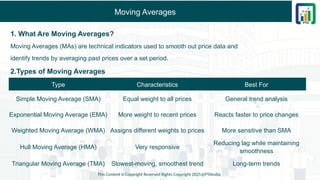
1. What Are Moving Averages?
Moving Averages (MAs) are technical indicators used to smooth out price data and
identify trends by averaging past prices over a set period.
2.Types of Moving Averages
This Content is Copyright Reserved Rights Copyright 2025@PTAIndia
Type Characteristics Best For
Simple Moving Average (SMA) Equal weight to all prices General trend analysis
Exponential Moving Average (EMA) More weight to recent prices Reacts faster to price changes
Weighted Moving Average (WMA) Assigns different weights to prices More sensitive than SMA
Hull Moving Average (HMA) Very responsive
Reducing lag while maintaining
smoothness
Triangular Moving Average (TMA) Slowest-moving, smoothest trend Long-term trends
Moving Averages
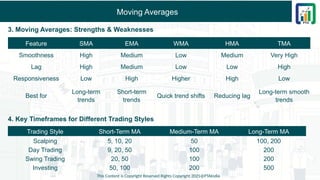
3. Moving Averages: Strengths & Weaknesses
4. Key Timeframes for Different Trading Styles
This Content is Copyright Reserved Rights Copyright 2025@PTAIndia
Feature SMA EMA WMA HMA TMA
Smoothness High Medium Low Medium Very High
Lag High Medium Low Low High
Responsiveness Low High Higher High Low
Best for
Long-term
trends
Short-term
trends
Quick trend shifts Reducing lag
Long-term smooth
trends
Trading Style Short-Term MA Medium-Term MA Long-Term MA
Scalping 5, 10, 20 50 100, 200
Day Trading 9, 20, 50 100 200
Swing Trading 20, 50 100 200
Investing 50, 100 200 500
Moving Averages
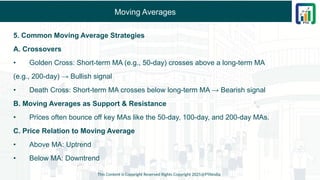
5. Common Moving Average Strategies
A. Crossovers
• Golden Cross: Short-term MA (e.g., 50-day) crosses above a long-term MA
(e.g., 200-day) → Bullish signal
• Death Cross: Short-term MA crosses below long-term MA → Bearish signal
B. Moving Averages as Support & Resistance
• Prices often bounce off key MAs like the 50-day, 100-day, and 200-day MAs.
C. Price Relation to Moving Average
• Above MA: Uptrend
• Below MA: Downtrend
This Content is Copyright Reserved Rights Copyright 2025@PTAIndia
Moving Averages
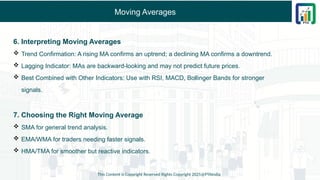
6. Interpreting Moving Averages
 Trend Confirmation: A rising MA confirms an uptrend; a declining MA confirms a downtrend.
 Lagging Indicator: MAs are backward-looking and may not predict future prices.
 Best Combined with Other Indicators: Use with RSI, MACD, Bollinger Bands for stronger
signals.
7. Choosing the Right Moving Average
 SMA for general trend analysis.
 EMA/WMA for traders needing faster signals.
 HMA/TMA for smoother but reactive indicators.
This Content is Copyright Reserved Rights Copyright 2025@PTAIndia
Simple Moving Average (SMA) vs. Linearly Weighted Moving Average (WMA)
1. What Are They?
Both SMA and WMA are types of moving averages used in technical analysis to
smooth price data and identify trends.
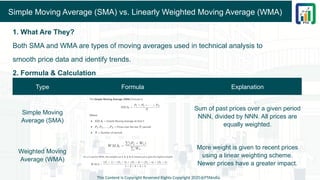
2. Formula & Calculation
This Content is Copyright Reserved Rights Copyright 2025@PTAIndia
Type Formula Explanation
Simple Moving
Average (SMA)
Sum of past prices over a given period
NNN, divided by NNN. All prices are
equally weighted.
Weighted Moving
Average (WMA)
More weight is given to recent prices
using a linear weighting scheme.
Newer prices have a greater impact.
Simple Moving Average (SMA) vs. Linearly Weighted Moving Average (WMA)
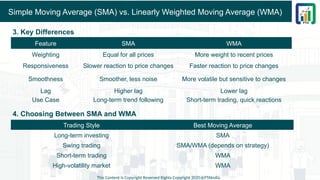
3. Key Differences
4. Choosing Between SMA and WMA
This Content is Copyright Reserved Rights Copyright 2025@PTAIndia
Feature SMA WMA
Weighting Equal for all prices More weight to recent prices
Responsiveness Slower reaction to price changes Faster reaction to price changes
Smoothness Smoother, less noise More volatile but sensitive to changes
Lag Higher lag Lower lag
Use Case Long-term trend following Short-term trading, quick reactions
Trading Style Best Moving Average
Long-term investing SMA
Swing trading SMA/WMA (depends on strategy)
Short-term trading WMA
High-volatility market WMA
Simple Moving Average (SMA) vs. Linearly Weighted Moving Average (WMA)
5. Interpretation & Use Cases
✅ Simple Moving Average (SMA)
• Best for long-term trend analysis.
• Less prone to short-term price fluctuations, making it good for identifying major trends.
• Often used for support and resistance levels.
• Works well in stable or slow-moving markets.
✅ Weighted Moving Average (WMA)
• Reacts faster to price movements.
• More useful for short-term traders and those looking for quick signals.
• Can help identify trend reversals earlier than SMA.
• More effective in fast-moving or volatile markets.
This Content is Copyright Reserved Rights Copyright 2025@PTAIndia
Wilder’s Smoothing vs. Exponential Moving Average (EMA) Smoothing
1. What Are They?
Both Wilder’s Smoothing and Exponential Moving Average (EMA) Smoothing are methods used
to smooth out price fluctuations and identify trends in financial markets. They assign more
weight to recent prices but differ in how they calculate smoothing.
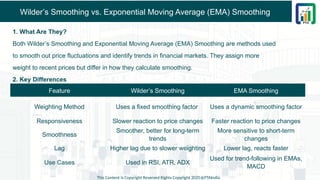
2. Key Differences
This Content is Copyright Reserved Rights Copyright 2025@PTAIndia
Feature Wilder’s Smoothing EMA Smoothing
Weighting Method Uses a fixed smoothing factor Uses a dynamic smoothing factor
Responsiveness Slower reaction to price changes Faster reaction to price changes
Smoothness
Smoother, better for long-term
trends
More sensitive to short-term
changes
Lag Higher lag due to slower weighting Lower lag, reacts faster
Use Cases Used in RSI, ATR, ADX
Used for trend-following in EMAs,
MACD
Wilder’s Smoothing vs. Exponential Moving Average (EMA) Smoothing
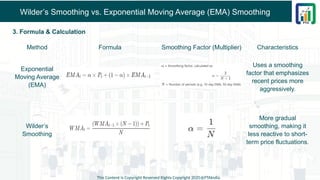
3. Formula & Calculation
This Content is Copyright Reserved Rights Copyright 2025@PTAIndia
Method Formula Smoothing Factor (Multiplier) Characteristics
Exponential
Moving Average
(EMA)
Uses a smoothing
factor that emphasizes
recent prices more
aggressively.
Wilder’s
Smoothing
​
More gradual
smoothing, making it
less reactive to short-
term price fluctuations.
Wilder’s Smoothing vs. Exponential Moving Average (EMA) Smoothing
4. Interpretation & Use Cases
✅ Exponential Moving Average (EMA)
• Best for short-term trading since it reacts quickly to price movements.
• Commonly used in MACD (Moving Average Convergence Divergence) and
crossover strategies.
• Ideal for identifying trend reversals sooner than Wilder’s Smoothing.
✅ Wilder’s Smoothing
• Used in RSI (Relative Strength Index), ATR (Average True Range), and ADX
(Average Directional Index).
• Better for long-term trend stability.
• Reduces noise while maintaining price movement consistency.
This Content is Copyright Reserved Rights Copyright 2025@PTAIndia
Wilder’s Smoothing vs. Exponential Moving Average (EMA) Smoothing
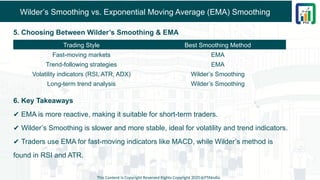
5. Choosing Between Wilder’s Smoothing & EMA
6. Key Takeaways
✔ EMA is more reactive, making it suitable for short-term traders.
✔ Wilder’s Smoothing is slower and more stable, ideal for volatility and trend indicators.
✔ Traders use EMA for fast-moving indicators like MACD, while Wilder’s method is
found in RSI and ATR.
This Content is Copyright Reserved Rights Copyright 2025@PTAIndia
Trading Style Best Smoothing Method
Fast-moving markets EMA
Trend-following strategies EMA
Volatility indicators (RSI, ATR, ADX) Wilder’s Smoothing
Long-term trend analysis Wilder’s Smoothing
Moving Average Calculation Period
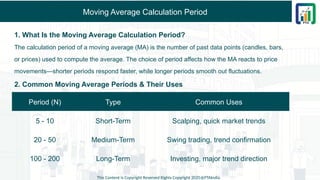
1. What Is the Moving Average Calculation Period?
The calculation period of a moving average (MA) is the number of past data points (candles, bars,
or prices) used to compute the average. The choice of period affects how the MA reacts to price
movements—shorter periods respond faster, while longer periods smooth out fluctuations.
2. Common Moving Average Periods & Their Uses
This Content is Copyright Reserved Rights Copyright 2025@PTAIndia
Period (N) Type Common Uses
5 - 10 Short-Term Scalping, quick market trends
20 - 50 Medium-Term Swing trading, trend confirmation
100 - 200 Long-Term Investing, major trend direction
Moving Average Calculation Period
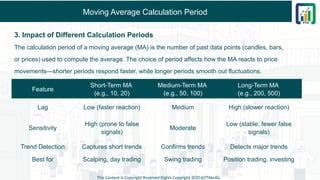
3. Impact of Different Calculation Periods
The calculation period of a moving average (MA) is the number of past data points (candles, bars,
or prices) used to compute the average. The choice of period affects how the MA reacts to price
movements—shorter periods respond faster, while longer periods smooth out fluctuations.
This Content is Copyright Reserved Rights Copyright 2025@PTAIndia
Feature
Short-Term MA
(e.g., 10, 20)
Medium-Term MA
(e.g., 50, 100)
Long-Term MA
(e.g., 200, 500)
Lag Low (faster reaction) Medium High (slower reaction)
Sensitivity
High (prone to false
signals)
Moderate
Low (stable, fewer false
signals)
Trend Detection Captures short trends Confirms trends Detects major trends
Best for Scalping, day trading Swing trading Position trading, investing
Moving Average Calculation Period
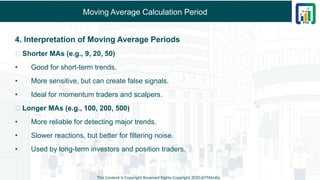
4. Interpretation of Moving Average Periods
✅ Shorter MAs (e.g., 9, 20, 50)
• Good for short-term trends.
• More sensitive, but can create false signals.
• Ideal for momentum traders and scalpers.
✅ Longer MAs (e.g., 100, 200, 500)
• More reliable for detecting major trends.
• Slower reactions, but better for filtering noise.
• Used by long-term investors and position traders.
This Content is Copyright Reserved Rights Copyright 2025@PTAIndia
Moving Average Calculation Period
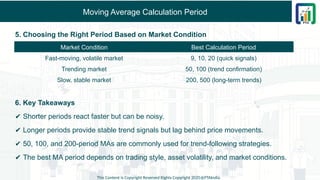
5. Choosing the Right Period Based on Market Condition
6. Key Takeaways
✔ Shorter periods react faster but can be noisy.
✔ Longer periods provide stable trend signals but lag behind price movements.
✔ 50, 100, and 200-period MAs are commonly used for trend-following strategies.
✔ The best MA period depends on trading style, asset volatility, and market conditions.
This Content is Copyright Reserved Rights Copyright 2025@PTAIndia
Market Condition Best Calculation Period
Fast-moving, volatile market 9, 10, 20 (quick signals)
Trending market 50, 100 (trend confirmation)
Slow, stable market 200, 500 (long-term trends)
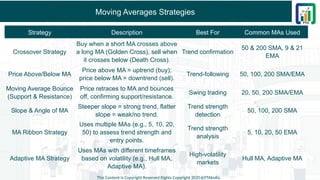
Moving Averages Strategies
This Content is Copyright Reserved Rights Copyright 2025@PTAIndia
Strategy Description Best For Common MAs Used
Crossover Strategy
Buy when a short MA crosses above
a long MA (Golden Cross), sell when
it crosses below (Death Cross).
Trend confirmation
50 & 200 SMA, 9 & 21
EMA
Price Above/Below MA
Price above MA = uptrend (buy);
price below MA = downtrend (sell).
Trend-following 50, 100, 200 SMA/EMA
Moving Average Bounce
(Support & Resistance)
Price retraces to MA and bounces
off, confirming support/resistance.
Swing trading 20, 50, 200 SMA/EMA
Slope & Angle of MA
Steeper slope = strong trend, flatter
slope = weak/no trend.
Trend strength
detection
50, 100, 200 SMA
MA Ribbon Strategy
Uses multiple MAs (e.g., 5, 10, 20,
50) to assess trend strength and
entry points.
Trend strength
analysis
5, 10, 20, 50 EMA
Adaptive MA Strategy
Uses MAs with different timeframes
based on volatility (e.g., Hull MA,
Adaptive MA).
High-volatility
markets
Hull MA, Adaptive MA
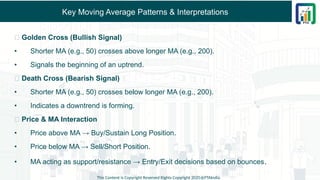
Key Moving Average Patterns & Interpretations
✅ Golden Cross (Bullish Signal)
• Shorter MA (e.g., 50) crosses above longer MA (e.g., 200).
• Signals the beginning of an uptrend.
✅ Death Cross (Bearish Signal)
• Shorter MA (e.g., 50) crosses below longer MA (e.g., 200).
• Indicates a downtrend is forming.
✅ Price & MA Interaction
• Price above MA → Buy/Sustain Long Position.
• Price below MA → Sell/Short Position.
• MA acting as support/resistance → Entry/Exit decisions based on bounces.
This Content is Copyright Reserved Rights Copyright 2025@PTAIndia
Key Moving Average Patterns & Interpretations
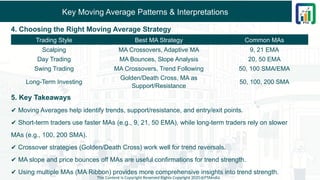
4. Choosing the Right Moving Average Strategy
5. Key Takeaways
✔ Moving Averages help identify trends, support/resistance, and entry/exit points.
✔ Short-term traders use faster MAs (e.g., 9, 21, 50 EMA), while long-term traders rely on slower
MAs (e.g., 100, 200 SMA).
✔ Crossover strategies (Golden/Death Cross) work well for trend reversals.
✔ MA slope and price bounces off MAs are useful confirmations for trend strength.
✔ Using multiple MAs (MA Ribbon) provides more comprehensive insights into trend strength.
This Content is Copyright Reserved Rights Copyright 2025@PTAIndia
Trading Style Best MA Strategy Common MAs
Scalping MA Crossovers, Adaptive MA 9, 21 EMA
Day Trading MA Bounces, Slope Analysis 20, 50 EMA
Swing Trading MA Crossovers, Trend Following 50, 100 SMA/EMA
Long-Term Investing
Golden/Death Cross, MA as
Support/Resistance
50, 100, 200 SMA
Using Moving Averages for Trading & Investing Signals
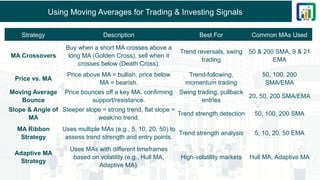
Strategy Description Best For Common MAs Used
MA Crossovers
Buy when a short MA crosses above a
long MA (Golden Cross), sell when it
crosses below (Death Cross).
Trend reversals, swing
trading
50 & 200 SMA, 9 & 21
EMA
Price vs. MA
Price above MA = bullish, price below
MA = bearish.
Trend-following,
momentum trading
50, 100, 200
SMA/EMA
Moving Average
Bounce
Price bounces off a key MA, confirming
support/resistance.
Swing trading, pullback
entries
20, 50, 200 SMA/EMA
Slope & Angle of
MA
Steeper slope = strong trend, flat slope =
weak/no trend.
Trend strength detection 50, 100, 200 SMA
MA Ribbon
Strategy
Uses multiple MAs (e.g., 5, 10, 20, 50) to
assess trend strength and entry points.
Trend strength analysis 5, 10, 20, 50 EMA
Adaptive MA
Strategy
Uses MAs with different timeframes
based on volatility (e.g., Hull MA,
Adaptive MA).
High-volatility markets Hull MA, Adaptive MA
Using Moving Averages for Trading & Investing Signals
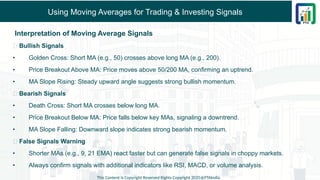
Interpretation of Moving Average Signals
✅ Bullish Signals
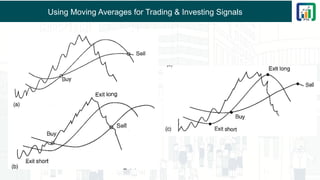
• Golden Cross: Short MA (e.g., 50) crosses above long MA (e.g., 200).
• Price Breakout Above MA: Price moves above 50/200 MA, confirming an uptrend.
• MA Slope Rising: Steady upward angle suggests strong bullish momentum.
❌ Bearish Signals
• Death Cross: Short MA crosses below long MA.
• Price Breakout Below MA: Price falls below key MAs, signaling a downtrend.
• MA Slope Falling: Downward slope indicates strong bearish momentum.
📌 False Signals Warning
• Shorter MAs (e.g., 9, 21 EMA) react faster but can generate false signals in choppy markets.
• Always confirm signals with additional indicators like RSI, MACD, or volume analysis.
This Content is Copyright Reserved Rights Copyright 2025@PTAIndia
Next Chapter 2 - Technical Indicator Construction
Section 5 – Technical Indicators
Presented By :
This Content is Copyright Reserved Rights Copyright 2025@PTAIndia

Section 5 - Chapter 1 - Moving Averages - CMT Level 1 2025

  • 1.
    Chapter 1 –Moving Averages Section 5 – Technical Indicator Presented By : This Content is Copyright Reserved Rights Copyright 2025@PTAIndia
  • 2.
    Agenda Generalize what amoving average is? Describe the simple and linearly weighted moving averages Explain the Wilder and EMA smoothing methods Recall the length of the three most common trends Summarize strategies for using moving averages Discuss moving average bands This Content is Copyright Reserved Rights Copyright 2025@PTAIndia
  • 3.
    Moving Averages 1. WhatAre Moving Averages? Moving Averages (MAs) are technical indicators used to smooth out price data and identify trends by averaging past prices over a set period. 2.Types of Moving Averages This Content is Copyright Reserved Rights Copyright 2025@PTAIndia Type Characteristics Best For Simple Moving Average (SMA) Equal weight to all prices General trend analysis Exponential Moving Average (EMA) More weight to recent prices Reacts faster to price changes Weighted Moving Average (WMA) Assigns different weights to prices More sensitive than SMA Hull Moving Average (HMA) Very responsive Reducing lag while maintaining smoothness Triangular Moving Average (TMA) Slowest-moving, smoothest trend Long-term trends
  • 4.
    Moving Averages 3. MovingAverages: Strengths & Weaknesses 4. Key Timeframes for Different Trading Styles This Content is Copyright Reserved Rights Copyright 2025@PTAIndia Feature SMA EMA WMA HMA TMA Smoothness High Medium Low Medium Very High Lag High Medium Low Low High Responsiveness Low High Higher High Low Best for Long-term trends Short-term trends Quick trend shifts Reducing lag Long-term smooth trends Trading Style Short-Term MA Medium-Term MA Long-Term MA Scalping 5, 10, 20 50 100, 200 Day Trading 9, 20, 50 100 200 Swing Trading 20, 50 100 200 Investing 50, 100 200 500
  • 5.
    Moving Averages 5. CommonMoving Average Strategies A. Crossovers • Golden Cross: Short-term MA (e.g., 50-day) crosses above a long-term MA (e.g., 200-day) → Bullish signal • Death Cross: Short-term MA crosses below long-term MA → Bearish signal B. Moving Averages as Support & Resistance • Prices often bounce off key MAs like the 50-day, 100-day, and 200-day MAs. C. Price Relation to Moving Average • Above MA: Uptrend • Below MA: Downtrend This Content is Copyright Reserved Rights Copyright 2025@PTAIndia
  • 6.
    Moving Averages 6. InterpretingMoving Averages  Trend Confirmation: A rising MA confirms an uptrend; a declining MA confirms a downtrend.  Lagging Indicator: MAs are backward-looking and may not predict future prices.  Best Combined with Other Indicators: Use with RSI, MACD, Bollinger Bands for stronger signals. 7. Choosing the Right Moving Average  SMA for general trend analysis.  EMA/WMA for traders needing faster signals.  HMA/TMA for smoother but reactive indicators. This Content is Copyright Reserved Rights Copyright 2025@PTAIndia
  • 7.
    Simple Moving Average(SMA) vs. Linearly Weighted Moving Average (WMA) 1. What Are They? Both SMA and WMA are types of moving averages used in technical analysis to smooth price data and identify trends. 2. Formula & Calculation This Content is Copyright Reserved Rights Copyright 2025@PTAIndia Type Formula Explanation Simple Moving Average (SMA) Sum of past prices over a given period NNN, divided by NNN. All prices are equally weighted. Weighted Moving Average (WMA) More weight is given to recent prices using a linear weighting scheme. Newer prices have a greater impact.
  • 8.
    Simple Moving Average(SMA) vs. Linearly Weighted Moving Average (WMA) 3. Key Differences 4. Choosing Between SMA and WMA This Content is Copyright Reserved Rights Copyright 2025@PTAIndia Feature SMA WMA Weighting Equal for all prices More weight to recent prices Responsiveness Slower reaction to price changes Faster reaction to price changes Smoothness Smoother, less noise More volatile but sensitive to changes Lag Higher lag Lower lag Use Case Long-term trend following Short-term trading, quick reactions Trading Style Best Moving Average Long-term investing SMA Swing trading SMA/WMA (depends on strategy) Short-term trading WMA High-volatility market WMA
  • 9.
    Simple Moving Average(SMA) vs. Linearly Weighted Moving Average (WMA) 5. Interpretation & Use Cases ✅ Simple Moving Average (SMA) • Best for long-term trend analysis. • Less prone to short-term price fluctuations, making it good for identifying major trends. • Often used for support and resistance levels. • Works well in stable or slow-moving markets. ✅ Weighted Moving Average (WMA) • Reacts faster to price movements. • More useful for short-term traders and those looking for quick signals. • Can help identify trend reversals earlier than SMA. • More effective in fast-moving or volatile markets. This Content is Copyright Reserved Rights Copyright 2025@PTAIndia
  • 10.
    Wilder’s Smoothing vs.Exponential Moving Average (EMA) Smoothing 1. What Are They? Both Wilder’s Smoothing and Exponential Moving Average (EMA) Smoothing are methods used to smooth out price fluctuations and identify trends in financial markets. They assign more weight to recent prices but differ in how they calculate smoothing. 2. Key Differences This Content is Copyright Reserved Rights Copyright 2025@PTAIndia Feature Wilder’s Smoothing EMA Smoothing Weighting Method Uses a fixed smoothing factor Uses a dynamic smoothing factor Responsiveness Slower reaction to price changes Faster reaction to price changes Smoothness Smoother, better for long-term trends More sensitive to short-term changes Lag Higher lag due to slower weighting Lower lag, reacts faster Use Cases Used in RSI, ATR, ADX Used for trend-following in EMAs, MACD
  • 11.
    Wilder’s Smoothing vs.Exponential Moving Average (EMA) Smoothing 3. Formula & Calculation This Content is Copyright Reserved Rights Copyright 2025@PTAIndia Method Formula Smoothing Factor (Multiplier) Characteristics Exponential Moving Average (EMA) Uses a smoothing factor that emphasizes recent prices more aggressively. Wilder’s Smoothing ​ More gradual smoothing, making it less reactive to short- term price fluctuations.
  • 12.
    Wilder’s Smoothing vs.Exponential Moving Average (EMA) Smoothing 4. Interpretation & Use Cases ✅ Exponential Moving Average (EMA) • Best for short-term trading since it reacts quickly to price movements. • Commonly used in MACD (Moving Average Convergence Divergence) and crossover strategies. • Ideal for identifying trend reversals sooner than Wilder’s Smoothing. ✅ Wilder’s Smoothing • Used in RSI (Relative Strength Index), ATR (Average True Range), and ADX (Average Directional Index). • Better for long-term trend stability. • Reduces noise while maintaining price movement consistency. This Content is Copyright Reserved Rights Copyright 2025@PTAIndia
  • 13.
    Wilder’s Smoothing vs.Exponential Moving Average (EMA) Smoothing 5. Choosing Between Wilder’s Smoothing & EMA 6. Key Takeaways ✔ EMA is more reactive, making it suitable for short-term traders. ✔ Wilder’s Smoothing is slower and more stable, ideal for volatility and trend indicators. ✔ Traders use EMA for fast-moving indicators like MACD, while Wilder’s method is found in RSI and ATR. This Content is Copyright Reserved Rights Copyright 2025@PTAIndia Trading Style Best Smoothing Method Fast-moving markets EMA Trend-following strategies EMA Volatility indicators (RSI, ATR, ADX) Wilder’s Smoothing Long-term trend analysis Wilder’s Smoothing
  • 14.
    Moving Average CalculationPeriod 1. What Is the Moving Average Calculation Period? The calculation period of a moving average (MA) is the number of past data points (candles, bars, or prices) used to compute the average. The choice of period affects how the MA reacts to price movements—shorter periods respond faster, while longer periods smooth out fluctuations. 2. Common Moving Average Periods & Their Uses This Content is Copyright Reserved Rights Copyright 2025@PTAIndia Period (N) Type Common Uses 5 - 10 Short-Term Scalping, quick market trends 20 - 50 Medium-Term Swing trading, trend confirmation 100 - 200 Long-Term Investing, major trend direction
  • 15.
    Moving Average CalculationPeriod 3. Impact of Different Calculation Periods The calculation period of a moving average (MA) is the number of past data points (candles, bars, or prices) used to compute the average. The choice of period affects how the MA reacts to price movements—shorter periods respond faster, while longer periods smooth out fluctuations. This Content is Copyright Reserved Rights Copyright 2025@PTAIndia Feature Short-Term MA (e.g., 10, 20) Medium-Term MA (e.g., 50, 100) Long-Term MA (e.g., 200, 500) Lag Low (faster reaction) Medium High (slower reaction) Sensitivity High (prone to false signals) Moderate Low (stable, fewer false signals) Trend Detection Captures short trends Confirms trends Detects major trends Best for Scalping, day trading Swing trading Position trading, investing
  • 16.
    Moving Average CalculationPeriod 4. Interpretation of Moving Average Periods ✅ Shorter MAs (e.g., 9, 20, 50) • Good for short-term trends. • More sensitive, but can create false signals. • Ideal for momentum traders and scalpers. ✅ Longer MAs (e.g., 100, 200, 500) • More reliable for detecting major trends. • Slower reactions, but better for filtering noise. • Used by long-term investors and position traders. This Content is Copyright Reserved Rights Copyright 2025@PTAIndia
  • 17.
    Moving Average CalculationPeriod 5. Choosing the Right Period Based on Market Condition 6. Key Takeaways ✔ Shorter periods react faster but can be noisy. ✔ Longer periods provide stable trend signals but lag behind price movements. ✔ 50, 100, and 200-period MAs are commonly used for trend-following strategies. ✔ The best MA period depends on trading style, asset volatility, and market conditions. This Content is Copyright Reserved Rights Copyright 2025@PTAIndia Market Condition Best Calculation Period Fast-moving, volatile market 9, 10, 20 (quick signals) Trending market 50, 100 (trend confirmation) Slow, stable market 200, 500 (long-term trends)
  • 18.
    Moving Averages Strategies ThisContent is Copyright Reserved Rights Copyright 2025@PTAIndia Strategy Description Best For Common MAs Used Crossover Strategy Buy when a short MA crosses above a long MA (Golden Cross), sell when it crosses below (Death Cross). Trend confirmation 50 & 200 SMA, 9 & 21 EMA Price Above/Below MA Price above MA = uptrend (buy); price below MA = downtrend (sell). Trend-following 50, 100, 200 SMA/EMA Moving Average Bounce (Support & Resistance) Price retraces to MA and bounces off, confirming support/resistance. Swing trading 20, 50, 200 SMA/EMA Slope & Angle of MA Steeper slope = strong trend, flatter slope = weak/no trend. Trend strength detection 50, 100, 200 SMA MA Ribbon Strategy Uses multiple MAs (e.g., 5, 10, 20, 50) to assess trend strength and entry points. Trend strength analysis 5, 10, 20, 50 EMA Adaptive MA Strategy Uses MAs with different timeframes based on volatility (e.g., Hull MA, Adaptive MA). High-volatility markets Hull MA, Adaptive MA
  • 19.
    Key Moving AveragePatterns & Interpretations ✅ Golden Cross (Bullish Signal) • Shorter MA (e.g., 50) crosses above longer MA (e.g., 200). • Signals the beginning of an uptrend. ✅ Death Cross (Bearish Signal) • Shorter MA (e.g., 50) crosses below longer MA (e.g., 200). • Indicates a downtrend is forming. ✅ Price & MA Interaction • Price above MA → Buy/Sustain Long Position. • Price below MA → Sell/Short Position. • MA acting as support/resistance → Entry/Exit decisions based on bounces. This Content is Copyright Reserved Rights Copyright 2025@PTAIndia
  • 20.
    Key Moving AveragePatterns & Interpretations 4. Choosing the Right Moving Average Strategy 5. Key Takeaways ✔ Moving Averages help identify trends, support/resistance, and entry/exit points. ✔ Short-term traders use faster MAs (e.g., 9, 21, 50 EMA), while long-term traders rely on slower MAs (e.g., 100, 200 SMA). ✔ Crossover strategies (Golden/Death Cross) work well for trend reversals. ✔ MA slope and price bounces off MAs are useful confirmations for trend strength. ✔ Using multiple MAs (MA Ribbon) provides more comprehensive insights into trend strength. This Content is Copyright Reserved Rights Copyright 2025@PTAIndia Trading Style Best MA Strategy Common MAs Scalping MA Crossovers, Adaptive MA 9, 21 EMA Day Trading MA Bounces, Slope Analysis 20, 50 EMA Swing Trading MA Crossovers, Trend Following 50, 100 SMA/EMA Long-Term Investing Golden/Death Cross, MA as Support/Resistance 50, 100, 200 SMA
  • 21.
    Using Moving Averagesfor Trading & Investing Signals Strategy Description Best For Common MAs Used MA Crossovers Buy when a short MA crosses above a long MA (Golden Cross), sell when it crosses below (Death Cross). Trend reversals, swing trading 50 & 200 SMA, 9 & 21 EMA Price vs. MA Price above MA = bullish, price below MA = bearish. Trend-following, momentum trading 50, 100, 200 SMA/EMA Moving Average Bounce Price bounces off a key MA, confirming support/resistance. Swing trading, pullback entries 20, 50, 200 SMA/EMA Slope & Angle of MA Steeper slope = strong trend, flat slope = weak/no trend. Trend strength detection 50, 100, 200 SMA MA Ribbon Strategy Uses multiple MAs (e.g., 5, 10, 20, 50) to assess trend strength and entry points. Trend strength analysis 5, 10, 20, 50 EMA Adaptive MA Strategy Uses MAs with different timeframes based on volatility (e.g., Hull MA, Adaptive MA). High-volatility markets Hull MA, Adaptive MA
  • 22.
    Using Moving Averagesfor Trading & Investing Signals
  • 23.
    Using Moving Averagesfor Trading & Investing Signals Interpretation of Moving Average Signals ✅ Bullish Signals • Golden Cross: Short MA (e.g., 50) crosses above long MA (e.g., 200). • Price Breakout Above MA: Price moves above 50/200 MA, confirming an uptrend. • MA Slope Rising: Steady upward angle suggests strong bullish momentum. ❌ Bearish Signals • Death Cross: Short MA crosses below long MA. • Price Breakout Below MA: Price falls below key MAs, signaling a downtrend. • MA Slope Falling: Downward slope indicates strong bearish momentum. 📌 False Signals Warning • Shorter MAs (e.g., 9, 21 EMA) react faster but can generate false signals in choppy markets. • Always confirm signals with additional indicators like RSI, MACD, or volume analysis. This Content is Copyright Reserved Rights Copyright 2025@PTAIndia
  • 24.
    Next Chapter 2- Technical Indicator Construction Section 5 – Technical Indicators Presented By : This Content is Copyright Reserved Rights Copyright 2025@PTAIndia