
Chapter 2 - Technical Indicator Construction
Section 5 – Technical Indicators
Presented By :
This Content is Copyright Reserved Rights Copyright 2025@PTAIndia
Agenda
 Explain what a technical indicator is?
 Describe the two general categories of
indicators
 Contrast various momentum indicators
 Summarize various volume indicators
 Discuss indicators that use price and
volume
 Describe the three plots of the Directional
Movement Index (DMI)
 Express the DMI’s general interpretation
 Outline the DMI’s uses
This Content is Copyright Reserved Rights Copyright 2025@PTAIndia
Technical Momentum
Presented By :
This Content is Copyright Reserved Rights Copyright 2025@PTAIndia
Technical Momentum
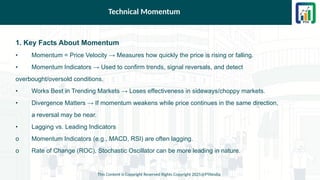
1. Key Facts About Momentum
• Momentum = Price Velocity → Measures how quickly the price is rising or falling.
• Momentum Indicators → Used to confirm trends, signal reversals, and detect
overbought/oversold conditions.
• Works Best in Trending Markets → Loses effectiveness in sideways/choppy markets.
• Divergence Matters → If momentum weakens while price continues in the same direction,
a reversal may be near.
• Lagging vs. Leading Indicators
o Momentum Indicators (e.g., MACD, RSI) are often lagging.
o Rate of Change (ROC), Stochastic Oscillator can be more leading in nature.
This Content is Copyright Reserved Rights Copyright 2025@PTAIndia
Technical Momentum
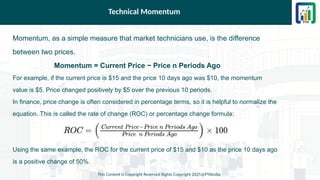
Momentum, as a simple measure that market technicians use, is the difference
between two prices.
Momentum = Current Price − Price n Periods Ago
For example, if the current price is $15 and the price 10 days ago was $10, the momentum
value is $5. Price changed positively by $5 over the previous 10 periods.
In finance, price change is often considered in percentage terms, so it is helpful to normalize the
equation. This is called the rate of change (ROC) or percentage change formula:
Using the same example, the ROC for the current price of $15 and $10 as the price 10 days ago
is a positive change of 50%.
This Content is Copyright Reserved Rights Copyright 2025@PTAIndia
Popular Momentum Indicators
This Content is Copyright Reserved Rights Copyright 2025@PTAIndia
Indicator Purpose Formula Interpretation
Relative Strength Index (RSI)
Measures overbought/oversold
conditions
RSI = 100 - [100 / (1 + RS)]
where RS = Avg. gains / Avg.
losses
RSI > 70 → Overbought, RSI <
30 → Oversold
Moving Average Convergence
Divergence (MACD)
Identifies trend direction &
reversals
MACD = (12 EMA - 26 EMA),
Signal = 9 EMA of MACD
MACD > Signal → Bullish,
MACD < Signal → Bearish
Stochastic Oscillator
Measures price relative to
range
%K = [(C - L14) / (H14 - L14)] ×
100, %D = 3-day SMA of %K
%K above 80 → Overbought,
Below 20 → Oversold
Rate of Change (ROC)
Measures speed of price
change
ROC = [(Current Price - Price N
periods ago) / Price N periods
ago] × 100
Rising ROC → Strong
Momentum, Falling ROC →
Weak Momentum
Commodity Channel Index
(CCI)
Identifies cyclical trends
CCI = (Typical Price - SMA) /
(0.015 × Mean Deviation)
CCI > 100 → Overbought, CCI
< -100 → Oversold
Williams %R Measures price strength %R = [(H - C) / (H - L)] × -100
%R above -20 → Overbought,
Below -80 → Oversold
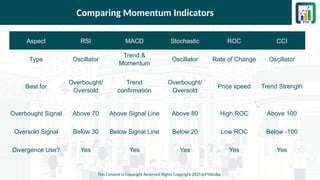
Comparing Momentum Indicators
This Content is Copyright Reserved Rights Copyright 2025@PTAIndia
Aspect RSI MACD Stochastic ROC CCI
Type Oscillator
Trend &
Momentum
Oscillator Rate of Change Oscillator
Best for
Overbought/
Oversold
Trend
confirmation
Overbought/
Oversold
Price speed Trend Strength
Overbought Signal Above 70 Above Signal Line Above 80 High ROC Above 100
Oversold Signal Below 30 Below Signal Line Below 20 Low ROC Below -100
Divergence Use? Yes Yes Yes Yes Yes
Technical Momentum
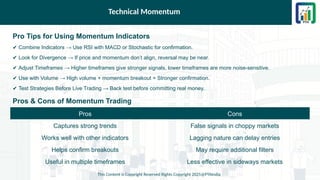
Pro Tips for Using Momentum Indicators
✔ Combine Indicators → Use RSI with MACD or Stochastic for confirmation.
✔ Look for Divergence → If price and momentum don’t align, reversal may be near.
✔ Adjust Timeframes → Higher timeframes give stronger signals, lower timeframes are more noise-sensitive.
✔ Use with Volume → High volume + momentum breakout = Stronger confirmation.
✔ Test Strategies Before Live Trading → Back test before committing real money.
Pros & Cons of Momentum Trading
This Content is Copyright Reserved Rights Copyright 2025@PTAIndia
Pros Cons
Captures strong trends False signals in choppy markets
Works well with other indicators Lagging nature can delay entries
Helps confirm breakouts May require additional filters
Useful in multiple timeframes Less effective in sideways markets
Rate of Change (ROC)
Presented By :
This Content is Copyright Reserved Rights Copyright 2025@PTAIndia
Rate Of Changes (ROC)
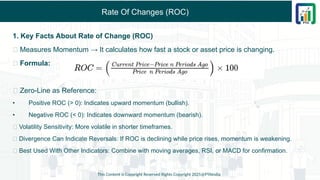
1. Key Facts About Rate of Change (ROC)
✅ Measures Momentum → It calculates how fast a stock or asset price is changing.
✅ Formula:
✅ Zero-Line as Reference:
• Positive ROC (> 0): Indicates upward momentum (bullish).
• Negative ROC (< 0): Indicates downward momentum (bearish).
✅ Volatility Sensitivity: More volatile in shorter timeframes.
✅ Divergence Can Indicate Reversals: If ROC is declining while price rises, momentum is weakening.
✅ Best Used With Other Indicators: Combine with moving averages, RSI, or MACD for confirmation.
This Content is Copyright Reserved Rights Copyright 2025@PTAIndia
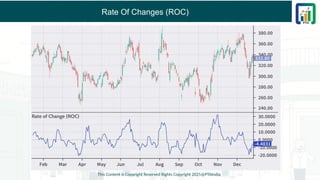
Rate Of Changes (ROC)
This Content is Copyright Reserved Rights Copyright 2025@PTAIndia
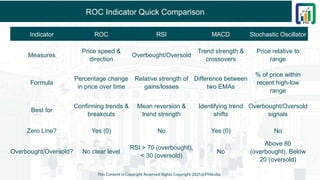
ROC Indicator Quick Comparison
This Content is Copyright Reserved Rights Copyright 2025@PTAIndia
Indicator ROC RSI MACD Stochastic Oscillator
Measures
Price speed &
direction
Overbought/Oversold
Trend strength &
crossovers
Price relative to
range
Formula
Percentage change
in price over time
Relative strength of
gains/losses
Difference between
two EMAs
% of price within
recent high-low
range
Best for
Confirming trends &
breakouts
Mean reversion &
trend strength
Identifying trend
shifts
Overbought/Oversold
signals
Zero Line? Yes (0) No Yes (0) No
Overbought/Oversold? No clear level
RSI > 70 (overbought),
< 30 (oversold)
No
Above 80
(overbought), Below
20 (oversold)
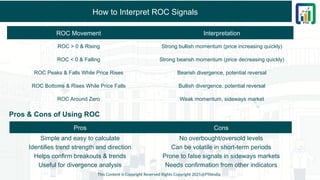
How to Interpret ROC Signals
This Content is Copyright Reserved Rights Copyright 2025@PTAIndia
ROC Movement Interpretation
ROC > 0 & Rising Strong bullish momentum (price increasing quickly)
ROC < 0 & Falling Strong bearish momentum (price decreasing quickly)
ROC Peaks & Falls While Price Rises Bearish divergence, potential reversal
ROC Bottoms & Rises While Price Falls Bullish divergence, potential reversal
ROC Around Zero Weak momentum, sideways market
Pros Cons
Simple and easy to calculate No overbought/oversold levels
Identifies trend strength and direction Can be volatile in short-term periods
Helps confirm breakouts & trends Prone to false signals in sideways markets
Useful for divergence analysis Needs confirmation from other indicators
Pros & Cons of Using ROC
Rate Of Changes (ROC)
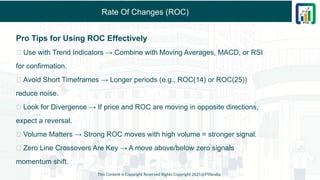
Pro Tips for Using ROC Effectively
✅ Use with Trend Indicators → Combine with Moving Averages, MACD, or RSI
for confirmation.
✅ Avoid Short Timeframes → Longer periods (e.g., ROC(14) or ROC(25))
reduce noise.
✅ Look for Divergence → If price and ROC are moving in opposite directions,
expect a reversal.
✅ Volume Matters → Strong ROC moves with high volume = stronger signal.
✅ Zero Line Crossovers Are Key → A move above/below zero signals
momentum shift.
This Content is Copyright Reserved Rights Copyright 2025@PTAIndia
Moving Average Convergence Divergence (MACD)
Presented By :
This Content is Copyright Reserved Rights Copyright 2025@PTAIndia
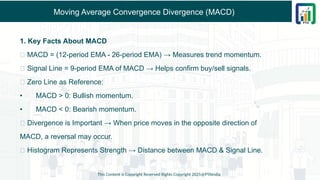
Moving Average Convergence Divergence (MACD)
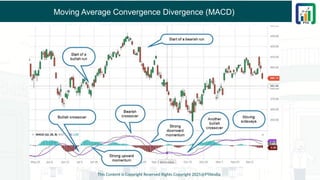
1. Key Facts About MACD
✅ MACD = (12-period EMA - 26-period EMA) → Measures trend momentum.
✅ Signal Line = 9-period EMA of MACD → Helps confirm buy/sell signals.
✅ Zero Line as Reference:
• MACD > 0: Bullish momentum.
• MACD < 0: Bearish momentum.
✅ Divergence is Important → When price moves in the opposite direction of
MACD, a reversal may occur.
✅ Histogram Represents Strength → Distance between MACD & Signal Line.
This Content is Copyright Reserved Rights Copyright 2025@PTAIndia
Moving Average Convergence Divergence (MACD)
This Content is Copyright Reserved Rights Copyright 2025@PTAIndia
Moving Average Convergence Divergence (MACD)
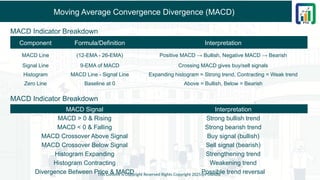
MACD Indicator Breakdown
This Content is Copyright Reserved Rights Copyright 2025@PTAIndia
Component Formula/Definition Interpretation
MACD Line (12-EMA - 26-EMA) Positive MACD → Bullish, Negative MACD → Bearish
Signal Line 9-EMA of MACD Crossing MACD gives buy/sell signals
Histogram MACD Line - Signal Line Expanding histogram = Strong trend, Contracting = Weak trend
Zero Line Baseline at 0 Above = Bullish, Below = Bearish
MACD Indicator Breakdown
MACD Signal Interpretation
MACD > 0 & Rising Strong bullish trend
MACD < 0 & Falling Strong bearish trend
MACD Crossover Above Signal Buy signal (bullish)
MACD Crossover Below Signal Sell signal (bearish)
Histogram Expanding Strengthening trend
Histogram Contracting Weakening trend
Divergence Between Price & MACD Possible trend reversal
Moving Average Convergence Divergence (MACD)
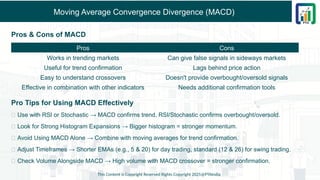
Pros & Cons of MACD
Pro Tips for Using MACD Effectively
✅ Use with RSI or Stochastic → MACD confirms trend, RSI/Stochastic confirms overbought/oversold.
✅ Look for Strong Histogram Expansions → Bigger histogram = stronger momentum.
✅ Avoid Using MACD Alone → Combine with moving averages for trend confirmation.
✅ Adjust Timeframes → Shorter EMAs (e.g., 5 & 20) for day trading, standard (12 & 26) for swing trading.
✅ Check Volume Alongside MACD → High volume with MACD crossover = stronger confirmation.
This Content is Copyright Reserved Rights Copyright 2025@PTAIndia
Pros Cons
Works in trending markets Can give false signals in sideways markets
Useful for trend confirmation Lags behind price action
Easy to understand crossovers Doesn't provide overbought/oversold signals
Effective in combination with other indicators Needs additional confirmation tools
Relative Strength Index (RSI)
Presented By :
This Content is Copyright Reserved Rights Copyright 2025@PTAIndia
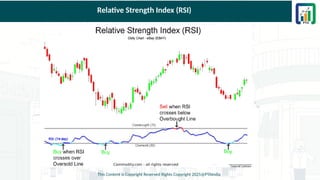
Relative Strength Index (RSI)
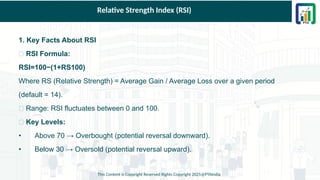
1. Key Facts About RSI
✅ RSI Formula:
RSI=100−(1+RS100)
Where RS (Relative Strength) = Average Gain / Average Loss over a given period
(default = 14).
✅ Range: RSI fluctuates between 0 and 100.
✅ Key Levels:
• Above 70 → Overbought (potential reversal downward).
• Below 30 → Oversold (potential reversal upward).
This Content is Copyright Reserved Rights Copyright 2025@PTAIndia
Relative Strength Index (RSI)
This Content is Copyright Reserved Rights Copyright 2025@PTAIndia
Relative Strength Index (RSI)
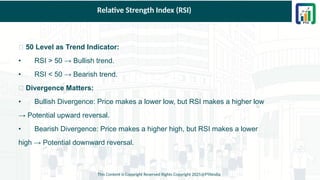
✅ 50 Level as Trend Indicator:
• RSI > 50 → Bullish trend.
• RSI < 50 → Bearish trend.
✅ Divergence Matters:
• Bullish Divergence: Price makes a lower low, but RSI makes a higher low
→ Potential upward reversal.
• Bearish Divergence: Price makes a higher high, but RSI makes a lower
high → Potential downward reversal.
This Content is Copyright Reserved Rights Copyright 2025@PTAIndia
Relative Strength Index (RSI)
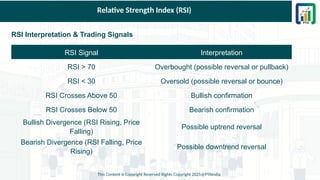
RSI Interpretation & Trading Signals
This Content is Copyright Reserved Rights Copyright 2025@PTAIndia
RSI Signal Interpretation
RSI > 70 Overbought (possible reversal or pullback)
RSI < 30 Oversold (possible reversal or bounce)
RSI Crosses Above 50 Bullish confirmation
RSI Crosses Below 50 Bearish confirmation
Bullish Divergence (RSI Rising, Price
Falling)
Possible uptrend reversal
Bearish Divergence (RSI Falling, Price
Rising)
Possible downtrend reversal
Relative Strength Index (RSI)
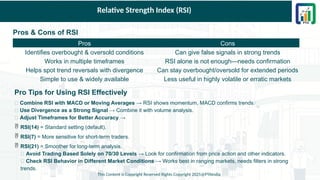
Pros & Cons of RSI
This Content is Copyright Reserved Rights Copyright 2025@PTAIndia
Pros Cons
Identifies overbought & oversold conditions Can give false signals in strong trends
Works in multiple timeframes RSI alone is not enough—needs confirmation
Helps spot trend reversals with divergence Can stay overbought/oversold for extended periods
Simple to use & widely available Less useful in highly volatile or erratic markets
Pro Tips for Using RSI Effectively
✅ Combine RSI with MACD or Moving Averages → RSI shows momentum, MACD confirms trends.
✅ Use Divergence as a Strong Signal → Combine it with volume analysis.
✅ Adjust Timeframes for Better Accuracy →
 RSI(14) = Standard setting (default).
 RSI(7) = More sensitive for short-term traders.
 RSI(21) = Smoother for long-term analysis.
✅ Avoid Trading Based Solely on 70/30 Levels → Look for confirmation from price action and other indicators.
✅ Check RSI Behavior in Different Market Conditions → Works best in ranging markets, needs filters in strong
trends.
Stochastic Oscillator
Presented By :
This Content is Copyright Reserved Rights Copyright 2025@PTAIndia
Stochastic Oscillator
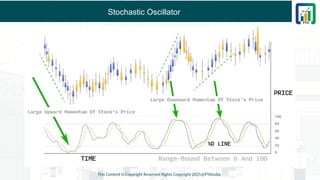
The Stochastic Oscillator is a momentum indicator that compares a security's closing price to its
price range over a specific period. It helps traders identify overbought and oversold conditions
and potential reversals.
Range: 0 to 100
✅ Key Levels:
• Above 80 → Overbought (potential downward reversal).
• Below 20 → Oversold (potential upward reversal).
✅ Two Main Components:
• %K Line → Fast-moving main line.
• %D Line → Slower signal line (3-period moving average of %K).
This Content is Copyright Reserved Rights Copyright 2025@PTAIndia
Stochastic Oscillator
This Content is Copyright Reserved Rights Copyright 2025@PTAIndia
Stochastic Oscillator
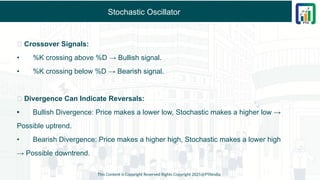
✅ Crossover Signals:
• %K crossing above %D → Bullish signal.
• %K crossing below %D → Bearish signal.
✅ Divergence Can Indicate Reversals:
• Bullish Divergence: Price makes a lower low, Stochastic makes a higher low →
Possible uptrend.
• Bearish Divergence: Price makes a higher high, Stochastic makes a lower high
→ Possible downtrend.
This Content is Copyright Reserved Rights Copyright 2025@PTAIndia
Stochastic Oscillator
✅ Stochastic Oscillator Formula:
This Content is Copyright Reserved Rights Copyright 2025@PTAIndia
Stochastic Oscillator
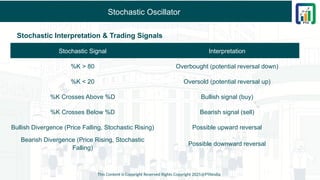
Stochastic Interpretation & Trading Signals
This Content is Copyright Reserved Rights Copyright 2025@PTAIndia
Stochastic Signal Interpretation
%K > 80 Overbought (potential reversal down)
%K < 20 Oversold (potential reversal up)
%K Crosses Above %D Bullish signal (buy)
%K Crosses Below %D Bearish signal (sell)
Bullish Divergence (Price Falling, Stochastic Rising) Possible upward reversal
Bearish Divergence (Price Rising, Stochastic
Falling)
Possible downward reversal
Stochastic Oscillator
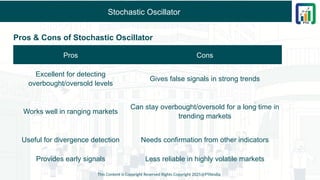
Pros & Cons of Stochastic Oscillator
This Content is Copyright Reserved Rights Copyright 2025@PTAIndia
Pros Cons
Excellent for detecting
overbought/oversold levels
Gives false signals in strong trends
Works well in ranging markets
Can stay overbought/oversold for a long time in
trending markets
Useful for divergence detection Needs confirmation from other indicators
Provides early signals Less reliable in highly volatile markets
Stochastic Oscillator
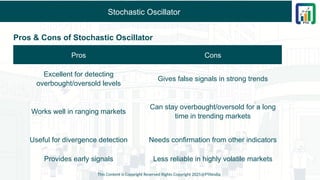
Pros & Cons of Stochastic Oscillator
This Content is Copyright Reserved Rights Copyright 2025@PTAIndia
Pros Cons
Excellent for detecting
overbought/oversold levels
Gives false signals in strong trends
Works well in ranging markets
Can stay overbought/oversold for a long
time in trending markets
Useful for divergence detection Needs confirmation from other indicators
Provides early signals Less reliable in highly volatile markets
Stochastic Oscillator
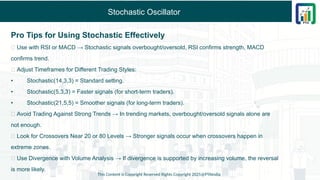
Pro Tips for Using Stochastic Effectively
✅ Use with RSI or MACD → Stochastic signals overbought/oversold, RSI confirms strength, MACD
confirms trend.
✅ Adjust Timeframes for Different Trading Styles:
• Stochastic(14,3,3) = Standard setting.
• Stochastic(5,3,3) = Faster signals (for short-term traders).
• Stochastic(21,5,5) = Smoother signals (for long-term traders).
✅ Avoid Trading Against Strong Trends → In trending markets, overbought/oversold signals alone are
not enough.
✅ Look for Crossovers Near 20 or 80 Levels → Stronger signals occur when crossovers happen in
extreme zones.
✅ Use Divergence with Volume Analysis → If divergence is supported by increasing volume, the reversal
is more likely.
This Content is Copyright Reserved Rights Copyright 2025@PTAIndia
Coppock Curve
Presented By :
This Content is Copyright Reserved Rights Copyright 2025@PTAIndia
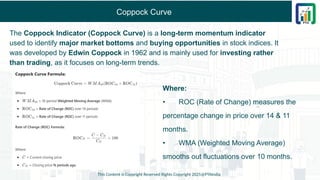
Coppock Curve
This Content is Copyright Reserved Rights Copyright 2025@PTAIndia
Where:
• ROC (Rate of Change) measures the
percentage change in price over 14 & 11
months.
• WMA (Weighted Moving Average)
smooths out fluctuations over 10 months.
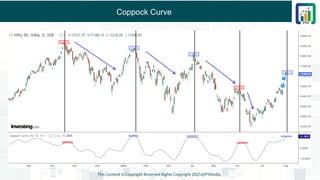
The Coppock Indicator (Coppock Curve) is a long-term momentum indicator
used to identify major market bottoms and buying opportunities in stock indices. It
was developed by Edwin Coppock in 1962 and is mainly used for investing rather
than trading, as it focuses on long-term trends.
Coppock Curve
This Content is Copyright Reserved Rights Copyright 2025@PTAIndia
Coppock Curve
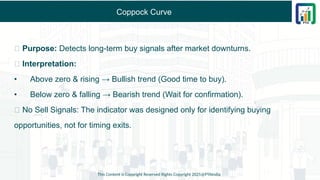
✅ Purpose: Detects long-term buy signals after market downturns.
✅ Interpretation:
• Above zero & rising → Bullish trend (Good time to buy).
• Below zero & falling → Bearish trend (Wait for confirmation).
✅ No Sell Signals: The indicator was designed only for identifying buying
opportunities, not for timing exits.
This Content is Copyright Reserved Rights Copyright 2025@PTAIndia
Coppock Curve
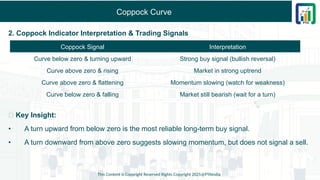
2. Coppock Indicator Interpretation & Trading Signals
💡 Key Insight:
• A turn upward from below zero is the most reliable long-term buy signal.
• A turn downward from above zero suggests slowing momentum, but does not signal a sell.
This Content is Copyright Reserved Rights Copyright 2025@PTAIndia
Coppock Signal Interpretation
Curve below zero & turning upward Strong buy signal (bullish reversal)
Curve above zero & rising Market in strong uptrend
Curve above zero & flattening Momentum slowing (watch for weakness)
Curve below zero & falling Market still bearish (wait for a turn)
Coppock Curve
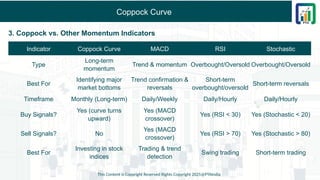
3. Coppock vs. Other Momentum Indicators
This Content is Copyright Reserved Rights Copyright 2025@PTAIndia
Indicator Coppock Curve MACD RSI Stochastic
Type
Long-term
momentum
Trend & momentum Overbought/Oversold Overbought/Oversold
Best For
Identifying major
market bottoms
Trend confirmation &
reversals
Short-term
overbought/oversold
Short-term reversals
Timeframe Monthly (Long-term) Daily/Weekly Daily/Hourly Daily/Hourly
Buy Signals?
Yes (curve turns
upward)
Yes (MACD
crossover)
Yes (RSI < 30) Yes (Stochastic < 20)
Sell Signals? No
Yes (MACD
crossover)
Yes (RSI > 70) Yes (Stochastic > 80)
Best For
Investing in stock
indices
Trading & trend
detection
Swing trading Short-term trading
Coppock Curve
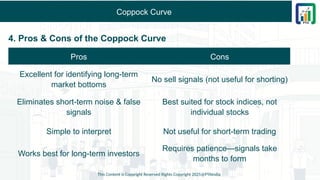
4. Pros & Cons of the Coppock Curve
This Content is Copyright Reserved Rights Copyright 2025@PTAIndia
Pros Cons
Excellent for identifying long-term
market bottoms
No sell signals (not useful for shorting)
Eliminates short-term noise & false
signals
Best suited for stock indices, not
individual stocks
Simple to interpret Not useful for short-term trading
Works best for long-term investors
Requires patience—signals take
months to form
Coppock Curve
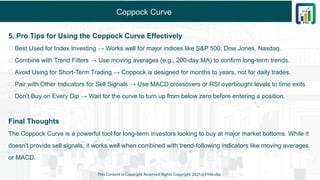
5. Pro Tips for Using the Coppock Curve Effectively
✅ Best Used for Index Investing → Works well for major indices like S&P 500, Dow Jones, Nasdaq.
✅ Combine with Trend Filters → Use moving averages (e.g., 200-day MA) to confirm long-term trends.
✅ Avoid Using for Short-Term Trading → Coppock is designed for months to years, not for daily trades.
✅ Pair with Other Indicators for Sell Signals → Use MACD crossovers or RSI overbought levels to time exits.
✅ Don’t Buy on Every Dip → Wait for the curve to turn up from below zero before entering a position.
Final Thoughts
The Coppock Curve is a powerful tool for long-term investors looking to buy at major market bottoms. While it
doesn’t provide sell signals, it works well when combined with trend-following indicators like moving averages
or MACD.
This Content is Copyright Reserved Rights Copyright 2025@PTAIndia
Volume Indicators
Presented By :
This Content is Copyright Reserved Rights Copyright 2025@PTAIndia
Volume Indicators
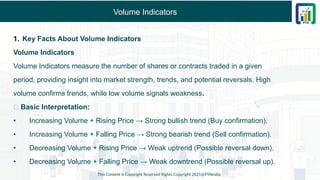
1. Key Facts About Volume Indicators
Volume Indicators
Volume Indicators measure the number of shares or contracts traded in a given
period, providing insight into market strength, trends, and potential reversals. High
volume confirms trends, while low volume signals weakness.
✅ Basic Interpretation:
• Increasing Volume + Rising Price → Strong bullish trend (Buy confirmation).
• Increasing Volume + Falling Price → Strong bearish trend (Sell confirmation).
• Decreasing Volume + Rising Price → Weak uptrend (Possible reversal down).
• Decreasing Volume + Falling Price → Weak downtrend (Possible reversal up).
This Content is Copyright Reserved Rights Copyright 2025@PTAIndia
Volume Indicators
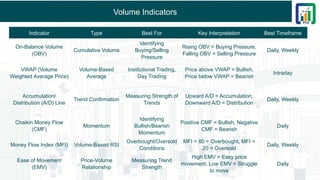
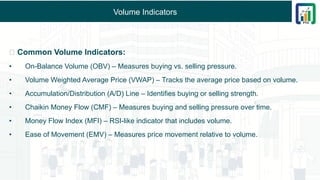
✅ Common Volume Indicators:
• On-Balance Volume (OBV) – Measures buying vs. selling pressure.
• Volume Weighted Average Price (VWAP) – Tracks the average price based on volume.
• Accumulation/Distribution (A/D) Line – Identifies buying or selling strength.
• Chaikin Money Flow (CMF) – Measures buying and selling pressure over time.
• Money Flow Index (MFI) – RSI-like indicator that includes volume.
• Ease of Movement (EMV) – Measures price movement relative to volume.
Volume Indicators
Indicator Type Best For Key Interpretation Best Timeframe
On-Balance Volume
(OBV)
Cumulative Volume
Identifying
Buying/Selling
Pressure
Rising OBV = Buying Pressure,
Falling OBV = Selling Pressure
Daily, Weekly
VWAP (Volume
Weighted Average Price)
Volume-Based
Average
Institutional Trading,
Day Trading
Price above VWAP = Bullish,
Price below VWAP = Bearish
Intraday
Accumulation/
Distribution (A/D) Line
Trend Confirmation
Measuring Strength of
Trends
Upward A/D = Accumulation,
Downward A/D = Distribution
Daily, Weekly
Chaikin Money Flow
(CMF)
Momentum
Identifying
Bullish/Bearish
Momentum
Positive CMF = Bullish, Negative
CMF = Bearish
Daily
Money Flow Index (MFI) Volume-Based RSI
Overbought/Oversold
Conditions
MFI > 80 = Overbought, MFI <
20 = Oversold
Daily, Weekly
Ease of Movement
(EMV)
Price-Volume
Relationship
Measuring Trend
Strength
High EMV = Easy price
movement, Low EMV = Struggle
to move
Daily
Volume Indicators
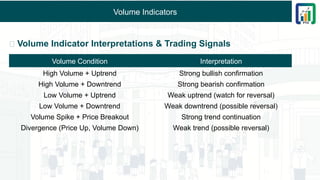
✅ Volume Indicator Interpretations & Trading Signals
Volume Condition Interpretation
High Volume + Uptrend Strong bullish confirmation
High Volume + Downtrend Strong bearish confirmation
Low Volume + Uptrend Weak uptrend (watch for reversal)
Low Volume + Downtrend Weak downtrend (possible reversal)
Volume Spike + Price Breakout Strong trend continuation
Divergence (Price Up, Volume Down) Weak trend (possible reversal)
Volume Indicators
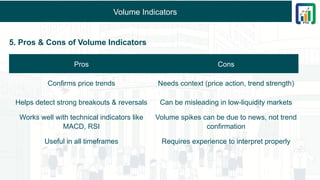
5. Pros & Cons of Volume Indicators
Pros Cons
Confirms price trends Needs context (price action, trend strength)
Helps detect strong breakouts & reversals Can be misleading in low-liquidity markets
Works well with technical indicators like
MACD, RSI
Volume spikes can be due to news, not trend
confirmation
Useful in all timeframes Requires experience to interpret properly
Volume Indicators
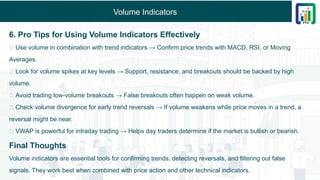
6. Pro Tips for Using Volume Indicators Effectively
✅ Use volume in combination with trend indicators → Confirm price trends with MACD, RSI, or Moving
Averages.
✅ Look for volume spikes at key levels → Support, resistance, and breakouts should be backed by high
volume.
✅ Avoid trading low-volume breakouts → False breakouts often happen on weak volume.
✅ Check volume divergence for early trend reversals → If volume weakens while price moves in a trend, a
reversal might be near.
✅ VWAP is powerful for intraday trading → Helps day traders determine if the market is bullish or bearish.
Final Thoughts
Volume indicators are essential tools for confirming trends, detecting reversals, and filtering out false
signals. They work best when combined with price action and other technical indicators.
On-Balance Volume (OBV)
Presented By :
This Content is Copyright Reserved Rights Copyright 2025@PTAIndia
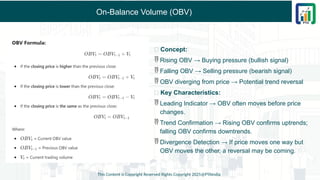
On-Balance Volume (OBV)
This Content is Copyright Reserved Rights Copyright 2025@PTAIndia
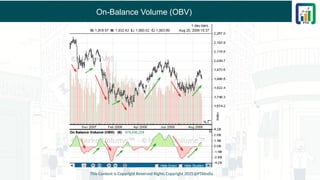
✅ Concept:
 Rising OBV → Buying pressure (bullish signal)
 Falling OBV → Selling pressure (bearish signal)
 OBV diverging from price → Potential trend reversal
✅ Key Characteristics:
 Leading Indicator → OBV often moves before price
changes.
 Trend Confirmation → Rising OBV confirms uptrends;
falling OBV confirms downtrends.
 Divergence Detection → If price moves one way but
OBV moves the other, a reversal may be coming.
On-Balance Volume (OBV)
This Content is Copyright Reserved Rights Copyright 2025@PTAIndia
On-Balance Volume (OBV)
OBV Interpretation & Trading Signals
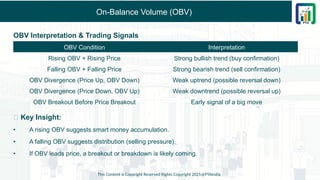
💡 Key Insight:
• A rising OBV suggests smart money accumulation.
• A falling OBV suggests distribution (selling pressure).
• If OBV leads price, a breakout or breakdown is likely coming.
This Content is Copyright Reserved Rights Copyright 2025@PTAIndia
OBV Condition Interpretation
Rising OBV + Rising Price Strong bullish trend (buy confirmation)
Falling OBV + Falling Price Strong bearish trend (sell confirmation)
OBV Divergence (Price Up, OBV Down) Weak uptrend (possible reversal down)
OBV Divergence (Price Down, OBV Up) Weak downtrend (possible reversal up)
OBV Breakout Before Price Breakout Early signal of a big move
On-Balance Volume (OBV)
Pros & Cons of OBV
This Content is Copyright Reserved Rights Copyright 2025@PTAIndia
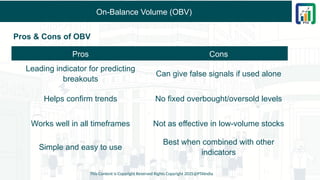
Pros Cons
Leading indicator for predicting
breakouts
Can give false signals if used alone
Helps confirm trends No fixed overbought/oversold levels
Works well in all timeframes Not as effective in low-volume stocks
Simple and easy to use
Best when combined with other
indicators
On-Balance Volume (OBV)
Pro Tips for Using OBV Effectively
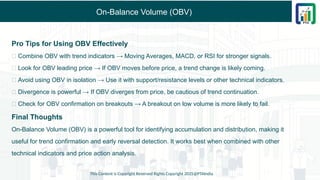
✅ Combine OBV with trend indicators → Moving Averages, MACD, or RSI for stronger signals.
✅ Look for OBV leading price → If OBV moves before price, a trend change is likely coming.
✅ Avoid using OBV in isolation → Use it with support/resistance levels or other technical indicators.
✅ Divergence is powerful → If OBV diverges from price, be cautious of trend continuation.
✅ Check for OBV confirmation on breakouts → A breakout on low volume is more likely to fail.
Final Thoughts
On-Balance Volume (OBV) is a powerful tool for identifying accumulation and distribution, making it
useful for trend confirmation and early reversal detection. It works best when combined with other
technical indicators and price action analysis.
This Content is Copyright Reserved Rights Copyright 2025@PTAIndia
Price and Volume Indicators
Presented By :
This Content is Copyright Reserved Rights Copyright 2025@PTAIndia
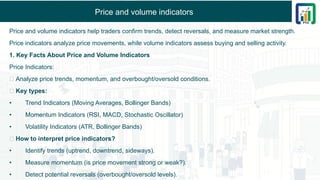
Price and volume indicators
Price and volume indicators help traders confirm trends, detect reversals, and measure market strength.
Price indicators analyze price movements, while volume indicators assess buying and selling activity.
1. Key Facts About Price and Volume Indicators
Price Indicators:
✅ Analyze price trends, momentum, and overbought/oversold conditions.
✅ Key types:
• Trend Indicators (Moving Averages, Bollinger Bands)
• Momentum Indicators (RSI, MACD, Stochastic Oscillator)
• Volatility Indicators (ATR, Bollinger Bands)
✅ How to interpret price indicators?
• Identify trends (uptrend, downtrend, sideways).
• Measure momentum (is price movement strong or weak?).
• Detect potential reversals (overbought/oversold levels).
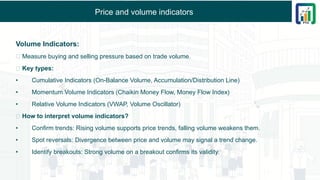
Price and volume indicators
Volume Indicators:
✅ Measure buying and selling pressure based on trade volume.
✅ Key types:
• Cumulative Indicators (On-Balance Volume, Accumulation/Distribution Line)
• Momentum Volume Indicators (Chaikin Money Flow, Money Flow Index)
• Relative Volume Indicators (VWAP, Volume Oscillator)
✅ How to interpret volume indicators?
• Confirm trends: Rising volume supports price trends, falling volume weakens them.
• Spot reversals: Divergence between price and volume may signal a trend change.
• Identify breakouts: Strong volume on a breakout confirms its validity.
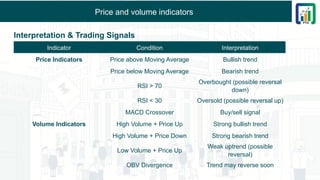
Price and volume indicators
Interpretation & Trading Signals
Indicator Condition Interpretation
Price Indicators Price above Moving Average Bullish trend
Price below Moving Average Bearish trend
RSI > 70
Overbought (possible reversal
down)
RSI < 30 Oversold (possible reversal up)
MACD Crossover Buy/sell signal
Volume Indicators High Volume + Price Up Strong bullish trend
High Volume + Price Down Strong bearish trend
Low Volume + Price Up
Weak uptrend (possible
reversal)
OBV Divergence Trend may reverse soon
Price and volume indicators
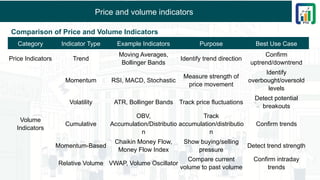
Comparison of Price and Volume Indicators
Category Indicator Type Example Indicators Purpose Best Use Case
Price Indicators Trend
Moving Averages,
Bollinger Bands
Identify trend direction
Confirm
uptrend/downtrend
Momentum RSI, MACD, Stochastic
Measure strength of
price movement
Identify
overbought/oversold
levels
Volatility ATR, Bollinger Bands Track price fluctuations
Detect potential
breakouts
Volume
Indicators
Cumulative
OBV,
Accumulation/Distributio
n
Track
accumulation/distributio
n
Confirm trends
Momentum-Based
Chaikin Money Flow,
Money Flow Index
Show buying/selling
pressure
Detect trend strength
Relative Volume VWAP, Volume Oscillator
Compare current
volume to past volume
Confirm intraday
trends
Price and volume indicators
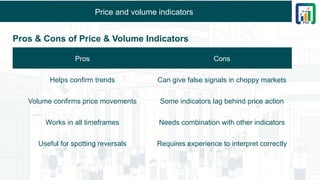
Pros & Cons of Price & Volume Indicators
Pros Cons
Helps confirm trends Can give false signals in choppy markets
Volume confirms price movements Some indicators lag behind price action
Works in all timeframes Needs combination with other indicators
Useful for spotting reversals Requires experience to interpret correctly
Price and volume indicators
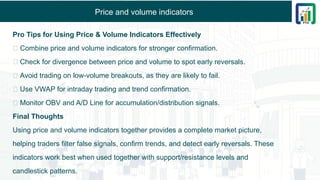
Pro Tips for Using Price & Volume Indicators Effectively
✅ Combine price and volume indicators for stronger confirmation.
✅ Check for divergence between price and volume to spot early reversals.
✅ Avoid trading on low-volume breakouts, as they are likely to fail.
✅ Use VWAP for intraday trading and trend confirmation.
✅ Monitor OBV and A/D Line for accumulation/distribution signals.
Final Thoughts
Using price and volume indicators together provides a complete market picture,
helping traders filter false signals, confirm trends, and detect early reversals. These
indicators work best when used together with support/resistance levels and
candlestick patterns.
Accumulation/Distribution (A/D) Line
Presented By :
This Content is Copyright Reserved Rights Copyright 2025@PTAIndia
Accumulation/Distribution (A/D) Line
Key Facts About the Accumulation/Distribution (A/D) Line
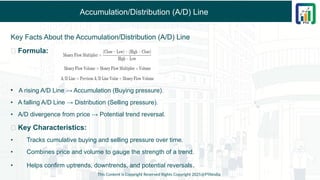
✅ Formula:
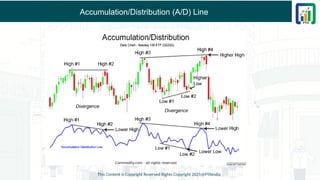
• A rising A/D Line → Accumulation (Buying pressure).
• A falling A/D Line → Distribution (Selling pressure).
• A/D divergence from price → Potential trend reversal.
✅ Key Characteristics:
• Tracks cumulative buying and selling pressure over time.
• Combines price and volume to gauge the strength of a trend.
• Helps confirm uptrends, downtrends, and potential reversals.
This Content is Copyright Reserved Rights Copyright 2025@PTAIndia
Accumulation/Distribution (A/D) Line
This Content is Copyright Reserved Rights Copyright 2025@PTAIndia
Accumulation/Distribution (A/D) Line
Key Facts About the Accumulation/Distribution (A/D) Line
✅ Formula:
• A rising A/D Line → Accumulation (Buying pressure).
• A falling A/D Line → Distribution (Selling pressure).
• A/D divergence from price → Potential trend reversal.
✅ Key Characteristics:
• Tracks cumulative buying and selling pressure over time.
• Combines price and volume to gauge the strength of a trend.
• Helps confirm uptrends, downtrends, and potential reversals.
This Content is Copyright Reserved Rights Copyright 2025@PTAIndia
Accumulation/Distribution (A/D) Line
Interpretation & Trading Signals
💡 Key Insight:
• A rising A/D Line suggests accumulation by smart money.
• A falling A/D Line suggests distribution and potential downtrend.
• Divergence between price and A/D can indicate an upcoming reversal.
This Content is Copyright Reserved Rights Copyright 2025@PTAIndia
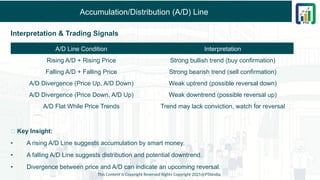
A/D Line Condition Interpretation
Rising A/D + Rising Price Strong bullish trend (buy confirmation)
Falling A/D + Falling Price Strong bearish trend (sell confirmation)
A/D Divergence (Price Up, A/D Down) Weak uptrend (possible reversal down)
A/D Divergence (Price Down, A/D Up) Weak downtrend (possible reversal up)
A/D Flat While Price Trends Trend may lack conviction, watch for reversal
Accumulation/Distribution (A/D) Line
Pro Tips for Using the A/D Line Effectively
✅ Combine A/D Line with trend indicators → Moving Averages, MACD, or RSI for stronger
signals.
✅ Look for A/D leading price → If A/D moves before price, a trend change is likely coming.
✅ Avoid using A/D in isolation → Use it with support/resistance levels or other technical
indicators.
✅ Divergence is powerful → If A/D diverges from price, be cautious of trend continuation.
✅ Check for A/D confirmation on breakouts → A breakout on low volume is more likely to fail.
Final Thoughts
The Accumulation/Distribution (A/D) Line is a powerful tool for identifying buying and selling
pressure, making it useful for trend confirmation and early reversal detection. It works best
when combined with other technical indicators and price action analysis.
This Content is Copyright Reserved Rights Copyright 2025@PTAIndia
Money Flow Index (MFI)
Presented By :
This Content is Copyright Reserved Rights Copyright 2025@PTAIndia
Money Flow Index (MFI)
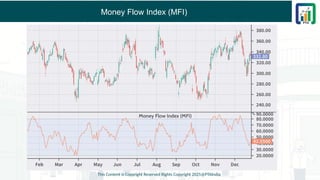
The Money Flow Index (MFI) is a volume-weighted momentum indicator that measures buying and
selling pressure by combining price and volume. It is similar to the Relative Strength Index (RSI) but
incorporates volume data, making it a stronger confirmation tool for overbought and oversold
conditions.
✅ Interpretation:
• MFI above 80 → Overbought (possible reversal down).
• MFI below 20 → Oversold (possible reversal up).
• MFI Divergence with Price → Trend may be weakening.
• MFI above 50 → Buying pressure is stronger.
• MFI below 50 → Selling pressure is stronger.
This Content is Copyright Reserved Rights Copyright 2025@PTAIndia
Money Flow Index (MFI)
This Content is Copyright Reserved Rights Copyright 2025@PTAIndia
Money Flow Index (MFI)
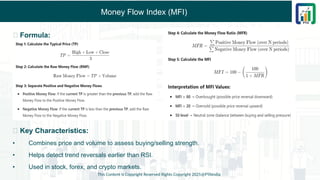
✅ Formula:
✅ Key Characteristics:
• Combines price and volume to assess buying/selling strength.
• Helps detect trend reversals earlier than RSI.
• Used in stock, forex, and crypto markets.
This Content is Copyright Reserved Rights Copyright 2025@PTAIndia
Money Flow Index (MFI)
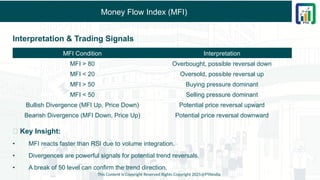
Interpretation & Trading Signals
💡 Key Insight:
• MFI reacts faster than RSI due to volume integration.
• Divergences are powerful signals for potential trend reversals.
• A break of 50 level can confirm the trend direction.
This Content is Copyright Reserved Rights Copyright 2025@PTAIndia
MFI Condition Interpretation
MFI > 80 Overbought, possible reversal down
MFI < 20 Oversold, possible reversal up
MFI > 50 Buying pressure dominant
MFI < 50 Selling pressure dominant
Bullish Divergence (MFI Up, Price Down) Potential price reversal upward
Bearish Divergence (MFI Down, Price Up) Potential price reversal downward
Money Flow Index (MFI)
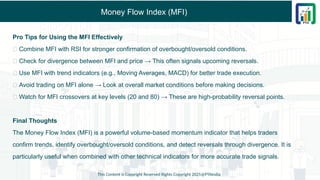
Pro Tips for Using the MFI Effectively
✅ Combine MFI with RSI for stronger confirmation of overbought/oversold conditions.
✅ Check for divergence between MFI and price → This often signals upcoming reversals.
✅ Use MFI with trend indicators (e.g., Moving Averages, MACD) for better trade execution.
✅ Avoid trading on MFI alone → Look at overall market conditions before making decisions.
✅ Watch for MFI crossovers at key levels (20 and 80) → These are high-probability reversal points.
Final Thoughts
The Money Flow Index (MFI) is a powerful volume-based momentum indicator that helps traders
confirm trends, identify overbought/oversold conditions, and detect reversals through divergence. It is
particularly useful when combined with other technical indicators for more accurate trade signals.
This Content is Copyright Reserved Rights Copyright 2025@PTAIndia
Normalized Indicator Construction
Presented By :
This Content is Copyright Reserved Rights Copyright 2025@PTAIndia
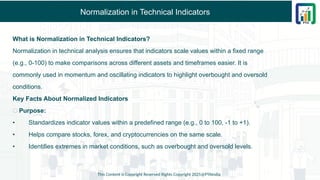
Normalization in Technical Indicators
What is Normalization in Technical Indicators?
Normalization in technical analysis ensures that indicators scale values within a fixed range
(e.g., 0-100) to make comparisons across different assets and timeframes easier. It is
commonly used in momentum and oscillating indicators to highlight overbought and oversold
conditions.
Key Facts About Normalized Indicators
✅ Purpose:
• Standardizes indicator values within a predefined range (e.g., 0 to 100, -1 to +1).
• Helps compare stocks, forex, and cryptocurrencies on the same scale.
• Identifies extremes in market conditions, such as overbought and oversold levels.
This Content is Copyright Reserved Rights Copyright 2025@PTAIndia
Normalization in Technical Indicators
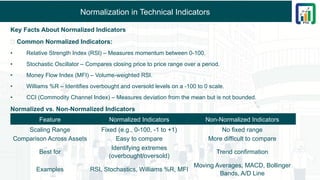
Key Facts About Normalized Indicators
✅ Common Normalized Indicators:
• Relative Strength Index (RSI) – Measures momentum between 0-100.
• Stochastic Oscillator – Compares closing price to price range over a period.
• Money Flow Index (MFI) – Volume-weighted RSI.
• Williams %R – Identifies overbought and oversold levels on a -100 to 0 scale.
• CCI (Commodity Channel Index) – Measures deviation from the mean but is not bounded.
Normalized vs. Non-Normalized Indicators
Feature Normalized Indicators Non-Normalized Indicators
Scaling Range Fixed (e.g., 0-100, -1 to +1) No fixed range
Comparison Across Assets Easy to compare More difficult to compare
Best for
Identifying extremes
(overbought/oversold)
Trend confirmation
Examples RSI, Stochastics, Williams %R, MFI
Moving Averages, MACD, Bollinger
Bands, A/D Line
Normalization in Technical Indicators
Interpretation & Trading Signals
💡 Key Insight:
• Normalization allows traders to use a universal approach to different markets.
• Breakouts confirmed by normalized indicators are stronger signals.
• Using multiple normalized indicators together improves accuracy.
This Content is Copyright Reserved Rights Copyright 2025@PTAIndia
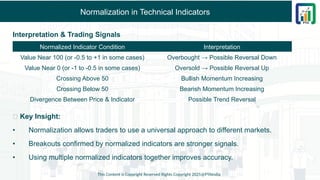
Normalized Indicator Condition Interpretation
Value Near 100 (or -0.5 to +1 in some cases) Overbought → Possible Reversal Down
Value Near 0 (or -1 to -0.5 in some cases) Oversold → Possible Reversal Up
Crossing Above 50 Bullish Momentum Increasing
Crossing Below 50 Bearish Momentum Increasing
Divergence Between Price & Indicator Possible Trend Reversal
Normalization in Technical Indicators
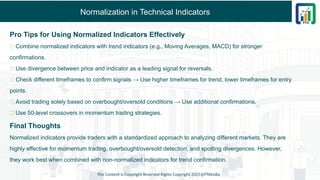
Pro Tips for Using Normalized Indicators Effectively
✅ Combine normalized indicators with trend indicators (e.g., Moving Averages, MACD) for stronger
confirmations.
✅ Use divergence between price and indicator as a leading signal for reversals.
✅ Check different timeframes to confirm signals → Use higher timeframes for trend, lower timeframes for entry
points.
✅ Avoid trading solely based on overbought/oversold conditions → Use additional confirmations.
✅ Use 50-level crossovers in momentum trading strategies.
Final Thoughts
Normalized indicators provide traders with a standardized approach to analyzing different markets. They are
highly effective for momentum trading, overbought/oversold detection, and spotting divergences. However,
they work best when combined with non-normalized indicators for trend confirmation.
This Content is Copyright Reserved Rights Copyright 2025@PTAIndia
Percentage Price Oscillator (PPO)
Presented By :
This Content is Copyright Reserved Rights Copyright 2025@PTAIndia
Percentage Price Oscillator (PPO)
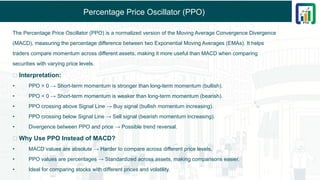
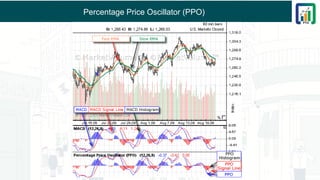
The Percentage Price Oscillator (PPO) is a normalized version of the Moving Average Convergence Divergence
(MACD), measuring the percentage difference between two Exponential Moving Averages (EMAs). It helps
traders compare momentum across different assets, making it more useful than MACD when comparing
securities with varying price levels.
✅ Interpretation:
• PPO > 0 → Short-term momentum is stronger than long-term momentum (bullish).
• PPO < 0 → Short-term momentum is weaker than long-term momentum (bearish).
• PPO crossing above Signal Line → Buy signal (bullish momentum increasing).
• PPO crossing below Signal Line → Sell signal (bearish momentum increasing).
• Divergence between PPO and price → Possible trend reversal.
✅ Why Use PPO Instead of MACD?
• MACD values are absolute → Harder to compare across different price levels.
• PPO values are percentages → Standardized across assets, making comparisons easier.
• Ideal for comparing stocks with different prices and volatility.
Percentage Price Oscillator (PPO)
Interpretation & Trading Signals
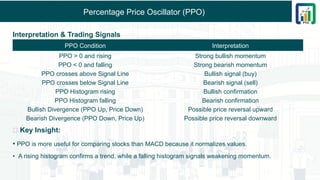
💡 Key Insight:
• PPO is more useful for comparing stocks than MACD because it normalizes values.
• A rising histogram confirms a trend, while a falling histogram signals weakening momentum.
PPO Condition Interpretation
PPO > 0 and rising Strong bullish momentum
PPO < 0 and falling Strong bearish momentum
PPO crosses above Signal Line Bullish signal (buy)
PPO crosses below Signal Line Bearish signal (sell)
PPO Histogram rising Bullish confirmation
PPO Histogram falling Bearish confirmation
Bullish Divergence (PPO Up, Price Down) Possible price reversal upward
Bearish Divergence (PPO Down, Price Up) Possible price reversal downward
Percentage Price Oscillator (PPO)
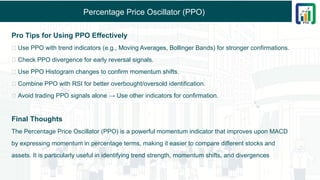
Pro Tips for Using PPO Effectively
✅ Use PPO with trend indicators (e.g., Moving Averages, Bollinger Bands) for stronger confirmations.
✅ Check PPO divergence for early reversal signals.
✅ Use PPO Histogram changes to confirm momentum shifts.
✅ Combine PPO with RSI for better overbought/oversold identification.
✅ Avoid trading PPO signals alone → Use other indicators for confirmation.
Final Thoughts
The Percentage Price Oscillator (PPO) is a powerful momentum indicator that improves upon MACD
by expressing momentum in percentage terms, making it easier to compare different stocks and
assets. It is particularly useful in identifying trend strength, momentum shifts, and divergences
Normalized Volume
Presented By :
This Content is Copyright Reserved Rights Copyright 2025@PTAIndia
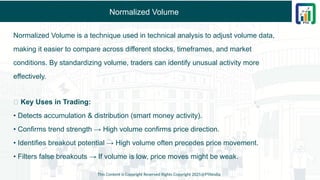
Normalized Volume
Normalized Volume is a technique used in technical analysis to adjust volume data,
making it easier to compare across different stocks, timeframes, and market
conditions. By standardizing volume, traders can identify unusual activity more
effectively.
✅ Key Uses in Trading:
• Detects accumulation & distribution (smart money activity).
• Confirms trend strength → High volume confirms price direction.
• Identifies breakout potential → High volume often precedes price movement.
• Filters false breakouts → If volume is low, price moves might be weak.
This Content is Copyright Reserved Rights Copyright 2025@PTAIndia
Normalized Volume
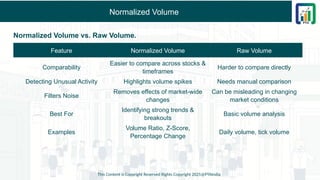
Normalized Volume vs. Raw Volume.
This Content is Copyright Reserved Rights Copyright 2025@PTAIndia
Feature Normalized Volume Raw Volume
Comparability
Easier to compare across stocks &
timeframes
Harder to compare directly
Detecting Unusual Activity Highlights volume spikes Needs manual comparison
Filters Noise
Removes effects of market-wide
changes
Can be misleading in changing
market conditions
Best For
Identifying strong trends &
breakouts
Basic volume analysis
Examples
Volume Ratio, Z-Score,
Percentage Change
Daily volume, tick volume
Normalized Volume
Interpretation & Trading Signals
💡 Key Insight:
• Volume should confirm price moves → If price rises on high normalized volume, it’s a stronger bullish sign.
• Volume spikes without price change → Watch for potential breakouts or fake moves.
This Content is Copyright Reserved Rights Copyright 2025@PTAIndia
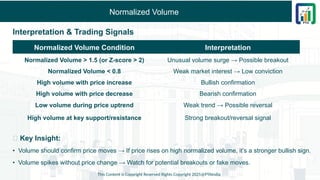
Normalized Volume Condition Interpretation
Normalized Volume > 1.5 (or Z-score > 2) Unusual volume surge → Possible breakout
Normalized Volume < 0.8 Weak market interest → Low conviction
High volume with price increase Bullish confirmation
High volume with price decrease Bearish confirmation
Low volume during price uptrend Weak trend → Possible reversal
High volume at key support/resistance Strong breakout/reversal signal
Normalized Volume
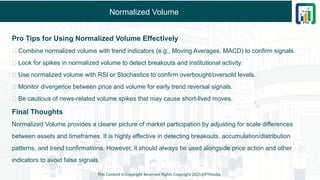
Pro Tips for Using Normalized Volume Effectively
✅ Combine normalized volume with trend indicators (e.g., Moving Averages, MACD) to confirm signals.
✅ Look for spikes in normalized volume to detect breakouts and institutional activity.
✅ Use normalized volume with RSI or Stochastics to confirm overbought/oversold levels.
✅ Monitor divergence between price and volume for early trend reversal signals.
✅ Be cautious of news-related volume spikes that may cause short-lived moves.
Final Thoughts
Normalized Volume provides a clearer picture of market participation by adjusting for scale differences
between assets and timeframes. It is highly effective in detecting breakouts, accumulation/distribution
patterns, and trend confirmations. However, it should always be used alongside price action and other
indicators to avoid false signals.
This Content is Copyright Reserved Rights Copyright 2025@PTAIndia
Trend Strength Indicator Construction
Presented By :
This Content is Copyright Reserved Rights Copyright 2025@PTAIndia
Trend Strength Indicators
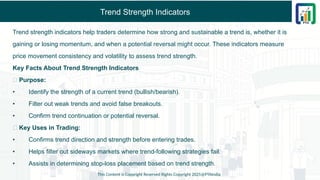
Trend strength indicators help traders determine how strong and sustainable a trend is, whether it is
gaining or losing momentum, and when a potential reversal might occur. These indicators measure
price movement consistency and volatility to assess trend strength.
Key Facts About Trend Strength Indicators
✅ Purpose:
• Identify the strength of a current trend (bullish/bearish).
• Filter out weak trends and avoid false breakouts.
• Confirm trend continuation or potential reversal.
✅ Key Uses in Trading:
• Confirms trend direction and strength before entering trades.
• Helps filter out sideways markets where trend-following strategies fail.
• Assists in determining stop-loss placement based on trend strength.
This Content is Copyright Reserved Rights Copyright 2025@PTAIndia
Trend Strength Indicators
Trend Strength Indicators Comparison
This Content is Copyright Reserved Rights Copyright 2025@PTAIndia
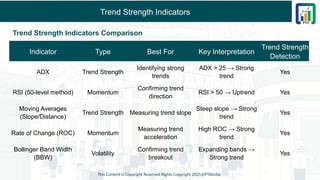
Indicator Type Best For Key Interpretation
Trend Strength
Detection
ADX Trend Strength
Identifying strong
trends
ADX > 25 → Strong
trend
Yes
RSI (50-level method) Momentum
Confirming trend
direction
RSI > 50 → Uptrend Yes
Moving Averages
(Slope/Distance)
Trend Strength Measuring trend slope
Steep slope → Strong
trend
Yes
Rate of Change (ROC) Momentum
Measuring trend
acceleration
High ROC → Strong
trend
Yes
Bollinger Band Width
(BBW)
Volatility
Confirming trend
breakout
Expanding bands →
Strong trend
Yes
Trend Strength Indicators
Interpretation & Trading Signals
💡 Key Insight:
Stronger trends = More reliable breakouts and price moves.
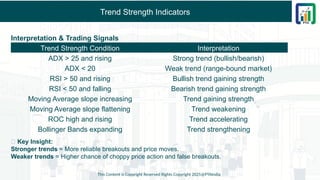
Weaker trends = Higher chance of choppy price action and false breakouts.
This Content is Copyright Reserved Rights Copyright 2025@PTAIndia
Trend Strength Condition Interpretation
ADX > 25 and rising Strong trend (bullish/bearish)
ADX < 20 Weak trend (range-bound market)
RSI > 50 and rising Bullish trend gaining strength
RSI < 50 and falling Bearish trend gaining strength
Moving Average slope increasing Trend gaining strength
Moving Average slope flattening Trend weakening
ROC high and rising Trend accelerating
Bollinger Bands expanding Trend strengthening
Trend Strength Indicators
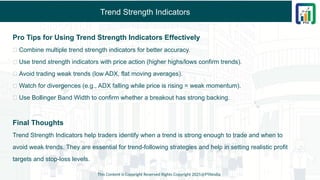
Pro Tips for Using Trend Strength Indicators Effectively
✅ Combine multiple trend strength indicators for better accuracy.
✅ Use trend strength indicators with price action (higher highs/lows confirm trends).
✅ Avoid trading weak trends (low ADX, flat moving averages).
✅ Watch for divergences (e.g., ADX falling while price is rising = weak momentum).
✅ Use Bollinger Band Width to confirm whether a breakout has strong backing.
Final Thoughts
Trend Strength Indicators help traders identify when a trend is strong enough to trade and when to
avoid weak trends. They are essential for trend-following strategies and help in setting realistic profit
targets and stop-loss levels.
This Content is Copyright Reserved Rights Copyright 2025@PTAIndia
Directional Movement Indicator (DMI)
Presented By :
This Content is Copyright Reserved Rights Copyright 2025@PTAIndia
Directional Movement Indicator (DMI)
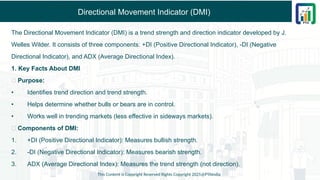
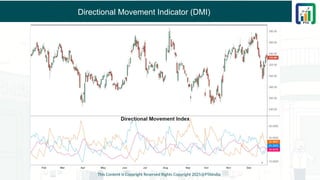
The Directional Movement Indicator (DMI) is a trend strength and direction indicator developed by J.
Welles Wilder. It consists of three components: +DI (Positive Directional Indicator), -DI (Negative
Directional Indicator), and ADX (Average Directional Index).
1. Key Facts About DMI
✅ Purpose:
• Identifies trend direction and trend strength.
• Helps determine whether bulls or bears are in control.
• Works well in trending markets (less effective in sideways markets).
✅ Components of DMI:
1. +DI (Positive Directional Indicator): Measures bullish strength.
2. -DI (Negative Directional Indicator): Measures bearish strength.
3. ADX (Average Directional Index): Measures the trend strength (not direction).
This Content is Copyright Reserved Rights Copyright 2025@PTAIndia
Directional Movement Indicator (DMI)
This Content is Copyright Reserved Rights Copyright 2025@PTAIndia
Directional Movement Indicator (DMI)
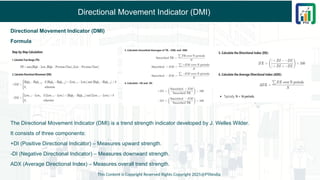
Formula
The Directional Movement Indicator (DMI) is a trend strength indicator developed by J. Welles Wilder.
It consists of three components:
+DI (Positive Directional Indicator) – Measures upward strength.
-DI (Negative Directional Indicator) – Measures downward strength.
ADX (Average Directional Index) – Measures overall trend strength.
This Content is Copyright Reserved Rights Copyright 2025@PTAIndia
Directional Movement Indicator (DMI)
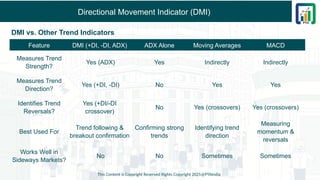
DMI vs. Other Trend Indicators
This Content is Copyright Reserved Rights Copyright 2025@PTAIndia
Feature DMI (+DI, -DI, ADX) ADX Alone Moving Averages MACD
Measures Trend
Strength?
Yes (ADX) Yes Indirectly Indirectly
Measures Trend
Direction?
Yes (+DI, -DI) No Yes Yes
Identifies Trend
Reversals?
Yes (+DI/-DI
crossover)
No Yes (crossovers) Yes (crossovers)
Best Used For
Trend following &
breakout confirmation
Confirming strong
trends
Identifying trend
direction
Measuring
momentum &
reversals
Works Well in
Sideways Markets?
No No Sometimes Sometimes
Directional Movement Indicator (DMI)
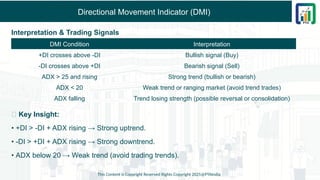
Interpretation & Trading Signals
💡 Key Insight:
• +DI > -DI + ADX rising → Strong uptrend.
• -DI > +DI + ADX rising → Strong downtrend.
• ADX below 20 → Weak trend (avoid trading trends).
This Content is Copyright Reserved Rights Copyright 2025@PTAIndia
DMI Condition Interpretation
+DI crosses above -DI Bullish signal (Buy)
-DI crosses above +DI Bearish signal (Sell)
ADX > 25 and rising Strong trend (bullish or bearish)
ADX < 20 Weak trend or ranging market (avoid trend trades)
ADX falling Trend losing strength (possible reversal or consolidation)
Directional Movement Indicator (DMI)
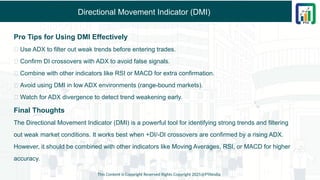
Pro Tips for Using DMI Effectively
✅ Use ADX to filter out weak trends before entering trades.
✅ Confirm DI crossovers with ADX to avoid false signals.
✅ Combine with other indicators like RSI or MACD for extra confirmation.
✅ Avoid using DMI in low ADX environments (range-bound markets).
✅ Watch for ADX divergence to detect trend weakening early.
Final Thoughts
The Directional Movement Indicator (DMI) is a powerful tool for identifying strong trends and filtering
out weak market conditions. It works best when +DI/-DI crossovers are confirmed by a rising ADX.
However, it should be combined with other indicators like Moving Averages, RSI, or MACD for higher
accuracy.
This Content is Copyright Reserved Rights Copyright 2025@PTAIndia
Average Directional Index (ADX)
Presented By :
This Content is Copyright Reserved Rights Copyright 2025@PTAIndia
Average Directional Index (ADX)
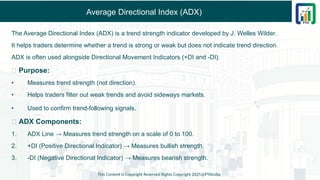
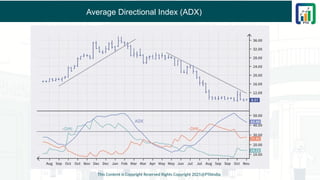
The Average Directional Index (ADX) is a trend strength indicator developed by J. Welles Wilder.
It helps traders determine whether a trend is strong or weak but does not indicate trend direction.
ADX is often used alongside Directional Movement Indicators (+DI and -DI).
✅ Purpose:
• Measures trend strength (not direction).
• Helps traders filter out weak trends and avoid sideways markets.
• Used to confirm trend-following signals.
✅ ADX Components:
1. ADX Line → Measures trend strength on a scale of 0 to 100.
2. +DI (Positive Directional Indicator) → Measures bullish strength.
3. -DI (Negative Directional Indicator) → Measures bearish strength.
This Content is Copyright Reserved Rights Copyright 2025@PTAIndia
Average Directional Index (ADX)
This Content is Copyright Reserved Rights Copyright 2025@PTAIndia
Average Directional Index (ADX)
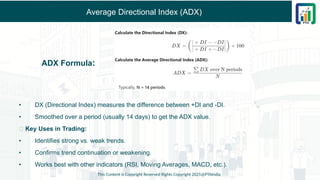
• DX (Directional Index) measures the difference between +DI and -DI.
• Smoothed over a period (usually 14 days) to get the ADX value.
✅ Key Uses in Trading:
• Identifies strong vs. weak trends.
• Confirms trend continuation or weakening.
• Works best with other indicators (RSI, Moving Averages, MACD, etc.).
This Content is Copyright Reserved Rights Copyright 2025@PTAIndia
ADX Formula:
Average Directional Index (ADX)
Interpretation & Trading Signals
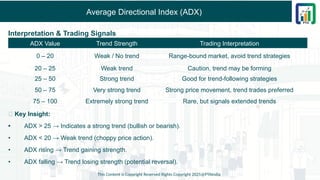
💡 Key Insight:
• ADX > 25 → Indicates a strong trend (bullish or bearish).
• ADX < 20 → Weak trend (choppy price action).
• ADX rising → Trend gaining strength.
• ADX falling → Trend losing strength (potential reversal).
This Content is Copyright Reserved Rights Copyright 2025@PTAIndia
ADX Value Trend Strength Trading Interpretation
0 – 20 Weak / No trend Range-bound market, avoid trend strategies
20 – 25 Weak trend Caution, trend may be forming
25 – 50 Strong trend Good for trend-following strategies
50 – 75 Very strong trend Strong price movement, trend trades preferred
75 – 100 Extremely strong trend Rare, but signals extended trends
Average Directional Index (ADX)
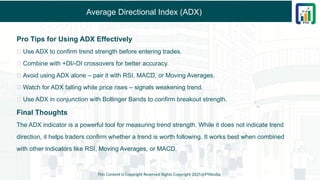
Pro Tips for Using ADX Effectively
✅ Use ADX to confirm trend strength before entering trades.
✅ Combine with +DI/-DI crossovers for better accuracy.
✅ Avoid using ADX alone – pair it with RSI, MACD, or Moving Averages.
✅ Watch for ADX falling while price rises – signals weakening trend.
✅ Use ADX in conjunction with Bollinger Bands to confirm breakout strength.
Final Thoughts
The ADX indicator is a powerful tool for measuring trend strength. While it does not indicate trend
direction, it helps traders confirm whether a trend is worth following. It works best when combined
with other indicators like RSI, Moving Averages, or MACD.
This Content is Copyright Reserved Rights Copyright 2025@PTAIndia
Next Chapter 3 - Introduction to Bollinger Bands
Section 5 – Technical Indicators
Presented By :
This Content is Copyright Reserved Rights Copyright 2025@PTAIndia

Section 5 - Chapter 2 - Technical Indicator Construction

  • 1.
    Chapter 2 -Technical Indicator Construction Section 5 – Technical Indicators Presented By : This Content is Copyright Reserved Rights Copyright 2025@PTAIndia
  • 2.
    Agenda  Explain whata technical indicator is?  Describe the two general categories of indicators  Contrast various momentum indicators  Summarize various volume indicators  Discuss indicators that use price and volume  Describe the three plots of the Directional Movement Index (DMI)  Express the DMI’s general interpretation  Outline the DMI’s uses This Content is Copyright Reserved Rights Copyright 2025@PTAIndia
  • 3.
    Technical Momentum Presented By: This Content is Copyright Reserved Rights Copyright 2025@PTAIndia
  • 4.
    Technical Momentum 1. KeyFacts About Momentum • Momentum = Price Velocity → Measures how quickly the price is rising or falling. • Momentum Indicators → Used to confirm trends, signal reversals, and detect overbought/oversold conditions. • Works Best in Trending Markets → Loses effectiveness in sideways/choppy markets. • Divergence Matters → If momentum weakens while price continues in the same direction, a reversal may be near. • Lagging vs. Leading Indicators o Momentum Indicators (e.g., MACD, RSI) are often lagging. o Rate of Change (ROC), Stochastic Oscillator can be more leading in nature. This Content is Copyright Reserved Rights Copyright 2025@PTAIndia
  • 5.
    Technical Momentum Momentum, asa simple measure that market technicians use, is the difference between two prices. Momentum = Current Price − Price n Periods Ago For example, if the current price is $15 and the price 10 days ago was $10, the momentum value is $5. Price changed positively by $5 over the previous 10 periods. In finance, price change is often considered in percentage terms, so it is helpful to normalize the equation. This is called the rate of change (ROC) or percentage change formula: Using the same example, the ROC for the current price of $15 and $10 as the price 10 days ago is a positive change of 50%. This Content is Copyright Reserved Rights Copyright 2025@PTAIndia
  • 6.
    Popular Momentum Indicators ThisContent is Copyright Reserved Rights Copyright 2025@PTAIndia Indicator Purpose Formula Interpretation Relative Strength Index (RSI) Measures overbought/oversold conditions RSI = 100 - [100 / (1 + RS)] where RS = Avg. gains / Avg. losses RSI > 70 → Overbought, RSI < 30 → Oversold Moving Average Convergence Divergence (MACD) Identifies trend direction & reversals MACD = (12 EMA - 26 EMA), Signal = 9 EMA of MACD MACD > Signal → Bullish, MACD < Signal → Bearish Stochastic Oscillator Measures price relative to range %K = [(C - L14) / (H14 - L14)] × 100, %D = 3-day SMA of %K %K above 80 → Overbought, Below 20 → Oversold Rate of Change (ROC) Measures speed of price change ROC = [(Current Price - Price N periods ago) / Price N periods ago] × 100 Rising ROC → Strong Momentum, Falling ROC → Weak Momentum Commodity Channel Index (CCI) Identifies cyclical trends CCI = (Typical Price - SMA) / (0.015 × Mean Deviation) CCI > 100 → Overbought, CCI < -100 → Oversold Williams %R Measures price strength %R = [(H - C) / (H - L)] × -100 %R above -20 → Overbought, Below -80 → Oversold
  • 7.
    Comparing Momentum Indicators ThisContent is Copyright Reserved Rights Copyright 2025@PTAIndia Aspect RSI MACD Stochastic ROC CCI Type Oscillator Trend & Momentum Oscillator Rate of Change Oscillator Best for Overbought/ Oversold Trend confirmation Overbought/ Oversold Price speed Trend Strength Overbought Signal Above 70 Above Signal Line Above 80 High ROC Above 100 Oversold Signal Below 30 Below Signal Line Below 20 Low ROC Below -100 Divergence Use? Yes Yes Yes Yes Yes
  • 8.
    Technical Momentum Pro Tipsfor Using Momentum Indicators ✔ Combine Indicators → Use RSI with MACD or Stochastic for confirmation. ✔ Look for Divergence → If price and momentum don’t align, reversal may be near. ✔ Adjust Timeframes → Higher timeframes give stronger signals, lower timeframes are more noise-sensitive. ✔ Use with Volume → High volume + momentum breakout = Stronger confirmation. ✔ Test Strategies Before Live Trading → Back test before committing real money. Pros & Cons of Momentum Trading This Content is Copyright Reserved Rights Copyright 2025@PTAIndia Pros Cons Captures strong trends False signals in choppy markets Works well with other indicators Lagging nature can delay entries Helps confirm breakouts May require additional filters Useful in multiple timeframes Less effective in sideways markets
  • 9.
    Rate of Change(ROC) Presented By : This Content is Copyright Reserved Rights Copyright 2025@PTAIndia
  • 10.
    Rate Of Changes(ROC) 1. Key Facts About Rate of Change (ROC) ✅ Measures Momentum → It calculates how fast a stock or asset price is changing. ✅ Formula: ✅ Zero-Line as Reference: • Positive ROC (> 0): Indicates upward momentum (bullish). • Negative ROC (< 0): Indicates downward momentum (bearish). ✅ Volatility Sensitivity: More volatile in shorter timeframes. ✅ Divergence Can Indicate Reversals: If ROC is declining while price rises, momentum is weakening. ✅ Best Used With Other Indicators: Combine with moving averages, RSI, or MACD for confirmation. This Content is Copyright Reserved Rights Copyright 2025@PTAIndia
  • 11.
    Rate Of Changes(ROC) This Content is Copyright Reserved Rights Copyright 2025@PTAIndia
  • 12.
    ROC Indicator QuickComparison This Content is Copyright Reserved Rights Copyright 2025@PTAIndia Indicator ROC RSI MACD Stochastic Oscillator Measures Price speed & direction Overbought/Oversold Trend strength & crossovers Price relative to range Formula Percentage change in price over time Relative strength of gains/losses Difference between two EMAs % of price within recent high-low range Best for Confirming trends & breakouts Mean reversion & trend strength Identifying trend shifts Overbought/Oversold signals Zero Line? Yes (0) No Yes (0) No Overbought/Oversold? No clear level RSI > 70 (overbought), < 30 (oversold) No Above 80 (overbought), Below 20 (oversold)
  • 13.
    How to InterpretROC Signals This Content is Copyright Reserved Rights Copyright 2025@PTAIndia ROC Movement Interpretation ROC > 0 & Rising Strong bullish momentum (price increasing quickly) ROC < 0 & Falling Strong bearish momentum (price decreasing quickly) ROC Peaks & Falls While Price Rises Bearish divergence, potential reversal ROC Bottoms & Rises While Price Falls Bullish divergence, potential reversal ROC Around Zero Weak momentum, sideways market Pros Cons Simple and easy to calculate No overbought/oversold levels Identifies trend strength and direction Can be volatile in short-term periods Helps confirm breakouts & trends Prone to false signals in sideways markets Useful for divergence analysis Needs confirmation from other indicators Pros & Cons of Using ROC
  • 14.
    Rate Of Changes(ROC) Pro Tips for Using ROC Effectively ✅ Use with Trend Indicators → Combine with Moving Averages, MACD, or RSI for confirmation. ✅ Avoid Short Timeframes → Longer periods (e.g., ROC(14) or ROC(25)) reduce noise. ✅ Look for Divergence → If price and ROC are moving in opposite directions, expect a reversal. ✅ Volume Matters → Strong ROC moves with high volume = stronger signal. ✅ Zero Line Crossovers Are Key → A move above/below zero signals momentum shift. This Content is Copyright Reserved Rights Copyright 2025@PTAIndia
  • 15.
    Moving Average ConvergenceDivergence (MACD) Presented By : This Content is Copyright Reserved Rights Copyright 2025@PTAIndia
  • 16.
    Moving Average ConvergenceDivergence (MACD) 1. Key Facts About MACD ✅ MACD = (12-period EMA - 26-period EMA) → Measures trend momentum. ✅ Signal Line = 9-period EMA of MACD → Helps confirm buy/sell signals. ✅ Zero Line as Reference: • MACD > 0: Bullish momentum. • MACD < 0: Bearish momentum. ✅ Divergence is Important → When price moves in the opposite direction of MACD, a reversal may occur. ✅ Histogram Represents Strength → Distance between MACD & Signal Line. This Content is Copyright Reserved Rights Copyright 2025@PTAIndia
  • 17.
    Moving Average ConvergenceDivergence (MACD) This Content is Copyright Reserved Rights Copyright 2025@PTAIndia
  • 18.
    Moving Average ConvergenceDivergence (MACD) MACD Indicator Breakdown This Content is Copyright Reserved Rights Copyright 2025@PTAIndia Component Formula/Definition Interpretation MACD Line (12-EMA - 26-EMA) Positive MACD → Bullish, Negative MACD → Bearish Signal Line 9-EMA of MACD Crossing MACD gives buy/sell signals Histogram MACD Line - Signal Line Expanding histogram = Strong trend, Contracting = Weak trend Zero Line Baseline at 0 Above = Bullish, Below = Bearish MACD Indicator Breakdown MACD Signal Interpretation MACD > 0 & Rising Strong bullish trend MACD < 0 & Falling Strong bearish trend MACD Crossover Above Signal Buy signal (bullish) MACD Crossover Below Signal Sell signal (bearish) Histogram Expanding Strengthening trend Histogram Contracting Weakening trend Divergence Between Price & MACD Possible trend reversal
  • 19.
    Moving Average ConvergenceDivergence (MACD) Pros & Cons of MACD Pro Tips for Using MACD Effectively ✅ Use with RSI or Stochastic → MACD confirms trend, RSI/Stochastic confirms overbought/oversold. ✅ Look for Strong Histogram Expansions → Bigger histogram = stronger momentum. ✅ Avoid Using MACD Alone → Combine with moving averages for trend confirmation. ✅ Adjust Timeframes → Shorter EMAs (e.g., 5 & 20) for day trading, standard (12 & 26) for swing trading. ✅ Check Volume Alongside MACD → High volume with MACD crossover = stronger confirmation. This Content is Copyright Reserved Rights Copyright 2025@PTAIndia Pros Cons Works in trending markets Can give false signals in sideways markets Useful for trend confirmation Lags behind price action Easy to understand crossovers Doesn't provide overbought/oversold signals Effective in combination with other indicators Needs additional confirmation tools
  • 20.
    Relative Strength Index(RSI) Presented By : This Content is Copyright Reserved Rights Copyright 2025@PTAIndia
  • 21.
    Relative Strength Index(RSI) 1. Key Facts About RSI ✅ RSI Formula: RSI=100−(1+RS100) Where RS (Relative Strength) = Average Gain / Average Loss over a given period (default = 14). ✅ Range: RSI fluctuates between 0 and 100. ✅ Key Levels: • Above 70 → Overbought (potential reversal downward). • Below 30 → Oversold (potential reversal upward). This Content is Copyright Reserved Rights Copyright 2025@PTAIndia
  • 22.
    Relative Strength Index(RSI) This Content is Copyright Reserved Rights Copyright 2025@PTAIndia
  • 23.
    Relative Strength Index(RSI) ✅ 50 Level as Trend Indicator: • RSI > 50 → Bullish trend. • RSI < 50 → Bearish trend. ✅ Divergence Matters: • Bullish Divergence: Price makes a lower low, but RSI makes a higher low → Potential upward reversal. • Bearish Divergence: Price makes a higher high, but RSI makes a lower high → Potential downward reversal. This Content is Copyright Reserved Rights Copyright 2025@PTAIndia
  • 24.
    Relative Strength Index(RSI) RSI Interpretation & Trading Signals This Content is Copyright Reserved Rights Copyright 2025@PTAIndia RSI Signal Interpretation RSI > 70 Overbought (possible reversal or pullback) RSI < 30 Oversold (possible reversal or bounce) RSI Crosses Above 50 Bullish confirmation RSI Crosses Below 50 Bearish confirmation Bullish Divergence (RSI Rising, Price Falling) Possible uptrend reversal Bearish Divergence (RSI Falling, Price Rising) Possible downtrend reversal
  • 25.
    Relative Strength Index(RSI) Pros & Cons of RSI This Content is Copyright Reserved Rights Copyright 2025@PTAIndia Pros Cons Identifies overbought & oversold conditions Can give false signals in strong trends Works in multiple timeframes RSI alone is not enough—needs confirmation Helps spot trend reversals with divergence Can stay overbought/oversold for extended periods Simple to use & widely available Less useful in highly volatile or erratic markets Pro Tips for Using RSI Effectively ✅ Combine RSI with MACD or Moving Averages → RSI shows momentum, MACD confirms trends. ✅ Use Divergence as a Strong Signal → Combine it with volume analysis. ✅ Adjust Timeframes for Better Accuracy →  RSI(14) = Standard setting (default).  RSI(7) = More sensitive for short-term traders.  RSI(21) = Smoother for long-term analysis. ✅ Avoid Trading Based Solely on 70/30 Levels → Look for confirmation from price action and other indicators. ✅ Check RSI Behavior in Different Market Conditions → Works best in ranging markets, needs filters in strong trends.
  • 26.
    Stochastic Oscillator Presented By: This Content is Copyright Reserved Rights Copyright 2025@PTAIndia
  • 27.
    Stochastic Oscillator The StochasticOscillator is a momentum indicator that compares a security's closing price to its price range over a specific period. It helps traders identify overbought and oversold conditions and potential reversals. Range: 0 to 100 ✅ Key Levels: • Above 80 → Overbought (potential downward reversal). • Below 20 → Oversold (potential upward reversal). ✅ Two Main Components: • %K Line → Fast-moving main line. • %D Line → Slower signal line (3-period moving average of %K). This Content is Copyright Reserved Rights Copyright 2025@PTAIndia
  • 28.
    Stochastic Oscillator This Contentis Copyright Reserved Rights Copyright 2025@PTAIndia
  • 29.
    Stochastic Oscillator ✅ CrossoverSignals: • %K crossing above %D → Bullish signal. • %K crossing below %D → Bearish signal. ✅ Divergence Can Indicate Reversals: • Bullish Divergence: Price makes a lower low, Stochastic makes a higher low → Possible uptrend. • Bearish Divergence: Price makes a higher high, Stochastic makes a lower high → Possible downtrend. This Content is Copyright Reserved Rights Copyright 2025@PTAIndia
  • 30.
    Stochastic Oscillator ✅ StochasticOscillator Formula: This Content is Copyright Reserved Rights Copyright 2025@PTAIndia
  • 31.
    Stochastic Oscillator Stochastic Interpretation& Trading Signals This Content is Copyright Reserved Rights Copyright 2025@PTAIndia Stochastic Signal Interpretation %K > 80 Overbought (potential reversal down) %K < 20 Oversold (potential reversal up) %K Crosses Above %D Bullish signal (buy) %K Crosses Below %D Bearish signal (sell) Bullish Divergence (Price Falling, Stochastic Rising) Possible upward reversal Bearish Divergence (Price Rising, Stochastic Falling) Possible downward reversal
  • 32.
    Stochastic Oscillator Pros &Cons of Stochastic Oscillator This Content is Copyright Reserved Rights Copyright 2025@PTAIndia Pros Cons Excellent for detecting overbought/oversold levels Gives false signals in strong trends Works well in ranging markets Can stay overbought/oversold for a long time in trending markets Useful for divergence detection Needs confirmation from other indicators Provides early signals Less reliable in highly volatile markets
  • 33.
    Stochastic Oscillator Pros &Cons of Stochastic Oscillator This Content is Copyright Reserved Rights Copyright 2025@PTAIndia Pros Cons Excellent for detecting overbought/oversold levels Gives false signals in strong trends Works well in ranging markets Can stay overbought/oversold for a long time in trending markets Useful for divergence detection Needs confirmation from other indicators Provides early signals Less reliable in highly volatile markets
  • 34.
    Stochastic Oscillator Pro Tipsfor Using Stochastic Effectively ✅ Use with RSI or MACD → Stochastic signals overbought/oversold, RSI confirms strength, MACD confirms trend. ✅ Adjust Timeframes for Different Trading Styles: • Stochastic(14,3,3) = Standard setting. • Stochastic(5,3,3) = Faster signals (for short-term traders). • Stochastic(21,5,5) = Smoother signals (for long-term traders). ✅ Avoid Trading Against Strong Trends → In trending markets, overbought/oversold signals alone are not enough. ✅ Look for Crossovers Near 20 or 80 Levels → Stronger signals occur when crossovers happen in extreme zones. ✅ Use Divergence with Volume Analysis → If divergence is supported by increasing volume, the reversal is more likely. This Content is Copyright Reserved Rights Copyright 2025@PTAIndia
  • 35.
    Coppock Curve Presented By: This Content is Copyright Reserved Rights Copyright 2025@PTAIndia
  • 36.
    Coppock Curve This Contentis Copyright Reserved Rights Copyright 2025@PTAIndia Where: • ROC (Rate of Change) measures the percentage change in price over 14 & 11 months. • WMA (Weighted Moving Average) smooths out fluctuations over 10 months. The Coppock Indicator (Coppock Curve) is a long-term momentum indicator used to identify major market bottoms and buying opportunities in stock indices. It was developed by Edwin Coppock in 1962 and is mainly used for investing rather than trading, as it focuses on long-term trends.
  • 37.
    Coppock Curve This Contentis Copyright Reserved Rights Copyright 2025@PTAIndia
  • 38.
    Coppock Curve ✅ Purpose:Detects long-term buy signals after market downturns. ✅ Interpretation: • Above zero & rising → Bullish trend (Good time to buy). • Below zero & falling → Bearish trend (Wait for confirmation). ✅ No Sell Signals: The indicator was designed only for identifying buying opportunities, not for timing exits. This Content is Copyright Reserved Rights Copyright 2025@PTAIndia
  • 39.
    Coppock Curve 2. CoppockIndicator Interpretation & Trading Signals 💡 Key Insight: • A turn upward from below zero is the most reliable long-term buy signal. • A turn downward from above zero suggests slowing momentum, but does not signal a sell. This Content is Copyright Reserved Rights Copyright 2025@PTAIndia Coppock Signal Interpretation Curve below zero & turning upward Strong buy signal (bullish reversal) Curve above zero & rising Market in strong uptrend Curve above zero & flattening Momentum slowing (watch for weakness) Curve below zero & falling Market still bearish (wait for a turn)
  • 40.
    Coppock Curve 3. Coppockvs. Other Momentum Indicators This Content is Copyright Reserved Rights Copyright 2025@PTAIndia Indicator Coppock Curve MACD RSI Stochastic Type Long-term momentum Trend & momentum Overbought/Oversold Overbought/Oversold Best For Identifying major market bottoms Trend confirmation & reversals Short-term overbought/oversold Short-term reversals Timeframe Monthly (Long-term) Daily/Weekly Daily/Hourly Daily/Hourly Buy Signals? Yes (curve turns upward) Yes (MACD crossover) Yes (RSI < 30) Yes (Stochastic < 20) Sell Signals? No Yes (MACD crossover) Yes (RSI > 70) Yes (Stochastic > 80) Best For Investing in stock indices Trading & trend detection Swing trading Short-term trading
  • 41.
    Coppock Curve 4. Pros& Cons of the Coppock Curve This Content is Copyright Reserved Rights Copyright 2025@PTAIndia Pros Cons Excellent for identifying long-term market bottoms No sell signals (not useful for shorting) Eliminates short-term noise & false signals Best suited for stock indices, not individual stocks Simple to interpret Not useful for short-term trading Works best for long-term investors Requires patience—signals take months to form
  • 42.
    Coppock Curve 5. ProTips for Using the Coppock Curve Effectively ✅ Best Used for Index Investing → Works well for major indices like S&P 500, Dow Jones, Nasdaq. ✅ Combine with Trend Filters → Use moving averages (e.g., 200-day MA) to confirm long-term trends. ✅ Avoid Using for Short-Term Trading → Coppock is designed for months to years, not for daily trades. ✅ Pair with Other Indicators for Sell Signals → Use MACD crossovers or RSI overbought levels to time exits. ✅ Don’t Buy on Every Dip → Wait for the curve to turn up from below zero before entering a position. Final Thoughts The Coppock Curve is a powerful tool for long-term investors looking to buy at major market bottoms. While it doesn’t provide sell signals, it works well when combined with trend-following indicators like moving averages or MACD. This Content is Copyright Reserved Rights Copyright 2025@PTAIndia
  • 43.
    Volume Indicators Presented By: This Content is Copyright Reserved Rights Copyright 2025@PTAIndia
  • 44.
    Volume Indicators 1. KeyFacts About Volume Indicators Volume Indicators Volume Indicators measure the number of shares or contracts traded in a given period, providing insight into market strength, trends, and potential reversals. High volume confirms trends, while low volume signals weakness. ✅ Basic Interpretation: • Increasing Volume + Rising Price → Strong bullish trend (Buy confirmation). • Increasing Volume + Falling Price → Strong bearish trend (Sell confirmation). • Decreasing Volume + Rising Price → Weak uptrend (Possible reversal down). • Decreasing Volume + Falling Price → Weak downtrend (Possible reversal up). This Content is Copyright Reserved Rights Copyright 2025@PTAIndia
  • 45.
    Volume Indicators ✅ CommonVolume Indicators: • On-Balance Volume (OBV) – Measures buying vs. selling pressure. • Volume Weighted Average Price (VWAP) – Tracks the average price based on volume. • Accumulation/Distribution (A/D) Line – Identifies buying or selling strength. • Chaikin Money Flow (CMF) – Measures buying and selling pressure over time. • Money Flow Index (MFI) – RSI-like indicator that includes volume. • Ease of Movement (EMV) – Measures price movement relative to volume.
  • 46.
    Volume Indicators Indicator TypeBest For Key Interpretation Best Timeframe On-Balance Volume (OBV) Cumulative Volume Identifying Buying/Selling Pressure Rising OBV = Buying Pressure, Falling OBV = Selling Pressure Daily, Weekly VWAP (Volume Weighted Average Price) Volume-Based Average Institutional Trading, Day Trading Price above VWAP = Bullish, Price below VWAP = Bearish Intraday Accumulation/ Distribution (A/D) Line Trend Confirmation Measuring Strength of Trends Upward A/D = Accumulation, Downward A/D = Distribution Daily, Weekly Chaikin Money Flow (CMF) Momentum Identifying Bullish/Bearish Momentum Positive CMF = Bullish, Negative CMF = Bearish Daily Money Flow Index (MFI) Volume-Based RSI Overbought/Oversold Conditions MFI > 80 = Overbought, MFI < 20 = Oversold Daily, Weekly Ease of Movement (EMV) Price-Volume Relationship Measuring Trend Strength High EMV = Easy price movement, Low EMV = Struggle to move Daily
  • 47.
    Volume Indicators ✅ VolumeIndicator Interpretations & Trading Signals Volume Condition Interpretation High Volume + Uptrend Strong bullish confirmation High Volume + Downtrend Strong bearish confirmation Low Volume + Uptrend Weak uptrend (watch for reversal) Low Volume + Downtrend Weak downtrend (possible reversal) Volume Spike + Price Breakout Strong trend continuation Divergence (Price Up, Volume Down) Weak trend (possible reversal)
  • 48.
    Volume Indicators 5. Pros& Cons of Volume Indicators Pros Cons Confirms price trends Needs context (price action, trend strength) Helps detect strong breakouts & reversals Can be misleading in low-liquidity markets Works well with technical indicators like MACD, RSI Volume spikes can be due to news, not trend confirmation Useful in all timeframes Requires experience to interpret properly
  • 49.
    Volume Indicators 6. ProTips for Using Volume Indicators Effectively ✅ Use volume in combination with trend indicators → Confirm price trends with MACD, RSI, or Moving Averages. ✅ Look for volume spikes at key levels → Support, resistance, and breakouts should be backed by high volume. ✅ Avoid trading low-volume breakouts → False breakouts often happen on weak volume. ✅ Check volume divergence for early trend reversals → If volume weakens while price moves in a trend, a reversal might be near. ✅ VWAP is powerful for intraday trading → Helps day traders determine if the market is bullish or bearish. Final Thoughts Volume indicators are essential tools for confirming trends, detecting reversals, and filtering out false signals. They work best when combined with price action and other technical indicators.
  • 50.
    On-Balance Volume (OBV) PresentedBy : This Content is Copyright Reserved Rights Copyright 2025@PTAIndia
  • 51.
    On-Balance Volume (OBV) ThisContent is Copyright Reserved Rights Copyright 2025@PTAIndia ✅ Concept:  Rising OBV → Buying pressure (bullish signal)  Falling OBV → Selling pressure (bearish signal)  OBV diverging from price → Potential trend reversal ✅ Key Characteristics:  Leading Indicator → OBV often moves before price changes.  Trend Confirmation → Rising OBV confirms uptrends; falling OBV confirms downtrends.  Divergence Detection → If price moves one way but OBV moves the other, a reversal may be coming.
  • 52.
    On-Balance Volume (OBV) ThisContent is Copyright Reserved Rights Copyright 2025@PTAIndia
  • 53.
    On-Balance Volume (OBV) OBVInterpretation & Trading Signals 💡 Key Insight: • A rising OBV suggests smart money accumulation. • A falling OBV suggests distribution (selling pressure). • If OBV leads price, a breakout or breakdown is likely coming. This Content is Copyright Reserved Rights Copyright 2025@PTAIndia OBV Condition Interpretation Rising OBV + Rising Price Strong bullish trend (buy confirmation) Falling OBV + Falling Price Strong bearish trend (sell confirmation) OBV Divergence (Price Up, OBV Down) Weak uptrend (possible reversal down) OBV Divergence (Price Down, OBV Up) Weak downtrend (possible reversal up) OBV Breakout Before Price Breakout Early signal of a big move
  • 54.
    On-Balance Volume (OBV) Pros& Cons of OBV This Content is Copyright Reserved Rights Copyright 2025@PTAIndia Pros Cons Leading indicator for predicting breakouts Can give false signals if used alone Helps confirm trends No fixed overbought/oversold levels Works well in all timeframes Not as effective in low-volume stocks Simple and easy to use Best when combined with other indicators
  • 55.
    On-Balance Volume (OBV) ProTips for Using OBV Effectively ✅ Combine OBV with trend indicators → Moving Averages, MACD, or RSI for stronger signals. ✅ Look for OBV leading price → If OBV moves before price, a trend change is likely coming. ✅ Avoid using OBV in isolation → Use it with support/resistance levels or other technical indicators. ✅ Divergence is powerful → If OBV diverges from price, be cautious of trend continuation. ✅ Check for OBV confirmation on breakouts → A breakout on low volume is more likely to fail. Final Thoughts On-Balance Volume (OBV) is a powerful tool for identifying accumulation and distribution, making it useful for trend confirmation and early reversal detection. It works best when combined with other technical indicators and price action analysis. This Content is Copyright Reserved Rights Copyright 2025@PTAIndia
  • 56.
    Price and VolumeIndicators Presented By : This Content is Copyright Reserved Rights Copyright 2025@PTAIndia
  • 57.
    Price and volumeindicators Price and volume indicators help traders confirm trends, detect reversals, and measure market strength. Price indicators analyze price movements, while volume indicators assess buying and selling activity. 1. Key Facts About Price and Volume Indicators Price Indicators: ✅ Analyze price trends, momentum, and overbought/oversold conditions. ✅ Key types: • Trend Indicators (Moving Averages, Bollinger Bands) • Momentum Indicators (RSI, MACD, Stochastic Oscillator) • Volatility Indicators (ATR, Bollinger Bands) ✅ How to interpret price indicators? • Identify trends (uptrend, downtrend, sideways). • Measure momentum (is price movement strong or weak?). • Detect potential reversals (overbought/oversold levels).
  • 58.
    Price and volumeindicators Volume Indicators: ✅ Measure buying and selling pressure based on trade volume. ✅ Key types: • Cumulative Indicators (On-Balance Volume, Accumulation/Distribution Line) • Momentum Volume Indicators (Chaikin Money Flow, Money Flow Index) • Relative Volume Indicators (VWAP, Volume Oscillator) ✅ How to interpret volume indicators? • Confirm trends: Rising volume supports price trends, falling volume weakens them. • Spot reversals: Divergence between price and volume may signal a trend change. • Identify breakouts: Strong volume on a breakout confirms its validity.
  • 59.
    Price and volumeindicators Interpretation & Trading Signals Indicator Condition Interpretation Price Indicators Price above Moving Average Bullish trend Price below Moving Average Bearish trend RSI > 70 Overbought (possible reversal down) RSI < 30 Oversold (possible reversal up) MACD Crossover Buy/sell signal Volume Indicators High Volume + Price Up Strong bullish trend High Volume + Price Down Strong bearish trend Low Volume + Price Up Weak uptrend (possible reversal) OBV Divergence Trend may reverse soon
  • 60.
    Price and volumeindicators Comparison of Price and Volume Indicators Category Indicator Type Example Indicators Purpose Best Use Case Price Indicators Trend Moving Averages, Bollinger Bands Identify trend direction Confirm uptrend/downtrend Momentum RSI, MACD, Stochastic Measure strength of price movement Identify overbought/oversold levels Volatility ATR, Bollinger Bands Track price fluctuations Detect potential breakouts Volume Indicators Cumulative OBV, Accumulation/Distributio n Track accumulation/distributio n Confirm trends Momentum-Based Chaikin Money Flow, Money Flow Index Show buying/selling pressure Detect trend strength Relative Volume VWAP, Volume Oscillator Compare current volume to past volume Confirm intraday trends
  • 61.
    Price and volumeindicators Pros & Cons of Price & Volume Indicators Pros Cons Helps confirm trends Can give false signals in choppy markets Volume confirms price movements Some indicators lag behind price action Works in all timeframes Needs combination with other indicators Useful for spotting reversals Requires experience to interpret correctly
  • 62.
    Price and volumeindicators Pro Tips for Using Price & Volume Indicators Effectively ✅ Combine price and volume indicators for stronger confirmation. ✅ Check for divergence between price and volume to spot early reversals. ✅ Avoid trading on low-volume breakouts, as they are likely to fail. ✅ Use VWAP for intraday trading and trend confirmation. ✅ Monitor OBV and A/D Line for accumulation/distribution signals. Final Thoughts Using price and volume indicators together provides a complete market picture, helping traders filter false signals, confirm trends, and detect early reversals. These indicators work best when used together with support/resistance levels and candlestick patterns.
  • 63.
    Accumulation/Distribution (A/D) Line PresentedBy : This Content is Copyright Reserved Rights Copyright 2025@PTAIndia
  • 64.
    Accumulation/Distribution (A/D) Line KeyFacts About the Accumulation/Distribution (A/D) Line ✅ Formula: • A rising A/D Line → Accumulation (Buying pressure). • A falling A/D Line → Distribution (Selling pressure). • A/D divergence from price → Potential trend reversal. ✅ Key Characteristics: • Tracks cumulative buying and selling pressure over time. • Combines price and volume to gauge the strength of a trend. • Helps confirm uptrends, downtrends, and potential reversals. This Content is Copyright Reserved Rights Copyright 2025@PTAIndia
  • 65.
    Accumulation/Distribution (A/D) Line ThisContent is Copyright Reserved Rights Copyright 2025@PTAIndia
  • 66.
    Accumulation/Distribution (A/D) Line KeyFacts About the Accumulation/Distribution (A/D) Line ✅ Formula: • A rising A/D Line → Accumulation (Buying pressure). • A falling A/D Line → Distribution (Selling pressure). • A/D divergence from price → Potential trend reversal. ✅ Key Characteristics: • Tracks cumulative buying and selling pressure over time. • Combines price and volume to gauge the strength of a trend. • Helps confirm uptrends, downtrends, and potential reversals. This Content is Copyright Reserved Rights Copyright 2025@PTAIndia
  • 67.
    Accumulation/Distribution (A/D) Line Interpretation& Trading Signals 💡 Key Insight: • A rising A/D Line suggests accumulation by smart money. • A falling A/D Line suggests distribution and potential downtrend. • Divergence between price and A/D can indicate an upcoming reversal. This Content is Copyright Reserved Rights Copyright 2025@PTAIndia A/D Line Condition Interpretation Rising A/D + Rising Price Strong bullish trend (buy confirmation) Falling A/D + Falling Price Strong bearish trend (sell confirmation) A/D Divergence (Price Up, A/D Down) Weak uptrend (possible reversal down) A/D Divergence (Price Down, A/D Up) Weak downtrend (possible reversal up) A/D Flat While Price Trends Trend may lack conviction, watch for reversal
  • 68.
    Accumulation/Distribution (A/D) Line ProTips for Using the A/D Line Effectively ✅ Combine A/D Line with trend indicators → Moving Averages, MACD, or RSI for stronger signals. ✅ Look for A/D leading price → If A/D moves before price, a trend change is likely coming. ✅ Avoid using A/D in isolation → Use it with support/resistance levels or other technical indicators. ✅ Divergence is powerful → If A/D diverges from price, be cautious of trend continuation. ✅ Check for A/D confirmation on breakouts → A breakout on low volume is more likely to fail. Final Thoughts The Accumulation/Distribution (A/D) Line is a powerful tool for identifying buying and selling pressure, making it useful for trend confirmation and early reversal detection. It works best when combined with other technical indicators and price action analysis. This Content is Copyright Reserved Rights Copyright 2025@PTAIndia
  • 69.
    Money Flow Index(MFI) Presented By : This Content is Copyright Reserved Rights Copyright 2025@PTAIndia
  • 70.
    Money Flow Index(MFI) The Money Flow Index (MFI) is a volume-weighted momentum indicator that measures buying and selling pressure by combining price and volume. It is similar to the Relative Strength Index (RSI) but incorporates volume data, making it a stronger confirmation tool for overbought and oversold conditions. ✅ Interpretation: • MFI above 80 → Overbought (possible reversal down). • MFI below 20 → Oversold (possible reversal up). • MFI Divergence with Price → Trend may be weakening. • MFI above 50 → Buying pressure is stronger. • MFI below 50 → Selling pressure is stronger. This Content is Copyright Reserved Rights Copyright 2025@PTAIndia
  • 71.
    Money Flow Index(MFI) This Content is Copyright Reserved Rights Copyright 2025@PTAIndia
  • 72.
    Money Flow Index(MFI) ✅ Formula: ✅ Key Characteristics: • Combines price and volume to assess buying/selling strength. • Helps detect trend reversals earlier than RSI. • Used in stock, forex, and crypto markets. This Content is Copyright Reserved Rights Copyright 2025@PTAIndia
  • 73.
    Money Flow Index(MFI) Interpretation & Trading Signals 💡 Key Insight: • MFI reacts faster than RSI due to volume integration. • Divergences are powerful signals for potential trend reversals. • A break of 50 level can confirm the trend direction. This Content is Copyright Reserved Rights Copyright 2025@PTAIndia MFI Condition Interpretation MFI > 80 Overbought, possible reversal down MFI < 20 Oversold, possible reversal up MFI > 50 Buying pressure dominant MFI < 50 Selling pressure dominant Bullish Divergence (MFI Up, Price Down) Potential price reversal upward Bearish Divergence (MFI Down, Price Up) Potential price reversal downward
  • 74.
    Money Flow Index(MFI) Pro Tips for Using the MFI Effectively ✅ Combine MFI with RSI for stronger confirmation of overbought/oversold conditions. ✅ Check for divergence between MFI and price → This often signals upcoming reversals. ✅ Use MFI with trend indicators (e.g., Moving Averages, MACD) for better trade execution. ✅ Avoid trading on MFI alone → Look at overall market conditions before making decisions. ✅ Watch for MFI crossovers at key levels (20 and 80) → These are high-probability reversal points. Final Thoughts The Money Flow Index (MFI) is a powerful volume-based momentum indicator that helps traders confirm trends, identify overbought/oversold conditions, and detect reversals through divergence. It is particularly useful when combined with other technical indicators for more accurate trade signals. This Content is Copyright Reserved Rights Copyright 2025@PTAIndia
  • 75.
    Normalized Indicator Construction PresentedBy : This Content is Copyright Reserved Rights Copyright 2025@PTAIndia
  • 76.
    Normalization in TechnicalIndicators What is Normalization in Technical Indicators? Normalization in technical analysis ensures that indicators scale values within a fixed range (e.g., 0-100) to make comparisons across different assets and timeframes easier. It is commonly used in momentum and oscillating indicators to highlight overbought and oversold conditions. Key Facts About Normalized Indicators ✅ Purpose: • Standardizes indicator values within a predefined range (e.g., 0 to 100, -1 to +1). • Helps compare stocks, forex, and cryptocurrencies on the same scale. • Identifies extremes in market conditions, such as overbought and oversold levels. This Content is Copyright Reserved Rights Copyright 2025@PTAIndia
  • 77.
    Normalization in TechnicalIndicators Key Facts About Normalized Indicators ✅ Common Normalized Indicators: • Relative Strength Index (RSI) – Measures momentum between 0-100. • Stochastic Oscillator – Compares closing price to price range over a period. • Money Flow Index (MFI) – Volume-weighted RSI. • Williams %R – Identifies overbought and oversold levels on a -100 to 0 scale. • CCI (Commodity Channel Index) – Measures deviation from the mean but is not bounded. Normalized vs. Non-Normalized Indicators Feature Normalized Indicators Non-Normalized Indicators Scaling Range Fixed (e.g., 0-100, -1 to +1) No fixed range Comparison Across Assets Easy to compare More difficult to compare Best for Identifying extremes (overbought/oversold) Trend confirmation Examples RSI, Stochastics, Williams %R, MFI Moving Averages, MACD, Bollinger Bands, A/D Line
  • 78.
    Normalization in TechnicalIndicators Interpretation & Trading Signals 💡 Key Insight: • Normalization allows traders to use a universal approach to different markets. • Breakouts confirmed by normalized indicators are stronger signals. • Using multiple normalized indicators together improves accuracy. This Content is Copyright Reserved Rights Copyright 2025@PTAIndia Normalized Indicator Condition Interpretation Value Near 100 (or -0.5 to +1 in some cases) Overbought → Possible Reversal Down Value Near 0 (or -1 to -0.5 in some cases) Oversold → Possible Reversal Up Crossing Above 50 Bullish Momentum Increasing Crossing Below 50 Bearish Momentum Increasing Divergence Between Price & Indicator Possible Trend Reversal
  • 79.
    Normalization in TechnicalIndicators Pro Tips for Using Normalized Indicators Effectively ✅ Combine normalized indicators with trend indicators (e.g., Moving Averages, MACD) for stronger confirmations. ✅ Use divergence between price and indicator as a leading signal for reversals. ✅ Check different timeframes to confirm signals → Use higher timeframes for trend, lower timeframes for entry points. ✅ Avoid trading solely based on overbought/oversold conditions → Use additional confirmations. ✅ Use 50-level crossovers in momentum trading strategies. Final Thoughts Normalized indicators provide traders with a standardized approach to analyzing different markets. They are highly effective for momentum trading, overbought/oversold detection, and spotting divergences. However, they work best when combined with non-normalized indicators for trend confirmation. This Content is Copyright Reserved Rights Copyright 2025@PTAIndia
  • 80.
    Percentage Price Oscillator(PPO) Presented By : This Content is Copyright Reserved Rights Copyright 2025@PTAIndia
  • 81.
    Percentage Price Oscillator(PPO) The Percentage Price Oscillator (PPO) is a normalized version of the Moving Average Convergence Divergence (MACD), measuring the percentage difference between two Exponential Moving Averages (EMAs). It helps traders compare momentum across different assets, making it more useful than MACD when comparing securities with varying price levels. ✅ Interpretation: • PPO > 0 → Short-term momentum is stronger than long-term momentum (bullish). • PPO < 0 → Short-term momentum is weaker than long-term momentum (bearish). • PPO crossing above Signal Line → Buy signal (bullish momentum increasing). • PPO crossing below Signal Line → Sell signal (bearish momentum increasing). • Divergence between PPO and price → Possible trend reversal. ✅ Why Use PPO Instead of MACD? • MACD values are absolute → Harder to compare across different price levels. • PPO values are percentages → Standardized across assets, making comparisons easier. • Ideal for comparing stocks with different prices and volatility.
  • 82.
  • 83.
    Percentage Price Oscillator(PPO) Interpretation & Trading Signals 💡 Key Insight: • PPO is more useful for comparing stocks than MACD because it normalizes values. • A rising histogram confirms a trend, while a falling histogram signals weakening momentum. PPO Condition Interpretation PPO > 0 and rising Strong bullish momentum PPO < 0 and falling Strong bearish momentum PPO crosses above Signal Line Bullish signal (buy) PPO crosses below Signal Line Bearish signal (sell) PPO Histogram rising Bullish confirmation PPO Histogram falling Bearish confirmation Bullish Divergence (PPO Up, Price Down) Possible price reversal upward Bearish Divergence (PPO Down, Price Up) Possible price reversal downward
  • 84.
    Percentage Price Oscillator(PPO) Pro Tips for Using PPO Effectively ✅ Use PPO with trend indicators (e.g., Moving Averages, Bollinger Bands) for stronger confirmations. ✅ Check PPO divergence for early reversal signals. ✅ Use PPO Histogram changes to confirm momentum shifts. ✅ Combine PPO with RSI for better overbought/oversold identification. ✅ Avoid trading PPO signals alone → Use other indicators for confirmation. Final Thoughts The Percentage Price Oscillator (PPO) is a powerful momentum indicator that improves upon MACD by expressing momentum in percentage terms, making it easier to compare different stocks and assets. It is particularly useful in identifying trend strength, momentum shifts, and divergences
  • 85.
    Normalized Volume Presented By: This Content is Copyright Reserved Rights Copyright 2025@PTAIndia
  • 86.
    Normalized Volume Normalized Volumeis a technique used in technical analysis to adjust volume data, making it easier to compare across different stocks, timeframes, and market conditions. By standardizing volume, traders can identify unusual activity more effectively. ✅ Key Uses in Trading: • Detects accumulation & distribution (smart money activity). • Confirms trend strength → High volume confirms price direction. • Identifies breakout potential → High volume often precedes price movement. • Filters false breakouts → If volume is low, price moves might be weak. This Content is Copyright Reserved Rights Copyright 2025@PTAIndia
  • 87.
    Normalized Volume Normalized Volumevs. Raw Volume. This Content is Copyright Reserved Rights Copyright 2025@PTAIndia Feature Normalized Volume Raw Volume Comparability Easier to compare across stocks & timeframes Harder to compare directly Detecting Unusual Activity Highlights volume spikes Needs manual comparison Filters Noise Removes effects of market-wide changes Can be misleading in changing market conditions Best For Identifying strong trends & breakouts Basic volume analysis Examples Volume Ratio, Z-Score, Percentage Change Daily volume, tick volume
  • 88.
    Normalized Volume Interpretation &Trading Signals 💡 Key Insight: • Volume should confirm price moves → If price rises on high normalized volume, it’s a stronger bullish sign. • Volume spikes without price change → Watch for potential breakouts or fake moves. This Content is Copyright Reserved Rights Copyright 2025@PTAIndia Normalized Volume Condition Interpretation Normalized Volume > 1.5 (or Z-score > 2) Unusual volume surge → Possible breakout Normalized Volume < 0.8 Weak market interest → Low conviction High volume with price increase Bullish confirmation High volume with price decrease Bearish confirmation Low volume during price uptrend Weak trend → Possible reversal High volume at key support/resistance Strong breakout/reversal signal
  • 89.
    Normalized Volume Pro Tipsfor Using Normalized Volume Effectively ✅ Combine normalized volume with trend indicators (e.g., Moving Averages, MACD) to confirm signals. ✅ Look for spikes in normalized volume to detect breakouts and institutional activity. ✅ Use normalized volume with RSI or Stochastics to confirm overbought/oversold levels. ✅ Monitor divergence between price and volume for early trend reversal signals. ✅ Be cautious of news-related volume spikes that may cause short-lived moves. Final Thoughts Normalized Volume provides a clearer picture of market participation by adjusting for scale differences between assets and timeframes. It is highly effective in detecting breakouts, accumulation/distribution patterns, and trend confirmations. However, it should always be used alongside price action and other indicators to avoid false signals. This Content is Copyright Reserved Rights Copyright 2025@PTAIndia
  • 90.
    Trend Strength IndicatorConstruction Presented By : This Content is Copyright Reserved Rights Copyright 2025@PTAIndia
  • 91.
    Trend Strength Indicators Trendstrength indicators help traders determine how strong and sustainable a trend is, whether it is gaining or losing momentum, and when a potential reversal might occur. These indicators measure price movement consistency and volatility to assess trend strength. Key Facts About Trend Strength Indicators ✅ Purpose: • Identify the strength of a current trend (bullish/bearish). • Filter out weak trends and avoid false breakouts. • Confirm trend continuation or potential reversal. ✅ Key Uses in Trading: • Confirms trend direction and strength before entering trades. • Helps filter out sideways markets where trend-following strategies fail. • Assists in determining stop-loss placement based on trend strength. This Content is Copyright Reserved Rights Copyright 2025@PTAIndia
  • 92.
    Trend Strength Indicators TrendStrength Indicators Comparison This Content is Copyright Reserved Rights Copyright 2025@PTAIndia Indicator Type Best For Key Interpretation Trend Strength Detection ADX Trend Strength Identifying strong trends ADX > 25 → Strong trend Yes RSI (50-level method) Momentum Confirming trend direction RSI > 50 → Uptrend Yes Moving Averages (Slope/Distance) Trend Strength Measuring trend slope Steep slope → Strong trend Yes Rate of Change (ROC) Momentum Measuring trend acceleration High ROC → Strong trend Yes Bollinger Band Width (BBW) Volatility Confirming trend breakout Expanding bands → Strong trend Yes
  • 93.
    Trend Strength Indicators Interpretation& Trading Signals 💡 Key Insight: Stronger trends = More reliable breakouts and price moves. Weaker trends = Higher chance of choppy price action and false breakouts. This Content is Copyright Reserved Rights Copyright 2025@PTAIndia Trend Strength Condition Interpretation ADX > 25 and rising Strong trend (bullish/bearish) ADX < 20 Weak trend (range-bound market) RSI > 50 and rising Bullish trend gaining strength RSI < 50 and falling Bearish trend gaining strength Moving Average slope increasing Trend gaining strength Moving Average slope flattening Trend weakening ROC high and rising Trend accelerating Bollinger Bands expanding Trend strengthening
  • 94.
    Trend Strength Indicators ProTips for Using Trend Strength Indicators Effectively ✅ Combine multiple trend strength indicators for better accuracy. ✅ Use trend strength indicators with price action (higher highs/lows confirm trends). ✅ Avoid trading weak trends (low ADX, flat moving averages). ✅ Watch for divergences (e.g., ADX falling while price is rising = weak momentum). ✅ Use Bollinger Band Width to confirm whether a breakout has strong backing. Final Thoughts Trend Strength Indicators help traders identify when a trend is strong enough to trade and when to avoid weak trends. They are essential for trend-following strategies and help in setting realistic profit targets and stop-loss levels. This Content is Copyright Reserved Rights Copyright 2025@PTAIndia
  • 95.
    Directional Movement Indicator(DMI) Presented By : This Content is Copyright Reserved Rights Copyright 2025@PTAIndia
  • 96.
    Directional Movement Indicator(DMI) The Directional Movement Indicator (DMI) is a trend strength and direction indicator developed by J. Welles Wilder. It consists of three components: +DI (Positive Directional Indicator), -DI (Negative Directional Indicator), and ADX (Average Directional Index). 1. Key Facts About DMI ✅ Purpose: • Identifies trend direction and trend strength. • Helps determine whether bulls or bears are in control. • Works well in trending markets (less effective in sideways markets). ✅ Components of DMI: 1. +DI (Positive Directional Indicator): Measures bullish strength. 2. -DI (Negative Directional Indicator): Measures bearish strength. 3. ADX (Average Directional Index): Measures the trend strength (not direction). This Content is Copyright Reserved Rights Copyright 2025@PTAIndia
  • 97.
    Directional Movement Indicator(DMI) This Content is Copyright Reserved Rights Copyright 2025@PTAIndia
  • 98.
    Directional Movement Indicator(DMI) Directional Movement Indicator (DMI) Formula The Directional Movement Indicator (DMI) is a trend strength indicator developed by J. Welles Wilder. It consists of three components: +DI (Positive Directional Indicator) – Measures upward strength. -DI (Negative Directional Indicator) – Measures downward strength. ADX (Average Directional Index) – Measures overall trend strength. This Content is Copyright Reserved Rights Copyright 2025@PTAIndia
  • 99.
    Directional Movement Indicator(DMI) DMI vs. Other Trend Indicators This Content is Copyright Reserved Rights Copyright 2025@PTAIndia Feature DMI (+DI, -DI, ADX) ADX Alone Moving Averages MACD Measures Trend Strength? Yes (ADX) Yes Indirectly Indirectly Measures Trend Direction? Yes (+DI, -DI) No Yes Yes Identifies Trend Reversals? Yes (+DI/-DI crossover) No Yes (crossovers) Yes (crossovers) Best Used For Trend following & breakout confirmation Confirming strong trends Identifying trend direction Measuring momentum & reversals Works Well in Sideways Markets? No No Sometimes Sometimes
  • 100.
    Directional Movement Indicator(DMI) Interpretation & Trading Signals 💡 Key Insight: • +DI > -DI + ADX rising → Strong uptrend. • -DI > +DI + ADX rising → Strong downtrend. • ADX below 20 → Weak trend (avoid trading trends). This Content is Copyright Reserved Rights Copyright 2025@PTAIndia DMI Condition Interpretation +DI crosses above -DI Bullish signal (Buy) -DI crosses above +DI Bearish signal (Sell) ADX > 25 and rising Strong trend (bullish or bearish) ADX < 20 Weak trend or ranging market (avoid trend trades) ADX falling Trend losing strength (possible reversal or consolidation)
  • 101.
    Directional Movement Indicator(DMI) Pro Tips for Using DMI Effectively ✅ Use ADX to filter out weak trends before entering trades. ✅ Confirm DI crossovers with ADX to avoid false signals. ✅ Combine with other indicators like RSI or MACD for extra confirmation. ✅ Avoid using DMI in low ADX environments (range-bound markets). ✅ Watch for ADX divergence to detect trend weakening early. Final Thoughts The Directional Movement Indicator (DMI) is a powerful tool for identifying strong trends and filtering out weak market conditions. It works best when +DI/-DI crossovers are confirmed by a rising ADX. However, it should be combined with other indicators like Moving Averages, RSI, or MACD for higher accuracy. This Content is Copyright Reserved Rights Copyright 2025@PTAIndia
  • 102.
    Average Directional Index(ADX) Presented By : This Content is Copyright Reserved Rights Copyright 2025@PTAIndia
  • 103.
    Average Directional Index(ADX) The Average Directional Index (ADX) is a trend strength indicator developed by J. Welles Wilder. It helps traders determine whether a trend is strong or weak but does not indicate trend direction. ADX is often used alongside Directional Movement Indicators (+DI and -DI). ✅ Purpose: • Measures trend strength (not direction). • Helps traders filter out weak trends and avoid sideways markets. • Used to confirm trend-following signals. ✅ ADX Components: 1. ADX Line → Measures trend strength on a scale of 0 to 100. 2. +DI (Positive Directional Indicator) → Measures bullish strength. 3. -DI (Negative Directional Indicator) → Measures bearish strength. This Content is Copyright Reserved Rights Copyright 2025@PTAIndia
  • 104.
    Average Directional Index(ADX) This Content is Copyright Reserved Rights Copyright 2025@PTAIndia
  • 105.
    Average Directional Index(ADX) • DX (Directional Index) measures the difference between +DI and -DI. • Smoothed over a period (usually 14 days) to get the ADX value. ✅ Key Uses in Trading: • Identifies strong vs. weak trends. • Confirms trend continuation or weakening. • Works best with other indicators (RSI, Moving Averages, MACD, etc.). This Content is Copyright Reserved Rights Copyright 2025@PTAIndia ADX Formula:
  • 106.
    Average Directional Index(ADX) Interpretation & Trading Signals 💡 Key Insight: • ADX > 25 → Indicates a strong trend (bullish or bearish). • ADX < 20 → Weak trend (choppy price action). • ADX rising → Trend gaining strength. • ADX falling → Trend losing strength (potential reversal). This Content is Copyright Reserved Rights Copyright 2025@PTAIndia ADX Value Trend Strength Trading Interpretation 0 – 20 Weak / No trend Range-bound market, avoid trend strategies 20 – 25 Weak trend Caution, trend may be forming 25 – 50 Strong trend Good for trend-following strategies 50 – 75 Very strong trend Strong price movement, trend trades preferred 75 – 100 Extremely strong trend Rare, but signals extended trends
  • 107.
    Average Directional Index(ADX) Pro Tips for Using ADX Effectively ✅ Use ADX to confirm trend strength before entering trades. ✅ Combine with +DI/-DI crossovers for better accuracy. ✅ Avoid using ADX alone – pair it with RSI, MACD, or Moving Averages. ✅ Watch for ADX falling while price rises – signals weakening trend. ✅ Use ADX in conjunction with Bollinger Bands to confirm breakout strength. Final Thoughts The ADX indicator is a powerful tool for measuring trend strength. While it does not indicate trend direction, it helps traders confirm whether a trend is worth following. It works best when combined with other indicators like RSI, Moving Averages, or MACD. This Content is Copyright Reserved Rights Copyright 2025@PTAIndia
  • 108.
    Next Chapter 3- Introduction to Bollinger Bands Section 5 – Technical Indicators Presented By : This Content is Copyright Reserved Rights Copyright 2025@PTAIndia

Editor's Notes

  • #77 Feature Normalized Indicators Non-Normalized Indicators Scaling Range Fixed (e.g., 0-100, -1 to +1) No fixed range Comparison Across Assets Easy to compare More difficult to compare Best for Identifying extremes (overbought/oversold) Trend confirmation Examples RSI, Stochastics, Williams %R, MFI Moving Averages, MACD, Bollinger Bands, A/D Line